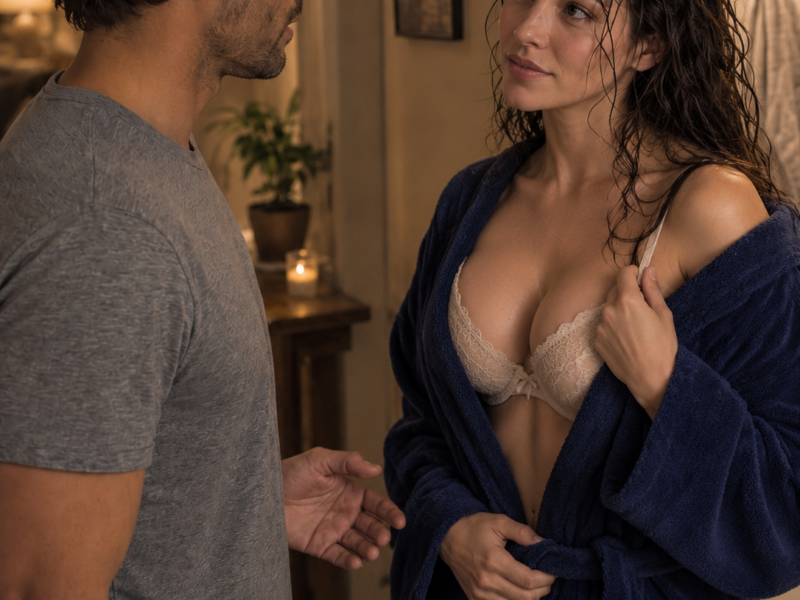
My Roommate Came Out of the Shower in My Robe… “I Think It’s Time We Stopped Pretending.”
I Married a 29-Year-Old Woman from Chile to Save Her from Losing Her Home, but We Agreed to Live as Nothing More Than Roommates for Two Years. Then One Night, She Walked Out of My Shower Wearing My Navy Robe, Looked Me in the Eyes, and Whispered, “I Think It’s Time We Stopped Pretending.” I Thought I Knew What She Meant Until She Showed Me the Immigration Email Waiting on Our Kitchen Table—and Revealed What She Had Been Hiding in Her Heart All Along.
PART 1
The first time Isabel came out of my shower wearing my robe, I dropped an entire carton of eggs on the kitchen floor.
Not one egg. Not two.
The whole carton.
I was thirty-three years old, a grown man with a mortgage, a photography business, and enough emotional baggage to fill a moving truck. I had photographed more than a hundred weddings, witnessed countless romantic proposals, and listened to dozens of people promise each other forever.
Yet somehow, the sight of one woman standing in my hallway made me forget how to function.
That woman was Isabel Navarro.
My roommate.
My wife.
And the only woman I had spent two years convincing myself I didn’t love.
She stood between the bathroom and the kitchen, swallowed by my old navy-blue robe. The sleeves hung past her wrists, and her dark hair fell in damp strands against her cheeks. A little steam followed her into the hallway, disappearing beneath the warm yellow kitchen light.
She glanced down at the broken eggs.
Then she looked at me.
“Should I apologize?” she asked. “Or should I be offended that I caused such a dramatic reaction?”
I stared at her.
“You’re wearing my robe.”
“Our robe,” she corrected, lifting her chin.
I opened my mouth, but nothing useful came out.
She smiled, although there was something different about it that evening. Usually, Isabel smiled with complete confidence, as if she knew exactly what she was doing and the rest of the world simply needed to catch up.
This time, her smile was smaller.
Nervous.
Almost frightened.
She tightened the belt around her waist and took a breath.
“I think,” she said quietly, “it’s time we stopped pretending.”
For a moment, I couldn’t hear anything.
Not the refrigerator humming behind me. Not the rain tapping against the kitchen window. Not even the water dripping from the showerhead down the hallway.
All I could hear was that sentence.
And I knew, somehow, that my life had just divided itself into two parts.
Before Isabel wore my robe.
And after.
But to understand why I didn’t immediately cross the kitchen and kiss her, you need to understand how we had ended up sharing an apartment, a last name, and a marriage certificate without ever becoming a real married couple.
Two years earlier, Isabel had been introduced to me through a mutual neighbor at a backyard barbecue.
She was twenty-nine, an architectural designer from Chile, and one of those people who could make an ordinary conversation feel like an intellectual competition.
She arrived carrying homemade empanadas, corrected my terrible Spanish within approximately four minutes, and somehow managed to convince three grown men that their opinions about kitchen renovations were completely wrong.
I liked her immediately.
Not romantically. At least, that was what I told myself.
She had been married once before to an American man named Daniel. He had died unexpectedly before her immigration process was completed, leaving her with grief, unanswered questions, and a complicated legal situation.
I didn’t know the full story when we first met.
I only knew that she had lost someone she loved, and that the country she had begun calling home suddenly seemed determined to make her prove she belonged there.
Her days were filled with appointments, documents, deadlines, and conversations with lawyers.
She hated asking for help.
She hated crying in front of people even more.
I understood more about that than she probably realized.
Eight months before meeting Isabel, my own engagement had fallen apart.
My fiancée had left me just weeks before we were supposed to get married.
Her explanation had been simple enough to remember forever.
“You are safe, Ethan. You’re kind. But you’re not enough.”
I had spent months wondering what that meant.
Was I too predictable? Too cautious? Too ordinary?
Eventually, I buried myself in photography.
Weddings were particularly convenient. I could spend entire weekends documenting other people’s happiness without having to explain why I couldn’t seem to find my own.
Then one evening, during a thunderstorm, I ran into Isabel at a laundromat.
She was arguing with a dryer.
Not with its owner.
With the machine itself.
“You took my quarters,” she told it angrily, “and now you refuse to heat. That is theft with buttons.”
I laughed before I could stop myself.
She turned toward me.
“Is something funny?”
“Only the fact that you’re losing an argument with a dryer.”
“I am not losing. I am establishing boundaries.”
I offered her my last three quarters.
She examined me suspiciously before accepting them.
“Are you always this heroic, or only around struggling appliances?”
“Only the weak ones.”
She laughed.
It was the first time I heard that laugh, and I remember thinking that the world had become a little brighter.
A few weeks later, I learned how serious her immigration situation had become.
Her lawyer explained that there was a possibility she might have to leave the country before everything could be resolved.
I found her sitting on the curb outside our building one night, holding a paper cup of gas-station coffee.
She wasn’t crying.
That was the worst part.
She was simply staring at the pavement, looking like someone who had run out of energy to be afraid.
“I cannot lose another home,” she whispered.
I sat beside her.
For a while, neither of us spoke.
Then I said something that would change both our lives.
“Then don’t.”
She turned toward me.
“What?”
“Marry me.”
She stared at me for several seconds before laughing.
Not a happy laugh.
An incredulous one.
“That is possibly the worst joke you have ever made.”
“I’m serious.”
Her expression changed.
I explained that I was willing to help, but I wanted everything handled properly. We would speak to a lawyer, understand the consequences, and make sure neither of us was being pressured into anything.
Eventually, we agreed.
It wasn’t a romantic proposal.
There was no ring, no candlelit dinner, and certainly no dramatic declaration of love.
There was only a desperate woman who needed a chance to remain in the country and a man who couldn’t stand the thought of watching her lose everything again.
We married legally and established boundaries before moving forward.
Separate bedrooms.
Shared expenses.
No expectations of romance.
No physical intimacy.
No taking advantage of gratitude, loneliness, or fear.
We would help each other, live together, and deal with the immigration process as honestly and carefully as possible.
We repeated one particular sentence so often that it almost became a household prayer.
“We are not in love.”
For the first few months, it was easy to believe.
Isabel worked from home several days a week, designing buildings and occasionally threatening her computer in Spanish.
I photographed weddings, corporate events, and restaurants.
We divided the refrigerator, negotiated bathroom schedules, and discovered that we had very different opinions about the correct temperature for sleeping.
She thought my coffee tasted like burnt wood.
I thought her habit of leaving architectural sketches on every available surface was a fire hazard.
Somehow, we made it work.
Then the little things began.
She started leaving sticky notes on my camera bag.
“Eat real food, American raccoon.”
“Stop buying coffee that tastes like sadness.”
“Your socks are migrating again.”
I began fixing things around the apartment without being asked.
The cabinet above her desk squeaked, so I repaired it.
The kitchen faucet leaked, so I replaced it.
When she mentioned that she missed a particular tea from Chile, I spent twenty minutes searching for it at the grocery store.
Neither of us acknowledged these things.
We simply continued living together.
But somewhere between the shared dinners and the late-night conversations, the invisible line separating us began to move.
One evening, I came home from a wedding shoot with a terrible migraine.
I expected an empty apartment.
Instead, I found soup on the stove, the lights dimmed, and a note beside a glass of water.
“Do not be stubborn. Eat something.”
Another night, we watched a movie on the couch.
Isabel fell asleep halfway through, and her hand slipped against mine.
I didn’t move.
Neither did she.
We stayed like that for twenty minutes, pretending we were both still watching the television.
Then there were the mornings when she walked into the kitchen wearing my socks.
The afternoons when I caught myself listening for her footsteps.
The evenings when I delayed going to bed because talking to her was more interesting than sleeping.
I had photographed hundreds of couples, but somehow I was the one who couldn’t recognize when he had fallen in love.
And now, two years after that ridiculous proposal, Isabel was standing in my kitchen wearing my robe.
“I think it’s time we stopped pretending,” she repeated.
I bent down and began collecting the broken eggs.
It was the only thing I could think to do.
“You’re going to slip,” she said.
“I’m standing still.”
“Emotionally, perhaps.”
I almost laughed, but something in her expression stopped me.
She was nervous.
Her hands were trembling slightly as she adjusted the robe.
“Ethan.”
My name sounded different coming from her that night.
I stood.
“What happened?”
She glanced toward the dining table.
Her phone was lying there, its screen illuminated by an open email.
I recognized the sender immediately.
Immigration.
For two years, every notification from that office had brought a fresh wave of anxiety into our apartment.
We had learned to read official letters together, discuss deadlines, gather documents, and reassure each other that everything would be fine.
But this email was different.
It contained a date.
An interview scheduled for the following Friday.
They wanted supporting evidence of our marital relationship.
“That soon?” I asked.
“Yes.”
“We’ll handle it.”
She shook her head.
“That’s what we always say, Ethan. We handle paperwork. We handle bills. We handle dinners with your sister and smiling in photographs. We handle pretending to be married in public while sleeping in separate bedrooms.”
I looked at her.
She stepped closer.
Her robe brushed my wrist.
“But I don’t know how to sit in front of a stranger next Friday and lie about being in love with my husband.”
My heartbeat became almost painful.
She looked directly into my eyes.
“When I’m not lying anymore.”
I wanted to answer immediately.
I wanted to tell her that I had loved her for months, perhaps longer. That I had memorized the sound of her laughter and the way she pushed her hair behind her ear when concentrating.
But fear held me back.
“What if you’re saying this because of the interview?” I asked.
Her expression changed.
“What?”
“What if you’re scared? What if you think this will make everything easier? I don’t want you feeling obligated to turn this arrangement into something romantic just because we have an appointment next Friday.”
She stared at me.
Then she stepped back.
“I don’t want you to feel trapped.”
“Trapped?”
“You married me because I was desperate.”
“I married you because you needed help.”
“That’s a prettier way of saying desperate.”
“It’s the true way.”
She looked down.
“And now I’m standing here telling you I have feelings for you one week before we have to convince immigration that our marriage is real.”
I reached for her hand.
“Isabel, listen to me.”
She looked up.
“If this is fear, we don’t act on it. We go to the interview, tell the truth, and deal with whatever happens. But I won’t let you turn gratitude into a marriage bed because someone in a government office put a date on a calendar.”
Her eyes softened.
“I know,” she whispered.
Then she said the words I had secretly wanted to hear for almost two years.
“That’s why I fell in love with you.”
I forgot how to breathe.
She looked embarrassed, as though she had revealed something she had been carrying for far too long.
I took her hand.
“I fell in love with you, too.”
She blinked.
“No.”
I laughed nervously.
“No?”
“You cannot just say that like you’re reporting the weather.”
“Would you prefer a forecast?”
“Ethan.”
“Cloudy, with a chance of rain. By the way, I love you.”
She tried to smile.
I stepped closer.
“I love you when you argue with your drafting software in three languages. I love you when you steal my socks and pretend they migrated. I love you when you fall asleep wearing your glasses and deny it even though they leave marks on your nose.”
Her eyes filled with tears.
“I love you because this apartment became home when you moved into it. Not because of the paperwork or the story we tell other people. Because you’re here.”
She leaned into my hand.
“Better,” she whispered.
I laughed.
“Do I get a review score?”
“Four and a half stars.”
“What cost me the half?”
“Your coffee.”
I shook my head.
Then I cupped her face.
“Can I kiss you?”
She didn’t answer with words.
She rose onto her toes and met me halfway.
The first kiss was careful, almost hesitant.
Then her hands found my chest, and I wrapped my arms around her waist.
For two years, I had imagined what it would feel like to kiss Isabel.
The reality was better than anything I had imagined.
When we finally separated, she rested her forehead against mine.
“We need rules,” she whispered.
I laughed.
“Now?”
“Yes. Especially now.”
She took a breath.
“I don’t want our first real night together to happen because we’re afraid. Or because of the interview.”
I brushed my thumb across her cheek.
“Then what do you want?”
“A date.”
That single word hit me harder than any declaration of love.
We had grocery-shopped together, attended family dinners, watched movies, and shared countless ordinary moments.
But we had never actually dated.
Not once.
“Tomorrow,” I said.
Her smile returned.
“Tomorrow.”
And for the first time in two years, I wasn’t thinking about how to protect our arrangement.
I was thinking about how to win my wife’s heart.
PART 2
The next afternoon, I discovered that planning a date with your own wife could be considerably more stressful than photographing a hundred weddings.
I had four restaurant tabs open, a florist on hold, and absolutely no idea what I was doing.
Isabel found me surrounded by my laptop and a collection of handwritten notes.
“You look like you’re planning a hostage exchange,” she said.
“I’m planning romance.”
“Then why do you look terrified?”
At six, I knocked on her bedroom door.
She opened it wearing jeans, a cream sweater, and red lipstick.
I forgot every sentence I had prepared.
Our first date wasn’t a fancy restaurant. It was tacos from a food truck near the river, followed by a walk beneath winter lights.
She stole my napkins, laughed at my terrible jokes, and eventually took a photograph of me looking at her.
“Look chosen,” she whispered.
I realized then that I had spent two years making her feel safe.
Now I wanted her to feel loved.
That evening, beneath a tree covered in tiny white lights, I asked her to stay after the immigration interview.
“Not because you have to,” I told her. “Because you want a life with me.”
She kissed me.
“Yes, Ethan. I’ll stay.”
Then she touched my cheek.
“But you must also stay.”
And I promised her I would.
PART 3
The week leading up to our immigration interview became the strangest week of my life.
I had always imagined that falling in love would make things simpler.
Instead, it seemed to make everything more complicated.
Before Isabel confessed her feelings, I had been able to hide behind the rules of our arrangement. I could tell myself that buying her favorite tea was simply considerate, that remembering her mother’s stories was nothing more than being a good roommate, and that looking forward to coming home every evening was perfectly normal.
Now I couldn’t hide behind any of those excuses.
I loved my wife.
And for the first time, I had to figure out what being married actually meant.
The morning after our first date, I woke up smiling.
It was embarrassing.
I stood in the bathroom brushing my teeth, caught sight of myself in the mirror, and realized I looked like a man who had just won the lottery.
Then I heard Isabel moving around in the kitchen.
“You’re smiling at yourself,” she called.
I leaned into the doorway.
“Are you spying on me?”
“Your face is visible in the mirror.”
“Perhaps I’m admiring my excellent dental hygiene.”
“Perhaps you need a hobby.”
She was standing at the counter wearing my gray socks.
I pointed at them.
“Those are mine.”
She looked down.
“Evidence?”
“They have my initials.”
“Perhaps we have the same initials.”
“We don’t.”
“Then perhaps they are emotionally attached to me.”
I laughed.
She smiled.
And suddenly, the ordinary morning felt like something I wanted to remember forever.
But there was still the interview.
On Tuesday, we began gathering the documents our lawyer had recommended.
There were photographs from birthdays, holiday dinners, family gatherings, and the courthouse wedding.
There were shared bills, bank statements, insurance documents, apartment records, and years of small purchases that demonstrated how two people had slowly built a life together.
I spread everything across the dining table.
Isabel sat opposite me, sorting photographs into neat piles.
“This one is terrible,” she said.
I looked over.
It was a picture of us standing outside a restaurant with my sister.
“What’s wrong with it?”
“My hair looks enormous.”
“Your hair looks beautiful.”
“You’re biased.”
“Extremely.”
She examined another photograph.
“This one is better.”
It showed us standing in the kitchen on her birthday. I was holding a cake, and she was laughing at something just outside the frame.
I remembered that evening clearly.
I had tried to bake a chocolate cake.
It had collapsed in the middle.
Isabel had declared it an architectural disaster and spent twenty minutes explaining how gravity had defeated my structural design.
We had eaten it anyway.
She placed the photograph in the folder.
“Do you remember what you said that night?”
“Probably something about the cake being delicious.”
“You said that if we ever bought a bigger apartment, you wanted a kitchen with two ovens.”
I smiled.
“I stand by that.”
“You said one would be for cooking and the other for your photographic equipment when I wasn’t looking.”
“That sounds like me.”
She laughed.
Then her expression softened.
“Do you remember when I first realized I loved you?”
I stopped sorting papers.
“No.”
“It was during the winter.”
“Which winter?”
“The first one after we got married.”
She leaned back in her chair.
“You came home late from a wedding. You had a terrible headache, and you looked exhausted. I had made soup, but you told me you weren’t hungry.”
“I remember.”
“You sat on the couch for a while, then fell asleep. I covered you with a blanket.”
I nodded.
“You were very stubborn.”
“I was sick.”
“You were impossible.”
She smiled faintly.
“Then, while you were sleeping, you reached for my hand.”
I looked at her.
“I did?”
“Yes. You held it for a few seconds, then relaxed.”
She looked down at the photograph in her hands.
“I remember thinking that I wanted to be the person you reached for when you were tired.”
My throat tightened.
I hadn’t known.
I had no idea that something so small had mattered to her.
“Why didn’t you tell me?”
“Because I was afraid.”
“Of what?”
“Of wanting something I had no right to ask for.”
I stood and walked around the table.
“Isabel, you have every right to ask me for anything.”
She looked up.
“Even if I ask for too much?”
“Especially then.”
She reached for my hand.
For several seconds, we stood there surrounded by photographs and documents that were supposed to prove we were a real married couple.
It occurred to me that none of those things could fully explain what had happened between us.
A photograph could show that we had celebrated birthdays together.
A bank statement could show that we shared expenses.
A lease could show that we lived under the same roof.
But none of them could show the way Isabel looked at me when she was afraid, or how naturally she leaned against me when she was tired.
None could capture the quiet comfort of hearing her laugh from another room.
And perhaps that was why the upcoming interview frightened me.
Someone who had never met us would have to decide whether our marriage was genuine by examining pieces of our life.
I wanted them to understand the truth.
But I also wanted to protect the parts of our relationship that belonged only to us.
That evening, our lawyer, Ms. Hahn, came over to review the documents.
She was a practical woman with sharp eyes and a calm voice.
She had helped us through the original marriage process, and she knew exactly how our arrangement had begun.
When she entered the apartment, her gaze moved from my slightly disheveled appearance to Isabel standing beside the dining table.
Then she noticed the way Isabel’s hand rested against my arm.
Ms. Hahn blinked.
“Well,” she said, placing her folder down, “that answers several questions.”
Isabel immediately turned red.
I cleared my throat.
“We were reviewing documents.”
“Naturally.”
For the next hour, she walked us through possible interview questions.
She asked about our first meeting, our wedding, our apartment, our daily routines, and the way we divided household responsibilities.
Then she reached a question that made both of us uncomfortable.
“Where does each of you sleep?”
Isabel looked at me.
I looked at the papers.
“We have separate bedrooms,” she answered.
“Had,” I said at the same time.
Her head turned sharply.
My face became hot.
Ms. Hahn raised an eyebrow.
“We are discussing the arrangements,” I added.
“Bed size,” Isabel said quickly.
“Very important,” our lawyer replied without changing her expression.
I wanted the floor to swallow me.
But then Ms. Hahn became serious.
“Listen carefully. Your marriage began as an arrangement. You both know that, and I know that. The important thing is that you answer truthfully about your current relationship. Do not invent romantic details to make your story sound better.”
Isabel nodded.
Ms. Hahn looked at both of us.
“Do not perform love. People can smell performance. Answer honestly, and explain how your relationship developed.”
After she left, Isabel began organizing the folders with unnecessary intensity.
I watched her for a moment.
“Talk to me.”
“I’m organizing.”
“You’re hiding in office supplies.”
She stopped.
Then she lowered the folder.
“I’m afraid.”
I walked around the table.
“Of the interview?”
“Yes. And no.”
She rubbed her forehead.
“I’m afraid they’ll look at the beginning of our marriage and decide that nothing afterward matters. That they’ll see the arrangement and refuse to believe the life we built.”
I took both her hands.
“Then we’ll tell them about the life we built.”
“What if they ask when we fell in love?”
“I’ll tell them I don’t know the exact day.”
She looked at me.
“I’ll tell them it happened somewhere between the soup you made when I had a migraine and the socks you keep stealing.”
Her lips twitched.
“And I’ll tell them that you’re the first person I look for when I come home. That I buy your favorite tea before you ask. That I stopped imagining my future as a quiet place where I lived alone.”
Her eyes filled.
She squeezed my hands.
“And if they ask me?” she whispered.
“Tell them whatever is true.”
She looked down.
“I loved you first as safety,” she said. “Then as habit. Then as something I couldn’t control.”
She paused.
“And now as a choice.”
I pulled her into my arms.
That night, something happened that neither of us had planned.
Isabel appeared in the doorway of my bedroom wearing sleep shorts and a loose T-shirt.
She looked unusually serious.
“I have a proposal.”
I sat up.
“Architectural or marital?”
“Both.”
She crossed her arms.
“We buy the new bed after the interview.”
“Okay.”
“But tonight, I would like to sleep here.”
My heart started beating faster.
She hurried to explain.
“Only sleep. I want to be careful. I don’t want us doing anything because we’re frightened about next Friday.”
I pushed the covers back.
She smiled.
Then she crossed the room and climbed into bed beside me.
For a moment, we were awkward.
There were elbows, pillows, nervous laughter, and a disagreement about how much space two adults required.
“You are very large,” she complained.
“This is a queen bed.”
“It is now a democracy. Move.”
I moved.
She settled against me, turning onto her side and pulling my arm around her waist.
I barely breathed.
“You’re allowed to breathe,” she murmured.
“Thank you for the permission.”
“You’re welcome.”
After a while, she covered my hand with hers.
“Thank you for not making me feel foolish.”
“For wanting this?”
“For wanting slowly and wanting badly at the same time.”
I kissed her shoulder.
“I’m right there with you.”
She turned in my arms.
“After the interview, take me on a second date.”
“Only if you rate the first one honestly.”
“Fine. Six stars.”
“Out of five?”
“I’m generous with men who let me steal blankets.”
I laughed.
Then she kissed me.
Softly.
Sleepily.
And for the first time since we had married, I fell asleep beside my wife without wondering whether I was crossing a line.
The interview came on Friday.
The sky was gray, and rain covered the city in a thin, persistent mist.
I wore a navy suit.
Isabel wore a rust-colored dress that made her skin glow and her dark hair look almost black.
When she stepped into the hallway, I forgot for a moment that we were supposed to be nervous.
“You look beautiful,” I told her.
She glanced down.
“Thank you. You look expensive.”
“I’ll take that as a compliment.”
“It is.”
We drove to the immigration office in silence for the first few minutes.
Then she reached across the center console and took my hand.
“If I throw up, you still love me?”
“Especially then.”
“That is disgusting.”
“That is marriage.”
She laughed.
It was small, but real.
In the waiting room, couples sat in plastic chairs with folders resting on their knees.
Some whispered to each other.
Others stared at their phones.
Isabel’s leg bounced nervously.
I placed my hand over her knee.
She looked at me.
I smiled.
When our names were called, we stood together.
The officer was a middle-aged man with tired eyes and a voice that revealed almost nothing.
He asked us to sit down.
Then the questions began.
Our addresses.
Our wedding date.
Our daily routines.
Who paid which bills.
Which side of the bed each person slept on.
“What time does your wife usually wake up?” he asked me.
“Earlier than I do.”
“Approximately?”
“Six-thirty.”
Isabel turned toward me.
“Six-fifteen.”
I looked at her.
“You’re correcting me during an immigration interview?”
“Accuracy matters.”
The officer continued writing.
He asked about our first meeting, our families, our apartment, and the reasons we had decided to marry.
Then his questions became more direct.
“Why did you marry so quickly?”
I glanced at Isabel.
She was sitting very still.
I took a breath.
“Because she needed help,” I said.
The officer looked up.
Beside me, Isabel’s fingers tightened.
“It began as a favor,” I continued. “A serious one. We understood what we were doing. But living with someone changes things. Caring for someone every day changes you.”
The officer didn’t interrupt.
“I can’t tell you which day it happened. I can’t give you a date that fits neatly on a form. But I know I love my wife.”
The room became very quiet.
The officer turned toward Isabel.
“Mrs. Navarro-Reed, what is your perspective?”
She lifted her chin.
“I did not fall in love with him because he saved me,” she said.
Her voice trembled slightly.
“I fell in love with him because he never asked me to pay for being saved.”
She paused.
“Because he knows I hate olives. Because he makes terrible coffee but buys good beans for me. Because when I came out wearing his robe, he looked at me like he had been waiting two years to come home.”
I felt my throat tighten.
The officer looked down at his notes.
For a long moment, the only sound was his pen moving across the paper.
Then he closed the folder.
“You’ll receive a decision by mail.”
That was all.
Outside, the rain had stopped.
We stood on the sidewalk without speaking.
Then Isabel turned toward me.
“Was I too much?”
I stared at her.
Then I took her face in my hands and kissed her.
Right there in front of the federal building.
There were taxis passing, strangers walking along the sidewalk, and a security guard who politely looked away.
When I pulled back, her eyes were wet.
“You were exactly enough,” I whispered.
And we walked home holding hands.
For the first time, neither of us wanted to pretend.
PART 4
The three days following our interview were possibly the longest seventy-two hours of my life.
Isabel became convinced that she could control the outcome by reorganizing the apartment.
She rearranged the pantry.
She scrubbed the bathroom grout with a toothbrush.
She alphabetized my old photography contracts.
Then she reorganized them again because, apparently, my filing system was an insult to civilization.
I watched her move around the apartment with increasing concern.
“You put Anderson before Alvarez,” I said, holding up two folders.
“Coincidence.”
“You made labels.”
“Labels are not a confession.”
“You alphabetized the spices.”
“That was necessary.”
“Paprika cannot live beside oregano like an animal.”
She turned toward me with an expression of complete seriousness.
I couldn’t help laughing.
Then I caught her around the waist before she could escape.
She made a small protest, but her hands settled over mine almost immediately.
“You’re spiraling,” I whispered against her hair.
“I’m improving our filing system.”
“You’re trying to intimidate the universe.”
She sighed.
Then she leaned back against my chest.
“I hate waiting.”
“I know.”
“What if they refuse?”
I turned her around.
“Then we’ll figure out what happens next.”
“What if I have to leave?”
The question was so quiet that it hurt.
I brushed her hair away from her face.
“Then we’ll deal with that together, too.”
She looked at me.
“I don’t want another goodbye, Ethan.”
I pulled her into my arms.
“Neither do I.”
I knew that words couldn’t remove her fear.
I also knew that I couldn’t promise her an outcome I didn’t control.
So I decided to give her something else to think about.
Our second date.
I drove her to the botanical garden on the edge of the city.
It was a place she had mentioned months earlier, during one of our late-night conversations.
Her mother had loved gardening when Isabel was growing up in Valparaiso.
She used to grow basil in old coffee cans and shout at snails as though they were personally responsible for every problem in the world.
I remembered that story because Isabel had laughed so hard while telling it that she had nearly dropped her bowl of lentils.
When we entered the greenhouse, she stopped walking.
The air was warm and humid.
Vines climbed the glass walls, orchids hung in brilliant colors, and the scent of damp earth surrounded us.
She turned toward me.
“You remembered.”
“Of course.”
“I told you that once.”
“You were making lentils.”
She looked at me with an expression I couldn’t quite describe.
“I listen,” I said.
Her eyes softened.
“I know.”
We wandered through the greenhouse for nearly an hour.
She pointed out plants she recognized from Chile.
I pretended to understand the difference between several varieties of orchids.
At one point, she explained how certain architectural spaces could influence the way people experienced nature.
I listened because I loved hearing her talk about the things she cared about.
Near a tiled fountain, she leaned against me.
For the first time in days, we didn’t discuss immigration.
We talked about our apartment.
About repainting the bedroom.
About whether we could keep a basil plant alive.
About visiting Chile someday, not as a forced return or a painful goodbye, but as a trip we would take together.
Then Isabel became quiet.
“Ethan, I want to change my name.”
I looked at her.
“You don’t have to.”
“I know.”
“I mean it. Navarro is your name. You don’t owe anyone a change.”
She smiled.
“You are very noble. It is sometimes irritating.”
“I’ve heard.”
She took both my hands.
“I want to be Isabel Navarro-Reed.”
I didn’t answer immediately.
She continued.
“Not because paperwork requires it. Not because someone expects it. I want both names because they are both part of my life.”
She glanced toward the glass ceiling.
“My first marriage was part of my story. My family is part of my story. And you are part of my story now.”
She squeezed my fingers.
“This marriage began as a bridge. Somehow, it became a house.”
My chest tightened.
“I want both names on the door,” she whispered.
I kissed her beneath the glass ceiling, surrounded by green leaves and winter light.
For once, she didn’t apologize for wanting something good.
Neither did I.
The following afternoon, I was working on photographs in my office when I heard Isabel call my name.
“Ethan?”
Something about her voice made me stand immediately.
I found her in the kitchen.
She was holding an envelope.
A plain envelope.
Her hands were shaking.
I recognized the return address before she said anything.
The immigration decision had arrived.
She looked at me.
I walked toward her slowly.
“Open it,” I whispered.
She shook her head.
“I can’t.”
“Do you want me to?”
She nodded.
I took the envelope and carefully opened it.
The letter contained several official paragraphs.
I read the first lines.
Then I read them again.
Approved.
Her permanent resident status had been granted.
For a moment, I couldn’t speak.
Isabel was staring at my face, searching for an answer.
“What does it say?”
I looked at her.
“It’s approved.”
She blinked.
“What?”
“Isabel, it’s approved.”
She took the letter from my hands.
She read it once.
Then again.
Then she sat down hard in the kitchen chair and covered her mouth.
I crouched in front of her.
“Hey.”
She looked at me through her fingers.
“I can stay,” she whispered.
I nodded.
“Yes.”
“No more waiting for someone to decide whether my life is allowed to continue here?”
“No more.”
She made a sound that was half laughter and half sob.
Then she folded into my arms.
We ended up sitting on the kitchen floor, holding each other.
She cried against my shoulder.
I kissed her hair and held her tightly.
For two years, she had lived with the possibility that everything she had built could disappear.
She had been afraid to make plans too far into the future.
Afraid to become too attached to a home.
Afraid to imagine a life that might be taken away.
And now, finally, she could breathe.
After several minutes, she pulled back and wiped her cheeks.
“We need champagne.”
I looked toward the refrigerator.
“We have half a bottle of flat ginger ale.”
She stared at me.
“Romantic.”
“I can do better.”
“You have ten minutes.”
I managed to find champagne, a small bouquet of grocery-store flowers, and a chocolate cake.
Unfortunately, the cake was decorated with blue icing that read:
CONGRATULATIONS!
It looked like something intended for a children’s soccer team.
Isabel stared at it.
“This is ridiculous.”
“It was either this or a cake that said Happy Retirement, Gary.”
She picked up a fork.
“Congratulations it is.”
We ate cake directly from the plastic container at the dining table.
The same table where we had once gathered documents to prove that our marriage existed.
Only now, no one needed convincing.
Later that evening, Isabel disappeared into the bedroom.
When she returned, she was wearing the navy robe.
My robe.
Our robe.
She stood in the doorway with her arms crossed and a familiar little smile.
“I think,” she said, “we are finished pretending.”
I set down the champagne glasses.
“Yes,” I replied. “We are.”
I walked toward her slowly.
Even now, after everything, I wanted to give her time to change her mind.
She met me halfway.
Her hands rested against my chest.
Mine settled at her waist.
“This is not gratitude,” she whispered.
“I know.”
“This is not fear.”
“I know.”
“This is not paperwork.”
I smiled.
“Definitely not paperwork.”
She laughed.
Then she rose onto her toes and kissed me.
It felt different from our first kiss.
There was no nervousness about whether we were crossing a boundary.
No fear that we were making a decision because of an upcoming appointment.
No invisible line separating us.
There was only Isabel.
My wife.
The woman I had loved quietly for two years.
And the woman who was finally choosing to love me openly.
That night, we didn’t need to discuss whether she would stay in the apartment.
We began discussing what kind of life we wanted to build.
She talked about redesigning the bedroom.
I suggested a bigger closet.
She reminded me that I already occupied three quarters of the storage space.
I argued that camera equipment was essential.
She informed me that socks were also essential, particularly when I apparently had no intention of buying enough for myself.
Eventually, we fell asleep together.
And when I woke in the middle of the night, I found her hand resting on my chest.
I held it.
She didn’t wake up.
I lay there for a long time, thinking about how strange life could be.
Two years earlier, I had married a woman because I couldn’t bear to watch her lose her home.
I had never expected that she would become the person who made my home worth coming back to.
I had never expected that the woman I promised to protect would become the woman who taught me how to stop being afraid of love.
But there we were.
And for the first time, forever didn’t feel like an impossible promise.
It felt like something we could build one ordinary day at a time.
PART 5
By the following spring, our apartment barely resembled the place we had shared during the first year of our marriage.
Isabel moved her drafting table closer to the window because she wanted more natural light.
My photography shelves took over most of the hallway.
The kitchen became a battlefield of coffee equipment, architectural drawings, and an increasingly impressive collection of plants.
There was a basil plant sitting in an old coffee can on the windowsill.
It survived the winter.
Isabel claimed this was because she had threatened it in Spanish every morning.
I insisted it was because of my inspirational leadership.
Neither explanation was scientifically convincing.
We also bought a new bed.
A king-size bed.
The process took longer than expected because Isabel had very specific opinions about mattresses.
She tested every one as though she were evaluating the structural integrity of a bridge.
I simply wanted something comfortable.
She wanted something that would support our backs for the next twenty years.
After forty minutes of disagreement, she pointed toward one mattress.
“This one.”
“Why?”
“Because I said so.”
“Excellent scientific reasoning.”
“Thank you.”
We bought it.
Then we spent another hour arguing about sheets.
I had never realized how many decisions could be involved in purchasing a bed.
But that was married life, apparently.
And I loved it.
We hosted my sister for dinner a few weeks later.
She had been curious about our relationship ever since the immigration interview, particularly after Ms. Hahn had accidentally discovered that Isabel and I were no longer maintaining our separate-bedroom arrangement.
My sister arrived carrying a bottle of wine and immediately began asking questions.
“So,” she said, sitting at the kitchen counter, “are you two finally going to tell me what actually happened?”
Isabel looked at me.
I looked at Isabel.
Then she smiled.
“Do you remember the story we told you about our first kiss?”
My sister nodded enthusiastically.
“The olive story?”
I groaned.
That had been one of our worst inventions.
We had claimed that I saved Isabel from choking on an olive at a restaurant, which somehow led to a dramatic kiss in the parking lot.
My sister had believed every word.
She had even cried.
“I remember,” Isabel said.
“Well, that wasn’t what happened.”
My sister leaned forward.
“What?”
Isabel began telling her the real story.
The shower.
The navy robe.
The broken eggs.
The confession.
My sister listened without interrupting.
When Isabel finished, she looked at me.
“That’s actually much better.”
“I know.”
My sister’s eyes filled with tears.
Then she started laughing.
“Of course you dropped the eggs.”
“Can we move on?”
“No. I need to know whether all twelve were destroyed.”
“Eleven,” I corrected.
Isabel smiled.
“One survived.”
We laughed until dinner was ready.
That evening, after my sister left, Isabel stood beside the kitchen sink washing glasses.
I came up behind her and wrapped my arms around her waist.
She leaned back against me.
“Your sister likes me.”
“She’s obsessed with you.”
“Understandable.”
I kissed her cheek.
“Very modest.”
“I am simply reporting the facts.”
I rested my chin on her shoulder.
For a moment, neither of us spoke.
Then she turned her head.
“Do you ever think about how strange this is?”
“What?”
“That we got married before we even knew whether we would like living together.”
I laughed.
“We knew we liked each other.”
“Not enough to share a bathroom.”
“That was a major commitment.”
She smiled.
Then her expression became thoughtful.
“Sometimes I think about Daniel.”
I loosened my arms slightly.
I knew she still carried memories of her first marriage.
I never wanted her to feel that she had to hide them from me.
“What are you thinking?”
“That I wish he could have seen me happy.”
I kissed her temple.
“He would have wanted that.”
She nodded.
“I think so, too.”
There was no jealousy in me when she spoke about her past.
Daniel had been part of her life long before I arrived.
He had loved her, and losing him had changed everything.
I couldn’t erase that.
I didn’t need to.
I understood that loving Isabel meant accepting the entire story of her life, not just the chapters that included me.
She turned around in my arms.
“Thank you.”
“For what?”
“For never making me feel that loving you means forgetting him.”
I brushed a strand of hair away from her cheek.
“You don’t have to forget anyone to choose a future with me.”
She kissed me.
And I realized that perhaps the greatest thing about our relationship was that neither of us had to become someone different to make it work.
We had both arrived carrying our own disappointments.
I had been left at the altar by someone who thought I wasn’t enough.
She had lost a husband and nearly lost the country she had begun calling home.
We hadn’t rescued each other from our pasts.
We had simply made room for each other in the future.
As the months passed, our routines became increasingly ordinary.
We walked to the taco truck near the river on Sundays.
We argued about the thermostat.
She stole my socks.
I continued making terrible coffee, although she admitted that my newer beans were an improvement.
Sometimes she left sticky notes inside my camera bag.
“Eat real food, American raccoon.”
“Call your mother.”
“Do not forget the groceries.”
I kept every single one.
A few months after our anniversary, I photographed another wedding at City Hall.
It was a small ceremony.
The couple had invited only close family and a few friends.
The bride wore a simple white dress, and the groom looked so nervous that he nearly dropped the ring.
I spent the afternoon capturing their photographs.
I watched them exchange vows.
I photographed their first kiss.
I documented the way their families embraced afterward.
And somewhere between the ceremony and the final photographs, I found myself thinking about my own wedding.
Not the romantic version.
The real one.
The courthouse.
The green dress Isabel had worn.
My trembling hands.
The six inches of space we had deliberately maintained between us.
At the time, I had believed I was doing something generous for someone who needed help.
I had no idea that I was standing beside the woman who would eventually become my greatest happiness.
When I finished the wedding, I walked outside.
Isabel was waiting for me.
She wore a green dress.
The same color she had worn on the day we married for practical reasons and impossible mercy.
She held out her hand.
“Come on,” she said.
I smiled.
“Where are we going?”
“Home, husband.”
I took her hand and lifted it to my lips.
Behind us, another couple stood on the courthouse steps, nervous and glowing at the beginning of their own story.
I recognized the expression on the groom’s face.
The uncertainty.
The excitement.
The feeling that something enormous was happening, even if he didn’t fully understand it yet.
I looked at Isabel.
She caught me staring.
“What?”
“Nothing.”
“You’re doing that thing again.”
“What thing?”
“Looking at me like I am the only person in the world.”
I smiled.
“Maybe you are.”
She rolled her eyes.
But her fingers tightened around mine.
We walked home beneath the soft gold of the evening.
Halfway down the street, she stopped beside a bakery window.
“Ethan.”
“Yes?”
“Do you remember the first night I wore your robe?”
I laughed.
“How could I forget? I sacrificed eleven eggs.”
“That was a very expensive confession.”
“Emotionally and financially.”
She smiled.
“Would you have done anything differently?”
I considered the question.
I thought about the two years we had spent pretending not to want more.
The separate bedrooms.
The careful boundaries.
The grocery lists.
The stolen socks.
The nights when we sat on opposite ends of the couch because we were afraid of what might happen if our hands touched.
I thought about the immigration interview.
The waiting.
The envelope.
The moment she finally understood that she could stay.
Then I looked at the woman standing beside me.
“No,” I said.
“Nothing?”
“Maybe I would have bought more eggs.”
She laughed.
Then she leaned forward and kissed me.
We continued walking.
That night, when we got home, she disappeared into the bedroom.
A few minutes later, she returned wearing the navy robe.
Our robe.
She stood in the doorway, holding the belt loosely in her hands.
I looked up from the photographs on my laptop.
“What?”
She smiled.
“Nothing.”
“You’re smiling suspiciously.”
“Am I?”
“Very.”
She walked toward me.
Then she leaned down, rested her hands on my shoulders, and kissed my forehead.
“I love you, Ethan.”
I took her hand.
“I love you, too.”
And I meant it in all the ways I had once been too frightened to say.
I loved her when she was happy.
I loved her when she was anxious.
I loved her when she argued with computer software, when she stole my blankets, and when she insisted that the basil plant needed more attention than I did.
I loved her past.
I loved her present.
And I wanted every ordinary, complicated day we could build together.
Sometimes people imagine that love arrives like a lightning strike.
They expect a dramatic moment, a perfect kiss, or a declaration that changes everything.
But our love hadn’t happened that way.
It had grown quietly.
In a shared kitchen.
In separate bedrooms.
In late-night conversations.
In homemade soup and terrible coffee.
In the little notes she left inside my camera bag.
In the way I learned which tea she liked.
In the way she learned when I needed silence and when I needed someone to remind me that I wasn’t alone.
We had married before we knew how to love each other.
Then, slowly, we learned.
And perhaps that was what made our marriage stronger.
We hadn’t fallen in love because we were required to.
We had fallen in love because, day after day, we kept choosing each other.
A year after that first night in the robe, I found an old photograph tucked inside one of my camera cases.
It was the picture Isabel had taken of me during our first date.
I was standing beneath the winter lights beside the river.
My hands were in my pockets.
My expression was completely unguarded.
I was looking at her.
Not at the camera.
Not at the city.
At her.
On the back, she had written four words.
“Look chosen. Stay chosen.”
I carried the photograph into the kitchen.
Isabel was sitting at the table, sketching something.
I placed it in front of her.
She looked down.
Then she smiled.
“You kept it.”
“Of course.”
She picked it up and examined it.
“You looked very handsome.”
“I was trying.”
“You were failing.”
“Thank you.”
She laughed.
Then she reached across the table and took my hand.
I looked at her fingers intertwined with mine.
Two years earlier, I had offered her a marriage because she needed somewhere to stay.
I thought I was giving her a temporary home.
Instead, she had given me something I hadn’t known I was missing.
A reason to look forward to coming home.
A person who knew all my imperfections and loved me anyway.
A woman who could make an ordinary Tuesday feel like the best day of my life.
I leaned across the table and kissed her.
She smiled against my mouth.
“What’s that for?”
“Nothing.”
“You’re being sentimental.”
“Apparently, I married a woman who makes me sentimental.”
She laughed.
Then she rested her forehead against mine.
And I understood something I wished I had known years earlier.
A marriage doesn’t become real because two people sign a document.
It doesn’t become real because they share an address, a bank account, or a collection of photographs.
It becomes real through the choices they make when nobody is watching.
Through patience.
Through honesty.
Through forgiveness.
Through the willingness to stay when life becomes difficult.
Some vows become true the moment they are spoken.
Others become true slowly.
In shared kitchens.
In separate rooms.
In stolen socks.
In grocery-store flowers.
In a badly decorated chocolate cake.
And sometimes, in one old navy robe worn by the right woman at exactly the right time.
I had married Isabel before I knew how to love her.
And I had fallen in love with her long before I found the courage to say it.
But now, when she called me her husband, I no longer wondered whether I deserved the title.
I simply reached for her hand.
Because she was home.
And I was finally home, too.