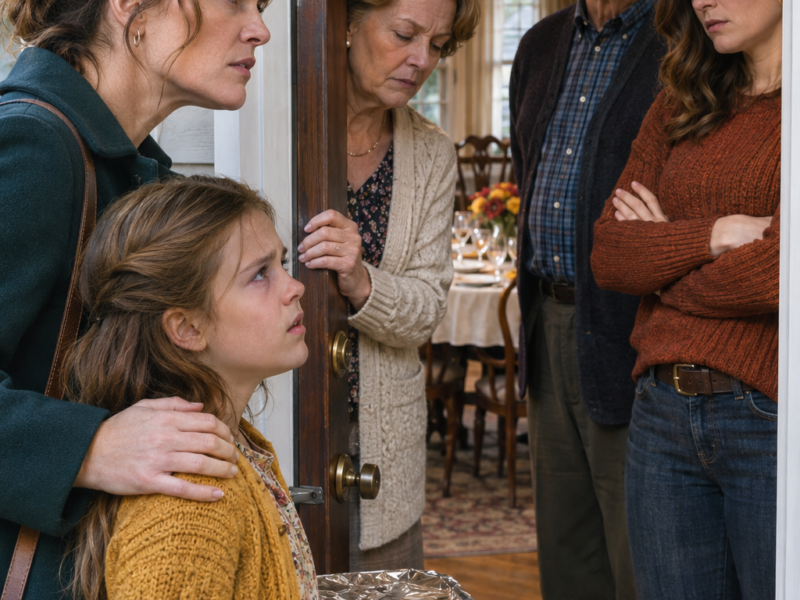
My Parents Uninvited My Daughter From Family Gathering Because My Sister Said, “She’s Not Family!”
My Parents Uninvited My Daughter From Family Gathering Because My Sister Said, “She’s Not Family!”
At 7:06 on Friday morning, my phone showed ninety-nine missed calls. My sister Jocelyn had called thirty-eight times, my mother sixteen, and my father twenty-three. Seven other relatives accounted for the rest. Underneath all those calls was a single text from my father.
You can’t do this to your family.
Down the hall, my twelve-year-old daughter was opening and closing drawers, looking for clean socks. On the kitchen table lay an envelope with the crossword she’d spent two weeks making for him. She’d even put aside a spare pencil in case he made a mistake.
The night before, he’d told me she could bring the puzzle another time.
I was still staring at his message when Rosie called out to ask whether socks counted as matching if they were both mostly blue.
“Close enough,” I said.
She accepted that more easily than anything I’d told her about Saturday.
Two nights earlier, she’d been sitting at that same table with a pencil behind her ear, trying to fit stubborn into a crossword grid that was one square too short. I suggested changing the clue. She looked at me as though I’d suggested pouring orange juice on her cereal.
“It’s about Grandpa,” she said. “I can’t change his personality to fit the squares.”
We settled on determined. She circled it twice and predicted he’d never get it because he was always telling people how flexible he was.
My father, Martin, was seventy-five. Once, during a rainy visit, he’d spent the better part of an afternoon showing Rosie how a crossword clue could send you looking in the wrong direction on purpose. She’d been fascinated by the idea that the words could be perfectly fair and still fool you. After that she called him her puzzle partner. For this crossword she’d worked in his favorite pie, the name of his childhood dog, and a saying he repeated so often that she could imitate the exact way he cleared his throat before saying it. I could picture the two of them bending over the page after lunch while everybody else reached for dessert.
Rosie had come to live with me as a foster child when she was five. I adopted her when she was seven. By then she’d stopped asking whether she could leave a half-finished drawing on the kitchen table overnight. She knew it would still be there in the morning. I was forty-seven that September, and the two of us lived in a little rented house in a Wisconsin town where I worked at a medical clinic. Her adoption was a fact we could talk about openly. The circumstances that brought her to me belonged to her.
My younger sister had sent out a color-coded seating chart for Saturday, along with serving instructions and a reminder about photographs. Rosie wanted to know if Aunt Jocelyn had assigned seats to the mosquitoes. I tried to keep a straight face and made the mistake of looking directly at her.
Jocelyn was good at organizing things. If you needed three extra folding chairs or somebody to remember which cousin couldn’t eat walnuts, you were glad she was there. My mother, Esther, admired her decisiveness. I’d learned to answer most of her questions with whatever works best. A different dinner hour or a chair by the window rarely seemed worth a fight. By the time I understood what else I’d been giving away with that answer, my sister had grown used to hearing it.
On Thursday, around a quarter to five, Jocelyn called me at the clinic. I stepped away from reception so the people in the waiting room wouldn’t hear us. She’d texted around lunchtime to confirm that Rosie and I could come early for pictures. Now she wanted to discuss which children belonged in the main family portrait.
“What do you mean, belonged?”
She said I was turning a practical arrangement into a debate. I reminded her that if the photograph was of Mom and Dad’s grandchildren, Rosie had as much reason to be in it as anyone else. Jocelyn sighed and asked why I always had to make everything about adoption.
“I hadn’t mentioned adoption,” I said. “Rosie wants to see her cousins and give Dad a puzzle.”
“She’s just an abandoned child,” my sister said. “She doesn’t deserve to be part of this family.”
A printer was running behind me. I remember waiting for it to finish, as if the last sheet coming out might tell me how long I’d been standing there without speaking. Then I told Jocelyn she was talking about a twelve-year-old girl. My sister told me to call our parents. They were tired of the arguments, she said. Then she hung up.
I called my mother, certain that once I put the question plainly, she’d hear how terrible it sounded. Had she and Dad really withdrawn Rosie’s invitation?
“Jocelyn thinks Saturday could be awkward,” Mom said. “It might be calmer for everyone if Rosie sits this one out.”
“How do you think that’s going to feel for Rosie?”
She said she wished I wouldn’t force her to choose between her daughters. I asked if she’d spoken to her granddaughter. There was a pause, then an apology for how unpleasant things had become. Dad had agreed, she said. I would have to explain it to Rosie myself.
So I called him. He said Jocelyn had a right to consider her children’s feelings. I asked which of her children wanted Rosie to stay home. He told me he’d made his decision and wouldn’t be lectured about his own house.
I reminded him about the crossword. For a moment he went quiet, and I thought I’d reached him. I thought he was remembering what it felt like to sit with her on a rainy afternoon and watch her work out a clue.
“She can bring it another time,” he said.
I asked him once more whether Rosie was invited on Saturday.
“No, Theresa.”
After the clinic closed, my coworker Marcy Reid took one look at my face and asked if I wanted her to stay. I told her I could finish up. Rosie had texted that she was home doing math and included a drawing of a cat to express her opinion of fractions. I looked at the cat for a long time. She still thought she was going to Grandpa’s on Saturday. She was probably keeping the crossword under a notebook so it wouldn’t bend.
I knew how news traveled in my family. By Saturday, my mother would have softened the words and Jocelyn would have supplied an explanation. Anyone asking where we were might hear that Rosie needed space or that I’d decided to keep her home. I’d already spoken privately to all three people who’d made the decision. At about 6:20, I wrote in the family group chat that Rosie and I had accepted the invitation and that my parents had told me that afternoon that she was no longer welcome. Neither of us had chosen that. Anyone with questions could ask me directly.
I deleted two drafts before I sent it. One repeated Jocelyn’s insult. The other called my parents cowards. The message I sent gave the family the information they needed and gave Rosie some privacy. I also contacted my aunt Agnes and my cousin Diane separately. Agnes asked whether Rosie knew yet. I told her I was on my way home to tell her.
When I got there, a little after seven, Rosie had finished her homework. The crossword was exactly where I’d imagined it. She asked whether the clinic had been busy, then noticed I was still wearing my coat.
I sat down beside her and told her Grandma and Grandpa had decided she couldn’t come on Saturday. She asked if there had been a mistake. I told her they’d made an unfair decision and that it belonged to them. She asked whether Aunt Jocelyn had said something. I told her there’d been a disagreement and waited to see what else she wanted to know.
“Did Grandpa agree that I shouldn’t come?”
I’d spent the whole drive home wishing she’d ask me anything else.
“Yes,” I said. “He did.”
She looked at me for a few seconds. Then she slid the crossword into its envelope, taking care that the corners didn’t catch.
“I guess he won’t need this on Saturday.”
She leaned against my shoulder after a while. Later we made dinner and talked about a boy who’d left his trumpet on the school bus. By bedtime I could recognize who was calling from how soon the screen lit up again. I put the phone on Do Not Disturb, left a way for urgent calls to reach me, and went to check that Rosie had packed her school things.
The next morning, after I saw my father’s text, I called him from the kitchen. He picked up before the second ring. He wanted to know why I’d put a private matter in the family chat. He said he’d already explained to people that I’d chosen to keep Rosie home. I could straighten it out, he told me, by deleting the message and saying I’d overreacted.
“What should I take back?” I asked. “That she was invited? That you told her she couldn’t come? That you agreed to it?”
He said I’d embarrassed him.
I looked at the doorway. Rosie was still down the hall.
“I won’t tell people it was her decision,” I said. “Or mine.”
At lunch, Mom called with what sounded, for a few seconds, like the news I’d been waiting for. She and Dad were willing to have Rosie come after all. I closed my eyes and pictured my daughter on their front step with the envelope in her hands.
“What time should we get there?”
There was a pause. Mom said we should come later than everyone else. There would be a welcome, a little family recognition, and the grandchildren’s portrait before lunch. It would be best to wait until those were finished. Jocelyn had already made arrangements, and changing them might upset the other children.
I asked her which children. She said I was making too much of a schedule. If Rosie asked about the pictures, we could tell her they’d been taken before we arrived.
That evening, I told Rosie what her grandmother had offered. She looked hopeful right up until I explained which parts of the afternoon we’d be arriving too late for.
“So I can come when they’re finished being a family?” she asked.
I’d spent hours at work trying to find a gentle way to explain it. She’d understood in a sentence. Then she asked whether Grandma would tell people she’d refused to come. I said the adults could talk to me about it. I sent my parents a short message declining the offer and explaining why. Before long, Jocelyn was telling the group that an invitation had been extended and I was keeping Rosie away.
On Saturday morning we made pancakes. Rosie made one in the shape of a cat that looked deeply disappointed with its breakfast. We laughed, went out for a while, and left some of the afternoon empty. The crossword stayed under the corner of her school notebook.
Diane called after the gathering. People had asked where we were, she said, and Jocelyn had told them Rosie and I wanted distance. When someone brought up the second invitation, Jocelyn said I’d refused it. Diane hadn’t heard anyone mention the photographs or the condition about arriving late.
“Did you say anything?” I asked.
She told me she’d looked down at her plate. Her children spent a lot of time with Jocelyn’s, and she was afraid of what might happen to those friendships if she embarrassed my sister in front of everybody. Later she came over with leftover cake and tried to explain in person. I understood why she was afraid. I also knew my daughter had spent the afternoon wondering whether everybody thought she’d chosen to stay away.
There was one more thing Diane had seen. When the grandchildren assembled for the photograph, Jocelyn’s fifteen-year-old daughter, Tessa, stepped out. She said she didn’t feel comfortable posing. Jocelyn spoke sharply to her, but Tessa stayed out of the picture.
That evening Tessa texted Rosie herself. She said she hadn’t wanted to stand there without her. She sent the photo from the family group, and Rosie brought her phone to me. My parents were smiling. Jocelyn stood off to one side, looking composed. Rosie knew the chairs, the room, and exactly where she would have been standing.
I was grateful to Tessa. I also wished the only thing she’d had to send her cousin that night was a joke about the detective books they liked. I sat beside Rosie while she looked at the picture. When she’d had enough, she put the phone down herself.
Agnes came over with fresh bread and chicken and rice. She listened to Rosie explain why the assistant in her book was cleverer than the detective and let her go back to reading when she was ready. Afterward, with both hands around a cup of tea, she told me there was something she’d been thinking about since the gathering.
Late the previous summer, she’d planned an afternoon of baking rolls with the children. She’d asked Jocelyn to invite Rosie. My sister had replied that she’d spoken to me and that Rosie was uncomfortable around the family and would rather stay home. Agnes had wanted to give her space.
I’d never heard about the invitation. In fact, around that time I’d texted Jocelyn to ask if any relatives were planning something Rosie might enjoy before school started. I found the exchange and laid my phone on the table beside Agnes’s. On her screen, my sister had said Rosie declined. On mine, she’d said Agnes had nothing planned for children.
For a while we just looked at the two phones. I kept thinking about eleven-year-old Rosie, who’d have jumped at the chance to get flour all over somebody else’s kitchen.
Agnes asked why I thought Jocelyn had done it. I had no answer I could stand behind. I could tell her that I’d never refused the invitation. She could tell me that she’d meant to send it. By the time she left, we’d agreed that the next time she wanted to invite one of us somewhere, she’d ask me herself.
Around then I found myself looking again at an older family photograph. Rosie and Tessa were standing shoulder to shoulder. I remembered how that picture had almost gone differently. Jocelyn had wanted Rosie to step aside. Rosie had already started toward the group and stopped, looking back at me to see what she was supposed to do. Tessa reached for her. Agnes said anyone who wanted another grouping could take another picture. Dad told us to quit arguing, and I hurried Rosie into place beside her cousin.
The picture came out beautifully. For a long time, that had been the part I remembered best.
My mother asked to meet at a diner. She asked how Rosie was doing, and I reminded her how much courage it had once taken my daughter to call Martin Grandpa. Esther admitted that she and Dad had withdrawn the invitation and that people had been given the wrong impression. She agreed to say so in front of relatives who’d been asking questions. I let myself believe her.
On the group call, with my father and Jocelyn listening, Mom said there had been misunderstandings. Somebody asked whether Rosie had been invited back. Mom said there’d been an offer and I had turned it down. When I asked her to explain what had happened first, she said I was particularly sensitive about the subject and nobody benefited from picking over every detail. Agnes spoke up. Diane said she wished everyone had been clearer. My mother took that as agreement that we ought to call the whole thing a misunderstanding.
Then Jocelyn proposed another call, this time with Rosie. She said the family had heard enough of my interpretation and should hear what my daughter wanted directly. When I refused, she suggested that people might wonder whether I’d been speaking for Rosie all along.
That got under my skin. I started asking Rosie whether there had been other moments when she’d felt unwelcome. She told me that sometimes she didn’t know where to stand when people arranged themselves for pictures. Instead of letting her tell me what that felt like, I started asking for examples. A little later, Agnes offered to share a bread recipe over the phone if Rosie felt like talking. Rosie said she didn’t know. I asked again the next day. At one point I heard myself say that a call might help show the family that things could be different.
“Mom,” she said, looking down at her homework. “I already said I don’t know.”
The next evening I found her looking through old birthday cards. She put the box away when I came in, and I asked if she was looking for a card from Agnes. That turned into another question. Finally, she looked at me.
“Why do you keep asking?”
I told her I was trying to understand what had happened so I could make better choices.
“You had a family before you adopted me,” she said. “Now they’re all angry with you.”
She told me she used to hear me laugh when Grandma called. Now she watched my face every time the phone rang. She worried that if she told me the wrong thing about a relative, I’d get angrier and lose somebody else. If she called Agnes, would I feel better? Would that make everything go back to how it was?
I’d kept her off Jocelyn’s call. In our kitchen, I’d been asking her to do some of the same work.
“I’m sorry I keep asking you questions about things you shouldn’t have to settle,” I said. “You get to decide whether you want to talk to Agnes. I’ll be okay with whatever you decide.”
She asked whether I’d still be sad sometimes. I said I probably would. That seemed to make more sense to her than all my efforts to assure her I was fine. She said she liked Agnes and still had her birthday card. She also said she wasn’t ready to be anybody’s proof that the family was getting better.
I told Agnes that Rosie would reach out if she wanted to. Agnes accepted that. When Dad insisted a group call was the only way everyone could speak freely, I told him he could speak for himself any time. Rosie would be at home doing whatever twelve-year-olds ought to be doing on a weekday evening. In her case, that usually involved reading past the point when she’d promised to turn out the light.
A few weeks after the gathering, Diane asked me to meet her at a café. She had two things she wanted to show me on her phone. The first was an attachment Jocelyn had sent to the people helping with food, chairs, and photographs. It was dated September 5, exactly three weeks before the gathering on September 26. There was an opening welcome, a portrait, lunch, and games. Beneath the heading for the grandchildren’s portrait, Jocelyn had listed the biological grandchildren by name. Below that was a note saying Rosie and I would arrive after the pictures.
I read the date again. On September 5, as far as Rosie and I knew, we were both invited. I hadn’t refused an invitation or argued about a photograph. My daughter had been left off the portrait list while she still believed she’d be spending Saturday with her grandfather.
Then Diane scrolled down to my mother’s reply.
That works. Just keep the picture short.
The second thing Diane showed me was a message from June. She’d planned a picnic by the lake and asked Jocelyn to invite us because Jocelyn was already coordinating the food. My sister had written back that she’d checked with me and we’d decided against it. Rosie and I had been looking for inexpensive things to do that summer. We would have loved a picnic. I’d never heard about it.
Diane admitted that when the September program first arrived, she’d paid more attention to the number of plates and chairs than to the names under the photograph. And when Jocelyn said we’d declined the picnic, she’d found it easier to accept the answer than to call me. We sat with that for a while. I asked if she’d tell me directly the next time she wanted to see us. She said she would.
I called Mom and asked whether she’d noticed that Rosie’s name was missing from the program. She said she had. She’d thought there could be other pictures later and had worried that if she challenged Jocelyn, she might see less of her other grandchildren. I could understand that fear coming from Diane and from my mother. I also knew who had been asked to bear the cost of it each time.
My father sent an ultimatum. Until I withdrew my statement and agreed to reconcile on his terms, Rosie and I were unwelcome in his home. I read it while I was drying dishes. My first impulse was to call him and keep talking until he said something less final. I could almost hear my mother in the background asking everybody to calm down. Then I noticed Rosie’s half-finished cocoa on the counter. She’d finally started having evenings where she could read a book without asking me whether the whole family was angry because of her.
I wrote back that I understood he could decide who came into his house. I stood by what I’d told the family. If he wanted to talk about his decision, he knew how to reach me.
By late October, Agnes offered to host a conversation at her house. Martin wanted to set the terms. Agnes said that anyone in her home would speak respectfully or leave. She made it clear to me that I could go whenever I needed to. I told Rosie I’d be home for dinner. She asked if I would come home even if the meeting went badly.
“Especially then,” I said.
Jocelyn arrived a little late and said she hoped we could stop making the family suffer over misunderstandings. She asked how anybody could know what Rosie wanted when I wouldn’t let her speak. Agnes brought out her phone and read the message in which she’d invited Rosie to bake. I showed her the message I’d received from the same period. Diane read the exchange about the picnic and said she should have called me herself. Jocelyn said it had been a small picnic. Diane agreed. It had still been her invitation, and she’d wanted to know what the people she invited actually thought.
Then she opened the September program. Jocelyn said it was a draft. Diane said it was the draft she and the other helpers had been sent to work from. A relative who remembered seeing it said she’d assumed there would be other pictures and wished she’d asked why we were listed as arriving late.
I asked Mom to tell the room what she’d already told me. She looked at Dad before she answered. Then she said she had noticed Rosie was missing. She had chosen to let Jocelyn have that picture and hoped the later activities would make up for it. She admitted that she’d been afraid of a quarrel and of seeing less of the other grandchildren. Somewhere in the room, a spoon touched a saucer. Nobody rushed in to fill the silence.
Dad leaned forward. The gathering had been at his house, he said. He could decide which pictures were taken and who came through his door. Then he accused me of making the family choose between us.
Agnes stood up. She said he was entitled to decide who came into his home. She was entitled to decide who came into hers. From then on she’d send her own invitations, and when somebody answered, she’d take the answer from the person she’d asked. Diane said she’d do the same. One relative admitted that she’d believed I’d simply decided to stay home. She said that the next time she had a question about my household, she’d ask me directly. Another relative said she hoped everybody would still get along at the holidays. Dad repeated his ultimatum. Jocelyn wanted to know if anybody understood how much work it took to bring the family together.
Diane said she understood. She’d spent years helping with that work. She knew exactly how much could turn on one person saying somebody else had declined.
I’d imagined how it might feel to have the dates and messages in front of everybody. Mostly I felt tired. Dad still hadn’t apologized. Mom’s admission mattered, and Rosie would still remember looking at that photograph. I thanked Agnes, took my coat, and left.
At home, Rosie was sitting with her books spread around an empty plate. She studied my face when I came in. I asked if she still wanted to have dinner together, and she said yes, although she’d decided apple pie couldn’t count as a vegetable, regardless of the number of apples involved. We made eggs and toast. She used a salt shaker and two spoons to demonstrate what was wrong with the ending of her latest mystery. By the time she asked what had happened at the meeting, we’d finished eating. I told her some people had agreed to speak directly to one another and some hadn’t changed their minds.
“Are you still coming to my presentation this week?” she asked.
“I wouldn’t miss it.”
In November, Agnes invited us to lunch. Rosie said she wasn’t ready, so I went for an hour by myself. Agnes had opened the oven too soon and her cake had sunk in the middle. Diane spent ten minutes trying to establish whether that made it a pudding. Nobody asked me to report on whether Rosie had forgiven anybody. When Jocelyn later announced in the family chat that everyone had agreed to return to the usual arrangements, Agnes and Diane each replied that they’d speak for their own plans. One relative thanked them for clarifying. It was a small exchange, and in my family I’d seen larger decisions go unquestioned.
There were costs. Diane told me her children saw less of Jocelyn’s for a while. Tessa and Rosie still messaged about books, sometimes with long gaps that left Rosie wondering if she’d said something wrong. Then Tessa would send a joke about a detective and I’d hear Rosie laugh from the other room. I left their friendship in their hands. My father left two messages at the clinic asking whether I’d reconsidered my attitude. I listened to both. He had nothing to say about Rosie’s invitation.
For Thanksgiving, Rosie and I cooked at home. Two of our rolls came out shaped like rocks. We ate them anyway. At the grocery store beforehand I’d passed a display of serving dishes and remembered Dad complaining, with great feeling, that nobody knew how to make gravy anymore. I missed the way Mom used to pack more leftovers than I could possibly eat. After our meal, Rosie asked whether Grandpa had called. I told her he hadn’t reached out in a way that made a visit possible. She looked down for a moment, then asked if we could go for a walk. We came home after the lights had gone on in the neighbors’ windows and put our own leftovers away.
In December, Mom asked to speak to me alone. She said she’d seen the photograph arrangements weeks ahead of time and let them stand. She acknowledged that she’d let relatives think our absence was my doing. She said she was sorry she’d made Rosie pay for her fear of upsetting Jocelyn. When she asked whether Rosie might want to hear from her someday, I told her I couldn’t answer that for her. I needed to see whether Mom could treat Rosie as an equal granddaughter even when somebody objected. We ended the call without arranging a visit.
One evening around then, Rosie found me putting away laundry and asked if I wished things could go back to how they were before she came to live with me. I sat on the edge of the bed. I told her there had been things I liked about my life before I knew her, and some decisions had been easier because nobody had asked me to make them yet. Then I told her about the first night she’d left a drawing on our kitchen table. I’d gone in to turn out the light and seen the unfinished picture with the crayons still lying beside it. I’d stood there smiling because she trusted that she could come back and finish it in the morning.
“I was happy to be your mom that night,” I said. “I’m happy to be your mom tonight.”
She leaned against me. After a while she said she was glad I still came home when I said I would. Then she asked for help choosing a book for school, and we spent fifteen minutes arguing about whether a mysterious dog made one of her options automatically better.
Just after New Year’s, Agnes invited us to dinner. She said it would be the three of us, with soup and bread and no surprise guests. Rosie took a day to think about it. She asked how long we’d stay, whether she’d have to hug anybody, and whether we could leave if she wanted to.
“Whenever you want,” I told her.
She brought her favorite book so she’d have something to talk about. At Agnes’s house she chose the chair closest to the door for her coat. Agnes asked about the book, and before the soup bowls were half empty, Rosie was explaining why the detective ought to have checked the time of a train before accusing his neighbor. Agnes wanted to know what time he thought it had left. Rosie opened the book to find the page.
A little later she dropped a piece of bread and bent to pick it up. Agnes said she could leave it, adding that there was only one strict rule in her house. I felt Rosie go still beside me.
“Muddy shoes off the chairs,” Agnes said. “I’ve cleaned my last boot print out of that upholstery.”
Rosie looked down at her spotless shoes. Agnes admitted she’d been the last person caught with a boot on a chair. Rosie laughed and reached for another piece of bread.
We stayed past the twenty minutes Rosie had asked about on the drive over. After dinner, Agnes showed her how to tell when dough had risen enough. From the doorway I watched them press floured fingers into it. Rosie looked over at me once. I glanced toward our coats to remind her she could leave, and she turned back to ask Agnes whether the recipe could be made smaller for two people.
As we were putting on our jackets, Rosie said she might make Agnes a crossword next time. Agnes warned her that she was terrible at clues about famous athletes and even worse at anything involving modern phones.
“I’ll be merciful,” Rosie promised, with the same expression she’d worn when she wrote determined into her grandfather’s puzzle.
That night she took Martin’s envelope out of the drawer. The crossword inside was still neatly folded. She told me she wasn’t ready to send it and didn’t know if she ever would be. I said she could keep it as long as she liked. Her grandfather still hadn’t acknowledged what he’d done. There were things she missed about him, and I understood why she wanted to keep something she’d made when she was looking forward to seeing him.
She put the envelope back in the drawer and took out a fresh sheet of paper. For Agnes, she decided, the first clue would be about bread. The second would be about the dog in her book. She drew a row of boxes, counted them, rubbed out the last one, and asked whether we could go back sometime next month.
I opened our calendar and let her choose a Sunday. Then she leaned across the table and helped me write the invitation herself.