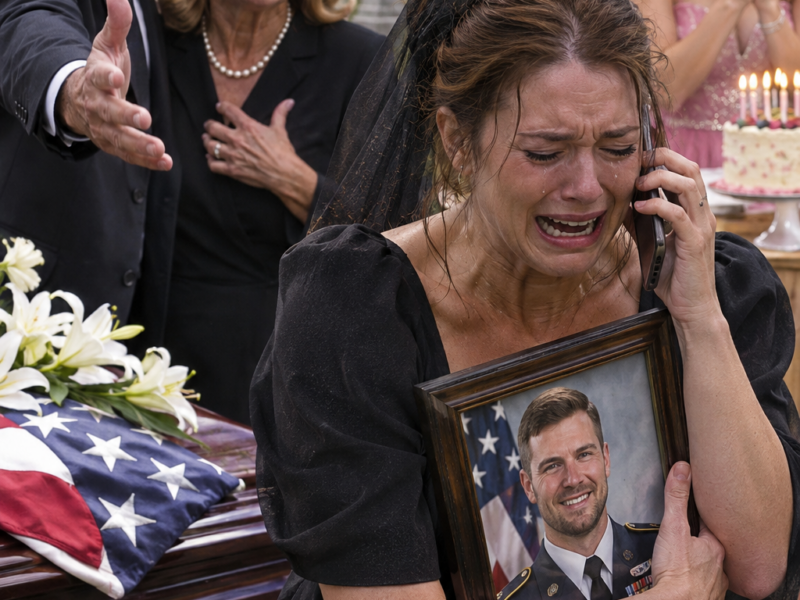
My Parents Skipped My Husband’s Funeral For My Sister’s Birthday—Then Made The Call That Ruined Them
My Parents Skipped My Husband’s Funeral For My Sister’s Birthday—Then Made The Call That Ruined Them
The first time my mother told me my husband’s funeral was too depressing to attend, I thought I had misunderstood her.
I was standing in my kitchen, holding a phone that had carried thousands of emergencies through twelve years of working as a 911 dispatcher. I had heard people scream as their houses burned. I had listened to fathers beg their unconscious children to wake up. I had guided strangers through the last moments of lives that could not be saved. I knew what panic sounded like. I knew what cruelty sounded like, too.
But I had never imagined hearing it delivered so casually by the woman who gave birth to me.
“Honey, you have to understand,” my mother said in that patient, almost indulgent voice she used whenever she expected me to surrender. “Tessa’s birthday weekend has been planned for months. Everything is booked. The rooms are nonrefundable. And frankly, a funeral is just too depressing. Your sister really needs us right now.”
I stared at the glass of water beside my bed through the open kitchen doorway.
My husband had placed it there on the last morning of his life.
He had been dead for six days.
And my mother was explaining why celebrating my sister’s thirty-second birthday mattered more than helping me bury him.
I didn’t argue. I didn’t beg. I simply said, “Okay,” and ended the call.
What my mother didn’t know was that the night my husband died, she had called him six times while he was working. She didn’t know that one of those calls had left behind a voicemail I would eventually hear. She certainly didn’t know that an ambulance radio had recorded fourteen seconds of my husband’s voice immediately before the crash that killed him.
And she had no idea that, six weeks later, hundreds of people would hear that recording.
By then, the story my family had spent years telling about themselves would begin falling apart.
But to understand how we reached that day, you need to understand the man I married, the family I came from, and the one terrible night that changed everything.
My name is Aaron Moore. I was thirty-five years old when my husband, Bryce Peton, died on February 21, 2026.
For twelve years, I had worked at the Hamilton County emergency communications center outside Cincinnati. My job was built around other people’s worst moments. When someone called 911, I was supposed to become the calmest voice in their world, no matter what was happening on the other end of the line.
I trained myself to follow three simple rules.
Keep your voice steady. Use the caller’s name. Count their breaths.
Those rules had helped me talk a terrified teenager through delivering her baby before the ambulance arrived. They had helped me keep an elderly man conscious after a heart attack. They had helped me convince a woman hiding in a closet that the police were coming and that she needed to remain silent just a little longer.
At work, I understood emergencies.
At home, I thought I understood love.
Bryce was the reason I believed the two could exist together.
We met in the summer of 2016 during a critical incident stress management training session at the Cincinnati Police Academy. He was twenty-eight, newly certified as a paramedic, and so tall and awkward that he seemed perpetually uncertain what to do with his arms.
He had dark hair that refused to stay combed, a crooked smile, and the gentlest eyes I had ever seen on someone who spent his days witnessing human suffering.
The first thing he did was pull out a chair for me.
The second thing he did was thank me.
It turned out that a week earlier, he had responded to a call involving an elderly woman with advanced lung disease. Her husband had been on the phone with dispatch for nearly ten minutes, terrified that his wife would die before help arrived.
I had been the dispatcher.
Bryce remembered my voice.
“You kept that man together,” he told me after recognizing my name. “He was falling apart when we got there, but he kept repeating what you told him. He said you promised somebody was coming.”
I shrugged because praise made me uncomfortable.
“I was just doing my job.”
Bryce shook his head.
“No. You made him believe he wasn’t alone. That’s different.”
That was the beginning.
We started dating the following spring, married in September 2018, and spent the next eight years building a life that was ordinary in all the ways that mattered.
We bought a modest house with squeaky floors and a backyard too small for the garden Bryce insisted he would eventually plant. We argued about whether the thermostat should be set to sixty-eight or seventy-two. We spent ridiculous amounts of money on takeout after exhausting shifts. We had a dog named Murphy who was convinced every delivery driver had come specifically to visit him.
And every night, without being asked, Bryce placed a glass of water on my side of the bed.
It was always cold. It was always in one of the little old-fashioned tumblers his grandmother had given us. Sometimes he left it there while I was still brushing my teeth. Sometimes I found it waiting when I came home after midnight.
He never made a production of it.
He simply knew I woke up thirsty, and he made sure I had water.
There are grand romantic gestures people remember forever. Diamond rings. Surprise vacations. Public declarations of love.
Bryce loved me through small, quiet acts that were almost invisible until they stopped.
We wanted children.
For years, we imagined a house filled with toys and bedtime stories and little shoes abandoned in the hallway. Then came our first miscarriage in 2020, followed by another the following year.
The third happened in 2022.
I still struggle to describe that period of my life.
There are kinds of grief that arrive with flowers, casseroles, and condolences. Everyone knows what has happened, and even strangers understand that something terrible has been lost.
Then there are losses that happen quietly, behind closed doors, while the rest of the world continues as though nothing has changed.
After the third miscarriage, I began to believe my body had betrayed us.
Bryce never once allowed me to carry that belief alone.
One evening in early 2023, he sat across from me at our kitchen table, reached for my hand, and said something I have never forgotten.
“Aaron, I think we’re already a family. We’re enough. And if we still want a child, maybe we should try opening a different door.”
That April, we began the adoption process.
It took years of paperwork, background checks, interviews, inspections, medical examinations, and conversations so personal that I sometimes wondered whether we would ever reach the other side.
Bryce never complained.
He approached every requirement as though someone had simply given him a complicated problem he was determined to solve.
On January 28, 2026, our case manager, Pamela Whitam, called with the news we had been waiting for.
Our home study had been approved.
We were officially eligible to be matched with a child.
That night, Bryce found a plain white ceramic mug at the back of our kitchen cabinet. He took a black permanent marker and carefully wrote across the side:
For the one who’s coming.
Then he placed it on the shelf above the coffee maker.
Every morning afterward, I saw that mug and imagined a future neither of us could yet fully picture.
Three weeks later, I was standing in a hospital corridor, trying to comprehend that my husband was dead.
The day began like any other Saturday.
Bryce was scheduled to work from two in the afternoon until ten that evening with his partner, Casey Vaughn, a twenty-six-year-old paramedic he had taken under his wing.
Casey was energetic, talented, and occasionally reckless in the way young people can be when they haven’t yet learned how quickly life can change.
Bryce adored him.
“He reminds me of myself,” he once said.
I laughed.
“You were never that loud.”
“No,” Bryce admitted. “But I was definitely that stupid.”
The weather had been miserable all afternoon. Rain fell steadily over Cincinnati, covering the roads in a reflective black sheen.
At six-thirty, I sent Bryce a text.
Be careful tonight. Roads are awful.
He replied with a thumbs-up emoji.
That was the last message I ever received from him.
I was working a swing shift at dispatch, monitoring several active incidents. There had been a domestic disturbance in Norwood, a possible structure fire near Westwood, and an elderly man reporting chest pain in Anderson Township.
My attention was divided between screens, radio transmissions, and the constant rhythm of the call queue.
I didn’t know that during those hours, my mother was repeatedly calling Bryce.
From 5:42 p.m. until 9:14 p.m., she contacted his personal phone six times.
He answered two of the calls.
He ignored the others.
On the sixth attempt, she left a voicemail.
At the time, I knew none of this.
Shortly before ten, Bryce and Casey were assigned a late patient transfer because the replacement crew was delayed.
It should have been routine.
They transported a stable patient to Mercy Health Anderson, completed the paperwork, and started driving back toward their station.
Casey was behind the wheel. Bryce sat in the passenger seat.
Rain hammered the windshield.
At 11:14 p.m., near mile marker twenty-seven on Ohio State Route 32, an intoxicated driver named Brett Sutherland lost control of his pickup truck.
He crossed into oncoming traffic without his headlights on.
The truck struck the passenger side of the ambulance.
The impact killed Bryce.
Casey survived with a broken arm, a concussion, and memories that would haunt him for the rest of his life.
I learned what had happened when a dispatcher from Clermont County called my personal phone.
Her name was Eliza Crawford.
I had heard her voice over the radio before, but we had never met.
She spoke softly, carefully, with the controlled compassion of someone who knew exactly what she was about to do to another person’s life.
“Aaron, there’s been an accident involving a Hamilton County EMS unit.”
I remember looking at the clock.
11:44 p.m.
I remember the blue flannel shirt hanging beside our front door.
I remember Murphy lifting his head from the living room rug because he recognized the change in my breathing.
I remember asking Eliza which unit had been involved.
She hesitated.
And in that hesitation, I knew.
The next forty-eight hours passed in fragments.
A highway patrol trooper standing in my living room with his hat in his hands. A hospital hallway smelling of disinfectant. Bryce’s brother, Declan, arriving with red eyes and a face that looked suddenly ten years older.
I remembered signing papers.
I remembered someone asking whether I wanted to see Bryce.
I remembered saying yes and then wishing, for one terrible moment, that I had said no.
Because once I saw him, there was no possibility that somebody had made a mistake.
There was no chance he would walk through our front door, toss his keys into the ceramic bowl on the counter, and complain that he had worked overtime again.
He was gone.
My parents did not come to the hospital.
My father sent a text the following morning.
Sorry, honey. We’re praying for you.
My younger sister, Tessa, sent something equally brief.
We’re devastated. Sending love.
Neither asked whether I needed anything.
Neither offered to come.
By Sunday afternoon, I had stopped expecting them.
Then my mother-in-law arrived.
Bridget Peton had lost her own husband three years earlier. She understood a kind of silence that I was only beginning to recognize.
She walked into my kitchen carrying two casseroles wrapped in aluminum foil and a bouquet of yellow tulips.
Bryce loved yellow tulips.
She placed the flowers in a vase, put the food in the refrigerator, and sat across from me at the kitchen table.
For three hours, she said almost nothing.
She didn’t tell me to be strong.
She didn’t promise that everything happened for a reason.
She didn’t insist Bryce was in a better place.
She simply stayed.
At one point, I began crying so hard that I couldn’t speak.
Bridget reached across the table and held my hand.
When the crying passed, she waited.
Finally, just before leaving, she said, “He talked about you every shift, sweetheart. Every single one.”
Then she kissed my forehead, washed her coffee cup, and went home.
I would later realize that those three hours gave me more comfort than anything my own family had offered during my entire marriage.
On Wednesday, an overnight envelope arrived from Tessa.
Inside was a sympathy card.
She had written, Thinking of you. Try to enjoy what’s left of the day.
For a long time, I stared at those words.
I wondered whether she had actually read them before sending the card.
Then I discovered a second item tucked behind it.
A glossy, professionally printed itinerary.
Tessa’s 32nd Vineyard Weekend.
March 6 through March 8.
A luxury retreat in the Hocking Hills area, complete with spa treatments, wine tastings, private dinners, and a Sunday brunch.
I sat at my kitchen table, holding the itinerary in one hand and the sympathy card in the other.
For some reason, I laughed.
It wasn’t a happy sound.
It was the kind of laugh that escapes when reality becomes so absurd that your mind briefly refuses to recognize it.
Tessa had included her birthday schedule in the same envelope as a condolence card for my dead husband.
That was when I called my mother about the funeral.
I told her it would take place on Saturday, March 7, at eleven in the morning.
I explained that Bryce’s family would be there, along with his colleagues, friends, and the people whose lives he had touched.
Then I said something I rarely said to my mother.
“I need you.”
I didn’t ask for money.
I didn’t ask her to organize anything.
I simply wanted my parents and sister to sit beside me while I said goodbye to the man I loved.
Instead, she told me it was too depressing.
She told me Tessa needed her.
She told me she hoped I would understand.
And when I hung up, something inside me became very still.
I had spent most of my life being the dependable daughter.
Tessa was the celebrated one.
When she graduated, our parents threw a party that occupied the entire backyard. When I earned a promotion to senior dispatcher, my mother sent a congratulatory text three days late.
When Tessa had financial trouble, everyone rallied around her. When I needed help, I was reminded that I was capable and independent.
At twenty-seven, I paid off a credit card debt Tessa had accumulated after making purchases she couldn’t afford.
At twenty-nine, I covered her rent for three months.
At thirty-one, I intervened when she faced a drunk-driving charge, directing her toward legal help and encouraging her to take responsibility before things became worse.
None of those sacrifices made me resent her at the time.
I thought that was what family did.
But Bryce saw the pattern long before I was willing to admit it.
He never demanded that I cut them off.
He simply asked, every so often, “Who takes care of you when you’re busy taking care of everyone else?”
I always answered the same way.
“You do.”
And he did.
Until he couldn’t anymore.
The day after my conversation with my mother, Marlene Strickland called.
Marlene had trained me when I first became a dispatcher. She had twenty-eight years of experience, the patience of a saint, and the ability to make an entire room fall silent without raising her voice.
She was now involved in quality assurance and critical incident reviews.
“Aaron,” she said, “there’s something from Bryce’s final shift you need to hear.”
My stomach tightened.
“What is it?”
“Audio. And some phone records.”
“Is it about the crash?”
“Yes. But not in the way you think.”
She asked me to come to her office the following morning.
I barely slept.
At eight o’clock, I walked into her office and found two cups of coffee waiting on the desk.
Three folders lay beside them.
Marlene closed the door.
“I need you to understand something before we start,” she said. “None of what you’re about to hear changes who caused the accident. The driver who crossed the center line was intoxicated. That responsibility belongs to him.”
I nodded.
“Okay.”
“But there are other things you deserve to know.”
She opened the first folder.
Inside were call detail records documenting repeated contact between my mother’s phone and Bryce’s personal number during his final shift.
Six calls.
Two brief conversations.
Four unanswered attempts.
I felt my pulse quicken.
“Why was she calling him?”
Marlene didn’t answer immediately.
Instead, she opened the second folder.
It contained the incident review of the ambulance’s final radio transmissions.
A microphone had remained activated for approximately fourteen seconds immediately before the crash.
The recording had captured Bryce speaking to Casey.
Marlene looked at me.
“You can stop this whenever you need to.”
“Play it.”
The speakers crackled.
I heard rain.
Windshield wipers.
Then Bryce.
His voice was tired but unmistakably his.
“Casey, remind me to delete a voicemail from my mother-in-law when we get back.”
Casey responded with a faint laugh.
“What does she want now?”
“Wanted me to drive through Eastgate and pick up champagne for Tessa’s brunch. Told her no twice already.”
A brief silence followed.
Then Bryce spoke again.
Softer this time.
“Tell Aaron I love her. And tell her mom I’m not her goddamn errand boy.”
The recording ended abruptly.
Fourteen seconds.
Fourteen seconds that I wished I could stretch into a lifetime.
For a moment, I couldn’t breathe.
I had spent twelve years teaching frightened strangers how to control their breathing, and suddenly I couldn’t remember how to do it myself.
Marlene moved her chair closer.
I stared at the speaker.
“Play it again.”
She hesitated.
“Are you sure?”
“Yes.”
I listened a second time.
The rain.
The wipers.
His voice.
And then nothing.
I broke.
Not because Bryce had been angry.
Not because he had used language he rarely used.
I broke because the very last thing captured of my husband was proof that even while exhausted, even while finishing a dangerous shift, he had still been forced to defend the boundaries I had struggled to protect for years.
And somehow, even then, he had been thinking about me.
When I could finally speak, Marlene played the voicemail my mother had left him.
Her voice filled the office, bright and cheerful.
“Bryce, honey, I know you’re working, but I really need you to stop at Whole Foods in Eastgate and get two bottles of the yellow-label champagne. Not the rosé. Tessa needs them for her brunch. You’re the only one who’ll be nearby. Be a sweetheart. And don’t tell Aaron. She’ll get prickly about overtime.”
The message lasted thirty-eight seconds.
Thirty-eight seconds of my mother treating a paramedic on duty like a personal delivery service.
I listened to it without speaking.
Then I asked a question.
“Did she know he was working?”
Marlene looked at me carefully.
“She said it in the message.”
I closed my eyes.
There was no misunderstanding.
No emergency.
No sick relative.
No desperate situation that justified repeatedly interrupting him.
Champagne.
She had called him six times about champagne.
Marlene leaned forward.
“Aaron, I want you to hear me clearly. Your mother didn’t cause Bryce’s death. The drunk driver did. But your mother was making demands on him during the final hours of his life, and that matters. It matters because it shows how she treated him.”
I nodded slowly.
Then she mentioned the county memorial scheduled for April 18 at Fountain Square.
Bryce would be among several emergency workers honored during the ceremony.
As his surviving spouse, I could request that the recording be considered for the tribute.
At first, I couldn’t imagine allowing strangers to hear those final words.
They felt too private.
Too sacred.
But as I sat there, another thought began to form.
For years, my family had relied on silence.
Silence when Tessa mistreated someone.
Silence when my parents demanded things they had no right to demand.
Silence when I was hurt and expected to forgive them before anyone acknowledged what they had done.
Bryce’s voice had finally broken that silence.
And I began to wonder whether I should let people hear him.
A few days later, I gained access to an archive of Bryce’s digital information.
He had named me as his legacy contact when we began our adoption journey, another small act of preparation he had never bothered to mention.
I sat at our kitchen table with his messages open on the laptop.
I searched Tessa’s name.
The results made me physically ill.
There were requests for errands, rides, favors, deliveries, and financial assistance stretching back more than a year.
Pick up Mom from the airport.
Take Spencer’s car to the mechanic.
Stop by the pharmacy.
Buy the wine.
Drop off the package.
My sister had treated Bryce like someone who existed to make her life easier.
And he had almost always responded politely.
Sure.
No problem.
I’ll see what I can do.
Then I found a message from October 2025.
Don’t tell Aaron Mom called you. She’ll get dramatic. Just pick up the wine, okay?
Bryce had never replied.
I stared at those words until they blurred.
The worst part wasn’t the request itself.
It was the secrecy.
They knew I would object.
They knew Bryce was being taken advantage of.
And instead of respecting that, they had simply learned to go around me.
I printed the messages and placed them in a gray folder.
Beside it, I put the phone records and the transcript of the ambulance recording.
For the first time since Bryce died, I felt something other than helplessness.
I felt clarity.
The funeral came on Saturday, March 7.
The morning was cold, with a damp wind that slipped through my coat as I stepped out of the car.
Hodapp Funeral Home stood beneath a gray Cincinnati sky.
Inside, the chapel smelled of fresh flowers and polished wood.
Bryce’s photograph was displayed beside the casket.
He was smiling in his uniform.
I looked at that smile and nearly turned around.
For one irrational second, I wanted to run home and pretend none of this had happened.
Instead, Bridget took my hand.
“We’ll walk together,” she whispered.
The chapel was crowded.
Paramedics in dress uniforms occupied several rows. Firefighters stood near the back. Friends from our neighborhood sat beside colleagues from dispatch.
Bryce’s brother Declan stood near the front, his jaw clenched so tightly that I wondered whether his teeth hurt.
And on the left side of the chapel, fourteen seats reserved for my family remained empty.
Fourteen.
I counted them.
I wished I hadn’t.
My mother hadn’t even sent a message that morning.
Neither had my father.
Tessa had posted photographs from the vineyard the previous evening. I had seen one before forcing myself to close the app.
She was wearing a satin dress and holding a champagne flute.
My mother stood beside her, smiling.
The caption read, Family is everything.
I had stared at those words for a long time.
Now, standing in a chapel where my husband lay in a casket, I understood that my mother’s definition of family had always been conditional.
When it was time for the eulogy, I walked to the podium.
My hands shook.
I had rewritten the speech twelve times.
Each version seemed inadequate.
How could I reduce eight years of marriage to a few pages?
How could I explain that the greatest thing Bryce ever gave me wasn’t a home, or financial stability, or even the dream of becoming parents?
It was the certainty that I mattered.
I didn’t begin by describing his awards or his career.
I began with the glass of water.
I told the room how he placed one beside my bed every night.
I described his habit of singing badly while cooking breakfast, how he cried at sentimental commercials, and how he once spent an entire weekend repairing a neighbor’s porch because the elderly woman had mentioned that she was afraid of falling.
I told them about our miscarriages.
I told them how he had held me through those losses without ever making me feel like a failure.
Then I told them about the white mug.
For the one who’s coming.
By that point, people throughout the chapel were crying.
I looked toward Bryce’s photograph.
“We never got to meet our child together,” I said. “But I hope someday, when I tell that child about Bryce, they understand that he was already loving them before he ever knew their name.”
My phone began vibrating inside my blazer.
I ignored it.
It vibrated again.
And again.
I continued reading.
At the end, I said the words Bryce had always used when teaching younger paramedics how to remain calm.
“Keep your voice steady. Use their name. Count their breaths. Nobody should have to face their worst moment alone.”
Then I stepped away from the podium.
Bridget reached for my hand as I sat down.
She pressed a glass of water into it.
Only then did I check my phone.
Forty-four missed calls.
I stared at the number, confused.
Eighteen calls from my mother.
Nine from my father.
Seven from Tessa.
Several from relatives.
Others from unfamiliar numbers, including a hospital line.
One message from my mother appeared in capital letters.
CALL ME NOW. SOMETHING HAS GONE TERRIBLY WRONG.
My first reaction was fear.
Then disbelief.
Then a strange, cold realization.
Whatever had happened, they had finally remembered I existed.
I locked the phone.
For the first time in my life, I chose not to answer.
After the funeral, Declan approached me in the reception hall.
He had heard reports of a hit-and-run on Route 32 the previous night, near the same stretch of road where Bryce had died.
The victim had been taken to the hospital.
Investigators were tracing a vehicle seen on nearby cameras.
I listened quietly.
Something about the timing unsettled me.
That afternoon, Trooper Garrett Beaumont from the Ohio State Highway Patrol called.
He was the officer who had helped explain Bryce’s accident to me.
His voice was gentle when I answered.
“Aaron, I’m sorry to disturb you today. But there’s been another incident, and I believe you need to know about it.”
I sat down.
He explained that the vehicle involved in the hit-and-run was registered to my sister.
Tessa Moore.
And the victim was Casey Vaughn.
Bryce’s partner.
For a moment, the room seemed to tilt.
Casey had survived the crash that killed my husband.
And now, two weeks later, he had been struck by another vehicle near the same road.
The driver was my sister’s fiancé, Spencer Holloway.
Investigators believed Spencer had been drinking.
He had fled the scene.
Casey was alive, but his injuries were severe.
I drove to meet Trooper Beaumont.
He showed me the information investigators had gathered.
The two incidents were not legally connected, and there was no evidence of some deliberate scheme.
But the circumstances were devastatingly similar.
Both occurred late at night.
Both involved drivers suspected of being intoxicated.
Both happened along Route 32.
And both had become entangled with my family’s obsession with my sister’s celebration.
Spencer had reportedly driven to a friend’s house to pick up expensive champagne for Tessa’s birthday weekend.
Despite warnings that he had been drinking too much, he left.
On his return journey, he struck Casey, who was walking along the roadside after attending a support meeting.
Spencer did not stop.
He drove away.
By the time I returned home, the afternoon was fading.
I sat in the kitchen where Bryce’s coffee cup still rested beside the sink.
I hadn’t washed it.
A faint brown stain remained at the bottom.
It was ridiculous, perhaps, to preserve a dirty cup.
But I couldn’t bear to erase one more trace of him.
I finally listened to my mother’s voicemails.
The first was frantic.
“Aaron, you need to call us immediately. Spencer’s been involved in an accident. Tessa is falling apart.”
Another followed.
“You work in emergency services. You must know someone who can help us. Spencer made a mistake, but he’s a good young man. We can’t let one bad decision destroy his future.”
Then came the sentence that changed something permanently inside me.
“We need you to make this softer.”
Make it softer.
Casey was lying in a hospital bed with serious injuries.
A driver had allegedly hit him and fled.
And my mother wanted me to use my professional connections to protect that driver from consequences.
My father’s message was even worse.
Your mother is having a breakdown. This is bigger than Bryce now. Tessa needs you. You owe this family.
I read it three times.
Bigger than Bryce.
The man I had buried that morning had become an inconvenience in their newest crisis.
Tessa’s final voicemail was mostly sobbing.
“Aaron, please. I can’t lose Spencer. Mom says you can help. Please call me back.”
Not one of them asked how the funeral had gone.
Not one mentioned the fourteen empty seats.
Not one apologized.
At six that evening, I picked up my phone.
Habit is a powerful thing.
For thirty-five years, I had been trained to rescue my family from its own mistakes.
Even now, some part of me wanted to make a call, speak to an acquaintance, find a lawyer, and begin smoothing the path for Tessa.
My fingers hovered over the screen.
Then I saw Bryce’s cup.
I remembered his final recorded words.
Tell Aaron I love her.
And then his refusal to keep serving as my family’s errand boy.
I lowered the phone.
The sun was setting through the kitchen window, turning the counter a deep, warm gold.
For a moment, the light illuminated the rim of Bryce’s cup.
I looked at it and whispered, “You spent years protecting me from them. I think it’s time I learned how to protect myself.”
I didn’t call my mother.
I called Marlene.
She listened as I explained everything.
When I finished, she said, “Aaron, you know what the right thing is.”
“Yes.”
“And you know what your family wants.”
“Yes.”
“They aren’t the same thing.”
“No,” I whispered. “They’re not.”
Over the following weeks, the investigation into Spencer moved forward.
There were interviews, reports, medical updates, and questions about his actions before and after the collision.
I stayed out of the investigation.
I did not make professional calls on his behalf.
I did not try to influence anyone.
For once, my family had to face a situation without me making it easier.
My mother reacted badly.
She sent emails accusing me of abandoning my sister.
My father left messages about loyalty.
Tessa alternated between begging and anger.
Eventually, I blocked their numbers.
The silence was painful at first.
Then it became peaceful.
On March 25, a cousin sent me a link to a fundraising page.
I opened it and felt my stomach tighten.
The page was titled Help Spencer Holloway: A Family Under Attack.
The goal was forty thousand dollars.
My mother had written the description herself.
She claimed Spencer was being unfairly persecuted and that the family needed support during an extremely difficult time.
Then she added a sentence about me.
Our oldest daughter, Aaron, is grieving and unable to support the family right now.
I stared at the screen.
They had turned my grief into an explanation for why I wasn’t helping them.
They had made themselves the victims.
Bryce wasn’t mentioned anywhere.
Not once.
I saved the page.
Then I wrote to Pastor Holden Sullivan, the minister who had married Bryce and me and later stood beside his grave.
I explained what had happened and provided relevant information about my mother’s attempts to seek support for Spencer.
I didn’t ask him to attack anyone or publicly shame my parents.
I simply wanted him to understand the situation before his congregation continued donating.
He replied that evening.
He said the church would no longer endorse the fundraiser without a clearer and more accurate account of the circumstances.
Then he added something unexpected.
I’ll be at the memorial on April 18. Tell me where you need me.
I cried when I read that.
Not because he had offered to confront my family.
But because he had offered to show up.
It was such a simple thing.
And I was beginning to understand how much it mattered.
On April 5, Casey asked to see me.
He had been moved from intensive care to a neurological recovery unit.
The hit-and-run had caused a serious head injury, and although he was improving, he still struggled with memory and concentration.
When I entered his room, he was sitting upright, his left arm supported and a bandage visible near his temple.
He gave me a tired smile.
“Mrs. Moore.”
“Casey,” I said, sitting beside him. “You know you can call me Aaron.”
He looked down.
“I’ve been wanting to talk to you.”
I nodded.
He told me what he remembered about the night Bryce died.
The rain.
The late transfer.
Bryce joking about how much he wanted to get home.
He remembered the champagne conversation, too.
“He wasn’t angry at you,” Casey said quickly. “I need you to know that. He was angry because people kept taking advantage of how good he was.”
I swallowed hard.
“I know.”
Casey hesitated.
“There’s something else.”
He told me that eighteen months earlier, Bryce had discovered he was struggling with alcohol.
Casey had been using drinking to cope with the stress of emergency medical work.
He was ashamed of it.
Afraid that asking for help would ruin his career.
Bryce hadn’t lectured him.
Instead, he had offered to drive Casey to a support meeting.
The first Friday, Bryce waited outside in his car.
The second Friday, he did the same.
Then the third.
Eventually, Casey began attending on his own.
“Your husband never told anyone,” Casey said, staring at his blanket. “He said it was my story to tell, not his.”
My eyes filled.
On the night Spencer hit him, Casey had been walking home from one of those meetings.
He had been following his doctor’s instruction not to drive while recovering from the earlier concussion.
And the person who struck him had allegedly been drinking.
Casey’s voice trembled.
“Bryce spent a year and a half making sure I didn’t destroy my life with alcohol. Then he died because somebody else drove drunk. And two weeks later…”
He couldn’t finish.
Neither could I.
We sat together quietly.
After a while, Casey reached for the paper cup of water beside his bed.
“You know what he used to say?” he asked.
I shook my head.
“He said the worst thing about emergencies isn’t always the pain. Sometimes it’s the feeling that nobody is coming.”
I wiped my cheeks.
“That sounds like him.”
“He told me if I could make one person feel like somebody was coming, I’d done something worthwhile.”
Casey looked toward the window.
“I want to speak at the memorial. If they’ll let me.”
I took his hand.
“They’ll let you.”
He gave a faint smile.
“Good. Because I owe him more than I can ever pay.”
“You don’t owe him anything,” I whispered.
Casey shook his head.
“Maybe not. But I want people to know what kind of man he was.”
That night, I went home and opened the orange adoption folder.
For weeks, I had barely been able to look at it.
Every document seemed to represent a future that had died with Bryce.
There were photographs of our house, references from friends, certificates, background checks, and notes from interviews.
Near the back, I found a handwritten page Bryce had tucked between two forms.
It was a list of things he wanted to do with our future child.
Teach them to ride a bike.
Take them fishing.
Make pancakes on Saturday mornings.
Build a treehouse, even if the yard was too small.
Tell them every day that being loved was not something they had to earn.
I held that piece of paper against my chest and cried until my throat hurt.
Then I called Pamela Whitam.
I told her I didn’t want to abandon the adoption process.
I knew everything would need to be reassessed after Bryce’s death.
I understood that raising a child alone would be different from the future we had planned.
But I wanted to continue.
Pamela listened.
Then she said, “Aaron, grief changes a family. It doesn’t automatically mean that family has nothing left to offer.”
For the first time in weeks, I allowed myself to imagine a future again.
April 18 arrived bright but cold.
Fountain Square in downtown Cincinnati was filled with people long before the memorial began.
Firefighters stood beside paramedics in formal uniforms. Dispatchers from surrounding counties gathered near the stage. Families of fallen emergency workers sat in reserved rows.
There were flowers, photographs, flags, and a low stage facing hundreds of folding chairs.
Four portraits stood at the front.
Bryce’s was on the left.
He wore his dress uniform and looked directly at the camera with that familiar crooked smile.
I couldn’t stop staring at him.
His jacket hung nearby, carefully displayed.
I touched the sleeve before the ceremony.
For a brief, terrible moment, I expected it to feel warm.
Behind me, I heard my mother’s voice.
“Aaron.”
I turned.
She was standing beside my father and Tessa.
All three wore black.
My mother had pearls around her neck.
Tessa’s eyes were swollen, and my father looked uncomfortable.
They had come to the memorial.
Not to the funeral.
Not when I had begged them to be present.
But now, with reporters and cameras nearby, they had decided they belonged among the grieving family.
My mother glanced toward the reserved seating.
“We should be sitting up front with you.”
I looked at her.
For several seconds, neither of us spoke.
Then I said, “The front seats are for the people who stood beside Bryce and me.”
Her expression tightened.
“Aaron, don’t make a scene.”
I almost laughed.
I had spent my entire life being told not to make a scene whenever the truth made my mother uncomfortable.
Instead, I simply walked away.
At two-twenty, Marlene stepped to the podium.
She spoke briefly about the dispatch community, about the bonds formed between people who spend their working lives responding to suffering.
Then she introduced me.
I walked toward the microphone carrying a few pages of notes.
My heart pounded.
I could see Bridget in the front row.
Declan sat beside her.
Casey was in a wheelchair near the aisle.
Pastor Sullivan stood near the back of the square.
And somewhere behind them were my parents and sister, waiting to learn what I had chosen to say.
I adjusted the microphone.
“My name is Aaron Moore,” I began. “I was married to Bryce Peton.”
The square grew quiet.
“Bryce was thirty-seven years old when he died. He was a paramedic, a brother, a son, a friend, and the person I trusted more than anyone in the world.”
I looked at his photograph.
“He was also preparing to become a father.”
My voice trembled.
“We had spent almost three years trying to adopt a child. He didn’t live long enough to see that dream become real.”
I paused.
“Today, I want you to hear something from his final shift. It’s a short recording, and it includes a private conversation. It is painful for me to share. But I believe it reveals something important about a man who spent his life helping others, even when others forgot that he was a person with limits.”
I nodded to the technician.
The recording played.
Rain.
Windshield wipers.
Bryce’s voice.
The request to delete a voicemail.
The explanation about the champagne.
And then those final words.
“Tell Aaron I love her. And tell her mom I’m not her goddamn errand boy.”
The recording stopped.
I heard someone crying.
I didn’t look to see who it was.
I waited until the silence settled.
Then I told the crowd about the six phone calls.
I explained that my mother had repeatedly contacted Bryce during his final shift to request a personal errand unrelated to his work.
I described how my sister had made similar requests for months.
I spoke about the text asking Bryce to keep those demands secret from me.
And then I explained why my family hadn’t attended his funeral.
“My mother told me it would be too depressing,” I said quietly. “She said my sister needed the family at her birthday celebration.”
A murmur moved through the crowd.
I continued.
“I don’t believe my mother caused Bryce’s death. I want that to be absolutely clear. The intoxicated driver who struck his ambulance is responsible for that crash.”
I looked down at my notes.
“But there is another kind of harm that happens when good people are treated as though their time, their kindness, and their dignity belong to everyone except themselves.”
I raised my head.
“Bryce spent his life answering calls for help. He never expected the people he loved to earn his kindness. He offered it freely.”
My throat tightened.
“But kindness is not permission to exploit someone.”
In the front row, Casey lowered his head.
I looked toward him.
“Bryce helped his partner through a difficult period without asking for recognition. He sat outside support meetings because he wanted another person to know that somebody cared enough to wait.”
Casey covered his face with one hand.
“He did that because he believed nobody should face their darkest moments alone.”
I glanced toward Bridget.
“He believed family was something you proved through your actions.”
Then I looked toward the section where my mother was seated.
“And when Bryce died, I discovered just how different that belief was from the one I had grown up with.”
I did not raise my voice.
I did not call anyone names.
I simply described the funeral.
The fourteen empty seats.
The missed calls.
The messages asking me to protect Spencer.
The fundraising appeal that used my grief as an explanation for why I wasn’t supporting the family.
I told the crowd I had refused to interfere in the investigation.
Not because I wanted revenge.
Not because I wanted Tessa to suffer.
But because Casey deserved justice, and Bryce deserved a wife who would honor the values he had lived by.
When I finished, the square remained silent for several seconds.
Then I said the words I had written the night before.
“Some families teach you that love means always answering when they call. Bryce taught me that love also means knowing when to say no.”
I looked at his photograph one last time.
“My husband spent eight years making sure I never had to wonder whether I mattered. Today, I want to make sure nobody has to wonder whether he mattered.”
My voice broke.
“He did.”
I swallowed.
“He mattered more than I can ever explain.”
Then I stepped back from the microphone.
The applause began slowly.
It grew until the sound seemed to fill the entire square.
I hadn’t expected applause.
I wasn’t trying to win an argument.
I only wanted Bryce’s voice to be heard.
Marlene met me at the bottom of the steps with a paper cup of water.
I took it and laughed through my tears.
“Everyone keeps giving me water.”
She smiled sadly.
“Seems like somebody taught us well.”
As I walked back toward my seat, I passed my mother.
She stood suddenly.
“Aaron…”
I stopped for one moment.
Her face was pale.
My father stared at the ground.
Tessa was crying.
For years, that sight would have been enough to make me abandon whatever I was feeling and rush to comfort them.
But something had changed.
I looked at my mother and said, “I needed you on March seventh.”
She opened her mouth.
No words came.
I nodded once and continued walking.
I didn’t know exactly what happened to my family’s relationships in the weeks that followed.
I heard that people from their church questioned the fundraising campaign.
I heard that friends were upset by the circumstances surrounding the hit-and-run.
I heard that my mother was furious about what I had said publicly.
But I no longer made it my responsibility to manage the consequences of her choices.
The criminal investigation was handled by the authorities.
I refused to turn Bryce’s memorial into an ongoing war.
He deserved more than that.
In the days afterward, something unexpected happened.
People began telling me stories about Bryce.
A woman wrote to say he had stayed with her father after a medical emergency because the elderly man was afraid of being alone.
A firefighter remembered Bryce giving up his lunch break to help a colleague repair a flat tire.
A young paramedic sent a message explaining that Bryce had once talked him through a traumatic call and then checked on him every day for a week.
Each story hurt.
Each story healed something, too.
I was discovering that the man I loved had left pieces of himself everywhere.
And those pieces were still doing good.
Then, on Monday, May 4, my phone rang while I was sitting at the kitchen table.
Pamela Whitam’s name appeared on the screen.
I answered immediately.
“Aaron,” she said gently, “I have some news.”
I held my breath.
She explained that a potential adoption match had been identified.
A little girl named Bri.
Four years old.
Her foster mother had recently passed away, and her caseworkers were searching carefully for a stable, loving home.
Pamela emphasized that more evaluations and steps would be necessary.
Nothing was guaranteed.
But she believed our home might be a good match.
I sat completely still.
Then I began crying.
Not the way I had cried after the accident.
Not the way I had cried at the funeral.
This was different.
It was grief and hope colliding so suddenly that I couldn’t separate them.
“Her name is Bri?” I whispered.
“Yes.”
“How old did you say?”
“Four.”
I looked toward the white mug on the shelf.
For the one who’s coming.
My hands trembled.
Bryce had written those words months earlier, believing we would welcome a child together.
Now there was a little girl somewhere in Ohio who might someday walk through our front door.
A few days later, Pamela sent me a photograph.
Bri was sitting on a porch step wearing a yellow dress covered in tiny daisies.
She had dark hair, round cheeks, and a shy smile that seemed to be waiting for permission to become bigger.
I taped the photograph to the cabinet above Bryce’s mug.
That evening, I stood in the kitchen and spoke aloud to my husband.
“I think she’s beautiful.”
The house was quiet.
Murphy lay at my feet.
The late afternoon sunlight stretched across the counter.
“I wish you were here,” I whispered. “I wish you could meet her.”
I looked at the photograph again.
Then I smiled through my tears.
“But if this works out, I promise she’ll know you. She’ll know exactly who you were.”
I began telling Bri’s photograph about him.
About his awful singing.
His love of pancakes.
His ridiculous jokes.
How he never forgot birthdays.
How he treated frightened strangers with the same compassion he gave his family.
And how he always left a glass of water beside my bed.
It wasn’t the future we had imagined.
But for the first time since February, I understood that a different future might still be possible.
On Monday, May 11, I returned to work.
Walking into the dispatch center felt strange.
The familiar sounds were still there.
Telephones ringing.
Radio traffic crackling.
Keyboards clicking.
Coffee brewing in the break room.
A dozen people had asked whether I was ready to return.
I wasn’t sure anyone was ever completely ready to return to normal life after losing the person they loved most.
But I knew I needed to try.
When I reached my console, Marlene was waiting with two cups of coffee.
One was in her own mug.
The other was in a familiar white ceramic cup.
I stopped.
She had brought Bryce’s mug from my kitchen.
The black handwriting was still visible.
For the one who’s coming.
I stared at it.
“Marlene…”
She shrugged.
“Thought you might want it nearby.”
I wrapped both hands around the mug.
For a moment, I couldn’t speak.
Then I hugged her.
She held me tightly.
Across the room, someone called out a greeting.
A colleague squeezed my shoulder.
Another left a small packet of cookies on my desk because she remembered I used to forget breakfast during long shifts.
These were ordinary gestures.
But ordinary gestures had become the language I trusted most.
At nine-oh-three that morning, a radio transmission came through from Station 17.
“Dispatch, Unit 17-1, radio check.”
I recognized Casey’s voice.
He had returned to light duty.
His recovery was still ongoing, but he was back among the people who understood him.
I pressed the transmit button.
“Unit 17-1, receiving you loud and clear.”
There was a brief pause.
Then Casey said, “Headset clean, coffee fresh. Good to hear you again, Aaron.”
My eyes filled.
I smiled.
“Good to hear you too, Casey.”
I released the button.
Beside my monitor was the same yellow sticky note I had kept for years.
Breathe with them. Count to four.
I touched the edge of it.
Then I looked at the white mug.
For a long time, I had believed surviving meant learning how to live in the absence of everything I had lost.
But perhaps survival wasn’t only about absence.
Perhaps it was about recognizing what remained.
Bryce was gone.
I could not change that.
I could not undo the terrible night on Route 32.
I could not recover the years we would never share or the mornings when I would reach across the bed and find only an empty pillow.
I could not force my mother to become the parent I had needed.
I could not make my sister understand the damage she had done.
And I could not go back to February 21 and tell Bryce not to volunteer for that final call.
For months, I had tortured myself with impossible questions.
What if the replacement crew had arrived on time?
What if the weather had cleared?
What if Bryce had taken a different route?
What if he had gone home at ten instead of staying late?
What if I had called him after his last text?
What if I had known my mother was bothering him?
But every one of those questions led to a door that no longer existed.
The truth was painful and simple.
An intoxicated driver had taken my husband from me.
And the people who should have helped me carry that loss had revealed who they were when I needed them most.
I could spend the rest of my life trying to make them understand.
Or I could spend it honoring the man who already had.
I chose Bryce.
Not by remaining trapped in grief.
Not by devoting my future to punishing my family.
But by living according to the quiet, stubborn kindness he had shown me.
The first evening after returning to work, I drove home as the sun was setting.
Murphy greeted me at the door with the enthusiasm of a dog who believed an eight-hour absence was an unforgivable abandonment.
I laughed, scratched behind his ears, and went into the kitchen.
Bri’s photograph was still above the coffee maker.
The orange adoption folder was still on the table.
There was paperwork to complete, interviews to attend, and an uncertain road ahead.
Nothing about becoming her mother would be automatic.
But I was ready to keep walking.
I took a clean glass from the cabinet and filled it with cold water.
Then I carried it into the bedroom.
For the first time since Bryce died, I placed it on my own nightstand without feeling that I was betraying his memory.
I stood there for a moment, looking at the glass.
The light caught its surface, just as it had on the last night he was alive.
And suddenly, I understood something.
Bryce hadn’t left water beside my bed because he wanted me to depend on him forever.
He did it because he loved me.
He wanted me to be cared for.
Even when he wasn’t there to do it himself.
I sat on the edge of the mattress and let myself cry.
Then I whispered, “I’ve got it from here.”
There are still mornings when grief surprises me.
Sometimes it’s a song playing in a grocery store.
Sometimes it’s the sight of an ambulance turning a corner.
Sometimes it’s a coffee cup, a yellow flower, or the sound of rain against a windshield.
And sometimes it’s simply waking up and remembering that the person who made the world feel safe is no longer beside me.
But there are good moments, too.
Moments when Bridget laughs at something I say and I can hear a little of Bryce in her voice.
Moments when Casey sends a message about his progress and I know my husband would be proud.
Moments when Pamela calls with another step forward in Bri’s adoption process.
Moments when I look at that little girl’s photograph and allow myself to imagine pancakes on Saturday mornings, bedtime stories, and tiny shoes left in the hallway.
I don’t know exactly what the future will bring.
I don’t know whether my parents will ever offer a sincere apology.
I don’t know whether Tessa will ever understand why I refused to rescue Spencer from the consequences of his actions.
But I no longer measure my life by their approval.
For thirty-five years, I thought being a good daughter meant being available whenever my family needed something.
Bryce taught me that love was never supposed to be a one-way emergency line.
It wasn’t about how much you could demand from someone.
It was about what you were willing to give without expecting anything in return.
And the people who proved that to me weren’t the ones who shared my blood.
They were the woman who sat in my kitchen for three hours without speaking.
The supervisor who held my hand while I listened to my husband’s final recorded words.
The brother who stood beside me in a funeral chapel.
The young paramedic who fought his way back from two terrible accidents because he wanted to honor the man who had once helped him save himself.
They were the people who showed up.
I think about that often when I put on my headset at the beginning of a shift.
Somewhere, someone is about to make the worst phone call of their life.
They may be frightened.
They may be alone.
They may have no idea what to do next.
And when the call reaches my console, I will answer.
I will keep my voice steady.
I will use their name.
I will count their breaths.
Because that’s what Bryce believed in.
That’s what he lived for.
And that’s what he left behind.
My mother once told me that my husband’s funeral was too depressing for our family to attend.
For a long time, I thought those words were the cruelest thing anyone had ever said to me.
Now I understand that they also gave me something I desperately needed.
They showed me the difference between people who say they love you and people who are willing to stand beside you when love becomes difficult.
On the day I buried Bryce, fourteen seats were empty.
But eighty people came.
And six weeks later, hundreds more gathered to remember him.
I had been so focused on the people who refused to show up that, for a while, I almost overlooked everyone who did.
I won’t make that mistake again.
Because family isn’t always the people whose names appear beside yours on a birth certificate.
Sometimes family is the person who brings you a casserole when you haven’t eaten in two days.
Sometimes it’s the friend who sits beside you without demanding that you stop crying.
Sometimes it’s the colleague who remembers your favorite coffee.
Sometimes it’s a frightened young man who keeps going to his support meetings because someone once believed he was worth saving.
And sometimes it’s a little girl in a yellow daisy dress, waiting somewhere in the world for someone to open the door.
Bryce understood that long before I did.
He understood that love wasn’t proven by grand promises or perfect photographs or expensive birthday celebrations.
It was proven in the smallest moments.
A phone answered.
A chair pulled out.
A hand held.
A glass of water waiting beside the bed.
And now, whenever someone asks me what my husband left me, I don’t begin by talking about his death.
I tell them about the white ceramic mug.
The one with the crooked black handwriting.
The one that still sits in my kitchen, waiting for a child who may soon call me Mom.
For the one who’s coming.
Because even after everything we lost, even after the funeral my family abandoned and the terrible secrets that followed, Bryce somehow left me one final gift.
He taught me that the people we love can continue shaping our lives long after they’re gone.
And that sometimes, when one door closes in the most devastating way imaginable, we still have the courage to open another.
Every night, I place a glass of water beside my bed.
And every morning, I wake up knowing that although Bryce isn’t here to fill it anymore, the love behind that simple gesture never really left.
It lives in the choices I make.
In the people I protect.
In the boundaries I finally learned to hold.
And, I hope, one day soon, in the little girl who will grow up hearing stories about a wonderful man she never had the chance to meet.
A man who spent his life answering other people’s emergencies.
A man who believed nobody should ever feel abandoned in their darkest hour.
A man who loved me enough to remind me, even in his final recorded moments, that I deserved better than being used.
My husband was right about so many things.
But the greatest lesson he ever taught me was the one I didn’t understand until after he was gone.
You cannot make people love you by sacrificing yourself for them.
The people who truly love you will never ask you to disappear just to make their lives easier.
They will make room for you.
They will stand beside you.
And when the world falls apart, they will answer.
That is what family means to me now.
Not the people who call the loudest when they need rescuing.
The people who show up when you have nothing left to give.
Bryce was one of those people.
And because of him, I am finally learning to be one for myself.
THE END