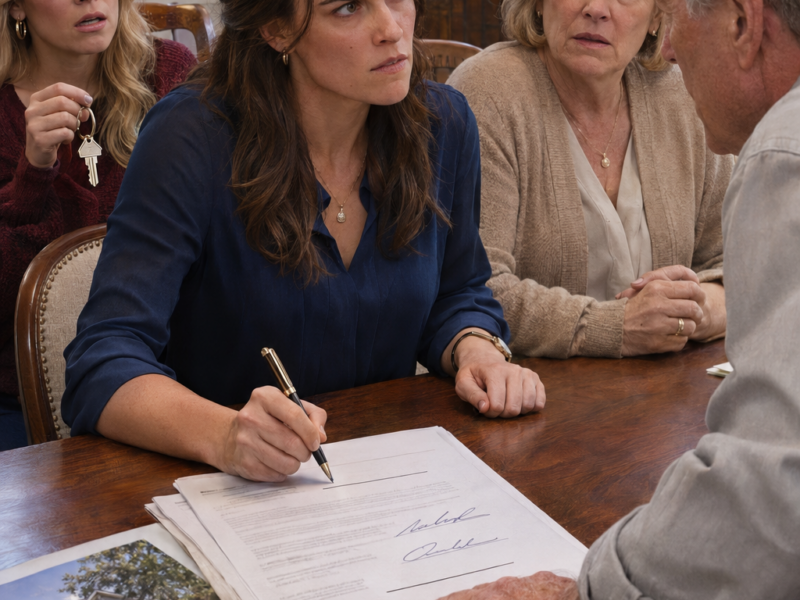
My Parents Signed Papers for My Sister’s House With My Inheritance—I Had One Signature Left
My Parents Signed Papers for My Sister’s House With My Inheritance—I Had One Signature Left
“Don’t worry,” my sister said, holding up the key to the house my parents were buying with my inheritance. “You can visit.”
It was my eighteenth birthday. My mother was serving potatoes. My father had just told me he’d already signed the papers, and the candles were still in their plastic sleeve beside the cake. In the light over the table, I could see that the little heart on Haley’s key ring was brass, just like the key.
“Keep it,” I said.
Dad’s shoulders dropped. He picked up his fork. I’d seen that look on him before, usually right after he handed me a bill he’d forgotten to pay and I told him I’d take care of it.
“You’ll need it at the meeting,” I said.
His fork stopped halfway to his plate. Across the table, Mom reached for the basket of rolls and passed it to Trent.
The cake had come from the grocery store on Bay Road, the one with the bakery counter by the entrance. Blue trim, white frosting, my name misspelled in gel. Mom had picked it up on her way home from the dental office and put it on the table without opening the lid. I’d noticed when I set out the plates. There were five of us, and I’d put mine at the end nearest the kitchen, where I always sat because it made clearing up easier.
Haley was twenty-three. She’d had her hair done that afternoon. When Mom tapped her glass with a knife and said they had big news, Haley turned her phone around to show me a living room with gray walls and curtains so new the folds still showed.
“A ranch on Weiss Street,” Dad said. “Three bedrooms. A hundred and seventy-six thousand, which in this market is a steal.”
He had both hands flat on the table. He always did that when he’d rehearsed something and was worried about getting through it in the right order.
Grandpa’s money had been sitting in the credit union for three years, he told me. Haley needed a fresh start. A house was an investment. The money would stay in the family. He’d signed the purchase papers. Closing was on the fifteenth. It was, in his words, “basically done.”
“You’re young,” Mom said, spooning potatoes onto Trent’s plate. “She needs it more.”
I let them get all the way through it. I even cut the cake afterward. The night before, I’d found a letter with my name spelled correctly.
It was in the recycling bin, torn in half. Every other Thursday I took the bin down to the curb because Dad could never remember which week the truck came. The two halves of the envelope were lying together under the lid, and the letter was still inside. I took it into the bathroom, locked the door, and taped it together on the counter.
The notice was dated August 21. It said the custodial account held for my benefit would terminate on September 4, 2026, my eighteenth birthday. After that, the account would be put in my name, and transactions would require my authorization. At the bottom was a phone number for the branch on Grace Street.
I’d read it three times. I knew it was about Grandpa’s money. I couldn’t figure out why anybody would go to the trouble of keeping me from knowing I was about to have access to it.
Then, over dinner the next night, Dad said “closing,” and I understood what he meant by basically.
After cake he asked me to come out on the porch. He leaned against the railing and told me that now that I was eighteen, there was a little paperwork. We’d swing by the credit union together Monday the fourteenth. I’d sign a form, and on Tuesday we’d go to the title office. He called it a family thing.
“It’s literally a formality,” Trent said. He’d followed us out with a beer.
“If it’s done,” I asked Dad, “why do you need me?”
He glanced through the screen door at Mom. “You know how banks are.”
I did. I’d been paying our bills since I was fifteen.
My grandfather’s name was Vernon Pruitt. He was Mom’s father, and he spent thirty-one years fixing trucks for Harland Freight Lines in Bay City. When I was a kid, I went to the shop with him on Saturdays. He had a red rolling toolbox taller than I was. There were twelve drawers and only one he kept locked.
“What’s in that one?” I asked him once.
“Paperwork,” he said. “Nobody cares about paperwork until they need it.”
When I was twelve he taught me to change the brake pads on his pickup. He did one side while I watched. Then he handed me the tools and drank his coffee while I did the other. Twice I looked over to see if he was going to get up. Both times he just took another sip. Later, when something came into the shop rattling so hard you could hear it from the dispatch office, he’d stand back with his arms crossed and tell me to find the part that was actually broken. A noise could travel a long way from where it started.
Loretta Mayberry ran dispatch. She made me coffee with so much milk in it that Grandpa said she ought to put it in a cereal bowl. She called him Vern. I never heard anyone else get away with that.
In the fall of 2021, when I was thirteen, he told me he was switching to nights. I asked whether we’d still have Saturdays. He said we’d see. At sixty-four, he had already worked enough winters in that shop to know how cold the concrete got before dawn. I remember thinking he’d be back on days by Christmas.
On January 17, 2023, a trailer jack failed while he was underneath it. The company called Mom at six in the morning. From my bedroom I heard the phone hit the kitchen floor.
Dad made the calls that week. He chose the funeral home and wrote the obituary while Mom sat at the table, still in the robe she’d been wearing when the call came. At the funeral, I stood in the back and watched relatives tell Haley how close she and Grandpa had been. I’d been holding myself together all morning. Then Loretta found me in the parking lot and handed me his brown canvas work jacket, and I had to sit in the car for a long time before I could go inside our house. The jacket still smelled like diesel and the orange soap he used on his hands. In the pocket was the business card Loretta had given me, with her cell number written underneath the dispatch number.
“He talked about you every shift,” she’d said. “If you ever need to know something about him, you call me.”
That March, the insurance letters arrived. Between the policy and what was left after the sale of Grandpa’s little house on Hoyt Street, there was $215,000. I saw that number once. I saw my name, too. He’d left all of it to me.
Because I was fourteen, an adult had to manage the money. Dad signed the custodial paperwork at our kitchen table. “Let your dad handle it,” Mom said. She still had trouble opening anything that came addressed to the estate.
By the time I was fifteen, I was the one calling the electric company about the disconnect notice. I made a chart on graph paper and taped it inside the cabinet above the microwave. Electric on the eighth. Water on the fifteenth. Mortgage on the first. There was one rule Dad made sure I remembered. Anything from the credit union went on the counter for him.
It felt like a fair division of labor at the time. He had his envelopes. I had the rest.
In March 2025, I came home from school and found one of his statements half out of its envelope. There was a withdrawal for $22,000 on March 11. That same week Haley pulled into the driveway in a silver Nissan Rogue with dealer plates. She left it crooked, blocking both sides of the garage, and stood beside it grinning.
“Dad says it’s an early birthday present,” she told me. “Don’t be weird about it.”
I took a picture of the statement and put it back where I’d found it. Over the next eighteen months, I came up with several explanations for what I’d seen. The one I liked best was that Dad had savings I didn’t know about. The one that required the least imagination was that he knew I wouldn’t ask.
On Labor Day, three days after my birthday, we went to grill at the house on Weiss Street. Haley had asked me to bring the folding chairs we used at Thanksgiving. I left them in the garage.
The house was a low brick ranch with a chain-link fence and a maple already dropping leaves. A television the size of a door leaned against the living room wall in its box. Trent showed me the curtains he’d hung. He brought them up again when we went out back, as if hanging curtains had given him some claim on the place.
I waited until he went inside for ketchup before I told Dad I wanted every statement from the account before I signed anything.
He moved a hot dog from one side of the grill to the other. “It’s going to your sister’s house. What is there to see?”
“The statements,” I said again.
Mom took me into the kitchen. Haley had quit the salon in July, she told me. Trent’s hours were unpredictable. Haley needed a foundation, something nobody could take away from her. Then she said what she’d been saying since I was little and wanted to know why Haley got driven to dance while I took the bus.
“You’ve always been fine on your own.”
When I was eight, my birthday party had been moved to the parking lot of the Civic Theater because Haley had a recital. There’s a picture of me smiling beside a cake on the hood of our car while three friends stand around in their coats. I can remember checking Mom’s face before I blew out the candles. She was watching the theater doors in case Haley came out.
In the kitchen on Weiss Street, I asked her why she’d torn up my letter.
“I didn’t want you to worry,” she said.
“What did you think would happen if I read it?”
She looked out the window. “Your father thought it went to twenty-one, like your cousins’ accounts.”
That was the first time either of them admitted the date mattered. A moment later she was telling me Dad could still move the money. He was the custodian, she said, as if it were a title he got to keep.
Haley called that night. She told me Trent would leave if I ruined this. He’d painted the bedroom. He had plans. If I pulled a stunt, she’d make sure everybody knew whose fault it was. When I stayed quiet, her voice softened. I could have the second bedroom, she said. She’d even put a lock on the door for me.
“Who’s in the third bedroom?”
She hung up.
The next morning, I called the credit union from my friend Grace’s car before school. Beverly Strand in member services confirmed that the custodianship had ended on my birthday. If I brought in my identification, she could finish putting the account in my name. Before we hung up, she mentioned a request submitted on August 25 for a cashier’s check covering most of the balance. The credit union had held it for review.
August 25. Four days after they mailed the letter Mom tore up.
The following morning, I was outside the branch ten minutes before it opened. Beverly took me to a desk away from the teller line. I signed a card. She signed underneath as a witness and gave me a stack of statements thick enough that she had to find a bigger envelope.
“Any future request has to come from you,” she said.
Grace picked me up at lunchtime. She ate a sandwich in the driver’s seat while I worked through the pages. The balance was a little over $177,000. I found the check for the Rogue first, payable to a Saginaw dealership. Then came six cash withdrawals between May and February. Two thousand here, three thousand there. Sixteen thousand altogether. I pulled up the calendar on my phone and checked the dates. Every one was a Monday.
There was also a $5,000 wire to Tri-County Title Agency on August 12. The account had earned some interest, enough to obscure part of what had gone out. That wire was the earnest money on Weiss Street. By the time Dad asked me to sign his one little form, he’d already put five thousand dollars of mine at risk.
I called the number on the receipt. Nancy Pelletier, the closer handling the sale, told me the buyer was listed as Glenn Wilson “and/or assigns,” which meant he could direct the deed to someone else at closing. The remaining $171,000, plus costs, had to arrive before ten on Tuesday. If it didn’t, the seller could keep the deposit. Nancy confirmed there was an agreement allowing Haley to move in early, though she couldn’t share the terms with me.
Afterward, Grace asked if I wanted her to drive me home.
“School,” I said.
I spent fifth period with the envelope in my backpack under my chair, thinking that I could lose five thousand dollars by doing nothing. I could also spend a hundred and seventy-one thousand trying to save it. For years I’d been good at figuring out what a bill was going to cost if we ignored it. I’d never had to put a number on what paying it would cost me.
The next night I came home to find the garage light on. Through a gap in the door I could see Trent on an overturned bucket and Dad at his workbench.
“When we all move in,” Trent said, “the TV goes in the living room. I’m watching the game in there.”
Dad told him to keep his voice down.
“Relax. She’s signing. Pam said she always does.”
I stood there until Trent went inside. Dad stayed at the bench with both hands planted on the wood. I went upstairs and lay on my bed in my shoes, listening to my mother run water in the kitchen, wondering how long she’d known where she was going to live.
The next morning, I opened the drawer in Dad’s workbench where he kept his mail. On top was a foreclosure notice for our address. The sale was set for September 24 at ten in the morning on the courthouse steps. Under it was a stack of notices dating back to December. I’d been writing mortgage on the first on my chart for months while Dad took the envelopes that would have told me otherwise.
I found the occupancy agreement in the same drawer. Haley had permission to move in September 1. If the sale fell through, she had seventy-two hours to vacate and return the keys.
That evening, I put the foreclosure notice in front of Mom. She read the first line and pushed her coffee away.
“Yes,” she said finally. All four of them were moving in after the sale. The house had to be in Haley’s name, she explained, because she and Dad were worried about their creditors.
“And where do I sleep?”
She took her time answering. She’d measured the living room. The curtains had blackout lining. We could put up a folding screen, and it would feel like my own little apartment until I left for college.
She said that last part with a kind of eagerness. I could picture her standing in the empty room with a tape measure, making sure the couch would fit. I wondered whether Trent knew where she planned to put the screen when he wanted to watch a game.
I asked her about the six cash withdrawals. She picked up her coffee again.
“Ask your father.”
The family iPad was on its charger by the microwave. I’d set it up years earlier so Mom could video call my aunt. Dad used it, too, and the notifications from his betting app were right there. Deposit confirmed. Your bet has been settled. Deposit confirmed. I matched the dates against the statements. Six Mondays, six deposits. The amounts varied a little. The dates held.
Dad came in while I was standing at the counter with the iPad. He saw what I was holding, looked at me, and went upstairs.
That night I wrote an email to Nancy saying I’d authorize the wire.
I could see how it would go if I refused. Haley would be out in three days. Trent would leave, or Haley would spend the next year waiting for him to leave. My parents would lose the house I’d grown up in. My aunt in Flint, who’d already congratulated Haley on Facebook, would hear about it from Mom. I could imagine facing all of that. What I couldn’t imagine was Grandpa standing in front of a problem he could afford to fix and walking away.
Grace texted while I was still sitting there. You don’t owe them anything.
I know, I wrote back. But I owe him.
The cursor was over Send. I remember moving my hand off the mouse and looking around my room. From the window I could see the wall of the neighbor’s garage, the same view I’d had at nine when Mom told me Haley needed the room with the maple because Haley needed the light.
Grandpa had put one name on the policy. I’d spent hours trying to figure out what he would do, and I’d never asked why he’d done that.
I left the email in drafts and went down to the garage for his jacket. Loretta’s card was still in the pocket, the corners soft and the blue ink faded. She picked up on the second ring.
“Emily,” she said.
I told her about the house, the money, and the email.
“Your grandpa left something with me,” she said when I finished. “He said you’d know when to ask.”
“Ask what?”
“Why he put your name on it.” She was quiet for a moment. “Come tomorrow. Bring somebody to drive you home.”
Grace drove me to Bay City. Loretta lived in a small brick house with a detached garage. She walked straight past the front door and lifted the garage door herself. There, next to the snowblower, was Grandpa’s red toolbox.
Harland had been going to scrap it, she told me. Mom had said they could do whatever they wanted with his things. Loretta paid a dollar for the box and brought it home in her brother’s truck. She took a small key off a nail and opened the bottom drawer.
The first thing inside was a sheet of graph paper dated October 9, 2021. I knew Grandpa’s handwriting from my birthday cards. He’d written that he was paying $31,000 on Glenn Wilson’s behalf. It was the second time and the last time. In return, everything he owned and everything he left behind would go to Emily Wilson alone. He’d written out the names of the people who were to receive none of it. Glenn. Pam. Haley.
Under Grandpa’s name was Dad’s signature, slanting left, just like the note he’d left on the counter telling me to wear something nice to the closing.
At the bottom, in blue ink, was Mom’s.
I read it three times.
“She was there?” I asked.
“She washed the dishes,” Loretta said. “Then she signed. He told me about it at work the next night.”
The first time, in 2019, Grandpa had covered $11,500. The second time, people had started calling the house. He’d taken the $31,000 out of his savings. There was almost nothing left afterward.
The second thing in the drawer was a copy of an employee benefits form dated November 15, 2021. He already had a basic life insurance policy. This form elected another $160,000 in coverage, the maximum the company offered. Where it asked for a beneficiary, he’d put Emily R. Wilson, granddaughter, one hundred percent.
“He took nights for the shift differential,” Loretta said. “Paid the premium out of every check. He told me he had to build your part back up.”
Fourteen months. I could picture him getting dressed in the dark, pulling that jacket off a hook and going out to a truck with frost on the windshield. I’d thought he gave up Saturdays because the company needed him on a different shift. He’d died at three in the morning on a shift he’d chosen so he could afford to leave me something of my own.
I rested my hand on the edge of the drawer. The red paint was worn smooth where his fingers had pulled it open.
The third thing was a sealed envelope. He’d written two words on the front.
Emily. When.
Loretta told me to take it home. I put it in the inside pocket of his jacket. I had enough of his handwriting to get through that day.
I called Nancy and told her I wouldn’t authorize the wire. She said I didn’t have to come to the closing. I told her I’d be there. By then I wanted to meet the person on the other side of the table. I knew how much my family needed her house. I wanted to know what they’d told her to get it.
On Sunday Mom made pot roast for the first time since Grandpa died. Dad asked about school. Halfway through dinner, Haley sent me a text telling me to wear something cute. I washed the dishes afterward, and Mom dried. When I was going upstairs, I heard Dad say, “See? Told you she’d come around.”
Monday morning he texted me a picture of the credit union from his truck. Here when you are.
I was already at school. I’ll meet you at the title office tomorrow, I wrote.
By the end of second period there were eleven missed calls. Dad left a voicemail saying he could still fix it if I’d call him back. Mom wrote, Don’t do this. Haley wrote, You’re dead to me.
In fourth period, the credit union called. A man at the branch told me someone had submitted a request at the counter to wire $171,000 to Tri-County Title. Policy required a callback to the owner. Had I authorized it?
“No,” I said.
He thanked me and said the request would be declined. Dad had gone inside and filled out the form anyway. I stood in the hall for a minute after the call ended. Then I put my phone in my pocket and went back to class.
I wore my black funeral dress on Tuesday. Nancy met me at the door and seated me beside her. Dad was in his good shirt. Mom had taken care with her makeup. Trent had one ankle propped on his knee, and Haley’s brass key sat on the table in front of her.
At the other end was Irene Costello, who’d owned the house for forty years. She wore a lavender cardigan. Her daughter had driven her up from Grand Rapids, and her listing agent, Doug Ferrante, sat beside them with a leather folder on his lap.
Mrs. Costello leaned over and patted Haley’s hand. “I had a higher offer, you know. Your mother told me you were starting over on your own. I was twenty-six when I had to do that.”
Haley thanked her. Dad looked at his watch.
Nancy opened her folder and said the funds hadn’t arrived. Dad took out his phone so quickly I knew he’d been waiting for that exact sentence.
“Mix-up at the credit union,” he said. “Give me two minutes.”
He scrolled through the app, looking for an account he already knew wasn’t there. Then he called the branch, put the phone on speaker, and recited the account number from memory.
“I’m the custodian,” he told Beverly.
“The custodianship ended September fourth,” she said. “The owner of record is Emily Wilson.”
Everyone turned to look at me.
“She’s here,” I said.
Nancy put the earnest money receipt on the table and turned it so Dad could read the account title. “Is the balance coming from this account?”
“There won’t be a wire,” I said.
Dad put both palms on the table. “Emily. This is your sister’s home.”
I looked at the woman in the lavender cardigan. “It’s Mrs. Costello’s home.”
Trent stood. “So where are we supposed to live?”
Mrs. Costello looked at Mom. “We?”
Mom began explaining. It was temporary. Haley would be on the deed. The rest of them would just be helping out until things settled. Doug closed his folder. He said he’d pulled the public foreclosure notice that morning. He gave the date of the sale and asked Mom whether she’d told his client any of this before Irene turned down the other offer.
“You told me she’d be alone,” Mrs. Costello said. She looked down at the hand she’d put over Haley’s a few minutes earlier.
Dad raised his voice. Grandpa wanted the family taken care of, he said. The money had been sitting there for three years. Grandpa would have wanted him to use it.
I took the graph paper out of Grace’s folder and slid it toward him.
“October ninth,” I said. “You remember?”
He didn’t touch it. Haley leaned over far enough to read her own name. Mom put a hand over her mouth before I got to the signature in blue ink.
I told them about the $11,500 and the $31,000. I told them what Grandpa had done at open enrollment a month later, how much coverage he bought and whose name he put on the form. I told Dad about the extra pay for nights. Until that morning, I’d never said the hour Grandpa died out loud in front of him.
“Three in the morning,” I said. “He was there because he was trying to replace what you’d borrowed.”
Dad stared at the table. “That’s a piece of notebook paper. It isn’t a legal document.”
“I brought it because you keep telling people what he wanted.”
That was all I needed from him. I looked at Haley, then at the key she’d brought to my birthday dinner.
“Mrs. Costello needs that back,” I said.
Haley kept her finger on the ring for a second. Then she pushed it down the table. It slid past the receipt and stopped in front of Mrs. Costello, who put it in her cardigan pocket.
Nancy closed the file. I thanked Mrs. Costello and walked out. Grace was waiting in the parking lot with the engine running. She unlocked the passenger door as soon as she saw me.
Doug called the next morning. Mrs. Costello was keeping the $5,000 under the purchase agreement. She also asked him to tell me she wished she’d asked more questions. I told him she’d had every reason to believe what she’d been told. I’d believed the same people for eighteen years.
Haley and Trent cleared the house in two days. He carried the big television out himself and loaded it into his car. By the time the seventy-two hours ran out, he’d gone to his brother’s. Haley came back with her suitcases and shut herself in the room that looked out at the maple.
Dad found me in the garage on Saturday. He told me about the betting app, how it started with small amounts, how much time he’d spent on it after his hours got cut, how close he’d been a couple of times to winning enough to put the money back.
“With what?” I asked.
He looked out at the silver Rogue. There was a dent in the bumper now. Then he asked whether I was going to sue him.
I’d looked up enough to know what a claim would cost me and what I might recover from a man about to lose his house. I told him I wouldn’t. He let out a long breath. He’d been standing there for twenty minutes by then. It was the only answer he’d come for.
On Sunday, Mom washed the dishes while I dried. She told me how Grandpa had come to the house with a cashier’s check in his shirt pocket. He’d read every line of the agreement out loud. When Dad was finished signing, Grandpa held the pen out to her.
“‘You’re her mother,’ he said. ‘You sign.’” She handed me a glass. “I thought he was making a point. I didn’t think he’d really pick you over all of us.”
I put the glass away. “I think he knew what would happen if he left it up to you.”
She stood with her hands in the water. After a while, she asked where I was going to go.
I moved the money to a bank Dad had never used. Then I called the landlord of a two-bedroom apartment on Court Street that Mom had been looking at. He wanted first month, last month, a deposit, and six more months up front after he ran Dad’s name. I paid him $10,800 directly by cashier’s check. The lease went in my parents’ names. They could move in October 1.
Mom asked me why when I handed her the lease.
“I want to be able to leave without wondering where you’re going to sleep,” I said. “And I want you to know this came from me.”
The bank bought the house at the sheriff’s sale on September 24. My parents had time before they had to leave, but they decided to take the apartment as soon as it was ready. I packed the next day. I took the graph-paper chart down from the cabinet, held it for a minute, and taped it back up. The water bill was still due on the fifteenth.
Haley stood in my doorway while I taped my last box. “Was it worth it?”
“Ask me in a year.”
She picked at the paint on the doorframe. “Trent’s gone.”
“I know,” I said. “I’m sorry.”
I was. She’d been promised a life in that house, and for a couple of weeks she got to walk through the front door and believe in it. I could feel sorry for her without giving her the money to get it back.
Grace pulled into the driveway. I carried the first box down myself.
Loretta’s spare room looked out on her garage. We agreed on three hundred dollars a month after I insisted on paying rent. I’d get to school with Grace when she could drive and take the bus when she couldn’t. On Saturdays I’d work the dispatch desk at Harland. Loretta said the manager remembered Grandpa and wanted to know if I could start the following week.
“Rent’s due on the first,” she said the evening I moved in. She handed me a key and showed me which kitchen drawer stuck. Then she went to find a lamp for the room.
On Sunday, September 27, while Loretta was at church, I opened Grandpa’s letter at her kitchen table. The date at the top was November 2021. He’d written it on the same graph paper as the agreement.
The first time he gave Dad money, he wrote, he’d done it for Mom. The second time, he did it for me. He wanted me to have a house where I could eat dinner without hearing what the adults were afraid to say to each other. He didn’t regret giving them the money. He regretted that I might have to learn why he’d made them sign.
Don’t be mad at your mom for signing, he wrote. Be mad at her if she forgets it.
He told me about the insurance. He hoped someone at a bank would look after it until I was eighteen. He knew he couldn’t make sure of everything from where he was. Then, in the same block letters he used to label the drawers in his toolbox, he wrote that the money was so I’d have a choice when somebody came to me with a problem they’d made themselves.
He remembered the brake pads. He remembered that I’d asked him to teach me, and that after he did the first side, I did the second one myself. I had spent years thinking the proudest I ever made him was when I could do a job without help. Sitting at Loretta’s table, I remembered how long he’d stayed beside me while I learned it. I remembered the cold coffee he finally got up to throw away when I was done.
I folded the letter along his creases and took it to the garage in my socks. The bottom drawer opened without a sound. I put the letter beside the insurance form and the agreement, locked the drawer, and hung the key back on its nail. Then I sat on the step in the morning light until Loretta came home.
She dropped me at school at 6:45 the next morning, on her way to the shop. I was wearing his jacket. Mom had sent me five words the night before. Thank you for the rent. I’d read them and left the phone on the nightstand.
Outside school, I reached into the jacket pocket for my own key. My fingers found Loretta’s old card first. The ink had almost worn off. I slipped it back into the pocket, got out of the car, and waved to her before she pulled away. I had time before the doors opened, so I sat down on the low brick wall by the entrance, my key warm in my hand.