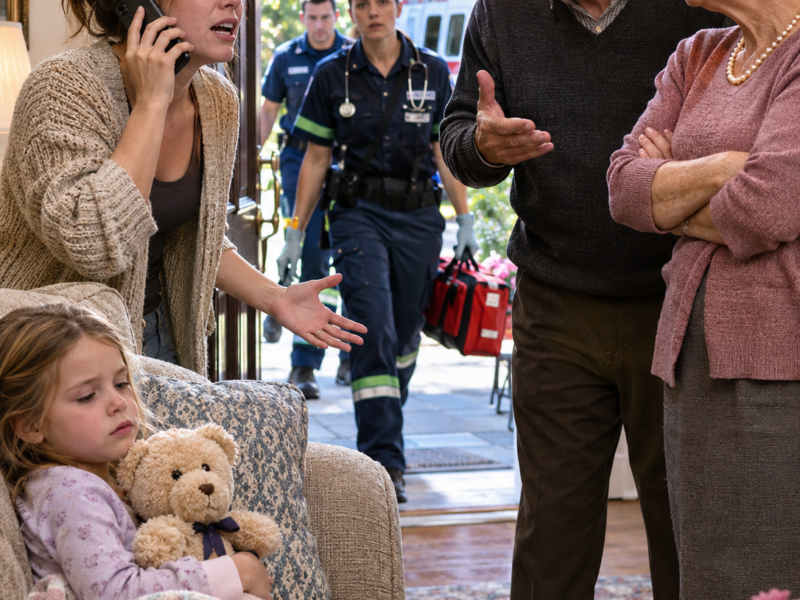
My Parents Refused to Take My 4-Year-Old Daughter to the Emergency Room While I Was Away for Work, Insisting She Was Just Being Dramatic. “We Have the Other Children Here,” My Father Said Before Hanging Up on Me. Forty-Seven Minutes Later, My Babysitter Called 911, and I Heard My Little Girl Struggling to Breathe Over the Phone. When I Finally Reached the Hospital, I Discovered My Parents Had Been Keeping a $1,100-a-Month Arrangement With My Sister a Secret—but Nothing Prepared Me for What My Mother Had Told Her Behind My Back…
My Parents Refused to Take My 4-Year-Old Daughter to the Emergency Room While I Was Away for Work, Insisting She Was Just Being Dramatic. “We Have the Other Children Here,” My Father Said Before Hanging Up on Me. Forty-Seven Minutes Later, My Babysitter Called 911, and I Heard My Little Girl Struggling to Breathe Over the Phone. When I Finally Reached the Hospital, I Discovered My Parents Had Been Keeping a $1,100-a-Month Arrangement With My Sister a Secret—but Nothing Prepared Me for What My Mother Had Told Her Behind My Back…
The first time my mother told me my four-year-old daughter was being dramatic, I was sitting in a conference room three hours away, trying to concentrate on a presentation that was supposed to help me get promoted.
Forty-seven minutes later, I was pulled over on the shoulder of Interstate 85, shaking so badly I could barely hold my phone, while a babysitter I had hired for three afternoons a week told me paramedics were trying to save my little girl’s life.
I could hear people shouting instructions in the background. There was a strange electronic beeping, the sound of equipment being moved, and somewhere beneath all of it, a tiny, frightened voice that I would have recognized anywhere.
My daughter was trying to call for me.
“Mommy…”
It was barely a whisper.
I pressed the phone against my ear and said her name so loudly that the babysitter had to tell me to calm down.
“Lucy, sweetheart, Mommy’s here. I’m coming. Just hold on, baby. Please hold on.”
But Lucy couldn’t answer.
And the most horrifying part was that less than an hour earlier, I had begged both my parents to take her to the emergency room.
My mother had laughed at me.
My father had told me everything was under control.
Neither one had taken her.
At the time, I thought they had simply made a terrible mistake. I thought they had underestimated how sick she was, and I wanted desperately to believe that once they understood what had happened, they would be devastated.
What I discovered over the following days was much worse.
My parents had known I wanted Lucy taken to the hospital. They had deliberately ignored me, lied about what I said, and planned to make my daughter wait several more hours for medical attention.
All because of a promise they had made to my younger sister.
A promise involving $1,100 a month, two other grandchildren, and an afternoon activity they apparently considered more important than my daughter’s life.
My name is Hannah Mercer. I was thirty-one years old when this happened, living with my daughter Lucy in a small rented duplex outside Charlotte, North Carolina.
Lucy was four, with enormous brown eyes, perpetually tangled hair, and an imagination that turned almost anything into an adventure. She had a purple stuffed rabbit named Pickles, whom she considered a full member of our household. Pickles had his own imaginary birthday, his own seat at our kitchen table, and, according to Lucy, very specific opinions about vegetables.
She was the kind of child who could spend twenty minutes examining a ladybug on the sidewalk and then ask me six questions about where ladybugs went when it rained.
Every morning, she wanted her toast cut into triangles. Every evening, she insisted on choosing which pajamas Pickles would approve of. And every Friday night, we had what she called our “fancy movie dinner,” which usually involved frozen pizza, sliced strawberries, and blankets spread across the living room floor.
We didn’t have much money, but we had a good life.
I worked in the billing department of a regional medical supply company. The work was repetitive and sometimes stressful, but the benefits were decent, and I had spent years building a reputation as someone who could be trusted to get things done.
Lucy’s father and I had separated when she was a baby. He lived several states away, sent child support inconsistently despite our legal arrangement, and rarely followed through on promises to visit.
Eventually, I stopped telling Lucy he was coming unless I knew he was already on his way.
I couldn’t control his decisions, but I could protect her from spending entire Saturdays watching the front window for someone who never arrived.
For the most part, it was just the two of us.
I handled preschool drop-offs, doctor appointments, groceries, laundry, birthday parties, and the endless little responsibilities that fill a parent’s day. I kept emergency cash hidden in a kitchen drawer, bought children’s clothes when they were on clearance, and had learned how to stretch a single rotisserie chicken into three different meals.
I was proud of the life I had built.
But being a single parent also meant there were days when I genuinely needed help.
That was where my parents came in.
Diane and Robert Walsh lived about twenty minutes away in the house where my younger sister Brooke and I had grown up. It was a comfortable brick ranch with a large kitchen, a sunroom full of plants, and a backyard where my father had built a wooden swing set years earlier.
To anyone looking from the outside, my parents seemed like wonderful grandparents.
My mother baked elaborate birthday cakes and posted photographs of the grandchildren on Facebook. My father attended school performances whenever he could and could repair practically any toy that stopped working.
At Christmas, they decorated their house so thoroughly that neighborhood children came to look at the lights.
People were always telling me how fortunate I was to have such devoted parents nearby.
I used to agree.
What I didn’t tell people was that my parents had very different standards when it came to helping their two daughters.
Brooke was twenty-eight, married to a man named Tyler, and had two children, eight-year-old Owen and six-year-old Ellie.
Brooke worked at a dental practice, while Tyler worked long hours for a delivery company. Their schedules were busy, and my mother seemed to consider every inconvenience in their household a personal emergency.
If Brooke needed someone to collect the children from school, my father rearranged his afternoon.
If Ellie forgot her lunch, my mother delivered it.
If Owen had a soccer game at the same time as Brooke’s appointment, one of my parents attended the game without being asked twice.
Meanwhile, if I needed someone to watch Lucy for two hours while I worked late, my mother usually responded with a sigh.
“Hannah, you have to learn to plan better.”
Or she would say the sentence I had heard so many times that I could practically recite it with her.
“Brooke has two children. You only have one.”
As if children were units in some mathematical equation and having fewer of them meant I was entitled to less support.
For years, I made excuses for the difference.
Brooke was younger. Her schedule was more complicated. Her children had activities. I was organized, independent, and supposedly good at handling things.
My mother often described me as her “capable daughter.”
I had once thought it was a compliment.
Eventually, I realized it was also a convenient reason to expect more from me while offering less in return.
Thankfully, I had another person in our lives whom I trusted completely.
Her name was Maya Ortiz.
Maya was twenty-four, studying early childhood education, and had started babysitting Lucy the previous year after a colleague recommended her.
She watched Lucy on Monday, Wednesday, and Friday afternoons, as well as occasional evenings when I had to stay late at work.
She was patient in a way that never seemed forced.
When Lucy wanted to build a cardboard castle, Maya helped her find boxes. When Lucy became upset because she couldn’t draw a horse properly, Maya sat beside her and showed her how to begin with simple shapes.
She never dismissed Lucy’s feelings just because she was little.
Once, when Lucy accidentally broke a ceramic bowl, Maya didn’t scold her. She moved her away from the broken pieces, cleaned everything up, and then calmly explained why she should never touch sharp fragments.
Lucy adored her.
And although I didn’t know it then, trusting Maya would turn out to be one of the most important decisions I ever made.
Everything began in early October.
Lucy’s preschool announced that a heating problem would force two classrooms to close temporarily. Unfortunately, the closure overlapped with a mandatory two-day training session I was scheduled to attend at our company’s Greenville office in South Carolina.
The training mattered.
My supervisor had recommended me for a senior billing coordinator position, and completing the program was one of the requirements.
The promotion would mean better pay and more predictable working hours. For someone raising a child alone, those weren’t small things.
I immediately started trying to arrange child care.
Maya could cover the afternoons, but she had college classes until 1:30. I considered taking unpaid leave, but that would have meant missing the training entirely.
I even researched temporary child care near Greenville, although the cost made my stomach sink.
Then my mother called.
When I explained the situation, she sounded almost offended that I hadn’t asked her first.
“For heaven’s sake, Hannah. Your father and I are home. Just bring Lucy here.”
I hesitated.
“Are you sure? I don’t want to interfere with anything you already have planned.”
“What could we possibly have planned that’s more important than our granddaughter?”
I remember those exact words.
They returned to me many times afterward.
I asked whether she was helping Brooke with Owen and Ellie.
My mother sounded irritated.
“Honestly, Hannah, must everything be so complicated? Do you want help or not?”
So I accepted.
We agreed that I would drop Lucy off early Thursday morning. My parents would keep her until Maya arrived at 1:30, and Maya would take her back to my house.
I repeated the pickup time twice.
My mother assured me that everything was arranged.
On Wednesday night, I packed Lucy’s bag with extra clothes, her blue water bottle, a coloring book, her favorite blanket, and Pickles.
Lucy sat on my bed watching me.
“Mommy?”
“Yes, Bug?”
“Do I have to go to Grandma’s?”
Something in her voice made me stop folding.
“It’s only for a little while. Maya will come after lunch.”
Lucy picked at a loose thread on her blanket.
“Grandma says I ask too many questions.”
I frowned.
“When did she say that?”
“When I asked why Owen and Ellie got to watch the big television.”
I crouched beside her.
“Did something else happen?”
Lucy shrugged.
“Grandma says they’re bigger.”
I told myself it was ordinary grandparent frustration. Three young children could be exhausting, especially when two were older and louder than the third.
“Well, you can ask questions here whenever you want,” I said.
She looked up.
“Even silly ones?”
“Especially silly ones.”
She smiled and handed me Pickles.
“He needs his seat belt tomorrow.”
I promised to buckle him in.
The next morning, I arrived at my parents’ house at 6:15.
The sun hadn’t risen yet. The kitchen windows glowed warmly, and my mother opened the front door wearing slippers and a gray cardigan.
She had made pancakes.
Lucy’s favorite pink cup was waiting on the table.
“See?” Mom whispered. “She’s going to have a wonderful day.”
My father came in from the garage and lifted Lucy into his arms.
“There’s my favorite little troublemaker.”
Lucy giggled.
He kissed her cheek and told me to drive carefully.
I watched my daughter settle at the kitchen table, with Pickles beside her and a pancake on her plate.
Then I kissed her forehead, told her I loved her, and drove away.
I had no reason to imagine that less than six hours later, she would be fighting for her life.
At 9:30, while I was sitting through a presentation about medical billing compliance, my phone vibrated.
My mother had sent a photograph.
Lucy was lying on the living room couch under her little blanket.
She was wearing the pink pajamas I had packed as backup clothes, and her hair looked damp around her forehead.
Underneath the picture, Mom had written, “She’s being lazy today. Maybe you let her stay up too late.”
I stared at the photograph.
Lucy wasn’t lazy.
She was the kind of child who woke me up on Saturdays because she wanted to know whether the birds were already eating breakfast.
I typed back, “She went to bed at 8:30. Is she feeling okay?”
Mom replied, “She’s fine. Just wants attention.”
I asked her to call me.
She didn’t.
At 10:15, during our first break, I called her myself.
The television was loud in the background. I could hear children arguing, and someone was complaining about a missing shoe.
“How’s Lucy?” I asked.
“She’s resting.”
“Can I speak to her?”
“She’s asleep.”
I looked at my watch.
“Mom, it’s after ten. She never sleeps this late unless she’s sick.”
“Children get tired, Hannah.”
“Has she eaten anything?”
“A little.”
“Is she drinking water?”
My mother gave an irritated laugh.
“Constantly. She’s been asking for water every five minutes. Honestly, I don’t know where she puts it.”
I felt a small cold sensation in my stomach.
For the previous week, Lucy had been drinking more than usual.
Twice, she had woken me in the middle of the night asking for water. She’d also had a couple of nighttime accidents after months of staying dry.
I had assumed it was a temporary phase.
She had been excited about Halloween, and her preschool teacher had mentioned that several children were going through similar sleep disruptions.
Still, the photograph bothered me.
“Can you take her temperature?”
My mother sighed.
“Hannah, I’m not running a hospital.”
“I’m just asking you to check.”
“She doesn’t feel warm.”
“Please keep an eye on her. And call Maya if you need help.”
“We’re perfectly capable of looking after a four-year-old.”
I apologized.
I still hate remembering that I apologized.
At 11:07, another message appeared.
“Lucy threw up. Cleaned her up. Probably a stomach bug. Don’t panic.”
I immediately left the training room and called.
My mother answered after several rings.
“Mom, I need to talk to Lucy.”
“She’s resting.”
“Put her on the phone.”
“Hannah—”
“Please.”
There was a long pause, followed by muffled movement.
Then I heard my daughter’s voice.
“Mommy?”
She sounded wrong.
There is no other way to describe it.
Her voice was slow and heavy, almost as though she were struggling to stay awake long enough to finish a sentence.
“Hi, sweetheart. What’s hurting?”
“My tummy.”
“Where does it hurt?”
“Everywhere.”
I swallowed.
“Are you having trouble breathing?”
Before she could answer, my mother took the phone.
“You’re upsetting her. She just needs sleep.”
“Mom, I want you to take her to the emergency room.”
Silence.
Then a short, disbelieving laugh.
“For a stomachache?”
“She’s vomiting. She sounds confused. She’s not acting normally.”
“Children get stomach bugs.”
“I know. But I want a doctor to examine her.”
My mother’s tone changed.
“You left her with us because you needed help, Hannah. You don’t get to call every hour and criticize everything we do.”
“I’m not criticizing you. I’m asking you to get medical help for my child.”
“You’re being hysterical.”
“Then let me be hysterical. Take her.”
“Call your father if you’re going to act like this.”
She hung up.
I called my father twice.
He didn’t answer.
I sent both of them a text.
“Please take Lucy to the ER immediately. Don’t wait for me. Call when you’re on your way.”
A minute later, my father responded.
“Your mother says it’s a stomach bug. We’re watching her.”
I typed back, “She can barely talk. Please, Dad.”
His reply arrived almost immediately.
“We can’t just leave right now. Everything is under control.”
I stood in the hallway staring at those words.
What did he mean they couldn’t leave?
They had two vehicles. They were both home. The emergency department was about twenty minutes away.
I had left them Lucy’s insurance information and everything they might need.
There was no reasonable explanation.
I called Maya.
She answered on the first ring.
“Hey, Hannah. Everything okay?”
“No. Lucy’s sick, and my parents won’t take her to the hospital.”
Her voice became serious.
“What symptoms?”
I told her everything.
“Can you go there early? Please? I need someone to look at her.”
“My class ended early. I can leave right now.”
“If she’s having trouble breathing, call 911. Don’t ask my parents. Don’t wait for permission.”
“I understand.”
I told my supervisor there was an emergency and left the training session.
By 11:40, I was driving north on Interstate 85.
I called my father again.
This time he answered.
“Dad, please tell me you’re taking Lucy.”
He sounded annoyed.
“Your mother’s with her. She’s sleeping.”
“She shouldn’t be this difficult to wake up.”
“Hannah, you’re making everyone nervous.”
“Then be nervous. Just get her checked.”
He sighed.
“We have the other children here.”
I gripped the steering wheel.
“What other children?”
“Owen and Ellie.”
“Why are they there? Aren’t they at school?”
“It’s a teacher workday. Your mother has plans with them.”
I couldn’t believe what I was hearing.
“What plans?”
“That’s not important.”
“Apparently it is, because you’re using it as a reason not to take my daughter to the hospital.”
“Hannah, we’re not having this conversation while you’re driving.”
“Dad—”
He disconnected the call.
I wanted to scream.
Instead, I kept driving, watching the road ahead while my mind raced through possibilities I didn’t want to consider.
At 11:54, Maya called.
“Hannah, listen carefully. I’ve called 911.”
Everything inside me seemed to stop.
“Why? What’s happening?”
“Lucy is very sick. She’s breathing hard, and she’s barely responding. The paramedics are here.”
I could hear unfamiliar voices in the background.
Someone asked about her medical history.
Another person mentioned checking her blood sugar.
“Is she conscious?” I whispered.
“She’s opening her eyes sometimes.”
“Can she hear me?”
“I think so.”
Then I heard a small sound.
It was Lucy.
I knew it was her even before Maya said anything.
“Mommy…”
I nearly lost control of the car.
I pulled onto the shoulder, turned on my hazard lights, and pressed my forehead against the steering wheel.
“Baby, I’m coming. Mommy’s coming.”
Maya spoke again.
“They’re taking her to St. Mary’s Children’s Emergency Department. I’ll go with them.”
I don’t remember much of the next half hour.
I remember the traffic.
I remember a highway sign.
I remember calling the hospital and being transferred twice before someone could confirm where Lucy was being taken.
And I remember the horrible, helpless realization that I couldn’t reach my daughter quickly enough.
At 12:26, Maya texted that they had arrived.
At 12:32, she told me a doctor would be calling.
The call came almost immediately.
“Ms. Mercer? This is Dr. Nikhil Patel from the pediatric emergency department.”
I pulled into a rest area.
“Is Lucy alive?”
“Your daughter is receiving treatment. She’s very ill, but we’re working to stabilize her. I need to ask you some questions.”
He asked whether Lucy had ever been diagnosed with diabetes.
I said no.
He asked whether she had been unusually thirsty.
Yes.
Urinating more frequently?
Yes.
Losing weight?
I thought about the way her leggings had seemed looser recently.
Possibly.
Complaining of stomach pain?
Yes.
Then he explained that Lucy appeared to be experiencing diabetic ketoacidosis, a serious condition caused by a severe shortage of insulin.
Her blood sugar was extremely high, and her body had begun producing dangerous levels of acids called ketones.
The doctors suspected that she had previously undiagnosed type 1 diabetes.
I listened to the explanation, but one question drowned out everything else.
“Is she going to die?”
The doctor paused.
“We are treating her urgently. She’s in the right place now, and we’ll be monitoring her very closely.”
It wasn’t the reassurance I wanted.
But he wasn’t going to lie to me.
Then he asked something that made my blood run cold.
“The caregivers reported that her symptoms began suddenly. Her babysitter provided a different timeline. Do you know when Lucy first became unwell?”
I told him about the photograph at 9:30.
The call at 10:15.
The vomiting at 11:07.
And my repeated requests that my parents take her to the hospital.
“Did they do that?” he asked.
“No. Her babysitter called the ambulance.”
There was a brief silence.
“Thank you for explaining. We’ll document the timeline.”
I reached the hospital shortly after 1:30.
Maya was waiting in a consultation room, holding Pickles in both hands.
The moment I saw that purple rabbit, I started crying.
Maya stood and hugged me.
“She’s alive,” she said immediately. “She’s in pediatric intensive care. They’re treating her.”
I clung to her.
“Thank you for going there.”
She pulled back just enough to look at me.
“Hannah, of course I went. She’s Lucy.”
Then her expression changed.
“But there’s something you need to know.”
Maya told me she’d arrived at my parents’ house around 11:45.
Brooke’s silver SUV was parked in the driveway.
My father’s truck was behind it.
When Maya rang the doorbell, my mother opened it only a few inches.
“Why are you here?”
“Hannah asked me to come early.”
“Well, Lucy’s asleep. Come back later.”
Maya insisted on seeing her.
My mother tried to explain that Lucy had been cranky, jealous of the older children, and difficult all morning.
Then Maya heard Lucy breathing.
She described it as a deep, rapid, labored sound, almost like someone who had been running for a very long time.
She pushed past my mother.
Lucy was curled on the couch, pale and limp, clutching her blue water bottle.
Her lips looked dry.
She could barely open her eyes.
Maya immediately knew something was seriously wrong.
She asked my mother when Lucy had last used the bathroom.
Mom didn’t know.
She asked whether Lucy had kept down any water.
Mom said she’d stopped offering it because Lucy kept vomiting.
Then Maya asked why they hadn’t taken her to the hospital.
My mother’s answer was something I would never forget.
“I have three children here today. I can’t drop everything because Hannah gets nervous.”
Maya called 911.
According to her, my mother complained that she was creating unnecessary drama.
When the paramedics arrived, my father asked whether the ambulance was really necessary because he could drive Lucy later.
One of the paramedics told him plainly that she needed medical care immediately.
My parents stayed at the house.
Neither rode with Lucy.
Neither followed the ambulance.
They remained with Owen and Ellie because Brooke wasn’t supposed to collect them until six.
I sat in the consultation room, trying to understand how two people who had raised me could watch my daughter being carried into an ambulance and still decide their other grandchildren needed them more.
Eventually, a nurse escorted me to the intensive care unit.
Lucy looked impossibly small in the hospital bed.
There were wires on her chest, an IV in her arm, and machines beside her that displayed numbers I didn’t understand.
Her skin looked pale beneath the fluorescent lights.
I placed Pickles near her pillow and carefully took her hand.
“Hi, Bug. Mommy’s here.”
Her eyelids fluttered.
For one brief moment, she looked at me.
“Home?” she whispered.
I leaned forward and kissed her forehead.
“Not yet, sweetheart. First, we have to help you feel better.”
I wanted to promise her that everything would be fine.
But I couldn’t.
So I made the only promise I knew I could keep.
“I’m staying right here.”
Over the next hour, the doctors explained what had happened.
Lucy’s body had been struggling without enough insulin, most likely because she had developed type 1 diabetes.
The thirst, frequent urination, fatigue, abdominal pain, vomiting, and abnormal breathing were all signs of the developing emergency.
They explained that treatment required careful monitoring, fluids, insulin, and repeated blood tests.
They were watching her closely for complications as her condition improved.
I asked whether I should have recognized the symptoms sooner.
A pediatric critical care doctor told me that early signs of type 1 diabetes can resemble ordinary childhood changes and that families sometimes don’t recognize the pattern until a child becomes seriously ill.
I nodded, but I still felt sick with guilt.
I remembered every nighttime request for water.
Every accident I’d dismissed as a phase.
Every moment I could have called the pediatrician.
Yet the thought that haunted me most was that when the danger became obvious, I had recognized that Lucy needed help.
I had said so.
And my parents had refused to listen.
At 2:43 that afternoon, my mother called.
I didn’t answer.
A text followed.
“How is Lucy? We would have taken her if Maya hadn’t made such a scene.”
I read it several times.
We would have taken her.
As though I hadn’t begged.
As though my father hadn’t told me they couldn’t leave.
As though Maya had somehow interrupted an otherwise perfect plan.
At 3:10, Brooke called.
I answered because I assumed she’d heard about Lucy and wanted to know whether she was okay.
Instead, she said, “Hannah, can you please call Mom? She’s crying.”
I looked at my daughter lying in the hospital bed.
“Brooke, Lucy is in intensive care.”
“I know, but Mom feels terrible.”
“Then she should.”
My sister went quiet.
“Well, she couldn’t exactly leave my children alone.”
There it was again.
Her children.
Their schedules.
Their needs.
As though the only problem that required solving was how to keep Owen and Ellie entertained.
“Brooke, why were your children there in the first place?”
“Because Mom and Dad watch them on Thursdays.”
“Since when?”
“Since August.”
I frowned.
“What do you mean, since August?”
Brooke hesitated.
Then she explained that my parents had been providing regular child care for Owen and Ellie.
Before school. After school. Teacher workdays. Occasional evenings.
It wasn’t an informal favor.
It was an ongoing arrangement.
And Brooke was paying them.
“How much?” I asked.
“That’s private.”
“How much, Brooke?”
She sighed.
“Eleven hundred dollars a month.”
I felt physically cold.
My parents had spent the previous year telling me they were struggling financially.
I had helped pay for a new refrigerator in the spring.
I’d contributed money toward their property taxes in July.
Whenever I explained that I couldn’t afford to give them more, my mother reminded me that family helped family.
All that time, my sister had been paying them $1,100 a month for child care.
The money itself wasn’t what upset me.
They were entitled to earn extra income.
What upset me was that they had repeatedly refused to help with Lucy while accepting a standing commitment to watch Brooke’s children.
And now, when Lucy needed emergency medical care, that commitment had apparently become more important than everything else.
“Why couldn’t Dad take Lucy while Mom stayed with the kids?” I asked.
Brooke hesitated again.
“Because he was supposed to take Owen and Ellie somewhere.”
“Where?”
“An indoor climbing center.”
I genuinely thought I’d misunderstood her.
“A climbing center?”
“They had a prepaid group activity with some friends.”
I stared at the floor.
“My daughter couldn’t breathe properly, and Dad wouldn’t take her to the emergency room because your kids had a climbing appointment?”
“Don’t say it like that.”
“How would you like me to say it?”
“We didn’t know she was that sick.”
“I told Mom and Dad she needed to go to the hospital.”
Brooke’s voice sharpened.
“Well, you always think everything is an emergency, Hannah. Everybody knows how protective you are.”
Normally, that sentence would have made me question myself.
But not this time.
There was a medical monitor beside my daughter’s bed.
There were nurses checking her every few minutes.
Her little body was receiving treatment for a potentially life-threatening condition.
I didn’t need my sister to approve of my concern.
“We’re done talking,” I said.
Then I hung up.
That evening, I took screenshots of every message my parents had sent.
I saved the photograph of Lucy on the couch.
I saved the exact time I’d asked them to take her to the hospital.
I saved my father’s response.
I wasn’t sure whether anyone would need the evidence.
I only knew my family well enough to understand what would happen next.
My mother would rewrite the story.
My father would soften the details.
Brooke would insist everyone had misunderstood one another.
And eventually, someone would suggest that I should apologize for being so angry.
At seven that evening, my father arrived at the hospital carrying a grocery bag.
Inside were coloring books and crayons.
“I brought these for Lucy,” he said quietly.
I looked at the bag.
“She’s barely conscious, Dad.”
“I know. I thought she might want them later.”
He glanced toward the bed, then looked away.
“Your mother wanted to come, but she’s very upset.”
I stared at him.
“Why didn’t you take her?”
He rubbed his forehead.
“We didn’t realize how serious it was.”
“You didn’t have to know. I told you to take her.”
“We had arrangements.”
“With Brooke.”
He looked surprised.
“She told you?”
“Yes. She told me about the money.”
My father straightened slightly.
“There’s nothing wrong with your mother and me earning a little extra.”
“I’m not talking about the money. I’m talking about why you refused to take Lucy to a doctor.”
He didn’t answer.
I asked him to step into the hallway.
There, he admitted that Brooke’s child care arrangement included an understanding that my parents wouldn’t cancel at the last minute for favors involving other relatives.
Brooke had a strict attendance policy at work and didn’t want to risk losing her job.
My parents had promised to prioritize their commitment.
“And when Lucy got sick,” I said slowly, “you treated taking her to the hospital like it was an inconvenient scheduling conflict.”
Dad looked uncomfortable.
“Your sister was depending on us.”
“So was Lucy.”
He lowered his eyes.
“You could have taken Lucy while Mom stayed home. Or Mom could have taken her while you stayed. You could have called Brooke or Tyler. You could have called Maya. You could have called an ambulance.”
He said nothing.
“What exactly was your plan?”
My father exhaled.
“Your mother thought Lucy should sleep for a few hours. We knew you were coming back early.”
“How long were you planning to wait?”
He hesitated.
“Until Brooke got off work.”
“At six?”
He nodded.
I felt as though the hallway had tilted beneath me.
They were going to leave Lucy on that couch until six o’clock.
Five more hours after I had begged them to get help.
Five hours while her condition could have continued deteriorating.
I placed one hand against the wall.
“Dad, do you understand what might have happened?”
His eyes filled with tears.
“I know.”
“No. You keep talking about arrangements and commitments. I don’t think you understand at all.”
He began to reach for my arm, then stopped.
For most of my life, seeing my father upset would have made me comfort him.
But this time, I couldn’t.
“I need you to leave.”
He nodded.
As he walked toward the elevator, he turned around.
“Your mother thinks Maya shouldn’t have called an ambulance without discussing it with us.”
I felt something inside me become perfectly still.
“Then Mom is wrong.”
He disappeared into the elevator.
Later that night, Lucy opened her eyes for a little longer.
She asked for Pickles.
I tucked the rabbit against her side, and she curled her fingers around one of his purple ears.
Then she whispered something that broke my heart.
“Mommy, did I do something bad?”
I leaned closer.
“Of course not, sweetheart. Why would you think that?”
“Grandma said I made everybody late.”
I froze.
“Late for what?”
“Owen’s climbing.”
Lucy swallowed.
“My tummy hurt. I told Grandma. She said to be quiet because everybody had to get ready.”
I turned my face away for a moment because I didn’t want her to see my expression.
My daughter had been frightened and in pain.
And somehow, the adults responsible for caring for her had made her believe that she was causing trouble.
I kissed her hand.
“Lucy, listen to me carefully. You never do anything wrong by being sick. If something hurts, you tell a grown-up you trust. You don’t have to stay quiet just because someone is busy.”
She looked at me.
“Even if they’re mad?”
“Even then.”
“Is Grandma mad at me?”
I swallowed hard.
“Grandma’s feelings are not your responsibility.”
Lucy seemed satisfied with that answer.
She closed her eyes, still holding Pickles.
I sat beside her for a long time afterward, thinking about how children absorb the emotions of the adults around them.
How easily they mistake impatience for their own wrongdoing.
And how desperately I needed to make sure Lucy never learned that being loved meant making herself smaller for everyone else’s convenience.
The next morning, a hospital social worker named Allison Green came to speak with me.
She explained that when a child arrived critically ill and there were concerns about delayed medical care, the hospital needed to understand what had happened.
She asked detailed questions.
Who had been responsible for Lucy?
When had the symptoms started?
What had I been told?
When had I requested medical attention?
Why had the caregivers not taken her?
I answered everything.
I showed her my messages.
I gave her Maya’s contact information.
I also explained that I didn’t believe my parents had intentionally wanted to hurt Lucy.
“I think they convinced themselves she could wait because they had other plans,” I said. “And when I told them she couldn’t wait, they decided I was overreacting.”
Allison listened carefully.
She explained that concerns about possible medical neglect could be reviewed through the appropriate procedures.
She didn’t promise a particular outcome.
She did tell me that the hospital’s priority was ensuring Lucy had a safe care plan when she went home.
I appreciated that.
Because at that moment, I wasn’t thinking about revenge.
I was thinking about how I would ever trust anyone with my daughter again.
That afternoon, Brooke called furious because she’d learned a social worker was asking questions about our parents.
“Do you realize Mom and Dad could lose their child care arrangement?”
I looked through the glass at Lucy’s bed.
“Brooke, your children aren’t the victims here.”
“That’s not what I’m saying.”
“Then what are you saying?”
“I’m saying we should handle this as a family.”
“We can discuss family issues privately. I’m not hiding what happened to my daughter.”
“You always have to make everything dramatic.”
I closed my eyes.
There was that word again.
Dramatic.
As though any problem became my fault the moment I refused to minimize it.
“Brooke, my daughter nearly died. I’m not apologizing for taking that seriously.”
I ended the call before she could answer.
On Saturday morning, Lucy improved enough to be transferred out of intensive care.
I cried in the hallway when the doctor told me.
For two days, I had been holding myself together through sheer determination.
When I finally heard that she was improving, all of that fear came rushing out.
Lucy was still weak, but she was beginning to behave more like herself.
She asked whether the hospital had pancakes.
She complained that the television remote was confusing.
She wanted to know why the nurses wore different-colored uniforms.
And when a diabetes educator named Carmen arrived to explain her new care routine, Lucy listened with a seriousness that made me ache.
Carmen showed me how to check blood sugar, administer insulin according to the care team’s instructions, and recognize signs that Lucy needed immediate attention.
She explained what we would need to do at preschool, during meals, and at bedtime.
My notebook filled with questions.
What if Lucy refused to eat?
What if she became sick again?
What if her blood sugar dropped while she was sleeping?
What if I made a mistake?
Carmen never seemed impatient.
“We’ll make sure you understand the plan before you go home,” she said. “And you’ll have people to call when you need help.”
At one point, Lucy asked, “Did I get diabetes because I ate too much candy?”
Carmen crouched beside her.
“No, sweetheart. Type 1 diabetes isn’t caused by eating candy. You didn’t do anything wrong.”
Lucy considered that.
Then she lifted Pickles.
“Does he need insulin?”
Carmen smiled.
“Only if he’s a very unusual rabbit.”
Lucy laughed.
It was a tiny laugh, but I hadn’t heard it since Wednesday.
I wanted to remember that sound forever.
Later that afternoon, Maya asked to speak with me privately.
She looked nervous.
“There’s something I should have shown you sooner.”
She opened a message thread on her phone.
The conversation was between Maya and my mother.
It had started Wednesday evening, after I had confirmed the 1:30 pickup time.
My mother had written, “Change of plans. Don’t come until four tomorrow. We’ve got Lucy covered, and the older kids have activities. I’ll tell Hannah.”
Maya had replied, “Hannah told me 1:30. Has she approved the change?”
Mom responded, “I’m her grandmother. I can handle my granddaughter for a few extra hours.”
I read the messages twice.
My mother had never told me.
She had deliberately tried to change Lucy’s pickup time without my knowledge.
Maya apologized for not informing me immediately.
She explained that she’d intended to ask me about it the following morning, but her schedule became hectic, and then I’d called about Lucy being sick.
I shook my head.
“You came when I needed you. You saved her life.”
Maya looked down.
“I just did what anyone should have done.”
But that wasn’t true.
The adults who had raised me hadn’t done it.
Maya had.
And those messages revealed something important.
My mother hadn’t been unexpectedly overwhelmed by three children.
She had known about Brooke’s plans in advance.
She had promised to watch Lucy while continuing the other arrangement, then tried to move Maya’s pickup time to suit the day’s schedule.
At six that evening, Brooke sent me a screenshot.
“Mom told me something. Is this true?”
The screenshot showed a conversation between Brooke and our mother from Thursday morning.
The timestamp was 11:22.
My mother had written, “Hannah knows Lucy isn’t feeling well. She’s coming home early. She said to let Lucy rest until she gets here. Please don’t change your plans.”
I stared at those words.
At 11:12, I had sent a text begging my parents to take Lucy to the emergency room.
Ten minutes later, my mother was telling Brooke the exact opposite.
She hadn’t merely misunderstood me.
She had lied.
I sent Brooke my screenshot showing the actual message.
“Please take Lucy to the ER now. Don’t wait for me.”
For several minutes, Brooke didn’t respond.
Then she wrote, “Mom said you wanted to avoid an unnecessary hospital bill.”
I stared at the screen.
My mother had invented a completely different version of events.
One where I had chosen to wait.
One where she was simply respecting my wishes.
One where the responsibility for delaying treatment belonged to me.
Brooke called.
This time, her voice was different.
“She told me you changed your mind,” she said.
“I didn’t.”
“I can see that now.”
I waited.
Brooke took a shaky breath.
“Owen told me something else.”
My stomach tightened.
“What?”
“He said Lucy kept asking for water. He said Mom put her on the couch and told everyone not to bother her.”
I closed my eyes.
“Anything else?”
“Ellie said she wanted to bring Lucy her rabbit, but Mom told her to leave Lucy alone because they needed to get ready.”
For a moment, neither of us spoke.
Then Brooke said, “Tyler and I are going to find another child care arrangement.”
I was surprised.
“Why?”
“Because I don’t know if I trust Mom’s judgment anymore.”
Her voice cracked.
“What if one of my children got sick and she had something else planned?”
I felt a bitter flash of anger.
Only now, when Brooke imagined the same thing happening to Owen or Ellie, did she seem to grasp how serious it was.
But I also recognized the fear in her voice.
It was the fear I’d been living with since Thursday.
“Then find someone you trust,” I said. “And make sure they know what to do in an emergency.”
Brooke was quiet.
“I’m sorry, Hannah.”
I didn’t respond.
“For what I said yesterday. For acting like your concern was inconvenient. I should have listened.”
“Yes,” I said. “You should have.”
It wasn’t a warm reconciliation.
But it was the first honest conversation we’d had about the situation.
On Monday afternoon, my mother arrived at the hospital uninvited.
I was standing near the nurses’ station when I saw her stepping out of the elevator.
She carried pink carnations and a gift bag decorated with cartoon animals.
She looked tired, but her expression was familiar.
It was the same look she wore whenever she believed someone was treating her unfairly.
“Hannah.”
She opened her arms.
I stepped back.
“I want to see Lucy.”
“She’s resting.”
“I’m her grandmother.”
“And you were her caregiver on Thursday.”
My mother glanced around nervously.
“Please don’t make a scene in public.”
I looked at her.
“You came here without asking. Where did you expect us to talk?”
She tightened her grip on the flowers.
“Your father says you’ve been speaking to social workers.”
“Yes.”
“Do you understand how humiliating this has been?”
I almost couldn’t believe the question.
“Lucy nearly died, Mom.”
“Don’t exaggerate. The doctors got everything under control.”
“Because Maya called an ambulance.”
Her expression hardened.
“That girl had no right to overrule me in my own house.”
I felt my last bit of patience disappear.
“She wasn’t arguing about the television. She was getting emergency help for a sick child.”
“We didn’t know Lucy had diabetes.”
“Neither did I. That’s why I wanted a doctor to see her.”
My mother looked away.
I pulled out my phone.
“Why did you tell Brooke I asked you to wait?”
She blinked.
“What?”
“At 11:22. You told her I said Lucy should rest until I got home. I have the screenshot.”
Her face changed.
For several seconds, she said nothing.
Then she whispered, “I didn’t want everyone panicking.”
“So you lied.”
“I thought she’d feel better after sleeping.”
“You knew I wanted her taken to the hospital.”
“I knew you were on your way.”
“From South Carolina.”
My mother shifted the flowers.
“We couldn’t just abandon Brooke’s children.”
“You had two cars, two adults, and a phone.”
Her eyes filled with tears.
“Your sister depends on us. We depend on that money.”
I stared at her.
There it was.
Not concern for Lucy.
Not regret for ignoring me.
Money.
Schedules.
Brooke.
“Mom, Lucy needed medical care.”
“It’s easy to say that now.”
I shook my head.
“No. I said it on Thursday. Before anyone knew what was wrong. I said it repeatedly.”
She began crying.
“Are you really going to punish me over one mistake?”
I felt exhausted.
“One mistake is forgetting her lunch. One mistake is mixing up her pickup time. You refused to get her medical help, changed her care arrangements without telling me, and lied about what I said.”
My mother opened her mouth, but I continued.
“And you’re still blaming Maya for calling an ambulance.”
She looked wounded.
“What do you want me to do?”
“I want you to understand that Lucy was more important than your afternoon plans.”
“Of course she was.”
“Then why didn’t you act like it?”
She had no answer.
I took a breath.
“Lucy won’t be staying alone with you or Dad again. And I don’t want you visiting her today.”
My mother stared at me.
“You can’t mean that.”
“I do.”
She pushed the carnations toward me.
“At least give her these.”
I looked at the flowers.
Lucy loved pink.
She would probably have been delighted by them.
But I understood that accepting them would change the conversation.
Suddenly, it would be about whether I was being cruel by rejecting a gift.
Whether I was hurting my mother’s feelings.
Whether I was willing to forgive.
And I wasn’t going to let the discussion drift away from what had happened.
“Not today.”
My mother stood motionless.
Then she placed the bouquet on a table near the elevators and walked away.
I watched the doors close behind her.
I expected to feel victorious.
Instead, I felt an enormous sadness.
For thirty-one years, I had wanted my mother to see me as someone whose judgment mattered.
I had spent so much time trying to explain myself gently enough, politely enough, reasonably enough, hoping she might finally listen.
That afternoon, I understood that I couldn’t keep sacrificing my peace to earn her approval.
And Lucy’s safety was not something I would ever negotiate.
We came home on Tuesday.
I had imagined our return so many times while sitting beside Lucy’s hospital bed.
I thought walking through our front door would make everything feel normal again.
But the kitchen looked different.
There were medical supplies on the counter.
A written care plan was attached to the refrigerator.
Emergency phone numbers were taped inside a cupboard.
I had a notebook full of instructions and appointments scheduled with Lucy’s medical team.
Our life had changed.
That first evening, Lucy stood in her bedroom doorway holding Pickles.
“Mommy, can I sleep with you?”
“Of course.”
“Even if I wake up?”
“Even then.”
“Even if I need water?”
“Especially then.”
She climbed into my bed and fell asleep with her rabbit tucked under one arm.
I sat beside her, listening to her breathe.
For days, I had been surrounded by alarms, monitors, and the sound of hospital equipment.
Now her breathing was soft and ordinary.
I didn’t realize how desperately I had missed that sound until tears began running down my face.
Later, after she was asleep, I stood in the kitchen and cried into a dish towel.
I cried because she was home.
I cried because she had been so close to something terrible.
I cried because I was frightened of making mistakes as I learned to manage her diabetes.
And I cried because the parents I had trusted with my daughter were no longer people I could trust to protect her.
The next morning, Maya came over with a paper calendar.
We sat at the kitchen table and discussed schedules, backup care, and how to prepare for emergencies.
She gave me contact information for two caregivers she trusted.
I checked their references before adding them to our plan.
I also arranged a meeting with Lucy’s preschool so her teachers could learn about her medical needs before she returned.
I started confirming every child care arrangement in writing.
No more vague promises.
No more assuming that being related to someone automatically made them safe.
For years, my family had called me controlling whenever I asked too many questions.
Now I understood that asking questions was part of protecting my child.
A week later, Allison, the hospital social worker, followed up.
I answered her questions and provided the information she requested.
I wasn’t promised that my parents would face charges or any particular consequence, and I didn’t pretend to know how the review would end.
My priority was making sure there was an accurate record of what had happened.
I also wanted Lucy to grow up knowing that adults were supposed to respond when children said something was wrong.
Brooke eventually sent me a long message.
She and Tyler had enrolled Owen and Ellie in an after-school program and arranged alternate care for days when school was closed.
She admitted that she had been so focused on protecting her child care arrangement that she’d failed to understand the danger Lucy was in.
She apologized again.
I didn’t tell her everything was forgiven.
But I did tell her that Lucy was doing better.
A few days later, a package arrived.
Inside were handmade cards from Owen and Ellie, a small puzzle, and a note from Brooke saying she didn’t expect a response.
One of the cards showed Lucy and Ellie standing beneath a giant rainbow.
The other had a drawing of Pickles wearing a superhero cape.
Lucy laughed when she saw it.
“Pickles can’t fly,” she said. “He doesn’t have wings.”
I helped her tape the cards to her bedroom wall.
Whatever happened between the adults, Owen and Ellie hadn’t caused this.
They were children, too.
Two weeks after Lucy came home, my father sent me a letter.
He admitted that he had heard me ask for medical help and had chosen not to challenge my mother because doing so would have disrupted the day’s plans.
He wrote that he’d convinced himself Lucy wasn’t seriously ill because believing otherwise would have required him to act.
He had been more worried about upsetting my mother and disappointing Brooke than about the possibility that I was right.
Reading those words hurt.
But they were also the first sign that he understood the difference between explaining his behavior and excusing it.
I replied briefly.
I thanked him for acknowledging what happened.
I told him Lucy was safe.
And I made it clear there would be no unsupervised visits.
He answered, “I understand. I’ll respect that.”
My mother never sent a letter.
Instead, she sent a photograph of Lucy’s drawing taped to her refrigerator.
Underneath it, she wrote, “I hope someday you remember all the good things I’ve done for you.”
I didn’t respond.
I did remember the good things.
I remembered her making soup when I was sick as a child.
I remembered her helping me with school projects and sitting through piano recitals.
I remembered family vacations, Christmas mornings, and birthday cakes.
Those memories were real.
But so was Lucy struggling to breathe on my parents’ couch.
So was my mother refusing to take her to the hospital.
So was the lie she sent Brooke after I’d begged her to get help.
Good memories didn’t erase dangerous decisions.
And gratitude for the past didn’t mean I had to sacrifice my daughter’s future.
Six weeks after the ambulance ride, Lucy returned to her preschool’s autumn music program.
It was held in a multipurpose room decorated with construction-paper leaves and strings of orange lights.
The chairs were small and uncomfortable.
Someone had spilled apple cider near the entrance.
Parents whispered to one another while adjusting their phones to record the performance.
It was perfectly ordinary.
And to me, it was one of the most beautiful afternoons of my life.
Maya sat beside me in the second row.
Lucy walked onto the makeshift stage wearing a green sweater and a crooked paper crown.
She looked around the room until she found us.
Then she waved so enthusiastically that her crown slipped over one eye.
Maya laughed.
I waved back, trying not to cry.
During the second song, Lucy forgot the words.
She looked frightened for a moment.
Then she saw Maya smiling at her.
She adjusted her crown, took a breath, and began singing again.
After the performance, she ran straight toward me.
“Mommy! Did you see me?”
“Every second.”
“Even when I messed up?”
I picked her up.
“Especially then.”
She wrapped her arms around my neck.
I held her longer than usual, breathing in the familiar smell of her shampoo and feeling the steady warmth of her little body against mine.
A few minutes later, she demanded that Maya take a photograph of us with Pickles, who had apparently attended the performance from inside my purse.
On the drive home, Lucy asked a question I had been expecting.
“Will Grandma come next time?”
I looked at her in the rearview mirror.
“I don’t know yet, sweetheart.”
“Is she still mad?”
“I don’t know how Grandma feels right now.”
Lucy looked down at Pickles.
“She was mad when I got sick.”
My throat tightened.
“I know.”
After a moment, she asked, “Will you get mad if I get sick again?”
I pulled into an empty parking space near the park.
Then I turned around so I could look directly at her.
“Lucy, I need you to remember something.”
She nodded solemnly.
“You can always tell me when something hurts. You can always ask for help. Even if I’m working, even if we’re late, even if someone else gets upset. You never have to hide that you’re sick because you’re worried about making somebody angry.”
She thought about this for several seconds.
“Even if it’s pancake day?”
I smiled through tears.
“Even on pancake day.”
“What if you’re making the letter pancakes?”
“Then I’ll turn off the stove and take care of you.”
She seemed satisfied.
Then she looked at her rabbit.
“Pickles says that’s a good rule.”
I laughed.
“Tell Pickles I agree.”
We stayed parked for another moment.
Lucy hummed one of the songs from her performance while watching a squirrel move along the grass.
And I finally understood something I had spent most of my life avoiding.
I had always tried to be the daughter who didn’t make trouble.
The sister who understood when someone else’s needs came first.
The single mother who could manage everything without asking too much.
I had mistaken endurance for strength and silence for keeping the peace.
But my daughter was four years old.
She couldn’t defend herself against complicated family expectations.
She couldn’t explain why a doctor’s appointment mattered more than a prepaid climbing activity.
She couldn’t recognize that adults were dismissing her pain because they didn’t want to change their plans.
All she could do was tell someone she felt sick and trust that they would help her.
My parents had failed that trust.
Maya hadn’t.
The babysitter who didn’t share our last name, who wasn’t in our holiday photographs, and who had no obligation beyond the care she had agreed to provide, had walked into that house and recognized a child in danger.
She hadn’t worried about offending my mother.
She hadn’t worried about Brooke’s schedule.
She hadn’t tried to make everybody comfortable before doing what needed to be done.
She had simply called for help.
People sometimes ask whether I’ve forgiven my parents.
I don’t have a simple answer.
Forgiveness, if it happens, will take time.
Trust will take even longer, and some forms of trust may never return.
I don’t want Lucy growing up believing that people are disposable after making mistakes. But I also refuse to teach her that loving someone means giving them unlimited opportunities to endanger you.
My father has begun taking responsibility.
My sister has acknowledged what happened.
My mother still seems more concerned about the consequences she faces than the danger Lucy survived.
Maybe that will change.
Maybe it won’t.
What I do know is that Lucy is safe now.
She has people around her who understand her medical needs, listen when she speaks, and know how to respond when something isn’t right.
She still loves pancakes shaped like letters.
She still asks impossible questions about the moon.
She still sleeps with Pickles, although the rabbit now occasionally receives pretend medical checkups.
Some evenings, when I tuck her into bed, she asks whether she can tell me something important.
And every time, no matter how tired I am, I stop what I’m doing.
I sit beside her.
I look her in the eyes.
And I listen.
Because the most frightening thing about what happened wasn’t simply that my parents failed to recognize a medical emergency.
It was that they heard a mother begging them to protect her child and decided their own plans mattered more.
They looked at Lucy and saw an inconvenience.
Maya looked at her and saw a little girl who needed help.
And when Lucy is older, if she asks why our family changed so suddenly that October, I will tell her the truth in words she can understand.
I will tell her that love isn’t measured by how many photographs someone takes of you, how many birthday cakes they bake, or how often they call you their favorite person.
Love is revealed in the decisions people make when protecting you becomes inconvenient.
I will tell her that she deserved to be heard that day.
That she deserved to be safe.
And that the moment I understood who was truly willing to protect her, I stopped trying to please everyone else.
Because no matter what anyone says, no matter how much money is involved, and no matter whose plans have to change, there is one promise I will never break.
When my daughter needs me, I will choose her.
Every single time.