My Parents Left My 8-Year-Old in a Lake Storm—Then Our Dog Brought Back What Dad Had Hidden
My Parents Left My 8-Year-Old in a Lake Storm—Then Our Dog Brought Back What Dad Had Hidden
The middle C had stopped ringing, but my finger was still on the key when my father said, “I went back, Leah. She was gone.”
Six children were waiting for me to finish showing them how to play a scale. One of them had been swinging his feet beneath the bench, his sneakers bumping softly against the wood. I remember that sound because it stopped just as my father told me he had brought my mother and my sister’s three boys back from the island.
My eight-year-old daughter and our dog were still out there.
“Who stayed with Ren?” I asked.
“She never listens,” he said.
He sounded irritated. I’d heard that same irritation when I cried as a child and he wanted me to stop before someone noticed. I had to look down at the little boy beside me to remind myself where I was.
“Dad, who was with her?”
He still didn’t answer.
I hung up and called 911.
The dispatcher asked whether Ren was in the water. I said I didn’t know. She asked when anyone had last seen her, and I discovered I couldn’t answer that either. I knew my daughter hated the seams in certain socks and slept with one foot sticking out of her blanket. I couldn’t tell the woman on the phone whether she was standing on a dock or trying to keep her head above Willow Narrows Lake.
My colleague Tessa saw my face and came over. I mouthed Ren’s name. She put a sheet of music in front of the nearest student and started clapping out a rhythm for the class to follow. By the time I reached the office, the children were clapping with her.
I gave the dispatcher the location of the main landing and described what Ren had put on that morning, a light blue shirt and dark shorts, with the shoes she liked for climbing. We’d checked the fit of her life jacket before she left. I wanted badly to say she was wearing it. All I could tell the dispatcher was that she’d taken it with her.
When I called my father again, he said the wind had come up quickly and the boys had needed to get ashore. He couldn’t tell me what time he’d gone back or how long he’d spent looking. When I asked again who had stayed with Ren, he finally said, “Piper was there.”
“Piper is a dog, Dad.”
“She knows Piper. They were together.”
I told him to stay at the landing so the responders could speak to him. He told me to avoid getting everyone worked up. I could hear his breathing over the line. He was scared, too. I wished that had made him easier to talk to.
Tessa took my keys from the corner of the piano and brought me my bag. Before I left, I checked the messages my mother, Jean, had sent from the lake. There was a recording from 12:15 that I hadn’t played while setting up for class.
“Mom, Piper and I have decided she’s the captain,” Ren announced. “But she doesn’t know where we’re going.”
There was a bark in the background, followed by Ren’s laugh. The week before, she’d made Piper a captain’s hat out of paper and blue crayon. Piper had worn it for about four seconds before the vacuum cleaner sent her behind the sofa. I’d questioned her qualifications. Ren told me that was why captains needed a crew.
“Grandma says we can tell you all about the lake tonight,” she went on. “Don’t forget to listen, okay? I love you.”
I played the last sentence twice under the red exit sign. Then I drove to Willow Narrows.
For years my parents had helped me manage the parts of single parenting that overlapped with my teaching schedule. Jean knew which snacks Ren could eat without getting a stomachache. My father, Calvin, had once spent a whole Saturday repairing her music box. The tune sounded a little slow afterward, and Ren decided that made it prettier. She’d told him so herself.
He could be patient for hours at his workbench. At a family picnic the previous summer, he’d lasted about thirty seconds watching Ren hesitate at a footbridge before he started teasing her. I’d asked him to stop. He told me children needed to learn they weren’t made of glass, then bought her an ice cream ten minutes later. By the time she was deciding between vanilla and strawberry, I’d let myself think the worst of it had passed.
At the landing, rescuers were already on the lake. A coordinator caught me walking toward the boats and steered me to the shelter. He explained that if he sent me out, someone would have to look after me. I hated him for about half a second. Then I showed him the photograph I’d taken of Ren the week before, grinning into the camera with a gap where she’d lost a tooth.
My mother sat at the far end of the shelter with a child’s life vest across her knees. Logan, my thirteen-year-old nephew, stood with his hands deep in his pockets. Owen and Milo had taken off their wet shoes and lined them up under the bench. I was so relieved to see the boys safe that for a moment I couldn’t look at them.
“Where was she when you pulled away?” I asked Jean.
My mother began with the weather. Then she told me she had seen Ren standing on the dock as the motorboat left.
“She was fine when we left,” Dad said. “You make it sound as though we abandoned her.”
Until he said it, nobody under the shelter had used that word.
Jean told the coordinator there was phone service at the main landing. She hadn’t called because Dad said he was going straight back. She thought they’d all be together again in a few minutes. Dad pointed out his return route on the map while Jean sat with the vest across her lap. I remembered her carrying Ren’s school bag to my car, waiting until she heard the seat belt click before she waved goodbye.
At about 5:30, a voice on the radio reported a dog near an overturned rowboat on the island’s sheltered side.
“Golden retriever?” I asked.
The coordinator checked. They thought it was Piper.
For a second I felt such relief that I smiled at him. Then he told me they hadn’t found Ren. I put my palm flat on the bench and leaned my weight into it.
Dad said Ren must have walked away from where he’d left her. I asked whether he’d seen her do that. He stared at me for a moment before answering.
“She wasn’t there when I got back.”
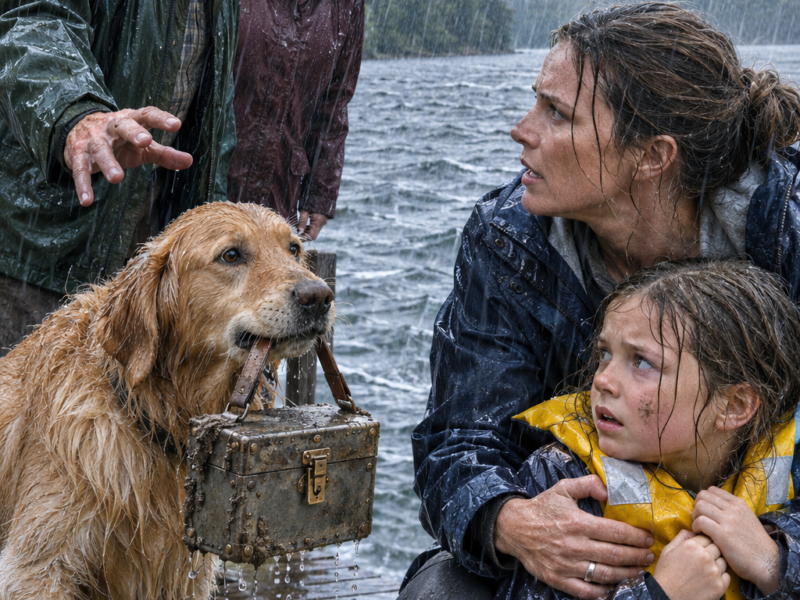
The coordinator relayed that over the radio. He was careful to say that nobody had seen her leave. A little before six, the rescue crew got Piper aboard. Someone mentioned that she’d grabbed a bright orange object from the water near the overturned boat. They were keeping it with the things they’d recovered. I scarcely heard them. I was still watching the coordinator’s face for any sign that another boat had found my daughter.
When someone asked where Ren might go to get away from the wind, I thought of the narrow hallway outside our linen closet. At home, she went there when thunder shook the windows. She liked having a wall against her back. The coordinator opened a map, and I asked about a building marked uphill from the dock.
Jean leaned forward. “There’s a shed. I showed her the path.”
Earlier in the day, Ren had asked where people could go if it rained. My mother had pointed out the trail to an old maintenance shed about 170 meters from the dock. She didn’t know if the door would be open. She did remember that Ren had watched carefully when she showed her where the path began.
At 6:10, the radio said, “We found her alive.”
I made the coordinator tell me again. Ren was inside the shed, behind a door that gave her some shelter from the wind. She was cold and exhausted, but conscious. She still had her life jacket on.
Later, I learned that water had begun washing over the dock boards. Ren had remembered the trail and climbed to the shed, scraping her hands and knees along the way. Piper went with her at first. After a crack of thunder and a noise down by the shore, the dog ran back toward the water. Ren had wanted to go after her. By then she could barely see the path, so she stayed where she was.
The rescue boat brought her in under a thermal blanket. When I got close enough, she looked up and reached for me. I knelt in front of her and felt her cold hands meet behind my neck.
“Did Piper come home too?”
I told her Piper was safe.
“I’m sorry I couldn’t keep her with me,” she whispered.
I said she’d done the right thing staying in the shed. Then, looking at the scrapes on her knees, I asked a question I heard in my father’s voice the instant it came out of my mouth.
“Why didn’t you stay where Grandpa told you?”
Her grip on my wrist loosened. “I tried, Mom.”
“That was the wrong question,” I said. “You were trying to stay safe. You can tell me about it whenever you want.”
I held my hand where she could see it. For a while she just looked at it. When the medic brought her a drink and she needed someone to steady the cup, she let me help.
At the medical center, they cleaned her scrapes, checked her temperature and watched her warm up. Jean came to the doorway holding a bag of dry clothes. She opened her arms a little, and Ren pressed her face into my shirt. I nearly asked her to give Grandma a hug. My mother looked so hurt that for a second I forgot whose bedside I was sitting beside.
“Leave the clothes with the nurse, Mom,” I said. “She needs some room.”
Dad was standing in the hall. “We need to stop making a scene.”
Ren’s hand tightened on my sleeve. I asked the nurse to give us some privacy. My parents left, and Ren and I went home a little before ten.
That night she lay on top of her covers in her clothes and asked whether she could keep her sneakers on. I asked if her feet hurt.
“If somebody says we have to leave fast,” she said, “I don’t want to be the last one.”
I sat beside her until she agreed that the shoes could go by the door, exactly where she pointed. We left the porch light on. The next morning Tessa brought Piper home from the vet, moving a little slowly but well enough to drop a toy onto Ren’s bed. I called Ren’s father, Evan, in Oregon and told him what had happened. Then I stood in front of the calendar on the refrigerator and tried to figure out how I was going to teach the rest of the summer. For years my mother’s name had filled the gaps between my schedule and Ren’s. I crossed it out.
Two days after Piper came home, Deputy Ellis Grant sent me a photograph. The orange object from the rescue was a floating handle attached to a scuffed black waterproof camera. I recognized it immediately. Logan had been showing it to his brothers before they left for the lake.
My father had already asked me who had taken possession of the thing Piper pulled from the water. At the time, I’d assumed he was keeping track of the boys’ belongings. When I told him the deputy had asked me to identify the camera, Dad said he could take care of it himself. It belonged to one of Dana’s boys, he said. There was no reason to involve anybody else.
I could see Ren through the kitchen doorway, drawing with Piper’s head resting against her knee.
“Then Dana can tell Deputy Grant it belongs to Logan,” I said. “The camera stays with him.”
When Grant later showed me the recovered clip, the first thing I saw was a shoe and a strip of dock boards. Then the picture lifted. The rowboat was upright, secured by a rope. Ren stood on the dock in her life jacket, staring down at the gap she’d have to cross to get into it.
“Lake Courage Challenge,” one of the boys called out.
Logan was filming. Owen and Milo were jostling for a look. One of them mimicked the way Ren tested the boards with her foot. I could see my father by the cleat, close enough to hear her say she wasn’t sure she wanted to do it.
Someone helped her step into the rowboat. It rocked, and she reached back toward the dock.
“I want to get out,” she said.
“You haven’t even tried,” Dad answered.
He moved into the space where she would have stepped back onto the dock. She asked again. I watched her fingers open and close around the edge of the wood.
“Crying isn’t going to fix this,” he told her. “Your mother has made every little worry into a crisis. You can manage a few minutes without someone rushing in to rescue you.”
Grant paused the recording when he saw my hand go to my mouth. I asked for water. By the time I could hold the cup without spilling it, I’d remembered that the girl on the screen was upstairs at home with Piper, safe enough to fall asleep with a book open on her chest. I asked him to finish playing it.
“I said I want to get off,” Ren said. Her voice was clearer this time. Dad was still telling her she needed to finish what she’d started when Logan mentioned that the camera was running. My father looked directly into the lens. His sleeve filled the frame, there was a scrape of sound, and the picture went dark.
I asked to see those last seconds again. They showed him reaching for the camera. The boat trip and the storm came afterward. To find out what happened in those missing minutes, someone who’d been there would have to talk.
For a while, my family did plenty of talking. The version that made its way around the group chat held that the boys had invented a game, Ren had wandered off, and Dad had done everything he could to bring her home. A relative suggested Ren should forgive her cousins so they could all put the afternoon behind them.
By then, Ren had overheard Jean use the words run off on the phone. She’d stopped in the hallway, one hand against the wall.
“The water came onto the boards,” she said. “I went where Grandma showed me.”
I hung up and told her I believed her. She wanted to know if Grandma believed her, too. I said I would make sure the adults heard what she’d told me. Then I wrote it down so she wouldn’t have to tell it over and over. In the group chat, I said where she’d gone and why. I kept the footage out of it. Enough people had watched my daughter beg to be let off that boat.
Dana and I came close to arranging a short visit at the park. Ren made Logan a card with all three boys and Piper on the front. She wanted to see her cousins somewhere Grandpa wouldn’t turn up. When the adults couldn’t agree on the visit, she slid the card into its envelope and left it on the kitchen table. Over the next few days, I watched her move it from one end of the table to the other to make room for breakfast.
Logan eventually asked to talk to me. At Dana’s house he sat on the arm of a chair, running his finger along the seam of a folded blanket.
“Grandpa told me to turn it on,” he said. “He said to get the beginning and the ending.”
Calvin had gathered the children at the dock and given them the name of the challenge. Logan had laughed because he thought it would be funny, and he’d kept filming because he wanted his grandfather to think he’d done a good job. After Dad took the camera, Logan watched him bend over the rowboat, slip the camera and its orange handle into a mesh pocket beneath the wooden bench, and snap the fastening shut. He remembered the click. He couldn’t tell us whether his grandfather meant to hide it or whether anyone took it out again.
Dana looked down at her hands. She’d been asking Logan to take responsibility for a game she’d been told was his idea. Now she asked him why he’d let her think so.
“I knew I’d done something wrong,” he said. “I thought I was supposed to say sorry for all of it.”
I thought of Ren apologizing for losing hold of Piper. The two children had each found a piece of the afternoon they could blame themselves for. The adults had been happy to leave them holding it.
By the end of July, Tessa couldn’t cover my schedule anymore. Dad offered to have Jean start watching Ren again, provided I dropped the questions about the camera. For a moment I could see the old arrangement clearly enough to miss it. I’d finish my last lesson, pull into my parents’ driveway, and find Ren on the porch with a snack in her hand. I’d be able to pay the rent without opening the emergency savings account.
I turned him down. Three canceled lessons and sixteen hours of paid childcare came to $575 between lost income and money out of my pocket. Ren found me at the table with a calculator and asked whether she’d made everything expensive. I pushed the calculator aside. On the first day with her new caregiver, I told her when I’d be home and showed her where my number was written. The caregiver asked whether she’d rather read on the couch or draw at the table. Ren chose the couch and looked over at me to see if the choice would stick.
In early August, Dad asked to meet at a café. He said he’d spent nights thinking about what would have happened if the rescuers hadn’t found the shed. He admitted he’d pushed Ren when she was frightened and spoken about me as if his granddaughter were a way of getting a message to me. When he said he was sorry, his voice broke. I let myself imagine him saying those words to Ren someday, if she ever wanted to hear them.
Then he asked me to tell Grant to put the recording aside. He wanted the family to agree that Ren had wandered from the dock while he was on his way back. If we kept fighting, he said, she might lose her place at family gatherings.
I put my bag on my shoulder. “You can tell people you’re sorry,” I said. “You can do that without asking me to change what happened.”
At home Ren saw I’d been crying. She offered to make Grandpa a card saying she should have stayed on the dock. Maybe then Grandma and the boys could visit again.
I sat down with her on the kitchen floor. When I was little, I told her, I used to practice apologies on the way to my father’s study. I could sometimes make a bad evening end by finding the right thing to say. It had taken me years to understand how much I’d been apologizing for that belonged to someone else.
“You were allowed to get away from the water,” I told her. “We can miss people. We can wish they’d come over. You still get to tell the truth.”
The account that finally explained why Ren had been left came from my mother. We met at Dana’s house with no children present. Jean brought a folded sheet of paper and pressed her hands flat against it.
At 2:05 on July 14, she said, a weather warning had come through on her phone. She’d read it aloud. Dad insisted the challenge was almost over. About twelve minutes later he ended it and took the camera from Logan. Jean remembered a flash of orange near the seat of the rowboat. A few minutes after that, they were deciding who would leave in the motorboat.
Jean had offered to stay. Ren could take her seat while she waited with Piper. If Ren was too frightened to board, Jean would stay with her until they could come back together. The motorboat’s capacity plate, which I later checked with an inspector, allowed five people. Swapping Jean for Ren would have kept the number at five and reduced the weight. Whether any crossing was safe in that weather was a separate question. What mattered at Dana’s table was that my mother had offered to keep an adult with Ren, and my father had refused.
“She needs to learn that crying doesn’t change my rules,” Jean said, repeating his words. “Get in the boat, Jean. I’ll go straight back for her.”
My sister stopped writing.
“I got in,” Mom said. She looked at me then. “I knew she was standing there, and I got in anyway.”
Dad had expected to come back. I could believe that and still hear what he’d said before he left. The child standing on the dock had heard him, too.
Jean gave her statement to Grant separately. Logan described the instructions he’d been given and where he saw his grandfather put the camera. Owen remembered the people in the motorboat and Ren standing with Piper as they pulled away. He hadn’t understood the conversation between the adults. I gave Grant my call history and the notes I’d made at the landing. When he asked a question I couldn’t answer, I left the answer blank.
Dana corrected the story in the family chat herself. She said she’d been wrong about Ren wandering off and wrong to let people think Logan had invented the challenge. Jean moved into Dana’s spare room. At one last meeting among the adults, Dad told us we’d taken his words out of context. Jean agreed that he’d meant to return. Then she repeated the part about crying, all the way to the end, even when he started talking over her. When he walked out, nobody got up to bring him back.
The lake association suspended him from duties involving children and transportation while it reviewed what happened. In September, prosecutors filed a child endangerment charge. The court barred him from contacting Ren or Logan, going to their homes or schools, or trying to influence their accounts. Ren asked if she could still keep the music box he’d fixed. I told her it was hers. That evening she wound it up and listened until halfway through the tune, then closed the lid and set it back on her shelf.
In October, after sending Dana messages urging her to get Logan to soften his statement, Dad went to her house. Dana came outside when she heard raised voices. He’d caught Logan by the wrist and was telling him to admit he’d exaggerated. A neighbor witnessed part of the confrontation and stayed while Dana called for help. She saved the messages and told the responding officers exactly what she’d seen. Dad was arrested on a warrant for violating his release conditions. When Dana told me, I pictured Logan walking home from school and seeing his grandfather at the door, in the very place he’d been told he could count on being safe.
By March, Dad had pleaded guilty to gross misdemeanor child endangerment. He was sentenced to forty-five days in county jail, followed by twenty-four months of supervised probation, with contact restrictions and required intervention. The lake association ended his volunteer role. My mother pleaded guilty in a separate case and received twelve months of probation and a hundred hours of community service. Neither Dana nor Logan was charged. When Jean and I spoke afterward, she said she wished she’d found her voice before the motorboat left.
“I wish you had, too,” I said.
She moved into a place of her own and sent Ren a birthday card that asked for nothing in return. Sometimes Ren wanted to speak to her on the phone. Sometimes she let it ring. Jean learned to accept either answer.
When Ren finally wanted to see Logan, she asked to meet in our yard with Piper beside her. He brought cookies with a broken corner wedged back into place and icing that looked like it had gone on during an earthquake. He held the box with both hands while he told her he was sorry he’d laughed and kept filming after she asked to stop.
“Why didn’t you stop?” she asked.
“I wanted Grandpa to think I’d done a good job,” he said. “And I was scared of him getting mad at me.”
She took her time with that. Then she asked what kind of cookies he’d made. Piper came closer as soon as the box opened.
“She’s judging me,” Logan said.
“She’s disappointed there’s no chicken,” Ren told him.
They both laughed. I was sitting far enough away that they could have the laugh to themselves. At the end of the visit, Logan thanked her for letting him come. She told him he could leave the cookies.
By May, ten months after the storm, Ren was sleeping better. There were still nights when she wanted the lamp on and Piper close enough to touch. She talked to a counselor, and sometimes I heard her sing while she brushed Piper’s fur. The first time she sang a whole verse, I stayed in the kitchen and washed the same plate until she finished.
One afternoon we took sandwiches and strawberries to a small lakeside park far from Willow Narrows. Ren drew ducklings in a notebook and appointed Piper chief snack inspector. After lunch she walked toward a little dock that stretched over the calm water. She stopped just before the boards.
“I don’t want to go on it today,” she said.
“Okay,” I said. “We can stay here.”
She waited a moment, as though I might add a condition. Then she asked if Grandpa would have called her a scared baby.
“He might have,” I said. “You get to decide how close you want to go.”
She looked down at the boards again. There were families at the end of the dock, looking over the side at the ducks. Ren stood there long enough to watch one of the ducklings paddle out from under it. Then she asked if we could take the grassy path around the lake instead.
Piper got up so fast she nearly tipped over her water dish. Ren caught the leash, laughing, and took my hand for the first stretch of the path. A little farther on, she let go and ran ahead. At the bend she looked back to see whether I was coming. I lifted my hand. She waited there with Piper until I caught up.