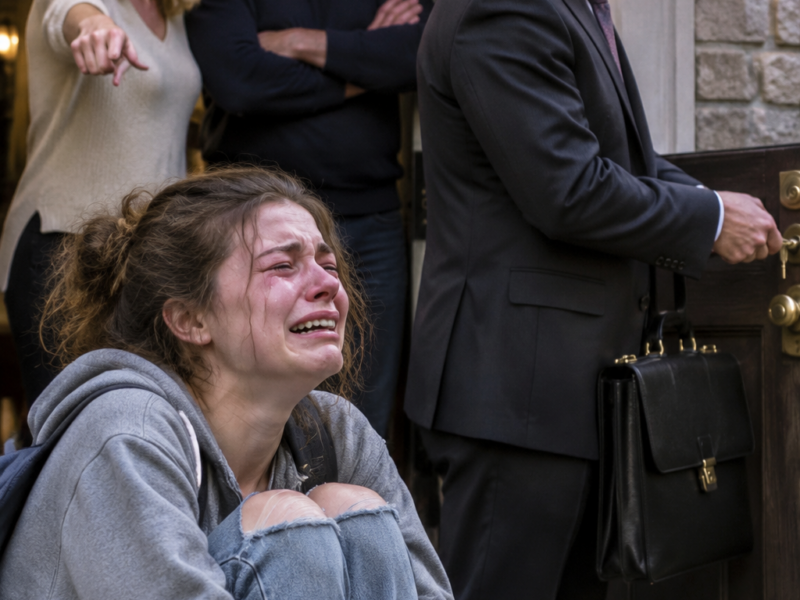
My Parents Kicked Me Out at 18—Then the Bank Manager Locked the Door
My Parents Kicked Me Out at 18—Then the Bank Manager Locked the Door
The first thing the bank manager said after looking at my grandmother’s account was something I never expected to hear.
“Mallory, the police are here for you.”
For a moment, I simply stared at him. I was sitting in a small office inside a downtown Columbus bank, holding a worn envelope that had belonged to my grandmother. The manager, a man named Arthur Bellamy, had just locked the office door. His expression had changed so dramatically that I couldn’t tell whether I was about to receive the biggest surprise of my life or become the center of an investigation.
I was eighteen years old. Less than twenty-four hours earlier, I had walked across a stage, accepted my high school diploma, and watched my parents celebrate as though my graduation were nothing more than another obligation they had to get through. I had no permanent place to sleep, barely enough money to buy food, and a suitcase containing almost everything I owned.
My parents had kicked me out of their house on the very night I graduated.
And now, somehow, the last thing my grandmother had left me had brought me face-to-face with a bank manager and the police.
I wish I could say I immediately understood what was happening. I didn’t. At that moment, I was frightened, confused, and still trying to make sense of the fact that the people who were supposed to love me unconditionally had decided I was no longer welcome in their home.
But before I explain what was inside that account, I need to tell you how everything began, because the truth is that my grandmother had been preparing me for this moment long before I realized it.
My name is Mallory Keen, and I grew up in a comfortable suburban neighborhood outside Columbus, Ohio. From the outside, our family looked like the kind people admired. We lived in a spacious house with a wide front porch, a two-car garage, and carefully maintained flower beds. My father, Warren, worked in commercial real estate. My mother, Diane, managed the household and volunteered at school events. My older sister, Paige, was four years ahead of me and had always been the center of attention.
Our family photographs told a beautiful story. My parents smiled proudly, Paige stood beside them looking confident, and I usually occupied whatever space remained at the edge of the frame.
People often told me how lucky I was to have such a wonderful family. I learned to smile whenever they said it, because explaining the truth would have required admitting something I didn’t fully understand myself.
Paige could do almost anything and receive applause.
When she got accepted into college, my parents organized a celebration. My father invited relatives, ordered an expensive cake, and spent the entire evening talking about how proud he was of his oldest daughter.
When Paige bought her first car, Dad called it an investment in her future. He helped her negotiate the purchase, paid for the insurance, and proudly showed photographs to anyone who visited.
When I earned a scholarship that would cover most of my university tuition, my mother glanced at the letter and said, “That’s nice, Mallory.”
Then she placed it on the kitchen counter and continued preparing dinner.
I wasn’t particularly surprised. By then, I had become accustomed to receiving less attention, fewer compliments, and considerably less patience than my sister.
Paige was the daughter who made our parents look successful. I was the daughter who was expected to be grateful for whatever remained.
Fortunately, there was one person who never made me feel that way.
My grandmother, Beatrice.
She lived about twenty minutes away in a modest house with a small garden, a wooden porch swing, and a kitchen that always smelled of cinnamon or freshly baked bread. She had been a schoolteacher for nearly forty years, and even after retiring, she never stopped behaving like someone who believed every person deserved the opportunity to learn something new.
She kept handwritten recipes in an old kitchen drawer, read the newspaper every morning, and maintained a collection of books that seemed to grow every year.
Every Sunday, I visited her.
Sometimes we baked cookies. Sometimes we watched old movies. Other times, we sat together on her porch while she told me stories about students she had taught decades earlier.
She remembered their names, their personalities, and even the little things they used to say in class.
I once asked her how she could possibly remember so many people.
She laughed and replied, “Because, sweetheart, people don’t always remember what you teach them, but they remember how you make them feel.”
I never forgot that sentence.
Grandma was also the only person who noticed how differently my parents treated Paige and me.
She never directly criticized them, but occasionally she would look at me over her reading glasses and say something that seemed almost too serious for an ordinary Sunday afternoon.
“Mallory, being family doesn’t give anyone the right to control your life.”
I would usually smile and ask what she meant.
She would simply return to whatever she was doing.
At the time, I thought she was offering general advice. I had no idea she was preparing me for something much more important.
Grandma Beatrice died the previous winter.
Her passing left a silence in my life that I struggled to describe. I had lost the person I called whenever something wonderful happened, whenever something terrible happened, and whenever I simply needed someone to listen.
After the funeral, my parents took responsibility for handling most of her estate arrangements.
Dad explained that there wasn’t much to divide and that everything had been taken care of. Mom agreed, saying there were several legal matters to settle and that I didn’t need to worry about any of it.
I trusted them.
I was grieving, preparing for graduation, and trying to figure out my college plans. I never imagined that my own parents might be hiding something from me.
A few weeks before graduation, however, Dad placed several documents on the kitchen counter.
He was standing beside the refrigerator, holding a pen.
“Your grandmother left some financial matters unfinished,” he said. “We just need your signature to close everything out.”
I looked at the papers.
There were several pages filled with legal language, paragraphs, and signature lines.
“What exactly am I signing?”
Dad sighed.
“Legal paperwork. Nothing complicated.”
“Can I read it first?”
His expression changed almost immediately.
“Why are you making this difficult?”
“I’m not. I just want to understand what I’m signing.”
Mom entered the kitchen at that moment. She had been putting away groceries and apparently heard enough of the conversation to understand that Dad was becoming irritated.
“Your father is trying to help you, Mallory,” she said. “You don’t need to question everything he does.”
“But these documents have my name on them.”
“Exactly,” Dad replied. “That’s why you need to sign them.”
I picked up the first page and started reading.
He reached across the counter and placed his hand over it.
“Just sign where I’ve marked.”
Something about the way he said it made me uncomfortable.
I couldn’t explain it, but I felt that I was being pushed into agreeing to something I didn’t understand.
So I put the pen down.
“I’m not signing anything until I know what it is.”
Dad stared at me for several seconds.
Then he gathered the papers and walked away without saying another word.
That evening, Mom told me I had embarrassed him.
Paige later made a comment about how I apparently thought I was better than everyone else because I had earned a scholarship.
I didn’t understand why a few signatures had caused such a dramatic reaction.
But something changed after that conversation.
My parents became noticeably colder. Dad stopped asking about my college preparations. Mom rarely spoke to me unless she needed something. Paige seemed particularly entertained by the tension.
I tried to ignore it.
Then came graduation night.
The ceremony was held in the school auditorium. Families filled the seats, cameras flashed, and students whispered excitedly while waiting for their names to be called.
I had worked hard for that diploma. I had spent years studying, completing assignments, working toward scholarships, and trying to build a future that would allow me to become independent.
When my name was announced, I walked across the stage and accepted my diploma.
For a brief moment, I searched the audience for my family.
They were there.
Dad was checking his phone. Mom smiled when someone nearby lifted a camera. Paige spent most of the evening talking with her friends.
I told myself it didn’t matter.
I had graduated. I had earned my scholarship. I had a future ahead of me.
That was enough.
After the ceremony, we took a few photographs. My mother asked me to stand beside her, and Dad briefly placed a hand on my shoulder.
Anyone looking at those pictures would have assumed we were a happy family celebrating an important milestone.
I had no idea that within an hour, I would no longer have a home.
When we arrived at the house, I noticed two cardboard boxes beside the front door.
My suitcase was already packed.
For a moment, I thought someone had brought the wrong belongings outside. Then I noticed my winter coat folded over one of the boxes.
I looked toward the living room.
Dad was standing near the fireplace with his arms folded. Mom sat on the sofa, her expression unusually blank.
Paige was halfway up the stairs, holding a glass of iced tea.
“What is this?” I asked.
Dad didn’t move.
“You’re eighteen now, Mallory. It’s time you learned to take care of yourself.”
I laughed nervously.
I genuinely thought he was joking.
“What are you talking about?”
Mom stood up.
“We’ve discussed this, and we’ve made a decision. We’ve supported you for eighteen years. We aren’t going to keep doing everything for you.”
I stared at her.
“Everything? I’m going to college. I have a scholarship. I’ve been working toward this for years.”
“Then you’ll manage,” Dad said.
“Where am I supposed to go tonight?”
He shrugged.
“You’re supposedly so independent. Figure it out.”
I looked at Mom, waiting for her to intervene.
She didn’t.
I turned toward Paige.
She was still standing on the stairs. She glanced at my boxes, looked directly at me, and smiled.
“Good luck on your own.”
Those four words hurt more than I expected.
I had spent years hoping that one day Paige and I might become close. I had defended her when she was difficult, congratulated her when she succeeded, and tried to build a relationship with someone who seemed to regard me as competition.
But she was enjoying the moment.
I turned back to my mother.
“You’re really letting him do this?”
She looked away.
“Don’t turn this into another argument.”
That was the moment I understood.
Nobody was going to change their mind.
I packed what remained of my belongings, carried everything outside, and called a friend from school.
Her name was Jenna, and when I explained what had happened, she didn’t ask unnecessary questions.
“Come over,” she said. “We’ll figure something out.”
Jenna drove to the house and helped me load my suitcase and boxes into her car.
I didn’t say goodbye to my parents.
I didn’t even look toward the staircase again.
That night, I slept on the couch in Jenna’s small apartment.
I barely slept at all.
My mind kept replaying the evening. I wondered whether I had done something terrible without realizing it. I wondered whether my parents had been planning this for weeks. Most of all, I wondered how a family could celebrate a daughter’s graduation and then put her belongings outside the front door a few hours later.
My phone kept lighting up.
There were several messages from Dad, but none asked whether I was safe.
One said I needed to stop being dramatic.
Another said I should remember who had paid for my upbringing.
I turned the phone face down.
The next morning, while searching through my suitcase for a clean shirt, I found something tucked inside the lining of a small handbag.
It was an envelope.
My name was written across the front in familiar handwriting.
Grandma Beatrice’s handwriting.
I sat on the edge of Jenna’s sofa and carefully opened it.
Inside was a handwritten letter, a bank document, and a small note containing the name and address of a branch in downtown Columbus.
The letter was short.
“Dear Mallory,
When you turn eighteen, please visit this bank in person. Bring your identification and this document.
Do not let anyone speak for you, and never sign anything you haven’t read.
I wanted you to have choices even when I was no longer here to help you.
I have taken care of more than you know.
Trust yourself, sweetheart.”
I read it three times.
Then I turned the paper over, hoping to find another explanation.
There was nothing.
I called the bank to confirm the branch was open and took a bus downtown.
The building was larger than I expected. Its glass entrance reflected the morning sunlight, and the lobby was filled with people carrying folders, briefcases, and coffee cups.
I felt strangely out of place.
I was wearing an ordinary sweater and jeans, carrying a handbag that contained a letter from a woman who had been dead for several months.
At the front desk, I explained that I had documents concerning an account established by my grandmother.
The employee asked me to wait.
A few minutes later, a senior manager named Arthur Bellamy appeared.
He was a middle-aged man with silver hair and a calm manner. He introduced himself, invited me into his office, and asked to see my identification.
I handed him my driver’s license and the bank document.
At first, he seemed perfectly relaxed.
He examined the paperwork, typed something into his computer, and nodded.
Then he stopped.
His eyes moved from the screen to the document.
He checked my name again, then asked me to confirm my date of birth.
I answered.
He typed another entry.
A few seconds passed.
Then he picked up the telephone and spoke quietly to someone in another department.
I couldn’t hear the entire conversation, but I noticed that his voice had become unusually serious.
When he finished, he walked toward the office door and closed it.
“Mallory,” he said carefully, “I need you to stay here for a moment.”
My stomach tightened.
“Is something wrong?”
He didn’t answer immediately.
Instead, he returned to his desk and opened another file.
“Have you ever signed documents related to a trust established by your grandmother?”
I shook my head.
“My father gave me some papers a few weeks ago. He said I needed to sign them to finish handling her estate. But I refused because he wouldn’t let me read them properly.”
Arthur leaned back.
“Did he explain why your signature was necessary?”
“He said it was just legal paperwork. He got angry when I asked questions.”
Arthur looked at the documents again.
Then he said something that completely changed my understanding of my grandmother’s final months.
“Your grandmother, Beatrice Keen, established an irrevocable trust several years ago. According to the records available to us, you are the sole beneficiary.”
I stared at him.
“A trust?”
“Yes.”
“What kind of trust?”
“A financial trust intended to provide for your education, reasonable living expenses, and future financial stability.”
I tried to process his words.
He continued explaining that my grandmother had gradually funded the trust through savings and investments accumulated over decades.
She had been careful about how the money was invested and had included specific provisions governing when distributions could be made.
My parents had been appointed as co-trustees.
They were responsible for managing the assets according to the trust agreement.
“Does that mean there’s money in it?” I asked.
Arthur hesitated.
“Yes. There is a substantial amount.”
He turned his computer monitor slightly toward me.
I looked at the figure displayed on the screen.
For several seconds, I couldn’t understand what I was seeing.
The original trust records showed several hundred thousand dollars.
But the current balance was dramatically lower.
I leaned closer.
“Where did the rest go?”
Arthur didn’t answer immediately.
He opened another document containing a transaction history.
There were transfers to accounts I didn’t recognize, payments that appeared unrelated to my education, and withdrawals supported by authorization documents.
One transaction had been described as a distribution for beneficiary-related expenses.
Another appeared to cover a property-related obligation.
Then I noticed a name.
Paige.
I pointed at the screen.
“That’s my sister.”
Arthur nodded.
A payment had been made toward expenses associated with her.
I felt my face grow warm.
“Why would Grandma’s money pay for my sister?”
“That’s one of the questions currently being examined.”
He explained that trustees had legal responsibilities. They could not simply use trust assets for personal purposes or distribute them to people who were not entitled to receive them.
The exact authority depended on the trust agreement, but the transactions required careful examination.
I looked at him.
“Did my parents take the money?”
“I cannot make that determination for you. What I can tell you is that certain transactions have been flagged for review.”
He printed several authorization forms.
One of them included a signature bearing my name.
I leaned closer.
The signature looked familiar at first glance.
But something was wrong.
“That isn’t mine.”
Arthur looked directly at me.
“Are you certain?”
“I’ve never seen this document before.”
I pointed toward the signature.
“And I definitely didn’t sign it.”
The signature was close enough to fool someone who didn’t know me. But the letter M was different, and the final stroke was nothing like the way I had always written my name.
Arthur explained that the bank’s fraud department had identified inconsistencies in some documentation.
Certain transactions had been referred for further investigation, and the bank had preserved the relevant records.
Then he opened another file.
“There is something else you should know.”
A few months before her death, Beatrice had contacted the bank because she was concerned about the management of her trust.
She had requested that certain records be retained and that unusual transactions receive additional scrutiny.
Most importantly, she had specifically asked that I be protected as the beneficiary.
I felt my throat tighten.
Even near the end of her life, when she must have known her time was limited, Grandma had been thinking about me.
“Did she know my parents were taking the money?” I whispered.
Arthur chose his words carefully.
“We cannot assume what she knew. Her correspondence raised concerns about how the trust was being administered.”
Before I could ask another question, his telephone rang.
He answered, listened, and glanced toward me.
“Yes, she’s here. I’ll bring her through.”
He put down the receiver.
“Mallory, a financial crimes detective would like to speak with you. Her name is Lena Ortiz.”
A few minutes later, a woman in a dark navy suit entered the office.
She introduced herself, showed me her identification, and sat across from me.
“I understand this is overwhelming,” she said. “I’m not here to accuse you of anything. I need to understand what you know about these transactions.”
I told her everything.
I explained the documents my father had wanted me to sign, the argument at home, the boxes outside the front door, and the envelope I had found in my suitcase.
She listened carefully, occasionally writing something in a notebook.
Then she asked whether I had ever received money from the trust.
“No. I didn’t even know it existed until today.”
She nodded.
“That’s important. We have been examining suspected irregularities involving the trust’s assets. Some documents appear to have been executed using your name. We need to establish whether those signatures are genuine.”
I felt sick.
“Are my parents involved?”
Detective Ortiz paused.
“Your parents are among the individuals whose actions we’re examining. We have reason to believe that funds may have been improperly transferred.”
I looked down at my hands.
Less than twenty-four hours earlier, my father had thrown me out of his house.
My mother had watched.
My sister had smiled.
And now I was learning that money my grandmother had carefully saved for my future might have been taken without my knowledge.
Before I could ask another question, my phone began vibrating.
Mom.
I let it ring.
A text appeared almost immediately.
“Mallory, call me immediately. Your father knows where you are. Don’t talk to anyone at that bank. We’ve explained everything.”
A second message followed.
“You have no idea what you’re getting yourself into.”
I showed the detective.
She read the messages and looked at me.
“Did you tell your parents you were coming here?”
“No.”
She nodded slowly.
“Then I’d like you to save those messages. Don’t delete anything, and don’t confront them while we’re still reviewing the evidence.”
My phone rang again.
This time, it was Dad.
I answered without saying anything.
His voice came through immediately.
“Mallory, listen to me. Whatever those people are telling you, they’re twisting things. Your grandmother made promises she had no right to make.”
I looked at Detective Ortiz.
“Why did you throw me out?”
There was silence.
For several seconds, I heard nothing but faint background noise.
Then he answered.
“Because you wouldn’t cooperate.”
I closed my eyes.
That was it.
He hadn’t thrown me out simply because I had turned eighteen.
He hadn’t suddenly decided I was too old to live at home.
He had thrown me out because I had refused to sign something.
And now he knew I had discovered the one thing Grandma had spent years protecting.
I ended the call.
My hands were trembling, but something inside me had changed.
For the first time, I wasn’t simply confused about my family’s behavior.
I was beginning to understand it.
Dad didn’t call again that afternoon.
Instead, he sent another message.
“You’re making a terrible mistake. That money belongs to this family. Your grandmother understood that. Don’t let strangers turn you against your own parents.”
I read it several times.
I wanted to believe there was some explanation. Some misunderstanding that could make the previous twenty-four hours less painful.
Perhaps my parents had borrowed the money and intended to replace it. Perhaps Grandma had agreed to help Paige. Perhaps the documents were legitimate, and I had simply misunderstood what I was seeing.
But then I remembered the signature.
I remembered Dad refusing to let me read the papers.
And I remembered the boxes beside the front door.
Detective Ortiz advised me not to respond.
She arranged for the bank to preserve copies of the relevant records and asked me to provide the original envelope from Grandma.
I also asked Arthur whether I could access the money.
He explained that the trust’s current balance and any future distributions would have to be handled according to the trust agreement. The bank could not simply release the assets because I had discovered the account.
I understood that having money legally set aside for me and actually being able to use it were two very different things.
That afternoon, Detective Ortiz arranged for me to meet my grandmother’s attorney.
Her name was Vivian Shaw.
She had represented Beatrice for more than a decade and worked in a small law office near downtown Columbus.
The building wasn’t impressive. It had an old elevator, narrow hallways, and a reception area filled with filing cabinets.
But when Vivian saw the envelope I was carrying, her expression changed.
“Where did you find this?”
“Inside my suitcase. Grandma left it there before she died.”
She carefully examined the handwriting.
“Beatrice told me she had given you something important. I wasn’t sure whether your parents had allowed you to keep it.”
That sentence made my stomach tighten.
“Why wouldn’t they?”
Vivian didn’t answer immediately.
Instead, she invited me into her office and asked her assistant to retrieve the original trust agreement from the firm’s records.
She placed several pages on her desk.
“Your grandmother established this irrevocable trust when you were much younger. She funded it over several years. Your parents agreed to serve as co-trustees, which meant they had legal responsibilities to manage the assets for your benefit.”
I looked at the documents.
There were signatures, dates, and paragraphs filled with legal language I barely understood.
Vivian explained that the trust was intended to support my education, reasonable living expenses, and future financial stability.
It also contained restrictions on how the trustees could distribute the money.
“Your grandmother was very specific,” she said. “She didn’t want anyone treating this money as a family account.”
I immediately remembered my father’s message.
That money belongs to this family.
Apparently, Grandma had anticipated exactly that attitude.
Vivian showed me financial statements from previous years.
Several transfers appeared to have benefited my parents personally.
One had gone toward expenses connected to a property owned by my father.
Another had been used for payments associated with Paige’s college costs.
There were also administrative documents containing signatures that appeared to belong to me.
I stared at one of them.
The date was two months before my eighteenth birthday.
“How could I have authorized this? I wasn’t even eighteen.”
Vivian adjusted her glasses.
“That is precisely why these documents require careful examination. Your parents may have had authority to manage certain matters as trustees, but that does not give them unlimited permission to use the assets. And a signature attributed to you must be genuine and legally valid.”
I asked whether my parents could simply claim they had spent the money on the family.
“No,” she replied. “Being a trustee is a fiduciary responsibility, not personal ownership. They must be able to account for every transaction and demonstrate that it was permitted under the trust.”
For the first time since graduation night, I felt something other than fear.
I felt angry.
Not because my parents had money.
Not because Paige had received help.
I was angry because my grandmother had carefully built something for my future, and the people entrusted with protecting it had apparently treated it as though I had no right to question them.
Vivian then opened a separate folder.
“There’s something else your grandmother asked me to preserve.”
Inside was a letter dated approximately three months before Beatrice died.
The handwriting was unmistakable.
Vivian explained that Grandma had become concerned about my father’s financial situation.
His commercial real estate business had experienced difficulties, and he had begun asking questions about the trust.
Beatrice worried that he might use his position as trustee to access money that wasn’t his.
She had therefore asked Vivian to preserve copies of the original trust records and document any concerns she raised.
I read the letter slowly.
“My dear Mallory,
If you are reading this, I may no longer be there to explain things myself.
Your grandfather and I worked hard for everything we saved.
I didn’t establish this trust because I thought you would become wealthy. I established it because I wanted you to have choices.
Your father sometimes believes that being responsible for something means owning it.
Please remember that those are not the same thing.
You deserve to build a life without having to ask permission from someone who controls your future.”
I had to stop reading.
My eyes were filling with tears.
Vivian handed me a tissue and waited.
For a moment, I could almost imagine Grandma sitting beside me, explaining everything she had never wanted to say while she was alive.
Then Vivian pointed to a paragraph near the bottom.
It mentioned that Beatrice had requested an independent review of the trust if any beneficiary-related documents appeared to have been signed without my knowledge.
That request had helped preserve a clear record of her concerns.
Grandma hadn’t simply left me money.
She had left behind instructions designed to protect me if something went wrong.
The next morning, Detective Ortiz contacted me again.
Investigators had identified several transactions requiring further examination. They were reviewing bank records, transaction histories, supporting documents, and the circumstances surrounding the alleged signatures.
I also learned that Paige had received payments from accounts connected to the trust.
I couldn’t stop thinking about her.
Had she known?
Had she understood where the money came from?
Had she stood on the staircase that night, smiling while I carried my belongings outside, knowing that the money Grandma had saved for me had helped pay for her education?
I didn’t know.
Then my phone rang.
Paige.
I almost ignored it.
But something made me answer.
“Hello?”
“Can we talk?” she asked.
Her voice sounded different.
There was no sarcasm, no confidence, and none of the familiar impatience she usually displayed whenever I questioned her.
“About what?”
“Mom and Dad.”
I sat down.
“What about them?”
She took a breath.
“They told me Grandma had left money for all of us. They said you were getting your education paid for, and I was supposed to receive help because I was already in college.”
I remained silent.
“Did you know the money came from my trust?”
There was a long pause.
Then she whispered, “I didn’t know it was only yours.”
I closed my eyes.
“Paige, you stood there while they threw me out.”
“I know.”
“You watched me carry my boxes outside.”
“I know, Mallory.”
“You told me good luck on my own.”
Her voice became quieter.
“I know.”
For once, she didn’t defend herself.
She didn’t blame me for being sensitive or accuse me of misunderstanding the situation.
Then she said something that made my blood run cold.
“Dad has been telling everyone that Grandma promised him the house and the money. He says you’re trying to steal what belongs to him.”
I looked at Grandma’s letter on the table.
Suddenly, I understood why my father had been so desperate to stop me.
He wasn’t afraid I would misunderstand the documents.
He was afraid I would finally understand them.
Paige continued speaking.
“He’s been saying that you’re being manipulated by the bank and that you’re trying to destroy everything Grandma wanted.”
I didn’t respond.
“Mom believes him,” she added. “At least, that’s what she keeps telling everyone.”
I wanted to ask why Paige had waited so long to call.
I wanted to ask whether she had ever wondered why I received so little while she received so much.
But I was too exhausted to argue.
Instead, I told her that the investigation was ongoing and that I wasn’t going to discuss evidence with her over the phone.
Before ending the call, she said something else.
“I think you should be careful. Dad is furious.”
I almost laughed.
For the first time in my life, I wasn’t frightened by the idea of making him angry.
Later that afternoon, I received another voicemail.
Dad.
I pressed play.
“You have no idea what Grandma promised us. If you keep digging, you’ll destroy this family.”
I listened until the message ended.
Then I opened a new message and typed:
“You destroyed it the night you threw me out. I’m just finding out why.”
I sent it.
For the first time, I didn’t feel afraid.
The following months were not easy.
People sometimes imagine that discovering financial misconduct automatically leads to a dramatic courtroom confrontation, where everyone confesses and justice arrives within a few days.
Real life wasn’t like that.
There were meetings, requests for records, financial reviews, conversations with attorneys, and long periods of waiting.
Vivian Shaw helped me understand my rights and the options available under the trust agreement and Ohio law.
Detective Ortiz continued reviewing the financial evidence.
I had to provide examples of my handwriting and answer questions about the documents bearing my name.
A forensic examination raised serious questions about the authenticity of several signatures.
I had never authorized those transactions.
And investigators had evidence supporting my account.
The financial review also revealed a pattern.
My father, Warren, had authorized payments that benefited himself and other members of the family. My mother, Diane, had signed documents supporting some of those transactions.
The payments connected to Paige’s education were particularly difficult for me to understand.
It wasn’t that I believed my sister should never have received financial assistance.
It was that the money had been placed in a trust specifically established for me, and my parents had apparently made decisions about it without telling me.
They had treated the trust like their personal savings account.
They had assumed I would never know it existed.
The alleged forgery made everything worse.
My father had repeatedly insisted that I sign documents without reading them, yet records already existed showing signatures bearing my name on transactions I had never authorized.
The more I learned, the more I understood that the situation had been developing for years.
Grandma had noticed the warning signs before I did.
She had asked questions, preserved records, and arranged for an independent review if anything suspicious happened.
She had even hidden the bank document in a place where I would eventually find it.
I began to wonder whether she had known that my parents might try to keep me away from the trust.
Perhaps she had understood my father’s personality better than I had.
Perhaps she had recognized that my mother would avoid confrontation even when something important was at stake.
Or perhaps she had simply wanted to make sure I knew that I had options.
Whatever her reasons, I was grateful.
Eventually, the civil proceedings established that significant trust assets had been improperly transferred.
The accounting identified amounts that needed to be restored, and the legal process moved forward to pursue repayment.
My parents also faced the consequences of their decisions.
Dad’s business was already struggling. The financial claims made his situation worse.
The questions surrounding the trust created problems he couldn’t solve by simply telling people what they wanted to hear.
Mom stopped attending the social events she had once considered essential.
For years, she had been someone who knew everyone in the neighborhood, volunteered at school events, and carefully maintained the appearance of a respectable family.
Now people were asking questions.
The people who had spent years judging everyone else’s lives were being asked difficult questions about their own.
I didn’t celebrate their embarrassment.
I didn’t organize public confrontations or try to humiliate them.
I wanted the truth documented.
I wanted the trust protected.
And I wanted the future my grandmother had worked so hard to secure.
Meanwhile, I had to learn how to live independently.
With Jenna’s help, I found a small apartment near campus.
It wasn’t luxurious.
The kitchen was barely large enough for two people, the bathroom had an old shower that sometimes took several minutes to produce hot water, and the heating system made strange noises whenever the temperature dropped.
The bedroom window overlooked a parking lot.
But the apartment had something my parents’ beautiful suburban house had never given me.
Peace.
Nobody questioned when I came home.
Nobody inspected my belongings.
Nobody made me feel guilty for studying or spending time with friends.
I could sit at my kitchen table for hours, reading, writing, or simply drinking coffee without worrying that someone would criticize me for taking up space.
The first night I slept there, I cried.
Not because I was unhappy.
Because I finally understood how exhausting it had been to live somewhere I never felt completely welcome.
I enrolled in college, continued working part-time, and began taking personal finance classes.
I learned about credit scores, emergency funds, estate planning, investment principles, and the importance of understanding legal documents before signing them.
Grandma’s money wasn’t something I wanted to waste simply because it had finally become accessible.
I wanted to use it in the way she had intended.
I also wanted to become the kind of person she would have been proud of.
Someone who understood the value of money without allowing it to become the measure of her worth.
Someone who could support herself without needing to control anyone else.
And someone who never confused having authority with having ownership.
Six months after my graduation night, my father finally understood that I wasn’t coming back to beg for a place at his table.
By then, the investigation had uncovered more than I could have imagined.
But the biggest surprise wasn’t the money, the legal consequences, or even the fact that my parents had been hiding things from me for years.
It was my sister.
One rainy Thursday afternoon, Paige showed up at my apartment.
I hadn’t seen her in several weeks.
She stood outside holding a paper bag from a coffee shop. Her hair was damp from the rain, and she looked considerably less confident than the sister who had smiled at me on graduation night.
“Can I come in?”
I hesitated before stepping aside.
She entered and placed the bag on the kitchen counter.
Then she looked around.
“Your place is nice.”
I shrugged.
“It’s small.”
“Still, it feels peaceful.”
I wasn’t sure what to say.
For several minutes, neither of us spoke.
Then Paige sat down.
“I need to tell you something.”
I leaned against the counter.
“Okay.”
She stared at her hands.
“Mom and Dad told me Grandma’s estate was being divided fairly. They said the money was meant to help the whole family. They told me your education would be covered separately, and that I was supposed to receive help because I was already in college.”
I listened.
“They said it was all arranged. I never asked to see the documents.”
“Why not?”
She looked up.
“Because I believed them.”
I waited.
She continued.
“Actually, that’s not the whole truth. I knew something wasn’t right. I knew you were being treated differently, but I didn’t want to question it.”
I looked at her.
“Why?”
Her eyes dropped again.
“Because I liked being the daughter they chose. I liked being the one who got everything.”
Her honesty hurt more than any excuse could have.
For years, I had watched Paige receive attention, affection, and opportunities that seemed to come naturally to her.
I had wondered whether she understood how much it hurt.
Now I knew that at least part of her had understood.
She simply hadn’t wanted to give up what she was receiving.
“I was selfish,” she said. “And when they threw you out, I knew it was wrong. I should have said something.”
“Yes, you should have.”
She nodded.
“I know.”
Then she told me that she had started returning money she could identify as coming from the disputed transfers.
She had also agreed to provide investigators with information about payments our parents had described to her.
“I can’t undo what I did,” she said. “But I don’t want to keep pretending I didn’t know.”
I studied her face.
I wanted to believe her.
But I had learned that believing someone simply because they were family was not always wise.
“Paige, I don’t need you to fix everything today.”
She looked at me.
“I need you to be honest from now on.”
She nodded.
“I can do that.”
I didn’t immediately forgive her.
I wasn’t ready to pretend that one apology could erase years of being made to feel unwanted.
But I appreciated that she had finally stopped making excuses.
For the first time, I felt that perhaps my sister and I might have a chance to build a different relationship.
Not the relationship our parents had encouraged.
Not one based on competition or favoritism.
Something more honest.
My parents took longer.
Dad sent several messages asking me to reconsider the legal action.
At first, he blamed the economy.
Then he blamed Grandma for creating unnecessary complications.
Eventually, he claimed that he had only borrowed the money because he believed he would be able to replace it.
That explanation was particularly difficult to accept.
I could understand financial pressure.
I could understand making mistakes.
I could even understand someone becoming desperate when a business began to fail.
But I couldn’t understand why someone who genuinely intended to repay the money would need to forge his daughter’s signature.
I finally asked him one question.
“If you intended to pay it back, why did you forge my signature?”
He never gave me a convincing answer.
Mom eventually called and asked whether we could meet.
I agreed, but only in a public place.
We met at a small restaurant near the university.
She arrived early and was already sitting at a table when I walked in.
She looked tired.
The confidence I remembered from my childhood had disappeared. Her hair was pulled back, and she seemed uncertain about what to say.
For a moment, I felt sorry for her.
Then I remembered the boxes outside the front door.
I remembered asking where I was supposed to sleep that night.
I remembered her telling me not to turn it into another argument.
We ordered coffee.
Mom began by saying she regretted what had happened.
“I never wanted you to feel unwanted,” she said.
I looked at her.
“Then why did you let Dad put my belongings outside the house?”
She lowered her eyes.
“I should have stopped him.”
“Yes, you should have.”
There was a long silence.
She explained that my father had been under considerable pressure because of his business. She said the financial situation had become complicated, and that she had trusted him to handle the trust properly.
I listened.
Then I asked why she had signed documents containing my name.
She said she believed the paperwork was legitimate.
I told her that believing something was legitimate did not excuse refusing to let me read it.
She had no answer.
For the first time, I realized that my mother might never give me the explanation I had spent so many years hoping to hear.
Perhaps she was afraid of my father.
Perhaps she had convinced herself that keeping the family together was more important than questioning him.
Perhaps she had simply become so accustomed to allowing him to make decisions that she no longer recognized when those decisions were wrong.
None of those possibilities changed what had happened.
I realized that I could love my mother and still refuse to pretend she hadn’t hurt me.
I could understand that my father had made terrible financial decisions without accepting those decisions as excuses.
And I could eventually forgive my sister without giving her permission to treat me badly again.
Reconciliation, I learned, wasn’t the same as returning to the way things used to be.
It meant building something different, slowly, with honesty and boundaries.
When the meeting ended, Mom asked whether I would ever come home.
I thought about the house.
The wide front porch.
The family photographs.
The staircase where Paige had stood with her glass of iced tea.
For years, I had imagined that home was something I needed to earn.
I thought if I became successful enough, helpful enough, or agreeable enough, my parents might finally treat me the way they treated Paige.
But I no longer wanted to spend my life trying to win a place in a house where my presence had always felt conditional.
“I don’t know,” I answered honestly.
She nodded.
I left without making promises.
A few months later, I visited Grandma Beatrice’s grave.
It was a quiet afternoon, and the sky was pale gray.
I brought flowers and a photograph of myself wearing my college sweatshirt.
I sat beside her headstone and told her about my apartment, my classes, and the little things I was learning to do without asking anyone for help.
I told her about Jenna, who had given me a place to sleep when I had nowhere else to go.
I told her about the bank, Arthur Bellamy, Detective Ortiz, and Vivian Shaw.
I told her that Paige had apologized.
I even told her that Mom and I had finally met for coffee.
Then I laughed softly.
“You would probably have told me to keep asking questions,” I whispered.
The wind moved gently through the trees.
I sat there for a long time, remembering the Sundays we had spent together.
I remembered the smell of her kitchen, the old movies, the stories about her students, and the way she always listened as though whatever I had to say mattered.
Before leaving, I took out the letter she had written me.
I had read it so many times that the folds were beginning to wear.
I carefully opened it and looked at the final lines.
There was one sentence I had overlooked before.
“Money can give you a safer place to stand, Mallory, but it cannot teach you who deserves a place in your life. That part is yours to decide.”
I smiled through my tears.
For months, I had thought the most important thing Grandma left me was the trust.
It wasn’t.
The money had given me options. It had helped protect my education and offered me a chance to build a stable life.
But the letter had given me something more valuable.
It had reminded me that I was allowed to make decisions for myself.
I was allowed to question people, even when they were older than me.
I was allowed to say no, even when someone I loved became angry.
And I was allowed to walk away from relationships that demanded obedience instead of respect.
My parents had believed that throwing me out would teach me how powerless I was without them.
Instead, it taught me that independence wasn’t something I needed their permission to have.
I didn’t get justice by destroying my family.
I got it by refusing to let the people I loved take away the future someone had carefully protected for me.
I didn’t forgive because everyone suddenly deserved forgiveness.
I began forgiving when I realized I no longer wanted their actions to control the rest of my life.
There were still difficult days.
Sometimes I missed the idea of having a normal family.
Sometimes I wished I could call my mother without remembering that she had watched me leave.
Sometimes I wondered whether Paige and I would ever become the kind of sisters who could sit together without carrying years of resentment.
And sometimes, when I passed a house that looked like the one where I grew up, I remembered the night I stood outside with two cardboard boxes and a suitcase.
But those memories no longer defined me.
I had friends who cared about me.
I had professors who encouraged me.
I had a small apartment that felt safe.
I had a future that belonged to me.
And I had a grandmother whose love had reached beyond her lifetime.
Eventually, I understood something that I wished I had known much earlier.
Being loved and being controlled are not the same thing.
Being family does not automatically make someone trustworthy.
And having a parent does not mean you must surrender your judgment whenever they tell you what to do.
My father had believed that because he was responsible for managing the trust, he was entitled to control it.
He had confused authority with ownership.
My mother had believed that keeping quiet was the same as keeping peace.
My sister had believed that being the favorite was worth more than standing up for someone who was being treated unfairly.
And I had spent years believing that if I simply tried harder, I might finally become someone they were proud of.
Grandma had understood something all of us had failed to recognize.
A person’s future should never depend entirely on the goodwill of someone who has the power to take it away.
She had saved money for me, but she had also saved evidence, preserved documents, and left instructions that would allow me to protect myself.
She knew that one day I might have to stand alone.
She wanted to make sure I could.
I still keep her letter in the top drawer of my desk.
Sometimes, before an important decision, I take it out and read it again.
Not because I need the money to remind me that I am safe, but because I need to remember the woman who believed I deserved choices.
The last time I visited her grave, I brought another photograph.
This one showed me standing outside my university building, holding a stack of books and smiling.
I placed it beside the flowers.
“I think I’m going to be okay, Grandma,” I whispered.
And for the first time, I believed it completely.
My parents thought they were teaching me a lesson when they put my belongings outside the front door on graduation night.
They thought I would become frightened, apologize, and eventually return to ask for their help.
They thought I would sign whatever papers they placed in front of me because I had nowhere else to go.
They were wrong.
The girl who left that house with a suitcase and two cardboard boxes was not the same person who eventually walked into that bank carrying her grandmother’s letter.
That girl was frightened and uncertain.
She still believed that family was something she had to earn.
The woman I became learned that love should never require the surrender of dignity.
I didn’t need to become wealthy to prove my parents wrong.
I didn’t need to watch my father lose his business or my mother lose her social standing to feel that my life mattered.
I didn’t need Paige to admit every mistake before I could begin moving forward.
What I needed was the courage to protect myself, the patience to let the truth emerge, and the strength to build a life that no one could take away simply because they were unhappy with my choices.
Grandma had left me money.
But more importantly, she had left me the courage to question people, protect my future, and understand that family should never require me to surrender my dignity.
If there is one thing I hope people take from my story, it is this: never sign something you don’t understand, even when the person asking you to sign it is someone you love.
Read the documents.
Ask questions.
Seek independent advice when something doesn’t feel right.
Know your rights.
And never confuse loyalty with obedience.
If someone truly cares about you, they should not be afraid of you understanding your own future.
And if you’ve ever had to rebuild your life after being hurt by your own family, I hope you remember something else.
Starting over doesn’t mean you’ve lost.
Sometimes, it means you’ve finally chosen yourself.
I used to think the strongest families were the ones that stayed together no matter what happened.
Now I understand that a healthy family is not defined by how long people remain under the same roof.
It is defined by whether they respect one another, whether they tell the truth, and whether they allow each person to become who they are meant to be.
Sometimes the bravest thing you can do is leave a place where you are no longer valued.
Sometimes the most important inheritance isn’t money, property, or possessions.
Sometimes it is the knowledge that you deserve better.
And sometimes the greatest gift someone can leave behind is the confidence to stand on your own feet, even when the people who should have supported you are the very ones trying to push you down.
My grandmother understood that.
She couldn’t be there to hold my hand when my parents put those boxes outside the front door.
She couldn’t walk into the bank with me or sit beside me when I discovered what had happened to her trust.
She couldn’t tell my father that he had crossed a line that should never have been crossed.
But she had prepared me.
She had left me a way forward.
And every time I look at that letter, I remember that the woman who believed in me never once asked me to prove that I deserved her love.
That is the kind of family I want to build.
One where people don’t have to compete for affection.
One where questions are welcomed instead of punished.
One where money is used to create opportunities rather than control people.
And one where nobody has to stand outside in the dark, holding everything they own, wondering whether they are worthy of having a place to call home.
I finally have that place.
It isn’t the beautiful suburban house where I grew up.
It is a small apartment with an imperfect heating system, an ordinary kitchen, and a window overlooking a parking lot.
But when I turn the key and step inside, I know I belong there.
And nobody gets to take that feeling away from me.
Because sometimes the strongest thing we can do isn’t getting even.
It’s making sure the people who hurt us never get to decide who we become.
THE END