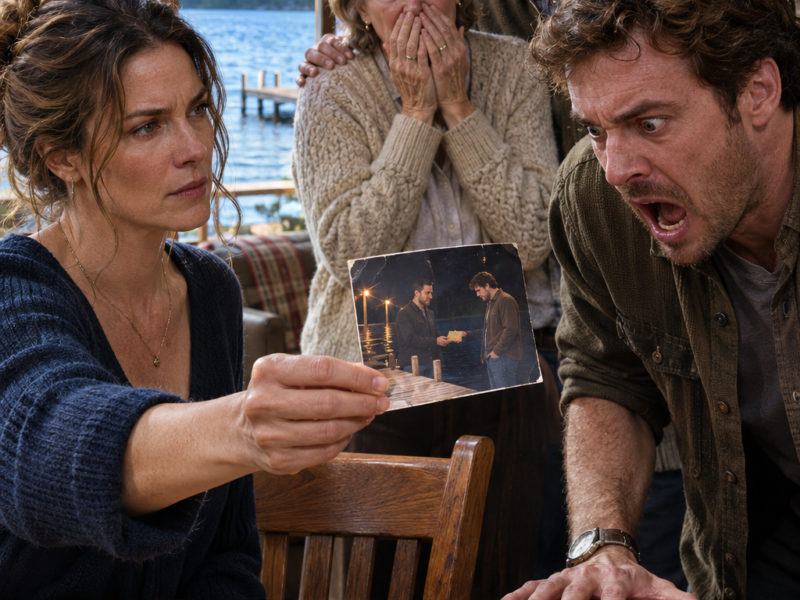
My Parents Gave My Late Husband’s Lake House to My Brother — One Photo Later, He Was Screaming
My Parents Gave My Late Husband’s Lake House to My Brother — One Photo Later, He Was Screaming
My father threw the bag hard enough to split it. Caleb’s red flannel spilled onto the porch steps, followed by the coffee mug our son had once glued back together after chipping the handle. My father had helped him do it. I remember that because he’d held the pieces in place while Owen counted to sixty, and when Owen lost his place at forty-three, Dad let him start over.
That Thursday, he kept his eyes on the gravel.
“Take what you want and go,” he said.
Behind him, my mother stood in the doorway of the lake house my husband had left me. The sign Caleb carved for that door was gone. In its place hung a glossy plaque with a painted loon and my brother’s last name.
“He’s dead, Carrie,” she said. “Your brother has a real family.”
My twelve-year-old son was at the bottom of the steps. He held a canoe paddle with his name carved into it in his father’s handwriting. He’d heard every word.
I gathered the flannel and the mug. Underneath them I found a flat carpenter’s pencil, a tape measure, and a shoebox. I carried the whole bag down to the water, walked out onto the brand-new dock my brother had put his name on, and opened the box.
There were sympathy cards inside. Every envelope had been slit cleanly across the top. One had two kinds of handwriting on it. I recognized the handwriting on the back.
I set the envelope on the cedar boards, crouched low enough to get the brass plaque on the dock in the same frame, and took a picture.
“Go ahead, Carrie,” my brother yelled from the porch. “Put it on Instagram.”
I sent it to one person. Three hours later, my brother called, screaming to know who had it.
We’d gone up to Spruce Lake for Caleb’s birthday. He would have been forty-three that Friday, May 15. When he was alive, we did two things on his birthday. In the morning, he marked the kids’ heights on the bedroom doorframe. In the afternoon, we jumped off the dock into water cold enough to make grown adults forget how ladders worked. Caleb always went last so he could make sure everybody got out. By the time he climbed the ladder, Josie would be up on the boards in her towel, counting how long he’d been in, usually with several extra seconds added to get him in trouble.
We’d missed two birthdays. The first came a month after he died. On the second, I worked a double shift at the hospital and came home to find Josie crying in the bathtub. She asked if Daddy’s jump was over now. I’d been thinking of it as something we could do when we felt ready. She was eight by the time I understood that she’d been waiting for me to tell her it could still happen.
I took two days off, called the school, and texted my father Wednesday evening. I told him we were coming up and would stay in the kids’ room through Sunday. He wrote back, “Okay.”
That was all.
We left Grand Rapids at eight forty the next morning. Owen sat up front in charge of snacks and rationed them with a seriousness that lasted until he opened the pretzels. Josie wore her beach towel around her neck almost the whole drive. Somewhere past Cadillac, she leaned forward to ask whether Daddy’s jump spot was still there.
“Of course it is,” I said. “It’s a dock.”
We turned onto the gravel road shortly after eleven thirty. Both my parents’ vehicles were in the driveway. My sister-in-law, Tessa, opened the front door with Ivy on her hip before I could take my key out.
“Oh,” she said. “Connie said you might come by.”
From the doorway I could see a photograph of my brother Brent and his family above the fireplace, all four of them in white shirts on a beach. Our wedding picture had hung there for years. The smaller photograph on the mantel, of Caleb grinning at the end of the dock, was gone too.
My mother came out of the kitchen drying her hands. “You should’ve called.”
“I texted Dad.”
She folded the towel over her wrist.
Owen had already walked to the sliding door. “Mom,” he said. “Where’s Dad’s dock?”
The old dock had been gray, a little crooked, and narrow enough that Caleb and my father had to turn sideways to get past each other with their tools. My father, a retired electrician, had wired lights along it in 2016. I used to stand at the kitchen window and watch the two of them working after dark, waiting for the lights to come on. The dock out there now was wide and straight, almost orange in the sun. I could read the brass plaque from inside the house. Holloway Landing, 2026.
Brent slid open the door with a pair of barbecue tongs in his hand. “Old one rotted out,” he said. “Built you a new one. You’re welcome.”
Owen turned and went down the hall. I followed him to the bedroom, where two sets of built-in bunks stood against the walls. Painted wooden name boards hung over them. HUDSON. IVY. My son barely glanced at the beds. He reached out and ran one finger down the doorframe.
I knew where he’d started. His first mark had been down near the hinge, from the year he could barely stand on his own. Caleb had held the pencil sideways and waited for him to stop bobbing his head. Josie’s marks began a few years farther up the frame. Beside each line Caleb had written the date in the same square letters he used to label the drawers in his workshop.
The wood was glossy white.
“Grandpa,” Owen said. My father had come up behind us. “Where are the lines?”
“Paint was peeling, bud.”
Owen kept his finger on the doorframe a moment longer, as though his father had pressed hard enough for the pencil to leave a groove.
In the garage we found six black contractor bags lined up against the wall. My mother had written DUMP SAT on each one. I knew her big looping capitals from the notes she used to leave beside my breakfast. I pulled the cedar sign out through a tear in one bag. Josie had both hands on the sleeve of Caleb’s flannel, which was hanging out of another.
“Mommy, why’s Daddy’s coat in the garbage?”
My mother called me out onto the porch before I could answer.
Caleb had inherited the house from his grandfather, Walter, who built it in 1979. I’d met both of them in 2010, when Walter came to the clinic for his lung appointments. Walter was short of breath and short on patience. Caleb drove him every time and used to bring a book he rarely got to open. On the fourth visit, while Walter was getting his coat on, Caleb asked me to coffee. He still had a pencil tucked behind his ear from work.
We married in September 2012. Caleb taught woodshop at Cedar Ridge High School for fifteen years, all of them in room 114. At home he fixed things other people would’ve thrown away, sometimes to a fault. He drove with a cracked windshield for so long that I could tell how far it had spread by which traffic light it pointed to on my way to work. He hated borrowing money. He was equally particular about lending it.
In 2023, Brent asked him for twenty thousand dollars for a mini skid steer. Brent had already gone through two businesses with help from my parents. Caleb listened to him, asked some questions about the work he had lined up, and said no. That evening my mother called to tell me my husband had humiliated my brother. When I got off the phone, Caleb was at the sink washing a pan he’d already washed twice.
“That’s nearly everything we put aside for the kids,” he said. “I’m leaving it where it is.”
He turned off the tap and stood a while with his hands dripping over the sink. Then he said, “Your mom hears ‘not yet’ when you tell her no.”
I laughed. I remember him looking over at me, and I remember that he didn’t.
When Walter died in 2015, he left the lake house to Caleb because he figured Caleb would fix the porch and stay awhile. The following summer, Caleb put my name on the deed. I told him it seemed like a lot of running around for a piece of paper. He said if anything happened to him, he wanted me to be able to walk into my own house without asking anybody. Then he carved the words Lane Landing into a slab of white cedar and hung it above the door.
In April 2024, he died on a run he’d done hundreds of times. The doctors found a heart condition nobody had known he had. I’m a respiratory therapist. At the hospital I looked at the monitor and understood what had happened before anyone had a chance to pull up a chair.
Almost six hundred people came to the memorial. Students in shop shirts lined the hallway. Someone set a wicker basket on a table by the auditorium doors for cards. My mother took charge of the basket, the casseroles, and the people who wanted to know when they could stop by. When one of Caleb’s colleagues asked where the proceeds from the school fundraiser should go, I told him to talk to her.
At the time I was grateful she could finish a conversation. I couldn’t get through one without losing track of what we were talking about.
That Memorial Day, Owen held the box while we scattered some of Caleb’s ashes off the old dock. Josie dropped a dandelion into the water and watched it float all the way under the boards. I didn’t go back for two years. That fall I gave Dad a key so he could close the house for winter. I asked Mom to put the sympathy cards up there with Caleb’s things. In September of the following year, Dad called to say Brent’s lease was up and the business had folded. Could he and Tessa and the kids stay at the lake for a few weeks?
I said yes before he finished asking. In January, when I wanted to know how much longer they needed, my mother told me I ought to thank them for keeping my pipes from freezing. I went back to work. The taxes and insurance still came out of my account. The key on my ring still fit, as far as I knew.
On the porch, Brent said, “Mom said you gave us the place.”
“I said you could stay a few weeks.”
“As long as they needed,” my mother said. “That’s what family means.”
I looked at Dad. He’d made the call. He leaned against the railing and let the two versions sit there.
I asked how they’d paid for the dock, the porch, and the bunks. At Christmas, Brent had told Dad he was behind on his truck payments. My mother said they’d paid for everything out of their retirement savings. Dad looked at her then, quick enough that I might’ve missed it if I’d been looking at anybody else. He looked puzzled.
When I said I was taking Caleb’s things, she told Dad to haul the bags to the transfer station. He picked up two. I called after him about the coat and the cedar sign. My mother told me my brother had a real family. My father threw the bag.
Twenty minutes after we left, we checked into room nine at the Pine Shore Motel in Elk Rapids. The pool was still covered, but there was a swing set outside our window. Owen took Josie out to it while I emptied the bag onto the bedspread.
I counted thirty-eight cards besides the envelope I’d photographed. Neighbors, nurses from my unit, parents of Caleb’s students, my aunt Cheryl. More than one had written some version of a little something for the kids. Pam, my charge nurse, had raised two boys on her own. She wrote that she’d put in what she would’ve wanted someone to give hers. I tipped her envelope over anyway. By then I knew it was empty, but I did it with every one.
The envelope from the photograph was white, with soft corners. Across the front, in a teenager’s slanted capitals, it said, For Owen and Josie. From Mr. Lane’s kids.
On the back, in a man’s square handwriting, were three short lines.
$612.
Room 114.
Counted twice.
I could picture the students counting it. Caleb used to send a boy back to the same board three times if he thought the boy was giving him the measurement he wanted to hear. These were teenagers with grocery-store jobs and lawns to mow. They’d put their money together, counted it the way he’d taught them, and brought it to his memorial. Two years later I’d found their envelope in a bag headed for the dump.
My phone buzzed at one twenty.
“That’s my handwriting,” the reply said. “Give me two hours. Don’t call your mom.”
In July 2024, my mother had stood in my kitchen wiping a counter I’d already cleaned. She told me the school money was in two education savings accounts, one for each child. The statements would go to her email, she said, so I wouldn’t have to look at numbers while I was grieving. I thanked her. The following winter Owen brought home a worksheet that asked how much he had saved for college. I called her for the account numbers. She asked whether I trusted her after everything she’d done for me.
I apologized. Owen wrote a lot on the worksheet and drew a smiley face beside it.
At one forty, Tessa called from somewhere quiet enough that I could hear her breathing between sentences. She said she’d thought we wanted the place cleared out. She’d thought we didn’t want the old beds or toys. She’d thought we’d offered the house for as long as they needed. She kept telling me what she’d thought until she got to the part about the dock.
“It was fourteen-nine just for that,” she said.
“Fourteen thousand nine hundred?”
“Your mom said it came out of savings. I asked if we should pay her back. She said a mother doesn’t keep score.”
After we hung up, I searched for the fundraiser. It took less than a minute. The page was still up, with Caleb’s school photograph at the top and a total of $31,600 from 286 donors. The names belonged to teachers, bus drivers, cafeteria staff, parents. One person had given twenty-five dollars and written, From a kid Mr. Lane didn’t give up on.
There was a link to the video of the first Lane Build Day. The school held it every spring so former students could come back and build benches for Riverside Park. I’d worked the day of the first one, and my mother had offered to represent us. I watched her walk up to the microphone holding the photograph that had disappeared from my mantel. She thanked the donors in my name and told them every penny was in the children’s college accounts. Behind the camera, somebody sniffled. When the applause started, my mother looked down at the photograph in her arms.
Below the video was the program for the second Build Day. It was in two days. She was scheduled to speak again.
Then the family group chat lit up. My mother said I’d made a scene in front of the children and asked everyone to pray for me. Aunt Cheryl wrote that I’d been so sweet to send a thank-you card after the funeral. She still had it on her refrigerator. I asked her to send me a picture.
There were three names at the bottom. Carrie, Owen, and Josie. All in my mother’s hand.
I called the education savings program. The woman who answered explained that she could discuss an account only with its owner. She couldn’t even tell me whether an account existed. I hung up and took the little motel notepad from beside the lamp. Using Caleb’s pencil, I drew a line down the middle. On one side I wrote what I knew. On the other I wrote what I could prove.
I had the empty envelopes, the fundraiser page, the video, and a photograph of a thank-you card I hadn’t written. Across from the money is gone, I had a blank.
My father texted at two fifty-two to ask what I’d taken out of the box. At three oh one he said my mother was crying and asked what I’d sent. She hadn’t called me once. Ordinarily, when she thought I’d misunderstood something, she’d call before I’d made it to the end of the driveway.
The next message came from the man I’d sent the picture to. He’d asked my mother for the balances. She’d promised to send them that night.
“She’s had two years, Carrie,” he wrote.
Owen came inside wearing his father’s flannel. He’d rolled the sleeves three times. He sat on the bed beside me and turned the chipped mug between his hands.
“Is it because Dad’s dead and we don’t count?”
I’d thought he might ask whether we could make Grandma give the house back. I hadn’t thought about how long he’d been standing with that paddle, or what he’d had to work out by himself while I was down on the dock.
“Your dad had students who used their lunch money to help you,” I said. “There’s a whole page full of people who wanted to make sure you and Josie would be okay. I’ll show you their names if you want.”
He thought about that. “Can we get it back?”
“Yes,” I said. I still had that blank on the page. I said it anyway.
At three forty, Brent called.
“Who did you send that to?” he yelled. “Somebody from the school called Mom. She’s been tearing the house apart. Is it on Facebook? Tessa’s whole family is on Facebook, Carrie.”
I could hear Ivy crying in the background. I held the phone away from my ear until he stopped for breath.
“I sent it to somebody who knew what was in the envelope,” I said.
There was a brief, bewildered silence. Then he started talking so fast the words ran together.
“Mom said it was a loan. She said it was just sitting there and she was going to put it back as soon as I got on my feet. Every dollar. That’s what she told me.”
I hadn’t said a word about money.
“Brent,” Tessa said, close enough to the phone that I heard her perfectly. “What money?”
The line went dead.
At four oh five, Neil Ashford called me from his truck. Neil taught woodshop in room 112, next door to Caleb. They’d shared a lumber order and a coffee maker that worked if you hit it in the right spot. At the memorial, Neil had made it halfway through his speech before he folded the paper and stepped away from the microphone.
He’d organized the online fundraiser. He’d also helped the students count the cash they’d collected in an old coffee can. I remembered him standing beside a tall boy in sawdust-covered jeans at the memorial, waiting for my mother to finish talking. He told me he’d handed her the envelope himself.
The organizer’s records showed a transfer of $31,600 to Connie Holloway on June 12, 2024. Neil had been asking her for statements since March so he could show donors what they’d accomplished at Build Day. Each time, she said bringing up the money would upset me. That afternoon he’d asked for a screenshot. When she said she’d send it later, he told her he could always ask me to log in and get it myself.
“I’ve got a thank-you card from you on my refrigerator,” he said after a pause. “I thought you wrote it in the worst week of your life.”
“I didn’t.”
“I know.” He took a breath. “I owe those people an update on Saturday. I’d rather you be there when I give it.”
My mother never sent him the balances. After the kids went to sleep, I texted my father the motel address and told him to come alone at seven thirty.
At seven thirty on Friday morning, he knocked. I stepped outside and pulled the door nearly shut behind me. Dad held a folded bank printout in one hand. My mother had said she’d forgotten her password, so he’d used his own login for the first time. The account was in both their names.
The first deposit was $3,900 in cash. The second, on June 12, was $31,600. Withdrawals began the following January. Transfers to Brent. A cabinet shop. A porch company. In April 2026, $14,900 to Birch Point Lumber.
The balance was $1,860.
Dad ran his finger down the rows. I could see where years of working with wire had left little pale scars on his knuckles. “She told me it was our savings,” he said. “I thought we were helping our boy.”
Then he looked across the parking lot and said, “I ran the lights on the first dock. Caleb held the flashlight for me.”
He stood there a while. I kept the papers.
We went back to the lake at noon. Tessa had taken Hudson and Ivy to her sister’s in Traverse City and come back alone. I sent Owen and Josie out with fishing poles, far enough away that they couldn’t hear us from the porch. Then I set the envelope, the bank statement, and the photograph of Cheryl’s thank-you card on the table in front of my mother.
“I was going to put it back,” she said.
She laid one hand on the envelope. Then she listed the things I had. A paid-off house, a job, life insurance, Caleb’s pension. She asked what she was supposed to do when Brent had two children and nowhere to go, with all that money sitting in an account doing nothing.
“I lost two babies before I had him,” she said. “I couldn’t watch him lose everything. Caleb could’ve helped him when he asked. He looked him in the eye and said no. I did what should’ve happened in the first place.”
Brent shoved his chair back. “Caleb doesn’t get to say no anymore.”
Through the porch screen, I could see Josie holding up her fishing line for Owen to untangle. He put his own pole down and bent over hers.
“You told me it was her savings,” Tessa said.
“It was in her account.”
Tessa looked at him for a long moment. Then she went inside. We heard a drawer open, followed by the faint squeak of a screwdriver. She came back holding the painted boards from the bunks. A screw was still sticking out of the back of Ivy’s.
“We’re leaving,” she said, and set both names beside the envelope.
My father turned to my mother. “You let me throw that bag at her, Con.”
I took out the sheet I’d written at the motel. I gave them until May 29 to return the full $35,500 to accounts I controlled. I gave Brent until May 31 to move out and handed Tessa the date in writing. I told my mother she wouldn’t speak for me at Build Day or sign our names again. The dock would stay. It had been paid for with the kids’ money.
“You’d do this to your own mother?” she asked.
I slid the bank statement toward her. “Look at the names on the envelope, Mom.”
Behind me the screen door opened. Owen stood there in the red flannel, holding his fishing pole. “It’s almost three,” he said.
He put the pole down and went to the car for the cedar sign. He carried it out to the dock and propped it against the post, covering the brass plaque with his father’s words. He stood back to see if it would stay.
“If it was our money,” he said, looking up at the porch, “then it’s our dock.”
I brought the towels down. Josie stood at the end in her swimsuit, her knees already knocking. She counted louder than she needed to, the way Caleb always had.
“Three. Two. One. For Daddy.”
The kids hit the water together. They came up screaming and laughing, both reaching for the ladder at once. When they were clear, I jumped in my jeans and sweatshirt. The cold took my breath. For one second underwater, I let myself cry. Then I came up and saw Owen lying flat on the dock, reaching down to help me, though the ladder was right there.
I took his hand anyway.
The next morning there were about two hundred people in the shop yard at Cedar Ridge. Half-built benches stood on sawhorses. My mother came in a navy dress and sat in the last row with her purse on her lap. When it was time for the family remarks, Neil told the crowd the money would be moved into accounts for the children that month. He said he was sorry it had taken this long. Then he handed me the microphone.
“Last year you were told the money was safe,” I said. “It wasn’t. It will be. Thank you for counting it twice.”
Afterward, a young man named Tanner Briggs found Owen by the benches. I recognized him as the boy who’d stood beside Neil at the memorial. He took Owen into the courtyard and showed him the first bench he’d ever built in room 114. His initials were burned into one leg.
“Your dad made me measure every piece twice,” he said. “Drove me nuts.”
He sat down on one end and waved Owen over to the other. The bench held steady. When I looked back toward the folding chairs, my mother’s seat was empty.
My father listed his fishing boat that afternoon. It sold on Thursday for $16,200. He took another $17,440 out of his retirement and added the $1,860 left in the credit union account. On Friday, May 22, the full $35,500 went into two education accounts with my name on them. Dad texted, “It’s done. All of it.” An hour later he sent a photograph of the empty trailer in his driveway. He’d had that boat for seventeen years. I looked at the picture for a while before I put the phone down.
Tessa’s parents came with a borrowed truck the next day. At six twelve she texted to say they were out and Dad had the keys. Brent sent me one message. Hope you’re happy. I left it unanswered. That evening I blocked my mother’s number. It took me four tries to press the button.
Dad started calling on Sundays. The calls were short at first. He asked about the kids and waited for me to tell him when he could see them. We agreed I’d be there. Tessa wrote that she should’ve asked more questions. I told her I was glad she’d asked the one she did. At the kids’ schools, I changed the emergency contacts to Neil and his wife, Diane.
At home, Owen asked who had written the thank-you cards. I told him. He went to get a pad of paper, and over the next ten days he and Josie wrote thirty-eight letters. I copied the addresses off the old envelopes. Josie drew docks with impossibly long ladders. Owen kept his letters short. He wanted each person to know we’d finally read what they’d written.
They wrote one more letter for room 114. Owen folded it into thirds and slid it into the envelope that had carried the $612. On May 29, we drove to Cedar Ridge after school. The shop smelled like sawdust and old coffee. Caleb’s workbench was still in the corner, with a small brass plate on it now.
Owen held out the envelope to Neil. “It’s not empty anymore.”
Neil took it over to the corkboard beside a class picture of Caleb with his safety glasses pushed up on his head. He pinned it there, then wrote Delivered on a sticky note in the same square handwriting and pressed it underneath.
Before we left, he asked Owen if he wanted to come in on Saturdays that summer and learn to use the lathe. Owen said yes before Neil had finished the question.
The next morning, a locksmith met us at the lake. When he left, I put the new keys on the ring beside the little wooden fish Caleb had whittled for me. Josie stood on a chair to put her father’s photograph back on the mantel. The chipped mug went on its hook, handle facing out. Dad came for a couple of hours and held the ladder while Owen screwed the cedar sign back above the front door. Owen climbed down once to check how it looked from the driveway, then went back up with Caleb’s tape measure.
I unscrewed the brass plaque from the dock and handed it to Dad on his way out. “Give it to Brent,” I said. Dad slipped it into his pocket. He hugged the kids, and when he drove away, Josie and I stood in the doorway until the sound of his truck faded.
“Can we do the lines now?” she asked.
Caleb had taken a picture of the doorframe every year. I’d found them on his old phone a few weeks before our trip and never made it through all of them in one sitting. That afternoon I sat cross-legged on the bedroom floor and worked my way from 2015 to 2023. I copied the little dates as closely as I could. There was one photograph where Caleb’s thumb covered half of Josie’s line, so she leaned over my shoulder and helped me work out where it ended.
I left a space for the two years we’d missed.
Owen went first. He was tall enough that I had to stand up to mark his height. Then Josie backed against the frame and pressed her heels down hard, determined to give me a fair measurement. I made a small mark and lowered the pencil.
“Daddy would check,” she said.
She stepped away and got back into position. I laid the pencil flat on her head again. It came to the same place. She turned around to watch me write the date, May 30, 2026, beside the two new lines. Then she put one finger on her oldest mark and walked it slowly up the frame until she reached the one we’d just made.