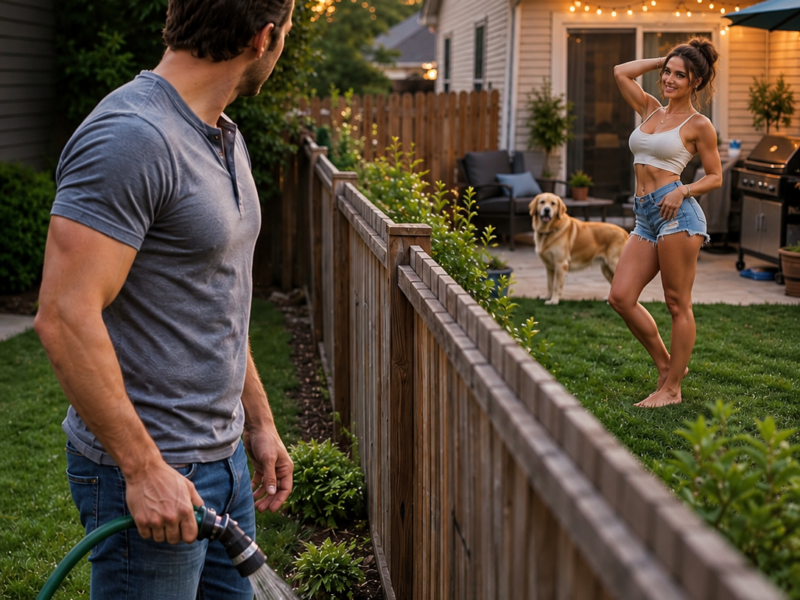
My Neighbor Caught Me Staring From the Yard… Then Said, “If You Want to Look, Just Ask ”
After My Divorce at 36, I Thought I’d Spend the Rest of My Life Alone—Until a Beautiful Woman Moved Into the Blue House Next Door. One Evening, She Caught Me Staring From My Backyard and Smiled, “If You Want to Look, Just Ask.” I Thought It Was Harmless Flirting, Until Her Wealthy Ex-Fiancé Suddenly Appeared at Her Door With a Box From Their Broken Engagement. Then She Opened an Envelope Inside, and Her Expression Changed Completely…
Part 1
The first time my new neighbor caught me staring at her, I was standing in my backyard holding a garden hose, watering the exact same patch of grass for so long that the water had started pooling around my shoes.
I wasn’t trying to be creepy. At least, that was what I kept telling myself.
I was simply trying to figure her out.
Unfortunately, that explanation sounded even worse.
My name is Jake Morrison. I’m 36 years old, recently divorced, and apparently the kind of man who can survive a failed marriage, refinance a house, rebuild a backyard deck, and manage an entire household alone, yet somehow become completely helpless around a woman who moved into the blue house next door.
Her name was Claire Bennett.
I learned that from the mailbox before I ever properly introduced myself.
Claire arrived on a Saturday morning in late June. A moving truck pulled into the driveway, followed by two young men who looked like teenagers and carried boxes with the enthusiasm of people being punished for something they hadn’t done. A golden retriever jumped out of the truck and immediately began exploring the neighborhood as though he had personally purchased every property on the street.
I’d lived in that neighborhood outside Raleigh for nearly six years. It was one of those quiet suburban streets where everyone knew everyone else’s business but pretended otherwise. There were old oak trees, neatly trimmed lawns, front porches, and neighbors who waved from their driveways even when they clearly had no intention of having a conversation.
After my divorce, that quiet had become the main reason I stayed.
My ex-wife had moved downtown. I kept the house because I convinced myself that maintaining something familiar was better than starting over somewhere else.
The truth was less impressive.
I had become comfortable hiding.
My days followed the same predictable pattern. Wake up, make coffee, go to work, come home, prepare dinner, clean the kitchen, mow the lawn, and eventually fall asleep in a house that seemed to get bigger every time I walked through it alone.
Nothing was particularly wrong with my life.
It simply felt as though someone had pressed pause and forgotten where the remote was.
Then Claire arrived.
She was probably 34 or 35, with brown hair that was usually twisted into a messy clip and warm eyes that seemed to notice more than she let on. She wore paint-stained jeans during the first week, carried boxes of books into the house, and occasionally talked to her dog as though he were a particularly difficult roommate.
The dog’s name was Murphy.
He was a golden retriever with absolutely no understanding of personal boundaries.
Our first conversation happened when Murphy wandered into my flower bed and began sniffing my hostas.
“Murphy!” Claire called from her driveway. “Get out of there!”
The dog looked at her, then at me, then returned to sniffing the plants.
“I’m sorry,” she said, hurrying over. “He’s still adjusting.”
“He’s emotionally committed to the hostas,” I replied.
Claire laughed.
“That’s his biggest weakness. He gets attached too quickly.”
“Sounds familiar.”
She gave me a curious look, but I quickly changed the subject.
Over the next few days, we exchanged the usual neighborly conversations. She asked when the recycling was collected. I told her Tuesday night, although I warned her that our neighborhood operated on what I called a special system where everyone remembered recycling only after midnight on Monday.
She laughed again.
A few days later, she mentioned that my porch light was flickering.
“I know,” I told her. “I’ve been meaning to fix it.”
“How long?”
“That’s a private matter.”
“Right. Well, if it starts sending Morse code, let me know.”
I found myself smiling long after she had gone inside.
That was the first warning sign.
The second was that I started paying attention to things I had never noticed before.
Claire drank coffee on her front steps every morning around seven. Murphy usually lay beside her with his head resting on her feet. Sometimes she read a book. Other times she simply watched the street as the neighborhood slowly woke up.
One afternoon, I saw her painting her front door a deep shade of green. She had a streak of paint on her cheek and didn’t seem to notice.
When I eventually asked why she had chosen that color, she said the house needed a spine.
I had no idea what that meant, but I liked the way she said it.
I also liked her laugh, the way she talked with her hands, and the fact that she seemed perfectly comfortable being herself.
I hadn’t felt that kind of curiosity about another person in years.
Of course, I tried to keep my interest under control.
A glance from the backyard. A quick wave from the driveway. An occasional conversation while taking out the trash.
Completely normal behavior.
Except I had started mowing my lawn in straighter lines since she moved in.
And I had developed a suspicious interest in watering plants that didn’t particularly need water.
The incident happened on a Thursday evening.
The summer heat had been unbearable all day, and even after sunset, the air remained heavy and warm. I was in my backyard watering the herb planters my sister had given me as a supposedly healthy way to cope with my divorce.
The basil was thriving.
I was not.
Across the fence, Claire was attempting to hang string lights over her patio.
She had one end of the lights wrapped around a pergola post, the other tangled around her forearm, and Murphy sitting directly on the extension cord as though he had successfully captured an enemy.
I watched her struggle for a few moments.
I should have offered to help.
Instead, I stood there holding the hose.
Claire stretched upward, trying to hook the lights over a wooden beam. The loop slipped, caught on her sleeve, and nearly pulled the entire strand down.
She muttered something under her breath.
Then she turned her head.
Our eyes met.
I froze.
The hose continued running, and water began collecting around my shoes.
Claire looked down at the puddle, then back at me.
One corner of her mouth lifted.
“If you want to look,” she called across the yard, “just ask.”
I nearly dropped the hose.
The water sprayed directly onto my ankle.
Excellent. A truly dignified performance.
I cleared my throat.
“I was looking at the lights.”
“Were you?”
“Mostly.”
Her smile widened.
“That’s a very honest correction.”
I turned off the hose.
“Do you need help?”
“With the lights or with your staring problem?”
I looked at her.
She looked back.
Then she laughed, and something about that sound made the embarrassment worth it.
“With the lights,” I said.
“The other thing appears chronic.”
“Good to know.”
I walked through the side gate and entered her yard.
Murphy greeted me as though we had been separated for years. He nearly knocked me backward, wagging his tail with enough enthusiasm to suggest I was the most important person he had ever encountered.
Claire handed me the tangled strand of lights.
“He’s useless,” she said.
“He seems proud of it.”
“He has confidence without evidence.”
“Relatable.”
She gave me a brief look. It wasn’t quite amusement. It was something more observant, as though she had heard the joke but also noticed the loneliness hiding underneath it.
I focused on the lights.
We spent the next twenty minutes untangling wires, moving the ladder, and arguing about where the bulbs should hang.
Claire held the ladder while I attached the first section. Then she climbed up and hooked the remaining strands over the beams.
Murphy repeatedly attempted to eat the plastic zip ties.
“Murphy, stop!” she shouted.
“He thinks he’s helping.”
“He thinks everything is food.”
“At least he’s enthusiastic.”
“That’s what I tell myself every morning.”
Eventually, the last strand was in place.
The sun had disappeared behind the rooftops, leaving a lavender glow in the sky. Claire plugged in the lights.
One by one, warm golden bulbs illuminated the patio.
She stepped backward and looked up.
“Okay. That’s much better.”
“It is.”
She glanced at me.
“Thank you.”
“You’re welcome.”
For a moment, neither of us moved.
Her backyard looked different under the lights. It wasn’t perfectly organized, but it felt lived in. There were books stacked on the patio table, a half-open paint can near the steps, and a dog toy beneath one of the chairs.
It looked like someone was building a life rather than simply maintaining one.
Claire leaned against the table and studied me.
“Can I ask you something?”
“After tonight, I feel like I should be nervous.”
“You probably should.”
I smiled.
“Go ahead.”
She folded her arms loosely.
“Are you always this careful, Jake?”
The question caught me off guard.
I looked toward the lights.
“Depends what I’m trying not to break.”
She didn’t answer immediately.
When I looked back, her expression had softened.
“Well, for the record, I’m not made of glass.”
Before I could respond, Murphy charged between us and knocked over an empty flowerpot.
Claire sighed.
“He disagrees.”
I laughed.
Not a polite laugh. Not the kind I used when someone at work told a joke I didn’t understand.
A real laugh.
I hadn’t heard that sound coming from myself in a long time.
Claire noticed.
Of course she did.
Then she looked at me beneath the newly installed lights and smiled.
“Would you like a beer?”
I should have gone home.
The sensible thing would have been to thank her, return to my side of the fence, and continue pretending that the woman next door had not completely disrupted my carefully organized existence.
Instead, I said yes.
Ten minutes later, I was sitting in a metal patio chair beside Claire, holding a cold bottle of beer while Murphy sprawled across both our feet.
She brought out a bowl of pretzels and another bottle for herself.
The neighborhood was settling into evening. Somewhere down the street, a child was laughing. A lawn mower hummed in the distance, and crickets had begun their nightly performance.
Claire tucked one leg beneath herself and looked at me.
“So, are you always this careful, or did I just catch you on a heavily supervised night?”
I took a sip of beer.
“We’re going back to that?”
“We never left it.”
I considered giving her another joke, but something about the way she looked at me made that feel dishonest.
“My divorce was finalized about two years ago,” I said. “It wasn’t dramatic. No screaming matches in the street or broken windows. Just a slow death by disappointment and bad communication.”
Claire winced.
“That somehow sounds worse.”
“It was efficient.”
“I hate efficient heartbreak.”
“You seem very against heartbreak.”
“I’m pretty progressive that way.”
I smiled.
She asked whether I had children. I told her I didn’t. The paperwork had been difficult enough without adding children to the equation.
Then I asked about her.
She looked up at the lights.
“Almost married,” she said.
I turned toward her.
“Almost?”
“Wedding venue, guest lists, spreadsheets, arguments about flowers. The entire embarrassing production.”
“What happened?”
She took a sip of beer.
“One argument too many, followed by one honest conversation too late.”
She paused.
“I left before the wedding.”
I didn’t interrupt.
“People think that sounds dramatic,” she continued. “But honestly, it was just delayed self-respect with a deposit attached.”
I laughed.
“That’s a surprisingly polished way to describe devastation.”
“I’ve had practice.”
There was something in her expression that made me realize she wasn’t simply making conversation.
She had been hurt, too.
And perhaps that was why I felt so comfortable sitting there.
We were two people who had reached the point where starting over seemed more frightening than staying alone.
Claire told me that her sister lived about twenty minutes away, and that she worked remotely most of the week. She had moved to our neighborhood because she wanted somewhere quieter, somewhere people still sat outside and waved at one another.
“I also wanted a place where strangers would tell me their dog’s medical history before telling me their names,” she added.
“That happens quickly around here.”
“Mrs. Hanley already told me about her beagle’s digestive problems.”
“Then you’re officially part of the neighborhood.”
We laughed.
Then Claire’s expression became more serious.
“Can I tell you something slightly rude?”
“Given our relationship so far, I’d be disappointed if you didn’t.”
She smiled.
“After my engagement ended, everyone became very gentle with me.”
“Gentle?”
“Careful. Soft voices. Loaded pauses. People constantly asking whether I was okay. And every time I met someone new, I could practically see them wondering whether I was brave for living alone or secretly miserable.”
I understood more than I wanted to admit.
“I hated it,” she continued. “I wanted people to talk to me like a normal person. Not like I was some fragile headline.”
I looked down at my bottle.
Maybe I had been doing the same thing.
Since meeting Claire, I had treated my attraction as something that needed to be hidden, controlled, and carefully managed.
I had convinced myself that I was being respectful.
But perhaps I was simply afraid.
She lifted her bottle slightly.
“That’s why I told you I’m not made of glass.”
I nodded.
“I figured.”
“No, I don’t think you did.”
She met my eyes.
“I wasn’t saying don’t be kind. I was saying don’t act like noticing me is some kind of offense.”
I didn’t know what to say.
For the first time that evening, I stopped looking for an escape route.
“You think that’s what I’m doing?”
“I think you’re very aware of me, Jake. And I think you keep trying to make that awareness look polite.”
Murphy snored loudly beneath the table.
I took a breath.
“The truth is, Claire, I’m not very good at wanting things halfway.”
She became still.
Then she placed her bottle on the table.
“That,” she said quietly, “sounds like the first real thing you’ve said to me.”
And before I could decide what to do with that admission, she leaned slightly toward me and asked a question that would make the rest of my summer impossible to predict.
Part 2
“Do you know what I’ve been trying to figure out?” Claire asked.
I shook my head.
“Whether you’re staring because you find me attractive or because you’re trying very hard not to.”
I looked at her, then down at Murphy, who was sleeping across our feet.
“Both.”
Her eyebrows lifted.
“Both?”
“Yes. I find you attractive, and I’m trying very hard not to make that obvious.”
“Why?”
“Because I’m divorced. Because we’re neighbors. Because I’m tired of wanting something good and immediately calculating how it could go wrong.”
Claire studied me for several seconds.
Then she smiled.
“I’m not accepting your application for permanent emotional retirement, Jake.”
I laughed, but before I could answer, headlights appeared outside her house.
A silver SUV stopped in front of her driveway.
The moment Claire saw the driver, her smile disappeared.
A man stepped out, wearing expensive casual clothes and carrying himself like someone who expected every room to make space for him.
“Claire,” he called.
She stood slowly.
“Nathan.”
And suddenly, I understood that the woman sitting beside me had a past that wasn’t nearly as finished as I had thought.
Part 3
I didn’t know who Nathan was at first.
I only knew that Claire’s entire expression had changed the moment she saw him.
The warmth disappeared from her face. Her shoulders stiffened, and the hand holding her coffee cup tightened slightly.
It was such a sudden transformation that I almost wondered whether I had imagined the woman who had been laughing with me only seconds earlier.
Nathan walked toward her with the confidence of someone who believed he still belonged wherever she happened to be.
He was probably in his mid-thirties, neatly dressed, with expensive shoes that looked completely out of place on our ordinary suburban street.
He glanced at me before turning back to Claire.
“I found the last box from the storage unit,” he said.
He opened the back of his SUV and pulled out a cardboard box sealed with packing tape.
Claire didn’t move.
“You could have shipped it.”
“I wanted to see the house.”
“It’s a house, Nathan.”
He smiled faintly.
“It’s a long way to move for a clean break.”
I immediately disliked him.
Not because he was her former fiancé. People had past relationships. Everyone did.
It was the way he spoke to her, as though her decision to leave him was something he was still entitled to question.
Claire stepped down from the porch.
“Leave the box by the steps.”
Nathan laughed softly.
“Still doing that?”
“Doing what?”
“Acting like you don’t care when you care too much.”
I watched Claire’s jaw tighten.
For a moment, I considered walking over and saying something. I could feel the protective instinct rising inside me, but I remembered what she had told me the previous night.
She didn’t need someone to rescue her.
She needed someone to listen.
So I walked only as far as the edge of her driveway and stopped.
Nathan glanced at me.
“Neighbor?”
“Jake.”
He nodded as though he had just identified an insignificant piece of furniture.
“Right.”
Claire’s voice became cold.
“Don’t do that.”
Nathan looked at her.
“Do what?”
“Decide someone’s importance before you know it.”
For the first time, his confident expression faltered.
He placed the box beside the steps.
“I wasn’t trying to start anything.”
“No,” Claire replied. “You were trying to measure how far I got without you.”
Silence settled over the driveway.
Even Murphy stopped sniffing the flowers.
Nathan stared at her for several seconds, then got back into his SUV.
He drove away without another word.
Claire watched until the vehicle disappeared around the corner.
I stayed where I was.
Eventually, she looked at me.
“You can stop pretending that mailbox is fascinating.”
I glanced at the empty mailbox beside her driveway.
“Strong architectural presence.”
She laughed, but the sound was uneven.
I walked closer.
“You okay?”
“No.”
Her answer came immediately.
Then she looked at the box.
“But I think I will be.”
I nodded.
“Do you want company or space?”
She studied me for a moment before holding out Murphy’s leash.
“Walk with me.”
So we walked.
For two blocks, neither of us said anything. Murphy led us down the sidewalk with the determination of a dog who believed he had important government business to conduct.
Eventually, Claire spoke.
“That was the man I almost married.”
“I gathered.”
She looked over.
“And you didn’t jump in.”
“You didn’t ask me to.”
She nodded.
“Thank you.”
I wasn’t sure what to say, so I simply kept walking beside her.
A little farther down the street, she told me more about Nathan.
He hadn’t always been the man I had just met. In the beginning, she said, he had been charming, attentive, and incredibly good at making her feel special.
He remembered little details. He planned thoughtful dates. He talked about their future as though it were already something beautiful waiting for them to arrive.
But gradually, things changed.
He began making decisions for both of them. He questioned her friendships, criticized her choices, and treated disagreements as evidence that she didn’t understand what was best for their relationship.
Whenever Claire objected, he would tell her she was overreacting.
Whenever she tried to explain how she felt, he would turn the conversation around until she ended up apologizing.
“He always stepped in,” she told me. “But not because he wanted to help me. He wanted to own the scene.”
I looked at her.
“That sounds exhausting.”
“It was.”
She kicked a small stone along the sidewalk.
“The worst part was that I started doubting myself. I kept thinking that maybe I was too sensitive. Maybe I was difficult. Maybe relationships were supposed to feel like constantly negotiating for permission to be yourself.”
She stopped walking for a moment.
“Then one day, I realized I was more afraid of disappointing him than I was excited about marrying him.”
I didn’t interrupt.
“That’s when I knew I had to leave.”
We continued walking.
When we reached the corner, Murphy stopped to investigate a mailbox.
Claire turned toward me.
“Jake, I don’t need you to rescue me from my past.”
“I know.”
“But I also don’t want to keep pretending I don’t like how it feels when you stand beside me.”
My heart seemed to forget its usual rhythm.
She stepped closer.
“So the next time you want to look at me, maybe don’t do it from across the yard.”
I looked at her.
For two years, I had told myself I was careful because carefulness was a form of kindness.
But standing there, with Claire only a few inches away, I finally understood something.
Sometimes carefulness was just fear wearing better manners.
“Okay,” I said.
She raised an eyebrow.
“Okay? That’s your answer?”
“I’m trying not to overcomplicate things.”
“Historically unusual for you.”
I laughed.
Then I stepped a little closer.
“I like looking at you, Claire.”
Her expression softened.
“I like the way you make the street feel less asleep. I like that you talk to boxes of books. I like that you painted your front door green because you thought the house needed a spine. I even like that your dog has absolutely no boundaries.”
“Murphy will appreciate that.”
“And I like you. Not because you’re attractive and live next door. I like the way you see things. I like how you challenge me. I like that when you ask a question, you actually want the answer.”
She looked at me for a long moment.
“You really don’t do halfway.”
“No.”
“Good,” she whispered. “I’m tired of halfway.”
I thought about kissing her right there.
The morning sun was shining through the trees, Murphy’s leash hung loosely between us, and for once, I wasn’t thinking about what could go wrong.
Then Mrs. Hanley stepped onto her porch.
“Murphy looks wonderful today!”
Claire closed her eyes.
I nearly laughed.
Our neighborhood had absolutely no respect for romantic timing.
We finished the walk and returned to her house.
Nathan’s box was still sitting beside the front steps.
Claire stared at it for a moment.
“I should probably open that.”
“Do you want me to stay?”
She nodded.
“Yeah. I do.”
Inside, her house was still half-unpacked. Books occupied several corners of the living room, paint samples were taped beside the kitchen doorway, and a framed print leaned against a chair.
She placed the box on the kitchen floor and opened it.
Inside were wedding planning folders, photographs, a guest book sample, and several documents from the venue they had once booked.
There was also a small white envelope with her name written in Nathan’s handwriting.
Claire picked it up.
For several seconds, she simply stared at it.
Then she opened it.
I watched her expression change as she read.
Not sadness.
Annoyance.
“Oh, he’s unbelievable.”
“What?”
She handed me the note.
It contained only one sentence.
I hope this new life gives you whatever you thought I couldn’t.
I read it twice.
“Wow.”
Claire crossed her arms.
“Right?”
“That sentence owns a linen blazer.”
She burst out laughing.
It wasn’t a polite laugh or a nervous one. It was the kind of laughter that happens when something that once had power over you suddenly becomes ridiculous.
She took the note, folded it, and dropped it into the trash.
Then she looked at the photographs and wedding folders scattered across the floor.
“I don’t want any of this in my house.”
“Then it doesn’t stay.”
We carried everything to the garage.
Claire didn’t make a dramatic ceremony out of it. She simply placed the box on a shelf and labeled it with three words: donate, shred, never again.
When we returned to the kitchen, she leaned against the island.
“Thank you.”
“For what?”
“For not making that bigger than it needed to be.”
I smiled.
“I’m learning your preferred scale of emotional support.”
“Good. It’s very specific.”
“I’ve noticed.”
For a moment, we stood there looking at each other.
Murphy had abandoned us for a patch of sunlight near the back door.
Claire tilted her head.
“Jake?”
“Yeah?”
“I don’t want to be careful right now.”
My heartbeat changed.
I stepped closer.
“Are you sure?”
She smiled.
“That’s a very you question.”
“I can ask it in a cooler voice.”
“No.”
She reached out and touched the front of my shirt with two fingers.
“I like that you asked.”
Then she looked directly into my eyes.
“I’m sure.”
I kissed her.
At first, it was gentle. Almost hesitant. We were both aware that something important was happening, and neither of us wanted to rush through it.
Then she leaned toward me, and the uncertainty disappeared.
When we finally pulled apart, Claire was smiling.
“Well,” she whispered, “that was much better than staring.”
I laughed.
“Good to know.”
Murphy barked from the back door.
Claire looked over my shoulder.
“He’s going to tell the whole neighborhood.”
“Mrs. Hanley probably already knows.”
We both laughed.
And just like that, my quiet little life had become something I no longer wanted to hide from.
Part 4
I stayed at Claire’s house for another couple of hours that morning.
Not because either of us had planned anything, but because neither of us seemed particularly interested in ending the day.
She made coffee even though it was barely ten o’clock, and I helped her hang the framed print that had been leaning against the living room chair.
Apparently, hanging a picture was a more complicated task than I had expected.
“Higher,” Claire instructed.
I lifted it.
“Too high.”
I lowered it.
“Now it looks insecure.”
I turned around.
“Are we talking about the picture or the entire wall?”
She laughed.
By noon, the print was finally in place, Nathan’s box had disappeared into the garage, and Murphy had managed to fall asleep directly in the doorway.
Claire walked me to the side gate.
“So,” she said, leaning against the fence, “are we going to be weird now?”
“Probably.”
“Good. I’d hate for us to become emotionally efficient overnight.”
I smiled.
“Would you like to have dinner with me?”
Her eyes warmed.
“Are you asking properly?”
“I’m trying.”
“Then yes.”
Our first actual date happened two nights later.
I spent far too long deciding what to wear, which was embarrassing considering I had spent the previous evening telling my sister that I wasn’t nervous.
She had laughed at me.
“You’ve been divorced for two years, Jake. You’re allowed to like someone.”
“I know.”
“Then why are you treating dinner like a job interview?”
I didn’t have a good answer.
When I arrived at Claire’s house, she opened the door wearing a red sundress.
For a moment, I genuinely forgot what I had planned to say.
She noticed immediately.
“If you want to look, you can still ask.”
I shook my head.
“You’re never letting me survive that, are you?”
“Absolutely not.”
We went to a small Mexican restaurant downtown. The tables were close together, the music was slightly too loud, and the salsa was spicy enough to make me question several decisions.
But the evening was wonderful.
We talked about everything.
Claire told me about her childhood, her sister, and the years she had spent trying to become the kind of woman Nathan wanted her to be.
I told her about my marriage.
I hadn’t talked much about it since the divorce.
There hadn’t been one terrible moment that ended everything. No dramatic betrayal or enormous scandal.
Instead, there had been hundreds of small disappointments.
Conversations that ended before they began. Plans that were constantly postponed. Arguments where neither person remembered what they were actually fighting about.
Eventually, we became two people sharing a house rather than sharing a life.
“I think I stopped being myself somewhere along the way,” I told her.
Claire listened carefully.
“What do you mean?”
“I used to be spontaneous. I liked road trips, trying new restaurants, meeting people. Then everything became about avoiding conflict. I learned to choose the answer that caused the least trouble.”
She nodded.
“That’s a lonely way to live.”
“It was.”
After dinner, we walked beside the river.
The air was cooler, and the lights reflected across the water.
Claire slipped her hand into mine.
I looked down at our hands for a second.
Then I smiled.
She noticed.
“What?”
“Nothing.”
“Jake.”
“I just haven’t done this in a while.”
She squeezed my hand.
“Neither have I.”
We continued walking.
For the first time in years, I wasn’t trying to predict how something would end before allowing myself to enjoy how it began.
The months that followed were surprisingly ordinary.
And that was exactly what made them special.
Claire began spending more time at my house. Murphy discovered that my couch was considerably more comfortable than his own dog bed and started treating it as his personal property.
My sister noticed Claire’s coffee mug beside the kitchen sink during a visit.
She looked at it, then at me.
“Finally.”
“What?”
“The yard-staring era has evolved.”
I nearly choked on my coffee.
Claire laughed so hard that Murphy started barking.
Our relationship grew slowly.
We didn’t rush into making promises. We didn’t immediately start talking about marriage or moving in together. We had both experienced what happened when people confused excitement with certainty.
Instead, we learned each other.
I learned that Claire liked her coffee strong, hated mornings when it rained, and believed every room needed at least one plant.
She learned that I became quiet when I was worried, that I occasionally forgot to buy groceries, and that I had a habit of fixing things around the house whenever I didn’t know how to express what I was feeling.
She also learned that I was terrible at choosing paint colors.
One Saturday, I suggested repainting my guest room a light beige.
Claire stared at the sample.
“Absolutely not.”
“What’s wrong with it?”
“It looks like sadness.”
“It’s neutral.”
“It’s emotionally exhausted.”
I laughed.
She eventually chose a warm cream color that made the room look completely different.
Little by little, our houses began changing.
My kitchen acquired a second coffee mug. Her sweater appeared on the back of my dining chair. Murphy’s toys started showing up in places where they had no business being.
I stopped pretending to dislike the dog hair on my couch.
Claire noticed.
“You know, you could just admit you like him.”
“I tolerate him.”
“You bought him a birthday present.”
“It was on sale.”
“It was a personalized birthday present.”
I had no defense.
Six months after Claire moved in, her house finally looked like hers.
The green front door stood proudly against the pale exterior. The string lights remained above the patio, her books had been arranged on shelves, and the paint samples had finally disappeared from the kitchen wall.
More importantly, she seemed different.
She laughed more freely. She stopped checking her phone whenever an unfamiliar car passed the house. She no longer seemed to carry the weight of her previous relationship into every new situation.
One afternoon, I found her sitting on the patio reading a book.
Murphy was asleep beside her.
I brought out two cups of coffee and sat down.
She closed the book.
“What?”
“Nothing.”
“You’re staring again.”
I smiled.
“Am I?”
“Terribly.”
I handed her a cup.
“Just checking whether you’re still real.”
She laughed.
Then she leaned over and kissed my cheek.
I realized that I had stopped thinking about Claire as the woman who lived next door.
She had become part of my daily life in a way that felt completely natural.
And that was when I started wondering whether two houses separated by a fence were really necessary.
One evening, nearly a year after our first conversation, I watched Claire walk through my kitchen, grab Murphy’s leash, and head toward her back door.
She moved between the two properties as though the fence had become a meaningless formality.
I stood there watching her.
Then I realized something.
I didn’t just want her to visit.
I wanted to wake up knowing she was there.
I wanted to share breakfast, grocery lists, laundry, and all the unremarkable details of everyday life.
I wanted the ordinary.
So that evening, I asked her to move in with me.
She was standing in my kitchen when I brought it up.
“Have you ever thought about living in one house instead of two?”
She looked at me.
“Are you suggesting something?”
“Maybe.”
“That’s very mysterious.”
I smiled.
“I’d like you to move in with me.”
Claire didn’t answer immediately.
She looked around my kitchen, then toward the window that faced her house.
Finally, she asked, “What about the green door?”
I laughed.
“Your green door?”
“Our green door.”
That was her answer before she even said yes.
We decided to sell my house the following spring and move into hers.
It made sense financially, and Claire’s house had always felt more like a home than mine did.
The moving process was chaotic.
Murphy was convinced that every cardboard box contained something specifically intended for him. My sister helped us pack, Mrs. Hanley offered unsolicited advice about which furniture should go where, and Claire spent an entire afternoon arguing with me about whether we needed to keep a coffee table I had owned for nearly a decade.
“We need it,” I insisted.
“We have another one.”
“This one has sentimental value.”
“It’s ugly.”
“It’s functional.”
“It’s ugly and functional.”
I eventually lost that argument.
When the last box was unpacked, I stood in the living room and looked around.
My furniture was there. Her books were there. The green door was visible through the front window.
And Murphy was lying in the middle of the floor, completely satisfied with the arrangement.
Claire walked over and slipped her arms around my waist.
“Are you happy?”
I looked down at her.
“More than I expected.”
“Good.”
She rested her head against my chest.
I held her there, thinking about how strange life could be.
Two years earlier, I had believed that the best thing I could do was preserve the life I already had.
I had been so afraid of making another mistake that I had almost missed the chance to make something beautiful.
Claire had never asked me to become someone else.
She had simply asked me to stop hiding.
And somehow, that had changed everything.
Part 5
Two years after Claire first caught me staring from across the yard, I proposed to her beneath the same string lights we had hung together that Thursday evening.
I had planned the entire thing for weeks.
My sister knew. Claire’s sister knew. Even Mrs. Hanley knew, which meant that approximately half the neighborhood probably knew before Claire did.
Murphy, unfortunately, was the most difficult part of the plan.
I had purchased a small bow tie for him, hoping he would look adorable in the photographs.
He hated it.
He spent twenty minutes trying to remove it, then sat in the corner looking at me as though I had personally betrayed him.
Claire was outside when I finally called her over to the patio.
She looked at the lights, then at the table.
“What are you doing?”
“Nothing.”
“Jake.”
I smiled.
“You know, you ask that question a lot.”
“Because you frequently do suspicious things.”
I took her hands.
For a moment, I couldn’t speak.
I had rehearsed what I wanted to say countless times, but standing there with her in front of me made every prepared sentence seem unnecessary.
“Two years ago, I was a man who had convinced himself that being alone was easier than risking another disappointment,” I began.
Claire’s expression softened.
“I had a house, a job, a routine, and absolutely no idea what I wanted the rest of my life to look like. Then you moved into the blue house next door with a golden retriever who apparently believed property boundaries were optional.”
She laughed.
“I remember.”
“I remember standing in my backyard pretending to water the same patch of grass because I couldn’t stop looking at you.”
Claire smiled.
“You were terrible at pretending.”
“I know.”
I took a breath.
“You taught me that being careful isn’t always the same as being kind. Sometimes it’s just fear. You taught me that starting over doesn’t mean everything before it was wasted. And you made me realize that a quiet life doesn’t have to be an empty one.”
Her eyes were already filling with tears.
“I don’t want to spend the rest of my life watching you from across a fence,” I continued. “I want to stand beside you. I want the ordinary mornings, the ridiculous arguments about paint colors, the terrible jokes, the dog hair, the holidays, and every unexpected thing that comes with loving you.”
I lowered myself onto one knee.
Claire covered her mouth.
“Claire Bennett, will you marry me?”
She began crying before I had even finished the question.
Then she nodded.
“Yes.”
I stood up, slipped the ring onto her finger, and kissed her beneath the lights.
Murphy barked so loudly that the moment nearly turned into a neighborhood emergency.
Claire laughed through her tears.
“He’s going to want credit for this.”
“He already thinks he arranged our entire relationship.”
She kissed me again.
Then, after a moment, she pulled back and gave me a mischievous smile.
“For the record, I knew you wanted to kiss me the night we hung these lights.”
I stared at her.
“You did?”
“Of course.”
“Then why did you wait?”
She tilted her head.
“Because you needed to ask.”
I laughed.
She was right.
We got married in the backyard a few months later.
It was a small wedding, exactly the kind Claire wanted. There were flowers along the patio, warm lights overhead, and enough chairs for our closest friends and family.
Mrs. Hanley sat in the front row and provided commentary throughout the ceremony.
My sister cried so loudly that she had to pretend she was suffering from allergies.
Claire’s sister gave a speech that included several stories I was fairly certain Claire had hoped would remain private.
And Murphy wore another bow tie.
This time, he tolerated it for almost fifteen minutes.
When Claire walked toward me, I remember thinking that she looked happier than anyone I had ever seen.
Not because everything in her life had become perfect.
But because she was finally living a life she had chosen for herself.
When the ceremony ended, we stood beneath the string lights while everyone congratulated us.
Claire leaned against me.
“Do you remember the first time you saw me?”
“Unfortunately, yes.”
“Why unfortunately?”
“Because I was holding a garden hose and behaving like an idiot.”
She laughed.
“You were watering the same patch of grass.”
“I was distracted.”
“By me?”
I looked down at her.
“Completely.”
She kissed me.
And for the first time in a very long time, I felt no need to wonder whether I deserved the happiness I had found.
I simply allowed myself to enjoy it.
Life after marriage wasn’t some endless romantic movie.
We still argued about groceries. Murphy still stole food whenever we turned our backs. Claire still insisted that I was incapable of choosing appropriate home decorations, and I still believed that her collection of houseplants was slowly taking over our living space.
But those ordinary things became the parts of life I treasured most.
Some mornings, I would wake up before Claire and make coffee. She would eventually wander into the kitchen wearing one of my old shirts, her hair messy, and her eyes barely open.
She would sit at the counter while I prepared breakfast.
Sometimes we talked about our plans for the day.
Sometimes we said nothing.
And I discovered that silence could feel completely different when you were sharing it with someone who made you feel understood.
A few years after our wedding, I found myself sitting on the patio one evening while Claire painted a small wooden planter.
The sun was setting, Murphy was sleeping beneath the table, and the string lights were beginning to glow.
Claire looked up.
“What?”
I smiled.
“Nothing.”
She narrowed her eyes.
“You’re doing it again.”
“Doing what?”
“Looking at me.”
I leaned back in my chair.
“Is that a problem?”
She dipped her brush into the paint.
“Depends.”
“On what?”
She smiled.
“If you want to look, just ask.”
I stood up, walked over to her, and kissed her forehead.
“Can I?”
She laughed.
“You don’t have to ask anymore.”
I shook my head.
“Actually, I think I do.”
She looked at me curiously.
“Why?”
“Because I like asking. I like knowing you’re choosing this, too. Every day.”
Her expression softened.
Then she reached for my hand.
“Then yes, Jake. You can look.”
I sat beside her.
For a while, we watched the evening settle over the neighborhood.
The same street was still there. The same old trees, the same porches, the same neighbors who waved from their driveways.
Mrs. Hanley still knew everyone’s business.
Murphy still had no respect for boundaries.
And the blue house next door had long since become part of our story.
Sometimes I think about the man I was before Claire arrived.
I remember how carefully I had organized my life. I thought I was protecting myself by avoiding uncertainty. I thought that if I kept everything predictable, I could never be hurt again.
But I had been confusing safety with happiness.
I had mistaken loneliness for peace.
And I had almost allowed fear to become the permanent shape of my life.
Claire didn’t come along and magically fix everything.
She didn’t erase my divorce or make my past disappear. She didn’t demand that I forget what had happened or pretend I had never been hurt.
She simply gave me a reason to stop treating the future like something dangerous.
She showed me that love didn’t have to mean losing yourself.
That being vulnerable wasn’t the same as being weak.
And that sometimes, the most important decision you make is allowing yourself to be seen.
I still remember that Thursday evening when she caught me staring.
I remember the water running around my shoes, the embarrassment on my face, and the way she smiled before saying those eight words that changed everything.
“If you want to look, just ask.”
I thought she was teasing me.
I had no idea she was giving me permission to stop hiding.
And perhaps that’s what I would tell anyone who finds themselves standing at the edge of something new.
Don’t let the fear of what might happen prevent you from discovering what could.
Sometimes the person who changes your life isn’t someone you meet across a crowded room or someone you spend years searching for.
Sometimes they’re simply the person who moves into the house next door.
Sometimes they catch you staring from your backyard.
And sometimes, all it takes is one unexpected conversation to remind you that your story isn’t over just because one chapter ended.
So I want to ask you something.
Have you ever met someone who entered your life unexpectedly and made you realize how long you had been living on autopilot?
Have you ever been so afraid of getting hurt again that you almost missed an opportunity to be happy?
And if you had been standing in my backyard that evening, holding a garden hose while Claire looked directly at you and said, “If you want to look, just ask,” would you have found the courage to walk across the fence?
Because I almost didn’t.
And if I had chosen to go back inside that night, I might still be living in the same quiet house, following the same routine, convincing myself that everything was fine.
Instead, I walked across the yard.
I helped her hang a few lights.
And somewhere between a tangled extension cord, a mischievous golden retriever, and a conversation neither of us had planned, I found the person I wanted to spend the rest of my life with.
Sometimes, happiness doesn’t arrive with a grand announcement.
Sometimes, it simply waits on the other side of a fence, smiling at you, until you’re finally brave enough to take the first step.