My Mother-in-Law Reached for My Grandmother’s Emerald Necklace in Front of 12 Dinner Guests and Said, “You’ll Leave That With Me Tonight—It’s for the Montgomery Family Gala.” My Husband Stayed Silent, but My Two Security Escorts Immediately Stood Up, Leaving Her Speechless. The Next Morning, I Discovered That $920,000 Had Vanished From My Company’s Bank Account—and My Husband Had Authorized the Transfer. When I Called My Grandmother’s Former Attorney, He Revealed a Secret Clause She Had Written Years Before Her Death…
My Mother-in-Law Reached for My Grandmother’s Emerald Necklace in Front of 12 Dinner Guests and Said, “You’ll Leave That With Me Tonight—It’s for the Montgomery Family Gala.” My Husband Stayed Silent, but My Two Security Escorts Immediately Stood Up, Leaving Her Speechless. The Next Morning, I Discovered That $920,000 Had Vanished From My Company’s Bank Account—and My Husband Had Authorized the Transfer. When I Called My Grandmother’s Former Attorney, He Revealed a Secret Clause She Had Written Years Before Her Death…
PART 1
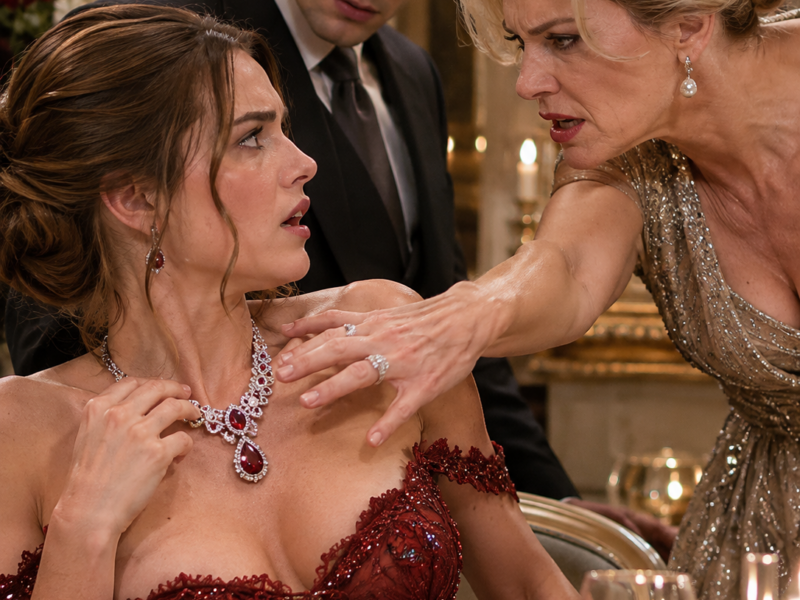
My mother-in-law reached for my grandmother’s emerald necklace in the middle of dinner, as casually as if she were asking me to pass the salt.
“You’ll leave that with me tonight, Alexandra,” Eleanor Montgomery announced, leaning across the beautifully arranged table. “The photographer needs it for Saturday’s Foundation Gala. The Montgomery women have always worn the family jewels for important occasions.”
I remember staring at her perfectly manicured fingers, wondering how someone could speak with such certainty about something that had never belonged to her.
There were twelve people at the table that evening. My husband, Preston, sat beside me, studying the wine in his glass. His father, Charles Montgomery, checked his expensive watch. Two foundation trustees exchanged uncomfortable glances.
And Eleanor kept reaching toward my neck.
The necklace contained seven Colombian Muzo emeralds, purchased by my grandmother, Rosa Vasquez, in 1994. She had bought them with the first substantial profits from a refrigerated warehouse she built after spending nearly a decade cleaning other people’s offices.
Those stones weren’t Montgomery family jewels.
They represented everything my grandmother had sacrificed to give me a future.
“Eleanor, I don’t think—”
“Don’t be difficult, sweetheart.”
Her fingers brushed the back of my neck as she searched for the clasp.
“Turn around. I’ll take it off for you.”
For two years, I had turned around whenever Eleanor told me to.
I had changed holiday plans because she preferred different arrangements. I had moved my grandmother’s photographs from the living room because Eleanor thought they made guests uncomfortable. I had even allowed her to keep a key to my grandmother’s house.
But that evening, something inside me refused to move.
Then a chair scraped against the floor.
“Ma’am, please step away from the principal.”
The voice belonged to Dante, one of the two professional security escorts accompanying me that evening.
He stood several feet behind Eleanor, his hands relaxed at his sides. His partner, Luce, had risen near the entrance.
Neither touched her.
They didn’t need to.
The entire room fell silent.
Eleanor slowly withdrew her hand.
“Alexandra,” she said sharply, “tell these people to sit down.”
I could have ended the embarrassment immediately.
All I needed to say was, “We’re fine, Dante.”
Those were the words we’d established earlier that afternoon. The insurance requirements governing my grandmother’s trust demanded two licensed escorts whenever the necklace left its secured vault.
But I couldn’t make myself say them.
Instead, I looked directly at my mother-in-law.
“This necklace belongs to my grandmother’s trust, Eleanor. It isn’t mine to give away, and it certainly isn’t yours to borrow.”
Her expression hardened.
“You’ve embarrassed this family in front of our closest friends.”
“You reached for my neck without permission,” I replied. “I was sitting perfectly still.”
Charles chuckled, attempting to rescue the evening.
“Different families have different customs.”
Several guests laughed nervously.
Preston stood.
“I’ll bring the car around.”
He never looked at me.
As we left, Charles fell into step beside me.
“Family bridges go both ways, Alexandra,” he murmured.
At the time, I thought he was talking about respect.
I would soon discover he meant something much more dangerous.
During the drive home, Preston barely spoke until we stopped at a red light.
“You could have just given her the necklace,” he said. “We would have figured it out later.”
“That’s what I’ve been doing for two years, Preston. Figuring things out later. That’s how your mother ended up with a key to Rosa’s house.”
“She only wanted it for photographs.”
“And I said no.”
He tightened his grip on the steering wheel.
“You made my father look ridiculous.”
I turned toward him.
“Your father wasn’t the person trying to remove jewelry from my body.”
“Can we please not do this tonight?”
I watched the streetlights pass across his face.
He was still handsome. Still the man who had once brought me coffee during exhausting warehouse shifts, who remembered how I liked my eggs, who held my hand when thunderstorms frightened me.
And I wanted him to defend me so badly that it physically hurt.
But he didn’t.
When we arrived home, I placed the necklace inside its velvet box and called Dante.
“Change of plans. It goes back to the vault tonight.”
Preston stared at me.
“Are you seriously locking your own husband out of a jewelry box?”
“I’m putting something valuable where it belongs.”
Dante arrived within minutes. I signed the transfer documentation, watched him secure the case, and closed the door.
Preston went upstairs without saying goodnight.
I slept in my childhood bedroom downstairs.
Or rather, I lay awake until four in the morning, staring at the brass thermometer on my dresser.
It had belonged to Rosa.
She carried it through her refrigerated warehouses for thirty years.
At five, I put it in my jacket pocket and drove to Doral.
The cold rooms were already running when I arrived.
There is a particular smell inside a floral refrigeration facility: fresh roses, damp cardboard, carnations, metal shelving, and the faint sweetness of thousands of flowers waiting to travel across the country.
To most people, it might smell like work.
To me, it smelled like home.
I walked through room three, holding Rosa’s thermometer at chest height.
Thirty-four degrees Fahrenheit.
Perfect.
My grandmother came to Miami from Boyacá, Colombia, in 1979 with two dresses, a small suitcase, and an address written on folded paper.
She cleaned offices at night for nine years.
In 1988, she purchased a used refrigerated container.
The following year, she bought eleven acres in Doral, back when the surrounding land seemed worthless.
With two laborers and more determination than money, she constructed her first cold-storage room.
By 1994, her business was profitable enough to purchase the emeralds.
She once told me that she bought them because she wanted something beautiful from Colombia that nobody could ever convince her she didn’t deserve.
When I was six, my mother left for California.
Eventually, the telephone calls stopped.
Rosa raised me.
She taught me how to read temperature charts before I understood long division.
She taught me how to negotiate with suppliers, inspect damaged shipments, and recognize when someone was lying about money.
Most importantly, she repeated one warning.
“No partners, mija. Partners are how people steal your name.”
After Rosa died, I inherited control of Vasquez Cold Chain Logistics and became trustee of her family trust.
The business generated tens of millions in annual revenue.
But Eleanor always called it my “little refrigeration company.”
I met Preston four years earlier at a logistics conference.
He was charming without being flashy, attentive without seeming demanding.
His father ran an investment firm, but Preston seemed uninterested in wealth or status.
I thought that made him different.
When Rosa entered hospice twenty-two months earlier, Eleanor sat beside me through an entire night.
She held my hand while my grandmother struggled to breathe.
I have never forgotten that kindness.
Perhaps that’s why I forgave so many things afterward.
First, Eleanor suggested holding Rosa’s memorial at her church.
Then she wanted the photographs moved.
Then she insisted on choosing my wedding dress.
Eventually, she wanted a house key.
Every request sounded harmless when considered individually.
Together, they slowly erased my authority over my own life.
The most serious mistake happened the previous Valentine’s Day.
Our flower operation was overwhelmed, and I was working nearly twenty hours a day.
Preston arrived carrying sandwiches.
“Let me help you,” he offered. “Put me on the operating account so payroll doesn’t depend on you being available every minute.”
I was exhausted.
I trusted him.
I added him as an authorized signer.
Four months later, a compressor bank failed with nearly 400,000 bunches of roses sitting inside the affected rooms.
The replacement cost was enormous.
Our bank needed six weeks to approve emergency financing.
Charles Montgomery offered six million dollars immediately.
“A family bridge,” he called it.
Nine percent interest, twenty-four months.
I signed a forty-page agreement in twenty minutes.
Buried inside was a covenant requiring the company to maintain at least $1.5 million in cash at each quarter’s end.
If we failed, Montgomery Capital could convert its loan into 51 percent ownership of my company, based on a valuation of just twelve million dollars.
I noticed the clause.
I simply believed we would never fall below the threshold.
Standing inside room four that morning, I remembered Charles’s words from dinner.
Family bridges go both ways.
Then I saw Marisol Peña’s car outside.
Marisol had managed our accounting since 1998.
She rarely arrived before six.
When I entered my office, she was waiting with a bank statement.
One transaction was circled in red.
September 26.
$920,000.
Bayfront Refrigeration Services LLC.
“Compressor maintenance retainer.”
I stared at it.
“Marisol, who is Bayfront?”
“I was hoping you could tell me.”
“We use Carrier. We’ve used Carrier for years.”
“I know.”
She hesitated.
“Preston approved the payment.”
I looked up.
“Preston?”
She nodded.
“I emailed you. You were in Medellín visiting suppliers. He said everything was authorized.”
She handed me another sheet.
Our operating cash at the September 30 quarter-end had been $1.31 million.
One hundred ninety thousand dollars below the required minimum.
Without that payment, we would have remained safely above it.
I suddenly understood why Charles had been talking about family bridges.
Someone had deliberately created the exact financial condition that would allow his investment firm to take control of my grandmother’s company.
And the person who had approved the payment was my husband.
PART 2
I called Preston immediately.
“What’s Bayfront Refrigeration?”
He answered with the relaxed voice he used whenever he wanted me to stop worrying.
“Dad’s maintenance people. Emergency protection in case the compressors fail again.”
“Nine hundred twenty thousand dollars?”
“Alex, we discussed this.”
“We absolutely did not.”
He sighed.
“I’m playing golf with Dad. Can we talk later?”
I ended the call and opened Florida’s corporate registration database.
Bayfront Refrigeration Services had been established only six weeks earlier.
No public website. No operating history. No listed refrigeration license.
Its registered agent was a law office on Brickell Avenue.
I recognized the address immediately.
It was the same office listed on Charles’s six-million-dollar loan agreement.
I printed both documents and placed them beside each other.
Same address.
Same suite.
My hands went cold.
Then I called Herb Feldman, the elderly attorney who had created Rosa’s trust.
After listening carefully, he told me something I’d never properly understood.
The company operated on eleven acres owned by Rosa’s trust.
And the lease contained a special provision.
If control of the company changed without the trustee’s written consent, the trust could terminate the lease.
Rosa had called it her husband clause.
I almost laughed.
My grandmother had anticipated a betrayal I hadn’t even imagined.
PART 3
“Does Charles know about that clause?” I asked Herb.
There was a long silence.
“I can’t tell you what Charles knows,” he said. “But your grandmother specifically wanted that provision included. She understood that owning a business and owning the ground beneath it are two very different things.”
I stood beside my office window, watching forklifts move pallets toward the loading docks.
For the first time since discovering Bayfront’s payment, I felt something other than fear.
Not confidence exactly.
More like the feeling of finding an emergency exit in a building filling with smoke.
Herb continued.
“Alexandra, I don’t practice commercial litigation anymore. You need someone experienced. And you need to stop assuming the people around you are acting in good faith.”
I thanked him.
Before hanging up, he added something.
“Rosa knew you were generous. She loved that about you. But she never wanted generosity to become permission.”
Afterward, I took a sheet from the old paper temperature log and drew a line down the middle.
On the left, I wrote:
What they think I have.
On the right:
What I actually have.
Under the first heading, I listed an indebted warehouse, a vulnerable company, and a wife too frightened of conflict to challenge her husband’s family.
Under the second, I wrote eleven acres of protected land, a valuable operating business, decades of relationships with growers, and one extremely important lease.
Then I drove to the bank.
As the sole owner of Vasquez Cold Chain Logistics, I had the authority to change who could access company accounts.
Even so, my hand trembled as I signed the forms removing Preston as an authorized signer.
I required two approvals for transfers exceeding $25,000.
I also requested a detailed authorization audit for the Bayfront payment.
“Who approved the transaction, when, and from which device?” I asked.
The branch manager said it would take several business days.
I filed a formal fraud report.
Nobody promised me the money would return.
By the time I reached home, Preston had received the bank’s automatic notification.
He was waiting in the kitchen.
“You removed me from the company accounts?”
“Yes.”
“Do you have any idea how humiliating that is?”
I put my handbag on the counter.
“Do you have any idea how much money disappeared from those accounts?”
He folded his arms.
“Dad was helping protect your business.”
“Then why was the payment sent to a company registered through his lawyer?”
His eyes flickered.
Only for a second.
But I saw it.
“That’s ridiculous. Dad knows hundreds of businesses.”
“Then he won’t mind explaining the relationship.”
Preston shook his head.
“You’re turning a family disagreement into something ugly.”
I wanted to ask when stealing nearly a million dollars had become a family disagreement.
Instead, I said, “I’m protecting the business.”
He stepped closer.
“After everything my mother did for you when Rosa died, this is how you repay us?”
Those words nearly broke me.
Because Eleanor had helped me.
She had been there during one of the worst nights of my life.
And I had spent almost two years confusing gratitude with obedience.
“I appreciated what your mother did,” I said. “But that doesn’t give your family ownership of me.”
Preston stared as though he didn’t recognize me.
He slept on the couch.
Near midnight, I heard him talking quietly on the patio.
When I approached the window, he turned away.
I never heard what he said.
But the next morning, Eleanor sent a message.
Foundation Gala. Seven o’clock. Please dress appropriately without assistance this time.
I considered staying home.
Then I realized that if I didn’t attend, the Montgomerys would control the story.
So I wore a black dress Rosa had bought me in Bogotá, small copper earrings, and no necklace.
The gala took place in an extravagant ballroom overlooking the water.
Everything glittered.
Crystal chandeliers.
Polished silver.
Champagne glasses arranged like expensive ornaments.
And on every table were enormous arrangements of Ecuadorian roses.
I recognized the variety immediately.
Those flowers had passed through my warehouse three days earlier.
I knew the distributor, the grower, and probably the temperature of the room where they’d been stored.
Yet Eleanor introduced me as though my only accomplishment was marrying her son.
“This is Preston’s wife, Alexandra,” she told a group of women.
Then she lowered her voice just enough to ensure I heard.
“She was rather protective of her jewelry on Thursday. You know how people can be when money is new.”
Several women laughed.
I smiled.
Not because it was funny.
Because I was finally beginning to understand exactly what Eleanor needed me to be.
Small.
Grateful.
Easy to correct.
Later, the photographer from Thursday’s dinner approached me near the bar.
“For what it’s worth,” he whispered, “I thought you handled yourself beautifully.”
Before I could answer, he disappeared into the crowd.
Those few words meant more than they should have.
Charles found me near the balcony.
“Alexandra. Walk with me.”
Outside, the ocean air smelled of salt and cigar smoke.
He leaned against the railing.
“Your company’s cash position isn’t where it should be.”
I didn’t respond.
“Quarter-end obligations are serious things,” he continued. “Especially when there’s a substantial loan involved.”
“Is Bayfront your company?”
He smiled.
“Bayfront is a vendor.”
“That’s not what I asked.”
“Vendor relationships are management’s responsibility. You’re management, aren’t you?”
I watched his expression.
Nothing moved.
He had practiced that calmness for years.
Then he said, “I’d prefer to resolve this privately. We all want what’s best for the family.”
Through the glass doors, I could see Preston dancing with Eleanor.
He looked happy.
Neither of them searched for me.
“Whose family?” I asked Charles.
For the first time, his smile weakened.
I left shortly afterward.
Monday morning, a courier arrived at our warehouse carrying an envelope from Montgomery Capital Partners.
Inside was a formal notice.
Our company had breached the minimum cash covenant.
The lender intended to convert its six-million-dollar loan into 51 percent ownership.
We had ten business days to cure the breach.
A closing meeting was scheduled for October 17 at Montgomery Capital’s Brickell offices.
Marisol read the documents beside me.
Then she placed the previous year’s financial statements on my desk.
“Thirty-eight million dollars in revenue,” she said. “A company worth somewhere around thirty to thirty-five million, and they want majority control for six.”
She sat down slowly.
“They aren’t interested in refrigeration, Alex.”
I looked outside at the trucks.
“No,” I said. “They’re interested in the land.”
Eleven acres near Miami International Airport.
A long-term lease at a rate far below current market prices.
An established customer base.
And a business that could be sold to a developer or another investor without Charles ever learning how to operate a compressor.
That afternoon, I met Naomi Okafor.
She was a commercial litigation attorney recommended through Herb’s former firm.
Naomi read every page before speaking.
When she finally looked up, she didn’t offer comforting words.
“This is serious.”
“I know.”
“You suspect the lender deliberately caused the default?”
“Yes.”
“Suspicion isn’t enough. We need proof.”
She pointed to the Bayfront statement.
“We need evidence that these services weren’t performed, evidence connecting the vendor to the lender, and the bank’s authorization records.”
I asked whether we could simply challenge the conversion.
“We can challenge it,” she replied. “But litigation takes time. Your employees need their salaries next Friday, not after a judge reviews the case.”
“What would end this immediately?”
“Repaying the loan within the cure period.”
“Six million dollars?”
“Plus applicable interest.”
I laughed once.
It sounded terrible.
“That’s impossible.”
Naomi closed the folder.
“Then we need another option.”
When I returned home, Preston was packing a suitcase.
“My mother prepared my old room,” he said.
I stood in the doorway.
“You’re leaving?”
“Until you’re ready to behave like part of this family.”
He folded another shirt.
“Dad’s willing to work things out, but you keep making everything harder.”
I stared at the empty hangers behind him.
I wanted to beg him to stay.
That’s the part people don’t understand about betrayal.
You can know someone is hurting you and still miss the version of them who once made you feel safe.
But I didn’t beg.
Preston carried his suitcase downstairs and left.
The following morning, two drivers asked Marisol whether the Montgomerys were buying the company.
Rumors had already reached our warehouse floor.
At shift change, I climbed onto an overturned crate.
Forty employees looked up at me.
Some had worked beside Rosa.
Others had children whose school fees depended on our payroll.
“I know you’ve heard rumors,” I said. “We’re dealing with a financial dispute, but this business is still operating. Payroll runs Friday, and it runs the Friday after that.”
Nobody applauded.
They simply returned to work.
And somehow, that made the responsibility feel even heavier.
That afternoon, Rubén Castaño called from Medellín.
His growers’ cooperative represented roughly two hundred flower farms.
He had known Rosa for twenty years.
“I heard what happened,” he said.
“Then you’ve heard too much.”
“We offered to buy a minority stake last year, Alexandra. That offer still stands.”
“Rosa didn’t believe in partners.”
Rubén was quiet.
Then he said, “Your grandmother built the walls. You built the thermostat. We don’t want either one sold to strangers.”
I thanked him.
But I refused.
That night, sitting alone at Rosa’s kitchen table, I opened the warehouse lease.
I read every page.
When I reached the clause Rosa had added in 2011, I stopped.
Her signature curved across the bottom in large, familiar letters.
Suddenly, I understood something.
Rosa hadn’t avoided every partnership.
She had used lawyers, trustees, growers, and contracts to protect what she created.
Her warning had never really been about refusing help.
It had been about refusing to surrender control.
And I began wondering whether the greatest mistake of my life had been taking her words too literally.
PART 4
Preston contacted me three days later.
Dad has a proposal. Can we talk tomorrow? Just us.
I stared at the message for several minutes.
Then I agreed.
He came home Friday evening carrying groceries.
He cooked arroz con pollo, the first meal I’d taught him to make when we were dating.
He used too much saffron, just as he always had.
And he set the table with Rosa’s old dishes.
For a brief moment, the kitchen looked like our marriage before everything went wrong.
Preston poured water into my glass.
“I spoke with Dad for almost two hours,” he said.
I waited.
“He wants this settled. Nobody benefits from a fight.”
“What does he want?”
Preston took a breath.
“Dad withdraws the conversion notice. The company stays yours.”
My chest loosened.
Then he continued.
“Mom gets to borrow the emerald necklace during gala season. I take a seat on your board so Dad knows his investment is protected. And Bayfront returns part of the retainer when cash flow allows.”
I looked at him.
“That’s his proposal?”
“It’s a fair compromise.”
“Your father takes nearly a million dollars from my company, threatens to seize it, and offers to stop if I give your mother my grandmother’s necklace and put you on the board?”
“Don’t say it like that.”
“How should I say it?”
Preston rubbed his forehead.
“Alex, please. We can have our life back.”
There it was.
The offer I had secretly wanted.
A way to make everything normal again.
No legal fees.
No worried employees.
No empty side of the bed.
Only one necklace, one board seat, and a few more compromises.
I looked at the familiar plates, then at the man sitting across from me.
“Did you know what Bayfront was when you approved the transfer?”
“Dad said it was a maintenance retainer.”
“Did you know the money would take us below the cash requirement?”
“I don’t manage Dad’s fund.”
“That’s not what I asked.”
His eyes filled with tears.
“I was trying to help.”
Then he lowered his head onto his folded arms and cried.
I had seen Preston cry only twice before.
Once at our wedding.
Once after Rosa’s funeral.
I reached toward him automatically, then stopped.
Because for the first time, I couldn’t tell whether I was seeing grief, guilt, or the fear of losing something he thought belonged to him.
“Give me until Monday,” I said.
He stayed that night.
We lay beside each other in our old bedroom.
I listened to his breathing and remembered Eleanor sitting beside me at hospice, holding my hand for eight hours.
For years, I had believed that genuine kindness and manipulation couldn’t exist inside the same person.
Now I wasn’t so sure.
Early Saturday morning, I drove to the secured jewelry vault near the airport.
Luce met me at the entrance.
Inside, an employee brought out the velvet case containing Rosa’s emeralds.
Under the bright security lights, they looked almost black.
I lifted the necklace carefully.
The clasp was old-fashioned and difficult to operate.
Rosa had deliberately refused to replace it.
When I was twelve, she’d let me try the necklace on for the first time.
“Anyone can admire the stones,” she’d told me. “Only the woman wearing them knows how the clasp works.”
I held the necklace in one hand and my phone in the other.
I’d drafted an email to Naomi.
Please hold the legal filing. I’m considering a settlement.
My thumb hovered over Send.
Then Luce asked a simple question.
“Will this be logged as a viewing or a release to a third party?”
I looked at her.
“Excuse me?”
“The necklace, ma’am. Are you taking it, or simply viewing it?”
Suddenly, I understood what I was about to do.
I was going to hand over the last piece of Rosa’s life that Eleanor had not yet managed to claim.
And I was going to call it compromise.
“Viewing,” I whispered.
I returned the emeralds to their case.
As the employee closed the lid, my phone vibrated.
An email from the bank.
Authorization Audit Report — Bayfront Refrigeration Services.
I opened the attachment in my parked car.
The payment had been approved at 11:52 p.m. on September 26.
Authorized user: P. Montgomery.
The originating internet connection was associated with Montgomery Capital Partners’ offices on Brickell Avenue.
I read the details three times.
Then I opened my call history.
September 26.
11:31 p.m.
Incoming call from Preston.
Six minutes.
I remembered that conversation perfectly.
I had been in Medellín, exhausted from visiting greenhouses all day.
Rain was falling against the hotel windows.
Preston had called to say goodnight.
“Everything’s quiet here,” he’d told me. “Don’t worry about home. Focus on your growers.”
Twenty-one minutes after that conversation began, he approved a $920,000 transfer from my company to a suspicious vendor using a connection associated with his father’s office.
He had known I was abroad.
He had known I was distracted.
He had known exactly when I wouldn’t be watching.
I sat behind the steering wheel, feeling something inside me go very still.
Then I called Naomi.
“Don’t hold the filing.”
“What changed?”
“I have the bank audit.”
I forwarded the attachment.
Next, I called Marisol.
“Bring me the temperature logs for rooms three through five, September fifteenth through thirtieth. The gate entries too. And every Carrier maintenance record.”
“Already working on them,” she replied.
Finally, I called Rubén.
“Is your investment offer still available?”
“Of course.”
“I want to discuss twenty-three percent. Minority ownership, board observation rights, restrictions on future transfers, and trustee approval for any change of control.”
There was a pause.
Then he laughed.
“Rosa would have given me a terrible lecture.”
“She would have read every page first,” I said.
By Monday, the evidence was coming together.
The temperature records showed that rooms three through five had operated steadily throughout the period when Bayfront supposedly performed major compressor maintenance.
No shutdowns.
No significant fluctuations.
No service vehicles recorded at the gate.
The last documented Carrier maintenance visit had occurred in August, and the temperature charts clearly showed the temporary changes that real servicing caused.
Bayfront’s supposed emergency work had left no operational trace.
Naomi warned me that the records did not independently prove every allegation.
But together with the bank audit and corporate registration documents, they created a much stronger case.
Rubén flew into Miami on Sunday.
His cooperative proposed a valuation of thirty-two million dollars.
Twenty-three percent would provide $7.36 million.
Enough to satisfy the Montgomery loan and leave cash for operating expenses.
But I wasn’t going to repeat the mistake I’d made in Charles’s study.
For three days, Naomi and I examined every clause.
We negotiated board rights, transfer restrictions, consent requirements, and protections for Rosa’s trust.
I insisted that the Vasquez name remain on the building.
I also refused any arrangement that would give the cooperative control of daily operations.
Rubén agreed.
“You run the cold rooms,” he told me. “We grow the flowers. That’s why this works.”
For the first time in weeks, I slept through the night.
On Thursday, I gathered the warehouse employees again.
I stood on the same crate.
“We’re bringing in an investment partner,” I said. “A growers’ cooperative we’ve worked with for years. Our operations are continuing, and we’re protecting the company’s future.”
One of our longest-serving employees, Teresa, raised her hand.
“Does this mean the Montgomerys aren’t taking over?”
I looked around.
“That’s what we’re fighting to prevent.”
Teresa nodded.
“Then Rosa would be proud.”
I couldn’t answer immediately.
Because I wasn’t sure Rosa would be proud of all my decisions.
But perhaps she’d be proud that I was finally making them myself.
Friday morning, October 17, I dressed before sunrise.
Black tailored suit.
Rosa’s copper earrings.
And the seven Muzo emeralds.
Dante and Luce arrived at my door.
The necklace rested against my collarbone, heavy and cold.
I carried Rosa’s brass thermometer in my handbag.
At ten o’clock, I stepped out of the elevator on the thirty-first floor of Montgomery Capital Partners.
Charles sat at the head of a long conference table overlooking Biscayne Bay.
Preston sat beside him.
The firm’s general counsel was already arranging documents.
And Eleanor was there.
She looked directly at my necklace.
“Oh, good,” she said. “At least you’ve remembered how to dress for an important occasion.”
I took my seat across from Charles.
Naomi sat beside me.
Marisol placed a cardboard tube on the table.
Rubén took the chair nearest the window.
Charles smiled and slid a folder toward me.
“Let’s finish this quickly,” he said. “We can all go to lunch afterward.”
I looked at the signature tabs protruding from the folder.
He still believed I had come to surrender.
I closed it without opening a single page.
“Before anyone signs anything,” I said, “we need to talk about the $920,000 your son transferred out of my company.”
And for the first time since I’d met Charles Montgomery, I watched his smile disappear.
PART 5
Charles recovered quickly.
He folded his hands on the polished table.
“Alexandra, I understand you’re upset. But vendor payments are ordinary management matters.”
“Then this should be easy to explain.”
I placed the Bayfront corporate registration beside the loan agreement.
“Your refrigeration contractor was registered through the same law office that prepared this loan. Same address. Same suite.”
The general counsel glanced down.
He didn’t speak.
Marisol opened her cardboard tube and spread a temperature chart across the table.
She weighted the corners with glasses of water.
“These are the readings from rooms three through five during the period Bayfront supposedly performed compressor maintenance,” she explained.
She pointed to three nearly flat lines.
“No shutdowns, no service interruption, no meaningful temperature variation.”
Then she showed the August Carrier maintenance record.
“Here is what actual compressor servicing looks like. Equipment is temporarily taken offline. Temperatures shift. Recovery gets recorded.”
She returned to the September charts.
“Nothing like that happened.”
Charles leaned back.
“This proves nothing about the financial agreement.”
“Not by itself,” Naomi replied calmly.
I placed the bank authorization audit in front of Preston.
“Your son approved the payment at 11:52 p.m. from a connection associated with this building.”
Preston looked down.
His face drained of color.
Eleanor turned toward him.
“Preston? What does she mean?”
He said nothing.
“Preston, answer me.”
I watched her carefully.
For the first time, I believed she genuinely hadn’t known about the transfer.
She understood humiliating people at dinner.
She understood social power, jewelry, and appearances.
But apparently, Charles hadn’t shared every detail of his financial strategy with her.
That didn’t make her innocent of everything.
It simply meant she had been operating with a different set of instructions.
Charles turned toward me.
“You should consider what you’re doing. Accusing your husband’s family of fraud could destroy your marriage.”
I looked at Preston.
“He already made that decision.”
Charles’s expression hardened.
“You don’t have the resources for years of litigation.”
“I’m aware.”
“Your workers won’t be paid with moral victories.”
“I know that too.”
I opened another folder.
“That’s why I’m offering you a choice.”
Charles almost smiled.
He thought I was finally negotiating.
I laid Rosa’s lease on the table.
“Vasquez Cold Chain Logistics operates on land owned by my grandmother’s trust. Eleven acres near Miami International Airport.”
Charles’s lawyer reached for the document.
“The tenant has fifteen years remaining on the lease,” I continued. “But Section 14.3 gives the trust the right to terminate if controlling ownership changes without the trustee’s written consent.”
The lawyer began reading.
Then he turned back a page.
Charles watched him.
“What’s the problem?”
His lawyer lowered his voice.
But the room was silent enough that everyone heard.
“The lease may be terminated if the conversion closes.”
Charles looked at me.
I didn’t look away.
“You can take fifty-one percent of my company,” I said. “But you cannot force my grandmother’s trust to continue leasing it the warehouse property.”
He said nothing.
“And without the warehouse, you’re acquiring a cold-chain operation that cannot operate on its principal site.”
Rubén placed a single sheet on the table.
Confirmation of funds committed for our investment transaction.
$7.36 million.
“Or,” I continued, “you can accept repayment of your loan and withdraw the conversion notice.”
Charles stared at the confirmation.
He hadn’t expected me to find another investor.
Especially not one that would allow me to retain majority ownership.
Naomi opened her binder.
“We are prepared to complete the necessary repayment arrangements. We also have documentary evidence supporting potential claims concerning the Bayfront transaction.”
Charles looked at her.
“Are you threatening litigation?”
“I’m explaining the available legal remedies.”
I spoke before he could reply.
“Here’s what I want. Written withdrawal of the conversion notice. Full satisfaction of the loan upon payment. And restitution of the $920,000 Bayfront received.”
“That’s outrageous,” Charles snapped.
“Then we can let the appropriate investigators and courts review the transaction.”
The air seemed to leave the room.
Charles looked toward Preston.
His son was staring at the audit sheet.
Eleanor had gone completely still.
Then Charles spoke softly.
“You would destroy your husband’s family over money?”
I thought about Rosa cleaning offices at night.
I thought about her building refrigerated rooms in the Florida heat.
I thought about forty employees waiting to find out whether their paychecks were safe.
And I thought about Eleanor reaching behind my neck while Preston stared into his wineglass.
“No,” I said. “I’m protecting what my family built.”
Eleanor finally spoke.
“Your grandmother would be ashamed of this spectacle.”
I turned toward her.
“Rosa wrote that lease provision in 2011. She knew exactly what she was protecting.”
For once, Eleanor had no answer.
Charles’s lawyer leaned toward him and whispered something.
They spoke quietly for several minutes.
Then Charles reached into his jacket and removed a pen.
He signed the withdrawal document prepared for review.
Naomi examined the language before accepting it.
The loan still needed to be repaid through the agreed process, and the other obligations required separate written arrangements.
But the threatened conversion had been stopped.
Charles pushed the document across the table.
“There. Are you satisfied?”
I looked at his signature.
“I’m satisfied that my grandmother’s company is still hers.”
I stood.
Preston followed me into the hallway.
Dante and Luce remained a respectful distance behind us.
“Alex.”
I stopped near the elevators.
“I didn’t think things would go this far,” Preston said.
I looked at him.
“You approved nearly a million dollars leaving my company. What did you think would happen?”
He stared at the floor.
“I wanted Dad to respect me.”
I didn’t speak.
He continued.
“You have everything Rosa built. You’ve got her business, her house, her land. People respect you because of what you’ve accomplished.”
His voice cracked.
“And all I have is my father’s last name.”
I felt an unexpected sadness.
Not sympathy for what he’d done.
Sadness for the man who believed he needed to steal something from his wife to become worthy of his father’s approval.
“I thought if the company became part of the family holdings,” he whispered, “I’d finally have something to bring him.”
“You had a wife who loved you.”
He closed his eyes.
For several moments, neither of us moved.
Then I asked the question I’d been carrying since the bank audit arrived.
“When you called me in Medellín and said everything was quiet, were you already at your father’s office?”
He looked away.
That was my answer.
The elevator doors opened.
“Herb’s firm will contact you about access to the house,” I said. “The locks are being changed Tuesday morning. We’ll handle everything else through our attorneys.”
“Alex, please.”
I stepped into the elevator.
The doors closed between us.
And only then did I cry.
I cried so hard that I had to lean against the mirrored wall.
Thirty-one floors.
By the time I reached the lobby, my face was wet, my makeup ruined, and the emeralds felt unbearably heavy.
Marisol was waiting beside the entrance.
She looked at me once.
Then she said, “Payroll runs Friday.”
I laughed through my tears.
“Yes,” I answered. “It does.”
The financial settlement took several weeks to complete.
The cooperative’s investment funds cleared.
Montgomery Capital received full repayment of the loan under the agreed settlement.
The conversion withdrawal was documented.
Bayfront returned the entire $920,000 on the ninth day, using a single wire transfer from an unfamiliar bank.
The bank’s fraud file was eventually closed following restitution.
Nobody went to prison.
There was no dramatic arrest, no courtroom confession, no television cameras waiting outside Charles’s office.
I know people sometimes expect an ending like that.
But real consequences are often quieter.
Charles’s reputation suffered in certain investment circles. His general counsel left the firm shortly afterward. And the story about Eleanor reaching for the necklace spread through Palm Beach society.
The same people who had politely laughed at me during dinner suddenly wanted to know the truth about the Vasquez emeralds.
I didn’t give interviews.
I didn’t need to.
Preston filed for divorce first.
Perhaps he wanted to control that story too.
Our lawyers worked through the separation, including which property belonged to the trust and which assets were marital.
I didn’t fight over the car I’d purchased for him.
I wanted my freedom more than I wanted another argument.
Eleanor sent a handwritten apology on cream-colored stationery.
She wrote that she regretted what happened Thursday evening.
Thursday.
Not the financial scheme.
Not the stolen money.
Not the months of pressure.
Only Thursday.
I read the card twice and placed it in a drawer.
I never answered.
And yet, I still remember her holding my hand at Rosa’s hospice bedside.
That kindness was real.
I’ve stopped trying to pretend otherwise.
But a beautiful memory doesn’t excuse everything that comes afterward.
Our first board meeting with the cooperative took place in the warehouse break room.
Rubén joined from Medellín.
Marisol became our chief financial officer, with stronger approval authority and permanent financial controls.
No major transaction would ever again depend on one person’s casual approval.
We wrote it into the procedures.
We reviewed every agreement carefully.
And I made a promise to myself.
Never again would I mistake avoiding conflict for protecting peace.
I moved Rosa’s photographs back into the living room.
Her favorite picture, taken in 1994 outside the first cold room, went above the warehouse coffee machine.
She was squinting into the sun, one hand on her hip, looking exhausted and absolutely victorious.
A month later, I visited Herb.
I asked whether I should remove the emerald necklace from the trust.
“It’s expensive to arrange security every time I wear it,” I explained.
Herb smiled.
“Your grandmother knew that.”
“Then why make it so difficult?”
He leaned forward.
“Alexandra, Rosa didn’t put those emeralds in the trust to keep them from you. She put them there so nobody else could demand them from you.”
I sat quietly.
Then he retrieved an old envelope.
My name was written across the front in Rosa’s unmistakable handwriting.
It contained a letter she’d left with her estate documents.
Most of it concerned the business.
She reminded me to treat employees fairly, to keep honest temperature records, and never to let pride interfere with necessary repairs.
Near the end, she mentioned the necklace.
The clasp is stiff on purpose, mija. It should take your own two hands.
I read that sentence several times.
For years, I believed she was telling me that the emeralds held a secret only I understood.
But she meant something much simpler.
Some things are supposed to require your own hands.
Your own decision.
Your own permission.
That December, we hosted the growers’ annual harvest dinner at the warehouse.
We emptied room four and arranged long tables beneath strings of warm lights.
One hundred forty employees and thirty Colombian growers joined us.
There were paper cups, homemade food, loud conversations, laughter, and roses everywhere.
No society photographer.
No foundation trustees.
No expensive ballroom.
Just people who understood the work behind every flower.
Before dinner, I went into Rosa’s old office.
The velvet necklace case sat on her desk.
I opened it and lifted the emeralds.
For a moment, I imagined her standing behind me, fastening them as she had on my wedding day.
Then I reached back and found the clasp myself.
It was stubborn.
I tried again.
This time, it clicked.
I smiled.
When I walked into the cold room, Marisol raised her paper cup.
Rubén said something in Spanish that made the growers burst into laughter.
Dante and Luce were near the entrance, eating dinner instead of standing guard over an uncomfortable family confrontation.
Nobody stared at my necklace as though it belonged to them.
Nobody told me what to wear.
Nobody asked me to make myself smaller.
Before taking my seat, I removed Rosa’s brass thermometer from my pocket.
I held it at chest height and waited for the needle to settle.
Thirty-four degrees.
Exactly where it should be.
I wrote the reading in the logbook.
Then I sat among the people who had helped keep my grandmother’s dream alive.
For the first time in years, I understood what belonging to a family was supposed to feel like.
It wasn’t surrendering everything you loved to prove you deserved a place at someone else’s table.
It was being able to sit at your own table without anyone reaching across to take what was yours.
And every December, when I fasten those emeralds around my neck, I remember the evening Eleanor tried to remove them.
Not because she almost succeeded.
But because that was the first night I finally refused to turn around.