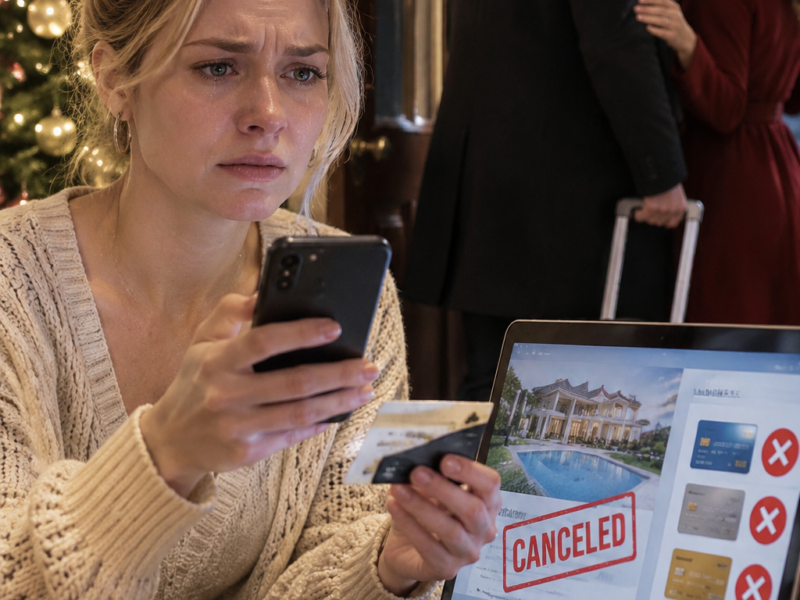
My Husband Left Me Behind On Christmas Eve — So I Canceled The Villa And All His Cards…
My Husband Left Me Behind On Christmas Eve — So I Canceled The Villa And All His Cards…
At 5:45 on Christmas Eve morning, I stood beneath the harsh fluorescent lights of O’Hare International Airport, holding a nine-dollar cup of coffee that tasted like burnt cardboard. Beyond the glass windows of Terminal Three, snowflakes drifted lazily across the runway, illuminated by the blinking red and green lights of aircraft preparing for departure. It was supposed to be the beginning of a beautiful family vacation. Six nights in a luxurious ski-in, ski-out chalet in Snowmass, Colorado. First-class flights, private airport transportation, expensive dinners, and a Christmas celebration surrounded by people I had spent more than a decade trying to make happy.
Instead, I was watching my husband walk away with another woman.
Brendan was already halfway toward the jet bridge, his expensive winter coat perfectly fitted across his shoulders. Behind him walked his mother, Patricia, and his younger sister, Lauren. A few steps behind them was Sienna, a junior accounts manager from Brendan’s department, wearing a pristine white Moncler jacket and carrying a silver Rimowa suitcase.
Nine minutes earlier, Brendan had taken my boarding pass directly out of my hand.
He hadn’t snatched it. He hadn’t raised his voice. He had simply approached me with the calm, practiced expression of a man who believed that every situation could be controlled if he spoke confidently enough.
“You’re way too stressed, Willow,” he had whispered, making sure the gate agent couldn’t hear. “Go home and rest. Don’t ruin this trip for my mother.”
Then he had handed my first-class boarding pass to Sienna.
For a moment, I couldn’t quite process what I was seeing. I looked at the paper in her hand, then at my husband’s face. He wasn’t embarrassed. He wasn’t apologetic. He wasn’t even particularly concerned about whether I understood what was happening.
He looked relieved.
Sienna accepted the boarding pass as if she had been expecting it all along. Patricia stood nearby, sipping her Starbucks latte, while Lauren concentrated on her phone. Neither woman looked surprised. Neither asked why my seat had suddenly become available.
They all knew.
I was the only person in that terminal who had apparently been expected to pretend otherwise.
I could have screamed. I could have grabbed the boarding pass back, demanded an explanation, or made such a scene that the entire departure gate would have turned to watch. But something inside me had gone strangely quiet.
I watched them disappear down the jet bridge.
Then I dropped my coffee into a nearby trash bin, turned away from the gate, and walked toward the airport train station.
Before the Blue Line train had even left the platform, I opened the Chase banking application on my phone.
With three deliberate taps, I canceled the twelve-thousand-five-hundred-dollar luxury chalet in Snowmass and locked the credit card Brendan was carrying in his wallet.
I didn’t know it yet, but that morning would become the beginning of the most important decision I had made in my entire marriage.
Six weeks earlier, I had been sitting at the quartz kitchen island in our Lincoln Park home, planning the very vacation that would eventually expose everything.
It was a Tuesday evening, and the house was filled with the soft warmth of the heating system. My laptop was open in front of me, displaying photographs of an enormous mountain chalet with floor-to-ceiling windows, a stone fireplace, heated floors, and a private terrace overlooking the snowy slopes.
The property had four bedrooms, a gourmet kitchen, and direct access to the ski runs. It was exactly the kind of place Patricia liked to describe as appropriate for a proper Christmas holiday.
The price for six nights was $12,500.
I entered my billing information, reviewed the cancellation policy, and clicked the confirmation button.
The reservation was secured.
Brendan walked into the kitchen a few minutes later, wearing his usual business-casual clothes. He opened the refrigerator, poured himself a glass of sparkling water, and glanced at my laptop.
“Did you get the confirmation?”
“Yes. Everything is booked.”
“Great. Make sure Mom gets the bedroom on the ground floor. Her knee has been bothering her.”
“I already requested it.”
“And Lauren needs her gluten-free meals arranged.”
“I’ve taken care of that too.”
He nodded, took a drink, and returned to the living room.
That was how our marriage worked.
I handled the details. Brendan enjoyed the results.
For more than a decade, I had managed the machinery behind our comfortable lifestyle. I worked as a consultant, handling complex projects, financial forecasts, and operational planning for my firm. My job required precision, organization, and an almost unreasonable ability to anticipate problems before they appeared.
Unfortunately, those same skills had gradually become an unpaid second occupation inside my marriage.
I managed the household finances, scheduled maintenance appointments, coordinated family holidays, tracked insurance renewals, arranged travel, handled deliveries, and remembered every birthday.
Brendan rarely asked how something had been accomplished. He simply expected it to happen.
He had an additional credit card connected to my Chase Sapphire Reserve account. His name appeared on the card, but I was the primary account holder. I paid the balance every month, and he used it freely for restaurants, business lunches, shopping, and whatever else he considered part of his executive lifestyle.
He had his own income, of course. But somewhere along the way, our financial arrangements had become so comfortable that he stopped distinguishing between his money and the resources I managed.
I didn’t consider that a problem at the time.
I thought I was building a life with someone.
After securing the chalet, I logged into my airline account. Years of business travel had earned me a substantial number of loyalty miles, and I decided to use them to upgrade all four of our tickets to first class.
I selected Brendan’s seat, Patricia’s preferred aisle seat near the bulkhead, and Lauren’s seat close to the front of the cabin.
I also arranged special meal requests, checked baggage allowances, and organized a private shuttle from Aspen Airport to Snowmass.
Patricia frequently complained about walking long distances, so I made sure the shuttle would collect everyone directly outside the terminal.
Lauren had a dietary restriction, so I confirmed that the chalet’s kitchen could accommodate the groceries I planned to have delivered.
Everything was organized.
Brendan merely needed to arrive at the airport.
At the time, I considered that division of responsibility normal.
Looking back, I realize that I had become so accustomed to being useful that I rarely stopped to ask whether anyone actually valued me.
The first signs that something was wrong appeared in small, almost forgettable moments.
One Thursday morning, Brendan’s phone was lying on the bathroom vanity while he showered. I had reached over to check the weather because we were supposed to attend a weekend event.
His screen was locked.
I entered the six-digit passcode he had used for years. It combined our wedding anniversary with his birth year.
The phone rejected it.
I tried again, thinking I had entered the numbers incorrectly.
Nothing.
When Brendan stepped out of the shower, I mentioned the change casually while applying my moisturizer.
“Did you change your phone password?”
He was drying his hair with a towel. His eyes remained fixed on the mirror.
“Corporate pushed a new security protocol yesterday. Mandatory password updates for anyone carrying company information.”
It sounded reasonable enough.
I nodded and went downstairs to make coffee.
A few days later, another detail caught my attention.
It was almost eleven at night. I was sitting in bed reviewing a contract draft on my tablet when Brendan’s phone vibrated against the wooden nightstand.
The screen illuminated the room.
A notification appeared.
Sienna.
I recognized the name because Brendan had mentioned her department a few times. She was a junior accounts manager who had joined his division the previous spring.
Brendan immediately reached for the phone.
His fingers moved quickly across the screen before he placed it face down.
“Work?” I asked without looking away from my tablet.
“Sienna,” he replied. “She’s panicking about tomorrow’s regional presentation. Apparently, she needs clarification on some revenue projections.”
I said nothing.
People worked late sometimes. Junior employees occasionally needed help. There was nothing inherently suspicious about a manager answering a work-related message.
But I remembered the time.
Eleven at night.
And I remembered how quickly he had hidden the screen.
The following week, I noticed the same pattern twice more.
His phone would light up. He would glance at it, smile faintly, and turn it over whenever I entered the room.
I didn’t confront him.
At that point, I still believed there might be a reasonable explanation.
The atmosphere became more uncomfortable during a Sunday brunch with his family two weeks before Christmas.
We met at an expensive restaurant near the river. Patricia arrived wearing a cream-colored coat and a collection of jewelry that seemed designed to attract attention. Lauren followed her mother, carrying a designer handbag and checking her phone every few minutes.
I spent the first twenty minutes coordinating a delayed furniture delivery through email while everyone else ordered drinks.
Patricia sat opposite Brendan.
She spoke almost exclusively to him.
“You look absolutely exhausted, sweetheart,” she said, placing her hand over his arm. “You work far too hard. This Aspen vacation is going to be exactly what you need.”
Brendan smiled.
“I’ve been looking forward to it.”
“You deserve a chance to breathe. To spend time with people who understand the kind of pressure you’re under.”
She didn’t look at me when she said that.
I lowered my eyes toward my plate.
The irony was difficult to ignore. I had spent weeks arranging the vacation she was praising, and I had paid for nearly everything associated with it. Yet she spoke as if Brendan were personally carrying the financial and emotional burden of the entire family.
A few minutes later, Lauren’s phone made a notification sound.
She glanced at the screen and smiled.
Almost immediately, Brendan’s phone chimed.
He read something and gave a short laugh.
I looked between them.
Patricia was smiling too.
They were clearly communicating through a private group conversation.
“What is funny?” I asked.
Lauren placed her phone face down.
“Just a meme Mom sent. An inside joke.”
They didn’t show me the message.
They didn’t explain it.
They simply returned to their conversation as if I hadn’t spoken.
I sat there, drinking my coffee, and began to understand something uncomfortable.
I was useful enough to organize their vacations, pay their restaurant bills, and remember their preferences.
But I wasn’t necessarily considered part of their family.
When the meal ended, I paid the $140 bill, drove Patricia and Lauren back to Patricia’s condominium, and returned home to finish preparing the packing list.
I still hadn’t connected all the details.
I hadn’t realized that I was organizing the logistics for my own replacement.
The morning of December twenty-fourth began at 3:45.
Chicago was bitterly cold, with the temperature hovering around twelve degrees. I started my Audi Q7, opened the garage door, and began loading our luggage.
There were two heavy ski bags, four large suitcases, and a garment bag.
Brendan remained in the heated passenger seat, scrolling through emails while I lifted everything into the cargo area.
After checking the house, I locked the doors and drove toward O’Hare.
Holiday traffic made the journey slower than usual, but I managed to reach the airport without incident.
I parked in the premium long-term lot, collected our belongings, and hauled the ski equipment onto the shuttle.
At the United Airlines premier desk, I presented my identification and confirmation codes.
Patricia complained about the cold air near the automatic doors.
Lauren stood several feet away, typing rapidly on her phone.
Brendan handed me his passport before walking away to purchase bottled water.
I handled the baggage tags, the security instructions, and the directions to our departure gate.
By 5:30, we were standing near gate B12.
That was when Sienna appeared.
She approached us from the concourse, wearing a white Moncler puffer jacket, tailored ski pants, and immaculate suede boots.
A silver Rimowa suitcase rolled behind her.
She looked nothing like someone who had unexpectedly missed a standby flight.
She looked like someone who had packed for a luxury winter holiday.
“Brendan!” she exclaimed, pretending to be surprised. “I can’t believe you guys are at this gate. My standby flight to Denver just got canceled.”
I looked at Brendan.
He seemed momentarily caught between two thoughts, but only for a second.
Before he could respond, Patricia and Lauren approached from the nearby Starbucks.
Neither woman appeared surprised to see Sienna.
Patricia smiled warmly.
“Sienna, sweetheart! It’s so good to see you. I love those boots.”
Lauren barely looked up from her phone.
I stood holding the folder containing our four boarding passes.
The truth was suddenly obvious.
They had known she was coming.
They had probably discussed it during brunch, while sharing their private jokes across the table.
Brendan placed his hand on my lower back and gently guided me toward a concrete pillar.
His touch was firm enough to direct me but subtle enough to appear affectionate to anyone watching.
Once we were away from the others, he reached for the folder.
He removed my boarding pass.
“Willow, listen,” he said quietly. “Sienna’s flight situation is complicated. She needs to get to Denver, and there’s no other available seat. You don’t need this trip as much as the rest of us do.”
I stared at him.
“What?”
“You’re stressed. You’ve been working too much. Go home and rest. Don’t turn this into something unpleasant in front of my mother.”
He handed my boarding pass to Sienna.
“She can take your seat.”
For several seconds, I couldn’t speak.
I wanted to ask whether he had lost his mind. I wanted to ask whether he understood that I had purchased the tickets, booked the chalet, arranged the transportation, and organized the entire vacation.
Instead, I looked over his shoulder.
Sienna was laughing with Patricia.
Lauren was standing beside them.
No one appeared uncomfortable.
No one seemed to think that what Brendan had just done was unreasonable.
That was when I understood that this wasn’t an impulsive decision.
It was a coordinated arrangement.
They had expected me to accept it.
They had expected me to go home quietly, probably crying, while they continued enjoying a holiday I had financed.
Brendan gave my shoulder a small pat.
“I’ll call you later.”
Then he walked away.
I watched the four of them disappear down the jet bridge.
My husband was cheating on me, and he was using my money to take his mistress on vacation.
The realization was painful, but the practical implications were even clearer.
He had assumed I would allow the reservation to remain active.
He had assumed I would continue paying for the accommodation.
He had assumed the credit card in his wallet would continue working.
He had assumed that, even after being humiliated, I would remain responsible for making sure everyone else had a wonderful Christmas.
He was wrong.
The Blue Line train took forty-two minutes to reach the city.
The carriage was mostly empty. A faint smell of damp wool and old newspaper lingered in the air.
I sat near the window, watching the gray winter landscape pass by.
My breathing gradually returned to normal.
By the time I reached our Lincoln Park home, the emotional shock had transformed into something colder and more deliberate.
I unlocked the front door shortly before seven.
The heating system was humming quietly. The house was still warm, and the faint scent of the cedar candle I had extinguished before leaving remained in the air.
I removed my gloves, hung my coat in the closet, and walked into the kitchen.
I filled the electric kettle with filtered water and selected an Earl Grey tea bag.
I needed something warm to hold.
I needed a task that required no emotional interpretation.
When the water boiled, I poured it into my ceramic mug and watched the amber color spread through the liquid.
Then I carried the tea to the dining table and opened my laptop.
The first thing I did was log into my Airbnb account.
The Snowmass chalet appeared at the top of the reservation list.
Check-in was scheduled for four that afternoon.
The total cost was $12,500.
I scrolled down to the cancellation policy.
Because the cancellation was happening on the day of check-in, the property owner was entitled to retain fifty percent of the payment.
That meant I would lose $6,250.
I sat quietly, considering the number.
It was a substantial amount.
Brendan knew I disliked financial waste. He knew I carefully tracked expenses and compared prices before making major purchases.
He had probably assumed that the cancellation penalty would stop me.
He believed I would calculate the loss, decide it was irrational, and allow them to enjoy the property while I remained in Chicago.
For years, my practical nature had made me predictable.
He thought he understood how to use that against me.
I moved the cursor toward the cancellation button.
Then I clicked.
A confirmation window appeared.
I read the message once and selected the option to proceed.
A loading symbol spun briefly.
Then the screen changed.
Your reservation has been canceled.
I stared at the confirmation.
Six thousand two hundred and fifty dollars was gone.
But for the first time that morning, I felt that I had made a decision entirely for myself.
The reservation had been my responsibility.
The cancellation penalty was mine to absorb.
And I was no longer willing to spend another dollar supporting people who had deliberately excluded me.
However, I wasn’t finished.
The property manager had emailed me a welcome packet two days earlier. It included the chalet’s address and the electronic keypad code.
I had forwarded that information to Brendan so he could coordinate with the airport shuttle.
He still had the access code.
I contacted the property manager, a woman named Sarah, and explained that I had experienced an emergency and needed the entry code changed immediately.
I specifically informed her that unauthorized individuals might attempt to enter the property using the old code.
I didn’t want Brendan convincing anyone that the cancellation was a misunderstanding.
Once the message was sent, I opened another browser tab.
Chase.
I logged into my Sapphire Reserve account and selected Account Services.
Two cards appeared on the screen.
One belonged to me.
The other belonged to Brendan.
His card ended in 9073.
He was an authorized user, not the primary account holder. The credit line belonged to me, and I was responsible for the outstanding balance.
I selected his card.
A small switch appeared beside the word Active.
I clicked it.
The status changed to Locked.
There was no dramatic sound, no warning, and no flashing notification.
Just a quiet change on a screen.
But I knew exactly what it meant.
Brendan would no longer be able to use my credit to pay for ski rentals, lift passes, luxury dining, resort drinks, or whatever else he had planned for the week.
He had boarded that plane believing he possessed unlimited access to the comfortable life I had organized.
He was about to discover otherwise.
I closed the laptop, finished my tea, and rinsed the mug.
Then I began thinking about what else I needed to understand.
By two o’clock on Christmas afternoon, the sunlight was falling across my living room floor.
I was sitting at the dining table with a turkey sandwich I had barely touched.
I opened my banking records again.
This time, I wanted more than the satisfaction of canceling a vacation.
I wanted to know how long the deception had been going on.
I downloaded eight months of credit card transactions into a CSV file and opened it in Excel.
I isolated every purchase associated with Brendan’s card.
At first, the records looked ordinary.
There were charges for business lunches, fuel, transportation, hotels, and restaurants.
But I began noticing patterns.
I sorted the rideshare transactions by time.
Several rides had taken place shortly after midnight.
Others were recorded at one-thirty or two-fifteen in the morning.
I examined the drop-off locations.
River North.
Again and again.
I knew the neighborhood well. It was filled with expensive apartment buildings, cocktail lounges, restaurants, and luxury condominiums.
I opened the company’s external vendor directory and located Sienna’s contact information.
Her residential ZIP code matched the River North locations.
I cross-referenced the dates with my calendar.
On several of those nights, Brendan had told me he was working late at the office.
On others, he claimed to be attending client dinners or entertaining regional directors.
The records told a different story.
He had been traveling to Sienna’s apartment while I sat at home believing he was finishing presentations.
I continued reviewing the transactions.
A $400 charge from Gibsons Italia caught my attention.
It had occurred on a Tuesday evening in early October.
I remembered that particular night.
Brendan had texted me around seven, complaining about a difficult prospective client from Denver.
He said he was trapped at a steakhouse, trying to salvage an important business relationship.
I had spent that evening reviewing compliance reports and eating leftovers.
The restaurant charge was far too expensive to dismiss as a casual meal.
It represented a premium dinner for two, complete with expensive food and drinks.
I moved further down the spreadsheet.
Then I saw a transaction dated November twelfth.
$1,200.
The merchant was Brilliant Earth, a fine jewelry retailer downtown.
I stared at the amount.
For several seconds, I couldn’t move.
Then I turned toward the kitchen island.
A small Christmas gift sat beside the fruit bowl.
Brendan had given it to me that morning before we left for the airport.
It was a set of three lavender-scented candles in frosted glass jars.
The original price sticker was still attached to the bottom.
Thirty-four dollars.
He had spent $1,200 on jewelry for Sienna using the credit card connected to my primary account.
And he had given me a thirty-four-dollar candle set.
The contrast was so absurd that I almost laughed.
For months, I had been paying his credit card balance without carefully examining every line.
I had assumed the purchases were legitimate.
I had trusted him.
He had used that trust to finance his affair.
The more I examined the records, the more disturbing the pattern became.
He wasn’t simply cheating.
He was using the financial system I maintained to pay for the very relationship that was replacing me.
The rideshares, the dinners, the jewelry, the expensive outings—all of it had passed through an account I managed.
He had treated my financial discipline as an invisible service that would continue regardless of how he behaved.
I highlighted the Brilliant Earth transaction in bright yellow.
Then I saved the file.
The following morning, December twenty-fifth, I called a family law attorney named Miriam Hayes.
I had met Miriam two years earlier at a corporate networking event. She was known for her direct manner and her ability to dismantle complicated arguments without raising her voice.
Her hourly rate was $450.
I considered that money extremely well spent.
“Good morning, Willow,” she said when she answered. “Tell me where we stand.”
I explained everything.
I described the airport incident, the canceled chalet, the locked credit card, and the transactions involving Sienna.
I also explained that Brendan had been an authorized user on my account.
My biggest concern was whether canceling the reservation and restricting his card could expose me to legal trouble.
Miriam listened carefully.
When I finished, she spoke in her usual measured tone.
“You’re the primary account holder. Restricting an authorized user’s access to your credit account is generally within your rights under the account arrangement. You are not required to finance someone else’s discretionary spending.”
She also explained that the chalet reservation had been made through my personal account using my payment information.
I had exercised the cancellation clause and accepted the financial penalty.
“Essentially, you canceled your own vacation,” she said.
I asked whether Brendan could accuse me of abandoning him in Colorado.
Miriam gave a short laugh.
“Willow, he’s in Aspen, not an active war zone. He has a smartphone, winter clothing, and access to his own income. Being inconvenienced by having to arrange different accommodation is not the same as being placed in danger.”
I felt some of the tension leave my shoulders.
Then her tone became more serious.
“However, there is one thing I want you to be extremely careful about. Do not touch the joint checking account. Do not transfer money out, do not empty it, and do not attempt to hide marital funds. Leave those accounts exactly as they are until we determine the proper financial arrangements.”
I wrote the instruction on my legal pad and underlined it twice.
“What about the transactions involving Sienna?”
“That is where we need to focus. Depending on the source of the funds and the applicable law, expenditures made for an extramarital relationship may qualify as dissipation of marital assets. We need a complete record.”
She asked me to organize every suspicious transaction by date, merchant, amount, and supporting evidence.
“Think of this as an audit,” she said. “You don’t need to argue with him. You need to document what happened.”
That was advice I understood perfectly.
For the next several hours, I organized the financial records.
I created a folder for the rideshare transactions, another for restaurant charges, and a separate file for the jewelry purchase.
I saved the Airbnb cancellation confirmation.
I saved the banking screenshots showing the card lock.
I also backed up every voicemail Brendan had left since Christmas Eve.
Only then did I begin packing my belongings.
I went upstairs, opened the double doors of the walk-in closet, and pulled several empty canvas storage bins from the top shelf.
I ignored Brendan’s tailored suits and polished shoes.
I focused entirely on my own side.
Sweaters, trousers, dresses, shoes, handbags, and personal documents went into the bins.
I folded everything neatly.
I wasn’t trying to destroy his belongings or provoke another confrontation.
I was simply removing myself from a life that no longer belonged to me.
By late afternoon, I sat at the kitchen island and listened to the first of Brendan’s voicemails.
It had arrived at 1:42 p.m. on Christmas Eve.
His voice came through the speaker against a background of wind and clattering ski equipment.
“Willow, pick up.”
He sounded annoyed.
Not worried.
Not sorry.
Annoyed.
“The Chase Sapphire card just got declined at the rental counter. I tried it twice for the equipment and lift passes, and the machine threw an error. Did you lock this account on purpose because of what happened at the gate?”
He paused.
“Don’t play these petty games with me. Call the bank and unlock it right now. I had to put the rentals on my mother’s debit card, and she’s already complaining about the daily limits. Fix this before dinner.”
The message ended.
I listened to it again.
He had just taken my boarding pass and given it to his mistress.
Yet his first reaction to discovering that his credit card no longer worked was to order me to call the bank.
He still considered me responsible for making his life comfortable.
I opened the second voicemail.
It was recorded at 3:15 p.m.
This time, I heard the sound of a car engine and a vehicle door closing.
“Willow, where is your phone? We’re sitting in the driveway of the Airbnb. The property manager isn’t picking up, and the keypad is flashing red. I entered the code you sent me, and it isn’t working.”
I heard him take a frustrated breath.
“Did you miss a confirmation email? Check your inbox. It’s freezing out here, and Lauren is losing her patience. Pull up the reservation and figure out what the host needs.”
A woman’s voice came through faintly in the background.
Sienna.
“Did you try pressing the pound key after the numbers?”
“I tried the pound key,” Brendan snapped.
Then he returned to the phone.
“Willow, check your email right now. Call me the second you have the updated access code.”
I felt an unexpected sense of satisfaction.
He still believed this was a technical problem.
He hadn’t yet understood that I had deliberately canceled the reservation.
The final voicemail arrived at 4:12 p.m.
By then, he had apparently spoken to Airbnb support.
“Willow, what is wrong with this host? I finally got someone on the phone, and they’re claiming the reservation was completely canceled this morning.”
His voice rose.
“First the card, and now the reservation? Did you actually cancel the chalet just to spite me and my family?”
He didn’t wait for an answer.
“Stop acting like a bitter child. Log into the account and get this booking reinstated. Now we’re sitting in a ski town on Christmas Eve with a car full of luggage and nowhere to stay.”
He demanded that I contact a supervisor.
He demanded that I explain the situation as a system error.
He demanded that I fix the problem immediately.
“My mother is freezing, and Sienna is trying to find a hotel. Everything is booked. You booked this trip. You need to sort it out.”
Then he gave me an instruction.
“I expect a call back in ten minutes.”
I sat quietly for a moment.
Then I saved the recording.
He was giving me an extraordinary amount of evidence without realizing it.
I moved to the next voicemail.
This one had been left by Patricia at 8:15 p.m.
Her voice sounded fragile and wounded.
“Willow, I simply don’t understand what childish tantrum you’re throwing right now, but you need to stop.”
She explained that Brendan had been forced to use his corporate card to secure two cramped rooms at a Marriott down the highway.
Lauren was supposedly crying because Christmas had been ruined.
Patricia continued describing how exhausted and uncomfortable everyone was.
Then her voice hardened.
“You are being incredibly selfish. You need to call the bank, fix whatever hold you put on the reservation, and solve this. Fix it now.”
I listened carefully.
She had accidentally given me something far more useful than an insult.
Brendan had used his corporate card to pay for the emergency hotel rooms.
I knew the expense policy at his company.
He was a sales director at a publicly traded logistics firm. During the early years of his promotion, I had occasionally helped him organize his expense reports.
The corporate card was intended for authorized business travel and approved client entertainment.
It wasn’t a personal holiday fund.
Using it to pay for accommodation for his mother, sister, and mistress because his wife had locked a personal credit card could create a serious compliance problem.
I didn’t know exactly how his company would interpret the transaction, but I knew it deserved proper scrutiny.
I opened Dropbox and created a folder.
I named it Divorce Evidence.
I exported Patricia’s voicemail and renamed the file so the date and subject were clear.
Then I added Brendan’s recordings.
I did not call anyone in Aspen.
I did not send a long message explaining why I had canceled the reservation.
I did not argue with Patricia.
For the first time in years, I allowed other people to experience the consequences of their own decisions without immediately stepping in to repair everything.
The following days were surprisingly peaceful.
I ate dinner alone, slept without interruption, and continued organizing my records.
Brendan called repeatedly.
I didn’t answer.
He sent messages accusing me of being vindictive and unreasonable.
I didn’t respond.
His family tried different approaches.
Patricia left another message suggesting that I was destroying a marriage over a misunderstanding.
Lauren sent a short text asking whether I had considered how difficult the situation was for everyone.
I read it once and placed my phone face down.
They still didn’t understand.
They believed the problem was that I had stopped helping them.
They didn’t seem to understand that I had stopped because they had treated me as someone who existed only to help.
On December twenty-ninth, Brendan finally returned to Chicago.
I was sitting at the kitchen island when I heard the front door open.
The wheels of his Tumi suitcase rattled aggressively across the entryway tile.
He walked into the kitchen without removing his winter coat.
His face was flushed, his jaw tight, and his shoulders rigid.
He looked like a man who had spent five days rehearsing an argument.
“What the hell did you do?”
I looked up from my coffee.
He placed both hands on the opposite side of the island.
“Are you out of your mind? You stranded my mother in a ski town on Christmas Eve!”
I said nothing.
He continued.
“You humiliated me in front of my family. You embarrassed me in front of Sienna. Do you have any idea what it looked like when my card got declined at the rental counter?”
He began pacing.
“And then I had to put the Marriott rooms on the corporate card because you locked the Chase account. Do you know what happened yesterday? Finance flagged the transaction. I have a compliance warning sitting in my inbox!”
He pointed toward me.
“You jeopardized my job because you wanted to throw a petty tantrum over an airplane seat.”
I allowed him to finish.
He was expecting a defense.
He wanted me to explain why I had canceled the vacation.
He wanted me to apologize for the inconvenience.
He wanted to turn the entire situation into a discussion about my reaction rather than his behavior.
I took another sip of coffee.
Then I placed my mug on the coaster.
“Did Sienna like the $1,200 earrings from Brilliant Earth?”
His expression changed immediately.
The anger disappeared from his face.
His hands loosened.
For a moment, he looked as if he hadn’t understood the question.
“What?”
“November twelfth. Brilliant Earth. Twelve hundred dollars. I was just wondering whether the jewelry matched the price.”
I paused.
“Especially considering the Christmas gift you gave me cost thirty-four dollars.”
The kitchen became completely silent.
Brendan stared at me.
His mouth opened slightly, but no words came out.
I continued.
“I also reviewed the rideshare transactions. The one-in-the-morning trips to River North over the last eight months. I matched them against your calendar and the nights you told me you were working late.”
He looked down at the counter.
I could almost see him trying to calculate how much I knew.
“Willow, I…”
He stopped.
Then he tried another approach.
“You went through my private transactions?”
I didn’t answer.
“You audited my credit history? This is exactly what I’ve been talking about. You have to control every single variable in this house. The moment I step out of line, you treat me like a fraudulent vendor.”
I placed my hand on the manila folder in front of me.
Then I pushed it across the island.
Inside were the printed spreadsheets, the highlighted jewelry transaction, the rideshare records, and the documents prepared by Miriam.
The first page showed the $1,200 purchase.
Beneath it were dozens of suspicious transportation charges.
The legal documents carried the letterhead of Miriam Hayes’s law office.
“An authorized user doesn’t have administrative authority over the primary account,” I said. “You were using an account I controlled to finance an affair.”
His face tightened.
“She’s not an escort.”
The words came out almost automatically.
I looked at him.
He seemed to realize what he had said only after it was too late.
“That’s what you’re concerned about?” I asked. “The terminology?”
He straightened.
“Sienna makes me feel like I actually exist, Willow. Do you know what it’s like living with you?”
I waited.
“It’s like being married to an algorithm. You don’t have feelings. You have schedules. You have spreadsheets and itineraries. Everything is a project. Everything is a performance review.”
He raised his voice.
“You’ve been suffocating me for years. You’re dry, you’re boring, and you manage this marriage like a hostile corporate merger. I finally found someone who actually wants a relationship instead of another performance review.”
I looked at him for a long moment.
There was a time when those words would have hurt me deeply.
I would have tried to defend myself.
I would have reminded him of the anniversaries I remembered, the meals I prepared, the trips I organized, the bills I paid, and the countless small things I did because I believed they made our life better.
But I no longer felt the need to prove that I was a human being to a man who had spent years benefiting from my efforts while criticizing the very qualities that made those efforts possible.
He wanted to call me cold.
Fine.
I was no longer interested in warming a relationship that had been deliberately set on fire.
“You can ask your mother to reimburse you for the hotel rooms,” I said.
Then I reached into my pocket and placed Miriam’s business card on top of the spreadsheet.
“This is my attorney’s contact information.”
Brendan looked at the card.
“Attorney?”
“Yes. I’ve already begun the separation process. Miriam has advised me to seek exclusive use of the residence while the proceedings are underway. You have forty-eight hours to arrange somewhere else to stay and collect your remaining personal belongings, subject to the legal process.”
His expression changed again.
“Forty-eight hours?”
“That’s what I said.”
“Where am I supposed to go?”
I picked up my mug and walked toward the sink.
“I suggest you consult Sienna. She seemed quite comfortable making travel arrangements.”
I turned on the faucet.
Behind me, Brendan remained silent.
For the first time, he was facing a problem that I wasn’t going to solve for him.
The divorce took seven months.
There were no dramatic courtroom scenes, no public confessions, and no emotional speeches in front of a judge.
There were emails, legal documents, mediation sessions, financial disclosures, and an extraordinary number of PDF attachments.
Brendan hired an attorney who initially attempted to portray the canceled chalet as malicious destruction of shared marital property.
In late February, his lawyer sent Miriam a formal demand for reimbursement of the $6,250 cancellation penalty.
The letter described my actions as deliberate financial retaliation.
Miriam didn’t argue about my feelings.
She didn’t discuss the airport.
She didn’t describe the humiliation or the affair.
She simply attached the consolidated financial ledger.
It documented $17,400 in questionable expenditures associated with Brendan’s relationship with Sienna.
The spreadsheet included the jewelry purchase, restaurant charges, and transportation expenses.
Each transaction had a date, a merchant, and supporting information.
Miriam’s response was brief.
She explained that we were prepared to offset the $6,250 chalet cancellation penalty against the amount Brendan owed the marital estate for the documented expenditures.
After the offset, the remaining balance was $11,150.
We offered to accept payment by cashier’s check.
Brendan’s attorney never raised the chalet cancellation again.
The issue disappeared from the correspondence.
In early May, we attended mediation.
The conference room had polished mahogany furniture, neutral-colored walls, and a large table surrounded by uncomfortable chairs.
We spent four hours discussing property division.
Brendan fought aggressively over the modular leather sofa in the basement.
He wanted the teak patio furniture.
He also insisted that the Breville espresso machine belonged to him.
At one point, he spent nearly twenty minutes arguing about it.
I watched him with a strange sense of distance.
This was the man I had once planned vacations for, worried about, and imagined growing old with.
Now he was arguing over a coffee machine.
I could have fought him.
Instead, I agreed to let him take it.
I knew he had never purchased the proprietary descaling solution required to maintain the internal valves.
He had never cleaned the machine properly or followed the maintenance schedule.
Without someone reminding him, it would probably fail within six months.
I let him have it.
I kept the Lincoln Park house, my retirement accounts, my investment portfolio, and my travel rewards profile.
The final financial arrangement reflected the records and agreements negotiated through our attorneys.
Brendan left with the sofa, the espresso machine, and the responsibility of managing his own life.
He moved into a one-bedroom apartment in a sprawling complex in the western suburbs.
It was a considerable change.
He was no longer living a short rideshare away from the downtown restaurants he liked.
He had to deal with the Kennedy Expressway every morning.
He had to arrange his own dry cleaning, manage his bills, buy groceries, and remember his appointments.
The small administrative tasks I had quietly handled for years began accumulating around him.
He had to figure out internet service.
He had to keep track of utility payments.
He had to organize his own laundry.
He had to remember when his estimated taxes were due.
None of those things were extraordinary.
Millions of adults managed them every day.
But Brendan had spent so long assuming someone else would take care of everything that ordinary responsibilities suddenly seemed overwhelming.
The final divorce decree was issued after seven months.
I didn’t celebrate.
I simply signed the documents, placed my copy in a folder, and returned to work.
The most interesting development came later that summer.
Through mutual acquaintances, I learned that Sienna had ended her relationship with Brendan.
She had apparently discovered that the lifestyle she admired was not something he could maintain independently.
She had liked the executive who booked luxury holidays and secured premium restaurant reservations.
She liked the man who handed over expensive jewelry and traveled first class.
She had assumed those things reflected his personal wealth and generosity.
But after the divorce, Brendan’s financial situation changed.
He could no longer rely on my income or my administrative support.
His spending became more restricted.
The expensive dinners became less frequent.
The luxurious vacations disappeared.
He was no longer the man who could effortlessly arrange a week in a private mountain chalet.
He was simply a middle-aged man living in a standard apartment, trying to manage his own expenses.
Sienna reportedly described their relationship as lacking compatibility.
It was a polite way of saying that the arrangement no longer offered what she wanted.
By the end of the summer, she was gone.
Brendan had lost his wife, his comfortable lifestyle, and eventually the woman he had chosen to replace me with.
I didn’t feel particularly happy about that.
I simply recognized the irony.
He had believed I was the boring part of his life.
He hadn’t understood that I was the person keeping that life functioning.
By the second week of August, the Chicago summer had become hot and humid.
The air outside my Lincoln Park home was thick and heavy, but inside, the climate control maintained a comfortable sixty-eight degrees.
The property deed had been recorded under my legal name.
The mortgage payments came from an account controlled by my credentials.
The security system responded to my biometric data.
The house was quiet.
For years, I had believed that a full house was a sign of a successful family life.
There had always been someone visiting, someone needing something, or someone expecting me to organize an event.
Patricia used to invite her bridge club over and assume I would arrange the catering.
Lauren regularly asked me to review her cover letters or use my professional network to help her find opportunities.
Brendan expected his clothes to be collected from the dry cleaner, his travel documents to be organized, and the refrigerator to contain whatever he preferred.
I had spent countless weekends managing these responsibilities.
Now, my weekends belonged to me.
I no longer received frantic messages about delayed deliveries.
I no longer had to remember anyone else’s dietary restrictions.
I no longer needed to check whether Patricia had enough space for her luggage or whether Lauren’s passport was about to expire.
The administrative burden of my life had almost disappeared.
I began noticing how much time I had previously given away.
I could wake up on Saturday morning without immediately checking my phone.
I could drink coffee slowly.
I could read a book without interrupting myself to coordinate a family obligation.
I could leave the kitchen clean because I wanted it clean, not because someone else expected it.
One morning, I was sitting at the marble kitchen island, reviewing a quarterly projection report for my consulting firm, when my phone vibrated.
It was a notification from United Airlines.
My Premier status had renewed for the upcoming calendar year.
I opened the application and looked at my accumulated mileage balance.
During the divorce negotiations, I had successfully retained my travel rewards profile.
I hadn’t used any of the miles since the canceled Christmas vacation.
For a moment, I simply stared at the screen.
Then I opened the booking section.
I entered Tokyo Haneda as my destination.
I selected a departure date in mid-October, when the autumn foliage would be turning red and gold across Japan.
I chose the premium Polaris cabin.
The application asked me to select the number of travelers.
For more than a decade, my instinct had been to increase the number.
Two.
Four.
Sometimes six.
I would calculate how many relatives were coming, check everyone’s passport expiration dates, arrange their meals, and select seats that accommodated their preferences.
This time, I left the number exactly where it was.
One traveler.
I searched for flights.
The system displayed a direct fourteen-hour journey.
I selected a window pod away from the aisle traffic.
I applied my accumulated miles to the fare, paid the remaining taxes with my credit card, and confirmed the reservation.
A digital ticket appeared in my wallet.
One traveler.
One itinerary.
Zero compromises.
I placed the phone on the counter and looked around my kitchen.
The morning sunlight was falling across the stainless-steel refrigerator.
The quartz surfaces were clear.
There were no suitcases waiting to be packed, no family members demanding updates, and no one asking whether I had remembered to arrange transportation.
I was going to Tokyo.
I would decide what I wanted to eat.
I would choose which neighborhoods to explore.
I would spend as much time as I liked in museums, cafés, gardens, and quiet streets.
If I wanted to change my plans, I could.
If I wanted to sleep late, I could.
Nobody would complain that the schedule had become inconvenient.
Somewhere in the western suburbs, Brendan was probably waking up in his apartment near the interstate.
He was responsible for his own grocery inventory, utility deposits, laundry, and transportation.
He no longer had someone standing between his decisions and their consequences.
For years, he had mistaken my competence for an unlimited resource.
He believed that because I could organize almost anything, I would continue doing it regardless of how he treated me.
He believed that my patience was permanent.
He believed that my financial discipline would prevent me from making an expensive decision against his interests.
Most importantly, he believed that I needed him more than he needed the life I had created.
He had misunderstood everything.
I eventually realized that the Christmas Eve incident was not the moment my marriage ended.
The marriage had been deteriorating for much longer.
It ended gradually, through late-night messages, hidden conversations, dishonest explanations, and a thousand small moments in which I was expected to contribute without being included.
The airport was simply the moment when all those invisible details became impossible to ignore.
I had spent years trying to be a good wife, a supportive daughter-in-law, a dependable sister-in-law, and the person everyone could rely on.
I had confused being needed with being loved.
I had assumed that if I made life comfortable enough for everyone around me, they would naturally value my presence.
But people who benefit from your labor do not always appreciate the person providing it.
Sometimes they simply become accustomed to the service.
They stop noticing the planning, the money, the time, and the emotional energy required to keep everything running.
They see the finished vacation, not the person who booked it.
They see the clean house, not the hours spent maintaining it.
They see the comfortable lifestyle, not the financial decisions and sacrifices that support it.
And eventually, they begin believing that the comfort is something they are entitled to.
That was Brendan’s greatest mistake.
He didn’t understand that the life he enjoyed was not an automatic feature of being Brendan.
It was the result of years of effort from someone he had stopped respecting.
I didn’t need to destroy his career.
I didn’t need to embarrass him publicly or spend the rest of my life trying to make him regret what he had done.
I didn’t need to send his family long messages explaining every betrayal.
I simply stopped providing the services they had taken for granted.
I secured my finances.
I documented the facts.
I sought professional legal guidance.
I removed myself from the arrangement.
And I allowed the consequences to unfold.
The Christmas chalet had cost me $6,250 in cancellation fees.
At the time, that seemed like an extraordinary amount to pay for a decision made in anger.
Now, I understood that it had been the first meaningful investment I had made in my own freedom.
The money was gone, but the lesson remained.
I no longer organized vacations for people who didn’t want me there.
I no longer paid for expensive dinners where I was treated as an inconvenience.
I no longer maintained relationships in which my usefulness mattered more than my happiness.
I no longer mistook endless responsibility for love.
And when I boarded my flight to Tokyo in October, I didn’t feel as though I was traveling alone.
For the first time in years, I felt as though I was finally traveling with myself.
There would be no one asking me to check their boarding pass.
No one complaining about the seat assignment.
No one demanding that I rearrange the itinerary.
No one expecting me to anticipate every possible problem before it occurred.
I would have a window seat, a book, a comfortable blanket, and fourteen uninterrupted hours.
I could watch the clouds pass beneath the aircraft.
I could drink coffee without worrying about anyone else’s preferences.
I could look forward to arriving somewhere simply because I wanted to be there.
And that was when I understood the real difference between what Brendan had lost and what I had gained.
He had lost someone who made his life easier.
I had lost someone who made my life harder.
He had lost access to my money, my planning, my time, and my patience.
I had regained control of all four.
For years, I had believed that revenge meant making someone feel the pain they had caused.
But I discovered that there was something much more powerful than revenge.
It was the ability to withdraw completely from a situation that had been draining you.
To stop explaining.
To stop negotiating.
To stop repairing damage you did not cause.
To stop making yourself smaller so that other people could remain comfortable.
You don’t always have to destroy the life of someone who betrayed you.
Sometimes you only need to stop maintaining it.
And when you finally step away, you may discover that the person who seemed indispensable was never the one holding everything together.
It was you.
That Christmas Eve morning, Brendan walked down a jet bridge believing he had successfully replaced his wife with someone younger, more cheerful, and apparently more convenient.
He believed the chalet would be waiting.
He believed the credit card would continue working.
He believed I would eventually return to my usual responsibilities.
He believed I would spend Christmas alone, devastated by his rejection, and then welcome him home when he decided the situation had blown over.
He never imagined that I would cancel the entire arrangement.
He never imagined that I would examine eight months of financial records.
He never imagined that a $1,200 jewelry purchase would become the first page of a divorce settlement.
And he certainly never imagined that the woman he had dismissed at an airport gate would eventually board a first-class flight to Japan without giving him a second thought.
But that was exactly what happened.
I didn’t need to chase him.
I didn’t need to compete with Sienna.
I didn’t need to convince Patricia or Lauren that they had treated me unfairly.
I simply closed the accounts, ended the arrangements, and walked away.
The most important thing I learned was that my competence was never the problem.
My ability to organize, plan, manage, and provide had always been valuable.
The mistake was giving those abilities to people who believed they were entitled to them.
From that point forward, my time would belong to me.
My money would support the life I wanted.
My travel plans would reflect my own preferences.
And my home would be a place where I could exist without constantly anticipating someone else’s needs.
I had spent years making sure everyone else reached their destination comfortably.
Now, I was finally choosing my own.
THE END