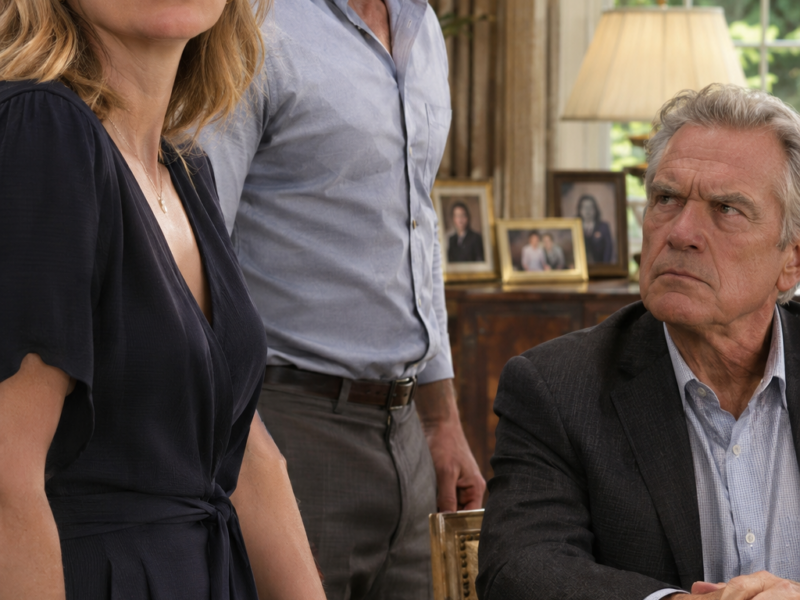
My Husband Humiliated Me at His Parents’ Anniversary Dinner, Saying, “You Never Even Finished College, So You Don’t Belong at This Table.” His Family Laughed, Unaware I Had Secretly Written the Research That Built His Career for Nine Years. Then My 65-Year-Old Father, a Retired Mechanic They All Looked Down On, Stood Up and Said, “I Have Every Original Draft.” My Husband Turned Pale—But None of Us Expected What Was Hidden Inside My Father’s Old Toolbox…
My Husband Humiliated Me at His Parents’ Anniversary Dinner, Saying, “You Never Even Finished College, So You Don’t Belong at This Table.” His Family Laughed, Unaware I Had Secretly Written the Research That Built His Career for Nine Years. Then My 65-Year-Old Father, a Retired Mechanic They All Looked Down On, Stood Up and Said, “I Have Every Original Draft.” My Husband Turned Pale—But None of Us Expected What Was Hidden Inside My Father’s Old Toolbox…
PART 1
The night my husband destroyed our marriage, he was laughing at me in front of twelve people.
We were celebrating his parents’ fortieth wedding anniversary at their lakeside mansion in Connecticut. Crystal glasses sparkled beneath the chandeliers, and every guest seemed to have an impressive title or an expensive degree.
Everyone except me.
My name is Ren Holloway. I was thirty-two, married to Garrett Prescott, a celebrated researcher at the Harmon Prescott Institute. For nine years, I had secretly helped him develop the mathematical models that made him famous.
But nobody knew that.
“Ren, darling,” my mother-in-law, Lorraine, said across the dinner table. “Remind us what your degree is in.”
“I never finished college,” I answered.
She smiled. “Oh, that’s right. Garrett, how do you explain that at your academic dinners?”
Several guests laughed.
Garrett placed a hand on my knee.
“She’s fine, Mother. But she doesn’t really belong at this table.”
The laughter grew louder.
I stared at the man I had loved for nearly a decade. He had published my research under his name, promised me recognition, and repeatedly told me to be patient.
Now he was laughing because I lacked the qualifications he had used to justify stealing my work.
Beside me sat my father, Virgil Holloway, a sixty-five-year-old retired mechanic from Ohio.
He quietly put down his fork.
Then he stood.
“Every page of the paper you’re being promoted for tomorrow began in my daughter’s handwriting,” he said. “And I have every original draft dated for nine years.”
Silence swallowed the room.
Garrett turned pale.
His father, Conrad, looked down at his plate.
Lorraine demanded an explanation, but Garrett grabbed my arm and pulled me into the hallway.
“Your father is confused,” he hissed.
“No, Garrett. He isn’t.”
He leaned closer.
“I’m the one with the doctorate. You’re the one without a degree. Who do you think they’ll believe?”
I had heard that argument for nine years.
This time, it didn’t frighten me.
“Did you publish my calibration method under your name?”
He avoided my eyes.
“Tomorrow is the biggest day of my career. Don’t ruin it.”
That was when I understood.
He wasn’t afraid of losing his wife.
He was afraid of losing everything his wife had created.
I returned to the dining room, took my father’s arm, and left.
During the long drive home, I asked Dad how he knew.
“I’ve been keeping records,” he replied.
At his house in Ohio, he led me into the garage and opened an old steel toolbox.
Inside were sixty-seven sealed envelopes, each carefully dated and authenticated, alongside handwritten drafts, emails, and USB drives.
Nine years of my work.
Nine years of proof.
My father touched my shoulder.
“I hoped you’d never need these.”
I opened Garrett’s latest paper. In the acknowledgments, he had thanked his wife for her support.
Support.
That was what he called my research.
I opened my laptop and began writing a formal complaint.
For once, Garrett wouldn’t be able to put his name on what I wrote.
PART 2
At eight the next morning, Garrett appeared outside my father’s house.
His suit was wrinkled, and he looked as though he hadn’t slept.
“I’ll add your name to the paper,” he promised. “Full co-author credit. Whatever you want.”
“After your promotion?”
He hesitated.
“Just give me until nine.”
I shook my head.
“You already had nine years.”
He left without another word.
At nine, the institute announced his promotion to program director.
Five minutes later, I submitted my complaint to its research integrity office.
I attached original drafts, dated correspondence, and messages in which Garrett had promised to acknowledge my contributions.
Then I hired an attorney named Marian Doyle.
Within days, the Prescott family’s lawyers sent a cease-and-desist letter demanding my documents.
Lorraine visited with Garrett’s brother, Brent, insisting everything was a misunderstanding.
But when I asked why their attorneys were threatening me, neither had an answer.
The institute’s integrity officer, Naen Ellsworth, examined my evidence.
“These documents are compelling,” she said. “But we’ll need independent corroboration.”
The final hearing was scheduled for December 19.
I had forty-nine days.
Then Conrad Prescott unexpectedly arrived at my father’s house.
He showed me a message Garrett had sent him three years earlier.
Dad, she wrote the core of this one, too. Please don’t tell anyone.
I stared at the screen.
“You knew?”
Conrad nodded.
“For three years?”
“I was protecting my family.”
“No,” I replied. “You were protecting its reputation.”
He promised to preserve the message but refused to commit to testifying.
Meanwhile, Garrett spread rumors that I was fabricating evidence to extort his family.
My consulting employer placed me on unpaid leave.
With no income and mounting legal bills, I began wondering whether I could afford to continue.
Then Brent invited me to a café.
He placed a check in front of me.
Five hundred thousand dollars.
“Withdraw the complaint and sign a confidentiality agreement,” he said.
For a moment, I thought about my father’s debts and the years he had struggled to keep his repair shop alive.
Then I pushed the check back.
“No.”
Brent’s expression hardened.
He mentioned old audits from Dad’s business.
The threat was unmistakable.
That evening, I received a message from Keegan Marsh, a former researcher who had worked with Garrett.
He remembered seeing handwritten calculations on Garrett’s desk that didn’t match his handwriting.
Later, those calculations appeared in published manuscripts.
“Will you testify?” I asked.
After a long silence, he agreed.
Days later, while comparing my drafts against Garrett’s papers, I discovered something even more revealing.
He had changed a positive correction coefficient into a negative one.
The alteration made the equation inconsistent.
Garrett had copied my work without understanding it.
But before I could present the discovery, the institute notified me that Garrett had filed a countercomplaint.
He accused me of illegally accessing confidential research.
My complaint account was temporarily suspended.
Suddenly, I wasn’t only fighting for recognition.
I was fighting to prove I hadn’t stolen my own work.
PART 3
When I returned home, my father found me crying at the kitchen table.
“Why didn’t you tell me what Garrett was doing?” I asked.
Dad looked at his hands.
“Because you already gave up so much for me.”
At nineteen, I had left college after an accident shattered his wrist. I managed his repair shop, drove him to medical appointments, and helped him recover.
I never returned to school.
“I couldn’t bear to be the reason your marriage fell apart, too,” he whispered.
He opened the oldest envelope.
Inside was one of my first research drafts and a note in his handwriting.
If he ever makes my girl cry, remember this date.
I broke down.
The next morning, we began preparing my defense.
With Marian’s help, we assembled photographs, mechanical testing records, and original calculations showing that my work began in Dad’s garage, not on the institute’s servers.
But we needed an independent expert.
A family friend introduced me to Professor Leland Jarvis, a retired mechanical reliability specialist.
He handed me a blank sheet of paper.
“Derive your thermal lag calibration model.”
For eleven minutes, I wrote without stopping.
When I finished, he studied my equations.
“You understand this more deeply than many doctoral researchers I’ve examined,” he said.
Then he agreed to testify.
He also revealed something astonishing.
Years earlier, while reviewing one of Garrett’s manuscripts, Jarvis had questioned whether another researcher contributed to its methodology.
Garrett had responded in writing that his wife only edited for grammar.
I stared at those words.
Nine years of original research reduced to correcting commas.
Jarvis gave us the correspondence.
It became one of our strongest pieces of evidence.
But legal expenses kept growing.
One afternoon, I returned home and discovered Dad’s beloved pickup truck was gone.
He had sold it to help pay my attorney.
“Dad, you shouldn’t have!”
He smiled sadly.
“That truck is just iron. You’re the engine that matters.”
As December approached, Keegan recovered institutional records showing that manuscript files originally bearing my name had been altered before submission.
The timestamps matched Dad’s preserved drafts.
Professor Jarvis independently verified the mathematical error Garrett had introduced.
Then Conrad called.
“I’ll testify,” he said.
“Against your own son?”
“Yes. I should have spoken years ago.”
Six days before the hearing, Garrett returned.
Standing in the rain, he admitted that he had always feared disappointing his father.
“You understood things I couldn’t,” he said. “At first, I told myself we were partners. Then I got used to taking the credit.”
He offered to correct the papers if I stopped the hearing.
“You’re offering to return something that was already mine,” I replied.
“Ren, I love you.”
For years, those words had controlled my decisions.
Not anymore.
“Go home, Garrett.”
On December 19, Dad and I entered the institute’s hearing room.
Garrett sat beside his attorney.
His mother and brother watched from the back.
His father sat apart from them.
The hearing began with Garrett’s lawyer questioning my qualifications.
Then he dismissed my father as “merely a retired mechanic.”
The panel chair reviewed Dad’s credentials.
“Mr. Holloway, didn’t you chair an industry working group responsible for a major thermal fatigue testing protocol?”
“Yes, sir.”
The lawyer fell silent.
My father had helped establish technical standards Garrett himself had cited.
And my husband had never bothered to learn that.
PART 4
My father testified first.
He explained the sixty-seven envelopes, the preserved drafts, and the years he had watched me develop the research.
Keegan described how manuscript files originally bearing my name had been changed.
The institute’s server records supported his testimony.
Then Conrad read Garrett’s message aloud.
Dad, she wrote the core of this one, too. Please don’t tell anyone.
Garrett stared at the table.
Finally, the panel chair asked him to approach the whiteboard.
“Dr. Prescott, please derive the calibration model from your published paper.”
Garrett began confidently.
He wrote the basic heat-transfer equation.
Then he reached the nonlinear correction.
His hand stopped.
He erased a line, rewrote it, and paused again.
After several painful minutes, he admitted he couldn’t remember the intermediate steps.
The panel chair turned toward me.
“Ms. Holloway, would you demonstrate the derivation?”
I stood.
Dad gently touched my sleeve.
“Remember who you are,” he whispered.
At the board, I reconstructed the model from its foundations.
I explained the three-sensor averaging method, the temperature thresholds, and the nonlinear correction.
Then I reached the coefficient Garrett had copied incorrectly.
I wrote the positive sign.
And explained why it had to be positive.
Without it, the model amplified the error instead of correcting it.
Nobody interrupted.
When I finished, the board was covered in equations.
For the first time, everyone could see the difference between someone who had published the research and someone who understood it.
Four days later, the institute delivered its decision.
The panel ruled unanimously.
My authorship would be restored on five disputed papers.
Garrett’s promotion was revoked, and his research grant was suspended.
His accusation that I had accessed confidential data without authorization was dismissed.
I sat at Dad’s kitchen table reading the decision.
Five papers.
Nine years.
Sixty-seven envelopes.
My name was finally being returned to the work I had created.
Dad poured me coffee.
“Looks like they finally listened.”
I laughed.
Then I cried.
The ruling couldn’t give me back my lost years, but it gave me something I had almost forgotten.
The right to trust myself.
In January, I filed for divorce.
During mediation, Garrett admitted that he had stolen my work because he feared being ordinary.
“I forgive you,” I told him.
He looked hopeful.
“But I’m not coming back.”
In February, Lorraine visited to apologize for humiliating me at the anniversary dinner.
I accepted her apology without inviting her back into my life.
Then, in March, something extraordinary happened.
An independent research foundation offered me a $250,000 scholarship to continue developing my calibration research.
Under my own name.
Without Garrett.
Without the Prescott Institute.
For the first time, my future belonged to me.
PART 5
I sat at Dad’s kitchen table completing the research paperwork.
Under Principal Investigator, I typed:
Ren Holloway.
Then I reached the section for technical advisers.
I smiled and entered another name.
Virgil Holloway.
When I showed him the document, he stared at it for a long time.
“What’s this?”
“Your name, Dad. Right where it belongs.”
He turned away before I could see his tears.
Later, I found him standing in the garage beside an old chalkboard.
He pointed toward a faded equation.
“Remember writing that?”
I stepped closer.
It was one of my earliest attempts at explaining heat transfer.
I had been fourteen.
“You kept it?”
“Of course.”
Nearly twenty years had passed, and he had never erased it.
The same man who had preserved my childhood calculations had spent nine years protecting my adult work.
Two months later, I drove a familiar pickup truck into his driveway.
It was the truck he had sold to pay my legal expenses.
I had tracked down the buyer and purchased it back.
Dad came outside and stopped walking.
He approached slowly, placing his palm against the hood.
“Runs well,” he said.
“Of course. You maintained it.”
He pulled me into a hug.
That afternoon, I opened the old steel toolbox.
The sixty-seven envelopes were still arranged in their careful rows.
Once, they had represented years of betrayal.
Now they reminded me of my father’s patience and love.
I took a fresh envelope and placed the title page of my new research project inside.
My name appeared at the top.
I sealed it and handed it to Dad.
“One more for the box.”
He smiled.
“What’s in this one?”
“Something I wrote that nobody else gets to claim.”
He nodded.
“About time.”
We placed it beside the others.
Sixty-eight envelopes.
But only one had been created to celebrate a beginning rather than protect me from an ending.
That evening, Dad made vegetable soup.
We ate at our scratched wooden kitchen table, using mismatched bowls.
There were no crystal glasses, no wealthy donors, and no distinguished academics.
Just my father and me.
After dinner, he asked whether I had any regrets.
I thought about Garrett, the humiliation, the accusations, and the nine years I had spent believing I needed his approval.
Then I looked around our little kitchen.
“I used to think I needed those people to accept me,” I said.
Dad waited.
“But I finally understand something.”
“What’s that?”
“I was sitting at the wrong table all along.”
He smiled and filled my bowl again.
Outside, his old truck rested in the driveway.
Inside the garage, the toolbox held sixty-eight envelopes.
And somewhere, five scientific papers were being corrected to carry my name.
Garrett had once told me I didn’t belong at his family’s table.
He was right about one thing.
I didn’t.
Because the place where I truly belonged had been waiting for me in a small kitchen in Ohio.
And the man sitting across from me had never needed sixty-seven envelopes to know what I was worth.
THE END