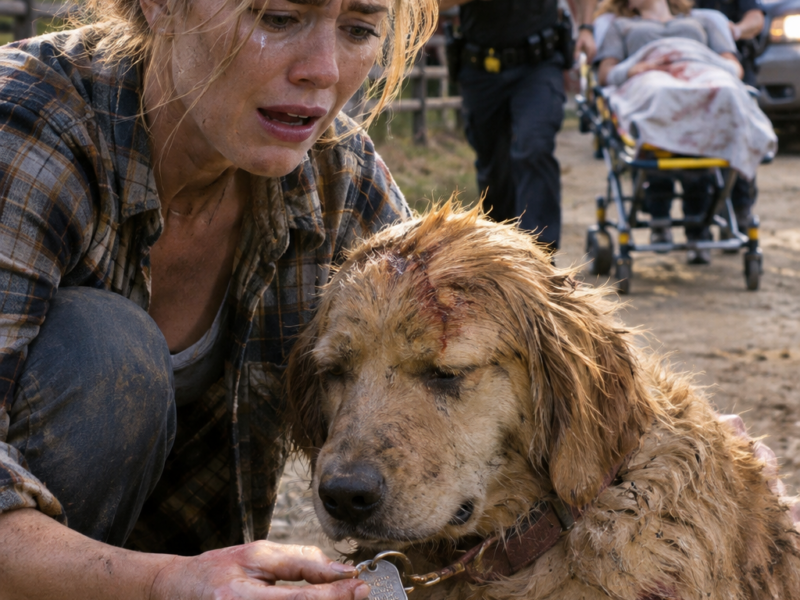
My Daughter’s Dog Showed Up At My Farm — What I Found On Its Collar Tag Made Me Call 911…
My Daughter’s Dog Showed Up At My Farm — What I Found On Its Collar Tag Made Me Call 911…
The first sign that something terrible had happened to my daughter came at 5:17 on a freezing Tuesday morning, when a dog I hadn’t seen in nearly two weeks collapsed against my front door.
At first, I thought it was a branch scraping the porch. The wind had been fierce all night, rattling the gutters and sending dead leaves skittering across the wooden steps. But then I heard it again—three desperate scratches, followed by a low, painful whimper.
I grabbed the flashlight beside my bed and hurried downstairs.
The moment I opened the door, something heavy fell against my legs.
It was Bramble.
My daughter’s dog.
For several seconds, I simply stared at her, unable to understand what I was seeing.
Bramble was a beautiful golden-brown shepherd mix, normally strong enough to drag a grown man across a field whenever she spotted a rabbit. But the animal lying at my feet looked as though she had crawled out of a battlefield. Mud covered her coat. Her ribs showed beneath her skin. Blood had dried around her paws, and one hind leg trembled so violently that she could barely stand.
“Oh, sweetheart,” I whispered, dropping to my knees. “What happened to you?”
She lifted her head at the sound of my voice.
Then, with the last strength she seemed to possess, she pushed her nose against my chest.
I was sixty-three years old, and I had spent my entire life working a cattle farm in Calder County, Virginia. I had seen injured livestock, terrible storms, and more death than I cared to remember. But nothing had ever frightened me quite like the sight of that dog.
Because Bramble belonged to my only daughter, Odessa Whitlock, whom everyone called Desa.
And Desa lived forty-seven miles away.
There was no reasonable explanation for why her dog would appear on my porch before sunrise, half-starved and bleeding.
I carried Bramble inside, wrapped her in an old blanket, and placed a bowl of water beside the stove. She drank desperately, coughing between gulps.
“Easy, girl. Slow down.”
I examined her paws. The pads were split open, and her legs bore scratches that looked too deep to have come from an ordinary walk.
Something was wrong.
I knew it before I picked up the telephone.
Desa hadn’t called me much lately. For six months, our conversations had become shorter and less frequent. Whenever I asked whether everything was all right, she blamed the pressures of work and her husband’s struggling construction business.
I’d believed her.
That was a mistake I would spend many sleepless nights regretting.
I dialed her number.
No answer.
I called again.
Voicemail.
On the third attempt, someone finally picked up.
“Hello?”
It was her husband, Garrick.
“Garrick, where’s Desa?”
There was a pause.
“Lowell? It’s barely five-thirty.”
“I know what time it is. Where’s my daughter?”
“She’s busy.”
I looked down at Bramble, who was lying beside my boots with her eyes half-closed.
“Busy doing what?”
“Work stuff. She’ll call you later.”
“Listen carefully. Bramble just showed up at my farm. She’s covered in blood, and she can barely walk.”
The silence that followed was unmistakable.
Then Garrick said something that chilled me.
“That’s strange. She’s been missing for a few days.”
“A few days?”
“She slipped out of the yard. We figured somebody picked her up.”
“And nobody thought to tell me?”
“We were handling it.”
“Put Desa on the phone.”
“She’s not available.”
“Then make her available.”
“Lowell, you’re being dramatic.”
I felt my grip tighten around the telephone.
“Son, my daughter’s dog has somehow traveled forty-seven miles and arrived at my door half-dead. You don’t get to tell me I’m being dramatic.”
“She’s fine.”
“Then let me hear her say it.”
Another silence.
“I can’t do that.”
“Why?”
“Because I can’t.”
The line went dead.
I stood motionless in my kitchen, listening to the empty connection.
Garrick had never been an especially warm man, but he had always been polite. He had eaten Sunday dinners at my table, helped repair my fences, and attended my wife’s funeral four years earlier.
Now he had hung up on me rather than let me speak to my daughter.
I looked down at Bramble.
Her collar was twisted around her neck, and the brass identification tag was covered in deep scratches.
I knelt beside her and turned it over.
What I saw made the blood drain from my face.
Two words had been carved into the back of the metal.
WELL 3.
I read them again.
Then again.
The flashlight slipped from my hand.
There were five old monitoring wells scattered across my property, installed by the county decades earlier. Four had been filled and forgotten. The third remained marked on an old survey map, hidden in the north pasture near a stand of red cedar trees.
Years ago, when Desa was twelve, I had taken her there during one of our walks.
She had asked why a lonely steel marker stood in the middle of nowhere.
I’d told her it marked an old groundwater well.
She had laughed and said it sounded like a secret treasure location.
From then on, whenever she wanted to hide something from me, she would jokingly threaten to bury it at Well Three.
It had been our private little joke.
Nobody else knew what that place meant to us.
And now those words were scratched into her dog’s collar.
My hands began shaking.
“Desa,” I whispered. “What have you gotten yourself into?”
Bramble raised her head and rested it against my knee.
That was when I called 911.
Deputy Reuben Callaway arrived shortly after six. He was a tall, broad-shouldered man in his thirties who had grown up around Marlo Gap. I knew his father, and I had once sold his family a calf.
He examined Bramble, photographed the tag, and listened carefully as I described the conversation with Garrick.
When I finished, he didn’t immediately promise me anything.
Instead, he said, “Mr. Whitlock, we need to look at that well.”
We drove through the darkness in my old pickup, following the rough pasture road toward the northern ridge.
A thin layer of frost covered the grass.
As the headlights swept across the cedar trees, I spotted the place where the old steel marker should have stood.
But it wasn’t there.
I slammed on the brakes.
“That’s impossible.”
Reuben followed me out of the truck.
The marker had been anchored in a heavy concrete foundation built by my father. Removing it would have required machinery.
Yet someone had done exactly that.
The ground had been freshly disturbed, smoothed over in a wide circle. Tire tracks curved through the weeds toward the tree line.
Reuben crouched beside them.
“Heavy equipment,” he murmured.
“My son-in-law owns heavy equipment.”
“So do plenty of other men around here. We need evidence before we accuse anyone.”
A few minutes later, he found a strip of orange survey ribbon caught in a thornbush.
Printed across it were the words BLACK RIDGE GEOLOGICAL SERVICES.
I’d never heard of the company.
Neither had Reuben.
He bagged the ribbon and called the Brightwater Police Department, requesting a welfare check at Desa’s house.
While he spoke, I stared at the empty patch of earth.
Someone had come onto my land without permission.
Someone had removed a marker that had stood there for almost forty years.
And somehow, my missing daughter’s dog had carried me directly to that spot.
At 6:51, my phone vibrated.
A message from Desa.
Dad, I’m okay. Please stop calling.
For one beautiful second, relief flooded my body.
Then I noticed the first word.
Dad.
My daughter had never called me Dad.
Not once in her entire life.
When she was little, she called me Daddy. After she turned fourteen, she shortened it to Pop.
Even when she was furious with me, I was Pop.
I showed Reuben the message.
“That’s not my girl.”
He studied the screen.
“It could be someone else using her phone.”
“That’s exactly what I’m telling you.”
We called back.
The phone was switched off.
By noon, the Brightwater police had visited Garrick. He claimed Desa had traveled to Richmond for a bookkeeping conference and that her dog had escaped several days earlier.
Her green Subaru was supposedly with her.
The house showed no obvious signs of a struggle.
I wanted to drive there myself, but Reuben persuaded me to wait.
Meanwhile, I took Bramble to Dr. Imogene Tarbell, the veterinarian who had treated my cattle for twenty years.
Imogene examined the dog’s injured feet and gave me a look I would never forget.
“Lowell, this animal didn’t walk forty-seven miles.”
“How can you know?”
“Her paw pads are cut, not worn smooth. She walked over sharp rocks, rough woodland, and broken ground. I’d estimate ten or twelve miles, perhaps over two nights.”
She brushed a little gray dust from Bramble’s fur.
“Limestone. Red clay. Pine resin.”
I felt suddenly cold.
Those were the exact materials covering the ridge north of my pasture.
Bramble hadn’t escaped from Brightwater.
She had been somewhere nearby.
While Imogene removed the dog’s damaged collar, she noticed something unusual beneath the leather lining.
A small lump.
Reuben photographed it before she carefully opened the stitching.
A brass key fell onto the examination table.
The number 214 was stamped into its head.
A storage-unit key.
Whoever had prepared Bramble’s collar had hidden something far more important than a desperate message.
My daughter had been planning.
She had known she might disappear.
And she had trusted her dog to bring the evidence home.
That evening, I asked my oldest friend, Ambrose Teague, to visit.
Ambrose had been my accountant for seventeen years. He knew everything about my finances, my farm, and my family. When my wife Maybel died, he had sat beside me at the funeral and held my arm when I couldn’t stand.
I told him about Bramble, the missing marker, and the strange message from Desa.
I didn’t mention the hidden key.
Even now, I cannot explain why.
Perhaps some instinct deep inside me was already warning me.
Ambrose listened with apparent concern.
Then he told me something surprising.
“Garrick called me a couple of weeks ago,” he said. “He was worried about your finances.”
“My finances?”
“He said Desa was frightened you might lose the farm.”
I stared at him.
“Ambrose, you keep my books. This land has been paid off for years.”
“I know.”
“Then why would Garrick tell her otherwise?”
Ambrose sighed.
“He’s under a lot of pressure himself. Maybe he’s projecting his problems onto you.”
Then he suggested something that made my stomach turn.
“Perhaps Desa simply needs a little distance from the family.”
I looked at Bramble, sleeping with bandages around her paws.
“A woman who wants distance doesn’t carve a secret message into her dog’s collar.”
Ambrose didn’t answer.
Before leaving, he straightened the weekly pill organizer on the shelf beside my stove.
He had always been particular about keeping things tidy.
“Take care of yourself, Lowell,” he said. “And don’t forget your blood pressure medicine.”
The next morning, my neighbor Hester Moody arrived with coffee cake.
Hester had spent thirty years working in the county land records office. When I mentioned the mysterious survey company, she insisted we go downtown.
“If someone wants rights to your property,” she said, “there’s usually paperwork somewhere.”
She was right.
At the courthouse, we discovered that an easement had been recorded against my land three weeks earlier.
It gave Black Ridge Geological Services extensive access to the north pasture and the ground beneath it.
The document carried my signature.
Except it wasn’t mine.
Even the name was wrong.
Lowell A. Whitlock.
I didn’t use a middle initial.
The signature was a clumsy imitation of my handwriting.
And the notary listed on the document was a woman named Lorna Beckwith, whom I had never met.
My attorney, Linus Ratliff, arrived and examined the document with growing concern.
Then he found something worse.
A preliminary survey authorization had been signed by my daughter.
Desa had apparently given Black Ridge permission to investigate the property.
I felt as though someone had struck me across the face.
My own daughter had signed papers concerning my farm without telling me.
But Linus cautioned me not to jump to conclusions.
“Signing an initial survey letter isn’t the same as agreeing to surrender property rights. We need to see the complete agreement.”
That was when Hester discovered a missing page.
Page seven.
The official record jumped directly from page six to page eight.
Someone had deliberately removed part of the filing.
Linus demanded that the county preserve the electronic audit logs.
And I went home feeling that every piece of ground beneath my boots had become unfamiliar.
That night, something else happened.
I fell asleep almost immediately after taking my evening coffee, despite feeling sick with worry.
Hours later, Bramble’s barking dragged me awake.
My head felt heavy. My tongue was thick. I could barely make my legs move.
When I finally reached the window, I saw the door of my father’s old file room hanging crookedly from its hinges.
Someone had broken in.
The cash box remained untouched.
My father’s gold pocket watch was still sitting in its usual place.
But the original geological survey maps had vanished.
Reuben examined the scene.
“Somebody knew exactly what they wanted.”
Fortunately, my father had kept a second copy of the survey in the workshop.
The next morning, I unrolled it across a wooden table.
Beneath the north pasture, nearly nine hundred feet underground, lay a massive salt formation.
My father had spoken about it occasionally, but I’d never paid much attention.
Now I realized why a geological company might be interested.
Deep salt formations can be used to create underground storage caverns for certain energy projects.
A suitable deposit beneath privately owned land could be worth millions.
When I searched the company’s name, I found connections to a larger enterprise called Ridgeway Reserve, which was developing underground energy storage.
Suddenly, the forged easement made sense.
Someone wanted control of the formations beneath my farm.
And someone was willing to commit crimes to obtain it.
The following morning, Reuben arrived with two important discoveries.
First, the bookkeeping conference in Richmond had been canceled weeks earlier.
Garrick had lied.
Second, the deputy had located storage unit 214 at Riverbend Self Storage.
It was rented in Desa’s name.
Reuben had obtained a search warrant.
We drove there together.
The storage facility stood beside an old railroad spur, with rows of orange metal doors stretching toward a fence.
Beyond that fence was a yard filled with drilling equipment.
A sign on the gate read BLACK RIDGE GEOLOGICAL SERVICES.
Desa had rented a storage unit practically next door to the people she suspected.
When Reuben opened unit 214, we found a waterproof case containing documents, a flash drive, and a sealed envelope.
One word was written across the envelope.
Pop.
My knees nearly gave way.
That was her handwriting.
I would have recognized it anywhere.
Later, at my kitchen table, Reuben let me read the letter.
Desa explained that Garrick had shown her documents claiming I owed nearly nine hundred thousand dollars against the farm.
He had convinced her I was too proud to ask for help.
Black Ridge had supposedly offered enough money for preliminary survey access to ease my financial burden.
So she had signed the initial authorization.
But then she had begun checking the numbers.
The loans were fictitious.
The bank statements were manufactured.
And she had discovered evidence suggesting Garrick was involved.
She also believed someone more powerful was directing him.
Her letter said she had insisted on a clause requiring my personal approval before anyone could acquire permanent subsurface rights.
She feared that clause had been altered or removed.
At the bottom, she had written:
Pop, I know I made a terrible mistake. I thought I was protecting you. Please believe that I never meant to give anyone your farm. I love you more than anything. If something happens to me, keep looking.
I couldn’t finish without crying.
For weeks, I had worried about our growing distance.
Now I understood she had been carrying a burden she thought was mine.
And that burden had led her into danger.
Reuben examined the falsified loan statements.
The same distinctive forged signature appeared on every one.
Someone had been planning this for months.
Then, just when I thought we were finally making progress, the investigation turned against me.
An anonymous caller claimed to have heard me threatening my daughter with a firearm on the night she disappeared.
Garrick supported the allegation.
The sheriff obtained an emergency order requiring me to surrender my hunting rifles.
Those guns had belonged to my father.
I had never pointed one at another human being.
But I handed them over.
I still remember standing in the hallway while Reuben carried my father’s Winchester out of the house.
“Just find my daughter,” I told him.
He nodded.
Then he quietly warned me that somebody seemed determined to make me look dangerous.
By Friday, the situation became even worse.
Desa’s Subaru was discovered at a bus station in Bristol.
A letter supposedly written by her arrived at the sheriff’s office, claiming she had voluntarily left her husband and father and wanted no further contact.
But the letter was wrong.
She had signed her full name, Odessa.
My daughter had signed her name Des for years.
And once again, the letter referred to me as her father rather than Pop.
The sheriff treated it as evidence that she might simply be avoiding us.
I begged him not to stop searching.
He told me adults were entitled to disappear if they wished.
Then an Adult Protective Services worker arrived at my home with a psychologist.
They asked whether I had been forgetting things, wandering at night, hearing voices, or becoming paranoid.
I tried to answer calmly.
But my head was spinning.
I couldn’t remember the exact date.
Simple arithmetic became strangely difficult.
When I told the psychologist someone had forged my signature and stolen documents from my farm, he wrote something in his notes.
I caught the words paranoid thinking.
That afternoon, I was served with court papers.
Garrick had filed a petition to have me declared incapable of managing my financial affairs.
He wanted a temporary conservator appointed to control my money and property.
The proposed conservator was Ambrose Teague.
My best friend.
The man who had kept my accounts for seventeen years.
I read his name again and again.
Surely there had been some misunderstanding.
Surely Ambrose would never agree to take control of my farm.
But a cold memory returned.
Ambrose standing beside my stove.
Ambrose straightening my pill organizer.
Ambrose telling me to take my medicine.
Before I could understand what that meant, someone set fire to my workshop.
It happened shortly before one in the morning.
Bramble woke me, barking frantically at a red glow beyond the bedroom window.
Flames were climbing the workshop walls.
Three sick calves had been sheltered in the attached lean-to.
My longtime farmhand, Delmer Nettleton, ran toward the fire before I could stop him.
I followed, shouting his name.
Inside, smoke filled the building.
Delmer had managed to release the calves, but he collapsed before reaching the exit.
Bramble began barking near the doorway.
I crawled through the smoke and found him lying beside a workbench.
Together, we struggled toward the outside air.
By the time the firefighters arrived, Delmer had suffered burns to both hands, and I could barely breathe.
The fire chief suspected arson.
There were signs that gasoline had been poured in several places.
At the hospital, a doctor examined me because of my persistent dizziness.
Her blood tests revealed something I had never expected.
Along with my prescribed medication, my bloodstream contained high levels of sedating drugs.
I had taken no such medicines knowingly.
My attorney brought my pill organizer to the hospital, where a pharmacist examined the tablets.
Several were not my prescribed blood pressure medication.
Someone had substituted sedatives.
Suddenly, everything made sense.
The exhaustion.
The confusion.
The difficulty remembering dates.
The strange weakness during the psychological evaluation.
Someone had been drugging me.
And someone wanted the courts to believe I was losing my mind.
I thought of Ambrose touching my pill organizer.
I wanted desperately to believe there was another explanation.
Then my bank called.
An unauthorized transfer of $38,500 had been initiated from my account.
The recipient was Hargrove Security Consulting.
The electronic login had originated from the office network of Teague and Associates.
Ambrose’s accounting firm.
I was still sitting in shock when a federal agent arrived.
Her name was Ingrid Kilbride.
She had been contacted by Reuben after he noticed that the false letter attributed to Desa had been mailed from Tennessee.
The agent was investigating the possibility of interstate fraud and kidnapping.
For the first time in days, someone seemed willing to connect all the evidence rather than treat every event as an isolated coincidence.
She explained that the last known location of Desa’s phone placed it somewhere in a broad region north of my pasture.
The anonymous call accusing me of threatening my daughter had originated from a similar area.
Then she told me something that turned my stomach.
“We have reason to believe someone close to you is directing this.”
I thought of Garrick.
I thought of Ambrose.
And I wondered which betrayal would hurt more.
That night, shortly after midnight, an old pickup rolled into my driveway.
Garrick climbed out.
His clothes were dirty and torn.
He looked ten years older than he had the last time I’d seen him.
Bramble growled the moment she recognized him.
I stood on the porch.
“Where is my daughter?”
He raised both hands.
“Mr. Whitlock, please. I came to tell you everything.”
“Then start with where she is.”
“She’s alive.”
The words nearly dropped me to my knees.
“Where?”
He started crying.
And what he told me would change the way I remembered the last seventeen years of my life.
Ambrose had approached Garrick months earlier, when his construction business was close to collapse.
He had offered to solve Garrick’s financial problems in exchange for his help persuading Desa that I was deeply in debt.
The forged loan papers had been Ambrose’s idea.
So had the preliminary survey agreement.
He had connections to Black Ridge and expected to receive a substantial payment once the subsurface rights were secured.
But Desa had uncovered the fraud.
She had confronted Ambrose and threatened to tell me everything.
That was when things turned violent.
Ambrose had hired a man named Royce Hargrove, who operated under the cover of a private security business.
Royce and another man had abducted my daughter.
Garrick had witnessed it.
And done nothing.
He had been threatened with exposure for his role in the fraud.
Instead of protecting his wife, he had obeyed the people who took her.
He had lied to the police.
He had fabricated the conference story.
He had provided an old driveway video to create the impression she had driven away voluntarily.
He had helped maintain the illusion that she wanted distance from her family.
And all the while, she had been held somewhere in the wooded hills.
“Why didn’t you tell me?” I demanded.
Garrick stared at the ground.
“Because I was afraid.”
“She was your wife.”
“I know.”
“She trusted you.”
“I know.”
I could barely look at him.
Then he told me something that made my heart pound.
Desa had been allowed to keep Bramble with her for a time.
At an old hunting lodge, she had managed to loosen a metal bolt from the bed frame.
Using that bolt, she scratched a message into the dog’s identification tag.
One night, when Royce left a door unsecured, she sent Bramble away.
She had told the dog to find me.
And somehow, through miles of forest and rocky trails, Bramble had obeyed.
Garrick said Royce had kept Desa alive because Ambrose needed her as leverage until the fraudulent transaction was complete.
The anticipated payout was more than four million dollars.
Afterward, Garrick didn’t know what they intended to do with her.
That was enough.
I called Agent Kilbride.
She arrived with a state trooper and interviewed Garrick through the night.
By sunrise, a search team had reached the hunting lodge.
But Desa was gone.
The kidnappers had moved her.
Inside the building, investigators found evidence that she had been confined there.
They also recovered discarded drafts of the letter supposedly written by her.
Eleven versions.
Some had been crossed out.
Others had been rewritten.
In the earliest drafts, she had referred to me as Pop.
Someone had forced her to change it.
In later drafts, she had signed Des.
Someone had rejected those too.
They had made her rewrite the letter until it sounded like a stranger had written it.
When Kilbride showed me the pages, I began crying.
Every correction represented another moment when my daughter had tried to preserve some small piece of herself.
But the greatest discovery was still waiting.
Bramble, now recovering from her injuries, accompanied Reuben to the lodge.
When she smelled one of Desa’s sweaters, she began pulling toward an old logging trail behind the property.
The investigators followed.
Two miles away, Bramble stopped outside an abandoned pump station and began scratching frantically at a loose floorboard.
Beneath it, wrapped in oily cloth, was Desa’s phone.
A yellow sunflower sticker decorated the back.
I had given her that sticker for her twentieth birthday.
She had never removed it.
With proper authorization, Agent Kilbride examined the phone and found a voice recording.
It had been made on the afternoon Desa disappeared.
The moment the recording began, I heard her voice.
Clear.
Angry.
Determined.
“Ambrose, I know the loans aren’t real.”
Then came a second voice.
Calm.
Patient.
Familiar.
“Desa, sweetheart, let’s discuss this reasonably.”
It was Ambrose.
The same voice that had comforted me after Maybel died.
The same voice that had told me not to worry.
My daughter accused him of changing the survey agreement and forging my signature.
She told him she would never allow him to steal my land.
His response was gentle enough to be terrifying.
“You don’t understand how much money is involved.”
She told him she didn’t care.
Then the recording captured a chair scraping, a door opening, and another man’s voice.
The final seconds were filled with confusion.
Someone shouted.
Desa demanded to be released.
Then the audio ended.
I stood in that abandoned building with the phone in my hand, feeling as though the entire world had gone silent.
She had been brave.
She had known she was in danger.
And she had still refused to surrender.
That afternoon, another part of the conspiracy unraveled.
Hester helped federal investigators question Neville Pratt, the courthouse employee who had processed the fraudulent easement.
He admitted Ambrose had paid him nine thousand dollars to delete page seven from the official record.
The missing page concerned independent legal approval of the subsurface transaction.
The notary, Lorna Beckwith, also confessed that she had authenticated my forged signature without ever witnessing me sign the document.
She had recently been injured when a dark pickup forced her car off the road.
Investigators suspected Royce had been responsible.
The case against Ambrose was growing stronger.
Yet we still had to find Desa.
And time was running out.
That evening, Bramble began pulling me toward the machine shed.
She had done it several times since the workshop fire, but I’d assumed the smell and excitement had upset her.
Now I followed.
She stopped beside my father’s old Farmall tractor and scratched at the metal seat.
Agent Kilbride lifted it.
Hidden in a waterproof bag beneath the battery compartment was a black notebook.
It contained handwritten financial records.
Payments to Garrick.
Payments to Hargrove.
Transactions associated with Black Ridge.
And entries connecting a senior executive at Ridgeway Reserve to the fraudulent scheme.
Desa had hidden the notebook during a secret visit to my farm before she disappeared.
She had come while I was away at the livestock auction.
Delmer had seen her Subaru leaving but hadn’t realized anything was wrong.
My daughter had stood in my own yard, perhaps frightened and desperate, while I was miles away buying cattle feed and discussing auction prices.
The thought nearly destroyed me.
But she had left the evidence.
And Bramble had somehow remembered where it was.
Agent Kilbride decided to use the discovery to force Ambrose into making a mistake.
Garrick agreed to participate in a recorded call.
Under federal supervision, he telephoned Ambrose and pretended to be hiding at my farm.
He told him I had discovered the notebook and intended to give it to the sheriff the following morning.
For several seconds, Ambrose said nothing.
Then he asked one question.
“Has Lowell opened it?”
Garrick said no.
Ambrose’s voice changed.
“Don’t let him give it to anyone. Stay where you are. I’ll handle it.”
He ended the call.
Within minutes, federal agents watching Royce Hargrove’s motel saw him leave in his dark pickup.
He carried a duffel bag.
He drove east along a rural highway, apparently unaware that several unmarked vehicles were following him.
Reuben drove me in his truck behind the federal convoy.
My hands were clasped so tightly that my fingers hurt.
I didn’t know whether my daughter was in Royce’s vehicle.
I didn’t know whether she had been moved to another location.
I knew only that a man connected to her disappearance was finally leading investigators somewhere.
After nearly thirty miles, Royce turned onto an abandoned industrial road.
The destination was an old apple-packing plant.
Its windows were broken, and weeds grew through the asphalt.
A gray van waited behind the building.
The federal vehicles stopped out of sight.
I listened to the radio.
Officers moved into position.
Someone reported seeing two men near the rear entrance.
Then Agent Kilbride gave the order.
The darkness exploded with headlights.
Officers rushed the building.
There were shouted commands.
Footsteps.
A brief struggle.
Then silence.
For several terrible seconds, the radio said nothing.
I couldn’t breathe.
I thought of Desa as a little girl in red boots, running through the pasture after Bramble’s predecessor, an old collie named Rusty.
I remembered her graduation.
Her wedding.
The final Sunday supper she’d eaten at my table.
I remembered Maybel telling me to look after our daughter.
And I wondered whether I was about to discover that I’d failed them both.
Then the radio crackled.
“Female located. Alive and conscious. Requesting medical assistance.”
I made a sound I had never heard come out of my own mouth.
It was half laughter, half sobbing.
Reuben grabbed my arm before I could climb out of the truck.
“Stay here, Mr. Whitlock. Let the medics do their work.”
“She’s alive?”
“Yes, sir.”
“Say it again.”
“Your daughter’s alive.”
I covered my face and wept.
For ten days, I had lived inside a nightmare.
Now, somewhere inside that broken building, my daughter was breathing.
Forty minutes later, Agent Kilbride approached our truck.
Desa was severely dehydrated, exhausted, and frightened.
Her wrists bore marks from restraints.
But she was conscious.
She could speak.
And one of the first things she had asked was whether her father was all right.
I almost collapsed.
Kilbride caught my shoulder.
“She’s going to the hospital. You can see her there.”
I asked about Royce.
He and his accomplice were in custody.
No shots had been fired.
Ambrose had also been arrested at his home.
He had requested an attorney immediately.
He reportedly described the situation as a misunderstanding.
A misunderstanding.
I thought about that word all the way to the hospital.
A man had drugged me.
He had stolen from me.
He had manipulated my daughter and helped arrange her abduction.
He had tried to persuade a court that I was mentally incompetent.
He had nearly cost Delmer his life in a fire.
And he called it a misunderstanding.
But the moment I stepped into Desa’s hospital room, I stopped thinking about Ambrose.
She was lying beneath a thin blanket, her face pale and her cheeks hollow.
An IV line ran into her arm.
Her hair was tangled.
When she saw me, her eyes filled with tears.
“Pop.”
That single word broke whatever strength I had left.
I crossed the room, fell to my knees beside her bed, and wrapped my arms around her.
She held me tightly.
For a long time, neither of us could speak.
Finally, she whispered, “I knew you’d come.”
“Oh, honey.”
“I told myself every night you’d figure it out.”
“I should have found you sooner.”
She shook her head.
“You found me.”
I pulled back to look at her.
Her eyes were exactly like Maybel’s.
Gray, intelligent, stubborn.
“Did they hurt you?”
“They didn’t beat me, Pop. They just kept moving me. They wouldn’t let me go.”
I touched her hair.
“You’re safe now.”
She began crying again.
“Royce kept telling me you’d stopped looking. He said they were putting you in a nursing home because you were confused.”
“He lied.”
“I know that now.”
“I never stopped looking. Not for one minute.”
She smiled weakly.
Then she asked the question I had been waiting to hear.
“Did Bramble make it?”
I laughed through my tears.
“She sure did.”
“Is she okay?”
“She’s got bandages on her feet and she’s spoiled rotten. She’s sleeping in your old room.”
Desa covered her mouth.
“I didn’t know whether she’d find you.”
“She found me.”
“I carved Well Three into her tag. I remembered what you told me when I was twelve. I thought if she got away, maybe you’d understand.”
“I understood the moment I saw it.”
She began to sob.
“I was so afraid they’d catch her.”
I took her hand.
“Your dog crossed eleven miles of mountain country to bring me your message. And when she got here, she never stopped helping.”
For the first time since entering the hospital, Desa laughed.
It was a weak, broken sound.
But it was hers.
Later, she told me about the notebook and the hidden phone.
She explained how she had kept copies of the documents and recorded her confrontation with Ambrose because she knew no one would believe her without proof.
She had hidden the notebook under the tractor seat during her secret visit.
The phone, she said, had been concealed when her captors moved her through the old pump station.
She had been trying to leave a trail.
Every small decision had been made with the hope that someone would eventually connect the pieces.
Then she told me about page seven.
The original page.
She had hidden it at my house weeks earlier.
Behind Maybel’s pot roast recipe.
The following morning, I climbed onto a chair and pulled down my wife’s old blue recipe tin.
It had sat untouched on the dining-room shelf since her death.
Inside were dozens of handwritten recipe cards.
Apple butter.
Sunday biscuits.
Birthday cake.
Pot roast.
Behind the pot roast recipe, folded carefully into thirds, was the missing document.
It contained the protective clause Desa had insisted upon.
No survey authorization could be converted into permanent subsurface rights without my personal signature, witnessed by an independent attorney of my choosing.
The clause did not magically erase the fraudulent easement.
The forged signature already made that document legally vulnerable.
But page seven proved something equally important.
My daughter had never intended to give away my property.
Even when she believed I was drowning in debt, she had tried to protect my right to make the final decision.
I sat at the dining table and cried.
Maybel had always been the practical one.
Whenever Desa and I argued, she would remind us that loving someone did not mean deciding everything for them.
And now, years after her death, one of her recipe cards had helped expose the greatest betrayal our family had ever faced.
The days that followed were filled with lawyers, medical appointments, investigators, and court hearings.
The petition to appoint Ambrose as my conservator was withdrawn.
The court ordered that no interest in my farm could be transferred while the fraudulent documents were being challenged.
My medical records confirmed that I had been drugged.
The investigation into the workshop fire continued.
The unauthorized bank transfer was flagged as fraud.
Federal prosecutors began building their case against Ambrose, Royce, and the others involved.
Ridgeway Reserve froze the disputed multimillion-dollar payment and placed the executive connected to the ledger under investigation.
Garrick cooperated with authorities.
That did not erase what he had done.
He had allowed strangers to take his wife.
He had watched her terror and chosen his own safety.
When Desa asked about him, I told her the truth.
She listened without speaking.
Then she said, “I don’t want him hurt.”
I nodded.
“But I don’t know if I can ever forgive him.”
“You don’t have to decide that now.”
She looked toward the window.
“I thought I knew him.”
“So did I.”
There was no comforting answer to that.
Betrayal rarely comes from a stranger.
The worst kind comes from people who know where you keep your spare keys, how you take your coffee, and which stories will make you believe them.
Ambrose had known me for seventeen years.
He had known how much I loved my daughter.
He had known that I trusted him with my money.
And he had used all of it against us.
But he had underestimated one thing.
He had underestimated my daughter’s courage.
And he had certainly underestimated her dog.
Desa came home to the farm the following Friday.
She was thinner than before, and sudden noises still made her flinch.
She slept poorly.
Some mornings she woke believing she was still locked inside the hunting lodge.
I made sure she had medical care and counseling, and I never pressured her to talk about what had happened before she was ready.
Bramble refused to leave her side.
The dog slept across the doorway to Desa’s bedroom, rising whenever she moved.
Sometimes, in the middle of the night, I heard Desa whispering to her.
“Good girl. You found Pop.”
I would lie awake in my own room, listening, grateful for every ordinary sound.
One evening, as the sun settled beyond the north pasture, Desa and I sat together on the porch beneath an old quilt.
Bramble lay across our boots.
For several minutes, we watched the light turn golden over the fields.
Then Desa spoke.
“Pop, I need to apologize.”
I looked at her.
“You already have.”
“Not properly.”
She took a breath.
“When Garrick showed me those loan statements, I believed him. I thought you were hiding things because you were proud. I thought I had to save you.”
I didn’t interrupt.
“So I signed that letter without asking you. I made decisions about your land and your life without telling you.”
Her eyes filled.
“I betrayed your trust.”
I sat quietly for a moment.
Then I nodded.
“Yes, sweetheart. You did.”
She looked down.
I took her hand.
“And it hurt.”
“I know.”
“But you also figured out what was happening. You fought back. You kept evidence. You thought of ways to warn me even when you were terrified.”
She wiped her cheek.
“I was so scared.”
“I know.”
“I thought I was going to die in those woods.”
My throat tightened.
“But you didn’t give up.”
She looked at Bramble.
“Neither did she.”
The dog thumped her tail against the porch boards.
I smiled.
“Your mother used to say that love isn’t deciding for somebody else. It’s staying beside them while they decide.”
Desa nodded.
“I remember.”
“Well, maybe we both forgot that for a while.”
She turned toward me.
“What do you mean?”
“For six months, you called me less and less. I heard something wrong in your voice, but I didn’t ask the hard questions. I told myself you were busy. I let you drift away because I didn’t want to interfere.”
“Pop, you couldn’t have known.”
“Maybe not. But I could have asked.”
She squeezed my hand.
We sat together until the porch light came on.
Eventually, she leaned her head against my shoulder.
“Can we start over?”
I looked across the pasture toward the distant cedar trees.
Somewhere beyond them stood the place where Well Three had once marked the earth.
For years, it had been nothing more than a forgotten piece of farm history and a private joke between a father and his little girl.
Now it represented something else.
It was proof that even in the darkest moment of her life, my daughter had believed I would understand her.
It was proof that she had trusted me to come.
And it was proof that loyalty sometimes arrives on four wounded paws.
“We don’t have to start over,” I told her. “We just have to keep going.”
She began crying quietly.
I put my arm around her.
“And this time,” I added, “we tell each other the truth. Even when it’s hard.”
She nodded.
“Especially when it’s hard.”
Bramble lifted her head, looked at us both, and settled back to sleep.
The evening breeze carried the smell of hay and damp earth.
Somewhere in the distance, cattle moved slowly through the pasture.
For the first time in nearly two weeks, the farm felt like home again.
There would be more court hearings.
More difficult conversations.
More nights when Desa woke frightened and I found myself checking the locks.
There would be questions about Garrick that only she could answer, and questions about Ambrose that perhaps no answer could ever satisfy.
The farm would need repairs.
Delmer’s hands would need time to heal.
And trust, once shattered, would not return simply because the danger had passed.
But none of those things frightened me the way they once would have.
Because my daughter was alive.
She was sitting beside me.
And when the world had tried to convince us that we were alone, a faithful dog had crossed a mountain to prove otherwise.
I still think about that Tuesday morning.
The scratches at my door.
The muddy paw prints across the kitchen floor.
The brass tag swinging in my trembling hand.
WELL 3.
Two simple words that carried the weight of a daughter’s desperate hope.
Sometimes I wonder what would have happened if I hadn’t heard Bramble scratching.
What if I’d slept through the noise?
What if I had accepted Garrick’s explanation?
What if I’d believed the text message, the fake letter, or the people who insisted my daughter simply wanted to disappear?
I can’t bear to follow those thoughts very far.
Instead, I remember the moment she looked up from that hospital bed and called me Pop.
I remember the warmth of her arms around my neck.
And I remember the dog who refused to surrender, even when every step must have hurt.
Years of raising cattle had taught me that animals understand certain things people often forget.
They know where they belong.
They know who loves them.
And sometimes, when everything else fails, they know the way home.
I had once believed that protecting my family meant keeping the land, maintaining the house, and making sure there was something valuable to leave behind.
I know better now.
The most valuable thing I ever had was never buried beneath the north pasture.
It wasn’t the salt formation or the millions someone hoped to make from it.
It wasn’t the farmhouse, the cattle, or the property my father had entrusted to me.
It was the little girl who grew up running through those fields, who became a strong and imperfect woman, and who found a way to call for help when she had almost nothing left.
And it was the brave dog who carried that call all the way to my front door.
These days, whenever Bramble scratches at the porch, I open it immediately.
Sometimes she only wants to chase a squirrel.
Sometimes she wants to sit beside me and watch the sunset.
And sometimes she stands there looking up at me with those solemn brown eyes, as though she remembers every mile of the journey that nearly took her life.
When she does, I kneel beside her, rub the soft fur behind her ears, and whisper the words I said when she first came home.
“Good girl, Bramble. You brought my baby back.”
And every single time, her tail begins to wag.
THE END