My Daughter-in-Law Ordered Me Out of My Condo. I Laughed—20 Minutes Later, Everything Changed
My Daughter-in-Law Ordered Me Out of My Condo. I Laughed—20 Minutes Later, Everything Changed
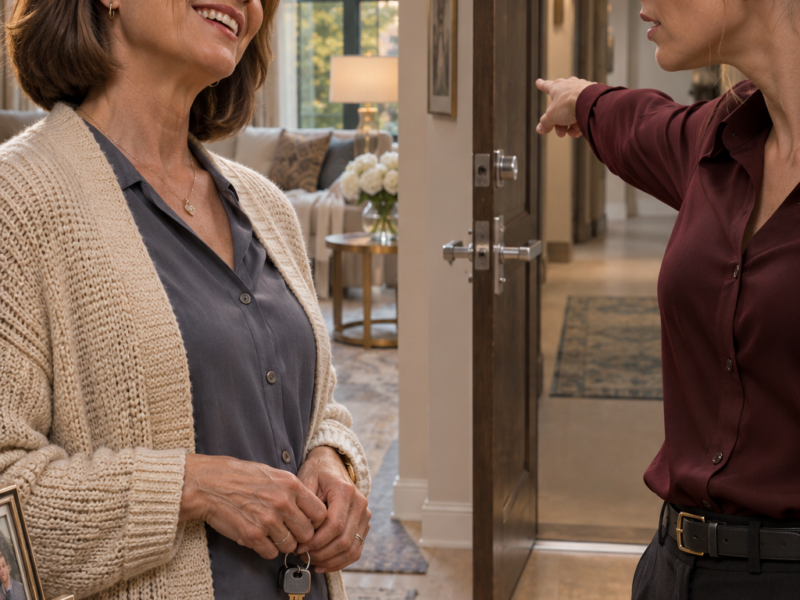
“Pack your bags and get out of this house,” my daughter-in-law said.
She pointed to the charcoal-gray suitcase in the middle of the living room. There was a little strip of my winter coat caught in the zipper. Of all the things I could have looked at just then, that was what caught my eye. Sabrina had gone into my bedroom, taken clothes out of my closet, packed three books from my nightstand, and hauled the suitcase out here for me to find. She had done all that work and still hadn’t noticed the coat caught in the zipper.
My son stood beside her with his arms crossed and a small smile on his face. I waited for him to say something. Even then, I waited.
When he didn’t, I laughed. I laughed so hard I had to take my glasses off and wipe my eyes.
“This is my condo, you fool,” I said when I could finally speak. “You two are the ones who need to leave.”
Twenty minutes later, the doorbell rang. Preston went to answer it. From my chair I could see his face clearly, and I watched that little smile disappear before the man on the other side of the door had said a single word.
My name is Everett Calloway. I was sixty-two years old that November, and for thirty years I had managed properties in Bucks County, Pennsylvania. I had sat across from tenants who couldn’t make rent, contractors who couldn’t account for money, and owners who were certain that an agreement said whatever they needed it to say. I knew how to read a contract. I knew how to keep a record. It took me considerably longer to apply either of those skills to my own son.
Eleanor and I bought the condo nineteen years earlier. It was a third-floor corner unit with three bedrooms and a view of the little park on Whitmore Street. The price was $920,000, a figure we went over so many times at our old kitchen table that I could see the numbers when I closed my eyes. We kept our cars well past the point when either of us enjoyed driving them and made a habit of looking at restaurant menus before going home to cook. The morning the last mortgage payment cleared, Eleanor poured sparkling cider into our good glasses. It was a Thursday. I remember that because I had a meeting at nine and called in late.
“Nobody can take this from us now,” she said.
We had put the deed in my name alone, a decision we made together when we worked out our estate plans. The condo was still ours in all the ways we lived in it. Eleanor picked out the credenza, found the rocking chair at a farmhouse sale, and made me hold a picture against the wall at five different heights before she admitted the first one had been right.
She died of ovarian cancer four years before the afternoon Sabrina told me to leave. For months afterward, I could walk into the living room at a certain hour and expect to see her in the rocking chair. Sometimes I sat there myself with a book open on my lap and read the same paragraph until it got too dark to see.
Preston called on a Tuesday evening. He used the careful voice I remembered from the time he broke a neighbor’s window at eleven and came home carrying the baseball.
The business was in trouble, he said. Suppliers wanted paying. Money that was supposed to come in hadn’t. He and Sabrina needed a place to stay while he got things under control.
“You can have both spare bedrooms,” I told him. “You won’t pay rent. When the business stabilizes, you find your own place. Understood?”
“Of course, Dad. We won’t be long.”
The relief in his voice sounded real. I still think it was.
They arrived on a Saturday in October with two suitcases and three cardboard boxes. I’d met Sabrina only four times. She took my hand in both of hers at the door and thanked me so formally that I told her to call me Everett. For months she kept calling me Mr. Calloway.
Felix Drummond, the building manager, made up two access cards that afternoon and entered them in his operations log. Preston needed separate authorization for parking. I signed it the following week and put the monthly charge on my account. I remember Felix sliding the form back toward himself and checking the date against the calendar on his desk. In eleven years I had never known him to leave a line blank that could be filled in.
Across the hall, my neighbor Mabel Hutchins watched Sabrina carry a box inside. Then she leaned toward me.
“Watch that one, Everett.”
“She’s my son’s wife, Mabel.”
“I can see that.”
She went on to her apartment. I wish I’d asked what she meant. The truth is, I wanted her to be wrong so badly that I was afraid she might have an answer.
For the first several months we got along. We shared the kitchen and mostly ate on our own schedules. Preston repaired a loose cabinet hinge. One cold Sunday we drank coffee at the kitchen table for the better part of an hour, talking a little, sitting quietly a little. It felt like having my boy home. I remember that morning as clearly as I remember what he did later. I’ve needed room for both memories.
In late February my sister, Loretta, called from outside Allentown. She needed knee surgery and had nobody available to stay with her afterward. Loretta would ordinarily drag a broken refrigerator to the curb herself before she asked anyone for help. I told her I’d be there Thursday.
“You don’t have to drop everything,” she said.
“Thursday,” I repeated. “Stop arguing.”
“You sound like Eleanor.”
I had to put the phone down for a second after we hung up.
I spent six weeks keeping track of ice packs and physical therapy appointments and arguing with Loretta about how much soup constituted a meal. Now and then she asked about Preston and Sabrina. I said they were fine. She asked whether I knew they were fine or whether that was the answer that let me finish cooking. I told her the soup was ready.
While I was away, Felix made seven entries in his operations log for large loads taken down in the elevator from the third floor. He had no reason at the time to know whose things were being moved. I had no reason, as far as I knew, to ask. I drove home thinking about sitting in the rocking chair with a cup of tea.
The first thing I saw when I opened the door was Preston and Sabrina’s wedding portrait. It was a large canvas, centered above the credenza. A pale rectangle to one side showed where Eleanor’s photograph had hung. Her paperbacks were gone from the shelf by the window, too. In their place were a ceramic bowl, a plant, and two hardcovers I’d never seen anyone open.
Sabrina came out of the kitchen with a dish towel over her shoulder.
“You’re back early,” she said. “How’s Loretta?”
“Where’s Eleanor’s photograph?”
“We thought we’d freshen things up while you were gone.”
“Where is it?”
“It’s stored safely.”
Preston came down the hall loosening his tie. “Dad, it’s just a photograph.”
I think I could have borne almost anything from him in that moment if he’d looked embarrassed. He sounded as comfortable as if he were telling me we’d run out of milk.
I found the photograph face down in a cardboard box under a folded comforter. There was a scratch along the bottom of the frame. I carried it to my room and sat on the bed with it across my knees. In the picture, Eleanor was thirty-one, wearing a pale blue dress and laughing at something our friend Hal had said a minute before the wedding ceremony. She had no idea the camera was on her. That was what I loved about it. I could still look at it and have the brief, unreasonable feeling that if I turned my head I’d see what had made her laugh.
“What happened to our boy?” I asked her.
Beyond my door, I heard somebody open the refrigerator.
Three days later Sabrina told me she’d ordered food for a dinner party. By the time the guests arrived, she had shifted the couch and pushed Eleanor’s rocking chair into a corner, facing the wall. She suggested I eat in my bedroom. Their friends, she said, might find the living arrangement awkward.
“I’ll be in the living room,” I said.
For a while I was. Then one of Preston’s friends asked who the condo belonged to. I was close enough to answer, but Preston got there first.
“My dad’s retired,” he said. “Sabrina handles the household now.”
At practically the same instant, Sabrina held out the ice bucket and asked me to bring it to the table. Preston had already turned back to his friend. I gave Sabrina the bucket and told her she could carry it herself. Then I went to my room, which was exactly where she’d wanted me all along. I sat by the window listening to them laugh and hated that I’d made it so easy for her.
I kept expecting that one of them would cross a line so obvious that even Preston would have to speak up. Then Sabrina came into my bedroom with a yellow measuring tape. She stretched it along the wall while I was still sitting at my desk with the newspaper open.
“Thirteen feet,” she said. “I thought it might be more.”
She wanted to use the room for Preston’s business. Clients could come in for consultations. I could move into the storage room off the kitchen, which she described as adequate for one person. That room had a window facing the utility corridor and was barely large enough for the things already in it.
I told her no. That afternoon I came back from the pharmacy and found a plastic bin outside my front door. Inside were my dress shirts, trousers, wool coat, and the gray cardigan Eleanor had given me for my fifty-eighth birthday.
I called Mabel before I touched anything. She came out carrying a cup of tea, took one look at the bin, and went back for her phone. She photographed it from three angles, making sure she got the unit number in the pictures.
“Thank you,” I said.
“Thank me by dealing with it.”
I carried my clothes back inside, hung everything where it belonged, and called Dwight Okafor, my accountant of twenty years. He listened as I went through the photograph, the dinner, the measuring tape, and the bin.
“Have they asked you to sign anything?”
“No.”
“Call me when they do.”
Three days later Sabrina brought me a neatly typed household contribution agreement. Groceries, utilities, maintenance, and a charge of $850 for what she called space usage. Altogether, she wanted $1,800 a month. The taxes, association fees, insurance, and basic utilities were already coming out of my account. So was Preston’s parking.
I looked down the table at my son. “Have you read this?”
“It makes sense financially,” he said. “You have your pension. We have a lot of overhead.”
I refused to sign. Dwight told me to keep the document, make copies, and put my title papers somewhere secure. That evening I went downstairs to ask Felix about a notary for a safe-deposit box. I remember standing in the elevator hoping none of my neighbors would get on. I couldn’t have explained what I was doing without saying out loud whom I was doing it because of.
Then I found Eleanor’s walnut clock in a donation bag by the front door. A crack ran diagonally across the glass from the eleven to the four.
Eleanor had spotted that clock in a shop window in Doylestown and stopped so abruptly I walked three steps before I realized she was gone. “That’s us,” she said when I came back. She bought it with cash from her own purse. At our old house on Millbrook Road, Preston stood on a step stool and helped her hang it. On the morning she went to the hospital for the last time, she reached up to set it forward two minutes. I’d been busy checking that we had her insurance card and a sweater. I hadn’t known to pay attention.
I sat down on the entryway floor with the clock in my lap and cried until my knees hurt from staying in the same position. Later, at the kitchen table, Sabrina told me the glass had already been cracked. Preston came in while she was saying it. He saw the clock and then he saw my face. For a second I thought he was going to sit beside me.
“I should get going,” he said. “Bridge traffic.”
I wrapped the clock in a plain white dish towel and carried it four blocks to a repair shop. The man behind the counter put a loupe to his eye and examined the glass. He said it would take six weeks, perhaps longer.
“Take the time you need,” I told him. “I’ll be here.”
Two days later Preston knocked on my bedroom door with a manila folder in his hand. He had prepared a clean, readable account of the business’s debts. The total was $240,000. Supplier credit, equipment financing, and an operating loan. He had found someone who could combine the debts into a single payment, he said. The lender required collateral.
“This unit qualifies,” he told me.
I asked him to say plainly what he wanted. He talked about exploring an option. I told him I had listened while his wife asked me to pay to occupy my own bedroom, and I wanted to hear him say what he was asking for now.
He looked around the room. “One day this place will be mine anyway.”
There it was. He’d said it so quietly that, from the hallway, you probably wouldn’t have heard a thing.
“Get out of my room, Preston.”
After he left I called Dwight. He asked if I had agreed to anything. When I said no, he asked if I thought Preston would have put together those figures without already talking to a broker. I had spent years dealing with people who brought me tidy folders after making decisions they still needed my permission to carry out. I knew the answer before Dwight finished the question.
The next morning Mabel sent me a screenshot of Sabrina’s social media. The caption under the pictures of my living room called it “our home.” A friend had asked whether they still lived with Preston’s father. Sabrina replied that they were finding me a more suitable arrangement. Somewhere smaller, where I’d be more comfortable.
In my email was a message from building management. Somebody had submitted a request to deactivate my owner’s access card and issue two replacements. Felix had put it on hold because he had no authorization from me. Sabrina said she had been trying to streamline things. I declined the request in writing, saved both messages, and called Arthur Pemberton, a property attorney I’d worked with years earlier.
Arthur asked me to bring my documents. He went through the photos, the contribution agreement, and the access request while I sat across from him with my coat still on. He asked about every piece of paper I could remember signing since they moved in. There was a cable upgrade form Sabrina had handed me at the kitchen table. I’d glanced at it and signed. I couldn’t remember where she’d put it afterward. Arthur wrote down the name of the provider and asked for a certified copy of Felix’s log.
“Now,” he said, “tell me what Preston said about the condo. The words he used.”
I repeated them. Saying them in that office was worse than hearing them the first time. At home I’d had the immediate business of getting him out of my room. In Arthur’s office I had to sit still and hear what my son sounded like to somebody who didn’t know him.
Arthur’s inquiries turned up a preliminary application submitted through a broker named Garrett Nussbaum. It identified my condo as collateral. The file contained a purported authorization in my name, even though I had given none. Arthur disputed it with the lender. Dwight assembled a dated timeline, going back over the charges I’d covered, the proposed contribution agreement, and the attempt to cancel my access.
“These are moves, Everett,” he said, turning his monitor toward me.
Seeing the events in rows made me remember how often I’d waited for a fresh explanation. The photograph could have been a mistake. The dinner could have been awkward. The measuring tape could have been Sabrina getting ahead of herself. I had taken each incident on its own because that gave me a way to get through the next meal with my son.
When Sabrina texted me on Wednesday to say they wanted to talk on Saturday afternoon, I told Arthur. We arranged for him to come to the condo at 4:20. I knew they wanted something from me. I didn’t know they planned to send me away with luggage.
At 3:45 that Saturday I opened the door and found the Samsonite on the rug. Eleanor and I had taken it to Portland on our last real vacation. The wheels kept catching on the airport floor because we’d packed too much, and we’d laughed every time one of us nearly ran into the other. I hadn’t used it since.
Sabrina said they’d found a one-bedroom in Jenkintown. There was an elevator and good light. Preston said it would give me room to breathe. Then he put a document on the coffee table. It said I would be relocating voluntarily and giving them ongoing authority to manage the condo.
I left it where he put it.
At four o’clock Sabrina looked at her watch. Then she told me to sign, take whatever else I needed, and get out. That was when I laughed. I’d been bracing for a difficult conversation for days, and here was a woman pointing at my own coat sticking out of my own suitcase, telling me how much space I needed to finish out my life. Behind her was the wall I’d painted. Beside her was the boy I’d taught to ride a bicycle. There was something so absurd about the certainty with which they stood there that, for a moment, laughter was the only response I had.
After I told them they were the ones who needed to leave, Sabrina called the front desk. Felix explained, in the same courteous voice he used to tell people when the recycling would be collected, that building staff couldn’t remove the owner from his home to settle a family dispute.
At 4:17 Preston tried one last time.
“Dad, we can still do this the easy way.”
“Sit down, Preston.”
To my surprise, he did. Three minutes later the doorbell rang.
Arthur walked in carrying a leather document case. He greeted me, introduced himself to Preston and Sabrina, and laid three documents on the table beside the paper they wanted me to sign. The first was a certified copy of the deed. The county records showed me as sole owner, with no recorded lien. The second was the lender’s response. The application was on hold while the lender investigated the disputed authorization. No money had been released and nothing had been recorded against my home.
Sabrina turned on Preston. “You told me he’d agreed.”
“I said he would agree,” Preston answered. “I thought he would.”
I asked who had put my signature on the application. Preston looked at the floor. I could see the muscles in his forearm tighten as he closed his hand.
Arthur let the silence sit for a moment before moving on to the third document. It set out how I could end their permission to live there. I was prepared to give them thirty days to leave voluntarily, he explained. If they stayed beyond that, he would handle the next step through the formal process.
I stood up and walked over to the suitcase. “You packed my bags,” I said. “Now start packing yours.”
That night I hung up my coat and put my books back on the nightstand. In the morning Sabrina brought me coffee and said the pressure of the business had made things get out of hand.
“You sent me the message on Wednesday,” I said. “By Saturday you’d found an apartment, drawn up papers, and packed my bag. Which part happened in the heat of the moment?”
She held her mug against her chest. For a little while I thought she might answer. Then she put it down and left.
A few days later, Preston found me making tomato soup. He sat at the kitchen table and placed both palms flat on it. Three months before he’d ever called to ask for a room, he told me, he’d already spoken to Nussbaum about financing. He’d told him about the condo and sent him ownership information, association records, and photos of papers I’d left on the counter before I went to Loretta’s. He said he hadn’t created the signature or told the broker to falsify anything. He admitted he’d known about the application before the confrontation.
The soup was still on the burner. I turned it off before I answered, because I could hear it beginning to stick to the bottom of the pan.
“Arthur needs every message you exchanged with him,” I said. “Every document you sent. You don’t get to decide which ones matter.”
“I know,” he said. And he turned them over.
One evening Mabel called from across the hall. She’d passed my door while it was ajar and heard Preston and Sabrina arguing. She had forty-three seconds of it on her phone. I listened to Sabrina accuse him of promising I would come around once the groundwork was laid. I heard Preston remind her that she’d said she could manage me. Then Sabrina said, with a kind of wonder that stayed with me, “He had a lawyer waiting.”
I sent the recording to Arthur and let him decide how to handle it. The lender kept the file suspended. Who had actually produced the signature remained an open question. I wanted an answer badly, but I had enough in front of me to decide who would live in my home.
I stopped paying for Preston’s parking and took the cable and streaming accounts back to what I actually used. Then one evening I came down the hall and smelled Eleanor’s pot roast. Sabrina had found the recipe in the kitchen drawer. She’d even brought out the woven placemats Eleanor bought at a craft fair in New Hope. For twenty minutes we ate together, and Preston told a story about a freight mix-up in Scranton that made me laugh with my mouth full.
Before dessert he reached beneath his chair for another document. This one asked me to confirm I’d known about the loan application and had raised no objection.
I folded it back along its crease. “No,” I said. “I won’t sign that for a plate of pot roast.”
Arthur added it to the lender’s file. I delivered the written notices, with copies sent by certified mail, and hung Eleanor’s photograph back above the credenza. Preston saw it that afternoon on his way out. He stood in the doorway with his keys in his hand and asked when I’d put it back.
“The day after you tried to take my home,” I said.
He looked at his mother for a long time. Then he nodded and went back down the hall.
They began looking at apartments. From my desk one afternoon I heard Sabrina complain that one kitchen faced a brick wall and another apartment had a bedroom the size of their bathroom. Preston told her the place with the good light was eight hundred dollars a month beyond what they could afford. When she insisted they needed more space, he said, “You stood in my father’s bedroom with a measuring tape and told him how much room one person needed.”
I heard a cabinet close. Then the tap ran for a few seconds. I went back to the statement I’d been reading.
When the repair shop called, I walked over in the cold and brought Eleanor’s clock home in both hands. The repairman had cut new glass and replaced a worn gear. I put it back above the credenza, to the left of the photograph, and stood there listening to it tick.
Preston found me in the living room.
“She let me hold the level,” he said. “When we hung it on Millbrook Road. I was nine.”
“I remember.”
He told me he’d found an accountant in Jenkintown. They were negotiating a payment schedule, scaling back the business, and selling the work truck. Getting things stable would take twelve to eighteen months. He said he should have done it a year earlier.
“Yes,” I said. “You should have.”
Then he said he was sorry. His voice faltered when he got to the part about standing there while Sabrina ordered me out.
“Are you sorry you hurt me,” I asked, “or are you sorry the loan didn’t go through?”
“Both,” he said. “At first, mostly the loan. Then I stood outside your door one night and couldn’t make myself knock. I knew what I’d done. I just didn’t know how to say it to you.”
I had been waiting a long time to hear him say something I could believe. That answer hurt, and I believed it.
“I hear you,” I said. “Trust is going to take longer.”
“I know.”
On their last morning, Felix came up with the departure paperwork. They signed it, returned their cards, and got receipts. I stayed in my room while the boxes went down in the elevator. Shortly before one, I came out and saw Sabrina crossing the living room with the same burgundy suitcase she’d brought fourteen months earlier. She paused on the rug where mine had been.
“Are you happy now?” she asked.
“I wanted to be treated with respect in my own home, Sabrina.”
She looked at me a moment. Then she picked up the suitcase and went out.
Preston came back to give me the keys. They were still on the ring I’d handed him the day he moved in. He thanked me for the room and the time I’d given him. He started to say something else, stopped, and put the keys in my palm.
“Get yourself somewhere good, Preston,” I said.
After he left, I had the lock changed and called Loretta. All I said was, “It’s done.” I heard her let out a breath, the same long breath she’d let out when I told her I’d come on Thursday. Then she asked if I’d eaten. I told her I was about to make something.
Instead, I took my tea to the rocking chair. Across the room Eleanor was laughing in her pale blue dress. Outside, two pigeons occupied the park bench until one of them flew off and the other shuffled into the space it had left. I watched the last of the light move across the floor. The clock was a little louder than I remembered, or perhaps the room was finally quiet enough for me to hear it.