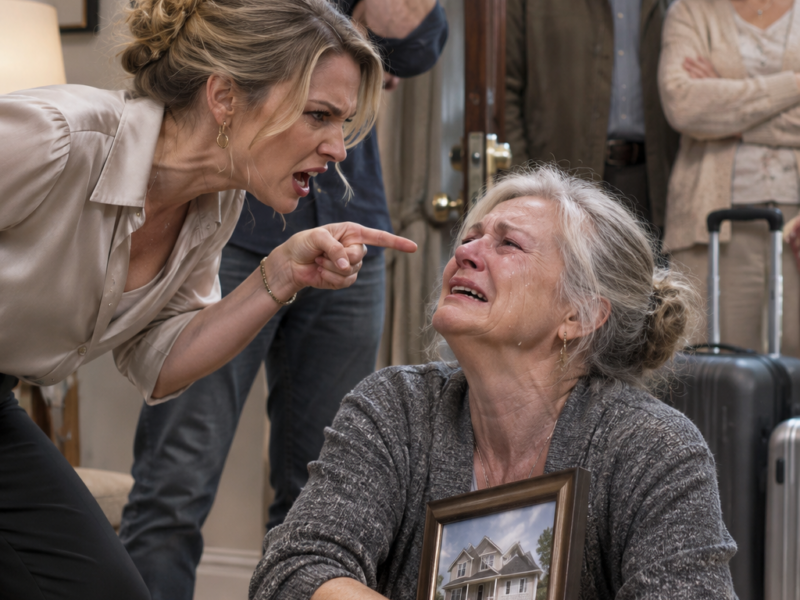
My Daughter-In-Law Gave Me a Move-In Date for Her Parents, So I Quietly Prepared…
My Daughter-In-Law Gave Me a Move-In Date for Her Parents, So I Quietly Prepared…
The first time my daughter-in-law told me I was too old to understand what was happening on my own property, I nearly laughed. The second time, I realized she wasn’t joking. And twelve days later, when a twenty-six-foot moving truck came rolling down my private gravel lane with her parents’ furniture packed inside, I was sitting in a folding chair beside a six-foot-deep trench, drinking coffee while a sheriff’s deputy waited just beyond the trees.
I had spent thirty-seven years making my living by moving earth. I knew how to dig foundations, redirect water, build roads, and make a piece of land do exactly what it was supposed to do. But until that autumn, I never imagined those skills would become the difference between keeping my home and losing everything my wife and I had spent our lives building.
My name is Duncan Hawkins. I was seventy-four years old when all this happened, and for most of my adult life, I owned an excavation company in Northern Virginia. I started with borrowed boots and a job driving a dump truck when I was seventeen. By the time I retired, Hawkins Grading and Excavation employed forty men and handled contracts worth millions of dollars.
My first boss used to tell me that dirt never lied. You could argue with a customer, challenge an engineer, or negotiate with a developer, but the ground always told the truth. Dig in the wrong place, and eventually something would collapse. Ignore a warning sign, and sooner or later you would pay for it.
I learned that lesson early.
Unfortunately, it took me another fifty years to understand that the same principle applied to family.
My wife, Annabelle, and I were married for forty-six years. She was everything I wasn’t. Where I was impatient, she was gentle. Where I saw a hillside and calculated how many truckloads of earth would need moving, she saw the colors changing across the mountains.
Annabelle was a painter, and a wonderful one, although she would have been embarrassed to hear me say it.
Ten years before everything happened, we sold our house in Fairfax County and purchased nine acres in Virginia’s Shenandoah Valley. We paid cash. No mortgage, no partners, no complicated ownership arrangements. The deed carried my name alone.
The property had a beautiful timber-frame house, a large barn, and a small fieldstone workshop about two hundred yards down a private gravel lane.
The first time Annabelle stepped inside that neglected workshop, she stopped beneath the tall north-facing windows and looked upward.
“Duncan,” she whispered, “look at that light.”
That was all she needed to say.
Over the following months, I restored the building for her. I hired masons to repair the stonework, replaced damaged flooring with wide pine boards, repaired the roof, and built a wall of cedar bookshelves from a tree that had fallen during a storm.
When it was finished, Annabelle stood in the doorway with tears in her eyes.
“You built me a little piece of heaven,” she said.
And for the next several years, that was exactly what it became.
She painted the river in morning mist, the changing leaves along the mountain ridges, and the blackberry bushes growing behind our barn. Sometimes she would work for hours without noticing the time. Other afternoons, particularly after her heart began to fail, she could barely manage thirty minutes at her easel.
During those last years, I often walked her down the gravel lane, carrying her supplies while she held my arm. Then I would sit outside with my coffee and listen to her describe the light.
She could make an ordinary puddle sound like a miracle.
Before she died, there were two things I had promised her.
The first was a cedar bench beneath the studio window. I had finished the frame and most of the seat, but three slats remained missing when she went into the hospital.
The second was a little stream beside the cottage.
One September evening, while we watched mist settle over the mountains, she told me she wished she could hear running water while she painted.
“Next spring,” I promised.
She squeezed my hand.
There was no next spring for Annabelle.
She died that winter, and when I returned home from the hospital, I put my woodworking tools away. I couldn’t bring myself to finish the bench. I couldn’t bring myself to move her paintings.
For three years, the stone cottage remained almost exactly as she had left it.
Some people called that unhealthy.
I called it remembering.
We had two children. Our daughter, Allison, was a nurse in Winchester. She lived nearby with her husband, Aaron, and their two children, Jack and Mia. They visited often, brought groceries when they thought I needed them, and never treated my age as an illness.
Our son, Cameron, was forty-one. He worked in logistics and lived in a large house in Ashburn with his wife, Danielle.
Cameron had once been a sweet boy. He loved riding beside me in my dump truck, asking questions about bulldozers, and bringing home stray animals he hoped his mother would let him keep.
I paid for his college education, helped him buy his first house, and did everything I knew how to do to give him a better start than I had.
But somewhere during his marriage, Cameron changed.
He stopped speaking freely. He began apologizing for things that didn’t require apologies. And whenever Danielle was present, he watched her face before answering even the simplest question.
I noticed.
I just didn’t want to admit what it meant.
Then came that Monday morning.
I was sitting on my porch with black coffee, watching the fog lift from the mountains, when my phone rang.
Danielle.
She never called simply to ask how I was doing.
“Good morning, Danielle,” I answered. “Is Cameron all right?”
“I didn’t call to chat, Duncan.”
Her tone was sharp enough to cut rope.
“I’m letting you know that my parents are moving into the stone cottage on the fifteenth. That gives you twelve days to clear out whatever’s inside. The moving truck will arrive at nine in the morning, so make sure the driveway is accessible.”
For several seconds, I thought I had misunderstood her.
“Your parents are doing what?”
“They sold their house in New Jersey. They’re retiring, and Cameron and I decided your cottage is the perfect place for them.”
“You decided?”
“Duncan, you’re seventy-four years old. You’re living alone on nine acres with more space than any one person needs. That cottage has been sitting empty for years. It’s selfish to let it go to waste.”
I carefully set down my coffee.
“Danielle, your parents are not moving into Annabelle’s studio.”
She laughed.
Not a nervous little laugh, either.
It was the kind of laugh people use when they believe someone else has no power to stop them.
“Oh, Duncan, please. Cameron already gave my father the spare key. The movers are booked, and my parents have nowhere else to go. This isn’t really up for discussion.”
I felt something cold settle beneath my ribs.
“Cameron gave him a key?”
“He took it from your kitchen during Thanksgiving. Honestly, you should be grateful we’re handling this. That property will belong to Cameron eventually anyway.”
I stood so suddenly that my knees protested.
“Listen carefully. I own this property. Your parents have no permission to enter it, much less live here. Tell them to cancel the truck.”
“Stop being difficult, old man.”
Then she hung up.
I stood motionless, listening to the wind move through the oak trees.
Old man.
That was what she called me.
Not Duncan. Not Dad. Not even Mr. Hawkins.
Just an old man occupying space she had already decided belonged to somebody else.
I called Cameron immediately.
He answered on the fourth ring, and I could tell from the echo that I was on speakerphone.
“Your wife just informed me that her parents are moving into your mother’s studio,” I said. “She also claims you stole the spare key from my kitchen. Tell me she is lying.”
He sighed.
“Dad, nobody stole anything. I took a spare key because you’re getting older and someone needs access in an emergency.”
“And gave it to your father-in-law?”
“We agreed it would make sense for them to live there.”
“Who agreed?”
“Danielle and me.”
“Not the owner?”
“Dad, please don’t make a scene.”
Those words would come back to me many times.
Please don’t make a scene.
They sounded reasonable until you understood what they really meant.
Don’t embarrass the people mistreating you.
Don’t make the consequences uncomfortable for anyone except yourself.
I reminded Cameron that the building was his mother’s studio, not a guesthouse. I explained that it wasn’t even approved for residential occupancy.
He called me stingy.
That hurt more than Danielle’s insults.
Two years earlier, Cameron had come to my house in tears. Danielle’s spending had pushed them into serious debt, and he feared their financial problems would cost him his job.
I had withdrawn $185,000 from my retirement savings to rescue them.
Both Cameron and Danielle signed a written agreement promising repayment.
Twenty-six months later, they hadn’t paid back one dollar.
But when I reminded him of that, Cameron dismissed the money as something I had “helped them with once.”
I asked why Danielle’s parents couldn’t live in their five-bedroom house.
He explained that they needed the guest rooms for a home office, exercise equipment, and Danielle’s design business.
Then Burton Lombardi, Danielle’s father, grabbed the phone.
“Duncan, quit making trouble. My leather sectional is being delivered to that cottage, and I expect those dusty paintings out of the way before we arrive.”
I felt my jaw tighten.
“And who gave you permission to remove my wife’s paintings?”
“You don’t need to cling to dead people’s belongings forever,” Burton barked.
Cameron said nothing.
Then the call ended.
I stood in my kitchen looking at the empty peg where the cottage key used to hang.
That was the moment I understood I wasn’t dealing with a misunderstanding.
They had made plans.
They had spent money.
And they believed my objections were irrelevant.
I didn’t know then how far those plans actually went.
The following afternoon, I heard an engine roaring down my driveway. Looking through the kitchen window, I saw Danielle’s black BMW heading straight toward the cottage.
She had told Cameron they would visit Saturday.
It was Tuesday.
I pulled on my work boots and hurried down the lane.
The cottage door stood open.
Inside, Danielle and her mother, Dolores, were measuring the stone fireplace.
My wife’s paintings were stacked on the floor.
One of the heavy frames had been placed against Annabelle’s final canvas, leaving a dent in the linen.
Her cedar bench had been dragged into a corner and covered with packing material.
Danielle was explaining how removing the bookshelves would create enough space for a television and wet bar.
I stepped into the room.
“Those shelves took me three weeks to build.”
Both women jumped.
Danielle turned, annoyed.
“Good Lord, Duncan! You nearly gave us a heart attack.”
I ignored her and knelt beside the paintings.
I lifted the heavy frame away from Annabelle’s last canvas. Fortunately, the paint hadn’t cracked.
For a moment, I remained there with the painting in my hands.
I remembered watching Annabelle work on it.
She had been terribly tired that afternoon, but when the sun reached the blackberries outside, she insisted on finishing the colors.
Now strangers were treating that memory like garbage.
“Who gave you permission to touch these?” I asked.
Dolores rolled her eyes.
“We’re helping you clean up. Honestly, keeping all these amateur paintings around is rather morbid.”
I rose slowly.
“Get out.”
Danielle stared at me.
“Excuse me?”
“You heard me. Get out of my wife’s studio.”
She began arguing about furniture deliveries, contractors, and money already spent.
I walked to the doorway and held it open.
“You have two minutes to leave before I call the sheriff.”
For once, neither woman knew what to say.
Danielle finally snatched up her handbag and marched outside, with Dolores following.
They drove off in a cloud of gravel dust.
Only then did I notice the blue folder lying beneath some design catalogs on Annabelle’s worktable.
Inside was a remodeling contract.
The total was $54,000.
An $18,000 deposit had already been paid.
The listed work included demolition of the cedar bookshelves, removal of the pine flooring, alteration of an interior wall, and installation of a wet bar.
The demolition crew was scheduled to begin two days after Danielle’s parents arrived.
Then I saw the signatures.
Danielle had signed as the client.
Cameron had signed as the owner’s authorized representative.
Beside his name were the words:
Agent under pending durable power of attorney for Duncan Hawkins.
I read that sentence three times.
I had never granted Cameron power of attorney.
I had never discussed granting it.
And I certainly hadn’t agreed to let him demolish his mother’s studio.
Behind the contract was an email exchange with a property appraiser.
Danielle was requesting an appraisal of my entire nine-acre estate, explaining that I was supposedly transitioning out of managing the property because of my age.
The proposed financing involved a bridge loan.
Suddenly, the cottage wasn’t the only thing they wanted.
I called Larry Swanson, the remodeling contractor.
Larry and I had known each other for twenty years.
When I asked about the contract, he sounded genuinely surprised.
“Duncan, Cameron and Danielle told me your health had deteriorated. They said you were moving into assisted living and Cameron was taking over the property.”
I closed my eyes.
“Larry, I worked on my tractor yesterday.”
There was a long silence.
“They told me the power of attorney was being finalized,” he admitted.
“It doesn’t exist.”
Larry apologized immediately and agreed not to begin work. He also offered to provide a written account of what Cameron and Danielle had told him.
I thanked him and photographed every page in the folder.
Then I called Cameron.
When I mentioned Larry’s name, my son hesitated.
Only briefly.
Then he said the contractor was merely coming to inspect the plumbing.
“A few leaky washers,” he explained.
I looked down at the $54,000 contract.
“Of course,” I said.
And I ended the call.
That evening, Allison called from the hospital.
She sounded frightened.
“Dad, Cameron has been trying to request your medical records.”
She explained that he had identified himself as my pending healthcare representative and claimed I was showing signs of cognitive decline.
According to the request, I had become confused, forgetful, and increasingly aggressive toward family members.
He even claimed I had been wandering into the woods at night.
I listened without interrupting.
By now, I could see the outline of the entire operation.
They weren’t merely planning to occupy my cottage.
They were preparing to portray me as incapable of managing my own affairs.
If they could persuade me to sign documents—or convince someone else that I needed a legal representative—they might gain control of everything.
I asked Allison to help me secure my medical records through the proper hospital procedures. Then I asked her husband to check the public property records.
Aaron called that evening.
There was no recorded power of attorney.
There was, however, a lender’s title inquiry involving my property.
And Cameron had contacted the county about converting the cottage into a rental.
A few minutes later, I checked my mailbox and found a thick envelope from a lending company.
Inside was a notice concerning a proposed $650,000 loan.
The borrowers were Cameron and Danielle.
The collateral was my property.
My entire property.
The estimated value was listed at $1.45 million.
I stood beneath the mailbox light with that letter trembling in my hand.
For decades, I had built roads and foundations so other people could have homes.
Now my own son was attempting to turn my home into collateral for his debts.
The financing depended on paperwork establishing legal authority over my property.
And the proposed closing date was only days away.
That night, Cameron sent me a text inviting me to dinner on Sunday.
He said he was sorry about the arguments.
He said he missed me.
For a moment, I wanted to believe him.
I remembered the little boy who used to fall asleep against my shoulder in the dump truck.
Then I remembered his signature beneath that false claim of authority.
I replied that I would come.
And I promised to bring blackberry cobbler.
What Cameron didn’t know was that I intended to find out exactly what he and Danielle were planning.
Before that dinner, I purchased a small voice recorder. I also spoke with someone knowledgeable about Virginia recording laws, because I wasn’t about to jeopardize my position by collecting evidence carelessly.
On Sunday, Allison drove me to Ashburn.
I arrived in the neighborhood well before dinner.
While walking along the public greenbelt behind the houses, I heard voices coming from Cameron’s backyard.
The fence was high, but the people beyond it were speaking loudly.
I recognized Burton first.
He was laughing about the “old fossil” who would arrive for dinner carrying dessert.
Then Danielle began discussing documents.
Four pages would appear to describe a property-tax relief program for seniors.
A fifth page, she explained, would be a quitclaim deed.
They intended to persuade me to sign it without realizing what I was transferring.
A notary named Euphemia was supposedly coming to witness the signatures.
Burton had contributed $150,000 toward the arrangement.
In return, he expected the cottage and three acres of land.
The rest of the property would be transferred into a company controlled by Cameron and Danielle.
Then they would secure the loan, repay their debts, and eventually sell the main house.
I stood motionless as Danielle explained where I would go.
An assisted-living facility near Winchester.
She had already investigated arrangements.
“He’s seventy-four,” she said. “He’s had his life. It’s time someone else got to enjoy that property.”
Those words hurt more than anything else.
Not because they came from Danielle.
Because Cameron was part of the plan.
I returned to Allison’s car without speaking.
She looked at me and knew immediately that something was wrong.
“Dad?”
I stared through the windshield.
“They’re going to try to take the house,” I said. “All of it.”
She reached for my hand.
“We can leave.”
“No,” I answered. “I’m going to dinner.”
At a quarter to five, I walked up Cameron’s driveway with the blackberry cobbler.
My son opened the door with a broad smile.
He hugged me.
And God help me, for one terrible second, I felt like I had my boy back.
The dining room was beautifully arranged. Candles flickered on the table. Burton poured wine, Dolores asked about my health, and Danielle apologized for being so forceful.
A woman named Euphemia sat nearby with a leather document case.
Everyone was remarkably pleasant.
Too pleasant.
I played my part.
I admitted I had been lonely. I said perhaps I had grown overly attached to Annabelle’s belongings. I even suggested that maybe I had been unreasonable about the cottage.
Danielle visibly relaxed.
After dinner, she placed a folder in front of me.
“Duncan, there’s just one little thing we should take care of.”
She explained that I qualified for a special property-tax benefit.
A few signatures, she promised, and everything would be handled.
She handed me an expensive gold pen.
I turned over the pages slowly.
Dense language covered the first four.
The fifth was attached behind them.
“Let me get my glasses,” I said.
Cameron leaned closer.
“Dad, please don’t make a scene.”
There it was again.
The same sentence.
The same tone.
The same attempt to make obedience sound like family peace.
I looked at my son.
Then I reached for my water glass.
And accidentally—at least as far as everyone else could tell—knocked it across the table.
Ice water flooded the paperwork.
Danielle shrieked.
Burton grabbed napkins.
Dolores lifted the documents, but the ink was already spreading.
I apologized repeatedly.
Then I offered what sounded like a reasonable solution.
“Bring me fresh copies on the fifteenth. I’ll read everything carefully, and we’ll sign them when your parents arrive.”
Danielle considered this.
A moving truck full of furniture, her family gathered around me, and another opportunity to pressure an elderly widower into signing paperwork.
She smiled.
“That sounds perfect.”
I smiled back.
But when I left that house, I wasn’t going home to surrender.
I was going home to prepare.
The next morning, I met Abigail Larson, an attorney in Harrisonburg whom Aaron trusted.
She was a small, silver-haired woman with sharp eyes and the quiet manner of somebody who had spent years listening to people lie.
I laid everything before her.
The remodeling contract.
The lender’s notice.
The medical-record request.
The proposed transfer documents.
The accounts of the conversations I had heard.
And the financial records showing the money I had already lent Cameron.
Abigail studied everything carefully.
Then she leaned back.
“Mr. Hawkins, this is far beyond a family disagreement.”
She explained that the attempted property transfer, the false statements concerning my health, and the financing arrangements raised serious concerns about fraud and financial exploitation.
She also warned me that suspected criminal conduct needed to be handled by the proper authorities, not by threats or private bargains.
I told her I didn’t want to see my son go to prison.
She looked at me for a long moment.
“Then we’ll focus on protecting you and the property first. But you must understand that you cannot control every consequence of what they’ve done.”
We arranged appropriate estate protections, reviewed the deed, prepared formal objections to any unauthorized transfer, and notified the lender that Cameron possessed no authority to pledge my land.
I updated my estate plan to place Allison in a position of responsibility and ensure that neither Cameron nor Danielle could use assumptions about inheritance to interfere with my affairs.
I also asked my doctor for a thorough cognitive evaluation.
There was nothing particularly enjoyable about spending an afternoon answering memory questions, drawing clocks, and solving puzzles.
But the physicians documented that I was capable of making my own decisions.
I made certified copies of those records.
Abigail then helped me report the situation to the sheriff’s office.
Deputy Alan Hooper listened patiently while I explained that people who had been expressly denied permission to occupy my property still intended to arrive with a moving truck.
He could not arrest anyone merely because I suspected future misconduct.
But he could document the situation and respond if a disturbance occurred.
“Mr. Hawkins,” he said, “if they show up and refuse to leave, call us. Don’t get into a fight with them.”
“I don’t intend to.”
He studied my expression.
“Something tells me you’ve already made a plan.”
I smiled slightly.
“I’ve been working on one.”
What I did next required something I understood better than almost anything else.
The ground.
I had been considering improving the drainage near the cottage for years.
Part of the private lane crossed an area where runoff collected after heavy storms. The surrounding ground had always been troublesome, and a proper drainage improvement had been on my list long before Danielle announced her parents’ arrival.
Now I had a very good reason to stop postponing it.
Working with the county, I arranged the necessary permissions and confirmed the limits of the project. Aaron helped me understand the relevant building records, but I made sure the official approvals went through the proper channels.
The cottage was still classified as a nonresidential building.
No one had obtained approval to convert it into a dwelling.
That fact alone was enough to defeat Danielle’s claim that her parents could simply move in.
But I also needed to control access while protecting everyone from an unsafe work area.
So I called an old friend.
Shep Dodson had operated heavy equipment for me for more than twenty years. At sixty-eight, he was still built like a tree stump, with enormous hands and the permanently skeptical expression of a man who had seen every bad construction idea imaginable.
He arrived with a backhoe early Wednesday morning.
I showed him the approved excavation area near the narrowest section of the private lane.
He studied the ground.
Then he studied me.
“Duncan, that’s going to make it mighty hard for anyone to reach that cottage in a truck.”
“That’s what happens when a private road is closed for drainage work.”
Shep grinned.
“You always did have good timing.”
We checked the utility locations, marked the excavation, arranged the required safety measures, and began work.
The first bite of the backhoe into the clay brought back memories I hadn’t felt in years.
The engine growled.
The bucket lifted.
Red earth spilled onto the designated spoil area.
For the first time since Annabelle died, I felt the familiar satisfaction of building something with my hands and judgment.
By Thursday afternoon, the excavation crossed the access lane. It was roughly six feet deep in its deepest section, ten feet wide, and extended across the approach.
We installed visible barricades, warning signs, and temporary fencing so no driver could accidentally enter the work area.
The route was clearly closed.
No vehicle could legally or safely pass until the work was complete.
As we inspected the excavation, Shep noticed moisture seeping from a layer of shale.
“Look at that,” he said.
Water was slowly collecting along the bottom.
I assumed it was ordinary groundwater.
Shep wasn’t convinced.
“That’s got a steady flow to it.”
I told him we’d inspect it again after the weather settled.
Neither of us knew how important that little trickle would eventually become.
That evening, Danielle sent me a message.
Truck confirmed. Nine sharp tomorrow. Please make sure the gravel lane is clear.
I looked out toward the barricades and the fresh excavation.
Then I typed:
I’ll be here.
On Friday morning, I woke before sunrise.
I made coffee and stood in the kitchen while the mountains slowly emerged from the darkness.
There was something strange about how peaceful the property looked.
A few birds moved through the trees.
Mist settled over the grass.
Annabelle’s studio stood in the distance, its stone walls glowing faintly as the first light touched them.
I whispered her name.
“I wish you were here.”
Then I corrected myself.
“No. I’m glad you don’t have to see this.”
Allison and Aaron arrived shortly before eight.
Shep came a little later.
I had arranged for everyone to remain clear of the excavation and for the authorities to be available if the situation became confrontational.
I carried a folding chair to a safe spot near the closed lane.
And I waited.
At eight fifty-five, I heard engines.
First came Danielle’s black BMW.
Behind it rolled a silver Buick with New Jersey plates.
And behind that, lumbering along my gravel road, came a twenty-six-foot moving truck.
They drove past the main house without stopping.
Not one of them came to ask permission.
Not one of them approached my front porch.
They simply headed toward the cottage as though every objection I had made was already forgotten.
Then Danielle rounded the bend.
Her brake lights flashed.
The BMW stopped abruptly before the warning barricades.
The Buick halted behind it.
The moving truck stopped last.
For several seconds, nothing happened.
Then Danielle climbed out.
She took off her sunglasses and stared at the excavation.
“What the hell is this?”
I raised my coffee cup.
“Good morning, Danielle.”
“What did you do to the driveway?”
“Drainage improvements.”
“You destroyed the road!”
“I closed part of my private lane for permitted work.”
“You knew we were coming!”
“Yes,” I said. “I did.”
Cameron got out of the passenger seat.
He looked from the barricades to the cottage.
“Dad, this is insane.”
“Is it?”
Burton climbed out of the Buick, red-faced and furious.
He approached the barriers and demanded that the moving crew find some way to cross.
The crew chief took one look at the excavation and refused.
“Sir, we’re not driving a loaded truck through an active construction site.”
Burton waved his arms.
“I’m paying you!”
“You’re paying us to move furniture,” the man answered. “Not to destroy a truck.”
Then Burton shouted something that made everyone go quiet.
“I’ve got a hundred and fifty thousand dollars tied up in that cottage!”
Danielle spun toward him.
“Dad, stop talking!”
I put down my coffee.
“That’s a curious amount of money, Burton. Why would you have that much invested in a building you don’t own?”
He stepped toward me angrily.
Before he got close, Aaron approached from the county vehicle parked farther up the property.
He had documentation confirming the cottage’s approved use and explained that it was not authorized for residential occupancy.
Danielle immediately accused him of favoritism because he was my son-in-law.
Aaron remained professional.
“The records are available through the county. Mr. Hawkins is the owner. No approved residential conversion exists.”
Danielle pulled out her phone.
“Fine. I’m calling the police.”
She told the dispatcher that I was confused, dangerous, and suffering from dementia.
I listened.
So did Cameron.
He looked at the ground.
He knew those claims were false.
And still he said nothing.
When Deputy Hooper arrived, he reviewed the situation, spoke to the parties, and reminded everyone that the property was privately owned and the access road was closed for authorized work.
Danielle tried to insist that her family’s arrangements gave them some right to occupy the cottage.
The deputy asked whether she had written permission from the owner.
She had none.
Then I took a folder from my chair.
“Danielle,” I said, “before you say anything else, I think there are a few matters we should discuss.”
I showed her the contractor’s paperwork.
I showed her copies of the lender’s notice.
And I explained that I knew about the proposed deed transfer, the financing company, the assisted-living arrangements, and the money Burton had contributed.
The color drained from her face.
“Where did you get those?”
“Some of them were left in my wife’s studio. Others were sent to me because I am the legal owner of this land.”
I looked at Cameron.
“Did you really believe I wouldn’t find out?”
He didn’t answer.
“Did you think I was so old that I wouldn’t understand what you were doing?”
His jaw tightened.
“Dad, it wasn’t supposed to happen like this.”
“Then tell me how it was supposed to happen.”
Silence.
I waited.
He looked at Danielle.
She glared back at him.
And suddenly, for the first time in years, I saw my son understand that his wife couldn’t rescue him from the consequences of his own choices.
Dolores stepped forward.
She looked shaken.
“Danielle told us Duncan had agreed,” she said.
Burton tried to interrupt.
But she continued.
“She said the property was being transferred and that Duncan wanted to move into a retirement community. She told us the cottage was ours.”
Danielle’s mouth fell open.
“Mom!”
“You said he had signed!”
“No, I said the paperwork was being finalized.”
“You made us believe everything was settled!”
Dolores turned toward me.
For the first time since I’d known her, she didn’t look superior or irritated.
She looked frightened.
“I didn’t know you hadn’t agreed.”
I couldn’t tell how much of that was true.
She had certainly heard me refuse during our earlier confrontations.
But I also knew Danielle had a gift for telling different versions of the same story to different people.
Burton began shouting again.
He blamed Danielle, then Cameron, then me.
At one point he took an angry step toward his son-in-law, and Deputy Hooper moved between them.
“Sir, step back.”
Burton stopped.
Cameron stood beside the BMW, his face pale.
I looked at him.
“Son, your mother spent her last healthy years in that cottage. I built it for her. And you were willing to let strangers tear it apart so you could borrow money against my land.”
His eyes filled.
“Dad—”
“No. You can explain it to the lawyer.”
The moving crew chief eventually approached with his clipboard.
He politely informed Danielle that the truck couldn’t complete the delivery and that charges for the unsuccessful trip were still due.
She paid.
Then the convoy began its slow retreat.
The truck backed carefully up the lane.
The Buick turned around near the entrance.
The BMW left last.
As Cameron passed me, he looked through the passenger window.
For a moment, I saw the little boy I used to know.
Then the car disappeared.
And the valley was quiet again.
I expected to feel triumphant.
Instead, I sat beside the barricades and stared at the cottage.
I had saved the property.
But I had lost something, too.
That evening, my phone rang forty-seven times.
Most of the calls came from Cameron.
I answered none of them.
The following morning, he called again.
This time, I picked up.
“Dad, please don’t hang up.”
His voice sounded exhausted.
He told me Danielle had thrown him out of the house after an argument about the failed loan. He was staying in a motel and didn’t know what to do.
Then he asked why one of his credit cards had stopped working.
I explained that it had been a supplemental card attached to an account in my name.
I had closed it.
I had also arranged to end the additional financial assistance and insurance support I’d been providing, with the required notices and safeguards.
And Abigail had begun the proper legal process to recover the $185,000 loan.
Cameron was silent.
Finally, he whispered, “Dad, I thought you’d always help us.”
“I did help you, son. For years.”
“I know.”
“No,” I answered. “I don’t believe you do.”
I told him he needed to meet with Abigail and obtain his own legal advice.
He agreed.
Over the following weeks, the financial situation became impossible for Cameron and Danielle to ignore.
The proposed bridge loan collapsed after the lender received evidence disputing their authority over my property.
The remodeling project was canceled.
Their debts remained.
And without access to my accounts, they could no longer pretend those debts would somehow disappear.
At Abigail’s office, I presented a ledger showing the assistance I’d provided over the previous decade.
Money for Danielle’s design business.
Help with the Ashburn house.
The $185,000 emergency loan.
Credit-card charges.
Insurance premiums.
The total exceeded $370,000.
Danielle stared at the figures.
“I didn’t realize—”
“You realized enough to accept every dollar,” I replied.
Cameron covered his face.
It was the first time I had ever seen him look truly ashamed.
Abigail explained that civil repayment arrangements could be negotiated, while any allegations of criminal wrongdoing would remain a matter for the authorities to assess independently.
I wasn’t interested in threatening anyone into an illegal agreement.
I wanted my property protected, unauthorized transactions stopped, and the money Cameron had formally borrowed addressed through the proper channels.
With legal advice on both sides, Cameron and Danielle eventually reached a repayment settlement.
They surrendered the BMW lease.
They sold their large house in Ashburn.
After the mortgage, transaction expenses, and other obligations were handled, I received repayment of the documented loan.
Whatever remained of their finances was theirs to manage.
That was important to me.
I didn’t want to own my son’s future.
I simply refused to finance his dishonesty any longer.
By winter, Cameron, Danielle, Burton, and Dolores were sharing a cramped apartment in Manassas.
The arrangement was miserable.
Burton complained constantly about the temperature, the neighborhood, and the lack of space.
Dolores argued with Danielle over money.
Cameron slept on a sofa bed.
Danielle took a retail job and hated every minute of it.
Allison occasionally heard news through Cameron, but I didn’t ask her to spy on anyone.
I was trying to learn how to live without measuring each day by the disasters happening in my son’s marriage.
Eventually, Danielle lost her job.
Then she left.
Cameron returned home one morning and found divorce paperwork on the kitchen counter, along with evidence that she had arranged to move to Miami.
Her parents left soon afterward to stay with relatives in Delaware.
For the first time in years, Cameron found himself alone.
And this time, I didn’t send money.
That was harder than I can explain.
There were nights when I stood by my kitchen window, staring down the lane, wanting to pick up the phone and tell him to come home.
But I remembered how easily he had accepted my money.
How little responsibility he had taken.
How readily he had sacrificed my peace to preserve his own comfort.
I loved him.
I just couldn’t keep confusing love with rescue.
Meanwhile, something unexpected was happening beside the cottage.
The water in the excavation hadn’t disappeared.
Through autumn and winter, a small but steady flow continued to emerge from the shale beneath the ground.
Shep came out one morning to examine it.
He stood there with his cap pushed back, listening.
“Duncan,” he finally said, “I don’t think that’s just trapped groundwater.”
We investigated properly, with the help of people who understood drainage and groundwater conditions.
The flow appeared to be a natural spring that had been diverted or obstructed by old drainage work decades earlier.
I remembered the iron pipe we had discovered beneath the lane.
And then I remembered Annabelle.
I’d love a little creek down by the studio.
For a long time, I couldn’t speak.
Shep looked at me.
“You all right, boss?”
I nodded.
“There’s something I promised my wife.”
That spring, we began turning the drainage improvement into something beautiful.
We had the necessary design and safety work completed, reshaped the excavation into stable, gentle slopes, and created a controlled channel for the spring water.
Shep handled the heavy equipment.
Aaron helped coordinate the appropriate inspections.
Two young apprentices assisted with the stonework.
We built three small cascades from fieldstone gathered around the property.
Then we constructed a white-oak footbridge across the stream.
The first time water flowed cleanly over those stones, I stood beside the cottage and listened.
It wasn’t loud.
Just a gentle, constant sound.
Water finding its way around rocks.
The very sound Annabelle had asked for.
I sat on the studio steps with tears running down my face.
“I’m late, sweetheart,” I whispered. “But I finally did it.”
By May, wildflowers were growing along the banks.
Jack and Mia spent entire afternoons dropping little paper boats from the bridge and running downstream to see which one reached the next waterfall first.
Allison helped me rehang Annabelle’s paintings.
We cleaned every frame.
We repaired the minor damage caused when Danielle and Dolores had pulled them from the walls.
And beside the front door, I installed a small bronze plaque.
It read:
Annabelle Hawkins — Next Spring.
The cottage was no longer a place I avoided because of grief.
It had become a place where I could remember my wife without feeling that memory was the only thing I had left.
Then, the following April, nearly a year after everything had begun, I saw a gray Honda Civic stop near my front gate.
A man climbed out wearing a warehouse uniform.
He carried a small paper bag.
I knew him immediately.
Cameron.
He stood beside the car without approaching.
I walked slowly down the lane.
“Hello, son.”
His eyes were tired, and there was gray in his hair I didn’t remember seeing before.
“Dad.”
He glanced toward the property.
“I know I’m not supposed to come in without permission.”
I nodded.
He looked down at the paper bag.
“I brought you some apples. Winesaps. There’s a stand near the warehouse where I work now.”
I took the bag.
Annabelle used to buy Winesaps every autumn.
She said they were the best apples for pie because their sweetness came with just enough sharpness.
Cameron remembered.
“They’re not the best ones,” he said awkwardly. “It’s late in the season.”
“Late fruit can still be sweet.”
He smiled faintly.
Then his expression changed.
“Dad, can we talk?”
I looked at him for a long time.
Finally, I took a folded letter from my shirt pocket.
I’d had Abigail prepare it weeks earlier, granting Cameron permission to visit the property under agreed conditions.
I hadn’t known when I would use it.
I only knew I didn’t want the door closed forever.
He read the letter twice.
His eyes grew wet.
“Does this mean—”
“It means we can walk down to the creek and talk.”
We started down the lane together.
For a while, neither of us said anything.
Then Cameron heard the water.
He stopped.
“What is that?”
“Come see.”
When we reached the bridge, he stood looking at the stream and the little waterfalls.
His face changed.
“She wanted this,” he whispered.
“Yes.”
“Mom used to talk about having running water outside the studio.”
“She did.”
He leaned against the railing.
For several minutes, the only sound was the stream beneath us.
Then he spoke.
“Danielle and I are divorced.”
“I heard.”
“She moved to Miami. I don’t think she’s coming back.”
I said nothing.
He rubbed his hands together.
“I’ve spent a lot of time trying to understand what happened. Why I let things get so bad.”
I waited.
“Danielle grew up watching her father take whatever he wanted from the family. When she was seventeen, Burton spent the money her parents had saved for her education. He used it to buy a boat.”
I thought of the cruiser he had wanted to park beside my barn.
Cameron continued.
“He told her it was his money and she had no right to complain. She never forgot it. I think she spent her whole adult life believing that if she didn’t take everything she could, somebody else would take it first.”
I watched water move over a smooth stone.
“That explains something about her,” I said. “It doesn’t excuse what she did.”
“I know.”
“And it doesn’t explain why you helped her.”
His shoulders dropped.
“No.”
He stood silently for a moment.
Then he turned toward me.
“I was afraid of losing her.”
The words came out almost too quietly to hear.
“I thought if I agreed with her, if I kept her happy, she’d stay. Every time she wanted something, I found a way to make it happen. When the money ran out, I came to you. When that wasn’t enough, she wanted the cottage. And instead of telling her no, I told myself you would eventually understand.”
He wiped his eyes.
“By the time she started talking about the loan and the paperwork, I knew it was wrong. I knew you didn’t want any of it.”
His voice broke.
“But I was more afraid of making her angry than I was of hurting you.”
I felt something inside me shift.
It wasn’t forgiveness.
Not yet.
It was the recognition that my son had finally stopped making excuses.
“I let her convince me that your age made everything different,” he continued. “That the property was going to be mine someday anyway. That we were just doing things early.”
He looked directly at me.
“But you were alive, Dad. You were healthy. You loved your home. And I treated you like you were already gone.”
There are words a father waits a lifetime to hear.
Not because they erase what happened.
But because they prove the person speaking has finally understood it.
I placed my hand on the back of Cameron’s neck, just as I had when he was little.
“Son,” I said, “you made some terrible choices.”
“I know.”
“Choices that could have cost me everything.”
“I know.”
“And it will take time for me to trust you again.”
He nodded.
“I don’t expect you to.”
We stood quietly.
Then I added, “But you’re still my son.”
His face crumpled.
“Dad, I’m so sorry.”
I pulled him toward me.
He held on the way he had when he was nine years old and afraid of thunderstorms.
After a while, I stepped back and wiped my own eyes.
“Now,” I said, “don’t make a scene.”
For a second, he stared at me.
Then he laughed.
A cracked, painful laugh that turned into something almost joyful.
I laughed with him.
And there we stood, two grown men on a wooden bridge, crying and laughing while Annabelle’s creek ran beneath us.
It didn’t fix everything.
I want that understood.
One apology doesn’t repair years of betrayal.
One conversation doesn’t erase stolen trust.
Cameron still had debts to settle, a life to rebuild, and choices to make without expecting me to solve the consequences.
But he had come back without asking for money.
He had brought apples.
And he had finally told the truth.
That was a beginning.
A month later, we held a barbecue on the property.
Allison and Aaron came with the children. Shep arrived with a casserole his wife insisted he bring. Larry Swanson brought drinks. Deputy Hooper stopped by while off duty.
And Cameron stood beside the grill flipping hamburgers.
There were awkward moments, of course.
Some conversations stopped when he approached.
Trust returns slowly.
But Jack wanted his uncle to show him how to throw a baseball. Mia asked him to help rescue a paper boat caught against a stone in the creek.
And eventually, everyone began talking again.
Not as though nothing had happened.
But as though life was allowed to continue.
That afternoon, after the guests had finished eating, I went into the barn.
At the back of my woodworking shelves were three pieces of seasoned cedar I had saved from the old storm-damaged tree.
I carried them to my workbench.
For three years, I had avoided those boards.
Now I measured them carefully.
Cut them.
Planed their edges.
And carried them down to the cottage.
The unfinished bench still stood beneath the north window, exactly where Annabelle had wanted it.
I ran my palm over the smooth frame.
Then I fitted the first missing slat.
The wood slid into place with a quiet, satisfying sound.
The second followed.
Then the third.
I secured them, smoothed the joints, and rubbed linseed oil into the grain until the cedar glowed warmly beneath the afternoon light.
When I finished, Cameron appeared in the doorway.
He looked at the bench.
“Dad, is that the one you were building for Mom?”
I nodded.
“She never got to sit on it.”
He approached slowly and touched the backrest.
“It’s beautiful.”
“Help me carry it outside.”
We lifted the bench together.
It was heavier than I remembered, or perhaps I was simply older than I wanted to admit.
We carried it across the flagstones and down to the bank of the creek.
Under the white oaks, we found a level place facing the water.
We set it down.
I adjusted one leg with a small flat stone.
Then I sat.
The cedar was solid beneath me.
Warm from the sun.
Exactly the way Annabelle believed good furniture ought to feel.
I patted the space beside me.
Cameron sat down.
Across the stream, sunlight moved through the leaves and scattered golden reflections over the water.
A breeze stirred the blackberry bushes.
Somewhere behind us, Mia was laughing.
For a long time, my son and I simply listened.
I thought about the morning Danielle called and announced that I had twelve days to surrender my wife’s studio.
I thought about the contracts, the lies, the moving truck, and the terrible sight of Annabelle’s paintings stacked carelessly on the floor.
I thought about the excavation that stopped a family from taking my home.
And I thought about the water that had risen from its bottom.
For most of my life, I had believed an excavation was something you made in order to build something else.
You opened the ground, completed the work, and filled the hole.
Simple as that.
But sometimes you discover something you never expected beneath the surface.
Sometimes the very thing you dig to protect yourself reveals something worth preserving.
The trench I had once needed to keep people away had become a creek that brought my family together.
And the bench I had been too heartbroken to finish was finally standing in the place Annabelle would have loved most.
Cameron leaned forward, resting his elbows on his knees.
“Dad?”
“Yes, son?”
“Do you think Mom would have forgiven me?”
I watched the water pass over the stones.
“Your mother believed people could change,” I said. “But she also believed they had to prove it.”
He nodded.
“I want to.”
“Then do it.”
He sat up a little straighter.
“I will.”
I believed he meant it.
Whether he would succeed was something only time could tell.
And for once, I was content to let time do its work.
A little later, Allison called us back toward the house. The children wanted dessert, and someone had discovered that Shep had eaten most of the blackberry cobbler.
Cameron rose first and offered me his hand.
I took it.
Together, we walked up the path beneath the oaks.
Before leaving the creek, I turned and looked back one last time.
The cedar bench stood facing the water.
The little bronze plaque beside the studio caught the evening sun.
And through the open north window, I could see Annabelle’s easel, waiting in the same pool of light she had loved.
I still missed her every day.
I expect I always will.
But I no longer felt that keeping her memory meant standing still.
She had loved this land because it was alive. The seasons changed, the mountains changed color, the blackberries returned each summer, and water found its way through the earth whether anyone was listening or not.
Maybe that was what she had been trying to tell me all those years ago when she asked for a creek.
Life is supposed to keep moving.
Even after loss.
Even after betrayal.
Even after you have every reason to close the gate and never open it again.
You can protect what belongs to you without becoming cruel.
You can love someone without allowing them to destroy you.
And you can forgive a person without pretending that the harm they caused never happened.
I was seventy-four when my own family tried to convince me I was too old to defend my home.
They mistook my quietness for weakness.
They mistook my generosity for surrender.
And they mistook the patience of an old man for an invitation to take everything he had.
But I had spent thirty-seven years learning one simple truth.
The ground doesn’t care who thinks they’re in charge.
It only responds to what you actually do.
My son had to learn that lesson the hard way.
So did I.
And now, on certain mornings, I take my coffee down to the cedar bench and sit beside Annabelle’s creek.
Sometimes Cameron joins me.
Sometimes Allison brings the grandchildren.
And sometimes I sit alone, listening to the water travel over the stones while the first sunlight reaches the cottage windows.
I think about how close I came to losing this place.
Then I think about how much more I might have lost if I’d let anger decide what happened afterward.
Because winning isn’t always about making somebody else suffer.
Sometimes winning means having the strength to say no when everyone expects you to surrender.
Sometimes it means knowing when to close a gate.
And sometimes, when enough time has passed and someone has finally learned how to knock, it means finding the courage to open it again.
As for that unfinished promise I made to my wife, I suppose I kept it a few years later than I intended.
But every time the creek runs and the morning sun shines across that cedar bench, I can almost hear Annabelle laughing softly beside me.
And I like to imagine she would tilt her head, smile that familiar smile, and say, “Well, Duncan. You finally got around to it.”
Yes, sweetheart.
I finally did.
THE END