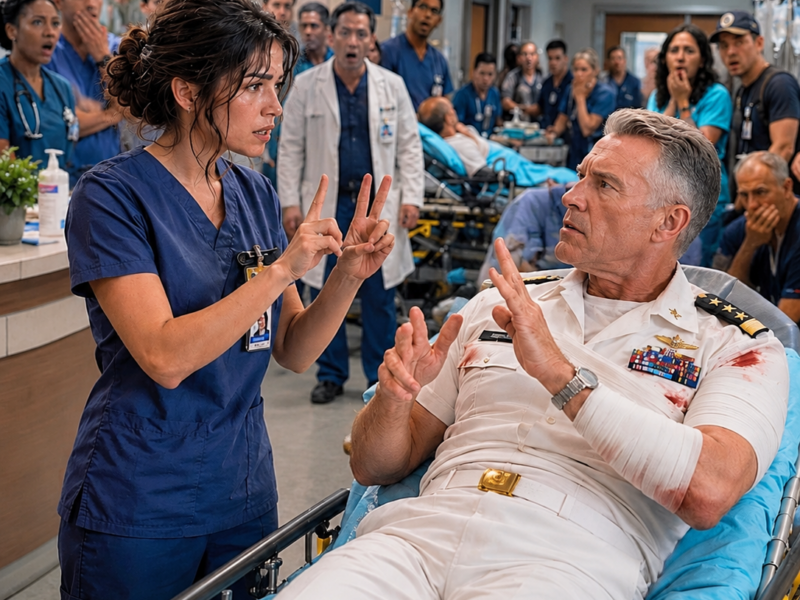
My Coworkers Sent Me to Handle a “Difficult” Deaf Navy SEAL Just to Humiliate the Rookie Nurse—But When He Saw the Scar on My Wrist, He Signed One Word: “Sparrow.” Then He Revealed That I Was Supposed to Be Dead After a Classified Navy Operation Five Years Ago, and Moments Later, a Man in a Maintenance Uniform Walked Into Our Hospital Carrying Something That Could Expose Everyone Involved.
My Coworkers Sent Me to Handle a “Difficult” Deaf Navy SEAL Just to Humiliate the Rookie Nurse—But When He Saw the Scar on My Wrist, He Signed One Word: “Sparrow.” Then He Revealed That I Was Supposed to Be Dead After a Classified Navy Operation Five Years Ago, and Moments Later, a Man in a Maintenance Uniform Walked Into Our Hospital Carrying Something That Could Expose Everyone Involved.
PART 1
“Give the rookie nurse the deaf Navy SEAL.”
The words came from Marla Finch’s mouth with a smile that made it clear she was not assigning a patient. She was setting up a joke.
For a moment, the nurses’ station at Franklin VA Medical Center fell silent. Then Trevor Blake, a young resident who seemed to find amusement in everyone else’s discomfort, burst into laughter. Two nurses near the printer exchanged knowing looks, while Dr. Arthur Kincaid glanced up from his tablet with an expression of mild irritation.
Lilly Parker stood beside the medication cart, holding a stack of patient records against her chest. Her bright blue scrubs were slightly loose around her shoulders, and her auburn hair was twisted into a messy knot. At twenty-nine, she was the newest nurse on the floor, having worked at Franklin VA for only eighteen days.
Eighteen days of being called inexperienced.
Eighteen days of receiving the most difficult assignments.
Eighteen days of hearing coworkers make jokes whenever they thought she was too far away to notice.
Lilly had learned to ignore them. She had also learned that being underestimated could sometimes be an advantage.
Marla tapped her pen against the counter.
“Room twelve. Chief Caleb Roark. Former Navy SEAL. Completely deaf following a blast injury. He refuses to let anyone examine him, won’t cooperate with doctors, and apparently has a particular dislike for hospital staff.”
Trevor grinned.
“So basically, he’s impossible.”
“Exactly,” Marla replied. “Let’s see how long our new nurse lasts.”
Dr. Kincaid stepped out of the physician’s workroom. He was handsome, confident, and accustomed to having everyone follow his instructions without question.
“Parker, you can handle basic communication, correct?”
“Yes, Doctor.”
“Good. Perhaps you can charm him. He’s been giving everyone trouble.”
Trevor lifted his phone slightly.
“Should I record this for training purposes?”
The laughter returned.
Lilly didn’t react. She simply accepted the chart and checked the patient’s information.
Caleb Roark. Thirty-eight years old. Retired Navy Chief Petty Officer. Former special warfare operator. Profound bilateral hearing loss. Left below-knee amputation. Previous blast trauma.
His current admission followed a collapse during a prosthetic fitting. He had a fever, elevated heart rate, and pain around his right ribs. A chest X-ray had been ordered.
Three separate notes described him as combative, difficult, and noncompliant.
Lilly disliked those words.
In her experience, people were often called difficult when nobody had bothered to understand what they were trying to communicate.
She walked toward room twelve while the laughter followed her down the corridor.
Through the narrow window, she saw Caleb sitting upright with his back against the wall rather than the pillow. His shoulders were squared, and his pale blue eyes moved constantly between the door, the windows, the oxygen outlet, and the medical equipment.
He wasn’t simply watching the room.
He was studying it.
Lilly recognized that immediately.
She knocked twice against the doorframe and entered slowly, keeping her palms visible.
The two orderlies standing beside the bed looked relieved.
“Good luck,” one muttered before leaving.
Lilly waited until the door was mostly closed, then raised her hands.
“My name is Lilly. I’m your nurse. I won’t touch you without your permission.”
Caleb froze.
His attention shifted from her face to her hands.
Then his fingers moved.
“You sign?”
“Yes.”
“Who taught you?”
“A friend.”
“Name?”
Lilly tilted her head slightly.
“Do you ask every nurse for references?”
His expression barely changed, but one corner of his mouth moved.
“Funny.”
“Sometimes.”
He signed again.
“No students. No Blake. No Kincaid. No restraints.”
“Agreed. Unless there’s an immediate danger to you or someone else. I’m not here to force anything.”
She turned toward the whiteboard and wrote in large letters:
ASL IS YOUR PRIMARY LANGUAGE.
NO TOUCH WITHOUT CONSENT.
NO STUDENTS WITHOUT CONSENT.
When she faced him again, she asked permission to check his vital signs.
Caleb raised one finger.
“One question first.”
“What did they say about me?”
Lilly considered giving him a reassuring answer, but she decided against it.
“They said you were difficult.”
His eyes narrowed.
“And what do you think?”
“I think you’re in pain, exhausted, and tired of people making decisions about you without listening.”
For several seconds, Caleb studied her.
Then he nodded.
She wrapped the blood pressure cuff around his right arm. His pressure was 158 over 94. His pulse was 124, his oxygen saturation 93 percent, and his temperature 100.9 degrees.
His breathing was also unusually rapid.
Lilly counted his respirations herself and noticed that his right hand remained pressed against his lower ribs.
“Pain here?”
“Yes.”
“When did it start?”
“This morning.”
“Worse after the prosthetic appointment?”
He nodded.
“Did you fall?”
“No.”
“Does it hurt when you breathe?”
“Yes.”
She asked permission before listening to his lungs.
The left side sounded coarse. The lower right side was noticeably diminished.
Lilly straightened.
Something wasn’t right.
“You need another assessment.”
Caleb watched her carefully.
“Doctor says anxiety.”
“Doctor is wrong.”
His expression changed.
“You military?”
“No.”
“Lie.”
“I’m a nurse. That’s the answer I’m giving you.”
He studied her posture, her hands, and the way she stood without blocking the door.
Then his fingers moved again.
But this time, it wasn’t ASL.
The gestures were short, sharp, and deliberate. They belonged to a different communication system entirely.
A silent tactical code.
Pain spreading. Breathing restricted. Internal problem.
Lilly felt the blood drain from her face.
She hadn’t seen those signals in years.
They belonged to men who operated in darkness, communicating without radios, without lights, and without the luxury of making mistakes.
Caleb repeated the sequence.
Then he signed one word.
“Identify.”
Lilly should have pretended not to understand.
Instead, she answered with a single tactical signal.
“Hold. I see you.”
Caleb stopped moving.
His eyes dropped toward her left wrist, where a pale scar disappeared beneath her watch.
His next signs came slowly.
“Sparrow?”
Lilly stepped back.
“No.”
“Sparrow died.”
“Then let her stay dead.”
Before he could respond, the door opened.
Marla entered with Trevor standing behind her, his phone already half raised.
“Why are the blinds closed?” Marla asked.
“Because he deserves privacy.”
Trevor smirked.
“Or because you’re in over your head?”
Lilly ignored him.
“Room twelve needs Dr. Kincaid. Immediately.”
Within minutes, Kincaid appeared, looking irritated.
“What happened?”
“His pulse is 124. His breathing is elevated, his temperature is 100.9, and his oxygen saturation has fallen. His right lower breath sounds are diminished, and he’s experiencing acute chest pain.”
Kincaid glanced at Caleb.
“Panic.”
“No. Something is happening in his chest.”
The doctor’s expression hardened.
“Order a breathing treatment. Document anxiety.”
“He needs his imaging reviewed.”
“You need to follow instructions, Parker.”
Lilly met his eyes.
“Attention doesn’t oxygenate patients, Doctor. If it did, he’d already be cured.”
Marla inhaled sharply.
Trevor stopped smiling.
Kincaid leaned closer.
“You are not special. You are not brave. And you are certainly not the first inexperienced nurse to mistake attention-seeking for competence.”
Lilly returned to Caleb’s bedside.
“Your oxygen is dropping,” she told him.
He nodded.
A moment later, the monitor sounded again.
Eighty-nine percent.
Then eighty-six.
Kincaid ordered lorazepam.
Lilly stepped between the doctor and the patient.
“No sedative until we rule out a respiratory emergency.”
“You don’t countermand my orders.”
“And you don’t sedate a man who cannot breathe.”
When the oxygen saturation dropped to 86 percent, Lilly pressed the rapid response button.
The announcement echoed through the unit.
Caleb reached toward Kincaid’s wrist, stopping him from canceling the alarm. Lilly signed one word.
“Release.”
He immediately let go.
That single moment silenced everyone.
The rapid response team arrived, followed by respiratory therapist Nina Cho. Lilly gave a precise report while Nina listened to Caleb’s chest.
Her expression changed.
“Anxiety doesn’t make breath sounds disappear on one side.”
A portable X-ray was ordered.
When the image appeared, Nina stared at the screen.
“Right pneumothorax.”
Caleb’s blood pressure began falling. His oxygen saturation dropped to 79 percent.
His lips were turning gray.
Lilly reached for the emergency equipment.
Kincaid shouted, “Stop! You are not authorized to perform that procedure!”
But Caleb caught Lilly’s sleeve.
His hands moved against her palm.
“You do it.”
“Consent given,” Lilly said.
She performed the emergency needle decompression.
For one terrible second, nothing happened.
Then came the hiss.
Trapped air escaped under pressure.
Caleb dragged a breath into his lungs.
His oxygen climbed to 83, then 87, then 90.
Nobody laughed.
Dr. Elise Warren, the trauma surgeon, arrived and immediately ordered a chest tube.
She looked at Lilly.
“Good save.”
Those two words hit harder than any insult.
Because Lilly remembered another room, another desperate patient, and another commander who had waited too long for confirmation.
She pushed the memory away.
Caleb was alive.
That was what mattered.
But as the team prepared to transfer him, he looked at her wrist again.
And signed the name she had spent years trying to bury.
“Sparrow.”
PART 2
At 3:10 that afternoon, Lilly was summoned to an administrative meeting.
Dr. Kincaid accused her of performing an unauthorized procedure, while administrator Dennis Pruitt questioned her judgment. Lilly calmly explained that Caleb’s oxygen had fallen to 79 percent and that delaying treatment could have killed him.
Dr. Warren entered with the medical report and defended Lilly’s decision.
Then the conference-room door opened.
Caleb stood there, holding his IV pole, despite being warned not to leave his bed.
He looked directly at the administrators and signed.
Lilly translated.
“She saved my life. You mocked me, spoke over me, and tried to drug me because understanding me was inconvenient.”
Then Caleb signed something else.
“Identity confirmed. Sparrow alive.”
He looked at Lilly.
And this time, he spoke aloud.
“Sparrow.”
Nobody moved.
Because the name belonged to a woman officially declared dead after a classified Navy operation called Black Current.
And Caleb Roark had just told an entire hospital that she was standing in front of them.
PART 3
The silence inside the conference room was so complete that Lilly could hear the faint hum of the ventilation system.
Dennis Pruitt slowly lowered his pen.
Dr. Kincaid looked as though someone had just informed him that the ground beneath his feet was about to disappear.
Marla stood near the door, her face pale.
Trevor had stopped pretending to be interested in his phone.
Lilly remained beside Caleb, one hand hovering near his IV line.
“Chief Roark,” she signed, “you should be in bed.”
Caleb ignored the instruction.
His eyes remained fixed on Captain Elias Ward, the silver-haired Navy officer who had entered behind the two investigators.
Ward looked at Lilly for several seconds.
“Petty Officer Parker,” he said quietly.
She closed her eyes.
“Captain.”
Pruitt stood.
“I’m sorry, Captain, but I believe there has been a misunderstanding. Nurse Parker is a probationary employee. She’s currently under review for an unauthorized medical procedure.”
Ward didn’t look at him.
“Probationary?”
“Yes.”
“And you placed her in charge of a patient who required emergency intervention?”
“She was assigned to routine nursing duties.”
Caleb began signing.
Lilly translated.
“He says your definition of routine nearly killed him.”
Pruitt flushed.
“Chief Roark, this is an administrative matter.”
Caleb signed again.
“He says you should arrest the review board first.”
Lilly almost smiled.
But the moment disappeared when Caleb’s breathing changed.
His right hand pressed against his ribs. His pulse began climbing on the monitor.
One hundred thirty-two.
His oxygen saturation fell to 88 percent.
Lilly moved immediately.
“Marla, get a non-rebreather mask. Fifteen liters. Call rapid response again.”
Kincaid stepped forward.
“You don’t give me orders.”
Lilly pointed at the monitor.
“Then act like a physician.”
She examined Caleb’s chest while the respiratory team prepared the equipment.
The right side barely rose.
His previous pneumothorax was worsening.
The portable ultrasound confirmed what Lilly feared.
No lung sliding on the right.
“Tension pneumothorax,” she said. “He needs immediate decompression.”
Kincaid swallowed.
“We need radiology confirmation.”
“He’ll arrest before radiology.”
Caleb’s fingers moved weakly.
“Sparrow.”
Lilly reached for the emergency equipment.
Ward stepped between her and Pruitt.
“Let her work.”
Kincaid remained frozen.
Lilly positioned herself beside the bed, found the correct anatomical landmarks, and inserted the catheter.
A sharp hiss filled the room.
Caleb’s chest rose.
His oxygen climbed from 79 to 84, then 89, then 92.
Marla covered her mouth.
Ward watched Lilly with an expression that carried years of memories.
“Black Current,” he whispered. “Second tunnel.”
Lilly didn’t answer.
Caleb signed slowly.
“Saved six. Lost none.”
“One lost,” Lilly replied.
Caleb shook his head.
“Not yours.”
Before Lilly could respond, a naval investigator rushed into the room.
“Captain, the prosthetics lab is empty. Chief Roark’s case is missing. Security footage from the last eleven minutes has been erased.”
Lilly’s attention sharpened.
“What case?”
Caleb looked at her.
“The prosthetic case.”
“What’s inside?”
He hesitated.
Then signed two words.
“Hidden drive.”
The evidence from Black Current had never been destroyed.
And someone inside Franklin VA had just stolen it.
PART 4
The elevator doors opened at the far end of the corridor.
A man in a maintenance uniform stepped out carrying a hard black prosthetic case.
For one second, everyone saw him.
Then the lights went out.
Emergency red illuminated the hallway, and a scream came from somewhere near the nurses’ station.
“Now!” shouted the man security had already arrested.
Lilly moved toward Caleb’s bed rather than chasing the suspect.
“Marla, close the doors. Move the visitors behind the nurses’ station. Keep Caleb upright. Do not remove his catheter.”
Ward looked at her.
“He has the case.”
“I know.”
“You’re letting him escape?”
“I’m choosing not to abandon a patient wing during a blackout.”
Ward almost smiled.
“Still you.”
Lilly picked up an IV pole and moved toward the respiratory storage area with Lieutenant Dane.
The door was locked.
Dane reached for his breaching equipment, but Lilly stopped him. She used a small metal clip from her identification badge to release the old latch.
Inside, she discovered a partially opened oxygen valve and a small ignition device taped beneath a shelf.
She understood immediately.
The attackers weren’t simply trying to steal evidence. They were preparing to create a disaster that would force the hospital to evacuate.
Lilly knocked the device away with a fire extinguisher and closed the oxygen valve.
Then a shout came from Caleb’s room.
Kincaid was standing beside his bed with a syringe.
Ward had already pinned him against the wall.
“What is in the syringe?” the captain demanded.
“Sedative. He was agitated.”
Lilly checked the label.
Wrong medication.
Wrong dose.
Wrong explanation.
Caleb signed one sentence.
“He tried to silence me.”
Kincaid’s face changed.
The drive was found hidden inside the foam liner of Caleb’s prosthetic equipment. It contained contracts, payments, altered medical reports, and signatures connecting several people to the Black Current operation.
Kincaid appeared in the records.
So did Pruitt.
Then three armed men entered the corridor.
Ward raised his weapon.
Lilly pulled the evidence drive into her glove and looked at Caleb.
“How many?”
Caleb watched their movements.
“Three.”
She nodded.
The hospital had mocked the rookie nurse for being quiet.
Now silence was their greatest advantage.
PART 5
The three men advanced through the corridor wearing hospital jackets over tactical vests.
They expected frightened nurses and confused patients.
Instead, they found veterans who understood exactly what was happening.
Lilly signed to Caleb from behind the supply alcove.
“Center man is the leader. Injured left shoulder. Watching my hands.”
Caleb responded with one word.
“Tunnel.”
Black Current returned to Lilly in fragments.
A coastal weapons facility. A failed intelligence operation. Contractors selling information to both sides. Seven men trapped underground.
She remembered Caleb before the explosion, when he could hear everything and still found reasons to laugh.
She remembered the blast that destroyed his hearing.
And she remembered returning to the tunnel after everyone else had ordered a retreat.
The attackers had been waiting for that evidence ever since.
The leader raised his weapon toward Caleb’s room.
Lilly stepped into the open.
“Looking for this?”
She raised her gloved hand.
The man turned toward her.
He rushed forward, expecting her to freeze.
She didn’t.
An IV pole struck his knee. His weapon went flying. Lilly closed the distance and forced him against the floor.
Dane tackled the second attacker, while the third aimed toward Marla.
Caleb moved despite his injuries.
He swung his prosthetic liner into the man’s wrist, redirecting the weapon just as Marla screamed and pressed the emergency call button twice.
Security arrived seconds later.
The fight was over in nine seconds.
When the hallway finally settled, Trevor stared at Lilly.
“She is a nurse,” he whispered.
Ward looked at him.
“She is also the reason several men are alive who should not be.”
Lilly stood, her blue scrubs torn and her hair falling loose around her face.
She looked at the frightened staff members.
“My name is Petty Officer First Class Lilly Ann Parker. United States Navy Special Warfare. Call sign Sparrow.”
The words changed everything.
She had served with a Navy special warfare medical assault element and survived Operation Black Current. She had received a Silver Star, two Purple Hearts, and several classified commendations.
She had also been officially declared dead.
The government had buried her identity because her testimony threatened to expose a network of military contractors and officials who had profited from the failed operation.
The evidence drive contained enough information to bring that network down.
But the attackers had not come only for the drive.
They had come for Caleb because he could identify the people responsible.
And they had come for Lilly because she had survived.
Federal investigators secured the evidence and arrested Kincaid. Pruitt was suspended, while Trevor admitted that he had helped provide access to the prosthetics department after being promised a prestigious fellowship recommendation.
Marla confessed that she had participated in the original prank because she wanted to impress the senior staff.
Lilly listened without interrupting.
Then she returned to Caleb.
He was being prepared for another chest tube procedure.
“You stayed,” he signed.
“You were my patient.”
“Before.”
Lilly looked at him.
“Before too.”
Caleb shook his head.
“You did not make me deaf.”
She looked away.
“I left you in that tunnel for four minutes.”
“To save Ramos. To save Hale. To open the exit.”
“I remember the explosion.”
“I remember your hand on my vest.”
His hands moved slowly.
“I woke up deaf. I did not wake up alone.”
Lilly finally allowed herself to cry.
Hours later, federal agents confirmed that the evidence drive had been authenticated. Arrest warrants were being prepared, and the investigation would extend beyond the hospital.
Captain Ward approached Lilly.
“Once your sealed status collapses, the people who protected your identity may want you transferred.”
“I’m aware.”
“Do you want extraction?”
She looked through the glass toward Caleb’s room.
Then she noticed Marla practicing ASL with an elderly Marine in the corridor.
“No.”
Ward studied her.
“I’m not asking as your captain.”
“Good. Because I’m answering as a nurse.”
Three weeks later, Franklin VA looked almost exactly the same from the outside.
The same brick walls. The same flag. The same coffee kiosk where veterans complained about the muffins.
Inside, however, the changes were obvious.
Every deaf and hard-of-hearing veteran now had access to qualified communication support. Staff members attended mandatory ASL training. No patient could be labeled combative without proper documentation of communication attempts.
Dr. Kincaid’s portrait disappeared from the physician recognition wall.
Pruitt resigned before the administrative hearing.
Trevor entered professional remediation.
Marla stayed.
That surprised Lilly most.
Instead of making excuses, Marla arrived early, practiced signing with patients, and helped establish a new communication policy.
One afternoon, Lilly found her in room ten, carefully signing to a deaf Vietnam veteran.
“Pain where?”
The veteran pointed toward his hip.
Marla looked up and noticed Lilly watching.
For a moment, she froze.
Lilly simply nodded.
It wasn’t forgiveness.
It was recognition that change had finally begun.
Caleb’s recovery took longer than he wanted, but he eventually regained enough strength to leave the hospital.
On discharge day, he stopped his wheelchair beside the nurses’ station.
The same place where the original joke had started.
He looked at Marla, Trevor, and the other nurses who had once laughed at him.
Then his hands began moving.
Lilly translated every word.
“You thought silence made me weak. You thought her kindness made her weak. You thought a rookie nurse was safe to humiliate because she had no power here.”
Caleb paused.
“You were wrong three times.”
His eyes moved toward Lilly.
“My silence hurt more than your noise. Her kindness saw more than your arrogance. And power was never in your titles. It was in what you did when someone needed help.”
Nobody spoke.
Then Caleb signed one final sentence.
“You did not give Lilly Parker authority. Character did.”
Lilly’s throat tightened as she translated.
Captain Ward, standing near the doorway, raised his hand in a quiet military salute.
Lilly returned it.
Then she lowered her hand, straightened her hospital badge, and went back to work.
It still read:
LILLY PARKER, RN.
No rank.
No medals.
No call sign.
Just her name.
Months later, people continued telling the story of the rookie nurse and the deaf Navy SEAL.
Some said she had been secretly trained for combat. Others talked about the stolen evidence, the attackers, and the military conspiracy.
All of those details were true.
But they were not the most important part.
The real story began when a group of hospital employees decided that a wounded veteran’s disability and a young nurse’s quiet personality were convenient tools for entertainment.
They expected laughter.
Instead, their cruelty exposed their own character.
They had mistaken silence for weakness, kindness for inexperience, and a patient’s inability to hear for an inability to understand.
They had also forgotten that the people sitting in hospital beds had survived things most of them could never imagine.
Lilly had spent years trying to disappear because the world had already taken too much from her.
But when Caleb needed someone to listen, she stepped forward.
And when the hospital needed someone to protect its patients, she stayed.
Because sometimes the person everyone underestimates is the only one who sees the danger coming.
Sometimes the patient nobody listens to is carrying the truth that could bring an entire conspiracy down.
And sometimes the quietest person in the room is the one who has already survived the worst day of her life.
The world had once called Lilly Parker dead.
Franklin VA had called her inexperienced.
Her coworkers had called her an easy target.
But Caleb Roark had recognized her from the very first moment she signed to him.
He hadn’t seen a rookie nurse.
He had seen the woman who once returned to a burning tunnel when everyone else had been ordered to retreat.
And perhaps that was the greatest lesson of all.
Never mistake gentleness for weakness.
Never mistake disability for helplessness.
Never judge a person by the title on their badge.
Because courage does not always announce itself.
Sometimes it walks quietly down a hospital corridor in bright blue scrubs, carrying a patient’s chart, ready to save a life.
And sometimes, when everyone else is laughing, it is already the only thing standing between a wounded man and death.