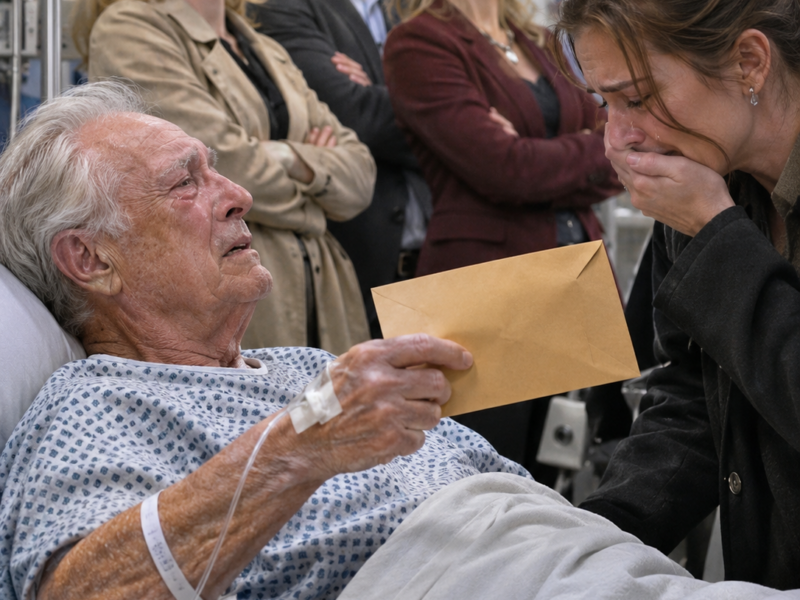
My 82-Year-Old Grandpa Was Stranded at the ER After All Three of His Children Refused to Pick Him Up, Even Though They Lived Just 20 Minutes Away. My Dad Texted, “We Are Too Busy. You Go,” So I Drove 180 Miles Through the Rain to Bring Him Home. But the Moment He Got Into My Car, He Handed Me a Thick Envelope With an Estate Attorney’s Card and Whispered, “Drive Here First.” When the Lawyer Opened a Secret Property File, I Realized My Family Had No Idea What Was Coming…
My 82-Year-Old Grandpa Was Stranded at the ER After All Three of His Children Refused to Pick Him Up, Even Though They Lived Just 20 Minutes Away. My Dad Texted, “We Are Too Busy. You Go,” So I Drove 180 Miles Through the Rain to Bring Him Home. But the Moment He Got Into My Car, He Handed Me a Thick Envelope With an Estate Attorney’s Card and Whispered, “Drive Here First.” When the Lawyer Opened a Secret Property File, I Realized My Family Had No Idea What Was Coming…
Part 1
The moment my eighty-two-year-old grandfather climbed into my car outside the emergency room, he handed me a thick cream-colored envelope and said six words I would never forget.
“Kaylee, drive to this address first.”
I glanced at the business card clipped to the envelope. It belonged to an estate attorney in Chagrin Falls.
“Grandpa, shouldn’t we get you home? You’ve been in the hospital since yesterday.”
He looked straight ahead through the rain-speckled windshield. Then he turned toward me with an expression I had never seen before.
“Your father, your aunt, and your uncle think I’m a helpless old fool,” he said quietly. “Before this day is over, we’re going to find out just how wrong they are.”
I had no idea that the next few hours would uncover a conspiracy involving forged signatures, millions of dollars, a secret property sale, and a betrayal so cruel that it would eventually send members of my own family to jail.
But everything began with a phone call that Friday morning.
My name is Kaylee Miller. I was thirty-four years old, living in Columbus, Ohio, and working as a senior commercial title and escrow auditor. To most people, that sounded like a boring job involving endless paperwork. To my family, it was something even less impressive.
My father liked to call me a glorified file clerk.
He never understood that my work required investigating complicated real estate transactions, identifying fraudulent documents, and protecting property owners from financial disasters.
Ironically, those were exactly the skills that would save my grandfather.
At 11:15 that morning, I was reviewing a commercial title commitment when my office telephone rang.
The woman on the other end introduced herself as Megan, a discharge coordinator at University Hospitals Geauga Medical Center.
“Miss Miller, I’m calling about your grandfather, Walter Miller.”
My stomach tightened immediately.
Grandpa Walter lived alone at Sycamore Ridge, a beautiful forty-two-acre farmstead near Chagrin Falls. He had owned the property with my grandmother Martha for more than fifty years.
Grandma died six years earlier, and since then Grandpa had refused to leave the house they built their lives around.
He was independent, stubborn, and remarkably sharp for eighty-two.
“What happened?” I asked.
Megan explained that paramedics had brought him to the emergency department the previous morning after he experienced sudden dizziness and confusion.
Fortunately, his brain scans and heart tests were clear. His doctor had approved his discharge at nine that morning.
There was just one problem.
“We need a responsible adult to take him home,” Megan explained. “We’ve contacted all three of his children. Unfortunately, none of them is willing to come.”
I stared at the telephone.
“None of them?”
There was a brief silence.
“His daughter Diane said she couldn’t leave a country club luncheon. His son Bruce said he had an important real estate closing. And your father suggested that your grandfather take a taxi.”
I felt something cold settle inside my chest.
All three of Grandpa’s children lived within twenty minutes of that hospital.
I lived one hundred and eighty miles away.
“Please tell Grandpa I’m coming,” I said. “I’ll be there as quickly as I can.”
After hanging up, I called my father.
He answered from the comfortable sunroom of his expensive house in Pepper Pike.
“What is it, Kaylee?”
“Dad, why is Grandpa sitting alone in the emergency room?”
He sighed dramatically.
“Your grandfather is being difficult again. Diane wants him to consider assisted living, but he refuses to listen. Now he expects everyone to abandon their responsibilities.”
“Dad, he’s eighty-two. He was taken to the hospital in an ambulance.”
“And he’s being discharged, isn’t he?”
I could hear my mother Lorraine talking in the background.
Then she joined the conversation.
“Kaylee, you’re single. You don’t have children or a husband depending on you. Your schedule is obviously more flexible than everyone else’s.”
I closed my eyes.
“Mom, I have a full-time job.”
My father laughed.
“You look at courthouse documents all day. Nobody’s going to miss you for one afternoon. Bruce has millions of dollars on the line, and Diane has responsibilities at the club.”
Then came the sentence I had heard throughout my entire life.
“Do your part for the family for once.”
He hung up.
Seconds later, a text appeared on my screen.
We are too busy. You go.
I stared at those six words for a long moment.
Then I took a screenshot.
I didn’t know why I felt compelled to save the message. Maybe some part of me already understood that one day I would need proof of how casually my family had abandoned Grandpa.
As I drove north through the October rain, memories I had spent years trying to forget came flooding back.
Six years earlier, Grandma Martha had been diagnosed with stage-four pancreatic cancer.
My father, Aunt Diane, and Uncle Bruce all lived nearby, but none had time to help with her daily care.
There were business meetings, golf outings, charity committees, and endless excuses.
So, at twenty-eight, I took an unpaid leave from work and moved into Sycamore Ridge.
For fourteen months, I cared for Grandma.
I helped her bathe, prepared her meals, managed her medication, and sat beside her through nights when pain made sleep impossible.
I was holding her hand when she took her final breath.
Four days after her funeral, my parents arrived at my apartment in Columbus.
My father looked devastated.
He told me Grandma’s medical treatments had left sixty-five thousand dollars in unpaid bills and that creditors might place a lien against Grandpa’s farm.
I had spent six years saving exactly that amount for the down payment on my first home.
Dad said Grandpa could lose Sycamore Ridge unless the bills were paid immediately.
So I transferred every dollar.
I never asked for receipts.
I never questioned the debt.
I simply believed my father.
For the next six years, I remained in a small rented apartment, drove an aging Honda, and watched home prices climb beyond my reach.
Whenever I mentioned my sacrifice, my parents acted as though I was embarrassing them.
“You helped your grandfather,” Mom would say. “Why do you need applause?”
I stopped bringing it up.
But that Friday, driving one hundred and eighty miles through the rain while Grandpa’s three wealthy children sat comfortably at home, I began wondering whether my family had ever appreciated anything I had done.
I arrived at the hospital shortly before two.
Grandpa sat near the nurses’ station wearing his familiar red flannel shirt, khaki trousers, and tweed cap.
He looked exhausted.
When he saw me, his face softened.
“You came all this way, sweetheart?”
“Of course I did.”
He squeezed my hand.
Before leaving, I asked Megan for copies of his discharge summary and the documented attempts to contact his emergency contacts.
She printed the records.
Every refusal was there.
Diane had declined to interrupt her luncheon.
Bruce had cited an important business appointment.
Dad had suggested alternative transportation despite living only minutes away.
I slipped the paperwork into my bag.
Then I helped Grandpa into my car.
That’s when he handed me the envelope.
Twenty minutes later, we entered the offices of Raymond Callahan, a respected estate attorney who had worked with Grandpa for decades.
Ray greeted us without surprise.
That should have been my first warning.
He ushered us into a private conference room, closed the door, and placed a document on the table.
It was a certificate from Grandpa’s doctors confirming that his mental capacity was unimpaired.
“Why did you need this?” I asked.
Grandpa didn’t answer immediately.
Instead, Ray turned his computer monitor toward us.
A county recording alert filled the screen.
Someone had recently placed a $185,000 home equity credit line and a pending property conveyance notice against Sycamore Ridge.
Both transactions relied on a durable financial power of attorney.
The listed agents were Kenneth Miller, Diane Mercer, and Bruce Miller.
My father, my aunt, and my uncle.
Grandpa’s voice became very quiet.
“I never gave them power of attorney.”
I leaned closer.
Ray opened the recorded document.
According to the paperwork, Grandpa had signed away sweeping control over his property eleven months earlier.
I examined the signature page.
The signature looked vaguely like his, but the execution date caught my attention.
November fourteenth.
“Grandpa, weren’t you recovering from cataract surgery that week?”
He nodded slowly.
“Both eyes. I couldn’t read anything for days.”
“Did anyone bring paperwork for you to sign?”
His expression changed.
“Your father came over with soup. He told me my prescription insurance renewal needed a signature before the deadline. He guided my hand because I couldn’t see the line.”
I felt my stomach drop.
My father had apparently used Grandpa’s temporary inability to read to obtain his signature on documents he never knowingly approved.
Ray reached for his telephone.
“We need to contact the authorities.”
“Not yet,” I said.
Both men looked at me.
“If we warn them before securing the property, they’ll claim Grandpa is confused. They’ll use yesterday’s hospitalization to question his memory.”
Grandpa nodded.
“That’s what I suspected.”
I turned back to the computer.
The forged authority was dangerous, but Grandpa still had the ability to revoke it and make a new estate plan with independent legal counsel.
“Ray, we need to protect everything before they know we’ve discovered this.”
Grandpa opened another folder.
Inside were financial statements that made me stare in disbelief.
For years, my family described him as a retired machinist living on a modest pension.
But when Grandpa sold Miller Precision Tooling twelve years earlier, he had invested the proceeds.
His portfolio contained $11.8 million in bonds and securities.
Sycamore Ridge itself was valued at approximately $6.2 million.
Together, the assets were worth around eighteen million dollars.
And my grandfather had kept almost all of it secret.
“Your father, Diane, and Bruce each expected five million dollars from my estate plan,” he said.
I couldn’t speak.
Grandpa reached across the table and took my hand.
“I gave them opportunities their entire lives, Kaylee. I paid for educations, weddings, houses, and businesses. But when I needed a ride home from the hospital, not one of them could spare twenty minutes.”
Ray began preparing protective documents.
Grandpa instructed him to establish a new trust, with me responsible for protecting its assets.
He insisted on making the decision himself, with independent legal advice and full understanding of the consequences.
By late afternoon, the urgent documents had been signed and submitted for recording.
Grandpa’s previous arrangements were no longer going to be the easy source of money his children expected.
At 4:52, Ray received confirmation of the new property filing.
Almost immediately, my phone buzzed.
It was Aunt Diane.
Where are you? We’re all at Dad’s house preparing a welcome-home dinner!
A second message appeared.
Pick up my dry cleaning and the catering trays on your way. Don’t be late.
I showed Grandpa the screen.
He read it and gave a small, humorless smile.
“Apparently,” he said, “my children have suddenly found time for me.”
Then his expression hardened.
“Let’s go home, Kaylee. I want to see what they’re planning.”
Neither of us knew that the worst betrayal was still waiting behind the farmhouse doors.
Part 2
When we arrived at Sycamore Ridge, my family was already behaving as though Grandpa’s home belonged to them.
Uncle Bruce was measuring the dining room walls. Aunt Diane had placed assisted-living brochures beside Grandpa’s dinner plate, while my parents enjoyed expensive whiskey from his private collection.
Nobody asked whether he felt better.
Instead, Bruce announced that Grandpa would enter Shady Pines Memory Care on Tuesday.
“You’re eighty-two, Dad. You can’t make these decisions anymore.”
Grandpa pretended to be tired and asked to rest in his study.
The moment he left, Dad cornered me in the kitchen.
“You’ll convince him to sign those papers,” he demanded.
I asked about the sixty-five thousand dollars I had given him after Grandma’s funeral.
Mom laughed.
“Those medical bills never existed! We used your money to renovate our kitchen and join the country club.”
My phone was recording.
When Dad noticed, he grabbed my wrist.
At that moment, my brother Bret arrived with his wife, Kendra, a senior real estate litigation attorney.
“Let her go,” Kendra ordered.
Later, she pulled me aside.
“Kaylee, I found something in a confidential property transaction.”
Her next words turned my blood cold.
“Your family has already signed a contract to sell Grandpa’s entire farm for $6.2 million.”
Part 3
For several seconds, I could only stare at Kendra.
The narrow butler’s pantry suddenly felt airless.
Beyond the swinging door, I could hear my family laughing over dinner, clinking wineglasses, and discussing Grandpa as though he were already gone.
But Kendra’s expression told me this was far worse than a dispute over inheritance.
“How did you find out?” I whispered.
She explained that a healthcare property company called Vanguard Health Properties had sent an urgent closing file to her law firm for additional title review.
The property was Sycamore Ridge.
Two weeks earlier, Bruce, Diane, and my father had signed a contract to sell all forty-two acres for $6.2 million.
The transaction was scheduled to close the following Friday.
“They represented themselves as authorized agents under Grandpa’s power of attorney,” Kendra said.
“The same document he never knowingly signed?”
She nodded.
“There is more. Bruce personally guaranteed clear title and vacant possession by closing. If he cannot deliver, he faces a $500,000 contractual penalty.”
I looked toward the dining room.
Everything suddenly made sense.
The memory-care brochures.
The manufactured concern about Grandpa’s independence.
The pressure to move him into Shady Pines by Tuesday.
They needed him out of the farmhouse before the buyer demanded possession.
And they were running out of time.
Kendra lowered her voice.
“Kaylee, I need you to think carefully. Didn’t you install security cameras in this house after Grandpa fell two winters ago?”
“Yes.”
“Can you still access the recordings?”
“Every second.”
“Then examine Thursday morning. Something about his collapse isn’t right.”
I felt a chill spread through my arms.
Grandpa had always been careful with his medication. He was healthy enough to manage the orchard, repair machinery, and maintain his own finances.
A sudden episode of dizziness and disorientation was possible at his age, of course.
But now I wondered whether it had truly happened naturally.
That night, after everyone left, I sat with Grandpa in his study.
He listened quietly while I explained the property sale.
He did not interrupt.
When I finished, he looked toward Grandma Martha’s photograph on the mantelpiece.
“For fifty years,” he said, “your grandmother and I worked to keep this land in our family.”
His voice broke slightly.
“I never imagined the people we’d need to protect it from would be our own children.”
The next morning, Grandpa, Kendra, and I met Ray Callahan at his office.
At 7:15, Ray received a call from Dr. Alan Patel.
The doctor had ordered expanded toxicology testing after Grandpa’s hospital admission.
The results had just returned.
There were unusual amounts of a sedating antihistamine and blood-pressure medication in Grandpa’s system.
The doctor explained that the combination could produce severe dizziness, low blood pressure, confusion, and symptoms that might resemble cognitive impairment.
Grandpa stared at the telephone.
“I take one prescribed blood-pressure tablet every morning,” he said. “I don’t take sleeping pills.”
Dr. Patel asked permission to provide the test results to Ray and recommended immediate investigation.
Once the call ended, I opened my laptop.
The security system at Sycamore Ridge had two cameras: one in the hallway and another overlooking the kitchen.
I searched Thursday morning’s footage.
At 9:12, Aunt Diane entered the kitchen carrying a bakery box.
She kissed Grandpa’s cheek and placed cinnamon rolls on the counter.
Everything looked ordinary.
Then she pointed toward the garden and asked Grandpa to check a loose cover on the cold frames.
As soon as he stepped outside, Diane opened her handbag.
My breath caught.
On the screen, she removed a small pill crusher and emptied powder into Grandpa’s teacup.
Then she opened his weekly medication organizer and moved additional tablets into the morning compartment.
She stirred the tea.
A moment later, her telephone rang.
She answered on speakerphone.
Bruce’s voice filled the conference room.
“Is it done?”
Diane glanced toward the garden door.
“He’ll drink it when he comes back.”
Bruce asked whether the hospital would consider Grandpa incapable of managing himself.
Diane replied that once he became dizzy and confused, the medical staff would have enough reason to question his ability to live alone.
Nobody in Ray’s conference room spoke.
The recording continued.
Diane placed a cinnamon roll beside the cup, smiled, and waited for Grandpa to return.
I paused the video.
Grandpa’s face had gone pale.
For a long time, he looked at the frozen image of his daughter standing in his kitchen.
Then he asked a question so quiet I almost missed it.
“Did she know how badly that could have hurt me?”
Kendra took his hand.
The answer was already obvious.
Diane had not merely manipulated her father.
She had endangered his life to create a medical emergency that would make stealing his property easier.
Ray contacted investigators and began arranging for the digital footage and medical records to be preserved.
Meanwhile, Kendra showed us the financial documents she had gathered through authorized legal channels.
The pattern was astonishing.
Bruce had built a reputation as a wealthy commercial property developer.
He drove an expensive Mercedes, wore designer suits, and frequently described himself as the most successful businessman in the family.
In reality, his development company was collapsing.
A poorly performing retail investment had left him owing $3.4 million on a high-interest bridge loan.
The debt was approaching its maturity date.
Without new money, Bruce faced default.
He had apparently pledged Grandpa’s property as collateral using the disputed power of attorney.
Aunt Diane was also in trouble.
Her interior decorating business owed substantial sums to suppliers.
She had obtained a $185,000 credit line against Sycamore Ridge and used the money to pay commercial debts, maintain her country club membership, and finance her luxurious lifestyle.
Then there was my father.
Dad and Mom had quietly borrowed $420,000 against their Pepper Pike home.
Their financial problems involved failed investments, credit cards, and years of spending beyond their means.
All three siblings were desperately dependent on Grandpa’s property.
Their plan was simple in its cruelty.
First, obtain control through deceptive paperwork.
Next, make Grandpa appear incapable of managing his affairs.
Then place him in a memory-care facility.
Finally, sell the farm and divide the proceeds before he could meaningfully challenge them.
One document showed that Bruce had promised Dad $1.5 million from the sale.
Another listed a proposed $100,000 gift to my brother Bret.
I stared at Bret’s name.
My older brother had spent years working for Uncle Bruce’s development company.
He had always been the family peacekeeper.
Whenever Dad insulted me or Diane made cruel remarks about Kendra, Bret would look away and tell us that arguing only made things worse.
I desperately hoped he knew nothing about the attempted fraud.
But seeing that promised payment made me realize how easily silence could become complicity.
Grandpa looked exhausted when we finished reviewing the documents.
He rubbed an old scar across his knuckle, a reminder of the years he had spent operating machines at his manufacturing plant.
“I built that company from nothing,” he said.
He told us how he had worked fourteen-hour days so his children could attend good schools and begin adulthood without the financial worries he had experienced.
He had paid for Dad’s education.
He had helped Diane buy her first home.
He had supported Bruce when he started his company.
“And now,” Grandpa whispered, “they want to take the one place your grandmother loved more than anything.”
I moved beside him.
“They’re not taking it.”
He looked at me.
“Promise?”
“I promise we’ll protect it legally, Grandpa.”
For the first time that morning, he smiled.
Kendra then explained something important.
Vanguard Health Properties did not necessarily need the farmhouse or orchards.
Its primary interest was the highway-facing acreage, where it wanted to develop an outpatient medical facility.
That opened the possibility of negotiating a separate commercial arrangement directly with Grandpa’s trust.
We could potentially preserve the farmhouse and most of the land while offering Vanguard a long-term lease on the outer fifteen acres.
Kendra contacted the company’s legal representatives.
They agreed to consider a ninety-nine-year ground lease structured around an $8.5 million total financial commitment, subject to final approvals and documentation.
The new arrangement would preserve Grandpa’s home while forcing Bruce’s company to confront the consequences of its unauthorized sale agreement.
For the first time, I felt we had a path forward.
But that afternoon, Grandpa’s phone rang.
Dad’s name appeared on the screen.
Grandpa answered on speaker.
“Dad!” my father said cheerfully. “We’ve been worried about you. Diane made your favorite apple pie, and we’re bringing steaks over tonight.”
He paused.
“Bruce also found a simple tax-protection form that could save you thousands on your property taxes.”
I glanced at Kendra.
She was already shaking her head.
Dad continued.
“All we need is your signature.”
Grandpa gave me a knowing look.
“That sounds lovely, Kenneth,” he replied.
After the call ended, I opened my notebook.
The people who had ignored Grandpa at the hospital were now bringing expensive steaks and homemade pie because they desperately needed him to sign something.
And this time, I intended to read every word.
Saturday evening arrived with a performance worthy of the theater.
Dad wore an apron and insisted on grilling the steaks.
Diane kissed Grandpa repeatedly.
Mom even thanked me for driving from Columbus, something she had never bothered to do before.
Bruce brought an expensive bottle of wine and spoke affectionately about preserving the Miller family legacy.
I watched them carefully.
Every compliment sounded rehearsed.
Every smile concealed an expectation.
After dessert, Bruce opened his briefcase.
He removed an eight-page document with three yellow signature tabs and placed it beside Grandpa’s coffee cup.
“Just a little family tax matter,” he explained.
Dad leaned forward.
“The county might dramatically increase taxes on large agricultural properties. Bruce’s advisers found a way to protect the farm.”
“Really?” Grandpa asked.
“Absolutely,” Diane said. “Thank goodness Bruce discovered it before the deadline.”
Bruce offered Grandpa a pen.
“Just sign beside the yellow tabs.”
I reached for the document.
“Let me make sure the parcel numbers are correct.”
Bruce’s smile tightened.
“Kaylee, it’s complicated legal paperwork. You wouldn’t understand.”
I ignored him and turned to page three.
The language was unmistakable.
It was not a tax-protection form.
It was a quitclaim agreement transferring Grandpa’s entire interest in Sycamore Ridge to Bruce’s development company for a nominal payment of ten dollars.
It also attempted to waive Grandpa’s occupancy rights.
I kept my expression neutral.
Grandpa watched my face.
Then he rubbed his forehead and sighed.
“My eyes are tired tonight. I want to read everything tomorrow morning.”
Bruce looked irritated.
“Dad, we’ve already explained it.”
“Then one more night won’t hurt,” Grandpa replied.
I smiled pleasantly.
“Leave it here. I’ll help him review it over breakfast.”
They reluctantly agreed.
But after their cars disappeared down the driveway, Grandpa stood up straight.
I held the document beneath the study lamp.
“They’ve tried to steal the entire property for ten dollars,” I said.
Grandpa looked at Grandma’s photograph.
Then he turned toward me.
“Take that to Ray.”
I picked up my keys.
“And Kaylee,” he added, “make sure every word they wrote becomes part of the evidence.”
That was the night their final attempt began to unravel.
Part 4
By eleven thirty Saturday night, the lights were still burning in Ray Callahan’s office.
Kendra sat beside me, carefully examining the eight-page agreement Bruce had left at Sycamore Ridge.
Ray stood near the window, reviewing the signatures and the unusual language buried inside the document.
The more we studied it, the clearer Bruce’s intentions became.
He had disguised a property conveyance as a family tax agreement.
He apparently believed that Grandpa would simply sign whatever his children placed before him, especially after a frightening hospital visit.
What Bruce had not anticipated was that Grandpa would seek independent advice.
Kendra explained that any legitimate agreement involving property rights required careful review, proper authorization, and valid execution.
We could not safely rely on the misleading paperwork, nor would we give Bruce another opportunity to pressure Grandpa.
Instead, Ray prepared a formal written response identifying the fraudulent provisions and affirming that Grandpa’s trust would not consent to transferring Sycamore Ridge.
He also preserved a complete copy for investigators.
Before we left, Grandpa received a message from Diane reminding him that Bruce’s notary would arrive at nine Sunday morning.
Her final sentence was almost cheerful.
After this, we can finally stop worrying about your future.
I wondered whether she had any idea how terrifying those words sounded now.
Sunday morning, three cars rolled up the driveway.
Bruce climbed out first.
Dad followed, with Diane and a nervous-looking notary named Hal.
They barely acknowledged Grandpa’s greeting.
Bruce immediately looked toward the paperwork resting on the porch table.
“Did you sign everything?”
Grandpa shook his head.
“I had my attorney review it.”
The silence that followed was remarkable.
Bruce stopped halfway up the steps.
Dad’s smile disappeared.
Diane looked from one brother to the other.
“Your attorney?” Bruce repeated.
“Yes,” Grandpa said. “A man I trust.”
He handed Bruce the written response.
Bruce skimmed the first page.
His face darkened.
“Dad, this is unnecessary. We’re trying to protect you.”
“Then you won’t mind explaining why your tax form transfers my home to your company for ten dollars.”
Nobody answered.
For several seconds, the only sound was wind rustling through the maple trees.
Then Dad turned toward me.
“You did this.”
I folded my arms.
“I read what your brother wrote.”
Bruce crumpled the corner of the document.
“You don’t understand commercial estate planning.”
Kendra, who had arrived quietly behind us, stepped forward.
“Actually, Bruce, I do.”
Bruce stared at her.
She continued calmly.
“A legitimate tax strategy doesn’t require an elderly homeowner to surrender his property and waive his right to occupy it. Your proposed transaction has serious legal problems.”
Hal the notary closed his journal.
“I don’t want any part of this,” he said.
Bruce rounded on him.
“It’s perfectly legal!”
“Then have an independent attorney explain it to your father,” Hal replied.
He returned to his car.
Watching the notary drive away, I saw something unfamiliar on Bruce’s face.
Fear.
Not because Grandpa had refused to sign.
Because Bruce finally realized he might no longer control the situation.
Diane recovered first.
“Daddy, we’re all emotional. Let’s not ruin your birthday luncheon over a misunderstanding.”
Grandpa raised an eyebrow.
“My birthday luncheon?”
She smiled brightly.
“We reserved the private terrace at the country club. Eighty guests are coming. It’s a celebration of your life and everything you’ve built.”
I nearly laughed.
The same children who could not drive twenty minutes to collect their father from the hospital had somehow arranged an elaborate luncheon for eighty people.
Grandpa agreed to attend.
But as the cars disappeared, he turned toward me.
“Why do I have a feeling they aren’t finished?”
“Because they aren’t,” I answered.
The luncheon began at one o’clock.
The Chagrin Valley Country Club looked magnificent.
White flowers covered the tables, soft music drifted through the terrace dining room, and servers moved between elegantly dressed guests.
Grandpa wore his favorite navy suit.
Kendra and Bret were already seated near the windows.
My parents, Diane, and Bruce greeted guests as though they were celebrating a tremendous family achievement.
Diane immediately approached me.
“Kaylee, darling, the main table is full. I’ve placed you near the kitchen doors.”
She pointed toward a small table beside the service entrance.
“You’ll be more comfortable there.”
I smiled.
“Perfect. I can see the whole room.”
Her expression tightened.
For the next forty minutes, I watched my relatives perform.
Dad shook hands with bankers.
Bruce discussed investment opportunities.
Mom showed off her sapphire-and-diamond bracelet.
Diane repeatedly reminded everyone how much responsibility she had assumed for her elderly father’s care.
Then a retired judge complimented Grandpa on looking remarkably healthy.
Diane immediately rose.
“Daddy always puts on a brave face,” she announced. “But his memory is slipping terribly.”
Grandpa stared at her.
She continued.
“We’ve been working tirelessly to protect him. It’s so difficult when elderly parents don’t recognize their own limitations.”
I watched the guests nod sympathetically.
Diane had transformed herself from the woman who had manipulated Grandpa’s medication into his devoted, exhausted caregiver.
And she did it with astonishing confidence.
A few minutes later, she approached my table carrying a glass of cranberry spritzer.
As she passed behind me, her arm moved sharply.
The red drink spilled across my ivory blouse.
“Oh, Kaylee!” she exclaimed loudly. “You bumped into me!”
Several guests turned.
The stain spread across my shirt.
Diane gave me a pitying smile.
“You really should pay more attention. Go clean yourself up before you embarrass the family.”
My mother shook her head from across the room.
I stood slowly.
“Don’t worry, Aunt Diane,” I said. “Some stains are easier to document than others.”
Then I walked toward the restroom.
Inside, I stepped into the last stall and waited.
I knew Diane and Mom too well.
They would never resist the opportunity to congratulate each other.
Ninety seconds later, the door opened.
Two pairs of heels clicked across the marble floor.
Diane laughed.
“Did you see Kaylee’s face? She looked ridiculous.”
Mom joined in.
“She always takes herself so seriously.”
I remained silent.
Then Lorraine mentioned the sixty-five thousand dollars.
“Ken said she’s still complaining about the money we took after Martha’s funeral.”
Diane scoffed.
“Ungrateful girl.”
My mother laughed.
“She thinks it paid medical bills. Imagine how furious she’d be if she knew we spent it on the kitchen and our country club membership.”
I activated my smartwatch recorder.
Their conversation grew darker.
Diane talked about getting Grandpa into Shady Pines.
She complained that the hospital had discharged him before she could establish a convincing case for cognitive decline.
Then she said something that made my blood run cold.
“If I’d known he would recover that quickly, I would have made sure he took more of those pills.”
Mom told her to lower her voice.
But Diane continued, complaining about how much easier everything would have been if Grandpa had remained hospitalized.
It was the confirmation we needed.
I stepped out of the stall.
Both women froze.
For a few seconds, nobody moved.
I walked to the sink, washed my hands, and looked into the mirror.
Mom’s face had gone white.
Diane gripped the marble countertop.
I met my mother’s eyes.
“I hope you kept the receipt for that bracelet,” I said.
She swallowed.
“Why?”
“Because investigators might want to know where the money came from.”
I dried my hands and left.
Back in the hallway, I sent Ray and Kendra a message.
I have another recording. They discussed the medication and the money. Preserve everything.
The following morning, the legal situation began changing quickly.
Ray had notified the relevant institutions of the disputed power of attorney and provided supporting documentation.
Banks began reviewing the loans associated with Grandpa’s property.
Vanguard’s attorneys were informed that Bruce’s company could not deliver the promised title.
The pending sale was stopped.
Disputed transactions were flagged.
Bruce’s lenders demanded explanations.
Meanwhile, discussions continued about Vanguard leasing the fifteen-acre highway parcel directly from Grandpa’s trust.
The arrangement was no longer dependent on Bruce.
And because Bruce had made personal promises to the buyer, his financial exposure was substantial.
At approximately nine fifteen Monday morning, Grandpa’s kitchen telephone rang.
He answered on speaker.
“Dad!” my father shouted. “What have you done?”
Grandpa calmly buttered another slice of toast.
“Good morning, Kenneth.”
“Bruce’s lawyer says Sycamore Ridge is in a trust! The bank is questioning everything!”
“I know.”
“What do you mean, you know?”
“I authorized it.”
There was a stunned silence.
Then Dad exploded.
“Kaylee manipulated you! She’s trying to steal our inheritance!”
Grandpa set down his knife.
“My inheritance is not yours to steal, Kenneth.”
Dad ignored him.
“We’re coming over at one o’clock with our attorney. You’re going to undo this.”
Grandpa glanced at me.
“Come if you wish,” he replied. “But bring your lawyer. You may need him.”
Dad hung up.
For a moment, Grandpa sat quietly.
Then he looked toward the photograph of Grandma Martha on the mantel.
“Your grandmother always said that one day our children would have to learn that money couldn’t buy character.”
I sat beside him.
“Grandpa, you don’t have to face them again.”
He shook his head.
“Yes, I do. I’ve spent my life giving them second chances. This time, I want to tell them why there won’t be another.”
At noon, Ray and Kendra arrived with organized files, certified records, and the preserved footage.
They also confirmed that investigators had been contacted.
Grandpa insisted on sitting at the head of the dining room table.
He placed Grandma’s framed photograph directly in front of him.
At one o’clock, cars appeared outside.
Bruce entered first, followed by Diane, Dad, Mom, and a silver-haired attorney named Jonathan Talbot.
Bret arrived with Kendra a moment later, looking deeply uncomfortable.
Nobody sat.
Bruce slammed a folder onto the table.
“This is outrageous!”
Talbot introduced himself and explained that his clients believed Grandpa had been subjected to improper influence.
He threatened to challenge the trust and seek emergency court intervention.
Dad pointed directly at me.
“Kaylee, you’re going to sign whatever is necessary to put things back the way they were.”
For a moment, I remembered being twenty-eight, sitting at my apartment table while he convinced me to hand over my savings.
Back then, I believed obedience was the same thing as love.
Now I knew better.
I looked at Grandpa.
He rose slowly from his chair.
At eighty-two, he stood tall and steady.
“Before anyone signs anything,” he said, “I believe you should see why I went to the hospital.”
He nodded to me.
I opened my laptop.
The television screen lit up.
First came the hospital discharge records.
Then Dad’s message.
We are too busy. You go.
Bret stared at the screen.
“Dad, you told me you never got that call.”
Dad didn’t answer.
I opened the next file.
The kitchen camera footage appeared.
Diane walked onto the screen carrying cinnamon rolls.
Within seconds, everyone in the room was watching her prepare Grandpa’s tea.
And when Bruce’s recorded voice asked whether the plan had worked, the silence around the dining table became absolute.
I let the footage play.
Nobody interrupted.
Not even Diane.
When it ended, Grandpa looked at his children.
“Now,” he said, “tell me again how much you were worried about my health.”
Part 5
For several seconds, nobody moved.
The dining room was so silent that I could hear the old grandfather clock ticking in the hallway.
Diane stood beside the mahogany table with one hand pressed against her throat.
Bruce’s face had turned a deep shade of red.
Dad stared at the television screen as though refusing to believe what he had just witnessed.
Then Bruce found his voice.
“That recording is fake!”
He pointed at me.
“She manipulated the footage. Kaylee knows computers. She could have made it look like anything!”
I didn’t argue.
Instead, I opened the medical report.
“Grandpa’s doctor ordered expanded toxicology testing,” I explained. “The results are consistent with the substances found in his system after Thursday’s episode.”
I displayed the relevant findings beside the video.
Then I played the audio from the country club restroom.
Diane’s own voice filled the room.
“If I’d known he would recover that quickly, I would have made sure he took more of those pills.”
Mom gasped.
Diane covered her mouth.
Bruce looked toward the door.
Their attorney, Jonathan Talbot, slowly closed the folder in front of him.
“Mr. Miller,” he said to Bruce, “why wasn’t any of this disclosed to me?”
Bruce stammered.
“Because it’s nonsense!”
Talbot looked at Ray.
“I need copies of these records.”
“They’ve already been preserved for investigators,” Ray answered.
Talbot turned back toward his clients.
“I cannot assist you in pursuing a property transfer based on fraudulent authority. This meeting is over as far as my representation is concerned.”
He collected his papers and left.
Watching their expensive attorney walk away was the first time I saw real panic overtake my father.
Dad pointed at Grandpa.
“You’re going to let her destroy your own children?”
Grandpa looked at him with an expression I couldn’t quite describe.
Not anger.
Not hatred.
Something closer to terrible disappointment.
“Did you think about being my child when you signed those papers, Kenneth?”
Dad opened his mouth but said nothing.
Grandpa continued.
“When Martha was dying, Kaylee lived here for fourteen months. She fed her, bathed her, and held her hand through the worst moments of her life.”
His voice grew stronger.
“Where were you?”
Dad looked away.
“Where were your brother and sister?”
Nobody answered.
“And when I was sitting in that hospital on Friday, where were all three of you?”
Diane started crying.
“Daddy, please—”
“Don’t call me that right now.”
Her crying stopped.
Grandpa turned to Ray.
“Show them the rest.”
Ray opened the financial files.
He explained how the disputed power of attorney had been used to support unauthorized loans and property transactions.
Bruce had borrowed millions for his failing development business.
Diane had obtained credit against the house to cover personal and commercial expenses.
Dad had participated in the scheme while expecting a significant share of the eventual property sale.
The evidence connected all three siblings to attempts to exploit their father’s assets.
Their financial institutions had already begun reviewing the transactions, and potential criminal and civil consequences were now unavoidable.
Bruce paced beside the table.
“You can’t prove all that!”
Kendra spoke for the first time.
“Bruce, your own signatures appear on multiple documents. The lender files, correspondence, and bank records will have to be examined. These aren’t accusations you can dismiss by shouting.”
He glared at her.
Then he looked at Bret.
“Are you going to let your wife talk to me like that?”
Bret remained seated.
For most of his life, my brother had been unable to confront anyone in our family.
He disliked arguments.
He worried about disappointing our parents.
And he depended on Bruce for his career.
But something had changed when he watched the recording of Diane preparing Grandpa’s tea.
He looked at Bruce and spoke quietly.
“Did you know?”
Bruce frowned.
“Know what?”
“That Aunt Diane was putting something in Grandpa’s drink.”
Bruce hesitated.
That hesitation told Bret everything.
“You knew,” Bret whispered.
Bruce looked away.
Bret stood.
“For years, you told me this company was about building a future for our family.”
“It is!”
“You were going to sell Grandpa’s home while he was locked away somewhere!”
Dad stepped forward.
“Bret, don’t be dramatic. We were trying to protect everyone.”
Bret looked at our father.
“Was stealing Kaylee’s savings part of protecting everyone?”
Mom began sobbing.
“We needed that money!”
“For what?” Bret demanded. “A nicer kitchen? Another country club membership?”
She reached for his sleeve.
He stepped back.
Then Bret removed his office security badge and placed it on the table.
“I quit, Bruce.”
Bruce laughed bitterly.
“You’ll regret that.”
“Maybe,” Bret replied. “But I won’t regret walking away from this.”
He took Kendra’s hand.
“And neither of you is coming near my wife or our baby until you’ve taken responsibility for what you’ve done.”
Mom froze.
“Baby?”
Kendra rested one hand on her stomach.
“We were going to tell everyone this spring,” she said. “But not like this.”
For a moment, I saw a familiar expression flicker across my mother’s face.
She was calculating what she had lost.
Not only money.
Access.
Influence.
The grandchildren she expected to admire her.
The family image she had spent decades constructing.
Grandpa reached for a thick black leather binder.
Bruce shook his head.
“Whatever Kaylee thinks she’s done, you’ll need a fortune to fight us in court. You’ll spend everything you have on attorneys.”
Grandpa opened the binder.
“Bruce, how much money do you think I have?”
Bruce snorted.
“You have a six-million-dollar property and a pension. That’s it.”
Grandpa turned the binder toward him.
The first page contained an institutional investment statement.
Bruce leaned forward.
His expression changed.
Grandpa spoke calmly.
“When I sold Miller Precision Tooling twelve years ago, I invested the proceeds.”
He pointed to the figures.
“The portfolio is worth approximately $11.8 million.”
Dad stared at the statement.
Diane stopped crying.
Bruce looked as though someone had struck him.
Grandpa continued.
“Sycamore Ridge is worth approximately $6.2 million. And the proposed arrangement with Vanguard for the highway parcel could provide an additional $8.5 million in long-term value.”
He paused.
“The total financial value involved is more than twenty-six million dollars.”
Nobody spoke.
Then Ray opened another folder.
“There’s also the matter of Walter’s previous estate plan.”
He explained that Grandpa had intended to give each of his three children a five-million-dollar distribution under the earlier arrangements, subject to the terms of his estate planning.
Dad’s mouth fell open.
Diane grasped the back of a chair.
Bruce stared at Grandpa.
“Five million each?” he whispered.
Grandpa nodded.
“That’s what I wanted to give you.”
He looked at all three.
“Fifteen million dollars. No lies. No forged documents. No stealing the home your mother loved.”
Diane started shaking her head.
“Daddy, we didn’t know—”
“That is precisely the problem,” Grandpa interrupted. “You thought I had nothing worth waiting for.”
He took a slow breath.
“When you believed I was just an old man living on a pension, you treated me like an inconvenience.”
Dad moved closer.
“We can fix this.”
Grandpa shook his head.
“No, Kenneth. You cannot fix what you did by discovering that I’m wealthy.”
I watched my father struggle to find another argument.
For years, he had known exactly how to manipulate me.
He could turn guilt into obligation and love into a debt that never seemed fully paid.
But now, standing before the father he had betrayed, he had no words powerful enough to change the evidence.
Then he looked at me.
“Kaylee, please. You’re my daughter.”
I remembered the hospital call.
The long drive through the rain.
The sixty-five thousand dollars.
The insults.
The pressure of his fingers around my wrist.
And the way he had laughed when Mom admitted what they had done with my savings.
“I was your daughter six years ago, too,” I said.
He lowered his eyes.
“I was your daughter when you told me Grandpa would lose his home unless I gave you everything I’d saved.”
Mom whispered, “We made mistakes.”
“Stealing my savings was a choice,” I answered. “So was lying about Grandma’s medical bills.”
Grandpa placed one hand over mine.
“Kaylee has already given this family more than any of you deserved.”
Outside, I heard tires crunching along the gravel driveway.
Two police vehicles arrived.
Ray had arranged for investigators to review the evidence, and the officers were now there to question those involved.
Diane began crying uncontrollably.
Bruce demanded to speak with a lawyer.
Dad stood frozen beside the dining table.
The investigators entered with professional calm.
Ray provided the preserved video footage, medical findings, and documentation relating to the property transactions.
Over the following days, formal investigations expanded.
Diane faced charges related to administering medication without authorization and exploiting a vulnerable adult.
Bruce faced scrutiny over forged documents and fraudulent financial transactions.
My father and mother were also investigated for their roles in the property scheme and the deception involving my savings.
The consequences did not happen overnight.
There were hearings, legal filings, negotiations, and months of uncertainty.
But the lives my relatives had built on appearances began unraveling.
Diane lost her standing at the country club.
Her decorating business collapsed under financial pressure.
Bruce’s development company entered a severe financial crisis as lenders pursued outstanding obligations and regulators examined his conduct.
He eventually lost his professional license following criminal proceedings.
My parents faced mounting debts, legal expenses, and the possibility of losing their Pepper Pike home.
Their expensive cars, vacations, and social memberships disappeared.
The people they once considered their closest friends suddenly became difficult to reach.
But the strangest part wasn’t watching their wealth vanish.
It was hearing how quickly their language changed.
My father, who had called me a glorified file clerk, began leaving messages describing me as the smartest person in the family.
Mom, who once mocked my small apartment, now begged me to help them find affordable housing.
They no longer called me selfish for protecting Grandpa.
Instead, they said they had always known I was special.
Every message contained the same underlying request.
Money.
At first, I felt angry.
Then I felt something even more unsettling.
I felt tired.
Tired of being the person everyone expected to rescue them.
Tired of having my kindness treated as an obligation.
Tired of being asked to repair damage other people had deliberately caused.
Ray helped me pursue recovery of the sixty-five thousand dollars my parents had obtained through false pretenses.
Eventually, they agreed to repay the money with additional compensation.
A total of $92,000 arrived through the agreed settlement arrangements.
I stared at the bank confirmation for several minutes.
Six years earlier, I had watched my savings disappear because I believed my family was facing a terrible emergency.
Now that money had returned.
But I was no longer the same woman.
I didn’t celebrate.
I didn’t call my parents.
I simply closed the account statement and went outside.
Grandpa was standing near the orchard, examining a young pear tree.
He looked healthier than he had in years.
The suspicious medication had been removed, his prescriptions had been reviewed by his doctor, and he had returned to his familiar routine.
He smiled when he saw me.
“Everything settled?”
I nodded.
“The money came back.”
He rested a hand on my shoulder.
“I’m sorry you had to fight so hard for what was yours.”
I looked toward the farmhouse.
“I’m sorry they hurt you.”
For a long moment, neither of us spoke.
Then Grandpa said something I still remember.
“Kaylee, don’t spend the rest of your life trying to understand why people who love money more than people do cruel things. Spend it with those who understand the difference.”
That evening, I opened the family group chat one final time.
There were dozens of unread messages.
Some accused me of destroying the family.
Others begged for forgiveness.
My father’s latest voicemail asked whether Grandpa might consider lending him two hundred thousand dollars so my parents could purchase a small condominium.
He said they wanted to preserve their dignity.
I thought about that word.
Dignity.
Grandpa had sat alone in an emergency room while his three children refused to collect him.
He had experienced confusion and physical danger because someone he trusted interfered with his medication.
He had nearly lost the home where he and Grandma had spent most of their marriage.
And my father was worried about the dignity of having to rent an apartment.
I typed one final message.
The money you owed me has been repaid. Grandpa’s property is protected. We are following our attorneys’ advice and will not discuss finances or inheritance with you again. Please respect our boundaries and do not contact us.
Then I blocked their numbers.
For the first time in years, I didn’t feel guilty.
I felt free.
Six months later, Sycamore Ridge looked completely different.
Spring had transformed the orchard into a sea of white and pink blossoms.
Sunlight filtered through the apple trees, and the old farmhouse smelled of fresh bread, polished wood, and the flowers Grandpa brought inside every morning.
I had moved permanently from Columbus.
Bret, who left Bruce’s company, established an independent architectural restoration business.
He helped renovate the old stone carriage house into a comfortable home and office for me.
Kendra continued her litigation work, and together we established a charitable initiative in Grandma and Grandpa’s names.
The Martha and Walter Miller Senior Advocacy Foundation offered assistance to older homeowners facing suspicious property transactions, exploitative relatives, and financial abuse.
I used my title-auditing experience to identify irregular deeds and questionable property records.
Kendra helped coordinate legal representation.
Grandpa insisted on attending planning meetings whenever he could.
He said it made him proud that something good had grown from what happened.
The Vanguard arrangement, once finalized, provided resources that helped support the foundation while protecting the farmhouse and orchard.
For the first time, our family’s wealth was doing something more meaningful than financing expensive cars and country club memberships.
One warm afternoon, we gathered on the stone terrace for Grandpa’s eighty-third birthday celebration.
Bret brought freshly baked biscuits.
Kendra arrived with a large bowl of garden salad, one hand resting on her growing belly.
Their daughter would be born soon.
They had decided to name her Martha.
When Grandpa heard, he had cried openly.
Now he stood at the head of the outdoor table, holding a glass of sparkling apple cider.
His eyes moved from Bret to Kendra.
Then he looked at me.
“I’ve spent eighty-three years learning what makes a person wealthy,” he began.
The orchard grew quiet around us.
“For much of my life, I thought providing for my children meant giving them every advantage I could afford.”
He paused.
“I believed if I worked hard enough and gave generously enough, they would understand what mattered.”
His voice softened.
“But when I was sitting in that hospital, frightened and waiting for someone to take me home, I learned something that all those years in business never taught me.”
He raised his glass.
“Real wealth is knowing someone will come when you need them, even when you have nothing to offer in return.”
I felt tears gathering in my eyes.
Grandpa smiled at me.
“Kaylee drove one hundred and eighty miles through the rain because she loved me. She didn’t know about the investments. She didn’t know about the trust. She didn’t know what she’d inherit.”
He swallowed.
“She just knew her grandfather needed a ride.”
Bret reached across the table and squeezed my hand.
Kendra smiled.
Grandpa raised his glass higher.
“To the family that shows up.”
We all raised ours.
The crystal glasses touched with a gentle chime.
Later, as the afternoon sunlight stretched across the orchard, Grandpa and I walked toward the old wooden bench beneath Grandma’s favorite apple tree.
He sat beside me.
For several minutes, we watched petals drift across the grass.
Then he asked, “Do you ever wish you’d handled things differently?”
I considered the question.
I thought about Dad’s desperate messages.
Mom’s tears.
Diane’s ruined reputation.
Bruce’s collapsed business.
The years of manipulation that had brought us to that point.
“I wish they had made different choices,” I answered.
Grandpa nodded.
“So do I.”
“But I don’t regret protecting you.”
He smiled.
“Good.”
We sat together until the sun began disappearing behind the trees.
Looking back, I realized the most important moment of the entire story had happened before anyone discovered the money, the forged documents, or the conspiracy.
It happened when a hospital nurse called three adult children and asked them to collect their father.
All three refused.
Not because they were physically incapable.
Not because they were thousands of miles away.
But because they believed his needs were less important than their schedules.
They assumed there would always be someone else willing to carry the burden.
And they were right.
There was someone else.
Me.
What they failed to understand was that kindness doesn’t mean stupidity.
Patience doesn’t mean weakness.
And loving your family doesn’t require allowing them to exploit you.
For years, my relatives thought I was the least important person in the room because I had the smallest house, the oldest car, and the least impressive social circle.
They never imagined I would become the person who protected everything they were trying to steal.
But I didn’t win because I inherited millions.
I won because Grandpa was safe.
Because Grandma’s home remained standing.
Because my brother finally found the courage to walk away from people who confused loyalty with silence.
And because I finally learned that I didn’t have to sacrifice my peace to earn my family’s approval.
As Grandpa and I walked back toward the farmhouse, he slipped his arm through mine.
“Kaylee,” he said, “thank you for coming to get me that Friday.”
I looked at him and smiled.
“I’d drive those one hundred and eighty miles again tomorrow.”
He laughed softly.
“I know you would.”
And that was the difference between me and the three people who had thrown away fifteen million dollars because they couldn’t spare twenty minutes.
They saw their father as an inconvenience.
I saw my grandfather as someone worth coming home for.
In the end, the greatest inheritance he gave me wasn’t Sycamore Ridge or the money.
It was the understanding that love reveals itself through actions when nobody is watching, when there’s no reward waiting, and when doing the right thing requires genuine sacrifice.
And every time I pass the old farmhouse kitchen, I remember the afternoon Grandpa climbed into my passenger seat and handed me that envelope.
His children thought they were sending their father home with the least powerful person in the family.
They had no idea they were sending him home with the one person who would never abandon him.
And that single mistake changed everything.