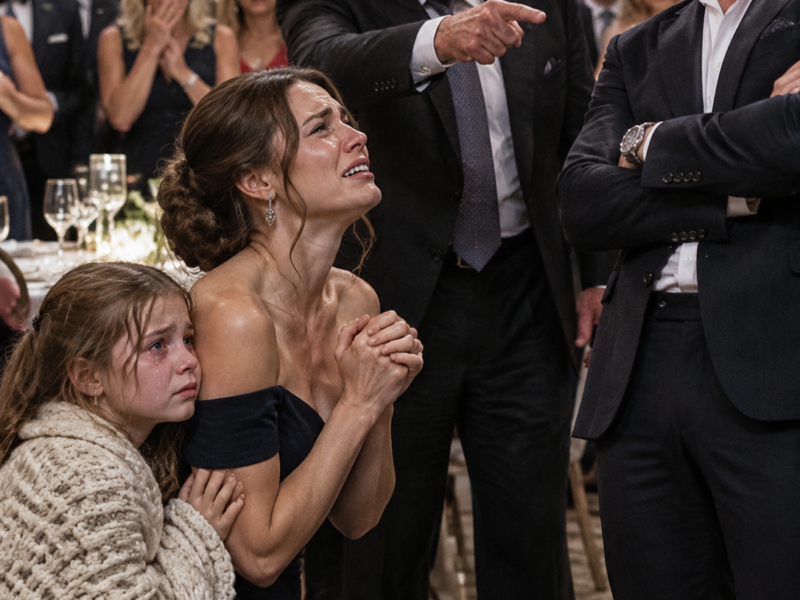
My 12-Year-Old Daughter Was Left Alone on a Frozen Highway at 16 Below Zero by My 39-Year-Old Brother, and When I Called My Parents, My Mother Said, “She Probably Deserved It.” I Thought My Family Had Simply Chosen to Protect Him Until My Pregnant Sister-in-Law Arrived With Screenshots of Their Secret Group Chat. Two Weeks Later, My Father Demanded I Apologize to My Brother in Front of 72 Guests at Their 40th Anniversary Party—But He Had No Idea What I Was About to Reveal.
My 12-Year-Old Daughter Was Left Alone on a Frozen Highway at 16 Below Zero by My 39-Year-Old Brother, and When I Called My Parents, My Mother Said, “She Probably Deserved It.” I Thought My Family Had Simply Chosen to Protect Him Until My Pregnant Sister-in-Law Arrived With Screenshots of Their Secret Group Chat. Two Weeks Later, My Father Demanded I Apologize to My Brother in Front of 72 Guests at Their 40th Anniversary Party—But He Had No Idea What I Was About to Reveal.
PART 1
My name is Andrea Hilliard. I’m 36 years old, and I’ve spent the last eleven years working in an emergency room. I’ve treated patients with broken bones, severe burns, cardiac arrests, and injuries so horrific that even experienced doctors needed a moment to collect themselves.
But nothing in my medical career prepared me for the phone call I received on a freezing Saturday night in November.
At 9:26 p.m., a Wisconsin State Patrol trooper called me and said six words that changed my family forever.
“Ms. Hilliard, I have your daughter.”
My twelve-year-old daughter, Maisie, had been left alone on the shoulder of Highway 97 by my own brother. The temperature was nine degrees below zero, and the wind made it feel like sixteen below. She had been standing there for approximately forty-one minutes when a passing truck driver found her.
She was wearing a sweatshirt, jeans, and canvas sneakers.
No winter coat. No gloves. No phone.
And when I eventually called my parents to tell them what their son had done, my mother responded with a sentence I will never forget.
“She probably deserved it.”
My father was even worse.
“Stop babying her, Andrea. You’ve done it for twelve years.”
I remember standing in the parking lot of a Quick Trip convenience store, listening to those words while my daughter sat in the passenger seat of my car, wrapped in a stranger’s horse blanket.
I remember looking at her little hands and noticing that the ends of her fingers had turned white.
And I remember realizing that the people I had spent nineteen years trying to please would never protect my child.
But to understand why that phone call mattered so much, you need to understand the Hilliard family.
My parents, Gene and Lorraine Hilliard, owned a dairy farm outside Athens, Wisconsin. The property covered 160 acres and had been in our family for generations. There were 210 cows, several old barns, and a wooden sign above the main entrance that my grandfather had painted in 1961.
My parents still repainted that sign every spring.
In our family, the farm wasn’t just a business. It was an identity. It was the reason my father believed his opinions mattered more than anyone else’s and the reason my mother considered loyalty more important than honesty.
I was the second child.
My older brother, Travis, was the golden one.
He stayed on the farm, learned the business, married a local woman, and eventually became the person my parents expected to inherit everything.
I left.
That decision had apparently been my greatest offense.
The real trouble started in October 2007, when I was seventeen.
My father had been drinking at the county fair. He insisted he was fine to drive, even though his blood alcohol level was eventually measured at 0.14.
Travis, who was twenty, sat in the passenger seat. I was in the back, holding a ribbon I had won at the 4-H tent.
We were driving home when Dad took a curve near Miller’s Creek too fast.
The truck rolled.
When everything stopped moving, Travis climbed out, swearing and shouting. My father remained slumped against the driver’s side window.
Something about his breathing frightened me.
His left shoulder was lower than his right, and his breaths were coming too quickly. I had a flip phone with two bars of reception.
So I called 911.
The ambulance arrived, my father was taken to the hospital, and a deputy began asking questions.
Dad had a broken collarbone. He also lost his commercial driver’s license for twelve months and, more importantly, the hauling contract with Foremost Farms.
That contract had been worth approximately $140,000 annually.
The following week, my mother served dinner and looked directly at me.
“Hilliards don’t call outsiders,” she said.
Nobody thanked me for getting help.
Nobody mentioned that my father could have died.
Instead, I became known as the daughter who had betrayed her own family.
They brought it up at Christmas. They brought it up when I got accepted into physician assistant school. They brought it up when I married Cal.
For nineteen years, I believed I had destroyed something that could never be repaired.
So I tried to compensate.
I paid for my own education, taking on $87,000 in student loans and working nights washing dishes at a restaurant called the Tipsy Cow.
In 2012, the same year I was struggling to pay tuition, my parents bought Travis an $84,000 John Deere tractor in cash.
“Travis is the one keeping the land,” my mother explained.
I didn’t argue.
I had learned that arguing with my family was considered worse than making a mistake.
I married Cal Brennan in 2013. He was an engineer at a paper mill, six-foot-four, and a man who rarely spoke more than forty words a day.
Twelve of those words were usually reserved for me.
Our daughter, Maisie, was born in 2014.
We bought a modest two-bedroom ranch in Wausau, about thirty-five minutes from my parents’ farm. It was close enough for me to help whenever they needed something, but far enough away that I could breathe.
And I helped constantly.
Every calving season, every hospital appointment for my father’s heart problems, every Thanksgiving, I showed up.
I brought pies, groceries, and sometimes even Narcan because one of my relatives always seemed to need it.
Travis, meanwhile, remained the farm’s golden child.
When milk prices collapsed in 2018, my parents refinanced their house to help him. When the barn roof needed replacing in 2021, they refinanced again.
By the autumn of 2026, the farm owed approximately $310,000. The bank wanted new terms by January 15.
Travis had married Kendra in 2019. She was thirty-four, a school nurse, and one of the steadiest people I had ever met.
Her parents owned eighty acres adjoining the Hilliard property. The farm leased that land, and without it, feeding two hundred cows would become considerably more difficult.
In other words, the farm’s survival depended less on Travis than my parents realized.
It depended on Kendra and her family.
But I didn’t know how important those eighty acres would become.
And neither did Travis.
On Saturday, November 21, I was scheduled for a twelve-hour emergency room shift.
Maisie was spending the day at the farm because she loved visiting her grandparents. She loved the calves, my mother’s kitchen, and the freedom of being twelve years old somewhere nobody constantly reminded her about screen time.
My mother was preparing pumpkin pies for Thanksgiving, and Maisie had been assigned the important responsibility of making the crust.
Travis was supposed to drive her home at eight.
Kendra was seven months pregnant and staying home because her ankles had become badly swollen.
At 8:06 p.m., Maisie sent me a text.
“Uncle T says we have to stop somewhere first.”
I was treating a man who had cut his forearm open on a band saw. He needed fourteen stitches, and I was holding a surgical instrument when the message arrived.
I didn’t answer.
I assumed Travis was taking her to pick something up.
At 8:30, the emergency room became quieter. I checked my phone and noticed the unanswered message.
I typed, “Where?”
There was no response.
At 8:50, I called her. It went straight to voicemail.
I finished signing out my last patient shortly after nine and walked toward the staff parking lot.
Then my phone rang.
It was an unfamiliar number.
“Ms. Hilliard? This is Trooper Halverson with Wisconsin State Patrol. I have your daughter. She’s safe.”
I had delivered that sentence to frightened parents many times during my career.
I knew exactly how much silence followed it.
But hearing it about my own child was different.
“Where is she?”
“Quick Trip in Edgar. You’ll want to bring a coat.”
I drove there in nineteen minutes, although the journey normally took twenty-five.
When I arrived, I saw a patrol cruiser and a large Peterbilt feed truck. Its engine was running, and the cab light was on.
Maisie was sitting inside.
She was wrapped in a heavy horse blanket, and a woman in her late sixties was sitting beside her.
The woman introduced herself as Ruth Ann Pruitt.
She explained that her husband, Dale, had spotted a little girl walking along the highway near mile marker 112.
His truck had a dash camera that recorded continuously for insurance purposes.
At 9:08, he had seen Maisie walking along the shoulder.
But the camera had also captured something much more important.
At 8:31, a red Silverado had pulled onto the shoulder, stopped, turned around, and driven away.
It was Travis’s truck.
Trooper Halverson explained that Maisie had been outside for approximately forty-one minutes.
Her original body temperature had been 95.2 degrees.
By the time I arrived, it had improved, and the emergency physician I consulted agreed that she could go home with careful monitoring.
Her fingertips showed signs of frostnip.
Not frostbite.
Not yet.
Ruth Ann had taken off her own dry wool socks and given them to my daughter because Maisie’s shoes and socks were soaked.
I knelt beside her.
“What happened, sweetheart?”
Maisie stared at the gray socks.
“Uncle Travis said I had to get out and think about it.”
“Think about what?”
She didn’t answer.
She simply looked at me and whispered, “Can we just go?”
I wrapped my navy wool coat around her, covering the horse blanket.
“It smells weird,” she murmured.
“That’s the emergency room.”
She leaned against me.
“It smells like you.”
I nearly broke down right there.
But I had one more call to make.
And I had no idea that, before I made it, my family had already decided what they would say.
PART 2
At 9:52 p.m., I called my parents.
My mother answered almost immediately.
“Travis left Maisie on Highway 97,” I told her. “A truck driver found her. She was outside for forty-one minutes.”
There was a four-second silence.
Then my mother said, “She probably deserved it. Travis said she mouthed off.”
My father took the phone.
“Stop babying her, Jeri. You’ve done it for twelve years.”
I told him it was nine degrees below zero.
He replied that he had spent longer outside feeding cows.
Then he hung up.
I sat in the parking lot, staring at my daughter.
Trooper Halverson approached and asked whether I knew where Travis was.
I told him I did.
He advised me not to enter the farmhouse until he arrived.
But I wasn’t going home.
I needed to look my parents in the eyes and hear them repeat what they had just said.
I drove to the farm.
And when Travis opened the door, he was already laughing.
“Still crying?”
I didn’t answer.
I asked for Maisie’s phone, backpack, and inhaler.
He demanded that I thank him for teaching her a lesson.
Then headlights flooded the driveway.
My husband had arrived.
And behind his truck, red and blue lights illuminated the farmhouse.
PART 3
Cal stepped out of his F-150 and walked toward the porch.
He didn’t run. He didn’t shout. He simply walked until he was standing beside me.
At six-foot-four, he was an imposing man, but that wasn’t what made the moment uncomfortable for my brother.
It was the fact that Cal hadn’t said a single word.
He had driven ninety minutes after hearing what happened to our daughter, and he was looking at Travis with an expression I had never seen before.
Then Trooper Halverson stepped out of his cruiser.
He adjusted his hat, walked toward the porch, and addressed my brother.
“Travis Hilliard? I need you to step outside, please.”
For the first time that night, Travis stopped smiling.
He looked toward my father.
My father looked at the patrol car.
My mother finally turned away from the kitchen sink.
Nobody looked at me.
Travis shook his head.
“You called the cops on family. Again?”
I almost laughed.
There it was.
Even with his twelve-year-old niece left on a freezing highway, he was still convinced that the problem was the person who reported it.
Trooper Halverson asked Travis to explain what had happened.
My brother claimed Maisie had jumped out of the truck at a stop sign.
The trooper calmly pointed out that there was no stop sign at mile marker 112.
Then he mentioned the dashcam footage showing Travis’s Silverado stopping on the highway shoulder before turning around and driving away.
Travis changed his story.
He said he had gone home to get Maisie a jacket and intended to return.
Halverson didn’t argue.
He simply walked toward the Silverado with a flashlight.
A few minutes later, he returned carrying Maisie’s backpack, inhaler, and phone.
He held up the phone.
“Her location was active. This device traveled twenty-two miles to this address after 8:30. It never returned to the highway.”
My brother looked at our father again.
This time, Dad was staring at the floor.
“You’ll receive a summons,” the trooper said. “And you are not to contact the child.”
My mother finally addressed me.
“Dree, you’re doing it again.”
I looked at her.
“Mom, I didn’t bring the police. I brought my daughter. The police came for your son.”
Then I picked up Maisie’s belongings and walked away.
Cal followed me to the car. He waited until I had driven out of the driveway before getting back into his truck.
He followed us all the way home.
Halfway through the drive, Maisie woke up.
She looked out the window for several minutes.
Then she whispered one word.
“Motel.”
I glanced at her.
“What did you say, sweetheart?”
She closed her eyes.
“Nothing.”
I didn’t ask again.
But that word stayed with me for the rest of the night.
The following morning, I took Maisie to her pediatrician. Her fingertips showed frostnip, but there was no tissue damage. We were instructed to keep her hands warm and monitor them over the next two weeks.
The doctor told me she was lucky.
I corrected him.
“She was found. That’s different.”
I spent the rest of Sunday checking her fingers, making breakfast, and trying to convince myself that the worst was over.
It wasn’t.
My mother called six times before noon.
Her voicemail sounded calm and reasonable, the way she spoke at church.
“Dree, call me back before this goes any further. We can still handle this as a family.”
I listened twice.
Then I put my phone down.
For nineteen years, I had always called back.
This time, I didn’t.
On Monday morning, my daughter’s school contacted me.
The woman at the front office explained that the school nurse hadn’t come in and nobody could reach her.
The nurse was Kendra, my brother’s pregnant wife.
Then the woman told me something surprising.
Kendra had listed me as her emergency contact.
Not Travis.
Me.
I promised to find her.
That afternoon, Trooper Halverson emailed me the incident report. It was eleven pages long.
I read every line.
The report confirmed the time Maisie had been abandoned, the weather conditions, and the clothing she had been wearing.
Forty-one minutes.
Sixteen degrees below zero with the wind.
No phone.
No gloves.
No hat.
I had worked in emergency medicine long enough to understand what those numbers meant.
People could die in less time.
I also noticed that I still had Ruth Ann’s gray wool socks.
I had washed them and folded them carefully, but I had no address where I could send them.
So I placed them on the hall table.
Every morning, Maisie walked past them.
And every morning, I wondered what my daughter had seen that night that she was too frightened to tell me.
On Tuesday, I drove to Athens to buy dog food.
The feed store was the only place that carried the brand our dog would eat.
Unfortunately, it was also next to a bakery owned by Marlis Koenig, a woman who had known me since I was a little girl.
She greeted me with sympathy.
“Dree, honey, I heard about Maisie.”
I stopped.
“What did you hear?”
“Lorraine said she jumped right out of Travis’s truck. Your mother is sick about the whole thing. She says you called the state patrol on your own brother.”
I bought two pastries and left.
By Tuesday afternoon, the story had spread throughout the community.
At the co-op, at church, and among the quilting guild, people were repeating the same version.
Maisie was difficult.
Travis had been disciplining her.
I had overreacted.
I had called the police on my own family.
My mother had managed to turn a child being abandoned on a frozen highway into a story about an unreasonable daughter.
But there was something else I discovered that evening.
Maisie was doing homework at our kitchen table when I asked whether Grandma had contacted her about Thanksgiving.
“Grandma doesn’t text me plans,” she said. “That’s in the farm chat. Grown-ups only.”
“What farm chat?”
She shrugged.
“Hilliard Farm. Uncle Travis, Grandma, Grandpa, and Aunt Kendra.”
I stared at her.
“Since when?”
“Forever, I guess.”
I later learned that the group chat had started in May 2019, the same month I stopped being invited to Sunday dinners.
I had assumed those dinners had simply ended.
Apparently, they hadn’t.
They had just stopped including me.
Wednesday morning brought another surprise.
My father walked into the emergency room where I worked.
He was wearing his church jacket, holding his cap, and accompanied by my uncle Ray.
They approached the triage desk at 10:20.
“Dree, we need five minutes,” Dad said.
I was working, so I took them into the hallway near the vending machines.
My father wasted no time.
“Travis could lose the farm over this.”
I looked at him.
“The trooper has the footage, Dad. I didn’t make a statement.”
“Then tell them it was a misunderstanding.”
“Which part?”
He didn’t answer.
Uncle Ray stepped forward.
“Be reasonable, Dree. He’s your brother.”
“She’s my daughter,” I replied.
My father’s jaw tightened.
“You’ve wanted to see Travis in trouble since you were seventeen.”
I called security.
I asked a young employee named Evan to escort them to the parking lot.
Before my father turned away, I said something I had wanted to say for nineteen years.
“You’re in my workplace. I’m not in yours. That’s the only courtesy I’m extending.”
He left without his cap.
I mailed it back that afternoon.
I thought that would be the end of it.
Then, at 9:40 that night, my phone lit up.
It was Kendra.
She sent one screenshot.
Then another.
Then three more.
And an hour later, she arrived at my house.
She was seven months pregnant, wearing a parka that barely zipped around her stomach.
She stood in my driveway holding her phone with both hands.
“Can I come in?”
Cal took her coat and put the kettle on.
That was his way of showing concern.
Kendra sat at our kitchen table and explained what she had discovered.
The night before, she had visited my mother’s house to drop off a casserole. She used the family iPad to check the local co-op’s opening hours.
The device was still logged into Travis’s Facebook account.
She had found messages between my brother and another woman.
The messages went back to September.
Kendra didn’t cry as she told me.
She simply looked exhausted.
Then she turned her phone toward me.
“This isn’t why I’m here,” she said. “I need you to see something else.”
On the screen was the family group chat.
The name at the top read Hilliard Farm.
There were four members.
Travis.
My mother.
My father.
And Kendra.
I wasn’t there.
Kendra scrolled to Saturday night.
The first message had been sent at 8:41 p.m.
Travis wrote:
“Dropped Mazie at 112. She needs to cool off. We’ll grab her in 20.”
My mother replied two minutes later.
“Let her walk a bit. Dre needs to learn, too.”
At 8:44, my father responded with a thumbs-up.
Then, at 9:05, Travis wrote:
“Heading home. She’ll call Dre.”
At 9:20, my mother sent one final message.
“Don’t answer if Dre calls tonight.”
I read the messages three times.
Suddenly, everything made sense.
My mother’s four-second silence on the phone hadn’t been confusion.
She had known for seventy-one minutes.
She had known exactly where Maisie was.
She had known that Travis had abandoned her.
And she had already decided what to say when I called.
“She probably deserved it.”
That wasn’t a spontaneous reaction.
It was a prepared response.
My father hadn’t simply agreed with Travis.
He had approved the plan.
Kendra explained that she had been asleep when the messages were sent. She hadn’t read the chat until Sunday morning, after the trooper had already arrived at the farmhouse.
“I sent everything to Halverson before coming here,” she said.
I looked at her.
“Why?”
She glanced toward the hallway where Maisie’s bedroom was.
“Because she’s twelve. And I’m about to have a baby. I need to know what kind of family I’m bringing my child into.”
Then she asked whether she could spend Thanksgiving with us.
I said yes.
For the first time in thirty-six years, I didn’t spend Thanksgiving at the Hilliard farm.
There was no pumpkin pie from my mother’s kitchen. No relatives asking me to bring extra groceries. No one needing help with medication.
Instead, we had fried chicken, instant mashed potatoes, and green bean casserole.
There were four people at our table.
Cal.
Maisie.
Kendra.
And me.
My mother posted a photograph of the farmhouse dining room that afternoon.
Fourteen people sat around the long table.
At the far end was an empty chair.
It had been set with a plate, fork, and folded napkin.
My chair.
Maisie noticed it before I did.
“Grandma left your chair,” she said.
“Yes.”
“She didn’t ask you to come.”
“No.”
“Then why did she set it?”
I thought about that question.
“Grandma’s good at pictures,” I answered.
Maisie looked at the photograph for another moment.
Then she said, “The napkin’s folded wrong. You always make the triangle.”
She returned to her chicken.
I knew then that she understood more than I had wanted her to.
On Friday, an invitation arrived in my mailbox.
It was for my parents’ fortieth wedding anniversary.
December 5.
Saint Agnes Parish Hall.
Five in the evening.
On the back, my mother had written a condition.
“Dree, come as family. We’ll put this behind us if you tell the DA it was a family matter. Travis will give a toast. Bring Maisie. People will ask about her.”
I read it twice.
Then I placed the invitation beside Ruth Ann’s gray socks.
That night, my mother called.
“Did you get the card?”
“I did.”
“Then you understand. Everybody will be there. The Koenigs, the Schmidts, Father Dan, Ray’s whole family.”
She paused.
“If you don’t come, the whole county will understand that you chose outsiders over your own blood.”
I almost laughed.
“The county already knows, Mom. You told them.”
She became quiet.
Then she softened her voice.
“We can forgive you, Dree. Can you forgive yourself for what you’re doing to your brother?”
I didn’t answer.
I told her I would think about it.
For the first time in my life, I ended the call before she did.
That night, Kendra texted me.
“I’m going, and I need you there. Not for them. For what I’m going to say.”
I replied with one word.
“Okay.”
I still didn’t know what she planned to announce.
But I knew she had earned the right to say it.
PART 4
Maisie’s first therapy appointment was on Monday, November 30.
Her therapist, Dr. Ostrander, had an office above a bookstore. There was a bowl of strawberry candies on the reception desk, the kind nobody seemed to buy anymore.
Maisie asked if she could wear my navy wool coat.
It was the same coat I had wrapped around her on the night she was found.
The sleeves extended several inches past her hands, but she rolled them twice and wore it anyway.
I didn’t ask what she discussed during her appointment.
Even though I was a medical professional, I understood that some things needed to remain private.
Three blocks from home, Maisie finally spoke.
“I was scared to tell.”
I kept my eyes on the road.
“Tell me what?”
“Uncle Travis said if I told Aunt Kendra, the baby wouldn’t have a dad. He said it would be my fault.”
I felt my hands tighten around the steering wheel.
I wanted to turn the car around and drive straight to the farmhouse.
Instead, I took a breath.
“That’s not how fault works, sweetheart.”
“I know. Dr. Ostrander said that too.”
“Then you’ve got two of us.”
She was quiet until we reached our driveway.
Then she asked the question I had been afraid she would eventually ask.
“If I tell the truth, will Grandma say I deserved it again?”
I turned off the engine.
“She might,” I answered honestly. “And she’ll be wrong again.”
Maisie nodded.
She didn’t take off my coat when we went inside.
She wore it through dinner.
The following evening, Travis appeared on our porch.
He had no beer in his hand and no smile on his face.
I spoke to him through the storm door without unlocking it.
“Kendra’s been at her mother’s for two nights,” he said.
“What did you say to her?”
“Nothing.”
“The group chat said enough.”
He looked confused, as if he couldn’t understand how written messages could become evidence.
Then he started talking about the farm.
“If Kendra’s father pulls the lease on those eighty acres, the bank takes everything in January. That’s Grandpa’s barn. That’s Dad’s whole life.”
I watched him.
He had driven twenty-two miles in the wrong direction after leaving my daughter on the highway. He had left her without a coat, without a phone, and without her inhaler.
Yet here he was, worried about acreage.
“Travis, I want my daughter to stop checking the weather before she gets into a car. That’s what I want.”
He rolled his eyes.
“She’s dramatic. She gets it from you.”
I told him to leave.
He stepped backward.
For one brief moment, I saw the brother who had taught me to drive a manual transmission in the north pasture.
Then the expression disappeared.
“You’ll regret this at the party,” he said. “Dad’s got something planned.”
He walked to his Silverado.
I watched him drive away.
Then I locked both doors.
Something about his final sentence bothered me.
I didn’t understand what he meant until Wednesday morning.
The district attorney’s office contacted me and requested that Maisie come in.
Assistant District Attorney Priya Nolan had been reviewing the evidence.
There was the dashcam footage from Dale Pruitt’s truck.
There was Trooper Halverson’s report.
There was Maisie’s phone location data.
There were the screenshots from the family group chat.
And there were the emergency medical records documenting her low body temperature and frostnip.
Priya explained that she already had enough evidence to pursue charges.
But there was one question.
“Do you know why Travis did it?”
I shook my head.
“I know he was angry.”
“Was there anything your daughter might have witnessed?”
I looked toward the waiting area, where Maisie was sitting beside Cal.
“I won’t force her to talk.”
“I’m not asking you to.”
Priya invited Maisie into the office.
My daughter walked in carrying her backpack.
She sat beside me, unzipped the front pocket, and removed Ruth Ann’s gray wool socks.
She placed them on the desk.
“If somebody says I made it up,” she explained, “I have these.”
Priya looked at the socks.
Then she moved her legal pad aside.
“Nobody in this office thinks you made it up.”
She told Maisie that she could speak if she wanted to, but she didn’t have to.
I nodded gently.
Maisie took a breath.
Then she began.
At approximately 8:05 p.m. on Saturday, Travis had driven into the parking lot of the Motel Northwoods on Highway 97.
He told Maisie to stay inside the truck.
She watched him walk toward a gray Jeep parked underneath the motel sign.
A woman with red hair got out.
Travis kissed her.
They stood together for approximately twenty minutes.
Then he returned to the Silverado.
He didn’t explain anything.
Maisie, however, had seen enough to understand that something was wrong.
She confronted him.
“I’m going to tell Aunt Kendra.”
Travis laughed.
Then he drove away.
At mile marker 112, he pulled onto the shoulder and told Maisie to get out.
“Think about whether you want Aunt Kendra’s baby to have a dad,” he said.
Then he drove away.
I sat completely still.
My brother hadn’t abandoned a child because she was disrespectful.
He had abandoned a witness.
A twelve-year-old girl who had seen him with another woman and threatened to tell his pregnant wife.
He had used the safety of a child as a weapon to protect his secret.
Priya asked whether Maisie remembered anything about the woman’s vehicle.
Maisie thought for a moment.
“The license plate ended in 417.”
She explained that she counted license plates whenever she was frightened.
Priya wrote the numbers on a sticky note.
I looked at my daughter.
She had remembered that detail while standing alone in freezing temperatures.
I had spent nineteen years believing I was the person in my family who made everything worse by telling the truth.
Now my daughter had inherited the same accusation.
And she had been punished for it.
When the meeting ended, Priya told us the new information would significantly affect the case.
That night, Cal and I sat on the back steps.
Maisie was asleep inside.
The dog lay between us.
Cal asked whether I intended to attend the anniversary party.
I didn’t answer immediately.
Instead, I told him something I had never explained during our thirteen years of marriage.
I told him about the accident in 2007.
I described the truck lying on its side, the smell of gasoline, and Travis climbing out of the wreckage.
I told him about my father slumped against the window.
I had been seventeen.
I wasn’t crying.
I was counting.
I remembered counting my father’s breaths.
Twenty-eight per minute.
Shallow.
Too fast.
I didn’t know the medical terminology at the time, but I knew something was wrong.
So I called 911.
For nineteen years, my family had described that moment as the day I betrayed them.
They never understood that I had been trying to save someone’s life.
Cal listened without interrupting.
When I finished, he was quiet for a long time.
Then he said something simple.
“Then go count in front of them.”
I decided I would attend.
Not for my parents.
Not for Travis.
I would go for Kendra, because she shouldn’t have to stand alone.
And I would go because there were two numbers I wanted everyone to hear.
Twelve.
And thirty-nine.
Kendra came to my house the following Wednesday.
She had visited a lawyer in Marshfield who specialized in farm families.
She explained that the eighty acres belonged to her parents, and the lease with Hilliard Dairy was renewed annually.
It would expire on December 31.
Her father had already decided not to renew it.
He had heard about the incident involving Maisie and didn’t want his property connected to a family that treated children that way.
Kendra had also filed for legal separation.
She was seven months pregnant, and her baby was due January 28.
Then she asked me something unexpected.
“I want you in the delivery room.”
I stared at her.
“Me?”
“Not Lorraine. Not my mother. You.”
I reminded her that I had helped deliver only three babies during my career, all in emergency situations.
She smiled faintly.
“That’s three more than Lorraine.”
Then she said something that stayed with me.
“They said you break families. You’re the only one who called when mine was on the side of the road.”
I agreed.
Of course I agreed.
For years, my parents had treated me like an outsider.
But apparently, I was going to be the person standing beside the next generation when she entered the world.
On Thursday, December 3, Priya called again.
Travis had been formally charged with child endangerment and abandonment of a child.
The possible combined sentence was three and a half years.
The local newspaper published a brief article.
An Athens man had been charged after allegedly leaving a child on Highway 97 for forty-one minutes in dangerously cold weather.
My brother’s name appeared in print.
The calls began immediately.
My parents called eleven times before seven that evening.
I didn’t answer.
My father left a voicemail.
“You wanted this since you were seventeen. You’ve got it. I hope you can sleep.”
I listened to the entire message.
Then I deleted it.
And I slept just fine.
On Friday morning, I called my mother.
“Is the party still happening?”
“Of course,” she answered. “People are coming. We’ll show them we’re fine.”
I told her I would attend.
She sounded pleased.
She believed she had won.
That evening, my father waited outside the emergency room staff entrance.
He didn’t come inside this time.
He stood beside his truck wearing his old barn coat.
“Tomorrow,” he said, “you’ll apologize to Travis in front of everybody.”
“For what?”
“For the police. For the newspaper. For making this family look like trash.”
I waited.
He explained that the banker, Mr. Hansen, read the local newspaper.
If everyone saw the family together at the anniversary celebration, perhaps the bank would agree to extend the loan.
He wanted a photograph.
That was all.
“Dad, Hansen reads the court docket, not the seating chart.”
He ignored me.
“You owe this family one time you don’t call. Nineteen years ago, you picked up that phone, and we lost the contract. You’ve never apologized.”
I looked at my father.
He was sixty-seven years old, still a large man who expected everyone to move when he entered a room.
But now he was standing in a hospital parking lot asking his daughter to lie for a photograph.
“I’ll come,” I said.
“I won’t lie.”
He heard only the first sentence.
“Good girl.”
He drove away smiling.
It was the last time I would see him smile in a room where I was present.
PART 5
Saturday, December 5, arrived.
My parents’ fortieth wedding anniversary celebration was scheduled for five o’clock at Saint Agnes Parish Hall.
Maisie stayed with Cal’s mother, Nora, who was sixty-six and made grilled cheese sandwiches as though they were sacred family traditions.
Before we left, Maisie asked whether she could keep my navy wool coat for the evening.
I said yes.
She curled up on Nora’s couch with the coat covering her legs and watched a baking show.
I wore my black work blazer.
Cal drove.
Kendra followed in her own car because she wanted the freedom to leave whenever she decided.
She carried her legal separation papers and a copy of the lease agreement.
I asked Cal whether he wanted to say anything if things became uncomfortable.
He shook his head.
“Do you need me to say anything?”
“No. I need you to stand.”
He nodded.
That was something he could do.
On the drive, I kept repeating two numbers in my head.
Twelve.
Thirty-nine.
I had decided that those were the only numbers I needed to say.
The parish hall was already crowded when we arrived at 5:04.
I counted seventy-two chairs.
There were folding tables covered with white cloths, a large photograph of my parents’ 1986 wedding, and a receiving line near the entrance.
My mother greeted me with a hug.
She held it longer than usual.
Then she whispered into my ear.
“Smile.”
I didn’t.
But I didn’t pull away, either.
She wanted a photograph.
I allowed her to have the hug.
Travis approached Cal and extended his hand.
Cal shook it.
No squeezing.
No unnecessary hostility.
Just an ordinary handshake.
My brother walked away faster than he had approached.
Our table was number six, near the kitchen entrance.
Across from me sat Ruth Ann Pruitt.
She was wearing a cardigan with a small quilted pin.
She had been part of the Saint Agnes Guild for fourteen years.
She had known my mother that entire time.
But she didn’t recognize me.
The night she found Maisie, it had been dark. I had been wearing a winter hat, and most of her attention had been focused on keeping my daughter warm.
I had never properly introduced myself.
Ruth Ann began talking to the woman beside her.
“Such a week,” she said.
Then she turned toward me.
“Lorraine’s granddaughter jumped out of a truck on the highway. Same week Dale and I found that poor girl on Highway 97. Two children in one week. Can you imagine?”
I looked at her.
“Did Lorraine ask who found her granddaughter?”
Ruth Ann frowned.
“No. Come to think of it, she never asked.”
I sat quietly.
My mother had told the entire county a story about Maisie.
But she had never once asked who had saved her.
Dinner began.
They served salad and then ham.
Travis sat at the head table beside my father.
There was an empty chair on his other side.
Kendra was supposed to be sitting there.
She wasn’t.
Instead, she sat at table four.
Before the plates were cleared, she stood.
She didn’t take the microphone.
She didn’t need it.
She was seven months pregnant, wearing a navy dress, and holding the back of her chair for support.
“Before Travis gives his toast, I want everyone to know something.”
The room became quiet.
“I’m not going home with him tonight. I filed for legal separation on Wednesday.”
My father stared at her.
Kendra continued.
“My father has sent written notice that he won’t renew the lease on the eighty acres. I’m saying this here so nobody can claim I did it behind his back. I’m not going to explain why. The court will explain why.”
Then she sat down.
Seventy-two people remained silent.
My mother stood.
“Kendra, honey, you’re emotional. It’s the hormones.”
Kendra looked directly at her.
“I’m a school nurse, Lorraine. I know what emotional looks like.”
A few people lowered their heads.
Travis stood up anyway.
He picked up his glass.
He had clearly rehearsed his speech.
“Forty years,” he began.
He looked toward my parents’ wedding photograph.
“Mom and Dad taught us one thing. Hilliards don’t leave anybody behind.”
He paused.
“This family’s group chat is lit up every single night. We show up for each other.”
Then he turned toward me.
“Some people in this family think calling outsiders is strength. I don’t.”
He raised his glass.
“Tonight, I’m hoping my sister can say one thing. Sorry. In front of all of you. So this family can heal.”
My father stood and took the microphone.
“Dree. Come up here. Say it.”
Uncle Ray started clapping.
A few others joined him.
My mother nodded from the head table.
I stood.
Cal stood half a second later, remaining beside our table.
I walked toward the front.
Past table four.
Past Kendra.
Past the enlarged wedding photograph.
I stopped beside my father.
He held the microphone toward me.
I didn’t take it.
I didn’t need it.
I had spent eleven years speaking to frightened patients and their families. I knew how to make myself heard without shouting.
“Two numbers,” I said.
The room became completely silent.
I looked around until I had everyone’s attention.
“Twelve.”
I paused.
“That’s my daughter.”
Then I looked at Travis.
“Thirty-nine. That’s my brother.”
I let the numbers settle.
I counted four seconds.
The same four seconds my mother had taken before telling me that Maisie deserved what happened.
Then I continued.
“She was outside for forty-one minutes. The wind chill was sixteen below. My brother drove twenty-two miles in the other direction.”
I stopped.
That was all I had planned to say.
My father stared at me.
“That’s not an apology.”
“No,” I answered.
“It’s the weather report.”
Someone at table two carefully put down a fork.
Then my mother stood.
Her napkin was clenched in one hand.
“She probably deserved it!”
Her voice carried across the room.
“She mouthed off to her uncle. Travis was teaching her. You’ve made a federal case out of a child being disciplined, Dree. You’ve dragged this family through the mud.”
I looked at her.
I repeated her words slowly.
“She probably deserved it.”
Then I continued.
“You said that at 9:52 that night.”
My mother’s expression changed.
“You weren’t in that chat,” she snapped.
“No,” I said. “I wasn’t. That’s how I know.”
Nobody understood what I meant.
Not yet.
Then Ruth Ann stood up at table six.
She was sixty-eight years old.
Her hands trembled slightly, but her voice carried.
“Lorraine.”
My mother turned.
“Forty-one minutes. Sixteen below. That was the girl on Highway 97. That was your granddaughter.”
My mother didn’t move.
Ruth Ann continued.
“Dale and I found her. She was wearing a sweatshirt. No coat. No gloves.”
She looked down at her hands.
“I gave her my socks.”
Nobody spoke.
“I’ve known you for fourteen years, Lorraine. Fourteen years in the guild. And you never once asked who picked up your grandbaby.”
My mother stared at Ruth Ann.
For the first time in my entire life, I saw her without a prepared response.
She didn’t have one.
Her napkin slipped from her fingers and landed on her plate.
My father reached for the microphone.
He couldn’t find the words.
Travis spoke first.
“You’re destroying this family!”
His face was red.
He was holding his glass so tightly that the liquid inside trembled.
“Three generations! Grandpa’s barn! I’ve got a baby coming! And you want me in jail so you can be right about something from when you were seventeen!”
He began crying.
Real tears.
He wiped his face with the back of his wrist.
But I noticed something.
He wasn’t crying for Maisie.
He was crying for the farm, the bank, the baby, and himself.
In that order.
Cal stepped forward once.
Not toward Travis.
Just enough to stand between my brother and the rest of the room.
Travis stepped back.
I looked at him.
“Two weeks ago, you asked me if I was still crying.”
He didn’t answer.
“Look around the room, Travis. Count who is.”
He looked.
Kendra wasn’t crying.
Ruth Ann wasn’t crying.
I wasn’t crying.
He was.
My mother had started, too.
Then she leaned toward me.
Her voice became small.
It was the only honest thing she said that evening.
“I just wanted this house to keep standing.”
I looked at her.
“It’s still standing, Mom. You’re just not in it with me anymore.”
I turned toward the room.
Seventy-two people.
The Koenigs, the Schmidts, Father Dan, Uncle Ray, and everyone else who had come to celebrate my parents’ marriage.
Nobody clapped.
Nobody needed to.
I walked back to table six and picked up my purse.
Ruth Ann was still standing.
I stopped beside her.
“I still have your socks,” I said. “Maisie won’t give them back.”
Ruth Ann smiled sadly.
“Keep them. She earned them.”
Kendra picked up her bag and walked toward the door.
Cal was already there, holding it open.
Cold air rushed into the hall.
The temperature had dropped to twelve below.
I didn’t have my coat.
It was in Wausau, covering my twelve-year-old daughter.
Behind me, my father said my name.
Once.
Not into the microphone.
I didn’t turn around.
I didn’t slam the door.
I simply walked out.
For my family, that was probably the loudest thing I had ever done.
The legal consequences came quickly.
On January 14, Travis accepted a plea agreement.
The charges were reduced, but he still received eighteen months of probation, sixty days in county jail served on weekends, one hundred hours of community service, and mandatory parenting classes.
He also received a five-year no-contact order involving Maisie.
Priya Nolan called me personally.
She explained that the group chat screenshots had played a significant role in the case.
The messages showed that my parents and brother had known exactly what happened and had deliberately chosen not to respond.
The evidence was difficult to dismiss.
On January 15, the bank declined to refinance the farm.
The letter cited the loss of leased acreage and reduced cash flow.
It did not mention the anniversary party.
It did not mention the photographs.
It certainly didn’t care whether the family had shaken hands in front of seventy-two people.
By March, my parents had listed sixty acres on the north side of the property for sale.
The herd was reduced from 210 cows to 140.
My father, now sixty-seven, had to return to morning milking.
The eighty-acre lease ended on New Year’s Day.
Meanwhile, Kendra gave birth to a baby girl on January 28 at 3:50 in the morning.
She weighed exactly seven pounds.
I was in the delivery room.
When the baby arrived, I instinctively began counting her breaths.
They were perfect.
Kendra named her June.
She told me she hadn’t named her after anyone.
That was the point.
She wanted her daughter to begin her life without carrying the weight of old family expectations.
The Hilliard Farm group chat eventually had only three members.
Kendra showed me the day she left it.
My mother sent me a handwritten letter in February.
I read it once.
It contained the word misunderstanding four times.
It contained no apology.
I placed it in a drawer with Maisie’s old report cards.
I haven’t blocked my parents’ house number.
I simply don’t answer anymore.
There is a difference, and I understand it now.
Maisie completed eleven therapy sessions with Dr. Ostrander.
By March, she had stopped asking me to leave the hallway light on at night.
She still counted license plates whenever she was nervous.
She said it was a good habit.
Ruth Ann’s gray socks remained in her top drawer.
And my navy wool coat, the one I bought while struggling through physician assistant school, now hangs in Maisie’s closet.
She asked if she could keep it.
I said yes.
Sometimes, when she wears it, the sleeves still cover her fingers.
She doesn’t seem to mind.
One evening, several months after everything happened, she came into the kitchen while I was preparing dinner.
She stood beside me for a moment.
Then she asked, “Mom, do you think Grandma knows what she did?”
I put down the knife.
“I think she knows what happened.”
“That’s not the same thing.”
“No,” I answered. “It isn’t.”
Maisie thought about that.
Then she went back to her room.
I don’t know whether my parents will ever understand what they did.
I don’t know whether Travis will ever accept responsibility without blaming somebody else.
And I don’t know whether the farm will survive another winter.
But I know something I didn’t know before November 21.
The person who calls for help isn’t the person who breaks a family.
The person who breaks it is the one who creates the emergency, watches someone suffer, and then asks why anyone dared to call for help.
For nineteen years, I believed I was the daughter who had destroyed everything by picking up a phone.
I spent my adult life apologizing for saving my father’s life.
Then my brother left my daughter on a frozen highway, and my parents showed me exactly what their version of family loyalty was worth.
Forty-one minutes.
One pair of gray wool socks.
A twelve-year-old girl who refused to let a lie become the truth.
And a group chat I was never invited into.
I used to believe that being a good daughter meant keeping the peace.
Now I understand that sometimes being a good mother means allowing the peace to disappear.
Because the people who truly love you will never ask you to sacrifice your child’s safety to protect their reputation.
And if your family has given you a nickname like the dramatic one, the sensitive one, or the person who always makes everything a crisis, perhaps you should ask yourself one question.
Who benefits from you believing that?
I spent nineteen years thinking I was the problem.
It took one freezing night for me to finally understand that I wasn’t.
I was simply the only one willing to make the call.