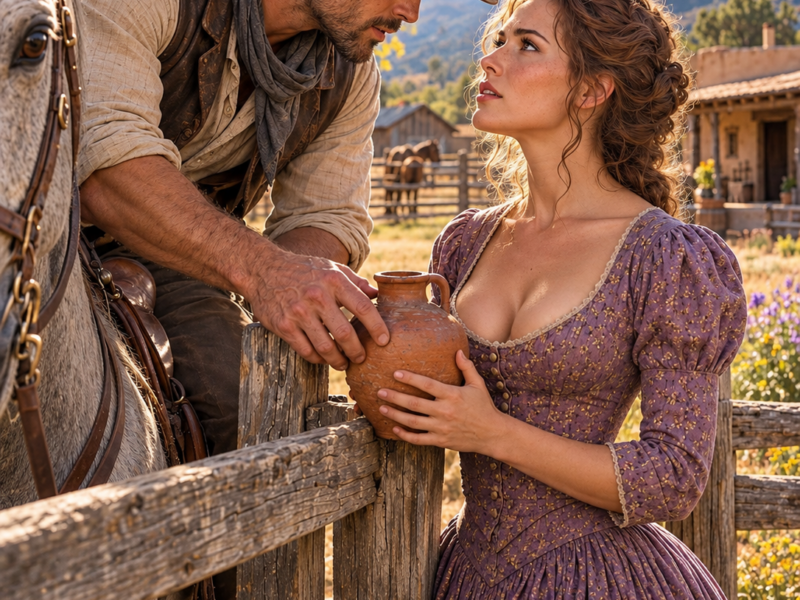
“I’m Not Asking You to Love Me… Just Give Me a Baby, Then Walk Away,” She Whispered to the Stranger
“I’m Not Asking You to Love Me… Just Give Me a Baby, Then Walk Away,” She Whispered to the Stranger
PART 1
Eleanor Price knew Silas Ror intended to destroy her before he had even finished folding the contract.
“If you refuse this offer,” he said, resting one hand on the wooden rail of the livestock yard, “don’t expect my buyers to make room for your cattle when spring comes.”
Eleanor looked down at the document in his hand. The offer was written in neat, expensive ink, with figures that might have seemed generous to someone who didn’t understand what was being taken from them.
But Eleanor understood perfectly.
Ror wasn’t interested in helping her ranch survive another season. He wanted her water rights, particularly the portion of the irrigation allotment that had belonged to the Price family for three generations. That water flowed from the Eastern Hills through a narrow ditch that supplied several ranches before reaching her land.
Without it, the Price Ranch would eventually become nothing more than dry pasture and memories.
And Ror knew it.
He already controlled several cattle buyers, grazing agreements, and freight contracts throughout the valley. Smaller ranchers had learned that disagreeing with him could become an expensive habit. Now he wanted Eleanor’s water, and he had decided that threatening her livelihood would be enough to make her surrender.
She took the contract from his hand.
For a moment, Ror smiled as though the matter had been settled.
Then Eleanor tore the paper straight down the middle.
The sound was small, but it seemed to travel across the entire livestock yard.
Men near the corrals stopped talking. A horse stamped against the dirt. Somewhere beyond the freight shed, a wagon rattled over uneven ground.
Ror stared at the two halves in her hand.
“You’re making an expensive point, Mrs. Price.”
“I’m keeping my water.”
“Everybody sells eventually.”
“Then you can ask everybody.”
She dropped the torn pieces onto the rail and walked away before he could answer.
Eleanor had learned a long time ago that certain men considered the final word their natural possession. She had no intention of helping them keep it.
Near the freight shed, a stranger was kneeling beside a wagon wheel. He had broad shoulders, dark hair beneath a battered hat, and a short beard that made him look older than he probably was. His sleeves were rolled above his forearms, revealing hands marked by years of honest work.
He had witnessed the exchange.
When Eleanor caught him looking, he returned his attention to the wheel.
For some reason, that irritated her more than if he had openly stared.
She had no interest in becoming the day’s entertainment.
By sundown, however, she had hired him.
The loading ramp at the Price Ranch had developed a dangerous lean after one of its supporting beams split. Spring cattle shipments were approaching, and Eleanor refused to wait until a problem became an emergency.
The stranger inspected the damage without immediately touching anything.
“The whole beam needs replacing,” he finally said.
“I can see that.”
“Then why ask me?”
“To find out whether you could.”
One corner of his mouth shifted.
“Daniel Mercer.”
“Eleanor Price.”
“I know.”
“Small town?”
“Smaller when people gossip.”
He removed his hat, examined the underside of the ramp, and pointed toward a cracked support.
“You’ve been standing on that for three years.”
Eleanor folded her arms.
“Mr. Mercer, I built half this ramp with my husband.”
“Then your husband should have replaced that brace.”
Her expression hardened.
Daniel crouched and pressed two fingers against the split wood.
“One hard sideways load, and this gives way. I’m not saying you can’t lift timber, Mrs. Price. I’m saying timber doesn’t care how capable you are.”
She stared at the damaged support.
She had missed it.
That annoyed her, too.
“Replace it,” she said.
For the next three days, Daniel worked beneath the New Mexico sun.
Eleanor watched him without appearing to watch. He measured everything twice, wasted no motion, and never raised his voice when someone made a mistake.
When Tom Alvarez, her ranch foreman, offered to hold a beam at an awkward angle, Daniel stopped him before he lifted it.
“Move the support first. You break your back trying to save five minutes, and nobody gets paid.”
Tom laughed.
“You always this cheerful?”
“Only when people insist on making easy work difficult.”
Eleanor heard the exchange from the barn and almost smiled.
On the second afternoon, a freight foreman rode out carrying payment for an earlier job Daniel had completed in town.
He counted the coins into Daniel’s palm, then added two more.
“These are extra,” the man said quietly. “Call it thanks for keeping quiet about Ruiz.”
Daniel looked at the money.
“These aren’t mine.”
The foreman lowered his voice.
“Ruiz broke a coupling. He cost us money.”
“The coupling was rotten. You withheld three days of his wages.”
“Mind your own trade, Mercer.”
“I am.”
Daniel stepped forward and dropped the extra coins into the man’s shirt pocket.
The foreman’s face tightened.
“You’ll regret making enemies.”
“Only if I start needing their approval.”
The man rode away angrily.
Eleanor had been repairing a harness about fifteen feet away. She watched Daniel return to his hammer.
“You always make earning money that difficult?”
“Only dishonest money.”
“That must be inconvenient.”
“Usually is.”
It was the first time Eleanor had wondered whether the stranger’s stubbornness was something other than pride.
By the fourth evening, the ramp stood level again.
Daniel tested every joint, gathered his tools, and followed Eleanor toward the irrigation ditch to wash the sawdust from his hands.
At the headgate stood a narrow wooden measuring board marked with dozens of knife cuts. Numbers had been carved beside the lines, recording the water levels across different seasons.
“My father started measuring here,” Eleanor explained. “I’ve continued the practice.”
Daniel studied the markings.
“Why?”
“So I know exactly what I have.”
He washed his hands in the cold water.
“That’s a useful habit.”
Eleanor glanced toward him.
She had spent three days studying the man. She had noticed how he worked, how he treated Tom, how he spoke when nobody important was listening, and how easily he had returned money he could have kept.
She also knew he was leaving Las Palomas in a few weeks.
He had mentioned it casually while repairing the ramp.
No family was waiting for him. No permanent work had been arranged. He intended to head west when his current obligations were finished.
Eleanor had considered her next words throughout the afternoon.
She was thirty-five years old. She owned the ranch, controlled her finances, and had spent nearly six years learning how to live without a husband.
Her first marriage had taught her that love could slowly become something she no longer recognized.
She didn’t want to repeat that mistake.
But there was something she wanted more than she had ever admitted aloud.
A child.
She turned toward Daniel.
“I want to ask you something.”
He dried his hands against his trousers.
“Go ahead.”
“You may think poorly of me afterward.”
“I can manage my own opinions.”
“Good.”
She placed one hand against the measuring board.
“I’m thirty-five. I own this ranch. I can support myself. I don’t need another man deciding when I sell cattle, where I keep my money, whose name belongs on my land, or whether my judgment counts inside my own house.”
Daniel listened without interrupting.
“I also want a child.”
The water moved between them.
Daniel became very still.
Eleanor forced herself to continue before embarrassment could steal her courage.
“I’m not asking you to love me. I’m not asking you to marry me. I’m asking you for something very specific.”
His eyes remained fixed on hers.
“Just give me a baby,” she whispered, “then walk away.”
For several seconds, neither spoke.
A meadowlark called somewhere beyond the ditch.
Eleanor had prepared herself for shock, laughter, perhaps even disgust. She had expected Daniel to ask whether she had lost her senses.
Instead, he removed his hat.
“What exactly are you asking me to become?”
“Nothing. You would owe me nothing. I wouldn’t ask for money, and I wouldn’t follow you wherever you went afterward.”
Daniel looked toward the flowing water.
“And what would I be to the child?”
“Nothing.”
The answer sounded firm in her mind, but considerably less convincing when spoken aloud.
Daniel looked at her again.
“Then no.”
Heat climbed Eleanor’s neck.
“You could have simply said that.”
“I just did.”
“Are you judging me?”
“No.”
His answer came immediately.
“That would be easier.”
Eleanor frowned.
Daniel picked up his tool bag.
“A man can leave a woman who tells him plainly she wants him gone. But I won’t deliberately help bring a child into the world and decide before that child takes its first breath that I’m already gone.”
She stared at him.
For the first time in years, Eleanor Price had no prepared answer.
Daniel walked toward the ranchyard.
Behind her, water climbed against the measuring board to exactly four and three-quarter inches.
For once, the number told her nothing.
His refusal should have ended the matter.
Instead, it followed her everywhere.
It followed her into the barn while she checked the tack, across the southern pasture while she counted calves, and back to the irrigation gate every morning.
Four and a half inches.
Four and three-eighths.
Four and one-quarter.
Numbers behaved.
People did not.
Two days after Daniel finished the loading ramp, Eleanor rode into Las Palomas to buy flour, lamp oil, and a replacement pulley.
She found him outside the wagon shop.
And standing directly in front of him was Silas Ror.
This time, Ror wasn’t threatening Eleanor.
He was making Daniel an offer.
“Six wagons,” Ror said, holding out a folded contract. “Freight repairs through summer. Better money than you’ll find anywhere between here and Santa Fe.”
Daniel wiped grease from his fingers.
“There’s a condition.”
Ror smiled.
“One.”
“You don’t work for Price again.”
Daniel looked at the contract, then at Ror.
“Why do you care who fixes her ramp?”
“I care where my money goes.”
“Then keep it.”
Ror’s smile disappeared.
Eleanor dismounted before either man noticed her.
“You’ve got a remarkable talent for making foolish financial decisions,” she told Daniel.
He glanced toward her.
“So I’ve been told.”
Ror looked between them.
“Careful, Mercer. A man can confuse stubbornness with virtue.”
Daniel shrugged.
“And a rich man can confuse leverage with respect.”
Ror folded the contract into exact quarters and slipped it into his coat.
Then he walked away.
Eleanor waited until he disappeared around the corner.
“You turned down months of work because of me?”
“No.”
“Don’t insult me.”
“I turned it down because I don’t let another man decide which customers I’m allowed to serve.”
“That sounds convenient.”
“It wasn’t.”
Eleanor dismounted.
“I can reimburse you.”
Daniel looked at her.
“No.”
“I’m offering to cover what you lost.”
“And I’m refusing.”
“Why?”
“Because then the loss becomes yours. And I don’t need another chain disguised as a favor.”
Eleanor looked away.
She hated that he understood her so well.
For the next week, Daniel stayed in Las Palomas, repairing wagons, replacing cracked hubs, and rebuilding freight equipment for independent farmers.
He never returned to Eleanor’s ranch unless she hired him.
That bothered her more than she wanted to admit.
When her northern fence collapsed after three posts loosened in the dry ground, she finally sent Tom into town.
“Ask Mercer what he charges for half a day’s work.”
Tom grinned.
“Anything else, ma’am?”
“Whatever thought is in your head, remove it.”
“Yes, ma’am.”
Daniel arrived after noon.
They worked on opposite ends of the fence for nearly an hour before he finally spoke.
“You don’t trust help.”
Eleanor drove a staple into a wooden post.
“I trust paid work.”
“That’s different.”
“It is supposed to be.”
He held the wire steady.
“What happens if somebody does something without wanting anything back?”
“Usually, they want something later.”
Daniel nodded.
Not agreement.
Recognition.
Eleanor stopped hammering.
“My husband used to buy me things after deciding something without me.”
Daniel said nothing.
She had not planned to continue, but the words came anyway.
“He’d sell calves, change pasture arrangements, lend money, take money. Then he’d come home with fabric from Santa Fe or a new stove handle and expect me to be grateful.”
“And if you objected?”
“He’d say I ought to appreciate everything he did for me.”
She struck the staple too hard, splitting the wood.
Daniel reached for another post.
“What was his name?”
“Henry.”
“You loved him?”
Eleanor looked at him sharply.
“That’s a personal question.”
“Then don’t answer it.”
She stared across the pasture.
“I did once.”
Daniel waited.
“He wasn’t a monster. I won’t pretend he was. He could be kind, and he worked hard. But he believed being my husband meant being right.”
She pushed loose hair from her face.
“After nine years, I could tell you exactly what Henry thought about cattle prices, land, banks, weather, politics, horses, neighbors, church sermons, and my cooking.”
Daniel’s mouth moved slightly.
“And what did you think?”
“That was the problem.”
He looked at her.
“I stopped knowing.”
The wind pressed warmly against the fence line.
“So when he died,” she continued, “I decided nobody would ever own enough of my life to make me disappear inside it again.”
Daniel nodded.
“That makes sense.”
She frowned.
“You’re supposed to tell me I’m wrong.”
“I think you’re wrong about some things. Believing every shared decision is surrender, for example.”
Eleanor narrowed her eyes.
Daniel lifted both hands.
“You asked.”
“I did not.”
“You looked like you were about to.”
She almost smiled.
Almost.
Two evenings later, she found him sitting behind the wagon shop with one boot braced against a broken axle.
This time, she asked the personal question.
“Why aren’t you a deputy anymore?”
Daniel’s hands stopped.
“You heard about that?”
“I hear things, too.”
He stared across the alley.
“There was a strike at a mining camp south of Socorro. The owners wanted one of the organizers arrested. Said he’d stolen payroll money.”
“Had he?”
“No.”
“How did you know?”
“Because I’d seen who took it.”
His voice remained flat.
“The marshal told me to make the arrest anyway.”
“And you refused.”
“I did.”
“What happened?”
“I stopped wearing a badge.”
There was no attempt to make himself sound noble.
That told Eleanor more than any speech could have.
She was beginning to understand that Daniel Mercer was a man who had already lost things rather than betray what he believed was right.
And she was beginning to wonder what else he might be willing to lose.
PART 2
The following Saturday, Tom Alvarez failed to arrive for morning work.
By noon, Eleanor was angry. By dusk, she was worried.
Tom finally rode in after dark, his expression unusually serious.
“Sorry, Miss Price.”
“Where were you?”
“Ror’s office.”
Eleanor went still.
Tom removed his hat.
“He offered me thirty dollars more a month to leave before spring drive. Said you’d eventually lose the ranch anyway.”
“And what did you tell him?”
Tom looked offended.
“I told him my wages were fine.”
“They are not,” Eleanor replied.
“I know. That’s why I asked for five dollars more.”
Daniel, standing near the barn door, turned his face away to hide a smile.
Eleanor gave Tom the raise.
Later, she stood beside the irrigation ditch, watching the dark water move past the measuring board.
Daniel approached but stopped several feet away.
“I thought Ror wanted my ranch,” she said.
Daniel waited.
“No,” she continued. “He wants me to believe I can’t keep it.”
“That’s different.”
Eleanor nodded.
For the first time, she understood exactly how dangerous that difference could be.
Ror wasn’t simply trying to buy her land.
He was trying to make her surrender before she realized she still had choices.
And Eleanor was beginning to understand that the man who had refused her strange proposal might be the first person in years who genuinely respected her right to make them.
PART 3
By the first week of March, Silas Ror had stopped pretending his pressure was ordinary business.
The cattle buyers who normally passed through Las Palomas began offering Eleanor less than the market deserved.
Not enough less to expose themselves immediately, but enough to make the difference between a comfortable spring and a season of financial trouble.
One buyer offered two dollars below the expected price per head.
Another offered three.
A third rode all the way to the Price Ranch, inspected the herd, and refused to make an offer at all.
“Trail conditions,” he explained.
Eleanor looked toward the clear western sky.
“What trail conditions?”
The man avoided her eyes.
“Business is business, Mrs. Price.”
She watched him ride away and knew exactly whose business he was protecting.
That evening, she found Daniel behind the loading ramp, replacing a warped plank.
“You heard?”
“Yes.”
“From whom?”
“Everybody.”
Eleanor leaned against the rail.
“I hate this town.”
“No, you don’t.”
“I dislike it with commitment.”
Daniel smiled.
She found herself less irritated by that expression than she once would have been.
He drove the final nail and stepped down.
“I checked the territorial road.”
Eleanor straightened.
“You did what?”
“There’s another way north.”
“I know.”
“Then why aren’t you using it?”
“Because it adds nearly two days to the drive. Cattle lose weight on longer journeys. Men cost money. Water stops are worse. And if the weather turns, I could arrive late and lose the sale entirely.”
Daniel nodded.
“You asked why.”
“I didn’t ask you to solve this.”
“I’m not solving it.”
“That sounds exactly like what you’re doing.”
“No. I’m giving you another option.”
She studied him.
Three months earlier, that sentence would have angered her. Options had once been the language Henry used to disguise decisions he had already made.
But Daniel wasn’t telling her which road to take.
He was simply offering information and leaving the choice in her hands.
“How bad is the territorial road?” she asked.
“The first twenty miles are difficult. After that, manageable.”
“You wrote it down?”
“Most of it.”
“Why?”
“Because I repair freight wagons. Roads matter.”
“That road hardly carries freight.”
“Maybe it should.”
Something in his tone made her look closer.
Daniel crouched and drew a rough line in the dirt with a nail.
“Three independent teamsters are tired of Ror deciding whose goods move first through Red Knife Canyon. He’s been charging extra fees, delaying wagons, and favoring his own contracts.”
Eleanor studied the marks.
“You’ve spoken to them?”
“About roads.”
“About me?”
“About roads.”
“Daniel.”
He tossed the nail aside.
“They know you may need another route. That’s all.”
“You had no right to make promises.”
“I made none.”
“No deals?”
“No.”
She waited.
Daniel looked almost amused.
“You running out of accusations?”
She hated when he did that.
“Yes.”
“Good.”
He stood.
“If you want the territorial road, I’ll help map the stops. If you don’t, I’ll keep fixing wagons.”
Then he walked toward the barn.
Eleanor remained beside the dirt sketch long after he had disappeared.
The difference between Daniel and Henry was becoming harder to ignore.
Henry had called control protection.
Daniel kept offering help and leaving the decision in her hands.
Two days later, Eleanor rode the first twelve miles of the alternate route with Daniel and Tom.
The trail climbed through broken red country where wagon wheels had carved deep scars into the packed earth. By midday, they reached a dry wash.
Daniel dismounted and examined the slope.
“The wheelers will struggle here.”
Eleanor scanned the ground.
“We could widen the turn with labor.”
“We have labor.”
“Then it works.”
“You say that easily,” he replied.
“I didn’t say cheaply.”
They continued until they reached a shallow spring beneath several cottonwood trees.
Tom filled the canteens while Eleanor examined the water level.
“We’ve got enough if the herd is split,” she said.
“Yes.”
“And if we leave before dawn each day.”
“Yes.”
“And if no wheel breaks.”
Daniel looked offended.
“Now you’re insulting me.”
She laughed before she could stop herself.
The sound felt strange out there.
Not unwelcome.
They stood beside the spring in silence for a while.
Then Eleanor turned toward him.
“I need to tell you something.”
Daniel waited.
“About that proposition I made.”
His expression changed, but he didn’t interrupt.
“I withdraw it.”
His brow tightened.
“You don’t owe me an explanation.”
“I know. That’s exactly why I’m going to give you one.”
She picked up a flat stone and turned it between her fingers.
“When I asked you, I thought I’d built the cleanest arrangement possible. No marriage, no promises, no man deciding anything for me. No possibility of becoming trapped inside someone else’s life.”
Daniel said nothing.
“But there was another person in that arrangement. The child.”
She tossed the stone into the water.
“I told myself I was protecting my independence. But I never asked what kind of independence begins by deciding someone else’s father should disappear before that child can even know him.”
Daniel looked toward the ripples.
“You changed your mind?”
“Yes.”
“Because of me?”
“Partly.”
He glanced at her.
Eleanor shook her head.
“Don’t look pleased. I’m trying very hard.”
A faint smile appeared on his face.
“I’m managing.”
She looked toward the horses.
“Mostly, I watched Ror try to make Tom choose between money and loyalty. I hated it. Then I realized I’d tried to make a future child live with a choice I’d made for them because it suited me.”
The admission hurt.
But it also felt necessary.
Daniel lowered his eyes to his hands.
“I’ve been thinking, too.”
Eleanor’s stomach tightened.
“About what?”
“Leaving.”
She forced herself not to react.
“I came to Las Palomas expecting to finish some work and move west. That was the plan.”
“And now?”
He looked at her.
“I’m not sure anymore.”
She wanted to ask whether she was the reason.
She wanted to ask whether he had started to care for her.
But she had spent too many years asking questions whose answers could become chains.
So she simply nodded.
“Neither am I.”
They returned to the ranch before sunset.
Three mornings later, Silas Ror arrived himself.
He wore a clean coat and rode a horse too polished for the rough road leading to the Price property.
Eleanor met him outside the barn.
Daniel was fitting an iron rim onto a freight wheel twenty yards away.
Ror glanced toward him.
“Still collecting strays?”
Eleanor ignored the insult.
“What do you want?”
“Your answer.”
“You’ve already had it.”
“Not to the new terms.”
He removed a folded document from his coat.
Red Knife Canyon was the shortest practical route north for Eleanor’s cattle. Ror controlled the maintenance contracts and had gradually turned that position into something resembling private authority.
He opened the document.
“Your cattle drive starts Monday. If you want your herd through the canyon, sign over your eastern water allotment.”
“And if I don’t?”
“Turn them around.”
The words landed harder than shouting would have.
Eleanor stared at him.
“You’re asking me to surrender three generations of water rights because you control a road.”
“I’m offering you a practical solution.”
“No. You’re offering me a choice between my property and my livelihood.”
Ror folded the document.
“You have until sunrise Monday.”
He mounted.
“Pride gets expensive, Mrs. Price.”
Eleanor stepped closer to his horse.
“So does owning too much.”
Ror rode away.
When the dust settled, Daniel crossed the yard.
“You don’t have to answer tonight.”
“Yes, I do.”
He studied her face.
“What are you going to do?”
Eleanor looked beyond the barns toward the eastern ditch, toward the measuring board, toward the water Henry once managed without asking her.
Then she looked at the road leading north.
“I’ve already chosen.”
Daniel didn’t ask her to explain.
He simply nodded.
For the first time, Eleanor understood that she might not have to face the coming battle entirely alone.
But she would still have to make the first move herself.
PART 4
Monday morning arrived cold and clear.
Before sunrise, Eleanor stood at the head of her cattle herd near the entrance to Red Knife Canyon.
Tom waited on her left. Daniel stood several yards behind her, his horse saddled and his expression unreadable.
Across the narrow entrance, two of Ror’s men had stretched a heavy chain between wooden posts.
Ror waited beneath the rocky opening with the folded contract in his hand.
“You’ve still got time,” he called.
Eleanor looked at the canyon.
It was the shortest route north, the one every buyer expected her to use. Taking it would save money, preserve the cattle’s weight, and give her the best chance of reaching the sale yard on schedule.
Then she looked toward the eastern hills.
Her water ran somewhere beyond them.
The water her father had measured.
The water she had protected through droughts, hard winters, and years when everyone had advised her to sell.
“Move the chain,” she said.
Ror smiled.
“Sign.”
“No.”
His smile disappeared.
“Then turn your cattle around.”
Tom shifted in his saddle.
Daniel said nothing.
Eleanor appreciated that more than she could explain.
This decision belonged to her.
She turned her horse.
“Tom.”
“Yes, ma’am?”
“Swing the lead cows south.”
Ror stared.
“You’re serious?”
Eleanor looked back at him.
“You were counting on me not being serious.”
The first cattle turned reluctantly.
Dust rose beneath their hooves.
Within minutes, the entire herd was moving away from Red Knife Canyon.
Eleanor didn’t look back again.
The territorial road began badly.
By midmorning, one steer had broken from the line. Near noon, Tom’s horse threw a shoe, forcing them to stop while he repaired it. The first dry wash took almost an hour longer than Eleanor had calculated because the rear cattle crowded the narrow turn.
Every delay cost money.
Every mile reminded her how much easier it would have been to surrender the water.
But she kept going.
Near sunset, they reached a wider stretch of road.
Three freight wagons were waiting there.
Eleanor pulled up her horse.
The drivers were men she recognized from Las Palomas. One was Ruiz, the laborer whose withheld wages Daniel had helped recover. Another was Ben Crawford, a wool hauler. The third was an independent teamster who had complained for months about Ror’s canyon fees.
“Mrs. Price,” Crawford called, lifting his hat.
Eleanor looked at Daniel.
“What did you do?”
He rested both hands on his saddle horn.
“I asked whether they planned to keep paying Ror for permission to move through one canyon.”
Crawford laughed.
“Turns out we don’t.”
Eleanor narrowed her eyes.
“You arranged this?”
“No. I told them the road was passable. They made their own decision.”
Ruiz leaned from his wagon.
“Mercer also told us there’d be cattle ahead, so we brought spare water barrels.”
Eleanor looked at Daniel again.
He shrugged.
“That part I mentioned.”
She wanted to be angry.
Instead, something loosened inside her.
Not because he had rescued her.
He hadn’t.
She had already turned the herd around before knowing whether anyone would meet them.
Daniel had simply chosen to share the harder road.
That mattered more.
They moved north together.
The wagons broke the worst ruts before the herd reached them. When a wheel cracked the following morning, Daniel repaired it while Eleanor kept the cattle moving in smaller groups.
When they reached a poor water stop, the teamsters opened their barrels without argument.
By the third day, another independent rancher joined the road.
Then another freight wagon appeared.
Word traveled ahead.
Red Knife Canyon was no longer the only practical route.
It was merely the shortest.
The journey remained difficult. The cattle lost some weight, the men slept badly, and Eleanor spent long hours in the saddle calculating whether the sale would still cover her expenses.
But every time she considered turning back, she remembered Ror’s face when she had ordered the herd south.
He had expected her to surrender.
She refused to give him that satisfaction.
They reached the northern sale yard almost a full day late.
The cattle had lost weight, and the final price was painful.
But they sold.
Not for enough to make the season easy.
Enough to keep the ranch.
That evening, Eleanor stood outside the sale office counting receipts when Daniel approached.
“You did it,” he said.
“We did it.”
He shook his head.
“No. You turned the herd. You accepted the loss. You chose the road.”
“And you helped make the road usable.”
“That came afterward.”
Eleanor folded the receipts.
Months earlier, she might have heard judgment in his words.
Now she heard respect.
The following afternoon, Silas Ror arrived at the sale yard.
His expression was controlled, but the anger beneath it was obvious.
Two more teamsters had chosen the territorial road. A neighboring rancher had already asked Eleanor about joining the next cattle movement.
Ror’s control hadn’t disappeared.
But it had cracked.
And everyone had seen where.
He approached Eleanor near the wagons.
“You’ve made a great deal of trouble for yourself.”
“Have I?”
“You think three wagons and a few disgruntled teamsters make you independent?”
“No. I think my water makes me independent.”
His jaw tightened.
“You’ll regret embarrassing me.”
Eleanor met his eyes.
“I didn’t embarrass you. I stopped obeying you.”
For once, Ror had no immediate answer.
He turned and walked away.
Daniel watched him disappear.
“Think he’ll try again?”
“Probably.”
“What will you do?”
“Whatever is necessary.”
Daniel nodded.
“Good.”
Weeks later, the first spring runoff pushed the irrigation water higher than usual.
Eleanor stood beside the measuring board, holding her knife against the wet wood.
“Six and one-eighth,” she murmured.
Daniel leaned against the post.
“You going to carve it?”
“In a minute.”
She marked the level.
Then she turned toward him.
“I don’t want you to leave.”
Daniel said nothing.
She continued before pride could rearrange the sentence.
“That isn’t the same request I made the first time.”
“No,” he said quietly.
“I don’t want you staying because I need a ranch hand.”
“Good. I’m expensive.”
She smiled.
“Or because you think I need protecting.”
“I’ve seen you with a branding iron. I value my life.”
Her smile faded into something quieter.
“I want you here because I choose you.”
Daniel stepped closer.
“And the child?”
Eleanor looked toward the water.
“I still want one.”
“So do I.”
She met his eyes.
“But not as a bargain. Not as something you give me.”
“No.”
“If it happens, we raise that child together.”
“Yes.”
“And if it doesn’t?”
Daniel answered immediately.
“I stay.”
Eleanor held his gaze.
“The ranch stays mine.”
“Yes.”
“Your wagon work stays yours.”
“Yes.”
“Big decisions belong to both of us.”
Daniel nodded.
“Especially the ones we disagree about.”
“That sounds unpleasant.”
“Probably.”
For the first time, Eleanor reached for his hand without wondering what she might owe him afterward.
He took it.
And neither of them let go.
PART 5
Their relationship did not suddenly become easy after that afternoon.
Eleanor had spent years learning to stand alone, and Daniel had spent much of his life refusing to let powerful people decide what kind of man he should be.
Neither was particularly skilled at compromise.
They argued about the best way to repair the south barn roof. They disagreed over how much money should be invested in new equipment before the next cattle season. Daniel believed an old wagon could be rebuilt, while Eleanor preferred replacing it before another breakdown cost them a valuable shipment.
Sometimes their disagreements lasted an entire evening.
But something was different.
Neither treated disagreement as an insult.
Daniel learned that Eleanor wanted to be consulted before anyone changed a ranch arrangement. Eleanor learned that asking for his opinion didn’t mean she had surrendered the final decision.
They were learning how to share a life without either person disappearing inside it.
One evening, while they sat on the porch watching the sun sink behind the western hills, Daniel told her more about his years as a deputy.
He explained how the mining camp incident had changed everything.
The man accused of stealing payroll money had been organizing workers who had gone months without receiving their wages. The mine owners had paid the marshal to arrest him, and Daniel had been ordered to carry out the arrest.
He had refused.
The marshal gave him a choice: follow orders or surrender his badge.
Daniel had surrendered it.
“You lost your position for a man you barely knew,” Eleanor said.
“I lost a position because I wouldn’t arrest someone I knew was innocent.”
“Did you ever regret it?”
He considered the question.
“Sometimes I regret what it cost. I don’t regret what I did.”
Eleanor understood that answer.
She had spent years wondering whether keeping the ranch had been worth everything she had sacrificed.
Now she was beginning to understand that some things couldn’t be measured by what they cost.
A few weeks later, Daniel received an offer from a freight company operating farther west.
The position paid well and included regular work repairing wagons along a major route.
He brought the letter to Eleanor rather than making the decision himself.
She read it twice.
“You’d earn more money there.”
“Yes.”
“Better equipment, too.”
“Probably.”
“Are you considering it?”
Daniel leaned against the kitchen table.
“I wanted you to see it before I answered.”
Eleanor folded the letter.
“What do you want?”
He looked at her.
“I want to stay. But I don’t want to stay because you feel obligated to ask me.”
She studied him for a moment.
“Then stay because you want to.”
He smiled.
“That simple?”
“No. But that’s the answer.”
He tore the letter carefully and placed it beside the stove.
Neither of them made a speech about it.
The decision was enough.
As the months passed, Ror’s influence began to weaken.
The alternative road had encouraged independent teamsters to negotiate among themselves. Ranchers who once depended entirely on Ror’s freight arrangements began exploring other options.
A few even approached Eleanor about coordinating their cattle drives.
She refused to become another version of the man who had tried to control her.
Instead, she proposed shared schedules, transparent fees, and agreements that allowed each rancher to retain ownership of their water and livestock.
It wasn’t a perfect system.
But it was fairer than what had existed before.
Tom was especially pleased.
“Ror won’t like this,” he remarked one afternoon.
Eleanor checked a list of cattle numbers.
“Ror doesn’t have to like it.”
Daniel, standing nearby, laughed.
“She’s becoming difficult.”
“I’m learning from the best,” Eleanor replied.
By late autumn, Daniel asked Eleanor to marry him.
He didn’t do it with an expensive ring or a grand declaration.
They were standing beside the irrigation ditch after a long day repairing the headgate. The sky was turning orange, and the first evening chill had settled over the pasture.
Daniel wiped his hands on a rag.
“I’ve been thinking about something.”
“That sounds dangerous.”
“Probably.”
She glanced at him.
“What is it?”
“I don’t want to spend the rest of my life wondering whether I should have asked you.”
Eleanor’s heart began beating faster.
Daniel took a small ring from his pocket.
It wasn’t extravagant. The band was simple, with a modest stone that caught the fading light.
“I know you don’t need a husband,” he said. “I know you can run this ranch without me, and I know you’ll probably argue with me about nearly everything.”
“Nearly?”
“I’m trying to remain optimistic.”
She laughed.
He grew serious again.
“I don’t want to own your life, Eleanor. I want to share mine with you. If that’s something you want, marry me.”
For several seconds, she simply looked at him.
Then she held out her hand.
“Yes.”
Daniel slipped the ring onto her finger.
Eleanor looked down at it.
For the first time, wearing a ring didn’t feel like accepting someone else’s authority.
It felt like choosing something for herself.
They married several months later beneath a simple cottonwood arbor behind the ranch house.
There was no grand celebration and no enormous crowd.
Tom stood beside Daniel. Ruiz brought his family. A few neighboring ranchers attended, along with people who had worked with Eleanor’s father years earlier.
Eleanor wore a cream dress she had chosen herself.
Daniel wore a dark coat he had paid for himself.
Those details mattered to both of them.
When the ceremony ended, Tom raised a glass.
“To the only woman in Las Palomas who can argue with Silas Ror, run a cattle ranch, and still make a grown man nervous by looking at a broken fence.”
Everyone laughed.
Eleanor shook her head.
“Careful, Tom. You’re still asking for another raise.”
Daniel leaned toward her.
“Should I be worried?”
“Always.”
He kissed her cheek.
For a while, the ranch seemed peaceful.
But life had not promised Eleanor that every difficult thing was finished.
The following winter brought unusually cold weather. Several nights of freezing temperatures damaged the irrigation channels, and the Price Ranch had to spend weeks repairing pipes and replacing sections of the ditch.
Daniel worked alongside the ranch hands, while Eleanor managed the livestock and supplies.
One morning, she found him carrying a replacement plank toward the measuring board.
“You’re putting it too high,” she said.
Daniel stopped.
“Am I?”
“Yes.”
He looked at the board.
“I’m fairly certain it’s level.”
“Fairly certain isn’t good enough.”
He adjusted it.
Eleanor examined the position.
“Now it’s too low.”
Daniel closed his eyes.
“Of course it is.”
She laughed.
He shook his head, but he was smiling.
Behind them, beneath the open ranch shed, rested the unfinished frame of a small wooden cradle.
Daniel had begun building it several weeks earlier.
He hadn’t asked when they might need it.
He hadn’t insisted they begin trying for a child immediately.
He had simply started making something with his hands, the same way he repaired wagons and built fences.
Eleanor had watched him work on it one afternoon and asked whether he thought it was too early.
Daniel had looked up.
“Maybe.”
“Then why build it?”
“Because I’d like to.”
She had no answer.
Now, standing beside the irrigation ditch, she looked toward the unfinished cradle.
“Do you think we’ll have a child?” she asked.
Daniel placed the plank against the measuring board.
“I hope so.”
“And if we don’t?”
He turned toward her.
“Then we’ll still have this ranch. We’ll still have each other. We’ll find other ways to make a family.”
Eleanor looked down at the water.
For years, she had thought motherhood was the one thing she needed to complete her life. She had imagined that if she could have a child, she would finally possess something nobody could take away from her.
But she understood now that a child wasn’t something to possess.
A family wasn’t something one person could arrange entirely for their own comfort.
It was something people chose to build together, even when the future remained uncertain.
Daniel held the measuring board steady.
Eleanor drove the first nail.
Water moved around their boots as they worked side by side.
That spring, the ranch flourished.
The cattle were healthier, the fences stronger, and the northern road had become a regular route for independent freight wagons. Ror still owned considerable property, but he no longer controlled every practical movement through the valley.
Eleanor never celebrated his difficulties.
She didn’t need to.
The greatest victory was waking each morning knowing that her ranch, her water, and her decisions remained her own.
One evening, several months after their wedding, Eleanor stood in the doorway of the ranch house and watched Daniel working beneath the shed.
He was sanding the cradle.
The last of the sunlight rested across his shoulders.
She walked toward him.
“You’ve made good progress.”
Daniel examined the wooden frame.
“It’s taking longer than I expected.”
“Everything worthwhile seems to.”
He looked up.
“Are you sure?”
She smiled.
“About the cradle?”
“About all of it.”
Eleanor considered the question.
She thought about the day she had first met him in Las Palomas. The torn contract. The broken ramp. The measuring board. The humiliating rejection of her proposal.
She remembered how certain she had been that the safest arrangement was one in which nobody could ever ask anything of her.
She had believed independence meant never needing another person.
Daniel had taught her something different.
Independence meant being free to choose who stood beside you.
And love meant allowing someone to stay without demanding that they surrender themselves in return.
“I’m sure,” she finally answered.
Daniel reached for her hand.
They stood together beneath the open shed while the evening wind moved through the cottonwoods.
The cradle remained unfinished.
There was no guarantee a child would ever sleep in it.
But for once, Eleanor didn’t need a guarantee before allowing herself to hope.
She had spent years measuring everything: water levels, cattle weights, feed supplies, debts, and the distance between one difficult season and the next.
She had believed that if she measured carefully enough, nothing could surprise her.
But the most important things in her life had never appeared on a measuring board.
Trust.
Respect.
The courage to accept help.
The freedom to love someone without losing herself.
Daniel squeezed her hand.
“Ready to go inside?”
“In a minute.”
She looked toward the irrigation ditch, where the water continued its steady journey through the ranch.
Then she rested her head against his shoulder.
For the first time in a very long time, Eleanor Price wasn’t standing alone against the future.
And she no longer felt the need to.
Somewhere beyond the hills, the evening wind carried the distant sound of cattle settling into the pasture.
The ranch was quiet.
The water was running.
And beside the man who had once refused to become a father who walked away, Eleanor finally understood what it meant to build a life with someone.
Not because she needed him to save her.
Not because he needed her to complete him.
But because, every morning, they both chose to stay.
And sometimes, that was the greatest promise two people could ever make.