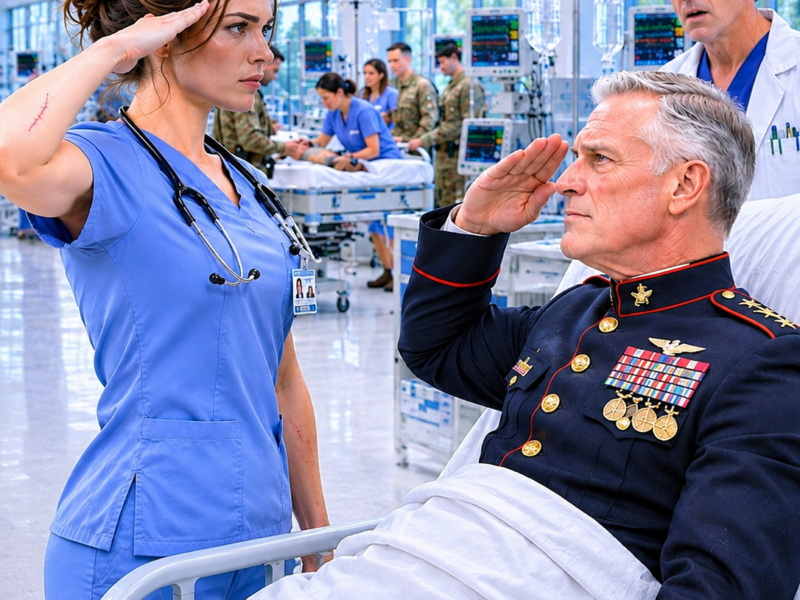
I Was the Quiet 34-Year-Old Nurse Everyone at Boston Central Mocked and Forced to Clean Bedpans—Until a Military Helicopter Crashed and Dozens of Wounded Soldiers Flooded Our ER. When Dr. Paxton Froze and Refused to Save a Dying Two-Star Marine General, I Stepped Forward and Took Command. Then a Battle-Hardened Gunnery Sergeant Saw the Scar on My Arm, Dropped His Anger, and Whispered, “Captain Mitchell… Is That Really You?”
I Was the Quiet 34-Year-Old Nurse Everyone at Boston Central Mocked and Forced to Clean Bedpans—Until a Military Helicopter Crashed and Dozens of Wounded Soldiers Flooded Our ER. When Dr. Paxton Froze and Refused to Save a Dying Two-Star Marine General, I Stepped Forward and Took Command. Then a Battle-Hardened Gunnery Sergeant Saw the Scar on My Arm, Dropped His Anger, and Whispered, “Captain Mitchell… Is That Really You?”
PART 1
The emergency department at Boston Central Medical Center was not a place where newcomers were welcomed. It was a battlefield of a different kind, ruled by sharp tongues, inflated egos, and physicians who believed their prestigious degrees made them untouchable.
Boston Central was considered one of the finest trauma hospitals on the East Coast. Its glass walls gleamed beneath expensive lighting, its corridors were polished to perfection, and its emergency department was staffed by some of the most celebrated medical professionals in the country. Everyone knew their place in the hierarchy, and everyone understood that questioning someone above you could destroy your career.
That was why Abigail Mitchell’s arrival attracted so much unwanted attention.
At thirty-four, Abigail looked nothing like the kind of person the hospital expected to find in its level-one trauma center. She was quiet, almost painfully reserved, with dark hair pulled into a tight bun and navy-blue scrubs that seemed slightly too large for her slender frame. She wore no makeup, rarely participated in conversations, and never tried to impress anyone.
She didn’t talk about her previous employers. She didn’t boast about her experience. When someone asked where she had worked before joining Boston Central, she simply answered that she had spent some time in military medicine.
That was all.
Her colleagues found her silence strange. Some interpreted it as insecurity, while others assumed she lacked the confidence required to survive in such a demanding environment.
But there was something about Abigail that nobody quite understood.
She always knew where the exits were.
She never stood with her back to an open doorway, and whenever she entered a room, her eyes instinctively moved across every corner before settling on the person speaking to her. She also had a habit of checking the people around her, particularly when someone appeared distressed.
Most people didn’t notice these things.
Those who did simply assumed she was nervous.
The first person to make Abigail’s life miserable was Brenda Carmichael, the emergency department’s charge nurse.
Brenda had worked at Boston Central for twenty years and considered herself the undisputed authority over every nurse who walked through the department’s doors. She controlled the schedules, assigned responsibilities, approved shift changes, and made sure everyone understood that challenging her decisions came with consequences.
When Abigail introduced herself on her first morning, Brenda barely looked up from her clipboard.
“So you’re the new girl?”
“Yes. Abigail Mitchell.”
Brenda examined her from head to toe before exchanging a knowing glance with another nurse.
“Well, welcome to Boston Central. Try not to get overwhelmed. This isn’t exactly a place for people who need their hands held.”
Abigail nodded politely.
“I understand.”
Brenda smiled without warmth.
“We’ll see.”
The second person who immediately disliked Abigail was Dr. Bradley Paxton, one of the emergency department’s most prominent physicians.
At forty, Paxton had everything he believed a successful doctor should possess. He had graduated from Yale Medical School, published several research papers, appeared at medical conferences, and cultivated a reputation as a brilliant diagnostician.
He was also deeply arrogant.
He enjoyed reminding nurses that their job was to follow instructions rather than question medical decisions. He expected admiration from junior doctors and unquestioning obedience from everyone else.
When Brenda mentioned that the new nurse had little to say, Paxton chuckled.
“Good. At least she knows when to keep her mouth shut.”
For the next three weeks, Abigail became the department’s unofficial servant.
Brenda assigned her the least desirable responsibilities. She restocked glove dispensers, cleaned empty trauma bays, organized medical supplies, untangled IV tubing, and handled overflow patients nobody else wanted to deal with.
Whenever another nurse called in sick, Abigail was expected to cover the additional work.
Whenever a patient complained, Brenda found a reason to blame her.
And whenever Paxton needed someone to humiliate, Abigail was conveniently nearby.
“Mitchell, did you seriously take fifteen minutes to organize a suture tray?”
“Everything is organized, Doctor.”
“Then why does it look like a five-year-old arranged it?”
“I can reorganize it.”
“Of course you can. That’s what you’re here for.”
The other staff members sometimes laughed.
Abigail never responded.
She simply nodded, corrected whatever needed correcting, and returned to work.
Before long, Brenda started calling her the mouse.
The nickname spread throughout the department.
Some nurses used it jokingly. Others deliberately said it loudly enough for Abigail to hear.
She never complained.
What they didn’t realize was that Abigail had spent years learning how to function in environments where humiliation was the least dangerous thing that could happen to a person.
She had learned that arguing rarely improved a situation.
She had learned that panic could cost lives.
And she had learned that sometimes the most important thing was to remain focused on the task directly in front of her.
One Tuesday afternoon, that quiet approach nearly cost a patient his life.
A fifty-year-old businessman arrived after a minor traffic collision. His vehicle had been struck from behind, and although the damage appeared relatively minor, he complained of chest tightness and shortness of breath.
Dr. Paxton entered the examination bay with his usual confidence.
“All right, let’s see what we have here.”
He listened briefly to the patient’s complaints, checked his pulse, and glanced at the preliminary observations.
“Probably anxiety combined with some whiplash. We’ll get an ECG, draw blood for cardiac enzymes, and have him transferred to the cardiac floor for observation.”
The businessman looked uncomfortable.
“Doctor, I really don’t feel right.”
Paxton offered him a reassuring smile.
“I understand. Car accidents can be frightening, especially when you haven’t experienced one before.”
He turned toward Abigail and snapped his fingers.
“Mouse. Blood sample. Try not to miss the vein.”
Abigail approached the bed.
“Of course, Doctor.”
She wrapped a tourniquet around the man’s arm and prepared the equipment. But as she positioned herself beside him, something caught her attention.
His left shoulder was slightly elevated.
His breathing was shallow, and he seemed to be protecting the left side of his upper abdomen.
Abigail looked at his face.
“Sir, does your left shoulder hurt?”
The man frowned.
“Actually, yes. It’s been hurting since the accident.”
“Did you strike anything with your chest?”
“The steering wheel. Pretty hard, I think. But the pain is mostly here.”
He touched his chest.
Abigail gently examined his upper abdomen. The moment her fingers reached the left side, the man’s entire body tightened.
He gasped.
She immediately looked toward the monitor.
His blood pressure was falling.
“Dr. Paxton.”
The physician was already heading toward the doorway.
“Yes?”
“I believe we need an immediate trauma assessment.”
Paxton sighed.
“Why?”
“He has left shoulder pain and rigidity in the left upper abdomen. Given the blunt impact, I’m concerned about internal bleeding. It could be a ruptured spleen.”
Paxton slowly turned around.
For a moment, the room became quiet.
Then he laughed.
“Excuse me?”
Abigail remained composed.
“His blood pressure is trending downward. I think we should investigate before transferring him.”
Paxton approached her, his expression hardening.
“Did I ask you to make a diagnosis, Mitchell?”
“No, Doctor. I’m communicating a concern.”
“You’re a floor nurse. Your responsibility is to collect blood samples, monitor vital signs, and follow orders. You are not here to play surgeon.”
“Understood.”
“If you ever question my assessment in front of a patient again, I’ll personally make sure your badge is deactivated before the end of your shift.”
Abigail held his gaze.
Then she quietly returned to her equipment.
“Drawing the blood now.”
Paxton turned away.
“Reed, get the ECG. Mitchell, when you’re finished, clean trauma bay four. It smells like urine.”
Ten minutes later, Abigail was on her knees scrubbing the floor of the empty trauma bay when the emergency alarms began screaming.
She looked up.
A nurse rushed past her.
“Room three! His pressure just dropped!”
Another voice followed.
“He’s crashing! Get the ultrasound!”
Abigail stood and moved toward the doorway.
Through the glass, she watched Dr. Simon Reed, a second-year resident, position the ultrasound probe over the patient’s abdomen.
The image appeared on the screen.
A dark collection of fluid.
Blood.
The patient’s spleen had ruptured, and he was bleeding internally.
The team rushed him toward surgery.
Hours later, the hospital’s chief of surgery congratulated Paxton for identifying the problem.
“Good catch on the spleen, Bradley. You may have saved that man’s life.”
Paxton smiled modestly.
“Thank you, sir. His initial presentation was misleading, but I decided to trust my instincts and investigate further.”
Brenda stood nearby, wearing a satisfied expression.
Abigail heard every word.
She was carrying a stack of fresh linens when their eyes briefly met.
Brenda raised an eyebrow, silently reminding her of her place.
Abigail simply continued walking.
She didn’t care who received the praise.
The businessman was alive.
That was enough.
Later, alone in the supply closet, Abigail glanced down at her left wrist. Beneath her scrub sleeve sat an old tactical Garmin watch. Its glass was cracked, its casing scratched, and a faint rusty stain remained around the edge despite countless attempts to clean it.
She touched the watch with her thumb.
For a moment, the fluorescent lights seemed to disappear.
She remembered dust, smoke, screaming, and the distant sound of helicopters.
Then she closed her eyes.
“Just keep your head down,” she whispered to herself.
“You left the war behind.”
But the war, as Abigail was about to discover, had not finished with her.
Two weeks later, Boston was struck by one of the worst nor’easters in recent memory.
And on the night when the hospital needed its most experienced medical professionals, almost all of them were somewhere else.
PART 2
Freezing rain hammered the hospital windows as the annual philanthropic gala took place at a luxury hotel downtown. Most senior physicians were attending, leaving Boston Central with a dangerously understaffed emergency department.
At 9:15 p.m., the emergency radio crackled.
“Code triage! Level-one mass casualty incident!”
Brenda grabbed the receiver.
A military transport helicopter, a Sikorsky UH-60, had suffered catastrophic rotor failure and crashed on Interstate 95. The aircraft had struck civilian vehicles, causing fires, multiple entrapments, and numerous severe injuries.
Boston Central was the only hospital capable of receiving the casualties.
The first ambulances were three minutes away.
When the emergency doors opened, paramedics rushed inside carrying bloodied soldiers and civilians.
Dr. Paxton froze.
Brenda dropped her clipboard.
Nobody knew where to begin.
Then, from the far end of the department, Abigail Mitchell stepped forward.
She removed the elastic from her hair, tightened her bun, rolled up her sleeves, and walked directly into the chaos.
The timid mouse was gone.
“Activate the massive transfusion protocol!” she commanded. “Clear every available trauma bay. We move now!”
And for the first time since joining Boston Central, Abigail wasn’t asking anyone for permission.
PART 3
The transformation happened so quickly that several people initially failed to recognize the woman standing in the middle of the emergency department.
Only moments earlier, Abigail Mitchell had been the quiet nurse who spent most of her shifts cleaning equipment and avoiding unnecessary conversations. Now her voice carried across the trauma floor with an authority that seemed completely incompatible with the person they thought they knew.
She moved through the chaos without hesitation.
“Brenda, I need four coolers of O-negative blood on this floor. Contact the blood bank and activate the emergency release protocol.”
Brenda stared at her.
For a fraction of a second, she seemed unable to process the instruction.
“Brenda!”
The sharpness in Abigail’s voice snapped her back to reality.
“Yes! I’m going!”
“Reed, I need you at bed two. Get the hemorrhage-control supplies. And someone clear that hallway. We cannot have stretchers blocking the entrance.”
People started moving.
Not because they suddenly understood what was happening, but because Abigail spoke with the kind of certainty that made hesitation feel dangerous.
The first patient who needed her attention was a young Marine with a devastating injury to his left leg.
A civilian tourniquet had been applied in the ambulance, but it was slipping. Blood continued to escape from the wound, and the young man’s face had turned an alarming shade of gray.
A paramedic was holding pressure with both hands.
“He’s losing too much blood! We can’t keep him stable!”
Abigail dropped beside the stretcher.
“How long has the tourniquet been on?”
“Approximately twenty minutes.”
“All right. Keep talking to him.”
She reached into her scrub pocket and removed a combat application tourniquet. She had carried one for years, even after leaving active military service. It was an old habit, one she had never managed to abandon.
She quickly secured the device and tightened it until the bleeding stopped.
Then she turned toward Dr. Reed.
“Get the hemostatic gauze. We need proper wound packing and sustained pressure.”
Reed stood frozen.
His hands trembled.
“I’ve never handled an injury this severe.”
Abigail looked directly at him.
“Then tonight is the night you learn to stop being afraid of it.”
He swallowed.
“Okay.”
“Stay with me, Reed. Look at the patient, not the blood. He’s still here. We are going to keep him here.”
Something in her expression steadied him.
He began working.
Meanwhile, another patient was rapidly deteriorating.
A civilian driver had been brought in with severe chest trauma. His oxygen saturation was falling, his neck veins were distended, and his chest was visibly expanding on one side.
Paxton stood nearby, looking at the monitor.
“Where is the surgical team? We need imaging before we do anything.”
Abigail turned toward him.
“Doctor, this patient is showing signs of tension pneumothorax. He cannot wait for imaging.”
Paxton looked irritated.
“Mitchell, I am aware of what the monitor says.”
“Then act on it.”
His eyes widened.
“Excuse me?”
Abigail stepped closer.
“His breathing is failing. The pressure inside his chest is compromising his circulation. We need immediate intervention.”
Paxton glanced toward the doorway.
“I need confirmation.”
Abigail’s expression hardened.
“You have the clinical signs in front of you. Get the equipment.”
For the first time, Paxton seemed to realize that the woman speaking to him wasn’t interested in his reputation.
He reluctantly moved toward the equipment cart.
Abigail directed the emergency response, ensuring the patient received immediate treatment while another team prepared for further intervention.
Within moments, the man’s condition began to improve.
Paxton stepped away, staring at the monitor.
He had just watched a nurse recognize a life-threatening condition before he had even decided what tests to order.
And that wasn’t the most unsettling part.
She had done it without raising her voice unnecessarily, without searching for approval, and without displaying the slightest trace of fear.
Then the doors opened again.
A group of Marines entered, surrounding a stretcher.
“Clear the bay!” shouted a gunnery sergeant.
He was a broad-shouldered man with blood running down one side of his face. His uniform was torn, his boots covered in mud and aviation fuel, and his expression suggested that he had been fighting against death for the last several hours.
The man on the stretcher was older.
His dress uniform was soaked with blood, his chest severely injured, and his face covered in small cuts from flying debris.
“Who is this?” Brenda asked.
The sergeant barely glanced at her.
“General William Garrison. Commander of the First Marine Expeditionary Force.”
The name immediately changed the atmosphere.
Even the most inexperienced staff members understood the significance of treating a senior military commander.
“His chest was crushed when the helicopter structure collapsed,” the sergeant continued. “He was trapped beneath the fuselage. He’s been losing blood and struggling to breathe. You have to save him.”
Paxton approached the stretcher, examined the general briefly, and stepped backward.
His face went pale.
“My God.”
The general’s injuries were extensive. His chest wall was badly damaged, and he was barely breathing.
Paxton shook his head.
“We need the thoracic team. I can’t manage this here.”
Brenda looked at him.
“But the surgical team is still downtown.”
“Then we wait.”
“Wait?” the sergeant repeated.
Paxton raised his hands.
“I’m not risking an irreversible procedure on a two-star general without the appropriate specialists. If he dies under my care, my entire career is finished.”
The sergeant grabbed the front of Paxton’s scrubs and slammed him against the glass wall.
“You listen to me, doctor. That man has spent his entire life protecting other people. You will not stand here and tell me you’re too afraid to help him.”
Paxton struggled to free himself.
“Security!”
“Sergeant, release him.”
The command came from directly behind the general’s stretcher.
The Marine turned.
Abigail was standing at the head of the bed.
She wasn’t looking at the sergeant. She wasn’t even looking at Paxton.
Her attention was entirely on the unconscious general.
Before anyone could stop her, she had already begun establishing an emergency airway.
The sergeant’s expression changed.
He recognized the way she moved.
He recognized the scar running along her left forearm.
And most importantly, he recognized the unmistakable calm in her eyes.
It was a look he had last seen in Afghanistan, in a place where the difference between a good medic and a great one was measured in the number of people who made it home.
His grip on Paxton loosened.
He took a slow step backward.
“Doc?”
Abigail continued working.
“Hold this bag. Keep his airway supported.”
The sergeant hurried to her side.
“Yes, ma’am.”
Brenda stared.
Paxton stared.
The man who had just threatened to kill a doctor was now following the instructions of the nurse they had nicknamed the mouse.
Abigail looked toward the surgical equipment.
“I need assistance preparing for chest decompression and drainage. Reed, stay with me. Paxton, you’re going to assist.”
Paxton nodded weakly.
“Yes.”
The sergeant watched Abigail for several seconds before finally speaking.
“That’s not just a nurse.”
Nobody answered.
He looked at the civilian staff.
“You’re all looking at her like she’s some ordinary hospital employee.”
Brenda swallowed.
“What are you talking about?”
The sergeant’s eyes remained fixed on Abigail.
“This woman saved six Marines when the rest of us thought we were already dead.”
Abigail finally glanced at him.
“Gunny, focus on the airway.”
The sergeant immediately obeyed.
But his voice trembled when he spoke again.
“Captain Mitchell.”
The title seemed to echo through the trauma bay.
Brenda’s clipboard slipped slightly in her hands.
Captain?
Abigail didn’t acknowledge the question.
She continued treating the general.
And as the medical team worked around her, the gunnery sergeant began telling them a story that would permanently change the way they saw the quiet woman standing before them.
It was a story that began more than ten years earlier, in the mountains of Afghanistan.
PART 4
“Her name is Captain Abigail Mitchell,” Gunnery Sergeant Miller said.
The words were delivered quietly, but they carried more weight than any of the shouting that had filled the emergency department.
“United States Army Nurse Corps. Attached to Joint Special Operations Command.”
Brenda looked at Abigail as though she were seeing a completely different person.
Paxton’s mouth opened, but no words came out.
Miller continued.
“Back in 2014, during Operation Enduring Freedom, our unit was ambushed outside Camp Bastion. We were moving through a dangerous stretch of terrain when insurgents opened fire from multiple positions.”
His eyes briefly lowered.
“I was there.”
He swallowed.
“We lost communications. Two vehicles were damaged, and several Marines were trapped. Six of my men were seriously wounded. We had no safe route out, no reliable medical evacuation, and enemy fire coming from the hills.”
The sounds of the emergency department seemed to fade around him.
“One of our men had a severe leg injury. Another had taken shrapnel to his chest. We were trying to keep everyone alive, but we were running out of supplies and time.”
Miller looked toward Abigail.
“Then Captain Mitchell came for us.”
He paused.
“She crossed an exposed stretch of ground while the enemy was still firing. There were mines in the area, and we couldn’t establish a safe path. She knew that. We all knew that.”
His voice became rougher.
“But she went anyway.”
One of the younger nurses stopped moving.
Miller continued.
“She reached the first Marine and started treating him. Then she crawled back for the second. Then the third. Every time she moved, we told her to stop. Every time we told her she was going to get herself killed, she ignored us.”
He looked down at the old scar on Abigail’s arm.
“An RPG exploded nearby. Shrapnel struck her left forearm. She was bleeding badly. We thought she’d finally have to stop.”
He shook his head.
“Instead, she tightened her own tourniquet and kept working.”
The gunnery sergeant’s eyes became glassy.
“She helped get all six men onto the evacuation helicopter. She was still treating them during the flight. She didn’t let anyone waste time worrying about her.”
Abigail finally spoke.
“Gunny.”
He stopped.
“That’s enough.”
But Miller wasn’t finished.
“They pinned the Silver Star on her chest at Walter Reed. The insurgents even put a bounty on her head after the operation.”
He turned toward Brenda and Paxton.
“Over there, we called her the Legend of Kandahar.”
The revelation struck the room with the force of an explosion.
Brenda’s face drained of color.
Paxton looked as though someone had removed the ground beneath his feet.
The woman he had ordered to clean urine from the floor had once crossed a minefield under enemy fire to save six soldiers.
The woman Brenda had mocked for being timid had received one of the military’s highest decorations for extraordinary courage.
And they had spent weeks treating her like an incompetent nobody.
But Abigail wasn’t listening to their reactions.
She was watching the general’s monitor.
His blood pressure was falling rapidly.
“Gunny, I need you to stop talking and keep supporting his breathing.”
Miller immediately returned to his position.
Dr. Reed glanced at the monitor.
“Captain, his pressure is dropping.”
Abigail examined the general’s chest and reached for the portable ultrasound.
The image appeared.
She studied it for a moment.
Then her expression changed.
“Cardiac tamponade.”
Reed leaned closer.
“What?”
“Blood is accumulating around his heart. The trauma has likely damaged a vessel, and the pressure is preventing the heart from filling properly.”
Paxton stepped forward.
“We need a pericardiocentesis.”
Abigail shook her head.
“Not if the bleeding is continuing at this rate. We need surgical control.”
Paxton stared at the ultrasound screen.
His medical training was finally catching up with the emergency.
“You’re talking about an emergency thoracotomy.”
“Yes.”
“Here?”
“Yes.”
“Mitchell, that’s insane. We don’t have a thoracic surgeon in the building.”
“We don’t have time to wait for one.”
“Dr. Keller is twenty minutes away!”
“The general won’t survive twenty minutes.”
Paxton shook his head.
“If you open his chest in this department and he dies, there will be an investigation. You could lose your license. We could all lose our licenses.”
Abigail turned toward him.
“Then make sure he doesn’t die.”
Paxton stepped backward.
“No. I’m not doing this.”
For the first time that night, Abigail’s expression revealed something close to anger.
“You’re an attending physician at a level-one trauma center. You have a critically injured patient in front of you, and you’re worried about your reputation?”
“I’m worried about making an irreversible mistake!”
“Then stop wasting time and help me save him.”
Paxton looked toward the others.
Nobody came to his defense.
Abigail turned to Reed.
“Prepare the field. Get the surgical instruments. We need to move.”
Reed nodded.
“Yes, Captain.”
Miller remained beside the general, assisting with ventilation.
The atmosphere was unbearable.
Every second seemed to stretch into an eternity.
Paxton stood near the edge of the bay, visibly trembling.
Then Abigail gave the instruction that would become the defining moment of his career.
“Dr. Paxton, I need you at the table. You’re assisting.”
He shook his head.
“No.”
“Bradley.”
She used his first name for the first time.
“Look at me.”
He did.
“That man is dying. You can spend the rest of your life explaining why you were afraid, or you can help us give him a chance.”
Paxton’s eyes moved toward the general.
For a moment, something resembling conscience appeared beneath his fear.
But it disappeared almost immediately.
“I’m not risking my career.”
Miller released the breathing bag long enough to reach toward his sidearm. He drew it and pointed it toward the floor near Paxton’s shoes.
“The captain gave you an order, doctor.”
The room became completely still.
“Get your hands on those instruments.”
Paxton looked at the weapon.
Then at Abigail.
Then at the general.
His hands trembled as he approached the table.
Abigail began the emergency procedure.
There was no dramatic speech, no celebration, and no room for hesitation.
She worked with the concentration of someone who had performed difficult procedures under conditions far worse than anything Boston Central could offer.
Reed followed her instructions.
Miller maintained the general’s airway.
Paxton assisted with the surgical equipment, his expensive scrubs now covered in blood.
When the chest was opened, Abigail found the source of the pressure.
A large accumulation of blood had compressed the heart.
She relieved the pressure and immediately began assessing the damage.
“Prepare for internal cardiac massage.”
Reed looked at the monitor.
“There’s no rhythm.”
“Continue resuscitation.”
The next several minutes were the longest of anyone’s life.
Abigail worked relentlessly, directing the team and coordinating the emergency response.
The monitor remained silent.
Paxton stood opposite her, his face pale and his hands shaking.
Miller continued supporting the general’s breathing.
Reed administered the ordered medications and watched the monitor.
One minute passed.
Then another.
The general’s heart remained motionless.
“Captain,” Reed whispered.
Abigail didn’t answer.
She continued.
She had seen men die before.
She had seen good soldiers disappear in seconds.
She had learned that the most painful part of losing someone was not the noise or the blood.
It was the moment when everyone around you stopped believing there was anything left to do.
Abigail refused to reach that moment.
“Come on, General,” she whispered.
Her hands continued their work.
“Not tonight.”
Then something changed.
A small movement passed through the heart.
Abigail felt it.
She stopped for a fraction of a second.
Another contraction followed.
“Wait.”
Reed looked up.
The monitor chirped.
A rhythm appeared.
Weak at first.
Then stronger.
“Pulse!” Reed shouted.
He checked again, barely believing what he was feeling.
“He’s got a pulse!”
Miller lowered his head.
For the first time since entering the hospital, the hardened Marine allowed himself to cry.
Paxton stepped away from the table.
His hands were covered in blood.
He looked at the general, then at Abigail.
He had just watched a woman he considered beneath him perform the work he had been too afraid to attempt.
And he understood that nothing about the night would ever be the same.
The doors suddenly opened.
Dr. Harrison Keller, Boston Central’s chief of surgery, entered with several residents.
They had run three miles through freezing rain and snow after their vehicles became trapped behind the highway blockade.
Keller took in the scene.
The open chest.
The bloodied instruments.
The exhausted nurses.
The general’s monitors.
Then his eyes settled on Abigail.
He recognized what had happened almost immediately.
He approached the operating field.
“Captain Mitchell?”
Abigail looked up.
“Dr. Keller.”
Keller examined the situation and nodded.
“I’ll relieve you. Let’s move him to the operating room.”
There was no accusation in his voice.
No surprise that a nurse had taken control.
Only professional respect.
Abigail carefully transferred responsibility to the surgical team.
As the general’s stretcher disappeared through the doors, Keller paused beside her.
“Captain, I’ve been practicing trauma surgery for twenty-six years.”
He looked at the blood on her sleeves.
“I’ve rarely seen anything like that.”
Abigail gave a tired nod.
“Thank you, Doctor.”
Keller glanced toward Paxton.
Then toward Brenda.
He didn’t say anything.
But his expression made it clear that the night was far from over.
PART 5
By sunrise, the storm had finally begun to weaken.
The ambulances had stopped arriving, the remaining patients had been transferred to appropriate departments, and the emergency room was slowly returning to something resembling normality.
But Boston Central was no longer the same hospital.
The events of the previous night had left a mark on everyone who had witnessed them.
Several patients were alive because of Abigail Mitchell.
The young Marine with the leg injury had survived long enough to undergo surgery. The civilian with the chest injury was recovering in intensive care. And General William Garrison had been transferred to the operating room with a pulse, something the surgeons had initially considered unlikely.
The staff were exhausted.
Some had blood on their shoes. Others had spent hours working without food or rest.
Yet almost nobody wanted to leave.
They wanted to know what would happen next.
More importantly, they wanted to know who Abigail Mitchell really was.
Brenda sat alone at the nurses’ station.
Her clipboard rested on the desk.
For the first time in twenty years, she didn’t feel like the most powerful person in the room.
She kept replaying the previous weeks in her mind.
The glove dispensers.
The bedpans.
The countless humiliating assignments.
The way she had laughed whenever Paxton called Abigail the mouse.
She remembered one particular afternoon when Abigail had quietly asked for additional trauma training.
Brenda had dismissed the request.
“Perhaps you should master the basic responsibilities first.”
At the time, she had considered it a harmless joke.
Now she wondered how many opportunities she had deliberately taken away from someone who had already spent years saving lives in places Brenda could barely imagine.
Across the department, Paxton sat in an empty consultation room.
His hands were clean now, but he could still feel the blood.
He had spent years building his reputation around the idea that he was exceptional.
He believed his education, his professional connections, and his position made him more valuable than the people who worked beneath him.
But when the hospital faced a genuine crisis, he had frozen.
A nurse had taken control.
A nurse had made the difficult decisions.
And a nurse had saved the life of a military commander while he stood nearby worrying about his career.
He knew what the others would say.
He also knew he couldn’t allow them to tell the story without him.
By the time the morning shift began, Paxton had already started preparing his version of events.
He told the hospital administrator that he had coordinated the emergency response.
He described himself as the physician who had guided the inexperienced nursing staff through an extraordinarily complex situation.
He even suggested that Abigail had performed certain actions under his direct supervision.
When the administrator asked whether he had personally led the emergency thoracotomy, Paxton hesitated.
Then he nodded.
“Yes. I made the decision to proceed when it became clear that the surgical team wouldn’t arrive in time.”
It was a lie.
But Paxton had convinced himself that it was necessary.
If he could control the narrative, perhaps he could protect his position.
Unfortunately for him, the general was awake.
And General William Garrison remembered more than Paxton realized.
Three hours after surgery, the general opened his eyes in the hospital’s private intensive care suite.
His breathing was supported, his chest was heavily bandaged, and the monitors surrounding his bed displayed a collection of numbers that would have frightened anyone unfamiliar with intensive care.
He was in considerable pain.
But he was alive.
A nurse approached carefully.
“General? Can you hear me?”
Garrison blinked.
Then he slowly nodded.
“Where?”
His voice was weak.
“You’re at Boston Central Medical Center, sir. You’ve undergone emergency surgery. You’re stable at the moment.”
The general closed his eyes briefly.
Then he remembered the helicopter.
The impact.
The crushing weight.
The darkness.
And the voice.
A woman’s voice.
He remembered someone telling the others what to do.
He remembered the feeling of hands working desperately to keep him alive.
He opened his eyes again.
“Who saved me?”
The nurse glanced toward the door.
“Your surgical team, sir. Dr. Keller and several other physicians.”
Garrison shook his head slightly.
“Before them.”
The nurse hesitated.
“There was a nurse. Captain Mitchell.”
The general’s expression changed.
“Abigail?”
“I believe so, sir.”
He tried to move, but pain stopped him.
“Where is she?”
“We can find out.”
“Please.”
The nurse nodded and stepped outside.
Several minutes later, the hospital’s chief executive officer entered with Dr. Keller and Dr. Paxton.
The CEO approached the bed with a broad smile.
“General Garrison, it’s wonderful to see you awake. You’ve given everyone here quite a scare.”
The general acknowledged him with a slight nod.
“We’re grateful that you’re recovering,” the CEO continued. “You were extremely fortunate. Dr. Paxton here made some very courageous decisions during the initial emergency.”
Paxton stepped forward.
“General, I’m glad to see you’re doing well. The situation was extremely difficult, but we managed to stabilize you before the surgical team arrived.”
Garrison slowly turned his head.
He studied Paxton’s face.
For several seconds, he said nothing.
Then he spoke.
“Doctor Paxton.”
“Yes, sir.”
“I understand you were involved in my treatment.”
“Yes, General. I coordinated much of the response.”
The general’s eyes narrowed.
“Interesting.”
Paxton smiled nervously.
“Sir?”
“I was unconscious during most of the procedure. However, Gunnery Sergeant Miller gave me a detailed account of what happened.”
The room became quiet.
Garrison continued.
“He told me about a civilian doctor who refused to help because he was afraid of losing his career.”
Paxton’s smile disappeared.
“He mentioned that this doctor had to be threatened before he would even hold a surgical instrument.”
The CEO turned toward Paxton.
“Is there something we need to clarify?”
Paxton swallowed.
“General, there were complications. It was a very unusual situation. I was simply trying to ensure that the correct procedures were followed.”
Garrison looked at him for a long moment.
Then he spoke in a voice that, despite his weakened condition, carried the authority of a man accustomed to commanding thousands.
“Shut your mouth.”
Paxton went silent.
“I don’t care about your explanations. I don’t care about your credentials. And I certainly don’t care about your reputation.”
The general shifted slightly against his pillows.
“Where is the woman who saved my life?”
The CEO looked confused.
“Which woman, General?”
Garrison stared at him.
“The Legend of Kandahar.”
Before anyone could respond, the door opened.
Abigail Mitchell entered.
She was no longer wearing her blood-soaked navy scrubs. Instead, she wore simple dark civilian clothes. Her hair was still pulled back into the same tight bun, and the old tactical watch remained on her wrist.
She looked almost exactly as she had when she first walked into the hospital several weeks earlier.
Quiet.
Reserved.
Unassuming.
If someone had passed her in the corridor, they might never have guessed what she had accomplished during the previous night.
But General Garrison knew.
The moment he saw her, he began raising his right hand.
Despite the pain, he straightened his arm and delivered a perfect military salute.
“Captain Mitchell.”
The room fell silent.
Abigail immediately stopped.
She stood at attention and returned the salute.
“General Garrison.”
He smiled faintly.
“Still saving people, I see.”
“Just doing my job, sir.”
The general shook his head.
“That’s what you always said.”
His eyes became moist.
“I heard what happened last night. Miller told me everything. You did it again, Abigail.”
She lowered her hand.
“You were the patient, sir. My job was to get you through it.”
Garrison gave a weak laugh that quickly turned into a grimace.
“Some things never change.”
He looked toward the others.
“This woman saved six Marines in Afghanistan when we had almost no chance of surviving. She went into an active minefield to reach us. She continued working after being wounded herself. And she refused to leave until every man under her care was evacuated.”
He paused.
“She received the Silver Star for that operation. Her name became known among Marines who served in that region. There are men alive today because she refused to give up on them.”
The general turned back toward Abigail.
“And last night, she saved me.”
Abigail remained silent.
Garrison looked at the CEO.
“I want you to understand something. Rank doesn’t make someone a hero. A medical degree doesn’t make someone courageous. And a position of authority doesn’t automatically make someone a leader.”
His gaze moved toward Paxton.
“Leadership is what you do when people are depending on you and there is no time left to protect your own interests.”
Paxton looked down.
The CEO cleared his throat.
“General, I assure you that the hospital takes these matters very seriously. We will review the entire incident.”
“You should.”
Garrison looked back at Abigail.
“Captain, would you mind staying for a moment?”
“Of course, sir.”
The CEO and the others stepped aside.
For several minutes, the general spoke with her privately.
He asked about her life after Afghanistan.
He asked whether she had continued working in military medicine.
And eventually, he asked the question nobody at Boston Central had thought to ask.
“Why did you leave?”
Abigail looked toward the window.
Outside, the last traces of the storm were disappearing from the streets.
“I needed a different life, sir.”
Garrison nodded slowly.
“I understand.”
She hesitated.
“After Kandahar, everything felt different. I could do my job, but I didn’t know how to be around people who hadn’t seen what I’d seen. Every ordinary sound reminded me of something. Every emergency made me remember another one.”
She glanced at her watch.
“I thought if I worked somewhere quiet, somewhere I could help people without being surrounded by the same memories, maybe I could finally move forward.”
The general listened without interrupting.
“Did it work?”
Abigail considered the question.
“Some days.”
He nodded.
“That’s more than some people manage.”
For a moment, neither spoke.
Then Garrison reached toward her.
“Thank you, Captain.”
Abigail took his hand.
“You’re welcome, sir.”
When she finally left the intensive care suite, the corridor seemed unusually quiet.
Brenda was standing near the nurses’ station.
She looked up as Abigail approached.
“Mitchell.”
Abigail stopped.
Brenda seemed uncertain how to begin.
“I wanted to talk to you.”
“All right.”
Brenda looked down at her clipboard.
For years, she had been able to silence anyone simply by raising her voice. But now she struggled to find words.
“I owe you an apology.”
Abigail waited.
“I treated you terribly. I assigned you work that had nothing to do with your experience, and I made jokes about you. I should never have done that.”
Brenda swallowed.
“I thought you were weak because you didn’t defend yourself.”
Abigail looked at her.
“I wasn’t trying to prove anything.”
“I know that now.”
Brenda’s voice became quieter.
“I don’t expect you to forgive me.”
Abigail gave a small nod.
“Thank you for saying it.”
She started walking again.
Brenda watched her go.
There was no dramatic confrontation.
No revenge.
No satisfying speech about how the tables had turned.
And somehow, that made the moment even more difficult for Brenda.
Because Abigail didn’t need to humiliate her.
She had already shown everyone who she was.
Paxton’s situation was different.
Within twenty-four hours, the hospital launched a formal investigation into his conduct during the mass casualty incident.
The testimony of Gunnery Sergeant Miller, Dr. Reed, several paramedics, and other medical staff contradicted Paxton’s account.
Security footage also confirmed that he had repeatedly refused to participate in the emergency response until he was confronted.
The investigation uncovered additional complaints about his treatment of nurses and junior physicians, including the incident involving the businessman whose internal bleeding Abigail had identified.
That patient had survived, and his family later provided a statement describing how Abigail had been the only person who seemed genuinely concerned about the unusual symptoms.
Paxton was removed from his position pending a full review.
His claim that he had led the emergency thoracotomy was formally challenged, and the hospital’s leadership began reviewing the culture that had allowed such behavior to continue.
Brenda was also required to answer questions about her treatment of Abigail.
For the first time, the department began examining its hierarchy, its training practices, and the way nurses were encouraged to raise concerns about patient safety.
Dr. Reed, meanwhile, became one of Abigail’s strongest supporters.
A few days after the crash, he approached her during a quiet afternoon shift.
“Captain?”
She looked up from the medication records.
“Yes, Reed?”
He hesitated.
“Can I ask you something?”
“Go ahead.”
“How did you stay so calm that night?”
Abigail put down her pen.
“Which part?”
“All of it. The helicopter crash. The general. The procedure. Everything.”
She considered the question.
“Fear is normal, Reed.”
He looked surprised.
“It is?”
“Of course. Anyone who tells you they never feel afraid is either lying or hasn’t understood the situation.”
She leaned back slightly.
“The important thing is learning what to do with that fear. You can’t allow it to make decisions for you.”
Reed nodded slowly.
“And how do you learn that?”
“Preparation. Practice. Experience. And understanding that the patient in front of you is more important than your pride.”
He smiled faintly.
“I think I needed to hear that.”
Abigail returned to her paperwork.
“Then remember it.”
Several weeks later, General Garrison was well enough to leave the hospital.
Before his departure, he requested one final meeting with Abigail.
He was still recovering, moving carefully, but his expression had regained much of its former strength.
When she entered his room, he was sitting upright beside the window.
“Captain Mitchell.”
“General.”
He gestured toward a chair.
“Sit down. I have something for you.”
Abigail approached.
Garrison handed her a small envelope.
Inside was a handwritten letter.
It was not an official commendation, nor was it an order from military headquarters.
It was a personal message from a man who knew what it meant to owe his life to someone else.
He had written about the six Marines she had saved in Afghanistan, about the general’s own survival, and about the families who would never have to receive the phone call telling them their loved ones were gone.
At the bottom, he had written one sentence.
Some people spend their entire lives searching for heroes. Others simply become one without ever asking to be remembered.
Abigail read it twice.
Then she carefully folded the letter.
“Thank you, sir.”
Garrison smiled.
“Don’t thank me. Just keep doing what you do.”
She looked at him.
“I will.”
Before she left, he reached out and offered his hand.
She shook it.
Then, as she turned toward the door, he added something else.
“Captain?”
She stopped.
“Yes, sir?”
“Don’t spend the rest of your life trying to disappear.”
Abigail looked at him.
“You have nothing to apologize for. You survived things most people will never understand. You earned the right to live a quiet life, but you don’t have to pretend your past never happened.”
She said nothing.
Garrison smiled.
“You’re still the Legend of Kandahar, whether you like the name or not.”
For the first time in a long while, Abigail laughed.
It was a small, genuine laugh.
And it felt strangely unfamiliar.
When she returned to the emergency department, things were different.
The staff no longer called her the mouse.
The nurses who had once avoided her now approached her with questions. Junior doctors asked for her opinions during difficult cases. Brenda stopped using her authority to intimidate people and began treating the department with a level of professionalism that should have existed from the beginning.
Abigail didn’t demand special treatment.
She didn’t request a promotion or insist that everyone acknowledge her military service.
She continued working.
She still wore the same navy scrubs.
She still kept her hair in a tight bun.
And she still carried the old tactical watch on her wrist.
But there was one small difference.
When new nurses arrived, Abigail made a point of welcoming them.
She remembered what it felt like to walk into a room where everyone had already decided she didn’t belong.
And she refused to let anyone else experience the same thing.
One evening, a young nurse approached her after a difficult shift.
“Can I ask you something?”
“Of course.”
The nurse glanced toward the trauma bay.
“People keep telling me that this department is no place for someone like me. They say I’m too quiet. Too inexperienced. That I’ll never survive here.”
Abigail looked at her carefully.
Then she smiled.
“Being quiet doesn’t mean you’re weak.”
The young nurse listened.
“And being confident doesn’t mean you’re right. Learn everything you can. Ask questions when something doesn’t seem right. Never let someone else’s ego become more important than a patient’s life.”
The nurse nodded.
“Thank you.”
Abigail returned to her work.
Outside, Boston was settling into another cold November evening.
The hospital’s sliding doors opened and closed as ambulances arrived, bringing new patients, new emergencies, and new opportunities to make a difference.
Somewhere in the department, a monitor began beeping.
A nurse called for assistance.
Abigail immediately stood.
For a moment, she glanced down at the scratched watch on her wrist.
She remembered the mountains.
She remembered the Black Hawk.
She remembered the six Marines who had survived.
And she remembered the general’s words.
She had spent years believing that leaving the battlefield meant leaving that part of herself behind.
But perhaps she had misunderstood.
Perhaps being a hero had never been about the uniform, the medals, or the recognition.
Perhaps it had always been about what a person chose to do when someone else’s life depended on them.
Abigail tightened her gloves and walked toward the trauma bay.
Nobody laughed.
Nobody questioned whether she belonged.
And nobody needed to know how many lives she had already saved before she ever stepped through Boston Central’s doors.
Because the truth was simple.
The hospital had hired a nurse.
But the people who needed her had found a hero.
And the Legend of Kandahar had never really left the battlefield.
She had simply found another place where lives needed saving.