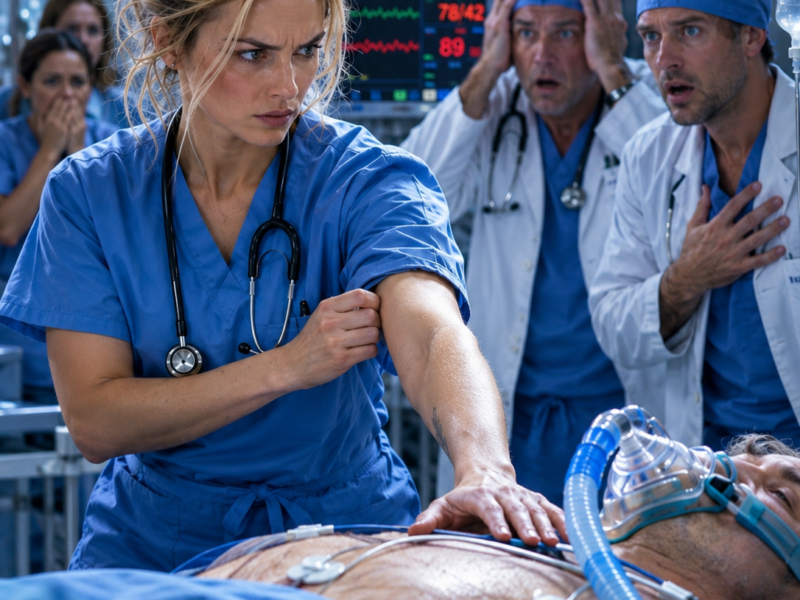
I Was Just the Quiet Nurse Everyone Ignored at Cedar Point Memorial Until a Famous Surgeon Abandoned a 38-Year-Old Father Bleeding to Death on the Operating Table. As the Monitors Screamed, He Walked Out, Leaving Me Behind, Then Returned and Ordered, “Move Away From My Patient!” I Looked Him Straight in the Eyes and Said, “Then Act Like His Surgeon.” But When I Took Control of the Emergency, Nobody Knew About My Six Years in the Coast Guard—or the Terrifying Secret Behind Why My Hands Never Shook…
I Was Just the Quiet Nurse Everyone Ignored at Cedar Point Memorial Until a Famous Surgeon Abandoned a 38-Year-Old Father Bleeding to Death on the Operating Table. As the Monitors Screamed, He Walked Out, Leaving Me Behind, Then Returned and Ordered, “Move Away From My Patient!” I Looked Him Straight in the Eyes and Said, “Then Act Like His Surgeon.” But When I Took Control of the Emergency, Nobody Knew About My Six Years in the Coast Guard—or the Terrifying Secret Behind Why My Hands Never Shook…
Part 1
The moment the most celebrated surgeon at Cedar Point Memorial Hospital pulled off his bloody gloves and walked away from a dying patient, everyone in Operating Room Two believed they were witnessing the end of a man’s life.
Everyone except the quiet nurse standing in the corner.
Her name was Elena Brooks, and for four years, she had been the kind of employee people barely noticed. She never challenged a doctor, never raised her voice during an emergency, and never demanded recognition for anything she did. Most of her colleagues knew her as the woman who arrived early, organized supplies without being asked, and disappeared into the background whenever someone important entered the room.
But on that terrible Tuesday morning, with a 38-year-old father bleeding to death on the operating table and the hospital’s most respected surgeon abandoning his position, Elena was about to reveal something nobody at Cedar Point Memorial could have imagined.
And the secret behind her extraordinary abilities would eventually threaten the reputation of one of the most powerful men in the hospital.
It began at 9:17 that morning.
Daniel Ortiz had been brought into the emergency department after his pickup truck overturned on a rain-soaked highway. Rescue workers had found him trapped behind the steering wheel, barely conscious, with severe abdominal injuries and a dangerously unstable blood pressure.
Daniel was a construction supervisor who had spent the previous evening helping his eight-year-old daughter, Sofia, build a cardboard model of the solar system for school. Before leaving home that morning, he had promised her he would be back in time to see her present it.
He had kissed his wife, Maria, on the forehead, grabbed his coffee, and walked out the door without knowing that a few miles later, his entire future would depend on a woman he had never met.
By the time the ambulance reached Cedar Point Memorial, Daniel had already lost a considerable amount of blood. The trauma team determined that internal bleeding was likely and that immediate surgery was necessary.
The surgeon assigned to his case was Dr. Marcus Kane.
At 52, Kane was practically a celebrity within the hospital. His photograph appeared in fundraising brochures, his achievements were frequently mentioned at medical conferences, and wealthy donors requested him by name.
He had built his reputation on confidence, precision, and an almost theatrical ability to make difficult operations look effortless.
Unfortunately, that confidence had gradually hardened into arrogance.
Kane loved an audience. He enjoyed teaching younger doctors, but mostly because he enjoyed being admired.
That morning, two surgical residents and a visiting fellow stood beside him, eager to observe the famous surgeon at work.
Naomi Patel, a young nurse who had worked at Cedar Point for fourteen months, was assisting near the operating table.
And standing beside the instrument tray was Elena Brooks.
Nobody asked Elena for an opinion.
Nobody ever did.
“Pay attention,” Kane announced as he prepared to begin. “Cases like these separate competent surgeons from exceptional ones.”
The visiting fellow nodded enthusiastically.
Naomi adjusted her position.
Elena silently checked the equipment.
The first several minutes passed without incident.
Kane worked carefully through the abdominal layers, explaining each movement as though he were delivering a lecture.
“Notice the angle,” he told the residents. “Minimal tissue disruption. Controlled exposure. This is the difference between technique and artistry.”
One resident smiled beneath his mask.
The anesthesiologist monitored Daniel’s vital signs, which remained relatively stable.
Heart rate: 74.
Oxygen saturation: 98 percent.
Everything appeared manageable.
But Elena noticed something.
The bleeding pattern beneath the exposed tissue did not match the comfortable explanation Kane was giving.
She watched the changing color of the suction tubing and the subtle movement of the blood pooling near the surgical field.
Her eyes moved briefly to the monitor.
Then back to Kane’s hands.
Something was wrong.
She considered speaking.
For a fraction of a second, an old instinct stirred inside her, urging her to warn the team that the injury might be more dangerous than it appeared.
But she stopped herself.
Four years earlier, Elena had made a promise to herself.
She would never again become the center of attention.
She would do her job, follow the rules, and stay invisible.
So she remained silent.
Then everything happened at once.
Kane reached deeper into Daniel’s abdomen, attempting to isolate a bleeding vessel.
“More retraction,” he ordered.
Naomi adjusted the instrument, pulling the tissue aside to provide a clearer view.
Suddenly, something gave way.
A sharp rush of dark blood surged into the surgical field.
The suction device began working furiously, but it could not keep up.
The monitor changed.
Daniel’s oxygen saturation dropped from 98 to 93.
Then 89.
Then 86.
His heart rate accelerated.
“What happened?” one resident whispered.
Kane stopped speaking.
For the first time that morning, the surgeon who always had something impressive to say appeared completely uncertain.
“Suction!” he snapped.
Naomi moved immediately.
But more blood poured into the wound.
Kane attempted to control the hemorrhage with packing, pressing gauze into the cavity and applying heavy pressure.
For several seconds, the bleeding appeared to slow.
Then the gauze became saturated.
Fresh blood spilled between his fingers.
The anesthesiologist looked at the monitor.
“Blood pressure is dropping. Eighty over forty-five.”
Kane pressed harder.
“Get more blood products in here!”
The circulating nurse, Teresa, reached for the telephone.
“Call vascular surgery,” Kane demanded. “Tell them we have a major arterial injury.”
Teresa made the call.
The response was devastating.
The nearest available vascular surgeon, Dr. Amara Adeyemi, was at the hospital’s satellite campus across town.
Her estimated arrival time was forty minutes.
Daniel Ortiz might not survive another five.
The room filled with alarms.
Naomi could hear her own heartbeat beneath the electronic warning tones.
She looked toward Kane, expecting instructions.
Instead, she saw something she had never witnessed before.
His hands were trembling.
Kane stared at the blood escaping beneath his gloves.
The famous surgeon seemed suddenly smaller, almost unrecognizable.
“Pressure is sixty over thirty,” the anesthesiologist announced.
One resident stepped backward.
The visiting fellow looked toward the door.
Nobody seemed to know what to do next.
Then Kane spoke.
“I need a minute.”
Naomi turned toward him.
“What?”
But Kane was already stepping away from the table.
He stripped off his surgical gloves, dropped them into the disposal container, and walked toward the scrub room.
“Doctor, we need you here!” the anesthesiologist called.
Kane did not turn around.
One resident followed him.
Then the visiting fellow.
Within seconds, the operating room had lost the very people who were supposed to be leading the emergency.
Naomi stood frozen beside the open wound.
Teresa stared toward the swinging doors.
Daniel’s blood pressure continued falling.
And in the corner, Elena Brooks slowly lifted her head.
Something changed in her expression.
It was not fear.
It was recognition.
As though she had spent years running from a particular kind of nightmare, only to discover that it had finally caught up with her.
She took one step forward.
Then another.
Her shoulders straightened.
Her entire posture transformed.
Naomi had spent fourteen months working beside Elena, and she had never seen her move with such purpose.
“Naomi,” Elena said.
Her voice was quiet but unmistakably commanding.
“Look at me.”
Naomi turned.
“He’s dying.”
“I know.”
“What do we do?”
Elena looked into the surgical field.
For a brief moment, memories flashed across her face. Darkness. A helicopter engine. Freezing ocean water. The screams of people who had no time left.
Then those memories disappeared behind an expression of absolute focus.
“We stop the bleeding.”
Naomi stared at her.
“But Dr. Kane—”
“Dr. Kane isn’t here.”
Elena moved beside the operating table.
“Listen carefully. I need you to stay calm and follow the emergency team’s instructions. We’re going to keep this man alive until vascular surgery arrives.”
The anesthesiologist looked up.
“Pressure is fifty-eight over twenty-eight.”
Elena studied the patient, the monitoring equipment, and the exposed injury.
She recognized the frightening pattern.
The damaged vessel appeared to be the external iliac artery, a major artery supplying blood to the lower body.
The hemorrhage was catastrophic.
And every passing second mattered.
Elena immediately directed the team to maintain appropriate hemorrhage control, activate the highest-level emergency response, and prepare the equipment needed by an authorized surgical specialist.
Naomi watched her in disbelief.
The woman who usually apologized when someone bumped into her was now directing an entire operating room.
“Teresa, confirm the massive transfusion protocol is active. And keep vascular surgery updated. Tell them this is a life-threatening arterial injury.”
Teresa moved.
The anesthesiologist began coordinating additional resuscitation.
Naomi followed Elena’s instructions, maintaining the temporary control measures already established.
Elena spoke without shouting.
She was precise, focused, and astonishingly calm.
It was as if the terrifying sounds around her had faded into the background.
For several agonizing minutes, the team worked together to buy Daniel whatever time remained.
And slowly, the bleeding began to come under better temporary control.
The monitor still showed dangerously unstable numbers.
But the situation was no longer deteriorating quite as rapidly.
Naomi swallowed.
“Elena, how do you know all this?”
Elena did not look away from the patient.
“Because I’ve seen what happens when people lose control.”
“Where?”
There was a pause.
“Somewhere else.”
Naomi wanted to ask more.
But before she could speak, the scrub room door opened.
Dr. Marcus Kane had returned.
His face was pale, and water still clung to his hairline.
He stopped the moment he saw Elena beside his patient.
For a few seconds, he simply stared.
Then his expression hardened.
“What exactly do you think you’re doing?”
Elena kept her attention on Daniel.
“Keeping him alive.”
Kane stepped forward.
“Move away from my patient.”
Naomi felt the air change.
The alarms continued.
Daniel’s life still hung in the balance.
But suddenly, there was another danger in the room.
The pride of a powerful man who had just discovered that the quietest person on his staff might be more capable under pressure than he was.
Elena finally looked directly into Kane’s eyes.
And what she said next would become the sentence everyone at Cedar Point Memorial remembered.
“Then act like his surgeon, Doctor. Because while you were outside, your patient was still dying.”
For the first time in his celebrated career, Marcus Kane had no answer.
And what nobody realized was that Elena Brooks had once faced emergencies far more terrifying than anything inside Operating Room Two.
There was a reason her hands never shook.
A reason she recognized disaster before anyone else.
And a reason she had spent four years desperately trying to forget the person she used to be.
That reason was about to come back into her life.
Part 2
Dr. Kane stood motionless, his authority challenged in front of the very people who had once admired him.
“You have no right to speak to me that way,” he snapped.
Elena did not respond.
Her attention remained on Daniel Ortiz, whose condition was still critical.
Eleven minutes later, Dr. Amara Adeyemi rushed into Operating Room Two with an emergency surgical team.
She immediately assessed the situation and assumed responsibility for the vascular repair.
“What happened here?” she demanded.
Naomi explained everything, including Kane’s departure and Elena’s efforts to organize the response.
Adeyemi studied the temporary hemorrhage-control measures.
Then she looked at Elena.
“Who recognized the arterial injury and coordinated this?”
“I did,” Elena answered.
Adeyemi seemed surprised.
“Where did you receive your trauma training?”
Elena hesitated.
“That was a long time ago.”
There was no opportunity for further questions.
Adeyemi returned to work.
After another forty tense minutes, the damaged artery had been repaired and Daniel was stable enough to leave the operating room.
His life had been saved.
But as Elena removed her protective gown, Kane approached her.
“You’ve crossed a line,” he whispered.
Elena met his gaze.
“I helped keep a patient alive.”
Kane leaned closer.
“Then you’d better hope the hospital board sees it that way.”
Elena walked past him without answering.
She did not yet know that Kane had already begun preparing a very different version of what had happened.
Part 3
By the time Daniel Ortiz was transferred to intensive care, the story of what happened inside Operating Room Two had already begun spreading through Cedar Point Memorial.
But there were two versions.
In the first, Dr. Marcus Kane had encountered an unexpected vascular complication, stepped away briefly to coordinate additional resources, and returned to find his team managing the emergency until the specialist arrived.
In the second, the famous surgeon had panicked, abandoned a critically injured patient, and left a quiet nurse to lead the remaining staff through the most dangerous minutes of the operation.
Only one version was true.
And the hospital’s risk management department was determined to make sure the other one became official.
At 2:40 that afternoon, Elena received a message asking her to report to an administrative conference room.
When she arrived, Gordon Wells, the hospital’s risk manager, was waiting with a neatly arranged folder.
Wells was a polished man in his late forties who had built a career around making dangerous situations sound manageable.
He offered Elena a chair.
“Ms. Brooks, thank you for coming.”
She sat down without speaking.
“First, I want you to know that we’re grateful for your dedication during this morning’s incident.”
Elena watched him carefully.
“Daniel Ortiz is alive,” she replied. “That’s what matters.”
“Of course.”
Wells opened the folder.
“However, several aspects of the incident require clarification.”
He slid a printed statement across the table.
Elena began reading.
The first paragraph described a serious intraoperative hemorrhage.
The second explained that Kane had temporarily stepped away to obtain assistance.
The third credited the surgical team with maintaining the patient until vascular specialists arrived.
There was no mention of Kane abandoning the procedure.
No acknowledgment that he had left without arranging immediate surgical coverage.
And not a single sentence explaining Elena’s role in directing the emergency response.
She placed the paper on the table.
“This isn’t what happened.”
Wells folded his hands.
“It’s a preliminary summary.”
“It’s inaccurate.”
“Ms. Brooks, we’re trying to protect everyone involved.”
“Everyone?”
He sighed.
“The hospital has obligations to its employees, its physicians, and its patients. An incident of this nature can create serious legal exposure.”
Elena looked at him.
“Then the report should describe exactly what happened.”
Wells leaned forward.
“Perhaps you don’t fully appreciate the implications. If this becomes a formal investigation, questions may arise about whether you exceeded your nursing scope of practice.”
Elena remained silent.
“Your license could be reviewed. Your employment could be affected. Depending on the findings, your entire career might be placed at risk.”
For a moment, Wells believed he had finally frightened her.
But Elena simply asked, “Would changing my statement make Daniel’s medical record more accurate?”
“That’s not the point.”
“Then I don’t understand why we’re discussing it.”
Wells stared at her.
He was accustomed to employees becoming nervous when he mentioned disciplinary proceedings.
Elena did not appear nervous.
She appeared tired.
Not physically tired, although she had been awake for nearly eighteen hours.
It was the exhaustion of someone who had already survived one battle with fear and refused to surrender to another.
Wells changed tactics.
“Dr. Kane is one of our most important physicians. His reputation affects the entire surgical department.”
Elena nodded slowly.
“I understand.”
“Good.”
“But Daniel Ortiz’s life matters more than Dr. Kane’s reputation.”
The room fell silent.
Wells closed the folder.
“I strongly advise you to reconsider your position.”
Before Elena could answer, someone knocked on the open door.
Naomi Patel stood in the hallway.
“Am I interrupting?”
Wells looked irritated.
“This is a private administrative discussion.”
Naomi stepped inside anyway.
“I came to submit my witness statement.”
She held out three handwritten pages.
Wells accepted them reluctantly.
His expression changed as he skimmed the first page.
Naomi had documented the sequence of events in detail.
Kane’s reaction.
His departure.
The absence of immediate surgical leadership.
Elena’s intervention.
The emergency response.
And the arrival of Dr. Adeyemi.
“Ms. Patel,” Wells began carefully, “you understand that statements like this can have serious professional consequences.”
Naomi’s hands trembled slightly.
But she had already made her decision.
“Yes.”
“Are you certain you want this included in the official record?”
Naomi looked at Elena.
She remembered the monitors screaming, the blood collecting beneath the surgical lights, and the terrible moment when she realized the person she trusted most had walked away.
Then she remembered Elena stepping forward.
“I’m certain.”
Wells leaned back in his chair.
“Very well.”
Naomi continued.
“And I want my statement preserved exactly as written.”
Elena turned toward her.
For the first time all afternoon, something softened in her expression.
She had spent years believing that speaking up only brought trouble.
Now someone else was risking her reputation simply because the truth mattered.
Neither woman knew that their decision would trigger a hospital investigation extending far beyond the events of that morning.
That evening, Naomi remained at the hospital after her shift ended.
She could not stop thinking about Elena.
Everything about the woman’s behavior during the emergency seemed impossible to reconcile with the quiet nurse Naomi thought she knew.
Elena had identified the severity of the injury almost immediately.
She understood the priorities of catastrophic trauma care.
She recognized the importance of controlling the hemorrhage and organizing a coordinated response before the situation became completely irreversible.
And most strangely, she had remained calm while trained surgeons visibly lost their composure.
Naomi opened Elena’s employee profile through the hospital’s authorized staff directory.
Nothing unusual appeared.
Elena Brooks.
Registered nurse.
Four years at Cedar Point Memorial.
Consistently excellent evaluations.
No disciplinary history.
No leadership appointments.
No specialist surgical credentials listed.
But Naomi remembered something.
Several months earlier, she had helped Elena restock an emergency supply cart.
Elena’s sleeve had slipped upward, revealing a small tattoo on the inside of her forearm.
An anchor crossed with narrow wings.
Naomi had barely noticed it at the time.
Now the image returned with startling clarity.
She remembered seeing a similar symbol on a framed recruiting poster in her cousin’s Coast Guard office.
The realization sent a chill down her spine.
The following morning, Naomi found Elena alone in the staff break room.
Elena was sitting beside the window with a cup of coffee.
She looked ordinary again.
Her shoulders had returned to their familiar position, and her eyes were fixed on the rain sliding down the glass.
“Can I ask you something?” Naomi said.
Elena nodded.
“Of course.”
Naomi sat opposite her.
“Were you ever in the Coast Guard?”
Elena’s fingers stopped moving around her coffee cup.
She looked up slowly.
“What makes you ask?”
“Your tattoo.”
For several seconds, Elena said nothing.
Then she pulled back her sleeve.
The faded symbol appeared.
“Yes,” she answered.
“What did you do?”
Elena studied the tattoo.
“I was an aviation survival technician. A rescue swimmer.”
Naomi stared at her.
“You jumped out of helicopters?”
“Sometimes.”
“Into the ocean?”
Elena gave a small, humorless smile.
“That was generally where the people needing rescue were.”
Naomi leaned forward.
“How long?”
“Six years.”
“Six years?”
Elena nodded.
“Night rescues. Storm evacuations. Medical emergencies on fishing vessels. People stranded offshore. Whatever came over the radio.”
Naomi struggled to imagine it.
The same woman who quietly organized hospital supplies had once descended from helicopters into dark, violent seas to rescue strangers.
“Why did you leave?”
The question changed everything.
Elena’s expression closed.
She looked toward the window.
For nearly a minute, Naomi believed she would not answer.
Then Elena said something so quietly that Naomi almost missed it.
“Because one night, I couldn’t bring everyone home.”
The words hung between them.
Naomi did not interrupt.
Elena looked down at her hands.
“There was a rescue. Bad weather. A damaged boat. More people in the water than we expected.”
She paused.
“My team did everything we could.”
Outside, rain tapped against the glass.
Elena continued.
“A hoist cable failed during the operation. I injured my shoulder badly enough that I couldn’t continue serving. Eventually, I was medically discharged.”
“Was someone killed?”
Elena’s jaw tightened.
“Yes.”
Naomi felt immediate regret.
“I’m sorry. I shouldn’t have asked.”
“No,” Elena said. “It’s all right.”
But it clearly was not.
She turned the coffee cup slowly between her fingers.
“When I left the Coast Guard, everyone wanted to talk about courage. They called me brave. They asked me to tell stories about rescues.”
Her voice weakened.
“But all I could think about were the people we hadn’t saved.”
She looked directly at Naomi.
“So I made a decision. I would become someone ordinary. Someone quiet. Someone who didn’t have to prove anything ever again.”
Naomi looked at the faded tattoo.
Then at Elena’s steady hands.
“But yesterday, when Daniel needed help, you didn’t hesitate.”
Elena’s eyes lowered.
“That’s what frightens me.”
“Why?”
“Because for a few minutes, I became the person I’ve spent four years trying to leave behind.”
Naomi sat silently.
Then she said, “Maybe that person isn’t someone you need to run from.”
Elena did not answer.
But when Naomi left the break room, she noticed that Elena had stopped hiding the tattoo beneath her sleeve.
And somewhere else in the hospital, Dr. Marcus Kane was about to discover that the quiet nurse he had threatened possessed a history he could neither intimidate nor erase.
Part 4
Three days after Daniel Ortiz nearly died in Operating Room Two, the hospital’s governing board assembled for an emergency meeting.
The conference room was located on the top floor, behind glass doors normally reserved for major financial decisions and executive appointments.
On the polished wooden table sat several documents.
Dr. Kane’s incident report.
Gordon Wells’s administrative summary.
Naomi Patel’s eyewitness statement.
Dr. Adeyemi’s surgical findings.
And a detailed account submitted by Elena Brooks.
For the first time, the hospital’s leadership was being forced to examine the enormous difference between the reputation of its most celebrated surgeon and what he had actually done when everything went wrong.
Kane entered wearing an expensive navy suit.
He greeted the board members confidently, although the dark circles beneath his eyes suggested he had not slept well.
He expected the meeting to be uncomfortable.
He did not expect it to threaten his career.
Gordon Wells began by presenting what he described as an unexpected, life-threatening complication during emergency abdominal surgery.
He emphasized the severity of Daniel’s injuries.
He praised the surgical staff’s eventual success.
And he attempted to frame Kane’s departure as part of a broader effort to obtain assistance.
But one of the board members, Dr. Evelyn Ross, interrupted him.
“Mr. Wells, I have a question.”
“Certainly.”
“Was Dr. Kane physically present in the operating room during the most critical phase of the hemorrhage?”
Wells hesitated.
“He was coordinating aspects of the response.”
“That wasn’t my question.”
The room grew quiet.
Ross turned toward Kane.
“Doctor?”
Kane adjusted his tie.
“The situation was extremely complicated.”
“I understand.”
“There was an unexpected arterial injury.”
“We’ve established that.”
Kane cleared his throat.
“I stepped away briefly to assess our options.”
Ross opened Naomi’s statement.
“According to three witnesses, you removed your gloves and exited the operating room without transferring immediate responsibility to another qualified surgeon.”
Kane’s jaw tightened.
“I was overwhelmed by an unusually difficult situation.”
Ross looked at him.
“Did you tell anyone you were overwhelmed?”
“No.”
“Did you arrange for another surgeon to take over before leaving?”
Kane stared at the table.
“No.”
For a moment, nobody spoke.
The silence was more damaging than any accusation.
Then another board member asked, “Would Daniel Ortiz likely have survived if the remaining staff had not maintained emergency care until Dr. Adeyemi arrived?”
The hospital’s medical director answered carefully.
“His condition was critical. The team’s response was an important factor in keeping him alive until definitive surgical treatment became available.”
Ross turned another page.
“And who coordinated that response?”
The medical director looked down at the documentation.
“Elena Brooks.”
Kane shifted uncomfortably.
“She’s a nurse.”
“Yes,” Ross replied. “We’re aware.”
“You need to understand that she acted beyond her authority.”
Ross looked toward Dr. Adeyemi, who had been invited to provide an independent clinical account.
“Is that your assessment?”
Adeyemi chose her words carefully.
“Any concerns about professional scope deserve a proper review. But they must be evaluated separately from Dr. Kane’s decision to abandon the procedure.”
Kane frowned.
Adeyemi continued.
“When I arrived, the remaining team had maintained enough stability for us to proceed with vascular repair. Ms. Brooks helped coordinate the response under extremely difficult circumstances.”
“Are you saying she’s qualified to perform surgery?” Kane demanded.
“No,” Adeyemi replied firmly. “I’m saying that she recognized an emergency, helped preserve a patient’s life, and remained present when the attending surgeon did not.”
Kane leaned back.
He had spent decades building a reputation based on being the smartest and most impressive person in the room.
Now his professional conduct was being examined because someone he considered insignificant had refused to remain invisible.
The board continued questioning him for nearly an hour.
Every explanation seemed to collapse beneath the same simple fact.
He had walked away.
And Daniel Ortiz had nearly died.
Meanwhile, Elena was working her normal shift downstairs.
She did not know what was being said in the conference room.
She had no idea whether she would be disciplined, suspended, or fired.
And strangely, she had stopped worrying about it.
Not because the consequences didn’t matter.
They did.
She needed her job.
She needed the stability of her ordinary life.
But after years of blaming herself for everything that had gone wrong during her Coast Guard service, she had finally begun to understand something important.
Doing the right thing did not always guarantee a good outcome.
And a bad outcome did not automatically mean someone had failed.
That afternoon, Naomi found Elena checking equipment in an empty treatment room.
“The meeting is still going,” Naomi said.
Elena nodded.
“All right.”
“Aren’t you nervous?”
“A little.”
“You don’t look nervous.”
Elena smiled faintly.
“I’ve had plenty of practice hiding it.”
Naomi hesitated.
“Can I ask you something about the rescue you mentioned?”
Elena stopped working.
Naomi continued gently.
“You said you couldn’t bring everyone home. Is that why you stopped doing rescue work?”
Elena pulled out a chair.
“Sit down.”
For the next twenty minutes, she told Naomi a story she had not shared with anyone at Cedar Point Memorial.
It had happened during a winter storm six years earlier.
A commercial fishing vessel had issued a distress call after losing power more than thirty miles offshore.
The weather was severe.
Waves towered over the damaged boat.
Visibility was nearly nonexistent.
Elena’s helicopter crew had been dispatched to evacuate the stranded fishermen.
They reached the vessel shortly after midnight.
Five people were trapped aboard.
Two were badly injured.
The helicopter could not safely land, so Elena entered the water to assist with the rescue.
One by one, the crew began extracting survivors.
The first man reached the helicopter.
Then the second.
Then a third.
But as Elena helped another survivor toward the hoist, a violent movement of the vessel caused the rescue equipment to fail.
The cable snapped under extreme strain.
Elena was thrown against part of the damaged structure.
Pain exploded through her shoulder.
For several terrifying seconds, she could barely move her arm.
The waves dragged her away.
She remembered cold water filling her mouth.
She remembered her teammates shouting through the radio.
And she remembered seeing one frightened fisherman disappear behind a wall of black water.
Despite their efforts, not everyone survived.
Elena eventually recovered physically, but the injury ended her operational career.
The nightmares lasted much longer.
“For years,” she told Naomi, “I kept replaying that night, wondering what I could have done differently.”
Naomi listened quietly.
“I thought if I had been faster, stronger, or smarter, maybe we could have saved him.”
“But the cable broke.”
“I know.”
“You were injured.”
“I know that too.”
Naomi looked at her.
“Then why did you blame yourself?”
Elena stared at the floor.
“Because sometimes guilt is easier to carry than accepting that you couldn’t control everything.”
Naomi had no response.
Elena continued.
“When Daniel started bleeding, I heard that same kind of panic. People were waiting for someone else to take responsibility.”
She paused.
“And I remembered what it felt like to be the person waiting for help.”
Her eyes filled with tears.
“I couldn’t let him die while everyone stood around.”
Naomi reached across the table.
“You didn’t.”
Elena nodded.
“No. This time, he survived.”
Later that evening, the hospital board issued its preliminary findings.
Dr. Marcus Kane was placed on administrative leave pending a formal review of his conduct and clinical judgment.
The hospital also initiated a separate professional-practice review of the emergency response, making clear that any intervention had to be assessed according to patient safety requirements and applicable clinical authority.
But Elena was not dismissed.
Her conduct, her statements, and her role in coordinating the remaining team were officially acknowledged.
For the first time in four years, Elena received a written message from the hospital administration thanking her for her composure during an extraordinary emergency.
She read it once.
Then placed it in her locker.
She did not celebrate.
She had other things on her mind.
Because on the fourth morning after his surgery, Daniel Ortiz finally opened his eyes.
The first thing he asked was whether his wife and daughter knew he was alive.
The second thing he asked was who had saved him.
And when he learned what had happened while he lay unconscious on the operating table, he made a request that would change Elena’s life more deeply than any decision made by the hospital board.
He wanted to meet the nurse who had stayed.
Part 5
When Elena Brooks entered Daniel Ortiz’s hospital room, she expected the conversation to last less than a minute.
She had never been comfortable accepting gratitude.
For six years in the Coast Guard, she had been taught that rescuing people was not an extraordinary favor. It was simply what the job required.
And during her four years at Cedar Point Memorial, she had become even more determined to avoid recognition.
But Daniel had asked for her personally.
So she came.
The room was filled with afternoon sunlight. A small arrangement of flowers stood beside the window, and children’s drawings covered the wall near Daniel’s bed.
One drawing showed a man holding hands with a little girl beneath an enormous yellow sun.
Across the bottom, written in uneven purple letters, were the words:
“Daddy, please come home.”
Elena stopped when she saw it.
Daniel noticed.
“My daughter made that,” he said.
His voice was weak, but he managed a smile.
“She’s eight. She thinks drawing things makes them happen.”
Elena approached his bedside.
“It’s a beautiful picture.”
Daniel looked at her carefully.
“Are you Elena?”
“Yes.”
He held out his hand.
She took it.
For several seconds, neither spoke.
Then Daniel said, “They told me what happened.”
Elena looked uncomfortable.
“I’m glad you’re recovering.”
“They said the doctor left.”
She remained silent.
“And they said you stayed.”
Elena lowered her eyes.
“The whole team worked hard to keep you alive.”
Daniel squeezed her hand.
“I understand that. But I asked to meet you.”
He turned toward the drawing.
“The morning of the accident, I promised Sofia I’d be home for her school presentation.”
His voice trembled.
“After they told me how close I came to dying, I couldn’t stop thinking about her waiting at the door.”
Elena felt something tighten in her chest.
Daniel continued.
“I don’t remember the crash. I don’t remember the surgery. I don’t remember anything until I woke up here.”
He looked directly at her.
“But my little girl doesn’t have to grow up wondering why her daddy never came home.”
Tears gathered in Elena’s eyes.
“Mr. Ortiz—”
“Daniel. Please.”
She nodded.
“Daniel.”
He smiled.
“I don’t know what you’ve been through. I don’t know why you were the one who stayed when everyone else was frightened.”
His voice grew quieter.
“But whatever made you that person, I’m grateful for it.”
Elena looked away.
For years, she had carried the memory of a man she could not save from the ocean.
She remembered his face.
His frightened expression.
The moment he disappeared behind the waves.
She had built an entire new life around that memory, believing it represented the worst failure of her career.
But here was another man.
A father.
A husband.
Someone whose family would have been devastated by losing him.
And he was alive.
Not because she had performed some impossible miracle, but because she had refused to let fear stop her from helping when her experience was needed.
“Thank you for staying,” Daniel whispered.
Elena wiped her cheek.
“I didn’t know how to do anything else.”
Daniel shook his head gently.
“That’s not true.”
She looked at him.
“You knew exactly how to stay. And that’s different.”
Those words followed her long after she left his room.
Within the next several weeks, the investigation at Cedar Point Memorial produced significant changes.
Dr. Kane eventually requested a transfer to another hospital system while his professional conduct remained under scrutiny.
Several speaking engagements were canceled.
His photograph disappeared from promotional materials.
The man who had once seemed untouchable was discovering that a prestigious title could not erase what witnesses had seen.
But the larger lesson extended beyond one surgeon.
The hospital revised its emergency escalation policies, strengthened communication protocols, and emphasized that every member of a clinical team had a responsibility to raise concerns when patient safety was threatened.
Gordon Wells, who had initially encouraged Elena to soften her statement, was required to participate in a review of the hospital’s incident reporting procedures.
Naomi received formal recognition for providing an accurate eyewitness account despite considerable professional pressure.
And Elena received an unexpected invitation.
The hospital administration wanted her to help lead a new training program for emergency response teams.
When the medical director presented the proposal, Elena stared at him.
“You want me to teach?”
“Yes.”
“To physicians?”
“To nurses, physicians, technicians, and anyone involved in emergency care.”
Elena shook her head.
“I’m not interested in becoming a public figure.”
“We’re not asking you to become one.”
“Then what are you asking?”
The medical director leaned forward.
“We want people to learn how to communicate, coordinate, and maintain their judgment when a crisis overwhelms them.”
Elena considered his words.
Then she gave him one condition.
“No publicity campaign. No photographs for fundraising brochures. No turning what happened to Daniel into entertainment.”
He nodded.
“Agreed.”
“And the training needs to be practical. Realistic simulations, clearly defined responsibilities, and proper clinical supervision. People need to understand what they can do, when to call for help, and how to work together.”
“Absolutely.”
Elena took a breath.
“Then I’ll do it.”
Her first training session was scheduled for the following month.
Thirty-two hospital employees registered.
By the time the doors opened, several additional staff members were standing along the back wall, hoping to observe.
Naomi sat in the second row.
She watched Elena walk toward the front of the room wearing the same light blue scrubs she had worn for years.
Her badge was straight.
Her hair was neatly tied back.
Her expression was calm.
But one thing was different.
She no longer seemed determined to disappear.
Elena stood beside a medical training mannequin.
“Good morning,” she began.
“My name is Elena Brooks. I’ve worked here for four years, and before that, I spent six years serving as a Coast Guard aviation survival technician.”
Several people exchanged surprised glances.
Elena continued.
“Today, we’re going to talk about what happens when a medical emergency becomes more complicated than anyone expected.”
She looked around the room.
“Because no matter how experienced you are, eventually something will happen that frightens you.”
Nobody spoke.
“You may not have the answer immediately. The most senior person in the room may not have it either.”
She paused.
“But fear cannot be allowed to destroy communication, teamwork, or the responsibility we have to our patients.”
For the next two hours, Elena guided the class through simulated emergencies.
She emphasized early recognition of deterioration, immediate escalation, effective communication, and the importance of practicing approved emergency procedures until teams could perform their responsibilities reliably under pressure.
She also taught them something no textbook could fully explain.
The difference between confidence and courage.
“Confidence is believing you know what to do,” she told the class.
“Courage is admitting when you don’t, asking for help, and still doing everything within your responsibility to protect the patient.”
Naomi wrote those words in her notebook.
Then Elena looked toward her.
Their eyes met.
For a moment, both remembered the terrible morning in Operating Room Two.
The alarms.
The blood.
The empty doorway.
And the decision that had changed everything.
After class, Naomi approached her.
“You were incredible.”
Elena smiled.
“I was nervous.”
“You didn’t look nervous.”
“That’s something else I learned a long time ago.”
Naomi laughed.
Then she grew serious.
“Do you ever think about going back? To rescue work, I mean?”
Elena considered the question.
“Sometimes.”
“Do you miss it?”
“Parts of it.”
“Which parts?”
Elena looked toward the training mannequin.
“The moments when someone realizes they’re going to survive.”
Naomi smiled.
“Sounds like you never really stopped rescuing people.”
Elena looked at her for a long moment.
Then she smiled too.
Perhaps Naomi was right.
Perhaps the woman Elena had tried so hard to bury had never truly disappeared.
Perhaps she had simply been waiting for Elena to stop being ashamed of surviving.
Two months later, Daniel Ortiz returned home.
His recovery was not easy, and he still faced months of rehabilitation.
But one afternoon, he walked through his front door with Maria supporting him on one side and little Sofia holding his hand on the other.
Sofia had insisted on keeping her solar system project in the living room until he returned.
She wanted to show him every planet.
Every carefully painted star.
Every crooked cardboard ring around Saturn.
Daniel sat beside her for almost an hour, listening to explanations she had practiced for weeks.
That evening, Maria helped him write a card.
A week later, a bouquet arrived at the nurses’ station at Cedar Point Memorial.
The card contained only five words.
“For the one who stayed.”
Elena held it for a long time.
Then she carried it to her locker.
Inside were her spare scrubs, a small photograph of her former Coast Guard crew, and the official letter acknowledging her role in Daniel’s emergency care.
She placed the new card beside the photograph.
For years, she had avoided looking at the faces of her old teammates because they reminded her of everything she believed she had lost.
But that afternoon, she studied them without turning away.
She remembered the long nights.
The freezing water.
The exhausting rescues.
The laughter inside the helicopter after a dangerous mission.
And the people who had survived because her team had answered their calls for help.
Finally, she understood that her past contained more than one terrible night.
It contained hundreds of moments when frightened strangers had been given another chance.
She was not defined solely by the person she had failed to save.
She was also shaped by every person she had helped bring home.
Elena closed her locker.
Her next shift was beginning.
The hospital corridors were busy, patients were waiting, and somewhere down the hall a nurse was calling for assistance.
Elena walked toward the sound.
Her shoulders were straight.
Her steps were steady.
She was still the same quiet woman who preferred doing her work without applause.
But she no longer mistook silence for weakness.
And she no longer believed that making herself invisible was the price she had to pay for surviving.
Months later, when a new employee asked Naomi why everyone treated Elena Brooks with such unusual respect, Naomi simply smiled.
“Because there was once a morning when the most important man in the hospital walked away from a dying patient.”
The employee stared at her.
“What happened?”
Naomi glanced toward Elena, who was helping a younger nurse prepare for an emergency simulation.
“Someone the rest of us had barely noticed decided to stay.”
And that was the part of the story Naomi never forgot.
Not the famous surgeon losing his reputation.
Not the hospital investigation.
Not even the remarkable transformation of a quiet nurse into a respected teacher.
What stayed with Naomi was the realization that courage often appeared in the people others overlooked.
Sometimes it wore no impressive title.
Sometimes it received no applause.
Sometimes it stood silently in a corner for years, waiting for the moment when it was needed most.
And when that moment came, it did not ask who was watching.
It simply stepped forward.
Because in the end, the true measure of a person was never how loudly they spoke when everyone was listening.
It was what they chose to do when someone desperately needed help, when fear filled the room, and when walking away would have been so much easier.
Elena Brooks had once believed her greatest failure was the life she could not save.
But Daniel Ortiz helped her recognize something she had forgotten.
One terrible outcome could never erase a lifetime of courage.
And sometimes, saving a stranger meant finally finding a way to save yourself.
That little card remained inside Elena’s locker for years.
Its paper eventually yellowed.
The flowers faded.
The hospital changed.
New doctors arrived, younger nurses graduated, and the story of Operating Room Two gradually became part of Cedar Point Memorial’s history.
But the words on that card never lost their meaning.
For the one who stayed.
And whenever Elena opened her locker before another long shift, those five simple words reminded her that the most extraordinary thing she had ever done was not jumping into a violent ocean or facing danger without fear.
It was choosing, after everything she had lost, to keep showing up for people who needed her.
Even when nobody knew her name.
Even when nobody expected anything from her.
Even when everyone else had already walked away.