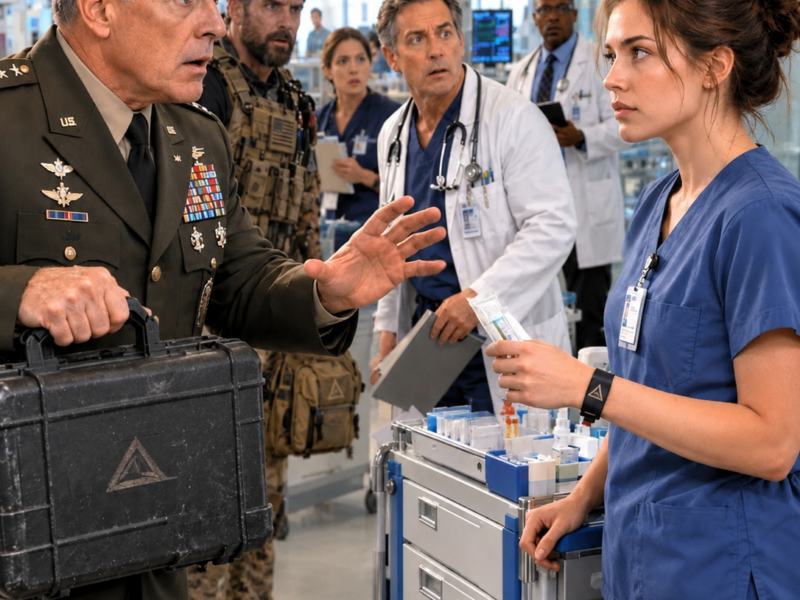
I Was Just a Quiet Rookie Nurse at St. Jude When a Doctor Humiliated Me in Front of Everyone—Until a Military Convoy Explosion Sent Dozens of Soldiers Into Our ER and He Froze at the Sight of Their Blood. I Took Over, Saved a Dying Operator, and Ordered Him Out of My Trauma Bay. Then a Two-Star General Stormed Through the Doors, Demanded Everyone Find “Valkyrie,” and When I Stepped Forward and Said “That’s Me,” He Raised His Hand and Saluted Me…
I Was Just a Quiet Rookie Nurse at St. Jude When a Doctor Humiliated Me in Front of Everyone—Until a Military Convoy Explosion Sent Dozens of Soldiers Into Our ER and He Froze at the Sight of Their Blood. I Took Over, Saved a Dying Operator, and Ordered Him Out of My Trauma Bay. Then a Two-Star General Stormed Through the Doors, Demanded Everyone Find “Valkyrie,” and When I Stepped Forward and Said “That’s Me,” He Raised His Hand and Saluted Me…
PART 1
The emergency room at St. Jude Medical Center always smelled the same: stale coffee, industrial bleach, and the faint metallic scent of old blood that no amount of scrubbing could completely remove. It was a smell Evelyn Carter had learned to tolerate, even though it occasionally reminded her of places she desperately wanted to forget.
She stood quietly in the corner of Trauma Bay 3, her back resting against a cold, painted cinder-block wall. Above her, fluorescent lights hummed with an irritating consistency. She barely noticed them anymore. Her attention was fixed on the IV bag hanging beside an empty hospital bed, watching the slow, rhythmic drops of saline fall through the transparent tubing.
One drop.
Then another.
Then another.
There was something comforting about repetition. Something predictable. Something that didn’t explode without warning or leave people screaming for help in the darkness.
Evelyn adjusted the sleeves of her standard-issue blue scrubs and checked the supplies on the nearby cart. Her uniform was slightly oversized, deliberately hiding the lean, muscular frame beneath it. Her dark hair was pulled into a tight ponytail, and her face carried the kind of quiet expression that made people forget she was even in the room.
To most of the staff at St. Jude, she was simply Evelyn, the new civilian trauma nurse.
She was polite, punctual, and almost painfully reserved. She rarely participated in conversations unless someone directly addressed her. She never competed for the attention of senior physicians and seemed perfectly satisfied with the least glamorous assignments.
Restocking medical supplies.
Checking expiration dates.
Organizing emergency equipment.
Updating patient charts.
She had become remarkably good at being invisible.
And that was precisely what she wanted.
Nobody at St. Jude knew that before arriving at the hospital, Evelyn had spent ten years serving as an independent duty corpsman attached to one of the most elite special operations units in the United States military.
Nobody knew that she had treated catastrophic injuries under mortar fire, performed emergency amputations with improvised equipment, and held severed arteries closed while helicopters struggled to reach extraction points.
Nobody knew that she had worked in environments where a medical mistake didn’t result in a complaint to hospital administration.
It resulted in a flag-draped coffin.
During those ten years, she had learned to recognize the difference between fear and panic. Fear could keep someone alive. Panic could kill an entire team.
She had learned to make decisions in seconds, to work with limited equipment, and to keep her hands steady even when everything around her was falling apart.
She had also learned what it felt like to lose people.
That was the part she never discussed.
Some nights, she still remembered the weight of a wounded teammate against her chest, the warmth of blood soaking through her gloves, and the terrible silence that followed when she could no longer find a pulse.
Those memories had followed her home long after she left the battlefield.
Eventually, Evelyn had decided she wanted something different.
She wanted a life where the loudest sound was a monitor beeping because someone had forgotten to silence an alarm. She wanted to worry about paperwork instead of ammunition. She wanted to go home after a shift without wondering whether the people she had treated would survive until sunrise.
Most importantly, she wanted people to call her Evelyn.
Not her old operational nickname.
Not the name whispered over encrypted military communications.
Not the name that had once made experienced operators stop talking when they heard it.
She wanted to be ordinary.
Unfortunately, ordinary life had a way of testing her patience.
“Nurse!”
The sharp voice came from behind her.
Evelyn turned slowly.
Dr. Julian Prescott stood in the middle of the trauma bay, wearing expensive custom-tailored navy scrubs. His hair was perfectly arranged, and his stethoscope hung around his neck like an award he had recently received.
He was young for an attending physician and made certain everyone knew it.
He had graduated from an impressive medical school, completed a prestigious fellowship, and regularly mentioned his academic accomplishments whenever an opportunity presented itself.
Unfortunately, his confidence was considerably larger than his practical experience.
“Yes, Dr. Prescott?”
Evelyn kept her voice neutral.
“Are those the central line kits I specifically requested?”
He pointed toward the tray she had just organized.
“These are the standard hospital-issued kits. The supply department hasn’t approved the new requisition yet. I can assemble the additional components individually if you’d prefer.”
Prescott stared at her as though she had personally sabotaged his career.
“Of course they haven’t. Bureaucracy is the enemy of exceptional medicine.”
He shook his head dramatically.
“When I was at Johns Hopkins, we didn’t have to wait for some administrator to approve basic equipment. Just make sure the ultrasound machine is properly calibrated. I don’t want to be fumbling with the settings when a real trauma rolls in.”
Evelyn glanced at the machine.
She had calibrated it three times that morning.
“It’s ready, Doctor.”
“Good. And try to anticipate what I need instead of waiting for instructions.”
“Of course.”
He walked away without another word.
From the doorway, Margaret Lewis had witnessed the entire exchange.
Margaret was the emergency department’s veteran charge nurse. She had worked in trauma medicine for thirty years and possessed an almost supernatural ability to identify incompetent people before they opened their mouths.
She waited until Prescott disappeared around the corner before approaching Evelyn.
“You know, you don’t have to let him speak to you like that.”
Evelyn continued arranging the supplies.
“It’s fine.”
“No, it isn’t. The man has the personality of a spoiled prince and the practical experience of a medical textbook.”
Evelyn smiled faintly.
“He needs to feel important.”
Margaret snorted.
“He needs a reality check. He can recite the survival statistics of a ruptured aorta down to the decimal point, but I wouldn’t trust him to hold a flashlight if somebody actually started bleeding.”
Evelyn said nothing.
Margaret studied her for a moment.
There was something about the new nurse that had bothered her from the beginning.
It wasn’t incompetence. Quite the opposite.
Evelyn’s hands moved with unusual precision. She never wasted motion. She always seemed to know where every instrument was located, even when she wasn’t looking.
Sometimes, Margaret caught her watching the emergency department doors with an expression that seemed completely disconnected from whatever conversation was happening around her.
“You know what your problem is?” Margaret finally asked.
Evelyn raised an eyebrow.
“What?”
“You’re too comfortable being underestimated.”
Evelyn offered a small smile.
“I like quiet, Margaret.”
“Quiet?”
“Quiet is safe.”
Margaret looked at her more carefully.
For a brief moment, she thought she saw something behind Evelyn’s eyes. Something old, exhausted, and difficult to explain.
Before she could ask another question, a piercing alarm shattered the room.
The mass casualty alert.
Every conversation stopped.
The overhead speaker crackled.
“Code triage. Code triage. Major incident reported. All available emergency personnel to the emergency department. Incoming mass casualty event. Stand by for additional information.”
Margaret immediately straightened.
“All right, people! Move! Clear the trauma bays! Get the blood bank on the phone!”
Nurses rushed out of the breakroom. Residents abandoned their coffee cups and sprinted toward the treatment areas. Someone knocked over a supply cart. Another nurse began shouting for additional stretchers.
Evelyn remained still for half a second.
Then something inside her changed.
It was almost imperceptible.
Her shoulders settled. Her breathing slowed. Her eyes became sharper.
The woman who had spent the morning quietly checking expiration dates disappeared.
In her place stood someone who had once operated in places where hesitation was fatal.
The radio on Margaret’s hip crackled.
“St. Jude, this is Rescue Four. We have a catastrophic incident on Interstate 95. Military transport convoy collided with a civilian fuel tanker. Multiple explosions reported. Structural collapse of the overpass. Casualties in the dozens, possibly hundreds. We have burns, blast injuries, traumatic amputations, and multiple penetrating wounds. First wave arriving in two minutes.”
Margaret’s face went pale.
“A fuel tanker and a military convoy?”
“That’s correct. Possible secondary explosions. Responders are still extracting personnel.”
Prescott appeared in the hallway, clapping his hands.
“Everybody listen! I’m the senior attending on the floor. We’re following triage protocol Alpha. I want airway carts in every bay, the blood bank on standby, and nobody makes independent decisions without authorization!”
Evelyn was already moving.
She bypassed the standard airway carts and headed straight toward the locked surgical reserve cabinet.
With a sharp twist, she broke the plastic security seal.
She began loading chest tubes, large-bore IV equipment, surgical clamps, tourniquets, and emergency airway supplies onto a rolling stand.
Prescott noticed immediately.
“Nurse! What exactly are you doing?”
“Preparing for the incoming patients.”
“I didn’t authorize you to open the surgical reserve.”
Evelyn didn’t look at him.
“Blast injuries mean internal hemorrhage, penetrating trauma, and compromised airways. We’ll need more than basic triage supplies.”
“That isn’t your decision!”
She finally turned.
For the first time that morning, her expression had changed.
“Paper doesn’t bleed, Doctor.”
Her voice was quieter than before, but something about it made Margaret stop moving.
“People do.”
Prescott opened his mouth.
Before he could respond, the automatic doors crashed open.
The first stretchers arrived.
The smell reached them before the patients did.
Burned plastic. Diesel fuel. Ozone. Blood.
And something else.
The unmistakable smell of human flesh exposed to fire.
Paramedics rushed through the entrance, shouting patient information as they pushed stretchers into the waiting bays.
“Bay One!”
“Bay Two!”
“Get this patient to surgery!”
Then a military casualty was wheeled into Trauma Bay 3.
The man’s uniform was torn and blackened. Blood covered his face, and his right leg had been mangled by the explosion.
A paramedic shouted over the noise.
“Male military personnel! Massive facial trauma! Suspected crushed airway! Catastrophic arterial bleeding in the right thigh! We couldn’t get the tourniquet tight enough. He’s losing pressure!”
The soldier was gasping.
His chest barely moved.
Blood pulsed from his thigh, spraying across the floor.
Prescott stared.
For one terrible moment, he couldn’t move.
And Evelyn recognized that moment immediately.
She had seen it before.
The moment when someone discovered that the medical emergency in front of them was no longer a simulation.
PART 2
The soldier’s monitor began screaming as his blood pressure collapsed. Prescott fumbled with the laryngoscope, arguing about which airway protocol to follow while the young resident desperately pressed gauze against the man’s bleeding leg.
Evelyn stepped forward.
“Move.”
When Prescott hesitated, she shoved him aside and took control. Her hands found the damaged artery, stopped the bleeding, and secured the airway with astonishing speed. Within seconds, the soldier was breathing again.
The room fell silent.
Prescott threatened to report her, but Evelyn ordered him out of the bay.
Then the emergency department doors opened again.
A heavily armed military police detail entered, followed by a scarred lieutenant general whose uniform carried two unmistakable stars.
“Find Valkyrie!” he barked. “I need her immediately!”
Nobody understood.
Until Evelyn stepped forward, her hands still stained with blood.
“That’s me.”
PART 3
For several seconds, nobody moved.
The general stood in the middle of the emergency department, his military police detail positioned around him, while dozens of medical personnel stared at the quiet nurse who had just identified herself as the person he was searching for.
Evelyn Carter.
The rookie.
The woman who had spent the last several months restocking gauze, checking medical supplies, and quietly accepting insults from a physician who considered himself the smartest person in the building.
The general looked at her.
Then, without hesitation, he raised his right hand and delivered a crisp military salute.
It wasn’t a casual greeting.
It was a formal gesture of respect.
And it was directed at the civilian nurse standing in front of him.
Margaret’s mouth fell open.
Davis, the young resident, looked from the general to Evelyn and back again, as though his brain was struggling to reconcile two completely different realities.
Near the nurses’ station, Prescott had stopped moving.
He had been watching from behind the counter, expecting the general to ask for a senior physician or perhaps the hospital’s trauma director.
Instead, the most powerful man in the emergency department had just saluted the woman Prescott had spent the morning treating like an incompetent assistant.
Evelyn didn’t return the salute.
She simply crossed her arms.
“I’m retired, Thomas.”
The general lowered his hand.
For the first time since entering the building, the severity in his expression softened.
“I know, Evelyn.”
His voice was different now. The booming command that had shaken the emergency department was gone, replaced by something quieter.
Something almost pleading.
“They hit the transport.”
Evelyn’s expression tightened.
“How many?”
“Three vehicles. One was completely destroyed. The second overturned during the explosion. The third was caught beneath the collapsing section of the overpass.”
“Who was in them?”
“Members of a Tier One operational element. We have multiple critical casualties. Some are still being extracted.”
Evelyn looked toward the incoming stretchers.
“How bad?”
The general hesitated.
“Bad enough that I came here personally.”
She closed her eyes briefly.
“Thomas, I’m not part of your unit anymore.”
“I know.”
“I’m not on active duty.”
“I know that too.”
“Then why are you standing in my emergency department?”
The general looked at her.
“Because I have men dying, and I know exactly what happens when you decide they’re not going to die.”
The words hung between them.
Margaret watched the exchange, trying to understand how a retired civilian nurse could have a relationship with a lieutenant general that seemed to transcend ordinary military hierarchy.
The general turned toward the administrator, who had been hovering nervously nearby.
“How many trauma bays can you clear?”
The administrator blinked.
“General, we’re already handling the civilian casualties. We have limited personnel and operating room capacity.”
“Then find more.”
“Sir, we have established protocols—”
“Your protocols aren’t going to be enough for what is coming through those doors.”
Evelyn interrupted before the argument could escalate.
“Margaret.”
The veteran nurse immediately turned.
“Yes?”
“Clear Bays Four through Eight. Military personnel only. I want the surgical reserve opened, the blood bank notified, and every available unit of whole blood brought down here.”
Margaret didn’t hesitate.
“Understood.”
“Get me two additional anesthesia teams. Call trauma surgery, vascular surgery, and orthopedics. I want someone from radiology assigned to each critical bay.”
“Already moving.”
Evelyn turned toward the general.
“Tell your people to establish a triage station outside. Anyone who can walk goes to the cafeteria. Anyone who can’t stays on a stretcher. No one gets moved twice unless absolutely necessary.”
The general looked at his security detail.
“You heard her. Execute!”
The soldiers moved instantly.
It was a remarkable sight.
A woman in ordinary blue scrubs was giving orders, and a lieutenant general was ensuring they were followed.
Prescott watched with growing disbelief.
He had spent years believing authority came from titles, degrees, and the ability to command a room through sheer confidence.
Yet Evelyn had taken control without raising her voice.
She hadn’t asked anyone to recognize her qualifications.
She simply knew what needed to happen.
And everyone around her could feel it.
The next stretcher arrived.
This time, the casualty was a young operator whose uniform had been torn open by fragments of metal. His left shoulder was badly injured, and a piece of shrapnel protruded near his upper chest.
His face was pale.
His eyes were open, but barely focused.
“Valkyrie?”
The word came out as a whisper.
Evelyn stepped closer.
“Right here.”
The young man tried to lift his hand.
“Thought… thought you were gone.”
“Not today.”
She placed a hand against his shoulder.
“Stay with me. What’s your name?”
“Mercer.”
“All right, Mercer. You’re going to keep talking to me.”
His eyes moved toward her face.
“You look different.”
“That’s because I’m wearing better clothes.”
He managed the faintest smile.
Then his breathing became irregular.
Evelyn immediately assessed his condition.
“Possible chest injury. Get the portable ultrasound. I need a chest tube tray.”
A resident moved toward the equipment.
“Doctor, prepare for decompression,” Evelyn instructed. “Get anesthesia here and have surgery ready.”
The resident looked toward Prescott instinctively.
Prescott opened his mouth.
Then he stopped.
He had no idea what to say.
Evelyn’s attention was already elsewhere.
She moved between patients with a speed that seemed almost impossible to the civilian staff. She didn’t rush unnecessarily, but every movement had a purpose.
A tourniquet was applied.
A pressure dressing was replaced.
A blood transfusion was initiated.
A patient with a compromised airway was moved into a treatment position while another nurse prepared emergency equipment.
She remembered faces.
She remembered injuries.
She remembered which patients were deteriorating and which ones could safely wait another minute.
More importantly, she understood the nature of the injuries coming through the doors.
The explosion hadn’t simply thrown debris into the convoy.
Something had burned.
Something had produced an unusual chemical residue.
Several soldiers were suffering from burns and respiratory complications that didn’t match the ordinary pattern of fuel-related injuries.
The general approached her while she examined a patient.
“There’s something you need to know.”
Evelyn didn’t look up.
“Make it quick.”
“The initial report suggests the tanker wasn’t carrying ordinary commercial fuel.”
Her hands stopped.
“What was it carrying?”
“We’re still confirming the details. Preliminary intelligence indicates an industrial chemical accelerant. It was disguised as a commercial shipment.”
Evelyn looked toward him.
“That explains the respiratory injuries.”
“We think the explosion was deliberate.”
“Think?”
“Intelligence believes the convoy was targeted.”
Evelyn’s jaw tightened.
“Then you need to keep your perimeter secure. No one enters this department without being cleared.”
“Already done.”
“Good.”
She turned back to the patient.
“Let’s keep these men alive first. We can discuss the rest afterward.”
The general nodded.
He knew that tone.
It was the tone Evelyn used when there was no room for arguments.
For the next several hours, the emergency department became something entirely different from the hospital Margaret had known for three decades.
The ordinary routines disappeared.
The waiting room was converted into a secondary treatment area. Security officers controlled the hallways. Medical supply carts rolled continuously between bays.
The sounds were relentless.
Monitors.
Ventilators.
Footsteps.
Orders.
The occasional desperate cry of someone who had just realized how close they had come to dying.
Evelyn moved through it all.
At one point, a senior trauma surgeon arrived from the operating department and immediately began questioning the treatment plan.
“Who authorized this sequence?”
Evelyn turned.
“I did.”
The surgeon looked at her badge.
“You’re the nurse?”
“Yes.”
“Then where is the attending physician?”
Evelyn pointed toward the operating room doors.
“Preparing the patient I just stabilized.”
The surgeon looked down at the chart.
Then at the patient’s vital signs.
He studied the information for several seconds before nodding.
“All right. Show me what you’ve found.”
Evelyn explained the injury pattern, the suspected internal damage, and the reason she had prioritized a particular intervention.
The surgeon listened.
Then he followed her recommendation.
Margaret saw the exchange and almost laughed.
Two hours earlier, she would have expected that surgeon to demand a meeting with hospital administration before accepting instructions from a new nurse.
Now he was standing beside Evelyn, listening carefully while she explained the next steps.
The hospital’s hierarchy was disappearing.
Competence had become the only qualification that mattered.
And Evelyn had more of it than anyone else in the building.
Prescott was beginning to understand that.
He had been assigned to assist with basic stabilization and supply coordination. Initially, he had considered the assignment humiliating.
He was an attending physician.
He had completed years of education.
He had worked hard to reach his position.
Yet here he was, carrying equipment and holding pressure on wounds while a civilian nurse directed the room.
He wanted to object.
He wanted to remind everyone of his position.
But every time he looked toward Evelyn, he remembered the soldier in Bay 3.
He remembered the blood.
He remembered his own hands shaking.
And he remembered how easily she had done what he couldn’t.
A little after midnight, he found himself standing beside Margaret.
“Who is she?”
Margaret glanced at him.
“Excuse me?”
“Evelyn. Who is she really?”
Margaret looked across the department.
Evelyn was leaning over a patient, speaking quietly while adjusting a monitoring line.
“I don’t know,” Margaret admitted. “But I’m beginning to think the question is bigger than either of us.”
Prescott swallowed.
“The general called her Valkyrie.”
“Yes.”
“What does that mean?”
Margaret gave him a tired look.
“I suggest you stop asking questions and start learning.”
Across the room, Evelyn heard a familiar voice.
“Valkyrie!”
She turned.
A military medic was standing beside a stretcher, looking frightened.
“He’s losing pressure!”
Evelyn immediately moved.
The conversation ended.
The night wasn’t over.
And somewhere beyond the hospital walls, the people responsible for the explosion were still out there.
PART 4
By two in the morning, the emergency department had become a battlefield without weapons.
There were no gunshots or incoming artillery, but the intensity was familiar to Evelyn.
Every decision mattered.
Every minute mattered.
Every mistake had consequences.
She had spent years learning to recognize the subtle signs that a wounded soldier was approaching the point of no return.
A change in breathing.
A slight alteration in skin color.
A monitor reading that seemed acceptable until it suddenly wasn’t.
She watched everything.
At the far end of the department, a young operator was struggling with a severe abdominal injury. His blood pressure continued to fall despite aggressive resuscitation.
“What’s his status?” Evelyn asked.
“Pressure is dropping,” Margaret replied. “The surgical team is still preparing.”
“How long?”
“Ten minutes.”
Evelyn looked at the monitor.
“He’s not going to give us ten minutes.”
She turned toward the attending surgeon.
“Can you take him now?”
The surgeon examined the patient.
“We need to stabilize him first.”
“He isn’t responding. We need definitive treatment.”
The surgeon hesitated.
Then he looked at Evelyn’s face.
He saw no panic.
No uncertainty.
Only a calm assessment of the situation.
“Prepare the operating room,” he ordered. “We’re moving.”
The patient was transferred.
Evelyn followed the stretcher until the operating room doors closed.
Only then did she allow herself to take a breath.
Margaret appeared beside her.
“You’ve been working for almost six hours without stopping.”
“I’m fine.”
“That’s what everyone says right before they fall over.”
Evelyn gave her a tired smile.
“Then I suppose I’ll try not to fall over.”
Margaret studied her.
“How long did you do this?”
Evelyn knew exactly what she meant.
“Ten years.”
“Ten years in special operations?”
Evelyn nodded.
Margaret shook her head slowly.
“Good Lord.”
“Most people don’t ask.”
“Most people don’t have a general walking into their emergency department and saluting a nurse.”
Evelyn glanced toward the military security detail.
“Thomas has always been dramatic.”
Margaret laughed despite herself.
“That man looks like he could order an entire country to move out of his way.”
“He probably could.”
“And you just called him Thomas.”
Evelyn shrugged.
“We’ve known each other a long time.”
Margaret leaned against the wall.
“Are you going to tell me what happened?”
Evelyn looked toward the operating room.
“Not tonight.”
Margaret nodded.
She didn’t press.
There were some things a person had to be ready to discuss.
Across the department, Prescott was assisting with another patient.
He had stopped trying to reclaim authority.
Instead, he was listening.
He asked questions.
He followed instructions.
He watched how Evelyn approached each situation.
At first, he had thought her calmness was indifference.
Now he understood that it was discipline.
She didn’t waste emotional energy on things that could be controlled.
She didn’t shout unless shouting was necessary.
She didn’t treat patients as problems to be solved for the sake of a successful case report.
She treated them as human beings who deserved every possible chance to survive.
A few minutes later, Prescott approached her.
“Valkyrie?”
Evelyn looked at him.
“Don’t call me that.”
He immediately nodded.
“Sorry. Evelyn.”
“What do you need?”
He held up a chart.
“Patient in Bay Six. Possible internal bleeding. The initial scan is inconclusive, but his pressure is declining. I wanted to know whether you think we should move him to surgery.”
Evelyn examined the information.
“How long has he been deteriorating?”
“About twelve minutes.”
“Then yes. Get the surgeon.”
Prescott nodded.
He started to walk away, then stopped.
“Can I ask you something?”
“Not if it can wait.”
“It can’t.”
Evelyn looked at him.
He seemed uncomfortable.
“How did you know what to do with the soldier in Bay Three?”
She held his gaze.
“Experience.”
“That’s not an answer.”
“It’s the only one I have right now.”
Prescott looked down at the chart.
“I froze.”
Evelyn didn’t respond.
“I saw the blood and I couldn’t think. I knew the theory. I knew the procedures. I could explain everything I was supposed to do. But when it happened, I couldn’t move.”
His voice became quieter.
“I’ve never felt anything like that.”
Evelyn studied him.
“That’s because you haven’t experienced it before.”
“I’ve treated trauma patients.”
“Yes. But reading about a procedure, practicing it in a simulation, and performing it when someone is dying in front of you are three different things.”
Prescott nodded slowly.
“Do you think I’ll ever get over it?”
“That depends on what you do with it.”
He looked up.
“What do you mean?”
“You can spend the rest of your career pretending it didn’t happen. You can blame the circumstances, blame the equipment, blame the people around you, or blame me for taking over.”
She paused.
“Or you can admit you weren’t ready, learn from it, and make sure the next patient gets a better version of you.”
Prescott absorbed her words.
For the first time since Evelyn had met him, he didn’t seem interested in defending himself.
“Thank you,” he said.
She nodded toward Bay Six.
“Go help that patient.”
He left immediately.
Margaret, who had overheard the exchange, approached Evelyn.
“You’re a lot kinder than I would have been.”
Evelyn gave a tired smile.
“Humiliation doesn’t teach much. Responsibility does.”
At approximately four in the morning, the hospital administrator arrived with two members of the security department.
He approached Margaret first.
“Where is Nurse Carter?”
Margaret pointed toward Bay Five.
“Working.”
“We need her personnel file.”
“Why?”
“Military security requested it.”
Evelyn heard the conversation and stepped out of the bay.
“What’s going on?”
The administrator looked uncomfortable.
“General Sterling has requested access to your employment records. Apparently, there are some details in your background that weren’t included in your civilian application.”
Evelyn’s expression hardened.
“That’s not surprising.”
“Some of the records are classified.”
“Then you shouldn’t be discussing them in a public hallway.”
The administrator immediately lowered his voice.
“Understood.”
General Sterling approached from behind the security officers.
“She’s right,” he said. “Take the documents somewhere private.”
He looked at Evelyn.
“Can we talk?”
“After the critical patients are stabilized.”
“Evelyn—”
“Thomas.”
He stopped.
She looked directly at him.
“I agreed to help your men. I didn’t agree to discuss my past while people are still dying.”
The general studied her for a moment.
Then he nodded.
“Understood.”
He turned toward the administrator.
“Leave her alone.”
The administrator nodded quickly.
A few minutes later, Evelyn returned to the trauma bays.
By five in the morning, the pace finally began to slow.
The last critical casualties had been transferred to the intensive care unit or operating rooms. The remaining patients were stable enough for continued treatment.
The emergency department looked as though a storm had passed through it.
Bloody linens covered the floors. Empty packaging and discarded medical supplies filled the counters. The air smelled of antiseptic, sweat, and exhaustion.
Evelyn stood at the sink in the decontamination room.
She washed her hands.
The water ran pink, then red, then clear.
She scrubbed beneath her fingernails, over her wrists, and along her forearms.
She had performed this ritual thousands of times.
Yet tonight, the sensation felt different.
The adrenaline was disappearing, leaving behind the familiar heaviness in her shoulders and the exhaustion that seemed to settle deep inside her bones.
The door opened.
Prescott stepped inside.
He looked nothing like the confident attending who had walked into Trauma Bay 3 earlier that morning.
His expensive scrubs were stained. His hair was disheveled. His face was pale.
He stood near the doorway for several seconds.
“I froze tonight,” he said.
Evelyn continued washing her hands.
“Yes.”
“I keep thinking about that soldier.”
She turned off the tap.
“He survived.”
“Because you moved.”
“Because everyone eventually moved.”
Prescott shook his head.
“No. You moved when none of us could.”
Evelyn reached for a towel.
He hesitated before continuing.
“I looked at your file.”
Her hands stopped.
“The administrator showed you?”
“Some of it. Most of it was redacted.”
Evelyn folded the towel carefully.
Prescott continued.
“Naval Special Warfare. Joint Special Operations Command. Silver Star. Navy Cross.”
He looked at her.
“Your records describe operational medical service that I can’t even imagine. There are pages of classified material. I didn’t know people like you existed.”
Evelyn looked tired rather than offended.
“People like me are usually too busy working to introduce themselves.”
“Why are you here?”
She didn’t answer immediately.
Prescott took a breath.
“You’re clearly capable of doing far more than stocking supplies in an emergency department. You could be working with a military medical unit. You could be teaching trauma surgery. You could be leading a specialized team.”
Evelyn looked at him.
“Because I don’t turn it off, Julian.”
Her voice was quiet.
“I only put it in a box.”
She looked down at the towel in her hands.
“I came here because I wanted quiet. I wanted to spend my days doing ordinary things. I wanted to restock gauze, check expiration dates, and go home without hearing helicopters in my sleep.”
Prescott said nothing.
“Every time I close my eyes, I remember the faces of people I couldn’t save. I remember the ones who asked me to stay with them. I remember the ones who didn’t make it.”
She swallowed.
“I didn’t want to be Valkyrie anymore. I just wanted to be Evelyn.”
Prescott lowered his eyes.
For the first time, he seemed to understand that the woman standing in front of him wasn’t hiding her abilities because she lacked ambition.
She was hiding them because she had already paid a terrible price for developing them.
Evelyn tossed the towel into the hamper.
“Paper doesn’t bleed, Doctor. You learned medicine in a library. I learned it in a war zone.”
She walked toward the door.
“Don’t ever confuse the two again.”
Prescott stepped aside.
He didn’t try to stop her.
He simply watched her leave, knowing that the woman he had dismissed that morning had taught him more about medicine in one night than he had learned from years of trying to impress other people.
PART 5
The shift officially ended at seven in the morning.
By then, the hospital had begun returning to something resembling normal operations.
The mass casualty alert had been lifted. Military personnel continued guarding the building, but the frantic movement through the corridors had stopped.
The survivors were receiving treatment in the intensive care unit and operating rooms.
Some would need months of rehabilitation.
Others would never return to active duty.
But they were alive.
And for Evelyn, that was enough.
She changed out of her bloodstained scrubs and into a simple gray hoodie and worn jeans. She tied her hair back again, collected her keys, and walked toward the employee exit.
Outside, the morning air was cold.
A row of military vehicles occupied the parking lot. Several soldiers stood beside them, speaking quietly into radios.
General Sterling was waiting near a black SUV.
He had removed his uniform jacket and was holding a cigar between his fingers.
When he saw Evelyn, he straightened.
“Morning, Carter.”
She stopped beside him.
“Morning, General.”
He smiled faintly.
“Still calling me General?”
“You’re still wearing the stars.”
He laughed.
For a moment, neither spoke.
The general looked toward the hospital entrance.
“All three transport teams have been accounted for. We lost two people at the scene.”
Evelyn lowered her eyes.
“I’m sorry.”
“Fourteen more are in critical condition, but the doctors believe they’ll survive.”
“Good.”
“Mercer asked about you.”
Evelyn looked up.
“Which one?”
“The young man with the chest injury. He wants to know whether you’re really retired.”
A faint smile appeared on her face.
“What did you tell him?”
“That I wasn’t going to make any promises.”
She shook her head.
“Thomas.”
“He’ll be fine.”
“That’s not what I meant.”
The general took a slow breath.
“I know.”
He looked at her for a long moment.
“I owe you.”
“No, you don’t.”
“Yes, I do.”
“Your people were my patients. I did my job.”
“Your job ended years ago.”
Evelyn looked toward the parking lot.
“Maybe. But the people didn’t stop needing help.”
The general nodded.
He understood more than most people.
He had watched Evelyn spend ten years giving everything she had to a team that depended on her. He had seen her work through injuries, exhaustion, and circumstances that would have broken most people.
He also knew why she had left.
She hadn’t abandoned the people she served.
She had simply reached a point where continuing to serve them meant losing whatever remained of herself.
He wasn’t going to ask her to return.
He knew better.
Instead, he reached into his pocket and removed a small envelope.
“I thought you might want this.”
Evelyn looked at it.
“What is it?”
“Copies of the casualty reports. The names of everyone who survived.”
She accepted the envelope.
“Thank you.”
“There are some people who will want to contact you. Former teammates. Men who heard what happened tonight.”
“Tell them I’m retired.”
“I will.”
He hesitated.
“But I suspect some of them will still call.”
Evelyn gave him a tired smile.
“They always do.”
The general stepped back.
Then he saluted again.
This time, Evelyn returned the gesture.
Not because she wanted to reclaim her old identity.
Not because she missed the battlefield.
But because she understood what that salute represented.
Respect.
Shared sacrifice.
And the memory of people who had once stood beside them.
She climbed into her battered sedan and started the engine.
The general watched until she pulled out of the parking lot.
Inside the hospital, Margaret was standing near the nurses’ station when Evelyn’s departure was reported.
“She left?”
“About five minutes ago,” another nurse answered.
Margaret looked toward the emergency department doors.
For a long time, she said nothing.
Then she turned toward the supply room.
“Well, I suppose somebody still has to restock the gauze.”
The nurse laughed.
But Margaret wasn’t really joking.
She knew the hospital would never be quite the same.
Neither would the people who had witnessed what happened.
Dr. Prescott arrived for his next shift two days later.
His behavior had changed.
He still worked hard. He still cared about his professional reputation. He still had moments when his confidence got the better of him.
But he no longer treated nurses as people whose only purpose was to follow instructions.
He started asking questions.
He listened to the experienced staff.
He spent more time in the trauma bays instead of hiding behind the authority of his title.
Most importantly, he stopped confusing confidence with competence.
One afternoon, a young nurse made a mistake while preparing a patient for a procedure.
Prescott noticed immediately.
Instead of embarrassing her in front of everyone, he quietly corrected the problem and explained why it mattered.
Margaret watched from the doorway.
When he finished, she approached him.
“That’s new.”
Prescott looked confused.
“What?”
“You actually taught someone something without making them feel stupid.”
He gave a small, uncomfortable smile.
“I’m trying.”
Margaret nodded.
“Keep trying.”
He glanced toward the empty Trauma Bay 3.
“Do you think she’ll come back?”
Margaret followed his gaze.
“I don’t know.”
“I’d like to apologize properly.”
“You already did.”
“Not enough.”
Margaret looked at him.
“Then become the kind of doctor she wouldn’t have to apologize for saving patients from.”
Prescott considered that.
Then he nodded.
Meanwhile, Evelyn returned to her apartment.
It was small, quiet, and almost completely undecorated.
There were no photographs of her military service on the walls. No medals displayed in glass cases. No uniforms hanging in the closet.
The only reminders of her former life were a locked storage box beneath her bed and an old photograph tucked inside a drawer.
She placed the envelope from General Sterling on the kitchen table.
For several minutes, she simply stared at it.
Then she opened it.
There were names.
Dozens of them.
Some belonged to men she remembered clearly. Others were names she had heard only over radio communications.
She read each one carefully.
Mercer.
Alive.
Another operator.
Alive.
A medic who had once worked alongside her.
Alive.
She stopped at the final page.
There were two names marked with a small black symbol.
The two men who had died at the scene.
Evelyn sat down.
The room was silent.
She placed the papers on the table and closed her eyes.
For a moment, she was back in another place.
Another time.
She could almost hear the distant thunder of explosions and the crackle of a radio.
She remembered a voice calling for medical assistance.
She remembered the feeling of kneeling in the dirt beside someone who had become more than a colleague.
She remembered promising she would get him home.
And she remembered the terrible realization that sometimes a promise was impossible to keep.
Her eyes opened.
The apartment was still quiet.
The sun had moved across the kitchen floor.
Evelyn folded the casualty report and placed it back inside the envelope.
She wasn’t going to pretend the past had disappeared.
It hadn’t.
It never would.
But perhaps she no longer needed to spend every day running from it.
That evening, Margaret called.
Evelyn stared at the phone for a moment before answering.
“Hello?”
“You’re alive.”
“Last time I checked.”
“Good. I was beginning to wonder whether you had disappeared into some secret military facility.”
Evelyn laughed softly.
“Not quite.”
“How are you?”
“Tired.”
“That’s understandable.”
A pause followed.
Then Margaret spoke again.
“You know, things are different here.”
Evelyn leaned against the kitchen counter.
“How so?”
“Prescott has been behaving like a human being. Davis has been telling everyone about the night you saved that soldier. The administrator has received approximately seventeen requests for information about your background.”
Evelyn sighed.
“Wonderful.”
“And the general called twice.”
“Thomas?”
“Yes. He asked whether you were available for a meeting.”
Evelyn closed her eyes.
“What did you tell him?”
“That you were busy being retired.”
Evelyn smiled.
“Thank you.”
Margaret became quiet.
Then she said something unexpected.
“I’ve been thinking about what you told me.”
“What did I tell you?”
“That quiet is safe.”
Evelyn didn’t answer.
Margaret continued.
“I think I understand now. You weren’t trying to avoid working. You were trying to find somewhere you could finally breathe.”
Evelyn looked out the window.
“Something like that.”
“Well, I hope you find it.”
“Me too.”
They talked for a few more minutes before ending the call.
Evelyn placed the phone on the counter.
Then she walked to the storage box beneath her bed.
She hadn’t opened it in months.
Inside were several old items from her military career.
A worn identification card.
A folded unit patch.
A photograph.
And a small metal emblem that had once been attached to her equipment.
She picked up the photograph.
It showed a group of operators standing together outside a temporary medical facility.
They looked exhausted.
Their uniforms were dirty.
Several were smiling.
Evelyn recognized every face.
She remembered the jokes, the arguments, the long nights, and the strange sense of family that developed between people who had learned to trust one another with their lives.
She ran her thumb over the edge of the photograph.
Then she placed it back in the box.
She didn’t lock it immediately.
Instead, she left the lid open.
It was a small thing.
But for Evelyn, it meant something.
She was beginning to understand that remembering her past didn’t necessarily mean returning to it.
She could acknowledge who she had been without allowing that identity to consume the rest of her life.
The following Monday, Evelyn returned to St. Jude.
She arrived ten minutes before her shift began.
The hospital looked exactly as it had before the explosion.
The same fluorescent lights.
The same polished floors.
The same smell of coffee and disinfectant.
Margaret spotted her immediately.
“Well, look who decided to come back.”
Evelyn placed her bag in the locker.
“I still work here.”
“Are you sure? I thought the general might have promoted you to something ridiculous.”
“He tried.”
Margaret laughed.
“Of course he did.”
Evelyn entered Trauma Bay 3.
The room had been cleaned and reorganized.
The equipment was in its proper place.
The monitor was switched off.
She walked toward the supply cart and began checking the inventory.
Gauze.
Surgical gloves.
Saline.
Emergency airway equipment.
Everything was where it belonged.
Margaret stood in the doorway watching her.
“You know, you don’t have to hide anymore.”
Evelyn continued working.
“I’m not hiding.”
“Then what are you doing?”
She placed a package of sterile dressings on the shelf.
“Living.”
Margaret considered the answer.
Then she nodded.
“Fair enough.”
A moment later, the overhead speaker crackled.
“Emergency department. Incoming trauma. Single vehicle collision. One critical patient, estimated arrival in four minutes.”
Margaret immediately turned.
“Ready?”
Evelyn looked toward the doors.
For a brief second, she felt the old instinct awaken.
Her body remembered before her mind could respond.
The tightening of her muscles.
The sharpening of her attention.
The quiet calculation of what might be needed.
She took one breath.
Then another.
“Ready.”
She began preparing the bay.
This time, nobody questioned why she moved so precisely.
Nobody tried to stop her from opening the necessary supplies.
And nobody called her rookie.
When the stretcher arrived, Evelyn stepped forward alongside the other nurses.
There was no military convoy outside.
No general waiting in the hallway.
No armed security detail.
Just another patient.
Another family waiting for news.
Another life that needed help.
Evelyn looked down at the injured man and began her assessment.
“Let’s get him stabilized.”
The team moved.
And as the familiar sounds of the emergency department filled the room, Evelyn realized something she hadn’t understood before.
She had spent years believing that the only way to escape her past was to become someone entirely different.
But that wasn’t true.
The courage, discipline, and compassion she had developed during those ten years weren’t things she needed to bury.
They were part of her.
She could still be Evelyn.
She could still live quietly.
She could still enjoy ordinary mornings and unremarkable shifts.
And if the moment came when someone needed the person who had once been called Valkyrie, she didn’t have to pretend that person no longer existed.
Because the truth was that Valkyrie had never been a different woman.
She had always been Evelyn Carter.
A woman who had seen too much, lost too much, and carried more memories than she knew how to explain.
A woman who had spent years fighting to keep other people alive.
A woman who had finally found a place where she could try to save herself.
The emergency room doors closed behind the arriving patient.
Evelyn adjusted her gloves.
The monitor began to beep.
And somewhere deep inside her, the old battlefield instincts settled into place once more.
She didn’t know what the next day would bring.
She didn’t know whether another general would ever come searching for Valkyrie.
She didn’t know whether the people from her former life would ever stop calling.
But she knew one thing.
She had not forgotten how to fight.
And if the alarm sounded again, if another patient arrived with seconds separating life from death, she would be ready.
Not because she wanted to be a legend.
Not because she needed recognition.
But because someone, somewhere, would still need her.
And Evelyn Carter had never been very good at walking away from someone who needed help.