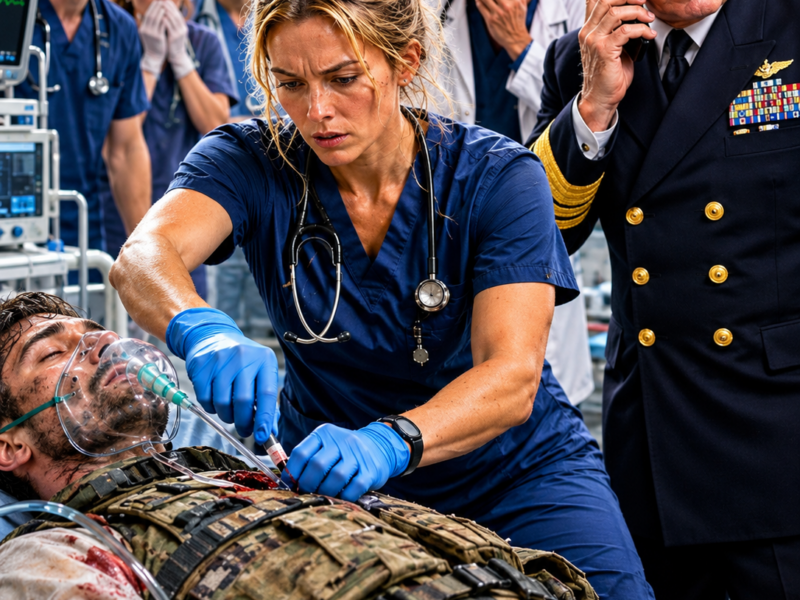
I Was Just a Quiet Nurse at Ramstein Air Base Hospital When Four Critically Wounded Soldiers Arrived, and My Boss Snapped, “That’s Not a Nursing Procedure!” After I Saved One Man’s Life. I Had Hidden My Military Past for 14 Months, but When I Helped Save Another Soldier, a Vice Admiral Suddenly Stared at the Scar on My Jaw. Then He Stepped Closer and Asked, “Were You Once Called Shepherd Two?” My Blood Ran Cold—Because I Knew Exactly What That Name Could Uncover…
I Was Just a Quiet Nurse at Ramstein Air Base Hospital When Four Critically Wounded Soldiers Arrived, and My Boss Snapped, “That’s Not a Nursing Procedure!” After I Saved One Man’s Life. I Had Hidden My Military Past for 14 Months, but When I Helped Save Another Soldier, a Vice Admiral Suddenly Stared at the Scar on My Jaw. Then He Stepped Closer and Asked, “Were You Once Called Shepherd Two?” My Blood Ran Cold—Because I Knew Exactly What That Name Could Uncover…
PART 1
The first time Vice Admiral Conrad Lester saw Sabine Mercer, he barely noticed her. She was standing beside a supply cart in the trauma ward at Ramstein Air Base Hospital, wearing faded blue scrubs, her light brown hair twisted into a loose clip, and a patient chart tucked beneath one arm. There was nothing about her appearance that suggested she had once survived some of the deadliest combat operations in modern military history. Nothing about her quiet expression suggested she had spent years making decisions that separated life from death by mere seconds. And certainly nothing suggested that, before the morning was over, this seemingly ordinary nurse would save four of his wounded operators and force everyone in that hospital to question everything they thought they knew about her.
For fourteen months, Sabine had worked at Ramstein without attracting much attention. She arrived twelve minutes before every shift, checked emergency equipment, reviewed patient charts, and completed her assignments without complaint. She rarely participated in conversations that wandered beyond hospital business. When colleagues invited her out for drinks, she usually declined politely. When someone asked about her previous experience, she mentioned a small hospital in rural Virginia and changed the subject.
Her personnel file supported the story perfectly. Her references were excellent, her nursing credentials were current, and her performance evaluations contained nothing except praise for reliability and professionalism.
Dr. Gerald Austin, the head of the trauma department, considered her a competent nurse who understood her place in the hospital hierarchy.
He had no idea how wrong he was.
Austin believed that effective medicine depended on discipline, structure, and strict adherence to established procedures. He had spent eleven years building a trauma department where every action could be justified through written policy. Physicians made the critical decisions. Nurses implemented those decisions. Nobody crossed those boundaries without authorization.
Sabine understood his philosophy. She also understood its limitations.
She had learned those limitations in places where no specialist could arrive in seventeen minutes, where operating rooms existed only in imagination, and where waiting for permission sometimes meant watching a wounded soldier die.
But she never challenged Austin unnecessarily.
She had come to Ramstein for a reason.
She wanted ordinary days. Predictable schedules. Quiet hallways. Work that mattered without requiring her to explain the person she had once been.
Most importantly, she wanted to stop hearing a particular voice in her dreams.
That voice belonged to a soldier who had died three years earlier, trapped beneath the wreckage of a collapsed building while Sabine desperately tried to keep him alive.
She had saved four men that night.
The fifth had never come home.
And although official reports described her actions as extraordinary, Sabine remembered only the one man she could not save.
Then, on a Thursday morning at precisely 8:23, the emergency radio came alive.
“Incoming military casualties. Four priority-alpha patients. Blast injuries and multiple gunshot wounds. Estimated arrival nine minutes.”
The atmosphere changed instantly.
Nurses hurried toward the trauma bays. Residents pulled on protective equipment. Technicians prepared ventilators and blood products while Austin began issuing instructions.
“Bay one for the most critical. Bay two for fragmentation trauma. Bay three for penetrating chest injuries. Bay four for the remaining casualty.”
Sabine pulled on her gloves.
She checked the equipment at bay two, then looked toward the entrance.
Her heartbeat slowed.
It always did when something terrible was about to happen.
Years earlier, a military psychologist had asked her why she appeared almost unnaturally calm during emergencies. Sabine had explained that fear had never disappeared. She had simply learned to put it somewhere it couldn’t interfere with her hands.
At 8:29, Vice Admiral Conrad Lester entered the trauma department.
He was a decorated senior officer in his early sixties, with close-cropped gray hair, a stern expression, and the unmistakable posture of a man accustomed to being obeyed. Three rows of ribbons decorated his uniform.
“Doctor Austin?”
Austin immediately approached.
“Vice Admiral. We’re prepared for your personnel.”
“Four of my people are on that transport,” Lester said. “I want the best treatment available.”
“You have my assurance, sir.”
Lester surveyed the room.
His eyes passed over Sabine.
She noticed the glance and recognized it immediately.
He saw a nurse. Someone responsible for equipment, medications, and whatever instructions the physicians gave her.
He did not see a soldier.
He did not see the woman whose call sign had once circulated through classified military medical reports.
And Sabine preferred it that way.
At 8:32, the ambulance doors opened.
Four stretchers rolled into the department almost simultaneously.
The wounded men were covered in dust, blood, and torn tactical equipment. One was struggling to breathe. Another was barely conscious. A third was pressing a trembling hand against his chest. The fourth looked terrifyingly still.
The flight medic shouted his report while the teams moved toward their assigned bays.
“Improvised explosive device followed by enemy fire! Multiple fragmentation wounds! Penetrating thoracic injury! Possible internal bleeding!”
Austin immediately concentrated on the man with the visible chest wound.
Sabine approached the casualty in bay two.
His identification read Staff Sergeant Daniel Reed.
He was thirty-four, broad-shouldered, and pale beneath the blood coating his face. His eyes remained open, but his breathing was shallow and increasingly desperate.
“Daniel, I’m Sabine,” she said. “I’m going to help you.”
He tried to answer.
Only a strained gasp emerged.
Sabine examined him quickly.
His chest was expanding unevenly. The breath sounds on his left side were severely diminished. His blood pressure was dropping, and his condition was deteriorating faster than the equipment could fully display.
She knew what was happening.
Air was accumulating under pressure inside his chest, compressing his lung and threatening his circulation.
Without immediate intervention, he could die within minutes.
“Get me an emergency decompression kit,” she told the technician.
The young man hesitated.
“Shouldn’t we wait for Dr. Austin?”
Sabine glanced toward bay three, where Austin was attempting to stabilize another critically injured patient.
“He’s occupied. Reed doesn’t have time.”
“But the authorization—”
“Get the kit.”
There was something in her voice that ended the conversation.
The technician handed it over.
Sabine immediately initiated the emergency intervention using the equipment and skills her advanced trauma training had given her.
A moment later, trapped air began escaping.
Reed’s chest expanded.
He pulled in a deep, trembling breath.
Then another.
The monitor began showing improvement.
“That’s it,” Sabine whispered. “Stay with me, Daniel.”
His eyes found hers.
For one extraordinary second, he looked like a drowning man who had suddenly reached the surface.
Across the room, Austin turned.
“What did you just do?”
“Emergency decompression,” Sabine replied. “He was developing a tension pneumothorax. He needs definitive treatment and imaging.”
Austin stared at her.
“That’s a physician-level intervention.”
“He was dying.”
“You should have called me.”
“I did assess the situation. You were treating another critical patient.”
“That’s not the point, Mercer.”
Sabine finally looked directly at him.
“Then tell me what the point is, Doctor. Because Staff Sergeant Reed is breathing again.”
Silence spread through the surrounding staff.
Austin’s face tightened.
For a moment, Sabine thought he might remove her from the bay.
Instead, an alarm sounded behind him.
He turned and hurried back to his patient.
Vice Admiral Lester had witnessed the entire exchange.
And this time, when his eyes settled on Sabine, they did not move away.
He had spent decades around military medical personnel. He knew the difference between someone following instructions and someone making decisions under extreme pressure.
What he had just witnessed was not ordinary confidence.
It was the kind of certainty that came from surviving circumstances most people would never understand.
He watched Sabine reassess Reed without wasting a movement.
Then he noticed something else.
A faint crescent-shaped scar ran along her jaw.
The sight stirred a memory, something buried in an old operational report he had reviewed years earlier.
But before he could examine the thought, another monitor began sounding.
Petty Officer First Class Michael Yeo was deteriorating.
His blood pressure was falling rapidly.
His breathing had become labored.
And when Sabine looked at the numbers on the monitor, she felt the old cold recognition settle into her stomach.
She had seen this pattern before.
In a medical tent without electricity.
During a mission nobody was supposed to discuss.
Beside a soldier who had less than five minutes to live.
She moved toward Yeo’s bed.
“Doctor Austin,” she called. “We have another emergency.”
Austin approached, exhausted and visibly strained.
“What is it?”
“Possible cardiac tamponade. His circulation is collapsing.”
Austin examined the patient.
“Call cardiology.”
“They’re seventeen minutes away.”
“Then we stabilize him until they arrive.”
Sabine watched the blood pressure fall again.
“Doctor, I don’t think he has seventeen minutes.”
Austin looked at her sharply.
“Mercer, we are not improvising another procedure.”
From behind them, Vice Admiral Lester stepped forward.
“What happens if you wait?” he asked.
Sabine turned toward him.
“He may go into cardiac arrest.”
“And if you intervene?”
“We may be able to keep him alive long enough for definitive treatment.”
Lester studied her face.
“Can you do it?”
Sabine hesitated for the first time that morning.
Not because she doubted her ability.
But because answering honestly might reveal a past she had spent two years trying to bury.
Then she looked at the young man struggling to breathe.
“Yes, sir.”
Austin stood motionless.
For several seconds, nobody spoke.
Finally, he looked at Yeo’s failing monitor and made a decision that would change not only the patient’s life but his own understanding of medicine.
“Prepare the equipment,” he said. “We’ll proceed with emergency support. I’ll take responsibility for the clinical decision.”
Sabine nodded.
And Vice Admiral Lester suddenly realized something deeply unsettling.
This quiet nurse was not merely familiar with battlefield medicine.
She was moving like someone who had once taught it.
PART 2
The next few minutes changed everything.
Under Austin’s supervision, Sabine helped carry out the emergency intervention while the medical team monitored Yeo’s condition. Nobody spoke unnecessarily. Every movement had a purpose.
Then the monitor began showing improvement.
Yeo’s pulse strengthened.
His blood pressure gradually climbed.
Austin stared at the readings, almost unable to believe the turnaround.
“He’s stabilizing,” he whispered.
Sabine exhaled.
“Only temporarily. He still needs imaging and surgical evaluation.”
Across the ward, the third casualty, Sergeant Layton Coates, began complaining of worsening abdominal pain. His initial injuries had appeared less severe, but Sabine noticed guarding and rigidity that suggested a hidden internal injury.
She immediately pushed for an urgent surgical assessment.
Within minutes, Coates was being transferred for emergency surgery.
The fourth man, twenty-two-year-old corpsman Thomas Walsh, had shrapnel wounds to his shoulder and thigh.
“Am I going to lose my arm?” he asked repeatedly.
Sabine held his hand.
“We’re going to do everything we can to save it.”
By late morning, all four men had survived the immediate crisis.
But Vice Admiral Lester was no longer watching the patients.
He was watching Sabine.
Because during Yeo’s treatment, she had made one tiny adjustment that he recognized from a classified account of a legendary combat medic.
And there was only one name associated with that technique.
Shepherd Two.
PART 3
By the time the trauma department finally began to settle, the morning had left its mark on everyone.
Bloodied uniforms had been removed from the treatment bays. Used equipment was being replaced. The sharp urgency of emergency alarms had given way to the quieter sounds of nurses checking monitors and technicians moving supplies.
Outside the windows, a gray German sky hung over Ramstein Air Base.
Inside, Sabine Mercer sat at a computer near the nurses’ station, documenting everything that had happened.
Her hands were steady now, but they had trembled briefly after Yeo stabilized.
That always happened.
During an emergency, her body seemed capable of ignoring everything except the task in front of her. Afterward, when nobody needed her to remain perfectly controlled, the fear returned in small physical reminders.
She had never considered herself fearless.
She simply understood that fear could not be allowed to make decisions.
“Mercer.”
She looked up.
Dr. Gerald Austin stood beside her holding two paper cups of coffee.
He placed one on the counter.
“Thought you could use this.”
“Thank you, Doctor.”
He didn’t leave.
Instead, he pulled a stool closer and sat beside her.
That surprised Sabine more than the coffee.
In fourteen months, she had never seen Austin sit at the nurses’ station unless something had gone seriously wrong.
“I’ve been thinking about what happened this morning,” he began.
Sabine waited.
“I’ve performed emergency decompressions under controlled conditions. I’ve supervised difficult cases. I’ve spent eleven years running this department.”
He paused.
“But you recognized Reed’s condition before anyone else. And you acted with a level of confidence I’ve rarely encountered.”
“Experience changes how you recognize things,” Sabine replied.
“Exactly what kind of experience?”
She looked back at the screen.
“Emergency medicine.”
“That’s not what I’m asking.”
“I know.”
Austin leaned back.
“I checked your personnel file.”
Sabine’s fingers stopped moving.
“Why?”
“Because I realized this morning that I know almost nothing about someone who has worked under my supervision for fourteen months.”
“My credentials are valid.”
“I never suggested otherwise.”
“Then what’s the problem?”
Austin hesitated.
“The problem is that I underestimated you.”
Sabine finally turned toward him.
For a man who valued professional authority as much as Austin did, the admission was significant.
“I wasn’t trying to embarrass you,” she said.
“I know that now.”
“Those men needed help.”
“And they received it because you saw what the rest of us were missing.”
He lowered his voice.
“I want to understand how you learned to work like that.”
Sabine stared into her coffee.
There were several answers she could give.
Some would satisfy his curiosity.
Others might end the quiet existence she had carefully constructed.
Before she decided, her pager vibrated.
She checked the message.
Vice Admiral Lester requested a private conversation.
At 3:14 that afternoon, she found him waiting in a corridor outside the supply room.
He was alone.
His uniform jacket was perfectly arranged, but his expression had lost some of the stern authority she remembered from that morning.
“Ms. Mercer.”
“Vice Admiral.”
“Thank you for meeting me.”
“Of course, sir.”
He gestured toward an empty section of corridor.
“I made a telephone call earlier.”
Sabine felt her stomach tighten.
“To whom?”
“An old colleague. Fourteen years in Naval Special Warfare. We worked together on several operations.”
She remained silent.
“I described what I witnessed today. Specifically, the way you assessed the casualties and how you compensated during Yeo’s emergency treatment.”
Sabine kept her face neutral.
“He recognized it.”
“Recognized what, sir?”
Lester studied her carefully.
“A particular field adaptation. Something developed under circumstances where standard equipment and conventional medical support were unavailable.”
Sabine said nothing.
“My colleague interrupted me before I finished describing it.”
A distant cart rattled down the corridor.
Lester continued.
“He asked whether the nurse had a scar along her jaw.”
Sabine’s expression hardened almost imperceptibly.
“Then he asked whether she had ever used the call sign Shepherd.”
For a moment, the hospital disappeared.
Sabine could smell smoke.
She could hear helicopter rotors somewhere beyond a distant ridgeline.
And she could see the face of a young soldier trapped beneath fallen concrete.
“Shepherd Two,” she corrected quietly.
Lester’s posture changed.
“So it is you.”
Sabine looked away.
“That call sign was retired.”
“I understand.”
“No, sir. I’m not sure you do.”
“Then help me understand.”
She turned back toward him.
“Chief Warrant Officer Sabine Mercer. Formerly assigned to the 160th Special Operations Aviation Regiment. Flight medic and combat trauma specialist. Seven deployments across three operational theaters.”
Lester listened without interrupting.
“Medically separated two years ago following a personnel matter that remains restricted.”
“Shepherd Two,” he repeated.
“Yes, sir.”
The Vice Admiral took a slow breath.
Three years earlier, he had read a classified after-action report concerning a joint operation in hostile territory.
The mission had deteriorated almost immediately.
An extraction team had been ambushed.
A building collapsed under explosive damage.
Five operators were trapped inside.
Their communications failed.
Medical evacuation became impossible.
And one flight medic had spent fifty-one minutes trying to keep them alive with almost no supplies.
According to the report, four men survived because of that medic.
The fifth died before extraction.
The medic had been identified only by a call sign.
Shepherd Two.
Lester had read the report twice.
At the time, he had privately questioned whether portions of it had been exaggerated.
The medical decisions described seemed almost impossible under those conditions.
Now he stood facing the woman who had made them.
“I remember that report,” he said.
Sabine lowered her eyes.
“Most people who read it remember the four survivors.”
“What do you remember?”
“The fifth.”
Lester said nothing.
“His name was Aaron Vale,” she continued. “He was twenty-six. He had a wife and a daughter who was eleven months old.”
Her voice remained controlled, but something beneath it had changed.
“He kept asking whether we were getting out. I told him we were.”
She swallowed.
“At the time, I believed it.”
Lester waited.
“His daughter was supposed to turn one two weeks after the mission. He’d bought her a ridiculous stuffed elephant at the airport before deployment. He was worried his wife would think it was too big for a baby.”
A faint, painful smile crossed her face.
“He asked me to make sure she got it.”
“What happened?”
Sabine looked toward the ceiling.
“I couldn’t save him.”
Lester had spent enough years around soldiers to recognize the difference between someone describing a memory and someone still living inside it.
“Four other men survived,” he said gently.
“I know.”
“Because of you.”
“I know that, too.”
“But you don’t believe it matters.”
She shook her head.
“That’s not what I said.”
“Then what are you saying?”
Sabine looked directly at him.
“I’m saying that saving four people doesn’t erase the fifth.”
For several seconds, neither moved.
Then Lester nodded.
“No,” he said. “It doesn’t.”
She had expected him to tell her she had done everything possible. She had expected another speech about sacrifice, courage, and the impossible nature of battlefield decisions.
Instead, he accepted what she said.
Somehow, that was harder.
“I read the operational findings,” Lester continued. “There was no evidence that your actions caused his death.”
“I didn’t say there was.”
“Then why are you carrying responsibility for it?”
Sabine almost laughed.
Because responsibility had never required evidence.
It had never required logic.
Sometimes it simply attached itself to the person who survived.
“Because I was there,” she answered.
Lester looked at her for a long moment.
Then he said something she did not expect.
“Two of the operators from that mission are currently patients in this hospital.”
Sabine’s breath caught.
“Which two?”
“Staff Sergeant Reed and Petty Officer Yeo.”
She stared at him.
“They were part of the later extraction element. Their names appeared in a supporting appendix. I confirmed it this afternoon.”
Sabine stepped back against the wall.
She remembered Reed now.
Not his face beneath the blood.
Not his identification.
His voice.
Years earlier, through static-filled communications, he had repeatedly asked whether the medical team needed additional supplies.
Yeo had helped establish the improvised evacuation route that eventually brought the survivors out.
The past had returned through the hospital doors that morning, and she had not even recognized it.
Lester watched her reaction.
“Neither man knows you’re here.”
“Please don’t tell them yet.”
“Why?”
“Because I don’t know what they’ll remember.”
He considered her answer.
“That’s fair.”
Then he straightened slightly.
“May I ask you one more question?”
“Yes, sir.”
“Why are you working here as an ordinary civilian nurse?”
Sabine looked toward the trauma ward.
For fourteen months, she had answered that question without ever speaking it aloud.
Because nobody expected her to be extraordinary here.
Nobody asked about classified missions.
Nobody mentioned the dead.
Nobody looked at her and saw someone who had survived when others hadn’t.
“I needed somewhere quiet,” she said finally.
Lester nodded.
“And has it helped?”
She thought about the morning.
About Reed breathing again.
About Yeo’s recovering blood pressure.
About Austin offering coffee.
About the name Shepherd Two suddenly spoken in a hospital corridor.
“Until today,” she answered, “I thought it had.”
Lester glanced toward the ward.
“Perhaps the quiet wasn’t meant to last forever.”
Sabine didn’t respond.
But later that evening, as she walked toward the staff parking lot, her phone vibrated with a message from an unfamiliar number.
It contained only eight words.
Shepherd, we need to talk about Aaron Vale.
Sabine stopped beneath the parking structure lights.
Because the message had come from a number she recognized.
A number she had deleted two years earlier.
And the last time its owner had contacted her, it had been to warn her never to discuss what really happened during that mission.
PART 4
Sabine stood beside her car for nearly ten minutes, staring at the message.
The sender was Colonel Nathaniel Brooks, a former operational commander whose name had become permanently associated with the worst chapter of her military career.
He had supervised the investigation following the failed extraction mission.
He had also been involved in the personnel proceedings that eventually ended her service.
For two years, Sabine had heard nothing from him.
Now, hours after Vice Admiral Lester recognized her, Brooks had suddenly appeared.
She typed a response.
What do you want?
The reply came almost immediately.
The original mission review is being reopened. Someone has requested the complete medical record.
Sabine stared at the screen.
Who?
Vice Admiral Lester.
Her stomach tightened.
She had told Lester only part of the story.
The official after-action report described a catastrophic enemy ambush, a collapsed structure, and a desperate attempt to evacuate wounded personnel.
It praised her actions.
It documented the casualties.
It acknowledged the loss of Aaron Vale.
What it did not adequately explain was why the extraction aircraft had been redirected away from the team during the critical opening minutes.
That decision had become the center of a bitter internal dispute.
Sabine had challenged the operational timeline after discovering inconsistencies between communications logs and witness statements.
She had insisted that the medical review include those discrepancies.
Brooks had argued that the available evidence did not support her interpretation and warned that continued allegations could damage ongoing operations.
The dispute eventually became a formal personnel matter.
No finding publicly established deliberate wrongdoing, but the process exhausted Sabine physically and emotionally.
By the time her separation became final, she no longer wanted to fight.
She wanted silence.
Now the silence was ending.
She climbed into her car but did not start the engine.
Instead, she called the number.
Brooks answered on the second ring.
“Mercer.”
“Why are you contacting me?”
“Because Lester is asking questions.”
“He’s allowed to ask questions.”
“You know what I mean.”
“No, Colonel. I don’t think I do.”
Brooks sighed.
“An old report is receiving renewed attention. People are interpreting incomplete information as evidence of something it may not be.”
Sabine closed her eyes.
“Then release the complete information.”
“It’s not that simple.”
“It never was.”
There was a pause.
Then Brooks lowered his voice.
“I know you believe the extraction delay contributed to Vale’s death.”
“I believe the timeline deserves an honest examination.”
“And you think reopening everything will help?”
“I think Aaron’s family deserved clear answers.”
Brooks remained silent.
For the first time, Sabine wondered whether he was calling to threaten her silence or to find out whether she still intended to challenge the original findings.
“I won’t discuss restricted operations over an unsecured telephone,” he said finally.
“Then we have nothing else to say.”
“Mercer—”
She ended the call.
That night, sleep came in fragments.
She dreamed of concrete dust and failing radio signals.
She dreamed of Aaron Vale’s hand gripping her sleeve.
She dreamed of the moment someone announced that extraction had been delayed.
And she woke just before dawn with the same thought that had haunted her for years.
What if they had arrived sooner?
At 6:48 the next morning, Sabine entered Ramstein’s trauma department.
The familiar smell of disinfectant met her at the door.
She checked the crash cart.
Counted the supplies.
Reviewed the overnight reports.
Routine steadied her.
But shortly after eight, the unit coordinator approached.
“Sabine, there’s a patient asking for you.”
“Which patient?”
“Staff Sergeant Reed.”
Sabine hesitated.
“Is something wrong?”
“No. He just said it was important.”
She walked to his room.
Reed was sitting upright, looking considerably better than he had the previous morning.
A chest drain remained in place, and fatigue showed beneath his eyes.
But he smiled when he saw her.
“There she is.”
“How are you feeling?”
“Like somebody parked a truck on my chest.”
“That’s an improvement over yesterday.”
He laughed, then winced.
“Don’t make me laugh.”
She checked his monitor.
“Your recovery is progressing.”
“That’s what they tell me.”
He watched her for several seconds.
“Can I ask you something?”
“Of course.”
“Have we met before?”
Sabine’s hands stopped.
“Why do you ask?”
“Your voice.”
He frowned.
“Yesterday, when I couldn’t breathe, you kept telling me to stay with you.”
“That’s fairly standard.”
“Not the way you said it.”
Sabine looked at him.
Reed’s expression grew more serious.
“Three years ago, I was part of an extraction mission. We had wounded people trapped inside a destroyed building.”
Her chest tightened.
“There was a medic on the radio,” he continued. “A woman. She was trying to keep everyone alive.”
Sabine said nothing.
“She kept telling us the same thing. Stay with me. We aren’t finished yet.”
Reed leaned forward carefully.
“Was that you?”
Sabine looked toward the window.
Then she nodded.
“Yes.”
His expression changed.
For several seconds, he seemed unable to speak.
“Shepherd?”
“Shepherd Two.”
Reed covered his mouth with one hand.
“I thought you were dead.”
Sabine felt her throat tighten.
“Why?”
“We heard you’d been injured after the mission. Then you disappeared from the unit. Nobody would give us a straight answer.”
“I left the service.”
“That’s all?”
“It’s complicated.”
Reed shook his head slowly.
“You saved people who had already given up on surviving.”
“I did my job.”
“No.”
His voice became firm.
“You did more than that.”
He looked at the door, then back at her.
“Do you remember Aaron Vale?”
Sabine nodded.
“Every day.”
Reed swallowed.
“He was my friend.”
“I know.”
“He talked about his daughter constantly.”
“I remember.”
Reed’s expression softened.
“Then you should know something. The last time I saw him before that mission, he told me he trusted the medical team more than anyone else in the operation.”
Sabine blinked rapidly.
“He said if things went wrong, Shepherd would find a way.”
She looked down.
“Not that time.”
Reed reached toward her hand.
“Sabine, you stayed with him when nobody else could.”
The words struck harder than she expected.
“He wasn’t alone,” Reed continued. “Whatever happened, he wasn’t alone.”
Sabine looked at the wounded soldier.
For years, she had replayed Aaron’s death as evidence of failure.
Now Reed was offering her another memory.
One where being present mattered even when survival wasn’t possible.
She sat beside his bed.
For the first time in a very long time, she allowed herself to cry in front of another person.
Later that morning, Dr. Austin found her in an unused consultation room.
He closed the door gently.
“Vice Admiral Lester called me.”
Sabine wiped her eyes.
“What did he tell you?”
“Enough to understand that your background is considerably more extensive than your personnel file suggests.”
She stared at the floor.
“I wasn’t trying to deceive anyone.”
“Your credentials are legitimate. Your work has been excellent. Your previous service doesn’t change that.”
“Then why are we having this conversation?”
Austin pulled out a chair.
“Because I owe you an apology.”
Sabine looked surprised.
“For what?”
“For treating your judgment as less valuable because of the position you occupied.”
He paused.
“I built a department around the belief that authority should follow a predictable hierarchy. Yesterday reminded me that knowledge doesn’t always arrive wearing the title we expect.”
Sabine remained quiet.
“I don’t regret following protocols,” he continued. “They protect patients. But I regret assuming that the people working beside me had nothing to teach me.”
“Protocols matter,” Sabine said. “They save lives every day.”
“I know.”
“What happened yesterday doesn’t mean anyone should improvise without training or appropriate authorization.”
Austin nodded.
“It means we need to prepare our teams better for emergencies that don’t fit neatly into a standard sequence.”
For the first time, she smiled.
“That would help.”
“Then perhaps you can help us.”
She frowned.
“How?”
“I’d like you to participate in our advanced trauma education program.”
Sabine immediately shook her head.
“I’m not interested in becoming a hospital celebrity.”
“Neither am I.”
He leaned forward.
“I’m interested in preventing the next critically injured patient from dying while a perfectly capable team is waiting for the ideal conditions.”
She considered him carefully.
There was no defensiveness in his expression.
No attempt to reclaim authority.
Only a physician who had recognized a gap in his department and wanted to close it.
“I’ll think about it,” she said.
Austin nodded.
“That’s all I’m asking.”
But the decision soon became more complicated.
At noon, Colonel Nadia Sabo, Ramstein’s hospital commander, requested a meeting.
When Sabine arrived, Vice Admiral Lester was already sitting across from Sabo’s desk.
A thick folder lay between them.
Sabine recognized the marking on its cover.
It was the old operational review.
The one she had spent two years trying to forget.
Sabo gestured toward a chair.
“Ms. Mercer, please sit.”
Sabine remained standing.
“Why is that file here?”
Lester answered.
“Because I requested a review of the circumstances surrounding Aaron Vale’s death.”
Sabine’s expression tightened.
“With respect, sir, reopening that file could affect people who have already spent years trying to recover.”
“I understand.”
“Then why?”
Lester looked directly at her.
“Because I found something in the original records that doesn’t agree with the final timeline.”
The room became silent.
Sabine stared at him.
For two years, she had wondered whether she had missed something.
Whether her questions had been justified.
Whether the consequences she suffered for raising them had been worth it.
Now a Vice Admiral was telling her that one of the discrepancies she had challenged might have been real.
“What did you find?” she whispered.
Lester opened the folder.
And the first document he placed on the desk was a communications record carrying a timestamp Sabine had never seen before.
PART 5
For several seconds, Sabine could not take her eyes off the document.
It was a transmission log from the night of the failed extraction, showing a communication between the airborne coordination element and the aircraft assigned to recover her team.
The timestamp was six minutes earlier than the one appearing in the summary she had received during the original investigation.
Six minutes.
To someone unfamiliar with combat medicine, the difference might have seemed insignificant.
To Sabine, six minutes could represent an entire lifetime.
Six minutes could mean the difference between a wounded soldier receiving definitive treatment and losing the last of his remaining strength.
She looked at Lester.
“Where did you get this?”
“An archived communications package. It wasn’t included in the abbreviated medical review.”
“Why not?”
“That’s one of the questions we’re examining.”
Sabine read the document again.
It did not prove that anyone had deliberately abandoned the team.
It did not establish that Aaron Vale would have survived if the aircraft had arrived sooner.
But it raised a serious question about the accuracy of the timeline presented in the original report.
And for Sabine, that mattered.
“Are you saying the original investigation was wrong?”
“I’m saying the underlying records deserve a more complete examination.”
She looked toward Colonel Sabo.
“What happens now?”
Sabo folded her hands.
“The appropriate reviewing authority has been notified. You may be asked to provide a statement, but this meeting is not an interrogation.”
Sabine’s eyes returned to the folder.
For years, she had been made to feel that asking questions was disloyal.
Now someone with enough authority to reopen the matter was finally acknowledging that the questions themselves were legitimate.
“I raised concerns about the timing during the first review,” she said.
Lester nodded.
“I saw your written statement.”
“Then you also saw what happened afterward.”
“I saw that your disagreement became part of a contentious personnel process.”
Sabine looked at him carefully.
“Are you going to tell me I should have handled it differently?”
“No.”
The simplicity of his answer startled her.
Lester continued.
“I don’t know what the renewed review will conclude. I won’t promise findings the evidence may not support. But I can promise your concerns will be considered on their merits.”
Sabine sat down slowly.
For the first time in two years, she felt that she might not have to carry the unanswered questions entirely alone.
“There’s something else,” Sabo said.
She moved the operational folder aside and placed a separate memorandum on the desk.
“This came through the Department of Defense working group on integrated trauma training.”
Sabine recognized the document immediately.
A year earlier, during a sleepless weekend, she had written a lengthy proposal about adapting lessons from combat casualty care for military hospital teams.
Her argument was simple.
Medical professionals needed more opportunities to practice recognizing rapidly deteriorating patients under stressful conditions, communicating across professional boundaries, and making coordinated decisions when time and resources were limited.
She had submitted the proposal without expecting anything to happen.
Then she had forgotten it.
“I remember writing that,” she said.
“We reviewed it,” Sabo replied. “It’s detailed, practical, and grounded in operational experience.”
Sabine waited.
“The working group has approved a pilot initiative. Ramstein is one of the proposed facilities.”
“What does that have to do with me?”
Sabo almost smiled.
“We need someone to help develop the curriculum.”
Sabine looked between the two officers.
“You want me to teach?”
“We want you to help us build a program,” Sabo said. “One that connects experienced battlefield clinicians with conventional hospital staff.”
Sabine stared at the memorandum.
For fourteen months, she had deliberately avoided visibility.
Now two senior officers were offering her an opportunity that would place her in front of physicians, nurses, medical technicians, and administrators.
It was exactly the sort of attention she had tried to escape.
“I don’t know,” she admitted.
Lester leaned forward.
“You don’t have to decide because of what happened yesterday.”
“Then why are you asking?”
“Because the people who have experienced the limitations of a system are often the ones best positioned to improve it.”
Sabine considered that.
She thought about Reed struggling to breathe.
Yeo’s falling blood pressure.
Coates waiting for surgical assessment.
Walsh repeatedly asking whether he would lose his arm.
Four men with different injuries and different needs.
None had required a miracle.
They had required capable people to recognize problems, communicate, and respond quickly.
She also thought about the countless physicians and nurses who already worked extraordinarily hard under difficult circumstances.
They did not need someone telling them they were inadequate.
They needed training, resources, and a culture that allowed professionals to learn from one another.
“What would the program involve?” she asked.
Sabo slid another document across the desk.
“Simulation exercises. Interdisciplinary training. Case reviews. Advanced recognition of critical deterioration. Communication and decision-making in resource-constrained environments.”
Sabine turned the pages.
There were sections about patient safety, scope of practice, credentialing, and supervised procedural training.
She nodded approvingly.
“This part matters,” she said, indicating the section on professional responsibilities. “You don’t improve emergency medicine by encouraging people to ignore qualifications. You improve it by making sure the right skills are available and everyone knows how to use them.”
“Agreed,” Sabo said.
Sabine continued reading.
“Who else would help develop it?”
“Dr. Austin has volunteered.”
She looked up.
“Austin?”
Lester smiled faintly.
“He was rather insistent.”
Despite herself, Sabine laughed.
It was a small sound.
But Sabo noticed.
“So,” the commander said, “are you interested?”
Sabine looked down at the proposal one more time.
For years, she had believed that returning to visible responsibility meant returning to the pain she had escaped.
But perhaps those things were not inseparable.
Perhaps she could teach what she knew without allowing the past to define everything about her.
“Yes,” she said.
Then, more firmly, “I’m interested.”
Three weeks later, Sabine stood at the front of a conference room at Ramstein.
A whiteboard behind her displayed diagrams related to trauma assessment, hemorrhage recognition, airway emergencies, and coordinated responses to rapidly deteriorating patients.
Thirty-two medical professionals filled the room.
There were nurses, residents, attending physicians, technicians, and department administrators.
Dr. Austin sat in the front row with a legal pad open on his knees.
For once, he wasn’t there to supervise.
He was there to learn.
Sabine looked at the audience.
A familiar nervousness gathered in her chest.
It was entirely different from the calm she experienced during emergencies.
In a trauma bay, she understood her purpose immediately.
Standing in front of a room full of professionals, she suddenly wondered whether she belonged there.
Then she noticed someone near the back.
Sergeant Layton Coates.
He had recovered sufficiently to attend, though he still moved carefully.
Beside him sat Thomas Walsh, his injured arm supported in a sling.
When Walsh noticed Sabine looking, he raised his good hand and smiled.
She smiled back.
And just like that, she remembered why she had agreed.
“Good afternoon,” she began. “My name is Sabine Mercer.”
She paused.
“Before we start, I want to make one thing clear. This course isn’t about turning every nurse into a physician or every hospital into a battlefield. It’s about learning to recognize when a patient is running out of time and making sure the team responds effectively.”
Several people nodded.
“Most of you already know the clinical material. What we’re going to practice is applying that knowledge when the situation becomes confusing, resources are stretched, and communication matters as much as technical skill.”
She turned toward the whiteboard.
“Let’s begin with a simple question.”
She wrote three words.
What happens next?
Then she faced the room.
“When you encounter a patient whose condition is deteriorating, what do you notice first? Who needs to know? What resources are available? And what can the team safely accomplish while additional help is on its way?”
The discussion began cautiously.
A resident offered an answer.
A senior nurse suggested an alternative approach.
Austin asked a question about decision-making during multiple simultaneous emergencies.
Sabine answered each one.
When someone proposed an unsafe shortcut, she explained why it could create additional danger.
When someone described a situation where procedures were unclear, she encouraged the group to examine how communication and preparation could improve the response.
She was not teaching people to disregard rules.
She was teaching them to understand the purpose behind those rules and to prepare for situations where decisions became difficult.
Halfway through the session, Austin raised his hand.
“May I ask something?”
“Of course.”
“How do you remain so calm when a patient is deteriorating?”
The room grew quiet.
Sabine considered her answer.
“Practice,” she said. “Preparation. Experience.”
Then she paused.
“But there’s another part.”
She looked around the room.
“You have to accept that fear is going to be there. You don’t defeat it by pretending it doesn’t exist. You learn to recognize it without letting it take control of your decisions.”
A young nurse in the second row leaned forward.
“Have you ever been afraid you were going to make the wrong decision?”
Sabine almost smiled.
“Many times.”
“What do you do?”
“You use your training. You communicate. You ask for help when help is available. And afterward, you examine what happened, including what you could have done better.”
She paused.
“The dangerous person isn’t necessarily the one who feels afraid. Sometimes it’s the one who becomes convinced they can never be wrong.”
Austin slowly lowered his pen.
He knew she wasn’t directing the comment at him.
Somehow, that made it more meaningful.
The session continued for two hours.
By the end, participants were discussing clinical situations with an openness Sabine had rarely seen in that department.
A resident admitted that he sometimes hesitated to speak up around senior physicians.
A nurse described difficulties getting concerns taken seriously during rapidly changing situations.
Austin listened.
Then he made an announcement.
“Beginning next month, we’ll implement regular interdisciplinary case reviews. Everyone involved in patient care will have an opportunity to identify concerns and recommend improvements.”
The room went quiet.
He looked at Sabine.
“This department can become better than it was yesterday.”
Sabine nodded.
“That’s the goal.”
Afterward, Walsh approached her near the conference room door.
“Ma’am?”
She turned.
“How’s the arm?”
“Still attached.”
“Good.”
“The doctors say I should recover most of my function with rehabilitation.”
“I’m glad.”
He shifted his weight awkwardly.
“Can I tell you something?”
“Sure.”
“When they brought me here, I thought my life was over.”
Sabine looked at him.
“I kept thinking about everything I wouldn’t be able to do anymore. And then you came over and talked to me like I was still a person instead of just another injury.”
He swallowed.
“I don’t know if you remember.”
“I remember.”
“You told me we were going to do everything possible.”
“Yes.”
“I believed you.”
Sabine felt a familiar tightness in her throat.
Walsh continued.
“I think what you’re doing here matters. Teaching people, I mean.”
“Thank you.”
“Because one day somebody like me is going to arrive at another hospital, and maybe a person you trained will know what to do.”
He smiled.
“That’s a pretty big deal.”
After he left, Sabine stood alone in the empty conference room.
She looked at the whiteboard.
At the abandoned coffee cups.
At the chairs scattered across the floor.
For years, she had believed the most important work of her life existed somewhere behind her, buried beneath classified files and memories she could barely endure.
Now she understood that the knowledge she had carried out of those places could still help people.
Not by changing the past.
Not by bringing Aaron Vale home.
But by making the future safer for someone else.
Two months after the original trauma emergency, the renewed review of the extraction mission reached an important preliminary conclusion.
The investigators confirmed that portions of the original operational timeline required correction and that relevant communication records had not been fully integrated into the abbreviated medical review.
The findings did not establish that the delay had caused Aaron’s death.
Nor did they determine that any particular individual had intentionally endangered the team.
But they acknowledged that Sabine’s earlier concerns had been reasonable and warranted examination.
For her, that acknowledgment mattered more than she expected.
She received the formal notice on a Tuesday afternoon.
She read it twice, then folded it carefully and placed it inside her desk.
There was no celebration.
No dramatic vindication.
Only a quiet sense that one part of the story had finally been examined without dismissing her questions.
That evening, she wrote a letter to Aaron Vale’s widow.
She had attempted the same letter dozens of times over the years.
Every previous version had ended in the trash.
This time, she told her what she remembered about Aaron.
His jokes.
His concern for the younger soldiers.
His ridiculous stuffed elephant.
The way he kept talking about his daughter, even when he was frightened.
She explained that she had stayed beside him until the end.
And she told his widow something she wished she had been able to say sooner.
Aaron had not been forgotten.
Several weeks later, a reply arrived.
Inside was a photograph of a little girl holding an oversized stuffed elephant.
On the back, a handwritten message read:
She still sleeps with it every night. Thank you for staying with him.
Sabine sat at her kitchen table and cried.
But this time, the tears felt different.
They were not only grief.
They were gratitude.
They were relief.
They were the beginning of understanding that she could remember Aaron without making his death the entire definition of her own life.
Meanwhile, the training initiative at Ramstein began to expand.
Additional departments requested sessions.
Other military medical facilities expressed interest in adapting the program.
Dr. Austin became one of its strongest supporters.
He and Sabine disagreed frequently about teaching methods, simulation scenarios, and how best to evaluate performance.
But their disagreements were different now.
Austin no longer treated every challenge as a threat to his authority.
And Sabine no longer assumed that being questioned meant someone was trying to silence her.
They had learned to trust one another.
One afternoon, as they reviewed the next training schedule, Austin glanced at her.
“Can I ask you something personal?”
Sabine raised an eyebrow.
“That depends.”
“Do you regret coming here?”
She considered the question.
Fourteen months earlier, she had arrived at Ramstein hoping to disappear into ordinary work.
She had wanted a hospital where nobody knew her call sign.
A job where the greatest emergency might be a missing medication tray or an incomplete chart.
And for a while, that had been exactly what she needed.
“No,” she answered.
“Even after everything?”
“Especially after everything.”
Austin smiled faintly.
“Good.”
He gathered his papers.
“Because I’d hate to lose my best instructor.”
Sabine laughed.
“Yesterday you called me your most difficult instructor.”
“Both statements can be true.”
He left the room.
Sabine remained at the desk, watching the afternoon sunlight stretch across the floor.
Her phone vibrated.
A message from Staff Sergeant Reed.
Yeo and I are coming by next week. Walsh says we owe you dinner. Coates insists he’s paying.
Sabine smiled and typed a response.
Only if nobody makes me listen to war stories.
Reed replied immediately.
No promises, Shepherd.
She stared at the name.
For the first time in years, it didn’t feel like a burden.
Several days later, Vice Admiral Lester sent a formal letter of commendation recognizing her actions during the four-casualty emergency.
Austin co-signed it.
The document praised her clinical judgment, her commitment to patient care, and her contributions to medical training.
It did not identify her former call sign.
It did not describe classified operations.
And it did not attempt to transform her into a legend.
Sabine appreciated that.
She was not interested in becoming a symbol.
She wanted to be useful.
On the following Tuesday morning, she arrived at the hospital twelve minutes early, just as she always had.
She walked through the trauma department, checking equipment and reviewing supplies.
At bay two, she paused.
It was the same bed where Staff Sergeant Reed had struggled for breath.
The same place where Dr. Austin had challenged her decision.
The same room where Vice Admiral Lester had first begun to suspect that the quiet nurse was someone entirely different from what she appeared to be.
Sabine adjusted a supply tray and checked the monitor connections.
Then she moved on.
A new resident approached her near bay four.
“Excuse me, Ms. Mercer?”
“Yes?”
“I heard you’re the person who developed the new trauma training program.”
“One of the people,” she corrected.
He nodded.
“I wanted to ask whether you’d review a case with me.”
“Of course.”
He looked relieved.
“Thank you. I wasn’t sure you’d have time.”
Sabine glanced at her watch.
Her shift would officially begin in four minutes.
She smiled.
“Show me what you’ve got.”
They walked toward the nurses’ station together.
And as the morning sunlight filtered through the windows, Sabine realized something she had spent years struggling to understand.
The woman who had held four wounded operators alive in the darkness and the woman who checked emergency equipment before her hospital shift were never two different people.
They were the same woman.
One had survived extraordinary circumstances.
The other had learned how to live afterward.
She did not need to choose between them.
She did not need to hide the past or allow it to consume the present.
She could honor the people she had lost by continuing to help the people standing in front of her.
And perhaps that was the lesson she had been searching for all along.
Being remembered for one extraordinary moment did not mean the rest of her life had to be lived inside it.
Sometimes courage meant entering a burning building.
Sometimes it meant making an impossible decision.
And sometimes it meant waking up, putting on ordinary blue scrubs, walking into a hospital, and allowing yourself to begin again.
Sabine Mercer kept her morning shift.
She kept her locker near bay six.
She kept arriving twelve minutes early.
She kept checking the crash carts.
But one small thing had changed.
When she walked through the hospital doors, she no longer lowered her eyes.
Because she finally understood that she had never needed to become smaller in order to find peace.
She had only needed time to remember that surviving was not the end of her story.
It was the beginning of everything that came next.