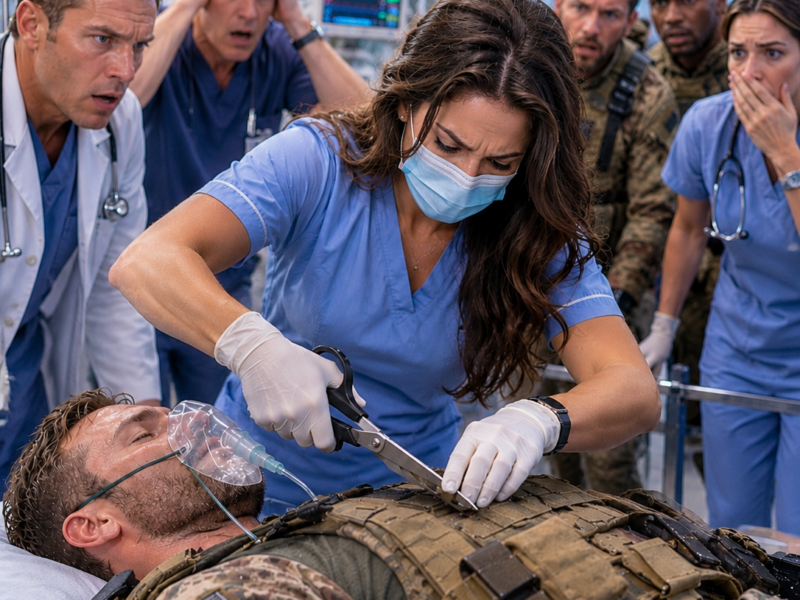
I Was Just a Quiet Nurse at Mercy Harbor General When a Navy SEAL Arrived Without a Pulse, But Dr. Pelham Humiliated Me for Questioning His Diagnosis: “This Is a Job for Doctors, Not Someone Who Changes Bandages.” I Stayed Silent Until I Saw Something Hidden Beneath the SEAL’s Tactical Vest—Then I Grabbed the Trauma Shears, and the Entire Room Froze When I Revealed What I Had Recognized.
I Was Just a Quiet Nurse at Mercy Harbor General When a Navy SEAL Arrived Without a Pulse, But Dr. Pelham Humiliated Me for Questioning His Diagnosis: “This Is a Job for Doctors, Not Someone Who Changes Bandages.” I Stayed Silent Until I Saw Something Hidden Beneath the SEAL’s Tactical Vest—Then I Grabbed the Trauma Shears, and the Entire Room Froze When I Revealed What I Had Recognized.
PART 1
“Step aside, Nurse Callaway. This is a job for doctors, not for someone who changes bandages.”
Dr. Grant Pelham delivered the words without even bothering to look at her. He was too busy adjusting the collar of his white coat in the reflection of the cardiac monitor, apparently more concerned with his appearance than the nurse standing beside him.
Nora Callaway lowered her eyes and stepped backward.
“Yes, Doctor.”
She had heard worse. Much worse, in fact. After two years working in the emergency department at Mercy Harbor General, she had learned that some people considered silence a sign of weakness, while others mistook kindness for incompetence. Dr. Pelham belonged firmly in the second category.
Nora picked up the empty instrument tray and returned it to the supply cart. Her cobalt-blue scrubs were wrinkled from a long shift, and her dark brown braid had begun coming loose near the nape of her neck. A few strands rested against her cheek.
She tucked them behind her ear.
“I had prepared a thoracotomy tray,” she explained quietly. “Trauma called ahead, and I thought we might need—”
“I didn’t ask you to prepare anything.”
Pelham finally turned toward her.
“When I need a nurse’s opinion, I’ll ask for one. Until then, please concentrate on the responsibilities you’re actually qualified to perform.”
Behind him, Dr. Aaron Voss, the young resident assigned to the trauma bay, stared at the floor. He looked uncomfortable but said nothing.
Nora nodded once.
“Understood.”
She moved to the wall, where she usually stood during emergencies.
Nobody noticed the faint scars crossing the backs of her hands. Nobody noticed that she always positioned herself where she could see every entrance. Nobody noticed that the sudden squeak of a medical cart sometimes made her shoulders tighten before she could stop herself.
And nobody at Mercy Harbor knew what she had done before becoming a nurse.
To them, Nora was simply a quiet employee who never complained, never argued, and always accepted the assignments nobody else wanted.
She worked the difficult shifts, covered for absent colleagues, and stayed late when patients needed extra attention. She rarely spoke during meetings and never challenged physicians in front of their teams.
Dr. Pelham considered her forgettable.
That suited him perfectly.
He liked being the smartest person in every room, and he preferred employees who understood that their purpose was to follow his instructions rather than question them.
“Nora, fix your hair,” he added as she passed the counter. “You look like you slept in a supply closet.”
A younger nurse glanced at her sympathetically.
Nora simply retied the loose strands.
Her fingers trembled for a moment, but she pressed them against her thighs until they became still.
Then the overhead speaker crackled.
“Medic Six to Mercy Harbor. We are inbound with one male patient, Navy Special Warfare, mid-thirties. Severe blast injury at the port. Patient has been pulseless since the scene. CPR in progress. Estimated arrival four minutes.”
The entire trauma bay changed.
Pelham stopped adjusting his coat.
Dr. Voss looked up sharply.
Tessa Brant, the charge nurse, abandoned the paperwork in her hands.
“How long has he been pulseless?” Pelham demanded.
“Approximately four minutes. Three rounds of epinephrine administered in the ambulance.”
“Prepare Bay One. Defibrillator ready. Get the trauma surgeon on standby.”
Nora’s hands stopped trembling.
Not gradually.
They simply became still.
A strange quiet settled inside her, the kind of stillness she had not experienced in years. She recognized it immediately. It belonged to another life, one she had spent two years trying to leave behind.
The ambulance doors burst open before the siren had completely faded.
Two paramedics rushed through the entrance, pushing a stretcher at full speed. One continued chest compressions while the other squeezed the ventilation bag.
“Chief Petty Officer Cole Mercer, thirty-six years old!” the lead paramedic shouted. “Blast injury near Pier Nine. Found unconscious. No pulse since the scene. Three doses of epinephrine administered. No sustained response!”
Three men wearing camouflage uniforms followed closely behind.
Their plate carriers were covered with dust and harbor water. Small SEAL insignias marked the Velcro panels on their tactical equipment.
The oldest man was broad-shouldered, with a clipped gray beard and a name tape reading BOONE. His face was rigid with fear he was desperately trying to hide.
“That’s my man,” he said.
Pelham pointed toward the treatment bed.
“Transfer him. Now.”
The paramedics moved Mercer across.
His front armor plate had already been removed, exposing his chest for resuscitation. However, the heavy tactical vest remained wrapped around his ribs and abdomen. It was soaked with seawater, torn near the left side, and covered in dark streaks of soot.
Mercer’s skin had turned the color of candle wax.
The cardiac monitor lit up.
A narrow rhythm raced across the screen at approximately 118 beats per minute.
“Organized rhythm,” Voss announced. “No palpable pulse.”
“Continue compressions,” Pelham ordered. “One milligram epinephrine. Prepare another line.”
Nora stood near the wall, watching.
But she was no longer looking at the monitor.
Her eyes had moved to the vest.
Something about its left side bothered her.
The cummerbund was torn near the seam. A small hole, barely larger than a pencil eraser, marked the fabric. Around it, a fan-shaped pattern of black soot spread outward. Several shallow scratches ran diagonally toward the shoulder.
Nora felt her stomach tighten.
She knew that pattern.
She had seen it before.
“Any obvious penetrating injuries?” Pelham asked the paramedics.
“Nothing we could identify externally.”
“Good. His chest is clean.”
Nora looked at the patient’s neck.
Then at the vest.
Then back at the neck.
Something was wrong.
“Doctor,” she said carefully, “the left side of his vest—”
Pelham turned.
“What?”
“The seam. I think we should examine—”
“Not now, Nurse Callaway.”
He returned his attention to the monitor.
“His rhythm is organized. Continue resuscitation.”
Dr. Voss squeezed the ventilation bag. His forehead creased.
“Doctor, I’m getting significant resistance. The airway pressure is extremely high.”
“Check the mask seal.”
“I have. It’s secure.”
“Then reposition it.”
Voss adjusted his hands.
Nothing changed.
The ventilation bag remained difficult to compress, and the pressure readings continued climbing.
Nora took two steps forward.
“Doctor, please look at his left side.”
Pelham spun around.
“Step aside, nurse. This is a job for doctors, not for someone who changes bandages.”
The words echoed through the trauma bay.
Nobody spoke.
Even the SEALs turned toward him.
Boone looked at Pelham, then at Nora.
Nora lowered her head.
“Yes, Doctor.”
She stepped backward.
But her eyes never left Mercer.
She knew the warning signs. She knew the emergency algorithms. She knew which causes of cardiac arrest were reversible and which one everyone in that room was overlooking.
Her fingers locked together.
Four years earlier, she had learned what happened when someone failed to notice the smallest detail.
She had promised herself she would never make that mistake again.
And now a man was dying in front of her because nobody wanted to listen.
PART 2
The monitor began screaming.
“Airway pressure is rising!” Voss shouted. “I can’t ventilate him!”
“Push harder!” Pelham ordered.
The oxygen saturation dropped to sixty-one percent.
Mercer’s neck veins bulged, and his lips turned blue-gray.
Nora looked at the clock, then at the torn vest.
She had waited long enough.
She crossed the room, seized the trauma shears, and moved toward the stretcher.
“Doctor Pelham, move.”
“Security!” Pelham shouted.
But nobody came.
Boone stepped aside.
The other SEALs stopped watching their dying teammate and stared at Nora’s hands.
With one decisive movement, she cut through the heavy nylon.
Then she peeled the vest away.
Her fingertips touched Mercer’s rigid, swollen ribs.
A faint crackling sensation passed beneath her gloves.
Nora’s expression changed.
“Tension pneumothorax,” she said. “You’ve missed the T.”
And suddenly, the quiet nurse nobody had respected was giving orders that nobody dared interrupt.
PART 3
“Fourteen-gauge catheter. Three and a quarter inches. Chlorhexidine.”
Nora’s voice was completely different now.
The hesitant, soft-spoken nurse who had apologized for preparing an instrument tray had disappeared. In her place stood someone whose movements were precise, whose eyes missed nothing, and whose commands carried the authority of someone who had spent years making decisions when hesitation could cost lives.
Tessa Brant reacted immediately.
She grabbed the catheter and placed it in Nora’s hand.
“Here.”
Nora swabbed the patient’s left chest, locating the appropriate anatomical landmarks with practiced precision.
“Dr. Voss, continue ventilation. Watch the pressure.”
Voss nodded.
Pelham stood beside the monitor, apparently unable to decide whether he should intervene or step away.
“What exactly do you think you’re doing?” he demanded.
Nora didn’t look at him.
“Saving your patient.”
She positioned the needle and advanced it carefully into the chest.
For a fraction of a second, nothing happened.
Then came a sharp, unmistakable hiss.
Air escaped from Mercer’s chest with a sound like a tire puncturing under pressure.
The entire trauma bay seemed to freeze.
Nora withdrew the needle and immediately checked the patient’s carotid artery.
“Pulse.”
She pressed two fingers against his neck.
A moment passed.
Then her expression softened slightly.
“There’s something. Weak, but present.”
She looked toward Boone.
“Master Chief, confirm.”
The broad SEAL moved forward. His fingers trembled as he placed them against his teammate’s neck.
His eyes closed.
“I have it,” he whispered.
Then louder:
“I have a pulse!”
The monitor chirped.
A blood pressure reading appeared.
Sixty-two over thirty-four.
A few seconds later, it climbed to eighty-eight over fifty-two.
The oxygen saturation rose from sixty-one to seventy-eight, then eighty-five.
Finally, it reached ninety-three.
Tessa covered her mouth.
Dr. Voss stared at the monitor as though he had just witnessed something impossible.
Nora was already preparing for the next step.
“Dr. Voss, I need a finger thoracostomy kit. Then a twenty-eight French chest tube. Left side.”
“Yes.”
He moved immediately.
This time, he didn’t question her.
The procedure continued under the guidance of the trauma team, and when the chest tube was placed, blood-tinged air and fluid rushed into the drainage system.
Mercer drew a ragged breath.
It was shallow, painful, and imperfect.
But it was his own.
Boone grabbed the edge of the stretcher.
“Cole?”
The injured SEAL didn’t open his eyes, but his chest rose again.
Boone lowered his head.
For several seconds, the master chief seemed unable to speak.
Then he whispered something Nora could barely hear.
“Stay with us, brother.”
Behind them, Pelham stood motionless.
His white coat hung open, and his face had lost nearly all its color.
The monitor continued its steady rhythm.
A patient who had arrived without a pulse was now breathing.
And the nurse Pelham had dismissed as someone who changed bandages had identified the condition that three rounds of medication and several minutes of resuscitation had failed to correct.
Nora removed her gloves.
The scars on the backs of her hands were visible beneath the bright surgical lights.
Tessa approached slowly.
“Nora?”
She sounded almost afraid to ask the question.
“Who are you?”
Nora looked at her.
For a moment, she seemed ready to answer.
Then Pelham found his voice.
“You performed an invasive procedure without my authorization.”
His words were sharp, but his confidence had disappeared.
He pointed toward the cut vest.
“You violated medical protocol. You acted outside your scope of practice. I will have your license suspended before the end of the day.”
Nora turned toward him.
“Standing emergency protocol authorizes needle decompression in cardiac arrest under these circumstances,” Tessa interrupted.
Pelham glared at her.
“I wasn’t speaking to you.”
“I signed that policy myself,” Tessa replied. “And I know exactly what it permits.”
“Protocol does not excuse insubordination.”
He turned toward the doorway.
“Security!”
Two hospital security guards appeared.
“Escort Nurse Callaway out of this department immediately.”
Neither guard moved.
They looked at the SEALs.
The SEALs looked back.
Boone had positioned himself beside the stretcher, his arms crossed and his expression cold.
Nora, however, was no longer paying attention to Pelham.
She had picked up the tactical vest from the floor.
Something about the damage bothered her.
She turned it beneath the examination light.
The soot pattern was clearer now. The scoring lines were shallow, angled, and concentrated around the left side.
This wasn’t ordinary fragmentation from a random explosion.
The marks suggested a directional blast originating near a fixed point.
Nora studied the torn seam.
Then she noticed something caught in the Velcro near the hem.
A thin strand of copper wire.
Red and white.
Twisted together.
Her breathing stopped.
She leaned closer.
It was a leg wire, part of a firing circuit, torn loose by the blast.
She recognized the configuration immediately.
The room seemed to grow colder.
Four years disappeared in an instant.
She was no longer standing inside Mercy Harbor General.
She was back in Houston, standing outside a warehouse with dust hanging in the air and the smell of burned metal filling her lungs.
She could hear the distant voices of her former team.
She could see the doorway.
And she could hear Ben Howell asking whether the scene was clear.
Ben had been her partner.
They had worked together for years, responding to explosive incidents, suspicious packages, and dangerous post-blast investigations. He was the kind of man who could make even the worst situation seem manageable.
He joked when he was nervous.
He checked everyone’s equipment twice.
And he never allowed a teammate to approach a suspicious device without making sure they understood the risks.
On that day in Houston, Nora had cleared the first door of a warehouse.
She had examined the visible hazards, checked the immediate surroundings, and called the area safe.
Ben followed.
The second door was rigged.
The explosion came so quickly that there was no time to warn him.
The blast threw debris across the warehouse floor. Nora remembered the sound more clearly than anything else.
Then came the silence.
Ben Howell never walked out.
The injuries to Nora’s hands and neck had healed, but the memory had never left her.
She had spent months replaying the incident, examining every decision, every movement, and every second before the explosion.
Eventually, she had left the field.
She had changed careers, trained as a nurse, and moved to a hospital where nobody knew her history.
She wanted a life in which the worst thing she encountered was a difficult shift or an impatient physician.
But the small piece of copper wire in her hand had brought everything back.
“Master Chief.”
Her voice cut through the room.
Boone turned.
“Where was Mercer standing when the explosion occurred?”
He frowned.
“Left door of a shipping container at Pier Nine. Customs flagged it for a seal inspection.”
“Which door?”
“The left one.”
“Who is still at the container?”
Boone hesitated.
“Lieutenant Reyes and four of my men. They’re holding near the right door.”
Nora looked down at the wire.
“Why?”
“Customs brought a cutting crew. They planned to remove the right hinge after the medics cleared the area.”
For a moment, Nora couldn’t speak.
Then she raised the copper strand.
“That’s not a routine inspection.”
Boone stared at it.
“What are you saying?”
“This wire came from a firing circuit. The blast that injured your teammate originated at the left hinge.”
She turned the vest so he could see the direction of the scoring.
“Look at the damage. The fragments traveled upward from the lower hinge area. Someone mounted a pipe charge beside the door.”
Boone’s expression hardened.
“But the inspection team cleared the container.”
“Dogs detect certain explosive odors. They don’t identify every concealed firing circuit.”
Nora pointed toward the copper strand.
“This wire runs back toward the direction of the other door.”
Boone looked confused.
“What does that mean?”
“It means the first door may have been designed to draw attention. If someone rigged the left hinge, they may have rigged the right one too.”
The master chief went still.
“Why would they do that?”
“Because they expected someone to survive the first explosion and come around to help.”
A thin, nervous laugh came from behind them.
Pelham.
“This is absurd.”
He shook his head.
“We’re in a hospital. You cannot turn a piece of wire into some elaborate criminal investigation. You’re a nurse, not a bomb technician.”
Nora ignored him.
She looked directly at Boone.
“Where is the radio?”
He unclipped it from his shoulder.
Before she could take it, the radio crackled.
“Master Chief Boone, this is Reyes. Customs has the cutter positioned at the right hinge. They’re beginning the cut now.”
Boone went rigid.
Nora took one step forward.
“Tell them to stop.”
He looked at her.
“Right now.”
Boone pressed the radio button.
“Reyes, this is Boone. Stop cutting. Hands off that hinge immediately.”
Static filled the room.
One long second passed.
Then Reyes responded.
“Say again?”
“Stop cutting. Nobody touches that door.”
“Customs says the box is clean.”
Boone turned toward Nora.
His face had changed.
“Tell me what to say.”
Nora reached into her pocket and pulled out an elastic band.
She gathered her loose hair and twisted it into a tight knot.
Her shoulders straightened.
Her chin lifted.
A pale blast scar became visible across the back of her neck.
For the first time since she had joined Mercy Harbor, she no longer looked like someone trying to disappear.
“Give me the radio.”
Boone handed it over.
Nora pressed the button.
“Lieutenant Reyes, this is Nora Callaway, ATF National Response Team.”
The trauma bay fell silent.
Pelham stared at her.
“What?”
Nora continued.
“I am a certified explosive specialist. I have worked more than nine hundred post-blast scenes. Your man was injured by a pipe charge mounted at the left hinge. I’m holding the firing-circuit wire that was torn from his vest.”
She paused.
“It runs toward the right door.”
The voice on the other end became cautious.
“Ma’am, we have a customs crew here. They have already inspected the container.”
“Lieutenant, take your hands off that cutter. Do not pry, push, cut, or touch that hinge.”
Her voice remained low.
“Move everyone back at least three hundred feet. Keep the customs crew behind a vehicle. Contact the Baltimore bomb squad and the ATF duty officer through a landline.”
Another pause.
“Once you’re clear, shut down your radios. Nobody approaches that door.”
Nobody in the trauma bay moved.
Then Reyes answered.
“Understood. We’re moving everyone back.”
Nora released the button.
She handed the radio to Boone.
For the first time in four years, she allowed herself to take a full breath.
PART 4
The trauma bay remained silent.
Dr. Voss looked at Nora as though he were seeing her for the first time.
Tessa stood beside the supply cart, her eyes moving between the scarred nurse and the radio in Boone’s hand.
The security guards had quietly retreated toward the doorway.
And Dr. Pelham, who had spent the entire shift reminding everyone that authority belonged to physicians, suddenly seemed to have nothing left to say.
“ATF?” he finally managed.
Nora looked toward him.
“Yes.”
“You’re telling me you’ve been working here as a nurse while claiming to be an explosives specialist?”
“I haven’t claimed anything. I simply haven’t discussed my previous career.”
“You cannot possibly expect us to believe—”
“Doctor,” Tessa interrupted.
She stepped between Pelham and the stretcher.
“Your patient needs a surgeon. You should probably concentrate on that.”
Pelham opened his mouth.
Then closed it.
He looked toward the monitor, where Mercer’s vital signs had finally stabilized enough for transfer.
Nora turned toward Voss.
“Call the operating room. We need the trauma surgeon upstairs immediately. Maintain two large-bore intravenous lines, continue warm blood products as ordered, and keep the chest tube connected to suction.”
“Yes, ma’am.”
Voss was already reaching for the phone.
He no longer sounded like a frightened resident.
He sounded like someone who had finally understood how much could be learned from the person standing beside him.
Two transport nurses entered.
They secured the stretcher and began preparing Mercer for the journey upstairs.
Boone remained beside his teammate.
His hand rested on Mercer’s boot.
“Is he going to make it?” he asked.
Nora checked the monitor.
“We’ve corrected the immediate problem. The next few hours will be important, but he’s responding.”
Boone nodded.
It wasn’t the reassurance he wanted, but it was honest.
He looked down at Mercer.
“That’s good enough for now.”
The stretcher disappeared through the doors.
Nora watched until it was gone.
Only then did she notice how tired she was.
Her hands began trembling again.
She walked to the counter, removed her gloves, and examined the old scars across her knuckles.
The injuries were not severe enough to interfere with her work, but they were unmistakable reminders of the day she had lost Ben.
Tessa approached with a paper cup of water.
“Here.”
“Thank you.”
Nora accepted it.
Tessa studied her face.
“I’ve worked beside you for almost two years.”
“I know.”
“You’ve covered my shifts. You’ve helped train new nurses. You’ve never once mentioned that you used to work for the ATF.”
Nora looked into the cup.
“I didn’t want anyone treating me differently.”
Tessa gave a small, disbelieving laugh.
“Well, that plan seems to have worked.”
Nora almost smiled.
Then the radio crackled again.
“Master Chief Boone, Reyes.”
Boone immediately raised it.
“Go ahead.”
“The bomb squad is on scene. They’ve deployed the robot.”
Nora moved closer.
“What have they found?”
Boone looked at her, then pressed the radio button.
“Reyes, put the bomb technician on.”
A few seconds later, another voice came through.
“This is Baltimore Bomb Squad.”
Nora identified herself again and explained what she had found on the vest.
The technician asked several questions about the wire, the soot pattern, and the direction of the blast.
Nora answered carefully.
She did not pretend to know more than she could establish from the available evidence.
“Treat the second door as a potential secondary device,” she said. “Do not assume the circuit is isolated. Have your robot examine the hinge assembly before anyone approaches.”
“Copy that.”
The radio went quiet.
Boone lowered it.
For several minutes, nobody spoke.
Then Pelham muttered something about administrative procedure and walked toward the physicians’ station.
His earlier confidence had not returned.
He looked smaller somehow.
A few minutes later, the trauma bay doors opened again.
Two agents wearing dark windbreakers entered.
The woman leading them had silver hair and a serious expression. She carried a folder beneath one arm and moved with the confidence of someone accustomed to entering rooms where difficult conversations were waiting.
She stopped when she saw Nora.
“Callaway?”
Nora stood.
“Ma’am.”
The woman extended her hand.
“I’m Helen Marsh, Special Agent in Charge, Baltimore Field Division.”
Nora shook it.
Marsh looked at the cut vest, then at the empty stretcher.
“I heard you identified the secondary device.”
“Yes.”
“Our bomb technicians are examining the container now.”
She opened the folder.
“The initial report suggested a single explosion. Your warning changed the entire response.”
Boone stepped forward.
“Agent Marsh, five operators and a customs crew were about to open that second door.”
Marsh nodded.
“We know.”
Her expression grew serious.
“Our robot has identified another pipe charge mounted beneath the right hinge plate. The wiring configuration is consistent with the first device.”
She paused.
“If the cutting crew had proceeded, they would have entered the blast area.”
Nobody spoke.
Tessa covered her mouth.
Dr. Voss looked toward the floor.
Boone slowly closed his eyes.
The thought of losing five more teammates, along with the customs personnel, was almost too much to process.
Marsh turned toward Nora.
“You prevented a second explosion.”
Nora looked down.
“I recognized the wiring.”
“That’s not all.”
Marsh studied her for a moment.
“You know, the ATF still uses the procedure developed after the Houston warehouse incident four years ago.”
Nora’s expression changed.
“The second-door check,” Marsh continued.
She looked at the scar across Nora’s neck.
“We call it the Howell rule.”
The name seemed to hang in the air.
Nora’s fingers tightened around the paper cup.
“Ben deserved better than a rule.”
Marsh’s expression softened.
“Ben deserved a partner who survived and carried what he taught her forward.”
Nora looked away.
For four years, she had believed that surviving the Houston explosion was something she would have to apologize for forever.
She had blamed herself for calling the first doorway safe.
She had remembered Ben’s final moments more clearly than almost anything else in her life.
And she had convinced herself that leaving the ATF meant leaving that part of her behind.
But Marsh’s words brought something unexpected.
Not forgiveness.
Not yet.
Just the possibility that her survival had meant something beyond the guilt she carried.
Boone stepped forward.
He looked at Nora for a long moment.
Then he placed one large hand over his heart.
It was a simple gesture.
No speech.
No dramatic declaration.
But Nora understood.
The three SEALs who had entered the hospital expecting to watch their teammate die were now looking at her with a respect that no job title could have commanded.
Marsh closed the folder.
“The bureau would take you back, if you wanted to return. The door is open.”
Nora shook her head slowly.
“I appreciate that.”
“You don’t want to return?”
“I don’t want to spend the rest of my life reading the wreckage after something happens.”
She looked toward the emergency department entrance.
“I want to stop some of those emergencies from happening in the first place.”
Marsh waited.
Nora turned toward the hospital’s chief medical office, where Dr. Lillian Shaw had just arrived after receiving the incident report.
“Dr. Shaw, how many nurses here have received specialized training in blast injuries?”
Shaw considered the question.
“Very few. We have standard trauma training, but nothing specifically designed around tactical blast incidents.”
“And how many physicians have received practical instruction on identifying concealed injuries caused by body armor?”
Shaw didn’t answer immediately.
Nora nodded.
“That’s what I thought.”
She glanced at the cut vest.
“Today, a man nearly died because the obvious signs weren’t visible. The armor concealed the wound, the initial assessment missed the cause, and the team became focused on the monitor instead of the patient.”
She looked directly at Shaw.
“Mercy Harbor needs a blast-injury protocol. Nurses need tactical emergency training. Physicians need to understand how protective equipment can hide injuries rather than simply prevent them.”
Marsh nodded.
“I can arrange ATF instructors.”
Boone added, “The Navy can provide medical personnel familiar with tactical equipment.”
Dr. Shaw looked at Nora.
For the first time that afternoon, someone in a position of authority was not questioning her qualifications.
Instead, Shaw asked one simple question.
“What would you need to build the program?”
Nora looked down at her scarred hands.
Then she lifted her head.
“Time, a training room, access to realistic equipment, and permission to teach everyone in this department that the quietest person in the room may be the one who sees the most important detail.”
Shaw nodded.
“Write the proposal. You’re leading it.”
Nora didn’t smile immediately.
She simply stood there, absorbing the words.
For two years, she had worked in a department where people rarely listened when she spoke.
Now she had been given the opportunity to make sure others would never have to experience the same silence.
PART 5
Cole Mercer survived the operation.
The surgeons repaired the damage, monitored his lungs, and confirmed that the emergency intervention had prevented the tension pneumothorax from becoming fatal.
His recovery would take time, but the prognosis was encouraging.
When Nora finally entered his hospital room, the afternoon light had begun fading behind the harbor.
Mercer was propped against several pillows. A chest tube remained secured at his side, and his face was pale beneath the hospital lighting.
His eyes opened when she approached.
“You’re the nurse?”
Nora smiled faintly.
“One of them.”
“Master Chief says you’re the reason I’m still breathing.”
“Your team brought you here in time. The doctors treated you. It took everyone.”
Mercer gave a weak laugh.
“That’s not how Boone tells it.”
Nora pulled a chair beside the bed.
“How does he tell it?”
“He says some doctor was too busy talking to notice I was dying. Then a nurse walked over, cut my vest open, and apparently decided she wasn’t going to let me die.”
Nora looked toward the window.
“Boone tells stories.”
“Not usually about things like this.”
Mercer shifted slightly, wincing as he moved.
“Did the others make it?”
“All five operators are safe. The customs crew is safe too.”
His eyes widened.
“Five?”
“There was another device at the other door. They stopped the cutting operation before anyone was injured.”
Mercer stared at her.
For several seconds, he said nothing.
Then he looked down at his hands.
“So it wasn’t over.”
“No.”
“Those people could have been killed.”
“Yes.”
He closed his eyes.
“Thank you.”
Nora reached toward the blanket and adjusted it near his shoulder.
“You don’t need to thank me. You needed help, and I was there.”
Mercer opened his eyes again.
“I heard you.”
Nora paused.
“What?”
“When everything was happening. I couldn’t open my eyes, but I could hear voices. Someone kept telling me to breathe.”
His fingers moved slowly across the blanket until they found her hand.
“I listened.”
Nora felt her throat tighten.
She looked at his hand resting over hers.
For years, she had associated explosions with the sound of people calling for help and the terrible possibility that she might not reach them in time.
But this time, the voice she remembered was not Ben’s final call.
It was Cole Mercer breathing.
A living man.
A man who would return to his teammates.
Her eyes filled.
She didn’t turn away.
“I’m glad you listened,” she whispered.
Mercer gave her hand a gentle squeeze.
After a moment, Nora stood.
“I’ll let you rest.”
“Will you come back?”
“If I’m on duty.”
“Then I’ll make sure Boone knows when you’re working.”
She laughed softly.
For the first time in a very long time, the sound came naturally.
Outside the room, the corridor was quieter than usual.
A hospital cart rolled across the polished floor.
Its wheels clicked twice against the tile.
Nora’s shoulders didn’t tighten.
She stopped walking and listened to the familiar sound.
For years, ordinary noises had reminded her of the warehouse in Houston. A slammed door, a sudden alarm, a metallic impact against concrete. Her body reacted before her mind could remind her that she was safe.
But now she was standing in a hospital corridor, and the only thing behind the door was a recovering patient.
Nobody was trapped.
Nobody was waiting for an explosion.
And nobody she loved was standing on the other side of a doorway that might disappear in a flash of light.
The next morning, Dr. Lillian Shaw called a meeting.
The room was filled with emergency physicians, nurses, trauma specialists, hospital administrators, and representatives from the tactical medical community.
Nora sat near the end of the conference table.
She had prepared a proposal outlining a new emergency training program.
It included procedures for evaluating patients who arrived wearing tactical equipment, recognizing concealed blast injuries, identifying signs of tension pneumothorax, and coordinating with bomb technicians when suspicious explosive remnants were discovered.
She also recommended practical exercises involving communication, teamwork, and decision-making under pressure.
The program would not teach nurses to replace physicians or bomb technicians to replace medical specialists.
It would teach everyone to recognize when another person’s expertise was needed.
When Nora finished presenting, the room remained quiet.
Then Dr. Voss raised his hand.
“I’d like to volunteer for the first training session.”
Nora looked at him.
“Why?”
He hesitated.
“Because yesterday I was standing beside a patient whose condition was getting worse, and I couldn’t understand why. I had the equipment, the monitor, the training, and a senior physician giving orders.”
He lowered his eyes.
“But I didn’t see what you saw.”
Nora nodded.
“Then we’ll make sure you know what to look for next time.”
Tessa raised her hand.
“I’ll help organize the nursing sessions.”
Another physician volunteered.
Then another.
Even several employees who had previously ignored Nora offered their support.
Dr. Shaw approved the proposal.
The training program would be developed with assistance from ATF instructors and Navy medical personnel.
Nora would lead it.
Dr. Pelham was not present.
He had been removed from his position as trauma lead pending a formal review.
The investigation found that he had dismissed Nora’s warnings, ordered the tactical vest left in place despite the unusual damage, and continued resuscitation without adequately addressing the signs of an obstructive cause of cardiac arrest.
He had also attempted to have Nora removed from the department after she intervened.
When Dr. Shaw met with him, she did not raise her voice.
She simply placed the incident report on the desk.
“You ordered the vest left in place.”
Pelham nodded.
“You dismissed the nurse who told you where to look.”
He remained silent.
“A man nearly died because you could not hear her.”
“I was trying to manage the emergency,” he replied.
“And she was trying to save your patient.”
Pelham looked down.
“I was wrong.”
“You are stepping down as trauma lead, effective immediately. The review board will determine the remaining consequences.”
He nodded again.
Before leaving, he asked whether he could speak with Nora.
She agreed to meet him in the staff corridor.
For several seconds, Pelham struggled to find the words.
“You prepared a tray,” he finally said.
Nora waited.
“I told you I hadn’t asked for it.”
“Yes.”
“I remember what I said about your hair.”
She didn’t respond.
He looked at her hands.
“And I remember telling you that you were only qualified to change bandages.”
His voice weakened.
“I should have listened. I should have thanked you.”
Nora held his gaze.
She could have reminded him of every insult, every time he had dismissed her, and every moment he had made her feel invisible.
But she didn’t.
Instead, she said something simple.
“Next time, Doctor, ask the room before you silence it.”
Pelham nodded.
Then he walked away.
Nora watched him disappear around the corner.
She didn’t feel victorious.
She didn’t feel the need to celebrate his humiliation.
The important thing was that Cole Mercer was alive, five operators had returned safely, and the customs crew had avoided an explosion that might have killed them all.
That was enough.
Several weeks later, Mercy Harbor held its first tactical trauma training session.
The hospital converted an unused section of its training center into a realistic emergency simulation area. Protective equipment, medical supplies, and carefully controlled training devices were used to recreate the kinds of situations emergency personnel might encounter.
Nora stood in front of a group of nurses and physicians.
She wore the same cobalt-blue scrubs.
Her hair was tied back neatly.
The scars on her hands were still visible.
“Before we begin,” she said, “I want everyone to understand something. A uniform does not tell you how much a person knows. A title does not guarantee that someone has noticed everything. And experience is not always obvious.”
She paused.
“When someone raises a concern, listen. Ask questions. Look again.”
She picked up a training vest.
“Protective equipment can save a life. But it can also conceal an injury. The absence of an obvious wound does not mean the absence of a serious problem.”
The trainees listened.
Some took notes.
Others watched her hands.
Nora demonstrated how to recognize unusual damage patterns and explained why communication between medical teams and specialists mattered.
Then she stopped.
“There’s one rule I want you to remember above everything else.”
She turned toward the group.
“Always check the second door.”
Nobody laughed.
They understood that the words meant more than a technical precaution.
They represented a lesson written in the life of a man who had not come home from Houston, in the scars Nora carried, and in the lives that had been saved at Pier Nine.
After the session, Tessa approached her.
“You know something?”
“What?”
“Two years ago, I thought you were simply the quietest nurse in the department.”
Nora raised an eyebrow.
“I was.”
“You still are, sometimes.”
They both laughed.
Tessa glanced toward the training room.
“But now everyone knows that when you speak, they should probably pay attention.”
Nora looked at the people packing away the equipment.
“That’s not what I want.”
“What do you mean?”
“I don’t want people listening because of my history or because they think I’m some kind of hero.”
She picked up the training vest.
“I want them to listen because the information matters. It shouldn’t take a dramatic rescue for someone to respect another person’s judgment.”
Tessa nodded slowly.
“That’s fair.”
Later that afternoon, Nora received a message from Helen Marsh.
The ATF had completed its initial review of the Pier Nine incident. Investigators were continuing to examine the circumstances surrounding the two devices, and the bomb squad had documented the construction and wiring for further analysis.
Marsh also sent a photograph.
It showed an old ATF team standing outside a warehouse years earlier.
Nora recognized the faces immediately.
And there, beside her, stood Ben Howell.
He was smiling, one arm resting casually on her shoulder.
She stared at the photograph for a long time.
Then she placed it inside the top drawer of her desk.
For years, she had avoided looking at pictures of Ben because they brought back the warehouse, the explosion, and the questions she could never answer.
Now she allowed herself to remember something else.
His terrible jokes.
His habit of checking everyone’s equipment.
The way he always said that a good investigator never stopped looking simply because the first answer seemed convincing.
She could almost hear him saying it again.
Look twice, Callaway.
She smiled faintly.
“You’d have liked today, Ben.”
The hospital continued operating around her.
Phones rang.
Patients arrived.
Nurses hurried through corridors, and physicians reviewed charts.
Somewhere nearby, a medical cart rolled over the tile.
This time, Nora barely noticed.
She had finally begun to understand that the past did not have to determine every moment of her future.
She would always carry the scars.
She would always remember the second door in Houston.
But she no longer had to spend the rest of her life standing outside it.
Because the lesson Ben had left behind had become something bigger than guilt.
It had become a way to protect others.
And somewhere in Mercy Harbor General, a young nurse who had been afraid to question a physician was beginning to understand that her observations mattered.
Nora intended to make sure she was heard.
Because the next life saved might depend on the smallest detail, noticed by the person everyone else had overlooked.
And sometimes, the most important voice in an emergency room is not the loudest one.
Sometimes, it belongs to the person standing quietly against the wall, watching everything, waiting for the moment when someone finally needs them.
Nora Callaway had spent two years trying to disappear.
Now she had found a reason to stand where everyone could see her.
Not because she needed recognition.
Not because she wanted another title.
But because she knew what silence could cost.
And she would never allow another team to lose someone simply because nobody bothered to listen.
Always take the second look.