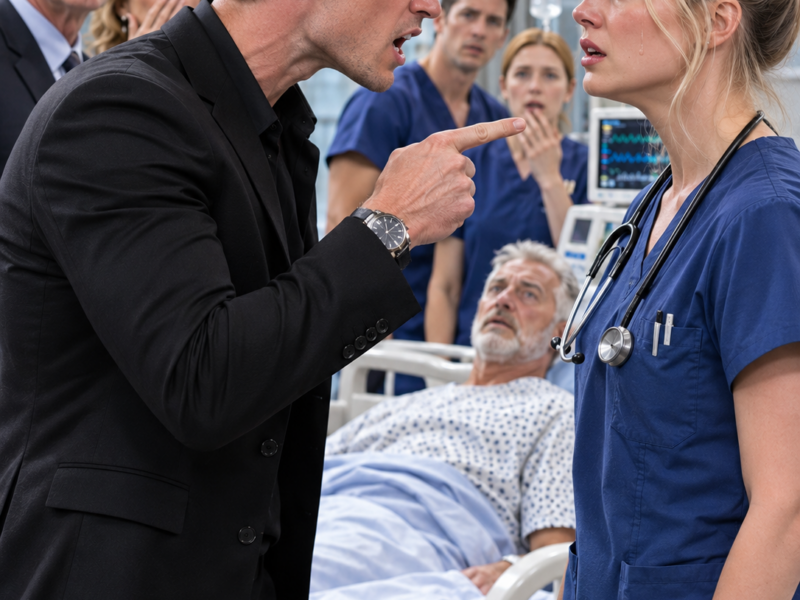
I Was Just a Quiet Nurse at a Naval Hospital When a 26-Year-Old Martial Arts Champion Tried to Humiliate Me in Front of Everyone, Then Threatened to Have Me Fired Because His Father Had Donated $4 Million. “Do You Know Who My Father Is?” He Snarled Before Swinging at Me—But Seconds Later, He Was Lying on the Floor. I Tried to Hide What Had Happened, Until His Father Suddenly Collapsed and I Rushed to Save Him. Then He Opened His Eyes, Recognized My Voice, and Whispered Something That Made My Blood Run Cold…
I Was Just a Quiet Nurse at a Naval Hospital When a 26-Year-Old Martial Arts Champion Tried to Humiliate Me in Front of Everyone, Then Threatened to Have Me Fired Because His Father Had Donated $4 Million. “Do You Know Who My Father Is?” He Snarled Before Swinging at Me—But Seconds Later, He Was Lying on the Floor. I Tried to Hide What Had Happened, Until His Father Suddenly Collapsed and I Rushed to Save Him. Then He Opened His Eyes, Recognized My Voice, and Whispered Something That Made My Blood Run Cold…
PART 1
The first thing everyone noticed was the sound of a grown man hitting the hospital floor.
The second was the woman standing above him.
She was barely five feet five inches tall, wearing faded blue scrubs, white sneakers, and a crooked name badge that read Kate Sullivan, RN. Her dark hair was pulled into a plain ponytail, and nothing about her appearance suggested she was capable of putting a trained martial artist on his back in less than two seconds.
Yet there he was.
Bradley Kessler, twenty-six years old, undefeated in three regional Brazilian jiu-jitsu tournaments, lay sprawled across the polished floor of the Naval Medical Center’s main lobby.
And the nurse who had just stopped him looked more frightened of the attention than she had been of his fist.
“I’m sorry,” Kate whispered. “It was a reflex.”
For several seconds, nobody moved.
A security guard stood frozen beside the reception desk. An elderly veteran stopped halfway through raising his coffee cup. Two receptionists stared at each other, uncertain whether they had witnessed an assault or something entirely different.
Bradley’s face turned a dangerous shade of red.
“You think that’s funny?” he demanded, scrambling to his feet.
Kate shook her head.
“No, sir.”
“Do you have any idea who I am?”
“Yes, sir.”
“Then you know you’ve just made the biggest mistake of your career.”
Kate lowered her eyes.
Perhaps the most extraordinary thing about that moment was that she could have explained everything. She could have told Bradley exactly why his attempted shove had failed, why her body had reacted before her mind could intervene, and why challenging her physically was an exceptionally poor decision.
But explaining would mean opening a door she had spent two years desperately trying to keep closed.
So she remained silent.
Nobody in that lobby knew that the quiet nurse had once been Chief Petty Officer Katherine Sullivan, attached to Naval Special Warfare.
Nobody knew about her two deployments, the classified operations, or the Silver Star locked inside a wooden box in her apartment.
And nobody knew that the government had invested hundreds of thousands of dollars teaching her to survive situations far more dangerous than an angry young man in an expensive jacket.
To understand how a hospital nurse ended up standing over a humiliated martial artist, however, you have to understand what happened five minutes earlier.
Bradley had arrived that morning with his mother, Diane, to visit his father.
Richard Kessler was a wealthy businessman and longtime supporter of the hospital. His family had donated four million dollars the previous year, funding everything from renovated patient rooms to advanced diagnostic equipment.
Richard had spent decades building a successful medical technology company, and the hospital administration treated his visits as important occasions.
His son had apparently inherited the family’s confidence without inheriting much of his father’s restraint.
Bradley walked through the corridors as though he owned them.
He complained about waiting times, criticized the reception staff, and demanded explanations whenever a physician failed to appear immediately.
When a young orderly accidentally brushed his shoulder while transporting equipment, Bradley snapped at him loudly enough to attract attention from the entire waiting area.
His mother had tried to intervene.
“Bradley, please. Your father is already under enough stress.”
“I’m making sure they do their jobs, Mom.”
But Bradley wasn’t concerned with medical efficiency.
He was concerned with control.
At twenty-six, he had spent most of his life being praised for his accomplishments. His athletic trophies lined an entire wall of his apartment. His social media accounts displayed photographs of competitions, luxury vacations, and expensive watches.
He believed discipline made him superior.
Unfortunately, he had confused discipline with intimidation.
Kate encountered him near the entrance to his father’s room.
Richard had been transferred from the cardiac observation unit earlier that morning. He was recovering from complications following a recent procedure, and his doctors were monitoring him carefully.
Bradley was leaning over the wheelchair, attempting to reposition an IV pole without assistance.
“Sir, please let me help you,” Kate said gently.
“I’ve got it.”
“The line is caught beneath the wheel.”
“I said I’ve got it.”
He pulled harder.
The pole tipped sideways.
Bradley stumbled backward, nearly losing his balance, and Kate instinctively reached out to steady him before he collided with a nearby patient.
Her fingers touched his forearm.
That was all.
But Bradley reacted as though she had slapped him.
“Don’t put your hands on me!”
Kate immediately released him.
“I’m sorry. You were falling, and I didn’t want you to get hurt.”
“You think I need some little nurse catching me?”
“No, sir.”
“Then keep your hands to yourself.”
Kate stepped away.
She would later remember that moment with painful clarity because she had recognized the warning signs immediately.
The squared shoulders.
The elevated voice.
The exaggerated movement of his hands.
The desperate need to dominate an audience.
She had seen similar behavior in frightened soldiers, aggressive civilians, and men who mistook another person’s restraint for weakness.
And she knew exactly how quickly embarrassment could turn into violence.
Unfortunately, Bradley seemed determined to demonstrate it.
“You people need to learn some respect,” he announced.
His mother rose from her chair.
“Bradley, that’s enough.”
But he ignored her.
“Do you know who pays for this hospital?”
Kate said nothing.
“My father could have you fired before lunch.”
“Bradley,” Richard said weakly from his wheelchair. “Leave her alone.”
Instead of calming him, his father’s intervention made Bradley angrier.
He stepped toward Kate, bringing his face close to hers.
“You think you can touch me, little girl?”
The waiting room fell silent.
Kate felt her heartbeat change.
Not accelerate.
Slow.
It was a sensation she hadn’t experienced in almost two years, a cold precision settling over her thoughts while the sounds around her became strangely distant.
She could see Bradley’s weight shifting onto his right foot.
She noticed the tension building in his shoulder.
She knew what he was preparing to do before his expression changed.
“Sir,” she said quietly, “please don’t.”
He laughed.
Then he swung.
It wasn’t a full punch. Bradley appeared to intend a forceful shove that would humiliate her in front of the waiting patients.
But Kate’s body didn’t distinguish between a humiliating shove and a potentially dangerous attack.
Her training took over.
One movement.
A controlled redirection.
Bradley’s momentum carried him past her, and suddenly the polished floor was rushing toward his face.
Kate released him before he struck the ground hard enough to cause serious injury.
She could have done considerably more.
That was the part nobody understood.
The movement wasn’t designed to punish him.
It was designed to end the threat.
For a heartbeat, she stood perfectly still, her posture straight, eyes alert, every muscle ready for another attack.
Then she saw the faces surrounding her.
And remembered where she was.
A hospital.
Not Afghanistan.
Not a hostile compound.
Not a place where hesitation might cost someone their life.
She slowly lowered her hands.
“I’m sorry,” she repeated.
The security guards arrived.
“What happened here?”
Bradley opened his mouth, ready to accuse her.
But Kate spoke first.
“He lost his balance. I tried to catch him.”
The guard looked at Bradley.
“Is that correct, sir?”
Bradley stared at her.
He knew she was lying.
She knew he knew.
For one brief moment, something unexpected passed between them.
Confusion.
Why would she protect him after he had threatened her?
Before he could answer, Diane intervened.
“Nobody is hurt. Please, we just want to get my husband back to his room.”
The guards exchanged glances and reluctantly stepped away.
Bradley straightened his jacket.
“This isn’t over,” he muttered.
Kate nodded.
“I understand.”
She helped an orderly collect several papers scattered during the confrontation and returned to her duties.
Only after she disappeared around the corner did Richard Kessler finally speak.
“Bradley.”
His son turned.
“What?”
Richard’s expression was grave.
“That woman could have hurt you.”
Bradley scoffed.
“She got lucky.”
“No,” Richard replied. “She didn’t.”
There was something in his father’s voice that Bradley had never heard before.
Recognition.
Richard had worked with military medical personnel for decades, attended countless veterans’ charity events, and spent enough time around elite service members to recognize certain qualities.
The nurse’s movement hadn’t been accidental.
Neither had her restraint.
“Stay away from her,” Richard warned.
Bradley rolled his eyes.
But what Richard didn’t know was that the nurse’s past was far more complicated than even he suspected.
Two years earlier, Katherine Sullivan had returned from Afghanistan carrying wounds that nobody could see.
There had been an explosion outside a remote settlement in Helmand Province.
A vehicle had struck an improvised explosive device during a mission that should have been routine.
Kate had survived.
Three members of her team had not.
In the aftermath, she had continued working until the surviving wounded were evacuated. By the time she was finally extracted, her uniform was soaked with blood, and she could no longer remember which stains belonged to whom.
The military recognized her actions with a decoration.
Kate remembered them as the worst day of her life.
She rarely slept more than four consecutive hours afterward.
Unexpected noises made her body react violently.
Crowded rooms felt dangerous.
And whenever someone thanked her for her service, she remembered the three men who hadn’t come home.
She eventually requested a quieter assignment.
The hospital gave her one.
She became a nurse who rarely raised her voice, avoided confrontation, and volunteered for difficult shifts nobody else wanted.
Her colleagues believed she was shy.
Some thought she lacked confidence.
A few openly questioned whether she had the temperament for emergency medicine.
Kate never corrected them.
Being underestimated was comfortable.
Being invisible was even better.
But that afternoon, as she stood inside an empty stairwell with her palm against the cold concrete wall, she realized her carefully constructed anonymity might be ending.
Her hands were trembling.
Not from fear of Bradley.
From the memories his aggression had awakened.
She closed her eyes and counted backward.
Ten.
Nine.
Eight.
She breathed slowly until the familiar images of fire, dust, and broken metal began to fade.
Then she straightened her uniform and returned to the ward.
She didn’t know that Hospital Administrator Warren Pruitt was already searching for her.
And she certainly didn’t know that before the afternoon was over, the same family threatening to destroy her career would be begging her to save a life.
PART 2
Warren Pruitt found Kate outside the supply room.
His expression was cold.
“Do you understand what you’ve done?”
Kate stood silently.
“The Kesslers donated four million dollars last year. Four million. And now their son is threatening to file an assault complaint against one of my nurses.”
“He tried to strike me, sir.”
“That’s not the story he’s telling.”
Kate swallowed.
“I understand.”
“No, Sullivan. I don’t think you do. One complaint could destroy your career.”
She could have defended herself. There were witnesses. There were security cameras.
Instead, she said, “I’ll apologize.”
Pruitt seemed satisfied.
“Make sure you do.”
After he left, Kate stared at the floor.
She had survived explosions, gunfire, and missions whose details remained classified.
Yet a wealthy donor’s angry son might succeed in taking away the peaceful life she had struggled to rebuild.
For the first time that afternoon, she wondered whether leaving the military had actually allowed her to escape anything.
Then an alarm erupted down the corridor.
A nurse shouted for help.
“Room fourteen! His blood pressure is crashing!”
Kate looked up.
Room fourteen.
Richard Kessler.
She started running.
And within moments, every accusation against her would become insignificant compared with the emergency unfolding behind that door.
PART 3
By the time Kate reached room fourteen, the cardiac monitor was sounding continuously.
Richard Kessler lay motionless against his pillows, his skin pale and damp with sweat.
His breathing had become shallow.
A young resident stood beside the bed, staring at the monitor while another nurse struggled to obtain a reliable blood pressure reading.
“Seventy over forty,” she announced. “And falling.”
Kate moved toward the bedside.
“What happened?”
“He complained of chest pressure,” the resident answered. “Then his pressure dropped. We’re paging cardiology.”
Kate glanced at Richard’s face, the monitor, and the visible swelling of the veins in his neck.
Something inside her shifted.
The frightened, apologetic nurse disappeared.
In her place stood the woman who had once made life-and-death decisions in combat medical stations thousands of miles from home.
“His heart sounds are muffled,” she said.
The resident frowned.
“What?”
“Listen.”
He placed his stethoscope against Richard’s chest.
His expression changed.
Kate looked toward the monitor again.
Low blood pressure.
Distended neck veins.
Muffled heart sounds.
The classic warning signs pointed toward one terrifying possibility.
Cardiac tamponade.
Fluid was building inside the protective sac surrounding Richard’s heart, compressing the organ until it could no longer pump enough blood to sustain his body.
Without immediate treatment, he could die.
“Call the rapid response team,” Kate ordered. “Get emergency cardiac equipment here and notify the attending physician.”
The resident hesitated.
“Cardiology is on the way.”
“How far away?”
“At least ten minutes.”
Kate looked at Richard.
His eyes were barely open.
His lips had begun losing color.
Ten minutes might as well have been an eternity.
“Get the emergency physician here now,” she said.
Her voice was different.
Not louder.
Simply absolute.
The resident moved immediately.
Outside the room, Diane Kessler was arguing with a staff member.
“What’s happening to my husband? Somebody tell me what’s happening!”
Bradley pushed through the doorway.
Then he saw his father.
The arrogance vanished from his face.
“Dad?”
Richard didn’t answer.
Bradley stepped closer.
“Dad, can you hear me?”
Kate moved between them.
“Bradley, I need you outside.”
He stared at her.
“You?”
“Your father is critically ill. We need space to work.”
“What’s wrong with him?”
Kate hesitated only long enough to choose words he would understand.
“There’s pressure building around his heart. We’re trying to relieve it before his circulation fails.”
Bradley looked toward the monitor.
“Then do something!”
“We are.”
“No, you’re standing here talking!”
Kate held his gaze.
For a moment, she recognized the same anger that had erupted in the lobby.
But this time, she could see what was underneath it.
Fear.
Pure, helpless fear.
“Bradley,” she said, “I need you to trust us.”
He opened his mouth.
Nothing came out.
Then he stepped backward.
The emergency team arrived moments later, led by Dr. Elena Reyes, a senior cardiologist who had returned urgently after receiving the call.
Kate delivered a concise report.
Richard’s recent procedure.
The sudden collapse.
The abnormal examination findings.
The worsening vital signs.
Dr. Reyes ordered immediate bedside imaging.
Within seconds, the ultrasound confirmed their concern.
A significant fluid collection surrounded Richard’s heart.
The right-sided chambers were showing signs of compression.
“Tamponade,” Dr. Reyes said.
Kate nodded.
Richard’s pulse weakened further.
The treatment couldn’t wait.
With the emergency team preparing for an ultrasound-guided drainage procedure, Kate assisted with equipment, maintained communication with the staff, and monitored Richard’s responses.
The scene should have overwhelmed her.
Multiple alarms sounded at once.
People called out numbers.
Equipment moved rapidly around the bed.
A nurse dropped a packaged instrument, and the sharp noise echoed against the tile.
Kate didn’t flinch.
Instead, she became extraordinarily calm.
Every movement was deliberate.
Every instruction was clear.
When one resident struggled to organize the necessary supplies, she quietly corrected the problem without making him feel incompetent.
When another staff member appeared close to panic, she gave him a single task and helped him focus.
Dr. Reyes noticed.
She had worked with exceptional emergency nurses before.
Kate was something different.
She seemed to anticipate problems before anyone voiced them.
It was almost as though she had already seen this emergency unfold many times.
As the physician began relieving the pressure around Richard’s heart, Kate watched the monitor.
“Pressure is still dropping.”
“Keep monitoring,” Reyes replied.
The room became silent except for the equipment.
Then the first change appeared.
Richard’s heart rate began to improve.
The blood pressure reading stabilized.
His breathing deepened slightly.
“He’s responding,” Kate announced.
Reyes continued the procedure.
Another minute passed.
Then Richard opened his eyes.
His gaze moved across the ceiling before settling on the nurse beside him.
Kate leaned closer.
“Mr. Kessler? Can you hear me?”
His lips moved.
“Yes.”
“You’re in the hospital. You’ve had a serious cardiac complication, but we’re treating it. Try not to move.”
Richard blinked.
Then, with surprising effort, he whispered something that made Kate freeze.
“I know that voice.”
She stared at him.
“What?”
Richard’s eyes narrowed.
“I’ve heard someone give orders like that before.”
Kate felt the first crack in her composure.
But Dr. Reyes interrupted.
“We need to transfer him to intensive care for further treatment.”
Kate stepped back immediately.
“Of course.”
The medical team prepared Richard for transport.
Outside, Diane stood with both hands covering her mouth.
Bradley was beside her, staring through the glass.
When Dr. Reyes emerged, she explained that Richard had suffered a life-threatening complication, but the emergency intervention had stabilized him.
Diane began crying.
Bradley leaned against the wall.
For the first time that day, he looked genuinely young.
“Can we see him?” Diane asked.
“Briefly, once he’s settled.”
Then her eyes moved toward Kate.
“She was inside?”
Reyes nodded.
“She recognized the warning signs immediately. That gave us valuable time.”
Diane turned toward the nurse.
“The same woman Bradley accused of attacking him?”
Kate looked uncomfortable.
“Ma’am, your husband still needs close monitoring.”
But Diane wasn’t listening.
She reached for Kate’s hand.
“Thank you.”
Kate lowered her gaze.
“Anyone here would have helped him.”
Dr. Reyes shook her head slightly.
“Not everyone would have recognized what was happening that quickly.”
Kate said nothing.
She wanted to disappear.
Instead, Warren Pruitt appeared at the end of the corridor.
He was moving quickly, his tie loosened, his face tense.
“What happened?” he demanded.
“Mr. Kessler experienced cardiac tamponade,” Reyes explained. “We’ve stabilized him.”
Pruitt’s shoulders relaxed.
“Thank God.”
Then he noticed Kate.
His expression hardened.
“Sullivan. I thought I told you to stay away from this family.”
The corridor fell silent.
Diane turned slowly.
“Excuse me?”
Pruitt hesitated.
“I was addressing a personnel matter.”
“A personnel matter?” Diane repeated.
“Mrs. Kessler—”
“This nurse just helped save my husband’s life.”
“Yes, and we’re certainly grateful, but—”
“No.”
Diane’s voice became firm.
“You listen to me. My son behaved disgracefully earlier. Instead of protecting your employee, you threatened her.”
Pruitt glanced toward Bradley.
Bradley looked away.
“That’s not exactly what happened,” Pruitt said.
Kate stepped forward.
“Please. It isn’t necessary.”
Diane stared at her.
“You’re still trying to protect him?”
Kate didn’t answer.
Diane turned back toward the administrator.
“There will be no complaint against this woman.”
Pruitt nodded quickly.
“Of course.”
“And I want to know why you were more concerned about our donations than whether your nurse was safe.”
Pruitt’s face drained of color.
Before he could respond, a voice came from behind them.
“That’s a question I’d like answered too.”
Everyone turned.
Richard Kessler was being wheeled toward intensive care, conscious enough to hear the conversation.
His face remained pale, but his eyes were focused.
He looked directly at Kate.
Then he said something nobody expected.
“Chief Sullivan?”
Kate stopped breathing.
Bradley looked between them.
“Chief?”
Richard continued staring at her.
“I thought I recognized you.”
Kate’s fingers curled slowly against her palms.
“Mr. Kessler, you need to rest.”
But Richard shook his head.
“Two years ago, I attended a Naval Special Warfare recognition ceremony.”
Kate felt the corridor shrinking around her.
Richard’s voice grew stronger.
“There was a woman receiving a Silver Star. She refused to pose for photographs afterward.”
Dr. Reyes turned toward Kate.
Pruitt looked confused.
Bradley stared openly.
Richard spoke again.
“That woman was you, wasn’t it?”
Kate closed her eyes.
For two years, she had carried her military past like a sealed container, terrified of what might happen if someone opened it.
Now, in front of half the hospital’s senior staff, the container was beginning to break.
And the person who had uncovered her identity was the father of the man who had tried to humiliate her.
PART 4
Kate didn’t answer immediately.
The corridor seemed impossibly quiet.
Only the distant sound of medical equipment and footsteps interrupted the silence.
Richard Kessler watched her carefully from his hospital bed.
“Chief Petty Officer Katherine Sullivan,” he repeated. “Naval Special Warfare.”
Bradley’s expression changed.
“Wait. What?”
Kate finally looked up.
“Mr. Kessler, that’s part of my previous employment.”
Richard almost smiled.
“Previous employment? You received one of the nation’s highest decorations for valor, and you’re calling it previous employment?”
A nurse nearby gasped.
Dr. Reyes slowly folded her arms.
Pruitt looked as though someone had struck him.
Bradley stared at Kate’s faded uniform.
For the first time, he understood that he hadn’t simply challenged a hospital employee.
He had attempted to intimidate a combat veteran whose training and experience existed on an entirely different level from his own.
The realization was written across his face.
“No,” he whispered.
Kate glanced toward him.
“What?”
Bradley swallowed.
“You were actually in special operations?”
Kate nodded.
“Yes.”
“You were a Navy SEAL?”
“I served in Naval Special Warfare,” she replied carefully. “There are details of my assignments that I can’t discuss.”
“But you were in combat?”
“Yes.”
Bradley stared down at his hands.
The same hands he had proudly used to demonstrate martial arts techniques.
The same hands he had raised against her that morning.
Suddenly, his regional tournament medals felt embarrassingly small.
Richard looked toward the attending physician.
“Please give us a few minutes once I’m settled.”
Dr. Reyes hesitated.
“You need rest.”
“I understand.”
His expression softened.
“But I believe this woman deserves more than a conversation in a hallway.”
An hour later, after Richard had been transferred to intensive care and his condition had stabilized further, Kate reluctantly entered his room.
Diane sat beside the bed.
Bradley stood near the window.
Pruitt had been asked to wait outside.
Richard gestured toward a chair.
“Please sit down.”
Kate remained standing.
“I’m more comfortable here.”
Richard studied her.
“Still prefer having a clear view of the exits?”
Kate’s expression changed almost imperceptibly.
He noticed.
“I’m sorry,” he said. “That was inappropriate.”
“No, sir. It’s just a habit.”
He nodded.
“I understand more than you might think.”
Richard explained that his company had spent years developing equipment used in military medical facilities. Through that work, he had encountered numerous service members whose courage rarely appeared in newspapers.
He remembered the recognition ceremony clearly.
Several decorated personnel had been invited to receive awards in a small, private gathering.
Most posed for photographs.
One woman declined.
She had accepted her decoration, thanked the people around her, and quietly left.
Richard had later learned that her award involved extraordinary actions during a disastrous operation in Afghanistan.
He didn’t know the classified details.
He knew only that people were alive because of her.
“I remember asking an officer why you didn’t want anyone taking your picture,” Richard said.
Kate stared at the floor.
“What did he tell you?”
Richard hesitated.
“He said you didn’t think you deserved to be there.”
Something moved behind Kate’s eyes.
For several seconds, she said nothing.
Then she replied so quietly that Diane leaned forward to hear.
“Three men died that day.”
Richard nodded.
“I know.”
“People kept congratulating me.”
Her voice tightened.
“They talked about bravery. Sacrifice. Doing the impossible.”
She stopped.
Diane reached toward her.
Kate instinctively moved away.
Not because she disliked the gesture.
Because she wasn’t sure what would happen if someone comforted her.
“I remember the ones who didn’t come home,” Kate continued. “That’s what I remember.”
Nobody spoke.
Outside the room, hospital staff moved through their ordinary routines, unaware of the conversation unfolding only a few feet away.
Kate stared at the window.
“We were supposed to escort a medical team through a dangerous area. The mission changed. There was an explosion.”
She swallowed.
“I can’t discuss the operation itself. But I can tell you what I remember afterward.”
Richard waited.
“I remember someone calling for help.”
Her eyes became distant.
“I remember smoke so thick I couldn’t see my own hands. I remember trying to keep people alive while everything around us was falling apart.”
She pressed her fingertips together.
“And I remember promising one of my teammates that he was going home.”
Her voice broke.
“He didn’t.”
Diane wiped her eyes.
Bradley lowered his head.
Kate forced herself to continue.
“Everyone kept telling me I saved lives. And maybe I did. But there are nights when all I can remember are the people I couldn’t save.”
Richard closed his eyes briefly.
When he opened them, his expression had changed.
There was no admiration in it now.
Only compassion.
“Chief Sullivan,” he said softly, “surviving doesn’t mean you failed the people who didn’t.”
Kate looked away.
Those words were familiar.
Therapists had said similar things.
Chaplains had said them.
Her surviving teammates had repeated them during their Sunday phone calls.
Yet somehow, hearing them from a man whose life she had just helped save struck her differently.
Richard extended his hand.
“Today, my wife gets another morning with her husband.”
Diane began crying again.
“My son gets another conversation with his father,” Richard continued. “And I get another chance to do something worthwhile with the time I’ve been given.”
Kate looked at his hand.
“You’re giving me too much credit. Dr. Reyes performed the procedure.”
“And she says you recognized the danger before anyone else.”
“That was my job.”
Richard smiled faintly.
“Exactly.”
Kate finally shook his hand.
Bradley had remained silent throughout the conversation.
Then he stepped forward.
“Can I say something?”
Kate looked at him.
“Of course.”
He took a breath.
“I’ve spent years thinking I was the toughest person in every room.”
His voice sounded unfamiliar without its usual arrogance.
“I trained constantly. I won tournaments. People told me I was dangerous.”
He looked at his father.
“And I believed them.”
Diane watched silently.
Bradley turned back toward Kate.
“When you touched my arm this morning, I thought you embarrassed me.”
He swallowed.
“So I tried to embarrass you back.”
Kate said nothing.
“I thought you were weak because you wouldn’t argue.”
His eyes reddened.
“And when you put me on the floor, I hated you because you made me look foolish.”
Kate shifted her weight slightly.
Bradley continued.
“Then I watched you help save my father.”
His voice cracked.
“And I realized how pathetic I was acting.”
For the first time since arriving at the hospital, he seemed entirely uninterested in how anyone perceived him.
“I’m sorry,” he said.
Kate studied him.
“Why are you apologizing?”
Bradley looked confused.
“Because I threatened you.”
“Is that the only reason?”
He thought for a moment.
“No.”
“Then tell me.”
Bradley took another breath.
“Because you were trying to help me, and I treated you like you weren’t worth respecting.”
Kate nodded.
“That’s a better answer.”
He looked at her.
“You could have hurt me badly, couldn’t you?”
“Yes.”
The answer was immediate.
Bradley visibly flinched.
Kate continued.
“But I didn’t want to hurt you.”
“Why?”
She looked toward Richard.
“Because you’re somebody’s son.”
Silence settled across the room.
Kate thought of young soldiers she had carried away from danger.
Men barely older than Bradley.
Men whose mothers had waited for phone calls.
Men who had believed they were invincible until one terrible moment proved otherwise.
“I’ve seen what happens when people stop remembering that the person in front of them matters to someone,” she said.
Bradley wiped his face.
“I don’t know how to make this right.”
Kate considered the question.
“Start by treating the next nurse, orderly, receptionist, or stranger you meet with respect.”
He nodded.
“I will.”
“And don’t mistake someone’s unwillingness to fight for an inability to fight.”
A small, embarrassed smile crossed his face.
“I won’t forget that.”
Richard chuckled softly.
“Neither will I.”
But the mood changed when Warren Pruitt entered the room a few minutes later.
He had learned enough about Kate’s background to recognize a public relations opportunity.
“Chief Sullivan,” he began warmly, “I understand we’ve had quite an extraordinary afternoon.”
Kate’s expression closed.
Pruitt continued.
“The hospital would love to recognize your service. Perhaps a ceremony. A photograph for our donor newsletter. We might even discuss a promotion.”
Kate looked at him.
“A promotion?”
“Absolutely. Someone with your background deserves visibility.”
Richard glanced toward Pruitt.
Kate’s voice remained gentle.
“Earlier, you said I was a liability.”
Pruitt’s smile faltered.
“That was before I understood the situation.”
“You understood that a patient family member threatened an employee.”
His face tightened.
“Well, yes, but—”
“And you understood that I was the employee.”
Pruitt said nothing.
Kate continued.
“You didn’t need to know my military record to know I deserved protection.”
Diane nodded slowly.
Richard’s expression hardened.
Pruitt opened his mouth.
Then closed it.
For the first time that day, he seemed unable to find a response.
Kate wasn’t finished.
“I don’t need a ceremony,” she said. “I don’t want a photograph.”
“What do you want?” Pruitt asked.
Kate looked toward the hallway, where several exhausted nurses were moving between patients.
She thought about the young resident who had frozen during Richard’s emergency.
The staff members who desperately wanted to help but lacked confidence when seconds mattered.
And the veterans who arrived carrying invisible wounds that ordinary medical charts rarely captured.
Then she spoke.
“I want to build something.”
Richard leaned forward slightly.
“What kind of something?”
Kate looked directly at him.
“A training program. Emergency recognition, trauma response, teamwork under pressure. Something that helps ordinary healthcare workers feel prepared when everything goes wrong.”
She paused.
“And support for veterans who need care but don’t know how to ask for it.”
Richard considered her words.
Then he smiled.
“How much?”
Kate blinked.
“What?”
“How much will it cost?”
Pruitt suddenly straightened.
“Mr. Kessler, we would need to review budgets and—”
Richard raised his hand.
“I’m asking her.”
Kate stared at him.
For the first time all afternoon, she had no immediate answer.
Because she had never imagined someone would offer to fund a program built around the very experiences she had spent years trying to forget.
And what Richard said next would change the direction of her life.
PART 5
“Whatever it costs to do it properly,” Richard Kessler said, “I’ll help fund it.”
Kate stared at him.
For a moment, she wasn’t sure she had heard correctly.
Richard was still recovering from a life-threatening emergency. His voice was weak, and medical equipment surrounded his bed.
Yet he spoke with the certainty of a businessman who had spent forty years making consequential decisions.
“Mr. Kessler, I wasn’t asking you for money.”
“I know.”
“I was describing an idea.”
“And I’m telling you it’s an idea worth supporting.”
Warren Pruitt stepped forward.
“Richard, that’s a generous offer, but we would need a proposal, an assessment of staffing requirements, and approval from—”
“Then prepare the proposal,” Richard interrupted.
Pruitt stopped.
Richard looked at Kate.
“How many nurses in this hospital have training similar to yours?”
Kate thought carefully.
“Very few. But that’s not really the point.”
“What is the point?”
“Nobody should need my background to recognize a critical emergency and know how to respond as part of a trained team.”
Richard nodded.
“Exactly.”
Kate continued.
“Most healthcare workers are dedicated, intelligent people. They spend years learning how to care for patients. But emergencies create a different kind of pressure.”
She remembered the young resident standing beside Richard’s bed.
“He knew the medical information. He understood the equipment. But when everything happened at once, he froze.”
Pruitt frowned.
“That’s a serious criticism of our training.”
“No,” Kate answered. “It’s an observation about human behavior.”
She looked toward Dr. Reyes, who had entered to check Richard’s condition.
“When people are frightened, they don’t always perform at the highest level they’re capable of. They fall back on the responses they’ve practiced.”
Reyes nodded.
“That’s why simulation matters.”
“Exactly,” Kate replied.
She began describing a practical program built around realistic emergency scenarios.
Nurses would learn to recognize dangerous changes in a patient’s condition before the situation became irreversible.
Residents and attending physicians would practice communicating under pressure.
Teams would rehearse critical events together so that confusion, hesitation, and competing instructions became less likely.
And veterans dealing with psychological trauma would have access to staff who understood how military experiences could influence their reactions to medical environments.
Kate was careful about one thing.
“This isn’t about turning nurses into soldiers,” she said. “It’s about helping people stay effective when someone else’s life depends on them.”
Richard smiled.
“Now that is something I understand.”
Pruitt glanced toward Reyes.
The cardiologist had been listening quietly.
Finally, she spoke.
“I’d support a pilot program. We could coordinate with our emergency department, simulation center, and existing clinical training teams.”
Kate turned toward her.
“Really?”
“Absolutely.”
Reyes smiled.
“You recognized a dangerous cardiac complication immediately. But what impressed me most was how you organized the people around you.”
Kate looked uncomfortable.
“I just did what needed doing.”
“That’s precisely what we need to teach.”
Richard raised his hand again.
“Then it’s settled. Build the proposal. I’ll review the budget.”
Diane squeezed his fingers.
“You’ve barely survived the afternoon, and you’re already making commitments.”
Richard smiled at his wife.
“Apparently, surviving gives a man a few new priorities.”
Everyone laughed softly.
Even Kate.
It was the first genuine laugh she had allowed herself that day.
But that evening, when her shift finally ended, the emotional weight of everything that had happened caught up with her.
She entered the staff locker room alone.
The fluorescent lights hummed overhead.
Her locker was exactly as she had left it that morning.
A spare uniform hung from a hook.
An old paperback rested on the shelf.
And tucked behind a small box of personal belongings was a photograph.
Six service members stood beneath the harsh Afghan sun, their uniforms dusty, their expressions exhausted but smiling.
Kate picked it up.
She traced the faces with her thumb.
Michael.
Daniel.
Thomas.
Three names she still struggled to say aloud.
Three people who had never returned home.
For two years, she had looked at that photograph and felt a familiar surge of guilt.
She remembered laughter inside cramped vehicles.
The smell of coffee burned over portable burners.
Terrible jokes whispered during long nights.
Promises about what everyone would do after deployment.
Then the explosion.
The shouting.
And the silence that followed.
Kate sat on the wooden bench and stared at the picture.
“I helped someone today,” she whispered.
The words sounded strange in the empty room.
Of course she helped people every day.
She administered medication, comforted frightened patients, and sat beside veterans who couldn’t sleep.
But today felt different.
Today, she had allowed the part of herself she most feared to become useful again.
Not the violence.
Not the instinct to anticipate attacks.
The ability to recognize danger, make decisions, and help others remain steady.
She looked at Michael’s smiling face.
“I think you would have liked that.”
A tear landed on the photograph.
Kate wiped it away.
Then, for the first time in months, she didn’t immediately put the picture back into hiding.
She placed it carefully inside the front pocket of her bag.
The following morning, the hospital felt different.
People stared when she entered the corridor.
Whispers followed her.
“That’s her.”
“The nurse from yesterday.”
“I heard she was special forces.”
“Someone said she earned a Silver Star.”
Kate kept walking.
At the nurses’ station, an older colleague named Margaret approached her.
Margaret had worked at the hospital for twenty-three years and rarely offered praise without good reason.
“Sullivan.”
Kate stopped.
“Yes, ma’am?”
Margaret studied her for a moment.
“Why didn’t you tell anyone?”
Kate hesitated.
“Tell anyone what?”
“About your service.”
Kate smiled faintly.
“It never seemed relevant.”
Margaret shook her head.
“Well, I owe you an apology.”
Kate frowned.
“For what?”
“I thought you were timid.”
Kate glanced down.
“A lot of people do.”
“I used to wonder why you apologized every time someone interrupted you.”
Kate said nothing.
Margaret continued.
“I mistook your quietness for insecurity.”
She paused.
“Now I realize you simply don’t feel the need to prove yourself.”
Kate considered the words.
Then she smiled.
“Sometimes I’m still insecure.”
Margaret laughed.
“Well, that makes two of us.”
Their conversation was interrupted by the young resident from Richard’s emergency.
His name was Dr. Andrew Collins.
He approached carrying a notebook.
“Kate, could I ask you something?”
“Of course.”
“I’ve been thinking about yesterday.”
She nodded.
“I thought I was prepared for emergencies,” he admitted. “Then one happened, and I couldn’t think clearly.”
Kate looked at him sympathetically.
“That’s common.”
“It felt terrible.”
“I know.”
He glanced toward his notebook.
“How do you stop being afraid?”
Kate considered the question.
“You don’t.”
Andrew looked surprised.
“You don’t?”
“No. You learn to recognize fear without letting it make every decision for you.”
She leaned against the counter.
“Confidence doesn’t come from believing nothing bad will happen. It comes from practicing enough that you know what to do when something does.”
Andrew nodded slowly.
“Would you help me learn?”
Kate smiled.
“That’s exactly what we’re planning.”
Over the next three weeks, something remarkable happened.
The hospital began transforming an unused conference room into an emergency training facility.
Simulation equipment was brought in.
Training scenarios were developed with physicians, nurses, and emergency specialists.
The program received administrative approval, and Richard Kessler provided funding for its initial phase.
Kate insisted that the courses be practical.
No unnecessary speeches.
No theatrical displays of military authority.
No pretending that one person’s experience made everyone else inferior.
Instead, she focused on teamwork.
She wanted every participant to understand that courage and competence were not the exclusive property of soldiers or elite specialists.
They could be developed by ordinary people willing to prepare for extraordinary moments.
On the first day of training, thirty-two hospital employees filled the room.
Kate stood at the front wearing the same faded blue scrubs she had worn before.
Her badge was still slightly crooked.
Dr. Reyes sat near the front.
Margaret stood beside two younger nurses.
Andrew had arrived early with his notebook.
And in the back row sat an unexpected visitor.
Bradley Kessler.
Kate noticed him immediately.
After the session began, she approached him during a break.
“Bradley.”
He stood quickly.
“Hi.”
“What are you doing here?”
He looked embarrassed.
“My father said I should come.”
Kate raised an eyebrow.
“And what do you think?”
Bradley hesitated.
“Honestly? I think I should have come without him telling me.”
Kate waited.
“I’ve been thinking about what happened,” he said. “Not just the fight. Everything.”
He glanced toward the training equipment.
“I’ve spent years learning how to defeat someone.”
Kate nodded.
“And?”
“I don’t think I ever spent much time learning how to help someone.”
For a moment, Kate didn’t speak.
Then she gestured toward an empty chair.
“Take a seat.”
Bradley smiled.
“You’re allowing me to stay?”
“You’re here to learn, aren’t you?”
“Yes.”
“Then you’re welcome.”
Over the following weeks, Bradley continued attending.
At first, he barely spoke.
The young man who once seemed incapable of entering a room quietly now listened while nurses described difficult cases and physicians discussed mistakes they had learned from.
He asked questions.
He took notes.
And when the staff practiced emergency team exercises, he volunteered to assist with nonclinical tasks.
Nobody treated him like a celebrity.
Nobody cared about his tournament trophies.
For the first time in his adult life, Bradley discovered an environment where respect couldn’t be purchased, demanded, or won through physical domination.
It had to be earned through reliability and consideration.
One afternoon, after helping move training equipment, he approached Kate.
“Can I tell you something?”
She smiled.
“You usually do.”
He laughed.
“I went back to my martial arts gym last week.”
“How was it?”
“Different.”
“Different how?”
Bradley considered his answer.
“One of the younger students made a mistake. Normally, I would have embarrassed him in front of everyone.”
Kate waited.
“But I remembered what you said.”
“What did I say?”
“That being stronger than someone doesn’t give you the right to hurt them.”
Kate nodded.
“So what happened?”
“I helped him correct the technique.”
“How did that feel?”
Bradley smiled.
“Better than winning.”
Kate looked at him for a moment.
“Then you’re learning.”
Eight days after his medical emergency, Richard Kessler had been discharged from the hospital, and he continued recovering under his physicians’ care.
He stayed involved in the training program.
Sometimes he visited during sessions.
Sometimes he sat quietly at the back beside his wife.
He never interrupted.
And whenever someone suggested naming the program after him, he refused.
“Name it after the people it’s meant to help,” he insisted.
Kate appreciated that more than he knew.
Six months later, the training program had expanded.
More than two hundred employees had participated in emergency simulations.
Interdisciplinary teams were practicing high-pressure scenarios regularly.
Several departments had introduced new communication procedures designed to reduce confusion during rapidly deteriorating patient situations.
The veteran-support component was also growing.
Kate worked with mental health professionals and experienced clinicians to develop sessions addressing trauma responses, emotional distress, and the importance of patient-centered care.
She never claimed that her military experience made her an expert in every field.
Instead, she invited people who possessed the necessary expertise and helped create an environment where they could work together.
That became the heart of the program.
Not one extraordinary person doing everything.
Ordinary people learning how to help one another perform at their best.
One Friday afternoon, Kate finished a training session and returned to her locker.
She opened her bag and removed the old photograph.
For years, seeing those six faces had brought nothing but pain.
Now, the grief remained, but something else existed beside it.
Purpose.
She thought about the nurses who had gained confidence.
The patients whose emergencies might be recognized sooner.
The veterans who had finally felt comfortable asking for help.
And the young man who was learning that restraint was more meaningful than intimidation.
Kate placed the photograph on the bench.
Then her phone rang.
It was one of the surviving members of her team.
“Hey, Chief,” the familiar voice said.
Kate smiled.
“Hey.”
“How’s the hospital?”
She looked around the quiet locker room.
“Busy.”
He laughed.
“Still keeping your head down?”
Kate considered the question.
For two years, she had believed that healing meant distancing herself from everything she once was.
She had tried to become someone smaller, quieter, less noticeable.
Someone who would never again face the terrible responsibility of deciding what to do when lives hung in the balance.
But now she understood something.
Her past wasn’t a place she needed to return to.
Nor was it something she could erase.
It was part of her.
And she could decide what to do with it.
“Not as much anymore,” she answered.
There was a brief silence.
Then her friend said softly, “Good. It’s about time.”
Kate laughed.
After ending the call, she looked once more at the photograph.
She remembered the day it was taken.
Michael had complained about the heat.
Daniel had insisted everyone stand closer together.
Thomas had made a terrible joke just before the camera clicked.
All six had laughed.
For so long, Kate had remembered only how their story ended.
That afternoon, she remembered how alive they had been.
She carefully slipped the photograph back into her bag.
Then she returned to the ward.
A new patient had arrived.
An elderly veteran who seemed frightened by the unfamiliar surroundings.
He sat alone on his bed, gripping the edge of his blanket.
Kate approached quietly.
“Good afternoon. I’m Nurse Sullivan.”
The man looked up.
“Are you military?”
Kate glanced at the small service pin on his jacket.
“I was.”
He nodded slowly.
“Me too.”
She pulled a chair beside his bed.
“Would you like to tell me about it?”
His expression softened.
For several minutes, they talked.
Not about medals.
Not about heroic acts.
About the strange weight of memories, the difficulty of returning home, and how some experiences stayed with a person long after the uniforms were put away.
Eventually, the veteran looked at her.
“Does it ever get easier?”
Kate considered his question carefully.
“Some days are easier than others,” she replied.
He nodded.
“And the hard days?”
She smiled gently.
“On those days, it helps to remember we don’t have to carry everything alone.”
The man looked toward the window.
Then he reached for her hand.
“Thank you.”
Kate squeezed his fingers.
“You’re welcome.”
Outside, the afternoon sunlight moved slowly across the hospital corridor.
There were no cameras.
No wealthy donors standing nearby.
No administrators preparing speeches.
Nobody applauded.
Nobody mentioned her Silver Star.
And Kate wouldn’t have wanted them to.
Because the most important lesson she had learned wasn’t about combat, survival, or the extraordinary things a trained person could accomplish under pressure.
It was about the quiet strength required to remain compassionate when the world gave you reasons to become hard.
Bradley Kessler had entered that hospital believing strength meant making other people afraid of him.
He left understanding that real strength often meant having the ability to hurt someone and choosing not to.
Richard Kessler had spent decades funding buildings, equipment, and prestigious projects.
He discovered that one of his most meaningful contributions could be helping ordinary healthcare workers prepare to save lives.
And Kate Sullivan, who had spent two years hiding from a past she couldn’t change, finally understood that her abilities were not a burden she had to carry in shame.
They were tools she could use to create something good.
She hadn’t stopped being a warrior when she exchanged camouflage for blue scrubs.
She had simply found a different way to serve.
That evening, as Kate finished her shift, she passed the main lobby.
It was the same place where Bradley had challenged her months earlier.
The same polished floor.
The same reception desk.
The same chairs filled with patients and worried families.
A young nurse hurried past her, carrying a stack of paperwork.
“Kate!” she called.
Kate turned.
“Yes?”
The nurse smiled.
“Thank you for today’s training. I feel a lot more prepared now.”
Kate returned the smile.
“That’s what matters.”
Then she walked toward the exit.
Nobody stopped her.
Nobody recognized a decorated veteran beneath her ordinary uniform.
And for once, that anonymity didn’t feel like hiding.
It felt like freedom.
Because Kate Sullivan no longer needed the world to know who she had been.
She knew who she was becoming.
And sometimes, the strongest person in the room isn’t the one who shouts the loudest, carries the most impressive title, owns the most expensive things, or boasts about how many fights they’ve won.
Sometimes, it’s the quiet person standing in the corner.
The one who doesn’t demand attention.
The one who chooses patience when others choose cruelty.
The one who has survived things nobody else can imagine, yet still finds the courage to be kind.
And when everything goes wrong, when fear fills the room and every second matters, that person may be the one who steps forward.
Not because they have something to prove.
But because someone needs their help.
Kate had spent years believing the greatest moment of her life was buried somewhere in the deserts of Afghanistan, surrounded by sacrifice and loss.
She had been wrong.
Her greatest moment wasn’t behind her.
It was waiting in every ordinary day when she chose to keep helping people.
And that was a future worth living for.