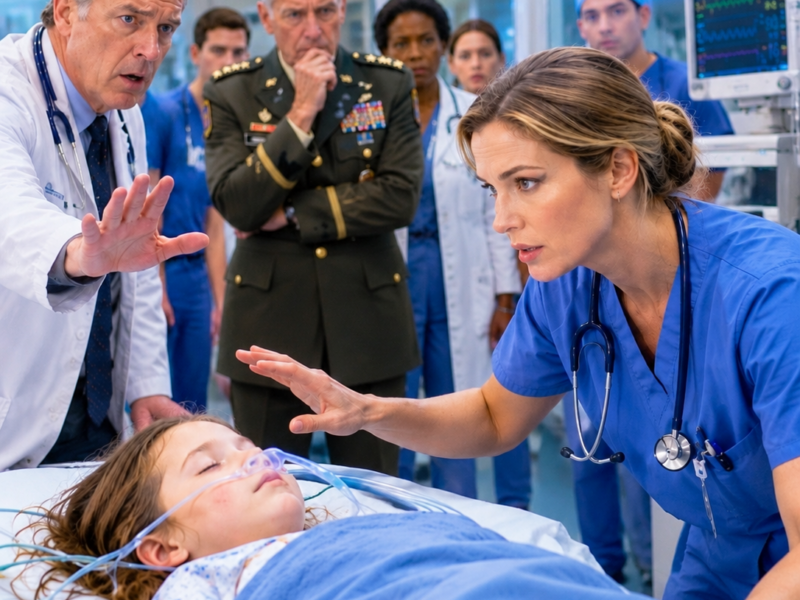
I Was Just a 37-Year-Old Floor Nurse at Fort Belvoir When Dr. Crandall Declared an 8-Year-Old Girl Dead After 38 Minutes in Freezing Water—But I Knew Something He Didn’t. “She’s Not Dead. She’s Hypothermic,” I Said, Just as Her Army General Father Walked In. When I Ordered the Entire Trauma Team to Keep Fighting, Nobody Expected What Would Happen Next—or What My Military Past Would Reveal.
I Was Just a 37-Year-Old Floor Nurse at Fort Belvoir When Dr. Crandall Declared an 8-Year-Old Girl Dead After 38 Minutes in Freezing Water—But I Knew Something He Didn’t. “She’s Not Dead. She’s Hypothermic,” I Said, Just as Her Army General Father Walked In. When I Ordered the Entire Trauma Team to Keep Fighting, Nobody Expected What Would Happen Next—or What My Military Past Would Reveal.
PART 1
“She’s already gone, Dr. Crandall said without turning around. Get her prepped for the paperwork.”
The words drifted through the trauma bay at Fort Belvoir Community Hospital shortly after midnight. They were delivered with the calm certainty of someone who had already moved on to the next task, someone who believed the most important decision had been made and that there was nothing left to reconsider.
But three feet behind him, Lena Holt wasn’t looking at the paperwork.
She was looking at the little girl lying motionless on the gurney.
The child couldn’t have been more than eight years old. Her lips had turned the color of old chalk, and her wet hair was plastered against her forehead. Her skin had a strange, almost waxen appearance beneath the harsh fluorescent lights. Her tiny chest wasn’t moving. The monitor beside her displayed a flat line that seemed to confirm what everyone in the room had already accepted.
Lena slowly lowered the IV kit she had been carrying.
She had worked the night shift on this floor for three years. Three years of answering call bells, preparing medication, assisting physicians, and watching emergencies unfold while remaining almost entirely invisible to the people making the important decisions.
She knew the sounds of that hospital better than she knew the sounds of her own apartment.
She could distinguish the irregular beeping of a patient whose condition was deteriorating from the steady rhythm of someone recovering. She knew the particular silence that settled over a room when a family received terrible news.
And she knew when a medical team had stopped fighting too soon.
This was one of those moments.
“Holt.”
Dr. Crandall’s voice came from the nurses’ station.
“Warm up the family room. I need to have a conversation before the general gets here.”
“Yes, doctor.”
Lena answered automatically, her voice quiet and controlled.
Her full name was Lena Morrow Holt. She was thirty-seven years old, with brown hair pinned neatly behind her head and a pale scar on her right forearm, just above the wrist. She wore ordinary blue scrubs and an expression that rarely revealed what she was thinking.
Most of her colleagues knew very little about her.
They knew she was dependable. They knew she rarely complained. They knew she never volunteered information about her personal life and never seemed interested in hospital politics.
What they didn’t know was that Lena had once worked in environments where a single incorrect decision could mean the difference between bringing someone home alive and leaving them behind in the wilderness.
She had learned to recognize danger in conditions most people couldn’t imagine surviving.
And the number on the little girl’s temperature monitor had just brought back memories she had spent three years trying to bury.
78.1 degrees.
Lena stared at the reading.
Her hands went completely still.
She had seen that number before, but not in a hospital. She had seen it in another life, under a different sky, surrounded by mountains and freezing winds, where the rules of ordinary medicine were sometimes insufficient to keep people alive.
She stepped closer to the gurney.
“How long was she in the water?” she asked.
The paramedic standing near the door looked up from his clipboard.
“Approximately thirty-eight minutes. A creek behind her family’s property. Extremely cold water. We started CPR at the scene and maintained it throughout transport.”
“Was she exposed to any warm water before arriving here?”
The paramedic frowned.
“What?”
“Any warm water exposure? Before she went into the creek or after you removed her?”
“No. She went straight from the water to our ambulance.”
Lena nodded.
“Thank you.”
She looked at the monitor again.
78.1.
Then she looked at the little girl’s face.
Behind her, Dr. Crandall was speaking to another physician. Lena heard her name mentioned, followed by a sentence she had heard countless times over the past three years.
“Just a floor nurse. She won’t interfere.”
Lena didn’t react.
She had learned that being underestimated could sometimes be useful. People rarely asked questions of someone they considered unimportant. They rarely noticed what that person was observing.
But tonight, remaining invisible was no longer an option.
The ambulance bay doors opened.
A man in Army service dress entered the trauma bay. He wore stars on both shoulders, and his uniform was immaculate despite the fact that he had clearly driven to the hospital in a desperate hurry.
General A. H. Whitmore.
Lena recognized his name from the intake paperwork.
His daughter was the little girl on the gurney.
The general stopped just inside the doorway. His eyes went immediately to the motionless child. For a moment, his military bearing seemed to disappear. He looked less like a commanding officer and more like a father who had arrived too late.
Dr. Crandall picked up his clipboard.
He began walking toward him, already arranging his expression into the practiced solemnity of someone preparing to deliver devastating news.
And then Lena spoke.
“Stop.”
The word came out before she had fully decided to say it.
Dr. Crandall froze.
The general looked toward her.
Every person in the room seemed suddenly aware that someone had interrupted a conversation that was supposed to be over.
“She isn’t dead,” Lena said.
Dr. Crandall turned slowly.
“Excuse me?”
“She’s severely hypothermic. Her core temperature is 78.1 degrees. She was submerged in extremely cold water for thirty-eight minutes. Those findings cannot be interpreted the same way they would be in a normally warm patient.”
Crandall stared at her.
“Nurse Holt, I have been a physician for twenty-six years.”
“Yes, doctor.”
“The patient has no detectable pulse, no spontaneous respiration, and no shockable rhythm. What exactly do you think you’re seeing?”
Lena was already reaching for the warming blanket.
“A patient whose body temperature is so low that the usual signs of death may be misleading.”
She looked directly at him.
“This is not an ordinary cardiac arrest. We need to rewarm her before anyone makes that determination.”
Crandall’s expression hardened.
“You are a floor nurse in my department. This is not your decision.”
Lena didn’t argue about titles.
She didn’t raise her voice.
Instead, she began giving instructions.
“I need the active external rewarming kit from the north cabinet. Warmed IV saline at forty-two degrees, two large-bore IV lines. Continuous chest compressions. Respiratory needs to prepare warmed, humidified oxygen.”
She glanced at the monitor.
“And I need all of it started immediately.”
Nobody moved.
The staff looked toward Crandall, waiting for him to put an end to what they considered an extraordinary act of insubordination.
Then the general spoke.
“She knows what she’s talking about.”
His voice was quiet, but it carried across the room.
Something changed.
A young resident moved toward the north cabinet. The paramedic put down his clipboard and approached the gurney.
Crandall’s jaw tightened.
“This is outside your scope of practice.”
“Then stand beside me and supervise,” Lena replied. “Or tell me which part of the temperature reading makes you certain I’m wrong.”
She paused.
“But until she’s rewarmed, we keep working.”
For several seconds, nobody said anything.
Then the room came alive.
Lena positioned the warming pads over the girl’s torso, groin, and underarm areas, carefully avoiding aggressive warming of the extremities.
“Core first,” she instructed. “We need to avoid bringing cold peripheral blood back toward the heart too quickly. Her system is extremely vulnerable right now.”
One nurse instinctively reached toward the girl’s feet with another blanket.
Lena gently stopped her.
“I know you want to warm her. That’s the right instinct in most situations. But not this one. Keep the focus on her core.”
The nurse withdrew her hand.
The warmed saline began flowing through the IV lines.
A paramedic resumed compressions.
Respiratory prepared the warmed oxygen circuit.
And Lena watched the temperature monitor.
78.1.
78.4.
It was moving slowly, but it was moving.
She leaned toward the little girl’s ear.
“I’m not walking away from you,” she whispered.
Her voice was so quiet that nobody else could hear it.
“If there’s any part of you still listening, just stay with me. You don’t have to do anything else. Just don’t let go.”
For a brief moment, Lena wasn’t standing in a hospital anymore.
She was somewhere else, surrounded by snow and freezing wind, listening to someone struggle to breathe.
She forced the memory away.
Tonight was not about the past.
Tonight was about the little girl in front of her.
And Lena had no intention of letting another life slip away simply because the people in charge had decided there was nothing left to do.
PART 2
Four minutes later, Dr. Christina Barra, chief of emergency services, entered the trauma bay.
She didn’t ask who had authorized the treatment. She didn’t demand an explanation from the nurse.
She looked at the monitor, then at the patient.
“Talk me through what you’re doing,” she said.
Lena explained the rewarming protocol, the temperature thresholds, and the reasons for every intervention.
Dr. Barra listened carefully before turning toward Crandall.
“Have you documented any objection?”
Crandall hesitated.
“Not yet.”
“Then don’t start now. Nurse Holt, continue. I’ll supervise personally.”
The temperature reached 80.6.
Then the monitor flickered.
A tiny disturbance appeared along the flat line.
“There’s something,” Lena said.
Everyone leaned closer.
“Keep the compressions going. Don’t stop.”
The flicker became more persistent.
At 82.3 degrees, the monitor showed ventricular fibrillation.
The resident looked uncertain.
Lena remained focused.
“That’s progress. We wait until the appropriate temperature before attempting defibrillation.”
At 84.7, she finally gave the order.
“Charge.”
The paddles were positioned.
“Clear!”
The girl’s small body rose beneath the pads.
The monitor scattered into chaotic lines before settling into something nobody in that room had expected to see.
A heartbeat.
Weak, irregular, but unmistakably real.
“She has a rhythm,” the resident whispered.
Lena looked toward the general.
“Your daughter has a heartbeat.”
For the first time since entering the hospital, General Whitmore covered his face with both hands.
His daughter was still alive.
But Lena knew the hardest part wasn’t over yet.
PART 3
The general remained motionless for several seconds.
He had spent most of his adult life learning how to control his reactions. He had commanded soldiers in dangerous situations, delivered orders when people around him were frightened, and made decisions that could affect hundreds of lives.
But nothing in his military career had prepared him for the sight of his eight-year-old daughter lying beneath hospital lights while strangers fought to bring her back.
And nothing had prepared him for hearing a nurse say that she had a heartbeat after another physician had already decided she was gone.
“Is she going to survive?” he asked.
It was the first question that mattered to him.
Lena didn’t give him the easy answer.
“She’s responding, but she’s not out of danger. Her heart is extremely vulnerable. We need to continue rewarming, monitor her rhythm, and watch for complications. The next several hours will be important.”
The general nodded.
He seemed to understand that promises were not what he needed.
He needed people who knew what they were doing.
And he needed them to keep working.
“Then keep going,” he said.
Lena turned back toward the monitor.
“That’s exactly what we’re doing.”
The room had changed completely.
Only minutes earlier, the staff had been preparing paperwork and waiting for the general to receive the worst news of his life. Now, every person in the trauma bay was focused on the little girl.
The paramedic maintained his position.
The resident checked the equipment.
Respiratory adjusted the warmed oxygen circuit.
Dr. Barra watched the monitor and reviewed the patient’s progress.
And Lena remained beside the gurney, following every change in temperature and every movement on the screen.
She had learned long ago that survival was rarely a single dramatic moment.
It was a sequence.
One correct decision followed by another.
One careful adjustment followed by another.
Sometimes, the difference between success and failure was simply refusing to become careless after the first sign of improvement.
The monitor continued displaying a weak but organized rhythm.
86.4.
88.1.
Lena checked the warming pads and adjusted their position.
“Maintain the current settings. I want another temperature reading in four minutes.”
The resident glanced at her.
“Understood.”
He had stopped looking at her as though she were merely a nurse who had interrupted a physician.
He was listening.
That alone told Lena how dramatically the atmosphere had shifted.
After nearly forty minutes of working together, he finally asked the question that had been bothering him.
“Where did you learn all this?”
Lena didn’t immediately answer.
“Mountain search and rescue medicine.”
“You worked in search and rescue?”
“Yes.”
The resident looked at her again.
“You mean civilian search and rescue?”
“No.”
She checked the monitor.
89.3.
“Army,” she added. “I worked as a flight medic. Medevac, then SERE training.”
The resident blinked.
“SERE?”
“Survival, Evasion, Resistance, and Escape.”
He looked genuinely surprised.
“You were military?”
“I was.”
“And now you’re here?”
“Now I’m here.”
She delivered the answer so plainly that he understood there would be no additional explanation.
But his curiosity had already been awakened.
He had spent three years in medical residency, studying emergency procedures, reading clinical guidelines, and learning how to respond to cardiac emergencies. Yet the approach Lena had described was something he had never seen demonstrated in this way.
“You should be teaching this,” he said.
Lena adjusted the angle of a warming pad.
“I know.”
There was no bitterness in her voice.
She wasn’t trying to impress him or make a point about the hospital’s shortcomings.
She simply knew that her experience contained knowledge that could save lives.
She also knew that she had spent three years deliberately keeping that knowledge to herself.
Not because she had forgotten it.
Because remembering it had become painful.
The temperature climbed again.
90.1.
Then something happened that made everyone in the room stop.
The little girl’s right hand moved.
It was barely noticeable at first. Her fingers curled slightly against the sheet, as though her body were trying to remember a movement it had once performed without thinking.
A nurse gasped.
The resident stepped closer.
“Did you see that?”
Lena had already seen it.
“She’s beginning to respond. Gentle movements only. Don’t stimulate her unnecessarily.”
She looked at the nurse near the foot of the bed.
“Her heart is still irritable. We need to handle her carefully.”
The nurse nodded, visibly emotional.
The general took one step closer.
He didn’t speak.
He simply watched his daughter’s hand, waiting to see whether it would move again.
For a man accustomed to measuring progress through reports, numbers, and operational results, the movement of two tiny fingers had suddenly become the most important development he had ever witnessed.
Dr. Barra stood near the wall, holding a small notebook.
She had been observing Lena for some time.
She was beginning to understand that the most remarkable part of the situation wasn’t simply that the little girl had survived.
It was how close the hospital had come to losing her because the staff had interpreted her condition through the wrong clinical assumptions.
The department had protocols.
It had experienced physicians.
It had advanced equipment.
Yet a nurse who had spent three years quietly working ordinary shifts had recognized something the entire team had missed.
And Dr. Barra was beginning to wonder how many other patients might have been affected by the same gap in training.
At 94 degrees, the little girl’s eyelids began moving.
Lena noticed immediately.
“She’s becoming more responsive.”
The general moved closer, but Lena raised one hand gently.
“Give her a moment. Let her come around slowly.”
He stopped.
His hands were trembling.
At 95 degrees, the girl’s lips parted.
At first, it was only a faint sound.
A small breath escaping through a dry throat.
Then it became something more deliberate.
“Dad.”
The word was barely audible.
But General Whitmore heard it.
He crossed the room so quickly that the resident had to step aside.
“I’m here, sweetheart.”
He reached for her hand.
The girl’s fingers tightened weakly around his.
“I’m right here.”
Her eyes opened slightly, unfocused and confused.
She looked at him as though she were trying to understand where she was.
The general bent closer.
“Daddy’s here. You’re safe.”
Lena stepped back.
She knew when to move toward a patient.
She also knew when to move away.
There were moments when medical intervention had to give way to something more human, and this was one of them.
The general held his daughter’s hand and lowered his head.
For a few seconds, his shoulders shook.
Nobody in the room interrupted him.
Nobody needed to.
The little girl was alive.
She was speaking.
She was holding her father’s hand.
The impossible had become real.
Lena watched them quietly.
Something inside her loosened.
It wasn’t happiness exactly, and it wasn’t relief alone.
It was the feeling of a door opening after years of being locked.
She had spent a long time convincing herself that the part of her that had once rushed into dangerous places had been left behind.
But the truth was standing in front of her.
She hadn’t lost those skills.
She had simply stopped allowing herself to use them.
“Doctor Barra,” Lena said quietly, “I’d like another rhythm assessment and a full review of her next-stage care.”
Barra nodded.
“Of course.”
Then she looked at Lena.
“I’d like to speak with you.”
“About the patient?”
“About your background.”
Lena glanced toward the general and his daughter.
“Now?”
“Not here. Tomorrow, in my office.”
Barra lowered her voice.
“What happened tonight has exposed a serious training deficiency in this department. I don’t want to lose sight of that simply because the patient is improving.”
Lena waited.
“I also don’t want to ignore the fact that someone with your experience has been working on my floor for three years without anyone recognizing what she can contribute.”
Lena didn’t answer immediately.
She wasn’t accustomed to being recognized.
For most of her time at Fort Belvoir, people had asked her to complete tasks, not explain her thinking. They had valued her reliability but rarely questioned whether she could do anything beyond the ordinary responsibilities of her position.
Barra continued.
“I want to discuss bringing your full capabilities into this hospital intentionally. Training, emergency protocols, perhaps a specialized role. We’ll work out the details later.”
Lena looked at her.
“I’ll be there.”
When she turned back toward the gurney, Dr. Crandall had returned.
He no longer carried his clipboard.
He stood near the doorway, watching the patient.
For the first time since Lena had known him, he seemed uncertain about what to say.
He approached the foot of the bed.
“What do you need?” he asked.
Lena looked at him.
It was a simple question.
But coming from Dr. Crandall, it was almost unbelievable.
“Another core temperature in four minutes,” she replied. “And I want respiratory to check the warmed circuit settings. The rate looks slightly high.”
Crandall nodded.
“I’ll check it.”
Then he turned and walked toward the equipment.
Lena watched him for a moment before returning her attention to the patient.
She had no interest in celebrating a change in someone’s attitude while a little girl was still recovering.
There would be time for that later.
For now, there was a heartbeat to protect.
PART 4
The next hour passed differently from the first.
There was still tension in the room, but it was no longer the hopeless tension that had surrounded the little girl’s arrival.
It was the tension of people who understood that something extraordinary had happened and were determined not to undo it through careless decisions.
The temperature readings continued to improve.
91.7.
93.2.
94.
95.
The little girl remained weak, but she was responding.
Her father stayed close, occasionally speaking to her in a low voice.
He told her that he was there.
He told her that she was safe.
He promised that her dog was waiting for her at home.
When she became more alert, she asked for water, then complained that the hospital blanket was uncomfortable.
The general almost laughed.
It was the most beautiful complaint he had ever heard.
Lena watched from the other side of the room.
She had seen many families receive good news.
She had seen parents cry when a child’s fever finally broke, spouses embrace after an emergency surgery, and adult children hold their elderly parents’ hands after a long night in intensive care.
But this was different.
This family had been standing on the other side of a door that might never have opened again.
Now they were being given another chance.
The little girl turned her head slightly.
“Dad?”
“Yes, sweetheart?”
“Where’s my dog?”
The general leaned closer.
“Your dog is at home.”
“Is he okay?”
“He’s fine.”
“Did you feed him?”
The general paused.
Lena noticed the expression on his face.
He looked as though he might have been asked to lead an entire military operation with fewer complications.
“Yes,” he said. “I fed him.”
“Really?”
“I promise.”
The girl seemed satisfied.
Then she closed her eyes again.
The general looked toward Lena.
“Is that normal?”
“She needs rest. Waking up after what she’s been through can be confusing. We’ll continue monitoring her.”
He nodded.
After a moment, he asked something else.
“Can I thank you?”
Lena looked at him.
“You already have.”
“No,” he said. “I mean properly.”
She didn’t respond.
He seemed to understand that she wasn’t comfortable with the conversation, but he continued.
“My daughter was going to be declared dead. I heard the doctor preparing to tell me. I saw the paperwork. I saw everyone accepting it.”
His voice became quieter.
“Then you walked over and told them to stop.”
Lena lowered her eyes toward the chart.
“I recognized the condition.”
“You recognized something nobody else did.”
“I had training.”
The general shook his head.
“Training doesn’t mean much if a person doesn’t have the courage to use it when everyone else is telling them to stand aside.”
Lena looked at him again.
He wasn’t speaking as a general now.
He was speaking as a father.
“I have a family because of you,” he said.
For a moment, Lena didn’t know what to say.
Then she answered in the only way that felt honest.
“You have a daughter because she was stubborn enough to fight. I simply refused to agree that she wasn’t still here until we could prove it.”
The general looked down at his daughter.
A small smile appeared on his face.
“She’s always been stubborn.”
“Then she’s in good company.”
He gave a quiet laugh.
It was the first ordinary sound either of them had made all night.
Eventually, the general stepped away to speak with the staff coordinating his daughter’s next stage of care.
Lena returned to the nurses’ station.
There were still charts to complete.
There were medication records to review, observations to document, and a detailed timeline of the emergency to enter into the patient’s file.
The hospital did not stop functioning simply because one extraordinary event had taken place.
She sat down and began recording the sequence of interventions.
The initial temperature.
The duration of immersion.
The absence of detectable cardiac activity.
The rewarming procedure.
The gradual return of electrical activity.
The successful restoration of a cardiac rhythm.
She wrote everything carefully.
She didn’t exaggerate.
She didn’t describe herself as a hero.
She documented the facts because the next person who encountered a similar patient needed to know what had happened.
The resident approached with two cups of coffee.
He placed one beside her.
“You haven’t touched anything to drink all night.”
Lena looked at the cup.
“Thank you.”
He sat down nearby.
“I’m still trying to understand how you recognized it so quickly.”
She took a sip.
“Because I’ve seen it before.”
“On a mission?”
“Several times.”
He waited, hoping she might say more.
Lena continued writing.
Finally, he asked, “Why did you leave?”
Her pen stopped.
It was a simple question, but it reached into a part of her life she had carefully kept closed.
“Because I lost someone.”
The resident’s expression changed.
“I’m sorry.”
Lena nodded.
“It was after a mission. The patient survived, but someone I was responsible for didn’t.”
She didn’t elaborate.
She didn’t explain the circumstances, the location, or the precise sequence of events.
Those details belonged to another time.
What mattered was that she had spent years carrying the outcome.
She had become so focused on the person she couldn’t bring home that she had gradually forgotten the lives she had helped save.
Eventually, leaving the military had seemed like the only way to stop reliving the same questions.
Had she made the right decision?
Could she have done something differently?
Was there one moment when everything might have changed?
She had moved into civilian nursing because she wanted a quieter life.
She wanted a place where she could work, go home, sleep, and stop expecting the next emergency to become another permanent memory.
For three years, she had almost succeeded.
But tonight had reminded her of something she had tried very hard to forget.
“You don’t leave the training when you leave the job,” she said quietly. “You just stop using it on purpose.”
The resident listened.
“And sometimes you start believing that the skills are part of a life that no longer belongs to you.”
She looked toward the trauma bay.
“Then something happens, and you realize they still matter.”
He was silent for a moment.
“You should teach us.”
Lena gave a faint smile.
“Maybe I will.”
Across the department, Dr. Barra was already making arrangements for the following morning.
She wanted a review of the emergency.
She wanted the clinical timeline.
She wanted to understand why the hospital’s existing procedures had not prompted a more thorough consideration of severe hypothermia.
And she wanted to know why a nurse with specialized military medical experience had been allowed to remain almost entirely unrecognized.
Meanwhile, Dr. Crandall stood in the hallway near the supply closet.
He had been there for several minutes.
His arms were no longer crossed.
When Lena finally approached, he looked up.
She stopped a few feet away.
“Doctor?”
He hesitated.
“I was wrong.”
Lena waited.
“Not just about the patient’s prognosis. About you.”
He looked uncomfortable, as though the words were difficult to arrange.
“I’ve spent three years treating you like a useful piece of furniture. Someone who could be counted on to complete tasks but didn’t need to be listened to.”
Lena said nothing.
“I don’t have an excuse for that.”
He glanced toward the trauma bay.
“I’ve been a physician for twenty-six years. I thought experience meant I knew when a situation was beyond recovery. Tonight, I was so certain of my conclusion that I stopped asking whether I had interpreted the evidence correctly.”
He paused.
“I’d like to stop treating you that way.”
Lena studied him.
She had imagined many conversations with Dr. Crandall over the years, though most of them had involved frustration rather than reconciliation.
She could have reminded him of every dismissive comment.
She could have listed every time he had ignored her observations.
She could have asked why it had taken a near-tragedy to make him reconsider her value.
But she didn’t.
“That’s a reasonable goal,” she said.
Crandall nodded.
Then he asked another question.
“I’d like to know what else I don’t know.”
For the first time, Lena saw something resembling genuine humility in his expression.
“Specifically, what this hospital is capable of that it currently doesn’t know it’s capable of.”
She considered that.
“That’s also a reasonable goal.”
He looked relieved, though not entirely forgiven.
And Lena was comfortable with that.
Respect wasn’t something that could be restored with one apology.
It would have to be demonstrated through actions.
She walked away.
Behind her, Crandall remained in the hallway, apparently thinking about the night that had changed his understanding of his own department.
Lena returned to the nurses’ station.
Her documentation was almost finished.
The little girl was alive.
Her father was with her.
The emergency team had learned something important.
And for the first time in three years, Lena was beginning to wonder whether the quiet life she had chosen was still the life she wanted.
PART 5
Nearly an hour after the little girl’s heartbeat returned, General Whitmore approached the nurses’ station.
Lena was completing the final lines of her report when she noticed him standing on the other side of the counter.
He waited until she looked up.
“My daughter is asking for her dog again.”
Lena smiled slightly.
“That sounds promising.”
“She wants to know why he’s not here.”
“I’m sure he’ll be delighted to visit when she’s feeling better.”
The general nodded.
Then he remained standing there.
There was something he wanted to ask, and Lena could tell that he was trying to decide how to phrase it.
Finally, he spoke.
“Can I ask you something personal?”
She placed her pen on the counter.
“You can ask.”
“Who are you?”
Lena raised an eyebrow slightly.
“You’ve seen my name on the paperwork.”
“I don’t mean your personnel file. I mean who you are.”
He looked toward the trauma bay.
“I’ve watched you work tonight. I’ve watched you give orders without hesitation, explain things that nobody else understood, and remain calm when everyone around you was waiting for someone more senior to make a decision.”
He paused.
“You weren’t afraid of Dr. Crandall. You weren’t trying to impress me. You weren’t even looking for recognition.”
He met her eyes.
“I want to know who the person behind that is.”
Lena leaned back slightly.
For three years, she had become very good at answering questions without revealing much.
She could tell people she had previously worked in emergency medicine without explaining the environments in which she had worked.
She could mention military service without discussing the people she had lost.
She could smile, change the subject, and return to her duties.
But the general had earned a more honest answer.
“I’m a nurse,” she said.
He waited.
“And I used to be someone who went into very bad situations and brought people out of them.”
She looked down at her hands.
“I stopped doing that for reasons that don’t change the skills. They only changed the address on my badge.”
“Why?”
She took a breath.
“I lost someone after a mission that went right for the patient and wrong for someone I was responsible for.”
The general didn’t interrupt.
“I needed to be somewhere that the wrong kind of outcome didn’t follow me off the clock.”
She paused.
“For a while, I thought becoming an ordinary floor nurse would make everything easier. No helicopters, no mountains, no dangerous extractions. Just patients, medication, charts, and regular hospital emergencies.”
She gave a small, almost humorless smile.
“It turns out you can’t simply decide that part of yourself no longer exists.”
The general listened quietly.
“Tonight reminded me that the training is still there. The knowledge is still there. And maybe I’ve been waiting for a reason to use it again that was bigger than the reason I stopped.”
The general looked toward his daughter.
“Then I hope you find that reason.”
Lena nodded.
He didn’t ask for the name of the person she had lost.
He didn’t ask what happened on the mission.
Perhaps he understood that some questions were not necessary to understand someone’s pain.
Instead, he offered his hand.
She shook it.
“Thank you,” he said.
This time, the words carried no military formality, no rank, and no expectation.
Just gratitude.
Lena returned to her documentation.
The general stood there another moment before walking back toward his daughter’s room.
A few minutes later, Dr. Barra appeared beside the counter.
“Lena.”
“Yes, doctor?”
“Tomorrow morning. My office. Nine o’clock.”
“I’ll be there.”
“I want to discuss a formal review of tonight’s emergency. I also want to discuss a training program.”
Lena looked up.
“What kind of training program?”
“Emergency response for severe environmental exposure. Hypothermia, cold-water immersion, wilderness trauma, and the kinds of situations where ordinary emergency assumptions can become dangerous.”
Barra paused.
“I’d like you to help design it.”
Lena was quiet.
“You would have the opportunity to teach physicians, residents, nurses, and emergency personnel. We would review your military experience, determine what can appropriately be incorporated into civilian practice, and develop procedures that meet this hospital’s clinical standards.”
“That sounds like a substantial project.”
“It is.”
Barra smiled slightly.
“But I think we’ve just discovered why we need it.”
Lena looked toward the room where the little girl was recovering.
“Then let’s make sure it helps someone.”
“That’s the idea.”
Barra left.
Lena finished the last line of the report.
She signed her full name:
Lena Morrow Holt, RN.
For the first time in three years, she didn’t feel the need to shorten it, hide behind it, or pretend that the history attached to it didn’t matter.
She filed the chart.
Down the hall, the little girl was talking to a night-shift nurse.
Her voice was still weak, but she was clearly awake.
She was describing her dog in great detail, explaining the color of his fur, the shape of his ears, and the way he always tilted his head whenever someone mentioned food.
The nurse listened patiently.
Eventually, she pulled out her phone and showed the child a photograph of her own dog.
The little girl studied the picture.
Then she frowned.
“That doesn’t look like my dog.”
The nurse laughed.
“Well, I tried.”
“You need to see my dog. He’s much bigger.”
“I believe you.”
“And he’s smarter.”
“Of course.”
Lena heard the exchange as she passed the doorway.
She stopped briefly.
There was something extraordinary about hearing a child argue about a dog after an entire hospital had nearly accepted that the child would never speak again.
The general sat beside the bed, smiling.
His daughter was holding his hand.
Her eyes were open.
Her voice was returning.
She was already planning what she wanted to do when she got home.
Lena watched for a few seconds before continuing toward the elevator.
She hadn’t saved the girl alone.
The paramedics had brought her in.
The resident had helped.
The nurses had followed the treatment plan.
Dr. Barra had recognized the importance of continuing.
Even Dr. Crandall had eventually set aside his pride and contributed.
But someone had needed to recognize that the patient wasn’t beyond saving.
Someone had needed to stand in a room full of people who believed the decision had already been made and insist that they reconsider.
That person had been Lena.
And she knew that the moment would stay with her for a long time.
As the elevator doors opened, she looked down at the pale scar on her right forearm.
For years, she had told people it came from a kitchen accident.
It was easier than explaining the past.
Easier than remembering the mission.
Easier than admitting that the person she had lost had never really stopped occupying a space inside her.
Tonight hadn’t erased that loss.
It hadn’t magically repaired the years she had spent trying to become someone else.
But it had reminded her that the past did not have to be only a source of pain.
The same experience that had once haunted her had also helped save a little girl.
Maybe that was enough to begin again.
The elevator doors started closing.
Lena stepped inside and pressed the button for the ground floor.
Tomorrow, she would meet with Dr. Barra.
Tomorrow, she would begin discussing how the hospital could improve its emergency response procedures.
Tomorrow, she might finally start using the knowledge she had spent three years keeping hidden.
But tonight, she allowed herself one small moment of satisfaction.
A child who had arrived without a detectable heartbeat was alive.
A father who had walked into the hospital expecting to lose his daughter was leaving the trauma bay with a future he had almost believed was gone.
And somewhere in the hospital, a little girl was already complaining about how long she had been asleep.
Lena smiled.
She had spent years believing that leaving the military meant leaving that part of herself behind.
Now she understood something different.
She hadn’t stopped being the person who went into impossible situations and fought to bring people home.
She had simply forgotten that she was still allowed to be that person.
The elevator reached the ground floor.
Lena stepped out into the quiet corridor, carrying her belongings and the exhaustion of a night she would never forget.
For once, she wasn’t thinking about the person she had lost.
She was thinking about the little girl who had survived.
And as she walked toward the hospital entrance, she realized that perhaps the most important thing she had recovered that night wasn’t her confidence, her reputation, or even the career she had once abandoned.
It was the belief that her life still had something meaningful left to give.
Because sometimes the person everyone overlooks is the only person who recognizes that a story isn’t over.
And sometimes, when an entire room has already accepted goodbye, all it takes is one person brave enough to say:
“Stop. She’s not gone yet.”