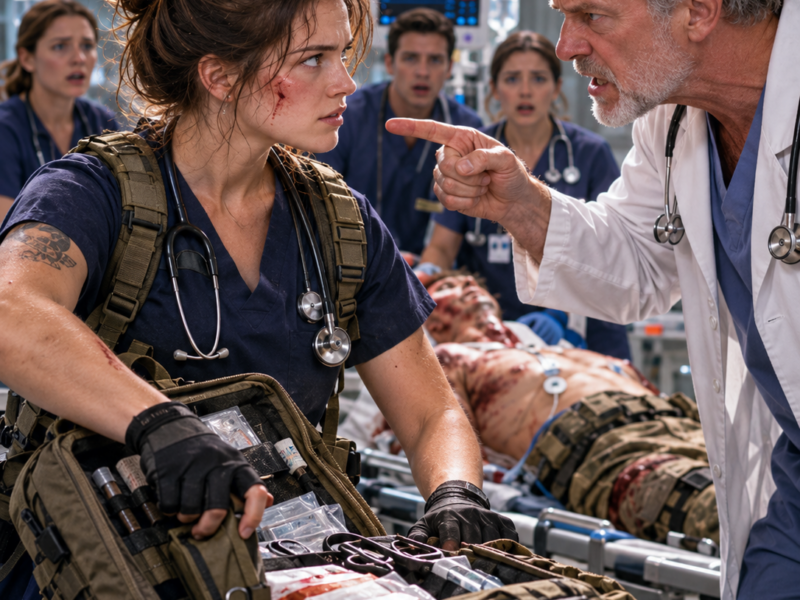
I Was Just a 34-Year-Old ER Nurse When My Arrogant Surgeon Declared a Gunshot Victim Dead and Screamed, “You’re Not Qualified for Combat Trauma!” But When I Recognized the Tattoo on the Dying Man’s Chest, I Opened a Forgotten Military Field Kit and Revealed the Secret Identity I’d Hidden for Three Years. Moments After I Saved His Life, He Grabbed My Wrist and Whispered, “Nightingale, the Ambush Was a Setup.” Then I Saw a Man in a Gray Suit Reaching Inside His Jacket…
I Was Just a 34-Year-Old ER Nurse When My Arrogant Surgeon Declared a Gunshot Victim Dead and Screamed, “You’re Not Qualified for Combat Trauma!” But When I Recognized the Tattoo on the Dying Man’s Chest, I Opened a Forgotten Military Field Kit and Revealed the Secret Identity I’d Hidden for Three Years. Moments After I Saved His Life, He Grabbed My Wrist and Whispered, “Nightingale, the Ambush Was a Setup.” Then I Saw a Man in a Gray Suit Reaching Inside His Jacket…
Part 1
The moment Dr. Richard Camden declared my patient dead, I knew I had two choices.
I could obey him, step away from the operating table, and let the man bleed out beneath the fluorescent lights.
Or I could open the olive-green military bag lying at my feet and reveal a past I had spent three years trying to bury.
What I didn’t know was that the dying man on that table was someone I had already mourned.
And the people who wanted him dead were already inside the hospital.
My name is Abigail Weston. I’m thirty-four years old, and until that Friday night, I was nothing more than an ordinary emergency room nurse at St. Jude’s Medical Center in downtown Chicago.
At least, that was what everyone believed.
I wore blue scrubs, kept my blonde hair pulled into a tight bun, and rarely spoke unless someone asked me a question. I arrived early, finished my paperwork, and avoided the conversations that usually filled the nurses’ station.
Nobody knew where I had worked before transferring from a small clinic in Oregon.
Nobody knew why certain sounds made me stop breathing for a second.
And nobody knew why I never stood with my back to an open doorway.
I had worked very hard to become invisible.
Dr. Richard Camden made that surprisingly easy.
He was the hospital’s most celebrated trauma surgeon, a man whose medical credentials were almost as impressive as his opinion of himself. He wore expensive watches, drove a German sports car, and treated nurses like pieces of equipment that occasionally made inconvenient noises.
In six months, he had never once called me Abigail.
“Weston!” he barked that evening, snapping his fingers across the nurses’ station.
I looked up from a patient chart.
“Bay four. Multiple-vehicle collision coming from Interstate 90. Get it ready, and try not to waste everyone’s time.”
“Already prepared, Doctor.”
He frowned.
“Then check it again.”
I nodded without arguing.
That was another thing I had learned during my years in hiding. Some battles weren’t worth fighting.
Outside, freezing November rain battered the hospital windows. The emergency department was crowded with exhausted paramedics, injured commuters, and families waiting for news.
Sarah Jenkins, a young nurse who had become the closest thing I had to a friend, leaned toward me.
“One day, you’re going to tell him where to shove that attitude.”
I almost smiled.
“Probably not.”
“Seriously, Abby. He treats you like you’re incompetent.”
“Let him.”
Sarah shook her head.
“You are the strangest person I’ve ever worked with.”
She had no idea.
At 10:47 p.m., a violent screech of tires cut through the steady noise of the emergency department.
I turned toward the ambulance entrance.
A black Chevrolet Tahoe had stopped outside the automatic doors.
There were no license plates.
Its windshield was cracked by several bullet impacts.
Before security could respond, two men dressed in dark tactical clothing dragged a stretcher from the vehicle.
They moved with the kind of coordination I hadn’t seen in years.
Not police.
Not ordinary paramedics.
Military.
One of them shoved the stretcher through the entrance while the other dropped an olive-green duffel bag onto the patient’s chest.
Neither spoke.
Then they disappeared into the vehicle and drove away.
For a heartbeat, everyone froze.
Sarah whispered, “What the hell was that?”
I was already running.
“Bay four!” Camden shouted. “Get him into bay four!”
I grabbed the stretcher and helped move the injured man beneath the surgical lights.
He was enormous, easily six feet three, with a muscular build beneath his torn civilian clothing. His face was covered in blood and grime.
Several gunshot wounds marked his torso and leg.
The amount of blood beneath him told me more than any monitor could.
He was dying.
Fast.
“Multiple penetrating injuries,” I reported. “Severe hemorrhage from the upper thigh. Possible thoracic injury. He’s barely maintaining circulation.”
Camden pushed past me.
“Get the bleeding under control.”
I applied pressure while Sarah activated the hospital’s emergency blood protocol.
Something about the injuries disturbed me.
They weren’t consistent with an ordinary street shooting. The damage suggested weapons and circumstances I recognized from another life.
And there was something familiar about the patient.
His jaw.
The scar near his left eyebrow.
I couldn’t place it.
Not yet.
“Pressure is falling!” Sarah announced.
Camden attempted to control the bleeding, but the wound was catastrophic.
“Doctor,” I said, “we need a different approach. His injuries require immediate damage-control resuscitation and surgical intervention.”
“Did I ask for your opinion?”
“No, but—”
“Then keep your mouth shut.”
I looked at the monitor.
His heart rate was climbing while his blood pressure collapsed.
The patient was slipping away.
Camden continued working, his movements becoming increasingly frantic.
“You’re making the bleeding worse,” I warned.
He slammed an instrument onto the tray.
“Listen carefully, Weston. I have performed more trauma surgeries than you’ve probably witnessed in your entire miserable career.”
I kept pressure on the wound.
“This isn’t a conventional injury.”
He looked at me with open contempt.
“And suddenly you’re an expert?”
The next words came out before I could stop them.
“I’ve seen this before.”
Camden laughed.
“Where? Your little countryside clinic?”
I said nothing.
He leaned closer, his face red with anger.
“You’re a civilian nurse. You’re not qualified for combat trauma. Step away before you kill this man.”
The entire room went quiet.
Sarah stared at him.
I felt an old, familiar numbness spreading through my chest.
Not anger.
Something colder.
I had heard men speak like that before.
Men who believed authority came from titles rather than experience.
Men who had never held a dying soldier in their arms while artillery shook the ground beneath them.
Men who would rather protect their pride than admit they needed help.
Then the heart monitor changed.
The rapid beeping became irregular.
The patient’s body went still.
And suddenly a continuous alarm filled the room.
“Cardiac arrest!” Sarah cried.
Camden stepped backward.
“Start resuscitation.”
The team moved immediately, but his expression told me he had already surrendered.
Seconds passed.
Then he lowered his head.
“He’s gone.”
I looked up sharply.
“We haven’t exhausted our options.”
Camden pulled off his gloves.
“Call it.”
“No.”
He turned toward me.
“What did you say?”
I stared at the man on the table.
His torn shirt had shifted, exposing part of a tattoo beneath his collarbone.
A winged dagger.
Wrapped in barbed wire.
My entire body went cold.
I knew that symbol.
I had watched it being tattooed onto the shoulders of men who operated in places that officially didn’t exist.
Men who had served beside me.
Men who had died in Damascus three years earlier.
I leaned closer.
Beneath the blood, a narrow scar crossed the patient’s left eyebrow.
My breath caught.
“No,” I whispered.
That scar had come from a piece of flying metal during a training accident.
I remembered patching it myself.
The man on the table couldn’t possibly be alive.
I had seen the report.
I had attended the memorial.
I had carried his folded flag.
“David?”
His eyes remained closed.
I felt something inside me fracture.
Corporal David Miller.
My former teammate.
My friend.
A man I had spent three years believing was dead.
Camden pointed toward the doorway.
“Weston, leave this room. You’re fired.”
I barely heard him.
Instead, I looked at Sarah.
“Continue the resuscitation. We are not giving up.”
She hesitated.
“Abby, his—”
“I know. Please trust me.”
There was something in my voice that made her move.
I dropped to my knees beside the stretcher.
The olive-green bag was still on the floor.
I pulled it toward me.
A military-grade locking mechanism secured the zipper.
My hands shook for the first time that evening.
Not because I was frightened of Camden.
Because someone had brought David to this hospital with a bag designed for a person who knew exactly how to use its contents.
Someone knew who I really was.
Someone knew where to find me.
Camden stared as I forced the bag open.
Inside were specialized emergency medical supplies, sealed trauma equipment, and a black electronic device I recognized immediately.
This wasn’t an ordinary medical kit.
It had been assembled for a specific mission.
And beneath the equipment, tucked into an interior pocket, was a small fabric patch.
A silver bird embroidered against black cloth.
A nightingale.
My old call sign.
I felt the years collapse around me.
The hospital disappeared for an instant, replaced by a burning compound in Syria, the screams of wounded soldiers, and a radio operator calling my name through static.
“Nightingale, we need you!”
I gripped the edge of the operating table.
Then I looked at Sarah.
“Get the trauma team and blood bank fully mobilized. Call the operating room. We need everyone ready.”
Camden stormed toward me.
“You are not touching that patient!”
I stood.
For six months, I had lowered my eyes whenever he shouted.
For six months, I had let him think I was weak.
This time, I met his gaze.
“My name is Captain Abigail Weston,” I said quietly. “I spent eight years treating combat casualties, including service with a classified military trauma unit. I know exactly what kind of injuries this man has.”
Camden stopped moving.
I pointed toward the monitor.
“And right now, Richard, I don’t care about your ego, your reputation, or whether you fire me. I care about keeping him alive.”
He opened his mouth.
I didn’t give him time to answer.
“Either help us save him, or get out of the way.”
For the first time since I had met him, Dr. Camden had absolutely nothing to say.
And as I reached back into that bag, I realized the life I had built in Chicago was already over.
Because the equipment inside it had one purpose.
To bring a ghost back from the dead.
And whoever had sent it knew I was the only person who could recognize him.
Part 2
For the next several minutes, nobody in the trauma bay remembered that I was supposed to be an ordinary nurse.
The team worked desperately to restore David’s circulation, control his bleeding, and prepare him for emergency surgery.
Sarah followed every instruction without hesitation.
Even Camden began helping.
Then the monitor sounded.
Once.
Twice.
A heartbeat.
“We have a pulse!” Sarah cried.
I gripped the edge of the stretcher, fighting the sudden weakness in my knees.
David was alive.
Barely.
His eyes fluttered open.
He reached for my wrist.
“Nightingale,” he whispered.
I leaned closer.
“David? Who did this?”
His lips trembled.
“They found the ledger.”
My stomach tightened.
“What ledger?”
“Damascus.”
He swallowed painfully.
“The extraction wasn’t an accident.”
Before I could ask another question, he whispered something that made my blood freeze.
“Command ordered it.”
Then his eyes closed.
I stared at him, unable to breathe.
Three years ago, my unit had been destroyed during what the military called an enemy ambush.
Now David was telling me it had been murder.
A movement caught my attention.
Beyond the glass doors stood a man in an immaculate gray suit.
He wasn’t watching David’s injuries.
He was watching me.
And when his hand slipped beneath his jacket, I recognized the movement immediately.
He was reaching for a gun.
Part 3
There are moments when fear makes the world move slowly.
I had experienced them in Afghanistan, Iraq, and Syria. Moments when a distant explosion seemed to unfold over several minutes, when every sound became separate, when your brain began making decisions before you consciously understood the danger.
That was what happened when I saw the man in the gray suit.
His expression never changed.
He stood beyond the trauma bay doors as though he were waiting for someone to finish an appointment.
But his eyes gave him away.
They moved from David to the equipment, then to Sarah, Camden, and finally me.
He was calculating.
Not worrying.
Not searching for a loved one.
Calculating.
“Sarah,” I said quietly, “move away from the doors.”
She looked up.
“Why?”
“Now.”
Something in my expression frightened her enough to obey.
The doors slid open.
“Good evening,” the stranger said.
His voice was calm, almost pleasant.
Camden immediately stepped forward.
“Thank God. Are you security? This woman has completely taken over my trauma room.”
The stranger produced a leather wallet.
“Special Agent Collins. Federal Bureau of Investigation.”
He displayed a badge.
I didn’t move.
“What’s your business here?”
He studied me.
“The patient is wanted in connection with a classified federal investigation. I’m taking him into custody.”
“He’s critically unstable,” I replied. “Moving him would place his life in immediate danger.”
“That’s unfortunate.”
The answer came too quickly.
I felt my stomach sink.
A genuine investigator would have asked about his condition or arranged medical supervision.
This man didn’t care whether David survived.
“Where’s your team?” I asked.
Collins smiled faintly.
“I’m sorry?”
“Your backup. The local officers securing the entrance. Your emergency credentials.”
His smile faded.
“That information doesn’t concern you.”
“It does when you walk into my trauma bay and try to remove a dying patient.”
He took one step closer.
“Step aside, Miss Weston.”
I noticed he hadn’t looked at my identification badge.
It was turned backward.
Yet he knew my name.
“Who sent you?” I asked.
For a second, neither of us moved.
Then he said something I hadn’t heard in three years.
“You should have stayed buried, Nightingale.”
Camden frowned.
“What is he talking about?”
Collins reached beneath his jacket.
I shouted, “DOWN!”
The first gunshot shattered a surgical light.
The second struck the wall behind me.
Sarah screamed.
I threw a stainless-steel instrument stand between us and lunged toward the doorway.
We collided hard enough to knock the breath from my lungs.
He was stronger than I expected, and the blow he drove into my jaw filled my mouth with blood.
But I hadn’t survived eight years in combat zones by assuming an enemy would fight fairly.
We struggled against the cabinet.
His weapon struck the floor.
I knocked him off balance, drove him away from the stretcher, and forced him down long enough to secure him with the help of a terrified hospital security officer who had finally reached the room.
It lasted only seconds.
It felt like an hour.
When I stood, my entire body trembled.
Sarah stared at me.
“Abby… who are you?”
I looked at Collins.
He was struggling against the restraints, his expression twisted with hatred.
“Someone who was supposed to die three years ago.”
Camden backed against the wall.
“You assaulted a federal agent.”
“No,” I said. “I stopped an armed man from murdering my patient.”
“He’s FBI!”
I picked up the badge Collins had dropped and examined it.
“Then why did he come here alone, with a suppressed pistol, and call me by a classified military designation?”
Camden had no answer.
Collins suddenly laughed.
It was a soft, ugly sound.
“You think surviving tonight changes anything?”
I crouched near him.
“Who sent you?”
He looked past me at David.
“You’re already too late.”
“For what?”
“The others.”
A chill moved through me.
“What others?”
He smiled.
“You really have no idea how many of you survived, do you?”
Before I could respond, his phone vibrated inside his jacket.
The screen displayed an incoming message.
Three words.
Confirm target termination.
I looked toward the doors.
If Collins didn’t answer, whoever sent him would know something had gone wrong.
And David was still trapped in the middle of a hospital full of innocent people.
I made a decision.
“Sarah, keep the trauma team working. We need to move David to a secure operating room or another surgical facility as soon as medically possible.”
Camden looked horrified.
“Move him? He could die!”
“He will die if those people get to him.”
I turned to the security officer.
“Lock this man in a guarded room. Contact your supervisor, and tell them an armed intruder attempted to kill a patient. Keep his weapon secured.”
Then I took the phone from Collins.
His expression changed.
For the first time, he looked nervous.
“Don’t answer that.”
I stared at the screen.
“Why not?”
“Because they’ll know.”
“Know what?”
His eyes moved toward the ceiling cameras.
“That Nightingale is awake.”
The phone stopped vibrating.
A new message appeared.
Secondary team activated.
I felt every muscle in my body tighten.
Somewhere in the hospital, another group was already moving toward us.
I turned to Camden.
“How many exits lead from this floor to the service elevators?”
He blinked.
“What?”
“Richard. Answer me.”
“Three. But—”
“Which one avoids the main lobby?”
“The west corridor. Through sterile supply.”
I nodded.
“Good. You’re coming with us.”
He stared at me.
“Absolutely not.”
I stepped closer.
“You wanted to be responsible for this patient. Now you are. He needs a surgeon, and we need someone who knows this hospital.”
For a moment, I thought he would refuse.
Then he looked at Collins, restrained against the floor.
Something in his face changed.
Perhaps he finally understood that the danger was real.
Perhaps he had simply realized that his prestigious medical degree offered no protection from men carrying guns.
“Fine,” he whispered.
Sarah helped arrange the transport equipment while Camden contacted the surgical staff. I called an old number from memory.
It rang five times.
Then a familiar voice answered.
“This number is not for emergencies.”
“Then you’re going to be disappointed.”
Silence.
“Abigail?”
“Hello, Marcus.”
Dr. Marcus Hale had once been a Navy surgeon. He had also saved my life outside Mosul when an explosion nearly took my left leg.
Now he operated a discreet emergency surgical facility in Chicago, providing specialized care for federal personnel and high-risk patients.
“What’s happened?” he asked.
“I have a critically wounded former teammate. Multiple gunshot injuries. He needs definitive surgery, and someone is trying to kill him.”
Another silence.
“Are you using your real name?”
“Unfortunately.”
He exhaled.
“Then it’s worse than I thought.”
“Marcus, can you help?”
“I can prepare the team and surgical suite. But you need a properly equipped transport and clinical handoff.”
“I know.”
“Abigail…”
His voice lowered.
“If this is connected to Damascus, don’t trust anyone claiming to represent your old command.”
I closed my eyes.
“You know about Damascus?”
“I know enough.”
“Then tell me.”
“Not over the phone.”
The line disconnected.
I stared at the screen.
Three years of silence.
Three years of believing my friends had died because of one disastrous mission.
And now every person from that life seemed to be hiding something.
We moved David through the service corridor with the clinical team maintaining his support.
The hospital alarms began sounding behind us.
Someone had triggered a security lockdown.
Sarah glanced over her shoulder.
“They’re going to close the elevators.”
“Keep moving.”
We reached the freight elevator just as the doors began sliding shut.
Camden jammed his hand against the safety sensor.
“Come on!”
The doors reopened.
We pushed the stretcher inside.
As the elevator descended, I watched the glowing floor numbers.
Five.
Four.
Three.
For a brief moment, nobody spoke.
Then Camden turned toward me.
“Captain Weston?”
I looked at him.
“Yes?”
“Did you really serve in combat?”
I almost laughed.
“That’s what you’re asking me right now?”
He swallowed.
“I suppose I deserve that.”
The elevator reached the basement.
Its doors opened onto the loading dock.
And there, beyond a row of parked ambulances, stood two black SUVs.
Their headlights switched on simultaneously.
A man stepped out of the nearest vehicle.
He was holding a rifle.
“Back!” I shouted.
Gunfire shattered the concrete wall beside us.
Sarah screamed as fragments sprayed across the floor.
We retreated behind the elevator’s steel doors.
David’s monitor began alarming.
Camden stared at me, pale and shaking.
“What do we do?”
I looked at the corridor behind us.
Then at David.
Then at the ambulance parked beside the loading dock.
I understood something terrible.
Whoever had planned this wasn’t simply trying to kill a witness.
They had anticipated our escape.
Someone had been watching every move.
And before we could reach safety, I needed to discover who was telling them where we were.
Part 4
The first thing I noticed was the hospital security camera above the loading dock.
Its small red indicator light blinked steadily.
Someone was watching.
The second thing I noticed was that the gunmen weren’t advancing.
They were waiting.
That frightened me more than the shooting.
Professional operators don’t stand exposed in an open loading bay unless they have a reason.
They wanted us trapped.
I pulled Camden and Sarah away from the doorway while the clinical team protected David behind the heavy concrete wall.
“Do not leave him,” I told Camden.
“Where are you going?”
“To find another exit.”
“There’s no other exit!”
“There always is.”
I remembered the building plans from an emergency preparedness exercise six months earlier.
A narrow maintenance corridor connected the lower loading dock to an older underground parking structure. It was rarely used because the hospital had renovated the main transport entrance.
If it was still accessible, we had a chance.
I found the door behind a row of industrial laundry carts.
Locked.
I pulled the emergency access key from the ring hanging beside the fire equipment.
The lock opened.
Behind it, a dim corridor stretched into darkness.
“Sarah, call the transport dispatcher and tell them we need a critical-care ambulance at the old garage entrance. No announcement over the hospital radio.”
She nodded.
Her hands were shaking so badly that she dropped her phone.
I picked it up and returned it to her.
“Look at me.”
Her eyes filled with tears.
“Are we going to die?”
I had been asked that question before.
By soldiers younger than she was.
By civilians pulled from bombed-out buildings.
By a little boy in Syria whose mother had died holding him.
I never lied when lives were at stake.
“I don’t know,” I said. “But we’re going to do everything we can to get out.”
She wiped her cheeks and made the call.
Minutes later, we were moving through the abandoned corridor.
David was pale and unconscious. His fragile circulation depended on the equipment accompanying him and the staff keeping it running.
Every delay was dangerous.
Every corner might conceal another attacker.
Camden walked beside the stretcher, monitoring David while repeatedly glancing toward the darkness behind us.
For the first time, he wasn’t barking orders.
He was frightened.
And he was working.
The old parking structure smelled of oil and damp concrete.
When the transport ambulance arrived, two paramedics stepped out.
One was a gray-haired woman named Denise.
She took one look at David and immediately began coordinating the transfer.
I recognized the efficiency of someone who had spent decades dealing with emergencies.
No unnecessary questions.
No panic.
Just work.
As the ambulance doors closed, Sarah grabbed my arm.
“I’m coming with you.”
I shook my head.
“You need to stay here and give the police your statement.”
“Abby—”
“Sarah, listen. Those people have seen your face. Tell the authorities everything. But don’t give anyone David’s destination unless you’ve verified who they are.”
Her eyes widened.
“How am I supposed to know who to trust?”
I looked at the phone in my hand.
That was the question I had been asking myself since David whispered my call sign.
“Start with the truth,” I said. “And keep copies of everything.”
Then I climbed into the ambulance.
Camden followed.
The doors slammed.
We drove into the storm.
For nearly twenty minutes, all I could hear was the engine, the rain, and the steady sounds of medical equipment.
Then David opened his eyes.
He looked straight at me.
“Abby.”
I leaned toward him.
“I’m here.”
His lips moved.
“Listen carefully.”
“Save your strength.”
“No time.”
He swallowed, struggling to stay conscious.
“The ledger… wasn’t just money.”
I felt my chest tighten.
“What was it?”
“Names. Operations. Transfers. People who disappeared.”
I looked at Camden.
He was focused on the monitor, but I knew he could hear us.
“Who was involved?” I asked.
David’s eyes filled with something I had never seen in them before.
Shame.
“We were supposed to recover evidence from a weapons broker in Damascus. The mission briefing said he was financing extremist cells.”
I remembered that briefing.
I remembered the photographs.
The intelligence officers.
The promise that our team would be extracted before sunrise.
David continued.
“But the broker had records showing American contractors selling weapons through shell companies. Those weapons were reaching both sides of several conflicts.”
My stomach turned.
“Who authorized it?”
“Senior officials. Private defense executives. People connected to our command structure.”
I stared at him.
Three years earlier, our team had entered a compound to retrieve a digital archive.
Everything had gone wrong.
Our communications failed.
Our extraction helicopter never arrived.
Explosions tore through the building.
When I woke in a field hospital, I was told my entire unit had been killed.
I remembered begging to see the bodies.
They refused.
I remembered signing confidentiality agreements and being told my survival was a matter of national security.
I remembered being advised never to discuss the mission again.
“They knew,” I whispered.
David nodded weakly.
“They knew we’d found the ledger.”
My throat tightened.
“Who ordered the attack?”
He closed his eyes.
For a moment, I thought he had slipped unconscious.
Then he whispered a name.
“General Thomas Voss.”
The world seemed to tilt.
General Voss had been our commanding officer.
The man who personally presented me with a medal after Damascus.
The man who stood beside me at the memorial ceremony.
The man who told me that my team had died serving their country.
I remembered his hand on my shoulder.
“Some losses are beyond our control, Captain.”
I felt suddenly sick.
“He was there,” I whispered. “He knew what happened.”
David’s eyes opened again.
“He ordered it.”
A terrible silence filled the ambulance.
Then Camden spoke.
“That’s impossible.”
I turned toward him.
“Why?”
“General Voss? He’s a national hero. I’ve seen him on television. He’s received awards from presidents.”
I stared at him.
“And that makes him incapable of murder?”
Camden looked away.
David squeezed my fingers weakly.
“There’s more.”
I leaned closer.
“The ledger wasn’t destroyed.”
My heart slammed against my ribs.
“Where is it?”
He swallowed.
“The man who gave us the archive made copies. I found one two months ago.”
“Where?”
David looked toward the medical bag.
“Hidden in the lining.”
I stared at the olive-green canvas.
The same bag the masked men had placed on his chest.
The same bag that contained my old unit patch.
“The team that brought you to the hospital…”
“They’re loyal,” he whispered. “Former operators. They knew you’d help.”
“Why didn’t they contact me first?”
“Because someone was monitoring you.”
My mouth went dry.
“What?”
“Abby… your life in Chicago wasn’t hidden.”
I felt a chill spread through my body.
“Explain.”
“They knew your address. Your workplace. Your schedule.”
I thought about the apartment I had rented.
The quiet mornings.
The coffee shop across from the hospital.
The feeling that someone occasionally watched me from the street.
I had dismissed it as paranoia.
David’s voice dropped.
“They were waiting to see whether you remembered anything from Damascus.”
I stared at him.
“Remembered what?”
He struggled for breath.
“Before the explosion… you saw something.”
I shook my head.
“No. I remember the raid. The gunfire. The blast. Then waking up in Germany.”
David’s expression became desperate.
“You saw the person who gave the final order.”
“David—”
“You told me his name over the radio.”
My pulse accelerated.
“I don’t remember.”
“You will.”
His hand fell from mine.
The monitor began sounding again.
Camden immediately moved closer.
“He’s deteriorating. We need that surgical team now.”
I looked through the windshield.
The ambulance was turning into a narrow industrial street.
At the end stood a low brick building without a sign.
A garage door opened.
Inside waited Dr. Marcus Hale and four medical professionals wearing surgical scrubs.
Marcus took one look at me.
His face went pale.
“Dear God, Abigail.”
I stepped down from the ambulance.
“Marcus, I need you to save him.”
He glanced at David.
Then at the olive-green bag.
Then he whispered something that stopped me cold.
“I was afraid they’d finally bring him here.”
I grabbed his arm.
“You knew David was alive?”
Marcus didn’t answer.
Instead, he looked over my shoulder.
A tall woman stood in the garage entrance, wearing a dark coat and holding a secure communication device.
Her face was familiar.
Painfully familiar.
“Hello, Captain,” she said.
I felt all the blood drain from my face.
Because the woman standing before me was Colonel Evelyn Shaw.
My former intelligence liaison.
And according to the official Damascus casualty report, she had been dead for three years.
Part 5
I stared at Colonel Evelyn Shaw as though I were looking at a ghost.
The last time I’d seen her, she was standing in the operations center outside Damascus, speaking into a radio while our team prepared to enter the compound.
She had smiled at me.
Told me to bring everyone home.
And then she had vanished from the world.
I had watched her funeral on a classified military recording because I was still recovering in Germany.
Now she stood less than ten feet away.
Alive.
Older.
With a thin scar running from her temple to her jaw.
“Abigail,” she said softly.
I stepped backward.
“Don’t.”
Her expression tightened.
“I know what this looks like.”
“No, you don’t.”
My voice rose.
“Three years, Evelyn. Three years I thought you were dead.”
Behind me, Marcus and the medical team rushed David into surgery.
I barely noticed.
“Why?” I demanded. “Why did everyone let me believe my friends were dead?”
Evelyn looked exhausted.
“Because we didn’t know who could be trusted.”
“You could have trusted me!”
“We did.”
I laughed bitterly.
“That’s a strange way of showing it.”
She reached into her coat and removed a small photograph.
It showed six people standing outside a military transport helicopter.
My old unit.
David.
Evelyn.
Three other operators.
And me.
I recognized the photograph immediately.
It had been taken twelve hours before the Damascus mission.
Evelyn turned it over.
Written on the back were three words.
Remember the nightingale.
I stared at the handwriting.
It was mine.
“What is this?”
“Something you gave me before the mission.”
I shook my head.
“I don’t remember writing that.”
“You weren’t supposed to.”
She led me into a small office beside the surgical suite.
Camden stayed behind to help Marcus.
For once, I was grateful he didn’t follow.
Evelyn placed a laptop on the desk.
“Three years ago, our team discovered that a network of defense contractors and intelligence officials was secretly supplying weapons to groups they were publicly fighting.”
“David told me.”
“Then he told you only half.”
She opened a file.
Photographs appeared on the screen.
Bank transfers.
Shipping manifests.
Names of companies.
Lists of military equipment.
And photographs of people who had vanished.
“These weren’t just illegal weapons deals,” she explained. “They were also using covert operations to eliminate witnesses and manipulate conflicts for profit.”
I stared at the records.
“Voss?”
“One of the architects.”
“One of?”
Evelyn hesitated.
“General Voss controlled the military side. Someone else handled the financial network.”
“Who?”
She looked directly at me.
“That’s what you discovered in Damascus.”
I shook my head.
“No.”
“Abigail, you were the last person to access the archive before the compound exploded.”
I felt a sharp pain behind my eyes.
A memory flickered.
A dark hallway.
A red emergency light.
Someone shouting.
Then nothing.
Evelyn leaned closer.
“The explosion caused a traumatic brain injury. You lost part of your memory.”
“I know that.”
“But what you don’t know is that the doctors treating you were ordered to keep you isolated while your condition was evaluated.”
My stomach tightened.
“By Voss?”
She nodded.
“When you couldn’t remember the identity of the financial controller, they decided you weren’t an immediate threat. They discharged you under a civilian identity and kept you under surveillance.”
I stood so abruptly that the chair fell backward.
“So I’ve been living in a cage.”
Evelyn said nothing.
“Every morning. Every shift at the hospital. Every time I thought I was finally safe.”
My voice broke.
“They were watching.”
“I’m sorry.”
I looked at her.
“Sorry doesn’t bring back three years.”
“No,” she whispered. “It doesn’t.”
A sudden knock interrupted us.
Marcus stood in the doorway.
His face was drawn.
“David’s in surgery. We’ve stabilized the immediate bleeding, but there are serious complications. The next few hours are critical.”
I gripped the desk.
“Can you save him?”
“I’m doing everything possible.”
He looked toward Evelyn.
“And you need to see what’s inside that bag.”
We followed him to a small examination room.
The olive-green duffel sat on a table.
Marcus carefully opened a concealed seam inside the lining.
From beneath the fabric, he removed a waterproof packet.
Inside was a small encrypted storage device.
David had carried the evidence through gunfire, nearly dying to deliver it.
Evelyn connected it to an isolated computer.
A password prompt appeared.
She looked at me.
“He said you’d know.”
I stared at the screen.
“What password?”
“Something from your final mission.”
I closed my eyes.
Damascus.
The compound.
The explosions.
My team.
A strange memory surfaced.
David standing beside me, laughing.
“If this goes wrong, Nightingale, make sure somebody knows we weren’t the bad guys.”
I opened my eyes.
I typed four words.
We were never ghosts.
The computer unlocked.
Hundreds of files appeared.
Audio recordings.
Financial records.
Encrypted correspondence.
Names.
And a video.
Evelyn clicked it.
The screen displayed a dimly lit conference room.
Several men sat around a table.
General Thomas Voss was among them.
His voice was unmistakable.
“The Damascus team has accessed material beyond its authorization. We cannot risk exposure.”
Another man replied.
“Then terminate the operation.”
Voss nodded.
“Leave no survivors.”
My knees almost gave way.
There it was.
Proof.
Not a suspicion.
Not a theory.
The man who had decorated me for bravery had ordered my friends murdered.
Evelyn paused the recording.
“We have enough to begin exposing the network.”
I stared at the screen.
“Not yet.”
She frowned.
“What?”
“We need copies in independent hands. Investigators who aren’t connected to Voss. Journalists. Oversight authorities. Everyone.”
Evelyn nodded.
“We prepared for that.”
For the next hour, we organized the evidence into verified packages, documenting the recordings and preserving the original files.
Evelyn contacted an independent federal prosecutor she had been working with secretly.
Marcus arranged protection for David through trusted personnel outside our former command.
And I called Sarah.
She answered immediately.
“Abby!”
“I’m alive.”
She began crying.
“Thank God. The hospital is crawling with police. They arrested the man who attacked you, but there are federal people asking questions about David.”
“Did you give them anything?”
“No. I told them everything had to go through hospital administration and the investigating detectives.”
“Good.”
She hesitated.
“Abby… they’re saying you’re dangerous.”
I closed my eyes.
“Who is?”
“Some man from Washington. He told the hospital you’re a former soldier suffering from severe psychological problems.”
I almost laughed.
Of course.
When powerful people can’t erase someone, they try to destroy that person’s credibility.
“Sarah, listen carefully. Everything I did tonight was to save a patient.”
“I know.”
Her voice became firmer.
“I watched you do it.”
Something warm moved through my chest.
For six months, I had worked beside people who knew nothing about my past.
Yet Sarah, who had seen me at my worst, still believed me.
“Thank you,” I whispered.
“Just come back alive.”
I promised I’d try.
Before dawn, Evelyn’s contacts confirmed that the evidence had reached multiple independent offices.
A federal investigation was being opened.
Emergency protective measures were being arranged.
But there was one problem.
General Voss had disappeared.
His security detail claimed he had left his residence hours earlier.
His phone was switched off.
And his private aircraft had departed from a military airfield without a filed public destination.
I stared at the report.
“He knows.”
Evelyn nodded.
“Someone warned him.”
I looked toward the operating room.
David was still fighting for his life.
Sarah was still at the hospital.
Marcus had risked everything to help us.
And somewhere in the country, the man responsible for destroying my unit was preparing to disappear.
I reached for my old military identification card, hidden for years inside my wallet.
Captain Abigail Weston.
Combat trauma specialist.
Call sign: Nightingale.
For three years, I had hated that name.
It reminded me of the people I couldn’t save.
The lives I believed I had failed.
But now I understood something.
Surviving Damascus had not been my shame.
The shame belonged to the men who ordered the slaughter and then pretended to mourn the dead.
At 5:42 a.m., Marcus entered the room.
His surgical gown was stained.
His eyes were exhausted.
I stood.
“David?”
Marcus took a breath.
“He’s alive.”
I covered my mouth.
Tears spilled down my face before I could stop them.
“He’s stable enough for intensive care. His recovery will be long, and there are still serious risks. But he survived the operation.”
I sank into the chair.
For the first time that night, I let myself cry.
Not quietly.
Not politely.
I cried for David.
For the teammates I had buried in my heart.
For the woman I had been before Damascus.
And for the three years stolen from all of us.
Marcus placed a hand on my shoulder.
“You saved him, Abigail.”
I shook my head.
“We saved him.”
He smiled faintly.
“That’s what a good trauma team does.”
Through the window, the first pale light of morning appeared above Chicago.
The storm had passed.
But as I stood to visit David, Evelyn’s phone rang.
She answered.
Listened.
Then slowly turned toward me.
Her face had gone white.
“What is it?” I asked.
She lowered the phone.
“The prosecutor’s office recovered a second classified recording from the archive.”
I frowned.
“Another meeting?”
“No.”
She swallowed.
“It’s from the night of the Damascus explosion.”
I felt the familiar pressure building behind my eyes.
“What does it show?”
Evelyn stared at me.
“Abigail, the person who personally activated the demolition charges wasn’t General Voss.”
My heart began pounding.
“Then who was it?”
She turned the laptop toward me.
A grainy security recording appeared.
A figure moved through the compound’s control room.
Wearing a military uniform.
Carrying an access card.
The camera captured the person’s face for less than two seconds.
It was enough.
I recognized that face.
And in that instant, the final missing memory from Damascus came rushing back.
I remembered the red emergency light.
I remembered the shouting.
I remembered trying to warn my team.
And I remembered the person who had looked directly into my eyes before the explosion.
My hand rose slowly toward the screen.
“No,” I whispered.
Because the person who had betrayed us wasn’t a stranger.
It was someone I had trusted with my life.
Someone who had stood beside me at every memorial.
Someone who had helped me rebuild my civilian identity.
Someone who had known exactly where I would be that Friday night.
I looked toward the surgical corridor.
And suddenly understood why David had been delivered to my hospital.
It had never been a coincidence.
Someone wanted me to remember.
But someone else had been waiting three years to make certain I never did.
For the first time since leaving the battlefield, I wasn’t afraid of remembering the truth.
I was afraid of what I would have to do once I faced it.
Because General Voss might have given the order.
But the person who destroyed my team was still close enough to finish the job.
And I had just realized who it was.