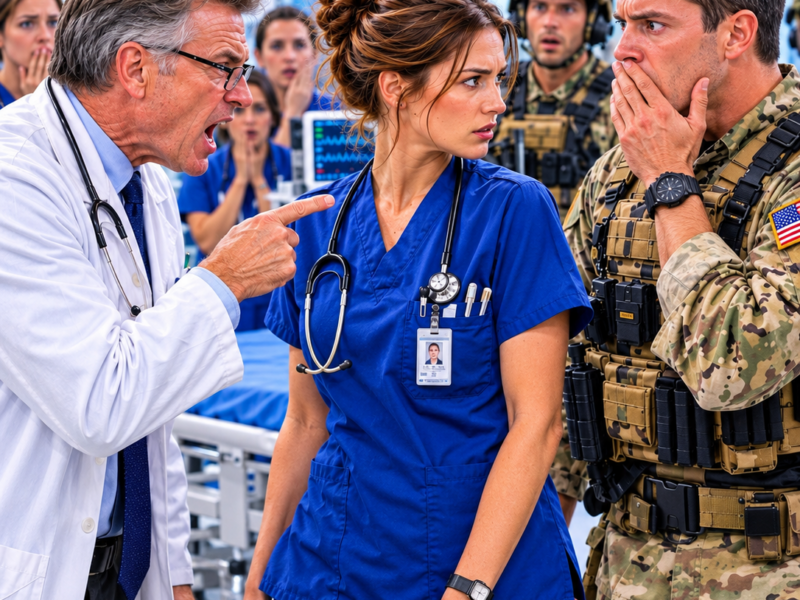
I Was Just 11 Days Into My Hospital Assignment When the Chief of Vascular Surgery Publicly Humiliated Me in Front of Six Residents After I Used a Technique He Had Never Seen. “Who Trained You?” Dr. Lester Demanded, as Everyone Turned to Watch Me. I Calmly Removed My Gloves and Replied, “Ghost Squadron.” The Color Instantly Drained From His Face, and He Whispered, “You Were Actually One of Them?” But When I Revealed How Long I Had Served There, His Next Question Left the Entire Room Speechless…
I Was Just 11 Days Into My Hospital Assignment When the Chief of Vascular Surgery Publicly Humiliated Me in Front of Six Residents After I Used a Technique He Had Never Seen. “Who Trained You?” Dr. Lester Demanded, as Everyone Turned to Watch Me. I Calmly Removed My Gloves and Replied, “Ghost Squadron.” The Color Instantly Drained From His Face, and He Whispered, “You Were Actually One of Them?” But When I Revealed How Long I Had Served There, His Next Question Left the Entire Room Speechless…
PART 1
The question was asked loudly enough for everyone on the surgical floor to hear.
“Who trained you?”
Dr. Graham Lester stood in the middle of Lakeview Academic Medical Center’s surgical department, his arms crossed, his expression carrying the unmistakable impatience of a man who believed someone had stepped beyond their authority.
Six residents were standing nearby. Two attending physicians had stopped their conversation. At the nurses’ station, Sandra Obi looked up from her computer.
And directly in front of Lester stood a woman who had just accomplished something none of them had expected.
Lieutenant Commander Priya Anand.
Forty-two years old. Quiet. Unassuming. Eleven days into a temporary assignment at Lakeview.
She had just completed a vascular access procedure using an approach that the chief of vascular surgery, a man with thirty years of experience, had never encountered.
Lester wasn’t asking because he was impressed.
He was asking because he wanted an explanation for something he believed should never have happened in his department.
Priya looked at him without flinching.
Then she carefully removed her surgical gloves, one at a time.
There was no nervousness in her movements. No attempt to apologize. No hurried explanation designed to protect herself from the embarrassment Lester was clearly preparing to deliver.
She simply looked into his eyes.
“Ghost Squadron,” she said.
Two words.
That was all it took.
The change in Graham Lester’s face was immediate.
The color drained from his cheeks. His lips parted slightly, but nothing came out. For several seconds, the man who could command an operating room with a single glance stood completely motionless.
He knew that name.
And judging by his expression, he knew something about the woman standing before him that nobody else on the floor understood.
The residents exchanged confused looks.
Sandra stopped typing.
One of the attending physicians slowly lowered the chart she had been holding.
Because whatever Ghost Squadron was, it had just frightened—or perhaps astonished—the most powerful surgeon in the department.
And the truth behind those two words would eventually change everything Lakeview believed about expertise, authority, and the quiet people nobody thought to question.
But to understand why Graham Lester reacted that way, you have to understand what kind of institution Lakeview was.
Lakeview Academic Medical Center was one of those prestigious hospitals where reputations mattered almost as much as results.
Its surgical residency program attracted brilliant young physicians from across the country. Fellowship positions were fiercely competitive. Research papers, professional conferences, and departmental appointments were treated as milestones in careers that could stretch across decades.
The hospital employed exceptional doctors.
But excellence had created something else.
A hierarchy.
It was rarely discussed openly, yet everyone understood it.
Certain voices carried more weight than others. Certain surgeons could question decisions without consequence. Others learned to remain silent unless invited to speak.
At the top of that structure stood Dr. Graham Lester.
At fifty-seven, Lester was an accomplished vascular surgeon whose reputation had been built through decades of technically demanding procedures.
His skill was undeniable.
He had saved countless lives, trained generations of surgeons, and published research that influenced treatment practices beyond Lakeview.
He also had one significant weakness.
He had spent so many years being the most knowledgeable person in the room that he had gradually stopped expecting anyone else to surprise him.
Lester believed he knew what expertise looked like.
It came with prestigious academic appointments, recognizable institutions, respected mentors, and an impressive publication history.
It certainly did not arrive quietly, wearing an unfamiliar badge, through a temporary military exchange program.
And that was exactly how Priya Anand had entered his department.
Her assignment was arranged through a federal medical exchange initiative intended to strengthen cooperation between military and civilian medical personnel.
On paper, she was simply a visiting clinician.
Her records identified her as a lieutenant commander with extensive trauma experience, but the details of her previous operational assignments were limited.
The administrative summary was brief.
It contained the qualifications necessary for the hospital to approve her placement, nothing more.
To Lester, that was enough.
He glanced through her paperwork, confirmed that she met the program’s requirements, and returned to his regular responsibilities.
He did not ask about her experience.
He did not inquire about her specialized training.
He did not even arrange a proper conversation to understand what she might contribute.
She was temporary, after all.
Three months at most.
And in Lester’s mind, temporary personnel were there to observe and learn, not to introduce knowledge that could challenge a department’s established practices.
Priya noticed the dismissal almost immediately.
She had encountered similar attitudes before.
In some places, people assumed military physicians were less sophisticated than their civilian counterparts because they spent less time publishing academic research.
In others, military rank confused people who were accustomed to measuring professional status through hospital titles.
Priya had learned not to waste energy fighting those assumptions.
She preferred allowing her work to speak.
And her work began attracting attention almost immediately.
Sandra Obi, Lakeview’s experienced charge nurse, was the first to recognize that something about Priya was unusual.
Sandra had worked in the department for seventeen years.
She knew how surgeons behaved under pressure.
She knew the difference between confidence and arrogance, competence and genuine mastery.
And by Priya’s fourth day, Sandra had already formed an opinion.
This woman was exceptional.
Not because she spoke loudly or demanded recognition.
Quite the opposite.
Priya listened more than she talked.
She learned unfamiliar systems astonishingly quickly. She anticipated complications before they became visible to less experienced clinicians. She remained calm during emergencies that caused younger doctors to become visibly anxious.
And there was something else.
Her hands.
Sandra had watched thousands of procedures throughout her career.
She knew what ordinary surgical confidence looked like.
Priya’s movements were different.
There was never an unnecessary gesture.
Never a moment of wasted motion.
When equipment was needed, her hand seemed to arrive where it belonged before anyone had finished asking.
During one particularly chaotic shift, a patient developed an unexpected complication while multiple departments were coordinating treatment.
Two residents began talking over each other.
A monitor sounded.
An attending requested additional assistance.
Priya simply assessed the situation, spoke three short sentences, and helped restore order.
Afterward, Sandra approached her.
“You’ve worked in some difficult places, haven’t you?”
Priya gave a small smile.
“A few.”
“Military hospitals?”
“Sometimes.”
Sandra waited, hoping she might elaborate.
Priya didn’t.
Instead, she asked whether another patient had received the medication ordered earlier.
That was typical.
She redirected attention toward the work whenever conversations became personal.
Sandra didn’t push.
But she started watching more closely.
And what she observed only strengthened her original impression.
By the second week, several nurses had begun quietly discussing the visiting clinician who seemed almost impossible to unsettle.
The residents noticed her too, although their reactions were mixed.
Some admired her.
Others assumed she was simply very experienced.
One fourth-year resident, James Cho, became particularly curious.
James was intelligent, ambitious, and deeply influenced by Lester’s teaching.
He had spent years trying to develop the same technical precision his chief demonstrated.
Yet there was something about Priya’s movements that reminded him of a different kind of training.
One afternoon, after watching her handle a complicated situation, he asked whether she had completed a fellowship in advanced trauma surgery.
Priya glanced at him.
“Not exactly.”
“Where did you train?”
“A few places that don’t show up on most residency brochures.”
James laughed, assuming she was joking.
Priya smiled politely and returned to her documentation.
He never realized how literal her answer had been.
Then Wednesday arrived.
The patient was sixty-three-year-old Robert Marquette, a retired engineer scheduled for a complex arterial repair.
His preoperative imaging had suggested a difficult but manageable procedure.
Dr. Vera Okonkwo, the attending surgeon responsible for the case, had reviewed the scans carefully.
She was an excellent physician, methodical and experienced.
Priya was assigned to assist.
Everything proceeded according to plan until the surgical team encountered an unexpected anatomical variation.
The vessel configuration did not match what the imaging had suggested.
It was an unusual arrangement, one that complicated the planned access route and required immediate reassessment.
Vera paused.
The monitors continued their steady rhythm.
Nobody panicked.
But everyone in the operating room understood that the situation had become more complicated.
“We need to reconsider our approach,” Vera said.
Priya studied the exposed anatomy.
Something in her expression changed.
Not concern.
Recognition.
She had seen something like this before.
Not in an academic journal.
Not during a conference demonstration.
Somewhere far removed from the clean, brightly illuminated operating rooms of Lakeview.
Somewhere where the luxury of extended deliberation had not existed.
“Dr. Okonkwo,” Priya said calmly, “I know an alternative approach for this configuration.”
Vera looked toward her.
“Explain.”
Priya described the anatomical reasoning behind a different access route.
The explanation was concise, technically sound, and immediately relevant.
Vera considered the proposal.
“Are you confident?”
“Yes.”
A brief silence followed.
Then Vera nodded.
“Proceed under my supervision.”
What happened next would be discussed throughout the hospital for weeks.
Priya worked with extraordinary control.
She navigated the unusual configuration using a method that none of the observing residents recognized.
Every movement was deliberate.
Nothing seemed improvised.
The approach was unfamiliar, yet Priya performed it with the confidence of someone following a pathway she had traveled many times.
Within minutes, the access challenge that had threatened to complicate the procedure was resolved.
The surgical team continued.
The repair was completed successfully.
Robert Marquette was transferred to recovery in stable condition.
And Vera Okonkwo stood for several seconds after the operation, thinking about what she had witnessed.
She had worked with many talented surgeons.
But this was different.
Priya had recognized a difficult anatomical variation almost instantly and applied a solution that appeared unfamiliar to the department’s existing training.
Vera wanted to know more.
She made a brief note about the unusual technique and later mentioned the case to Graham Lester.
She expected professional curiosity.
Perhaps a request for a technical discussion.
Maybe even an opportunity for Priya to present her experience during a departmental meeting.
Instead, Lester frowned.
“She used what?”
Vera explained.
“And you’re telling me you don’t recognize the technique?”
“No,” Vera admitted. “But the approach was effective.”
Lester’s expression hardened.
“Where exactly did she learn this?”
“I haven’t asked yet.”
He stood.
“Then I will.”
He left his office and walked toward the surgical floor.
And by the time he reached the nurses’ station, he had already decided that Priya Anand owed him an explanation.
He had no idea that the answer would force him to reconsider almost everything he believed about the woman he had ignored for eleven days.
PART 2
When Graham Lester approached the nurses’ station, Priya was finishing Robert Marquette’s postoperative documentation.
“Lieutenant Commander Anand.”
She looked up.
“Yes, Doctor?”
“I understand you used an unconventional vascular access technique during Dr. Okonkwo’s procedure.”
“That is correct.”
“Something not included in our department’s established protocols.”
Priya remained composed.
“The approach was discussed with Dr. Okonkwo before proceeding.”
Lester glanced toward the residents gathering nearby.
“That’s not what I asked.”
The floor became noticeably quieter.
“Who trained you?”
Priya understood the accusation beneath the question.
She had been trained to recognize threats, uncertainty, and the subtle ways people attempted to establish control.
This was not a threat to her safety.
It was a challenge to her credibility.
She removed her gloves slowly.
Then she answered.
“Ghost Squadron.”
Lester froze.
For the first time since joining Lakeview, Priya saw genuine uncertainty cross his face.
“You trained with Ghost Squadron?”
“No, Doctor.”
She held his gaze.
“I trained in Ghost Squadron.”
His jaw tightened.
“How long?”
“Seven years.”
The residents looked at one another.
Priya continued.
“I served as a flight surgeon and forward trauma officer. During my final three years, I directed the unit’s trauma training curriculum.”
Lester took a small step backward.
He knew the reputation of that unit.
And he now understood that he had publicly challenged someone whose experience reached far beyond anything listed in her hospital paperwork.
PART 3
There are certain names that mean nothing to most people but carry extraordinary weight within a small professional community.
Ghost Squadron was one of them.
To the residents standing around the nurses’ station, the name sounded almost theatrical.
James Cho initially wondered whether it referred to an aviation unit, a military training exercise, or some informal nickname used by battlefield medics.
But Graham Lester knew enough to recognize that none of those explanations came close.
Years earlier, while attending a specialized military-civilian surgical conference, he had spoken with a physician who had worked alongside personnel trained by an unusually secretive special operations medical program.
The physician never identified its official designation.
He referred to it only by a nickname.
Ghost Squadron.
The conversation had stayed with Lester because of one particular statement.
“These are the people who learn what medicine becomes when everything that usually makes medicine possible disappears.”
At the time, Lester had assumed the comment was an exaggeration.
Surgeons were accustomed to hearing dramatic accounts of battlefield medicine.
Limited resources. Extreme environments. Unconventional solutions.
But the physician had described something far more demanding than ordinary military trauma training.
The program reportedly prepared selected medical officers for operations where evacuation might be impossible, equipment could be severely limited, and multiple casualties might require treatment simultaneously.
Its physicians were expected to make complex decisions under circumstances where delay could have irreversible consequences.
They were trained to function without the institutional safety net that civilian medicine usually provides.
No large surgical team waiting nearby.
No convenient specialist available for consultation.
No guaranteed access to advanced imaging.
Sometimes no realistic possibility of transferring a patient elsewhere.
And those conditions changed the way they understood anatomy, trauma, prioritization, and surgical problem-solving.
The program’s internal methods were not openly published.
Some of its knowledge had emerged through carefully controlled collaborations, but much remained restricted to authorized personnel.
Lester had heard that completing its training was extraordinarily difficult.
He had also heard that only a small number of physicians ever progressed to leadership positions within its curriculum.
Now one of those physicians was standing in his department.
And he had spent eleven days treating her as an unremarkable temporary visitor.
Lester looked around.
Everyone was watching him.
The same residents who had witnessed his confrontational question were now studying his reaction.
It was a strange reversal.
Only moments earlier, he had intended to establish Priya’s place in the hierarchy.
Instead, his own expression had revealed that the hierarchy might not be as meaningful as he believed.
He cleared his throat.
“The Marquette case,” he said carefully. “The unusual vessel configuration.”
“Type-three variant,” Priya replied.
Lester’s eyes narrowed.
“You recognized it immediately?”
“Yes.”
“From where?”
Priya paused.
“There are injury patterns we encountered in forward trauma environments that aren’t represented extensively in civilian surgical literature. Some anatomical variations become more familiar when you’ve had to manage those patterns repeatedly.”
Vera, who had joined the gathering, leaned forward.
“You’ve seen that configuration before?”
“Several times.”
“In civilian practice?”
“No.”
The answer hung in the air.
Lester tried to reconcile what he was hearing with the woman he had observed over the previous eleven days.
She was not imposing.
She didn’t advertise her achievements.
She didn’t interrupt senior physicians to demonstrate her knowledge.
He had interpreted all of that as evidence that she had little to contribute.
Now he began to understand that her silence had been a choice rather than a limitation.
“Was the approach you used developed within Ghost Squadron?” he asked.
“Yes.”
“Can you explain it?”
“I can explain the anatomical principles and the portions cleared for professional discussion.”
“And the rest?”
“Restricted.”
Lester nodded slowly.
That single word reminded him that their conversation was not simply about professional status.
Priya had responsibilities extending beyond the hospital.
Knowledge gained under certain operational circumstances could not be casually shared simply because another physician wanted access to it.
For perhaps the first time that afternoon, he considered how carefully she had managed the situation.
She had not exposed classified material.
She had not attempted to establish superiority through stories about her past.
She had simply applied authorized medical knowledge to help a patient.
And when questioned, she had answered truthfully without revealing more than she was permitted to disclose.
Lester looked at Vera.
“How long would the conventional approach have taken?”
Vera considered the question.
“Longer. Potentially significantly longer, depending on how we navigated the variation.”
Lester nodded.
“And the alternative?”
“Efficient. Controlled. No complications.”
He turned back toward Priya.
Then he said something that stunned the residents almost as much as her earlier answer.
“It would have taken me longer.”
Nobody responded.
Lester rarely acknowledged that another surgeon possessed a technical advantage.
Yet he wasn’t speaking defensively anymore.
He was making a clinical assessment.
Priya nodded once.
“Different training environments produce different solutions.”
There was no triumph in her voice.
That seemed to affect Lester more than anything else.
She had every reason to embarrass him.
He had confronted her publicly, questioned her competence, and made it obvious that he considered her an outsider.
She could have reminded him that he had dismissed someone who had spent seven years in one of the military’s most demanding medical programs.
Instead, she offered him a simple explanation.
Different environments produced different knowledge.
And perhaps that was what finally allowed him to listen.
“I’d like to understand the classification framework,” Lester said.
Priya glanced at the clock.
“My documentation is nearly complete. I have another assignment in twenty-five minutes.”
“Could we meet after rounds?”
“Yes.”
“How much time would you need?”
“Twenty minutes for the basic framework.”
Lester nodded.
“Then I’ll make time.”
A resident near the back shifted uncomfortably.
James Cho had never heard his chief ask a visiting clinician for a lesson.
He had certainly never heard him do it after publicly questioning that clinician’s qualifications.
But the most interesting part came after Lester walked away.
Sandra Obi approached Priya.
“Seven years?” she asked quietly.
Priya looked up.
Sandra folded her arms.
“You’ve been here almost two weeks, and that’s the first I’ve heard of it.”
“You didn’t ask.”
Sandra laughed softly.
“Fair enough.”
Then her expression became serious.
“You know what just happened, don’t you?”
Priya saved her documentation.
“A misunderstanding.”
Sandra shook her head.
“No. I mean what happened to him.”
Priya glanced toward the corridor where Lester had disappeared.
“He learned something unexpected.”
Sandra smiled.
“That’s one way of putting it.”
But later, when Sandra spoke with James Cho, she offered a different interpretation.
“He wasn’t shocked because she’s good,” she told him. “He’s worked with good surgeons his entire life.”
James frowned.
“Then why?”
“Because she was good in a way he didn’t know how to recognize.”
James remained silent.
Sandra continued.
“Some people think expertise always announces itself. They expect impressive titles, famous institutions, or someone powerful introducing the person. But sometimes the most experienced person in the room is the one nobody bothered to ask about.”
James thought about Priya’s quiet behavior.
Her precise movements.
Her refusal to discuss her past unnecessarily.
And suddenly, several things he had observed began making sense.
That evening, Lester arrived for the scheduled twenty-minute discussion carrying a notebook.
Priya was already waiting in a small conference room.
On the screen behind her was a simplified anatomical diagram.
Nothing classified.
Nothing designed to impress.
Just the clinical framework necessary to understand what had happened during the Marquette operation.
Lester sat down.
For several seconds, neither spoke.
Then he asked the question that should have begun their professional relationship eleven days earlier.
“Dr. Anand, would you tell me about the experience that shaped your approach to trauma surgery?”
Priya studied him.
This time, the question contained no accusation.
No attempt to establish authority.
Only curiosity.
And because the question had changed, the conversation that followed changed everything.
Priya began describing the principles that had guided her training.
Lester listened.
He asked questions.
Then more questions.
At one point, he stopped taking notes because he wanted to give her explanation his complete attention.
Twenty minutes passed.
Then forty.
After fifty minutes, he contacted Vera Okonkwo.
“Can you join us?”
Vera arrived expecting a brief technical discussion.
Instead, she found the chief of vascular surgery leaning over a diagram while Priya explained how unfamiliar anatomical variations could be categorized through patterns of functional access rather than conventional visual expectations alone.
Vera sat down immediately.
The discussion continued.
They compared cases.
They debated clinical assumptions.
They identified situations where Lakeview’s existing teaching materials could benefit from additional examples.
Priya was careful to distinguish between transferable medical principles and restricted operational information.
Whenever a question approached a boundary she could not cross, she said so.
Lester respected it.
At the end of ninety minutes, he closed his notebook.
It contained several pages of observations.
But the most important realization was not written anywhere.
He had spent decades believing his department existed near the highest level of surgical knowledge.
Now he understood that excellence was not a single ladder with his institution near the top.
It was a much larger landscape.
And parts of that landscape contained knowledge his department had never encountered.
He looked toward Priya.
“Would you be willing to present this to the department?”
She considered the request.
“The unclassified portions?”
“Of course.”
“Then yes.”
Lester nodded.
“I’ll organize it.”
As Priya gathered her materials, he spoke again.
“And Dr. Anand?”
She turned.
“I owe you an apology.”
For the first time that evening, her expression softened.
He continued.
“I should have asked about your background when you arrived.”
Priya didn’t immediately answer.
Then she said, “You can ask now.”
Lester lowered his eyes.
He understood.
The important thing was not simply admitting that he had been wrong.
It was deciding what he would do differently.
And the following week would give him an opportunity to demonstrate whether that understanding was genuine.
PART 4
By the following Monday, rumors about Priya Anand had spread through nearly every surgical department at Lakeview.
Some versions were accurate.
Others were wildly exaggerated.
A few residents claimed she had worked inside classified military installations.
Someone insisted she had operated in combat zones without electricity.
Another suggested that Ghost Squadron was a secret medical organization whose existence the government refused to acknowledge.
Priya found most of the speculation mildly amusing.
She refused to confirm details that weren’t relevant to her work.
When James Cho finally gathered the courage to ask whether any of the rumors were true, she looked at him and said, “People tend to make unfamiliar things more dramatic than they need to be.”
James hesitated.
“So none of it is true?”
“I didn’t say that.”
She returned to her patient charts.
James stood there for several seconds, unsure whether he had received an answer or another puzzle.
Sandra, watching from the nurses’ station, laughed.
“She got you again.”
But beneath the rumors, something more important was happening.
The department’s attitude toward Priya had begun changing.
Physicians who had barely acknowledged her during her first week now greeted her with deliberate warmth.
Residents asked for her opinion.
Attendings invited her into case discussions.
Some of that attention was genuine.
Some came from curiosity about her mysterious background.
And some reflected the uncomfortable realization that they had overlooked someone exceptional.
Priya understood the difference.
She had spent years working in environments where professional recognition mattered less than whether the person beside you could be trusted when circumstances became dangerous.
She did not confuse sudden admiration with earned respect.
Respect, in her experience, required consistency.
It had to survive moments when there was no audience.
And that was why she paid particular attention to Graham Lester’s behavior after their conversation.
He had apologized.
He had listened.
He had invited her to teach.
But would he continue treating her differently once the embarrassment faded?
Would he remain curious when curiosity required acknowledging gaps in his own knowledge?
Or would he eventually return to the comfortable hierarchy that had shaped the department for years?
The answer began emerging during the days leading up to the presentation.
Lester personally reviewed the educational materials Priya prepared.
Not to control them.
Not to ensure that her conclusions matched his existing views.
He wanted to understand how best to introduce the material to physicians who had trained within a different framework.
During one meeting, he pointed toward a diagram.
“Our residents usually classify this situation differently.”
Priya nodded.
“I noticed.”
“Would you explain why your framework separates these two patterns?”
She did.
He listened.
Then he said, “That distinction could prevent confusion during an unusual case.”
“Yes.”
“Let’s include it.”
It was a small exchange.
But to Vera Okonkwo, who witnessed it, the difference was remarkable.
The Graham Lester she had known for years would often begin such conversations by defending existing protocols.
Now he was treating unfamiliar information as something worth investigating rather than something to be resisted.
He still challenged ideas.
He still demanded evidence.
He still insisted on clinical rigor.
But he no longer assumed that unfamiliarity itself was evidence of inferiority.
On the day of the presentation, the conference room filled early.
Surgeons arrived from neighboring departments.
Residents occupied nearly every available seat.
Several nurses stood along the back wall.
Sandra Obi had stayed beyond her scheduled shift because she wanted to hear the presentation.
James Cho sat near the front with a notebook open.
He had already written several questions.
At precisely eight o’clock, Lester stepped toward the podium.
The room quieted.
He glanced at Priya, who sat near the screen wearing ordinary hospital scrubs.
There was nothing ceremonial about her appearance.
No impressive display of medals.
No attempt to remind the audience of her military rank.
She looked like any other physician preparing to discuss a case.
Lester adjusted the microphone.
“Last week, our department encountered an anatomical variation during a complex arterial repair.”
Several residents nodded.
“Dr. Vera Okonkwo led the case. Dr. Priya Anand assisted and introduced an approach that was unfamiliar to many of us.”
He paused.
“I was unfamiliar with it as well.”
That admission drew attention.
Lester continued.
“I initially responded by questioning Dr. Anand’s training rather than asking about the reasoning behind her technique.”
The room became silent.
“I did so publicly. I was wrong.”
Sandra looked up sharply.
James stopped writing.
For most of the department, those words were unprecedented.
Lester was known for admitting technical errors when necessary, but he rarely discussed his own behavior in front of colleagues.
Yet there he stood, openly acknowledging that he had mishandled a professional interaction.
He glanced toward Priya.
“Dr. Anand brings experience from a specialized military trauma program, including several years developing advanced training for personnel operating in extremely demanding environments.”
He returned his attention to the audience.
“I should have asked about her background on her first day here.”
Another pause.
“I didn’t.”
He took a breath.
“Today, we’re correcting that.”
Then he stepped aside.
Priya approached the podium.
She thanked him briefly.
And without referencing the earlier confrontation, she began.
Her presentation opened with Robert Marquette’s case.
She described the imaging findings, the unexpected vessel configuration, and the clinical reasoning that had led to the alternative approach.
She did not dramatize the procedure.
She did not portray it as an impossible feat.
Instead, she broke the problem into clear decisions.
What was known?
What was uncertain?
Which assumptions needed reassessment?
What alternative pathways could be considered safely?
For the residents, the framework was immediately compelling.
Most of their training had focused on recognizing established anatomical presentations and applying carefully standardized techniques.
Priya showed them how unusual configurations could be approached through a broader reasoning process.
She explained that training under resource limitations often forced clinicians to distinguish between what was truly essential and what had simply become customary.
That distinction was powerful.
Because hospitals naturally develop routines around their available technology, staffing, and institutional systems.
Those routines are often excellent.
But they can also create habits of thought.
Physicians become accustomed to certain resources being present.
They begin expecting certain forms of assistance.
And when a situation falls outside those expectations, the problem can seem more unusual than it actually is.
Priya explained that her previous training had emphasized the ability to recognize the underlying clinical problem even when familiar tools or procedures were unavailable.
She described decision-making under uncertainty.
The importance of adapting to changing conditions.
The value of maintaining clear communication when several competing priorities demanded attention.
She discussed clinical principles rather than restricted operational details.
And what made the presentation extraordinary was not the secrecy surrounding her background.
It was how practical her explanations were.
She made difficult concepts understandable.
She used examples without making anyone feel ignorant.
When a resident asked a basic question, she answered it with the same seriousness she gave to a senior attending’s technical inquiry.
James Cho noticed that immediately.
He had attended countless lectures where junior physicians were afraid to speak because they worried about appearing uninformed.
Priya created the opposite atmosphere.
Questions seemed welcome.
Even mistaken assumptions became opportunities for learning.
Halfway through the presentation, one senior surgeon raised his hand.
“Are you suggesting that conventional academic training is inadequate?”
Priya shook her head.
“Not at all.”
“Then what exactly is the advantage of your background?”
She considered his wording.
“Different environments reveal different weaknesses in our assumptions.”
The surgeon waited.
Priya continued.
“A well-equipped academic medical center can teach extraordinary precision because it provides access to specialized resources and advanced technology. A resource-limited environment may force you to develop different methods of assessment and problem-solving.”
“So which training is better?”
“Neither is universally better.”
A murmur passed through the room.
Priya looked toward the audience.
“The patient benefits when we recognize what each environment can teach us.”
Vera smiled.
Lester nodded.
And James wrote the sentence down.
When Priya finished her prepared presentation, the room remained quiet for several seconds.
Then the questions began.
At first, they came from attendings.
Technical questions.
Clinical comparisons.
Requests for clarification about anatomical classifications.
Then the residents joined in.
James asked one question.
Then another.
By the time the discussion was over, he had asked six.
The scheduled hour became nearly two.
Nobody seemed eager to leave.
Even the skeptical senior surgeon who had challenged Priya earlier remained afterward to discuss a complicated case from his own practice.
Sandra filled three pages of notes.
And when the conference room finally emptied, she approached Priya.
“I’ve sat through seventeen years of presentations in this hospital,” she said.
Priya smiled.
“That sounds exhausting.”
Sandra laughed.
“Some of them were.”
Then she became serious.
“That was one of the best.”
“Thank you.”
“But that’s not what impressed me most.”
Priya tilted her head.
“What did?”
Sandra glanced toward the doorway.
“You didn’t make anyone feel small for not knowing what you knew.”
Priya looked down at her notes.
For a brief moment, her expression carried something older than the conversation.
A memory, perhaps.
Then she answered quietly.
“I’ve worked with people who knew things I didn’t. Some of them never got the chance to teach me twice.”
Sandra didn’t ask what she meant.
She understood enough.
Because behind Priya’s calm presence was a history of working in circumstances where knowledge wasn’t merely a professional advantage.
Sometimes it determined whether someone came home.
And that history had given her a perspective on teaching that Lakeview was only beginning to appreciate.
But the most significant consequence of the presentation would not emerge until the final weeks of her assignment.
It would begin with a patient who had nothing to do with military medicine.
And a decision that tested whether the department had genuinely learned to listen.
PART 5
The following week, Lakeview admitted a patient whose case presented an unusual combination of medical complications.
The patient, a fifty-eight-year-old woman named Ellen Mercer, had undergone several previous procedures at another hospital.
Her medical history was complex.
Her anatomy had been altered by earlier interventions, and her current condition required careful coordination between multiple specialties.
The surgical team spent hours reviewing her records.
Imaging specialists provided their assessments.
Senior physicians debated several possible approaches.
No immediate emergency required them to act recklessly, but the case demanded a plan that accounted for uncertainties not fully resolved by the existing records.
James Cho attended one of the planning discussions.
Priya was also present.
During the meeting, a resident proposed an approach based on standard anatomical expectations.
Several physicians agreed that it was reasonable.
Then Priya raised a question.
“Are we certain the previous intervention preserved the vascular relationship shown on the older images?”
The room fell quiet.
One attending looked back at the scans.
“That’s a fair question.”
Another physician frowned.
“We assumed it had.”
Priya nodded.
“Then perhaps we should confirm before building the entire plan around that assumption.”
Nobody dismissed her.
Nobody asked why a temporary military clinician was questioning the team’s reasoning.
Instead, the physicians reopened the imaging review.
And they discovered that a subtle detail in the patient’s recent studies justified modifying their planned approach.
The finding did not turn into a dramatic rescue.
There was no frantic emergency.
No miraculous procedure performed at the last possible second.
The team simply recognized a potential problem before it became a dangerous one.
They adjusted the treatment strategy.
The patient subsequently underwent her procedure successfully.
For James Cho, that experience was more important than the sensational stories circulating about Ghost Squadron.
He had watched a department change its decision because someone asked a useful question.
And the most remarkable part was how ordinary it had become.
A few weeks earlier, Priya’s question might have been treated as an interruption.
Now it was treated as a contribution.
That evening, James found Lester reviewing notes in his office.
“Dr. Lester?”
“Come in.”
James stepped inside.
“Can I ask you something?”
“Of course.”
“Do you think we would have caught that issue in Mercer’s case if Dr. Anand hadn’t mentioned it?”
Lester set down his pen.
He considered the question.
“Possibly.”
James waited.
“Possibly isn’t the same as certainly,” Lester added.
“No, sir.”
Lester leaned back.
“That’s the problem with assumptions, James. When they happen to be correct, we rarely notice them. When they’re wrong, the consequences can be severe.”
James nodded.
“Dr. Anand seems to notice things we don’t.”
“She notices different things.”
“Because of Ghost Squadron?”
“In part.”
Lester folded his hands.
“But don’t misunderstand what makes her valuable. It isn’t simply that she trained in a prestigious or secretive program.”
James looked confused.
“Isn’t that what impressed you?”
“It was what caught my attention.”
Lester paused.
“What impresses me now is how she thinks.”
He glanced toward the window.
“She doesn’t assume her experience makes everyone else’s irrelevant. She asks questions. She examines the evidence. She’s willing to change her conclusions.”
Then he looked directly at James.
“And she doesn’t confuse authority with certainty.”
James remained silent.
The meaning was obvious.
Lester was describing a quality he himself had lacked.
And unlike the man James had known throughout his residency, this version of Graham Lester seemed willing to admit it.
As Priya’s final weeks approached, something else began happening.
Lester started inviting her to participate in teaching sessions beyond the original vascular case.
They discussed decision-making under pressure, communication during emergencies, and ways to prepare residents for situations outside their familiar training.
Priya never revealed restricted information.
She didn’t need to.
Her greatest contribution came from connecting principles that had previously remained separated by institutional boundaries.
Vera Okonkwo became one of her strongest collaborators.
The two physicians reviewed difficult cases together, comparing the lessons of civilian academic surgery with those from military trauma practice.
Sandra occasionally joined their discussions to contribute the nursing perspective.
That collaboration produced another unexpected change.
The department began recognizing that important knowledge did not belong exclusively to the physicians with the most impressive titles.
Experienced nurses understood workflow failures that surgeons sometimes overlooked.
Residents noticed inconsistencies that senior doctors had become accustomed to ignoring.
Visiting clinicians brought experience from systems operating under entirely different conditions.
The hospital had always possessed that diversity of knowledge.
What it lacked was a consistent habit of listening to it.
Priya helped expose the gap.
One afternoon, Sandra approached Lester with a suggestion about an inefficient communication process between operating rooms and recovery staff.
In previous years, she might have mentioned the issue informally and accepted that nothing would change.
This time, Lester invited her into his office.
“Walk me through it,” he said.
Sandra explained.
He asked several questions.
Then he requested that the team evaluate a revised process.
As Sandra left, she stopped in the doorway.
“Can I tell you something, Graham?”
He looked up.
“Go ahead.”
“You’ve been asking a lot more questions lately.”
He smiled faintly.
“I’ve noticed.”
“Good questions, too.”
“Don’t sound so surprised.”
She laughed.
“After seventeen years, I’ve earned the right.”
He laughed with her.
But later, alone in his office, Lester considered what she had said.
He remembered the expression on Priya’s face when he had confronted her publicly.
Not fear.
Not anger.
Just the calm recognition of someone who had encountered that kind of judgment before.
He wondered how many other talented clinicians had passed through Lakeview without anyone taking the time to understand what they knew.
Some had probably left with valuable insights never shared.
Others might have adapted quietly to the department’s expectations.
And perhaps some had learned that offering an unfamiliar idea wasn’t worth the discomfort it created.
The thought troubled him.
Because a hospital existed to care for patients.
Its hierarchy was supposed to support that purpose.
Not interfere with it.
Several days before Priya’s departure, Lester requested a private meeting.
She arrived carrying a tablet and a folder of clinical notes.
“Is this about the upcoming case review?” she asked.
“Not exactly.”
He gestured toward a chair.
“Please.”
Priya sat.
Lester opened a document on his desk.
“I’ve been speaking with the department’s education committee.”
She waited.
“We’d like to establish a formal consulting relationship with you after your exchange assignment ends.”
For the first time during the meeting, Priya looked genuinely surprised.
“In what capacity?”
“Quarterly case reviews. Selected teaching sessions. Discussions about approaches that can be appropriately shared between our institutions.”
He slid the proposal toward her.
“We would work within whatever professional and security restrictions apply.”
Priya read the document.
Lester continued.
“I know your obligations may prevent you from accepting. But I believe our department would benefit enormously from maintaining this connection.”
She looked up.
“Why?”
He blinked.
“Why?”
“Why do you want me to return?”
Lester paused.
There were several easy answers.
Her specialized training.
Her unusual experience.
Her excellent clinical performance.
Her ability to teach.
All were true.
But he understood that she was asking something deeper.
He folded his hands.
“Because you’ve shown us that our understanding of expertise was narrower than we realized.”
Priya said nothing.
“And because I’d rather have people around me who challenge my assumptions than people who simply confirm them.”
She studied him.
Then she returned her attention to the proposal.
“I’ll consider it.”
Lester nodded.
“That’s all I’m asking.”
On Priya’s final day at Lakeview, the department organized a small gathering.
Nothing elaborate.
Coffee.
Cake.
A handwritten card signed by colleagues.
Several residents thanked her for the time she had spent answering their questions.
Vera embraced her.
Sandra handed her a small envelope.
“What’s this?” Priya asked.
“A note.”
“From you?”
“Read it later.”
Priya smiled.
“I will.”
James Cho approached carrying the same notebook he had used during her presentation.
“I wanted to thank you,” he said.
“For what?”
“Teaching me something I didn’t know I needed to learn.”
Priya raised an eyebrow.
“That sounds mysterious.”
James laughed.
“Apparently, I’ve been spending too much time around you.”
Then he became serious.
“I used to think the best surgeons were the ones who always had the answers.”
“And now?”
“I think they’re the ones who know which questions to ask.”
Priya smiled.
“That’s a good place to start.”
When Lester approached, the conversation around them gradually quieted.
He extended his hand.
“Thank you for your work here, Dr. Anand.”
She shook it.
“Thank you for having me.”
He hesitated.
“I hope this isn’t the last time we work together.”
“Neither do I.”
Then she added something he would remember for years.
“Don’t wait for someone to surprise you before you become curious about them.”
Lester gave a small, rueful smile.
“I won’t.”
And this time, he meant it.
Three months later, after completing the necessary approvals, Priya accepted a limited consulting arrangement.
She would return to Lakeview four times each year for selected clinical discussions and educational reviews.
Her military responsibilities remained her primary commitment.
Her work continued to be governed by the restrictions associated with her assignment.
But the collaboration created something neither institution had originally anticipated.
A lasting exchange of knowledge built not around reputation, but around mutual respect.
Lester made another change as well.
Every visiting clinician entering his department would now participate in a personal onboarding conversation.
Not merely an administrative review.
Not a checklist of qualifications already printed in a file.
A genuine conversation about experience, training, specialized knowledge, and what the individual might contribute.
During the first six months, Lester conducted those meetings himself.
Then he began allowing senior residents to lead them.
His reasoning was simple.
A good habit should not depend on one person’s presence.
Four months after Priya’s departure, James Cho welcomed a new visiting clinician to Lakeview.
The physician came from a small regional hospital.
Her résumé was respectable but not especially distinguished.
She had no prestigious academic appointment.
No famous mentor.
No classified military background.
Several years earlier, James might have assumed there was little to learn from her.
Instead, he invited her to sit down.
“Before we begin,” he said, “I’d like to understand your experience.”
She looked slightly surprised.
“What would you like to know?”
James smiled.
“What kinds of situations have taught you the most?”
She considered the question.
Then she began describing her work at a hospital that served a geographically isolated population.
She explained how limited resources had forced her team to develop unusually effective coordination practices.
She described challenges that rarely appeared in major academic centers.
And within fifteen minutes, James realized she possessed experience that could improve Lakeview’s patient transfer and emergency communication processes.
He listened closely.
He asked more questions.
And when their conversation ended, he invited her to share those lessons with the department.
Later that afternoon, James passed the nurses’ station where Priya had stood months earlier.
He remembered the confrontation.
The six residents.
The watching attendings.
Sandra’s silence.
Graham Lester’s disbelief.
And the two words that had transformed the atmosphere of an entire surgical floor.
Ghost Squadron.
At the time, James believed the lesson was about discovering that an apparently ordinary physician had extraordinary credentials.
Now he understood something more important.
The real lesson wasn’t that Priya Anand had belonged to an elite military medical unit.
It was that her knowledge had been valuable before anyone discovered where she had trained.
Her abilities had not changed when she spoke those two words.
She had been the same physician five minutes earlier.
The same person who had quietly assisted patients for eleven days.
The same clinician who had already earned Sandra Obi’s respect.
The same woman who had saved valuable time during a complicated operation without expecting recognition.
What changed was the way everyone else saw her.
And that realization stayed with James long after his residency ended.
Years later, when he became responsible for training younger physicians, he remembered the people who had shaped his understanding of medicine.
There was Graham Lester, who taught him precision, discipline, and the importance of technical excellence.
There was Vera Okonkwo, who demonstrated how to remain thoughtful when an operation presented unexpected difficulties.
There was Sandra Obi, who understood that experience often reveals itself through small details overlooked by those who only notice titles.
And there was Priya Anand.
The quiet military physician who had taught him that expertise did not always arrive with an impressive introduction.
Sometimes it walked into a hospital wearing ordinary scrubs.
Sometimes it completed its documentation without drawing attention.
Sometimes it waited patiently while others underestimated it.
And sometimes, when finally challenged, it answered with two words that caused an entire room to fall silent.
But James never forgot the deeper meaning of that afternoon.
Because the most consequential part of the story wasn’t the moment Graham Lester went pale.
It was what happened afterward.
He could have protected his pride.
He could have dismissed Priya’s experience.
He could have insisted that his institution’s methods were superior simply because they were familiar.
Instead, after an initially unfair confrontation, he chose to learn.
He asked questions.
He listened.
He acknowledged what he didn’t know.
And eventually, he changed the way his department treated people.
That decision allowed knowledge that might otherwise have remained hidden to benefit patients, residents, physicians, and nurses.
A moment of humiliation became an opportunity for growth.
Not because someone had defeated someone else.
But because one person finally understood that being respected did not require being the most knowledgeable person in every room.
Sometimes true leadership means recognizing when somebody else has something important to teach.
And sometimes the difference between arrogance and wisdom is nothing more complicated than the way a question is asked.
“Who trained you?” can be an accusation.
It can be a demand for someone to justify their presence.
It can be a way of reminding a person that they are considered an outsider.
But the very same words, spoken with genuine curiosity, can open a conversation that changes everything.
Priya Anand never needed Graham Lester’s recognition to become exceptional.
She had already earned her expertise through years of demanding work.
What she needed, and what every skilled professional deserves, was the opportunity to contribute without first being forced to defend their right to belong.
And Graham Lester eventually understood that the greatest cost of his original mistake had never been his embarrassment.
It was the knowledge his department might have lost if he had never learned to listen.
Because in a hospital, the consequences of overlooking expertise aren’t always measured in bruised egos or missed professional opportunities.
Sometimes they’re measured in the care patients receive.
That is why the quietest person in the room should never automatically be mistaken for the least experienced.
Why unfamiliar backgrounds should invite questions rather than dismissal.
And why no institution, regardless of its reputation, should assume it has nothing left to learn.
The world is much larger than any one person’s experience.
Knowledge is scattered across hospitals, communities, professions, and places most people will never see.
Sometimes it comes from years spent in prestigious institutions.
Sometimes it comes from working with limited resources in isolated communities.
And sometimes it comes from seven years inside a military program almost nobody has heard of.
But wherever it comes from, its value depends partly on whether someone is willing to recognize it.
Graham Lester spent eleven days overlooking Priya Anand.
He spent one afternoon questioning her.
And he spent the months that followed becoming a better leader because he finally listened to her answer.
In the end, Ghost Squadron was the name that made him stop.
But humility was what allowed him to move forward.
And the greatest lesson Priya left behind had nothing to do with secret military training, extraordinary surgical techniques, or impressive credentials.
It was something much simpler.
Never assume you know the limits of another person’s knowledge simply because you haven’t taken the time to ask.
Because the person you’re preparing to dismiss may be carrying the very experience your entire team needs.
And the most important question isn’t always who trained them.
Sometimes it’s whether you’re humble enough to learn from them.