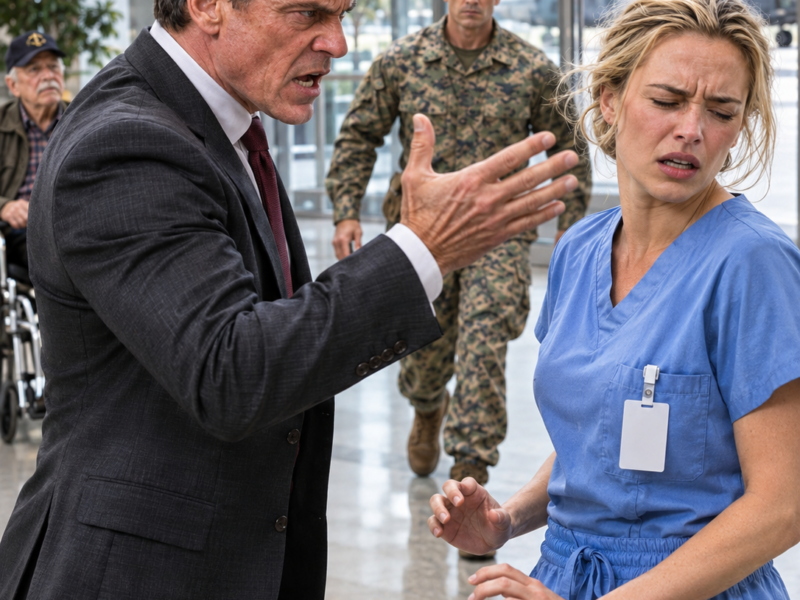
I Was Fired and Slapped by My Hospital CEO for Saving a 70-Year-Old Navy Veteran Who Had No Insurance Information, Even Though He Was Bleeding From a Head Injury. “You’re Fired! Get Out!” He Shouted in Front of Two Investors, So I Walked Into the Rain Without My Coat. But Minutes Later, a Navy Helicopter Landed Outside, and a Commander Stormed In Demanding, “Where’s Emma Carter?” When the Old Veteran Heard My Name, He Made One Phone Call—and the Secret I’d Buried for Nine Years Was About to Resurface…
I Was Fired and Slapped by My Hospital CEO for Saving a 70-Year-Old Navy Veteran Who Had No Insurance Information, Even Though He Was Bleeding From a Head Injury. “You’re Fired! Get Out!” He Shouted in Front of Two Investors, So I Walked Into the Rain Without My Coat. But Minutes Later, a Navy Helicopter Landed Outside, and a Commander Stormed In Demanding, “Where’s Emma Carter?” When the Old Veteran Heard My Name, He Made One Phone Call—and the Secret I’d Buried for Nine Years Was About to Resurface…
Part 1
The first thing I noticed about the old man was the blood running down his face. The second was the Navy cap sitting crooked on his head. But what I didn’t know, as I rushed toward him through the emergency room, was that helping this stranger would cost me my job, bring a military helicopter down onto our hospital lawn, and force me to confront a secret I had spent nine years trying to bury.
My name is Emma Carter. I’m thirty-four years old, and until that October afternoon, I was just another exhausted emergency room nurse at St. Gabriel Medical Center in San Diego.
At least, that was what everyone believed.
I’d worked there for six months, mostly nights. I volunteered for holidays, covered shifts nobody wanted, and rarely joined conversations in the break room. My coworkers knew almost nothing about me. They didn’t know where I’d worked before, why I never talked about my family, or why I wore a thin gold chain beneath my scrubs.
Whenever anyone asked, I smiled and changed the subject.
There are things you can survive without ever learning how to talk about them.
For me, those things began nine years earlier, somewhere in the mountains of Afghanistan.
But I’m getting ahead of myself.
St. Gabriel had once been the kind of hospital where an injured fisherman could walk through the doors without a dollar in his pocket and still receive treatment. Dr. Walter Thornwood had founded it in 1971 with a simple philosophy: nobody should have to choose between their life and their bank account.
Unfortunately, the hospital that carried his legacy was dying.
His son, Richard Thornwood, had become CEO after his father’s death. Over the years, expenses climbed, insurance reimbursements shrank, and entire departments were eliminated. By the time I arrived, St. Gabriel was losing money every month.
Richard wore expensive suits, but he looked perpetually exhausted. His face was pale, his eyes were bloodshot, and his phone never seemed to leave his hand.
That particular afternoon, two representatives from Harborcrest, a private investment company, were touring the hospital. Their decision the following morning would determine whether St. Gabriel received another financial lifeline.
At seven that morning, hospital management had circulated a memo.
Uninsured patients were to be redirected to the county hospital whenever possible. Staff were instructed not to authorize unnecessary expenses without financial verification.
I read the memo twice.
Then I threw it away.
I’d taken an oath to care for people. I wasn’t about to start checking bank balances before checking vital signs.
Around four o’clock, rain began hammering the emergency room windows.
Five minutes later, Marcus Green, our security guard, came rushing through the automatic doors, pushing a wheelchair.
“Emma! I need some help!”
The man in the chair looked about seventy. His jacket was soaked, and a bloody paper towel was pressed against his forehead. His Navy cap had a gold anchor and two silver stars stitched above the brim.
“He slipped outside,” Marcus explained. “Hit his head pretty hard.”
I knelt beside him.
“Sir, can you tell me your name?”
“Frank,” he muttered.
“Okay, Frank. I’m Emma. Can you tell me where you are?”
He glanced around the emergency department.
“Someplace that smells like an old Navy ship.”
Despite everything, I smiled.
“That’s probably the disinfectant. Can you follow my finger?”
His eyes tracked my movement, although his response seemed slightly delayed.
I gently lifted the blood-soaked paper towel.
The cut wasn’t especially deep, but something about his presentation bothered me.
“Frank, are you taking any medications?”
He nodded.
“Heart pills. Blood thinner. Twice a day.”
My stomach tightened.
A head injury in someone taking anticoagulants could be dangerous even when the external bleeding looked relatively minor. An intracranial hemorrhage could develop before anyone recognized what was happening.
“We need to get you examined and arrange a CT scan,” I told him.
He waved one hand.
“Sweetheart, I’ve had worse injuries shaving.”
“I believe you. We’re checking anyway.”
As I cleaned the wound, I noticed him studying my hands.
“You military?” he asked.
I hesitated.
“Why would you think that?”
“Because you talk like a corpsman.”
I continued working.
“Maybe I’ve spent too much time around them.”
His eyes narrowed.
“That’s not an answer, Doc.”
The word stopped me.
Doc.
For nine years, I’d avoided people who called me that.
I glanced at the anchor on his cap.
“Hold still, Chief. Almost finished.”
His expression changed.
“You know what those stars mean?”
I nodded.
“Retired Master Chief?”
“Thirty-one years in the Navy.”
“That’s a long time to serve.”
“Long enough to lose more people than I’d like.”
His voice softened.
“My son served too.”
I looked up.
“Is he still in?”
Frank stared at the floor.
“No. Lost him nine years ago.”
Something cold moved through my chest.
Nine years.
A Navy son.
There were thousands of service members who had died over the years. I reminded myself of that as I reached for another sterile dressing.
“I’m sorry,” I said.
He nodded without looking at me.
“He was twenty-six. Thought he was invincible.”
I couldn’t explain why that sentence affected me so deeply.
Before I could ask anything else, a sharp voice came from behind the curtain.
“What exactly is happening here?”
Richard Thornwood stood in the doorway, flanked by the two Harborcrest investors.
I rose from my stool.
“We have a patient with a head injury. He’s taking anticoagulants. I’m arranging an urgent medical evaluation.”
Richard looked at Frank, then at the paperwork.
“Has he provided insurance information?”
“Not yet.”
“Then why are we ordering expensive tests?”
I stared at him.
“Because he may have bleeding inside his skull.”
Richard’s jaw tightened.
“Did you read this morning’s memo?”
“Yes.”
“Then you know our policy.”
I could feel Kayla, the younger nurse working beside me, going perfectly still.
“Mr. Thornwood,” I said carefully, “we’re required to provide an appropriate emergency medical screening examination regardless of insurance status. We can’t simply turn him away.”
One of the investors shifted uncomfortably.
Richard noticed.
His face darkened.
“Don’t lecture me about hospital policy in front of my guests.”
“I’m not lecturing you. I’m explaining why this patient needs evaluation.”
“He can go to county.”
“He’s an elderly man with a head injury, and he’s on blood thinners. Sending him away without proper assessment could put his life at risk.”
Richard stepped closer.
“You seem to have forgotten who runs this hospital.”
“And you seem to have forgotten why hospitals exist.”
The words escaped before I could stop them.
For one terrible second, nobody moved.
Then Richard slapped me.
Hard.
My head turned sideways. A sharp sting spread across my cheek, and the sound seemed to echo through the treatment bay.
Kayla gasped.
Frank tried to rise from his wheelchair.
“Hey! You don’t put your hands on her!”
“Sit down,” Richard snapped.
Then he turned back to me.
“You’re fired. Effective immediately.”
I looked at him.
It wasn’t anger I felt first.
It was disbelief.
I’d worked through sixteen-hour shifts. I’d held dying patients while their families screamed. I’d stayed late when the hospital couldn’t afford enough nurses.
And now I was being dismissed for refusing to abandon an injured man.
Richard pointed toward the exit.
“Turn in your badge.”
My hands remained remarkably steady as I unclipped it.
I placed it on the stainless-steel tray beside Frank.
“Please make sure he gets that scan,” I told Kayla.
Her eyes were shining with tears.
“Emma—”
“Promise me.”
She nodded.
I turned to Frank.
“Don’t let anyone convince you that you’re fine until a doctor checks your head.”
He stared at me with an expression I couldn’t understand.
“What’s your last name, Doc?”
“Carter.”
His eyes widened slightly.
“Emma Carter?”
“Yes.”
He looked at the badge lying on the tray.
For a moment, he said nothing.
Then he whispered, almost to himself, “Well, I’ll be damned.”
I didn’t understand.
I picked up my bag and walked away.
Behind me, Richard was already reassuring the investors that the incident had been an unfortunate personnel matter.
Nobody followed me.
Outside, the rain was coming down in sheets.
I had no coat, no umbrella, and no job.
I crossed the street and sat beneath the narrow roof of a bus shelter. My cheek still burned, but I barely noticed.
Instead, my fingers slipped beneath my scrubs and found the little gold ring hanging from my necklace.
It had a tiny blue sapphire.
Nine years earlier, a young Navy SEAL had placed that ring in my hand beneath a sky full of stars.
And nine years earlier, I’d watched him die.
I closed my eyes, trying not to hear his voice.
Across the street, inside St. Gabriel, Frank Davis was staring at my name badge.
He reached into his jacket and retrieved an old flip phone.
There was only one person he wanted to call.
Commander Ryan Merrick.
The man who had led his son’s team in Afghanistan.
The man who had spent nine years searching for a Navy corpsman who had saved his life.
When Ryan answered, Frank didn’t bother with a greeting.
“Ryan, I think I found your Doc.”
Silence.
“What did you say, Chief?”
“The corpsman you’ve been searching for. Her name’s Emma Carter.”
Another silence.
Then Ryan spoke, his voice suddenly unsteady.
“Chief… say that name again.”
Frank did.
And what he said next would change everything.
“Some hospital administrator just slapped her across the face and fired her for trying to save my life.”
For several seconds, the commander said nothing.
Then Frank heard a chair scrape against the floor.
“Where are you?”
“St. Gabriel Medical Center.”
“Are you hurt?”
“Hit my head. Nothing serious.”
“Did they scan you?”
“Not yet.”
“Are you still taking blood thinners?”
“Of course.”
Ryan’s voice changed.
“Chief, listen carefully. Don’t leave. I’m coming to get you.”
Frank glanced toward the glass doors, beyond which the storm continued to rage.
“You don’t have to make a big production out of this.”
But Ryan had already started moving.
And forty minutes later, everyone at St. Gabriel would hear the unmistakable sound of a military helicopter approaching.
Part 2
By four forty, I was still sitting across from the hospital when the windows began vibrating.
At first, I thought it was thunder.
Then I recognized the sound.
Rotors.
A Navy helicopter descended toward the hospital grounds, its landing lights flashing through the rain.
I stood so quickly my bag fell from my knees.
Nine years of memories flooded back.
Dust. Gunfire. Screaming men. A helicopter that had arrived too late.
Across the street, Commander Ryan Merrick emerged from the aircraft and strode into St. Gabriel.
Richard confronted him near the entrance.
“You can’t land a military helicopter on private hospital property!”
Ryan didn’t slow down.
“Where’s Emma Carter?”
“That nurse was dismissed for misconduct.”
Ryan stepped closer.
“That nurse saved my life in Afghanistan. She also tried to protect a retired Master Chief whom you refused to treat.”
Richard’s confidence faltered.
Ryan continued.
“His name is Frank Davis. His son died serving under my command. And you sent him away without a proper evaluation.”
At that moment, Frank was being wheeled toward the entrance.
He looked pale.
Ryan hurried to him.
“Chief, we’re taking you to Balboa.”
Frank tried to answer.
Instead, his speech came out slurred.
His hand rose toward his forehead.
“Ryan… something’s wrong.”
Then he collapsed sideways.
From across the street, I saw him fall.
I didn’t think about being fired.
I didn’t think about the man who’d slapped me.
I ran.
Cars screeched to a halt as I crossed the road.
I dropped beside Frank and checked his responsiveness.
“Frank? Can you hear me?”
His right pupil was larger than his left.
My blood went cold.
“Possible intracranial bleed,” I shouted. “We need emergency transport now!”
Ryan stared down at me.
“Doc?”
I looked up.
Nine years had passed, but I recognized him instantly.
“Hello, Lieutenant.”
His expression crumpled.
“It’s Commander now.”
“Congratulations. We can catch up later.”
I looked toward the helicopter.
“Is that aircraft going to Balboa?”
“Yes.”
“Then help me get him there.”
Ryan nodded immediately.
And just like that, after nine years of running from my past, I was climbing into a Navy helicopter again.
Part 3
The moment my boots touched the helicopter floor, I felt twenty-five years old again.
The smell of aviation fuel hit me first. Then came the vibration beneath my feet, the metallic rattle of equipment, and the enormous roar of the rotors.
For one second, my hands trembled.
I hated that they trembled.
I’d spent nearly a decade convincing myself that Afghanistan was behind me. I’d worked in emergency rooms in four different states. I’d treated gunshot wounds, car accidents, overdoses, and every kind of tragedy imaginable.
But nothing had prepared me to climb back into a military helicopter with a dying man.
“Doc?”
Ryan’s voice cut through the noise.
I looked at him.
“He’s deteriorating.”
That was enough to bring me back.
I knelt beside Frank as the crew secured him for transport. He was barely responsive. I watched his breathing, reassessed his pupils, and kept his head and neck supported while the aircraft lifted into the storm.
“Stay with me, Master Chief,” I said close to his ear. “You’re not finished fighting yet.”
Ryan crouched across from me.
“Can you save him?”
I looked at Frank.
“We need a neurosurgeon. Fast.”
Ryan reached for his radio and contacted the receiving medical team.
As he spoke, I searched Frank’s jacket for identification.
His wallet was tucked inside a damp pocket.
I opened it.
There was a Medicare card.
Then a military health coverage card.
My stomach tightened.
He had insurance all along.
Richard hadn’t even bothered to find out.
But when I pulled another card free, something slipped from the wallet and landed on the floor.
A photograph.
Its corners were worn, and the colors had faded.
I picked it up.
The man in the picture wore desert camouflage and held a chipped white coffee mug. He had dark hair, a crooked grin, and the kind of smile that made you believe everything would turn out all right.
I knew that smile.
I knew every line of his face.
My heart seemed to stop.
“Danny.”
Ryan looked toward me.
“What?”
I couldn’t answer.
My fingers closed around the photograph.
Danny Davis.
The man I’d loved.
The man I’d promised to marry.
And the son of the unconscious veteran lying in front of me.
For nine years, I’d wondered what had become of Danny’s father. I remembered hearing stories about a retired Master Chief living in Virginia Beach, a stubborn man who refused to let anyone call a repairman because he believed he could fix anything himself.
Danny had always called him Pop.
Never Frank.
I had no idea that he’d moved to San Diego.
I had no idea that the stranger I’d treated in the emergency room was the father of the man whose ring still rested against my chest.
“Emma?”
Ryan was watching me carefully.
I held up the photograph.
“Why does he have this?”
Ryan’s expression shifted.
“That’s Danny.”
I couldn’t breathe.
“Frank is Danny’s father?”
Ryan looked from the photograph to my face.
“Yes.”
I closed my eyes.
The helicopter suddenly felt unbearably small.
“What is it, Doc?” Ryan asked.
But there was no time to explain.
Frank’s breathing had become irregular.
I leaned over him again.
“Stay with me, Pop,” I whispered.
The word escaped before I could stop it.
Ryan heard me.
I knew he did.
But he said nothing.
Six minutes later, medical personnel were waiting when we landed at Naval Medical Center San Diego.
Frank was rushed directly into emergency evaluation. Imaging revealed a dangerous intracranial hemorrhage requiring urgent surgery.
As the neurosurgical team took him away, I stood motionless in the corridor.
My scrubs were damp.
My cheek was swollen.
I was still holding Danny’s photograph.
Ryan approached quietly.
“You can sit down, Emma.”
“I should have noticed sooner.”
“Noticed what?”
“His name. His age. The stories. All the signs were there.”
“Emma, you didn’t know.”
I laughed bitterly.
“That’s becoming a familiar sentence.”
He studied me.
Then his eyes lowered toward the chain visible at my collar.
“Where did you get that ring?”
I immediately tucked it beneath my shirt.
“Ryan, please.”
His expression changed.
For a moment, neither of us spoke.
Then he asked the question I’d dreaded for years.
“Did Danny give that to you?”
I sat down because my legs suddenly wouldn’t hold me.
Ryan lowered himself into the chair beside mine.
For a long time, we listened to the distant sounds of the hospital.
Finally, I nodded.
“He asked me to marry him.”
Ryan turned sharply.
“What?”
“The night before the attack. We were going to tell everyone when we came home.”
He stared at me.
“Why didn’t he tell me?”
“Because we wanted one thing that belonged only to us.”
I twisted the chain between my fingers.
“We were going to have a real engagement when we got back. He wanted to tell his father first.”
Ryan covered his mouth.
“Emma…”
“He gave me his mother’s ring. He said Pop had been saving it for the right woman.”
My voice broke.
“And then, the next morning, there was no future to plan.”
Ryan leaned back slowly.
“I had no idea.”
“Nobody did.”
I looked down at the photograph.
“He was supposed to come home.”
Those six words opened something I’d kept locked inside for nine years.
I began crying.
Not quietly.
Not gracefully.
I cried like the twenty-five-year-old woman I’d once been, the one who had held a dying man in her arms while telling him help was coming.
Ryan didn’t try to stop me.
He just sat beside me.
After a while, he spoke.
“I tried to find you.”
I wiped my face.
“I know.”
“I sent letters through every channel I could think of. I contacted people who served with us. Nobody knew where you’d gone.”
“I kept moving.”
“Why?”
I looked at him.
“Because every time someone thanked me for saving your life, I remembered the one person I couldn’t save.”
Ryan lowered his head.
“You saved three of us that night.”
“And lost Danny.”
“You didn’t lose him because you failed.”
I shook my head.
“You weren’t there when he stopped breathing.”
Ryan looked at me steadily.
“No. But I was alive to hear what happened because you pulled me out of the open.”
I turned away.
“That doesn’t make it easier.”
“No,” he admitted. “I suppose it doesn’t.”
The operating room doors remained closed.
I watched them until my eyes hurt.
Eventually, Ryan asked, “What happened after you left the Navy?”
I told him more than I’d told anyone in years.
I explained how I’d returned to civilian nursing because treating patients was the only part of myself I still recognized. How I’d moved from city to city whenever someone grew close enough to ask questions. How I’d kept my military records in a sealed box and ignored every letter that arrived from former colleagues.
I told him about the sleepless nights.
The dreams.
The guilt.
And the cemetery I’d driven past four times without finding the courage to enter.
“Danny’s buried here?” Ryan asked gently.
I nodded.
“That’s why I came back to San Diego.”
“Have you visited?”
“No.”
Ryan sighed.
“Emma, you’ve spent nine years punishing yourself.”
I stared at the photograph.
“Maybe I deserved it.”
He turned toward me.
“Then I suppose Mike Alvarez deserved to die that night. And Tommy Brannigan. And me.”
“Don’t say that.”
“Why not? You saved us, but somehow you’ve decided those lives don’t count because you couldn’t save Danny.”
I had no answer.
He leaned forward.
“Danny loved you.”
My eyes filled again.
“And if he’d had the chance, he would have spent the rest of his life making sure you knew it.”
I pressed my lips together.
“Please don’t tell Frank about the engagement.”
Ryan hesitated.
“He deserves to know.”
“I know. But he needs to hear it from me.”
“Then tell him.”
“What if he hates me?”
Ryan looked genuinely surprised.
“Why would he hate you?”
“Because I was there when his son died. Because I was supposed to keep everyone alive.”
“Emma, Frank has read the official report. He knows what happened.”
“Reports don’t tell you what it feels like to hold someone’s hand while they’re dying.”
Ryan’s voice softened.
“No. They don’t.”
Three hours later, a surgeon finally emerged.
Frank had survived the operation.
The bleeding had been controlled, and his condition was serious but stable.
I covered my face with both hands.
For the first time that day, I could breathe.
Ryan placed a hand on my shoulder.
“You helped save him.”
I shook my head.
“The surgical team saved him.”
“And you got him there.”
I looked at the closed doors.
I wanted desperately to believe that saving Frank meant something more than one successful emergency.
But the truth was that I was terrified.
Because once Frank woke up, I would have to tell him who I really was.
And I had no idea whether I could survive seeing Danny’s eyes looking back at me from his father’s face.
Part 4
I didn’t sleep that night.
Around eleven, Ryan received a phone call from Captain Ellen Hayes, a retired Navy nurse who served as chair of St. Gabriel’s board.
Kayla had recorded Richard slapping me.
She’d also captured his instructions to send Frank away without proper medical evaluation.
The video had reached Captain Hayes.
By midnight, an emergency board meeting had been scheduled for eight the following morning.
Ryan told me Richard would face consequences.
I barely heard him.
All I could think about was Danny.
At five in the morning, after confirming that Frank remained stable, I slipped out of the hospital.
I told nobody where I was going.
By six, I had purchased a one-way bus ticket to Phoenix.
Departure: 2:15 p.m.
It was almost laughable how easily I could return to my old habits.
A new city.
A new apartment.
A new emergency room where nobody knew my history.
I could tell myself I was moving for better opportunities, or cheaper rent, or a fresh start.
But deep down, I knew what I was doing.
I was running.
Again.
I returned to my apartment, packed a green duffel bag, and drove to St. Gabriel to empty my locker.
The hospital seemed different that morning.
People spoke in quiet voices as I passed.
Some avoided looking at me. Others smiled sympathetically.
Kayla practically ran toward me.
“Emma!”
She threw her arms around me.
“Are you okay?”
“I’m fine.”
She pulled back.
“You’re not fine. Your cheek is bruised.”
“I’ve had worse.”
She looked at my bag.
“Where are you going?”
“Just collecting my things.”
Her smile disappeared.
“You’re leaving San Diego?”
I didn’t answer.
“Emma, Richard’s gone.”
I stared at her.
“What?”
“The board fired him this morning.”
For a moment, I couldn’t speak.
Kayla explained that Captain Hayes had confronted Richard about the incident, the hospital’s treatment policies, and the danger he’d created for Frank.
Harborcrest’s proposed investment depended partly on preserving an important medical partnership involving the Navy community.
That partnership was suddenly at risk.
Richard had tried to defend his decisions as necessary cost controls.
But the board had seen the video.
They had also learned that Frank possessed military health coverage and had been improperly treated as an uninsured patient without proper assessment.
By the end of the meeting, Richard Thornwood was no longer CEO.
I should have felt triumphant.
Instead, I felt unexpectedly sad.
I’d seen the man at his worst.
But I’d also seen what the hospital had become under financial pressure.
And I knew something about watching something you loved fall apart.
Marcus was at the security desk when I approached.
He stood immediately.
“Miss Carter, I owe you an apology.”
“For what?”
“I should’ve stepped in when he hit you.”
I shook my head.
“You stayed with Frank. You got him inside. You did what mattered.”
He looked down.
“Still doesn’t feel like enough.”
“I understand that feeling.”
I continued toward the staff corridor.
Then, as I passed the little chapel near the administrative wing, I noticed someone sitting alone inside.
Richard.
He wore yesterday’s shirt.
A cardboard box rested beside him.
In his hands was a framed photograph of an older man wearing a white doctor’s coat.
His father.
I stopped.
Everything in me wanted to keep walking.
He had humiliated me.
He’d struck me.
He’d nearly sent a vulnerable patient away without the evaluation he needed.
I didn’t owe him anything.
But something about the way he sat there, staring at his father’s picture, reminded me of myself.
So I stepped inside.
Richard heard my footsteps.
He looked up.
His face tightened when he recognized me.
“If you’ve come to celebrate, congratulations.”
“I came to empty my locker.”
He glanced at the duffel bag.
“Then why are you here?”
I looked toward the photograph.
“Is that your father?”
Richard nodded.
“He built this place.”
“I know.”
“He used to treat fishermen who couldn’t afford a doctor. Sometimes they paid him with vegetables or fresh fish.”
His voice broke.
“He believed anyone could walk through those doors and find someone willing to help.”
I stood quietly.
Richard stared at his hands.
“Yesterday, I turned away a man exactly like the people my father built this hospital for.”
“Yes,” I said.
He looked up, surprised by my directness.
I continued.
“You did.”
For several seconds, he said nothing.
Then he whispered, “I spent three years trying to save this hospital.”
He told me about the mounting debts, the constant phone calls, the investors who walked away, and the departments he’d been forced to close.
He’d mortgaged his house.
Sold his boat.
Lost his marriage.
He’d begun sleeping in his office because he couldn’t bear to go home.
Every decision had seemed like the last possible way to keep the doors open.
Until eventually, he’d started seeing patients as expenses rather than people.
“My father told me to keep the hospital alive,” he said. “I thought that meant keeping the building open.”
I looked at him.
“Maybe he meant keeping its purpose alive.”
Richard closed his eyes.
A tear slipped down his cheek.
“I hit you.”
“Yes.”
“I’ve never done that before.”
I waited.
He looked at me with genuine confusion.
“Why did I do that?”
“Because I contradicted you in front of people whose approval you desperately needed.”
He nodded slowly.
“You were right.”
“I was doing my job.”
“And I couldn’t stand being wrong.”
His hands began trembling.
“I’m sorry, Emma.”
I believed him.
But believing an apology wasn’t the same as pretending the harm hadn’t happened.
“What you did was wrong, Richard. Frank could have died. And your staff shouldn’t have to fear being assaulted for protecting patients.”
“I know.”
“You need help.”
He gave a bitter laugh.
“That’s what my doctor keeps telling me.”
“Then maybe it’s time to listen.”
He looked toward his father’s photograph.
“What am I supposed to do now?”
I thought about the bus ticket in my pocket.
About nine years of running.
About the man waiting in a hospital bed whose son I’d loved.
“I don’t know,” I admitted. “But you can start by taking responsibility for what happened. Then you can decide what kind of person you want to be.”
Richard stared at me.
After a moment, he whispered, “Do you hate me?”
I considered the question.
Yesterday, I might have said yes.
Today, standing in that chapel, I was too tired to carry any more hatred.
“No,” I told him. “But you have a lot to make right.”
He nodded.
I turned to leave.
“Emma?”
I stopped.
“Why are you being kind to me?”
I looked back.
“Because I know what it’s like to lose something you love and spend years blaming yourself.”
His expression softened.
“What did you lose?”
For the first time in nine years, I answered without hiding.
“The man I was going to marry.”
Richard lowered his head.
“I’m sorry.”
“So am I.”
I walked out of the chapel with tears in my eyes.
At the front entrance, my phone vibrated.
A message from Ryan.
Frank’s awake. He’s asking for you.
My chest tightened.
A second message appeared.
There’s a car outside. You don’t have to come, but I think he needs you.
I looked toward the street.
A dark sedan waited by the curb.
Inside my pocket, I could feel the folded bus ticket.
It would have been so easy to leave.
I could have disappeared before Frank learned the truth.
But as I stood there, I remembered something Danny had once said.
We’d been sitting on the roof of our outpost in Afghanistan, watching stars spread across the desert sky.
He’d taken my hand and told me that courage wasn’t the absence of fear.
It was choosing what mattered more than fear.
I’d laughed and accused him of stealing the line from a movie.
He’d laughed too.
Then he’d kissed me.
Now, nine years later, I realized how much I’d misunderstood that conversation.
I’d believed courage meant running into gunfire.
Holding pressure on wounds.
Keeping people alive when the world was collapsing around you.
But sometimes courage meant walking into a quiet hospital room and telling an old man the truth.
I climbed into the car.
At Naval Medical Center, I stood outside Frank’s floor for nearly ten minutes.
The elevator opened.
I couldn’t move.
It closed again.
I took the bus ticket from my pocket.
Phoenix.
Another escape.
Another chance to avoid the past.
Then I tore it in half.
The pieces fell into a trash can.
When the elevator opened again, I stepped inside.
A few moments later, I reached Frank’s room.
He lay propped against several pillows, his head wrapped in white bandages.
He looked exhausted.
But when he saw me, he smiled.
“There’s my Doc.”
My throat closed.
“Hello, Chief.”
He patted the chair beside his bed.
“Come sit down, young lady.”
I entered slowly.
“How are you feeling?”
“Like somebody tried to knock some sense into my thick skull.”
Despite myself, I laughed.
Then he looked at me more carefully.
“Ryan tells me you’re the corpsman from Afghanistan.”
I nodded.
“Yes.”
His smile faded.
“The night we lost Danny.”
My hands began trembling.
“Yes, Chief.”
Frank stared at me for a long time.
Then he reached across the bed and took my hand.
“There’s something I’ve wanted to ask that corpsman for nine years.”
I held my breath.
“Was my boy afraid when he died?”
I looked into his eyes.
And suddenly, I was back beneath the Afghanistan stars, holding Danny’s hand while everything around us burned.
Part 5
For nine years, I’d imagined what Danny’s father might say if he ever met me.
Sometimes, in my nightmares, he shouted.
Sometimes, he accused me of abandoning his son.
Sometimes, he asked why I’d saved three other men but couldn’t save the person I loved most.
I had never imagined he would simply take my hand and ask whether Danny had been afraid.
The question broke my heart.
“No,” I whispered.
Frank watched me.
“Are you sure?”
I nodded.
“He was in pain. He knew he was badly hurt. But he wasn’t afraid of dying the way you’re thinking.”
Frank swallowed.
“What did he do?”
I looked down at our hands.
“He kept trying to make me laugh.”
The memory came back so vividly that I could almost smell the dust.
“He told me my coffee was terrible. Said if we ever got home, he was buying me a proper coffee maker because he couldn’t marry someone who made coffee that tasted like engine oil.”
Frank went still.
“Marry?”
I realized what I’d said.
There was no taking it back.
I lifted my hand to my necklace and pulled the gold ring free.
The little sapphire caught the light.
Frank stared at it.
Then his entire expression changed.
“That’s Margaret’s ring.”
I nodded, tears filling my eyes.
“Yes.”
His lips trembled.
“My wife’s engagement ring.”
“I know.”
He looked up at me.
“Where did you get it?”
I struggled to speak.
“Danny gave it to me.”
Frank closed his eyes.
For a moment, I thought he might be too overwhelmed to continue.
Then he whispered, “He told me there was a girl.”
I pressed the ring between my fingers.
“Before we deployed, we were together. We’d been seeing each other for a while, but we kept it private. We didn’t want anything interfering with our work.”
Frank nodded slowly.
“He called me before he left. Said he’d met someone special. Asked if he could have his mother’s ring.”
My tears fell onto the blanket.
“He gave it to me the night before the attack.”
Frank’s eyes opened.
“He proposed?”
“Yes.”
“And you said yes?”
I nodded.
“I loved him more than anything.”
He stared at the ring for a long time.
Then he began crying.
Not loudly.
Just quiet tears sliding down the weathered face of a man who had survived decades at sea but had never recovered from burying his only child.
“Nine years,” he whispered. “Nine years I’ve wondered who that girl was.”
“I’m sorry.”
He shook his head.
“I didn’t know if she was alive. Didn’t know if she knew what had happened. Didn’t even know her name.”
My voice broke.
“I should have come to you.”
Frank tightened his grip on my hand.
“Why didn’t you, sweetheart?”
Because I couldn’t face you.
Because I thought you’d hate me.
Because I couldn’t bear to see Danny’s face in yours.
All those answers crowded into my mind.
But the truth was simpler.
“I couldn’t save him.”
Frank looked at me.
I began telling him everything.
I told him about the attack on our outpost.
How the explosion at the gate had thrown us from our beds.
How gunfire came from several directions.
How the team’s medic was wounded almost immediately, leaving me as the only available corpsman for multiple casualties.
I told him about Ryan, bleeding in the open, and how I’d dragged him behind cover.
About Mike Alvarez struggling to breathe.
About Tommy Brannigan’s shattered arm.
And about the endless minutes waiting for evacuation while the weather and enemy fire kept aircraft away.
Then I told him about Danny.
“He was conscious when they brought him to me,” I whispered.
Frank didn’t interrupt.
“I knew he was bleeding internally. I did everything I could to stabilize him, but he needed surgery. We couldn’t get him out.”
I began shaking.
“I kept telling him the helicopter was coming.”
Frank’s eyes filled.
“I told him to hold on. I promised we’d go home.”
I covered my mouth.
“He believed me.”
Frank gently pulled my hand away from my face.
“Emma, look at me.”
I couldn’t.
“Please.”
I raised my eyes.
“Did you abandon him?”
“No.”
“Did you stop trying?”
“No.”
“Did you stay with him?”
I nodded.
“Until the end.”
Frank drew a trembling breath.
“Then my boy wasn’t alone.”
The words struck deeper than anything he could have said.
I began sobbing.
Frank pulled me close as best he could.
For several minutes, we simply held each other.
An old father who had lost his son.
And a woman who had lost the future she’d believed they would share.
Eventually, Frank asked, “Did he say anything at the end?”
I pulled back.
There it was.
The secret I’d carried for nine years.
The words I had replayed thousands of times.
“Yes.”
Frank waited.
I looked at the ring.
“He asked me to tell you that he stayed in the fight.”
Frank pressed his lips together.
“And then he said…”
My voice broke.
“He said to tell you about us.”
Frank’s face crumpled.
I continued through my tears.
“He said you deserved to know that he’d been happy. That he’d found someone he wanted to spend his life with.”
Frank covered his eyes.
For a long time, neither of us spoke.
Then he whispered, “That sounds like my Danny.”
I nodded.
“He loved you so much.”
Frank lowered his hands.
“And he loved you.”
I shook my head helplessly.
“I should have told you sooner.”
“You’re telling me now.”
“But I wasted nine years.”
He took the ring gently between his fingers.
“Emma, this ring belonged to my Margaret. She wore it for thirty-five years. When she died, I thought I’d lost everything.”
His thumb brushed the sapphire.
“Then I gave it to Danny because he told me he’d found someone worth sharing a lifetime with.”
He looked at me.
“He chose you.”
I couldn’t speak.
“That ring belongs right where it is.”
I stared at him.
“You don’t want it back?”
Frank gave a watery smile.
“Why would I take it from my son’s fiancée?”
Something inside me finally broke open.
Not from grief.
From relief.
For nine years, I’d been waiting for punishment.
I’d convinced myself that I deserved rejection, anger, and shame.
Instead, the man I’d feared most was offering me a place in his family.
Frank held out his arms.
“Come here, sweetheart.”
I leaned toward him.
And for the first time since Danny died, I let myself feel loved by someone who had loved him too.
Over the next two weeks, my life changed in ways I never could have imagined.
Frank recovered steadily after surgery. There were difficult days, headaches, and long conversations with his doctors, but he was determined to regain his strength.
Ryan visited almost every day.
Sometimes, he brought coffee.
Sometimes, groceries.
And sometimes, he simply sat with us and told stories about Danny.
Stories I’d never heard.
Like the time Danny had tried to cook breakfast for the entire team and somehow set off a smoke alarm.
Or the afternoon he’d challenged Ryan to a swimming race and accused him of cheating when he lost.
For years, I’d remembered Danny mainly through the worst night of our lives.
Now I was learning to remember the rest.
The laughter.
The stupid jokes.
The ordinary moments.
The wonderful, ridiculous man he’d been.
Meanwhile, St. Gabriel was undergoing changes.
Captain Hayes and the board appointed interim leadership and began rebuilding the hospital’s emergency care policies.
The Harborcrest investment negotiations continued, but this time the hospital’s financial recovery plan included stronger protections for patients who needed emergency treatment.
A renewed partnership supporting military families and veterans became part of that plan.
Then, one morning, Ryan called me.
“Doc, I need you at St. Gabriel next Friday.”
“Why?”
“There’s a ceremony.”
“What kind of ceremony?”
He hesitated.
“The kind that should have happened nine years ago.”
I knew immediately what he meant.
After Afghanistan, the Navy had recommended me for the Silver Star.
I’d refused to attend the presentation.
At the time, accepting an award for saving lives had felt unbearable when Danny was dead.
I’d told my commanding officer that medals couldn’t change what had happened.
Then I’d left the service and tried to disappear.
Now Ryan was asking me to stand in front of everyone and accept the honor I’d spent years avoiding.
“I don’t think I can do it,” I told him.
“Frank wants to be there.”
I closed my eyes.
“That’s unfair.”
Ryan laughed gently.
“I learned from the best.”
That Friday, the sky over San Diego was bright and clear.
White chairs filled the front lawn of St. Gabriel.
An American flag moved gently in the ocean breeze.
Hospital staff, military personnel, veterans, and members of the community gathered beneath the afternoon sun.
Kayla spotted me before I reached the seating area.
She ran over and hugged me.
“You’re actually here!”
“Apparently.”
She grinned.
“You look terrified.”
“I am.”
“Good. That means you’re human.”
I laughed.
For once, I was wearing my scrubs without feeling the need to hide.
Ryan stood near the stage with Mike Alvarez and Tommy Brannigan.
Both men had traveled to San Diego for the ceremony.
When Mike saw me, he spread his arms.
“There’s the woman who kept this ugly face alive!”
I laughed through sudden tears.
Tommy stepped forward.
“You have no idea how long we’ve wanted to see you.”
They hugged me one after another.
I remembered both men covered in blood and dust.
Now they were standing in front of me, alive, older, and smiling.
Families had grown around the lives they’d nearly lost.
Tommy showed me photographs of his children.
Mike told me about his granddaughter.
And slowly, I began understanding something Ryan had tried to tell me for years.
The people I’d saved weren’t just names in a military report.
They were fathers.
Husbands.
Grandfathers.
Men who had gone home and continued living.
Their lives mattered.
And so did Danny’s.
The ceremony began shortly after noon.
Captain Hayes spoke first, explaining the hospital’s renewed commitment to emergency care and the military community.
Then Ryan stepped to the microphone.
He looked directly at me.
“Nine years ago, in Afghanistan, our team came under devastating attack.”
The lawn fell silent.
“During that attack, one Navy corpsman repeatedly exposed herself to extreme danger to reach wounded service members.”
I felt my hands beginning to shake.
Ryan continued.
“She treated multiple casualties under fire, maintained lifesaving care through hours of uncertainty, and refused to abandon the men who depended on her.”
His voice caught.
“I was one of those men.”
I stared at the ground.
He waited until I looked up.
“For nine years, I’ve wanted to say thank you to her in person.”
He smiled.
“Today, I finally can.”
The applause began before he finished.
I covered my face.
Then Ryan announced that my Silver Star would finally be formally presented.
Frank approached the stage with a cane.
His movements were slow, but his smile was enormous.
When he reached me, he stopped.
“Ready, Doc?”
I shook my head.
“Not even a little.”
He chuckled.
“Good. Neither am I.”
With the appropriate military personnel overseeing the presentation, Frank was given the honor of helping place the medal on my uniform.
His hands trembled slightly.
Then he stepped back and looked at me.
“Thank you for bringing my boy home in your heart,” he whispered.
I couldn’t answer.
So I hugged him.
The crowd rose to its feet.
For the first time in nine years, I accepted their gratitude without feeling that I was betraying Danny.
Afterward, Captain Hayes announced that a section of St. Gabriel’s emergency department would become the Daniel Davis Veterans Care Unit.
I had been invited to serve as its charge nurse.
The purpose was simple: veterans and their families would receive compassionate, coordinated care while the hospital maintained its responsibilities to every emergency patient.
I accepted.
Not because I wanted recognition.
But because the unit would carry Danny’s name.
And because I finally understood that honoring him didn’t require me to stop living.
There was one more surprise that afternoon.
Near the back of the crowd, I noticed Richard Thornwood.
He wasn’t wearing an expensive suit.
Just a simple button-down shirt and dark trousers.
He’d begun receiving counseling and had started volunteering at a free clinic near the harbor.
I walked over.
He looked nervous.
“I wasn’t sure you’d want me here.”
“Why not?”
He glanced toward the stage.
“After what I did.”
I looked at him for a moment.
“You’re not the same man who slapped me that afternoon.”
He lowered his eyes.
“I’m trying not to be.”
“Keep trying.”
He nodded.
Then he glanced toward the hospital entrance, where his father’s name still stood above the doors.
“The board wanted to remove the Thornwood name.”
“I heard.”
“They told me you asked them to keep it.”
I nodded.
“Your father built this hospital to help people. That part of its history deserves to remain.”
Richard swallowed.
“Thank you.”
I shook my head gently.
“Just make sure the choices you make from now on honor him.”
He nodded.
“I will.”
That evening, after everyone else had gone home, Frank asked me to take a drive.
I knew where he wanted to go.
Fort Rosecrans National Cemetery.
I’d driven to its entrance four times over the past six months.
Four times, I’d turned around.
This time, Frank sat beside me.
We parked near the long rows of white headstones overlooking the Pacific.
The sunset painted the water gold.
Frank took my arm, and together we walked slowly through the cemetery.
Neither of us spoke.
When we reached Danny’s grave, I stopped.
There it was.
His name.
His rank.
The dates marking a life that had ended far too soon.
For nine years, I’d imagined this moment.
I’d expected to collapse.
To scream.
To feel the same unbearable guilt that had followed me across the country.
Instead, I felt Frank’s steady hand on my arm.
I knelt beside the headstone.
“Hi, Danny.”
My voice shook.
“It’s me.”
The wind moved gently through the grass.
“I know I’m late.”
I touched the white stone.
“There’s so much I wish I could tell you.”
I looked back at Frank.
He smiled sadly.
Then I turned toward the grave again.
“I found your dad.”
Tears slipped down my face.
“Well, technically, he found me. It’s a long story.”
Frank chuckled softly behind me.
I smiled through my tears.
“I told him, Danny. I told Pop about us.”
My fingers moved to the ring resting against my chest.
“He knows I said yes.”
I paused.
“And he knows you stayed in the fight.”
For several minutes, I sat quietly.
Then I removed the Silver Star from its presentation case and rested it on the grass beside the headstone.
“I wish you were here to see this.”
I looked at the medal.
“For a long time, I thought accepting it meant pretending everything turned out okay.”
My voice softened.
“But I think I finally understand.”
I brushed my fingers over his name.
“You gave your life doing what you believed in. The others survived. And I survived too.”
I took a trembling breath.
“I’m going to stop apologizing for that.”
Frank knelt carefully beside me.
He placed one hand on the headstone and the other over mine.
“My boy loved you,” he said.
I nodded.
“I know.”
“And I think he’d be proud of you.”
I looked at him.
For the first time, I believed it.
As the sun sank toward the ocean, the distant sound of helicopter rotors floated across the coastline.
I looked up.
A Navy helicopter was moving toward the horizon.
Nine years earlier, that sound had meant loss.
Two weeks earlier, it had meant rescue.
Now, standing beside Danny’s father, it meant something else.
It meant life was still moving.
And maybe I could move with it.
I stood and helped Frank to his feet.
“Come on, Pop,” I said.
He looked at me.
His eyes filled.
Then he smiled.
“Let’s go home, sweetheart.”
I took his arm.
And for the first time in nine years, the word home didn’t frighten me.
I still missed Danny.
I always would.
There would be birthdays, anniversaries, and quiet mornings when grief returned without warning. There would be moments when I’d reach for my necklace and remember a young man kneeling beneath a sky full of stars.
But I was no longer running from those memories.
I had a family again.
I had work that mattered.
And I had finally learned that surviving someone you love doesn’t mean leaving them behind.
Sometimes, the greatest way to honor the people we’ve lost is to carry their love into the lives we still have.
Nine years after I lost Danny, I walked away from his grave holding his father’s hand.
And for the first time, I wasn’t walking away from him.
I was carrying him home.