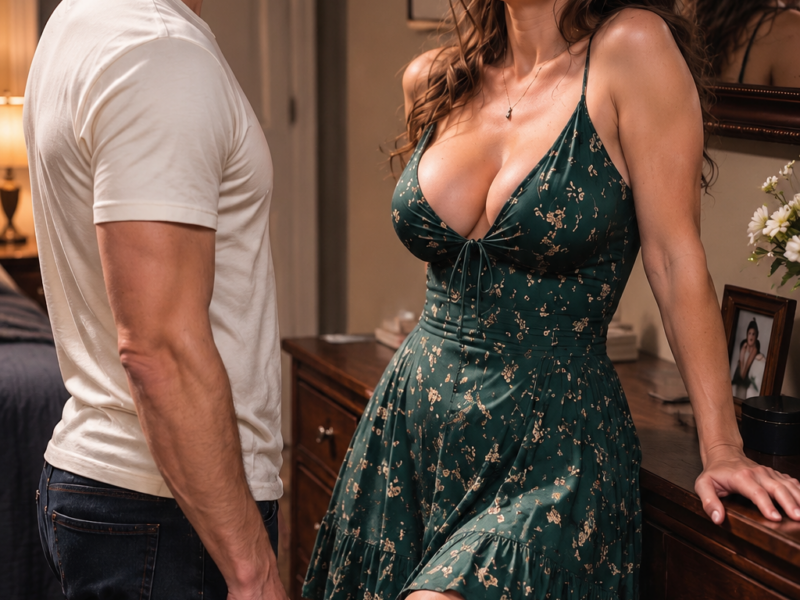
I Was Driving My Ex’s Mom Home… Then She Said, ‘Pull Over. I Need You to Hear This.’
I Was Driving My Ex’s Mom Home… Then She Said, ‘Pull Over. I Need You to Hear This.’
The rain was coming down so hard that the windshield wipers seemed almost useless. Every few seconds, another wave of water crashed against the glass, blurring the road ahead into a dark, shimmering mess of headlights and reflections. My hands were locked around the steering wheel, my jaw clenched, and my mind was racing through a hundred thoughts I couldn’t quite put into words.
Then I felt it.
A warm hand slowly reached across the center console and settled against my arm.
I didn’t turn my head. I didn’t even move. I simply stared through the windshield, listening to the steady rhythm of the rain pounding against the roof of my old Ford truck. Her fingers rested lightly on my sleeve, but that small gesture carried more weight than anything either of us had said during the entire drive.
I knew who was sitting beside me.
Sarah.
The mother of my ex-girlfriend.
And somehow, after three weeks of repairing her kitchen, a forgotten shipment of cabinet handles, and one unexpected summer storm, I had found myself in a situation I never could have imagined.
My name is Cole. I was thirty-something, worked as a custom furniture maker and carpenter, and had spent most of my adult life believing that if you measured carefully, planned ahead, and never rushed a job, things usually turned out the way they were supposed to.
Wood was simple that way.
You examined the grain, measured the dimensions, made your cuts, and adjusted the joints until everything fit. There was a certain comfort in knowing that every mistake could be traced back to something measurable.
People were different.
People had memories, expectations, fears, and feelings that refused to follow any sensible blueprint.
And sitting beside Sarah that evening, I was beginning to understand just how little control I actually had over my own heart.
But to explain how I ended up on that dark highway with my ex-girlfriend’s mother resting her hand against my arm, I have to go back three weeks.
It started on an ordinary Monday afternoon.
The kind of afternoon when nothing particularly interesting happens, the weather is too warm, and the biggest concern on your mind is whether you remembered to bring the right drill bits to the job site.
I was kneeling on the old kitchen floor of a house I knew far too well, wiping a smear of dark grease onto my faded work jeans.
The wooden screen door behind me had just slammed shut with its familiar rusty groan. Outside, the summer air hung thick and humid over the yard, and somewhere beyond the kitchen window, cicadas were making enough noise to drown out almost anything.
I reached into my toolbox, searching for a wrench.
Then I heard the soft sound of a ceramic mug being placed on the kitchen island.
“I wasn’t sure if you still drank it black.”
I looked up.
Sarah stood a few feet away, wearing a simple gray sweater and dark trousers. Her dark hair was loosely pulled back, and she had a pale blue mug in one hand.
For a moment, I simply stared at her.
Not because she looked particularly different from the woman I remembered, but because seeing her standing there brought back a collection of memories I hadn’t thought about in a long time.
For three years, I had been part of her family.
I had spent holidays in that house, sat at that kitchen island, helped carry groceries through the back door, and listened to conversations that seemed to stretch endlessly from Thanksgiving dinner into the late evening.
Back then, Sarah had always been moving.
She was the mother who made sure everyone had enough to eat, who remembered birthdays, who knew where the extra towels were kept, and who somehow managed to keep the entire household functioning without ever appearing to stop and rest.
I had dated her daughter, Jenna.
Jenna and I had been together for three years, but our relationship had ended almost two years earlier. There hadn’t been a dramatic breakup. No screaming arguments, no betrayal, no shattered dishes or angry messages in the middle of the night.
We had simply grown apart.
One day, we were making plans for the future. Then, gradually, those plans stopped making sense. Our conversations became shorter, our schedules became busier, and the things we once imagined doing together began to feel like obligations.
Eventually, we admitted what we had both been avoiding.
We wanted different things.
After that, I stopped visiting the house. I stopped attending family gatherings. I stopped calling Sarah to ask how she was doing.
It seemed like the natural thing to do.
When a relationship ends, you don’t usually keep showing up at your former girlfriend’s mother’s kitchen.
At least, that’s what I had always believed.
Yet there I was, hired to replace the rotting kitchen cabinets in the very house I had once considered a second home.
The job had come through a telephone call from a local customer. I had accepted the project without paying much attention to the last name on the invoice. By the time I recognized the address, I had already agreed to the work and loaded my truck with the necessary equipment.
Turning down the job would have been awkward, and honestly, I needed the business.
So I showed up.
And Sarah opened the door.
“I do,” I answered, reaching for the coffee.
“Thank you.”
She smiled gently.
“Take your time with the wood. This old house isn’t in any rush.”
I nodded and took a sip.
The coffee was strong, bitter, and exactly the way I liked it.
“That’s good,” I said. “I’ll try not to destroy anything while I’m here.”
She laughed softly.
“I think the house has survived worse.”
That should have been the end of our conversation.
I was the contractor, she was the homeowner, and we had a kitchen to finish.
Nothing more complicated than that.
For the next couple of hours, I concentrated on removing the damaged cabinets. The lower sections had suffered years of moisture damage, and several boards were so badly warped that they practically fell apart when I pulled them away from the wall.
The smell of old wood, dust, and damp drywall filled the kitchen.
Sarah stayed nearby, sitting at the small round dining table with her laptop open. Occasionally, I heard her typing. Sometimes she got up to refill her coffee or move something out of my way.
It was strange having her there.
When I had known her before, she had always seemed surrounded by people. Jenna, her friends, relatives, neighbors, and anyone else who happened to stop by.
Now the house was quiet.
Not an uncomfortable quiet, exactly.
Just a different one.
There was something peaceful about the way she moved through the rooms, as though she had become accustomed to living without the constant noise that once filled every corner.
I finished removing the last damaged board and stood up, stretching my back.
“The worst of it is gone,” I said. “The framing looks pretty solid. Most of the damage was limited to the cabinets themselves.”
Sarah closed her laptop.
“That’s good news.”
“Once I install the new oak frames, everything should look completely different.”
She looked toward the exposed wall.
“It’s funny how things hold up longer than you expect.”
I glanced at her.
“What do you mean?”
She shrugged slightly.
“You look at something every day, and eventually you stop noticing how worn down it has become. Then one day, somebody points it out, and you realize it needs attention.”
I smiled.
“That’s usually how I get most of my business.”
She laughed, but there was something thoughtful behind her expression.
I picked up my measuring tape and turned back toward the wall.
At the time, I didn’t think much about her words.
But I remembered them later.
The following afternoon, I returned to continue measuring the space for the new cabinets.
The heat was already building inside the kitchen. Sunlight poured through the windows, making the room feel like an oven.
Sarah was standing beside the stove, peeling apples for a pie.
The rhythmic scrape of her knife against the fruit became the background music to my work.
“You always work too hard,” she said suddenly.
I looked over my shoulder.
“I like the work. Keeps my mind clear.”
“I know it does.”
She let a long strip of apple peel fall into the sink.
“Jenna used to say you cared more about your tools than anything else.”
Hearing Jenna’s name caught me off guard.
Not painfully, but enough to make me pause.
“She wasn’t entirely wrong,” I replied. “Tools don’t change their minds. You measure twice, cut once, and things fit.”
Sarah stopped peeling.
She placed the knife on the cutting board and turned toward me.
“Safe is good,” she said quietly. “But it can get very lonely, Cole.”
I didn’t answer.
Her eyes remained on mine for a moment longer than I expected.
I felt something shift inside me, something I couldn’t quite identify.
It wasn’t simply attraction. It was more complicated than that.
I had known Sarah for years, but only in a particular role. She was Jenna’s mother, the person who welcomed me into her home, remembered what food I liked, and occasionally asked whether I was taking enough care of myself.
I had never considered what she might be like outside that role.
Now, standing in the afternoon sunlight, she seemed like someone I had only just begun to meet.
I wanted to ask what she meant.
I wanted to know whether she was talking about herself or whether she had somehow noticed something in me that I had spent years trying to ignore.
But before I could say anything, the old telephone on the wall rang.
The sound was so sudden and unpleasant that we both jumped.
Sarah turned toward it.
I looked down at my measuring tape and pretended to check a measurement I had already taken.
The moment disappeared.
I told myself I was being ridiculous.
She was being kind. That was all.
I was a contractor repairing her kitchen, not a man who needed to invent hidden meanings in ordinary conversations.
I carried a piece of oak outside and spent the next hour cutting it beneath the blazing sun.
The noise of the circular saw helped.
At least, it gave me something else to think about.
Over the next two days, I settled into a routine.
I arrived in the morning, unloaded my equipment, and worked until the shadows stretched across the front lawn.
The kitchen gradually transformed.
The damaged cabinets disappeared, replaced by the solid oak frames I had built in my workshop. The grain was beautiful, with warm natural patterns that caught the afternoon light.
Sarah was almost always somewhere nearby.
Sometimes she worked on her laptop. Sometimes she sat by the living room window with a cup of tea. Occasionally, she came into the kitchen just to ask whether I needed anything.
We didn’t talk constantly.
In fact, most of the time, we barely spoke.
But the silence was beginning to feel different.
I no longer felt like I had to invent conversation simply because we were sharing the same room.
There was something comfortable about knowing she was there.
On Thursday afternoon, I started installing the upper cabinets.
It was a difficult job, particularly because the frames were heavy and I was working alone.
I stood on the second step of my aluminum ladder, holding one cabinet against the wall with my left arm while trying to reach for my drill with my right.
My muscles were beginning to shake.
“You’re going to drop that.”
I recognized Sarah’s voice before I looked toward the doorway.
“I’ve almost got it.”
“You say that now.”
She walked over and picked up my yellow power drill.
A moment later, she placed it into my searching hand.
“Hold it steady,” she said. “I’ll support the bottom.”
I nodded.
She moved closer and pressed both hands against the lower edge of the cabinet.
I drove the first screw into the stud.
Then another.
The cabinet settled into place with a low wooden groan.
Finally, I lowered my arms.
“Got it.”
I looked down.
Sarah was still standing close to the ladder.
Very close.
Her hands remained against the bottom of the cabinet, and she was looking up at me.
For a moment, neither of us moved.
I could smell the faint scent of vanilla and cedar that seemed to follow her everywhere. I could see the small details of her expression, the gentle lines near her eyes, and the way the afternoon light caught her dark hair.
Then she lifted one hand.
Her fingertips brushed the side of my tool belt, grazing the small patch of skin above my waistband.
“You missed a spot,” she whispered.
I swallowed.
“Where?”
She smiled.
“Right here.”
Her thumb traced a tiny line of sawdust on the leather edge of my tool pouch.
It was such a small gesture.
It could have meant nothing.
But the way she looked at me made it difficult to believe that.
My heart started beating faster.
I remained on the ladder, one hand gripping the side rail, suddenly unable to think of anything sensible to say.
Then a truck horn blasted from outside.
We both flinched.
Sarah stepped back immediately, smoothing the front of her sweater.
I climbed down the ladder much faster than necessary and nearly twisted my ankle on the bottom step.
A white delivery truck was parked in the driveway.
The driver had apparently dropped off a package.
I stared out the window for a few seconds, feeling foolish.
When I turned around, Sarah was already returning to the dining table.
The rest of the afternoon passed in painfully ordinary conversation.
I concentrated on the hinges.
She answered emails.
Neither of us mentioned what had happened.
I told myself it was nothing.
I repeated that explanation so many times that eventually I almost believed it.
By Friday, the kitchen was nearly finished.
The base cabinets were secured, the upper frames were installed, and the doors were hanging perfectly.
Only one thing remained.
The brass handles Sarah had ordered several weeks earlier.
Unfortunately, the shipping company claimed they had been delivered, but nobody could find them.
Sarah searched the garage and checked the porch. She even looked through the storage cabinets in the hallway.
Nothing.
When she finally walked into the kitchen holding a handful of shipping invoices, she looked genuinely frustrated.
“I can’t find them.”
I closed my toolbox.
“Find what?”
“The handles. The brass ones I ordered.”
She dropped the papers onto the island.
“The company says they were delivered three weeks ago, but I’ve searched everywhere.”
I examined the empty holes in the cabinet doors.
“We can still finish without them. Opening the drawers might be annoying, though.”
She laughed quietly.
Then she leaned against the island and stared at the cabinets.
“I just wanted this to be finished.”
Something about her voice made me look up.
“I thought I knew exactly what I wanted for this space,” she continued. “But now that everything is coming together, I think I’m looking for something completely different.”
I understood what she meant.
Or at least, I suspected I did.
She wasn’t only talking about kitchen hardware.
There was something deeper in her words, something about the house, her life, and the emptiness that had settled into both.
I wanted to say something meaningful.
Instead, I did what I always did when a conversation became too personal.
I turned it into a practical problem.
“We could look at other options. There’s a hardware store in town with a pretty big selection. If we leave now, we should get there before they close.”
Sarah looked at me.
For a moment, I thought she might say something else.
Then she gave a small smile.
“Okay. Let me get my purse.”
I grabbed my truck keys.
The inside of my old Ford smelled like black coffee, worn leather, and fresh-cut pine. It was a familiar space, one that had always felt entirely my own.
Having Sarah sitting in the passenger seat changed that.
She settled into the wide leather seat and looked out the window as I started the engine.
The road into town wound between tall trees and open fields.
Above us, dark clouds were gathering.
I wanted to break the silence.
Anything would have been better than the strange tension that had followed us out of the house.
“Jenna used to hate going to the hardware store,” I said, trying to sound casual. “She always said it smelled like old boots and regret.”
The moment the words left my mouth, I regretted them.
I tightened my grip on the steering wheel.
Why had I brought Jenna into the conversation?
Sarah didn’t respond.
She continued looking out the passenger window, her reflection faintly visible in the darkening glass.
I began imagining all the ways I might have made her uncomfortable.
Perhaps I had mistaken her kindness for something else.
Perhaps she was simply trying to be friendly, and I had somehow turned an ordinary working relationship into an embarrassing situation.
The rest of the drive passed in silence.
When we arrived at the hardware store, the parking lot was nearly empty.
Inside, the fluorescent lights buzzed overhead.
We walked through the long aisles until we reached the cabinet hardware section.
Sarah examined the different displays.
Brass.
Bronze.
Brushed nickel.
Matte black.
I stood a few feet away with my hands in my pockets, trying to give her room.
I wanted to apologize for the comment about Jenna, but every possible version of an apology sounded worse than the original mistake.
Sarah picked up a heavy bronze handle and studied its shape.
Then she stepped backward.
Her shoulder bumped gently against my chest.
I expected her to move away.
Instead, she allowed herself to rest against me for a brief moment.
Then she turned her head.
“She was right, you know.”
I blinked.
“Who?”
“Jenna.”
Her dark eyes held mine.
“It really does smell like old boots in here.”
I let out a quiet laugh.
“But I think I like it.”
She gave my chest another playful bump with her shoulder.
Just like that, the tension disappeared.
She wasn’t angry.
She hadn’t misunderstood my comment.
And she certainly wasn’t trying to create distance between us.
Before I could respond, thunder exploded above the building.
The sound rolled through the metal roof, making the shelves seem to vibrate.
We both looked toward the front windows.
The sky had opened.
Rain poured down in thick, violent sheets, turning the parking lot into a shallow river.
“We should go,” I said. “The roads are going to get bad.”
Sarah picked up a box of matte black handles from the shelf and handed it to me.
“Let’s go home, Cole.”
Home.
It was such a simple word.
But hearing it in her voice made something tighten in my chest.
She hadn’t said, “Let’s go back to the house.”
She hadn’t said, “Let’s return to the job site.”
She had said home.
We paid for the handles and hurried toward the entrance.
Outside, the wind was strong enough to bend the trees along the street. Rain struck the pavement so hard that it bounced back in tiny silver splashes.
“We’re going to have to run for it,” I said.
Sarah pulled her sweater tighter around herself.
I pushed open the glass door.
We sprinted through the storm.
By the time we reached the truck, my jacket was soaked. I opened the passenger door and held it while Sarah climbed inside.
Then I ran around the front and practically threw myself into the driver’s seat.
The moment I shut the door, the world outside became distant.
Rain hammered the roof.
Wind pushed against the windows.
Water streamed down the windshield.
Inside, everything was warm and quiet.
Sarah brushed wet hair away from her face.
Her sweater clung to her shoulders, and she was shivering slightly.
I started the engine and turned the heater all the way up.
“Are you okay?”
She leaned back against the seat.
“Perfectly fine.”
I shifted into gear and slowly pulled out of the parking lot.
The highway was already filling with standing water.
The windshield wipers moved frantically, clearing the glass for only a second before another wave of rain covered it.
For several minutes, neither of us spoke.
But the silence no longer felt awkward.
It felt charged with something neither of us wanted to name.
I kept my eyes on the road.
I was driving my ex-girlfriend’s mother home.
That was the reality.
And whatever I thought I felt, I knew there were boundaries I needed to respect.
Then Sarah reached across the center console.
Her hand settled against my arm.
I felt the warmth through my damp jacket.
I didn’t move away.
She didn’t say anything.
We simply continued driving.
After a while, the tension began to soften into something more comfortable.
I adjusted the heater.
My elbow brushed her knee.
She didn’t flinch.
Her thumb moved slowly against the fabric of my sleeve, tracing a small, almost absent-minded circle.
Outside, the dark trees bent beneath the wind.
We passed the old grain silo at the edge of town, its rusted metal sides shining beneath my headlights.
“I used to love storms,” Sarah said.
I kept my eyes on the road.
“Really?”
“When I was twenty-two, I lived in this terrible little apartment near the lake in Chicago. It was drafty, the heating barely worked, and the windows rattled whenever the wind picked up.”
She smiled faintly.
“I was studying architectural design. Whenever a thunderstorm rolled in, I’d open the windows, sit on the fire escape, and watch the lightning hit the water.”
I imagined her there.
A younger Sarah, far removed from the woman I had known in this kitchen.
“I loved the chaos of it,” she continued. “I loved watching something wild and uncontrollable happen right in front of me. I didn’t have to fix anything. I didn’t have to make decisions. I could just sit there and watch.”
She paused.
“I gave up the degree two years later.”
I glanced at her briefly.
“What happened?”
“I met Jenna’s father, and the firm I was interning with moved to Seattle. Everything changed around the same time.”
She looked through the window.
“I told myself it was the practical choice. A family, a house, a good school district, a stable life. It was what I thought I was supposed to want.”
Her fingers tightened slightly against my sleeve.
“And I did love raising my family. I really did. I wouldn’t trade those years for anything.”
She was quiet for a moment.
“But sometimes I wonder what happened to the girl who sat on that fire escape.”
I felt something move inside my chest.
For the first time, I wasn’t thinking of her as Jenna’s mother.
I was thinking about the woman sitting beside me.
A woman who had once dreamed of designing buildings, who had loved storms, who had made choices she believed were right, and who had somehow reached a point in life where she was wondering whether there was still room for something she had left behind.
“Safety is a powerful anchor,” I said.
She turned slightly toward me.
“It keeps you from drifting away,” I continued. “But if you’re tied to the dock for too long, you eventually forget how to sail.”
She looked at me for several seconds.
Then she squeezed my arm.
“What about you?”
I took a breath.
“I got accepted into a structural engineering program when I was nineteen. Full scholarship.”
“Really?”
“Yeah. Everyone thought I was going to do something important with it.”
I laughed quietly.
“I lasted three semesters.”
“What happened?”
“I hated it.”
I explained how I had spent my days in windowless lecture halls, studying equations and calculating the strength of materials.
It wasn’t that I disliked engineering.
I simply couldn’t imagine spending my entire life staring at numbers on a screen.
“I wanted to build something I could touch. Something real. I wanted to feel the grain of the wood beneath my hands and know that what I was making would still be standing years later.”
“So you left?”
“I packed my truck, came home, and bought my first table saw.”
She smiled.
“You chose the work that made you feel alive.”
“I chose the work,” I said. “But sometimes I wonder if I use it to hide from everything else.”
She looked at me.
I kept driving.
“You can control wood. You can’t control people. With a piece of lumber, you know where the flaws are. You can see them, measure them, work around them.”
I swallowed.
“Relationships aren’t that simple.”
For a moment, she said nothing.
Then I made the mistake of retreating into the familiar.
“You made the right choice, though,” I added quickly. “You gave your family a beautiful home. You gave Jenna a good life. That counts for a lot.”
The words seemed to fall heavily between us.
Sarah’s hand slowly slipped away from my arm.
She folded it into her lap and turned toward the window.
I immediately understood what I had done.
I had taken the one moment when she was allowing herself to be seen as an individual and pushed her back into the role she had spent years occupying.
I had reminded her that she was a mother.
That she was responsible for a family.
That her greatest achievement was the life she had built for everyone else.
And perhaps none of those things was wrong.
But that wasn’t what she had been trying to tell me.
I wanted to apologize.
I wanted to tell her that I had been listening, that I understood she was more than the memories I carried of her.
But I couldn’t find the words.
Then I felt something touch my wrist.
Sarah’s knuckles rested gently against the bare skin near my pulse.
She wasn’t looking at me.
She didn’t say anything.
But she hadn’t completely withdrawn.
The small gesture gave me room to breathe again.
The rain continued pounding against the truck.
The heater blew warm air across my hands.
And after several more minutes, Sarah shifted in her seat.
“Pull over.”
Her voice was quiet but firm.
I glanced at her.
“What?”
“I need you to hear this.”
I didn’t hesitate.
I slowed the truck and guided it onto the shoulder.
The tires crunched over the wet gravel.
The headlights illuminated a dense wall of pine trees beyond the road.
I shifted into park.
The engine continued idling.
For a moment, neither of us spoke.
Sarah slowly unbuckled her seat belt and turned toward me.
The soft green glow of the dashboard illuminated her face.
She looked nervous.
Not frightened, exactly.
More like someone who had spent a long time preparing to say something and had finally decided there was no point waiting any longer.
“I loved raising my family,” she began.
Her voice was gentle.
“I don’t regret it. I don’t regret the years I spent taking care of everyone, building that house, making sure Jenna had everything she needed.”
She paused.
“But my daughter is grown, Cole.”
I listened.
“The house is quiet now. The foundation is poured. The walls are built. The work I spent so many years doing is finished.”
She looked down at her hands.
“And for the last two years, I’ve been walking through those rooms feeling like a ghost in my own life.”
I felt my throat tighten.
“I know what you’re going to say,” she continued. “I know this is complicated. I know who you used to be to my family. I know that people might not understand.”
She raised her eyes.
“But I need you to understand something.”
Her hand reached toward mine.
“For the last few weeks, I’ve been looking forward to hearing your truck pull into my driveway.”
I couldn’t move.
“I’ve been making coffee earlier than usual because I knew you’d be there. I’ve found excuses to stay in the kitchen because I wanted to talk to you.”
Her fingers slid gently along my forearm.
“And when you were working, I found myself watching you. Not because I needed to check whether the cabinets were straight. Not because I was worried about the house.”
She gave a small, nervous smile.
“Because I liked watching you.”
I stared at her.
A thousand thoughts moved through my mind, but none of them seemed important enough to interrupt.
“You came into my kitchen to tear out the old, damaged wood,” she said. “And somewhere along the way, you reminded me that I was still a person outside the life I had spent so many years building.”
Her palm settled over the back of my hand.
“A woman with her own thoughts. Her own memories. Her own desires.”
She leaned slightly closer.
“I’m not asking you to build me a house, Cole.”
Her voice softened.
“I’m asking you to look at me. Not as Jenna’s mother. Not as the woman who hired you. Just me.”
I felt the last of my defenses begin to collapse.
For three weeks, I had been trying to measure something that couldn’t be measured.
I had been looking for rules, boundaries, and safe explanations.
I had convinced myself that if I kept my head down and concentrated on the work, whatever was happening between us would eventually disappear.
But sitting there, listening to her speak with such honesty, I realized I had been avoiding the truth.
I had been looking at her.
I had noticed the way she smiled.
I had noticed the quiet sadness behind her eyes.
I had noticed how easily we could sit together without speaking.
And I had been looking forward to seeing her every morning just as much as she had been looking forward to seeing me.
I slowly turned my hand beneath hers.
Our fingers intertwined.
“I’ve been looking at you,” I said.
My voice was barely above a whisper.
“I don’t think I’ve been looking at anything else.”
She smiled.
It wasn’t a dramatic smile.
It was small and genuine, and it reached all the way into her eyes.
I squeezed her hand gently.
“I don’t know exactly what happens next,” I admitted. “And I don’t want to pretend this is simple.”
“Neither do I.”
“But I know I don’t want to keep pretending I don’t feel anything.”
She nodded.
“That’s all I wanted.”
We sat there for a long time.
The storm continued raging outside, but the space inside the truck seemed strangely peaceful.
Eventually, I turned back toward the road.
Sarah rested her hand in mine.
Neither of us tried to rush the moment.
We drove the remaining distance to her house slowly, with the rain gradually weakening as the highway opened into the familiar streets of our town.
When I finally pulled into her driveway, I turned off the engine.
For a moment, neither of us moved.
Then she looked at me.
“Thank you for listening.”
I smiled.
“Thank you for telling me.”
She stepped out, closed the passenger door, and walked toward the house.
Before entering, she turned around.
I raised my hand slightly.
She smiled once more.
Then the front door closed.
I sat in the driveway for several minutes after she disappeared inside.
My mind was full of questions.
What would happen tomorrow?
What would happen when the kitchen was finished?
What would Jenna think if she ever found out?
And perhaps most importantly, was I prepared to let something this unexpected change the life I had spent so many years keeping predictable?
I didn’t have answers.
For once, I decided I didn’t need them immediately.
Seventeen days passed.
The late afternoon sun poured through the industrial skylights of my workshop, filling the space with long golden beams.
The air smelled of black walnut, pine, and warm linseed oil.
My old radio played a quiet acoustic guitar melody while I worked at the main bench, shaving thin curls of wood from a walnut board with my hand plane.
It was a familiar sound.
A familiar place.
But something about the workshop felt different.
For years, I had treated that building like a sanctuary from the rest of the world.
I came there early, worked until evening, and rarely allowed anyone to interrupt my routine.
I liked being alone.
I liked knowing exactly where everything belonged.
I liked the predictable rhythm of measuring, cutting, sanding, and assembling.
But lately, I had begun to realize that my solitude had sometimes been less about enjoying my own company and more about avoiding the uncertainty of letting someone else into my life.
I was still the same carpenter.
I still cared about straight edges, tight joints, and beautiful wood grain.
But the shop no longer felt like a fortress.
It simply felt like a room where I made things.
And I was beginning to understand that there was room for more than one person in it.
The sound of tires moving over gravel interrupted my thoughts.
I set down the hand plane and wiped my palms against my canvas apron.
A silver sedan pulled up outside the open bay doors.
The driver’s door opened.
Sarah stepped out.
She was wearing a simple white summer dress, and her dark hair was pulled back loosely with a small silver clip.
For a second, I simply watched her.
Then she walked directly into the workshop.
Three weeks earlier, I would have worried about the sawdust on the floor, the tools scattered across the benches, and the fact that I hadn’t cleaned the space properly.
Now I didn’t care.
She looked around with quiet curiosity before stopping in front of my workbench.
“You’re covered in dust,” she said.
I glanced down at my shirt.
“It’s a wood shop. Dust is pretty much the only guarantee I have.”
She laughed.
Then she reached out and placed her palm against my chest.
The gesture was natural.
Uncomplicated.
As though she had been doing it for years.
“I brought you lunch.”
She placed a small brown paper bag on the corner of the bench.
“You never answer your phone when you’re working, so I assumed you were out here starving yourself again.”
I covered her hand with mine.
“You didn’t have to drive all the way out here.”
“I know.”
She smiled.
“I wanted to.”
That was the difference.
There was no hidden meaning that needed to be deciphered.
No uncertain glance.
No awkward pause.
She had come because she wanted to see me.
And I was happy she had.
I untied my apron and tossed it over a nearby stool.
Then I pulled two old folding chairs from the corner and placed them near the open bay doors.
We sat side by side, eating sandwiches while the warm breeze moved through the workshop.
The afternoon light caught the tiny particles of dust floating in the air.
Sarah looked around.
“This place is wonderful.”
“It’s mostly a mess.”
“It’s your mess.”
I smiled.
“That’s one way to describe it.”
She watched me for a moment.
“You seem different here.”
“Different how?”
“More relaxed.”
I considered that.
“Maybe because I’m not trying so hard to control everything.”
She nodded.
“That’s a good thing.”
We ate quietly for a while.
The silence felt nothing like the silence during our first few days together.
Back then, I had been constantly searching for the right thing to say.
Now I didn’t feel that pressure.
We could simply sit together.
And somehow, that was enough.
When we finished lunch, Sarah folded her sandwich wrapper and tossed it into the trash.
“Show me what you’re making.”
I stood and offered her my hand.
She took it immediately.
I led her toward a smaller worktable near the back wall.
Several pieces of dark walnut were arranged in neat rows.
“It’s a dining chair,” I explained. “A custom commission for a family out by the lake.”
She leaned closer.
The backrest curved gently, following the natural lines of the wood.
There were no sharp corners, and the joints were carefully cut to fit together without visible screws or nails.
“How does it hold together?”
I pointed toward the joints.
“It’s all tension and gravity. The pieces are cut to fit perfectly. Once everything is assembled, the structure supports itself.”
She examined the connection between the seat and the backrest.
“There aren’t any nails.”
“No nails. No metal screws.”
I smiled.
“If you understand the grain and measure the angles properly, the wood holds itself together.”
She ran her fingertips over one of the joints.
“It must take a lot of patience.”
“It does.”
I watched her examine the work.
Then I realized that I wasn’t merely showing her a chair.
I was showing her something about myself.
For years, I had used my work as a way to keep people at a distance.
I could talk endlessly about wood, tools, measurements, and construction techniques because those subjects were safe.
But now I was allowing her to see the things I cared about most.
I was letting her into my world.
“It’s beautiful, Cole,” she said.
I looked at her.
“It takes time.”
She raised her eyes.
I continued quietly.
“But when everything finally fits, you don’t have to worry about it falling apart.”
She smiled.
Her fingers tightened around mine.
We spent the next couple of hours together.
I returned to planing the walnut boards while Sarah wandered around the workshop.
She picked up old tools and asked what they were used for.
She examined the labels on jars of screws and small hardware.
At one point, she sat on a tall stool near the window and simply watched me work.
Every time I looked up, she was there.
And I found myself smiling without even realizing it.
The afternoon moved slowly.
The sun gradually lowered beyond the trees, and the golden light inside the workshop began to turn orange.
Eventually, I switched off the radio and started putting away my equipment.
Sarah didn’t wait for me to finish.
She walked to the corner, picked up the wide push broom, and began sweeping the concrete floor.
I looked over.
“You don’t have to do that.”
“I know.”
She kept sweeping.
“I want to help.”
I smiled and returned to unplugging the machinery.
There was something quietly beautiful about the scene.
The woman who had once spent her afternoons making sure everyone else had what they needed was now standing in my workshop, sweeping sawdust from the floor.
It wasn’t a grand romantic gesture.
It wasn’t something anyone would write songs about.
But I found myself wanting to remember every second of it.
We worked together without speaking.
I wrapped cords around the machines.
She swept beneath the benches.
I returned tools to their proper places.
She gathered the empty lunch wrappers.
Eventually, the shop was clean.
I pulled the main breaker, and the overhead lights went dark.
The remaining daylight filtered through the open bay doors, leaving the room bathed in soft twilight.
We walked outside together.
Gravel crunched beneath our shoes.
My truck was parked beneath the old oak tree.
I unlocked the passenger door and opened it for her.
Sarah stopped before climbing inside.
She turned toward me and stepped into the small space between the open door and my chest.
Her hands rested against my stomach.
Then she rose slightly onto her toes and kissed the corner of my mouth.
It was gentle.
Slow.
There was no urgency in it.
Just warmth.
“Thank you for letting me in,” she whispered.
I placed my hands lightly against her waist.
“You never have to knock.”
She smiled and climbed into the truck.
I closed the door and walked around to the driver’s side.
The engine started with its familiar low rumble.
The drive back to her house was nothing like the stormy evening when everything had changed.
The sky was clear.
The roads were dry.
Stars were beginning to appear above the trees.
We talked about ordinary things.
A customer who had changed his mind about a dining table.
A small garden project Sarah wanted to start.
A restaurant in town she had always wanted to try.
It felt strangely wonderful.
For the first time, I wasn’t thinking about what I should say or what I shouldn’t say.
I was simply enjoying the company of someone I cared about.
When we pulled into her driveway, I turned off the engine.
The house stood beneath the trees, its windows glowing warmly in the evening darkness.
I looked at it differently now.
Three weeks earlier, it had been a job site.
A place filled with old memories.
A place where I had once belonged and then deliberately removed myself.
Now it looked like a home again.
Not because the cabinets were finished.
Not because the kitchen had been repaired.
But because someone was waiting inside it.
Sarah unlocked the front door, and we walked down the hallway.
The kitchen was completely finished.
The custom oak cabinets were installed, their rich grain shining beneath the warm recessed lights.
The matte black handles we had bought during the storm were perfectly aligned.
There were no tools on the counters.
No sawdust on the floor.
No damaged boards leaning against the wall.
Everything looked clean and complete.
I stopped in the doorway.
Sarah walked past me and rested her hand against the kitchen island.
For a moment, she simply looked around.
Then she turned toward me.
Neither of us said anything.
I remembered the first afternoon I had worked there.
The coffee mug placed beside my toolbox.
The quiet conversations.
The apple pie.
The ladder.
The almost accidental touch that had left me thinking about her for the rest of the day.
I remembered the drive to the hardware store, the storm, the rain, and the moment she had asked me to pull over.
I remembered her telling me that she had spent two years feeling like a ghost in her own life.
And I remembered how difficult it had been for me to stop seeing her through the lens of my past.
Sarah stepped closer.
“Do you like how it turned out?”
I looked at the cabinets.
“They came out exactly the way I wanted.”
She smiled.
“I was talking about the kitchen.”
I laughed softly.
“Then yes. I think it’s beautiful.”
She looked around once more.
“Thank you, Cole.”
I shook my head.
“You don’t have to thank me. It was my job.”
“Not just for the cabinets.”
I understood.
I reached for her hand.
She took it.
And standing there in the kitchen we had rebuilt together, I finally understood something I had spent most of my life overlooking.
I had always believed that the best things were the ones I could construct with my own two hands.
A strong table.
A beautiful chair.
A cabinet that would last for decades.
I believed that if I chose the right materials, measured carefully, and worked patiently, I could create something that would never fail.
But people weren’t furniture.
Love wasn’t a woodworking project.
And sometimes the most meaningful things in life arrived without warning, at the exact moment you were convinced everything was already settled.
Sarah had spent years building a home for the people she loved.
I had spent years building a life around the safety of my workshop.
Neither of us had expected to find something new in the middle of those familiar spaces.
Yet somehow, through a kitchen renovation, a few quiet conversations, and one terrible summer storm, we had found each other.
I looked at her standing beneath the warm kitchen lights.
She wasn’t simply the woman who had once welcomed me into her home as her daughter’s boyfriend.
She wasn’t a memory from an old relationship.
She was Sarah.
A woman with dreams she had once put aside, stories I had never heard, and a future that was still waiting to be written.
And I was Cole.
A man who had finally begun to understand that not everything worth building could be measured with a tape.
Sometimes the strongest foundations came from patience.
Sometimes the most important repairs began with an honest conversation.
And sometimes, when you thought you were simply walking into someone’s house to replace a few damaged cabinets, you ended up discovering that the thing you had been missing wasn’t something you needed to build at all.
It was someone you needed to let into your life.
Sarah squeezed my hand.
I squeezed hers back.
Outside, the summer night settled quietly over the trees.
Inside, the kitchen glowed with warm light.
And for the first time in a very long while, neither of us seemed to be waiting for something to happen.
We were exactly where we wanted to be.
THE END