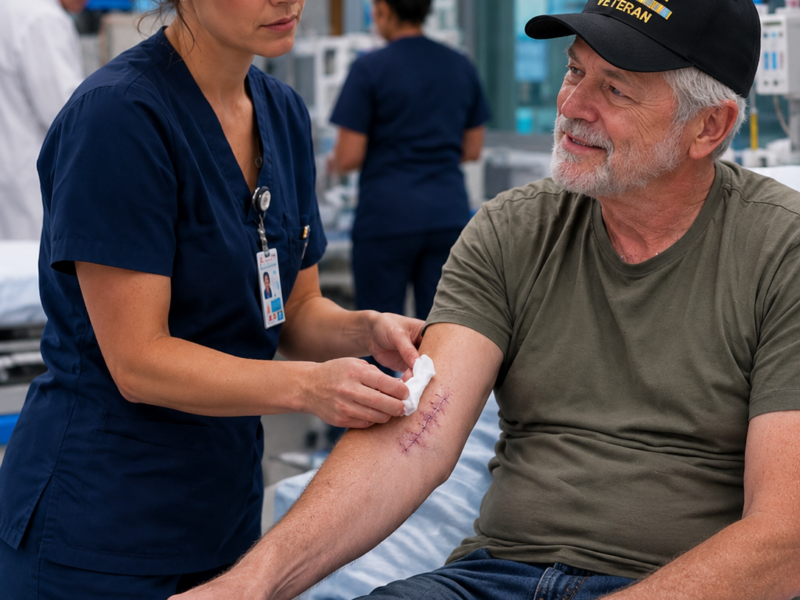
I Was an Ordinary Trauma Nurse at St. Gabriel Hospital Until a Surgeon Humiliated Me in Front of His Entire Team and Shouted, “GET OUT NOW, NURSE!” I Removed My Gloves and Walked Away, Knowing the Navy SEAL on the Bed Was Slowly Deteriorating. But Just as I Reached the Door, He Struggled to Sit Up, Called Me by My Name, and Raised His Hand in a Military Salute—Leaving Everyone Wondering What He Knew About Me.
I Was an Ordinary Trauma Nurse at St. Gabriel Hospital Until a Surgeon Humiliated Me in Front of His Entire Team and Shouted, “GET OUT NOW, NURSE!” I Removed My Gloves and Walked Away, Knowing the Navy SEAL on the Bed Was Slowly Deteriorating. But Just as I Reached the Door, He Struggled to Sit Up, Called Me by My Name, and Raised His Hand in a Military Salute—Leaving Everyone Wondering What He Knew About Me.
PART 1
“GET OUT NOW, NURSE!”
Dr. Adrien Kesler’s voice exploded across the trauma room, cutting through the steady beeping of monitors and the hurried footsteps of medical staff. Every person in the room stopped moving for a moment. A young resident lowered his eyes. Another nurse glanced nervously toward the attending surgeon, unsure whether she should intervene.
Mara Ellison didn’t argue.
She didn’t raise her voice, defend her qualifications, or remind the surgeon that she had been the one warning him about the patient’s deteriorating condition. Instead, she calmly removed her gloves, placed them on the edge of the supply cart, and turned toward the door.
She had learned a long time ago that not every battle deserved an argument.
But what Dr. Kesler didn’t know was that the woman he had just humiliated in front of his entire team had spent eight years serving as a special operations combat medic. She had treated soldiers under enemy fire, stopped arterial bleeding inside helicopters, and kept critically wounded men alive in places where evacuation was sometimes hours away and medical supplies were almost nonexistent.
She had made decisions under circumstances that would have terrified most people in that hospital.
And now, after saving the life of the man lying in front of her, she was being dismissed because a surgeon couldn’t tolerate having his judgment questioned.
What happened next would change the way everyone in that room understood authority, experience, and the quiet woman they had spent years underestimating.
But to understand why that moment mattered so much, it was necessary to understand who Mara Ellison had been before she ever walked through the doors of St. Gabriel Medical Center.
St. Gabriel was a busy hospital, particularly during the overnight hours. Its trauma department operated according to a rhythm that never truly stopped. Monitors beeped, elevators opened and closed, stretchers rolled through corridors, and exhausted medical staff moved between rooms carrying charts, medication trays, and cups of coffee that were usually cold before they had time to drink them.
Most employees eventually stopped noticing those sounds.
Mara never did.
For nearly four years, she had worked in the hospital’s trauma unit, developing an unusual ability to recognize when something was wrong before the problem became obvious to everyone else.
She noticed changes in breathing patterns, subtle shifts in skin color, and the small differences between a patient who was genuinely recovering and one who was quietly deteriorating.
She was not particularly talkative. She rarely participated in workplace gossip, never complained about difficult assignments, and didn’t seem interested in impressing senior physicians.
The younger residents often handed her additional paperwork, supply checks, and other responsibilities without asking whether she already had enough work.
Mara simply completed what needed to be done.
Some people interpreted her quietness as a lack of ambition. Others assumed she was content to remain in the background.
Nobody understood that she had deliberately chosen that life.
Before joining St. Gabriel, Mara had spent eight years working alongside special operations units as a combat medic. She had deployed to dangerous environments, treated catastrophic injuries, and learned to make decisions when hesitation could cost someone their life.
She had seen men survive injuries that seemed impossible to overcome. She had also watched people die despite every effort made to save them.
Those experiences had changed her, but they had not destroyed her.
Eventually, she decided she wanted something different. She wanted to practice medicine without the constant threat of gunfire, without the weight of classified operations, and without having to measure every day by how many people made it home alive.
She wanted an ordinary life.
So she left that world behind, completed her transition into civilian healthcare, and joined St. Gabriel.
She never mentioned her military background unless someone specifically needed to know.
She didn’t wear her old insignia, display photographs from deployments, or introduce herself by describing the things she had survived.
To her colleagues, she was simply Nurse Ellison.
That was how she preferred it.
Until the night Caleb Straoud arrived.
It was approximately twenty minutes before one in the morning when the hospital received an unexpected notification from military medical transport. A helicopter was bringing in a critically injured serviceman.
The initial report contained very little information. There was a name, a brief description of the injuries, and a classification notice indicating that portions of the patient’s military medical record were restricted.
An Army liaison officer accompanied the transport team. His name was Captain Dale Whitfield, a composed man in his early forties who looked as though he had spent the entire journey trying to keep his emotions under control.
His instructions were simple.
“Keep him alive.”
The patient, Caleb Straoud, had sustained multiple fragmentation injuries across his upper torso and left side. He had lost a significant amount of blood before reaching the hospital, and the field dressings covering his wounds suggested that whoever had treated him initially had been working under extremely difficult conditions.
Mara was among the nurses assigned to receive him.
The moment the stretcher entered the trauma bay, she began assessing the situation.
She noticed the tourniquet first. It had been positioned unusually high, exactly where the injury pattern required it. The dressing over his left flank had been packed with improvised material, suggesting that someone had been forced to work with whatever supplies were available.
These were not random emergency measures.
Someone had known what they were doing.
Mara recognized the decisions immediately. They reminded her of situations she had encountered during her military service, when a medic had to improvise without knowing whether another opportunity to treat the wounded person would ever come.
One of the younger residents noticed her examining the dressings.
“Have you seen injuries like this before?” he asked.
“A few times,” she replied.
Then she returned to work.
Twelve minutes later, Dr. Adrien Kesler entered the trauma bay.
Kesler was one of St. Gabriel’s most respected trauma surgeons. He had trained at prestigious institutions, published research in respected medical journals, and built a reputation for handling complicated surgical cases with exceptional confidence.
Hospital administrators valued him. Residents wanted to train under him. Other physicians generally avoided challenging his decisions unless they had overwhelming evidence.
There was little doubt that he was technically talented.
Unfortunately, years of being the most accomplished person in the room had also created a serious weakness.
Kesler had become accustomed to believing that his judgment was almost always the final word.
He entered the room, reviewed the preliminary information, requested imaging, and began directing the residents.
Mara continued monitoring the patient.
At first, everything appeared relatively controlled. Caleb’s vital signs were concerning but not unexpected given the severity of his injuries.
Then Mara noticed something.
His breathing pattern was subtly uneven. The relationship between his respiratory effort and the resulting readings suggested that something was not matching the information provided by the initial imaging.
She watched the monitors for nearly ninety seconds.
Then she checked the numbers again.
A concern began forming in her mind. There was a possibility that Caleb had sustained additional internal chest injuries that had not been fully identified.
Such injuries could remain relatively quiet for a short period before suddenly becoming life-threatening.
Mara approached Kesler.
“Doctor, I’m concerned about his respiratory pattern. The effort and oxygen readings aren’t matching what we’re seeing on the initial imaging.”
Kesler glanced at the monitor.
“The numbers are within acceptable parameters.”
“I understand, but there’s an asymmetry that concerns me.”
He looked at her again, this time with visible impatience.
“I’ve reviewed the imaging, Nurse Ellison.”
Mara nodded and returned to the bedside.
She continued watching the patient.
Eleven minutes later, Caleb’s blood pressure dropped sharply.
His heart rate accelerated as his body struggled to compensate. His oxygen saturation began falling, and the room suddenly shifted from controlled preparation to an emergency unfolding in real time.
The residents moved toward the bed, but for one brief moment, nobody seemed certain which problem needed to be addressed first.
Mara recognized that moment immediately.
She had experienced it countless times before. It was the fraction of a second when an emergency changed faster than the existing plan could accommodate.
She didn’t wait for permission.
“Get two large-bore IVs established. Call the blood bank. We need O-negative blood ready immediately.”
She turned toward another resident.
“Reassess the left chest. I want bilateral breath sounds checked now.”
Then she pointed toward the supply cart.
“Bring the crash cart to the left side of the bed. Keep it there.”
Her voice wasn’t loud, but it was unmistakably authoritative.
The residents moved.
Not because she outranked them, but because her instructions were precise, immediate, and appropriate to what was happening.
Kesler turned toward the patient and began issuing additional orders, following the emergency response Mara had already helped organize.
The room found its rhythm again.
Blood was requested. Additional access was established. The team reassessed Caleb’s chest and monitored his deteriorating condition.
For eighteen minutes, everyone worked with intense concentration.
Slowly, the numbers began improving.
Caleb’s blood pressure recovered. His oxygen saturation stabilized, and his heart rate gradually returned toward a safer range.
When the immediate crisis passed, Kesler resumed control of the room.
He issued the transfer orders, directed the residents to prepare the surgical handoff, and instructed the team to move Caleb upstairs.
He did not thank Mara.
He didn’t acknowledge that she had recognized the deterioration before anyone else or that her instructions had helped organize the response during the most dangerous moments.
Mara didn’t ask for recognition.
She returned to the documentation station and began recording the events.
There was, however, something she couldn’t stop thinking about.
During the worst moments of his deterioration, Caleb had not been completely unconscious. Although he had been unable to respond, she suspected that he might have heard parts of what was happening.
He might have remembered her voice.
She didn’t know whether that would matter.
Caleb entered surgery shortly before three in the morning.
He survived.
Dr. Kesler received most of the official credit, as the surgeon responsible for the case. The hospital’s internal report described the procedure as a successful intervention under his leadership.
Mara finished her shift at 6:47 a.m.
She drove home through the pale morning light, made herself a cup of coffee, and sat alone at her kitchen table.
She thought about the improvised dressings on Caleb’s wounds and the careful placement of the tourniquet.
Whoever had treated him before the helicopter arrived had understood the same things she had learned years earlier.
There was something familiar about that kind of work.
She finished her coffee, washed the cup, and went to bed.
She believed the incident was over.
She was wrong.
PART 2
Over the next few days, Dr. Kesler quietly tightened the boundaries around Mara’s responsibilities. She was expected to follow instructions, document observations, and leave clinical decisions to physicians. The residents noticed the change but remained silent.
Meanwhile, Caleb Straoud slowly began recovering from surgery. His sedation was reduced, and fragments of consciousness gradually returned.
Then, one afternoon, he heard a familiar voice outside his room.
It was Mara speaking to another doctor.
Caleb’s eyes opened.
He remembered that voice from the night he had nearly died. He remembered the calm instructions, the precise commands, and the person who had taken control when everyone else hesitated.
He asked Captain Whitfield to identify the nurse who had treated him.
The following morning, he received her name.
Mara Ellison.
Caleb listened quietly, then looked toward the hospital corridor.
He had recognized something about her that the hospital had completely overlooked.
And he wasn’t finished finding out who she was.
PART 3
By the fifth day after his surgery, Caleb Straoud had reached a point in his recovery where the doctors were cautiously optimistic.
He was still weak, and every movement reminded him of the injuries he had sustained. His chest ached whenever he breathed too deeply, and the surgical wounds made even simple adjustments in bed uncomfortable.
Nevertheless, he was awake for longer periods.
For someone who had spent most of his adult life operating in demanding military environments, being forced to lie still was an unfamiliar kind of frustration.
Captain Dale Whitfield visited regularly.
He usually sat beside the bed, reviewed messages from the military medical liaison, and provided brief updates about Caleb’s condition to the appropriate personnel.
Caleb rarely asked unnecessary questions.
He had learned to conserve energy, especially when his body was still recovering from major trauma.
But there was one question he couldn’t stop thinking about.
The nurse.
He remembered her voice from the trauma bay. He remembered how quickly she had identified the problem and how confidently she had directed the medical team.
Most importantly, he remembered the difference between her instructions and the uncertainty surrounding her.
She hadn’t sounded like someone guessing.
She had sounded like someone who had already seen the consequences of getting things wrong.
When Captain Whitfield visited that afternoon, Caleb finally asked.
“Who was the nurse in the trauma bay when they brought me in?”
Whitfield looked up from the paperwork.
“Which nurse?”
“The one who was giving instructions when my condition started deteriorating.”
Whitfield thought for a moment.
“I’ll find out.”
As the captain turned toward the door, Caleb added something.
“That wasn’t ordinary hospital training.”
Whitfield stopped.
Caleb continued.
“Whatever she has, she didn’t learn all of it here.”
The captain gave a small nod.
He understood that Caleb wasn’t asking out of casual curiosity. He was trying to identify someone whose actions had made a difference during a moment when his life was slipping away.
The following morning, Whitfield returned with the information.
Her name was Mara Ellison. She had worked in the St. Gabriel trauma department for four years. Her civilian employment records contained no military history.
Caleb listened without interrupting.
“No military history?” he asked.
“Nothing listed with the hospital.”
Caleb looked toward the window.
“Interesting.”
He didn’t explain further.
He didn’t need to.
A few hours later, Mara’s assignment changed.
She was temporarily supporting the recovery unit, which meant she would be responsible for checking several patients, including Caleb.
Her first two visits to his room were routine.
She checked his monitors, reviewed his medication schedule, and made sure he was comfortable.
On her third visit, something caught her attention.
Caleb’s blood pressure was technically within the expected postoperative range, but it was lower than it had been six hours earlier.
She reviewed the previous three readings.
Each one was moving in the same direction.
His heart rate was slightly elevated, suggesting that his body might be compensating for something.
Then she examined his hands and forearms.
The skin near the periphery had a slightly dusky appearance. It was subtle, the kind of change that could easily be overlooked if someone focused only on the numbers displayed on a monitor.
Mara checked the surgical drainage.
The amount wasn’t alarming by itself, but the color had changed slightly.
She stood beside the bed for several seconds, reviewing everything.
Blood pressure trending downward.
Heart rate increasing.
Peripheral circulation changing.
Drainage becoming subtly different.
Individually, each finding could be explained away.
Together, they suggested a developing problem.
Mara had seen this pattern before.
She knew that waiting until every number crossed an official threshold could mean waiting too long.
She immediately located the resident responsible for Caleb’s postoperative care.
Dr. Ryan Lawson was a second-year resident. He was intelligent, conscientious, and generally careful, although he was still developing the confidence necessary to challenge more experienced physicians.
Mara explained what she had observed.
Lawson reviewed the chart.
“The readings are drifting a little,” he admitted. “But they’re still within the expected postoperative range.”
“I’m not looking at any single reading,” Mara replied. “I’m looking at the direction they’re moving.”
He studied the chart again.
For a moment, he appeared to consider her argument.
Then he said he would contact Dr. Kesler.
Mara remained in the room.
She didn’t want to leave the patient unattended while waiting for the attending surgeon.
Twelve minutes later, Kesler arrived.
He reviewed the chart, examined Caleb, and checked the drainage measurements.
His conclusion was immediate.
The patient was stable.
The readings were within postoperative expectations, and there was no reason to assume a complication was developing.
Mara listened without interrupting.
When he finished, she spoke.
“Doctor, something is changing.”
Kesler glanced at her.
“His numbers are within range.”
“Individually, yes. But the trend over the last six hours is moving in one direction. His blood pressure is decreasing, his heart rate is increasing, and his peripheral perfusion is changing. The drainage also looks different.”
Kesler folded his arms.
“I’ve examined him.”
“I understand.”
“Then you understand that I’m not concerned.”
Mara remained professional.
“I’m asking for a reassessment and repeat drainage labs.”
It was a reasonable request.
It was also precisely the kind of request that nurses were expected to make when they observed a potential change in a patient’s condition.
Kesler knew that.
But he was no longer responding simply to the clinical information.
He was responding to the person presenting it.
The same nurse who had questioned him during Caleb’s initial emergency was now questioning his assessment again.
And she was doing it in front of the residents.
“Nurse Ellison,” he said, his voice becoming colder, “I’ve already made my determination.”
Mara held his gaze.
“I understand your determination. I’m asking you to consider the pattern.”
Kesler’s expression hardened.
“That’s enough.”
The room became uncomfortable.
Dr. Lawson looked down at the chart. Another nurse stood near the medication station, pretending to organize supplies while listening to every word.
Kesler looked around at the assembled staff.
He was accustomed to being obeyed. He expected his decisions to end discussions.
But Mara was not arguing for the sake of winning.
She was looking at a patient whose condition she believed was changing.
Finally, Kesler pointed toward the door.
“Get out now, Nurse.”
The words echoed through the room.
Nobody moved.
Mara looked at him, then turned her attention toward Caleb.
The patient was lying quietly, his eyes closed. The drainage bag hung beside the bed, its contents showing the subtle change she had been trying to explain.
She was certain she was seeing the beginning of something dangerous.
And she was being ordered away.
Kesler spoke again.
“You are no longer assigned to this patient. Leave.”
Mara slowly removed her gloves.
She placed them on the supply cart and turned toward the door.
She had learned long ago that sometimes the most difficult part of saving someone was recognizing what was within her control and what wasn’t.
But as she walked away, she couldn’t stop thinking about the patient behind her.
She had already watched Caleb come dangerously close to death once.
She wasn’t convinced he would survive another episode.
She was almost at the doorway when something moved behind her.
A faint shift of weight.
A strained breath.
Then a voice spoke.
“Ellison.”
Mara stopped.
She turned around.
Caleb Straoud had pushed himself slightly upright against the pillow.
His face was pale, his body visibly exhausted, but his eyes were open.
And they were fixed directly on her.
PART 4
For several seconds, nobody in the room said anything.
Caleb was clearly struggling. Even the small effort required to lift his upper body had cost him considerable energy.
His voice was rough from the recent intubation.
But he repeated her name.
“Ellison.”
Mara stepped back into the room.
“You need to lie down,” she said immediately.
“I know.”
His breathing was shallow, and his arms trembled slightly against the mattress.
Dr. Kesler moved toward the bed.
“Mr. Straoud, you need to rest. You’ve just undergone major surgery.”
Caleb didn’t look at him.
“I’ll lie down in a minute.”
His attention remained on Mara.
“I heard you.”
Mara frowned slightly.
“When?”
“When they brought me in. I couldn’t see anything clearly, but I heard you.”
He paused, collecting enough strength to continue.
“You were giving instructions. You knew what was happening before everyone else did.”
Kesler tried again.
“Mr. Straoud, this conversation can wait.”
Caleb raised his eyes toward the surgeon.
It was not an angry look.
It was simply the expression of someone who had decided that he would finish what he was saying.
Then he turned back to Mara.
“Special operations?”
The question changed the atmosphere immediately.
Dr. Lawson looked up.
The nurse near the window stopped moving.
Mara studied Caleb for a moment.
She understood what he was asking.
He had recognized something familiar in her voice and in the way she had responded during his emergency.
After a brief pause, she answered.
“Combat medic. Eight years.”
Caleb gave a small nod.
That was enough.
He understood what those words meant.
He understood that she had probably worked in places where decisions had to be made without complete information, where a wounded person might have only minutes before a situation became irreversible, and where the person treating them had to remain calm even when everything around them was falling apart.
He understood why her instructions had sounded different.
Why she had recognized the deterioration.
Why she had moved before waiting for someone to authorize every action.
Then Caleb did something nobody in the room expected.
He carefully raised his right arm.
The movement was slow and visibly painful. His IV line restricted one side, and his body was still recovering from the trauma and surgery.
But he managed to bring his hand to the correct position.
He saluted her.
It wasn’t an exaggerated gesture.
It wasn’t an attempt to create a scene.
It was a formal military salute, performed with the precision of someone who had done it countless times.
He held it for three seconds.
Then he lowered his arm.
The entire room seemed to freeze.
Dr. Lawson stared at Caleb.
The other nurse looked from the patient to Mara and back again.
Even Dr. Kesler appeared unable to decide what to say.
A Navy SEAL, barely five days removed from major surgery, had just used what little strength he had to salute the woman the attending surgeon had ordered out of his room.
One of the residents, Dr. Sarah Puit, finally whispered the question everyone else was thinking.
“Who is she?”
Caleb turned his attention toward Kesler.
“The woman who kept me alive.”
He paused.
“Maybe you should listen when she tells you something is wrong.”
There was no anger in his voice.
No accusation.
He simply stated what he believed to be true.
Kesler’s jaw tightened.
For the first time, he seemed to recognize that the situation had become much more complicated than a disagreement between a surgeon and a nurse.
But before anyone could respond, the monitor began sounding.
It was not the frantic alarm of a full cardiac emergency.
It was a persistent warning indicating that one of Caleb’s monitored values had moved beyond its acceptable threshold.
Mara’s eyes immediately went to the screen.
She had never stopped watching the trend.
His blood pressure had fallen further.
The drainage output had increased, and the color had changed again.
She looked at Caleb’s face, then at his hands.
The subtle signs she had noticed earlier were becoming more pronounced.
This was exactly what she had been worried about.
Kesler followed her gaze.
He checked the monitor, examined the drainage, and looked at Caleb’s increasingly pale appearance.
Something changed in his expression.
He was an excellent surgeon. Beneath his arrogance and his need to control the room, he still possessed the ability to recognize evidence when it became impossible to ignore.
He turned toward Mara.
“What are you seeing?”
Four simple words.
But they meant more than he probably realized.
For the first time since they had begun working together, he wasn’t asking her to follow an instruction.
He was asking for her clinical assessment.
Mara approached the monitoring station.
She didn’t mention their earlier disagreement.
She didn’t remind him that she had already raised these concerns.
She simply explained the evidence.
“The blood pressure has been trending down for six hours. His heart rate is increasing, suggesting compensation. I’ve observed changes in peripheral perfusion, and the surgical drainage has increased with a noticeable change in color.”
She pointed toward the previous measurements.
“The individual readings may have been within range earlier, but the combined pattern suggests ongoing blood loss. I believe we need to investigate an internal postoperative bleed.”
Kesler was already reaching for the telephone.
He called the surgical team and requested an updated blood count. He ordered a repeat ultrasound of the surgical site and instructed Lawson to prepare for the possibility of another intervention.
The room immediately became active.
Nobody questioned Mara’s assessment.
Nobody asked whether she was exceeding her responsibilities.
They focused on the patient.
The next forty minutes were tense, but controlled.
The ultrasound eventually confirmed what Mara had suspected.
There was a small but active source of postoperative bleeding.
It had been developing long enough to explain the changes she had observed, but it had not yet progressed beyond the point where intervention could save him.
The surgical team decided that Caleb needed to return to the operating room.
Within an hour, he was being prepared for another procedure.
As the team moved his bed toward the operating area, Caleb briefly opened his eyes.
Mara was standing near the doorway.
He looked at her.
She gave him a small nod.
“Focus on getting better,” she said.
He managed the faintest smile.
Then the doors closed behind him.
Four hours later, Caleb emerged from surgery alive.
Again.
This time, the circumstances surrounding his survival were different.
The first operation had addressed the original injuries.
The second had corrected a complication that had been developing quietly while his condition appeared acceptable according to the individual readings.
And the nurse who had recognized both emergencies had been ignored twice before her warnings were finally taken seriously.
The hospital could no longer treat the incident as a simple disagreement.
A formal retrospective review was initiated.
The review included the nursing documentation, surgical records, postoperative observations, and interviews with the medical staff who had been present.
Mara’s notes became particularly important.
She had documented every observation with precise timestamps.
Her first concerns appeared nearly forty minutes before Kesler’s eventual decision to investigate the bleeding.
The records showed that she had identified the downward blood pressure trend, increasing heart rate, changing peripheral circulation, and altered drainage characteristics well before the problem became obvious on the monitor.
Dr. Lawson was interviewed.
He could have avoided difficult questions by describing the situation vaguely. He could have claimed that everyone had been uncertain or that the changes had developed too quickly to interpret.
Instead, he decided to be accurate.
He explained that Mara had raised the concerns early, that she had requested reassessment, and that her recommendations had initially been dismissed.
Two other staff members provided similar accounts.
The resulting picture was difficult to ignore.
Mara had not been guessing.
She had been observing.
And the evidence showed that she had been right.
PART 5
The atmosphere in St. Gabriel’s trauma department changed gradually over the following days.
There was no dramatic announcement, no public confrontation, and no sudden gathering in which everyone apologized to Mara.
Hospitals rarely worked that way.
Instead, the truth spread through conversations in corridors, discussions between residents, and quiet acknowledgments from people who had witnessed what happened.
The younger doctors began discussing the case among themselves.
They talked about how Mara had recognized Caleb’s initial deterioration before his condition became critical. They discussed her postoperative observations and the fact that she had identified the bleeding long before the readings crossed the threshold that finally prompted intervention.
Some were embarrassed that they had remained silent.
Others admitted that they had noticed Kesler’s behavior toward her but had assumed it was simply part of his demanding personality.
Dr. Lawson thought about the incident more than anyone.
He had respected Mara before the emergency, but he had not fully understood the value of her experience.
He had seen her as a capable nurse who knew her responsibilities.
Now he understood that she possessed a level of clinical awareness that came from years of working in circumstances most medical professionals would never encounter.
He also understood something less comfortable.
He had recognized that her concerns made sense, yet he had hesitated to challenge a senior surgeon.
That hesitation had consequences.
Mara, meanwhile, continued working.
She returned to her assigned shifts, checked patients, updated records, and completed the same responsibilities she had performed for four years.
She did not discuss the review unless someone asked her directly.
She didn’t tell stories about her military service or use Caleb’s salute to establish her reputation.
She had never wanted to become a hospital celebrity.
She had simply wanted to do her job.
But something had changed inside her.
For years, she had accepted being overlooked as part of the life she had chosen.
She had deliberately hidden her military background because she didn’t want her past to define her present.
She wanted people to see her as a nurse.
There was nothing wrong with that.
What she had never expected was that some people would use the title as a reason not to listen to her.
She began to understand that remaining quiet and making herself invisible were not necessarily the same thing.
About a week after Caleb’s second surgery, Mara entered his room during her regular rounds.
He was sitting upright in bed, eating from a hospital tray.
His color had improved considerably. The gray pallor that had concerned her earlier was gone, and his eyes had regained some of their familiar sharpness.
He was still recovering, but he looked like someone who was finally moving in the right direction.
Mara checked his vital signs, reviewed his medication schedule, and examined the surgical site.
Caleb watched her quietly.
When she finished documenting the readings, he spoke.
“You never told them.”
Mara looked up.
She knew what he meant.
“My military background?”
Caleb nodded.
“They had no idea.”
“They didn’t need to know.”
He looked down at the tray for a moment.
Perhaps he was considering how to respond.
Then he looked back at her.
“Maybe they didn’t need to know where you came from,” he said. “But they needed to know your name.”
The words were simple.
Yet Mara felt them more deeply than she expected.
For four years, she had been accustomed to hearing the word nurse used as though it were a complete description of who she was.
Sometimes it was spoken respectfully.
Sometimes it was spoken dismissively.
And sometimes it was used as a boundary, a reminder that her role was to carry out instructions rather than question them.
She had accepted that distinction because she believed her work mattered more than recognition.
But Caleb had understood something she had not fully acknowledged.
A person’s professional title should never erase their identity or prevent others from recognizing their abilities.
Mara stood beside his bed for a moment.
“I’m glad you’re recovering,” she said.
Caleb gave a faint smile.
“I’m glad you were there.”
She nodded and continued with her rounds.
There was no need for a longer conversation.
Later that afternoon, Mara was walking through the corridor between the trauma bay and the recovery unit when she heard Dr. Kesler speaking with Dr. Puit.
They were reviewing information on a tablet.
Mara passed them without stopping.
She had gone several steps farther when Kesler spoke.
“Ellison.”
She turned.
It was the first time in days that he had addressed her by her surname rather than simply calling her nurse.
He looked at her for a moment.
His expression was difficult to read.
There was no dramatic display of regret, no emotional speech, and no attempt to justify his earlier decisions.
He simply said two words.
“Good catch.”
Mara understood what he meant.
He was acknowledging her assessment of Caleb’s postoperative bleeding.
It was not an apology for humiliating her.
It did not erase the fact that he had dismissed her warnings or ordered her out of a patient’s room when she was trying to prevent another emergency.
But it was an acknowledgment.
And it was delivered in front of another resident, which meant he had chosen not to keep the recognition private.
Mara held his gaze for a moment.
“Thank you, Doctor,” she replied.
Then she turned and continued down the corridor.
She had another patient waiting.
For Kesler, the incident would remain an uncomfortable reminder of how easily professional authority could become a weakness when it was no longer balanced by humility.
He had always believed that his training, experience, and position made him the person most qualified to make decisions.
In many situations, that belief had been justified.
He was an exceptional surgeon.
But the two emergencies involving Caleb had exposed a dangerous gap between knowing how to perform a procedure and knowing how to listen when someone else recognized a problem.
He had nearly lost a patient twice because he had been too focused on defending his authority to fully consider the information being presented to him.
His medical knowledge had not been the problem.
His pride had.
Dr. Lawson carried a different lesson away from the experience.
He began paying closer attention to nurses’ observations, especially when they described changes that weren’t yet reflected in the official readings.
He learned that a patient could be deteriorating before the numbers made the situation obvious.
He also learned that questioning a decision was not necessarily disrespectful.
Sometimes it was the most responsible thing a medical professional could do.
Dr. Puit remembered the salute.
She remembered how Caleb had struggled to lift his arm, how carefully he had performed the gesture, and how the room had fallen silent afterward.
She had initially wondered what could possibly make a wounded serviceman use so much energy to acknowledge a nurse.
Now she understood.
He wasn’t saluting her uniform.
He wasn’t saluting her position in the hospital.
He was acknowledging someone whose competence he recognized because he had seen it when his own life depended on it.
And that recognition had nothing to do with the hospital’s organizational chart.
Caleb eventually continued his recovery and prepared for the next stage of rehabilitation.
Before leaving St. Gabriel, he spoke with Mara one final time.
He thanked her for the two occasions on which she had recognized that something was wrong.
Mara told him that she had simply done her job.
Caleb shook his head slightly.
“That’s what everyone says when they do something extraordinary,” he replied.
She smiled.
“Then I suppose you should concentrate on getting back to doing your own job.”
He laughed quietly, although the movement still caused discomfort.
It was a small exchange, but it stayed with both of them.
When Caleb finally left the hospital, Mara returned to her ordinary routine.
The monitors continued beeping.
The elevators continued opening and closing.
Patients arrived in the middle of the night, and exhausted medical staff continued working through shifts that seemed to stretch forever.
St. Gabriel was still the same hospital.
Mara was still the same woman.
But she no longer felt the need to make herself smaller to fit the expectations of people who had never taken the time to understand her.
She continued listening carefully to every patient, watching the monitors, and noticing the small details that others sometimes missed.
She continued treating people with patience and professionalism.
And she continued speaking when something was wrong.
Because she had finally understood that humility did not require silence.
There was nothing wrong with respecting authority.
There was nothing wrong with recognizing that surgeons, physicians, nurses, and other medical professionals had different responsibilities.
But respect had to work in both directions.
A title could establish someone’s position within an organization.
It could not guarantee that person was always right.
A degree could demonstrate years of training.
It could not replace the experience of someone who had learned to recognize danger through thousands of difficult decisions.
And authority could never become an excuse to ignore information that might save a human life.
Dr. Kesler had learned that lesson in a way he would probably never forget.
The residents had learned it by watching someone they had previously underestimated.
And Caleb Straoud had demonstrated it with a gesture that required almost no words.
A wounded Navy SEAL had saluted a woman who had been ordered out of his room because he recognized something about her that the hospital had failed to see.
He recognized the discipline, courage, and experience behind her quiet voice.
He recognized the person beneath the title.
Mara had never asked anyone to know about her eight years in special operations.
She had never demanded recognition for the lives she had saved overseas or the difficult decisions she had made before joining St. Gabriel.
She didn’t need people to admire her past.
She simply needed them to listen when she told them something was wrong.
And perhaps that was the most important lesson of the entire experience.
The most capable person in a room is not always the one standing at the head of the table.
Sometimes it is the person quietly watching the monitors.
Sometimes it is the person noticing a change nobody else has considered important.
Sometimes it is the person who speaks only when necessary because every word is chosen carefully.
And sometimes, that person is the one being told to leave.
The next time someone with less authority raises a concern, it is worth remembering Caleb Straoud’s salute.
Because the question should never be whether someone has the highest title in the room.
The question should be whether they have the courage and wisdom to recognize the truth, even when it comes from someone they never expected to teach them anything.
Mara Ellison had spent eight years saving lives in places where almost nobody could hear her.
She had spent four more years doing the same thing in a hospital where people sometimes forgot to listen.
But on that particular day, a wounded soldier made sure her voice was finally heard.
And he did it with a single salute.