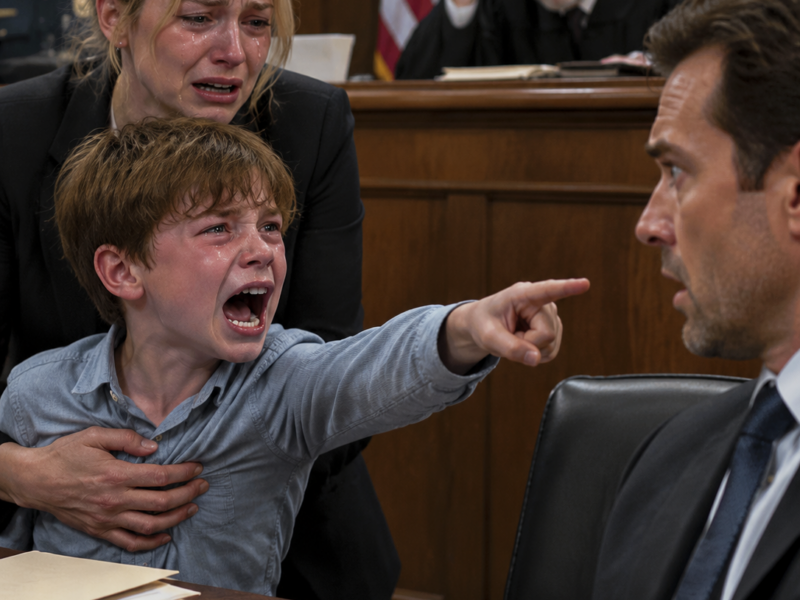
I Was a Terrified Mother Fighting for Custody of My 7-Year-Old Son When the Judge Suddenly Awarded Him to My Abusive Ex-Husband. I Begged Alex to Tell the Court What His Father Had Done, But Instead, He Looked at the Judge and Whispered, “Dad Put My Baby Sister in the Freezer for Six Months.” My Ex-Husband Turned Pale as Police Rushed Into the Courtroom, and What They Discovered in His Parents’ Basement Would Change Everything.
I Was a Terrified Mother Fighting for Custody of My 7-Year-Old Son When the Judge Suddenly Awarded Him to My Abusive Ex-Husband. I Begged Alex to Tell the Court What His Father Had Done, But Instead, He Looked at the Judge and Whispered, “Dad Put My Baby Sister in the Freezer for Six Months.” My Ex-Husband Turned Pale as Police Rushed Into the Courtroom, and What They Discovered in His Parents’ Basement Would Change Everything.
Part 1
The judge had just announced that my seven-year-old son would be placed in his father’s custody when everything I had feared became a reality.
I sat frozen at the plaintiff’s table, staring at the man who had spent seven years turning my life into a nightmare. David Miller sat across the courtroom, wearing an expensive suit, his hands folded neatly in front of him. A satisfied smile played across his face.
He had won.
Despite the bruises, the photographs, the medical records, and every desperate explanation I had given, the court had decided that he was the more suitable parent.
“Based on the evidence presented, the respondent has demonstrated a more stable financial situation and has secured a commitment from his parents to assist with the child’s upbringing. Therefore, physical custody of Alexander Miller is awarded to his father, David Miller.”
Judge Smith’s voice echoed through the courtroom.
I felt as though someone had driven a knife into my chest.
“No! Your Honor, please!” I cried, struggling to stand. “You can’t send my son to him! David beats me! He has hurt Alex, too!”
A bailiff immediately pushed me back into my seat.
My lawyer lowered his head. He had already done everything he could, but David had hired one of Pittsburgh’s most expensive attorneys. I had pawned my mother’s antique gold necklace to afford even the cheapest legal representation.
We never stood a chance.
David looked directly at me and smiled.
“Ellen, don’t worry. I’ll take good care of Alex.”
He deliberately emphasized the word care.
I knew that expression. I had seen it countless times after he slapped me, kicked me, or threw something at me. He always wore that same satisfied smile afterward, as though hurting someone weaker than himself made him feel powerful.
“You’re lying!” I shouted. “Alex, sweetheart, tell the judge what your father does to us. Tell him!”
My little boy stood beside David.
He was pale, frightened, and clutching the straps of his backpack. David’s hand rested heavily on his shoulder, squeezing hard enough that I could see Alex’s small body tense.
For several seconds, our eyes met.
I begged him silently to speak.
But Alex lowered his head.
My heart broke.
Judge Smith began collecting his papers. The hearing was apparently over. The marriage was dissolved, David had been awarded custody, and I was permitted to see my own child only two weekends each month.
David approached me before leaving.
“Get out of Pittsburgh, Ellen,” he whispered. “Alex is my blood. He’s staying with me. Don’t make trouble again.”
I stared at him, trembling with anger.
He turned toward our son.
“Come on, Alex. Let’s go home.”
Alex didn’t move.
“Alex.”
David’s voice became sharper.
Then, unexpectedly, my son raised his head and looked toward the judge.
“Sir, do I really have to go with my dad?”
Judge Smith paused.
“Son, the decision has already been made. You’ll live with your father, but your mother will be allowed to visit you.”
Alex shook his head.
His little voice trembled, but everyone in the courtroom could hear his next sentence.
“Dad put my baby sister in the freezer for six months.”
Silence.
Absolute silence.
I couldn’t understand what I had just heard.
Baby sister?
I had never told Alex that he had a sister. As far as I knew, there had never been another child.
But David’s reaction told me that something was terribly wrong.
His face turned gray. His mouth opened, but no words came out.
Then he suddenly lunged toward Alex.
“You little brat! What are you talking about?”
A bailiff intercepted him before he could reach our son.
“Respondent Miller, calm down!”
“He’s making it up!” David screamed. “His mother taught him to say that! This is a setup!”
Judge Smith slammed his gavel.
“Order! Bring the child forward. I want to hear exactly what he means.”
A female officer gently approached Alex and crouched beside him.
“Sweetheart, can you tell us what happened?”
Alex looked terrified. He glanced at David, then at me.
Finally, he whispered, “Dad told me never to tell anyone. But I saw her.”
“Saw whom?” the judge asked.
“My baby sister.”
Alex began crying.
“Last winter, Dad came home from the clinic with a big black plastic bag. He took it downstairs to Grandma’s basement and put it inside the old green freezer. Grandma tied the freezer shut with a rope.”
My entire body went cold.
Alex continued.
“One day, Grandma sent me downstairs to get some canned food. I saw the bag, and I wanted to know what was inside. I opened it a little.”
He covered his face.
“There was a tiny baby inside. Her skin was purple. She wasn’t moving. I was scared, so I ran away.”
The courtroom had become so quiet that I could hear the clock ticking on the wall.
“Then Dad found out,” Alex whispered. “He beat me and told me that if I ever told anyone, he would put me in the freezer too. He said the baby was a sister that Mom didn’t want, and we had to forget about her.”
I felt my knees weaken.
A year earlier, I had been pregnant.
David had been furious when I told him. He complained about money, expenses, and the inconvenience of another child. He insisted that we couldn’t afford a second baby.
When the time came to deliver, he refused to take me to a proper hospital. Instead, he brought me to a small private clinic on the outskirts of town.
I remembered the peeling sign, the unpleasant smell, and the doctor who barely spoke.
I remembered receiving general anesthesia.
And I remembered waking up to David telling me that our daughter had been stillborn.
“The baby didn’t survive,” he had said coldly. “The doctors already disposed of everything. Stop crying. There’s nothing we can do.”
I had cried for weeks.
Now, standing in that courtroom, I realized that perhaps everything I had believed was a lie.
Judge Smith immediately ordered the police to be contacted.
Within minutes, Detective Evans from the homicide division arrived with several officers.
“Where does your grandmother live, Alex?” he asked gently.
Alex gave him the address of David’s parents’ country house.
Evans turned toward his colleagues.
“Get a search warrant. Secure that property immediately. I want the basement searched, the freezer seized, and the forensic team notified.”
David was handcuffed.
He continued shouting that the baby was medical waste, that the clinic had mishandled everything, and that he had done nothing wrong.
But when the officers led him past me, he leaned close enough to whisper:
“Ellen, you’ll regret this. I’ll get you even if it’s the last thing I do.”
For the first time, I didn’t look away.
I was terrified, but something inside me had changed.
My daughter might have been hidden from me, but I would not allow her to disappear without a name, without dignity, and without justice.
At the police station, Detective Evans questioned me about the pregnancy, the clinic, and everything that had happened after the delivery.
I told him everything.
I also spoke about David’s violence, the years of humiliation, and the way he had gradually isolated me from friends and family.
Meanwhile, Alex was interviewed by a child psychologist.
Several hours later, Evans returned.
“Ellen, we’ve found the freezer.”
My heart stopped.
“It was in the basement of the country house. Your son described it accurately. An old green freezer, badly rusted, with its door tied shut. Inside, our officers found a black plastic bag containing what appears to be the remains of an infant.”
I covered my mouth.
“Is it…?”
“We need DNA testing and a complete forensic examination. We also need samples from you and Alex.”
I immediately agreed.
“Take whatever you need.”
My daughter had already lost everything. I wasn’t going to refuse the one thing that might finally establish who she was.
That evening, Alex and I left the station with only a few hundred dollars between us.
We had nowhere to go.
The apartment where David had beaten me was no longer safe, and his parents’ house held a secret I couldn’t bear to face.
We checked into a cheap motel near the police station.
Alex fell asleep almost immediately, exhausted from everything that had happened.
I sat beside him, watching his little chest rise and fall.
If he hadn’t spoken in court, he would have been forced to live with the very man who had threatened to freeze him alive.
I gently brushed his hair away from his forehead.
“Mommy is sorry, sweetheart.”
My old phone suddenly vibrated.
An unknown number appeared on the screen.
I hesitated before answering.
A man’s voice came through.
“Listen carefully, Ellen. Drop the charges. Tell the police your kid made everything up. Otherwise, you and that boy won’t have a future in Pittsburgh.”
My hand began shaking.
I looked at Alex sleeping peacefully.
Then I remembered the tiny girl in that freezer.
“No,” I whispered.
I ended the call and immediately contacted Detective Evans.
Whatever happened next, I would not surrender.
Part 2
That night, while Alex slept in the safe house, an unknown number flashed across my phone. A man ordered me to withdraw my statement and claim my son had imagined everything. If I refused, he warned, neither of us would have a future in Pittsburgh. My hands shook, but I called Detective Evans instead of surrendering. Within minutes, officers arrived, traced the call to a burner phone, and moved us to a protected apartment. Evans told me David’s associates were frightened because the investigation was closing in. The doctor from the illegal clinic had been arrested, and forensic testing was underway. Before leaving, Evans shared one preliminary finding: the baby had been full-term, and the crude treatment of her umbilical cord raised troubling questions. I barely heard the rest. For months, I had believed my daughter was stillborn. Now every memory of that clinic, every evasive glance from my mother-in-law, and every lie David had told me began to rearrange themselves into something unbearable. I had to know whether Lily had ever breathed, whether she had been alive when he carried her away. When the DNA results came, the truth would no longer be something I could hide from anymore.
Part 3
The police safe house was a small apartment in an ordinary residential building. It had one bedroom, a modest kitchen, and a living room with furniture that looked as though it had been purchased decades earlier.
But it had something our old home had never given us.
Safety.
Detective Evans introduced us to Officer Parker, who would help protect us while the investigation continued. He also gave me emergency contact numbers and warned me not to leave the apartment without informing the police.
For the first few days, I barely slept.
Every time I closed my eyes, I saw the old green freezer. I imagined my daughter lying inside a black plastic bag, surrounded by frozen meat, while her father continued living his ordinary life.
I couldn’t understand how someone could do such a thing.
David had been cruel to me, but I had never imagined he could be capable of murdering his own child.
One morning, Officer Parker arrived with breakfast and an update.
“The doctor from the illegal clinic has been arrested. He was found in another town and is being brought here for questioning.”
“What about David’s mother?”
“She’s being investigated for helping conceal the body. She initially denied knowing anything, but she’s beginning to contradict herself.”
I nodded.
I had never trusted Mary Miller, but I had once believed she was simply an unpleasant, controlling mother-in-law.
Now I understood that she had helped her son hide my daughter.
She had known there was something inside that freezer.
She had tied its door shut.
She had allowed her grandson to live in the same house as that terrible secret.
I couldn’t forgive her.
A few days later, Detective Evans called.
“Ellen, the DNA results are ready.”
I stood in the kitchen, gripping the edge of the table.
“The infant is your biological daughter. The comparison confirms it. David Miller is also confirmed as her father.”
My knees nearly gave way.
I had a daughter.
Her name was Lily, although she had never been given the chance to hear it.
Evans continued carefully.
“The preliminary autopsy report has also been completed. The medical examiner found evidence that the infant had been born at full term. There are signs of amniotic fluid in her lungs, and the umbilical cord was handled very crudely.”
“What does that mean?”
He paused.
“The medical examiner believes there is a possibility that your daughter was still showing signs of life before she was placed in the freezer. We need further examinations to establish the exact circumstances and cause of death.”
The phone slipped from my hand.
For several seconds, I couldn’t breathe.
My daughter might have been alive.
She might have been crying, struggling, waiting for someone to help her.
And instead of taking her to a hospital, David had placed her inside a plastic bag and hidden her in a freezer.
I collapsed.
Alex rushed toward me.
“Mom! What’s wrong?”
I tried to answer, but the words wouldn’t come.
Officer Parker called for medical assistance, and I was eventually given medication to calm me down.
When I woke up that evening, Alex was sitting beside my bed.
His eyes were red.
“Mom, are you still sad because of my baby sister?”
I nodded.
He took my hand.
“It’s not your fault. Dad is bad. Grandma is bad. They’re bad people.”
I pulled him into my arms.
I wanted to tell him that everything would be fine, but I knew that would be another lie.
Instead, I kissed his forehead.
“You’re right, sweetheart. None of this is your fault.”
Detective Evans visited later that evening.
He explained that David had initially blamed everything on the underground doctor. He claimed the baby had been born dead and that he had simply panicked.
His mother had also tried to distance herself from the crime.
But the police had recovered David’s phone records, vehicle GPS information, and financial transactions connected to the clinic.
The doctor had admitted performing an illegal delivery.
The investigation was becoming increasingly difficult for David to control.
I asked Evans whether I could see my former husband.
He looked surprised.
“Ellen, I don’t recommend it. He’s extremely aggressive.”
“I know. But I need to ask him something.”
After obtaining permission, Evans arranged a supervised visit at the county jail.
When David entered the visiting room, I barely recognized him.
His head had been shaved. His face looked exhausted, and his expensive clothes had been replaced by a prison uniform.
But his eyes were unchanged.
The moment he saw me, he slammed his hand against the glass.
“You! You destroyed everything!”
I sat quietly.
“Why did you do it, David?”
“Do what?”
“Why did you put our daughter in that freezer?”
He laughed bitterly.
“She was born dead. The doctor told me there was nothing to save. I didn’t know what to do with the body.”
“Then why hide it for six months?”
“I panicked!”
I leaned closer.
“She was full-term. She was our daughter. The medical examiner believes she was still alive.”
His expression changed.
For the first time, I saw genuine fear in his eyes.
“That’s nonsense. Those doctors don’t know anything.”
I continued.
“Your mother has already talked to the police. They know about the freezer. They know about the clinic. They know about your phone calls and the money you paid.”
David began breathing heavily.
Then he suddenly exploded.
“Why would I want another child? I was already struggling to provide for this family! Another mouth to feed! Another expense! Alex was already enough trouble!”
I stared at him.
There it was.
The truth.
He had never considered his children human beings with their own lives and feelings. They were simply inconveniences.
I slowly stood.
“My biggest regret is that I chose you. My second biggest regret is that I didn’t take Alex away from you sooner.”
David began shouting again.
But I no longer cared.
I walked out without looking back.
Outside, Evans was waiting beside his car.
“Did he admit anything?”
“He admitted what he thought about the baby. But he still denies killing her.”
Evans nodded.
“That may change when the full forensic report arrives.”
Before dropping me off, he told me that David’s associates had also been arrested. One of them had attempted to leave the area, but police found illegal substances and messages connecting him to threats against me.
For the first time in months, I felt that perhaps the danger was finally decreasing.
A few weeks later, the district attorney officially filed charges.
David was indicted for first-degree murder of a minor and abuse of a corpse.
Mary Miller was charged with accessory after the fact.
The underground doctor faced multiple charges relating to illegal medical practice and the circumstances surrounding the delivery.
The trial was scheduled for several months later.
During that time, I made arrangements to give my daughter a proper burial.
I chose the name Lily.
I bought a small silver locket and had her name engraved on the back.
When the funeral finally took place, I stood beside her tiny grave holding Alex’s hand.
There was no photograph on the headstone.
There were no memories of her first steps, first words, or first birthday.
Only her name.
“Lily, Mommy is here,” I whispered.
“I’m sorry I couldn’t protect you. I’m sorry I never got to hold you while you were alive.”
Alex placed a small flower beside mine.
“Don’t be afraid, baby sister. Mom and I will come visit you.”
I cried until my eyes hurt.
But I knew I had to keep going.
For Alex.
For Lily.
And for the woman I had once been before David had convinced me that I deserved every terrible thing he did.
When the criminal trial finally began, the courtroom was almost empty.
David sat beside his attorney, Lewis, the same expensive lawyer who had helped him win custody.
Mary sat beside her own defense attorney, her gray hair disheveled and her face pale.
The prosecutor presented the evidence.
The freezer.
The black plastic bag.
The DNA results.
The autopsy.
The clinic records.
The phone messages between David and the underground doctor.
And finally, the testimony of my son.
Because Alex was so young and had suffered severe psychological trauma, the court decided to present a recorded interview conducted by a child psychologist.
I watched his little face appear on the screen.
He described the purple baby, the freezer, and the threats his father had made.
The courtroom fell silent.
David lowered his head.
Mary covered her face.
Then I was called to testify.
I explained how David had taken me to the clinic, how I had been anesthetized, and how he had told me our daughter was dead.
When the defense attorney questioned me, he tried to portray me as a bitter former wife seeking revenge.
“Witness Miller, you hated my client, didn’t you?”
“I hated what he did to me and our children.”
“Isn’t it possible that you influenced your son to make these accusations?”
“No.”
“Your son is only seven years old. You weren’t present when he claims to have seen the infant, were you?”
“No, but the police found physical evidence that confirms his account.”
Lewis adjusted his glasses.
“So you’re asking this court to believe a child’s story and your own assumptions?”
I looked directly at him.
“I’m asking this court to believe the evidence. And I’m asking you to remember that the child you’re discussing is my daughter. She deserved a chance to live.”
The judge instructed the attorney to move on.
The prosecution then presented the medical examiner’s findings.
The evidence established that Lily had been born with signs of life and that the circumstances surrounding her death were consistent with prolonged exposure to extreme cold.
The doctor also testified about the illegal procedure and his communications with David.
There was no longer any convincing way to deny what had happened.
During his final statement, David suddenly began crying.
“I made a mistake. I was confused. I never wanted to kill my daughter. I thought she was already dead.”
Mary also pleaded for mercy.
“I’m an old woman. I didn’t understand the law. I only wanted to help my son.”
I listened without moving.
If their apologies could bring Lily back, I would have accepted them.
But they couldn’t.
Finally, the judge returned with the verdict.
“David Miller is found guilty of first-degree murder of a minor and abuse of a corpse. The court sentences him to life imprisonment without the possibility of parole.”
David’s face turned white.
The judge continued.
“Mary Miller is found guilty of accessory after the fact. She is sentenced to seven years in a state correctional facility.”
I gripped the edge of the table.
It was over.
The man who had terrorized my family would never again walk freely among us.
But when Evans approached me afterward, I couldn’t celebrate.
I could only cry.
Justice had finally arrived.
Unfortunately, it had arrived too late for my little girl.
Part 4
The weeks following the verdict were strange.
I had imagined that once David was sentenced, I would feel completely free.
Instead, I felt empty.
The anger that had kept me moving suddenly had nowhere to go. Some mornings, I woke up and couldn’t remember what I was supposed to do next.
Then I would see Alex sleeping beside me, and reality would return.
He still needed breakfast.
He still needed school supplies.
He still needed someone to help him with his homework and remind him that the world wasn’t entirely cruel.
I had to build a life for us.
Detective Evans suggested that I consider filing a civil lawsuit.
David had owned an apartment, a car, and several bank accounts. His mother also owned a country property.
An attorney named Norton explained that I could pursue compensation for emotional distress, punitive damages, funeral expenses, and the division of marital property.
At first, I wasn’t interested.
“What good is money if it can’t bring my daughter back?” I asked.
Norton looked at me sympathetically.
“It can’t bring her back. But it can help secure your son’s future. And David should be held financially responsible for what he did.”
I eventually agreed.
We filed a claim seeking approximately five million dollars.
The amount was enormous, but Norton explained that it reflected the seriousness of the crime and the suffering my family had endured.
Meanwhile, I needed employment.
Brenda Stevens, a social worker from the Department of Human Services, helped me find a position as a stocker at Maxi Mart.
The salary wasn’t particularly high, but it was stable.
I also qualified for food assistance, housing support, and free school lunches for Alex.
For the first time in years, I had a schedule that belonged to me.
I woke up early, prepared breakfast, went to work, collected Alex from school, and cooked dinner.
It wasn’t glamorous.
But it was peaceful.
My manager, Valerie, was a sharp-tongued woman with a surprisingly kind heart.
She sometimes let me leave early when Alex needed me. If the store had perfectly good groceries that were being written off, she occasionally sold them to me at a reduced price.
The other women slowly became friendly with me.
Some brought homemade food. Others asked how Alex was doing.
I was grateful for every small kindness.
Unfortunately, not everyone was kind.
One afternoon, while arranging bottles of cooking oil, I overheard two customers discussing the case.
“Did you hear about that baby murder? The husband got life, and his mother got seven years.”
“Terrible. Imagine being married to someone like that.”
“They say the wife didn’t even know her baby had been killed. The child was hidden in a freezer for six months.”
I stood motionless, holding a bottle.
One woman continued.
“Poor woman. I wonder how she’s managing with her son now.”
Their words weren’t intentionally cruel, but hearing strangers discuss my tragedy made my chest tighten.
I felt as though I had become a story people could casually discuss while shopping for groceries.
Valerie noticed my expression.
“Ellen, come to the stockroom for a minute.”
She handed me a bottle of water.
“Don’t listen to people. Everyone has something to say. You have a job, a child, and a future. That’s what matters.”
I nodded, fighting tears.
She patted my shoulder.
“Now drink that and get back to work. Those shelves aren’t going to fill themselves.”
I almost smiled.
For a while, things seemed to improve.
Alex returned to school, made a few friends, and began seeing a child psychologist regularly.
Then one afternoon, I arrived at the school gates and found him surrounded by several older students.
They were pushing him against a wall.
“Your dad is a murderer!”
“Your sister was killed and put in a freezer!”
“Maybe you’re just like him!”
Alex stood silently, holding his backpack.
His face was pale.
I rushed forward.
“Get away from my son!”
The boys stepped back.
One of them, a tall student named Nick, looked at me and smirked.
“Oh, look. The murderer’s wife is here.”
I wanted to scream.
Instead, I demanded an apology.
Nick refused.
His teacher, Miss Anderson, arrived and immediately took the boys to the principal’s office.
She apologized to me and promised that the school would take disciplinary action.
I took Alex home.
The moment we entered the apartment, he burst into tears.
“Mom, why do they hate me? I didn’t do anything!”
I held him tightly.
“Because some people don’t understand that children aren’t responsible for their parents’ actions.”
“But they say I’m cursed.”
My heart broke.
I explained that David’s crimes belonged to David alone. Alex had done nothing wrong, and neither had I.
But that night, after he fell asleep, I couldn’t stop thinking.
I could endure poverty.
I could work two jobs.
I could carry my own pain.
But I couldn’t allow Alex to grow up being punished for something his father had done.
Perhaps we needed to leave Pittsburgh.
The thought frightened me.
I had no special qualifications, very little savings, and a daughter buried in the city.
How could I leave her?
A few days later, I spoke to Detective Evans.
He understood my concerns.
“The law can punish criminals, Ellen. Unfortunately, it can’t control what people say. If you think moving would help your son, we can look into relocation assistance.”
I thanked him.
I still wasn’t sure what to do.
Then something unexpected happened.
One weekend, I took Alex to the supermarket to buy a sweater.
Near the entrance, a well-dressed woman approached me.
“Excuse me. Are you Ellen Miller?”
I nodded cautiously.
“My name is Olivia Nelson. We met briefly during your custody hearing.”
I remembered her.
She had been sitting in the gallery that day, watching everything unfold.
Olivia was in her forties and carried herself with quiet confidence.
She explained that she owned a small clothing factory called Silver Linings Apparel.
She had heard about my situation through Brenda Stevens.
“I’m looking for someone to help manage the stockroom and perform basic quality checks,” she said. “The salary is better than your supermarket job, and the schedule is stable.”
I hesitated.
“I don’t have much experience.”
“That’s fine. We’ll train you.”
Then she offered something I hadn’t expected.
“I also own a small apartment near the factory. It’s currently empty. You and your son can stay there while you get settled. I can help arrange a school transfer, too.”
I stared at her.
“Why would you do all that for us?”
Olivia was quiet for a moment.
“Many years ago, I was a single mother. I went through a difficult period, and someone helped me when I had nowhere to turn. I never forgot that kindness.”
She looked at Alex.
“I think your son deserves a chance to grow up somewhere peaceful.”
I felt tears forming.
“Thank you. I would love to accept.”
Olivia smiled.
“Then let’s get you started.”
Over the next several days, I arranged my resignation from Maxi Mart and completed the necessary paperwork.
Valerie was disappointed to lose me but genuinely happy about the opportunity.
Before leaving, I visited Lily’s grave.
I placed a small porcelain angel beside her headstone.
“Lily, Mommy and your brother are moving to another part of the city. We’ll still come to see you. Please watch over Alex.”
Then we boarded a bus.
As Pittsburgh’s familiar streets disappeared behind us, Alex rested his head against my shoulder.
“Mom, will we be happy there?”
I kissed his forehead.
“We’re going to try, sweetheart.”
Silver Linings Apparel occupied a renovated industrial building on the southern side of the city.
Inside, everything was bright and orderly.
Olivia personally showed me around the sewing rooms, warehouse, packaging department, and offices.
The apartment she offered us was small but clean. It had two beds, a kitchenette, a bathroom, and large windows overlooking a little courtyard.
Compared with the places we had lived before, it felt wonderful.
The next morning, I met John Peters, the warehouse manager.
He patiently taught me how to record incoming goods, check outgoing shipments, count inventory, and identify defective products.
The work required concentration, but I enjoyed it.
Nobody asked unnecessary questions about my past.
Nobody whispered behind my back.
People simply treated me like another employee.
Olivia also arranged Alex’s transfer to South Side Elementary.
His new teacher, Miss Anderson, welcomed him warmly.
On his first day, Alex was assigned to help distribute classroom folders.
When I collected him that afternoon, he ran toward me with an enormous smile.
“Mom! I made a friend! His name is Mike!”
I hugged him.
For the first time in months, I heard genuine excitement in my son’s voice.
And as we walked home together, I realized something important.
We hadn’t forgotten Lily.
We hadn’t escaped our past.
But perhaps we were finally learning how to live beyond it.
Part 5
Life at Silver Linings Apparel gradually became our new normal.
I learned the warehouse procedures, became more confident with inventory records, and developed a good relationship with John Peters.
The factory employees were friendly.
Some brought vegetables from their gardens. Others shared recipes during lunch breaks.
Olivia frequently checked on me and asked how Alex was adjusting.
She never made me feel like a charity case.
She treated me like someone who had been given an opportunity and was expected to make the most of it.
I appreciated that more than she probably realized.
Alex also began changing.
He made friends with Mike, started participating in class, and became interested in drawing.
His teacher noticed his talent and encouraged him to practice.
At home, he would sit at his desk for hours, filling notebooks with colorful pictures.
Sometimes he drew houses with enormous windows.
Sometimes he drew trees, flowers, and smiling children.
One evening, I asked him what his favorite picture represented.
“It’s our new home, Mom.”
I looked at the drawing.
There were two people standing in front of a little house, holding hands.
I kissed his forehead.
“It looks beautiful.”
Meanwhile, my civil lawsuit continued.
David’s attorney tried to negotiate a settlement for far less than we had requested.
But Norton refused.
She argued that David’s actions had caused extraordinary emotional damage and that his financial situation could not excuse his responsibility.
Eventually, the court awarded me three million dollars in damages and ordered the division of marital assets.
The money would take time to collect, but the decision was another confirmation that David could never escape the consequences of what he had done.
I began saving whatever I could.
My first full paycheck from the factory was approximately $2,500, including a bonus.
I bought Alex a set of colored pencils he had been wanting, deposited $1,000 into our savings account, and purchased fresh flowers for Lily’s grave.
For the first time, I could imagine a future that didn’t revolve entirely around surviving.
Then, one Saturday afternoon, an unexpected visitor appeared.
Alex and I were returning from Mike’s house when the security guard at the factory stopped us.
“Ellen, there’s someone waiting for you.”
“Who?”
“A man. He says he’s a relative.”
I noticed a black sedan parked near the entrance.
My stomach tightened.
I sent Alex inside with the groceries and approached the vehicle cautiously.
The man lowered his window.
“Are you Ellen?”
“Yes. Who are you?”
He removed his sunglasses.
“I’m Scott. David’s cousin.”
I vaguely remembered him from our wedding.
He got out of the car, looked at my work clothes, and gave a small disapproving smile.
“So this is where you’re living now?”
I didn’t answer.
He lit a cigarette and began explaining that David’s father had suffered a stroke after learning about the scandal. Mary was in prison, the family was falling apart, and everyone was struggling.
Then he finally revealed why he had come.
He wanted me to compromise.
“The court awarded you millions, but Dave can’t pay that. His father needs money for treatment. You should take half and leave the rest to the family.”
I almost laughed.
“Your cousin murdered my daughter. Your aunt helped hide her body. And you’re here asking me to worry about their finances?”
Scott’s expression hardened.
“Don’t be greedy, Ellen. David is already going to spend his life in prison. What more do you want?”
“I want the court’s decision respected.”
He stepped closer.
“Think carefully. Your son has only just started making friends at his new school. It would be a shame if something happened.”
My blood turned cold.
“Stay away from Alex.”
Scott smirked.
“I’m trying to help you.”
“No. You’re threatening me.”
He raised his hand as though he intended to strike me.
Before he could do anything, a woman’s voice rang out.
“What exactly is happening here?”
Olivia came through the factory gates, followed by security guard Paul and two employees.
She stepped between Scott and me.
“Ellen is my employee. You have no right to harass her on my property.”
Scott tried to act confident.
“This is family business.”
“Then discuss it somewhere else. If you don’t leave immediately, I’m calling the police.”
Paul already had his phone out.
Scott looked around, realized he was outnumbered, and backed toward his car.
He pointed at me.
“This isn’t over.”
Then he drove away.
My legs nearly collapsed.
Olivia caught my arm and brought me into her office.
She gave me water and listened while I explained everything.
“Don’t worry,” she said firmly. “I’ll arrange transportation for Alex to and from school. I’ll also contact the principal and make sure the security staff know what’s happening.”
“Olivia, you’ve already done so much for us. I don’t want to become a burden.”
She shook her head.
“Ellen, helping someone isn’t a burden. And nobody gets to threaten a child to steal money that legally belongs to his mother.”
Her words stayed with me.
The next morning, a company driver began taking Alex to school.
Olivia also spoke with the school principal, and the staff became more attentive.
Scott never returned.
Apparently, he had expected me to be frightened into giving up my compensation.
Instead, he discovered that I was no longer alone.
Winter eventually passed.
Spring arrived, bringing warmer weather and green leaves to the trees.
I had been working at the factory for almost six months.
My responsibilities increased, and Olivia raised my salary.
She also encouraged me to attend free evening computer classes through the Department of Human Services.
At first, I struggled.
I hadn’t studied anything beyond basic school subjects in years.
But I kept practicing.
I wanted to become more independent, and I wanted Alex to see that difficult circumstances didn’t mean someone had to stop learning.
Alex’s drawing improved dramatically.
His art teacher recommended additional lessons, and Olivia generously offered to help cover the costs.
“You have a talented boy,” she told me. “Let him develop that talent.”
I couldn’t thank her enough.
Eventually, with my savings and a small payment recovered from the sale of David’s car, I managed to rent a modest one-bedroom apartment.
It wasn’t luxurious.
The building was old, the kitchen was small, and the balcony could barely accommodate two chairs.
But it was ours.
On moving day, Alex helped me clean the windows and arrange our belongings.
He placed his desk near the brightest window.
Then he turned toward me.
“Mom, is this our real home now?”
I looked around.
There were no threats.
No shouting.
No locked doors.
No terrifying secrets hidden in the basement.
“Yes, sweetheart. This is our home.”
He smiled.
And I realized that this small apartment was worth more than every expensive room I had ever lived in with David.
Around that time, the final legal proceedings also concluded.
David’s appeal was rejected. His life sentence without parole remained in place.
Mary’s appeal was also denied, and she would serve her seven-year sentence.
The civil judgment was upheld as well.
David’s apartment was eventually sold to cover outstanding debts, and Norton continued pursuing the remaining assets.
I didn’t receive all the money immediately, but I no longer worried about whether he could somehow overturn the decisions.
The law had done what I had once believed impossible.
It had held him accountable.
One spring weekend, Alex and I visited Lily’s grave.
We brought a drawing he had made especially for her.
It showed a blue sky, white clouds, green grass, and a little girl with wings standing among yellow flowers.
I carefully placed it beside her headstone.
“Lily, look what your brother made.”
Alex crouched beside me.
“Baby sister, I’m going to become a great artist. I’ll draw lots of beautiful pictures for you.”
I watched him gently touch the stone.
My heart still hurt.
There were moments when I wondered what Lily would have looked like if she had been allowed to grow up.
Would she have had Alex’s eyes?
Would she have liked drawing?
Would she have laughed when I tickled her?
Those questions would never have answers.
But I no longer felt that grief was going to destroy me.
I had learned that surviving didn’t mean forgetting.
It meant carrying the memories of those we lost while continuing to care for those who remained.
On the bus ride home, Alex fell asleep against my shoulder.
Sunlight streamed through the window and rested on his face.
I looked at my son and thought about the day he had stood in that courtroom.
He had been only seven years old.
He had been terrified of his father.
Yet he had found the courage to speak when everyone else had failed to protect him.
He had saved himself.
He had saved me.
And most importantly, he had given his baby sister the chance to be remembered.
I kissed his forehead.
“Thank you, sweetheart,” I whispered.
He stirred slightly but didn’t wake.
When we reached our stop, I carried our bags and gently held his hand as we walked toward our apartment.
The yellow spring flowers along the sidewalk were beginning to bloom.
I thought about the woman I had been before everything happened.
I had been Ellen Miller, a frightened wife who believed that enduring abuse was simply part of marriage.
I had been a mother who thought she had lost her daughter through a tragic medical accident.
I had been a woman who lowered her head whenever strangers whispered about her family.
But that woman was no longer the whole story.
Now I was Ellen.
A working mother.
A student.
A woman who could support herself.
A mother who would never again allow anyone to convince her that she deserved to be mistreated.
My past would always leave scars.
There would still be difficult nights, painful memories, and days when I missed Lily so much that breathing became difficult.
But I had Alex.
I had a home.
I had people who cared about us.
And I had a future that belonged to me.
That evening, after Alex finished his homework, he showed me another drawing.
This time, it was a picture of our family.
There was me, Alex, and a little girl standing beside us, holding a flower.
Above them, he had drawn a bright yellow sun.
“That’s Lily,” he explained. “I wanted her to be in our picture.”
I couldn’t stop the tears.
I pulled him into my arms.
“She will always be part of our family.”
He nodded.
Then he asked the question that made me hold him even tighter.
“Mom, are you happy now?”
I thought about it for a moment.
I wasn’t completely healed. I didn’t have everything I wanted, and I never would.
But I was no longer afraid of opening my eyes in the morning.
I no longer wondered whether the person sleeping beside me might hurt me.
I no longer had to beg someone to let me see my own child.
So I smiled.
“Yes, sweetheart. I’m happy.”
And for the first time in a very long time, I knew I was telling the truth.
That night, before going to bed, I took out Lily’s silver locket and held it in my palm.
“Lily, Mommy and your brother are doing well. We have a little home now. Alex has friends, and he’s becoming a wonderful artist. I’m working hard, and we’re going to be okay.”
I placed the locket beside my bed.
“Mommy will never forget you. And we’ll keep living, not because we’ve forgotten what happened, but because you deserved a family that loved you.”
Outside, the spring breeze moved the curtains gently.
I looked toward Alex’s bedroom.
He was sleeping peacefully, surrounded by his drawings and colored pencils.
For years, I had believed that David had taken everything from me.
But he hadn’t.
He had taken my daughter’s life. He had stolen years of peace from my son and me. He had left wounds that would never completely disappear.
But he hadn’t taken our ability to love.
He hadn’t taken our courage.
And he hadn’t taken our future.
I turned off the light and closed my eyes.
Tomorrow, I would go to work.
Alex would go to school.
We would have breakfast, laugh about something ordinary, and continue building the small life we had fought so hard to obtain.
It wasn’t the life I had once dreamed of.
But it was ours.
And nobody would ever take it away from us again.