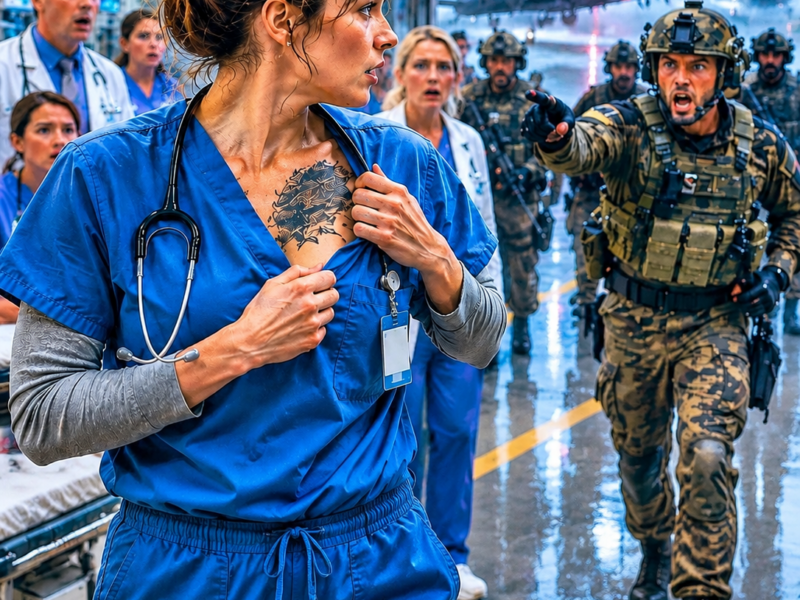
I Was a Quiet Night-Shift Nurse in Halifax, and My Senior Surgeon Had Humiliated Me for Three Years, Calling Me Incompetent in Front of Everyone. Then, During a Hurricane, Two Black Hawk Helicopters Landed Outside My Hospital Carrying Four Dying Navy SEALs. Their Commander Ignored Every Doctor and Asked One Question: “Where Is Nurse Wren?” When I Rolled Up My Sleeve, Five Battle-Hardened Men Stared at My Tattoo as If They Had Just Seen a Ghost…
I Was a Quiet Night-Shift Nurse in Halifax, and My Senior Surgeon Had Humiliated Me for Three Years, Calling Me Incompetent in Front of Everyone. Then, During a Hurricane, Two Black Hawk Helicopters Landed Outside My Hospital Carrying Four Dying Navy SEALs. Their Commander Ignored Every Doctor and Asked One Question: “Where Is Nurse Wren?” When I Rolled Up My Sleeve, Five Battle-Hardened Men Stared at My Tattoo as If They Had Just Seen a Ghost…
PART 1
The first thing the men asked when they stormed into Campbell Medical Center that night wasn’t for a doctor, a surgeon, or even the emergency department director.
They asked for a woman nobody seemed to know.
“Where is Nurse Wren?”
The question was delivered by a tall man in soaked military gear, his gray eyes moving across the emergency department with the precision of someone who had spent his entire life searching for threats. Behind him, four other men carried a wounded soldier on a stretcher. Their uniforms were covered in rain, their boots left muddy tracks across the hospital floor, and their expressions suggested they had already watched too many things go wrong that evening.
Nobody answered.
The charge nurse looked confused. The attending physician looked irritated. A hospital administrator would soon become furious.
But one woman standing quietly near the medication station felt the world stop turning.
Her name was Kimberly Roberts.
And four years earlier, she had been declared dead.
At Campbell Medical Center in Halifax, Nova Scotia, Kimberly was known as the quiet night-shift nurse who rarely spoke unless someone asked her a direct question. She was dependable, polite, and almost painfully modest. She never volunteered for leadership positions, never challenged senior physicians, and never attended the informal gatherings where the hospital staff discussed their personal lives.
Most people barely noticed her.
There was only one unusual thing about Kimberly.
She never rolled up her sleeves.
Not during the hottest summer shifts. Not when she was cleaning equipment, changing dressings, or rushing between patients. Her right sleeve remained buttoned tightly around her wrist, as though she were protecting an injury she didn’t want anyone to see.
Nobody knew what was underneath.
Nobody, except the woman herself, knew that beneath that sleeve was a small tattoo of a pair of black wings surrounding a single word.
WREN.
Below it was a line of numbers that meant absolutely nothing to ordinary people.
But to a very small group of military personnel, those numbers represented a history written in blood, sacrifice, and seven names that had never truly left her mind.
That evening, Halifax was being battered by the remnants of a powerful hurricane.
Rain slammed against the windows of Campbell Medical Center, and the wind rattled the emergency department doors. Flooding had closed several roads, leaving much of the evening staff stranded. Two ambulances had already been taken out of service, and nearby military flight operations at Shearwater Air Base had been suspended because of the dangerous weather.
The hospital was understaffed, exhausted, and preparing for a long night.
Kimberly stood at the medication station, carefully counting vials when a familiar voice interrupted her.
“Nurse Roberts.”
She immediately recognized the speaker.
Dr. Todd Spencer was forty-six years old, handsome in a carefully maintained way, and accustomed to being treated as the most important person in every room he entered. He was a senior attending physician who brought millions of dollars in clinical revenue to the hospital and never allowed anyone to forget it.
Unfortunately, he had developed a particular dislike for Kimberly.
He held a patient chart between two fingers and raised his voice so everyone nearby could hear.
“Bed eleven’s medication was ordered for 6:30. You documented administration at 7:00. Do you understand what happens when we start drifting on electrolytes, or should I draw you a picture?”
Several nurses lowered their eyes.
Kimberly continued arranging the medication.
“Pharmacy released it late, Dr. Spencer. I administered it four minutes after it arrived and documented the delay.”
“You documented the delay,” he repeated with a mocking smile. “Wonderful. When the patient codes, we’ll all take comfort in knowing you documented it.”
The accusation was ridiculous. Four minutes on an oral supplement was clinically insignificant, and everyone in the department understood that.
But nobody defended her.
Spencer had perfected the art of humiliating people while making it appear as though he was simply maintaining professional standards.
Kimberly lowered her eyes.
He leaned closer.
“Some people are born to follow orders. Try to remember which kind you are.”
Then he walked away.
Kimberly said nothing.
She had learned a long time ago that silence could be a form of discipline. There were people who could destroy your confidence with a sentence, and there were people who could destroy your entire life with a signature.
Todd Spencer was the first kind of man.
She had once known the second.
Three years earlier, Kimberly had arrived at Campbell with a nursing license earned under a different name and a history nobody was permitted to investigate. She had deliberately made herself ordinary. She accepted night shifts, avoided attention, and allowed people to underestimate her.
She had a reason.
Four years earlier, she had been a decorated Special Operations Medical Officer. She had worked in places where medical supplies were limited, where evacuation routes disappeared without warning, and where a decision made in ten seconds could determine whether an entire team survived.
Her call sign had been Wren.
Then came a mission that officially never happened.
Seven people died.
Kimberly survived.
The casualty report listed her among the dead, and the military record was never corrected. The truth behind the mission involved powerful people, classified decisions, and information that could have destroyed careers far above her rank.
She had been offered a choice.
Remain dead on paper and protect the people she loved, or challenge the official story and risk being branded a traitor.
She chose to disappear.
Before leaving Ottawa, she signed twelve documents, surrendered everything she had been permitted to keep, and began a new life as Kimberly Roberts.
She had even been offered the opportunity to remove her tattoo.
She refused.
The black wings remained on her forearm because seven names remained in her memory. Removing the ink felt too much like agreeing that those people had never existed.
Back at Campbell, she finished her medication count and went to check on a patient in bed seven.
His name was Jerry McIsaac, a seventy-something former dockworker who had spent forty years unloading ships in Halifax Harbour. He had pneumonia, a stubborn personality, and a habit of observing people more carefully than they realized.
He noticed Kimberly’s sleeves immediately.
“They always talk to you like that?” he asked.
Kimberly adjusted his oxygen tubing.
“Like what?”
“Like you’re smaller than everybody else.”
She smiled faintly.
“Dr. Spencer has high standards.”
Jerry gave a dry laugh.
“That’s not what I asked.”
She pulled his blanket up.
“Some people are easier to manage when you let them think they’re right.”
Jerry studied her.
“You hold your shoulders like you’re trying to disappear. Takes effort, that.”
Kimberly didn’t answer.
“I unloaded ships for forty years,” he continued. “I’ve seen strong men and weak men. Sometimes the strongest person in the room is the one who doesn’t need everybody looking at them.”
She looked at him for a moment.
“Get some sleep, Jerry.”
He closed his eyes, satisfied that he had said what needed saying.
Shortly afterward, the charge nurse, Judy Long, gathered everyone near the ambulance entrance.
Judy was a decent woman who had worked at Campbell long enough to understand that hospital administration and actual patient care were not always compatible. She looked exhausted.
“The storm has made landfall near the Eastern Shore,” she announced. “Shearwater is dark for flight operations, and we are the closest functioning emergency department for a significant stretch of coastline. Whatever comes through those doors tonight, we take it.”
Dr. Spencer stood beside her with his arms crossed.
“Everything comes through me first,” he announced. “Tonight, this department runs on precision. Everyone operates at their level, and nobody above it.”
His eyes briefly settled on Kimberly.
Everyone understood the message.
Then Gloria Edwards, the hospital administrator, appeared.
She carried a clipboard and wore the expression of someone who considered every unexpected situation a potential public-relations disaster.
“Corporate risk has already flagged tonight’s staffing,” she told Judy. “If anything goes wrong, the documentation had better be flawless.”
Her gaze moved toward Kimberly.
“That includes her. Dr. Spencer has raised concerns about her performance. I want every questionable person on this floor to have a paper trail.”
“Kimberly hasn’t received a single patient complaint in three years,” Judy replied.
“Dr. Spencer disagrees.”
“He brings this hospital four million dollars annually,” Edwards answered. “We have to understand our priorities.”
Kimberly continued restocking the trauma bays.
She had once been criticized by men whose decisions could determine whether people lived through the night. Now her employment depended on a surgeon who had never experienced anything worse than a difficult Friday evening.
She almost found it amusing.
Then she heard something.
At first, it sounded like another rumble of thunder.
But Kimberly knew better.
A low vibration moved through the windows. It was a familiar rhythm, one her body recognized before her mind could accept it.
Heavy rotors.
Two aircraft.
Low and fast.
In weather that had grounded almost everything else.
Kimberly slowly lifted her head.
Somewhere outside, two Black Hawk helicopters were approaching the hospital.
And whoever was inside them had run out of time.
PART 2
The first Black Hawk landed in the hospital’s visitor parking lot, ignoring the designated helipad entirely. Its rotor wash sent rainwater flying across the pavement, rocked parked cars, and scattered everything that wasn’t secured.
Five men rushed through the emergency department doors carrying a wounded soldier.
Their leader, a tall man with gray eyes and an early-silver beard, surveyed the room.
“One question before anything else,” he said. “We’re looking for a nurse. Her call sign is Wren. Where is she?”
Nobody understood.
Then the wounded soldier’s condition deteriorated.
Dr. Spencer demanded imaging, refusing to listen when the young operator explained that his friend was suffocating.
Kimberly watched from the corridor.
She recognized the injury immediately.
Tension pneumothorax.
The patient had seconds, not minutes.
She entered the trauma bay, rolled up her sleeves, and announced that the man needed immediate decompression.
Spencer ordered security to remove her.
But the gray-eyed commander stepped between them.
“Let her work, doctor, or explain to the Navy why you didn’t.”
Ninety seconds later, the patient was breathing again.
Then a young soldier noticed the black wings tattooed on Kimberly’s forearm.
The commander’s eyes followed.
For several seconds, nobody moved.
The wounded soldier opened his eyes, looked at her, and whispered:
“You’re dead.”
Kimberly continued working.
“Not tonight. Neither are you, sailor.”
The commander finally spoke.
“It’s good to see you, Ren.”
And the quiet nurse everyone had underestimated was no longer a mystery.
PART 3
The name hung in the trauma bay long after the commander had spoken it.
Ren.
Not Kimberly. Not Nurse Roberts.
Ren.
It was the name that had belonged to a woman the military had officially buried four years earlier. It was the name that had once been spoken over radios in places where nobody expected to survive the night.
For a moment, Kimberly allowed herself to look at the man standing beside the bed.
Chief Sean Andrews.
His call sign was Anvil.
He looked older than she remembered, although perhaps that was because the last time she had seen him, they had both believed there would be another mission, another briefing, another opportunity to sit somewhere safe and complain about bad coffee.
Now he stood in a civilian hospital, soaked from the storm, looking at someone he had helped bury.
But there was no time for explanations.
Kimberly checked the patient’s monitor and turned toward him.
“How many others were on the aircraft?”
Andrews understood immediately.
“More than one.”
“How many?”
“Four injured. Three critical.”
She nodded once.
“Then we have a very long night.”
The second Black Hawk appeared through the rain less than a minute later.
It approached the flooded parking lot with its landing light cutting through the darkness. The pilot brought it down hard, and the aircraft’s wheels touched the pavement while the first helicopter’s crew were still securing their patient.
Kimberly was already moving toward the ambulance entrance.
Three litters came into view.
The first carried a broad-shouldered Samoan crew chief named Efa. A tourniquet was secured above his badly injured thigh.
The second carried a co-pilot with severely burned hands wrapped in protective film. Despite her injuries, she kept apologizing to everyone who passed her.
The third held a man named Flint.
He was pale, barely responsive, and bleeding internally from a wound in his lower abdomen.
The flight medic, Red Ortiz, looked as though he had been awake for several days.
“His pressure keeps dropping,” he told Kimberly. “I’ve pushed everything I have. He needs a surgeon.”
“He’ll get one.”
She said it with such certainty that Ortiz didn’t question her.
“Efa stays on that tourniquet. Write the application time directly on his skin, not just the chart. Charts get misplaced. Ortiz, I need your complete intervention timeline when you can give it to me.”
“I can still work,” the medic protested.
“I know you can. That’s why I’m saving you.”
She pointed toward a chair.
“Drink something sweet. Sit down for five minutes. I need your hands later.”
The department transformed almost instantly.
Kimberly assigned beds, moved equipment, requested blood products, and organized the staff into small teams. She knew who could remain calm under pressure and who needed simple instructions delivered one at a time.
The strange part was that she had never officially been in charge of these people.
For three years, she had worked quietly in the background, watching how everyone behaved during emergencies. She knew which respiratory therapist was excellent at improvising, which young nurse was more capable than she believed, and which technician became overwhelmed when several people spoke at once.
Now all that observation became useful.
“Judy, clear beds two, three, and four.”
“Jeremy, you’re on bed three.”
“Dana, warm blankets and pressure bags.”
“Bring every unit of O-negative blood to this floor. If the tube system is slow, walk it upstairs yourself.”
The staff moved.
Not because Kimberly had a formal title.
Not because someone had announced that she was in charge.
They moved because every instruction made sense, and every second she spent speaking seemed to buy someone another chance to live.
Unfortunately, Gloria Edwards had a different understanding of what was happening.
She entered the emergency department carrying her red administrative binder.
“Stop! Everyone, stop!”
Her voice cut through the noise.
She stood at the entrance to the treatment area, with Dr. Spencer behind her.
“This is an unauthorized mass-casualty intake. There is a chain of command in this building, and it does not run through a staff nurse with a disciplinary record.”
She pointed directly at Kimberly.
“Nurse Roberts, you are relieved of duty. Security is on the way.”
For a moment, the department froze.
Not because anyone wanted to obey, but because civilians were accustomed to stopping when someone with authority raised their voice.
Kimberly looked at the monitor beside Flint.
His blood pressure was continuing to fall.
She turned toward Edwards.
“There are four service members in this department who won’t survive another round of administrative delays. You have two choices. You can document everything I do and use it against me tomorrow, or you can stand in that doorway and explain why you cost this hospital another body.”
Edwards tightened her grip on the binder.
“You cannot speak to me like that.”
Kimberly turned back toward the bed.
“Authority is what you’re holding. It’s a binder, Gloria.”
Then she looked at Spencer.
“I need physician orders documented for everything we’re about to do. You’re the attending.”
Spencer looked uncomfortable.
“You expect me to authorize procedures you’re directing?”
“I expect you to be the doctor these patients need. You can spend tomorrow explaining that you helped save four people during a hurricane, or you can spend it explaining why you watched them die.”
For the first time, Spencer had no immediate answer.
He looked at the patients.
Then he looked at Kimberly.
He had spent three years treating her as an incompetent employee, and now he was being asked to trust her with lives that depended on decisions he himself was struggling to make.
Something changed in his expression.
“Hang another unit,” he finally said.
He pulled on a fresh pair of gloves.
“Get me the on-call surgeon. Whatever she requests, order it.”
Edwards stared at him.
“You cannot be serious.”
Spencer didn’t look at her.
“Get out of the treatment area.”
She remained in the doorway, furious.
Then security arrived.
The officer was a heavy-set man named Corey Murray, who had spent twenty-two years in the Navy before joining the hospital security team. He wore his uniform neatly and had an anchor tattoo on his forearm.
He surveyed the room.
Four injured military personnel. Medical equipment scattered across the floor. A tired flight medic. A commander standing near the trauma bay.
Then he saw Kimberly.
Her sleeves were rolled up, revealing the black wings.
Murray looked at the tattoo for several seconds.
Without saying a word, he unclipped his radio, switched it off, and positioned himself beside the entrance.
He stood almost at attention.
Edwards stared at him.
“Officer Murray, I called you here to remove an employee.”
He didn’t move.
“Ma’am, I’m not interrupting medical treatment.”
And that was the end of the argument.
But the night was far from over.
The ambulance doors opened again.
This time, the incoming patient had nothing to do with the military.
A fifty-year-old roofer named Gable had been crushed when part of his carport collapsed during the storm. His chest and shoulder were badly injured, and his teenage son was running beside the stretcher, holding the rail with both hands.
Behind them came a woman from an evacuation shelter who had gone into labor.
The emergency department was now treating four military casualties, a critically injured civilian, and a woman about to give birth.
The storm continued pounding the building.
Kimberly surveyed the situation.
“Dana, take the mother to the birthing suite. Wake whoever is on call for obstetrics.”
She turned toward the roofer.
“Jeremy, I need chest imaging as soon as he’s stable enough. Watch his left side.”
Then she noticed the boy.
He was perhaps sixteen or seventeen, soaked to the skin, trembling, and trying desperately not to cry.
“What’s your name?”
“Ethan.”
“Ethan, your father is getting treatment. I want you to sit over there where you can see him. We’ll bring you a dry blanket.”
“Is he going to die?”
Kimberly paused.
She had learned never to make promises she couldn’t keep.
“Your father has people working very hard to help him. We’re going to give him every chance we can.”
The boy nodded.
She turned toward Spencer.
“Doctor, I need you on the roofer. Possible chest-wall injury and pulmonary contusion. He needs an attending’s assessment.”
Spencer nodded.
“On it.”
For the next forty minutes, something remarkable happened.
Todd Spencer became an excellent doctor again.
He examined the roofer, reviewed the available imaging, coordinated treatment, and spoke to the family with a patience nobody at Campbell had seen from him before.
Kimberly didn’t praise him.
She simply allowed him to do his job.
Meanwhile, Flint’s condition worsened.
His heart rate became erratic, and the monitor began sounding an alarm.
Kimberly moved to his bedside.
“Flint, stay with me.”
No response.
She checked his pulse.
Nothing.
“Start compressions.”
Boone, the youngest member of the military team, moved into position.
His hands shook as he began pressing against Flint’s chest.
“Keep your rhythm,” Kimberly instructed. “Don’t speed up. Every compression counts. You’re doing exactly right.”
Boone looked at her.
“How do you know my name?”
“Anvil said it when you came through the door.”
She kept her fingers near Flint’s neck.
“Names matter.”
The seconds stretched.
Boone continued compressions.
The room seemed to shrink around the bed.
Then Kimberly felt something.
A faint pulse.
“Wait.”
She checked again.
“There he is. Stop compressions.”
The monitor struggled, then found a rhythm.
Flint was alive.
Boone stepped backward, his hands hovering over the bed as if he didn’t trust what he was seeing.
Kimberly placed a hand on his shoulder.
“Look at the monitor, not at me. He’s still here.”
Boone nodded, tears running down his face.
Across the room, Andrews watched her.
He had seen her do extraordinary things before, but there was something different about this.
She wasn’t wearing a uniform.
She wasn’t carrying a weapon.
She was simply a nurse in a civilian hospital, doing the work she had never been able to stop doing.
Andrews approached her when the immediate crisis had settled.
“Ren.”
She didn’t turn.
“Not here.”
“I know.”
“You don’t understand. I spent four years making sure nobody could find me.”
“I know.”
“Then why did you come?”
He looked toward the wounded men.
“Because one of ours was dying, and Campbell was the nearest functioning trauma center.”
She finally met his eyes.
“And?”
He hesitated.
“Because I heard a story nine months ago.”
“What story?”
“A navy corpsman rode with an ambulance crew in Halifax. He watched a night nurse perform a procedure using the exact sequence we were taught in the military. Then he watched her apologize to the doctor for overstepping and quietly return to the corner.”
Kimberly looked away.
“He recognized the technique,” Andrews continued. “He told the story in a bar. It took nine months to reach me.”
“And you believed it?”
“I wanted to.”
He looked at the tattoo on her arm.
“Then tonight, when our aircraft went into the water, I looked at the map. Campbell was the nearest hospital.”
He paused.
“I’d like to say I chose it because of Flint. The truth is, I chose it because of the ghost story.”
Kimberly didn’t answer.
For several seconds, the only sound between them was the rain.
Then Andrews said something that changed her expression.
“The surgeon is still stranded. We need another option.”
Kimberly looked toward Flint.
“How long?”
“Not long enough.”
She glanced at the clock.
Four o’clock in the morning was approaching.
The hospital had exhausted almost every resource available to it.
And the one person who might still save Flint was trapped somewhere beyond the flooded highways.
Kimberly picked up the telephone.
“Then we find a way to bring the surgeon here.”
PART 4
The on-call trauma surgeon was stranded north of a flooded interchange.
Her vehicle had stalled in more than three feet of water, and the roads around her were completely impassable.
Judy had been trying to reach the county emergency services for nearly an hour.
Every response was the same.
No available vehicle.
No safe route.
No estimate of when the roads would reopen.
Flint was running out of time.
Kimberly stood beside the treatment bed, studying his monitor while Andrews stepped away to make a telephone call.
He didn’t explain who he was calling.
He simply gave someone an address, described the situation, and ended the conversation.
Eleven minutes later, the sound of a heavy engine echoed outside.
A high-water rescue truck from a reserve unit came through the flooded streets.
Inside it was Dr. White, a fifty-eight-year-old trauma surgeon who had been rescued from her stranded vehicle.
She arrived barefoot, wearing pajama pants beneath a rain jacket, and carrying her boots in one hand.
She entered the emergency department without wasting a second.
One glance at Flint’s condition told her everything she needed to know.
She examined the patient, checked the blood products, and then looked at Kimberly.
“What do you need from me?”
“A surgical table within thirty minutes. Lower-right abdominal injury. We’ve slowed the bleeding, but we haven’t stopped it. Four units of blood administered. He’s holding by his fingernails.”
Dr. White looked at the monitor again.
“Then he’ll have a table.”
She pulled on her boots as she walked toward the operating room.
At the door, she stopped.
“Where did you train?”
Kimberly looked at her.
“Somewhere with worse lighting.”
Dr. White studied the tattoo, then the silent military men gathered near the treatment area.
She understood that there was a story behind the woman standing in front of her.
But after thirty years in surgery, she had learned that not every story belonged to her.
She simply nodded and disappeared into the operating room.
The waiting began.
Andrews and his men gathered in the corridor.
They didn’t pace.
They didn’t complain.
They stood quietly, their attention fixed on the doors behind which their teammate was fighting for his life.
Kimberly didn’t join them immediately.
She reset the emergency department, checked on the roofer, made sure the woman in labor had everything she needed, and returned to Efa’s bedside.
Efa was awake now and deeply unhappy about his injuries.
“Can I get something to eat?”
“Not yet.”
“I’ve been flying for hours. I think I’ve earned a sandwich.”
“You’ve earned several sandwiches. Unfortunately, your surgeon needs to examine you first.”
He frowned.
“What if I promise not to tell?”
Kimberly almost smiled.
“I’ll personally document your last sip of water on your wristband. You don’t want that kind of paperwork.”
Efa grumbled but obeyed.
Later, Kimberly found Red Ortiz sitting in a chair near the nurses’ station.
His hands were still shaking.
He had spent forty minutes inside a damaged aircraft, trying to keep three men alive while the helicopter fought through the storm.
He had administered medication, controlled bleeding, and performed interventions in conditions that would have terrified most medical professionals.
But now that the immediate danger had passed, the exhaustion was catching up with him.
Kimberly sat beside him.
“Tell me everything from the beginning.”
Ortiz looked confused.
“Why?”
“Because I need your timeline.”
He began explaining.
At first, his words came quickly, almost mechanically. He described the impact, the damaged aircraft, the first injuries, the emergency procedures, and the difficult decision to divert toward Halifax.
Kimberly listened without interrupting.
Whenever he hesitated, she asked a precise question.
When he finished, he looked down at his hands.
“I should have done more.”
Kimberly shook her head.
“You did exactly what the situation allowed you to do.”
“But Flint almost died.”
“He’s alive because you kept him alive long enough to reach us.”
Ortiz looked at her.
“You really believe that?”
“I know it.”
Something in his expression softened.
His hands gradually stopped shaking.
It was an old technique from her previous life. After difficult missions, she had learned that people needed more than medical treatment. They needed someone to help them understand what had happened, what they had done correctly, and what they could not have controlled.
By sunrise, Flint was stable.
Dr. White emerged from the operating room carrying her surgical cap.
“He’s going to survive,” she announced.
The words seemed to release an entire corridor of tension.
“His injuries were serious, but we repaired the damage. He’s stable.”
Andrews closed his eyes.
Boone lowered his head.
Efa, hearing the news from his recovery bed, shouted something that made a passing nurse laugh.
Dr. White looked at the group.
“Somebody bought that man exactly enough time. I know who because I’ve never received a handoff that clean from a civilian emergency department.”
Her eyes settled on Kimberly.
“You can breathe now, everyone. That’s a medical order.”
The storm finally began to weaken.
Around five in the morning, the eye passed over Halifax Harbour.
The city became strangely quiet.
The rain slowed, and the windows of Campbell Medical Center stopped trembling.
Kimberly was checking Luke’s chest tube when he opened his eyes.
He looked younger awake than he had while fighting for his life.
Twenty-nine years old, pale, exhausted, and confused.
He watched her approach.
“My dad had a picture of you,” he whispered.
Kimberly stopped.
“Your father?”
“Warrant Officer Wayne Roberts. No relation to your cover name, I guess.”
She looked at him carefully.
“I know exactly who your father was.”
Luke gave a small, painful smile.
“He used to talk about a skinny kid and a fishing trip nobody believed.”
Kimberly pulled a chair beside his bed.
For the first time that night, she sat down.
Luke’s father had been one of the seven.
He had been a man who laughed too loudly, carried too many photographs, and insisted that every new member of the team needed to learn how to fish properly.
He had also been the man who held pressure against another soldier’s wound while the mission collapsed around them.
Kimberly remembered the final moments clearly.
The noise.
The dust.
The radio communications.
Wayne’s voice.
He had been injured, but he refused to let go of the wounded man beside him.
He had asked Kimberly to make sure his son knew he had been there.
She had been eleven meters away when he died.
For four years, she had carried that memory without being able to explain it to his family.
Now his son was lying in front of her.
“Your mother wrote to the department for a year,” Kimberly said quietly. “She wanted to know whether your father was afraid. Whether anyone had been with him. Whether he suffered.”
Luke swallowed.
Kimberly took a breath.
“It was fast where it mattered and slow where it didn’t. Your father held pressure on another man’s wound even after he was hit. He refused twice to let go.”
Her voice softened.
“The last thing he said wasn’t about himself. He asked me to look after the others.”
Luke’s eyes filled with tears.
“Was he scared?”
Kimberly shook her head.
“He was busy.”
Luke looked toward the ceiling.
“That’s exactly what he’d say.”
“Your father died the way most people only ever manage to live,” she told him. “Thinking about somebody else.”
Luke began crying carefully, mindful of his chest tube.
Kimberly placed her hand over his.
She stayed until the tears passed.
Later, Andrews found her in the family waiting room.
He brought two cups of coffee and handed her one.
“Four years,” he said.
She looked toward the window.
“There was a casket with a flag on it. I helped carry it. Two hundred people stood in the rain and watched your name go into the ground.”
“I know.”
“I wondered whether you were alive every single day.”
Kimberly held the coffee without drinking.
“I wrote three letters that year. I burned all three.”
“Why?”
“Because the mission went wrong in a way that had powerful names attached to it. Important names. The kind that don’t go to prison. They make problems disappear instead.”
She looked at the rain beginning to gather again on the glass.
“I knew what I’d seen, but I couldn’t prove any of it. The man who signed my casualty report told me I could die a hero on paper or become a traitor in a hearing room. Either way, the seven stayed dead.”
Andrews listened without interrupting.
“So I chose the hero option,” she continued. “I disappeared. It kept my mother safe. It kept your team safe.”
He looked down.
“You shouldn’t have had to do that.”
“No. But I did.”
For a moment, neither spoke.
Then Andrews looked toward the emergency department.
“They’ll come for you in the morning. People like Gloria Edwards wait for daylight. Let me make a call. By noon, there’ll be an officer here, a citation, and news cameras outside. Nobody will dare touch you.”
Kimberly slowly put down her coffee.
“That’s why I’m asking you not to.”
He frowned.
“I buried Wren for a reason. That reason hasn’t changed.”
“Ren—”
“But there’s one call you can make. And one uniform I want in this building by morning.”
She turned toward him.
“I want to explain it to this hospital myself.”
For the first time that night, Andrews smiled.
“Whatever you’re about to do to that man, I want a seat in the front row.”
PART 5
Morning arrived over Halifax with an almost insulting beauty.
The storm had passed, leaving flooded roads, broken branches, damaged roofs, and two Black Hawk helicopters sitting in the hospital parking lot with their rotors secured.
Inside Campbell Medical Center, the night shift was exhausted.
But nobody was going home without telling someone what had happened.
By nine o’clock, the story had spread through the building.
Two military helicopters had landed in the parking lot.
Four service members had arrived with serious injuries.
A quiet night nurse had taken control of the emergency department.
And the soldiers had obeyed her.
The woman Dr. Spencer had spent three years humiliating had apparently saved several lives before sunrise.
Nobody knew what to believe.
Gloria Edwards, however, knew exactly what she wanted people to believe.
She had spent the early morning preparing a disciplinary report.
At nine, she called an emergency meeting.
Present were the chief medical officer, Dr. Brooks, the director of nursing, two hospital council members attending by telephone, Judy Long, Dr. Spencer, and Kimberly.
Edwards sat at one end of the conference table with her red binder.
Kimberly sat opposite her.
Her sleeves were still rolled up.
Edwards began with a formal statement about catastrophic breaches of hospital protocol.
She discussed the unauthorized aircraft, the military personnel, the advanced medical procedures, and the fact that a nurse with an existing disciplinary record had apparently directed treatment without the approval of hospital administration.
She spoke for eleven minutes.
When she finished, she placed both hands on her binder.
“Effective immediately, Nurse Roberts is being terminated. Her conduct will also be reported to the College of Nurses. This institution depends on its reputation, and last night she gambled with ours.”
Kimberly waited.
Then she raised her hand slightly.
“May I ask one question?”
Dr. Brooks nodded.
“Is the reputation of this hospital better served by the story in that binder or by the four service members alive upstairs?”
Edwards frowned.
“You are not in a position to—”
Kimberly continued.
“You only get to tell one of those stories. And the Navy is about to help you choose.”
At that exact moment, the conference room door opened.
Corey Murray stood in the doorway, his posture straighter than anyone at Campbell had ever seen.
Behind him stood a naval captain in his fifties.
His name was Captain Michael Morris.
He carried a folder beneath one arm.
Andrews entered behind him and took a position near the back wall.
Captain Morris looked around the room.
“I’m looking for the administrator of this facility.”
Edwards stood.
“That would be me.”
“Excellent.”
He placed the folder on the table.
“I’m here on two matters. First, I want to convey the gratitude of two navies and four families whose loved ones are alive because of what this hospital did last night.”
Edwards’s expression immediately changed.
She had spent the morning preparing to portray the hospital as the victim of a dangerous employee.
Now someone was offering her the possibility of a public recognition ceremony.
“There will be a letter,” Morris continued. “If your communications department is wise, there will be considerably more than a letter.”
Edwards straightened her jacket.
“And the second matter?”
“Personnel.”
He opened the folder.
“Somewhere in this building is a former officer whose service I cannot discuss in this room. What I can tell you is that certain events from four years ago have been reviewed.”
The room became quiet.
“Certain individuals who signed certain documents are no longer in positions where they can sign anything.”
His gaze moved toward Kimberly.
“There is a page in this folder that took three good people two years to produce. It corrects the record of an officer declared dead and restores her name, rank, and honor.”
Kimberly sat perfectly still.
Captain Morris continued.
“She was never a floor nurse hiding from a mistake. She was a decorated Special Operations Medical Officer who protected others from the truth at the cost of her entire life.”
He paused.
“The Navy didn’t deserve her silence. From this morning forward, it intends to deserve her.”
Nobody spoke.
On the speakerphone, one of the council members could be heard quietly closing a laptop.
Dr. Spencer stood.
For three years, he had treated Kimberly as though she were incapable of understanding the work around her.
He had criticized her in front of colleagues, filed complaints, and deliberately made her feel small.
Now he was standing in front of a woman whose experience exceeded anything he had encountered in his career.
“I reviewed the medical records from last night,” he began.
His voice sounded different.
Every intervention she requested was correct. Several decisions were faster than I would have made them. Some were decisions I wouldn’t have had the courage to make.”
He looked directly at Kimberly.
“For three years, I told this hospital you were nothing because the way you accepted it made me feel important.”
He swallowed.
“You let me stand in that trauma bay and be a doctor when you had every right to put me through a wall.”
Kimberly looked at him.
“I don’t understand why,” he admitted.
“Because the patients needed a doctor more than I needed to be right.”
Spencer nodded slowly.
Then he remembered the incident that had started so much of their conflict.
“The potassium medication,” he said. “You administered it four minutes after pharmacy released it. I knew the delay wasn’t your fault.”
Kimberly said nothing.
“I knew it wasn’t a problem. I wrote it up anyway.”
For a moment, the entire room seemed to become uncomfortable.
But that wasn’t the end of the morning.
Judy had spent several hours reviewing three years of hospital records.
She stood and placed a thick stack of documents on the table.
“I pulled every complaint filed against Kimberly,” she said. “I also reviewed the pharmacy logs, badge records, and original timestamps.”
Dr. Brooks opened the documents.
The results were devastating.
Eleven separate disciplinary reports had been filed against Kimberly.
Every one of them was false.
Two had even been altered after the original dates under Spencer’s own login.
The room fell silent.
Ten days later, a second board meeting was held.
This time, Spencer sat across from a lawyer.
Edwards sat at the far end of the table with her red binder.
Kimberly had been asked to attend.
Dr. Brooks opened the audit report.
“Dr. Spencer, your login was used to alter two entries eleven days after the original dates. Do you dispute the audit trail?”
Spencer looked down.
“No.”
“Then there’s no need for this to be long.”
Dr. Brooks slid a document across the table.
“Your privileges at Campbell Medical Center are revoked, effective immediately. The matter will be referred to the College of Physicians and Surgeons, with the complete audit attached.”
Spencer said nothing.
Edwards suddenly interrupted.
“He brings in four million dollars a year in clinical revenue. You cannot simply terminate someone of his importance over a disagreement with a nurse.”
“Gloria.”
Dr. Brooks didn’t raise his voice.
“The same audit found that you instructed three managers to create disciplinary records against employees who had filed safety complaints.”
Edwards stared at him.
“Two managers have already provided written statements.”
She looked down at her binder.
“I was protecting this institution.”
“No,” the board chair replied. “You were protecting yourself from people who might tell the truth about it.”
Her employment was terminated for cause.
No severance.
No special arrangement.
No opportunity to rewrite the story.
When she stood, she reached for her red binder, then stopped.
For the first time in years, she had no authority left to enforce.
She walked out of the room with Corey Murray beside her.
He didn’t touch her or threaten her.
He simply accompanied her down the hallway, past the nursing station where every employee looked up.
Nobody said anything.
Nobody needed to.
Spencer left shortly afterward with a cardboard box containing his personal belongings.
At the door, he stopped in front of Kimberly.
“I know an apology is too small,” he said.
“It counts for something,” she replied. “Just not for what you wanted it to.”
He looked at her.
“Go home, Dr. Spencer. Think about the potassium.”
He nodded and left.
Kimberly watched him disappear down the corridor.
She didn’t feel triumphant.
She felt tired.
For three years, she had endured humiliation without responding because she had convinced herself that remaining invisible was the safest way to protect everyone she loved.
Now she understood something she had forgotten.
Silence could protect people.
But sometimes silence also protected the wrong people.
Before leaving the meeting, she made one final request.
Two younger nurses had watched Spencer humiliate her for years. They had been afraid to intervene because they feared losing their own positions.
“I want the hospital’s apology letter placed in their files too,” Kimberly told Dr. Brooks. “They did their jobs. They shouldn’t carry the consequences of what happened here.”
He wrote it down himself.
By midday, the military team came to say goodbye.
They were clean, wearing civilian clothes, and looking considerably less intimidating than they had during the storm.
Efa was recovering and had finally received permission to eat.
He shook Kimberly’s hand with a grip that could have crushed a radio.
“In my family,” he told her, “when somebody saves your life, they become family.”
Kimberly smiled.
“You don’t have to do that.”
“I wasn’t asking permission.”
He promised Christmas cards for the rest of her life.
Boone hugged her, which was apparently against several unwritten rules of their military community.
Andrews stood nearby, pretending to study a hallway evacuation map.
Luke was still too injured to leave.
When Kimberly visited him during her final round, she noticed a photograph attached to his bed rail.
It showed a smiling man with Luke’s jawline standing beside a young woman in dusty fatigues.
Wayne.
Her friend.
Her teammate.
One of the seven names.
“My mother’s driving in from Truro on Thursday,” Luke said. “I told her somebody was with Dad when he died.”
Kimberly looked at the photograph.
“She says you’ve got a place at her table for life.”
He paused.
“She doesn’t say things she doesn’t mean. So I’d just accept it if I were you.”
Kimberly nodded.
“Understood.”
But her voice needed a moment before it worked properly again.
That evening, she walked to the harbor park.
The storm had left broken branches and damaged shingles along the waterfront. The water was unusually calm, reflecting the golden light of the setting sun.
Kimberly stood near the edge with her sleeves rolled up.
For four years, she had carried seven names.
She had remembered them in silence, sometimes while working, sometimes while lying awake at night, and sometimes when she heard a familiar sound that transported her back to the mission.
Now, for the first time in four years, she spoke those names aloud.
One by one.
Slowly.
Carefully.
Not as a report.
Not as a memory she was ashamed to possess.
As the names of people who had lived, fought, laughed, and mattered.
When she finished, the water moved gently against the shore.
Something inside her seemed to loosen.
She didn’t cry immediately.
She simply stood there, looking at the harbor.
Then she heard footsteps.
Andrews and Boone approached and stopped beside her.
Neither asked what she was doing.
Neither tried to offer comfort.
They simply stood with her, facing the water.
After a while, Andrews spoke.
“Boone asked me something this morning.”
Kimberly turned slightly.
“What?”
“He wanted to know what your call sign meant. Why Wren?”
She looked toward the harbor.
“What did you tell him?”
Andrews smiled.
“That it’s the smallest bird in the woods and the loudest one when it counts.”
Kimberly laughed.
It was a real laugh, the first one anyone at Campbell had heard from her.
Andrews looked pleased.
For a few minutes, the three of them stood quietly together.
The seven names were still there.
They always would be.
But they no longer felt like a grave she had to carry alone.
Nine days later, the hospital completed its internal investigation.
Spencer’s false reports were removed from Kimberly’s employment record, and the board issued a formal apology.
Gloria Edwards was gone.
The red administrative binder was eventually replaced with a proper mass-casualty plan written by Judy and an experienced charge nurse from Dartmouth.
The hospital also began reviewing its emergency procedures.
The newspaper, The Chronicle Herald, published a front-page story titled Hospital in the Storm, accompanied by a photograph of the two Black Hawk helicopters sitting in the flooded parking lot at sunrise.
The story described the difficult night, the military casualties, the civilian patients, and the hospital staff who had worked together to save lives.
It did not reveal every detail of Kimberly’s military service.
Some things were still classified.
Some names still needed protection.
But the people who mattered knew the truth.
The Navy offered Kimberly several opportunities.
Reinstatement.
A training command.
A consulting position.
A public decoration.
She declined most of them.
Instead, she asked for something different.
She wanted to remain at Campbell Medical Center.
She wanted to work with Dr. White and Dr. Brooks to create a trauma-readiness program for small coastal hospitals throughout Nova Scotia.
She wanted nurses and physicians in remote communities to have the training, equipment, and confidence necessary to handle emergencies when the nearest major trauma center was separated from them by flooded highways or dangerous weather.
She wanted people to survive the kinds of nights she had spent years learning to manage.
The hospital agreed.
Andrews supported the decision.
“You could go back,” he told her one afternoon.
Kimberly looked toward the emergency department.
“I know.”
“You could have your old uniform, your old rank, everything.”
“I know.”
“Then why stay?”
She watched Judy helping a young nurse prepare a trauma cart.
“Because these people need someone who knows what happens when help is too far away.”
Andrews nodded.
He understood.
She wasn’t rejecting her past.
She was choosing what to do with everything it had taught her.
A few weeks later, the new emergency department schedule was posted.
Kimberly had been appointed charge nurse of the night shift.
Judy stood beside her as the staff gathered around the board.
There was something different about the department now.
The younger nurses spoke more confidently.
The technicians asked questions without fearing humiliation.
The physicians understood that experience did not always come with the highest title in the room.
And every person on that shift had specifically requested to work alongside Kimberly.
On her first night as charge nurse, Jerry McIsaac was still in bed seven.
His pneumonia had improved, although he continued finding reasons to complain about hospital food.
When Kimberly walked past his room, he looked up.
“Well,” he said, “I told you.”
“Told me what?”
“Folded. I said you were folded, not weak.”
She shook her head.
“Go to sleep, Jerry.”
“Charge nurse now, aren’t you?”
“Apparently.”
He smiled.
“Thought so.”
Kimberly continued down the hallway.
Her sleeves were rolled up.
The black wings on her forearm were visible beneath the hospital lights.
Nobody asked her to cover them.
Nobody told her to make herself smaller.
And when the next emergency call came through the ambulance entrance, she moved toward it without hesitation.
The seven names were still with her, written in ink and preserved in memory.
She hadn’t forgotten them.
She never would.
But she had finally stopped treating her own survival as something she needed to apologize for.
Four years earlier, the military had buried a woman named Wren.
Four years later, two Black Hawk helicopters had landed outside a civilian hospital looking for her.
They had expected to find a ghost.
Instead, they found a nurse who had spent years quietly saving lives while pretending she had never done anything extraordinary.
They had asked for a call sign.
They found the woman who had earned it.
And from that night forward, Kimberly Roberts no longer needed to hide her wings.