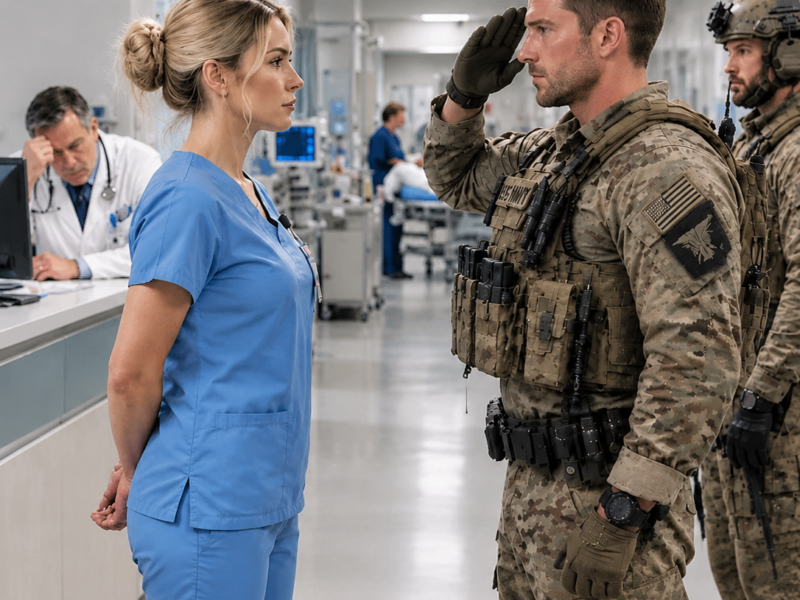
I Was a Former Navy Lieutenant Commander Working as a Trauma Nurse When My Chief Surgeon Publicly Humiliated Me for Speaking Spanish to a Patient, Then Removed Me From Duty in Front of Everyone. Hours Later, a Navy SEAL Commander Rushed Into the Hospital, Recognized Me, and Saluted Me: “Captain Vega, I Need Your Hands in This Room.” My Former Boss Turned Pale as the Commander Revealed Who I Really Was—But the Folder He Brought Contained Something Even More Damning.
I Was a Former Navy Lieutenant Commander Working as a Trauma Nurse When My Chief Surgeon Publicly Humiliated Me for Speaking Spanish to a Patient, Then Removed Me From Duty in Front of Everyone. Hours Later, a Navy SEAL Commander Rushed Into the Hospital, Recognized Me, and Saluted Me: “Captain Vega, I Need Your Hands in This Room.” My Former Boss Turned Pale as the Commander Revealed Who I Really Was—But the Folder He Brought Contained Something Even More Damning.
PART 1
The entire trauma ward at Veltham Cross Medical Center fell silent when Dr. Conrad Hale slammed a patient chart onto the nurses’ station and pointed directly at Marisol Vega.
“English!” he snapped, his voice loud enough for everyone on the floor to hear. “We speak English in this hospital. If you want to speak another language, do it somewhere else.”
Marisol stood perfectly still.
Only moments earlier, she had been explaining discharge instructions in Spanish to a terrified mother whose nine-year-old son had nearly bled to death after an accident involving farm equipment. The woman, Lorena Sandoval, spoke almost no English. The hospital’s interpreter service had informed the nursing staff that the waiting time was between two and four hours. Meanwhile, the little boy was ready to go home, and his mother needed to understand how to care for his wounds.
Marisol had simply done what she believed any responsible nurse should do.
She had sat beside Lorena, translated every instruction, explained the warning signs of infection, and made sure the woman understood when to bring her son back to the hospital.
But Dr. Hale saw something entirely different.
He saw a nurse speaking a language he didn’t understand, and apparently, that was enough to offend him.
“You are officially removed from trauma duty,” he announced. “Effective immediately. And if I hear you speaking anything other than English on this floor again, I will recommend termination.”
Nobody defended her.
Nobody questioned him.
Even the nurses who knew Marisol was one of the most capable people in the department lowered their eyes.
What Conrad Hale didn’t know was that the woman he had just publicly humiliated had once held the rank of Lieutenant Commander in the United States Navy. She had served three overseas deployments, worked alongside special operations medical teams, and given orders in Spanish while bullets struck the ground around her.
And before that day was over, a Navy SEAL commander would walk into that hospital, recognize her, and salute her in front of everyone.
Marisol had worked at Veltham Cross for four years. She was not someone who chased promotions or collected impressive titles. She preferred the trauma floor because it was where her experience mattered most. She understood that the difference between a patient surviving and a patient dying could sometimes come down to recognizing a problem thirty seconds before anyone else did.
Conrad Hale had arrived eight months earlier from a prestigious hospital in a wealthier district. He was forty-six, confident, impatient, and accustomed to getting his way. He had been personally recruited by Dr. Nolan Caldwell, the hospital’s chief of surgery, which meant that his position was protected by someone with considerable influence.
Hale had quickly developed a reputation among the nursing staff.
He questioned experienced nurses in front of patients, dismissed concerns, and treated disagreement as insubordination. People learned to avoid attracting his attention.
Marisol had become one of his preferred targets because she refused to pretend that his decisions were always correct.
She rarely argued. She simply continued doing her job.
That morning, however, he had gone too far.
After removing her from trauma duty, Hale walked away with Tomas Sandoval’s chart as though the incident were finished. Marisol returned to the staff lounge and changed into her street clothes.
A young nurse named Priya Okafor appeared in the doorway a few minutes later.
“That was wrong,” Priya said.
Marisol looked up.
“What he did. It was completely wrong.”
“Yes,” Marisol replied quietly. “It was.”
Priya hesitated before continuing.
“If you report him, I’ll tell HR exactly what I saw. And I don’t think you’re the only person who would.”
Marisol thanked her, although she knew the situation would not be simple. Caldwell had protected Hale before, and a complaint could easily disappear inside the hospital’s administrative machinery.
She was still considering her next move when the building began to vibrate.
At first, she thought it was construction equipment. Then she heard someone in the hallway ask whether a helicopter was approaching.
Marisol walked to the north-facing window.
An olive-gray military helicopter was descending toward the hospital’s rooftop landing pad.
Something changed inside her.
It was not quite fear or recognition. It was an old instinct, buried beneath four years of civilian nursing, suddenly coming awake.
She returned to her locker and changed back into her scrubs.
She had barely finished tying her shoes when the trauma wing’s double doors burst open.
A stretcher came rushing through.
The patient was a muscular man in his early thirties, dressed in tactical pants and a gray compression shirt. His face was pale, his breathing shallow, and his blood pressure was falling rapidly. Two military personnel accompanied him, urgently explaining that he had suffered abdominal trauma during a training exercise.
Hale immediately stepped forward.
“Trauma One. Get him inside.”
He began issuing orders, but Marisol noticed something troubling.
The patient’s abdomen was becoming rigid, and the pattern of his deterioration did not quite match the obvious injury.
She moved closer.
Then another man entered the ward.
He was in his early forties, lean and physically disciplined, wearing tactical gear that had clearly seen years of real service. His eyes moved rapidly across the room, assessing the medical team, the equipment, the exits, and the people standing around the stretcher.
Then his gaze stopped on Marisol.
For two seconds, he simply stared.
Then he crossed the room.
He stopped directly in front of her, raised his right hand, and delivered a crisp military salute.
“Capitana Vega,” he said in Spanish. “Tenemos un operador con hemorragia interna progresiva. Necesito sus manos en esta sala.”
Captain Vega, we have an operator with progressive internal bleeding. I need your hands in this room.
The entire ward seemed to freeze.
Hale turned.
The man lowered his hand.
His name was Commander Darian Reyes, a Navy SEAL officer Marisol had not seen in nearly four years.
He knew her from another life.
A life that nobody at Veltham Cross knew existed.
“Who are you?” Hale demanded.
Reyes barely looked at him.
“The man on that stretcher is my responsibility. Every second matters. Are you the attending physician?”
“I am the chief trauma attending,” Hale answered. “And this nurse has been removed from trauma duty.”
Reyes looked at Marisol.
She looked through the glass doors toward the patient. His blood pressure was falling, and the resident inside the bay appeared increasingly uncertain.
Hale stepped directly into her path.
“If you enter that room, I’ll have you escorted out of this hospital.”
Marisol remembered Lorena Sandoval, sitting beside her injured son, desperately trying to understand what the doctors were telling her.
She remembered another night, eight years earlier, in a forward medical tent where a communications failure had left several wounded men without anyone capable of understanding their emergency calls.
She remembered what happened when language became the difference between life and death.
Then she looked at Hale.
“Step aside.”
He refused.
She walked around him.
Behind her, Commander Reyes spoke in a quiet, unmistakable voice.
“That was the wrong move.”
Marisol entered Trauma One.
“Get me another large-bore IV. Notify the blood bank. Emergency-release O negative. And I need Dr. Hessler here immediately.”
The team moved.
The patient’s name was Marcus Webb. He was thirty-one years old, and the small tattoo on his wrist carried his wife’s name.
Marisol examined his abdomen and immediately requested an ultrasound.
The images revealed what she had suspected.
Blood was accumulating inside him.
“Positive Morrison’s pouch,” the resident announced.
“And the pelvis?” Marisol asked.
Another image appeared.
More fluid.
His blood pressure dropped to 68 over 39.
Four minutes until the surgeon could arrive.
Four minutes until the next blood units reached the room.
Marcus briefly opened his eyes and caught Marisol’s wrist.
“Don’t let Reyes…”
His voice disappeared.
Marisol leaned closer.
“Don’t let Reyes what?”
He could no longer answer.
She kept working.
Dr. Yael Hessler arrived shortly afterward. She listened carefully as Marisol explained the mechanism of injury, the ultrasound findings, and the unusual distribution of the blood.
“You’re thinking vascular?” Hessler asked.
“Yes. Possibly a branch of the right hepatic artery. If we focus only on the obvious injury, we could miss the actual source.”
Hessler studied the images.
Then she nodded.
“OR Three. We’re moving.”
That was when Hale entered the room again.
“Dr. Hessler, we have a protocol violation that needs to be addressed before this patient proceeds.”
Hessler looked at him.
“Can it wait until this man is out of danger?”
“No. This nurse was formally removed from trauma duty.”
“She just identified a probable vascular injury that could have taken me fifteen minutes to recognize. We’re going to operate. You can discuss your administrative concerns afterward.”
Hale’s face tightened.
But nobody stopped the stretcher.
The team rushed Marcus toward surgery, with Commander Reyes walking beside him.
Before they reached the operating suite, Reyes quietly told Marisol that Marcus had been deteriorating for nearly six hours. Earlier imaging had shown a small amount of internal fluid, but the bleeding had gradually increased.
It supported her suspicion.
A smaller arterial branch had likely been injured.
At the operating room doors, Reyes stopped.
“Marisol,” he said.
“He’s going to make it,” she replied. “I’m going to make sure of that.”
She disappeared through the doors.
Ninety-three minutes later, the operation was over.
The surgeons found a laceration in a branch of the hepatic artery, exactly where Marisol had suspected. They repaired it, controlled the hemorrhage, and identified a splenic contusion that could be managed without additional surgery.
Marcus was alive.
When Marisol emerged, Commander Reyes was waiting outside with several members of his team.
“The bleeding is controlled,” she told him. “He’ll need monitoring, but he’s going to recover.”
Reyes closed his eyes briefly.
Then he looked at her.
“Thank you.”
“It’s my job.”
“Not today it wasn’t.”
Before Marisol could respond, a familiar voice approached from behind.
Priya.
She had news.
Hale had spent the last hour in Caldwell’s office preparing a formal complaint against Marisol. He was claiming unauthorized clinical intervention and alleging that Commander Reyes had interfered with hospital administration.
Marisol listened without interrupting.
Then her phone rang.
It was Caldwell’s office.
He wanted to see her at 4:30 p.m.
And this time, Hale would not be the only person waiting in the room.
PART 2
At 4:28 p.m., Marisol entered Dr. Caldwell’s office expecting another attempt to silence her.
Hale was already seated beside the chief of surgery. A representative from the regional health consortium was also present.
Three sentences into Hale’s carefully prepared accusation, the door opened.
Commander Darian Reyes walked in, followed by an older official carrying a thick folder.
The man introduced himself as Warren Speight, from the consortium’s office of patient rights and institutional accountability.
He placed a printed email on Caldwell’s desk.
It had been sent from Conrad Hale’s hospital account eight months earlier.
Hale’s face went completely still.
Speight opened the folder.
“There are nine more,” he said. “And they document a pattern of discriminatory conduct dating back to Dr. Hale’s first weeks here.”
Caldwell slowly turned toward the physician he had personally recruited.
For the first time, Hale seemed unable to find the right words.
And Marisol realized the investigation was about to become much bigger than anyone in that room had expected.
PART 3
Warren Speight did not raise his voice or make dramatic accusations. He simply opened the folder and began explaining what the documents contained.
The first email had been sent eleven days after Conrad Hale joined Veltham Cross Medical Center. It concerned the hospital’s bilingual patient services program and specifically mentioned several employees who regularly communicated with patients in languages other than English.
The language used to describe those employees was troubling.
The remaining emails documented similar concerns over the following seven months.
Caldwell picked up the first printout and read it carefully. His expression changed with every paragraph.
“What context would make this communication acceptable?” Speight asked.
Hale immediately leaned forward.
“This is an internal communication taken out of context. I want legal counsel present before this discussion continues.”
“You are welcome to request counsel for any formal proceeding,” Speight replied. “But the documents are already part of the institutional record.”
Commander Reyes finally spoke.
He explained that he had arrived at Veltham Cross expecting nothing more than emergency treatment for one of his operators. Instead, he had witnessed a situation that he considered deeply concerning.
He had spoken to several nurses, residents, and other employees. He had not pressured anyone. He had simply asked what working under Hale was like.
The answers had been remarkably consistent.
“This morning,” Reyes continued, “I watched a nurse who had just identified a potentially fatal injury being ordered out of the trauma bay by the physician responsible for that department. I also watched that same physician publicly humiliate her for speaking Spanish to a patient.”
Hale’s jaw tightened.
“She is a floor nurse,” he said.
Reyes looked directly at him.
“She held the rank of Lieutenant Commander in the United States Navy. She completed three overseas deployments supporting special operations medicine. She has experience managing trauma situations that most physicians never encounter outside a textbook.”
He paused.
“And you told her to speak English.”
The room became silent.
Caldwell turned toward Marisol.
“I want to hear your account. From the beginning.”
She described the Sandoval family, the delayed interpreter service, Hale’s entrance, and the public reprimand. She explained how she had been removed from trauma duty and how she had returned to the ward only because a military patient was deteriorating.
She did not exaggerate.
She did not insult Hale.
She simply described what had happened.
When she finished, Caldwell looked toward the physician.
“There is a patient in my surgical ICU who would very likely have died if the nurse you removed from duty had actually left this building.”
Hale attempted to interrupt.
Caldwell raised one hand.
Speight then placed several written statements on the desk. They came from three nurses and one resident. Among them was a statement written by Priya Okafor.
Hale recognized the handwriting.
His expression hardened.
The documents described incidents that had occurred over the previous seven months, including public humiliation, intimidation, and repeated attempts to discourage bilingual employees from communicating directly with patients.
Priya had also retained copies of internal messages.
For months, she had quietly saved them because she believed the hospital might eventually need evidence.
Hale stood.
“I’m requesting legal representation.”
“You will receive every due-process protection available to you,” Speight answered. “But the hospital must also protect its patients and employees.”
The meeting continued for another forty minutes.
Caldwell was questioned about the department’s language-access policy and the complaints that had apparently been raised before that morning.
He admitted that he had received two informal concerns about Hale during the physician’s first month at the hospital.
He had spoken to Hale, accepted his explanation, and considered the matter resolved.
Marisol listened carefully.
Caldwell had known something was wrong.
He had simply decided not to investigate further.
At 6:15 p.m., he finally made his decision.
Marisol was reinstated to the trauma floor immediately.
Hale was placed on administrative leave pending a formal review.
Before leaving, Caldwell apologized.
“I owe you an apology,” he said. “Not only for today, but for the months before today when this should have been addressed.”
“Yes,” Marisol replied. “You do.”
Outside the office, Reyes was waiting.
They walked together toward the elevator.
Marisol asked him how he had managed to get Speight involved so quickly.
Reyes explained that he had contacted someone in the regional consortium after hearing the nurses’ accounts. Speight had already been in Veltham conducting another institutional review, so the timing had been fortunate.
But the emails had not come from Reyes.
Priya had provided them.
She had been keeping copies for three months, waiting for an opportunity to use them.
When Reyes spoke to her, she decided that opportunity had finally arrived.
Marisol thought about the young nurse standing in the staff lounge that morning.
“I’ll say what I saw,” Priya had promised.
And she had.
Later that evening, another development appeared on the hospital’s administrative system.
An emergency privileges review had been initiated against Conrad Hale.
The initiating authority was Dr. Yael Hessler.
Unlike an ordinary administrative complaint, this review questioned whether Hale was safe to continue practicing medicine.
Marisol understood the significance immediately.
Someone with considerable clinical authority had decided that his conduct required more than an apology or a temporary suspension.
Her phone rang shortly afterward.
It was the Regional Healthcare Compliance Board.
They wanted a formal interview the following morning.
The investigation, they explained, extended beyond the incident at Veltham Cross.
They were examining a documented pattern of behavior.
Marisol agreed to attend.
She was almost in her car when another message arrived.
It was from Commander Reyes.
Marcus Webb was awake and asking for her.
She returned to the surgical intensive care unit.
Marcus looked pale and exhausted, but he was conscious. His wife, Adrienne, sat beside him, holding his hand.
“You’re the one,” he said when Marisol entered.
“Reyes told me.”
She introduced herself to Adrienne, who immediately reached out and held her hand.
“Thank you,” she whispered.
Marisol explained the operation and the recovery process. She answered their questions and made sure Adrienne understood what to expect over the next forty-eight hours.
Before she left, Marcus caught her wrist.
“I want to give a formal statement about what happened when we arrived.”
“You don’t have to.”
“I know,” he replied. “But I want to.”
She nodded.
Then Reyes walked her toward the elevator.
He told her that the compliance board would probably ask about the pattern of behavior, not simply what had happened that morning.
She agreed.
But there was something else waiting for her.
As she crossed the main atrium, an unfamiliar email notification appeared on her phone.
The subject line read:
“Re: Northgate Meridian. Similar complaint, 2019.”
The sender was a former nurse named Dina Warwick.
Dina had worked at another hospital, Rushmore Valley Medical, where Conrad Hale had previously held a senior trauma position.
She described an incident from the fall of 2019.
A public humiliation.
A removal from duty.
A formal complaint.
And an investigation that had somehow ended with the complaint being classified as unsubstantiated.
The details were almost identical to what Marisol had experienced.
Dina had eventually resigned from nursing.
She had kept every document.
Marisol read the email twice.
Then she forwarded it to Warren Speight.
For the first time, she understood that the incident at Veltham Cross might not have been an isolated case.
The next morning, she arrived at the Regional Healthcare Compliance Board’s downtown office at 8:45.
Investigators Nadine Trask and Paul Severn were waiting, along with Speight.
The interview lasted three hours.
Marisol explained everything, including the incidents she had witnessed during Hale’s eight months at the hospital.
She also described the moment in the staff lounge when she had briefly wondered whether Hale was right about her belonging on the trauma floor.
It was difficult to admit.
But she told the truth.
During the interview, Trask received confirmation that Dina Warwick had agreed to participate in the investigation.
Her old documentation had also been submitted.
“This changes the scope of our review,” Trask explained. “We are no longer examining a single incident of inappropriate conduct. We’re examining a possible pattern that may have affected more than one medical institution.”
Marisol nodded.
Before the interview ended, she made one additional request.
She wanted the Sandoval family’s experience included in the patient-impact record.
Lorena and Tomas had nearly been discharged without understanding their care instructions because the interpreter service was delayed.
She did not want the investigation to become exclusively about employment disputes.
The patients mattered, too.
Trask agreed.
When Marisol left the building, her phone contained several messages.
One was from Hessler, confirming that the privileges review would proceed to the full credentialing committee.
Another came from Reyes.
“Marcus walked to the door of his room this morning. Twelve feet. Took him eight minutes. Thought that counted.”
Marisol smiled.
Then she returned to the hospital.
Marcus was sitting up when she visited him that afternoon. His color was improving, and his recovery was progressing.
He told her that he intended to give his statement.
Then he asked a question.
“Is Hale going to face real consequences?”
Marisol thought about the investigation, Dina’s documents, and the privileges review.
“I think so,” she answered.
But she did not yet know how much larger the situation was about to become.
PART 4
At two o’clock that afternoon, Marisol returned to Caldwell’s office.
This time, Hale was absent.
Caldwell explained that he wanted to formally reinstate her, remove the record of her dismissal, and issue an institutional apology.
He also agreed to restore the hospital’s previous bilingual communication practices and commission a complete review of interpreter-service delays.
Marisol read the document carefully.
The language was specific.
She signed the acknowledgment and requested a copy.
But before leaving, she made one final demand.
Priya and the other nurses who had provided statements needed written protection against retaliation.
She wanted that protection documented immediately.
Caldwell agreed.
Later that afternoon, Speight sent her another message.
Rushmore Valley’s documentation had confirmed a pattern of misconduct. The investigation was expanding into a formal multi-institutional review, and the state medical board would be notified.
Marisol returned to work.
The trauma floor still had patients waiting, medications to administer, and decisions that could not be postponed simply because the administrative structure was changing.
At 6:40 p.m., Dominguez told her that Marcus wanted to see her before she left.
She found him sitting up in bed with Adrienne and Reyes beside him.
Marcus explained that he had spent nine years in military service and had been rescued by many medical professionals.
He understood what Marisol had done medically.
But that wasn’t the only reason he wanted to speak to her.
“You came back into that building after he told you to leave,” he said. “You walked around him, went into that room, and did your job. I know what it takes to stay functional when somebody is actively trying to make you feel like you don’t belong.”
He paused.
“I wanted you to know that I saw the whole thing.”
Marisol thanked him.
It was a small exchange, but it meant more than she expected.
In the hallway afterward, Reyes told her something he had learned from the investigation.
Dina Warwick’s complaint from 2019 had been reviewed by a compliance officer named Patricia Greer.
Greer had classified it as unsubstantiated.
Six months later, she had moved into the credentialing division of the regional consortium that oversaw several hospitals, including Veltham Cross.
More importantly, Greer had signed off on the credentialing approval that allowed Conrad Hale to join the hospital.
Marisol stopped walking.
The problem was no longer simply one physician who mistreated his employees.
It was a system that had repeatedly allowed complaints to disappear.
And the person responsible for reviewing those complaints had later become responsible for approving physicians.
Reyes had already informed Speight.
At 4:47 that afternoon, Patricia Greer had submitted her resignation.
The following morning, Speight told Marisol that Greer’s records had been placed under an institutional hold.
Investigators had identified four medical institutions over seven years where she had processed approvals involving physicians with previous complaints.
Hale was only one of them.
The state medical board soon opened a formal inquiry.
Its preliminary findings showed that Dina Warwick’s 2019 complaint had not actually been unsubstantiated. It had been classified that way by a reviewer who had an undisclosed professional relationship with Hale.
Dina agreed to become a named complainant.
When Marisol heard the news, she thought about the five years Dina had spent believing nobody would ever listen.
She also thought about the nurses who were still working under similar conditions elsewhere.
The weeks that followed were difficult.
Hale’s medical license was suspended pending the board inquiry. Veltham Cross issued a public statement acknowledging its failure to protect Marisol and promising significant reforms to its language-access policy.
The hospital also announced that its interpreter service would receive new funding and technology.
Patricia Greer’s review expanded.
Two other physicians were still practicing at different hospitals, and investigators began examining their histories.
One additional license suspension eventually resulted.
The other case did not meet the threshold for formal disciplinary action.
Marisol found that outcome frustrating.
But she also understood that accountability was not always a perfect process.
Marcus Webb’s recovery continued.
He experienced a minor postoperative complication and developed a low-grade fever, which frightened Adrienne enough to bring her to the nursing station in the middle of the night.
Dr. Hessler assessed him and explained the problem.
It resolved with treatment.
Seventeen days after surgery, Marcus finally walked out of Veltham Cross under his own power.
Marisol met him in the lobby.
“Twenty feet,” he announced.
She raised an eyebrow.
“On day three, I walked twenty feet. You said twenty.”
“I remember.”
Adrienne hugged Marisol.
Marcus shook her hand.
Then he asked whether the hospital’s public apology had felt like enough.
Marisol considered the question.
“No,” she said. “But it was real. And real is better than adequate.”
Reyes walked with her toward the main entrance after Marcus and Adrienne finished their discharge paperwork.
He was returning to his command the following morning.
Before leaving, he asked what she intended to do next.
Caldwell had offered her an administrative position overseeing the new language-access program.
Marisol had refused to leave the trauma floor entirely.
She wanted to continue treating patients.
But she also understood that someone needed to ensure the new policies were actually followed.
So she proposed a different arrangement.
She would divide her time between clinical work and oversight.
Priya would become the program coordinator.
Caldwell initially argued that the staffing model could not support it.
Marisol told him to find a way.
He eventually agreed to consider the arrangement.
Reyes listened to the story and nodded.
“Good.”
Then Marisol brought up the salute.
“You didn’t have to do it in front of everyone,” she said. “You could have pulled me aside.”
“No,” he answered. “I couldn’t have.”
She understood immediately.
Hale’s humiliation had been public.
He had deliberately chosen an audience.
The correction needed to happen in front of that same audience.
The salute had not been a performance of military authority.
It had been a public acknowledgment of something the hospital had failed to recognize.
“You didn’t need me to tell you who you were,” Reyes said. “You already knew. But the room needed someone to say it out loud.”
Marisol nodded.
“Yes,” she replied. “That part mattered.”
Three weeks later, Dina Warwick arrived in Veltham for the formal proceedings.
She was forty-three and had left nursing after the 2019 incident.
She now worked as a medical interpreter.
When she met Marisol in the hospital’s family consultation room, she immediately explained that she had almost never sent the original email.
“I’ve been angry for five years,” Dina admitted. “The kind of angry you don’t talk about because it has nowhere to go.”
She had filed a complaint.
She had waited.
Then she had received a letter stating that the complaint was unsubstantiated.
She had eventually left the profession.
Marisol listened.
“What do you want me to say at the inquiry?” Dina asked.
“I don’t need you to help me,” Marisol answered. “I need you to tell the truth completely.”
Dina looked at her for a long moment.
“That’s what I needed someone to say to me in 2019.”
They talked for nearly an hour.
They discussed the difference between telling an institution what it wanted to hear and describing what had actually happened.
They discussed the patients who had been affected by language barriers and the employees who had been afraid to speak.
They discussed the strange irony of Dina leaving nursing and becoming a medical interpreter.
At the end, Dina asked whether Marisol’s work felt different now.
Marisol thought about the trauma floor.
“The work is the same,” she said. “What’s different is that I’m not carrying anything extra anymore. I put something down.”
Dina nodded.
“Yeah,” she whispered. “That’s it.”
The board inquiry concluded in December.
Marisol received the findings on a Thursday afternoon.
She opened the document in the break room.
The conclusion was clear.
Conrad Hale’s medical license was revoked because of a sustained pattern of discriminatory conduct, retaliatory behavior toward staff, and documented misconduct at multiple institutions.
Patricia Greer’s professional credentials in the credentialing field were also permanently revoked.
The regional consortium was ordered to audit seven years of physician approvals and establish an independent review mechanism for cases involving undisclosed professional relationships.
Marisol read the findings twice.
She did not feel exactly happy.
Dina had still lost five years of her career.
Other employees had endured humiliation that no official document could erase.
But the record had finally been corrected.
And sometimes that was the beginning of meaningful change.
PART 5
The new language-access protocol launched in January.
It included in-house bilingual staff certification, real-time remote interpretation in twelve languages, and a maximum fifteen-minute response guarantee.
Priya Okafor had become the program coordinator.
She approached the role with remarkable determination, using three months of historical patient data to defend every part of the new system.
On the day the protocol launched, she found Marisol on the trauma floor.
“I found the Sandoval family’s contact information,” Priya said. “I sent Lorena a letter in Spanish explaining the new system and offering a full care consultation.”
Marisol smiled.
“That was the right thing to do.”
Priya hesitated.
“I should have done more that morning in the lounge. I opened my mouth and closed it. I’ve been thinking about that ever since.”
“You gave your statement,” Marisol replied. “You kept the emails.”
“Afterward.”
“Then do better than afterward,” Marisol said. “That’s what the job is.”
Spring arrived slowly in Veltham.
Marisol continued dividing her time between clinical work and policy oversight. The arrangement was challenging, but she discovered that the two responsibilities strengthened each other.
Her administrative decisions were better because she still worked directly with patients.
Her clinical work became easier because the hospital was gradually becoming a place where staff could communicate without fear.
In April, Reyes called.
He would be visiting Veltham the following week. Marcus and Adrienne wanted to have dinner with him, and they had asked whether Marisol would join them.
She agreed.
They talked briefly about the trauma floor.
“Same,” she told him. “Better. Both.”
He laughed.
Then she looked out the break-room window.
“Reyes?”
“Yeah?”
“The salute.”
He waited.
“I understand why you did it now.”
There was a pause.
“Good,” he said.
She returned to work.
A patient in Bay Three had arrived ninety minutes earlier with an abdominal injury that the overnight resident had initially interpreted one way.
Marisol was beginning to suspect something different.
She examined the imaging, reviewed the patient’s vital signs, and listened carefully to her description of the pain.
Then she leaned down beside the bed.
“I’m going to ask you a few questions,” she said. “I need you to tell me exactly what you’re feeling, not what you think I want to hear.”
The woman looked frightened.
Marisol waited.
“What’s true?” she asked.
And the patient began speaking.
Marisol listened carefully.
Because that was the work.
And because she had learned something important from everything that had happened.
A person did not become less capable because someone in authority refused to recognize their ability.
A language did not become inferior because someone else could not understand it.
And silence was not always weakness.
Sometimes it was patience.
Sometimes it was discipline.
And sometimes it was simply the moment before someone decided they would no longer allow injustice to continue.
Marisol had known she belonged on that floor long before Commander Reyes walked through its doors.
The salute had not given her that knowledge.
It had simply made the truth visible to everyone else.
She stayed where she had always belonged.
And the people who had mistaken her patience for weakness, her silence for submission, or her Spanish for a professional deficiency had eventually revealed something far more important about themselves than they had ever revealed about her.
They had never made her smaller.
They had only shown everyone else exactly who they were.
THE END