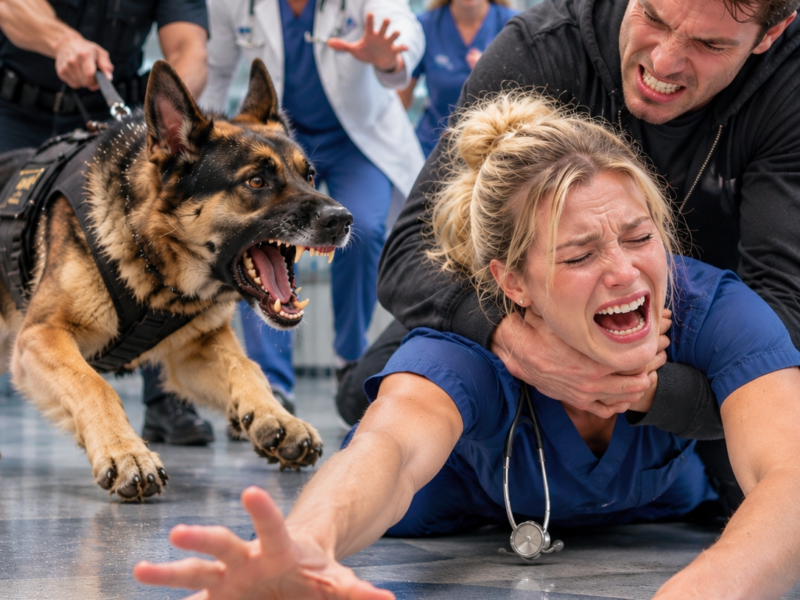
I Was a 42-Year-Old ER Nurse When a Doctor Publicly Humiliated Me for Warning Him That a Former Navy SEAL Was Bleeding Internally. “Step Away From My Patient,” He Snapped as My Colleagues Watched. Suddenly, the Veteran’s Retired Military Dog Abandoned His Bedside and Pressed Himself Against My Leg, Just as the Heart Monitor Began Screaming. But When the Veteran Grabbed My Wrist and Whispered, “Seven Years Ago… Africa… You Saved Us,” Nobody Was Prepared for the Truth About My Past.
I Was a 42-Year-Old ER Nurse When a Doctor Publicly Humiliated Me for Warning Him That a Former Navy SEAL Was Bleeding Internally. “Step Away From My Patient,” He Snapped as My Colleagues Watched. Suddenly, the Veteran’s Retired Military Dog Abandoned His Bedside and Pressed Himself Against My Leg, Just as the Heart Monitor Began Screaming. But When the Veteran Grabbed My Wrist and Whispered, “Seven Years Ago… Africa… You Saved Us,” Nobody Was Prepared for the Truth About My Past.
PART 1
“Step away from my patient.”
Dr. Raymond Holt said those words loud enough for everyone in the emergency department to hear.
For a moment, the entire trauma bay seemed to freeze.
Nurse Sarah Voss stood beside the hospital bed, her fingers resting on the metal railing. She had spent the past thirty minutes trying to convince Holt that the man lying in front of them was bleeding internally. She had warned him once when the patient arrived, again when his heart rate began climbing, and a third time when his skin turned an unnatural shade of pale.
Each time, Holt dismissed her concerns.
And now, with several nurses watching, he had decided to humiliate her.
“I gave you an instruction, Nurse Voss. I suggest you follow it.”
Sarah slowly removed her hand from the railing.
She didn’t argue. She didn’t raise her voice. She simply looked at the patient one more time.
His name was Ethan Rourke, a thirty-nine-year-old former Navy SEAL who had survived multiple combat deployments. Tonight, he had been involved in a violent highway collision.
Beside his bed lay Rook, an eight-year-old retired military working dog.
The Belgian Malinois had remained remarkably quiet since arriving at the hospital.
But as Sarah stepped backward, something extraordinary happened.
Rook suddenly rose.
The dog walked away from his injured owner, crossed the trauma bay, and pressed his entire body against Sarah’s leg.
A technician chuckled.
Someone whispered that even the dog was confused about who was in charge.
Dr. Holt shook his head.
“Get that animal out of here.”
Then the monitor behind him began screaming.
Ethan’s blood pressure collapsed.
His heart rate surged.
And the expression on Dr. Holt’s face changed from irritation to something Sarah had seen many times before.
Fear.
But what nobody in that emergency department understood was that Rook hadn’t approached Sarah by accident.
The dog recognized her.
And the reason went back seven years, to a night in Africa when three American soldiers and one wounded military dog were carried into a makeshift medical station.
A night Sarah had spent years trying to forget.
Six hours earlier, Sarah had arrived at Kesler Memorial Hospital in Norfolk, Virginia, just before seven in the evening.
She was forty-two years old, quiet, and almost invisible to the people who worked alongside her.
She never joined the nurses gossiping around the coffee machine. She rarely attended department gatherings. She didn’t talk about her personal life, and when conversations turned toward military service, she usually found a reason to return to work.
Her colleagues had developed their own explanations.
Some thought she was arrogant.
Others assumed she was simply socially awkward.
Cassidy, a popular day-shift nurse, enjoyed making jokes about her.
“Sarah treats every patient like they’re about to die,” Cassidy once told a group of new residents.
Everyone laughed.
Sarah heard them.
She continued checking the emergency equipment.
What nobody knew was that she had spent years working in places where patients really were seconds away from dying.
Before her civilian nursing career, Sarah had served in advanced military medical support, attached to special operations teams overseas.
She had treated gunshot wounds, blast injuries, traumatic amputations, and catastrophic bleeding in environments where the nearest fully equipped operating room could be hours away.
She had learned how to recognize danger before machines confirmed it.
And she had learned something else.
Sometimes, doing everything correctly still wasn’t enough to save someone.
That lesson had changed her life.
Seven years earlier, a soldier had died under her care.
His death had followed her home, entered her dreams, and gradually convinced her that she needed a smaller life.
So she left military medicine.
She moved to Virginia.
She accepted an ordinary night-shift nursing position.
And for eighteen months, she tried to become someone nobody noticed.
Unfortunately, Dr. Raymond Holt had noticed her just enough to dislike her.
Holt was forty-four, ambitious, and recently promoted to attending physician. He was intelligent, confident, and accustomed to people following his instructions without hesitation.
Sarah’s careful questions irritated him.
Her habit of noticing unusual symptoms made him feel challenged.
Four months earlier, she had questioned his interpretation of a patient’s breathing pattern during a department meeting.
Holt had smiled condescendingly.
“Thank you, Sarah. Now we’ll let the doctors practice medicine.”
The room erupted in laughter.
Sarah never mentioned the incident again.
But she remembered it.
That evening, the emergency department was unusually crowded.
At approximately 7:15, dispatch announced a multiple-vehicle collision on Interstate 64.
Eight possible casualties.
Within minutes, ambulances began arriving.
Sarah moved between trauma bays, preparing equipment, checking intravenous access, and helping stabilize injured patients.
She worked with an efficiency that seemed almost effortless.
While other nurses focused entirely on the patients directly in front of them, Sarah remained aware of everything happening around her.
She heard monitor alarms from neighboring rooms.
She noticed supply shortages before anyone requested replacements.
And she listened carefully to every paramedic report.
At 7:51 p.m., another ambulance arrived.
“Male, thirty-nine years old,” a paramedic announced. “Ethan Rourke. Former military. Significant passenger-side impact. Abdominal trauma. Conscious and oriented.”
Sarah looked toward the stretcher.
The patient was pale but alert.
His initial blood pressure was 118 over 74.
Heart rate, 96.
Oxygen saturation, 97 percent.
Nothing on the monitor appeared immediately catastrophic.
But Sarah noticed his hand.
Ethan was pressing it firmly against the lower left side of his abdomen.
It wasn’t the dramatic movement of someone seeking attention.
It was protective.
Instinctive.
And familiar.
Then Sarah noticed the dog walking beside the stretcher.
A large Belgian Malinois with a dark sable coat, graying muzzle, and an old scar along his left flank.
The animal stopped scanning the room the instant he saw her.
His ears rose.
His posture changed.
For several seconds, the dog stared directly into Sarah’s eyes.
Something about that gaze made her stomach tighten.
“Who’s responsible for the dog?” she asked.
“He’s a retired military working dog,” the paramedic replied. “Belongs to the patient. Apparently, they’ve been together for years.”
“Rook,” Ethan whispered.
Sarah turned.
“Excuse me?”
“His name is Rook. Please don’t separate us.”
“We’ll take care of him,” she promised.
Dr. Holt arrived moments later, studying the paramedic report.
“Probable abdominal bruising,” he announced. “Order imaging. Observation for now.”
Sarah looked at Ethan again.
“Doctor, I’m concerned about internal hemorrhage.”
Holt barely glanced up.
“His vital signs are stable.”
“His heart rate is elevated, and he’s guarding his abdomen.”
“He was just involved in a major collision. That’s expected.”
“The direction of the impact concerns me. The seat belt could have caused deeper injuries.”
Holt sighed.
“Sarah, please. Let me evaluate my patient.”
She remained quiet for a second.
Then she asked, “Could we perform a bedside FAST ultrasound while we’re waiting for imaging?”
Holt’s expression hardened.
“Not necessary at this stage.”
He turned away.
Sarah felt the old familiar frustration.
She could accept being wrong.
She couldn’t accept ignoring something potentially dangerous simply because someone with more authority disliked hearing it.
She helped settle Ethan into Bay 4.
Rook curled up beside the bed, positioning himself beneath his owner’s hand.
When Sarah gently examined Ethan’s abdomen, he winced.
“Does that hurt?”
“Not exactly,” he whispered.
“Tell me what you’re feeling.”
“Pressure. Deep inside. Like something’s pulling.”
Sarah nodded.
His description made her even more concerned.
“Were you deployed overseas?” she asked while checking his pulse.
Ethan studied her face.
“Several times.”
He paused.
“Were you ever stationed in Djibouti?”
Sarah’s fingers stopped moving for a fraction of a second.
“Why do you ask?”
“Your voice.”
He watched her carefully.
“Something about your voice sounds familiar.”
Sarah looked away.
“I need to check your test results.”
But as she moved toward the door, Ethan spoke again.
“I think I’ve met you before.”
She didn’t answer.
Outside the bay, she checked his vital signs.
Heart rate, 101.
A few minutes later, 104.
His blood pressure remained deceptively acceptable.
Sarah knew what that could mean.
The body could compensate for internal bleeding until its reserves were exhausted. A patient could appear relatively stable moments before deteriorating catastrophically.
She returned to the bedside.
Ethan’s face had lost more color.
His hands were colder.
His breathing had become shallow.
She immediately found Holt.
“Doctor, I need you to reassess Bay 4.”
Holt didn’t look up from his computer.
“We’ve already discussed this.”
“His heart rate is climbing. His appearance has changed.”
“Pain and anxiety can cause that.”
“I understand. But this is consistent with compensated hemorrhagic shock.”
Holt finally turned toward her.
“Do you realize how many unnecessary interventions we’d perform if we followed every nurse’s suspicion?”
Sarah held his gaze.
“I’m asking you to look at him.”
Holt stood abruptly.
“Fine.”
He walked into Bay 4 with Sarah following.
The monitor displayed a heart rate of 107.
Ethan lay almost motionless.
Holt examined his abdomen briefly.
“Some tenderness. Exactly what I’d expect after this type of collision.”
Sarah began speaking.
“Doctor, his clinical presentation—”
Holt cut her off.
“Step away from my patient.”
His voice echoed across the department.
Several people turned.
Cassidy, who had returned to retrieve something from her locker, stopped in the hallway.
A faint smile crossed her face.
Holt continued.
“You are interfering with medical decisions. I will not tolerate insubordination.”
Sarah released the bed rail.
For a moment, nobody moved.
Then Rook stood up.
He walked straight toward Sarah and leaned against her.
The retired military dog looked up at her with an expression so focused that she felt something stir deep inside her memory.
She recognized those eyes.
She recognized the scar.
And suddenly, she remembered a wounded dog lying beneath a flickering light in a military treatment tent.
Before she could complete the memory, Ethan’s monitor sounded.
His blood pressure plunged.
His heart rate accelerated.
Sarah turned.
“Activate the trauma response!” she shouted.
Dr. Holt stared at the screen.
Ethan was bleeding internally.
And now, there might not be enough time to save him.
PART 2
Within seconds, Bay 4 erupted into controlled chaos.
“Blood pressure ninety-four over sixty!” Priya shouted.
“Get the trauma director!” Sarah ordered.
Dr. Holt stood frozen for a moment before helping initiate emergency treatment.
A portable ultrasound was rushed into the bay.
Dr. Marisol Aguirre, the hospital’s trauma director, arrived and immediately examined Ethan.
The ultrasound confirmed what Sarah had feared.
Free fluid inside his abdomen.
Internal bleeding.
“He needs surgery now,” Aguirre announced.
Nobody laughed anymore.
As the team prepared Ethan for the operating room, he suddenly grabbed Sarah’s wrist.
His grip was weak, but his eyes were filled with recognition.
“You,” he whispered.
Sarah leaned closer.
“Save your strength.”
“I remember you.”
His breathing faltered.
“Seven years ago. Africa. You were there.”
Sarah felt her heart pound.
Rook stood beside her, watching silently.
Ethan squeezed her wrist again.
“You saved us.”
Before Sarah could respond, the surgical team rushed him through the doors.
Rook tried to follow but was gently restrained by the hospital’s veteran liaison.
Sarah remained standing in the empty trauma bay.
Seven years.
Africa.
A wounded military dog.
And a soldier she had believed she would never see again.
She looked toward the operating room.
The past she had buried was coming back.
PART 3
Sarah remained beside the empty hospital bed long after Ethan disappeared behind the operating room doors.
The monitors had been switched off. The bloodstained sheets were being removed. A technician was disinfecting the equipment.
Everything around her was returning to normal.
But inside Sarah, nothing felt normal.
She had spent seven years convincing herself that the past was finished. She had moved cities, changed jobs, and built an existence around predictable routines.
Yet one injured veteran and one retired military dog had brought everything back in a single night.
“Sarah?”
Priya stood near the entrance.
“You were right.”
Sarah looked at her.
“About the bleeding.”
“I know.”
“No, I mean you warned Holt three times. Everyone heard him dismiss you. And then the patient nearly died.”
Sarah began completing her documentation.
“The important thing is that he reached surgery.”
Priya stepped closer.
“You don’t have to pretend what happened was acceptable.”
Sarah finally stopped writing.
She thought about the humiliation.
She thought about the people who had laughed.
Most of all, she thought about what might have happened if she had obeyed Holt without questioning him again.
“I’m not pretending,” she said quietly. “I’m making sure the record tells the truth.”
She documented each assessment, every change in Ethan’s vital signs, and the times she had requested reassessment.
It wasn’t revenge.
It was the responsibility she owed her patient.
Twenty minutes later, Cassidy approached the nursing station carrying a coffee.
“That was quite a performance,” she remarked.
Sarah didn’t answer.
“I mean, nobody expected the dog to choose you over his owner.”
Cassidy smiled.
“Maybe you’ve found your calling.”
Sarah slowly looked up.
“Ethan Rourke is undergoing emergency surgery because he was bleeding internally.”
Cassidy’s smile weakened.
“I was joking.”
“And I raised that concern repeatedly before his condition deteriorated.”
Sarah’s voice remained calm.
“There’s nothing funny about it.”
For once, Cassidy had no immediate response.
Sarah returned to her chart.
A few minutes later, her pager sounded.
Dr. Aguirre wanted to see her outside surgical preparation.
When Sarah arrived, the trauma director was standing alone near a consultation room.
“Walk me through your assessment,” Aguirre said.
Sarah explained everything.
The impact mechanism.
The abdominal guarding.
The rising heart rate.
The changing skin color.
The increasing signs of poor circulation.
Aguirre listened without interrupting.
When Sarah finished, she asked a question Sarah hadn’t expected.
“Where did you learn to recognize that progression so early?”
“Trauma training.”
“Where?”
Sarah hesitated.
“Military medical support.”
Aguirre studied her.
“How extensive?”
“Extensive enough.”
For several seconds, neither woman spoke.
Then Aguirre nodded.
“I won’t push tonight. But your documentation is unusually precise.”
Sarah said nothing.
“The hospital will review what happened,” Aguirre continued. “And when that review begins, I want you to tell them exactly what you told me.”
“I will.”
As Sarah turned to leave, Aguirre spoke again.
“Your judgment may have saved that man’s life.”
Sarah stopped.
“We don’t know that yet.”
“No,” Aguirre agreed. “We don’t.”
The distinction mattered.
Ethan was still undergoing surgery.
And Sarah knew better than most how quickly hope could turn into grief.
On her way back to the emergency department, she passed the surgical waiting area.
Rook was sitting beside Garrett, the veteran liaison assigned to watch him.
The dog immediately stood when he saw Sarah.
Garrett looked surprised.
“He’s been restless since they took his owner into surgery.”
Rook walked toward Sarah.
She knelt.
The dog lowered his head into her open palm.
And when her fingers brushed the scar on his left side, the memory finally returned.
Not in fragments.
Not as a vague impression.
But with terrible clarity.
Seven years earlier, Sarah had been working at a forward medical station supporting American special operations personnel in the Horn of Africa.
It was supposed to be a relatively quiet assignment.
Then one night, an extraction mission went wrong.
An explosion struck near a small group of operators who were attempting to leave a compromised position.
Within minutes, wounded men began arriving at Sarah’s station.
There were three of them.
Two were barely conscious.
The third had suffered catastrophic injuries.
A military working dog had also been wounded by fragments from the explosion.
Sarah had been thirty-five years old, exhausted, and responsible for stabilizing patients until evacuation became possible.
She remembered the smell of dust and burning fuel.
She remembered blood soaking through temporary dressings.
She remembered the sound of distant gunfire.
Most vividly, she remembered a man lying on the treatment table while the young Belgian Malinois watched from the floor.
The man’s name, she later learned, was Marcus Fielding.
He had suffered severe chest injuries.
Sarah worked desperately to control the bleeding.
She managed to stabilize him temporarily, but his condition deteriorated again.
For seventeen agonizing minutes, she fought to keep him alive.
Then his heart stopped.
Despite everything she did, Marcus Fielding died.
The other two soldiers survived.
The dog survived too.
Sarah had treated the animal’s wounded flank with the limited supplies available.
She remembered telling him to stay still.
And somehow, despite the pain, he obeyed.
Now, seven years later, that same dog rested his head against her hand.
“Rook,” she whispered.
His ears lifted.
She looked closely at his face.
“Oh, my God.”
Garrett stared at her.
“You know him?”
Sarah swallowed.
“I treated him once.”
“Where?”
“A long way from here.”
Garrett looked from Sarah to the dog.
“Then he remembers you.”
Sarah didn’t answer.
She was thinking about the young soldier who had died.
She could still remember the desperate effort of keeping his heart beating.
What she couldn’t remember was whether there had been one more intervention she should have attempted.
One more decision she could have made.
One more minute she might have bought him.
That uncertainty had followed her for years.
It was the reason she had left military medicine.
The reason she avoided talking about her deployments.
The reason she had accepted humiliation from colleagues rather than expose the experience behind her clinical judgment.
She had never stopped believing she had failed Marcus Fielding.
And now, one of the men from that terrible night was fighting for his life again.
Sarah stood.
“Please take care of Rook,” she told Garrett.
“I will.”
She returned to work.
But when she reached the nurses’ station, another confrontation was waiting.
Dr. Holt stood beside a young resident, speaking in a low but unmistakably angry voice.
“Sarah went behind my back,” he said. “She documented a disagreement and undermined my authority.”
Sarah stopped.
Holt turned toward her.
“What you did tonight was outside your role.”
“No,” Sarah replied. “Escalating concerns about a deteriorating patient is explicitly permitted by hospital policy.”
“You challenged an attending physician.”
“I challenged an assessment because the patient’s condition was changing.”
Holt’s face tightened.
“You don’t belong in trauma.”
A voice sounded behind them.
“Raymond.”
Dr. Aguirre stood in the corridor.
Everyone turned.
“Your shift ended forty minutes ago,” she said. “Go home.”
Holt stared at her.
“We need to discuss—”
“We will. Tomorrow morning. With the clinical review committee.”
He collected his tablet and left.
Aguirre looked at Sarah.
“Finish your shift.”
Sarah nodded.
But before Aguirre walked away, she added something important.
“This is not the first time nursing concerns have been dismissed in this department. The review will address that.”
Sarah returned to her remaining patients.
She checked on an elderly woman awaiting orthopedic evaluation. She completed discharge instructions for a teenager injured in the highway accident. She restocked supplies that had been depleted during the evening rush.
She did everything she normally did.
Yet her mind kept returning to the operating room.
Shortly before midnight, Priya approached.
“They controlled the primary bleeding,” she said.
Sarah looked up immediately.
“But?”
“There’s a complication. Another bleeding site. They’re working on it.”
Sarah felt the old fear rise.
She remembered Marcus Fielding.
She remembered fighting for a life she couldn’t save.
And for the first time in years, her hands began to tremble.
She hid them beneath the nursing station counter.
Then she received another message.
A man named James Aldrich had arrived at the hospital.
He was connected to Ethan’s former military unit.
And he wanted to speak with Sarah about what happened in Africa seven years earlier.
When Sarah entered the consultation room, Aldrich was waiting beside Dr. Aguirre.
He introduced himself and placed a photograph on the table.
It showed three smiling servicemen standing together in bright sunlight.
A young Rook sat at their feet.
Sarah recognized Ethan immediately.
Then her eyes moved toward the man standing beside him.
Marcus Fielding.
Aldrich watched her expression.
“Ethan remembers you,” he said.
Sarah nodded.
“Then you know what happened that night.”
“I know what happened in my treatment area.”
Aldrich hesitated.
“That’s why I’m here.”
He moved the photograph closer.
“For seven years, Ethan has believed Marcus died because he failed to bring his entire team home.”
Sarah looked up.
“And for seven years,” Aldrich continued, “you’ve believed something equally painful.”
Sarah said nothing.
Aldrich leaned forward.
“There’s something about Marcus Fielding’s final minutes that neither of you understands completely.”
Outside, a hospital alarm sounded.
Sarah stared at the photograph.
For the first time, she wondered whether the memory that had destroyed her confidence was missing something important.
PART 4
“What do you mean?” Sarah asked.
James Aldrich didn’t answer immediately.
Instead, he studied the photograph lying between them.
“Marcus Fielding was more than another operator on Ethan’s team,” he explained. “They were close friends. Ethan trusted him with his life.”
“I know he died,” Sarah said quietly.
“Yes.”
“I was there.”
Aldrich nodded.
“But you weren’t there for everything that happened afterward.”
Sarah felt herself stiffen.
She had replayed that night thousands of times, trying to understand every decision she had made.
Now someone was telling her that the story she knew was incomplete.
“What exactly are you trying to tell me?”
Aldrich looked toward the operating room corridor.
“Ethan needs to tell you himself.”
Sarah wanted to demand an explanation.
Instead, she studied the man’s expression.
Whatever he knew, it was clearly personal.
And Ethan was still fighting to survive.
“All right,” she said. “Then we’ll wait until he’s strong enough.”
Aldrich nodded.
“There is something else.”
He opened a folder.
“Your military clinical record.”
Sarah looked at him sharply.
“What about it?”
“Ethan’s emergency documentation triggered a review of personnel connected to that deployment. We identified your name.”
Sarah remained silent.
“Your employer has only a limited description of your experience.”
“That’s all the position required.”
“I understand. But the full record describes advanced trauma surgical support, field medical leadership, and operational responsibilities far beyond ordinary nursing assignments.”
Sarah looked away.
“I left that work.”
“Your training didn’t disappear when you left.”
She felt an unexpected surge of irritation.
“I didn’t ask for recognition.”
“I’m not offering recognition.”
He paused.
“I’m telling you the hospital is going to ask questions after tonight, and I think you deserve the opportunity to answer them with your complete record.”
Sarah considered his words.
For years, she had kept her military experience private because she couldn’t bear the questions that followed.
Where had she served?
What had she seen?
How many people had she saved?
How many had she lost?
People loved stories about heroes.
Sarah had never felt like one.
But she remembered Holt’s voice.
You don’t belong in trauma.
And she remembered Ethan’s collapsing blood pressure.
The next nurse who noticed danger might not have Sarah’s experience.
They might be younger, less confident, or afraid of losing their position.
If hospital culture taught them that speaking up was insubordination, someone could die.
Sarah finally looked at Aldrich.
“I’ll authorize verification.”
He nodded.
“But I want to review what’s released. And I want Dr. Aguirre involved.”
“Agreed.”
At that moment, a surgical resident appeared in the doorway.
“The bleeding is controlled,” he announced. “We’re closing now.”
Sarah closed her eyes briefly.
For the first time all evening, she allowed herself to feel relief.
An hour later, Ethan was transferred to postoperative recovery.
Sarah had just finished another emergency case when Garrett hurried toward her.
“Rook got away from me.”
Sarah stared at him.
“What?”
“He slipped out when someone opened the recovery corridor door. I tried to stop him, but he went straight toward Ethan.”
Sarah immediately followed Garrett.
When they entered recovery, they found Rook standing beside Ethan’s bed.
The dog had placed his chin carefully against the mattress.
Ethan’s hand rested near his head.
The recovering patient was pale, exhausted, and surrounded by medical equipment.
But his vital signs were stable.
Sarah approached the bedside.
Rook looked up at her, then returned his attention to Ethan.
The recovery nurse shook her head.
“We can’t have an uncontrolled dog wandering through restricted areas.”
“I understand,” Sarah replied. “We’ll have him escorted out.”
She touched Ethan’s hand gently.
“Mr. Rourke?”
His eyelids moved.
Slowly, he opened his eyes.
At first, he seemed confused.
Then he looked directly at Sarah.
Recognition returned.
“You,” he whispered.
“Don’t try to talk. You just came out of surgery.”
But Ethan shook his head slightly.
“Fielding.”
Sarah froze.
Ethan’s lips moved again.
“He was awake.”
She leaned closer.
“What?”
“Marcus. Near the end.”
Sarah felt something tighten in her chest.
“He was conscious?”
Ethan nodded weakly.
“He told us where Kamura and Reyes were trapped.”
Sarah stared at him.
Two names.
Two missing soldiers.
Ethan struggled to continue.
“We couldn’t find them. The explosion separated everyone.”
He swallowed.
“Marcus remembered their position. He told us where to look.”
Sarah’s heart pounded.
She had never known this.
“Because of him,” Ethan whispered, “we found them.”
He closed his eyes briefly.
Then he opened them once more.
“You kept Marcus alive long enough to tell us.”
His voice was almost gone.
“Those two men came home because of what he said.”
His hand moved toward Rook.
The dog pressed closer.
“And he could tell us because you kept him alive.”
Ethan drifted back into sleep.
Sarah stood motionless.
For seven years, she had measured that night by one terrible outcome.
Marcus Fielding died.
She had worked desperately to prevent it.
She had failed.
That was the version of the story she carried.
But Ethan had just revealed another part.
During the time Sarah managed to keep Marcus alive, he had provided information that saved two fellow soldiers.
She hadn’t known.
Nobody had told her.
The official medical review documented the injuries, interventions, and eventual death.
It hadn’t told her what Marcus had accomplished during his final conscious moments.
Sarah looked down at Rook.
The old dog watched her quietly.
She suddenly understood why seeing him again felt so overwhelming.
He was living proof that not everything from that night had ended in tragedy.
His owner had survived.
Two missing soldiers had survived.
And Marcus Fielding’s final minutes had mattered.
Sarah pressed her lips together.
A tear escaped before she could stop it.
She wiped it away quickly.
But the recovery nurse had already noticed.
“Are you all right?”
Sarah nodded.
“I’m just glad he’s alive.”
That was true.
It simply wasn’t the whole truth.
A few minutes later, Sarah received a message from the hospital administration.
A formal review of the Bay 4 incident had been scheduled for eight the following morning.
Dr. Holt would present his account.
Sarah would be questioned about her clinical decisions.
And her newly verified military credentials would be included.
She finished her shift and drove home through nearly empty streets.
At her apartment, she sat at the kitchen table without turning on the television.
For a long time, she stared at her hands.
They were the same hands that had treated Marcus Fielding.
The same hands that had stitched Rook’s wound.
The same hands that had recognized Ethan’s internal bleeding when others saw only acceptable numbers.
She had spent years believing those hands had failed.
Now she realized that the truth was more complicated.
She had lost Marcus.
But she had also given him time.
Time he used to save others.
At seven fifty-two the next morning, Sarah entered the hospital’s third-floor conference room.
Dr. Aguirre was already seated.
The director of nursing practice sat beside the patient safety officer.
Several other committee members reviewed documents.
Dr. Holt arrived shortly before eight.
He wore a neatly pressed shirt and carried a folder filled with notes.
He looked prepared.
Sarah sat quietly across from him.
The meeting began.
Holt described Ethan’s initial condition, the decision to observe him, and the subsequent deterioration.
He emphasized that the early vital signs had been within acceptable limits.
He argued that Sarah’s concerns had been based on subjective interpretation rather than confirmed findings.
Then Dr. Aguirre opened her folder.
“Let’s examine the timeline.”
She described Sarah’s documented concerns.
The mechanism of injury.
The rising heart rate.
The abdominal guarding.
The changes in perfusion.
Then she displayed the ultrasound findings confirming internal bleeding.
“Dr. Holt,” she asked, “would you agree that Nurse Voss recognized the possibility of hemorrhage before the diagnostic confirmation?”
Holt hesitated.
“Yes.”
“And that she requested reassessment repeatedly?”
“Yes.”
“Then why was she ordered to leave the patient’s bedside?”
The room became silent.
Holt shifted in his chair.
“I believed her repeated interruptions were interfering with the established treatment plan.”
Aguirre looked at him.
“Was the treatment plan more important than the information she was providing?”
He didn’t answer immediately.
Before he could, the deputy chief of clinical standards, Harlon Voss, opened another folder.
“I’d like to address Nurse Voss’s professional background.”
Holt looked toward him.
Harlon began reading.
Advanced trauma surgical support.
Special operations medical assignments.
Field medical leadership.
Multiple commendations for emergency care under combat conditions.
The room grew increasingly quiet.
Holt’s expression changed.
He looked toward Sarah.
She remained still.
Harlon continued.
“Her documented experience includes responsibilities rarely encountered in ordinary civilian emergency departments.”
He closed the folder.
“Dr. Holt, you stated yesterday that Nurse Voss did not belong in trauma care.”
Holt lowered his eyes.
Harlon spoke again.
“It appears she has more direct experience managing complex traumatic injuries than many people working in this hospital.”
Sarah finally spoke.
“My background shouldn’t be necessary for someone to take a nurse’s concern seriously.”
Everyone turned toward her.
“If I were a newly qualified nurse who noticed the same changes, the patient would still deserve reassessment.”
Aguirre nodded.
“Exactly.”
Holt sat silently.
Then he looked directly at Sarah.
“I was wrong,” he said.
The words seemed difficult for him.
“My response was inappropriate. I allowed my assumptions about your role to influence how I treated your concerns.”
Sarah listened without expression.
Holt continued.
“And my decision to humiliate you publicly was unprofessional.”
For the first time, Sarah saw something other than confidence in his face.
He looked genuinely ashamed.
But the committee wasn’t finished.
Aguirre turned toward Harlon.
“We need to discuss what happens next.”
Harlon nodded.
“The review will recommend mandatory corrective training and a broader examination of communication between physicians and nurses.”
Then he looked at Sarah.
“And there is another issue.”
He lifted her military file.
“This record raises significant questions about whether we’re using Nurse Voss’s abilities appropriately.”
Sarah frowned.
“What kind of questions?”
Harlon leaned forward.
“The kind that may change your entire future at this hospital.”
PART 5
Sarah had expected the meeting to end with a determination about the previous night’s emergency.
She hadn’t expected anyone to discuss changing her career.
For eighteen months, she had been content to work quietly on the night shift.
She wasn’t seeking a promotion.
She wasn’t interested in supervising anyone.
She certainly didn’t want her military history turned into a reason for people to stare at her differently.
But Harlon Voss was looking at her with the expression of someone who had discovered an extraordinary resource hiding in plain sight.
“Your experience deserves a formal competency review,” he explained.
Sarah looked at the file.
“I’m employed as a registered nurse. That’s the position I applied for.”
“And you’ve performed that role exceptionally well.”
“Then I’m not sure what needs changing.”
Dr. Aguirre answered.
“Nothing about your current work is the problem. The question is whether there are additional ways your training could benefit this hospital.”
Sarah considered that carefully.
She had spent years deliberately limiting how much of her professional history she allowed into her civilian life.
The thought of stepping back into an advanced clinical leadership position frightened her more than she wanted to admit.
Yet another thought disturbed her.
What if the next patient arrived with the same hidden bleeding?
What if the nurse assigned to that patient recognized the danger but was afraid to speak?
What if nothing changed?
Sarah looked at Harlon.
“I’ll participate in the review,” she said. “But I want something else.”
“What?”
“A working group to examine how clinical concerns are escalated here. Not just policies on paper. How people actually treat each other.”
Aguirre nodded immediately.
“Agreed.”
“And I want nurses included at every level.”
“They will be.”
Sarah glanced toward Holt.
“This isn’t about punishing one doctor. It’s about preventing the same mistake from happening again.”
Holt looked down.
For a moment, Sarah wondered whether he would resent her forever.
Then he surprised her.
“I’d like to participate too,” he said quietly.
Sarah studied him.
The committee members exchanged glances.
Holt continued.
“If we’re going to address this, physicians need to understand the assumptions we make. Including the ones we don’t realize we’re making.”
Sarah didn’t smile.
But she nodded.
It was a beginning.
After the meeting, Aguirre approached her in the hallway.
“Ethan Rourke is doing well,” she said. “He’s been transferred to a step-down unit.”
Sarah felt immediate relief.
“Any complications?”
“None since surgery. His sister arrived overnight.”
Aguirre paused.
“He’s asking for you.”
Sarah looked toward the elevators.
She had known this conversation was coming.
Now that it was finally possible, she wasn’t certain she was ready.
But she went anyway.
Ethan’s room was on the fourth floor.
When Sarah knocked, a woman in her early thirties opened the door.
She looked exhausted.
“You’re Sarah?”
“Yes.”
“I’m Danielle. Ethan’s sister.”
Danielle stepped aside.
“He’s been talking about you.”
Inside, Ethan was sitting partially upright in his hospital bed.
His face was pale, and he moved cautiously.
Rook rested on the floor beside him.
The instant Sarah entered, the dog’s tail moved.
Ethan smiled weakly.
“Well,” he said, “you look better than I feel.”
Sarah almost laughed.
“That wouldn’t be difficult.”
He glanced at the dog.
“Rook’s been waiting for you.”
“I noticed.”
Sarah pulled a chair beside the bed.
For several moments, neither of them spoke.
Then Ethan’s expression became serious.
“Do you remember that night?”
“Yes.”
“All of it?”
Sarah looked toward the window.
“I remember the injuries. The treatment. Your dog.”
She paused.
“And I remember Marcus Fielding.”
Ethan nodded slowly.
“He was my best friend.”
“I’m sorry.”
“So am I.”
The room became quiet.
Ethan reached down and touched Rook’s head.
“Marcus had a wife. Two children.”
Sarah felt a sharp ache.
She hadn’t known that.
“They’re grown now,” Ethan continued. “His daughter graduated from high school last spring.”
Sarah swallowed.
“He would have been proud.”
Ethan nodded.
“He would.”
For a moment, he seemed lost in the memory.
Then he turned toward her.
“I meant what I said in recovery.”
Sarah looked at him.
“About Kamura and Reyes?”
“Yes.”
He took a slow breath.
“After the explosion, everything was chaos. We lost contact with part of the team. Smoke everywhere. Communications unreliable.”
His voice grew quieter.
“Marcus knew where those two men had been positioned. But nobody could get the information from him until you stabilized him.”
Sarah listened.
“He told us where to search. We sent people back.”
Ethan looked directly at her.
“They were both alive.”
Sarah felt tears gathering.
“They made it home?”
“Yes.”
He smiled faintly.
“Kamura has three kids now. Reyes has two.”
Sarah looked down at her hands.
She had spent seven years thinking about what she couldn’t do for Marcus.
Now she was learning what those final minutes had made possible.
Ethan seemed to understand.
“You saved me that night,” he said. “You saved Rook too.”
Sarah shook her head.
“I couldn’t save Marcus.”
“No,” Ethan replied. “You couldn’t.”
His honesty surprised her.
He continued.
“But you gave him time. And he used it.”
Sarah closed her eyes.
For years, she had wanted someone to tell her that she hadn’t failed.
But Ethan wasn’t offering comforting words.
He was telling her facts.
Facts she had never been given.
And somehow, that mattered more.
“I didn’t know,” she whispered.
“I know.”
Ethan looked toward Rook.
“Maybe that’s why he recognized you.”
Sarah reached down and touched the dog’s scar.
“I treated this wound in the field.”
“He never forgot you.”
She looked at the old dog.
Seven years had passed.
Different country.
Different life.
Different clothes.
Yet Rook had known her immediately.
There was something extraordinary about that loyalty.
Not because the dog could understand every complicated emotion inside the humans around him.
But because he had recognized someone who once helped him and his handler survive.
Sarah gently stroked his head.
“Good boy,” she whispered.
Rook leaned into her hand.
Ethan watched them.
“You know something?” he said.
“What?”
“I spent years blaming myself for Marcus.”
Sarah looked up.
“I was the team leader. I thought that meant everyone was supposed to come home.”
She recognized the thought immediately.
Different responsibility.
Same impossible burden.
“And now?” she asked.
Ethan looked at the window.
“Now I’m trying to understand that leadership doesn’t mean controlling every outcome.”
Sarah nodded slowly.
“Neither does medicine.”
He smiled.
“Seems we’ve both been carrying the same thing.”
“Something like that.”
Danielle, who had been quietly listening near the doorway, wiped her eyes.
“Thank you,” she told Sarah.
Sarah shook her head.
“Take care of your brother.”
“I intend to.”
Before leaving, Sarah looked at Ethan again.
“I hope your recovery goes smoothly.”
He smiled.
“Rook will make sure I behave.”
Sarah glanced at the dog.
“I wouldn’t count on that.”
Ethan laughed, then winced at the discomfort.
“Fair point.”
As Sarah reached the door, he called after her.
“Sarah?”
She turned.
“I’m glad he found you.”
She looked at Rook.
“So am I.”
Over the following days, word about the incident spread throughout Kesler Memorial Hospital.
Some colleagues were embarrassed.
Others were curious about Sarah’s military history.
A few seemed almost intimidated.
Sarah disliked all three reactions.
She didn’t want to become a legend.
She wanted to do her job without having to fight for the right to protect her patients.
But something important had changed.
The hospital began examining how staff handled disagreements during emergencies.
Nursing leadership reviewed documented incidents in which concerns had been dismissed.
Residents were encouraged to question assumptions when patients showed signs of deterioration.
And senior physicians were reminded that authority didn’t make anyone immune to error.
Sarah joined the working group.
So did Dr. Aguirre.
To her surprise, Cassidy volunteered too.
One evening, Cassidy approached Sarah near the supply room.
“Can I talk to you?”
Sarah stopped.
“Of course.”
Cassidy looked uncomfortable.
“I owe you an apology.”
Sarah waited.
“I made jokes about you because I didn’t understand you.”
She hesitated.
“And because your calmness made me uncomfortable. You always seemed to notice things before everyone else.”
Sarah said nothing.
“So I made it into something funny.”
Cassidy took a breath.
“That was cruel. And wrong.”
Sarah studied her.
“I appreciate you saying that.”
Cassidy nodded.
“I heard you’re helping redesign the escalation process.”
“Yes.”
“I’d like to help.”
Sarah considered her for a moment.
“Then help.”
Cassidy looked surprised.
“Just like that?”
“The goal is to improve things,” Sarah replied. “Not keep people ashamed forever.”
Cassidy smiled faintly.
“Thank you.”
Sarah returned to work.
A few days later, Dr. Holt approached her at the nursing station.
The department was unusually quiet.
He looked more hesitant than she’d ever seen him.
“Sarah, may I speak with you?”
She nodded.
“I’ve been reviewing the Bay 4 case.”
Sarah waited.
“I keep coming back to the same moment.”
“Which moment?”
“When you asked me to reassess him.”
Holt looked down at his hands.
“I remember thinking you were questioning my competence.”
Sarah remained silent.
“And that made me focus on defending my decision instead of reconsidering the evidence.”
He looked up.
“I’d like to believe I’m a good physician.”
“You are technically capable,” Sarah said.
Holt gave a small, uncomfortable smile.
“That’s a careful answer.”
“It’s an accurate one.”
He nodded slowly.
“I suppose that’s what I need to work on.”
Sarah looked toward Bay 4.
“Medicine doesn’t reward us for being right all the time,” she said. “It requires us to recognize when something isn’t right.”
Holt absorbed her words.
Then he extended his hand.
Sarah shook it.
It wasn’t forgiveness in a dramatic sense.
It wasn’t a promise that everything between them would suddenly become easy.
It was simply two professionals acknowledging what needed to change.
Weeks passed.
Ethan began physical therapy.
Rook accompanied him whenever hospital rules and treatment arrangements permitted.
On certain mornings, the old military dog would wait near the entrance until Sarah appeared.
Garrett joked that Rook had developed a second favorite person.
Sarah denied it.
But she always stopped to greet him.
One morning, Ethan arrived for rehabilitation carrying a small envelope.
He handed it to her.
“Something I think you should have.”
Inside was a photograph.
Marcus Fielding stood beside Ethan and two other operators.
Rook sat at their feet.
Everyone was smiling.
On the back, Ethan had written:
Marcus Fielding. A man who brought others home, even when he couldn’t come home himself.
Sarah stared at the words.
Her eyes filled.
Ethan touched her shoulder gently.
“I thought you deserved to remember him this way too.”
Sarah nodded.
“Thank you.”
She took the photograph home.
For years, she had avoided keeping anything that reminded her of her deployment.
Now she placed the picture on a shelf in her apartment.
Not to erase the sadness.
Not to pretend everything had turned out well.
But to remember that even painful stories could contain truths she hadn’t understood.
Meanwhile, her professional competency review continued.
Hospital leadership confirmed that her military background included advanced trauma experience and leadership responsibilities beyond what her original employment records described.
They offered her a broader role involving trauma training, clinical education, and emergency response improvement.
She considered it carefully.
Then she accepted a position that allowed her to continue bedside nursing while helping train other staff.
She didn’t want to abandon patients for administration.
She wanted her experience to remain useful where it mattered most.
The first training session she led was attended by nurses, residents, attending physicians, and department supervisors.
Sarah stood at the front of the room.
There were no dramatic photographs of military operations.
No presentation about medals.
No stories designed to impress anyone.
Instead, she displayed a simple clinical scenario.
A trauma patient.
Apparently stable vital signs.
Subtle changes in heart rate.
Increasing abdominal discomfort.
She asked the room a question.
“What happens when the first person who recognizes deterioration is afraid to say something?”
Nobody answered immediately.
Sarah continued.
“Then we have a problem that can’t be solved by medical knowledge alone.”
She looked around the room.
“We need an environment where concerns are heard, examined, and answered. Not dismissed because of who raised them.”
Dr. Aguirre nodded from the back.
Holt sat quietly beside several other physicians.
Sarah continued.
“Being experienced doesn’t mean being right every time. Being in charge doesn’t mean seeing everything.”
She paused.
“And being quiet doesn’t mean having nothing important to say.”
The room remained silent.
This time, the silence wasn’t dismissal.
It was attention.
After the session, a young resident named Anaya Morrow approached.
“Can I ask you something?”
Sarah smiled slightly.
“Of course.”
“How do you become confident enough to speak up when someone more experienced disagrees with you?”
Sarah thought carefully.
“You may never feel completely confident.”
The resident frowned.
“Then how do you know when to speak?”
“You look at the patient. You examine what you’re seeing. You communicate it clearly.”
Sarah paused.
“And if you still believe something is wrong, you don’t let the fear of embarrassment become more important than the patient’s safety.”
The resident nodded.
“That sounds difficult.”
“It is.”
Sarah smiled.
“But difficult and necessary often arrive together.”
That evening, Sarah returned to her regular shift.
She arrived early, as always.
She checked the supply carts.
Verified the emergency equipment.
Reviewed patient assignments.
The familiar rhythms of the department surrounded her.
But something was different.
She no longer felt the need to hide parts of herself.
The scratched black trauma shears she had carried through her military years now hung beside her hospital badge.
For eighteen months, she had kept them buried in her locker.
A reminder of a life she wanted to forget.
Now she carried them openly.
Not as a decoration.
Not as proof of anything.
Simply as tools that had belonged to her for years.
As Sarah passed Bay 4, she glanced inside.
A new patient occupied the bed.
A young nurse was taking vital signs while a resident reviewed the chart.
The patient mentioned an unusual discomfort.
The nurse paused.
Then she looked toward the resident.
“I’m concerned about something,” she said.
The resident turned immediately.
“Tell me what you’re seeing.”
Sarah stopped for a moment.
She watched the nurse explain her concern.
She watched the resident listen.
No sarcasm.
No dismissal.
No public humiliation.
Just two professionals working together.
Sarah continued down the corridor.
She knew one incident couldn’t transform an entire hospital overnight.
The working group still had months of difficult conversations ahead.
Training would need to change.
Habits would need to change.
People would make mistakes and have to correct them.
But progress had begun.
And she was no longer standing outside that progress, pretending she had nothing to contribute.
Later that night, Sarah received a photograph from Ethan.
He was standing outside the rehabilitation center, leaning lightly on a cane.
Rook sat proudly beside him.
Beneath the picture was a short message.
We’re both getting stronger. Thought you’d want to know.
Sarah smiled.
She typed a reply.
Keep doing the work. Both of you.
Then she returned her attention to the emergency department.
An ambulance had just arrived.
The paramedics were moving quickly.
A new patient needed help.
Sarah walked toward the entrance.
She didn’t know what the next hour would bring.
She didn’t know whether she would face another impossible decision.
And she no longer believed that experience could guarantee a perfect outcome.
What she knew was that she could bring everything she had learned into the room.
She could speak when something needed to be said.
She could trust her judgment without pretending she was incapable of error.
And she could remember Marcus Fielding without allowing his death to define the limits of her life.
Seven years earlier, Sarah had left a military treatment station believing she had failed one man.
Now she understood that the time she had fought to give him had helped save two others.
The truth didn’t bring Marcus back.
It didn’t erase the grief.
But it gave her something she had been missing.
The complete story.
And sometimes, the difference between a life lived under the weight of regret and a life lived with purpose isn’t that the past changes.
It’s that we finally learn what the past actually meant.
Sarah reached the ambulance.
The paramedic began his report.
She listened carefully.
Then she moved to help.
She no longer looked around to see who was watching.
She no longer made herself smaller to keep other people comfortable.
She was Nurse Sarah Voss.
And she had work to do.