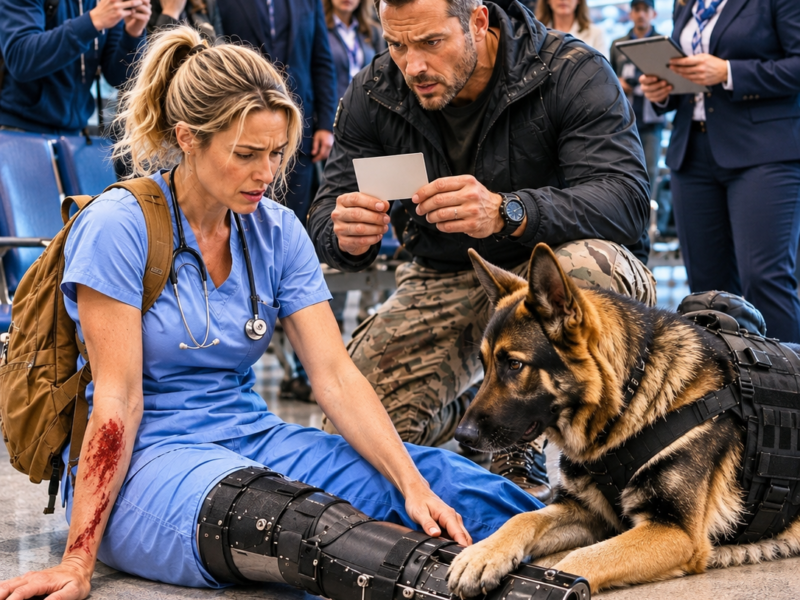
I Was a 36-Year-Old Disabled Navy Veteran Who Begged for Boarding Assistance for 40 Minutes, Only to Hear the Gate Agent Say, “Other Passengers Manage Their Disabilities Without Causing This Much Disruption.” Minutes Later, My Leg Brace Suddenly Locked, Sending Me Crashing Onto the Airport Floor While Strangers Walked Around Me. Then a Military Dog Broke Formation and Refused to Leave My Side. When His Handler Examined My Brace, His Face Went Pale, and He Whispered, “Ma’am, Where Did You Get That Device?”
I Was a 36-Year-Old Disabled Navy Veteran Who Begged for Boarding Assistance for 40 Minutes, Only to Hear the Gate Agent Say, “Other Passengers Manage Their Disabilities Without Causing This Much Disruption.” Minutes Later, My Leg Brace Suddenly Locked, Sending Me Crashing Onto the Airport Floor While Strangers Walked Around Me. Then a Military Dog Broke Formation and Refused to Leave My Side. When His Handler Examined My Brace, His Face Went Pale, and He Whispered, “Ma’am, Where Did You Get That Device?”
PART 1
The gate agent looked me straight in the eyes and said, “Ma’am, you’re holding up the boarding process. If you cannot walk to the aircraft without assistance, perhaps you shouldn’t be flying alone.”
I stood there with my forearm crutch pressed against my side, my left leg trembling inside a medical brace, and nearly forty minutes of waiting behind me.
“My name is Elena Voss,” I told her quietly. “I checked in on time. I requested wheelchair assistance three times. All I need is someone to help me down the jet bridge.”
The woman glanced at her computer.
Then she said the seven words that changed everything.
“Your flight is closed. You’re not boarding.”
Behind her, I could see the aircraft through the enormous terminal windows. Passengers were still settling into their seats. Ground workers were moving equipment beneath the plane.
I was twenty feet from the gate.
And they were leaving me behind.
What happened next would eventually expose a criminal organization operating inside a military rehabilitation program, lead federal investigators to a Navy captain who had been missing for eight months, and reveal a secret that had been strapped to my leg every single day.
But at that moment, I knew none of it.
I was simply a thirty-six-year-old nurse who wanted to visit her injured brother.
And everyone around me seemed determined to make that impossible.
Three years earlier, a highway accident outside Harlo City had nearly ended my career.
A delivery truck lost control on an icy overpass, struck my vehicle, and pushed it into the concrete barrier. By the time rescue workers pulled me out, my left leg had suffered extensive damage.
I remember the hospital lights more clearly than the crash.
I remember asking the orthopedic surgeon whether I would walk again.
He took longer than I liked to answer.
“You’ll walk,” he finally said. “But probably not the way you remember.”
Before the accident, I had spent four years serving as a Navy trauma nurse. I knew what severe injuries looked like. I understood complicated recoveries, permanent limitations, and the difference between medical optimism and reality.
Knowing those things did not make recovery easier.
There were surgeries, months of physical therapy, and mornings when getting from my bedroom to the kitchen felt harder than working a twelve-hour shift in an emergency department.
Eventually, I received a custom electronic leg brace through a veterans rehabilitation program called Silver Meridian Recovery Services.
It was an expensive piece of technology, designed to stabilize my damaged knee and ankle while adjusting pressure as I walked.
Without it, I needed a wheelchair for most distances.
With it, I could work, shop for groceries, and maintain something resembling the life I had before.
I trusted that brace.
I had no reason not to.
Every morning, I fastened its straps in the same order: lower leg, knee, then thigh. Every evening, I removed it carefully and placed it beside my bed.
For eight months, it had been as ordinary to me as putting on shoes.
That Thursday morning in late November, I woke at 4:47 a.m. in a hotel near Vaser Falls Regional Airport.
My younger brother, Dominic, had undergone his second knee surgery six days earlier. He lived alone in Merit Bay, and although he insisted he could manage everything himself, I knew better.
Dominic was twenty-nine, stubborn, and incapable of admitting when he needed help.
The night before, he had called me and said, “Please don’t bring that nurse voice into my apartment.”
“What nurse voice?”
“The one that makes grown men confess they haven’t taken their medication.”
I laughed.
“Then take your medication.”
He groaned and hung up.
It was the last completely normal conversation we would have for a while.
I reached the airport shortly after 5:30 a.m., nearly two hours before departure.
At the check-in counter, a young employee named Ferris examined my reservation.
“I requested mobility assistance when I booked,” I explained.
He typed for several seconds.
Then frowned.
“It’s not showing in the system.”
I pulled out my confirmation email.
“Here. It says wheelchair assistance and preboarding support.”
He barely looked at it.
“You’ll need to speak with the accessibility desk after security.”
“Can you contact them?”
“They handle those requests separately.”
I looked toward the security checkpoint, then down at my leg.
Walking long distances was painful. Standing too long caused swelling. I could manage both, but there were consequences.
Still, I thanked him and continued.
Security itself went smoothly, although the electronic brace required additional screening.
The accessibility desk was another matter.
The woman working there, Greta, was talking on the telephone when I arrived.
I waited.
And waited.
When she finally looked up, I explained everything again.
She checked her screen and shook her head.
“The assistance team is already assigned to other flights.”
“Can you call my gate?”
“I can submit a request.”
“My boarding time is approaching.”
“Someone should meet you there.”
I knew the difference between should and will.
I asked whether she could guarantee it.
She couldn’t.
By the time I reached Gate 14B, my hip was burning and the muscles around my knee had begun to tighten.
I sat near the window, watching the gate desk.
At 6:50, the announcement came.
“Passengers requiring additional assistance may now begin boarding.”
Relief washed through me.
I stood, adjusted my crutch, and approached the desk.
The agent’s name was Darby.
“I have a mobility assistance request,” I said. “I need help getting down the jet bridge.”
She scanned my boarding pass.
“No request is attached.”
“The accessibility desk submitted one.”
“I’m not seeing it.”
“Then could you call them?”
Darby looked toward the line forming behind me.
“We’re extremely busy this morning.”
“I understand. But I cannot safely walk down the incline without someone assisting me.”
She sighed.
“Please step aside while I see what can be arranged.”
I stepped aside.
Zone one boarded.
Then zone two.
Then zone three.
People walked past me carrying coffee, backpacks, shopping bags, and suitcases.
I watched a young father lift a stroller onto the boarding ramp. I watched an elderly couple receive assistance immediately because their names appeared correctly in the airline’s system.
Mine did not.
After another ten minutes, I approached Darby again.
“Excuse me. Have you found someone?”
Without looking up, she said, “We’re working on it.”
“I’m concerned the flight will close.”
“Ma’am, I’ve already explained the situation.”
Her voice was louder now.
Several passengers turned.
I lowered mine.
“I’m not asking for special treatment. I’m asking for the assistance I booked.”
Darby finally looked directly at me.
And said something I would remember for years.
“Other passengers manage their disabilities without causing this much disruption.”
For a moment, I couldn’t speak.
I had spent years treating wounded service members, comforting frightened families, and helping patients learn to live inside bodies that no longer obeyed them.
I had never imagined that asking someone to prevent me from falling would be described as causing a disruption.
“Please document that you denied the requested assistance,” I said.
Her expression hardened.
“I haven’t denied anything.”
“Then please help me board.”
She turned to her computer.
A few minutes later, she picked up the gate telephone, listened briefly, and put it down.
Then she faced me.
“The captain has authorized closing the flight.”
I stared at her.
“But I’m here.”
“I’m sorry. You’ll need to take the next available flight.”
“I’ve been standing beside this desk for forty minutes.”
“There’s nothing I can do.”
I could feel people watching.
Someone behind me whispered, “She’s making such a scene.”
I turned.
A woman holding a designer handbag looked away.
The humiliation was worse than the pain.
Not because I believed I’d done anything wrong, but because I knew how easily everyone would remember the incident differently.
They would remember an angry disabled passenger.
They would forget the three requests for assistance.
They would forget that I’d arrived early.
They would forget that I’d done everything correctly.
I removed my notebook from my jacket.
“What is your full name?” I asked.
Darby hesitated.
I wrote down the time, the gate number, the assistance requests, and the words she had spoken.
Then I turned away.
I had taken perhaps five steps when the brace made a sound I’d never heard before.
A sharp electronic click.
My left ankle locked.
The joint stopped moving completely.
I shifted my weight, instinctively trying to correct my balance.
But the brace forced my leg into an unnatural angle.
The crutch slipped.
And suddenly the floor was rushing toward me.
I struck the tile hard enough to knock the air from my lungs.
Pain exploded through my hip and elbow.
My crutch skidded several feet away.
For a few seconds, all I could hear was my own breathing.
Then came the footsteps.
People were walking around me.
Not running to help.
Walking around.
A man in a business suit stepped over the strap of my bag.
A woman glanced down, checked her watch, and continued toward the food court.
I asked someone to hand me my crutch.
A teenage boy wearing headphones picked it up and placed it beside me.
“Here you go.”
“Thank you,” I whispered.
He nodded and walked away.
Darby appeared above me.
“Ma’am, you can’t remain in the boarding lane.”
I stared up at her.
“My brace malfunctioned. I can’t stand.”
“We need to keep this area clear.”
“Then please bring me a wheelchair.”
Eventually, two ground crew workers helped me into a nearby chair.
I sat there, fighting tears I refused to let anyone see, while the aircraft I’d been supposed to board slowly pushed away from the terminal.
I tried the brace’s emergency reset.
Nothing happened.
I tried again.
The mechanism remained locked.
Then I heard a strange sound.
Not a bark.
A low, persistent whine.
I looked up.
A large Belgian Malinois stood fifteen feet away, pulling against his leash.
His handler, a tall man wearing dark jeans and a gray jacket, appeared genuinely surprised.
“Atlas. Heel.”
The dog ignored him.
His eyes were fixed on me.
More precisely, on my left leg.
“Atlas,” the man repeated, firmer this time.
But the dog kept pulling.
Finally, his handler allowed him to approach.
Atlas came directly to my chair.
He lowered his nose toward the electronic housing beneath my knee.
Sniffed once.
Then sat.
Perfectly still.
The man looked at the dog, then at the brace.
His face changed.
“Ma’am,” he said carefully, “where did you get that device?”
I frowned.
“Through a veterans rehabilitation program.”
“Which one?”
“Silver Meridian.”
His expression became cold.
He crouched beside me.
“My name is Mason Riker. I’m with Naval Special Warfare.”
I looked at him, confused.
“What does that have to do with my leg?”
Mason glanced toward the airport security cameras.
Then lowered his voice.
“Because my dog was trained to recognize a very specific signal.”
He pointed toward my brace.
“And something inside that housing is transmitting it.”
I felt my stomach tighten.
“Transmitting what?”
He hesitated.
“Something that shouldn’t be inside medical equipment.”
I stared at the device that had helped me walk for eight months.
“Are you saying someone tampered with my brace?”
Mason looked directly into my eyes.
“I’m saying there’s a hidden military transmitter inside it.”
Then he said something even more frightening.
“And I think the man who put it there has been missing for eight months.”
PART 2
I thought Mason Riker was mistaken.
Then he showed me a photograph.
The man in it wore a Navy uniform. He had dark hair, tired blue eyes, and a familiar kind of confidence I’d seen in soldiers who had survived terrible situations.
“Captain Adrien Sult,” Mason explained. “He disappeared from Silver Meridian eight months ago.”
“What happened to him?”
“Officially? He discharged himself voluntarily.”
“And unofficially?”
Mason’s expression darkened.
“He discovered someone stealing rehabilitation equipment from wounded veterans.”
I looked down at my brace.
“Why would he hide evidence inside my leg?”
“Because he knew I would recognize his signal.”
Before I could respond, Atlas rose and turned toward the terminal.
Two men were approaching.
One held his phone at an unusual angle. The other kept checking the exits.
Mason noticed them immediately.
“Do you know those men?”
“No.”
He quietly pressed a button on his radio.
Then he moved closer.
“Elena, I need you to listen carefully. Don’t look behind me.”
My heart started pounding.
“Why?”
“Because those men aren’t watching the airport.”
He paused.
“They’re watching you.”
One of them reached inside his jacket.
Atlas stepped between us and growled.
Mason’s radio crackled.
And a woman’s voice said, “Riker, we have a serious problem. The people you’re dealing with may have access to federal records.”
Mason looked at my brace.
Then at the approaching men.
“Elena,” he whispered, “whatever happens next, do not let anyone take that device.”
PART 3
I had spent years working in trauma units, so I knew what fear looked like when someone was trying to hide it.
Mason Riker was hiding it well.
His voice remained controlled, his movements deliberate, but the way he positioned himself between me and the two approaching strangers told me everything I needed to know.
We were in danger.
The man holding the phone slowed near a row of empty chairs. His companion stopped beside a coffee kiosk and pretended to examine the menu.
Neither bought anything.
Mason touched Atlas’s collar.
The dog immediately settled, but his attention never left the strangers.
“We need to move,” Mason said.
“My brace is locked.”
“I’ll help you.”
“I’m not going anywhere until you explain what’s happening.”
He looked toward the men.
Then back at me.
“Silver Meridian was diverting equipment purchased for injured veterans. Adrien discovered it. Four days before he disappeared, he sent me a message saying federal employees were involved.”
“What kind of federal employees?”
“We don’t know how far it goes.”
I felt cold despite the warm terminal.
For eight months, I had worn a medical device issued by the same organization.
I’d gone to work in it.
I’d slept in hotel rooms with it beside my bed.
I’d walked through hospitals filled with vulnerable patients.
And someone had hidden a transmitter inside it.
“Was I being tracked?”
“I don’t know.”
“That isn’t reassuring.”
“I’m not going to lie to you.”
I studied his face.
It was an answer I respected, even if I didn’t like it.
Mason helped me stand. Atlas moved beside my right leg while I leaned against Mason’s shoulder.
Every step sent pain through my hip.
We reached an unused gate at the far end of the concourse.
There, Mason guided me into a chair and made another call.
“Atlas has indicated,” he said into his radio. “I need technical support and a secure extraction team. Enter through airport operations.”
He listened.
“Understood.”
Then he disconnected.
“Who did you call?” I asked.
“Someone I trust.”
“Not everyone in your organization?”
His silence answered me.
I glanced toward the terminal windows.
“Your friend Adrien must have been desperate.”
Mason nodded.
“He was. He had found discrepancies in patient equipment logs. Devices worth tens of thousands of dollars were supposedly being issued, but patients weren’t receiving them.”
“Where were they going?”
“Private buyers. Resale brokers. People making money from equipment intended for wounded service members.”
I closed my eyes.
During my Navy service, I’d cared for a nineteen-year-old Marine who lost both legs in an explosion.
He cried when he received his first properly fitted prosthetics.
Not because they hurt.
Because they meant he might walk beside his mother again.
The idea of someone stealing equipment from people like him made something inside me harden.
“How many patients?” I asked.
“We don’t know yet.”
I looked at the brace.
“Then let’s find out.”
Twenty minutes later, three federal investigators arrived through a staff corridor.
The woman leading them introduced herself as Special Agent Lena Hargrove.
She carried a black equipment case and had the expression of someone who had already decided there was no time for unnecessary conversation.
“Elena Voss?”
“Yes.”
“I’m told you’ve been wearing the device for eight months.”
“Every day.”
“Has anyone modified it since the original fitting?”
“Not that I know of.”
Hargrove placed her case on a table inside a small airport operations room.
“We’re going to examine it without removing it from your leg.”
“Will you unlock it?”
“If we can do so safely.”
I extended my aching leg.
Mason stood nearby while Atlas settled beneath the table.
Hargrove activated a scanning device.
For several minutes, the room remained almost completely silent.
Then a series of readings appeared on her screen.
She leaned forward.
“That’s interesting.”
I disliked that word.
Medical professionals used it when they discovered something complicated.
“What?” Mason asked.
“The device is transmitting in short bursts. The signal is concealed inside the brace’s normal electronic activity.”
“Can you read it?”
“I’m working on it.”
She adjusted several settings.
A few moments later, another screen filled with characters.
Her expression changed.
“Got it.”
Mason moved closer.
“What is it?”
Hargrove stared at the display.
“Three encrypted data packages.”
She began opening the first.
What appeared on the screen made me forget my injured leg.
Names.
Hundreds of names.
Patient identification numbers, equipment descriptions, reimbursement records, and dates.
Some entries showed wheelchairs worth more than $30,000.
Others listed specialized braces, prosthetic components, rehabilitation devices, and adaptive technology.
Every item had supposedly been delivered.
But beside many entries was another notation.
Redirected.
Hargrove scrolled through the records.
“Two hundred and twelve patients,” she said quietly.
I looked at her.
“Two hundred and twelve?”
“That’s the minimum documented in this file.”
The second package contained financial records.
Equipment serial numbers matched to private sales.
Bank transfers.
Shell companies.
Money moving through businesses that appeared legitimate on paper but existed only to conceal stolen property.
The third file was different.
It contained fourteen names.
Hargrove read the list once.
Then again.
Mason noticed her expression.
“What is it?”
She looked up.
“One of these names belongs to the NCIS officer who closed Adrien’s disappearance investigation.”
The room went silent.
I felt as though the floor had moved beneath me.
“Someone investigating his disappearance was involved?”
Hargrove nodded.
“And that’s not all.”
She turned the screen.
Another name appeared.
Darren Quill.
A former federal program inspector.
The man who had supposedly approved Silver Meridian’s clean compliance audit eight months earlier.
Except he had retired six months before that audit.
I stared at the screen.
“Someone forged his approval?”
Hargrove shook her head.
“According to these records, he approved it knowingly. He continued helping them after retirement.”
Mason slowly exhaled.
“Adrien wasn’t just exposing theft.”
“No,” Hargrove said. “He was exposing a protected network.”
At that moment, another agent entered.
His name was Okafor.
He looked directly at me.
“We have a problem.”
I was beginning to hate those words.
“What now?”
“The man who followed you at the gate accessed your airline reservation.”
I frowned.
“Why?”
“To obtain your personal information.”
A terrible thought struck me.
“My brother.”
Everyone looked toward me.
“Dominic is listed as my emergency contact in my rehabilitation records.”
Hargrove immediately reached for her phone.
“Where does he live?”
“Merit Bay. He just had surgery.”
“Call him.”
I dialed.
Four rings.
Voicemail.
I tried again.
Nothing.
My hands began shaking.
Dominic sometimes slept through calls because of his medication.
That was normal.
But nothing about this morning was normal anymore.
“Please,” I whispered. “Someone needs to check on him.”
Hargrove contacted a trusted federal marshal.
Within minutes, she had arranged a welfare check.
Still, I couldn’t stop staring at my phone.
Mason sat beside me.
“We’re going to find him.”
“You don’t know that.”
“No,” he admitted. “But we’re not ignoring the risk.”
That was when I realized why his honesty mattered.
Everyone at the airport had offered promises without action.
Mason offered no promises.
He simply acted.
Several minutes later, Hargrove’s phone rang.
She answered.
Then looked at me.
“Your brother is safe.”
I covered my mouth.
“He was sleeping,” she continued. “He’s very confused, and apparently he’s demanding to speak to whoever frightened his sister.”
A broken laugh escaped me.
“That sounds like Dominic.”
For one brief moment, I believed the worst was over.
Then Okafor’s radio crackled.
He listened, walked to the door, and returned with a grim expression.
“We found Captain Sult.”
Mason stood so abruptly that his chair scraped across the floor.
“Alive?”
“Yes.”
“Where?”
“A private residential facility outside Dunore.”
“Why hasn’t anyone reported him?”
Okafor hesitated.
“Because he’s being held under a false identity.”
Mason’s face drained of color.
“He’s been there the entire time?”
“Eight months.”
I looked toward the evidence displayed on Hargrove’s screen.
Eight months.
The same eight months I’d worn the brace.
The same eight months a missing Navy captain had apparently waited for his evidence to reach someone who could act.
Hargrove was already making calls.
“We need an emergency order preventing patient transfers,” she said.
“Why?” I asked.
Okafor looked at me.
“Because the facility knows we’ve found him.”
Mason tightened his jaw.
“They’ll move him.”
Hargrove nodded.
“And if they move him before federal protection arrives, he may disappear again.”
I stared at the notebook sticking out of my jacket pocket.
I’d brought it to document an airline complaint.
Now it might help save a man’s life.
“What do you need from me?” I asked.
Hargrove turned.
“A sworn statement confirming where you received the brace and everything that happened today.”
“How quickly?”
“Immediately.”
I took out my notebook.
“Then give me a pen.”
I wrote for nine minutes.
I recorded names, times, dates, locations, and every interaction I could remember.
No speculation.
No exaggeration.
Only facts.
When I finished, Hargrove photographed the pages and sent them through a secure federal channel.
Then we waited.
The room felt smaller with every passing minute.
Finally, her phone rang.
She answered, listened, and closed her eyes briefly.
“The emergency order is authorized.”
Mason let out a breath.
“Adrien?”
“Federal marshals intercepted the transfer vehicle. He’s alive and in protective custody.”
I nearly collapsed with relief.
But before anyone could celebrate, Atlas suddenly stood.
His head turned toward the service entrance.
A shadow moved beneath the door.
Then someone tried the handle.
Once.
Twice.
Mason stepped in front of me.
The handle stopped moving.
From the other side came a man’s voice.
“Open the door. Airport security.”
Hargrove raised her identification.
“State your name and badge number.”
Silence.
Then footsteps retreating.
Okafor checked the corridor camera.
His face changed.
“They’re not airport security.”
On the monitor were the same two men who had followed me from the terminal.
Only now they had a third person with them.
And all three were moving toward our room.
PART 4
For several seconds, nobody spoke.
I watched the three men on the security monitor, their faces tense, their movements purposeful.
The man in the navy jacket had stopped pretending to be an ordinary passenger.
He was holding a phone against his ear, speaking rapidly.
His companion stood beside the corridor entrance.
The third man carried an airport maintenance badge that looked suspiciously new.
Hargrove turned to Okafor.
“Lock down the corridor.”
“Already requested.”
Mason moved Atlas closer to the door.
I gripped my crutch.
My left leg was still locked inside the brace, and the pain had become a constant, exhausting pressure.
But pain was familiar.
What frightened me was the knowledge that these men were desperate enough to approach a room containing federal agents.
Desperate people made dangerous decisions.
A voice came through Hargrove’s radio.
“Suspects approaching the restricted corridor. Federal personnel moving to intercept.”
Mason looked at me.
“Stay behind the table.”
“I can help.”
“You already have.”
“That’s not what I meant.”
For the first time, he almost smiled.
“I know.”
Outside, raised voices echoed through the corridor.
“Federal agents! Hands where we can see them!”
A metallic object struck the floor.
Someone shouted.
Atlas stiffened but remained where Mason had directed him.
Then came silence.
Hargrove listened to her radio.
“Three suspects detained,” a voice reported. “Area secure.”
I closed my eyes.
Only then did I realize how tightly I had been gripping the crutch.
My fingers ached.
Several minutes later, the door opened.
Two federal marshals entered.
Between them walked a tall, painfully thin man wearing a dark jacket over hospital clothes.
His movements were slow.
His skin was pale.
His eyes looked exhausted.
But when he saw Mason, his entire face changed.
“Riker?”
Mason stopped breathing for a moment.
“Adrien.”
The two men stared at each other.
Then Mason crossed the room and grabbed his friend’s shoulders.
Eight months of uncertainty seemed to collapse into that single moment.
“You stubborn son of a gun,” Mason whispered.
Adrien gave a weak smile.
“Took you long enough.”
Mason laughed once, a broken sound that almost became a sob.
Then Atlas moved.
The dog approached Adrien carefully, his tail moving in restrained, uncertain sweeps.
Adrien knelt with obvious difficulty.
“Hey, boy.”
Atlas pressed his head into Adrien’s chest.
And the missing captain began to cry.
Not loudly.
Not dramatically.
Just quiet tears slipping down his cheeks while his fingers moved through the dog’s fur.
I turned my face toward the window.
Some moments deserve privacy, even when they happen in a crowded room.
When Adrien finally looked at me, his eyes went immediately to my leg.
The expression on his face changed.
“You’re the one.”
I nodded.
“Elena Voss.”
He stared at the brace.
“I never knew who would receive it.”
“Apparently, neither did the people distributing it.”
He lowered his head.
“I’m sorry.”
I studied him.
“You designed the transmitter?”
“Yes.”
“And the locking mechanism?”
He hesitated.
“Yes.”
I felt anger rising through the exhaustion.
“You knew it could make someone fall?”
“I knew there was a risk.”
“A risk?”
My voice came out sharper than I intended.
“I fell on an airport floor. My hip is bruised, my ankle is swollen, and I spent hours unable to move properly.”
Adrien looked miserable.
“I know.”
“No. You didn’t know. You couldn’t know, because you had no idea whose leg this device would end up on.”
Mason started to speak.
I raised one hand.
“I’m not finished.”
Adrien looked at me.
“I understand that you were desperate. I understand you were trying to expose something terrible. But you used another injured person without asking.”
He swallowed.
“You’re right.”
There was no argument.
No elaborate justification.
Just those two words.
And somehow, that made it harder to remain angry.
I sat back.
“Tell me why.”
Adrien lowered himself into a chair.
He explained that he had discovered suspicious equipment records during rehabilitation at Silver Meridian.
When he began asking questions, his medical files were altered.
His symptoms were exaggerated.
A report appeared claiming he was unstable and unable to make treatment decisions.
He tried contacting oversight officials.
Those complaints disappeared.
Eventually, someone warned him that he would be transferred to a private residential facility.
Before they could take him, he copied the evidence and hid it inside an electronic brace scheduled for distribution.
He had helped develop detection systems with Mason and Atlas during a previous military assignment.
The transmitter used a familiar signal pattern, one associated with equipment Atlas had been trained to locate.
“I couldn’t tell Mason directly,” Adrien said. “My calls were monitored.”
“Why that particular brace?” I asked.
“Because it was scheduled for a patient who lived near Vaser Falls. I knew Mason traveled through that airport regularly.”
“So you gambled on a stranger.”
“Yes.”
“And on your dog finding the signal.”
He looked at Atlas.
“Yes.”
I shook my head.
“That is a terrible plan.”
Adrien smiled faintly.
“It was the only one I had.”
I looked at the evidence on Hargrove’s screen.
Two hundred and twelve veterans.
Four years of diverted equipment.
Millions of dollars moving through shell companies.
I thought about the people who had waited months for wheelchairs they desperately needed.
The patients who blamed themselves when rehabilitation failed.
The families who believed their loved ones weren’t improving because they lacked determination.
And all the while, criminals were selling the very devices meant to help them recover.
I looked back at Adrien.
“I’m still angry about the fall.”
“I know.”
“But I’m glad you’re alive.”
His eyes filled again.
“Thank you.”
The hours that followed were exhausting.
I gave two formal statements.
Adrien provided testimony about his confinement.
Hargrove coordinated with investigators examining Silver Meridian facilities across several states.
By early afternoon, authorities had begun detaining people connected to the fraud.
The man in the navy jacket was identified as Croft, a former private security contractor who had been helping the organization monitor sensitive cases.
A program administrator named Lorraine Veth was taken into custody.
Investigators were also examining the activities of Darren Quill, the retired inspector who had secretly continued approving fraudulent reports.
The psychiatrist responsible for Adrien’s confinement was under investigation.
The list kept growing.
But one name disturbed Hargrove more than the others.
The NCIS officer who had closed Adrien’s missing-person report.
It meant that even the people responsible for protecting service members could have helped conceal what happened to him.
By late afternoon, a technician finally unlocked my brace.
The release was so sudden that I almost cried.
For the first time in hours, I could bend my ankle.
A medical team examined me, confirmed that I had no fractures, and recommended further assessment.
I wanted to go home.
I wanted a shower.
I wanted to sleep for twelve uninterrupted hours.
Instead, I called Dominic.
He answered immediately.
“Elena, what on earth is happening?”
“It’s complicated.”
“Somebody told me federal marshals checked on me because of your flight.”
“They did.”
“Are you in trouble?”
“No.”
“Did you get arrested?”
“No!”
“Did you arrest someone?”
I started laughing.
“No, Dominic.”
He paused.
“Okay. Because I was about to tell Mom.”
“Don’t tell Mom.”
That made him laugh too.
For a moment, hearing my brother’s voice made everything feel ordinary again.
Two days later, I finally reached his apartment.
We sat on the couch with ice packs on our respective injuries, eating soup from his favorite restaurant.
I told him everything.
He listened without interrupting.
When I finished, he looked at me for a long time.
“So let me understand this.”
“Go ahead.”
“You requested help at the airport.”
“Yes.”
“They ignored you.”
“Yes.”
“You missed your flight.”
“Yes.”
“Your leg brace broke because a missing Navy captain had hidden evidence inside it.”
“Essentially.”
“A military dog found the evidence.”
“Yes.”
“And now federal investigators are arresting people.”
“Yes.”
Dominic stared at his soup.
Then said, “I am never complaining about airport delays again.”
We laughed until my hip hurt.
But later, when he became serious, he asked something important.
“What happens to the airline?”
I had almost forgotten that part of the story.
Almost.
“The complaint is still open.”
“After everything that happened, you’re still pursuing it?”
I looked at him.
“Of course.”
“Why?”
“Because the next person they abandon at a gate might not have a Navy SEAL and a military dog nearby.”
Dominic slowly nodded.
And I knew he understood.
Three weeks later, the airline issued its findings.
My mobility assistance request had been properly submitted.
It had failed to transfer between internal systems.
The gate staff had not completed the necessary follow-up.
And the airline had failed to provide reasonable assistance to a passenger with a documented disability.
The report recommended changes to the airline’s procedures and retraining for employees.
It did not publicly blame one worker.
It identified a system that had failed.
That mattered to me.
I wasn’t interested in destroying Darby’s life.
I wanted to make sure that another passenger didn’t spend forty minutes begging for help that had already been requested.
Meanwhile, the federal investigation expanded.
The original 212 victims became 431 potential cases requiring review.
Investigators identified more businesses involved in equipment diversion.
The stolen devices had been moved across three states.
Then Hargrove called with another development.
“Elena, we found evidence of a fifth rehabilitation organization connected to the same financial network.”
I sat down.
“Another one?”
“Yes.”
“How many victims?”
“We’re still counting.”
I closed my eyes.
There was a long silence.
Then Hargrove continued.
“And there’s something else. We believe someone in the network is trying to contact you.”
My stomach tightened.
“Who?”
“We don’t know yet. But the meeting invitation you received from the VA under secretary’s office wasn’t legitimate.”
I looked at the appointment confirmation sitting on my kitchen table.
A senior government official had supposedly requested to meet me about improving veterans rehabilitation programs.
I’d been honored.
I’d even rearranged my work schedule.
Now Hargrove was telling me the invitation was fake.
“Someone impersonated the government?”
“Yes.”
“Why?”
“We believe they intended to isolate you.”
I stared at the address printed on the letter.
A commercial office building on the east side of Harlo City.
Not government property.
Not a VA facility.
And definitely not somewhere I wanted to be alone.
Hargrove lowered her voice.
“Elena, whatever you do, don’t attend that meeting.”
I looked at the address again.
Then asked a question that surprised even me.
“What if we let them believe I’m coming?”
PART 5
Mason was sitting across from me at my kitchen table when I called the number on the fraudulent invitation.
Atlas lay beside his chair.
Hargrove was listening through a secure connection, recording the conversation.
I had never considered myself particularly brave.
I’d done difficult things as a nurse because difficult things were part of the job.
But this was different.
Someone had obtained my personal information, impersonated a federal office, and attempted to lure me into a building connected to the same organization that had held Adrien prisoner.
I knew the danger.
And I knew that refusing the invitation would not necessarily make those people disappear.
The telephone rang four times.
A woman answered.
“Office of the Under Secretary for Veterans Benefits.”
I kept my voice calm.
“Hello. This is Elena Voss. I’m calling about my appointment on Thursday.”
“Of course, Ms. Voss. We’ve been expecting your confirmation.”
“I need to change the time.”
A pause.
“What time would be convenient?”
“Ten in the morning.”
Another pause.
“That should be acceptable.”
“Excellent. Could you repeat the address? I seem to have misplaced it.”
The woman gave me the same location.
I repeated it carefully, as though writing it down.
Then thanked her and ended the call.
Mason looked at me.
“Nicely done.”
My hands were trembling.
“Please don’t tell me I have a talent for this.”
He almost smiled.
“I was going to say you have a talent for staying calm.”
“That’s called nursing.”
Within minutes, Hargrove traced the building’s ownership through several companies.
The final connection led directly to the same Delwick County holding company used to conceal the stolen rehabilitation equipment profits.
The trap had revealed itself.
The next two days passed in an uncomfortable imitation of normal life.
I went to work.
I reviewed patient charts.
I helped an elderly veteran stand for the first time after hip surgery.
I drank coffee that tasted like burnt cardboard.
And every few hours, I wondered whether someone was watching me.
Mason assured me federal investigators were monitoring the situation.
I believed him.
Still, I double-checked my apartment locks.
On Thursday morning, I was supposed to walk into the fake government meeting at ten o’clock.
Instead, at 9:47 a.m., federal agents entered the building.
They found three people inside.
One was a former VA regional oversight official named Callum Brig.
Another was a communications consultant who had worked for Silver Meridian.
The third was a sixty-one-year-old former federal employee named Delia Strom.
She had spent thirty-two years inside the government.
She possessed commendations, professional connections, and extensive knowledge of federal oversight procedures.
And according to investigators, she had helped coordinate the corruption network’s efforts to suppress complaints and conceal evidence.
The fake meeting invitation had been part of that effort.
When agents entered the room, Strom was sitting at a table with a cup of tea.
She calmly requested an attorney.
Investigators also discovered cabinets filled with paper records.
Names.
Payments.
Instructions.
Internal communications.
Evidence connecting people who had believed they were protected by layers of bureaucracy.
Strom had apparently kept detailed records as insurance against her own associates.
Those records identified nineteen additional individuals who had not appeared in Adrien’s original evidence.
I received Hargrove’s call shortly before noon.
“It’s done,” she said.
I leaned against the nursing station counter.
“All three?”
“All three.”
I closed my eyes.
For the first time since the airport, I felt something inside me loosen.
“Is it really over?”
Hargrove hesitated.
“The immediate threat to you appears contained. The investigation will continue for months, possibly years.”
I nodded, although she couldn’t see me.
“And Adrien?”
“His medical records have been corrected. His fraudulent discharge has been voided. He’s receiving appropriate treatment now.”
I swallowed.
“Good.”
“He asked me to tell you something.”
“What?”
Hargrove paused.
“He said the brace worked better than he ever expected.”
I laughed softly.
“Tell him I disagree with its safety features.”
Hargrove laughed too.
“I’ll pass that along.”
After the call, I stood there for several seconds.
Then a patient called from room seven.
And just like that, I went back to work.
The world did not stop because something extraordinary had happened to me.
People still needed medication.
Wounds still needed dressing.
Families still needed reassurance.
And somewhere, a frightened patient was still waiting for someone to explain that recovery would take longer than expected.
Over the following weeks, the Silver Meridian investigation became national news.
Reporters contacted me.
Television producers offered interviews.
One network wanted to recreate the moment Atlas discovered the transmitter.
Another asked whether I would describe myself as a hero.
I declined most of their invitations.
I did agree to speak with a veterans advocacy publication and a disability rights organization.
But I made one thing clear.
“I don’t want the story to be about a miraculous dog finding a secret device,” I told the first interviewer.
She looked surprised.
“Isn’t that what made the case possible?”
“It was part of it.”
“Then what should the story be about?”
I thought carefully before answering.
“It should be about people who were supposed to receive help and were treated as problems instead.”
I explained how Silver Meridian had exploited veterans whose medical conditions made it difficult to challenge complicated administrative decisions.
I explained how the airline had repeatedly ignored my requests because the assistance wasn’t appearing in its computer system.
And I explained why those two failures, although vastly different in scale, shared something troubling.
Both institutions had prioritized their procedures over the needs of the people those procedures were supposed to serve.
The interviewer was quiet.
Then she asked whether I was angry.
“I was,” I admitted. “Very angry.”
“And now?”
“Now I’m trying to make that anger useful.”
Eight weeks after the airport incident, the airline implemented revised mobility assistance procedures across its regional hubs.
Employees were required to confirm assistance requests directly between the accessibility desk and the gate.
A missing electronic flag could no longer be treated as sufficient reason to disregard a documented request.
There were new training requirements.
New escalation procedures.
New accountability measures.
They were not revolutionary changes.
They were simple things that should have existed long before I walked into Gate 14B.
But they mattered.
One afternoon, I received a letter from a woman who had read my interview.
She was seventy-two years old and used a wheelchair.
She described missing a family wedding because an airline failed to provide assistance despite repeated requests.
For years, she’d believed she was somehow responsible.
At the end of her letter, she wrote that she’d finally understood something after reading my story.
Needing help was not the problem.
Being denied help was.
I sat at my kitchen table and read that sentence three times.
Then I put the letter beside my notebook.
Four months after the airport incident, I received another invitation from the Office of the Under Secretary for Veterans Benefits.
This time, Hargrove verified it personally.
The meeting was real.
The office was real.
And the woman requesting to speak with me was Rosalind Ober, a senior official overseeing veterans benefits.
I arrived eleven minutes early.
Old habits.
Ober greeted me warmly and invited me to sit wherever I felt comfortable.
For ninety minutes, we discussed rehabilitation programs, equipment accountability, patient safety, and the importance of listening to veterans who depended on these services.
She asked precise questions.
I gave direct answers.
At the end, she folded her hands.
“Ms. Voss, we’re establishing a patient experience advisory panel to help review our rehabilitation programs.”
I nodded.
“That sounds necessary.”
“I’d like you to chair it.”
I stared at her.
“Me?”
“You’re a former military nurse, a current clinical professional, and someone who has personally experienced the failures we’re trying to correct.”
“I also work full-time.”
“We can accommodate that.”
I looked toward the window.
For a moment, I saw the airport floor again.
The polished tile.
My crutch lying beyond my reach.
People walking around me.
Darby telling me to move.
And a dog pulling desperately toward something nobody else could see.
I thought about all the people whose stories never reached investigators or reporters.
People who complained and were ignored.
People who became too exhausted to complain again.
People who simply learned to expect less.
“Yes,” I said.
Ober smiled.
“Excellent.”
Before I left, she surprised me.
“There is something else I want to say.”
I waited.
“The rehabilitation system failed to protect you. Equipment supplied through an affiliated program was compromised, and you were placed in danger without your knowledge or consent.”
I remained still.
She continued.
“That institutional failure is ours to acknowledge. You deserved better.”
For several seconds, I couldn’t speak.
It was strange.
I’d been questioned by investigators, interviewed by journalists, and asked to explain the same experience more times than I could count.
But no one in an official position had said those words so plainly.
You deserved better.
“Thank you,” I finally replied.
She nodded.
“You should have heard that much sooner.”
I left the building feeling lighter than I had in months.
Outside, winter sunlight fell across the sidewalk.
I called Mason.
He answered on the second ring.
“How’d it go?”
“I’m apparently chairing a federal advisory panel now.”
He laughed.
“Of course you are.”
“What’s that supposed to mean?”
“It means I’m not surprised.”
I could hear Atlas moving in the background.
“How’s Adrien?” I asked.
“Better. His neurologist says he’s recovering well. The medication they used suppressed his functioning, but the latest evaluations are encouraging.”
“That’s good.”
“He wants to know whether you’ll have dinner with us next week.”
I smiled.
“Is that an apology dinner?”
“Possibly.”
“Tell him he can buy dessert.”
Mason laughed.
“I think that’s reasonable.”
I hesitated.
“And Mason?”
“Yeah?”
“Bring Atlas.”
There was a pause.
“Wouldn’t dream of leaving him behind.”
We met the following Saturday at a quiet restaurant near the waterfront.
Adrien looked healthier than he had in the airport operations room.
His face had regained some color.
His movements were still careful, but his eyes were brighter.
When I arrived, he stood.
“Elena.”
“Adrien.”
He looked at my leg.
“How’s the brace?”
“Fully repaired. No more unexpected electronic surprises.”
He winced.
“I deserved that.”
“Yes, you did.”
Then I smiled.
He smiled back.
We sat for nearly three hours.
For the first time, I heard Adrien speak about something other than evidence, confinement, or the investigation.
He talked about his childhood, his military career, and his love of engineering.
He told me how Atlas had once stolen an entire sandwich from Mason during a training exercise.
Mason denied the story.
Atlas, lying beneath the table, offered no defense.
Eventually, the conversation turned serious.
Adrien looked at me.
“I’ve wanted to ask you something.”
“Go ahead.”
“Do you wish you’d made that flight?”
The question caught me off guard.
I looked toward the harbor.
A small boat was moving slowly through the evening light.
I thought about the pain.
The humiliation.
The fear for Dominic.
The weeks of uncertainty.
Then I thought about the veterans whose equipment might finally be recovered.
The families who might receive answers.
The patients who would benefit from better oversight.
And Adrien himself, sitting across from me, alive.
“I wish they’d helped me board,” I said.
Adrien lowered his eyes.
“But if I had made the flight, none of this would have happened that day.”
“Do you regret what happened?”
I considered that.
“I regret what happened to me. I don’t regret what I did afterward.”
He nodded slowly.
“I understand.”
“And for the record,” I added, “if you ever design another emergency evidence system, don’t make it injure the person carrying it.”
Mason nearly choked on his water.
Adrien laughed.
It was the first time I’d heard him laugh without sadness underneath it.
Months later, my life had settled into a different routine.
I still worked as a nurse.
I still visited Dominic, who had recovered enough to return to his usual habit of ignoring sensible advice.
I still went to physical therapy.
And I still fastened my brace every morning, one strap at a time.
The federal investigation continued.
Some defendants entered plea agreements.
Others challenged the charges.
The stolen equipment was traced through complicated financial networks, and recovery efforts continued for the veterans affected.
The advisory panel held its first meeting.
Then its second.
Then its third.
We reviewed equipment distribution procedures, patient complaint pathways, and safeguards intended to prevent the kind of fraud Silver Meridian had carried out.
The work was slow.
Sometimes frustrating.
Often buried beneath documents filled with language that seemed designed to make simple problems complicated.
But every time someone suggested that a particular change would be too difficult, I thought about Gate 14B.
About how easy it had been for three separate employees to tell me the problem belonged to someone else.
About how forty minutes of waiting had become a missed flight.
About how the absence of one correctly entered computer flag had somehow mattered more than the woman standing in front of the desk asking for help.
And I kept pushing.
One December evening, I returned home after a particularly long shift.
My hip ached.
The streets were cold and nearly empty.
I unlocked my apartment, put down my bag, and removed my brace.
As always, I placed it beside my bed.
Then I reached for my notebook.
The original notebook had become part of a federal evidence file.
I’d bought a new one.
Its pages were already filled with observations from advisory meetings, patient conversations, and ideas I wanted to explore.
I opened it to a blank page.
For a long moment, I sat there remembering that Thursday morning.
I remembered Darby’s impatient expression.
I remembered the passengers who stepped around me.
I remembered the teenage boy who quietly handed me my crutch.
He probably had no idea what happened afterward.
He didn’t know about the hidden transmitter.
He didn’t know about Adrien.
He didn’t know that federal agents would eventually uncover a network stealing medical equipment from wounded veterans.
He had simply seen someone who needed help and given her something she couldn’t reach.
I wondered how many small acts like that went unnoticed every day.
How many times someone made another person’s life easier without ever realizing it.
And how many times the opposite happened.
How many people were left waiting because helping them required a little extra time.
I picked up my pen.
Then I wrote a sentence that would later become the opening statement of our advisory panel’s next report.
People who need assistance are not the problem that systems must work around. They are the reason those systems exist.
I read it twice.
Then underlined it.
My phone vibrated.
A message from Dominic.
He’d sent me an article about the latest developments in the Silver Meridian investigation.
Beneath it, he’d written:
Still can’t believe my big sister missed one flight and somehow started a federal investigation.
I smiled.
Then typed back:
I didn’t start it. A dog did.
A moment later, he replied:
Then buy the dog a steak.
I laughed.
Outside my apartment, the city continued moving.
Cars passed.
People hurried home.
Somewhere, another nurse was finishing a shift.
Somewhere, a veteran was waiting for the equipment that might allow him to walk again.
Somewhere, an airport employee was helping a passenger board an aircraft using procedures that had been changed because someone finally documented what went wrong.
And somewhere, Atlas was probably sleeping beside Mason, completely unaware of how many lives his extraordinary nose had helped change.
I closed the message and returned to my notebook.
For a long time, I’d believed survival meant learning to accept the things I couldn’t control.
My accident.
My damaged leg.
The pain that would probably remain part of my life.
But that morning at Gate 14B had taught me something different.
I couldn’t control everything that happened to me.
I couldn’t force strangers to be compassionate.
I couldn’t prevent institutions from making mistakes.
And I couldn’t change the fact that someone had used my medical device without my permission.
But I could decide what happened after I discovered those failures.
I could speak.
I could document.
I could refuse to let someone’s indifference become the final word.
That was the part I had control over.
And perhaps that was why I no longer thought about the airport floor with the same humiliation I’d felt that morning.
I remembered the fall.
I remembered the pain.
But I also remembered getting back up.
Not immediately.
Not gracefully.
And certainly not without help.
Still, I got up.
And the next time someone needed help, I intended to make sure the people responsible didn’t simply walk away.
Because sometimes the difference between a person being forgotten and a person finally receiving justice isn’t a miracle.
Sometimes it’s a notebook.
Sometimes it’s one stranger willing to help.
Sometimes it’s a loyal dog who refuses to ignore what he’s been trained to recognize.
And sometimes it’s a woman everyone dismissed as a problem passenger deciding that her story deserves to be heard.
I placed my pen against the next blank line.
Then I kept writing.