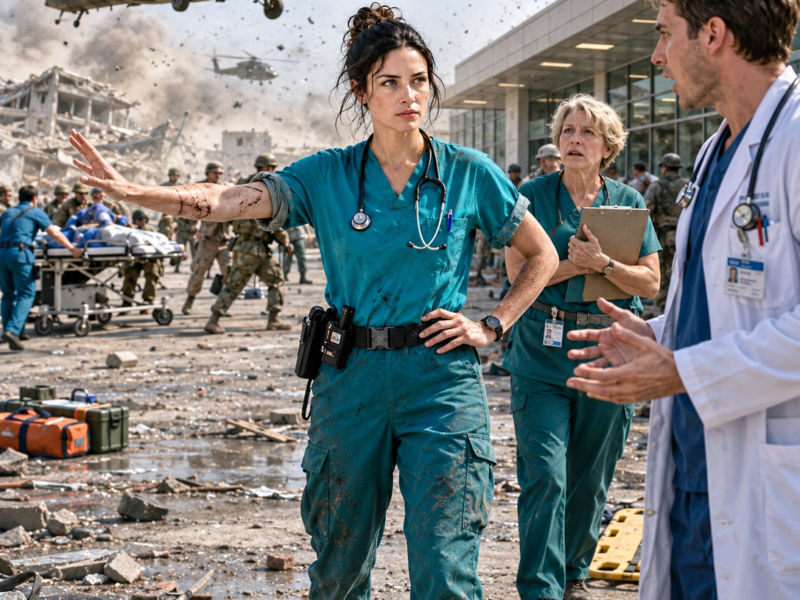
I Was a 34-Year-Old Nurse at a Small Connecticut Hospital, Where My Head Nurse Humiliated Me Every Day and the Chief Surgeon Dismissed My Warnings. Then Eight Black Military Helicopters Descended on Our Parking Lot, Carrying 34 Dying Special Forces Soldiers. When One Operator Saw My Scarred Arms, He Whispered, “You’re Supposed to Be Dead. They Said the Angel of Death Was Killed in Fallujah.” Suddenly, Everyone Realized They Had No Idea Who Was Standing Before Them…
I Was a 34-Year-Old Nurse at a Small Connecticut Hospital, Where My Head Nurse Humiliated Me Every Day and the Chief Surgeon Dismissed My Warnings. Then Eight Black Military Helicopters Descended on Our Parking Lot, Carrying 34 Dying Special Forces Soldiers. When One Operator Saw My Scarred Arms, He Whispered, “You’re Supposed to Be Dead. They Said the Angel of Death Was Killed in Fallujah.” Suddenly, Everyone Realized They Had No Idea Who Was Standing Before Them…
PART 1
Mercy General Hospital was the kind of place where the most exciting event of the week was usually a teenager arriving with a broken arm after a high school football game. Located in the quiet, affluent suburb of Westfield, Connecticut, it was a Level III trauma center that handled minor accidents, kitchen injuries, allergic reactions, and the occasional elderly patient who had fallen down a staircase.
Nobody expected anything extraordinary to happen there.
And certainly nobody expected the quiet new nurse who had spent six weeks being humiliated by her colleagues to become the only person capable of saving dozens of dying soldiers.
Her name was Clarice Hayes.
She was thirty-four years old, although her tired expression sometimes made her look older. She had joined Mercy General six weeks earlier, submitting a résumé that revealed almost nothing remarkable about her background. She had graduated from an ordinary state nursing school, worked for several years at a small medical clinic in the Midwest, and then disappeared from professional records for a period she explained by saying she had been caring for a sick relative.
Her employment history was unremarkable. Her references were ordinary. Her personality was quiet.
At least, that was what everyone believed.
Clarice never complained about her assignments. She accepted the night shifts nobody wanted, volunteered to clean rooms when the janitorial staff was unavailable, and regularly restocked emergency supplies without being asked. She rarely participated in conversations and never seemed interested in hospital gossip.
She also wore long-sleeved navy scrubs, even when the hospital became uncomfortably warm.
Her dark hair was always pulled into a tight bun, and her movements were so controlled that she sometimes seemed almost invisible.
Unfortunately, being invisible did not protect her from Brenda Carmichael.
Brenda had worked at Mercy General for twenty years and considered herself the unquestioned authority of the emergency department. She was the head nurse, a position she defended with endless criticism, unnecessary rules, and a clipboard she carried everywhere like a weapon.
For reasons nobody understood, she had decided that Clarice was her favorite target.
“Hayes!”
The sharp voice echoed across the nurses’ station one Tuesday morning.
Clarice looked up from the patient charts.
“Yes, Brenda?”
“Did you check the medication inventory in Trauma Bay Two?”
“Yes. Everything is accounted for.”
“Then check it again. I don’t want to discover another missing vial because someone decided to be careless.”
Clarice nodded.
“I’ll verify it.”
“And when you’re finished, go help with bedpan duty in Room Four. Dr. Aerys is consulting with a patient, and he doesn’t need unnecessary interruptions.”
A couple of junior nurses exchanged uncomfortable glances.
Clarice simply picked up her clipboard and walked away.
Dr. Thomas Aerys was another familiar source of frustration.
At thirty-two, he was the emergency department’s golden boy, an attending physician who mentioned his fellowship at Johns Hopkins so frequently that even the hospital cleaning staff knew where he had studied.
He wore expensive watches, perfectly tailored scrubs, and the expression of a man convinced that everyone around him was intellectually inferior.
Nurses were supposed to follow his instructions, residents were supposed to admire him, and patients were supposed to appreciate the privilege of receiving his attention.
Clarice had learned to avoid attracting his attention whenever possible.
But there was something unusual about the way she moved.
She never walked directly beneath an open doorway without briefly checking the room beyond it. She automatically noticed reflective surfaces, emergency exits, and blind corners. When someone approached from behind, she shifted her position without appearing to realize she had done so.
Her eyes constantly assessed the people around her.
Nobody noticed.
Or perhaps nobody cared enough to look.
Ten minutes later, Clarice was emptying a medical waste container in Trauma Bay One when Dr. Aerys entered with a medical student.
An older man was lying on the examination bed. He was sixty years old and had been involved in a minor rear-end collision earlier that afternoon.
Aerys barely glanced at the monitor.
“Minor whiplash. Give him eight hundred milligrams of ibuprofen and discharge him. We need this bed.”
Clarice paused beside the doorway.
Something was wrong.
The patient’s skin looked unusually pale. His breathing was shallow, and his abdomen appeared slightly distended. There was bruising beneath his seat belt, concentrated toward the lower left side.
His heart rate was also higher than she expected.
“Excuse me, Doctor.”
Aerys turned.
“What?”
“Would you like me to prepare the ultrasound machine for a quick examination?”
He stared at her.
“Why would I need an ultrasound for a five-mile-per-hour collision?”
Clarice lowered her eyes.
“His abdominal bruising and elevated heart rate could indicate internal bleeding. Perhaps a splenic injury.”
The medical student looked at the monitor.
Aerys’s expression hardened.
“Are you questioning my assessment, Nurse Hayes?”
“No, Doctor. I only thought it might be worth checking.”
“Diagnostics are the responsibility of physicians. Please concentrate on your assigned duties.”
Clarice nodded.
“Of course.”
She could have argued. She could have explained exactly why the patient’s symptoms concerned her.
Instead, she gave Aerys the smallest possible compliment.
“Someone with your training would probably appreciate having the additional information before making a final decision.”
His expression changed.
He straightened his shoulders.
“Well, yes. Naturally. For educational purposes, I suppose we can take a look.”
Two minutes later, the ultrasound revealed a dark collection of fluid surrounding the patient’s spleen.
He was bleeding internally.
Had Aerys discharged him, he might not have survived the night.
The physician stared at the screen, suddenly unable to find the confidence that had filled his voice moments earlier.
“Get him to CT,” he ordered. “Immediately.”
The medical student looked toward Clarice.
“How did you notice that?”
Clarice was already collecting the equipment.
“His symptoms didn’t match the original diagnosis.”
She said nothing else.
Aerys quickly began explaining to the student how his decision to perform additional imaging had prevented a potentially fatal outcome.
Clarice didn’t correct him.
She simply returned to her work.
She had a rule now.
Stay quiet. Save whoever you can. Never attract attention.
It was a rule she had followed for years.
And she intended to keep following it.
Unfortunately, the world had other plans.
At exactly 2:14 p.m., the emergency department was experiencing its usual afternoon lull.
Brenda was browsing online shopping websites at the nurses’ station. Dr. Aerys was drinking an iced latte while discussing golf with a resident. Clarice was in the supply room checking expiration dates on emergency equipment.
Then the building shook.
Not violently.
Not at first.
It began as a deep vibration that seemed to travel through the concrete foundations. Metal shelves rattled. A box of bandages slipped from its position.
Clarice froze.
Her fingers remained suspended above the supplies.
Her posture changed instantly.
The exhaustion disappeared from her face. Her shoulders straightened, and her eyes moved toward the ceiling before sweeping across the room.
She recognized the sound.
It wasn’t construction.
It wasn’t thunder.
It was a deep underground explosion.
Seconds later, the hospital’s emergency radio emitted a piercing electronic screech.
Then silence.
The county dispatch channel had gone dead.
Clarice stepped into the corridor.
Brenda looked up from her computer.
“What was that? Are they doing construction near the interstate?”
“No,” Clarice replied.
Her voice was different.
Brenda frowned.
“Excuse me?”
Before Clarice could answer, the red emergency telephone mounted on the wall began ringing.
David, the charge nurse, grabbed it.
“Mercy General Emergency Department.”
He listened.
His face slowly lost its color.
“Wait. Say that again.”
He gripped the receiver.
“How many casualties?”
The entire nurses’ station fell silent.
David finally replaced the receiver.
“County dispatch,” he said. “There’s been a major incident at the Blue Ridge facility.”
Dr. Aerys looked up.
“Blue Ridge? That old industrial park?”
Clarice turned toward him.
“Blue Ridge isn’t an ordinary industrial facility.”
Everyone looked at her.
She continued, her voice now precise and controlled.
“It’s a leased facility associated with Lockheed Martin’s advanced projects division. It also contains classified testing infrastructure connected to DARPA.”
Brenda stared.
“How on earth would you know that?”
Clarice didn’t answer.
David interrupted.
“The bridge on Route Nine has collapsed. The city’s main trauma center is cut off from the incident location. We’re the closest available hospital.”
Aerys stood up.
“All right. We’ll prepare for burns and smoke inhalation. We have three trauma bays. We can manage.”
David shook his head.
“You don’t understand. There was a secondary underground collapse. Emergency response teams are trapped. County EMS has been overwhelmed, and military command has taken control of the operation.”
He swallowed.
“They’re estimating more than sixty critical casualties.”
Brenda gave a nervous laugh.
“Sixty? We don’t even have enough ventilators for that.”
Panic spread through the department.
Nurses began shouting over one another. Residents searched for instructions. Aerys started pacing, muttering about liability and insufficient resources.
Brenda issued contradictory orders, leaving several junior nurses standing helplessly in the corridor.
Clarice closed her eyes.
For exactly two seconds, she stood motionless.
Then she opened them.
And the woman everyone knew as Nurse Hayes disappeared.
She reached up and removed the pins holding her hair. Her bun fell loose around her shoulders. She pulled off her oversized scrub jacket, revealing a fitted black undershirt.
Her forearms were covered with pale, jagged scars.
Some were narrow and surgical. Others were irregular, the unmistakable marks of old shrapnel wounds and burns.
David looked at her.
“Clarice?”
She stepped toward the nurses’ station.
“David, call the blood bank. I want every available unit of O-negative blood prepared and transported in coolers. Use the stairs, not the elevators.”
David blinked.
“Why?”
“Because we’re about to receive more casualties than this building was designed to handle.”
Brenda jumped to her feet.
“Hayes! You do not give orders in my department!”
Clarice turned toward her.
For the first time, Brenda saw something in the younger woman’s eyes that made her instinctively step backward.
“Brenda, if you don’t get every crash cart lined up in that hallway immediately, people are going to die.”
“How dare you—”
“Move.”
The single word silenced the room.
Clarice turned toward the physicians.
“Aerys, Trauma Bay One. You handle airways. Keep your attention on breathing and stabilization. Residents, prepare triage stations outside the ambulance entrance.”
Aerys stared at her.
“You cannot give me orders!”
Clarice picked up several colored triage tags.
“Today, we’re not operating under ordinary emergency department conditions. Green patients go to the cafeteria. Yellow patients go to the pediatric ward. Red patients come directly to the trauma corridor.”
She looked at the frozen residents.
“If you don’t know what you’re doing, find someone who does. But don’t stand here waiting for permission while people are dying.”
Then the sound began.
A rhythmic chopping noise.
At first, it was distant. Then it grew louder until the windows vibrated and the ceiling lights trembled.
David turned toward the security monitors.
“Oh my God.”
There were no ambulances outside.
Instead, eight military helicopters were descending over the hospital parking lot.
Two massive Chinook transport helicopters hovered above the surrounding buildings while six matte-black Blackhawks approached in precise formation.
They carried no visible civilian markings.
Their arrival transformed the peaceful suburban parking lot into something resembling a military landing zone.
The rotor wash tore through the ambulance shelter, overturned parked vehicles, and shattered several windows in the main lobby.
Clarice reached the manual controls for the ambulance entrance.
“Gloves and gowns! Everyone move!”
The first helicopter touched down.
Its side doors opened before the rotors had even completely slowed.
Armed operators rushed toward the hospital carrying stretchers. Their uniforms were covered in soot and blood. Some were limping. Others were supporting wounded teammates.
One massive soldier kicked a gurney through the sliding doors.
“I NEED A SURGEON!”
The man on the stretcher had lost most of his lower leg. Blood was pouring through a failing field tourniquet.
Dr. Aerys stepped forward.
Then he stopped.
He had treated accidents, infections, and ordinary trauma.
He had never stood face-to-face with a battlefield injury of this magnitude.
His hands trembled.
The soldier grabbed his coat.
“DO SOMETHING!”
Aerys couldn’t answer.
Clarice appeared beside him.
“Step aside, Doctor.”
She dropped to her knees beside the patient.
“Pressure here. Don’t move your hands.”
She guided the operator’s grip and immediately began controlling the bleeding.
Her movements were fast, deliberate, and completely devoid of hesitation.
She examined the injury, directed the team, and called for blood products and emergency equipment.
Within moments, the bleeding was under control.
The operator stared at her name badge.
C. HAYES, RN.
Then he looked at her scarred forearms.
His expression changed.
He recognized the way she worked.
He recognized the specific movements, the confidence, and the familiar technique she had used to control the wound.
His voice suddenly became a whisper.
“Angel?”
Clarice didn’t look up.
“Keep pressure on the secondary injury, Sergeant.”
The operator slowly removed his helmet.
“You’re supposed to be dead.”
Clarice finally looked at him.
He stared at her as though he had seen a ghost.
“They told us you died in Fallujah. They said the Angel of Death was killed during the insurgent raid.”
Dr. Aerys looked between them.
“What is he talking about? She’s a nurse.”
The soldier slowly straightened.
“That woman is Major Evelyn Cross.”
The room fell silent.
“Former commander of the Joint Special Operations Command’s premier forward surgical team. The finest combat trauma surgeon I’ve ever seen.”
He looked at Clarice.
“She’s the reason half the men in my unit are still alive.”
Clarice’s expression hardened.
“Evelyn Cross died in the desert.”
She returned her attention to the patient.
“My name is Clarice. Now get on your radio, Sergeant. Tell the other helicopters they’re cleared to land.”
The soldier immediately snapped to attention.
“Yes, ma’am.”
He keyed his radio.
“Viper One to command. Medical control has been established. Bring them all down.”
He paused.
Then spoke the words that made every operator outside turn toward the hospital.
“The Angel is here.”
And the seven remaining helicopters began descending.
PART 2
Within minutes, Mercy General had become something nobody in Westfield had ever imagined seeing.
Thirty-four critically wounded military personnel were being transported through its ambulance entrance. The hallways filled with bloodied uniforms, shattered equipment, and exhausted operators.
Clarice moved between the casualties, issuing instructions with an authority that even the most experienced soldiers immediately recognized.
Dr. Aerys watched her save another life and realized that everything he thought he knew about the quiet nurse was wrong.
Then six men in black tactical jackets entered the emergency department.
Their leader introduced himself as Director Sullivan of DARPA Special Projects.
“This hospital is under federal quarantine,” he announced. “Nobody enters or leaves.”
Twenty minutes later, two operators rushed through the doors carrying a four-star general.
General Thomas Hackett was barely conscious, with a piece of classified experimental shrapnel lodged dangerously close to his heart.
Sullivan immediately ordered everyone to stand down.
But Clarice examined the monitor, looked at the general’s rapidly falling blood pressure, and understood something Sullivan refused to accept.
The general had minutes left.
And saving him would require her to reveal just how much of her supposedly dead identity she had left behind.
PART 3
The emergency department had never looked like this.
Mercy General had been designed for routine medical emergencies, not for a military catastrophe involving dozens of severely wounded special operations personnel. Its polished floors were now covered in muddy bootprints and blood. Medical carts had been pushed into corridors, waiting rooms had become triage stations, and every available bed was occupied.
Outside, the eight helicopters remained positioned around the parking lot, their crews preparing for additional evacuations.
Inside, Clarice Hayes was running the entire operation.
She moved through the chaos with an almost frightening calm.
“Bay One, facial trauma. Secure the airway and prepare for transfer.”
“Bay Two, bilateral femur fractures. I want the pelvic stabilization equipment ready.”
“Get another blood cooler upstairs. Nobody waits for supplies while a patient is deteriorating.”
Her voice carried through the department.
Nobody questioned her.
Not the operators who had spent years following military commanders into dangerous territory. Not the residents who had initially struggled to remember her name. Not even the physicians who had spent months treating nurses as if they were simply assistants.
They followed her because she knew what she was doing.
And because they could see that people were surviving under her command.
Dr. Thomas Aerys, however, was still struggling to understand what had happened.
He stood beside a wounded soldier whose breathing was becoming increasingly labored.
“I need an anesthesiologist,” he said. “His airway is compromised.”
Clarice appeared beside him.
“Look at his chest.”
Aerys glanced down.
“What’s wrong?”
“His trachea is deviated. His blood pressure is falling, and he’s developing tension pneumothorax.”
Aerys stared at her.
“Are you certain?”
Clarice gave him a look.
“Doctor, look at the patient.”
She quickly explained what needed to happen and directed him toward the appropriate emergency equipment.
His hands were trembling.
“I haven’t performed this under these conditions.”
“Then stop thinking about the conditions.”
Clarice placed the necessary equipment into his hands.
“Focus on the patient. You know the anatomy. Trust your training.”
For a moment, Aerys looked as though he might refuse.
Then he took a breath and followed her instructions.
The patient’s condition improved.
Aerys stepped backward, staring at the monitor.
He had saved a life.
Not because he had suddenly become a better physician, but because someone had recognized the problem before he did and had forced him to act.
Clarice was already moving toward another patient.
“Good work, Doctor. Next bed.”
He looked at her.
There was no arrogance in her voice. No satisfaction at having proven him wrong.
She simply expected him to do his job.
Across the hallway, Brenda Carmichael was having a very different experience.
The head nurse had spent twenty years controlling the emergency department through intimidation. She knew how to manage schedules, inventory, and ordinary patient flow.
But she had never seen anything like this.
A soldier with blood-soaked bandages limped past her. Another was carried on a stretcher. Armed operators were speaking rapidly into radios, and the constant sound of monitors and emergency alarms made it difficult to hear anything.
Brenda backed against the wall.
“I can’t do this,” she whispered.
Clarice noticed her.
She walked over and placed both hands firmly on Brenda’s shoulders.
“Look at me.”
Brenda’s eyes were wide.
“We don’t have enough people. We don’t have enough equipment. This isn’t what we’re trained for.”
“You’re a nurse, Brenda. You know how to manage a blood bank. You know how to organize supplies. I need you to do those things.”
“But the authorization—”
“Paperwork comes later.”
Clarice’s voice softened slightly.
“Right now, these men need us. You can be frightened after they’re stable.”
Brenda swallowed.
“What if I make a mistake?”
“Then we correct it. But standing here doing nothing is the one mistake we cannot afford.”
For a moment, Brenda simply stared at her.
Then she nodded.
Clarice gave her the blood bank assignments and returned to the trauma corridor.
For the next two hours, the hospital functioned like a forward military treatment facility.
The operators recognized Clarice immediately. Some called her Major. Others simply called her Angel.
She ignored both names.
She checked patients, directed residents, coordinated blood products, and moved between treatment areas with an efficiency that seemed impossible.
But the arrival of the wounded soldiers was only the beginning.
At approximately 5:30 p.m., the ambulance entrance opened again.
This time, the people walking through the doors were not wounded soldiers.
They were six men wearing black tactical jackets.
At their center stood a tall man with silver hair and a charcoal suit. He carried a federal identification badge and wore the expression of someone accustomed to having every room fall silent when he entered.
He approached David at the nurses’ station.
“I am Director Sullivan, DARPA Special Projects.”
David nodded uncertainly.
Sullivan displayed his badge.
“This hospital is now under federal quarantine. All communications are to be restricted. Nobody enters or leaves without authorization.”
Brenda looked toward the windows.
“Excuse me, but we have patients arriving. We need additional supplies.”
“You will receive what is necessary.”
“When?”
Sullivan didn’t answer.
He turned toward the emergency department.
“The incident at Blue Ridge involved classified experimental materials. A specialized surgical team from Walter Reed is being dispatched. They should arrive within twenty minutes.”
Dr. Aerys approached.
“Twenty minutes?”
“That is correct.”
“Some of these patients won’t survive another twenty minutes.”
Sullivan looked at him coldly.
“Doctor, your hospital has been placed under federal jurisdiction. You will follow the instructions provided.”
Aerys’s expression hardened.
“These are human beings, not classified documents.”
One of Sullivan’s agents moved closer.
“Watch your tone.”
Before the argument could escalate, shouting erupted from the ambulance entrance.
“Make a hole! We need a trauma team immediately!”
Two enormous operators rushed inside, carrying a reinforced military stretcher.
The man lying on it was wearing the torn remains of a four-star general’s uniform.
General Thomas Hackett.
Deputy Commander of United States Special Operations Command.
His face was pale, his breathing shallow, and a dark wound marked the center-left portion of his chest.
“Secondary shrapnel injury,” one operator shouted. “He took the blast protecting the extraction team.”
Clarice was already pulling on fresh gloves.
“Trauma Bay Three. Now.”
They transferred the general onto the treatment bed.
She placed an ultrasound probe against his chest and studied the image.
Her expression changed.
“Pericardial tamponade.”
Aerys stepped closer.
“What does that mean?”
“Blood is accumulating around his heart. It’s preventing the heart from filling properly.”
She checked the monitor.
His blood pressure was dropping rapidly.
“He’s entering obstructive shock.”
Sullivan pushed into the treatment area.
“Stabilize him immediately.”
Clarice didn’t look up.
“He needs surgery.”
“Do not open his chest.”
She finally turned toward him.
“What?”
“The object lodged in his chest is classified experimental material. You are not authorized to remove it.”
Clarice stared at him.
The monitor continued sounding its increasingly urgent alarm.
“His heart is being compressed by blood. He is going to die.”
“Then stabilize him until the military surgical team arrives.”
“They’re twenty minutes away.”
“That is not your concern.”
Clarice slowly removed her gloves.
She looked at the general, then at the monitor.
His blood pressure had fallen to fifty over thirty.
She turned toward Aerys.
“Get me a scalpel, heavy trauma instruments, and everything we need for emergency chest surgery.”
Sullivan stepped forward.
“I said stand down!”
Clarice ignored him.
Her expression was no longer that of a quiet nurse trying to avoid trouble.
It was the expression of someone who had spent years making decisions while other people were screaming.
“My name is Major Evelyn Cross,” she said.
Her voice was low, but every person in the room heard it.
“I hold the highest surgical clearance in the history of this program. If you interfere with this operation, General Hackett will die.”
Sullivan’s jaw tightened.
“You have no authority here.”
Clarice looked at him.
“Then explain to his family why you allowed him to die while protecting a piece of metal.”
The room went silent.
Aerys stood beside her, holding the surgical instruments.
Sullivan turned toward his agents.
“Remove her from the operating area.”
Before anyone could move, the unmistakable sound of a rifle being chambered echoed through the doorway.
Four blood-covered operators stood there.
Their weapons were raised.
At their center was Sergeant Miller, the same man who had recognized Clarice when the first helicopter landed.
“You heard the Major,” he said.
His voice was quiet and dangerous.
“Get out of her way.”
Sullivan turned.
“You are threatening a federal director.”
Miller didn’t blink.
“We’re protecting the man who kept us alive. And we’re protecting the woman who saved our team.”
He glanced at Clarice.
“She gives the orders in this room.”
For several seconds, nobody moved.
The heart monitor continued its desperate rhythm.
Sullivan understood that he had lost control of the room.
He slowly raised his hands.
“Fine. But if anything happens to that classified material, you’ll answer for it.”
Clarice turned back toward the patient.
“He won’t have to answer for anything if we save him.”
She held out her hand.
“Scalpel.”
Aerys placed it in her palm.
And for the first time since she had arrived at Mercy General, Clarice was about to perform the kind of operation she had spent years trying to forget.
PART 4
The fluorescent lights above Trauma Bay Three seemed unusually bright.
General Hackett lay unconscious on the operating table, his heart struggling to maintain a rhythm. The monitor showed a rapidly deteriorating situation.
Clarice stood beside him.
Blood covered her scrubs, and her sleeves were pushed above her elbows. The old scars on her forearms were visible beneath the harsh hospital lighting.
She looked toward Aerys.
“You’re assisting me.”
He swallowed.
“Major, I’ve never performed this kind of emergency procedure under these conditions.”
“Neither have I performed it in this particular hospital.”
Aerys almost laughed.
It was an absurd answer, but it calmed him more than a long explanation would have.
Clarice continued.
“You will handle the suction and follow my instructions. If I ask for something, you give it to me immediately. Don’t anticipate. Don’t improvise. Understand?”
“Yes.”
She glanced toward David.
“Prepare the necessary medications and blood products. Keep the general’s status updated.”
David nodded.
Behind them, Sullivan stood near the doorway with two agents.
He had stopped arguing, but his expression made it clear that he was not finished with the matter.
Clarice ignored him.
Her attention was entirely on the patient.
The shrapnel had entered near the heart and damaged the surrounding tissue. The object itself was lodged in a position that made the injury even more dangerous.
Removing it without controlling the bleeding could cause the general to lose the remaining blood volume circulating through his body.
The hospital had no cardiopulmonary bypass machine.
It had none of the sophisticated equipment available in a military surgical center.
They had ordinary trauma equipment, a small team, and very little time.
Clarice looked at Aerys.
“Are you ready?”
He nodded.
She began.
The room became silent except for the sound of the monitors and the controlled instructions coming from her mouth.
She worked with the confidence of someone who had performed extraordinary operations under conditions far worse than these.
Aerys followed her directions.
“More suction.”
He adjusted the equipment.
“Keep the field clear.”
He moved closer.
“Watch the monitor.”
The heart rate suddenly changed.
David looked at the screen.
“Major, his pressure is dropping.”
“I see it.”
Clarice examined the injury.
The shrapnel had damaged the tissue surrounding the heart, creating a dangerous accumulation of blood.
She knew what had to happen.
She also knew that the next few seconds would determine whether General Hackett lived or died.
“Aerys, listen carefully.”
He looked at her.
“When I remove the object, the bleeding may become significantly worse. I need you ready to clear the field immediately.”
Aerys stared at the wound.
“How are we going to control it?”
Clarice took a breath.
“We will control it.”
“That’s not an answer.”
“It’s the only one I have.”
She positioned herself.
The world seemed to narrow around her.
There was no Director Sullivan.
No armed agents.
No frightened nurses.
No hospital administration.
There was only the patient.
And the familiar battle between life and death.
“Three,” she whispered.
Aerys tightened his grip on the suction equipment.
“Two.”
The monitor continued beeping.
“One.”
Clarice carefully removed the lodged metal fragment and immediately addressed the resulting injury.
Blood surged into the operative field.
“Now!”
Aerys reacted.
He worked desperately to clear the area while Clarice concentrated on identifying and controlling the damaged cardiac tissue.
For a terrifying moment, the monitor showed no meaningful rhythm.
David stopped breathing.
Brenda, who had been watching from the doorway, covered her mouth.
Sullivan took a step forward.
Then Clarice moved.
Her expression was completely focused.
She used direct pressure to control the bleeding while directing Aerys through the next critical steps.
“Stay with me, General.”
Her voice was barely above a whisper.
“You’re not dying here.”
Aerys followed her instructions, helping establish control of the injury and preparing the required sutures.
The next several minutes felt endless.
Clarice guided his hands.
“Carefully.”
He adjusted his position.
“That’s it.”
The monitor began registering a rhythm again.
David stared at the screen.
“Major…”
“Keep watching.”
Another moment passed.
Then the heart rate stabilized.
The blood pressure began to recover.
Aerys looked down at the patient.
He was alive.
General Thomas Hackett was still alive.
Clarice remained focused until the injury had been secured and the immediate danger had passed.
Only then did she allow herself to step back.
“Chest drain. Prepare for transfer to the military surgical team.”
Aerys removed his gloves.
His hands were shaking.
He looked at Clarice as though he had just witnessed something impossible.
“How did you do that?”
She glanced at him.
“One decision at a time.”
Before he could respond, the ambulance entrance opened again.
A team of military surgeons from Walter Reed rushed into the emergency department carrying advanced surgical equipment.
Their lead physician, a tall man in blue scrubs, hurried toward Trauma Bay Three.
“Where’s General Hackett?”
Sullivan immediately stepped forward.
“He’s here.”
The surgeon approached the table.
Then he stopped.
The general was alive.
The emergency operation had been completed, and the patient’s condition was stable enough for the specialized team to continue treatment.
The surgeon examined the operative field.
“Who performed this?”
Nobody answered immediately.
He looked around.
“Who performed this procedure?”
Sullivan pointed toward Clarice.
“She did.”
The surgeon turned.
His expression changed when he saw her face.
“Major Cross?”
Clarice removed her bloodstained gloves.
“Doctor.”
He stared at her.
“We were told you were dead.”
“Apparently, people keep saying that.”
The surgeon looked at the general again.
Then back at Clarice.
“You saved him.”
She said nothing.
The military team immediately began preparing the general for transfer and continued care.
Clarice walked toward the industrial sink.
She turned on the water and began washing the blood from her hands and forearms.
The water gradually turned red.
Sullivan approached.
“The Pentagon spent three years searching for you.”
Clarice continued washing.
“They thought you died in the convoy outside Ramadi. They recovered the wreckage, identified the remains of several personnel, and eventually closed the investigation.”
“Evelyn Cross died in that convoy.”
“You’re standing right here.”
“No. You’re looking at Clarice Hayes.”
Sullivan folded his arms.
“You cannot expect me to believe that distinction matters after what happened today.”
Clarice turned off the water.
“It matters to me.”
Sullivan studied her.
“Do you understand what you’ve done? You’ve saved the deputy commander of Special Operations Command. You’ve also demonstrated that the military’s most valuable combat surgeon is alive.”
Clarice dried her hands.
“I’m not interested in being valuable to the military.”
“That’s not how this works.”
“Then perhaps you should find someone who wants to play.”
Sullivan lowered his voice.
“The world is changing, Major. The Blue Ridge incident is only one part of a much larger situation. We need people with your experience.”
Clarice looked at him.
“Your people have helicopters, classified facilities, advanced technology, and entire departments dedicated to planning operations.”
She glanced toward the general’s room.
“Yet when a man was dying, you were more concerned about a piece of metal than his heartbeat.”
Sullivan said nothing.
Clarice stepped closer.
“I gave this country ten years of my life. I gave it my health, my sleep, my friends, and everything I thought I was supposed to become.”
Her voice remained controlled.
“When I came back, I couldn’t sleep through the night. I couldn’t sit with my back toward a door. Every unexpected sound made me reach for a weapon that wasn’t there.”
She looked down at her scarred arms.
“I had to learn how to live in a world where the loudest sound was an ambulance instead of an explosion.”
Sullivan’s expression softened slightly.
“Major—”
“I’m done.”
She picked up her discarded scrub jacket.
“I am not returning to your program.”
For a moment, the director seemed unable to respond.
Then he looked toward the doorway.
Sergeant Miller was standing there with several other operators.
They had heard enough.
Miller stepped forward.
“Ma’am.”
Clarice turned.
He straightened his back.
“On behalf of the team, thank you.”
She looked at him.
“How many made it?”
“Thirty-two are stable. Two are still critical. The rest are receiving treatment.”
Clarice nodded.
“Stay with them.”
“Yes, ma’am.”
He hesitated.
“Some of the younger guys don’t know who you are. They only heard the stories.”
“Good.”
“Good?”
“They don’t need stories. They need to recover.”
Miller smiled faintly.
“Understood.”
Clarice gave him a respectful nod.
Then she looked across the room.
Aerys was standing beside the general’s treatment area, still trying to process what he had witnessed.
Brenda was next to him.
Neither spoke.
Clarice approached them.
“Doctor Aerys.”
He immediately straightened.
“Major.”
“General Hackett needs his medication schedule maintained. Make sure the receiving team has every detail of the procedure and the blood products administered.”
“Of course.”
She turned toward Brenda.
“The trauma bays need to be sterilized and restocked before the next shift.”
Brenda swallowed.
“Yes, Nurse Hayes.”
Clarice gave her a faint smile.
“Good.”
Then she walked out.
For the first time in years, she wasn’t running toward danger.
She was simply walking down a hospital corridor.
PART 5
By 8:30 p.m., the situation at Mercy General had begun to stabilize.
The military surgical team had taken over the most critical cases, while the remaining patients were being transferred to hospitals with the capacity to continue their treatment.
The helicopters were still parked outside, but their engines had finally gone quiet.
The parking lot looked like the aftermath of a storm.
Broken glass covered the pavement. Several vehicles had been damaged, the ambulance shelter was partially destroyed, and temporary military lighting illuminated the surrounding buildings.
Inside, the emergency department was exhausted.
Nurses sat against walls, physicians reviewed patient records, and members of the military medical team coordinated transfers.
But the atmosphere had changed.
Nobody was shouting unnecessarily anymore.
Nobody was arguing about who had authority.
And nobody was treating Clarice Hayes as an insignificant employee.
Brenda stood at the nurses’ station, reviewing the inventory.
She had spent most of the evening carrying blood products, organizing supplies, and helping the junior nurses maintain order.
It was the most difficult shift of her twenty-year career.
It was also the first time she had understood how much she had underestimated the people working beside her.
She looked toward the corridor.
Clarice was standing near the coffee machine, holding a paper cup.
For several seconds, Brenda simply watched her.
Then she approached.
“Clarice?”
Clarice turned.
“Yes?”
Brenda looked uncomfortable.
“I wanted to talk to you.”
“All right.”
The older nurse glanced down at her clipboard.
“I know I’ve been difficult.”
Clarice said nothing.
Brenda took a breath.
“I’ve criticized you for things that didn’t matter. I’ve given you assignments nobody else wanted. I’ve treated you as if you didn’t belong here.”
She paused.
“And today, you trusted me with responsibilities I wasn’t sure I could handle.”
Clarice looked at her.
“You handled them.”
“Because you told me what to do.”
“No. Because you decided to help.”
Brenda’s eyes became slightly wet.
“I owe you an apology.”
Clarice took a sip of coffee.
“Thank you.”
Brenda waited, perhaps expecting something more.
An accusation.
A lecture.
A reminder of every humiliation she had endured.
But Clarice offered none.
She simply said, “Tomorrow, we’ll have a lot of cleaning and restocking to do. The supply room needs attention.”
Brenda nodded.
“I’ll take care of it.”
“Good.”
The conversation ended there.
Across the department, Dr. Aerys was reviewing the general’s medical records with the Walter Reed surgical team.
He had been unusually quiet since the operation.
One of the military surgeons approached him.
“You’re Dr. Aerys?”
“Yes.”
“I heard you assisted Major Cross.”
Aerys nodded.
“I did.”
“How was it?”
He looked toward the treatment room.
“Terrifying.”
The surgeon smiled.
“That’s normal.”
Aerys shook his head.
“No. You don’t understand. I’ve spent years believing that the most important part of being a physician was knowing the answer before anyone else.”
He paused.
“Today, I learned that sometimes the most important thing is recognizing when someone else knows more than you do.”
The surgeon studied him.
“That’s a useful lesson.”
Aerys looked down at his hands.
“I almost failed that first patient. The older man with the internal bleeding.”
The surgeon frowned.
“How?”
“I wanted to discharge him. Nurse Hayes noticed the symptoms I missed.”
He looked toward Clarice.
“She saved him before the incident even began.”
For the first time, Aerys seemed genuinely embarrassed by his earlier behavior.
He approached Clarice.
“Major Cross?”
She turned.
“Doctor?”
He hesitated.
“I owe you an apology.”
Clarice waited.
“I treated you like you didn’t know anything. I dismissed your concerns, and I took credit for your observations.”
He swallowed.
“I was wrong.”
Clarice looked at him for a moment.
“Yes, you were.”
Aerys almost smiled at the blunt answer.
“I suppose I deserved that.”
“You did.”
He nodded.
Then Clarice continued.
“But you listened when it mattered. You helped save General Hackett. That’s what counts now.”
Aerys looked relieved.
“Thank you.”
“Don’t thank me. Remember what happened today.”
“I will.”
He returned to his patients.
Meanwhile, Director Sullivan was speaking with the Walter Reed team near the ambulance entrance.
He had received several calls from Washington.
Some concerned the classified material recovered from Blue Ridge. Others concerned the condition of General Hackett.
But the most important conversation involved a name that had been absent from official military records for three years.
Major Evelyn Cross.
Sullivan had spent years searching for her.
He had reviewed classified reports, interviewed former members of her unit, and examined the evidence from the destroyed convoy.
The military had never completely understood how she had survived.
There had been no confirmed body.
No final transmission.
No reliable account of what happened during the last minutes of the operation.
Only a damaged vehicle, several missing personnel, and a commander who had disappeared.
Now she was standing in a civilian hospital, drinking coffee from a paper cup.
Sullivan approached her again.
“Major.”
Clarice looked up.
“Director.”
“I’ve spoken with Washington.”
“Congratulations.”
“They want a formal debriefing.”
“Then they should schedule one with the people who are still interested in the program.”
“They specifically requested you.”
Clarice shook her head.
“No.”
Sullivan exhaled.
“You’re making this difficult.”
“I’m making it clear.”
He looked toward the damaged ambulance entrance.
“After today, there will be questions. The hospital staff witnessed things they weren’t supposed to see. There were classified casualties, classified equipment, and a general whose injuries involved experimental material.”
“Then tell them what they need to know.”
“You understand that the government may require your cooperation.”
Clarice’s expression hardened.
“I cooperated for ten years.”
Sullivan lowered his voice.
“Do you really think you can go back to being a nurse after this?”
Clarice looked down at the paper cup in her hands.
“Why not?”
“Because people know who you are now.”
She looked at him.
“People knew who I was before. That was the problem.”
Sullivan was silent.
Clarice continued.
“When I first came here, nobody cared about my military record. Nobody asked how many operations I’d performed or how many soldiers I’d saved. They just saw a nurse who cleaned equipment and worked the shifts nobody wanted.”
She looked toward the emergency department.
“For the first time in years, I could do something useful without someone asking me to lead a mission.”
Sullivan studied her.
“You saved thirty-four military personnel today.”
“Then I’m glad I was here.”
“You could save thousands if you returned.”
“Maybe.”
“That’s not enough?”
Clarice shook her head.
“No.”
Sullivan frowned.
“Why?”
She looked at him for a long moment.
“Because I want to know what it feels like to live a life that doesn’t belong to somebody else’s mission.”
He had no immediate response.
Clarice turned away.
“General Hackett is stable. Your surgeons have everything they need. Your men are being cared for. That’s all I have to give you tonight.”
Sullivan nodded slowly.
For the first time, he seemed to understand that he couldn’t simply order her back into the life she had escaped.
“Washington will contact you.”
“Tell them to send a letter.”
He almost smiled.
“You haven’t changed.”
Clarice looked at him.
“That’s where you’re wrong.”
She walked away.
Several minutes later, Sergeant Miller approached her near the ambulance entrance.
He was wearing a clean shirt now, although his face still carried traces of the explosion.
“Ma’am.”
Clarice turned.
“Sergeant.”
He looked uncomfortable.
“I wanted to ask you something.”
“Go ahead.”
“Do you ever think about coming back?”
Clarice looked outside at the helicopters.
The dark shapes stood motionless beneath the temporary lights.
For a moment, she remembered another night.
Another desert.
Another convoy.
Men shouting through smoke.
The smell of burning metal.
The sound of a radio transmission ending before she could answer.
She remembered the people who hadn’t come home.
She remembered the young medic who had once called her Angel because she had kept him alive long enough to reach a surgical facility.
And she remembered the day she had finally decided that she couldn’t continue living inside that world.
“Sometimes,” she admitted.
Miller nodded.
“We could use you.”
“I know.”
“Then why stay here?”
Clarice looked toward the hospital corridor.
“Because I spent years learning how to save people in places where everyone expected them to die.”
She paused.
“Now I want to help people who still believe tomorrow is guaranteed.”
Miller considered her words.
Then he nodded.
“Understood.”
He straightened and saluted.
Clarice returned the salute.
It was a small gesture, but it carried years of shared history.
Then Miller walked away.
At 9:15 p.m., David approached Clarice with a clipboard.
“Hayes?”
She looked at him.
“Yes?”
He smiled awkwardly.
“I know you’ve been through a lot today, but I need to ask whether you’re available for your scheduled shift tomorrow.”
Clarice stared at him.
For a second, she thought he was joking.
Then she laughed.
It was a quiet, genuine laugh that surprised even her.
“David, I think I’ll need to check my schedule.”
He smiled.
“Fair enough.”
She took the clipboard and signed the necessary paperwork.
The same paperwork she had been completing for six weeks.
The same ordinary forms that had once seemed so insignificant.
Then she placed the clipboard on the counter.
“By the way, David?”
“Yes?”
“How’s the coffee machine?”
He looked toward the nurses’ station.
“Still broken.”
Clarice sighed.
“Of course it is.”
She picked up her cup and headed toward the break room.
Behind her, Brenda was organizing the supplies. Aerys was discussing the general’s treatment plan with the military surgeons. The residents were finally sitting down to eat something.
The hospital was returning to normal.
Or at least, as normal as a hospital could be after eight military helicopters had landed in its parking lot.
As Clarice reached the doorway, she heard someone call her name.
“Major Cross!”
She stopped.
A Walter Reed surgeon stood at the end of the corridor.
“One more thing.”
Clarice turned.
He approached with a small folder.
“We recovered the general’s personal effects. He asked me to make sure you received this.”
Clarice looked at the folder.
“What is it?”
“A note. He was conscious briefly before the transfer.”
She opened it.
Inside was a single handwritten sentence.
To the woman who refused to let me die: I owe you my life. Whatever you choose to do next, I hope you finally get the peace you deserve.
Clarice read it twice.
Then she folded the paper and placed it inside her scrub pocket.
She didn’t cry.
But for the first time in a very long while, the weight in her chest felt slightly lighter.
She looked toward the corridor where the soldiers were recovering.
Thirty-four people had arrived at Mercy General that afternoon.
Thirty-four people who had been caught in an explosion that could easily have become the end of their lives.
Some would carry permanent injuries. Some would spend months recovering. Some would never return to the jobs they had once performed.
But they were alive.
And that was enough.
Clarice stepped into the break room, poured herself another cup of coffee, and sat down.
Outside, the last of the military helicopters prepared to leave.
Their engines started, and the familiar vibration traveled through the hospital walls.
For a brief moment, Clarice closed her eyes.
The sound brought back memories she had spent years trying to bury.
Then she opened them.
She was not in the desert.
She was not in a combat zone.
She was not Major Evelyn Cross waiting for another mission.
She was Clarice Hayes, a nurse at Mercy General Hospital, sitting in a quiet break room with a terrible cup of coffee.
And for once, that was exactly where she wanted to be.
A few minutes later, Brenda appeared at the doorway.
“Clarice?”
She looked up.
“What is it?”
Brenda held out a fresh cup.
“I made you some coffee. The machine is working again.”
Clarice looked at the cup.
Then at Brenda.
“Thank you.”
Brenda smiled awkwardly.
“You’re welcome.”
She hesitated.
“And Clarice?”
“Yes?”
Brenda glanced toward the hallway.
“Tomorrow, when the morning shift arrives, I think we should tell them what happened.”
Clarice shook her head.
“Tell them the hospital received thirty-four injured patients and everyone worked hard to save them.”
“But what about—”
“That’s enough.”
Brenda nodded.
“All right.”
She turned to leave.
Then Clarice added something.
“Brenda?”
“Yes?”
“Don’t forget to restock the pediatric crash carts.”
Brenda laughed.
“I won’t.”
The door closed.
Clarice took another sip of coffee.
For six weeks, she had been the nurse nobody noticed.
She had been insulted, underestimated, and assigned the worst jobs in the department.
Nobody knew that the quiet woman pushing a cleaning cart had once commanded a surgical team in the middle of a war.
Nobody knew about the classified operations, the fallen soldiers, or the three years she had spent trying to disappear.
But when disaster arrived, she hadn’t needed a uniform, a medal, or a military title to prove who she was.
She had simply stepped forward and done what needed to be done.
Dr. Aerys had learned that intelligence without humility could cost lives.
Brenda had learned that leadership was not about controlling people through fear.
And Director Sullivan had learned that some heroes could not be ordered back into service simply because the world needed them.
Clarice had saved the general.
She had saved the soldiers.
She had saved a hospital that had never been prepared for the storm that arrived that afternoon.
But perhaps the most important thing she had done was save a small piece of herself.
The piece that still wanted an ordinary life.
The piece that still believed she deserved peace.
And when David walked past the break room a few minutes later, he found Clarice sitting quietly with her coffee.
He stopped.
“Hayes, are you all right?”
She looked up and smiled.
“Perfectly fine.”
“Good. Because you’ve been working for hours. You should probably take a proper break.”
Clarice glanced at the clock.
Then she leaned back in her chair.
“That’s exactly what I was planning to do.”
For the first time in a long time, nobody was asking her to save the world.
Nobody was asking her to lead an operation.
Nobody was calling her Angel.
She was simply a nurse on a coffee break.
And she intended to enjoy every second of it.