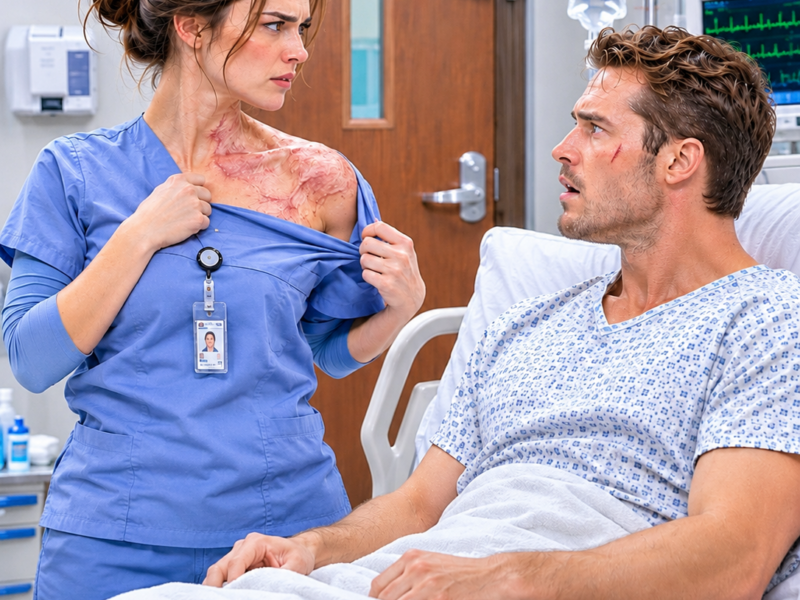
I Was a 32-Year-Old Army Captain Recovering From a Devastating Explosion When I Called a Quiet Nurse a “Civilian Coward” and Told Her She Knew Nothing About War. She Locked the Hospital Door, Unbuttoned Her Uniform, and Revealed Horrific Burn Scars Covering Her Neck and Shoulder. Then She Whispered, “Korangal Valley, 2011.” But When I Learned Who Had Been Trapped Inside That Burning Helicopter With Her, I Realized Her Story Was Far More Tragic Than I Could Have Imagined…
I Was a 32-Year-Old Army Captain Recovering From a Devastating Explosion When I Called a Quiet Nurse a “Civilian Coward” and Told Her She Knew Nothing About War. She Locked the Hospital Door, Unbuttoned Her Uniform, and Revealed Horrific Burn Scars Covering Her Neck and Shoulder. Then She Whispered, “Korangal Valley, 2011.” But When I Learned Who Had Been Trapped Inside That Burning Helicopter With Her, I Realized Her Story Was Far More Tragic Than I Could Have Imagined…
Part 1
The click of the heavy deadbolt echoed through the hospital room like the crack of a sniper’s rifle.
Captain Harrison Hayes stopped mid-sentence.
For six weeks, he had made everyone inside Oakhaven Veterans Rehabilitation Center afraid of him. Doctors avoided unnecessary conversations with him. Physical therapists dreaded seeing his name on their schedules. Even the nurses had learned to approach room 412 with careful expressions and quiet voices.
But the woman standing beside the door had just done something no one else had dared to do.
She had locked herself inside with him.
Harrison stared at her, his chest rising and falling with anger. His shattered right leg throbbed beneath the white hospital blanket, the titanium rod holding together what remained of his femur. Every movement sent sharp waves of pain through his body, and the medication seemed increasingly useless against the darkness gathering inside his mind.
He was thirty-two years old.
He had been a decorated infantry officer, a respected leader, and a man whose soldiers would have followed him into almost any situation without hesitation.
Now he couldn’t even walk to the bathroom without assistance.
Six weeks earlier, a roadside improvised explosive device had torn through his transport vehicle outside Kandahar. The explosion had killed three members of his unit, destroyed the vehicle, and left Harrison with injuries so severe that the military doctors had initially questioned whether he would survive the journey to a surgical hospital.
He had survived.
But survival, he was discovering, could sometimes feel like a punishment.
His military career was probably finished. His right leg might never regain its former strength. The three men who had died under his command would never come home.
And every morning, he woke up in a clean hospital bed surrounded by people who told him he was lucky to be alive.
Lucky.
He hated that word more than anything.
To Harrison, luck had nothing to do with what happened outside Kandahar. He had watched his men die. He had heard their final screams. He had held one soldier’s hand while the young man begged him to call his mother.
There had been nothing lucky about it.
So he directed his anger toward everyone around him.
He shouted at physical therapists who encouraged him to take small steps. He threw food against the wall when it arrived late. He accused nurses of treating him like a helpless child and doctors of hiding the truth about his injuries.
His favorite insult was calling them civilians.
They had comfortable homes, ordinary families, and predictable lives, he would tell them. They had no idea what it meant to watch someone die while knowing there was nothing you could do.
The person who received the worst of his hostility was Nurse Josephine Miller.
Everyone called her Josie.
She was in her late thirties, with dark hair always secured in a tight bun and an expression that rarely changed. Her long-sleeved nursing uniform was always immaculate, with its collar buttoned all the way to her throat.
Even during the hottest days of July, when the hospital’s air conditioning struggled to keep the rooms comfortable, she never rolled up her sleeves or loosened her collar.
Harrison had noticed that peculiarity early.
He had also noticed that she never reacted to his insults.
When he shouted, she answered calmly. When he refused medication, she explained his options. When he accused her of being incompetent, she simply checked his chart and continued doing her job.
Her composure infuriated him.
He wanted someone to fight back. He wanted someone to acknowledge that his anger was justified.
Instead, Josie treated his behavior like an unpleasant but manageable medical symptom.
On a Tuesday morning, the situation finally exploded.
Harrison was experiencing one of his worst episodes of nerve pain. The sensation in his injured leg was unbearable, as though someone were twisting hot metal through the damaged bone.
A young orderly named Timothy had been assigned to change his dressing.
Timothy was new to the rehabilitation center. He was polite, hardworking, and visibly nervous around the captain.
Unfortunately, his hands were shaking.
As he carefully removed the old gauze, his fingers accidentally brushed against the swollen tissue surrounding one of the surgical pins.
Harrison screamed.
“Get your incompetent hands off me!”
His fist slammed against the rolling tray table.
A plastic pitcher toppled over, shattered against the floor, and sent ice water spreading beneath the bed.
Timothy stumbled backward.
“I’m sorry, Captain. I didn’t mean—”
“Don’t apologize to me!”
Harrison’s face turned crimson.
“You useless child! Do you even know what you’re doing?”
“I was just trying to—”
“Three men died because of incompetence out there!” Harrison roared. “And now I have to come back here and let someone like you torture me because you can’t even change a bandage!”
Timothy looked as though he might faint.
Dr. Mitchell Gregory hurried into the room, followed closely by Josie.
“Captain Hayes, please,” Mitchell began. “Timothy is still learning. Let’s calm down. We can adjust your medication.”
“I don’t want your damn medication!”
Harrison grabbed a plastic bedpan and hurled it across the room.
It struck the wall with a hollow crack.
“I want all of you out! You stand around with your clipboards and your pity, pretending you understand what people like me have been through!”
His breathing became ragged.
“You go home to your families. You complain about traffic and the weather. Meanwhile, my men are coming home in boxes. You soft, pathetic civilians don’t know anything about war!”
Josie stepped forward.
Her shoes moved through the puddle of ice water.
“Mitchell.”
The doctor turned toward her.
“Take Timothy and leave the room.”
“Josie, protocol says we shouldn’t leave a combative patient alone.”
“I said leave.”
Something in her voice made Mitchell stop arguing.
It wasn’t anger.
It was authority.
The kind of authority that didn’t need to announce itself twice.
Mitchell gently grabbed Timothy’s sleeve and guided him toward the hallway.
Harrison watched them leave, still breathing heavily.
Then he turned toward Josie.
“What? You’re going to discipline me now? Write me up? Take away my television?”
Josie didn’t answer.
She walked toward the heavy oak-veneered door and pushed it shut.
Click.
The deadbolt slid into place.
Harrison’s expression changed.
“What the hell are you doing?”
Josie turned around.
“You talk a lot about war, Captain Hayes.”
“I earned the right to talk about it.”
“I see.”
“I bled for it. I sacrificed for it. Something you and everyone else in this building could never understand.”
He gestured angrily toward his injured leg.
“You look at this and wince. You don’t know what it feels like to lose men. You don’t know what it means to carry responsibility for people who never make it home.”
Josie stood perfectly still.
Then she spoke.
“Don’t I?”
Her voice was quiet.
Harrison frowned.
Josie slowly raised one hand toward the collar of her scrub top.
She unfastened the first button.
Then the second.
Then the third.
“What are you doing?” Harrison asked.
For the first time, his voice contained something other than anger.
Josie didn’t answer.
She opened her uniform halfway down her chest and gently pulled the fabric away from her left shoulder.
Harrison’s mouth fell open.
The skin along the left side of her neck, extending over her collarbone, across her upper chest, and around her shoulder, was covered in extensive burn scars.
They were not small marks or faint reminders of an old accident.
They were deep, raised, twisted bands of damaged tissue. Some areas were silvery white, others dark purple or reddish brown. The scars pulled at the surrounding skin, forming a terrible landscape of wounds that had healed without ever truly disappearing.
Harrison had seen men burned in combat.
He had seen injuries that most people would struggle to look at.
But he had never expected to see something like this beneath the pristine uniform of the quiet nurse he had spent six weeks insulting.
Josie looked directly into his eyes.
“Korangal Valley. 2011.”
Harrison couldn’t speak.
“I wasn’t a civilian contractor then, Captain. I was First Lieutenant Josephine Miller. Medevac nurse. Dustoff.”
She allowed him another moment to look at the scars.
“We were hit by an RPG during a hot extraction. It struck the tail rotor. We lost control and crashed into a ravine.”
Her expression didn’t change.
“The fuel lines ruptured. The helicopter caught fire almost immediately.”
She paused.
“The pilot died on impact. The co-pilot was trapped beneath the console. I tried to pull him free, but the door was jammed.”
Harrison swallowed.
“The fire reached the cabin before I could get it open.”
Her eyes seemed to move somewhere beyond the walls of room 412.
“I can still hear him screaming sometimes. Three in the morning. Four in the morning. It doesn’t matter how many years pass. Some sounds never really leave you.”
Harrison stared at her.
“I managed to pull two wounded infantrymen out of the back of the helicopter,” she continued. “My uniform caught fire while I was dragging the second one. I put it out with my bare hands.”
She looked down briefly at the scars.
“Then I dragged them behind a rock formation and held pressure on a femoral artery wound for three hours while we waited for the quick reaction force. We were still taking small-arms fire.”
Her voice became quieter.
“I spent six months in a burn unit in Landstuhl. Fourteen skin grafts. Multiple surgeries. I had to learn how to turn my head again because the scar tissue had fused my neck to my shoulder.”
She slowly began pulling her uniform back into place.
“My military career ended there.”
The buttons closed one by one.
“And every time I look in the mirror, I remember the people I couldn’t save.”
Harrison looked at the woman standing beside his bed.
He had no idea what to say.
Josie finished buttoning her collar.
“I don’t wear my scars on the outside anymore, Harrison.”
It was the first time she had used his first name.
“I don’t use my pain as a weapon against people who are trying to help me. And I don’t use my trauma as an excuse to become a cruel, arrogant bully.”
She walked back toward the door and unlocked it.
“You are in pain. You’re terrified that your life is over. You’re grieving the men you couldn’t save.”
Her expression softened.
“I know that. I know exactly what that feels like.”
She placed one hand on the doorknob.
“But you don’t get to claim a monopoly on suffering. You don’t get to look at everyone in this room and decide they haven’t paid a price.”
Harrison lowered his eyes.
“You want to heal? You want to be a soldier again? Then start acting like one. Find your discipline. Face your pain.”
She paused.
“And if you ever tell me or anyone else on this floor that we don’t know war, I’ll request your transfer to the psychiatric wing so quickly you’ll wonder what happened.”
Harrison stared at her.
For six weeks, he had believed that his anger was proof of his strength.
Now, for the first time, he understood how wrong he had been.
“We’re clear, ma’am,” he whispered.
Josie gave a single nod.
Then she opened the door.
Outside, Mitchell and Timothy were waiting anxiously.
“The captain is ready for his dressing change,” she said calmly. “Timothy, I’ll guide you through it.”
She turned toward Mitchell.
“You can cancel the additional morphine order for now. We’ll reassess his pain management.”
And just like that, she returned to being Nurse Josephine Miller.
But Harrison would never look at her the same way again.
Part 2
The following morning, Timothy entered room 412 carrying a fresh tray of bandages. His hands were trembling, and he was already preparing himself for another explosion.
Instead, Harrison sat upright against his pillows.
“Timothy.”
The young orderly froze.
“Yes, Captain?”
“I owe you an apology. Yesterday, I behaved like an undisciplined fool. You were doing your job, and I made it unnecessarily difficult.”
Timothy stared at him.
Harrison extended his hand.
“I’m sorry. It won’t happen again.”
For the first time in six weeks, the dressing change proceeded without shouting.
Harrison gripped the bedrails as Timothy worked, enduring the pain without taking it out on someone else.
That afternoon, he attended physical therapy without insulting anyone.
He still hurt. He still woke from nightmares. He still remembered the three men who hadn’t survived Kandahar.
But something had changed.
He had finally realized that pain did not give him permission to hurt other people.
And the woman who had taught him that lesson was carrying a history of suffering far greater than he had ever imagined.
Part 3
Over the following days, the atmosphere inside room 412 changed so noticeably that even the hospital staff began discussing it.
The captain who had once made experienced physical therapists dread their shifts was suddenly the most disciplined patient in the rehabilitation wing.
He no longer threw his meals against the wall. He stopped demanding that everyone address him by his rank. When a nurse entered with medication, he listened to the explanation instead of immediately assuming she was trying to control him.
Most importantly, he began participating in his rehabilitation.
The change wasn’t effortless.
There were mornings when the pain in his femur was so intense that he could barely move his toes. There were nights when he woke up shouting the names of men who had died in Afghanistan, his hands gripping the sheets as though he were still trapped inside the wreckage of his transport vehicle.
But whenever he felt anger building inside him, he remembered Josie’s scars.
He remembered the way she had stood in front of him, exposing wounds she had spent years hiding, simply to make him understand that suffering belonged to more people than the ones wearing military uniforms.
He began to recognize something uncomfortable about himself.
For six weeks, he had been demanding that everyone acknowledge his pain while refusing to acknowledge theirs.
He had expected compassion without offering respect.
And the worst part was that he had convinced himself he was justified.
One afternoon, after completing a particularly difficult physical therapy session, Harrison noticed Timothy struggling to move a heavy equipment cart down the corridor.
The young orderly was attempting to steer it around a corner while balancing a stack of folded linens on top.
One wheel caught against the wall.
The entire stack toppled.
Harrison watched Timothy close his eyes.
“Please don’t let anyone see that,” Timothy muttered.
A small smile appeared on Harrison’s face.
“Need a hand?”
Timothy turned so quickly that one of the linens nearly slipped from his arms.
“Captain?”
“I asked if you needed help.”
Timothy glanced at Harrison’s walker.
“You’re not supposed to be pushing anything.”
“Then I suppose we’ll both have to be careful.”
Harrison slowly approached, took the edge of the cart, and helped Timothy straighten it.
It wasn’t much.
But Timothy looked at him as though he had witnessed something extraordinary.
“Thank you, sir.”
“Don’t mention it.”
Harrison started back toward his room.
Then he stopped.
“And Timothy?”
“Yes?”
“You did a good job with my dressing yesterday.”
The young man smiled.
It was the first genuine smile Harrison had seen from him.
That evening, Harrison found himself unable to sleep.
Rain tapped against the reinforced hospital windows, and the air conditioner rattled intermittently above his bed.
He stared at the ceiling for a long time before finally reaching for his walker.
His leg was aching, but the discomfort was manageable.
He wanted some ice for the swelling around his knee.
When he reached the nurses’ station, he found Dr. Mitchell Gregory sitting alone beneath the fluorescent lights.
The physician was surrounded by paperwork, medical charts, and several half-empty cups of coffee.
He looked exhausted.
“Doc?”
Mitchell jumped slightly.
“Captain Hayes. What are you doing out of bed?”
“Getting some ice.”
“Are you sure you shouldn’t call a nurse?”
“I’ll survive the trip.”
Mitchell gave him a tired smile.
“That’s certainly an improvement.”
Harrison pulled a chair closer.
For a moment, neither man spoke.
Then Harrison glanced toward the empty corridor.
“I wanted to ask you something about Nurse Miller.”
Mitchell’s expression changed immediately.
“Josie’s medical history is confidential.”
“I know.”
“Then I assume you understand that I can’t discuss—”
“I know about the helicopter crash.”
Mitchell stopped.
Harrison lowered his voice.
“I know about Korangal Valley. I know she was a medevac nurse. I know she pulled two wounded soldiers out of a burning aircraft.”
The doctor removed his glasses and rubbed the bridge of his nose.
“She showed you?”
Harrison nodded.
Mitchell looked toward the hallway.
“She hasn’t shown anyone those scars in years.”
“Why?”
“Because she doesn’t want people looking at her differently.”
He paused.
“She spent a long time trying to become comfortable with her own reflection. Eventually, she decided that her scars were nobody else’s business.”
Harrison looked down at his hands.
“She said the pilot died on impact. The co-pilot was trapped beneath the console.”
“That’s correct.”
“Who was he?”
Mitchell didn’t answer immediately.
Harrison leaned forward.
“Was he someone from the 101st? Someone I might have known?”
The doctor’s eyes lowered toward the paperwork.
“No, Captain.”
A long silence followed.
Then Mitchell spoke.
“His name was Captain Samuel Miller.”
Harrison frowned.
“Miller?”
Mitchell nodded slowly.
“He was Josie’s husband.”
The words seemed to drain all the air from the room.
Harrison sat completely motionless.
“Her husband?”
“They had been married for fourteen months.”
Fourteen months.
Harrison tried to imagine what that meant.
Fourteen months of marriage. Fourteen months of building a life together. Fourteen months of believing that the person beside you would be there when you came home.
Then one helicopter crash had destroyed everything.
He pictured Josie inside the burning aircraft, her own body on fire, trying desperately to force open a jammed door while her husband was trapped only inches away.
He imagined her hearing him scream.
He imagined her having to make the decision to abandon that impossible rescue attempt because two other wounded men were still alive and needed her.
And then he imagined her returning to work years later, buttoning her uniform to her throat, helping wounded strangers, and listening quietly while a furious soldier accused her of knowing nothing about war.
Harrison felt sick.
“Does she ever talk about him?”
“Not much.”
“Does she have family?”
“Not that I know of. She keeps her private life private.”
Mitchell looked directly at him.
“Listen to me, Captain. Josie doesn’t want pity. She doesn’t want people treating her like a fragile object. She wants to do her job.”
Harrison nodded.
“She saved two soldiers that day.”
“Yes.”
“And lost her husband.”
Mitchell looked away.
“Yes.”
Harrison gripped the armrests of his chair.
He thought about his own three dead soldiers.
He thought about the nights he had spent raging at the world because he couldn’t bring them home.
Then he thought about Josie.
She had lost the man she loved, suffered burns across much of her upper body, endured fourteen skin grafts, and watched her military career disappear.
Yet she had found a way to return to the very profession that reminded her of everything she had lost.
She hadn’t abandoned the wounded.
She hadn’t decided that the world owed her an apology.
She had simply continued helping people.
“She’s the toughest soldier I’ve ever met,” Harrison whispered.
Mitchell said nothing.
He only handed him a plastic bag containing ice wrapped in a towel.
Harrison took it with trembling fingers and slowly wheeled himself back toward room 412.
That night, he didn’t sleep much.
But for the first time, his thoughts were not entirely consumed by the men he had lost.
He found himself thinking about the woman who had lost everything and still managed to show up for work every morning.
And somewhere in the quiet darkness, he made himself a promise.
He would never again mistake someone else’s silence for weakness.
Three weeks passed.
Harrison’s rehabilitation continued at a steady pace. His right leg was still far from healed, but he had progressed from a wheelchair to a metal walker.
He could stand for several minutes without assistance, and he had begun taking short walks along the corridor.
The physical therapists were cautiously optimistic.
Harrison, however, remained impatient.
He wanted to walk without the metal frame. He wanted to return to the life he had known before Kandahar. He wanted to believe that the man who had entered the hospital six weeks earlier still existed somewhere inside his broken body.
But he was beginning to understand that recovery wasn’t about returning to the exact person he had been.
It was about deciding what kind of person he would become next.
During those weeks, he also began noticing things about Josie that he had never paid attention to before.
He noticed that she occasionally paused before reaching for something with her left arm.
He noticed that cold air from the ceiling vents seemed to bother her more than it bothered anyone else.
Sometimes, when she lifted a heavy medical chart, her left shoulder stiffened, and she subtly shifted the weight to her right side.
Once, a confused patient grabbed her left arm during a moment of agitation.
Josie’s face went white.
She didn’t scream.
She didn’t push the patient away.
She simply closed her eyes for half a second, gently freed herself, and continued speaking in the same calm voice.
Harrison saw all of it.
He began to understand that the scars he had witnessed were only the visible part of her suffering.
Beneath them were years of chronic pain, restricted movement, nightmares, memories, and the constant effort required to make an ordinary day look ordinary.
He also noticed something else.
Josie never treated him as a special case.
She didn’t congratulate him excessively for completing therapy. She didn’t tell him how brave he was whenever he managed to stand.
She simply expected him to do the work.
And somehow, that was exactly what he needed.
One afternoon, Harrison was struggling through a set of exercises when his leg suddenly buckled.
The therapist caught him before he hit the floor.
“That’s enough for today, Captain.”
“No.”
“Your muscles are exhausted.”
“One more.”
“Captain Hayes—”
“One more.”
Josie happened to be passing the therapy room.
She stopped at the doorway.
“What’s happening?”
“He’s pushing too hard,” the therapist explained.
Harrison glared at him.
“I’m fine.”
Josie looked at the captain.
“Are you?”
He hesitated.
It was a simple question, but he found himself unable to answer it with his usual certainty.
“No,” he admitted.
“Then stop pretending.”
The therapist helped him sit down.
Josie approached and checked the swelling around his knee.
“Your body isn’t a machine,” she said.
“I know.”
“Do you?”
Harrison looked at her.
She wasn’t smiling, but there was no anger in her expression either.
“You don’t have to destroy yourself to prove you’re still a soldier.”
He looked down at his injured leg.
For a moment, he wanted to argue.
Then he remembered the helicopter crash.
He remembered the man trapped beneath the console.
He remembered that Josie had survived a terrible injury without allowing it to define every decision she made.
“You’re right,” he said.
Josie raised an eyebrow.
“Did you just agree with a nurse?”
“Don’t make a habit of expecting it.”
For the first time, she laughed.
It was a small laugh, barely more than a breath.
But Harrison noticed it.
And he realized he had never heard her laugh before.
Part 4
The summer heat finally broke during the third week of August.
Meteorologists had been warning residents about a powerful supercell system moving across the region. The forecasts predicted violent winds, torrential rain, and the possibility of widespread power outages.
At Oakhaven Veterans Rehabilitation Center, the staff made the usual preparations.
Emergency generators were checked. Backup oxygen systems were inspected. Battery-powered monitors were tested, and the maintenance department reviewed the building’s emergency evacuation procedures.
Most patients barely noticed.
Harrison was among them.
By midnight, he was sitting on his bed reading a novel. His metal walker rested against the wall, and a glass of water stood beside the lamp.
The rain had been falling for hours.
Occasionally, a gust of wind struck the reinforced windows hard enough to make the glass vibrate.
He had just turned a page when the lights went out.
Not dimmed.
Not flickered.
They disappeared completely.
The bedside lamp went dark. The hallway beyond his door fell silent.
For one strange second, the entire hospital seemed to stop breathing.
Then the emergency alarms began.
Red backup lights flickered to life, bathing the corridor in an eerie glow.
Harrison heard hurried footsteps outside.
Someone shouted for assistance.
A nurse called out a room number.
Then came the unmistakable sound of a medical alarm.
Harrison pushed his blanket aside and reached for his walker.
His leg protested immediately.
He ignored it.
He managed to stand, took several careful steps, and opened his door.
The corridor was chaos.
Nurses were moving quickly between rooms, checking equipment and attempting to determine which systems had lost power.
A maintenance worker hurried past with a flashlight.
“What’s happening?” Harrison called.
“Power surge! The main breakers are down!”
“Generator?”
“Backup is running, but we’ve lost power in part of the fourth floor!”
Harrison looked down the corridor.
Room 418.
A patient named Robert Ellis had undergone extensive thoracic surgery several days earlier. Harrison remembered seeing him during rehabilitation rounds. Robert was older, perhaps in his sixties, and had been recovering slowly.
Now several nurses were gathered outside his room.
Harrison heard one of them shouting.
“The ventilator is down!”
He immediately began moving toward the room.
His walker struck the floor with each step.
By the time he reached the doorway, he could see the problem.
The power surge had bypassed the protective system connected to the ventilator. The machine’s internal battery had failed, leaving the patient without mechanical assistance.
A nurse was attempting to reconnect the equipment.
Another was searching for an emergency power connection.
And Josie was standing beside the bed.
She had a manual resuscitator bag in her right hand.
She was squeezing it rhythmically, forcing oxygen into Robert’s lungs.
Her movements were fast and controlled.
But something was wrong.
The crash cart had become wedged against the doorway. Josie had tried to pull it into the room when the power went out.
The sudden exertion had caused the thick scar tissue around her left shoulder to seize.
Her arm was pinned against her side.
Her body had twisted slightly, and her face was pale beneath the emergency lighting.
She was in agony.
Harrison recognized it immediately.
He had seen that expression in combat.
He had worn it himself.
But Josie didn’t stop.
Her right hand continued squeezing the resuscitator bag.
“Robert, stay with me,” she whispered.
A young nurse looked toward the hallway.
“We need to get him to the ICU. The backup generator on the second floor is working.”
“Then prepare the transfer,” Josie ordered.
She looked toward Timothy.
“Get the backboard.”
Timothy stood motionless.
His face was white.
The darkness, the alarms, and the sight of a patient struggling to breathe had overwhelmed him.
“Timothy!”
He didn’t move.
Josie tried to reach across the bed with her injured arm.
A sharp cry escaped her lips.
Her knees buckled.
She caught herself against the mattress, struggling to remain upright.
Harrison saw the situation unfold in seconds.
A patient was dying.
A nurse was physically unable to complete the transfer.
And the young orderly who needed to help was frozen by fear.
The captain leaned heavily against the doorframe.
“Stand down, Nurse Miller!”
His voice boomed through the room.
Josie looked up.
For a moment, she seemed confused.
Then she saw Harrison abandoning his walker.
He stepped forward, placing his weight against the footboard.
His injured femur screamed in protest.
“Captain Hayes, get back to your room!” Josie ordered.
“Not happening.”
“Your leg—”
“My leg can wait.”
Harrison turned toward Timothy.
“Look at me!”
The orderly’s eyes snapped toward him.
“Timothy, you’re going to grab the left side of that backboard. Hold it firmly. Do you understand?”
Timothy swallowed.
“Yes, Captain.”
“Then move!”
The command cut through the panic.
Timothy hurried toward the bed.
Harrison looked at the two nurses beside the patient.
“You clear the lines. Make sure nothing is caught underneath him. We’ll take the weight together.”
One nurse nodded.
The other immediately began disconnecting the necessary equipment.
Harrison looked at Josie.
“Keep bagging him.”
“I can’t carry—”
“You don’t have to.”
He adjusted his grip against the footboard.
“I’ve got the heavy lifting. You keep him breathing.”
Josie stared at him.
For a moment, the two of them looked at each other without speaking.
Then she gave a tight nod.
“All right.”
Harrison drew a breath.
“On three. One. Two. Three!”
They lifted.
The patient was heavier than Harrison expected.
His arms tightened. His injured leg trembled violently beneath him.
But he held on.
The team moved the patient onto the backboard and began the slow journey toward the stairwell.
Harrison took the lower end.
Timothy held the opposite side.
The two nurses controlled the patient’s upper body and equipment.
Josie walked beside them, using only her right hand to squeeze the resuscitator bag.
Every few seconds, she checked the patient’s chest.
“Keep moving,” she instructed. “Don’t stop unless we have to.”
The corridor seemed endless.
Red emergency lights reflected against the polished floor.
The storm continued hammering the windows.
Harrison’s breathing grew increasingly labored.
The pressure on his injured leg was unbearable.
He could feel the muscles around his femur trembling, and every step sent a sharp shock through his hip.
But he had spent years leading men through difficult terrain.
He knew how to maintain a rhythm when everyone else was exhausted.
“Left side steady!”
“Watch the corner!”
“Keep the lines clear!”
His voice became the anchor holding the team together.
They reached the stairwell.
The ICU was on the second floor.
The elevator was useless.
They would have to carry Robert down two flights of concrete stairs.
Timothy looked at the steps.
“Captain, I don’t know if we can—”
“Yes, we can.”
Harrison tightened his grip.
“One step at a time. Don’t look at the whole staircase. Look at the next step.”
He had said something similar to his soldiers during long patrols in Afghanistan.
Now he was saying it to a frightened young orderly in a hospital stairwell.
They began descending.
The first few steps were manageable.
By the second landing, Harrison’s injured leg was shaking so badly that he feared it might give way.
He felt sweat running down his face.
His vision blurred.
“Captain?” Timothy whispered.
“Keep moving.”
“You’re bleeding.”
Harrison glanced down.
The pressure around his surgical dressing had caused a small amount of blood to seep through the gauze.
He didn’t stop.
“Not important.”
“Sir—”
“Timothy, listen to me. You’re holding a patient who needs you. Don’t make me tell you twice.”
The young man tightened his grip.
They continued.
Beside them, Josie maintained the rhythm of the oxygen bag.
Her left shoulder remained locked in place.
Every movement sent pain through the damaged tissue, but she refused to let it interfere with her right hand.
She watched Robert’s chest rise and fall.
She watched his face.
She counted each breath.
Harrison noticed the way she moved.
Even in the middle of the emergency, she was focused entirely on the person who needed her.
He thought about what Mitchell had told him.
She had done this before.
She had once carried wounded soldiers away from a burning helicopter while her own uniform was on fire.
She had once held pressure on an artery for three hours while bullets struck the ground nearby.
And now, years later, she was doing everything she could to save another stranger.
The thought gave Harrison a strange sense of determination.
He had spent weeks believing that his life was over because he could no longer fight the way he once had.
But standing there, supporting the weight of a dying patient, he finally understood something.
A soldier’s purpose was never limited to the battlefield.
Sometimes the most important fight happened in a hospital stairwell.
At the second-floor landing, one of the nurses pushed open the heavy fire door.
Bright white light flooded the stairwell.
The ICU backup generator was working.
A team of physicians and respiratory specialists rushed toward them with a hospital bed and emergency equipment.
“Transfer him here!”
Harrison and Timothy lowered the backboard carefully.
The medical team immediately took over.
One respiratory therapist connected the patient to a functioning ventilator while another checked his vital signs.
Josie gave one final squeeze of the manual bag before allowing the specialist to remove the mask.
“Patient transferred,” she said, breathing heavily.
A physician checked the monitor.
“He’s responding.”
The words were simple.
But to everyone standing there, they felt enormous.
Robert was alive.
Harrison released his grip.
For a moment, he remained standing.
Then his injured leg finally gave way.
He slumped against the wall and slid down until he was sitting on the floor.
His breathing came in ragged bursts.
The pain in his femur was almost blinding.
A nurse hurried toward him.
“Captain Hayes!”
“I’m fine,” he managed.
“You’re not fine. We need to examine that leg.”
Josie lowered herself onto the floor beside him.
Her face was pale, and her left shoulder remained rigid.
Neither of them spoke for several seconds.
Then Harrison turned toward her.
He looked at the scars hidden beneath her uniform.
He thought about Captain Samuel Miller.
And he understood that the woman sitting beside him had once faced a moment in which no amount of courage had been enough to save the person she loved.
He swallowed.
“He would be incredibly proud of you, Josie.”
She looked at him.
Harrison continued.
“Captain Miller. He would be proud.”
Josie froze.
The sound of the alarms seemed to fade into the distance.
Her eyes filled with tears.
For the first time since Harrison had known her, she looked completely unguarded.
One tear slipped down her cheek.
“Thank you, Captain Hayes,” she whispered.
Harrison lowered his head.
“You’re still a hell of a soldier.”
And Josie smiled.
It was a small, fragile smile, but it was real.
Part 5
The storm continued through the night, but the worst of the emergency had passed.
By the time the hospital’s primary electrical system was restored, Robert Ellis had been stabilized in the intensive care unit.
His doctors later confirmed that the emergency transfer had prevented a potentially fatal outcome.
Timothy received particular praise for his work during the evacuation.
The young orderly, who had frozen at the beginning of the crisis, had helped carry a critically ill patient down two flights of stairs while the hospital was operating on emergency power.
He would remember that night for the rest of his life.
So would Harrison.
The captain was taken back to room 412, where the medical team examined his leg.
The additional strain had aggravated the surgical area, and his rehabilitation schedule would need to be adjusted.
The doctors weren’t pleased.
Neither was Harrison.
But for once, he didn’t argue.
He understood that there were consequences to pushing a damaged body beyond its limits.
Josie’s shoulder also required attention.
The severe muscle spasm had left her in considerable pain, and the medical team recommended rest and an examination by a specialist familiar with burn-related contractures.
She initially resisted.
“I’m fine,” she told Mitchell.
He looked at her over his glasses.
“Josie, you can barely move your left arm.”
“I can still do my job.”
“That’s not the point.”
“Mitchell—”
“You spent half the night helping save a patient while your shoulder was practically locked in place. You need to let someone help you for once.”
Josie looked away.
It was a familiar argument.
She had spent years being the person who helped everyone else. Accepting assistance had never come naturally to her.
But that morning, something was different.
She had watched Harrison abandon his walker, risk his healing leg, and take responsibility for a frightened orderly.
He hadn’t been trying to prove that he was invincible.
He had simply recognized that someone needed help.
Perhaps she could allow herself the same thing.
“All right,” she finally said.
Mitchell looked surprised.
“All right?”
“I’ll see the specialist.”
“Good.”
“And don’t look so pleased with yourself.”
He smiled.
“Wouldn’t dream of it.”
Later that afternoon, Harrison was resting in his room when Josie came in.
Her left arm was supported in a sling.
She looked tired, and her usual brisk movements were slower than normal.
Harrison noticed immediately.
“How’s the shoulder?”
“Still attached.”
“That’s encouraging.”
“How’s the leg?”
“Still attached.”
Josie gave him a look.
For a moment, neither could help smiling.
She checked his chart and examined the dressing around his thigh.
“You’re going to need a few days of lighter activity.”
Harrison sighed.
“That sounds terrible.”
“It will be worse if you ignore it.”
“I’ve learned that lesson recently.”
Josie adjusted the blanket.
Then Harrison spoke again.
“Thank you.”
She glanced at him.
“For what?”
“For showing me what discipline actually looks like.”
Josie was quiet.
“I didn’t do anything special.”
“You saved my life in a way you probably don’t realize.”
She raised an eyebrow.
“I don’t remember treating you for anything life-threatening.”
“Not my leg.”
Harrison looked toward the window.
“For six weeks, I thought my anger was the only thing keeping me together. I thought that if I stopped being angry, I’d have to admit how frightened I was.”
Josie listened without interrupting.
“I was angry because I couldn’t save my men. I was angry because I couldn’t walk. I was angry because every doctor kept telling me to be patient when I wanted to go back and undo what happened.”
He paused.
“And I took all of it out on people who were only trying to help me.”
Josie pulled a chair closer.
“Grief does strange things to people.”
“I know that now.”
“You don’t have to pretend you’re not hurting, Harrison.”
He looked at her.
“But you do have to decide what you do with that hurt.”
He nodded slowly.
“I think I’m beginning to understand.”
Josie glanced at his injured leg.
“Good. Because I have no intention of spending another six weeks cleaning scrambled eggs off your walls.”
Harrison laughed.
It was the first time he had laughed without feeling guilty afterward.
The following days brought another kind of change.
The hospital staff no longer regarded Harrison as the angry captain in room 412.
They saw a man who apologized when he made mistakes, who thanked people for their work, and who had begun treating rehabilitation as something more than a punishment.
He became particularly close to Timothy.
The young orderly often came by to help with small tasks, and Harrison gradually learned that Timothy had originally wanted to join the military.
His father had served in the Army, and Timothy had grown up listening to stories about deployments, friendships, and the responsibility soldiers carried.
But he had never enlisted.
A medical condition had prevented him from qualifying.
Instead, he had pursued nursing assistance, hoping to find another way to serve people who had sacrificed for their country.
Harrison listened carefully.
“Then you’re in the right place,” he told him one afternoon.
Timothy looked surprised.
“You think so?”
“I know so.”
Harrison adjusted the blanket over his leg.
“There’s more than one way to serve. Don’t let anyone convince you otherwise.”
Timothy smiled.
“I appreciate that, Captain.”
“And stop calling me Captain every five seconds.”
“Sorry, sir.”
Harrison stared at him.
Timothy laughed.
The friendship between them developed quietly, without any grand declarations.
Sometimes they discussed military history. Other times they talked about ordinary things: movies, sports, food, and the strange habits people developed when they spent too much time in hospitals.
But Timothy also began asking Harrison questions about leadership.
He wanted to know how someone could remain calm during an emergency. He wanted to know how soldiers learned to trust one another.
Harrison answered honestly.
He explained that leadership wasn’t about being the loudest person in the room.
It wasn’t about demanding obedience or making people afraid.
It was about taking responsibility when things went wrong.
It was about being willing to carry more than your share when someone beside you was struggling.
And sometimes, he admitted, it was about knowing when to ask for help.
Those conversations reminded Harrison of the man he had once been.
Not the angry man who had arrived at Oakhaven.
The leader who had tried to protect his soldiers.
He was beginning to find that person again, although he understood now that he would never be exactly the same.
One afternoon, Mitchell brought him an update.
The military rehabilitation board had reviewed his medical records.
His return to active infantry duty was unlikely.
The damage to his femur was extensive, and the nerve injuries could permanently limit his mobility.
There might be opportunities for administrative or training assignments, but the physical demands of his former position were probably beyond what his body could safely tolerate.
Harrison listened without interrupting.
For a moment, the familiar weight settled over his chest.
He had known this was coming.
Still, hearing it spoken aloud made it real.
“So that’s it?” he asked.
Mitchell sat down.
“Your military career may look different from what you planned. But that doesn’t mean your life is over.”
Harrison looked toward the window.
Outside, the summer rain had finally stopped.
A patch of sunlight stretched across the parking lot.
“I used to think the only thing I was good for was leading soldiers.”
“Perhaps you haven’t discovered everything you’re capable of yet.”
Harrison nodded.
He didn’t have an answer.
But for the first time, he was willing to consider the possibility.
Several days later, Josie returned to full nursing duties with restrictions on lifting and movement.
Her shoulder had improved, although the scar tissue remained a constant source of discomfort.
She continued wearing her long-sleeved uniform.
Her collar remained buttoned.
But something about her seemed lighter.
Perhaps it was the knowledge that Robert had survived.
Perhaps it was the fact that Harrison had finally begun to understand her without needing her to explain herself again.
Or perhaps it was simply that, for once, she had allowed another person to share the burden.
On the morning Harrison was scheduled to be transferred to a longer-term rehabilitation facility, he asked Mitchell for a few minutes with Josie.
The doctor found her at the nurses’ station.
“Josie, Hayes wants to see you.”
She looked up.
“Is something wrong?”
“Not that I know of.”
She walked down the corridor.
Harrison was sitting upright in bed, his walker positioned beside him. His belongings had already been packed into a small bag.
The captain looked toward her as she entered.
“Morning.”
“Morning. I hear you’re finally getting out of here.”
“Don’t sound so disappointed.”
“I’m devastated.”
He smiled.
Then his expression became serious.
“I wanted to say goodbye properly.”
Josie folded her arms carefully.
“Go ahead.”
Harrison took a breath.
“I spent six weeks believing that the people around me couldn’t possibly understand what I’d been through.”
He looked directly at her.
“I was wrong.”
Josie didn’t interrupt.
“I judged everyone by what I could see. Their uniforms, their jobs, their reactions. I thought that because they weren’t carrying rifles in Afghanistan, they couldn’t possibly know anything about sacrifice.”
He paused.
“But I was looking at the wrong things.”
His eyes moved briefly toward her collar.
“I couldn’t see what you were carrying.”
Josie lowered her gaze.
“You don’t have to apologize again, Harrison.”
“I know. But I want you to hear this.”
He leaned forward.
“You didn’t just teach me how to behave in a hospital. You reminded me why I became a soldier in the first place.”
Josie looked at him.
“What do you mean?”
“I joined because I wanted to protect people. Somewhere along the way, I started believing that being strong meant never showing weakness.”
He shook his head.
“Then I met someone who had survived things I couldn’t imagine, and she still found the strength to help strangers every day.”
His voice softened.
“You reminded me that courage isn’t the absence of pain. It’s what you choose to do while you’re carrying it.”
Josie was silent for a long moment.
Then she stepped closer.
“You’re going to be all right, Harrison.”
He looked at her.
“I hope so.”
“You don’t have to figure out the rest of your life today. Just take the next step. Then the one after that.”
He smiled faintly.
“Sounds familiar.”
“It should.”
She extended her hand.
Harrison took it carefully.
“Thank you, Lieutenant.”
Josie looked surprised.
He smiled.
“I think you’ve earned the title.”
For a moment, she seemed unable to respond.
Then she squeezed his hand.
“Take care of yourself, Captain.”
“I will.”
When Harrison was finally wheeled toward the hospital entrance, several members of the staff gathered to say goodbye.
Timothy stood near the doorway.
Mitchell was beside him.
Josie remained a little farther back, watching quietly.
Harrison stopped his wheelchair.
He looked at the people who had once represented everything he resented about his new life.
The nurses.
The doctors.
The therapists.
The young orderly whose hands had once trembled whenever he entered room 412.
“I owe all of you an apology,” Harrison said.
Nobody moved.
“I came here believing that my suffering made me better than everyone else. It didn’t. It just made me blind to what other people were going through.”
He looked at Timothy.
“And I learned that lesson the hard way.”
Timothy smiled.
Harrison turned toward Josie.
She gave him a small nod.
Then the wheelchair continued toward the exit.
Outside, the air smelled of wet pavement and fresh rain.
The world looked strangely familiar, yet somehow different.
Harrison knew that his recovery would take months, perhaps years. He would still have painful mornings. He would still experience nightmares. There would be days when he missed the life he had lost so intensely that he wouldn’t know what to do with himself.
He would never forget the three soldiers who died outside Kandahar.
But he no longer believed that remembering them required him to remain angry forever.
He had learned that he could honor their lives by becoming someone they would have been proud to follow.
And perhaps, one day, he could help other wounded soldiers discover the same thing.
Months later, after completing another stage of rehabilitation, Harrison returned to Oakhaven for a follow-up appointment.
He was walking with a cane now.
His gait was still uneven, but he could move independently.
The hospital corridor seemed smaller than he remembered.
He passed room 412 and briefly stopped.
The bed was occupied by another wounded veteran.
A young man lay beneath the white blanket, his face tight with frustration as a nurse attempted to adjust his medication.
Harrison recognized the expression.
He recognized the anger.
He recognized the fear hiding beneath it.
For a moment, he considered walking away.
Then he remembered what Josie had told him.
You don’t get to claim a monopoly on suffering.
He approached the doorway.
“Having a rough day?”
The young veteran turned toward him.
“Who asked you?”
Harrison almost smiled.
“Nobody. I just remember having a few myself.”
The nurse glanced toward him.
Harrison gave her a reassuring nod.
Then he looked back at the patient.
“Listen, I don’t know exactly what happened to you. And I’m not going to pretend I do. But I can tell you something.”
The young man remained silent.
“Being injured doesn’t make you useless. Needing help doesn’t make you weak. And the people trying to help you aren’t your enemies.”
He paused.
“Give yourself a chance to get better. You might be surprised what comes next.”
The patient looked away.
Harrison didn’t push him.
He simply continued down the corridor.
At the nurses’ station, he found Josie reviewing a chart.
She looked up.
For a moment, neither spoke.
Then her eyes moved to the cane.
“Making progress, I see.”
“Slowly.”
“Slowly is still progress.”
Harrison smiled.
He glanced toward the young soldier’s room.
“Someone in there reminded me of myself.”
Josie followed his gaze.
“That happens.”
“I hope he listens.”
“Sometimes people need time.”
Harrison nodded.
Then he noticed something.
Josie’s collar was still buttoned, as always. Her hair remained secured in its familiar bun, and her expression carried the same quiet composure he remembered from room 412.
But she was smiling.
Not the fragile smile she had given him in the stairwell.
A genuine one.
“How’s your shoulder?” he asked.
“Better.”
“Really?”
“Really.”
“Good.”
She returned to her chart.
Harrison remained standing for another moment.
Then he said something he had wanted to tell her for a long time.
“Captain Samuel Miller would be proud of the life you’ve built.”
Josie’s fingers stopped moving.
She looked up slowly.
For a moment, the old sadness appeared in her eyes.
Then she nodded.
“I hope so.”
Harrison gave her a respectful nod.
“He’d be proud.”
She looked down again, but this time her smile remained.
Harrison turned toward the exit.
As he walked away, he understood something that had taken him far too long to learn.
War did not always end when soldiers left the battlefield.
Sometimes it followed them into quiet hospital rooms. Sometimes it lived in scars hidden beneath carefully buttoned uniforms. Sometimes it appeared in the trembling hands of a young orderly or the silence of a nurse who had buried the person she loved.
And sometimes, the strongest person in the room was the one who never spoke about what she had survived.
Josephine Miller had spent years believing that her scars were something she needed to hide.
Harrison Hayes had spent six weeks believing that his scars gave him permission to hurt the world.
They had both been wrong in different ways.
Her scars were not a weakness.
His pain was not a license to become cruel.
And neither of them needed to pretend that the past had disappeared in order to build a future.
As Harrison stepped through the hospital doors, he paused and looked back one final time.
Through the glass, he could see Josie standing at the nurses’ station, helping another patient.
She moved carefully, protecting her left shoulder without making a show of it.
Her collar was buttoned to the top.
Her scars remained hidden.
But Harrison knew they were there.
He also knew that beneath that quiet uniform stood a woman who had survived a burning helicopter, lost her husband, endured fourteen skin grafts, and somehow found the courage to return to the work of saving lives.
He had once believed that the most heavily armored soldier in Oakhaven Veterans Rehabilitation Center was the man lying in room 412.
Now he understood the truth.
The strongest soldier he had ever met had never needed a uniform, a medal, or a battlefield to prove herself.
She had simply chosen, every morning, to keep helping people.
And that was a kind of courage Harrison Hayes would spend the rest of his life trying to deserve.