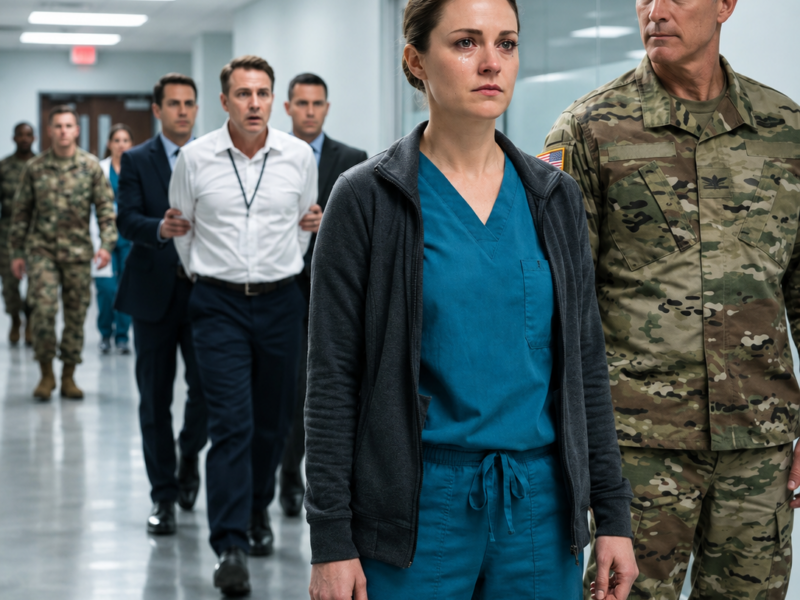
I Was a 31-Year-Old Surgical Nurse When My Hospital Suspended Me for Saving a Patient’s Life. My Supervisor Ordered Me to Surrender My Badge, and Hours Later, I Found a Threat on My Windshield: “Return the Drive, or Criminal Charges Will Be Filed Tonight.” Three Days Later, a Military Helicopter Landed on the Hospital Roof, and a Colonel From My Secret Military Past Summoned Me. When He Showed Me a State Senator’s Medical Records, I Finally Understood Why the Hospital Was So Desperate to Silence Me…
I Was a 31-Year-Old Surgical Nurse When My Hospital Suspended Me for Saving a Patient’s Life. My Supervisor Ordered Me to Surrender My Badge, and Hours Later, I Found a Threat on My Windshield: “Return the Drive, or Criminal Charges Will Be Filed Tonight.” Three Days Later, a Military Helicopter Landed on the Hospital Roof, and a Colonel From My Secret Military Past Summoned Me. When He Showed Me a State Senator’s Medical Records, I Finally Understood Why the Hospital Was So Desperate to Silence Me…
Part 1
The first time Nora Kessler realized someone at Larkspur Medical Center was willing to let a patient die to protect a hospital’s reputation, she had no idea that three days later, a military helicopter would land on the roof, a colonel from her forgotten past would demand to see her, and the most powerful people in the building would suddenly be afraid of a nurse they had just fired.
It all began on a Tuesday morning in Marlow Bay, a coastal city where fishing boats, expensive waterfront apartments, and aging industrial warehouses existed side by side. Larkspur Medical Center stood near the harbor, a sprawling collection of modern glass buildings connected to older brick wings. From the outside, it looked like a place where people could trust their lives to experienced professionals.
Inside, things were considerably more complicated.
Nora had worked there for almost three years. At thirty-one, she was known as a quiet, unusually observant surgical nurse who rarely participated in workplace gossip. She arrived early, completed her duties without complaint, and noticed details that other people overlooked.
Some coworkers admired her. Others considered her unfriendly.
Her supervisors mostly considered her inconvenient.
Dr. Grant Ellery, one of Larkspur’s senior surgeons, disliked nurses questioning his decisions. Judith Crane, the charge nurse who had controlled the surgical floor for seventeen years, disliked anyone who appeared capable of thinking independently of her instructions.
Nora had learned to tolerate both.
She had survived far worse environments before becoming a civilian nurse, although nobody at Larkspur knew much about that part of her life.
She preferred it that way.
On that Tuesday morning, her attention settled on Leonard Ambrose, a fifty-eight-year-old retired ferry captain recovering from coronary bypass surgery.
His operation had supposedly been successful. His medical chart showed normal postoperative progress, and the attending physician had documented no significant concerns.
Yet something about Leonard troubled Nora.
He rated his pain as moderate, but his body told a different story.
His shoulders were rigid. His breathing was shallow. His fingers tightened around the bed rail whenever he attempted to move.
When Nora gently checked his pulse, his jaw clenched so tightly that she could see the muscles moving beneath his skin.
“Mr. Ambrose,” she asked, “are you sure your pain is only a four?”
He attempted a smile.
“I’ve spent thirty years working on boats. I’ve had worse.”
“That wasn’t my question.”
His smile disappeared.
After a moment, he admitted that the pain had been getting worse since early morning.
Nora examined his medication records and vital signs. Nothing on the chart completely explained what she was seeing.
She flagged his file and entered a detailed nursing note.
Judith Crane appeared behind her.
“You’re spending an unusual amount of time on that patient.”
“His recovery doesn’t look right.”
“The doctor cleared him.”
“I’m aware.”
“Then follow the physician’s assessment.”
Nora looked up.
“Patients don’t always deteriorate according to the schedule in their charts.”
Judith’s expression hardened.
“Watch your tone.”
Nora returned to her computer without answering.
Forty minutes later, the alarm from room fourteen erupted across the surgical floor.
Nora was already running before the second warning sounded.
Leonard’s condition had deteriorated dramatically. His blood pressure was falling, his heart rate was climbing, and his skin had developed the unmistakable pallor of a patient in serious distress.
Nora immediately called for a rapid response team.
She suspected a rapidly developing infection and began emergency nursing interventions within her permitted scope while directing another staff member to summon additional help.
When Dr. Ellery finally entered, Nora had already initiated the response that would help stabilize Leonard.
Ellery pushed past her.
“I’ll take over.”
She stepped aside.
Not because she believed he had handled the situation well, but because the patient needed coordinated care more than he needed an argument.
Leonard survived.
For several minutes afterward, Nora allowed herself to believe the incident would end there.
Then Victor Rorke entered the room.
Rorke was Larkspur’s vice president of clinical operations, an ambitious administrator whose influence extended far beyond his official responsibilities.
He was not a physician, and he rarely appeared on surgical floors unless something threatened the hospital’s reputation.
Yet he had arrived almost immediately after Leonard’s emergency.
Nora noticed.
She also noticed the private conversation between Rorke and Ellery outside the room.
Four minutes later, both men returned.
“Miss Kessler,” Rorke said, “we need to discuss your conduct.”
The meeting took place upstairs, in a conference room with polished furniture and windows overlooking the harbor.
Rorke sat opposite her.
Ellery stood beside the window.
Glenda Pharaoh, the director of human resources, waited with a folder already prepared.
That folder told Nora everything she needed to know.
The decision had been made before she entered.
“We’ve received concerns about your response to the emergency in room fourteen,” Rorke began.
“I documented my concerns forty minutes before the emergency.”
“You bypassed established escalation procedures.”
“I requested emergency assistance when the patient began deteriorating.”
Ellery folded his arms.
“You made assumptions outside your professional authority.”
“My assessment was supported by what happened.”
“You’re not qualified to make that diagnosis.”
Nora looked directly at him.
“Would you prefer that I had waited until he stopped breathing?”
The room became silent.
Glenda glanced at Rorke.
He leaned forward.
“This conversation isn’t about your personal interpretation of events. It’s about compliance.”
Nora understood something then.
They were not investigating a clinical emergency.
They were deciding who would carry the blame for it.
Rorke announced that she was being placed on immediate administrative suspension pending a formal review.
He described the decision as temporary and nonpunitive.
Nora almost laughed.
Instead, she asked a question that changed his expression.
“Why has the supply closet on the third floor been locked for six days?”
Rorke paused.
Only briefly.
But she noticed.
“I don’t know what you’re referring to.”
“Then perhaps someone should find out.”
His eyes narrowed.
“Turn in your badge, Nora.”
She unclipped it from her uniform and placed it on the table.
“You’re making a mistake.”
Rorke smiled thinly.
“That remains to be seen.”
As Nora walked back through the surgical department, she could feel people watching her.
Owen Tran, a young nurse who had always treated her kindly, lowered his eyes when she passed.
Judith Crane stood near the nurses’ station, making no attempt to conceal her satisfaction.
Nora said nothing.
She went downstairs, changed her clothes, and emptied her locker into a paper bag.
But she did not leave immediately.
Eight months earlier, during a routine software audit, Nora had discovered that Larkspur’s employee access system did not revoke credentials instantly.
The termination process happened in stages.
Even after her badge was surrendered, certain older records terminals remained accessible for a short period.
At the time, she had considered it a security weakness.
Now it represented an opportunity to determine whether the hospital was hiding something.
She walked to a little-used records office on the second floor.
The terminal there was outdated, slow, and mostly ignored.
She opened Leonard Ambrose’s preoperative records.
Three safety concerns had been raised before his operation.
All three had been cleared within hours.
The electronic signature belonged to Dr. Martin Pruitt.
Nora checked his surgical schedule.
During two of those recorded approvals, Pruitt had been operating in other rooms.
He could not reasonably have performed the documented reviews at the times listed.
Her stomach tightened.
She opened another patient’s file.
Ruth Delaney, sixty-three.
A postoperative complication had been reclassified under a code that removed it from the hospital’s reportable adverse-event statistics.
Ruth had subsequently died.
The third file belonged to Andre Boateng, forty-nine.
His complication had supposedly been resolved twelve hours before the physician documented discovering it.
Nora stared at the screen.
One error could be carelessness.
Two might indicate poor documentation.
Three different patients, with the same strange pattern of altered records, suggested something much more serious.
She searched further.
Seven suspicious cases appeared across fourteen months.
Several involved safety concerns that had mysteriously disappeared. Others involved questionable physician approvals or complications recorded in misleading categories.
At least two patients had died.
And the same handful of names repeatedly appeared in the records.
Nora copied the documents onto a small USB drive and recorded the relevant reference numbers.
She knew the copies might create legal problems, especially now that she was suspended.
But she also knew that reporting concerns without evidence could leave her vulnerable to the very people whose actions she questioned.
When the terminal warned that her session was about to expire, she logged out.
She left through the parking garage.
Her car was where she always parked it.
Section C.
Third row.
Beside a concrete pillar.
But something white was tucked beneath her windshield wiper.
She pulled out the folded paper.
There were only two sentences.
“You copied files that don’t belong to you. Return the drive, or criminal charges will be filed tonight.”
For several seconds, she stared at the message.
Then she looked toward the surveillance cameras above the parking spaces.
Every recording indicator she could see was dark.
Someone had been watching her.
Someone knew exactly what she had done.
And whoever that person was had disabled the cameras before she reached her vehicle.
Nora folded the note, placed it in her pocket, and drove home.
She lived alone in a modest apartment twelve minutes from the hospital.
After locking her door, she placed the USB drive beside her laptop and began organizing the records into a timeline.
Seven cases.
Fourteen months.
Repeated signatures.
Questionable reclassifications.
Two deaths she could identify.
She worked until the evening had become night.
At 10:35 p.m., her phone rang.
Unknown number.
She answered cautiously.
“Nora Kessler?”
“Who’s calling?”
A pause.
Then the man said something that made her entire body go still.
“Sergeant Kessler.”
Nobody in Marlow Bay had ever called her that.
Nobody at Larkspur knew she had served in the military.
She had spent four years making certain her old life remained separate from her new one.
“Who are you?” she asked.
“My name is Hollis Mercer. We need to talk about Larkspur.”
“Why should I trust you?”
“Because the records you’ve found are only a fraction of what’s happening.”
Nora looked at her laptop.
“How much do you know?”
“Enough to know eight patients are dead.”
Her fingers tightened around the phone.
Eight.
Not two.
The voice continued.
“And one of them was a decorated Army veteran whose family has been asking questions for six weeks.”
Nora said nothing.
“Meet me near the harbor in thirty minutes. Come alone.”
The call ended.
For the first time since her suspension, Nora felt something colder than anger.
She had believed she was investigating dishonest hospital administrators.
Now she was beginning to understand that she had stumbled into something much larger.
And the people responsible already knew her name.
Part 2
The diner near the harbor was almost empty when Nora arrived.
Hollis Mercer sat in the back booth, wearing a dark jacket and watching the entrance.
He introduced himself as someone connected to a preliminary Defense Department Inspector General inquiry.
One of the dead patients, Dale Brennan, had been a retired soldier.
Before surgery, Brennan had documented three medical concerns.
Every warning had disappeared from his records.
“Eight deaths,” Hollis said quietly. “And possibly more.”
Nora showed him the threatening note from her windshield.
He studied it.
“Someone is frightened of what you found.”
“Who?”
“Victor Rorke is connected to Oberline Group, the contractor controlling major hospital supply agreements. Their financial interests depend partly on the hospital maintaining favorable performance numbers.”
Nora felt the pieces connecting.
Altered reports.
Missing warnings.
Suspicious deaths.
An administrator who arrived before anyone could question what happened.
“They’re protecting contracts,” she whispered.
Hollis nodded.
“And the money involved is substantial.”
He offered her a chance to cooperate with investigators.
Nora considered the risks.
Her nursing license.
Her freedom.
Everything she had spent years rebuilding.
Finally, she looked at him.
“I have one condition.”
“Name it.”
“Every family gets the truth.”
Hollis extended his hand.
“Agreed.”
Neither of them knew that within forty-eight hours, a state senator would arrive at Larkspur fighting for her life.
Or that Nora would be the only person capable of identifying the deception already waiting inside the senator’s medical chart.
Part 3
The following morning, Nora called Hollis shortly before eight.
“I’m willing to cooperate,” she said. “But I need to understand exactly what we’re dealing with.”
Hollis explained that the preliminary investigation had begun after Dale Brennan’s family challenged the circumstances of his death. Their inquiries had reached people with military connections who were concerned that other veterans might have received similarly compromised care.
Investigators had found enough inconsistencies to suspect a broader problem, but not enough verified hospital evidence to prove who was responsible.
Nora’s records could change that.
“We need to establish who altered the charts, who authorized those changes, and who benefited,” Hollis explained.
“And the hospital knows I’m looking.”
“Yes.”
“They’re already threatening charges.”
“Which means we’re running out of time.”
Nora glanced toward the USB drive on her kitchen table.
She had kept copies of the documents, but she understood that their evidentiary value would depend on independent verification, proper preservation, and authenticated system records.
The investigation needed access to the originals.
And she needed to protect herself.
By Thursday afternoon, Larkspur had extended her suspension.
Glenda Pharaoh called with the news, using the same pleasant administrative voice Nora remembered from the conference room.
“You have the right to review the documents associated with your disciplinary proceeding,” Glenda added.
“Can I come in person?”
“Tomorrow morning. Nine until eleven.”
Nora accepted.
When she informed Hollis, he advised her to preserve a careful record of the meeting and to avoid confronting anyone unnecessarily.
At nine the next morning, Nora entered the human resources office wearing ordinary clothes rather than scrubs.
Glenda invited her to sit.
“The review committee has identified several concerns about your conduct.”
“I’d like to examine the supporting documents.”
Glenda hesitated.
“Those are internal records.”
“They’re the records being used to justify my suspension.”
After a moment, Glenda produced three pages.
Nora examined Dr. Ellery’s incident report first.
It described her actions as an unauthorized intervention.
It neglected to mention her documented concerns before Leonard’s deterioration.
The second document contained a nursing protocol checklist.
The third was the rapid response log.
Nora stopped reading.
The official arrival time was twelve minutes after the emergency alarm.
That was considerably slower than the response expectation used for that unit.
“Is this correct?” she asked.
Glenda glanced at the page.
“It’s the recorded time.”
“Was it the time the team arrived or the time somebody entered the information?”
“I’m not certain.”
“Because those are two different things.”
Glenda’s expression changed.
Nora continued calmly.
“If the hospital is questioning my response, shouldn’t we also establish why additional help was delayed?”
“I’ll need to verify that.”
“Please do.”
Nora left without raising her voice.
But the conversation had accomplished something important.
Glenda now understood that Nora could identify inconsistencies in the hospital’s own evidence.
And the hospital’s attempt to blame her was becoming increasingly complicated.
Inside the elevator, her phone vibrated.
A message from an unfamiliar number warned that the hospital had discovered her earlier access to the archived records terminal.
Its legal team was preparing a data theft complaint.
Nora immediately contacted Hollis.
“We expected this,” he said.
“You’re telling me you expected them to try destroying my career?”
“I expected them to defend themselves aggressively.”
“That’s a diplomatic way to describe it.”
“I know.”
He explained that their inquiry had expanded.
They had now identified four veterans whose medical records showed suspicious reclassifications.
Federal investigators were considering formal action.
Nora stared at the hospital entrance.
People passed through the automatic doors carrying flowers, coffee, and overnight bags.
Families arrived believing the professionals inside would protect the people they loved.
She thought about Dale Brennan.
He had written down his concerns before surgery.
He had trusted the hospital to take them seriously.
Instead, his warnings had vanished.
That afternoon, Nora returned to visit Leonard Ambrose.
She bought a simple get-well card from the lobby shop and went upstairs.
Leonard recognized her immediately.
“You’re the nurse who noticed something was wrong.”
“I wanted to see how you’re recovering.”
He looked better, although his face remained pale.
“They told me you got suspended.”
Nora placed the card beside his bed.
“That’s being reviewed.”
Leonard studied her.
“Did you get in trouble because you helped me?”
She considered the question.
“No. I got in trouble because some people didn’t want questions asked.”
He was silent for several moments.
Then he said, “I spent most of my life taking boats across dangerous water. You learn quickly that ignoring a warning doesn’t make the danger disappear.”
Nora smiled faintly.
“Then you’ll understand why I need you to keep asking questions about your treatment.”
He nodded.
Before leaving, she asked him to keep a written record of his conversations with physicians and make sure someone he trusted accompanied him when important decisions were discussed.
It was the kind of advice she wished Dale Brennan had been able to benefit from.
That evening, Nora returned home and began preparing a more complete timeline.
She reviewed every document she had collected.
She carefully compared the signatures, modification times, and references to the surgical schedule.
Certain patterns stood out.
Dr. Pruitt’s name appeared repeatedly.
Judith Crane’s nursing station was associated with several chart amendments.
Victor Rorke had administrative authority over the departments responsible for reporting hospital performance.
The coincidences were becoming too numerous to dismiss.
At approximately nine, her phone rang.
Owen Tran.
The young nurse sounded nervous.
“I probably shouldn’t be calling.”
“Then I assume it’s important.”
He explained that he had overheard Rorke speaking with a man who appeared to be an outside attorney.
Rorke had discussed informing the nursing licensing board about Nora’s supposed misconduct.
“He said they needed to understand the full picture,” Owen recalled.
Nora closed her eyes.
She could almost hear Rorke saying it.
The same calm, polished language.
The same confidence that he could control how events would be interpreted.
“Thank you for telling me.”
“Are you going to be okay?”
“I don’t know yet.”
Owen hesitated.
“I should have said something when they suspended you.”
Nora looked toward her laptop.
“Next time you see something wrong, don’t wait until afterward.”
The silence on the other end was painful.
“I won’t,” he promised.
They ended the call.
Nora remained at her kitchen table, surrounded by papers, until her phone rang again.
This time it was Hollis.
His voice sounded different.
“Turn on the local news.”
“I don’t have a television.”
“Use your computer. Now.”
Nora opened a news livestream.
A breaking-news banner appeared.
State Senator Margaret Sandoval had been rushed to Larkspur Medical Center following a medical emergency.
Nora recognized the name immediately.
Sandoval chaired the state legislative committee responsible for healthcare oversight and hospital accountability.
The same committee that received performance information from hospitals like Larkspur.
“She’s in intensive care,” Hollis said.
“What happened?”
“Suspected catastrophic vascular emergency. They’re still assessing her.”
Nora felt a sharp uneasiness.
“Why are you calling me?”
“Because this senator has been pushing for stricter hospital reporting requirements.”
The room seemed suddenly colder.
Nora looked at the records spread across her table.
Eight deaths.
Four veterans.
A contractor with millions tied to favorable hospital statistics.
And now the politician responsible for scrutinizing those statistics was inside the same hospital.
“Tell me you’re not suggesting someone planned this.”
“I’m not suggesting anything we can’t prove.”
“But you’re worried.”
“Very.”
He explained that medical investigators had been reviewing Larkspur’s records and needed an accurate snapshot of Sandoval’s chart before any questionable amendments could occur.
Nora knew the hospital’s system better than almost anyone outside its information technology department.
She also knew the location of an older records terminal that might display the changes investigators needed to verify.
Hollis had arranged for her to meet an authorized contact at the east service entrance.
“You’re suspended,” he warned. “If you enter without proper authorization, Larkspur will use it against you.”
“Then make sure the people bringing me inside have the authority to do it.”
“We’re working on that.”
Nora picked up her jacket.
“How much time?”
“Twenty minutes.”
She was already moving toward the door.
Outside, rain had left the streets glistening beneath the harbor lights.
Nora drove without music.
For the first time in years, memories of her military service surfaced with unusual clarity.
She remembered emergency medical stations far from American hospitals.
She remembered wounded soldiers arriving faster than anyone could prepare.
She remembered the pressure of making decisions when every second mattered.
She had left that life because she wanted stability.
A normal job.
A quiet apartment.
A future in which nobody expected her to carry responsibility for disasters beyond her control.
Yet here she was, driving toward another emergency.
Three blocks from Larkspur, an urgent alert appeared on her phone.
Federal emergency response operations were being established at the medical center.
Traffic restrictions were beginning around the hospital.
A helicopter was approaching the north landing pad.
Hollis called again.
“The situation has escalated.”
“What kind of response team?”
“Military medical support, working with federal authorities and the hospital’s emergency leadership.”
Nora slowed her car.
“Why military?”
“The veterans’ investigation brought the facility under additional scrutiny. Sandoval’s condition has made the situation urgent.”
She turned toward the hospital.
Emergency vehicles crowded the entrance.
Security personnel were establishing a controlled perimeter.
Above the roof, powerful rotor blades disturbed the rainy night.
Then Hollis said something she had not expected.
“Nora, the unit commander knows you.”
“Who?”
“Colonel Simon Whitlock.”
Her foot lifted from the accelerator.
For several seconds, she forgot about the traffic around her.
Simon Whitlock.
Eight years had passed since she last saw him.
Back then, she had been a young military medical sergeant serving under his command.
During a classified operation, she had helped coordinate emergency treatment and evacuation under conditions that still appeared in her nightmares.
Whitlock had submitted a commendation describing her actions.
The commendation had never become public.
Nora had assumed that chapter of her life was closed.
“Does he know I’m here?”
“He does now.”
A message arrived almost immediately.
Kessler. East entrance. Two minutes.
Nora recognized the directness.
There was no greeting.
No explanation.
Just an instruction from someone who had once trusted her in a situation where trust meant survival.
She parked.
Crossed the service lot.
And entered the hospital she had been ordered to leave.
On the second-floor landing, Colonel Whitlock was waiting.
He had silver hair at his temples now, and the insignia on his uniform reflected the rank he had earned since their last meeting.
For a moment, neither spoke.
Then Whitlock looked at her tired face.
“You look terrible, Sergeant.”
“I’ve had a complicated week, sir.”
“I heard.”
He turned toward the records office.
“Walk with me.”
Nora followed.
Only then did he explain why Senator Sandoval had not yet reached an operating room.
She had suffered a life-threatening tear in her aorta.
Emergency surgery was urgently needed.
But a medical entry had appeared in her chart documenting a supposed contraindication.
The physician responsible was Dr. Martin Pruitt.
Nora stopped walking.
“Show me.”
Whitlock opened the senator’s records on a terminal in the secured records office.
Nora read the chart carefully.
Ninety seconds later, she found the problem.
A medication listed as a reason to delay surgery did not appear in the senator’s verified medication history.
It was absent from the emergency intake documentation.
There was no supporting record establishing that she had received it.
Nora pointed toward the entry.
“This doesn’t match her medication history.”
Whitlock nodded.
“Our team reached the same concern.”
“Who entered it?”
“Pruitt.”
“And who approved it?”
“That’s what we need to establish.”
Nora stared at the screen.
A questionable entry could delay an operation until the surgeon had resolved the discrepancy.
In a routine case, that delay might be manageable.
For Margaret Sandoval, it could be fatal.
Whitlock looked at Nora.
“I need someone who understands this system and can explain the discrepancy to our medical review team.”
Nora straightened.
“You have her.”
He watched her for a moment.
“Are you prepared for what happens when the hospital realizes you’re involved?”
She thought about her suspension.
The threatening letter.
The disabled cameras.
Dale Brennan’s missing warnings.
Then she answered.
“They’ve already tried to destroy my career. I’m not letting them destroy another patient’s life.”
Part 4
For the next forty minutes, Nora felt as though she had stepped backward into a life she believed she had escaped.
The hospital’s second-floor conference room had become a temporary coordination center.
Medical officers, investigators, hospital representatives, and legal personnel moved through the room with documents, radios, and urgent updates.
Captain Leah Zamora, a military medical officer, took Nora’s statement.
Nora explained the discrepancy in Senator Sandoval’s medication records.
She described Larkspur’s electronic charting system, the modification history, and the similar irregularities she had discovered in other patients’ files.
Zamora asked detailed questions.
Had Nora personally verified every medication entry?
Which records came from the original clinical system?
Which observations were direct, and which were conclusions based on documentation?
Nora answered carefully.
She understood that precision mattered more than dramatic accusations.
When the statement was complete, Zamora studied her.
“The hospital claims you obtained confidential information without authorization.”
“I understand that’s their position.”
“Are you prepared to explain your access to those records?”
“Yes.”
Zamora nodded.
“Then we’ll document everything.”
Meanwhile, Whitlock’s medical team worked with hospital leadership to resolve the senator’s treatment authorization and move her to emergency surgery.
Dr. Ellery was removed from the proposed operating team while his prior cases were reviewed.
The hospital’s objections continued, but eventually the surgical team received clearance to proceed.
Whitlock returned with an update.
“Sandoval is being prepared for surgery.”
Nora exhaled.
“Good.”
“But we have another problem.”
He explained that investigators needed to preserve the hospital’s original electronic records before anyone could modify or destroy them.
The primary systems were located in a server room on the fourth floor.
An access event had just appeared under Victor Rorke’s credentials.
But Rorke had been speaking with legal representatives downstairs when the entry occurred.
“Someone is using his account,” Nora said.
“That’s our concern.”
“How long ago?”
“Nine minutes.”
Nora immediately pictured the fourth-floor corridor.
She knew the staircase, the security door, and the location of the room.
“Your people need to go now.”
“They’re on their way.”
Nora looked at him.
“I know the building.”
Whitlock held her gaze.
Then he spoke into his radio and assigned personnel to accompany and support her.
Nora headed upstairs ahead of them.
When she reached the server room, the access indicator was green.
The door had not fully reset after the previous authentication.
She pushed it open.
Cold air struck her face.
Rows of machines hummed beneath fluorescent lights.
Two terminals were active.
And standing at one of them was Judith Crane.
For a moment, Nora almost could not believe what she was seeing.
The woman who had spent seventeen years enforcing rules on everyone else was working after hours in the hospital’s server room, using credentials belonging to its vice president.
Judith turned.
Her expression changed instantly.
“You’re not supposed to be here.”
Nora glanced at the screen.
A batch operation was prepared to move dozens of patient records into an archive category.
“What are you doing?”
“Hospital business.”
“Using Victor Rorke’s credentials?”
Judith straightened.
“You are suspended. You have no authority over me.”
Nora stepped closer, keeping a safe distance from the terminal.
“There’s an active investigation. Stop touching the keyboard.”
Judith’s jaw tightened.
“You don’t understand how this hospital works.”
“I understand that thirty-four records are about to be buried.”
Judith hesitated.
That tiny hesitation told Nora more than any confession.
She continued.
“Eleven of the chart amendments I’ve identified came from the nursing station assigned to your supervision.”
Judith looked toward the screen.
“Those entries were authorized.”
“By Dr. Pruitt?”
“He’s an attending physician.”
“And you never questioned why the approvals appeared after patients developed complications?”
Judith’s expression hardened.
“The hospital has procedures.”
“Eight people died.”
The words silenced the room.
For the first time, Judith seemed unable to find a suitable response.
Nora lowered her voice.
“How long have you known those records were being altered?”
Judith stared at her.
Finally, she spoke.
“Pruitt told me the safety flags were excessive. He said the documentation needed correcting.”
“And you believed him?”
“At first.”
Nora waited.
Judith’s gaze dropped.
“At first,” she repeated.
The meaning was unmistakable.
Eventually, Judith had recognized that the changes were not innocent corrections.
But she had continued anyway.
Perhaps she feared losing her position.
Perhaps she convinced herself the decisions belonged to physicians and administrators.
Perhaps after years of small compromises, wrongdoing had simply become part of her daily work.
None of those explanations could bring the dead patients back.
“Step away from the terminal,” Nora said.
This time, Judith obeyed.
When Whitlock’s personnel arrived, they secured the workstation and documented the pending batch operation.
The records had not been removed.
Nora stepped into the hallway and called Hollis.
“Thirty-four records preserved. Judith Crane was operating the system.”
There was a long silence.
“That explains several things,” he said.
“Where’s Pruitt?”
“That’s the next problem. He tried leaving the building four minutes ago.”
“Was he stopped?”
“Yes. At the north parking exit. He was carrying a flash drive.”
Nora closed her eyes.
Of course he had a flash drive.
People who falsified records needed protection against the very people who ordered them to do it.
If Pruitt had kept private copies, those files might contain the evidence missing from the official system.
She returned downstairs.
Outside the conference room, Victor Rorke was speaking with investigators.
His jacket was gone.
His expression no longer carried the calm assurance Nora remembered.
When he saw her, he stopped talking.
For several seconds, he simply stared.
Then he said, “You’re going to lose your nursing license.”
Nora looked directly at him.
“Those families are going to find out what happened.”
He opened his mouth.
She continued.
“Dale Brennan. Ruth Delaney. Every patient whose records you tried to change.”
An investigator guided Rorke back into the conference room.
Nora watched the door close.
She had imagined that confronting him might bring satisfaction.
Instead, she felt exhausted.
Eight people had died.
Nothing happening that night could undo that.
Whitlock approached.
“Sandoval is in surgery.”
“How is she?”
“It’s serious, but the surgical team believes she has a real chance.”
Nora nodded.
Then he told her the flash drive recovered from Pruitt contained fifty-one files.
Investigators were preparing a forensic review.
“Fifty-one?”
“Yes.”
“That’s more than the records Judith was trying to archive.”
“Much more.”
They proceeded to the mobile command unit parked outside the hospital.
A technician named Quinn had already prepared a secure copy of the drive for analysis.
The earliest files were fourteen months old.
As the team examined them, the full structure of the deception began to emerge.
Pruitt had saved copies of requests instructing him to clear safety warnings and approve changes to medical records.
Some instructions arrived through emails.
Others were documented in text messages or contemporaneous notes.
Many originated from Ingrid Yates, Larkspur’s director of clinical compliance.
Yates reported directly to Victor Rorke.
Her department was responsible for preparing performance reports, overseeing compliance documentation, and maintaining the hospital’s relationship with outside regulators.
She had been positioned to make altered statistics appear legitimate.
“Where is she?” Nora asked.
Whitlock contacted security.
Yates had entered the hospital earlier that evening.
There was no record of her leaving.
A team found her in her office on the third floor.
She was sitting quietly beside a cold cup of coffee.
When Nora entered with the investigators, Yates looked straight at her.
“You’re the nurse.”
“Yes.”
“I’ve been reading your nursing notes for two years.”
Nora felt an unpleasant chill.
“Then you knew what I was finding.”
“I knew you noticed things other nurses overlooked.”
Yates looked down at her desk.
“Whenever you raised concerns, I asked Pruitt to review the records.”
“To investigate?”
“To prevent the questions from going further.”
The admission came without dramatic emotion.
It sounded like the exhausted truth of someone who had carried a secret too long.
Yates explained that Rorke had repeatedly emphasized the importance of keeping adverse-event numbers beneath the thresholds affecting Oberline’s contracts and the hospital’s financial position.
At first, the changes were presented as administrative corrections.
Later, the instructions became more direct.
The figures had to improve.
Unfavorable incidents had to be reclassified.
Safety concerns had to be cleared.
And nobody was supposed to ask what those changes meant for actual patients.
“I knew it was wrong,” Yates admitted.
“When?”
“Months ago.”
“Then why did you continue?”
Yates looked toward the window.
“Because every time I thought about stopping, I told myself the damage had already been done.”
Nora felt anger rise in her chest.
“That’s how more damage gets done.”
Yates did not argue.
Instead, she opened a drawer and produced a sealed envelope.
“I kept documentation.”
Whitlock stepped forward.
“Documentation of what?”
“Internal communications. Meetings. Instructions.”
“Why keep them?”
Yates looked at Nora.
“Because I knew eventually someone would ask what really happened.”
The envelope was secured as evidence.
Its contents included communications and a summary of an Oberline board presentation.
Victor Rorke had presented the hospital’s favorable adverse-event statistics as a managed business outcome.
The presentation included figures representing patient complications and deaths.
Those figures were directly connected to contract expectations.
Nora stared at the documents.
Eight dead people.
Reduced to numbers on a corporate slide.
For a moment, she could not speak.
Hollis broke the silence.
“There’s enough here to pursue the people directing the operation.”
Before Nora could respond, the hospital’s main power suddenly failed.
The overhead lights disappeared.
Computer screens went dark.
Emergency lighting flickered on.
Somewhere below, people began shouting instructions.
Whitlock immediately reached for his radio.
Nora looked toward the darkened hallway.
“That wasn’t an ordinary outage.”
He nodded.
“Facilities is checking.”
She remembered something.
The locked closet on the third floor.
The one she had asked Rorke about during her suspension meeting.
The one question that had made him hesitate.
She told Whitlock.
Within minutes, investigators discovered that an employee with access to building controls had used a concealed electrical panel connected to parts of the security and power systems.
The same arrangement could explain why the parking garage cameras had stopped recording on the day Nora was suspended.
The employee had attempted to escape through the east service corridor.
But the door had locked when the power failed.
Investigators intercepted him before he could leave.
His actions did not save anyone.
Instead, they revealed another part of the operation.
The facilities employee had helped access records and equipment associated with the scheme, and he had retained copies of information to protect himself.
Even the people responsible for covering up the truth had secretly preserved evidence against one another.
Pruitt had records implicating Yates.
Yates had records implicating Rorke.
The facilities employee had copies implicating Pruitt.
They had built an elaborate system of concealment.
And each had quietly created insurance against the others.
By approximately one in the morning, the hospital’s power was returning.
Senator Sandoval had survived surgery and was being transferred into recovery.
Investigators had secured the records.
Rorke was being taken into federal custody.
Nora finally sat down in a corridor chair.
Whitlock joined her.
“You did good work tonight.”
She looked at the floor.
“Eight people are still dead.”
“I know.”
For a long moment, neither spoke.
Then Nora’s phone rang.
A young man introduced himself.
“My name is Kyle Brennan. Dale Brennan was my father.”
Nora straightened.
Someone had told him about the investigation.
He wanted to know what had really happened before his father’s surgery.
His voice trembled.
“Can you tell me the truth?”
Nora swallowed.
“Yes.”
She promised that he and the other families would receive the information through the investigation.
When she ended the call, Whitlock was watching her.
“You’re going to carry this for a long time,” he said.
“I know.”
Then Hollis appeared at the end of the hallway.
His face was serious.
“We found something else.”
Nora rose.
“What?”
“Six Oberline board members received Rorke’s presentation.”
“So?”
“Two of them are senior federal figures.”
He explained that one was a sitting member of the Senate Appropriations Committee.
The other was a deputy director at the Department of Health and Human Services.
Both had received the presentation showing how Larkspur’s adverse-event statistics were being managed.
Nora stared at him.
“Then the people responsible may have protection far beyond this hospital.”
“That’s what concerns us.”
Her phone vibrated again.
An anonymous email had arrived.
There was no subject.
Only an attachment.
It was a scanned letter signed by Ingrid Yates three months earlier.
The final paragraph warned that if the letter reached investigators and no action followed, two powerful individuals named on the third page might be responsible.
Nora opened the attachment.
The third page loaded slowly.
Then two names appeared.
She read them.
Her expression changed.
Without speaking, she turned the phone toward Whitlock.
He read the names and became completely still.
The hospital conspiracy was no longer the greatest danger.
The real question was whether the investigators could safely deliver the evidence to an authority that had not already been compromised.
Part 5
At 1:20 in the morning, Nora Kessler stood in a brightly lit hospital corridor with Colonel Simon Whitlock and Hollis Mercer, staring at two names on a scanned document that had the potential to transform a medical fraud investigation into a political scandal.
The names belonged to powerful officials who had received information about Oberline’s manipulation of hospital performance statistics.
The documents did not yet establish that either official had committed a crime.
But they raised a question nobody in that corridor could afford to ignore.
If senior officials knew what was happening, why had the operation continued for fourteen months?
And if those same officials held influence over the agencies responsible for investigating the scheme, who could guarantee the evidence would survive?
Nora looked at Hollis.
“Who controls the next stage of the investigation?”
He hesitated.
“Ordinarily, several agencies would become involved.”
“Including the department where one of those men works?”
“Potentially.”
“Then we need independent oversight.”
Whitlock nodded.
“Agreed.”
Within minutes, he began coordinating a secure referral through channels outside the potentially compromised reporting chain.
The documents were duplicated, preserved with their metadata, and placed under controlled evidence procedures.
Investigators documented every transfer.
Nora gave another statement describing how the anonymous email had reached her and when she opened it.
By 2:30 a.m., an experienced federal oversight official named Deputy Inspector Evelyn Nash arrived at the hospital’s north lot.
She was fifty-eight, calm, and precise.
Nash had spent decades investigating institutions that were accustomed to protecting themselves.
She listened without interrupting while Nora described the suspension, the medical records, the threats, the senator’s emergency, and the evidence recovered that night.
When Nora finished, Nash reviewed her notes.
“You understand this may become a very long process.”
“Yes.”
“They’ll question your judgment.”
“They already have.”
“They may examine your military history, your employment record, and every decision you made after your suspension.”
Nora looked at her steadily.
“Then I hope they’re as thorough when they examine the people who falsified those charts.”
Nash allowed herself the smallest smile.
“That’s precisely the point.”
She explained that a formal investigation would require patience.
The evidence needed authentication.
Witness statements had to be verified.
The medical cases would require independent clinical review.
The financial relationships between Larkspur and Oberline needed to be reconstructed.
And no individual could be presumed guilty simply because their name appeared in a meeting summary.
Nora understood.
She had never asked investigators to skip the process.
She wanted them to use it properly.
By early morning, she had given three detailed statements and reviewed more medical documentation than she could comfortably remember.
At 4:50 a.m., she left Larkspur through the front entrance.
Three days earlier, she had been escorted out of the hospital as though she were a problem the administration needed to remove.
Now its senior leadership was facing a major investigation.
She crossed the parking lot beneath the pale light of dawn.
The harbor smelled of salt and wet pavement.
Her hands were trembling slightly.
Only after she reached her apartment did she realize how exhausted she was.
She slept for six hours.
When she woke, the investigation had already begun spreading beyond the hospital.
But the hardest part of Nora’s ordeal was still ahead.
Larkspur’s lawyers continued pursuing the allegations concerning her access to confidential records.
Her nursing license remained under review.
She hired Esther Lindgren, an experienced attorney who had spent decades representing employees in retaliation and whistleblower cases.
Esther was sixty-one, sharp-tongued, and unimpressed by powerful institutions.
During their first meeting, she examined Nora’s documents for nearly two hours.
Then she removed her glasses.
“They want to make this about your character.”
Nora nodded.
“I expected that.”
“They’ll suggest you were reckless, angry, or motivated by revenge.”
“I wasn’t.”
“Then we’ll establish what happened using the original records. Not their descriptions of those records.”
Nora liked her immediately.
For weeks, the legal process consumed almost every part of her life.
She attended interviews.
Prepared statements.
Reviewed the events leading up to her suspension.
Answered detailed questions about her professional actions and the circumstances under which she accessed patient information.
Some questions were legitimate.
Others seemed designed to make her appear unreliable.
One attorney repeatedly returned to the same accusation.
“Miss Kessler, were you upset when the hospital suspended you?”
“Yes.”
“Would you describe yourself as angry?”
“I was concerned that a patient’s deterioration had been mishandled.”
“That’s not what I asked.”
“I understand the question.”
“Then answer it.”
Nora looked directly at him.
“Being angry about a patient safety failure doesn’t make the failure imaginary.”
Esther said nothing.
She did not need to.
The hospital eventually withdrew its data theft complaint after the investigation established the relevant circumstances and independent evidence made the allegations increasingly difficult to sustain.
Nora’s professional licensing review took longer.
Finally, six weeks after the complaint was dismissed, she received the decision.
She was fully cleared.
No restrictions.
No monitoring requirements.
No disciplinary conditions.
She read the letter twice.
Then she called Esther.
“I got it.”
“I know,” Esther replied. “They sent me a copy.”
For several seconds, neither woman spoke.
Then Esther said, “Now you can decide what comes next.”
Nora looked around her apartment.
She had spent months fighting to keep a career she had worked so hard to build.
And even with the decision in her hand, she did not feel victorious.
She felt relieved.
There was a difference.
The federal cases continued.
Victor Rorke was indicted on twelve counts involving fraud, obstruction, and criminal wrongdoing associated with patient deaths.
He pleaded not guilty.
After months of filings, hearings, testimony, and review of the hospital’s records, a jury convicted him on ten counts.
The trial revealed how Larkspur’s adverse-event statistics had been manipulated and how the altered figures had supported financial and contractual interests.
At sentencing, families of six of the eight deceased patients attended.
Kyle Brennan stood before the court and read a statement about his father.
He described a man who had served his country, raised his family, and spent his final days trying to ensure that his medical concerns were heard.
Dale Brennan had written down three warnings before his surgery.
He had trusted the hospital to consider them.
Instead, those concerns had been cleared through a compromised process.
Kyle’s voice shook as he spoke.
“My father believed that when he told a doctor something was wrong, somebody would listen.”
He paused.
“He wasn’t asking for special treatment. He was asking to be treated like his life mattered.”
Nora sat quietly among the observers.
Weeks earlier, she had met Kyle with a victim services coordinator and explained what the investigation had established about his father’s records.
It had been one of the most difficult conversations of her life.
Kyle had repeatedly returned to a single question.
“Did he do something wrong?”
Nora had answered without hesitation.
“No. He documented his concerns. He did what a patient should be able to do.”
“Then why didn’t anyone help him?”
Nora had no comforting answer.
The truth was that people entrusted with his care had allowed documentation, financial pressures, and institutional authority to override patient safety.
Kyle listened.
Then he cried.
Nora remained seated beside him until he was ready to continue.
She understood that justice could establish responsibility.
It could punish wrongdoing.
It could change procedures.
But it could not give Kyle another conversation with his father.
Dr. Martin Pruitt pleaded guilty to charges connected with falsifying medical records and obstructing the investigation.
His cooperation reduced his sentence, though it did not eliminate the consequences.
Judith Crane faced professional misconduct proceedings and criminal allegations related to the altered records.
She eventually accepted a reduced charge in exchange for testimony.
Her nursing license was permanently revoked.
When Nora heard the news, she remembered Judith standing at the nurses’ station on the morning of her suspension.
That expression of satisfaction.
The confidence of someone who believed seventeen years of seniority made her untouchable.
Nora also remembered their confrontation in the server room.
Judith had claimed she was following a physician’s instructions.
Perhaps that was how the wrongdoing began.
But eventually, she had understood.
And she had chosen to continue.
Dr. Grant Ellery faced a separate medical board investigation into his surgical practices and documentation.
His privileges were suspended.
His medical license was later reinstated with restrictions that effectively ended his career as a practicing surgeon.
He was not criminally convicted.
Nora found that outcome difficult to accept.
But Esther reminded her that legal proceedings could only establish liability supported by the evidence and applicable law.
Not every failure would produce the punishment its victims deserved.
Ingrid Yates cooperated extensively with investigators.
Her testimony helped establish how instructions moved between the hospital’s compliance department, senior administrators, and Oberline.
The inquiry also examined the two federal officials identified in the anonymous letter.
The Health and Human Services deputy director resigned.
The Senate Appropriations Committee member remained in office and was not convicted.
The evidence established that he had received relevant information, but it did not prove the criminal participation necessary for a conviction.
That distinction troubled Nora.
She discussed it with Esther one afternoon.
“If someone has enough influence to prevent questions from being asked, how do you prove they used it?”
“Sometimes you can,” Esther replied. “Sometimes you can’t.”
“That doesn’t seem right.”
“No. But knowing what happened and proving criminal responsibility are different things.”
Nora stared into her coffee.
For a long time, she said nothing.
Then she asked about the anonymous email that had arrived on the night of the emergency.
Its origin had finally been traced.
Three months earlier, Ingrid Yates had hired a private data security firm.
She had given the firm a sealed digital copy of her letter, including the page identifying the federal officials.
The company had been instructed to release the document to Nora’s personal email if a federal emergency declaration was ever triggered at Larkspur.
It was a contingency plan.
Yates had prepared for the possibility that the hospital’s cover-up would collapse.
And she had selected Nora as the person most likely to act on the information.
Hollis explained this during a meeting at the same harbor diner where he and Nora had first spoken.
“She read your nursing notes for two years,” he said.
“She also helped bury them.”
“Yes.”
Nora turned her coffee mug slowly.
“She knew I would notice.”
“And eventually, she knew you wouldn’t stop.”
Nora looked out at the harbor.
She did not consider Yates heroic.
The woman had participated in the deception for months after realizing it was harming patients.
But the evidence she preserved had helped expose the people directing the operation.
Human beings were capable of cowardice and courage in the same lifetime.
Sometimes within the same decision.
The Oberline Group lost its hospital contract shortly after Rorke’s indictment.
An independent audit identified approximately nine million dollars in contractual irregularities across four years.
Larkspur underwent an extensive organizational review.
Board members were replaced.
Reporting procedures were rewritten.
A new patient safety officer was appointed with independence from the administrative chain.
The hospital introduced additional safeguards around medical record amendments and adverse-event classifications.
None of these reforms erased what had happened.
But they made it more difficult for similar misconduct to remain hidden.
Senator Margaret Sandoval recovered from her emergency surgery.
She left Larkspur nineteen days later.
Two months afterward, she returned to legislative work.
Her committee eventually advanced new requirements addressing adverse-event reporting, independent verification, and disclosure deadlines for hospitals receiving federal funding.
The legislation passed.
Nora received a personal letter from Sandoval thanking her for her actions during the medical emergency.
The senator wrote that courage was not always loud or publicly celebrated.
Sometimes it consisted of noticing something wrong and refusing to ignore it despite personal consequences.
Nora placed the letter in a drawer beside the threatening note that had once appeared on her windshield.
She kept both.
Not because she enjoyed remembering.
But because together they represented the strange distance between punishment and recognition.
One piece of paper had threatened to destroy her life.
The other acknowledged that her refusal to remain silent had helped save lives.
Eleven months after the federal emergency, Nora walked into a conference room at Barlow Bay General Hospital.
She had accepted a nursing position there after her license was cleared.
It was a different hospital, with different administrators, different procedures, and different problems.
She preferred that.
She had no desire to spend the rest of her career inside Larkspur.
By then, she had been at Barlow Bay long enough to understand its daily rhythms.
She knew which nurses needed additional support, which physicians welcomed questions, and which hospital processes created unnecessary delays.
And she had been invited to lead the development of a new patient safety reporting protocol.
Nine people attended the meeting.
Among them was Owen Tran.
He had left Larkspur after the investigation became public and eventually joined Barlow Bay.
Nora had not arranged his employment.
But she was glad he was there.
He had changed.
The nervous young nurse who once looked away during her suspension now asked questions without waiting for permission.
He had learned what silence could cost.
Nora stood at the front of the room with a marker in her hand.
She looked at the physicians, administrators, nurses, and patient advocate seated around the table.
Then she wrote three words on the whiteboard.
NOTICE. DOCUMENT. ESCALATE.
She turned toward the group.
“Every person who works with patients needs a way to report safety concerns without depending entirely on whether their immediate supervisor wants to hear them.”
One administrator nodded.
Nora continued.
“A reporting process is useless if employees believe they’ll be punished for using it.”
She explained the proposed system.
Concerns would receive documented timestamps.
Unresolved warnings would be escalated through an independent review pathway.
Employees would have explicit protection from retaliation for raising good-faith patient safety concerns.
The system would create accountability rather than relying on informal promises.
One senior physician raised his hand.
“Won’t this encourage unnecessary reports?”
Nora considered his question.
“Perhaps we’ll receive reports that turn out to be harmless.”
She paused.
“But I would rather review a hundred concerns that prove unnecessary than discover we ignored the one that could have saved someone’s life.”
The physician leaned back.
He did not argue.
Owen was taking notes.
For the first time in a long while, Nora felt she was working toward something that might last.
The meeting continued for forty minutes.
When it ended, she returned to the surgical floor.
An older patient had been recovering from an operation, and she wanted to review his latest observations.
His vital signs were stable.
His pain assessment matched what she saw.
She documented everything and moved on.
At the end of the corridor, sunlight reflected from the harbor.
The view reminded her of the window outside Larkspur’s conference room.
The same city.
The same coastline.
The same distant cranes above the water.
But she was no longer the woman who had quietly surrendered her badge.
She had spent almost a year answering questions, defending her judgment, and reliving decisions that had changed her life.
She had watched powerful people lose the authority they once used to silence others.
She had also learned that accountability did not necessarily bring peace.
Eight people were still dead.
Their families would carry the loss for the rest of their lives.
No conviction, resignation, settlement, or policy reform could change that.
Nora understood something else now.
For years, she had believed that leaving the military meant leaving behind the responsibility to make difficult decisions under pressure.
She had wanted a quieter life.
A normal career.
A place where her greatest concern might be completing a shift on time.
But responsibility did not disappear simply because the uniform changed.
Sometimes it appeared in the form of an uncomfortable observation.
A patient’s pain that did not match the chart.
A signature entered at an impossible time.
A safety warning cleared without explanation.
An administrator arriving too quickly after an emergency.
Small details.
The sort most people were trained to dismiss.
Nora had once wondered whether her habit of noticing everything made her difficult to work with.
Now she understood that being observant was not the problem.
The problem was working in places where people were expected to ignore what they saw.
Her phone vibrated.
A message from Whitlock appeared.
They had remained in occasional contact since the investigation.
Their conversations were no longer entirely about the past.
Sometimes they spoke about work.
Sometimes about the years Nora had spent trying to build a civilian life that nobody from her military service could recognize.
During one conversation, Whitlock had apologized for losing contact after she left.
Nora had told him she wasn’t certain whether she had been resting or hiding during those years.
He had answered that sometimes the difference only became obvious afterward.
Now she read his message.
A military medical training center was considering using the Larkspur case as an example of how frontline observations could expose systemic failures.
Would she be interested in contributing?
Nora thought for a moment.
Then she replied.
Only if the focus stays on patient safety, not on me.
Whitlock’s response came shortly afterward.
I expected you to say that.
She smiled.
Then the monitor at the far end of the corridor sounded.
Room fourteen.
Nora instinctively turned toward it.
For the briefest instant, she remembered Leonard Ambrose gripping his bed rail while everyone insisted his recovery was normal.
She remembered Judith telling her to follow the chart.
Ellery dismissing her assessment.
Rorke demanding her badge.
The threatening letter.
The dark parking garage cameras.
The helicopter descending through the night.
Whitlock standing on the stairwell landing.
The false medication entry that might have cost Senator Sandoval her life.
And the eight patients whose records had been manipulated so thoroughly that their families were denied even the truth.
Then the memory passed.
She walked toward room fourteen.
Not hurried.
Not frightened.
Just attentive.
A younger nurse was already standing near the patient’s bed, looking uncertain.
“Nora,” she said, “the numbers look okay, but something about his breathing seems different.”
Nora approached immediately.
“Tell me what you noticed.”
The younger woman explained.
Nora listened carefully.
She did not interrupt.
She did not dismiss the concern because the monitor showed acceptable numbers.
She examined the patient, reviewed the observations, and arranged an appropriate clinical reassessment.
Then she turned to the young nurse.
“You did the right thing by speaking up.”
The nurse looked relieved.
“I wasn’t sure if I was overreacting.”
Nora remembered a time when she had stood at another nurses’ station and heard almost the same accusation.
She shook her head gently.
“Noticing something doesn’t mean you’ve made a diagnosis. It means you’ve noticed something worth checking.”
The young nurse nodded.
Nora returned to the bedside.
Outside, the afternoon sun continued shining across Marlow Bay.
People walked along the harbor, unaware of what had happened inside Larkspur almost a year earlier.
The city had moved on.
The courts had completed much of their work.
The hospital had changed its rules.
And Nora was still doing what she had always done.
Watching.
Listening.
Questioning.
Protecting the person lying in front of her.
She no longer believed courage meant being fearless.
She knew fear could follow someone into every important moment.
Courage was deciding that fear would not make the decision for you.
For three years, Larkspur’s administrators had mistaken her quietness for weakness.
They had believed her lack of argument meant obedience.
They had assumed that because she rarely challenged authority publicly, she would eventually accept whatever explanation they gave her.
They never understood that Nora’s silence was not surrender.
She was observing.
Remembering.
Connecting details.
Waiting until she could speak with evidence nobody could erase.
And when that moment arrived, the people who had told her to turn in her badge discovered something they had never considered.
They could take away her access card.
They could suspend her position.
They could threaten her career.
But they could not make her forget what she had seen.
And they could not silence the truth once she had found a way to preserve it.
Nora adjusted the patient’s blanket, checked the monitor again, and continued her work.
There would always be another room.
Another frightened family.
Another colleague uncertain whether to speak.
Another moment when doing the right thing would require more courage than anyone should have to summon.
She intended to be ready.
Because the greatest lesson Nora Kessler carried from Larkspur was not that powerful people could fall.
It was that ordinary people could prevent terrible things simply by refusing to look away.
And sometimes, the person everyone underestimates is the only one who notices the danger before it is too late.