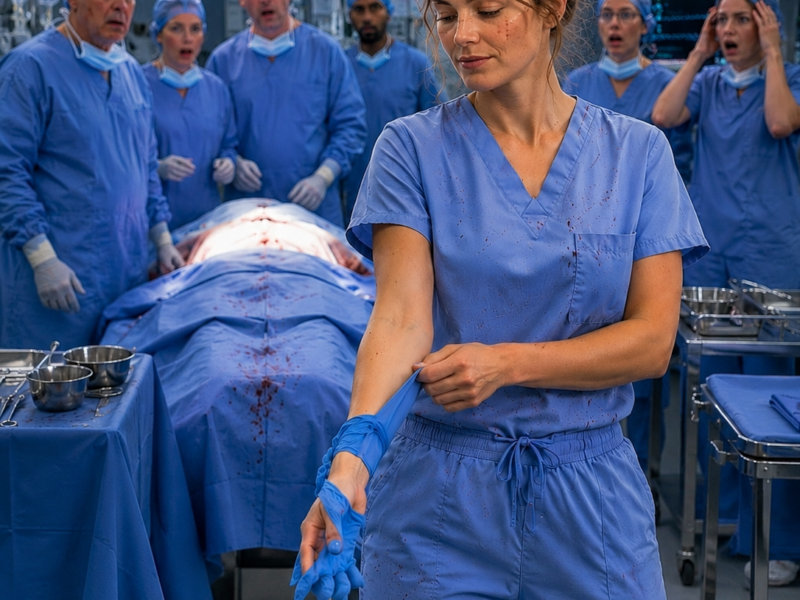
I Was a 31-Year-Old Nurse When I Discovered That a Veteran in Room 412 Had Been Conscious for Six Months While His Doctors Called Him Permanently Unresponsive. When I Whispered My Old Military Callsign, He Suddenly Opened His Eyes and Revealed He Recognized Me. Days Later, I Was Removed From His Care, Accused of Misconduct, and Warned to Stay Away—but Then an NCIS Agent Arrived With a Classified File Bearing a Name I Hadn’t Heard in Six Years…
I Was a 31-Year-Old Nurse When I Discovered That a Veteran in Room 412 Had Been Conscious for Six Months While His Doctors Called Him Permanently Unresponsive. When I Whispered My Old Military Callsign, He Suddenly Opened His Eyes and Revealed He Recognized Me. Days Later, I Was Removed From His Care, Accused of Misconduct, and Warned to Stay Away—but Then an NCIS Agent Arrived With a Classified File Bearing a Name I Hadn’t Heard in Six Years…
PART 1
The doctors had already given up on Declan Marsh.
For six months, he had lain motionless in Room 412 of Callaway Veterans Medical Center, unable to speak, move, or respond to the people around him. His medical records described his condition as permanent. His neurological assessments showed no meaningful signs of awareness. His prognosis had been reviewed, signed, and accepted by the hospital’s senior medical staff.
To them, Declan Marsh was a man whose life had effectively ended, even though his heart continued beating.
But they were wrong.
And the person who would eventually expose that terrible mistake was a young nurse nobody seemed particularly interested in listening to.
Her name was Nora Voss. She was thirty-one years old, had been working at Callaway for less than a year, and had developed a reputation for becoming too emotionally involved with difficult patients. Some colleagues admired her dedication. Others considered her inexperienced and overly sentimental.
Seven weeks earlier, she had been assigned to Declan’s care rotation.
At first, she treated him like any other patient. She checked his vital signs, monitored his medication, adjusted his bedding, and made sure his room remained comfortable. She spoke to him every morning, even though everyone told her there was no reason to expect a response.
Then she began noticing things.
His blood pressure changed whenever his head was positioned slightly to the left. His heart rate sometimes increased when particular people entered the room. Occasionally, his eyes seemed to follow sounds in ways that didn’t resemble ordinary reflexes.
Nora started recording everything.
She filled three personal notebooks with observations, measurements, and carefully documented patterns. When she showed her findings to Dr. Marcus Lyall, the hospital’s chief of neurology, he barely looked at them.
He had already decided what Declan’s condition meant.
“Mrs. Voss, long-term care patients can become emotionally difficult,” he told her. “I understand that you want to believe there’s something more happening here, but you cannot allow attachment to influence your clinical judgment.”
Nora took her papers and left without arguing.
But she didn’t stop watching Declan.
One Tuesday morning, six months, two weeks, and four days after his admission, Nora entered Room 412 as usual. She checked his IV, adjusted his pillow two centimeters to the right, and straightened the water pitcher on his bedside table.
“Good morning, Declan.”
She was about to turn away when she noticed something.
His lips had moved.
She stopped.
It wasn’t a random muscle twitch. It wasn’t the involuntary movement she had seen dozens of times in other patients.
His lips moved again.
Nora leaned closer.
A faint, broken sound emerged from his throat.
“Lancer.”
The water pitcher struck the bedside table as Nora’s hand suddenly tightened.
Lancer.
It wasn’t an ordinary word. It was a classified operational designation connected to a joint Army-Navy special operations program that had existed for only fourteen months before being dissolved and buried beneath layers of restricted documentation.
And Nora knew exactly what it meant.
Because before becoming a nurse, she had served as an Army combat medic attached to a Navy SEAL element.
She had been part of that program.
Her old call sign had been Spectre.
For several seconds, she couldn’t move. Then she leaned closer to Declan’s face and whispered two words.
“One word. Spectre.”
His eyes opened.
Not slowly. Not uncertainly.
They snapped open with the force of someone who had been fighting to break through an invisible wall for months.
His dark brown eyes immediately focused on Nora.
There was intelligence in them. Recognition. Anger.
And above everything else, an unmistakable awareness.
Nora forced herself to remain calm.
“Blink once for yes. Do you understand me?”
One deliberate blink.
“Are you in pain?”
Two blinks.
“Have you been conscious this entire time?”
A pause.
Then one blink.
Nora felt her heart tighten.
For six months, this man had been awake inside a body everyone believed was permanently unresponsive.
He had heard conversations. He had understood his doctors. He had watched his wife cry beside his bed. He had listened while strangers discussed his future as though he were no longer capable of understanding what they were saying.
And he had been unable to tell anyone.
Nora didn’t immediately call Dr. Lyall.
Instead, she returned to the nurses’ station, pulled up Declan’s overnight readings, and began documenting everything. She would build a record so precise that nobody could dismiss it as imagination.
She needed someone she could trust.
That person was Dr. Simone Adler, a neurosurgeon who had joined Callaway eight months earlier. Unlike Lyall, Adler had extensive experience with complicated cervical injuries and wasn’t particularly interested in hospital politics.
Nora brought her seventeen pages of observations.
Adler read them silently for twelve minutes.
Then she looked up.
“Where did you learn to build this kind of analysis?”
“I’ve had a diverse professional background.”
Adler studied her for another moment.
“If even half of this is accurate, we need new imaging.”
Three days later, Adler reviewed a new MRI sequence in her office.
The results changed everything.
There was significant compression at the C4-C5 level of Declan’s cervical spine. The original imaging could have revealed it, but the diagnostic approach used during his initial evaluation had apparently failed to identify it.
More importantly, the compression was potentially surgically treatable.
When Adler showed the findings to Lyall, his expression tightened.
“You requested this imaging?” he asked Nora.
“I documented the clinical observations. Dr. Adler ordered the scan.”
Lyall looked at the images again.
“The protocol for questioning an attending’s diagnosis is to bring your concerns through the proper channels.”
“I did,” Nora replied. “Three weeks ago. You told me attachment was affecting my judgment.”
The room fell silent.
Adler intervened.
“The compression is real, Marcus. I’ve already had an independent specialist review the images.”
Lyall said he would review the case.
But the following morning, instead of supporting Nora’s efforts, he filed a formal professional misconduct complaint against her.
He accused her of undocumented interventions, emotional overinvestment, and repeatedly disregarding established clinical procedures.
Within twenty-four hours, Nora was removed from Declan’s care rotation and reassigned to the respiratory unit.
Before leaving Room 412, she returned to his bedside.
“I’ve been reassigned,” she told him quietly. “But everything I’ve discovered is in your chart. I’m not finished.”
Declan watched her.
One deliberate blink.
Nora adjusted his pillow one final time and walked toward the elevator.
She hadn’t even reached the parking level when the overhead alarm sounded.
“Code blue. Fourth floor. Room 412.”
She turned around and ran.
When she reached the room, two nurses were already struggling to stabilize Declan. His blood pressure was collapsing. The pillow beneath his head had shifted.
Nora immediately understood.
“His pillow is two centimeters off center!”
“You’re not authorized to be here,” one nurse snapped.
She ignored him, reached across the bed, and repositioned the pillow.
Within seconds, the numbers began stabilizing.
Nobody spoke.
Then a man appeared in the doorway.
He wore civilian clothes, but his posture suggested years of military or federal service. He held up a badge wallet.
“Is there a Nora Voss on this floor?”
“I’m Voss.”
“My name is Cole Rafter. Naval Criminal Investigative Service.”
He looked toward Declan’s bed, then back at her.
“We need to talk about Declan Marsh. And about you.”
Nora followed him into a private consultation room.
What he revealed next made her realize that the medical mistakes surrounding Declan might have been only the beginning.
His wife, Judith Marsh, had contacted a congressman’s office after hospital administrators told her to consider permanent long-term care.
That complaint had attracted federal attention.
Rafter had also discovered irregularities in Declan’s original medical documentation. Two required diagnostic procedures were missing from the records.
Nora explained everything she had observed, including the blood pressure patterns and the unusual heart-rate changes whenever certain footsteps approached Room 412.
Rafter listened carefully.
Then he asked to see her private observation logs.
Before leaving, he gave her one final instruction.
“Keep track of who’s entering that room. Unofficially.”
That night, Nora sat alone in her apartment, reviewing six months of reconstructed observations.
She discovered that Declan’s heart rate had repeatedly spiked when a particular person approached his room.
She couldn’t yet identify the individual.
But she knew the pattern wasn’t random.
The following day, a hospital billing clerk named Wanda Puit approached her during lunch.
Wanda had worked at Callaway for twelve years and had noticed something unusual in Declan’s financial records months earlier.
She quietly introduced Nora to a name she had never heard before: the Neurological Recovery Initiative.
It was supposedly a research program designed to monitor long-term neurological patients.
But the billing codes didn’t match the procedures documented in the patients’ charts.
Eleven patients were enrolled.
All had been diagnosed with permanent neurological conditions.
And all had something in common: their medical files contained unexplained irregularities.
Nora immediately contacted Rafter.
His response was chilling.
“Voss, this is bigger than I initially thought.”
Three days later, the NRI files were accessed and partially erased.
The access credentials belonged to Dr. Marcus Lyall.
Someone knew they were investigating.
And someone was trying to make sure the truth never came out.
PART 2
Rafter moved quickly after learning that Lyall had accessed the files. He asked Nora to meet Dr. Adler privately and review Declan’s medication records.
What they discovered was worse than the missing documentation.
Four days earlier, someone had ordered a continuous low-dose sedative for Declan. Adler confirmed she had never prescribed it.
The medication had been introduced two days after the MRI revealed that Declan might be conscious.
It was suppressing the very responses Nora had spent weeks documenting.
Adler immediately contacted the pharmacy and ordered the infusion suspended pending review.
That afternoon, Judith arrived after receiving a mysterious call about her husband’s medication. Nora explained the situation, and together they watched the sedative being disconnected.
Meanwhile, Rafter obtained a federal order for the NRI records.
The files revealed that eight of the eleven patients had been classified as permanently unaware. Their families had supposedly authorized harmless research participation, but the medication records showed otherwise.
Someone had been deliberately keeping vulnerable patients neurologically suppressed.
And Dr. Lyall’s signature appeared on every enrollment authorization.
But when Rafter examined the administrative records, another name emerged.
Gerald Pitt, the hospital administrator who had ordered Nora’s reassignment, controlled the system that concealed the research documents.
Lyall might have been the doctor signing the orders.
Pitt might have been the man who built the entire operation.
And neither of them was working alone.
PART 3
The discovery of Gerald Pitt’s involvement transformed the investigation.
Until then, Nora had believed she was dealing with a corrupt neurologist who had made a series of deliberate decisions to keep Declan Marsh classified as permanently unaware.
Now she understood that the hospital’s problems reached much further than one doctor’s office.
Pitt had spent twelve years at Callaway controlling administrative operations, patient transfers, research agreements, and financial records. He had also previously worked at a private hospital in Raleigh that had been acquired by a healthcare investment group.
When federal investigators examined the acquisition records, they found that two members of that investment group’s board were also listed among the founding documents of Vantage Clinical Research, the company operating the Neurological Recovery Initiative.
It was beginning to look less like an isolated medical scandal and more like a carefully constructed business.
Nora learned most of this while standing outside Declan’s recovery room.
His first major surgery was approaching, and she had little time to think about anything else. Dr. Adler had managed to regain authority over his case, and the hospital director had approved an independent clinical review of all eleven NRI patients.
The original imaging had been repeated. Declan’s cervical compression was confirmed, and the surgical team agreed that waiting longer could increase the damage.
His wife, Judith, had spent the previous evening beside him.
Nora found them together when she stopped by his room.
Judith was reading aloud from a book she had brought from home. Declan’s eyes were open, and he was following her voice.
“We’re scheduled for six tomorrow morning,” Nora said.
Judith closed the book.
“Is there a chance he’ll recover?”
Dr. Adler had already explained the medical risks, and Nora wasn’t going to offer false promises.
“There is a chance of improvement. The compression can be relieved, but we cannot know how much function will return. Six months is a long time for an injury like this.”
Judith nodded.
“I just want him to have the chance.”
Nora looked at Declan.
He blinked once.
The next morning, at 6:02, he was taken into the operating room.
Nora remained on the fourth floor. She wasn’t part of the surgical team, and there was nothing useful she could do by hovering outside the operating room.
She tried to concentrate on her work.
At 9:17, her phone rang.
It was Dr. Adler.
“We have a bleed,” she said. “It’s partially controlled, but the source isn’t behaving the way we expected. I need you up here.”
Nora immediately took the stairs.
When she entered the operating room, the atmosphere was tense. Dr. Felix Orr, the spinal specialist leading the procedure, was working at the surgical field while the anesthesiologist monitored Declan’s unstable blood pressure.
Adler directed Nora toward a secondary imaging screen.
“Look at this.”
Nora studied the vascular map.
For a moment, she said nothing.
Then she leaned closer.
“The bleeding is tracking upward along the dural margin. It’s not coming from the original compression site.”
Adler nodded.
“That’s what we’re seeing.”
“There’s an epidural component above the decompression area. The pressure is redistributing. You need to examine the space above C3.”
Orr looked toward them.
“That’s not in the original plan.”
“The original plan didn’t account for this,” Adler replied.
Nora explained the pressure pattern she was seeing. Her knowledge of trauma medicine and her experience with complicated battlefield injuries allowed her to recognize a possibility that wasn’t immediately obvious from the original surgical plan.
Adler reviewed the image again.
“Left posterior, above C3,” she told Orr.
He studied the screen for several seconds.
Then he gave the order.
“Secondary retractor. Let’s move.”
The next eleven minutes were difficult.
The bleeding continued, and Declan’s blood pressure fluctuated dangerously. The anesthesiologist adjusted the medication while the surgical team carefully accessed the additional area.
Finally, the pressure began stabilizing.
The bleeding slowed.
Orr looked at the monitor.
“Holding.”
Adler exhaled.
For the first time that morning, the room seemed to breathe again.
Nora stepped back.
She had entered the operating room because Adler needed another perspective, but she understood that the work belonged to the surgical team. She had contributed what she could.
As she removed her surgical gown outside the room, she noticed Cole Rafter approaching.
He wasn’t alone.
A woman wearing a dark suit walked beside him. Her badge identified her as Diane Morrow from the Department of Justice.
Rafter looked exhausted.
“Lyall is gone,” he said.
“What do you mean?”
“He left Harwick about six hours ago. His vehicle was found at the Dunore Transit Hub.”
Nora felt a cold sensation move through her stomach.
“Did he escape?”
“We don’t know yet. But his attorney contacted us. Lyall is apparently prepared to provide information about another person involved in the research program.”
“Who?”
Rafter looked at Morrow.
She stepped forward.
“Gerald Pitt.”
Nora immediately remembered the reassignment meeting.
She remembered Pitt’s calm voice, his carefully chosen words, and the way he had insisted that her methods were the problem.
She had assumed he was simply protecting Lyall’s authority.
Now she wondered whether he had been protecting something much larger.
“Where is he?” she asked.
“Still inside the hospital,” Rafter replied. “We’re preparing to question him.”
Nora looked toward the recovery room.
Declan had survived the operation, but his future remained uncertain. His wife was waiting for news, and an entire investigation was unfolding around him.
For the moment, Nora did exactly what Rafter had instructed.
She stayed away from the administrative floor.
Declan was transferred to recovery, and by late morning Adler came to tell Nora that his pressure was stable.
The secondary decompression had worked.
The surgical team believed the additional bleeding had probably resulted from a pre-existing epidural complication associated with the original trauma. It was another problem that had never been properly identified.
Nora couldn’t stop thinking about the incomplete trauma report.
Declan had been transferred to Callaway seven days after his original injury. His transfer documents were the foundation on which the hospital’s doctors had built their diagnosis.
If those documents had been altered or incomplete, the doctors might never have received the information necessary to understand his condition.
“Who processed his transfer?” Nora asked Adler.
Adler looked at her.
“Administration.”
They both understood what that meant.
Gerald Pitt’s office had handled the transfer.
He might have influenced the medical information that reached the doctors before Declan’s diagnosis was ever established.
Meanwhile, federal investigators searched Pitt’s office.
He didn’t run.
When Rafter and Morrow entered, Pitt was sitting behind his desk with his phone turned face down and his paperwork neatly arranged.
He requested his attorney before answering questions.
It was a calculated response from someone who understood institutional systems and knew how to navigate an investigation.
But the search of his office uncovered documents that connected Vantage’s financial arrangements to Callaway’s hospital improvement fund.
The payments had been disguised as ordinary institutional funding.
Equipment purchases, facility upgrades, and staffing adjustments appeared legitimate on the surface. Without the underlying Vantage agreements, there was little reason for anyone to question them.
Wanda Puit’s private records helped investigators reconstruct the entire financial arrangement.
For months, she had kept notes about unusual billing codes, unexplained payments, and patient files that seemed to disappear from the standard system.
When federal investigators interviewed her, she provided everything.
She had no military background, no classified training, and no authority over medical decisions.
She was simply a billing clerk who had noticed that something didn’t add up.
And because she had refused to ignore it, investigators finally had the evidence they needed.
Rafter later told Nora that Wanda’s records had established a clear financial timeline.
The payments from Vantage had been flowing through Pitt’s administrative fund for years.
The company wasn’t simply collecting research data.
It was paying the hospital to maintain a system that made the data possible.
The eleven patients were the foundation of that system.
And Declan Marsh was one of its most dangerous complications.
He had become conscious enough to expose what was happening, and Nora had become determined enough to make sure somebody listened.
That afternoon, Rafter brought Nora another disturbing discovery.
Declan’s original NRI enrollment documentation contained a record of a conversation between Pitt and Judith.
During the first week after her husband’s admission, Pitt had personally approached her.
He had explained that Callaway was participating in a standard veterans’ outcome-monitoring program. He had assured her that it involved no medical intervention and carried no additional risk.
Judith had signed the consent form because she believed she was helping other veterans receive better care.
But the actual research program was completely different.
When Nora heard this, she sat silently.
Judith had trusted the hospital during the worst week of her life.
She had believed the people wearing medical badges and institutional credentials were working to protect her husband.
Instead, someone had used her trust to authorize something she had never knowingly agreed to.
“Does she know?” Nora asked.
“Not yet,” Rafter answered. “We’re going to explain it carefully.”
But there was no careful way to deliver that kind of information.
The following morning, Judith sat in the family consultation room while Morrow explained what the investigation had uncovered.
Rafter was present, and Nora sat nearby.
Judith listened without interrupting.
When Morrow finished, she asked three questions.
“What exactly did I sign?”
“What did it authorize?”
“And what did they do to my husband?”
Each answer made the room quieter.
Finally, Judith looked down at her hands.
“He told me they were collecting information to help veterans like Declan.”
She paused.
“He looked me in the face and told me that.”
Nobody answered.
There was nothing anyone could say that would make that betrayal easier to understand.
Judith eventually looked at Nora.
“How long was the sedative running?”
“Four days.”
“Four days while I was being told he wasn’t improving?”
Nora nodded.
Judith closed her eyes.
Then she opened them again.
“What happens to the other patients?”
“Every one of them is receiving an independent clinical review,” Nora explained. “We’re repeating the necessary imaging and reviewing their medications. We don’t know how many may have been affected, but we’re going to find out.”
Judith stood.
“I want Declan to know everything. I don’t want anyone deciding that he can’t handle the truth just because he’s in that bed.”
“He deserves to know,” Nora replied.
Two days later, when Adler believed Declan was stable enough, Rafter visited his room.
Judith sat beside the bed, and Nora helped establish the communication system.
The conversation took forty-seven minutes.
Every question had to be carefully framed so Declan could answer with deliberate eye movements. One blink meant yes, two meant no, and four indicated that he wanted the conversation to continue.
Rafter explained the NRI program, the unauthorized medication, the false documentation, and the investigation.
Declan listened.
He confirmed that he had been aware throughout his hospitalization.
He also confirmed that there had been periods when his responses became harder to control. He remembered unfamiliar staff members entering his room. He remembered moments when medication made his thoughts feel distant and heavy.
Most importantly, he remembered people discussing him as though he couldn’t hear them.
When Rafter finished, Declan looked at Nora.
Then he began producing a sequence of deliberate eye movements.
It wasn’t their established yes-or-no system.
Nora watched carefully.
She counted the pattern.
Then she recognized it.
Morse code.
Her expression changed.
Declan repeated the sequence.
Nora decoded it slowly.
Four words appeared in her mind.
“You found me.”
For several seconds, she couldn’t speak.
Judith looked from her husband to Nora.
“What did he say?”
Nora swallowed.
“He says I found him.”
Declan held her gaze.
And for the first time since she had entered Room 412, Nora felt that the man in the bed wasn’t simply acknowledging her medical observations.
He was acknowledging something much older.
Something connected to the operation they had both been part of six years earlier.
Something she had spent years trying not to remember.
But the full meaning of that message would become clear only after she understood what Declan had been carrying.
For now, the investigation was moving forward, and the people responsible were beginning to lose control.
Pitt was formally arrested on the eighteenth day after his first federal interview.
The evidence connected him directly to Vantage’s payments and to the administrative structure that had concealed the NRI program.
Lyall eventually surrendered through his attorney and agreed to cooperate.
But the investigation was far from over.
Because when investigators examined the research program’s publications, they discovered that Lyall had submitted a scientific paper based on the eleven patients.
It presented their condition as evidence that Callaway’s long-term care model was successful.
The paper never mentioned the unauthorized medication.
It never mentioned the false diagnoses.
It never mentioned that some patients might have been fully conscious while the hospital described them as permanently unaware.
The research had been designed to make the suppression look like successful medical management.
And if the paper had been published, it might have helped Vantage secure a much larger government contract.
The eleven patients hadn’t simply been research subjects.
They had been the company’s proof of concept.
And now federal investigators were beginning to uncover how far that proof had been intended to travel.
PART 4
The independent clinical review of the eleven patients was completed sixteen days after the investigation began.
The findings were devastating.
Four patients showed measurable signs of awareness that had never been properly documented in their official diagnoses.
Two had levels of responsiveness remarkably similar to Declan’s condition.
The other two required additional testing, but their medical histories suggested that their original prognoses might also have been premature.
Seven patients had received pharmaceutical interventions recorded in the NRI files but missing from their official medical charts.
Nora read the report in Dr. Adler’s office.
She had expected bad news.
She hadn’t expected the numbers to feel so personal.
“Four,” she said quietly.
Adler nodded.
“At least four. Possibly more.”
Adler then told her about a sixty-one-year-old woman named Margaret Pell, who had been admitted following a stroke eight months earlier.
Her diagnosis had been established using the same incomplete assessment process used for Declan.
She had been declared permanently unaware.
Her daughter, Sonia, had been told to prepare for a future in which her mother would never recognize her again.
Adler had reviewed Margaret’s imaging the previous evening.
The results were concerning.
“We need someone who can build a communication framework for her,” Adler said. “The team doesn’t have the experience you developed with Declan.”
Nora looked at her.
“I’m still officially in an advisory role.”
“Not for much longer.”
Adler had already arranged a meeting with the hospital director. She intended to demand that the misconduct allegations against Nora be withdrawn and that Nora be given a formal position in the independent review program.
There was no longer any reasonable justification for keeping her away from the patients she had helped identify.
But before that meeting could happen, Rafter called.
He had discovered another connection.
Two members of Vantage’s board had financial relationships with a veterans’ advocacy nonprofit that publicly supported legislation expanding long-term care placement authority for veterans with permanent neurological diagnoses.
The legislation was already moving through Congress.
It would make it easier to classify certain veterans as appropriate candidates for permanent care facilities, potentially removing them from regular hospital review cycles.
Nora stood motionless in the fourth-floor corridor as Rafter explained the implications.
“You’re saying this program was intended to expand beyond these eleven patients?”
“We don’t know the complete picture yet.”
“How many facilities has Vantage approached?”
There was a pause.
“Fourteen facilities across seven states.”
Nora looked toward the patient rooms.
Fourteen facilities.
Seven states.
And possibly hundreds of patients whose conditions had never been properly investigated.
She had thought she was uncovering a scandal inside one hospital.
Now she understood that she might have stumbled into something much larger.
She was about to respond when Dana Eckert approached from the other end of the corridor.
Dana looked pale.
“Nora, you need to come with me. Adler is in the recovery room.”
“What happened?”
“Declan’s vital signs are spiking. Someone accessed his IV line during the last hour.”
Nora was already running.
When she entered the recovery room, Adler was standing beside the monitor while another nurse examined Declan’s IV access.
His heart rate was elevated, and his blood pressure was fluctuating in a pattern Nora immediately recognized as dangerous.
“What happened?”
“Someone accessed the secondary port,” Adler replied. “The cap was removed, and the port was wet.”
“When was it discovered?”
“Twenty minutes ago.”
Nora examined the monitor.
Declan’s eyes were open, but his expression was different. He was struggling to maintain focus.
She moved beside him.
“One blink. Are you having chest pain?”
One slow blink.
“Is it sharp or pressure?”
He produced an uncertain sequence.
Nora looked toward Adler.
“We need cardiology immediately. And toxicology. Someone may have administered something through that port.”
Adler was already calling for assistance.
Nora remained beside Declan.
“Stay with me,” she whispered.
One blink.
The cardiology specialist arrived within eleven minutes.
Blood tests revealed an abnormality involving a cardiac glycoside, a compound capable of causing dangerous heart rhythm disturbances.
It wasn’t an ordinary medication error.
The concentration was consistent with something deliberately introduced through an IV port.
Dr. Prius Solless, the toxicology specialist, arrived shortly afterward.
She reviewed the results and explained that the compound was related to a cardiac medication but wasn’t the standard form that routine screening would immediately identify.
At the concentration found in Declan’s blood, it could produce severe arrhythmia and potentially acute cardiac failure.
“Whoever calculated this dose knew what they were doing,” she said.
The room went silent.
Rafter had arrived while the medical team was working.
He immediately ordered everyone not directly involved in Declan’s treatment to leave the room.
Nora stayed.
Security footage from the recovery wing showed someone entering at 8:47 p.m. wearing surgical scrubs and a cap.
The individual had used an access badge belonging to a nurse who was currently on medical leave.
The badge should have been deactivated.
It hadn’t been.
The administrative gap was another failure connected to the systems Pitt’s office had managed.
The figure remained inside for four minutes before leaving.
Federal analysts reviewed the footage.
By two in the morning, they had identified him.
His name was Terrence Vulk.
He wasn’t a Callaway employee.
He was a logistics contractor who had worked with Vantage Clinical Research for three years. Internal company documents described his responsibilities using an unsettling phrase: participant stability management.
Investigators had previously found references to the same phrase in the NRI records.
Now they understood what it meant.
Vulk was the person Vantage sent when a research participant became a problem.
When a family asked too many questions.
When a patient’s condition began changing.
When a medical professional threatened to expose the program.
He had been sent to Callaway to deal with Declan.
Federal officers arrested him at a motel outside Harwick at 4:15 a.m.
By sunrise, he was in custody.
But inside the hospital, Nora had spent the entire night beside Declan.
The treatment involved carefully stabilizing his cardiac function, monitoring his blood chemistry, and correcting the abnormalities caused by the compound.
There were two setbacks.
At 1:30 a.m., his heart rate began fluctuating again, and the medical team had to respond immediately.
Judith arrived shortly after midnight.
She sat in the corner of the room wearing the same coat she had driven in with.
She didn’t sleep.
Neither did Nora.
Around three in the morning, Judith finally looked across the room.
“Is this going to keep happening?”
Nora considered the question.
She couldn’t promise that nothing else would happen.
But she could tell Judith what she intended to do.
“No,” she said. “It won’t.”
Judith studied her.
There was no dramatic reassurance in Nora’s voice. No promise that everything would suddenly become safe.
It was simply a commitment.
And Judith understood the difference.
By morning, Declan’s heart rate had stabilized.
His blood pressure was holding, and the immediate danger had passed.
The arrest of Terrence Vulk opened another part of the investigation.
Under questioning, he eventually cooperated after his attorney reviewed the evidence against him.
What he revealed was worse than anything Rafter had anticipated.
There were six additional cases involving patients at four of the fourteen facilities Vantage had approached.
Those patients had also become potential threats when their medical conditions began changing in ways that could expose the research program.
Two had died.
Their causes of death would now require federal forensic review.
Four were still alive.
The investigation was no longer limited to medical fraud or unauthorized research.
It had become a much broader federal criminal case involving deliberate harm to vulnerable patients.
Additional investigators joined Morrow’s team.
The congressional office that had originally received Judith’s complaint requested a formal briefing.
And the legislation that would have expanded permanent neurological care placement was referred for ethics review.
Its primary sponsor requested that the bill be removed from the chamber calendar pending investigation.
Vantage’s operating licenses were suspended in three states.
The company hired an aggressive legal team, but the financial evidence was becoming impossible to explain.
Meanwhile, Callaway was undergoing its own internal reckoning.
The misconduct allegations against Nora were formally withdrawn six days after Declan’s cardiac emergency.
The hospital’s legal department concluded that the allegations had originated with individuals whose conduct was now under criminal investigation.
It also acknowledged that Nora’s documented interventions had been consistent with appropriate patient advocacy.
Hospital director Steven Galt personally summoned her to his office.
He looked uncomfortable.
He knew the institution had failed her.
“We would like you to consider a formal position in the neurological review program,” he said.
Nora sat across from him.
“What kind of position?”
“A clinical care coordinator role focused specifically on veterans with neurological injuries.”
He paused.
“You identified a systemic failure. We need someone who understands how to prevent it from happening again.”
Nora considered the offer.
Then she asked the only question that mattered to her.
“Will I have the authority to request independent reviews when I believe a patient’s awareness status has been incorrectly documented?”
“Yes.”
“Even if the concern involves a senior physician?”
“Yes.”
“Without going through that physician’s department first?”
Galt nodded.
“That is exactly what we’re proposing.”
Nora accepted.
She wasn’t interested in a title or recognition.
She wanted to make sure that nobody else had to spend six months trapped inside a body while the people responsible for their care discussed them as though they no longer existed.
But Declan’s recovery was still uncertain.
His first operation had relieved the most significant compression, yet additional work remained at C5.
Adler believed they would need a second procedure once his body had recovered sufficiently.
And while the legal investigation continued, Nora began preparing for the next challenge.
Margaret Pell.
The woman on the third floor who had been waiting eight months for someone to ask the right questions.
Nora visited her room the following morning.
Margaret lay quietly beneath a blanket, her eyes mostly closed. Her daughter, Sonia, sat beside her.
Nora introduced herself and explained that the hospital was conducting a new neurological assessment.
Sonia listened carefully.
“Are you saying my mother might still understand us?”
“I’m saying we haven’t done enough to rule that out.”
Sonia looked toward the bed.
For eight months, she had been living with a particular kind of grief. Her mother was physically present, but every doctor had told her that meaningful awareness was impossible.
Now someone was suggesting that the conclusion might have been wrong.
Nora didn’t promise anything.
She simply asked permission to begin the assessment.
Sonia agreed.
The first several days produced almost nothing.
The team tried different sounds, questions, and carefully controlled visual stimuli. They monitored Margaret’s responses and compared them against her neurological patterns.
Sometimes her heart rate changed.
Sometimes her eyes moved.
But there was no reliable communication.
After two weeks, even Dr. Tobias Hayne, the neurologist assisting Adler, began questioning whether the apparent responses meant anything.
Nora refused to rush to a conclusion.
She remembered how easily Declan’s awareness had been dismissed.
She also knew that false hope could hurt families just as deeply.
So they continued.
On the twenty-second day, something changed.
Hayne asked Margaret a simple question.
“Are you in pain?”
Two deliberate blinks.
No.
He repeated the question using a different phrasing.
Again, two blinks.
Hayne looked at the monitor.
Then he looked at Nora.
“That was a response.”
Nora nodded.
“Ask her again.”
This time, Margaret responded in the same way.
For the first time in eight months, there was measurable evidence that she could understand and answer a question.
Sonia was waiting in the family consultation room down the corridor.
Nora walked to the door.
“Dr. Hayne needs you.”
Sonia stood immediately.
She didn’t ask why.
She had been waiting for something for eight months, even though she had stopped allowing herself to imagine what that something might be.
Nora led her to the room and held the door open.
Sonia approached her mother’s bedside.
“Mom? Can you hear me?”
Margaret blinked twice.
Sonia covered her mouth.
Then she reached for her mother’s hand.
Nora quietly stepped into the corridor and closed the door.
She stood there for a moment, looking at the wall.
She felt relief.
She also felt grief for the months that had already been lost.
And she felt something else.
Anger.
Not the loud, explosive kind.
The quieter anger that comes from realizing how many people might have been helped if someone had simply taken the time to look.
She returned to her work.
Because Margaret wasn’t the only patient who needed someone to keep looking.
And the story of Room 412 was beginning to change the way an entire hospital understood its responsibility to the people inside it.
PART 5
The legal consequences unfolded over the following months.
Gerald Pitt was charged with fourteen federal offenses, including healthcare fraud, wire fraud, and conspiracy. The investigation uncovered evidence connecting him to the financial arrangements that had supported Vantage’s operations across multiple institutions.
Dr. Marcus Lyall lost his medical license after the state medical board concluded that he had falsified clinical documentation, enrolled patients in unauthorized research, and prescribed medications without legitimate medical justification.
He eventually received an eleven-year federal sentence.
Pitt received seventeen years.
Terrence Vulk cooperated with investigators and provided information that helped uncover the other cases. His sentence was reduced, although it remained substantial.
The two Vantage board members connected to the veterans’ advocacy nonprofit were charged separately. Their involvement in the financial arrangements surrounding the proposed legislation was also exposed.
The scientific paper Lyall had submitted was withdrawn before publication.
Its central findings had been based on patients whose neurological responses had been deliberately suppressed. What had been presented as successful long-term medical management was actually evidence of a system designed to conceal suffering.
For Nora, however, the most important developments were happening inside Callaway.
The hospital formally established the Veterans Neurological Advocacy Program four months after the investigation became public.
Its rules were straightforward.
No veteran could receive a final diagnosis of permanent non-awareness without an independent review by a second neurologist who had not previously participated in the case.
The review had to occur within forty-five days of admission.
Any staff member who suspected that a patient might be aware despite an existing diagnosis could report the concern directly to the program coordinator, bypassing the usual departmental hierarchy.
That coordinator was Nora Voss.
The announcement appeared on the hospital’s internal system on a Thursday morning.
Within fifteen minutes, she had received fourteen messages from staff members across four departments.
Some congratulated her.
Others asked how the new process would work.
Two nurses sent messages that stayed with her longer than the others.
They both said they had cared for patients who reminded them of Declan, but they had never known how to raise their concerns.
Nora answered every message before noon.
She knew that changing a policy was only the beginning.
The real work would happen in patient rooms, during difficult conversations, and in the moments when someone noticed something that didn’t fit the diagnosis.
She wanted those observations to matter.
Meanwhile, Declan continued his rehabilitation.
His second surgery was scheduled eleven weeks after the first, once his cardiac condition had fully stabilized.
The procedure lasted four hours and twelve minutes.
It went as expected, although recovery remained difficult.
Three days later, Declan reported sensation in his left hand.
It wasn’t complete.
Sometimes he could feel pressure, sometimes warmth, and sometimes nothing at all. His nervous system was slowly trying to find new pathways around the damage that had accumulated over months.
Physical therapy began ten days after the operation.
His therapist, Marcus Dell, had worked with neurological patients for twenty years. He understood that recovery wasn’t a straight line and had little patience for unrealistic expectations.
He also understood something about Declan’s personality.
The former SEAL operator was determined to regain control of his body.
Every exercise became a challenge.
Every small improvement mattered.
And every failure seemed to make him more determined to try again.
Six weeks into therapy, something extraordinary happened.
Declan squeezed Judith’s hand.
It wasn’t a strong grip.
It wasn’t even particularly steady.
But it was voluntary.
Judith felt it and immediately looked down.
Then she looked at her husband.
For a moment, neither of them moved.
When she finally stepped into the hallway, Nora was standing nearby.
“He squeezed my hand,” Judith said.
Nora smiled.
“I know.”
Judith looked at her.
“You should go in.”
“It’s his therapy session.”
“Nora.”
Judith emphasized her name.
“Go in.”
Nora entered the room.
Declan was sitting in his therapy chair, his left hand resting on a padded surface. Marcus Dell was making notes on his tablet.
When Declan noticed Nora, his eyes followed her.
“Good session,” she said.
He looked at her for a moment.
Then he slowly lifted his left hand about two inches and lowered it again.
It was a small movement.
But it was deliberate.
Nora nodded.
“Yeah. That’s a good session.”
For the first time, the possibility of a future beyond the hospital began to feel real.
His progress continued.
On the 112th day of rehabilitation, Declan stood without assistance.
It took tremendous effort.
His jaw tightened, his left hand gripped the support rail, and his right side struggled to contribute.
But he rose.
Seven seconds passed before Dell instructed him to sit.
Declan didn’t immediately obey.
He wanted to remain standing.
“Declan,” Dell said firmly.
Eventually, he lowered himself back into the chair.
Seven seconds.
For someone who had spent six months unable to move, those seven seconds represented an extraordinary achievement.
Nora heard about it later that afternoon.
She visited his room that evening.
Judith was sitting beside the bed, reading a book. Declan was awake.
“I heard about the seven seconds,” Nora said.
Declan looked at her.
Then he raised his left hand and extended two fingers.
He was correcting her.
“Seven?”
He held the gesture.
Nora smiled.
“All right. Seven. I’m terrible at math.”
The corner of his mouth moved.
It was barely a smile, but she recognized it.
And for a moment, Room 412 felt like an entirely different place.
Six months earlier, it had been a room where everyone expected nothing.
Now it was a room where every small movement represented another possibility.
Six months later, Nora received a package at her office.
It was an ordinary cardboard box with her name written across the top.
Inside was an old Army combat medic patch.
The fabric was worn, and its edges were frayed from years of actual use.
A small note was folded beneath it.
It was written in Judith’s handwriting.
He’s been carrying this for six years. He says you’ll understand why. He says it belongs with you.
Nora sat quietly at her desk.
She held the patch in both hands.
And suddenly, she understood what Declan had been trying to tell her all along.
Six years earlier, during the classified operation they had both served in, Nora had been attached to Declan’s SEAL element as a combat medic.
During one mission, an operator had been critically injured.
Nora had reached him, but despite everything she had done, she had been unable to save him.
She had spent years believing she had failed.
She remembered the operation, the noise, the confusion, and the terrible feeling of being too late.
She had carried that memory into civilian life without ever explaining it to anyone.
The patch had belonged to her.
Declan had kept it for six years.
He had carried it through the operation, through his military service, and eventually into the hospital.
Even when he couldn’t speak, he had remembered.
And when he finally found a way to communicate with Nora, he had chosen those words.
“You found me.”
She looked at the patch for a long time.
She finally understood that the message had been about more than recognizing an old teammate.
Declan knew what had happened six years earlier.
He knew what she had carried.
And perhaps most importantly, he knew that she had not abandoned him.
This time, she had found him.
This time, she had stayed.
Nora placed the patch on her desk.
She didn’t frame it or put it inside a display case.
She simply left it where she could see it every day.
Because some things didn’t need to be displayed to be meaningful.
They only needed to be remembered.
The following afternoon, she had a meeting with the physical medicine team about a new veteran admitted three days earlier.
He had suffered a cervical injury.
His initial prognosis was poor.
His wife had already been advised to begin considering long-term care placement.
Nora had reviewed the medical records twice.
She had identified several questions that needed answering and requested an independent imaging review before the end of the week.
She picked up the patient’s chart and walked toward the meeting room.
As she passed the fourth-floor corridor, she glanced toward Room 412.
Declan was no longer there.
His rehabilitation had progressed enough that he was preparing for a longer-term recovery program outside the hospital.
He wasn’t walking independently yet.
He wasn’t fully recovered.
There were still difficult days ahead, and nobody could say exactly how much function he would eventually regain.
But he was alive.
He was conscious.
He was communicating with his wife.
And he was no longer trapped inside a diagnosis that had never properly described him.
Margaret Pell was also making progress. She had moved into outpatient therapy, and three weeks earlier, she had spoken her first word in eight months.
It had been her daughter’s name.
Nora still thought about that moment.
She thought about Sonia standing beside her mother’s bed, waiting for a response she had been told would never come.
She thought about the eleven original NRI patients and the four whose awareness had been identified.
She thought about the other facilities, the ongoing investigations, and the families who were finally receiving answers.
And she thought about the nurse she had been when she first entered Room 412.
The nurse who had been told she was too emotional.
Too attached.
Too inexperienced.
The nurse whose observations had been dismissed after forty-five seconds.
She remembered the day she had been reassigned, the accusations, and the moment she had heard the code-blue alarm while standing inside the elevator.
She remembered running back to the room because she knew something the others didn’t.
And she remembered the first time Declan opened his eyes.
There had been no dramatic speech.
No miraculous recovery.
Just one man, trapped inside his own body, finding enough strength to whisper a single classified word.
Lancer.
And one nurse who understood what it meant.
The hospital would eventually remember the scandal as one of the most serious failures in its history.
It would remember the arrests, the federal investigation, the fraudulent research program, and the medical professionals who had betrayed the people they were supposed to protect.
But Nora remembered something different.
She remembered the eleven patients.
She remembered the families who had waited.
She remembered the small movements that everyone else had dismissed.
And she remembered that sometimes the difference between a person being lost and a person being found was simply whether someone was willing to look again.
She reached the meeting room, opened the door, and placed the chart on the table.
There were questions to ask.
Records to review.
A family waiting for someone to explain what might still be possible.
Nora took her seat.
The work wasn’t finished.
It probably never would be.
But that no longer frightened her.
Because somewhere in Callaway Veterans Medical Center, another patient might be lying in a bed while the world assumed there was nobody listening inside.
And this time, somebody would be looking.
Somebody would be asking questions.
Somebody would refuse to accept an answer simply because it was easier than searching for the truth.
Nora Voss had learned that a person’s silence didn’t mean they were absent.
And she had no intention of ever forgetting it.