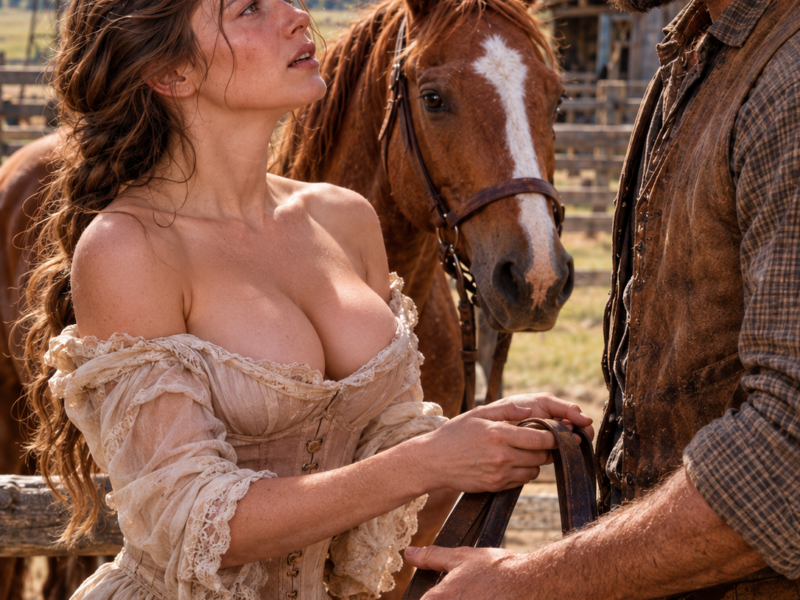
I Was a 29-Year-Old Widow With Just 60 Cents Left When I Rode 9 Frozen Miles to Sell My Dead Husband’s $40 Horse for Only $2 So My Starving 6-Year-Old Son Could Eat. But the Wealthy Rancher Looked at My Boy and Said, “No.” Humiliated, I Turned to Leave, Until He Stopped Me and Whispered, “Your Husband Saved My Life 14 Years Ago.” Then He Revealed That Daniel Had Sent Me to Him for a Reason I Never Imagined…
I Was a 29-Year-Old Widow With Just 60 Cents Left When I Rode 9 Frozen Miles to Sell My Dead Husband’s $40 Horse for Only $2 So My Starving 6-Year-Old Son Could Eat. But the Wealthy Rancher Looked at My Boy and Said, “No.” Humiliated, I Turned to Leave, Until He Stopped Me and Whispered, “Your Husband Saved My Life 14 Years Ago.” Then He Revealed That Daniel Had Sent Me to Him for a Reason I Never Imagined…
Part 1
The morning I offered to sell my dead husband’s horse for two dollars, I thought I had finally reached the lowest point of my life. I was wrong. The lowest point came a few minutes later, when a wealthy rancher looked at my starving six-year-old son, stared at the beautiful chestnut mare standing between us, and said one word.
“No.”
I remember how the cold wind moved through the wooden fence that morning. I remember the way my little boy, Caleb, tightened his fingers around my skirt. And I remember the terrible feeling that rose inside me when I realized I had nothing left to offer anyone.
But what happened after that refusal changed everything I believed about pride, kindness, and the promises people make before they die.
My name is Hannah Cole, and in the winter of 1887, I was a twenty-nine-year-old widow living on thirty acres of struggling farmland in Wyoming Territory.
Thirteen months earlier, I had buried my husband, Daniel.
Before his death, our lives had been difficult but happy. We weren’t wealthy. Our cabin leaked whenever heavy rain came down from the mountains, and there were winters when we stretched every sack of flour farther than anyone should have to. But Daniel had strong hands, a patient heart, and an extraordinary ability to make our little home feel like the richest place on earth.
He used to tell me that a family didn’t need much to be happy.
“Just a roof, something warm in the pot, and somebody waiting when you come home.”
I used to tease him about forgetting the importance of money.
He would laugh, pull me close, and promise that someday we would have enough of that, too.
Then fever came.
On Monday morning, Daniel had been repairing our fence. By Wednesday, he could barely lift his head from the pillow. Before Sunday arrived, I was kneeling beside our bed, begging a God who seemed terribly far away not to take him from us.
He was thirty-four.
Caleb was only five.
And I had no idea how to keep our little world standing without him.
The first few months were a blur of grief and desperate determination. I sold my mother’s silver brooch, then two handmade quilts, then most of our chickens. I took sewing jobs from women in Clearwater and worked by lamplight until my fingers cramped.
Every morning, I told myself that I only needed to survive another day.
But surviving had become more expensive than I could afford.
Our land still carried a debt of fifty-eight dollars. To someone who owned hundreds of cattle, that might have seemed insignificant. To a widow with a failing garden and a hungry child, it might as well have been fifty-eight thousand.
The man holding the note was Harlan Price, the largest merchant in Clearwater.
He had visited our homestead twice since Daniel died.
Both times, he smiled.
That smile frightened me more than shouting would have.
“Mrs. Cole,” he told me during his second visit, “I’ve been more than patient. Business is business. If the balance isn’t settled by the end of the month, I’ll have to reclaim the property.”
I asked whether he could give me until spring.
He adjusted his gloves and said, “I can’t build a business on sympathy.”
Then he climbed onto his horse and rode away.
I stood on the porch watching him disappear, knowing he had just sentenced my son and me to homelessness.
Three weeks later, I had sixty cents remaining.
I remember counting those coins at our kitchen table.
Six small pieces of metal.
I arranged them in a straight line, counted them, gathered them, and counted them again.
Sixty cents.
The flour barrel was empty. Our potatoes had gone bad. The final piece of salted meat had disappeared four days earlier.
Across the room, Caleb sat beside the stove holding a crust of bread with both hands.
He had been eating dry bread for three days.
The previous afternoon, he had asked when we would have stew again.
That morning, he hadn’t asked for anything.
And somehow, his silence hurt more than any complaint could have.
Children should complain when they’re hungry. They should demand another biscuit, ask for more jam, and believe their mothers can solve every problem in the world.
My little boy had already learned that asking didn’t make food appear.
He caught me watching him and smiled.
“It’s all right, Mama. I’m not very hungry.”
I turned away before he could see my face.
No mother should have to hear a child lie about hunger to protect her feelings.
That was the moment I knew I had to do something desperate.
Outside, behind our sagging fence, stood Grace.
She was a chestnut mare with a narrow white marking between her eyes and a gentle disposition Daniel had spent years developing.
He had brought her home four years earlier, stubborn and half-trained.
I still remembered standing in the yard with my hands on my hips.
“Daniel Cole, we need a new roof, not another mouth to feed.”
He had grinned like a mischievous schoolboy.
“A family needs a little grace now and then.”
That was how she got her name.
Grace had carried me to church, into town, and through the fields during happier seasons.
She had also carried me behind the wagon that took my husband to the cemetery.
Selling her felt almost like burying another piece of Daniel.
But Grace was worth at least forty dollars, and I no longer had the luxury of sentiment.
I needed food.
That morning, while staring at her through the window, I remembered something Daniel had told me during his final hours.
He had been burning with fever, his voice barely louder than a whisper.
“Hannah, listen carefully.”
I had taken his hand.
“Don’t talk like that. Save your strength.”
“If things ever become too hard, take Grace north to Luke Mercer.”
I knew the name.
Everyone around Clearwater knew Luke Mercer.
He owned an enormous cattle ranch near Pine Creek, with hundreds of acres of grazing land and more livestock than I could imagine.
“Why Luke Mercer?” I had asked.
Daniel had squeezed my fingers.
“Because he’ll do right by you.”
I had promised to remember.
For thirteen months, I hadn’t acted on those words.
I didn’t know Luke personally, and I refused to arrive at a stranger’s home begging for charity.
But now I believed I understood Daniel’s intention.
He knew Luke was a capable horseman. He must have wanted Grace to have a good home if I ever needed to sell her.
So I saddled my mare, wrapped Caleb in his thickest coat, and began the nine-mile ride north.
The morning was bitterly cold.
The mountains looked like jagged shadows against a pale sky. Frozen grass cracked beneath Grace’s hooves, and the wind found every opening in my worn clothing.
Caleb sat in front of me, unusually quiet.
After nearly an hour, he looked up.
“Mama, where are we going?”
“To visit a man your papa knew.”
“Is he nice?”
I hesitated.
“I hope so, sweetheart.”
“Will he give Grace a good home?”
My throat tightened.
“That’s what I’m going to ask.”
Caleb looked back toward the mare’s ears.
“But Grace already has a home.”
I couldn’t answer him.
By the time we reached the Mercer ranch, my hands were nearly numb.
I had never seen such prosperity.
Strong wooden fences stretched across rolling hills. Cattle grazed in the distance. A magnificent barn stood near the creek, and beyond it rose a large two-story house with smoke curling from three chimneys.
For one humiliating moment, I considered turning around.
What would a man who owned all this understand about a woman begging for two dollars?
Then Caleb coughed into his sleeve.
I tightened my hold on him and continued toward the gate.
A tall man was working with a black colt near the corral. He wore a dark coat, heavy gloves, and a weathered hat pulled low over his forehead.
One of the ranch hands called to him when he noticed us.
The man turned.
Even from a distance, there was something commanding about him.
He handed the colt’s rope to another worker and approached the gate.
“Morning, ma’am.”
“Mr. Mercer?”
“That’s right.”
I swallowed.
“My name is Hannah Cole.”
His expression changed immediately.
Not dramatically, but enough that I noticed.
“Hannah,” he said quietly. “Daniel’s wife.”
I nodded.
“You knew my husband?”
He removed his hat.
“Your husband saved my life fourteen years ago.”
I stared at him.
“Daniel never told me.”
“He wasn’t the kind of man who talked about his own goodness.”
Something in the rancher’s voice told me he wasn’t speaking casually.
He looked toward Caleb.
“And this must be his boy.”
“Caleb,” I said.
Luke crouched slightly.
“Good to meet you, Caleb.”
My son nodded politely.
Then Luke looked at Grace.
“Beautiful mare.”
“She’s a good horse,” I replied. “Daniel trained her himself.”
“I can see that.”
He examined her strong shoulders, her steady legs, and her calm eyes.
Then he asked the question I had spent the entire journey dreading.
“What brings you here, Mrs. Cole?”
I lifted my chin.
“I came to sell you my horse.”
Luke studied me for a moment.
“How much are you asking?”
I had practiced the words during our journey, but they still felt like stones in my mouth.
“Two dollars.”
His brows drew together.
“Two dollars?”
“Yes, sir.”
“Mrs. Cole, that mare is worth forty dollars, perhaps more.”
“I know what she’s worth.”
“Then why would you sell her for two?”
I looked at my son.
His cheeks were pale, and his coat hung loosely from shoulders that had grown too thin.
I forced myself to meet Luke’s eyes.
“Because two dollars will buy flour.”
He stopped moving.
“My son has eaten dry bread for three days. I have sixty cents to my name, and the merchant in Clearwater is preparing to take our land.”
The words tumbled out now.
“I can’t save our farm. I can’t pay what I owe. But I can keep my boy from going hungry tonight.”
Luke’s jaw tightened.
I reached down and stroked Grace’s neck.
“I’d rather lose a forty-dollar horse for two dollars than watch my child go hungry because I was too proud to ask.”
For several seconds, Luke said nothing.
The ranch seemed terribly quiet.
Finally, I gathered what remained of my dignity.
“So I’m asking you plainly, Mr. Mercer. Will you buy my horse?”
He looked at Grace.
Then at Caleb.
Then directly at me.
“No.”
My heart seemed to stop.
I reached for the reins.
“Then I’m sorry for wasting your time.”
But Luke stepped closer to the gate.
“Mrs. Cole, I won’t buy your horse for two dollars.”
“Then there’s nothing more to discuss.”
“Yes,” he said, holding his hat against his chest. “There is.”
I turned back reluctantly.
And the next thing he said made me realize that Daniel had kept a secret from me.
“I believe your husband sent you here for a reason, Hannah. And I don’t think that reason was to sell me a horse.”
Part 2
I stared at Luke Mercer, suddenly furious.
“You don’t get to tell me what my husband meant.”
He nodded, but then made his mistake.
“You and Caleb can live here. I’ll feed you, take care of the boy, and settle your debt with Price.”
I felt my cheeks burn.
“I came to make a trade, Mr. Mercer. Not to surrender my life.”
Before he could answer, Caleb tugged my sleeve.
“Mama, did he say there’s food?”
Luke knelt beside him.
“Biscuits, ham, potatoes, and gravy.”
Caleb’s eyes widened.
“Real gravy?”
“Real gravy.”
That nearly broke me.
Luke stood and looked at me differently.
“I apologize. I spoke as though your choices belonged to me.”
Then he explained that his housekeeper had left, his accounts were disorganized, and his household desperately needed managing.
“I can offer you four dollars a week, room and board, and pasture for Grace.”
I studied him.
“Real work?”
“Real work.”
“And my debts remain mine?”
He hesitated, then nodded.
“Yours.”
I looked at my hungry child, then remembered Daniel’s final promise.
“All right, Mr. Mercer. I’ll take the job.”
Caleb smiled.
For the first time in months, I believed we might survive.
But I had no idea that Luke was already hiding something that would eventually threaten every bit of trust between us.
Part 3
Three days after accepting Luke Mercer’s offer, I walked into his ranch house carrying two small bags, a sewing basket, and thirteen months’ worth of fear.
Caleb followed me, clutching a wooden horse Daniel had carved for his fifth birthday.
Grace remained outside in the pasture, where Luke had personally made sure she had fresh hay and a sheltered stall.
I had insisted that Caleb and I would continue living at our homestead for as long as the weather allowed. I would ride north each morning, work throughout the day, and return before dark.
Luke had agreed without argument.
That should have reassured me.
Instead, his willingness to accept my decisions unsettled me almost as much as his first attempt to make them for me.
I had grown accustomed to men telling me what a widow ought to do.
Harlan Price thought I should surrender my land.
The minister thought I should seek a respectable household willing to take me in.
Several women in Clearwater thought I should remarry quickly, preferably before my looks faded and my circumstances became completely hopeless.
Nobody ever asked what I wanted.
Luke had made the same mistake once.
But unlike the others, he had apologized.
And I wasn’t sure what to do with a powerful man who could admit he was wrong.
My first morning at the ranch began in the kitchen.
Cook Martha, an elderly woman with silver hair and an expression capable of frightening a grown cowboy, met me beside the stove.
“You’re the widow Luke hired?”
“Yes, ma’am.”
She looked me up and down.
“Good. Perhaps you can explain why a man who owns six hundred acres can’t remember where he keeps his coffee.”
Within twenty minutes, I understood her frustration.
The kitchen cupboards were a disaster.
Flour stood beside lamp oil. Sugar was stored in three containers, one of which contained nails. Coffee beans had been scattered between the pantry and the dining room.
A jar marked cinnamon held dried beans.
Nobody could explain why.
When Luke appeared for breakfast, Martha pointed toward the cupboard.
“Mr. Mercer, did you put those nails in the sugar jar?”
“No, ma’am.”
I raised an eyebrow.
He looked at me.
“I didn’t.”
“Then who did?”
Luke considered the question.
“Possibly Ben.”
Old Ben Hawkins, who was eating breakfast at the table, nearly choked.
“I’ve been working here sixteen years, boss. I’ve never mistaken nails for sugar.”
I hid a smile behind my coffee cup.
By the end of my first week, every cupboard had been organized, supplies had been counted, and Martha knew exactly what we needed to order.
The household accounts were worse.
Luke kept receipts in drawers, cattle-sale figures on scraps of paper, and expense records inside an old Bible.
I spent three evenings sorting everything into proper ledgers.
On the fourth evening, I discovered nearly ninety dollars in supplier overcharges.
I checked the numbers twice before bringing them to him.
Luke was sitting at the dining table, examining a broken piece of harness.
“Mr. Mercer, may I show you something?”
He set the leather aside.
I placed the ledger in front of him.
“Three suppliers have been charging you more than the agreed prices.”
He studied the figures.
“How much?”
“Almost ninety dollars.”
His eyebrows rose.
“Ninety?”
“Yes.”
“How long has this been happening?”
“Several months, possibly longer.”
He leaned back.
I waited for irritation.
Daniel had always welcomed my help with figures, but other men had been less willing to hear that a woman had noticed their mistakes.
Luke looked at me.
“Daniel once told me you kept better books than he did.”
My breath caught.
“He said that?”
“He said marrying you was the smartest business decision he ever made.”
I laughed before I could stop myself.
Luke smiled.
“There it is.”
“What?”
“Nothing.”
But the way he looked at me made me suddenly self-conscious.
It had been so long since anyone had noticed my laughter that I’d almost forgotten what it felt like.
Over the following weeks, I learned that Luke Mercer was a surprisingly complicated man.
He was wealthy, but his boots were repaired instead of replaced.
He commanded dozens of ranch hands, yet treated the youngest stable boy with the same courtesy he gave visiting cattle buyers.
He could handle an angry stallion without raising his voice.
And every morning before sunrise, he sat alone in the study reading his Bible.
There were things about him I didn’t understand.
He rarely spoke about his past.
He never mentioned a wife, and I eventually learned he had never married.
When I asked Martha why, she shrugged.
“Some men get so busy building a life that they forget to find someone to share it with.”
I thought about that longer than I wanted to admit.
Caleb, meanwhile, had decided Luke Mercer was the most fascinating man alive.
My son followed him whenever his work allowed it.
He asked questions about cattle, saddles, horses, storms, and nearly every fence post on the property.
“Mr. Mercer, why do cows chew all the time?”
“Because they’ve got important thinking to do.”
“About what?”
“Grass, mostly.”
“Why does that black horse bite people?”
“Because he hasn’t learned good manners.”
“Why do you wear the same hat every day?”
Luke looked deeply offended.
“Because it’s a fine hat, young man.”
Caleb studied it seriously.
“Papa had a fine hat, too.”
I happened to be standing in the doorway when he said it.
Luke stopped smiling.
For an instant, I worried the conversation had become uncomfortable.
Then he crouched beside Caleb.
“I bet he did.”
“It was brown,” Caleb explained. “Mama keeps it on a shelf.”
“Sounds like a good place for it.”
Caleb nodded.
“Sometimes I forget what Papa’s voice sounded like.”
Those words cut through me.
I hadn’t known he was forgetting.
Luke rested one hand on the boy’s shoulder.
“Then you must let your mama tell you stories. And I can tell you a few, too.”
Caleb looked delighted.
“You knew my papa?”
“I did.”
“Was he brave?”
Luke’s expression grew serious.
“Braver than almost any man I’ve known.”
My son beamed.
That evening, while I was preparing to leave, I found Caleb asleep beside the kitchen stove.
He had eaten two helpings of supper, and his cheeks were pink from the warmth.
For the first time since Daniel died, he looked like a healthy little boy rather than a child carrying troubles too large for him.
I stood watching him until Luke appeared beside me.
“He’s doing better,” he said.
“Yes.”
“You are, too.”
I looked at him.
“Am I?”
He nodded toward my hands.
“They don’t shake when you pour coffee anymore.”
I hadn’t realized he’d noticed.
For reasons I couldn’t explain, his observation made my throat tighten.
Then winter arrived in earnest.
Snow buried the roads and filled the valleys. Traveling between the ranch and my homestead became increasingly difficult.
One evening, Caleb fell asleep against me during the ride home.
Four miles from our cabin, Grace stumbled on a patch of frozen ground.
I managed to keep us upright, but my heart nearly stopped.
The next morning, Luke found me reviewing the accounts.
“The east room is empty,” he said.
I looked up.
He lifted one hand.
“I’m asking, Hannah. Not telling.”
I waited.
“Would you and Caleb consider staying here until spring? There’s no reason to risk that road every night.”
I stared at him.
“Room and board were included in my wages.”
“Exactly.”
“And my work stays the same?”
“Of course.”
I looked toward the window.
Caleb was outside helping Ben carry firewood. He laughed when a playful barn cat darted between his boots.
I realized how much I wanted him to stay somewhere warm and safe.
“All right,” I said. “Until spring.”
Luke nodded.
“Until spring.”
But when we moved into the east room three days later, something changed.
Not immediately.
Not dramatically.
It happened through small moments.
Morning coffee shared beside the stove.
Caleb’s laughter echoing through hallways that had been silent for years.
Luke carrying extra blankets upstairs without waiting to be asked.
Me noticing when he looked tired.
Him noticing when I was quiet.
One evening, after Caleb had gone to bed, I found Luke standing on the porch watching snow fall over the pasture.
“You’re going to freeze out here,” I told him.
He smiled faintly.
“I’ve survived worse.”
I handed him a cup of coffee.
For a while, we stood without speaking.
Then I asked the question that had been troubling me.
“Why didn’t you come after Daniel died?”
His expression changed.
“What do you mean?”
“You said he saved your life. You knew where we lived. Why did you wait until I came to you?”
Luke looked across the dark yard.
“Because I didn’t know whether you’d want me there.”
“I could have used a friend.”
“I know that now.”
His voice carried an unmistakable regret.
“I rode past your place several times. Once I saw you carrying wood through knee-deep snow. I nearly turned down your lane.”
“Why didn’t you?”
He took a long breath.
“Because I was afraid you’d see my help as pity.”
I thought about the anger I’d felt at his gate.
Perhaps he had been right to worry.
Still, I couldn’t help wondering how different those lonely months might have been if he had knocked on my door.
“Daniel trusted you,” I said quietly.
Luke turned toward me.
“More than I deserved.”
I wanted to ask what that meant.
But he looked so troubled that I let the matter rest.
In early January, I received my weekly wages and set aside two dollars for Harlan Price.
I had decided to pay what I could toward the debt every month.
It would take years to settle fifty-eight dollars that way.
But every payment mattered.
The homestead was the last piece of the life Daniel and I had built together.
I wouldn’t surrender it without a fight.
That morning, I rode into Clearwater and entered Price’s store.
The clerk, a young man named Samuel, stood behind the counter.
“Morning, Mrs. Cole.”
“Good morning. I’ve come to make my payment.”
I placed two silver dollars on the counter.
Samuel opened the ledger.
Then he frowned.
He examined another page.
“Mrs. Cole?”
“Yes?”
“There’s no payment due.”
I almost laughed.
“There’s always a payment due.”
He turned the ledger toward me.
“Not anymore.”
I looked down.
Beside my name was a single word.
PAID.
The entire fifty-eight-dollar balance had been settled.
For several seconds, I couldn’t breathe.
Then I noticed the name written beside the final payment.
Luke Mercer.
The shop seemed to tilt around me.
He had paid my debt.
Without telling me.
Without asking me.
After looking me directly in the eyes and promising that my debts would remain my own.
I gathered the two silver dollars from the counter.
“Thank you, Samuel.”
Then I walked outside, mounted Grace, and rode toward the Mercer ranch through falling snow.
By the time I reached the south pasture, my anger was burning hotter than the stove in Luke’s kitchen.
I found him repairing a fence.
He looked up as I approached.
One glance at my face told him everything.
“You went to Clearwater,” he said.
“Yes.”
He lowered his tools.
“Hannah—”
“You paid my debt.”
He didn’t deny it.
“Yes.”
“You promised me you wouldn’t interfere.”
Luke removed his gloves.
“I know.”
“You made me believe you respected my choices.”
“I do.”
“Then why did you go behind my back?”
He looked away.
And when he finally answered, the truth shocked me more than any excuse could have.
“Because I owe your husband a debt that no amount of money can ever repay.”
Part 4
I stood in the falling snow, staring at Luke Mercer.
For a moment, all I could hear was the wind moving through the fence rails and Grace shifting her weight behind me.
“You owe Daniel?” I repeated.
Luke nodded.
“He saved my life.”
“I know that much. You’ve told me.”
“There’s more to it than that.”
His voice had become strangely distant.
I folded my arms against the cold.
“Then perhaps it’s time you told me everything.”
Luke looked toward the mountains.
“Fourteen years ago, I was twenty-two, foolish, and too proud to admit I needed help.”
Despite my anger, I listened.
He told me about a spring storm near Cedar Creek.
He had been traveling alone, hoping to find work on a cattle spread farther west. Heavy rain had turned the creek into a dangerous torrent, but he had convinced himself he could cross.
The current swept his horse away.
Luke was thrown into the water and carried downstream.
He remembered striking a fallen tree.
After that, almost nothing.
“When I woke up,” he said, “I was lying beside a stove in a cabin I’d never seen before.”
Daniel had found him tangled between two trees nearly a mile downstream.
He dragged Luke out of the freezing water, brought him home, and cared for him until the fever broke.
Then, when Luke recovered, Daniel offered him work.
“He didn’t ask where I came from or whether I could pay him back,” Luke continued. “He gave me food, a bed, and a chance to begin again.”
I swallowed.
Daniel had never told me the story.
Perhaps because it happened before we met.
Perhaps because he didn’t think rescuing another man was something worth boasting about.
That would have been exactly like him.
“Luke,” I said gently, “you don’t have to repay me for something Daniel did fourteen years ago.”
“I know.”
“Then why did you?”
He looked at me.
“Because every time I saw you struggling, I remembered him reaching into that freezing water.”
His voice became rough.
“I had money in the bank. I had warm rooms sitting empty. And you were working yourself sick trying to save the last thing he built.”
“That still didn’t give you the right.”
“No.”
He answered immediately.
I hadn’t expected that.
He stepped closer, stopping a respectful distance away.
“I knew you would refuse if I asked. So I decided not to ask.”
“Exactly.”
“It was wrong.”
I stared at him.
Most men I knew would have defended themselves.
They would have explained that they meant well or suggested that I should be grateful.
Luke did neither.
He looked ashamed.
“There’s something you need to understand,” I said.
He waited.
“When Daniel died, everyone wanted to make decisions for me.”
My voice trembled despite my efforts to control it.
“People told me to sell the farm, move away, marry someone else, send Caleb to relatives. They spoke as though grief had taken my ability to think.”
Luke’s face tightened.
“I didn’t know.”
“Nobody asked what I wanted.”
I took a breath.
“And now you, the one man who promised otherwise, have done the same thing.”
Snow settled across his shoulders.
“I’m sorry, Hannah.”
I looked down at my hands.
“I know you wanted to protect us. But there’s a difference between shelter and a cage.”
Luke became very still.
“A shelter keeps the storm off while allowing someone to leave. A cage can be warm and comfortable, too.”
I raised my eyes.
“It can even be built by someone who cares deeply about what’s inside.”
Something changed in his expression.
He looked at me for a long moment before answering.
“You’re right.”
The simplicity of his words disarmed me.
He reached into his coat.
“There’s something else I should have given you a long time ago.”
He withdrew a small object wrapped in old cloth.
I watched as he carefully unfolded the fabric.
Inside lay a woodworking plane.
The handle was darkened with years of use, and a small carved symbol marked one side.
My breath caught.
I knew that mark.
My father had carved it into every tool he owned.
Daniel had inherited the plane when my father died.
I reached toward it with trembling fingers.
“That’s Daniel’s.”
Luke nodded.
“He lent it to me years ago when I was building the first barn.”
I touched the worn wooden handle.
I could almost see Daniel standing in our yard, sleeves rolled above his elbows, smoothing a board beneath the afternoon sun.
“Why do you still have it?”
Luke looked ashamed again.
“He told me to keep it until I finished the work. Then life got busy, and I never returned it.”
“After he died?”
“I couldn’t bring myself to ride to your door.”
“Why?”
“Because I was afraid of facing the family of the man who gave me everything when I had done so little for them.”
I held the tool carefully.
For the first time, I understood that Luke’s silence had not come from indifference.
It had come from guilt.
That didn’t excuse his decision to pay my debt.
But it helped me understand him.
“Daniel told me something before he died,” I whispered.
Luke looked up.
“He said that if things ever got too hard, I should take Grace to you.”
His face changed completely.
“He said that?”
“Yes.”
“What exactly did he say?”
I remembered the words as clearly as though Daniel were speaking beside me.
“Take Grace north to Luke Mercer. He’ll do right by you.”
Luke closed his eyes.
For a few seconds, he didn’t speak.
Then he turned away, wiping one hand across his face.
“That stubborn fool,” he whispered.
I felt a sharp pang of pain at the affectionate way he said it.
“He knew,” Luke continued.
“Knew what?”
Luke looked back at me.
“He knew I would never turn you away.”
I glanced toward Grace.
“All this time, I thought he wanted me to sell you the mare.”
Luke shook his head slowly.
“Maybe he simply wanted you to have somewhere safe to go.”
I couldn’t answer.
For thirteen months, I had believed Daniel’s final instruction concerned money.
Now I wondered whether he had been thinking of something far greater.
Luke wrapped the plane again and held it toward me.
“Take it home.”
I looked down at the tool.
Then I shook my head.
“Keep it.”
He frowned.
“Hannah—”
“Daniel would rather see you using it than have me hide it in a drawer.”
Luke’s expression softened.
“Are you certain?”
“Yes.”
He nodded.
Then I returned to the matter that had brought us into the snow.
“What about my land?”
He straightened.
“That’s your decision.”
“Not yours?”
“Not mine.”
“If I want the payment reversed?”
“I’ll speak to Price tomorrow.”
“And if I decide to repay you?”
“Then you can repay me.”
“Two dollars a month?”
“If that’s what you choose.”
“No interest?”
He almost smiled.
“I believe I’ve made enough mistakes in this arrangement.”
I studied him carefully.
For the first time since entering Price’s store, my anger began to ease.
“I’ll repay you,” I said.
“Then that’s how we’ll do it.”
We stood in silence.
Finally, Luke spoke again.
“I didn’t pay that debt because I thought you were weak.”
I looked at him.
“I paid it because watching you fight alone felt like standing beside a burning barn with a full bucket of water and refusing to use it.”
I couldn’t help smiling faintly.
He glanced toward the fence.
“But I suppose owning the bucket doesn’t give me the right to decide what happens to the barn.”
A laugh escaped me.
“No, Mr. Mercer. It certainly doesn’t.”
He smiled.
And somehow, standing in that freezing pasture, I felt closer to him than I had during all the comfortable evenings we had shared inside his house.
That night, after Caleb fell asleep, I sat alone in the kitchen thinking about everything Luke had told me.
Martha had gone to bed.
The ranch hands were in their quarters.
Only the soft crackle of the stove interrupted the quiet.
I remembered Daniel’s final hours.
His weak fingers tightening around mine.
His insistence that I promise to find Luke if I needed help.
Had Daniel known what would happen?
Of course not.
He couldn’t have predicted our poverty or Luke’s offer of employment.
But he had known his friend’s character.
He had trusted Luke with something far more precious than a horse.
His family.
That thought frightened me.
Because I was beginning to care about Luke Mercer in a way I had promised myself I never would.
The next several weeks passed quietly.
We continued our ordinary routines.
I managed the accounts.
Luke supervised the ranch.
Caleb learned to brush horses and recognize cattle brands.
But between Luke and me, there was a new awareness.
Sometimes I caught him watching me across the dinner table.
Sometimes our hands brushed when passing a cup.
We would both become strangely quiet.
I found myself listening for his footsteps in the hallway.
I noticed whether his chair remained empty at breakfast.
I began saving the best biscuits for him without meaning to.
And one afternoon, when he returned from checking fences during a snowstorm, I hurried outside before I realized what I was doing.
“You’re freezing,” I scolded.
He smiled beneath the ice gathering on his hat.
“Good afternoon to you, too.”
I took his coat.
“You should have come back earlier.”
“Are you worried about me?”
I looked away.
“Someone has to make sure the ranch owner doesn’t freeze to death.”
Luke said nothing.
But his smile stayed with him through supper.
A few days later, I found him repairing a stall door in the barn.
Daniel’s old plane rested on the workbench.
I watched Luke guide it carefully across a piece of wood.
The movement was so familiar that tears unexpectedly filled my eyes.
Daniel had worked in exactly the same way.
Luke noticed me standing there.
“Something wrong?”
I shook my head.
“No.”
He set the tool down.
“Then what’s troubling you?”
I stepped closer.
“I’ve been thinking.”
“That sounds dangerous.”
I gave him a look.
“For you, perhaps.”
He laughed softly.
Then I grew serious.
“Luke, I need something from you.”
His expression changed.
“Anything I can give.”
“Honesty.”
“You have it.”
“Even when the truth might upset me.”
“Especially then.”
“And patience.”
He nodded slowly.
I drew a breath.
“I don’t know what this thing between us means yet.”
Luke became completely still.
He didn’t pretend not to understand.
For a long moment, he looked at me.
Then he said, “I know what it means to me.”
My heart began beating so hard I was certain he could hear it.
“What does it mean?”
He looked down at Daniel’s old plane.
Then back at me.
“It means I haven’t looked forward to coming home this much in years.”
I swallowed.
“It means I find myself remembering things you say when I should be thinking about cattle.”
He smiled slightly.
“And it means I care about you and Caleb more than I’ve been brave enough to admit.”
My eyes filled.
“Luke…”
He raised one hand gently.
“But I’m not asking you for an answer.”
“Why?”
“Because you loved Daniel.”
His voice was steady.
“And because I won’t ask you to rush into another man’s arms simply because you’re tired of standing alone.”
I looked at him through tears.
“Give me until Sunday.”
He frowned slightly.
“Until Sunday?”
“To decide whether I can trust you with something more important than my accounts.”
He didn’t ask for an explanation.
He simply nodded.
“Sunday, then.”
That evening, I lay awake for hours.
I thought about Daniel.
About Luke.
About Caleb.
About how fiercely I had fought to remain independent.
And about the possibility that loving someone again didn’t have to mean losing myself.
By Sunday morning, I had made my decision.
But I had no idea that one innocent question from Caleb would force Luke to reveal exactly what he wanted from our future.
Part 5
Sunday arrived bright and bitterly cold.
The storm clouds that had covered the Wyoming valley for days had finally disappeared, leaving the hills wrapped in a beautiful blanket of white.
I stood beside the bedroom window fastening the buttons of my blue wool dress.
Behind me, Caleb was struggling with his boots.
“Mama?”
“Yes, sweetheart?”
“Are we going to church?”
“We are.”
“And is Mr. Mercer coming?”
“He’s already gone ahead to check on something at the ranch. We’ll see him afterward.”
Caleb considered that.
Then he asked, “Do you think Mr. Mercer likes us?”
I turned.
“Of course he does.”
“How much?”
I smiled.
“What do you mean?”
“Does he like us a little, or a whole lot?”
I knelt and straightened his collar.
“I think he likes us a whole lot.”
Caleb seemed satisfied.
But as I reached for my gloves, he added something that made my heart ache.
“I like him a whole lot, too.”
I pulled him into my arms.
For a moment, I held him tightly.
Then we went downstairs and prepared for church.
The service in Clearwater was ordinary.
The minister spoke about patience and forgiveness.
The congregation sang familiar hymns.
Neighbors exchanged greetings in the aisle.
But I barely heard any of it.
My thoughts kept returning to Luke.
I remembered how he had admitted paying my debt was wrong.
How he had accepted my decision to repay him.
How he had spoken about Daniel without jealousy or discomfort.
And how he had looked at me in the barn when he said he cared about us.
For thirteen months, I had believed my heart was something I needed to protect by keeping everyone at a distance.
I had confused independence with solitude.
I had imagined that accepting love again would somehow diminish the love I had shared with Daniel.
But slowly, I was beginning to understand something different.
Daniel had been my first great love.
He had given me a home, a child, and years of happiness.
Nothing could erase that.
And perhaps nothing had to.
When the service ended, Caleb and I rode Grace back toward the Mercer ranch.
Luke was waiting on the porch when we arrived.
He tried to appear casual.
But his coat was buttoned incorrectly, and he had apparently forgotten to shave one small patch near his jaw.
I almost laughed.
This was a man who could face an angry bull without flinching.
Yet somehow, a conversation with a widow made him nervous enough to dress like a distracted schoolboy.
“Afternoon,” he called.
“Good afternoon, Mr. Mercer.”
He stepped down to help Caleb from the saddle.
My son immediately threw his arms around Luke’s neck.
Luke lifted him easily.
“Well, hello there.”
“Did you miss me?”
Luke grinned.
“Terribly.”
“We were only gone two hours.”
“Longest two hours of my life.”
Caleb laughed.
I dismounted and tied Grace beside the porch.
Luke offered me his hand as I climbed the steps.
I took it.
Neither of us said anything about how long our fingers remained together.
We sat in the winter sunlight, watching the distant cattle move across the valley.
Caleb settled comfortably on Luke’s knee.
For several minutes, the three of us enjoyed the quiet.
Then my son looked up at Luke.
“Are you going to be my papa?”
Everything stopped.
Luke’s smile disappeared.
I felt my breath catch.
Caleb looked from him to me, completely unaware that he had just asked the most difficult question possible.
Luke slowly turned toward me.
I could see the answer in his eyes.
He wanted to say yes.
He wanted it so badly that the longing on his face almost brought me to tears.
But he didn’t speak for several seconds.
Then he looked back at Caleb.
“That’s something your mama gets to decide.”
My son frowned.
“Why?”
“Because she’s your mother, and she knows what’s best for you.”
“But I want you to be my papa.”
Luke swallowed.
He placed one hand against Caleb’s back.
“That’s a mighty fine thing to hear, son.”
The word hung between us.
Son.
I saw Caleb’s eyes widen.
Luke seemed to realize what he had said.
For an instant, he looked uncertain.
Then he continued gently.
“But your mama gets to choose. And I’ve learned it’s important to ask her before making plans that concern her life.”
Caleb thought about that.
Then he nodded solemnly.
“Because she gets mad if you don’t?”
I burst into laughter.
Luke closed his eyes.
“Something like that.”
Even he couldn’t keep from smiling.
But beneath the humor, I felt something inside me settle.
Luke had been given the perfect opportunity to claim a place in our lives.
He could have answered my son and left me struggling to contradict him.
He could have used Caleb’s affection to push me toward a decision.
Instead, he had placed the choice in my hands.
Just as he promised.
I reached across the porch and took Luke’s hand.
He looked at me.
“Ask me,” I whispered.
His expression changed.
“Hannah?”
“Properly.”
He stared at me for a moment.
Then he carefully shifted Caleb onto the bench beside us and turned fully toward me.
“Hannah Cole,” he began.
His voice was rougher than usual.
I smiled through gathering tears.
“Yes, Luke?”
“I would like permission to court you.”
I felt my throat tighten.
He continued before I could answer.
“I won’t pretend I’m a perfect man. I can be stubborn, impatient, and far too certain that I know what’s best.”
“That much I’ve noticed,” I said.
He smiled faintly.
“But I want to spend my life learning how to love you the way you deserve.”
My eyes filled completely.
“I want to stand beside you, Hannah. Not in front of you. Not above you.”
He glanced toward Caleb.
“I want to help raise your boy. I want him to grow up knowing he is loved and protected.”
Caleb leaned closer, listening intently.
Luke turned back to me.
“And someday, if you decide it’s what you want, I would be honored to marry you.”
For several seconds, I couldn’t speak.
I thought about the woman who had ridden to this ranch with sixty cents in her pocket.
The woman who had been willing to sell the last precious reminder of her husband for enough flour to feed her child.
I thought about how frightened and humiliated I had felt when Luke refused.
And now, sitting beside the same man, I realized that his refusal had been the beginning of something I could never have imagined.
“Yes,” I whispered.
Luke blinked.
“Yes?”
I laughed through my tears.
“Yes, Luke Mercer. You may court me.”
His entire face changed.
I had seen him smile before.
But never like that.
Caleb looked between us.
“Does that mean he can be my papa?”
Luke laughed.
“One thing at a time, young man.”
But my son had already wrapped both arms around him.
And when Luke hugged him back, I knew the answer Caleb hoped for was no longer impossible.
Over the following months, Luke courted me with a gentleness that surprised nearly everyone who knew him.
He brought flowers when spring finally reached the valley.
He accompanied Caleb and me to church.
He took me riding along Pine Creek when the weather grew warm.
Sometimes we sat on the porch after supper, talking until the stars appeared.
He asked about Daniel.
At first, I was hesitant.
But Luke never seemed threatened by my memories.
He listened when I told him about our wedding.
He laughed when I described Daniel’s terrible singing.
And when I cried while remembering my husband’s final days, Luke simply held my hand.
He never tried to replace Daniel.
That was one of the reasons I eventually knew I could marry him.
By May, the entire ranch seemed to know what was coming.
Old Ben Hawkins began collecting money from the younger ranch hands.
I discovered later that they had been wagering on when Luke would propose.
Ben had apparently predicted June.
He won three dollars.
Luke was furious when he found out.
Not because of the betting.
Because Ben refused to share his winnings.
Our wedding took place on a warm June morning at the little church in Clearwater.
I wore a pale blue dress I had sewn myself.
There was no elaborate celebration.
No expensive jewelry.
No grand procession.
Just a small church filled with people who cared about us.
Martha cried through most of the ceremony.
Ben pretended he wasn’t crying at all.
Luke wore a black coat and looked deeply uncomfortable until I took his hand.
Caleb stood between us.
He had been instructed to stand beside the minister during our vows, but after two minutes he decided he belonged in the middle.
Nobody had the heart to move him.
When the minister pronounced us husband and wife, Luke turned toward me.
There were tears in his eyes.
“I love you, Hannah,” he whispered.
“I love you, too.”
He kissed me gently.
Caleb immediately tugged on his coat.
“Now can I call you Papa?”
Luke crouched in front of him.
“Only if you want to.”
Caleb threw his arms around his neck.
“Papa!”
Luke held him tightly.
And I watched the man who had once nearly drowned in Cedar Creek become the father my little boy had been praying for.
After the wedding, Grace carried me back to the ranch.
I refused to ride in the fancy carriage Luke had arranged.
He laughed when I told him.
“Still stubborn?”
“More than ever.”
“Good,” he said. “I wouldn’t recognize you otherwise.”
Life after marriage wasn’t perfect.
Ranching remained difficult.
There were droughts, storms, sick cattle, and years when prices fell unexpectedly.
Luke and I argued occasionally.
He still had a habit of trying to solve problems before asking my opinion.
And I still had a habit of refusing help until I was nearly exhausted.
But now we had learned to listen.
Sometimes that mattered more than agreeing.
I continued managing the ranch accounts.
Within two years, three neighboring ranches had hired me to oversee their bookkeeping as well.
I charged fair rates.
Never cheaply.
Luke took great pleasure in telling anyone who would listen that his wife was the best businesswoman in Wyoming.
I always reminded him that his opinion was somewhat biased.
He never denied it.
And I kept my thirty acres.
Luke never asked me to sell them.
Together, we repaired the old cabin, strengthened the fences, and planted a new garden.
Occasionally, Caleb and I rode there alone.
We would sit beneath the cottonwood tree where Daniel had once built a swing.
I told my son stories about his first father.
I wanted him to remember Daniel as more than a photograph or a name spoken during prayers.
Luke understood.
Sometimes he came with us.
Other times, he stayed behind.
He knew certain memories belonged to Caleb and me.
That understanding became one of the strongest foundations of our marriage.
And I never forgot my agreement to repay Luke the fifty-eight dollars.
Every month, two dollars came from my earnings.
Luke never demanded payment.
He never reminded me.
But he accepted the money because he understood why it mattered.
By the time I handed him the final two dollars, we had been married for several winters.
He looked down at the coins resting in his palm.
“Hannah, you know we’re married, don’t you?”
I raised an eyebrow.
“I was there for the ceremony.”
He laughed.
“Then perhaps you can explain why my wife is still paying me for land we both work.”
“Because I made a promise.”
He sighed.
“You’re impossible.”
“And you’re late for supper.”
He shook his head, smiling.
But he kept those final two silver dollars.
Years later, I discovered that he’d framed them above his desk.
Beneath them, in his careful handwriting, were the words:
The best bargain I never made.
When I saw the frame, I stood looking at it for a long time.
Then I found Luke and kissed him.
He looked thoroughly confused.
“What was that for?”
“For refusing to buy my horse.”
He smiled.
“Best decision I ever made.”
Caleb grew into a strong young man.
He learned to ride, mend fences, work cattle, and keep his word.
He also inherited my stubbornness.
Luke claimed this was proof that God had a particularly mischievous sense of humor.
Grace grew old alongside us.
Her reddish coat faded around the muzzle, and her steps became slower.
We no longer asked her to carry heavy loads.
Instead, she spent her days grazing in the sunny pasture beside the house.
Every morning, Caleb visited her.
Even as a teenager, he still brought her apples and stroked the white marking between her eyes.
“She’s the reason we came here,” he liked to say.
Luke always shook his head.
“No, son. Your mother’s courage is the reason you came here.”
I never knew which of them was right.
Perhaps both were.
One spring evening, many years after that desperate winter morning, Luke and I sat together on the porch.
The sun was sinking behind the Wyoming mountains.
The air smelled of fresh grass and blooming cottonwoods.
Grace stood near the fence, peacefully grazing.
Luke handed me a cup of coffee.
I took it and leaned against his shoulder.
For a while, neither of us spoke.
Then I said, “Daniel knew.”
Luke looked at me.
“Knew what?”
“That day he told me to take Grace to you.”
Luke turned toward the pasture.
“He knew what kind of man you were,” I continued.
My husband was quiet for a long time.
Then he said, “I think Daniel knew what kind of woman you were, too.”
I smiled.
“Stubborn?”
“Fiercely.”
“Proud?”
“Without question.”
“Impossible?”
Luke laughed.
“Completely.”
Then his expression softened.
“And strong enough to survive things most people couldn’t imagine.”
I looked down at my hands.
They were older now.
The skin was marked by years of work, and my wedding ring had worn smooth.
But they were the same hands that had counted sixty cents on a cold morning long ago.
The same hands that had held a hungry child.
The same hands that had nearly surrendered the last living reminder of the man I loved.
“I was so frightened that day,” I admitted.
“I know.”
“I thought if you refused to buy Grace, Caleb and I would have nothing.”
Luke reached for my hand.
“You had more than you knew.”
“Not enough to eat.”
“No,” he acknowledged. “Not enough to eat.”
He squeezed my fingers gently.
“But you had courage. And you had Daniel’s love, even after he was gone.”
I looked toward Grace.
Her head lifted briefly, as though she’d heard her name.
Then she returned to the grass.
For years, I had thought Daniel’s final gift was the instruction that brought me to Luke’s ranch.
But now I understood it differently.
Daniel hadn’t sent me to find a wealthy man who would rescue me.
He had sent me to someone capable of learning how to love without controlling.
Someone who would make mistakes, admit them, and try again.
Someone who understood that a woman’s strength wasn’t something to overcome.
It was something to cherish.
Luke shifted beside me.
“You know,” he said thoughtfully, “I still think I should have bought Grace that morning.”
I raised an eyebrow.
“For two dollars?”
“No.”
He smiled.
“For forty.”
I shook my head.
“She was never really for sale, Luke.”
He looked at me for a moment.
Then he smiled.
“I figured that out.”
I rested my head against his shoulder.
The evening grew quiet.
Somewhere beyond the barn, Caleb was calling to one of the younger ranch hands.
The sound of laughter drifted across the yard.
I closed my eyes and listened.
There had been a time when I thought losing Daniel meant losing every possibility of happiness.
I had believed that grief was a door that closed forever.
But life had taught me something I never expected.
Love doesn’t always arrive in the form we imagine.
Sometimes it begins with a wedding vow.
Sometimes it begins with a stranger pulling another stranger from a flooded creek.
And sometimes it begins with a desperate widow offering her husband’s horse for two dollars, only to hear a wealthy rancher refuse.
That refusal had once sounded like the end of everything.
Now I knew it had been the beginning of another life.
I still missed Daniel.
There were mornings when I woke remembering his voice, evenings when a familiar scent brought tears to my eyes, and moments when I wished he could see the man Caleb had become.
But I no longer felt guilty for being happy.
Daniel had loved me when our future seemed bright.
Luke had learned to love me when I wasn’t certain I had a future at all.
One love hadn’t erased the other.
They had both become part of the woman I was.
As darkness settled over the valley, Luke stood and offered his hand.
“Come inside, Hannah. It’s getting cold.”
I took his hand.
And just before we entered the house, I looked back toward the pasture.
Grace stood beneath the fading light, her old chestnut coat glowing softly against the green grass.
I thought about the morning I had nearly lost her.
About the two dollars I had begged for.
About the hungry boy who had asked whether there would be gravy.
And about the extraordinary chain of kindness Daniel had begun fourteen years earlier when he pulled a drowning stranger from the water.
I finally understood something that had taken half a lifetime to learn.
Real love doesn’t demand that we surrender our freedom in exchange for safety.
It doesn’t take our choices away and call that protection.
Real love offers a hand when we’re struggling, respects us when we refuse it, and remains close enough to reach for when we’re finally ready.
That was what Daniel had trusted Luke Mercer to give us.
And as I walked into the warm house beside my husband, listening to our son’s laughter from the kitchen, I silently thanked the man who had loved me enough to make sure that even after his death, I would never have to face every storm alone.