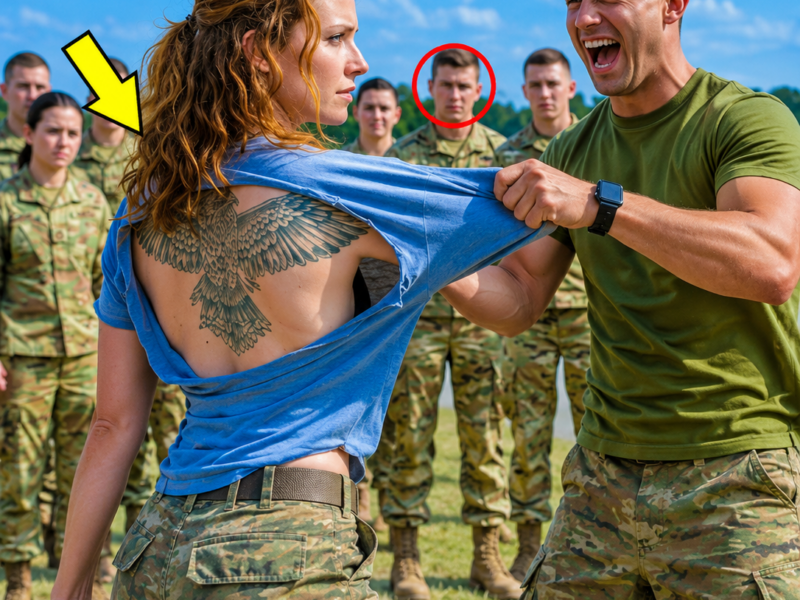
I Was a 29-Year-Old Captain at a NATO Training Camp When a Colonel Ordered a Soldier to Rip My Shirt in Front of 60 Officers, Exposing the Massive Hawk Tattoo on My Back. “What Are You Supposed to Be, Some Kind of Secret Assassin?” They Laughed as I Stood Silently. But a Navy SEAL Commander Suddenly Went Pale and Whispered, “That Tattoo Shouldn’t Exist.” That Night, He Opened a Classified Military File—and What He Discovered About My Identity Made His Hands Tremble…
I Was a 29-Year-Old Captain at a NATO Training Camp When a Colonel Ordered a Soldier to Rip My Shirt in Front of 60 Officers, Exposing the Massive Hawk Tattoo on My Back. “What Are You Supposed to Be, Some Kind of Secret Assassin?” They Laughed as I Stood Silently. But a Navy SEAL Commander Suddenly Went Pale and Whispered, “That Tattoo Shouldn’t Exist.” That Night, He Opened a Classified Military File—and What He Discovered About My Identity Made His Hands Tremble…
PART 1
The morning Colonel Victor Hail ordered a soldier to rip my shirt off in front of sixty NATO officers, he thought he was teaching me a lesson about humiliation.
What he didn’t know was that the tattoo on my back belonged to a military unit that had officially been dead for seven years.
And the Navy SEAL commander standing at the back of the formation was about to recognize something that would make his blood run cold.
My name is Captain Laya Anders. I’m twenty-nine years old, five feet four inches tall, and according to my official military record, I’ve never seen a day of combat.
That last part was a lie.
But it was a lie I had spent years protecting.
The NATO training installation was located in a remote stretch of Central Europe, surrounded by pine forests and miles of restricted military territory. I’d arrived there four days earlier with a single duffel bag, a transfer order, and instructions to remain as unremarkable as possible.
My assignment was simple on paper: intelligence liaison officer.
Administrative coordination. Supply reports. Communication between allied units.
Nothing dangerous.
Nothing important.
Exactly the kind of assignment that made experienced combat officers look straight through you.
Colonel Hail had taken an immediate dislike to me.
He was a broad-shouldered man in his early fifties, with silver hair, a permanently reddened face, and the particular arrogance of someone who had spent too many years confusing rank with respect.
During my first briefing, he’d looked at my personnel file for approximately twelve seconds before tossing it onto his desk.
“Another intelligence specialist,” he’d said. “Tell me, Captain, have you ever actually held a rifle outside a qualification range?”
“Yes, sir.”
He’d laughed.
“Wonderful. Perhaps we’ll let you supervise the staplers.”
I’d smiled politely.
That seemed to irritate him even more.
By Friday morning, he’d decided to make an example of me.
We were standing in formation at 0545, waiting for the day’s assignments. The temperature hovered just above freezing. Moisture hung in the air, and our breath rose in pale clouds.
I was wearing standard gray physical training clothes.
There was a small grease stain near the bottom of my shirt, probably from helping the maintenance crew move equipment the previous evening.
Hail spotted it immediately.
“Captain Anders!”
I stepped forward.
“Sir.”
He descended from the platform with deliberate slowness.
“Would you care to explain why you look like you’ve been sleeping beneath a truck?”
“Maintenance assistance yesterday evening, sir.”
“Did I ask for excuses?”
“No, sir.”
He turned toward the formation.
“This is what happens when we allow people who have never earned their place in a military environment to pretend they belong.”
A few soldiers chuckled.
I kept my eyes forward.
He walked around me, examining my uniform as though searching for additional imperfections.
“Perhaps we should inspect the rest of your clothing. Make certain you’re capable of following at least one basic regulation.”
He raised his voice.
“Corporal Briggs!”
Jake Briggs stepped out of formation.
He was enormous, nearly six feet five, with the build of a professional linebacker and the confidence of a man who had never been challenged by someone smaller than himself.
“Sir!”
“Inspect the captain’s undershirt.”
There was a moment of uncertainty.
Briggs glanced at me.
Then at Hail.
“Sir?”
“You heard me.”
I knew what was coming before Briggs moved.
I could have stopped him.
That was the part nobody understood.
I could have caught his wrist, turned his momentum against him, and put him on the concrete before he realized what had happened.
Instead, I remained still.
Because there were sixty witnesses.
Because Colonel Hail had just given an unlawful and degrading order.
And because sometimes the best way to expose a dangerous man is to let him believe he has complete control.
Briggs stepped behind me.
“Sorry, ma’am,” he muttered, sounding anything but sorry.
Then he grabbed the back of my collar.
And pulled.
The fabric split from my neckline almost to my waist.
A sharp tearing sound echoed across the parade ground.
Cold morning air touched my bare back.
Someone gasped.
Someone else laughed.
But within seconds, the laughter changed.
Because spread across my shoulder blades was a tattoo unlike anything most of those soldiers had ever seen.
A massive black hawk.
Its wings stretched from shoulder to shoulder, each feather rendered in intricate detail. Its talons curled beneath its body, and its eyes seemed to stare directly through anyone looking at it.
Beneath the left wing was a sequence of numbers.
Under the right, a short line of Latin.
And directly beneath the hawk’s chest were three tiny characters:
GH-7.
Hail stepped closer.
“Well, well.”
He tilted his head.
“Look what we’ve discovered.”
Briggs laughed.
“That’s a serious tattoo, Captain. What are you supposed to be, some kind of secret assassin?”
The formation erupted.
Hail joined them.
“I suppose watching too many military movies can create unrealistic expectations.”
I stared straight ahead.
Four counts in.
Four counts out.
Four counts held.
The breathing method had kept me alive through things these men couldn’t imagine.
“Tell me, Captain,” Hail continued, “how much did that artwork cost? Or did you get a discount for pretending to be a special operator?”
More laughter.
I said nothing.
He leaned closer to examine the letters.
“Ghost Hawk? Is that what this is? Some imaginary elite unit?”
He laughed again.
Then something happened that I hadn’t expected.
Near the rear of the formation, a man stopped breathing for a moment.
Commander Adam Reed.
Thirty-one years old. Navy SEAL. Assigned as a liaison to the multinational training program.
He had been standing beside Sergeant Major Thomas Hayes, a veteran with thirty-two years of service.
Reed wasn’t laughing.
He was staring at my back.
Specifically, at the small markings beneath the hawk’s wings.
His expression changed.
First confusion.
Then recognition.
Then something close to fear.
Hayes noticed.
“Commander? You all right?”
Reed didn’t answer immediately.
He watched as Hail ordered me to leave and replace my damaged shirt.
I turned and walked toward the barracks.
Behind me, Briggs was still laughing.
But Reed remained motionless.
Finally, he whispered something Hayes barely heard.
“That tattoo shouldn’t exist.”
Inside the barracks bathroom, I stood in front of a cracked mirror.
My torn shirt hung loosely around my arms.
The hawk stared back at me.
I hadn’t looked at it for several weeks.
Sometimes I tried not to.
Because tattoos were supposed to represent memories.
Mine represented graves.
I reached into my pocket and removed a small metal challenge coin.
On one side was the same hawk.
On the other was a serial number.
GH07114.
I turned it slowly between my fingers.
Seven years earlier, five people had carried coins like this.
Three were dead.
One had disappeared.
And according to the official record, so had I.
I remembered the last time we’d stood together, beneath a burning desert sky, waiting for an extraction helicopter that never arrived.
I remembered gunfire.
The smell of fuel.
A voice screaming that our position had been compromised.
And Colonel Victor Hail’s authorization code appearing on the final withdrawal order.
I closed my fist around the coin.
“Not much longer,” I whispered.
Then I changed my shirt and returned to work.
For the rest of the morning, everyone treated me like a joke.
At breakfast, Lieutenant Derek Foster asked whether I needed permission to fly between buildings.
During the intelligence briefing, someone drew a cartoon hawk on the whiteboard with the words NATO’s newest mascot.
Even the junior officers joined in.
They assumed silence meant weakness.
They assumed I didn’t know what they were saying.
They had no idea I was memorizing every face, every conversation, and every connection to Hail’s inner circle.
That afternoon, Colonel Hail reviewed my personnel file again.
Captain Laya Anders.
Intelligence analyst.
Fort Bragg.
Ramstein Air Base.
No combat deployments.
No special operations qualifications.
No classified field assignments.
Nothing that should have worried him.
But apparently something did.
Because at 1630, he called Major Owen Cross into his office.
“I want her gone,” Hail said.
Cross hesitated.
“Sir, she’s only been here four days.”
“I don’t care. Put her through advanced tactical training. Make it difficult. Give her every opportunity to embarrass herself.”
“And if she passes?”
Hail’s expression hardened.
“Then make sure she doesn’t.”
Neither man knew that their conversation would eventually become evidence.
Or that someone had already started investigating the financial records connected to Hail’s command.
That evening, Commander Reed sat alone in his quarters, staring at a photograph he’d recovered from an old classified archive.
The image was blurry.
Five operators stood beside a damaged armored vehicle somewhere in Syria.
Their faces had been obscured.
But the woman in the center had turned slightly away from the camera.
Just enough to reveal part of a tattoo beneath her collar.
A black wing.
Reed enlarged the image.
His hands began to shake.
Because he recognized that wing.
And suddenly he remembered a burning vehicle, a shattered windshield, and a woman’s voice telling him to keep breathing.
Four counts in.
Four counts out.
He hadn’t heard that voice in eight years.
And the woman who had saved his life was supposed to have died in 2019.
Reed opened the classified database.
He searched for Ghost Hawk.
Most of the records were sealed.
But one line appeared.
OPERATOR GH-7: NIGHTINGALE SEVEN. STATUS: KILLED IN ACTION. APRIL 2019.
He stared at the screen.
Then slowly looked toward the window.
Somewhere across the camp, I was sitting alone in the mess hall, eating dinner.
He didn’t know whether I was a survivor, an impostor, or part of something far more dangerous.
But he knew one thing.
The dead woman from the classified photograph had just walked into his training camp.
And Colonel Hail had publicly humiliated her.
PART 2
The next morning, Colonel Hail assigned me to an advanced close-quarters combat exercise.
He smiled when he announced it.
“Let’s see whether Captain Anders can do something besides decorate herself.”
At the training range, my equipment was waiting.
An outdated rifle.
A tactical vest two sizes too large.
A malfunctioning communication earpiece.
I inspected everything without complaint.
Staff Sergeant Travis Cole approached me.
“Captain, this course is designed for experienced operators. There’s no shame in stepping aside.”
“I’ll manage.”
He looked unconvinced.
The exercise began.
Three rooms.
Multiple hostile targets.
Several simulated hostages.
My teammates entered first.
Within seconds, I noticed mistakes they hadn’t recognized.
Poor positioning.
Blocked sightlines.
A concealed target nobody had seen.
I moved.
One controlled shot.
The hidden threat dropped.
In the final room, two more targets appeared behind simulated hostages.
I changed position, lowered my stance, and fired.
Both threats fell.
No hostages hit.
The buzzer sounded.
“Exercise complete. Forty-seven seconds.”
Silence filled the observation booth.
Then the range officer spoke again.
“New facility record.”
Cole stared at me.
“Where did you learn to shoot like that?”
“Practice.”
I returned my rifle.
Commander Reed watched the recording three times.
Sergeant Major Hayes stood beside him.
“That’s not the movement of an intelligence analyst,” Hayes murmured.
Reed shook his head.
“No.”
He froze the footage on my face.
“That’s the movement of someone who survived Ghost Hawk.”
Then his phone rang.
An unfamiliar voice spoke.
“Commander Reed, stop searching for Nightingale Seven.”
Reed went rigid.
“Who is this?”
The caller ignored him.
“If she’s alive, someone inside your camp is already trying to kill her.”
The connection ended.
PART 3
I learned about the phone call that evening, although Commander Reed never told me about it.
That was one of the advantages of being underestimated.
People assumed I wasn’t paying attention.
They spoke freely around me, discussed sensitive matters within earshot, and left documents unattended because they believed I lacked the experience to understand what I was seeing.
But I had spent almost a decade learning to recognize patterns.
And the pattern developing around Colonel Hail was becoming increasingly clear.
After my performance at the range, he grew nervous.
I noticed it during the following morning’s briefing.
His usual arrogance remained, but there was something new beneath it.
Impatience.
He kept checking his phone.
Twice, he interrupted the meeting to speak privately with Major Cross.
And when our eyes briefly met, he looked away first.
I knew that look.
I’d seen it on men who realized their carefully constructed lies were beginning to unravel.
The next incident happened shortly before noon.
Private Daniel Lee, a twenty-year-old soldier from Ohio, was participating in an obstacle course assessment.
He was enthusiastic, inexperienced, and determined to impress his instructors.
The climbing wall was twelve feet high.
He almost reached the top.
Then his left hand slipped.
I heard his scream before I saw him fall.
He landed awkwardly on the gravel, his leg folding beneath him.
The sound was unmistakable.
A fracture.
A bad one.
I was thirty yards away when the other trainees began shouting for help.
By the time I reached him, blood was soaking through his trousers.
His lower leg was visibly deformed.
His face had turned pale.
“I’m going to die,” he kept saying. “Oh God, I’m going to die.”
I dropped to my knees beside him.
“Daniel. Look at me.”
His eyes found mine.
“You’re not dying today.”
“My leg—”
“I know. I’m going to help you. But I need you to breathe.”
I demonstrated.
“Four counts in. Four counts out.”
His breathing was ragged at first.
Then gradually steadier.
I pulled my emergency medical pouch from my cargo pocket.
Gloves.
Trauma dressing.
Compression bandages.
Splinting materials.
I’d carried a similar kit since Syria.
Some habits don’t disappear simply because your official records say you’ve never needed them.
I assessed the bleeding, applied direct pressure, secured the dressing, and stabilized his injured leg while another soldier contacted medical personnel.
Lee gripped my sleeve.
“Please don’t leave me.”
I looked directly into his eyes.
“I won’t.”
The words escaped before I could stop them.
Because I’d said them before.
To men who survived.
And to men who didn’t.
Seven minutes later, the evacuation helicopter landed.
The medical team took over.
The lead paramedic examined the stabilization and looked at me sharply.
“Who did this?”
“I did.”
“What’s your medical specialty?”
“Intelligence.”
He frowned.
“You’re telling me an intelligence officer performed this?”
“Is the patient stable?”
“Yes. Because you controlled the bleeding before we arrived.”
“Then get him to surgery.”
He hesitated.
“Captain, where were you trained?”
I didn’t answer.
I watched the helicopter rise into the gray sky.
Then I returned to my assigned work.
By that evening, the entire camp knew.
The woman Colonel Hail had mocked for being useless had broken the range record and helped save a young soldier from a potentially life-threatening injury.
Some people began treating me differently.
Others became angrier.
Lieutenant Foster insisted my shooting performance had been staged.
Briggs claimed I must have received special training that hadn’t been listed in the exercise documentation.
But Sergeant Major Hayes wasn’t interested in gossip.
He was interested in evidence.
That night, he met Reed in a secure communications room.
Reed had printed several pages from the historical Ghost Hawk file.
Most of the information remained classified, even at his clearance level.
But he’d uncovered enough to confirm that the unit had existed.
Ghost Hawk had been a covert intelligence cell operating in Syria and Iraq between 2017 and 2019.
Five core operators.
High-risk reconnaissance.
Signals intelligence.
Recovery of captured personnel.
Operations so sensitive that most personnel serving nearby never knew the unit existed.
The files ended abruptly in April 2019.
Mission canceled.
Extraction compromised.
Three confirmed dead.
Two presumed dead.
One of those presumed casualties was Nightingale Seven.
Me.
Hayes studied the report.
“Why were they abandoned?”
“Officially, compromised intelligence.”
“Unofficially?”
Reed turned another page.
“The extraction order came directly from Victor Hail.”
Hayes looked up.
“Our Colonel Hail?”
“Same man.”
A long silence followed.
Reed continued.
“Ghost Hawk was preparing to intercept an international arms broker named Constantine Volkov. The operation had been underway for eight months. Then, forty-eight hours before the arrest, Hail canceled everything.”
“Maybe he had good reason.”
“Maybe.”
Reed slid a second document across the table.
“But three weeks after the cancellation, Volkov’s organization moved twelve million dollars through a network of shell companies. Several later turned out to be connected to corrupt military contractors.”
Hayes leaned back.
“And you think Hail was involved?”
“I think somebody warned Volkov.”
“Can you prove it?”
“Not yet.”
Neither man noticed that a small green indicator had appeared on the security console.
Someone else had accessed the same historical records.
Someone using a credential that hadn’t been active in seven years.
GH-7.
Meanwhile, Colonel Hail was growing desperate.
The following morning, I received an urgent assignment to the communications center.
Specialist Vega, the camp’s cryptographer, had been hospitalized with severe food poisoning.
An encrypted transmission from a forward operating unit in Poland required immediate processing.
Without it, a multinational drone exercise would be canceled.
Hail stood beside the communications terminal when I arrived.
“Captain Anders, since you seem determined to impress everyone, perhaps you’d like another opportunity.”
He pointed toward the encrypted message.
“You have twenty minutes.”
Foster stood nearby, smiling.
Several technicians gathered behind him.
I examined the display.
At first glance, the message appeared to contain random blocks of letters and numbers.
But something about the formatting was familiar.
Very familiar.
I sat down.
“May I have paper?”
Foster laughed.
“Planning to write the answer by hand?”
“Yes.”
He stopped laughing when I began working.
The cipher wasn’t a standard NATO training encryption format.
It was an older field system using a rotating key and a timestamp-dependent substitution pattern.
I’d encountered the same family of systems years earlier.
Under much less comfortable circumstances.
I worked through the message, identified the key sequence, and entered the result into the authorized decoding terminal.
The screen cleared.
Coordinates appeared.
Mission parameters followed.
The message had been authenticated successfully.
The room went quiet.
One technician stared at the clock.
“Eleven minutes, forty-two seconds.”
Foster looked at me.
“How did you know the encryption method?”
“Recognized the structure.”
“From where?”
“Previous experience.”
I placed my notes on the desk and stood.
“Transmit the coordinates.”
Then I left.
But I’d made a mistake.
A small one.
At the bottom of the page, without thinking, I’d written an old authentication notation.
NH-7.
Nightingale Seven.
Foster photographed the page.
He sent the image to Hayes with a mocking caption.
Our mystery captain has her own secret code now.
Hayes recognized it immediately.
He forwarded the photograph to Reed.
Ten minutes later, Reed was on the telephone with a classified operations officer.
“Commander,” the officer said, “where did you obtain that notation?”
“From an intelligence officer assigned to our NATO training installation.”
“Name?”
“Captain Laya Anders.”
There was silence.
Then the officer spoke again.
“Commander, do not discuss this conversation with anyone. Do not confront Captain Anders. And under no circumstances allow Colonel Hail to transfer her off the installation.”
“Why?”
The officer’s reply was barely above a whisper.
“Because if that’s really Nightingale Seven, she’s not there by accident.”
At the same time, I was sitting alone in the barracks, examining a photograph on my encrypted laptop.
It showed five people standing in front of a desert helicopter.
We were younger then.
Smiling.
We still believed that everyone wearing the same uniform was fighting for the same cause.
I touched the faces one by one.
Marcus.
Eli.
Jonah.
Three names that would never appear in any public memorial.
Three men whose families had been told almost nothing about how they died.
I stopped at the fifth figure.
My former team leader.
The only other person whose body had never been recovered.
Daniel Mercer.
His official status was identical to mine.
Presumed dead.
But six weeks earlier, I’d received an anonymous message containing a phrase only Mercer would have known.
The fourth tower never fell.
The message had included financial records linking Hail to Volkov’s network.
It was the reason I’d accepted this assignment.
I’d spent years believing Mercer had died in Syria.
Now I wasn’t certain.
And if he was alive, I needed to know whether he was helping me.
Or setting a trap.
I closed the laptop when footsteps approached.
Major Cross knocked.
“Captain Anders, Colonel Hail wants to see you.”
I slipped the challenge coin into my pocket.
“Of course.”
Cross looked unusually tense as we walked toward headquarters.
When we entered Hail’s office, the colonel was standing beside the window.
He didn’t invite me to sit.
“Captain, I’ve reviewed your recent activities.”
“Yes, sir.”
“Your shooting performance. The medical incident. The cryptography assignment.”
He turned toward me.
“You’re creating unnecessary attention.”
“By completing assigned duties?”
His jaw tightened.
“Don’t get clever with me.”
I remained silent.
He moved behind his desk.
“I’ve decided you’re not suited for this installation.”
Cross glanced at him nervously.
Hail continued.
“Tomorrow morning, you’ll participate in a final tactical extraction evaluation. If you fail, I will recommend immediate reassignment.”
“And if I pass, sir?”
He smiled.
“Then perhaps I’ll reconsider.”
I nodded.
“Understood.”
As I reached the door, he spoke again.
“One more thing, Captain.”
I turned.
“That tattoo of yours.”
My expression remained neutral.
“What about it, sir?”
He stared at me for several seconds.
Then asked a question that made every muscle in my body go still.
“Where exactly were you in April 2019?”
I kept my face blank.
“According to my records, sir, I was assigned to Ramstein.”
He stepped closer.
“Yes. According to your records.”
For the first time since arriving at the camp, I saw genuine fear behind his eyes.
And I understood.
He didn’t know everything.
But he suspected enough.
That evening, I received a message on my secondary radio.
Three words.
NIGHTFALL AUTHORIZATION CONFIRMED.
The operation I’d spent seven years waiting for had finally entered its last stage.
But before I could respond, another message appeared.
This one came from an unknown source.
DON’T TRUST THE EXTRACTION TEAM.
Beneath it was a photograph.
Five operators standing in Syria.
Our old team.
Someone had drawn a red circle around Daniel Mercer’s face.
And beneath the circle was a single sentence.
HE NEVER DIED.
PART 4
At 0430 the following morning, I woke before my alarm.
I hadn’t slept much.
The photograph of Mercer had stayed in my mind all night.
For seven years, I’d imagined his final moments.
I’d wondered whether he’d suffered, whether he’d understood why the extraction never came, and whether he blamed me for surviving.
Now there was a possibility that he’d been alive the entire time.
And that possibility frightened me more than anything Colonel Hail could do.
I dressed quietly.
Combat trousers.
Tactical shirt.
Body armor.
Communication equipment.
Then I removed the challenge coin from beneath my pillow.
For a moment, I thought about leaving it behind.
Instead, I slipped it into my pocket.
Some ghosts deserve to travel with you.
The extraction exercise began at 0600.
Our team consisted of five people.
Corporal Briggs was team leader.
Miles Chen handled communications.
Specialist Torres and Private First Class Novak provided support.
And I was assigned rear security.
Briggs examined the mission map.
“Simple operation,” he announced. “We enter the warehouse, secure the simulated high-value target, and extract. Fifteen minutes maximum.”
I studied the map.
Something bothered me.
The warehouse had been modified for training, but the map looked outdated.
Several internal structures were missing.
I pointed toward a corridor.
“What’s here?”
Briggs barely glanced at it.
“Storage.”
“Are you certain?”
He sighed.
“Captain, I’ve done dozens of these exercises.”
“Then you’ll understand why I’m asking.”
He stared at me.
For a moment, I expected another insult.
Instead, he looked down at the map.
“We’ll adjust if necessary.”
It wasn’t an apology.
But it was progress.
We approached the warehouse shortly after sunrise.
The building stood at the edge of the installation, surrounded by abandoned storage containers and reinforced concrete barriers.
A cold wind carried dust across the open ground.
Briggs raised his hand.
Three.
Two.
One.
The training door opened.
We entered.
Immediately, I knew something was wrong.
The first corridor didn’t match the briefing.
A secondary hallway extended toward the north wall.
And the staircase marked on the map had been relocated.
I spoke quietly.
“Layout’s different.”
Briggs nodded.
“I see it.”
We continued.
The first room was empty.
The second contained two opposing-force role players.
Chen and Torres engaged them with simulation ammunition.
Both targets went down.
Then six additional role players appeared from a connecting hallway.
Briggs cursed.
“That’s not the scenario.”
Paint-marking rounds struck the walls around us.
Torres was marked out of the exercise.
Then Novak.
Chen reported that his ammunition was exhausted.
Briggs took a marking round to his shoulder.
Within seconds, our team was trapped.
The scenario had been altered.
Not slightly.
Deliberately.
I checked our primary radio.
Static.
I tried again.
Nothing.
The training communications channel was being interfered with.
Briggs looked at me.
“Captain, we’re finished. We need to stop the exercise.”
I nodded.
“Agreed. Call the safety termination.”
He attempted to transmit.
No response.
I looked toward the corridor.
The role players were continuing their advance despite our attempts to halt the drill.
That was when I noticed one man standing apart from the others.
He wasn’t wearing standard opposing-force identification.
He was watching me.
Not the team.
Me.
I recognized the posture.
The careful stillness.
The way his head tilted slightly when I moved.
For one impossible second, I thought it was Mercer.
Then he disappeared through a side doorway.
My pulse quickened.
I reached beneath my vest and removed my secondary encrypted radio.
Briggs stared.
“Where did you get that?”
I ignored him.
“Nightingale Seven to Overwatch. Exercise compromised. Request immediate containment and recovery.”
For several seconds, there was nothing.
Then a familiar voice answered.
“Nightingale Seven, authentication required.”
I gave the code.
“Tango. Hotel. November.”
A pause.
“Authenticated. Response team moving.”
Briggs looked at me as though he’d never seen me before.
“What the hell is happening?”
I met his eyes.
“Stand down. Keep everyone together. Nobody fires unless there’s an immediate threat.”
My voice sounded different.
I knew it did.
I was no longer pretending to be an inexperienced desk officer.
I was giving orders in the same tone I’d used during real operations.
And Briggs obeyed.
Ninety seconds later, the warehouse doors opened.
Four heavily equipped security operators entered.
Their leader identified himself to the exercise controller and ordered the drill stopped.
The remaining role players lowered their training weapons.
Within minutes, the warehouse was secured.
The simulated hostage was recovered.
And the unauthorized modifications to the exercise were documented.
But the unidentified man I’d seen in the hallway was gone.
I searched the adjoining rooms.
Nothing.
No uniform.
No identification.
No sign he’d ever been there.
Except for a small object lying beside the northern exit.
A metal coin.
Identical to mine.
I picked it up.
The reverse side carried a different serial number.
GH07115.
My breath caught.
Mercer’s coin.
He had been there.
Or someone wanted me to believe he had.
I closed my fist around it.
For the first time in years, my hands were shaking.
Back at headquarters, Commander Reed was watching the warehouse footage when General Patricia Callaway arrived.
She was a senior officer attached to special operations oversight.
Her presence meant the situation had moved far beyond routine training matters.
Colonel Hail was summoned immediately.
He entered the command center furious.
“Why am I being interrupted? I have an evaluation to supervise.”
Callaway didn’t offer him a chair.
“Colonel, we need to discuss Captain Anders.”
He folded his arms.
“What about her?”
“Are you familiar with Operation Ghost Hawk?”
His expression changed.
Only slightly.
But enough.
“That operation was discontinued years ago.”
“Aborted,” Callaway corrected. “Not discontinued.”
Hail looked toward Reed.
“What’s this about?”
Reed activated the main screen.
My image appeared.
The footage showed me removing my encrypted radio and identifying myself as Nightingale Seven.
Hail went pale.
For several seconds, he said nothing.
Then he whispered, “That’s impossible.”
Callaway stepped forward.
“Why?”
Hail swallowed.
“Because that operator died in Syria.”
“Did she?”
His eyes moved toward the door.
Callaway continued.
“April 2019. Ghost Hawk was preparing to intercept Constantine Volkov. You authorized the cancellation of the operation.”
“Intelligence was compromised.”
“Where is the supporting evidence?”
“Classified sources.”
“Which sources?”
He hesitated.
“General, this is highly irregular.”
“So was the disappearance of five covert operators.”
Reed displayed another document.
“Two days before the cancellation, a shell company connected to your family received a two-hundred-thousand-dollar transfer.”
Hail’s face reddened.
“I have no knowledge of that.”
“The company was registered using your wife’s maiden name.”
“Coincidence.”
Hayes placed a second report on the table.
“Three other officers received similar payments from organizations connected to Volkov. All three were later convicted of corruption.”
Hail stared at the documents.
“You cannot prove anything.”
Callaway remained calm.
“Perhaps not from those transactions alone.”
Then she pressed a button.
A recording played.
Hail’s voice filled the room.
“Captain Anders needs to go. I don’t care what you have to do. Make her fail. Make her request reassignment.”
Major Cross’s voice followed.
“Sir, why are you so concerned about her?”
Then Hail again.
“Because if she stays here, people will start asking questions.”
The recording ended.
No one spoke.
Callaway looked directly at Hail.
“Colonel Victor Hail, you are relieved of command pending investigation.”
He stepped backward.
“This is absurd.”
Two military police officers entered.
“You’re making a mistake,” he said.
Callaway’s expression didn’t change.
“No, Colonel. The mistake was believing the truth would remain buried forever.”
Hail was escorted from the room.
But as he reached the doorway, he suddenly turned.
“You’re all fools.”
Reed frowned.
“What?”
Hail laughed bitterly.
“You think I was the one who betrayed Ghost Hawk?”
Callaway raised her hand, stopping the military police.
“Explain yourself.”
Hail looked toward the monitor displaying my face.
“You have no idea what happened in Syria.”
“Then tell us.”
His smile disappeared.
“Ask your precious Nightingale Seven who gave me the original coordinates.”
A terrible silence followed.
Then he spoke the words that would change everything.
“Ask her why Daniel Mercer was paid to disappear.”
At that exact moment, I was standing outside the warehouse, holding Mercer’s challenge coin.
My radio crackled.
A voice I hadn’t heard in seven years spoke through the encrypted channel.
“Laya.”
I froze.
“Mercer?”
A long pause.
Then he said quietly:
“Don’t believe Hail. He’s only telling you half the truth.”
I closed my eyes.
“Where are you?”
“Close.”
“Why did you disappear?”
His next words made my stomach turn.
“Because the man who betrayed us is still giving orders.”
Then the connection died.
PART 5
For several seconds, I stood completely still.
The radio was silent.
The wind moved through the empty training yard, carrying the distant sounds of engines and shouted commands.
But all I could hear was Mercer’s voice.
Seven years.
Seven years of mourning someone who had apparently been alive.
Seven years of wondering whether I could have saved him.
And now he’d spoken to me as though we’d only been separated for a few hours.
I tried the encrypted channel again.
“Mercer, respond.”
Nothing.
I repeated the call.
Still nothing.
Then Commander Reed appeared beside the warehouse.
He took one look at my face and stopped.
“Laya?”
I turned toward him.
“He’s alive.”
Reed frowned.
“Who?”
“Daniel Mercer.”
His expression tightened.
“The missing Ghost Hawk operator?”
I opened my hand.
Mercer’s challenge coin rested against my palm.
Reed examined it.
“Where did you find that?”
“Inside the warehouse.”
He looked back toward the building.
“You’re telling me he was here?”
“I heard his voice.”
Reed remained silent for a moment.
Then he asked something I hadn’t expected.
“How do you know it was him?”
I looked up.
“What?”
“Seven years, Laya. Voice recordings can be manipulated. Communications can be intercepted. Someone could be trying to make you believe he’s alive.”
I wanted to reject the possibility.
But he was right.
And that was what frightened me.
Because the voice had sounded exactly like Mercer.
Not just the tone.
The pauses.
The careful way he said my name.
The same voice that had once told me to keep moving through a burning village while enemy gunfire tore apart the walls around us.
I slipped the coin back into my pocket.
“We need to examine the warehouse footage.”
Reed nodded.
“Callaway is already investigating. Hail has been detained.”
I looked toward headquarters.
“Did he confess?”
“Not exactly.”
Something in Reed’s voice bothered me.
“What did he say?”
Reed hesitated.
Then told me.
Mercer.
Coordinates.
Payments.
The suggestion that my former team leader had been involved in the betrayal.
I felt something cold settle in my chest.
“No.”
“Laya—”
“No. Mercer wouldn’t do that.”
Reed didn’t argue.
And somehow, his silence hurt more than disagreement.
We walked toward the command center.
By the time we arrived, General Callaway had assembled a small investigative team.
Sergeant Major Hayes stood near the main display.
Major Cross sat at a separate table, looking pale and exhausted.
Corporal Briggs and Lieutenant Foster were waiting outside.
No one laughed when I entered.
No one mentioned my tattoo.
Callaway motioned toward a chair.
“Captain Anders, we need your full cooperation.”
“You have it.”
She studied me.
“I understand you’ve had contact with Daniel Mercer.”
“Yes, ma’am.”
“Direct contact?”
“Radio transmission. Less than thirty seconds.”
“Can you confirm his identity?”
I paused.
“No.”
It was the hardest word I’d spoken all day.
Callaway nodded.
“Good. Then we’ll treat his identity as unverified until we have evidence.”
She turned toward the display.
The warehouse security recordings appeared.
For nearly an hour, we reviewed every camera.
Every entrance.
Every corridor.
Every person who entered the facility that morning.
At 0614, Hayes stopped the footage.
“There.”
A man wearing standard tactical training equipment crossed the northern hallway.
His face was hidden behind protective gear.
But something about his movement caught my attention.
He favored his right leg.
Only slightly.
An old injury.
Mercer had suffered a severe knee injury during our first operation in Syria.
He’d recovered enough to remain operational, but he never completely lost the limp.
“Rewind,” I said.
Hayes complied.
The man crossed the hallway again.
The same movement.
The same slight imbalance.
I leaned forward.
“That’s him.”
Reed watched carefully.
“Maybe.”
Then the figure turned toward a security camera.
He raised two fingers briefly to his chest.
A signal.
An old Ghost Hawk acknowledgment.
My throat tightened.
“That’s him.”
Callaway ordered the man’s movements traced through the facility.
The footage showed him entering through a maintenance corridor using an authorized temporary credential.
The credential belonged to a contractor who had supposedly left the installation three weeks earlier.
At 0619, the man disappeared through an emergency exit.
Outside cameras captured a dark vehicle leaving a restricted service road.
The license plates had been obscured.
But the vehicle’s electronic access authorization remained in the security system.
It was registered to a logistics contractor based at Ramstein Air Base.
The same installation where I’d been posted years earlier.
Callaway stared at the information.
“Ramstein.”
I nodded slowly.
“That’s where the money went.”
She looked at me.
“What money?”
I opened my encrypted laptop.
For the first time since arriving at the camp, I displayed the files I’d been collecting.
Financial transfers.
Contracting records.
Supply discrepancies.
Names of officers who had approved questionable logistics shipments between 2018 and 2026.
The two-hundred-thousand-dollar payment to Hail was only one transaction.
A relatively small one.
The network had moved millions.
Money that should have purchased medical supplies, protective equipment, and operational support had been redirected through fraudulent contracts.
Some shipments had never arrived.
Others had contained substandard equipment.
And certain transportation records appeared to have been shared with organizations connected to Volkov.
Callaway examined the screen.
“How long have you been investigating this?”
“Seven years.”
She looked up sharply.
“Explain.”
I folded my hands on the table.
“In April 2019, Ghost Hawk was ordered to prepare an interception operation against Constantine Volkov. We’d spent eight months developing intelligence on his network.”
I paused.
“We were close.”
The room was completely silent.
“Forty-eight hours before the operation, our extraction support was canceled. Our command channels were disrupted. Someone transmitted our position to hostile forces.”
I could still remember the sound of the first explosion.
Marcus had been standing beside our vehicle.
He never reached cover.
Eli was hit during the retreat.
Jonah stayed behind to help him.
Neither came back.
Mercer and I separated while trying to reach an alternate extraction point.
I survived by reaching a concealed safe house.
For eleven days, I had no communication with friendly forces.
When a recovery team finally located me, I learned that my entire unit had been declared dead.
Including me.
I looked at Callaway.
“An investigator offered me a choice. Return to service publicly and accept that the investigation was closed, or remain officially dead while an authorized team continued examining the betrayal.”
“And you chose the investigation.”
“Yes.”
“Why?”
I thought about Marcus’s wife.
About Eli’s little daughter.
About Jonah’s father, who had once told me his son believed serving his country was the greatest honor of his life.
“Because three men deserved better than a classified paragraph saying their deaths were unfortunate.”
Callaway lowered her eyes.
For a moment, nobody spoke.
Then Hayes asked quietly:
“What about Mercer?”
I looked at the photograph on the screen.
“I thought he’d died.”
“Could he have betrayed your unit?”
I wanted to say no.
Immediately.
Without hesitation.
But I’d spent years learning that loyalty without evidence could become another kind of blindness.
“I don’t know,” I admitted.
That evening, the investigation took an unexpected turn.
Major Cross requested a private interview.
He had been working under Colonel Hail for almost four years.
Until that morning, I’d believed he was simply an administrator who preferred paperwork to confrontation.
But when he entered the interview room, he carried a sealed envelope.
“I need protection,” he said.
Callaway folded her arms.
“From whom?”
Cross swallowed.
“Everyone involved.”
He placed the envelope on the table.
Inside were printed records, encrypted correspondence summaries, and copies of several financial authorizations.
Cross explained that Hail had been receiving payments from intermediary companies for years.
At first, he’d believed they were legitimate consulting arrangements.
Then he’d noticed unusual patterns.
Payments appearing shortly before sensitive operational decisions.
Personnel transfers that benefited specific contractors.
Security restrictions being removed without explanation.
When he questioned Hail, he’d been threatened with professional ruin.
“So you helped him target Captain Anders?” Callaway asked.
Cross lowered his head.
“Yes.”
“Why?”
“Because I was afraid.”
I watched him carefully.
“And you thought making someone else suffer would protect you?”
He didn’t answer.
I leaned forward.
“Major, fear explains a decision. It doesn’t excuse it.”
His eyes filled with tears.
“I know.”
He pushed the envelope toward me.
“There’s something else.”
I opened it.
The final document was a transfer authorization dated April 2019.
The original destination had been concealed.
But the authentication signatures remained visible.
One belonged to Colonel Hail.
The second belonged to a senior logistics officer.
The third signature made my blood turn cold.
Daniel Mercer.
I stared at it.
For several seconds, I couldn’t speak.
Cross looked at me.
“Captain, I don’t know whether he authorized it voluntarily.”
I continued examining the document.
The timestamp was unusual.
The signature had been entered forty-three minutes after Mercer’s last confirmed radio contact with our command center.
Forty-three minutes after we’d reported coming under attack.
If Mercer had been captured or injured, someone could have used his credentials.
But if he’d signed it himself…
I couldn’t finish the thought.
Reed moved closer.
“Laya?”
I closed the file.
“We need to find him.”
Callaway agreed.
But before any search could begin, the communications officer entered the room carrying an urgent message.
A secure transmission had arrived.
It was addressed directly to me.
Not Captain Anders.
Not my official military identity.
Nightingale Seven.
The message contained an authentication phrase known only to the original Ghost Hawk team.
The fourth tower never fell.
Below it was a location at Ramstein Air Base.
An arrival window.
And a warning.
HAIL WAS A CUSTOMER. MERCER KNOWS THE SELLER.
I read the message twice.
Then a third time.
Callaway watched my expression.
“What does it mean?”
I looked toward the photograph of my former team.
“It means this isn’t over.”
She nodded.
“No. It isn’t.”
The following hours were filled with interviews, evidence preservation, and preparations for the next stage of the investigation.
Colonel Hail remained in custody.
His financial activities were placed under formal review.
Major Cross agreed to provide testimony.
Briggs and Foster were questioned about the harassment and attempts to sabotage my assignments.
Briggs requested permission to speak with me afterward.
I found him waiting outside the interview room.
For once, he wasn’t smiling.
“Captain Anders.”
“Corporal.”
He looked at the floor.
“I owe you an apology.”
I said nothing.
He swallowed.
“What I did on the parade ground was wrong. Hail ordered it, but I was the one who grabbed your shirt.”
“Yes,” I said.
He looked surprised by my answer.
I continued.
“You had a choice.”
“I know.”
“You could have refused.”
“I know.”
His voice broke slightly.
“I humiliated you because everyone else thought it was funny.”
I studied him.
“Do you still think it’s funny?”
“No, ma’am.”
“Then make certain you remember why.”
He nodded.
“I will.”
I started to leave.
Then he spoke again.
“Captain?”
I turned.
“Why didn’t you stop me? I’ve seen what you can do. You could have put me on the ground in two seconds.”
I considered the question.
“Because I needed to know who would follow an order they knew was wrong.”
He looked devastated.
I softened my voice.
“You can spend the rest of your career becoming a better soldier, Briggs. But that begins with understanding that obedience isn’t the same as integrity.”
He stood straighter.
“Yes, ma’am.”
Later that evening, Reed found me sitting outside the barracks.
The sky was darkening.
The installation had grown unusually quiet.
He sat beside me without speaking.
For several minutes, we watched the lights appear across the camp.
Then he said:
“I remember you.”
I looked at him.
“Syria?”
He nodded.
“2018. The convoy ambush.”
I felt the familiar ache of old memories.
“You were nineteen.”
“Yes.”
“Your vehicle overturned.”
He smiled faintly.
“You pulled me out.”
“I remember.”
“I never got to thank you.”
I looked toward the trees.
“You survived. That was enough.”
Reed shook his head.
“No. It wasn’t.”
He turned toward me.
“I remember being trapped. I couldn’t move. There was fire everywhere. I thought I was going to die.”
I said nothing.
“Then someone grabbed my vest. You kept telling me to breathe. Four counts in. Four counts out.”
He paused.
“I remembered that voice for eight years.”
My throat tightened.
“I didn’t know it was you until I heard you speaking to Private Lee.”
I looked down at my hands.
“You were just a kid.”
“I was a soldier.”
“You were both.”
He laughed quietly.
Then his expression grew serious.
“You’ve spent a long time carrying all of this alone.”
I didn’t answer.
He continued.
“Whatever happens with Mercer, whatever you find at Ramstein, you don’t have to do everything by yourself.”
For the first time in a long while, I felt something inside me loosen.
Not relief.
Not happiness.
Something smaller.
The possibility that I might eventually stop surviving long enough to begin living again.
“Thank you, Adam,” I said.
He smiled.
It was the first time I’d used his first name.
We sat together until the camp lights came fully alive.
Later that night, I returned to my quarters.
My bag was already packed.
I placed the two Ghost Hawk challenge coins on the desk.
Mine.
And Mercer’s.
For seven years, I’d carried one coin as a reminder of everyone we’d lost.
Now there were two.
One represented the past.
The other represented a question I was afraid to answer.
At 2307, my laptop received another encrypted message.
This time, there was no introduction.
No mission title.
Only a photograph.
It showed a room filled with military communications equipment.
A man stood near the center, facing away from the camera.
His right leg was slightly bent.
Beneath his sleeve, I could see the edge of a familiar tattoo.
A black hawk.
The photograph was timestamped less than an hour earlier.
Ramstein Air Base.
Below it was a message.
Laya, I didn’t betray them. I stayed alive because someone had to finish what we started.
My hands trembled as I continued reading.
The man who ordered our deaths is still in command. Hail was never the mastermind.
A second image loaded.
This one showed a senior officer standing beside Constantine Volkov at a private gathering.
The man’s face was partially obscured.
But the insignia on his uniform was unmistakable.
The investigation had reached someone far more powerful than Hail.
Someone with access to classified operations.
Someone who could manipulate military records, redirect extraction teams, and erase entire units.
I stared at the image.
Then my phone rang.
Unknown number.
I answered.
For a moment, there was only breathing.
Then Mercer spoke.
“Laya.”
My heart pounded.
“I’m listening.”
“Do you remember what I told you before our last operation?”
I closed my eyes.
“That we always bring our people home.”
“That’s right.”
His voice trembled.
“I’m sorry I couldn’t bring the others home.”
I felt tears rising.
“Daniel, where are you?”
“Ramstein.”
“Why didn’t you contact me sooner?”
“Because I didn’t know who had survived. And when I learned you were alive, I couldn’t risk leading them to you.”
I gripped the phone.
“Who are they?”
There was a long silence.
Then he answered.
“The people we’ve been hunting.”
“Who is giving the orders?”
He took a breath.
“Laya, listen carefully. The photograph I sent you is only part of the evidence. I have the original transaction records, the communications logs, and the authorization that proves the extraction was deliberately canceled.”
“Then give them to Callaway.”
“I can’t.”
“Why?”
“Because the person who authorized the operation against us has access to her command network.”
My chest tightened.
“Daniel…”
“There’s something else.”
I waited.
“You need to know what happened after you escaped.”
I pressed the phone closer.
“What happened?”
His voice became almost inaudible.
“They captured me. They offered me a choice. Work for them, or watch them find you.”
I stopped breathing.
“I made them believe I’d changed sides.”
“Did you?”
“No.”
A pause.
“But I’ve done things to stay close enough to expose them. Things I’m not proud of.”
I looked toward his challenge coin.
“Why are you telling me this now?”
“Because they’re moving the evidence tomorrow. Once it leaves Ramstein, we’ll never recover it.”
I straightened.
“Then we stop them.”
“Laya, there’s one thing you must promise me.”
“What?”
“Don’t come looking for me unless Callaway authorizes it. I don’t want you risking your life because you think you owe me.”
I swallowed.
“I don’t owe you, Daniel.”
“Then why are you still fighting?”
I looked at the names engraved along the edge of my coin.
Marcus.
Eli.
Jonah.
“Because they can’t.”
For several seconds, neither of us spoke.
Then Mercer whispered:
“I knew you’d say that.”
The connection ended.
At 0430, I left the barracks.
The camp was still asleep.
My bag rested against my shoulder.
I walked toward the waiting vehicle, where Commander Reed stood beside General Callaway.
Neither looked surprised.
Callaway handed me a sealed folder.
“Captain Anders, your next assignment has been authorized. You’ll have an investigative support team. No unauthorized action. No unnecessary risks.”
I accepted the folder.
“Understood, ma’am.”
Reed opened the vehicle door.
“Ready?”
I looked back toward the installation.
A few days earlier, sixty people had stood on that parade ground laughing while a colonel tried to humiliate me.
They’d seen a small woman with a strange tattoo and decided she was weak.
They hadn’t known the tattoo represented a unit that had been betrayed.
They hadn’t known that every mark beneath its wings carried a memory.
And they certainly hadn’t known that the woman standing silently before them was collecting evidence against the man who believed he controlled her future.
I thought about Briggs.
About Private Lee.
About Hayes.
About the people who had finally chosen to question what they’d been told.
Then I thought about the three men buried somewhere beneath the dust of Syria.
I’d spent seven years searching for answers.
Colonel Hail’s arrest was a beginning.
Not an ending.
I climbed into the vehicle.
As we passed through the installation gates, the first light of dawn appeared over the horizon.
I reached into my pocket and touched the two challenge coins.
For the first time, I wasn’t carrying the past alone.
But as we approached the airfield, the secure tablet beside me illuminated.
A new message appeared.
OPERATION NIGHTFALL — PHASE TWO ACTIVE.
Beneath it was a live security photograph from Ramstein.
Daniel Mercer stood in a room surrounded by armed men.
And facing him was the senior officer from the photograph.
The man who had apparently ordered Ghost Hawk’s destruction.
I enlarged the image.
His face came into focus.
My blood turned cold.
Because I recognized him.
Not from Syria.
Not from the classified records.
But from the NATO camp.
He’d been there on my first morning.
Standing quietly behind Colonel Hail while everyone laughed at my exposed tattoo.
He hadn’t laughed.
He’d simply watched.
And now I understood why.
He had recognized the hawk from the beginning.
He’d known exactly who I was.
My tablet vibrated again.
A final message appeared.
NIGHTINGALE SEVEN HAS BEEN IDENTIFIED.
SHE IS COMING.
I stared at the words.
Then I looked toward the rising sun.
Seven years ago, they’d erased my identity, abandoned my team, and convinced the world we were dead.
Now they knew I was alive.
And somewhere ahead, the people responsible were preparing for my arrival.
I closed the tablet.
Four counts in.
Four counts out.
Four counts held.
For seven years, they’d believed Ghost Hawk was nothing more than a forgotten name in a sealed military file.
They were about to discover how wrong they’d been.
Because the dead don’t always stay buried.
And some ghosts come back for the truth.