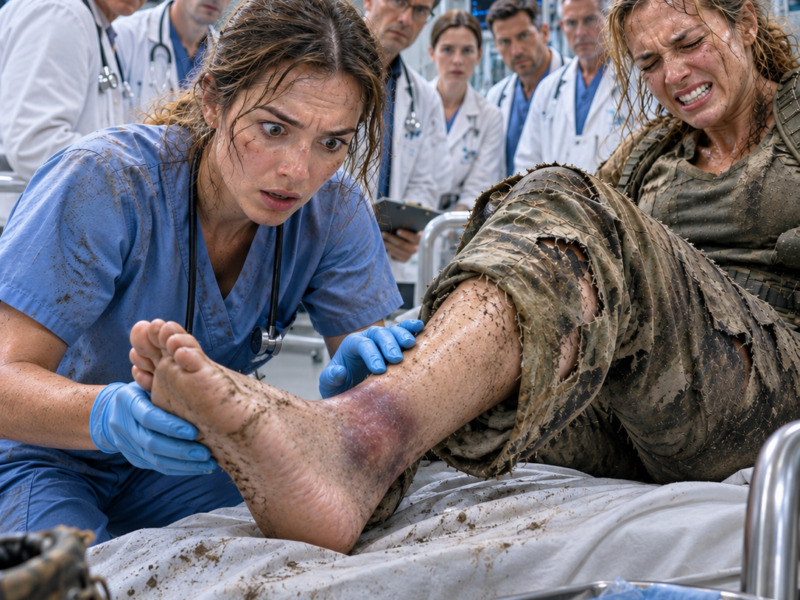
I Was a 28-Year-Old Rookie Nurse When Six Doctors Dismissed a Screaming Female Veteran’s Unbearable Foot Pain as Psychological. “Everyone Else Thinks I’m Crazy,” She Whispered, Begging Me to Believe Her. When I Secretly Performed an Ultrasound, I Discovered Something Buried Deep Inside Her Heel—but My Chief Ordered Me to Discharge Her Immediately. Then She Called Me “Doc,” a Name I Hadn’t Heard Since a Deadly Ambush in Afghanistan Six Years Earlier, and I Suddenly Realized Why My Boss Was Desperate to Bury the Evidence…
I Was a 28-Year-Old Rookie Nurse When Six Doctors Dismissed a Screaming Female Veteran’s Unbearable Foot Pain as Psychological. “Everyone Else Thinks I’m Crazy,” She Whispered, Begging Me to Believe Her. When I Secretly Performed an Ultrasound, I Discovered Something Buried Deep Inside Her Heel—but My Chief Ordered Me to Discharge Her Immediately. Then She Called Me “Doc,” a Name I Hadn’t Heard Since a Deadly Ambush in Afghanistan Six Years Earlier, and I Suddenly Realized Why My Boss Was Desperate to Bury the Evidence…
PART 1
“DON’T TOUCH IT! PLEASE! DON’T TOUCH MY FOOT!”
The woman’s screams echoed through the emergency department of Ashford Falls VA Medical Center, sending nurses rushing from their stations and patients turning their heads in alarm.
Six doctors would examine her that day. Six doctors would review her X-rays. And six doctors would eventually agree that the unbearable pain she described was probably psychological.
But one young nurse noticed something they had all overlooked.
What she discovered inside the soldier’s heel would expose a six-year-old military secret, destroy a respected physician’s career, and finally reveal the truth about a young soldier whose death had haunted two women for years.
And the most shocking part?
The nurse who made the discovery had been connected to that secret all along.
Her name was Larkin Hartwell.
At twenty-eight, Larkin had been working at Ashford Falls VA Medical Center in Montana for only six months. To her colleagues, she was an inexperienced nurse who spoke little, followed instructions carefully, and rarely challenged authority.
Nobody knew she had once served as a combat medic in Afghanistan.
Nobody knew she had treated wounded soldiers while bullets tore through the air above her.
And nobody knew that six years earlier, an incident during her deployment had nearly destroyed her life.
She had worked hard to keep that past buried.
Every morning, Larkin drove her late father’s old pickup truck to the hospital, parked in the same spot, and walked through the automatic doors at precisely the same time.
Her routine was simple. Check patient records. Prepare medications. Assist physicians. Finish her shift. Go home.
She avoided unnecessary conversations, especially with Dr. Preston Ashworth, the hospital’s fifty-four-year-old chief of emergency medicine.
Ashworth was a respected physician with twenty-two years of experience, expensive suits, impressive credentials, and an attitude that made junior employees afraid to question him.
He particularly disliked Larkin.
“Heartwell, these charts are incorrectly documented,” he told her one morning, dropping a folder onto the counter.
“The medication order was updated at five this morning, sir,” Larkin explained calmly. “I recorded the change in the addendum.”
“Then record it somewhere I can actually find it.”
“It is in the designated field.”
Ashworth narrowed his eyes.
“Don’t correct me.”
Larkin lowered her gaze.
“Understood, Doctor.”
She had learned long ago that not every battle was worth fighting.
But that morning, she was about to encounter one she could not walk away from.
At approximately eight thirty, an ambulance pulled into the emergency entrance.
Before the paramedics even opened its rear doors, a horrifying scream came from inside.
A young woman was strapped to a stretcher, her dark hair soaked with sweat and her hands gripping the rails.
“PLEASE! SOMETHING IS WRONG! DON’T TOUCH IT!”
One paramedic hurried toward the medical team.
“Female, twenty-eight years old. Found collapsed outside Founder’s Diner on Route Nine. Severe right-foot pain. No visible injury. Extremely distressed. We haven’t been able to examine her properly.”
As the stretcher rolled inside, the woman tried desperately to protect her right foot.
“Don’t take my boot off!” she cried. “Please, just listen to me!”
Dr. Ashworth approached.
“What’s the problem?”
“Severe unexplained pain,” the paramedic answered. “She’s refusing examination.”
Ashworth sighed.
“Get her stabilized and remove the boot.”
The woman began shaking her head violently.
“No! You don’t understand!”
Several members of staff moved closer.
Then Larkin stepped forward.
“Everybody, give her a moment.”
Ashworth turned.
“Excuse me?”
Larkin ignored his irritation and leaned toward the patient.
“My name is Larkin,” she said gently. “I’m a nurse here. Nobody is going to surprise you. I’ll tell you exactly what we’re doing before we touch your foot.”
The woman stared at her.
For one brief moment, her screaming stopped.
“Can you breathe with me?” Larkin continued. “In for four counts. Just four.”
The woman tried.
One.
Two.
Three.
Four.
Her breathing slowed enough for Larkin to notice something unusual.
This wasn’t ordinary panic.
The woman was constantly watching the doors, assessing people’s movements, and reacting to sudden sounds.
Larkin recognized those instincts immediately.
She had seen the same behavior in soldiers who had survived combat.
“Were you military?” she asked softly.
The woman looked startled.
Before she could answer, Ashworth interrupted.
“Enough. We need an examination.”
Despite the patient’s protests, the team eventually removed her boot after administering medication.
The woman grabbed Larkin’s wrist with astonishing strength.
“Don’t let them,” she whispered.
“Don’t let them what?” Larkin asked.
But the medication had already taken effect.
The patient’s eyes closed.
Ashworth examined her foot.
There was mild swelling around the heel, but no open wound, obvious deformity, or significant bruising.
“Nothing remarkable,” he announced.
He ordered X-rays.
When the images returned, they showed no obvious fracture.
Ashworth studied them briefly.
“Probably a psychiatric presentation. Severe somatic pain response. Could be PTSD-related.”
Larkin frowned.
“Doctor, shouldn’t we investigate further?”
“Pain is subjective, Hartwell. We can’t invent injuries because a patient screams.”
“But something triggered that reaction.”
“Then psychiatry can determine what it was.”
He walked away.
The woman’s identification was eventually located.
Her name was Ren Delaney.
She was twenty-eight years old, a decorated former Army soldier who had separated from service eleven months earlier.
Her listed address was three states away.
She had no emergency contact.
And according to the limited medical history available, there was no established psychiatric diagnosis explaining her current condition.
Yet the opinions were already forming.
A resident named Dr. Faraday examined her chart and agreed with Ashworth.
A temporary physician named Dr. Whitford recommended psychiatric evaluation.
Dr. Castellano examined the foot more carefully but found no obvious explanation.
Dr. Okafor raised the possibility that Ren might be exaggerating symptoms for disability-related benefits.
Finally, psychiatrist Dr. Delacroix endorsed the team’s recommendation for outpatient psychiatric follow-up.
By evening, six physicians had signed documentation supporting a psychiatric explanation.
Ren was scheduled for discharge the following morning.
Larkin read the notes in disbelief.
Six signatures.
Six professional opinions.
And not one convincing explanation for why a strong, battle-trained young woman had collapsed screaming outside a diner.
At six fifteen that evening, after her shift had officially ended, Larkin returned to Ren’s room.
Ren was awake.
Her face was pale, her eyes exhausted.
“You’re not supposed to be here,” she said.
“I know.”
“Then why are you?”
Larkin pulled a chair beside the bed.
“Because I don’t think you’re lying.”
Ren stared at her.
For several seconds, neither spoke.
Then Ren asked quietly, “Why?”
Larkin thought about the screams she had heard years earlier.
About wounded soldiers clutching her hands.
About people begging for help when there was no time left to give it.
“Because I’ve heard real pain before,” she answered. “And I know what it sounds like.”
Ren swallowed.
“Everyone else thinks I’m crazy.”
“I don’t.”
“Then look at my foot.”
Larkin hesitated.
She knew she wasn’t authorized to order additional imaging.
She also knew the consequences of challenging Ashworth again.
But Ren’s eyes were fixed on hers.
“Please,” the soldier whispered. “You’re the only one who actually listens.”
Larkin pulled on gloves.
She examined the foot carefully, pressing along the arch and around the heel.
Ren winced, but her response was different from before.
The pain appeared to originate deep beneath the tissue.
Not from the skin.
Not from a simple bruise.
Something deeper.
Larkin remembered an old lesson from her father, a former Special Forces medic.
Don’t just look for what’s damaged, Lark. Look for what doesn’t belong.
An idea suddenly occurred to her.
“There is a portable ultrasound machine in the supply room,” she said.
Ren looked up.
“Will it help?”
“It might show something the X-ray missed.”
“Then use it.”
“I could get in serious trouble.”
Ren’s expression hardened.
“I’ve lived with this pain for years. I can’t keep living like this.”
Larkin stood.
A few minutes later, she returned with the machine.
She applied gel to Ren’s heel and slowly moved the probe across the swollen area.
Gray shapes appeared on the screen.
Muscle.
Tissue.
Bone.
Then Larkin stopped.
Her heart began pounding.
Deep against the heel bone was a small, smooth, symmetrical object.
It wasn’t a normal anatomical structure.
And it didn’t resemble ordinary shrapnel.
It looked deliberately shaped.
Almost like a piece of metal placed there for a specific purpose.
Larkin adjusted the probe and checked again.
The object remained visible.
“What’s wrong?” Ren asked.
Larkin couldn’t answer immediately.
“Larkin?”
“There is something inside your heel.”
Ren went completely still.
“What?”
“An unidentified object. Deep inside the tissue.”
For the first time since arriving at the hospital, Ren looked more frightened than she had while screaming.
Larkin slowly turned toward her.
“Ren, do you know how something like this got into your foot?”
The woman looked away.
Her breathing changed.
Then, in a voice barely louder than a whisper, she said one word.
“Doc.”
Larkin froze.
“What did you say?”
Ren closed her eyes.
“The woman who put it there. We called her Doc.”
A cold sensation traveled down Larkin’s spine.
Because six years earlier, in Afghanistan, a wounded young soldier had called her by that exact name.
And suddenly, the face lying in the hospital bed looked terrifyingly familiar.
Before Larkin could ask another question, Ren drifted back into an exhausted sleep.
Larkin remained beside her, staring at the ultrasound image.
She had discovered something six doctors had missed.
But she was beginning to suspect that the object inside Ren’s heel wasn’t the biggest secret in that room.
The real secret was who had put it there.
And why the moment Larkin found it, someone inside the hospital had already started making sure the evidence disappeared.
PART 2
Larkin should have reported the discovery immediately.
Instead, she spent eleven minutes staring at the ultrasound image, trying to understand why Ren had called the person who treated her “Doc.”
That nickname belonged to a memory Larkin had spent six years trying to forget.
Before leaving, she checked the hospital’s electronic records.
The ultrasound image was saved.
But something else was missing.
The security recording outside Ren’s room had abruptly stopped at 6:11 p.m., the exact moment Larkin began the examination.
There was no technical warning.
No explanation.
Just a blank space where the footage should have existed.
Minutes later, Dr. Ashworth summoned her.
“Did you perform an unauthorized ultrasound?”
“Yes, sir. I found a foreign object.”
He studied the image.
For an instant, his expression changed.
Then he dismissed it.
“An imaging artifact. Nothing more. Ren Delaney will be discharged tomorrow.”
“But—”
“That’s final, Hartwell.”
That night, Larkin couldn’t sleep.
She opened a small box containing her father’s military dog tags and remembered the day in Afghanistan when she had been called Doc.
A roadside explosion.
A wounded driver.
A piece of antenna wire.
And a nineteen-year-old soldier who never came home.
Then she remembered something worse.
That soldier’s death had been blamed on her.
And Ren Delaney might be the only living person who could prove what really happened.
PART 3
The following morning, Larkin arrived at the hospital expecting Ren Delaney’s bed to be empty.
Instead, she heard shouting from the emergency wing.
“I’m not signing anything!”
Ren was sitting upright, gripping her discharge papers while Nurse Odalis Pruitt stood beside the bed.
“Ma’am, six physicians have approved your discharge,” Odalis explained.
“Then six physicians are wrong!”
Ren pointed toward her injured foot.
“There’s something inside me, and somebody finally found it. I’m not leaving until someone does something!”
Larkin entered the room.
Ren immediately looked at her.
“Tell them.”
Odalis glanced between them.
“Tell us what?”
Larkin took a breath.
“My ultrasound showed an abnormal object near the heel bone. I believe she needs an independent surgical evaluation.”
Odalis looked troubled.
“That should have been documented through the attending physician.”
“I know.”
“And Dr. Ashworth rejected it?”
“Yes.”
Odalis slowly lowered the clipboard.
“Wonderful. This is going to become everybody’s problem.”
When she left to contact administration, Larkin closed the curtain.
“Ren,” she said quietly, “I need to ask you something.”
Ren watched her carefully.
“Where did you serve?”
“Kandahar Province. Afghanistan. Why?”
“What year?”
“2018.”
Larkin’s stomach tightened.
“What unit?”
Ren gave the designation.
Larkin recognized it.
Then she asked the question she had been dreading.
“Were you part of a convoy that was ambushed during a morning route-clearance operation?”
Ren’s expression changed instantly.
“How do you know that?”
Larkin felt the hospital room disappear around her.
Suddenly she was twenty-two again, kneeling in Afghan dust with blood covering her hands.
“Because I was there.”
Ren stopped breathing for a moment.
Then tears filled her eyes.
“Doc?”
Larkin nodded.
“Yes.”
Ren covered her mouth.
“Oh my God.”
Six years earlier, their convoy had been traveling through Kandahar Province when an improvised explosive device struck the lead vehicle.
The explosion threw soldiers against their equipment.
Before the dust cleared, gunfire erupted from the tree line.
Larkin had been a young Army medic, trained to make impossible decisions under impossible conditions.
She remembered the noise.
The heat.
The smell of burning fuel.
And a twenty-two-year-old soldier trapped inside a damaged vehicle.
That soldier was Ren.
Her foot had been crushed against a twisted metal frame. The injury was severe, and the situation was deteriorating rapidly.
Larkin had dragged herself across the dirt under fire and reached her.
“Look at me!” she had shouted. “Stay awake!”
Ren was screaming.
“Doc! My foot! Please!”
“I know. I’m here.”
With little equipment and no immediate evacuation available, Larkin had improvised temporary stabilization using a carefully shaped piece of rigid antenna material.
It wasn’t a permanent surgical repair.
It was a desperate battlefield intervention intended to keep the injured foot stable until evacuation.
She had expected military surgeons to identify and remove the material later.
But in the chaos of evacuation and incomplete records, that apparently never happened.
Instead, the object remained buried near Ren’s heel for six years.
Scar tissue developed around it.
Over time, the pain increased.
Eventually, the soldier could barely walk.
And every doctor she encountered seemed more interested in explaining her pain psychologically than investigating its cause.
But Larkin remembered something else from that terrible morning.
A nineteen-year-old soldier named Mika Salo.
He came from Ohio.
His family owned a diner, and he loved talking about his mother’s homemade pies.
During the convoy ride, he had been teasing Larkin about her inability to cook.
“Cold butter,” he told her. “That’s the secret to good pie crust.”
She laughed.
“You’ve explained that about twelve times.”
“Because you keep forgetting!”
He had promised to teach her someday.
That someday never arrived.
When the ambush began, Mika suffered a devastating abdominal injury.
Larkin reached him after stabilizing Ren.
He was barely conscious.
“Doc,” he whispered.
“I’m here, Mika.”
“Tell my sister…”
“Save your strength.”
“Tell her… cold butter.”
Larkin pressed her hands against his wound, trying desperately to control the bleeding.
She called for evacuation.
Then she called again.
The helicopter was delayed.
Minutes passed.
She continued working.
But Mika’s condition worsened.
By the time evacuation finally arrived, he was gone.
Larkin had blamed herself ever since.
The subsequent military investigation made everything worse.
An initial report suggested her triage decisions had contributed to Mika’s death.
Although a later review found no professional fault in her battlefield actions, the accusations had already spread.
Her reputation suffered.
She eventually returned home and left military medicine behind.
Now, six years later, the soldier whose life she had saved was sitting directly in front of her.
Ren reached for Larkin’s hand.
“You didn’t kill him,” she said.
Larkin looked away.
“Ren—”
“No. You need to hear this.”
Ren tightened her grip.
“You saved me. The helicopter was delayed because somebody redirected it. You stayed with Mika until there was nothing more you could do.”
Larkin’s eyes filled.
“I should have reached him sooner.”
“You were saving my life!”
Silence filled the room.
Ren’s voice softened.
“You didn’t fail him, Doc. You saved me. Those are two different things.”
For six years, Larkin had waited to hear those words.
And when she finally heard them, she could barely speak.
But their reunion raised a disturbing question.
Why had Ren’s battlefield injury never been properly documented?
And why had Dr. Ashworth seemed frightened when he saw the ultrasound?
Larkin began creating a detailed written record.
Ren described the ambush, the temporary repair, her evacuation, and the years of worsening pain.
Larkin documented the ultrasound findings and requested an independent surgical consultation.
She also preserved copies of everything.
Meanwhile, rumors spread throughout the hospital.
A rookie nurse had discovered an object inside a decorated veteran’s foot after six physicians dismissed her complaints.
Some employees called Larkin courageous.
Others called her reckless.
Dr. Ashworth called her insubordinate.
When a local reporter named Marlo Finch arrived seeking information, Ashworth became furious.
He confronted Larkin in a supply room.
“Do you understand what this publicity could do to our hospital?”
“I haven’t spoken to the reporter.”
“Someone has!”
“Maybe people are concerned about what happened to Ren.”
Ashworth stepped closer.
“You are dangerously close to losing your job.”
Larkin held his gaze.
“Then perhaps someone should explain why the hospital keeps refusing to investigate a visible abnormality.”
His expression tightened.
“You have no idea what you’re getting involved in.”
That sentence changed everything.
Because Ashworth wasn’t speaking like a doctor defending a diagnosis anymore.
He sounded like a man protecting a secret.
Later, Larkin contacted Hollis Monroe, a seventy-one-year-old retired Army sergeant she had been treating for a chronic foot wound.
Hollis operated a small garage outside town and had spent decades building friendships throughout the veteran community.
He listened carefully as Larkin explained the situation.
Then he asked one question.
“What was the date of the ambush?”
She told him.
His expression became serious.
“I might know someone who can obtain the old after-action records.”
The following afternoon, Larkin visited his garage.
Hollis handed her a folder.
“Wasn’t easy,” he said. “Somebody filed these records under two different unit designations.”
Larkin opened it.
The first page listed the casualties.
The second explained the medical evacuation delay.
And there, beside the authorization for redirecting the helicopter, was a name.
Major P. Ashworth.
Larkin read it twice.
Then a third time.
The man who had spent six months humiliating her at work had been the military flight surgeon responsible for redirecting Mika Salo’s evacuation helicopter.
And the report suggesting Larkin had mishandled triage?
It had been written under his authority.
Larkin slowly looked up.
“He knew.”
Hollis said nothing.
“He knew what happened to Mika. He knew what happened to me.”
She stared at the signature again.
“And now he’s trying to make sure nobody finds out.”
But one detail was even more disturbing.
The original report clearly recorded an eleven-minute evacuation delay.
Exactly eleven minutes.
The same amount of hospital surveillance footage that had mysteriously disappeared after her ultrasound.
Whether those matching numbers were coincidence or deliberate, Larkin could no longer ignore the possibility that someone was actively interfering.
She closed the folder.
For six years, she had believed the worst thing that happened during the ambush was an irreversible battlefield mistake.
Now she understood that another decision had been made afterward.
A deliberate decision to hide the truth.
And the physician responsible was still powerful enough to threaten her career.
PART 4
Larkin left Hollis Monroe’s garage carrying a folder that seemed heavier than anything she had brought home from Afghanistan.
Inside were the names, dates, and military records she had spent years avoiding.
But this time, she wasn’t going to hide them in a drawer.
That evening, she sat across from Ren in the hospital room and explained everything.
Ren listened without interrupting.
When Larkin finished, she stared at the wall.
“Dr. Ashworth?” she whispered.
Larkin nodded.
“He authorized the helicopter diversion.”
“And then blamed you?”
“That’s what the records indicate.”
Ren closed her eyes.
For several moments, the only sound was the steady pulse of the bedside monitor.
“Six years,” she finally said. “We spent six years blaming ourselves while he walked around pretending nothing happened.”
Larkin looked down at the folder.
“He may have made a terrible decision with incomplete information. I can understand that part.”
Ren turned toward her.
“But?”
“But changing the story afterward was a different decision.”
Ren nodded slowly.
“Then we make sure the truth gets recorded.”
The following morning, Larkin prepared copies of the military documents, Ren’s medical statements, and the ultrasound findings.
She submitted them to the hospital’s governing board and appropriate oversight authorities.
She also shared the relevant records with Marlo Finch after making sure Ren had agreed to the public disclosure.
Within hours, the story began spreading.
A former Army medic had discovered that the physician dismissing her patient’s injury was connected to a fatal military evacuation decision years earlier.
The same patient carried physical evidence from the incident.
And the young soldier who had been blamed for the death was now challenging the official narrative.
Ashworth confronted Larkin before lunchtime.
“YOU HAVE NO IDEA WHAT YOU’VE DONE!”
His voice rang through the corridor.
Larkin remained calm.
“I submitted records for review.”
“You’ve put my entire career at risk!”
“Then tell the investigators what happened.”
Ashworth stared at her.
“You think battlefield medicine is simple? You think I had all the information when I redirected that aircraft?”
“No.”
The answer surprised him.
Larkin continued.
“I know exactly how confusing combat can be. I know what it’s like making a decision with seconds to spare.”
“Then you should understand!”
“I understand the decision you made that morning.”
She stepped closer.
“What I don’t understand is why you spent the next six years letting someone else carry responsibility for it.”
Ashworth opened his mouth.
Nothing came out.
“You signed a report criticizing my triage,” Larkin continued. “You knew the evacuation had been redirected. You knew those eleven minutes mattered.”
He looked away.
“I was young,” he muttered. “I had a family. A career ahead of me.”
“So did Mika Salo.”
The physician flinched.
Larkin’s voice remained steady.
“He was nineteen. He wanted to go home and help run his family’s diner. He died waiting for a helicopter.”
Ashworth sat down heavily.
For the first time since Larkin had met him, he looked less like a commanding physician and more like an exhausted man trapped inside his own choices.
“I told myself it was a shared failure,” he admitted.
“A shared failure isn’t the same as a false report.”
“I know.”
“Then correct it.”
He stared at her.
“You don’t understand what that will cost me.”
Larkin thought of Mika’s mother.
Of Ren’s years of pain.
Of the nights she had spent replaying the ambush and wondering whether she deserved to keep practicing medicine.
“Yes,” she answered. “I think I do.”
Ashworth did not respond.
But the hospital’s governing board had already begun its investigation.
An independent review of Ren’s condition was arranged.
Additional imaging supported the presence of a retained foreign object near the heel bone.
Specialists determined that the old injury required corrective surgery.
For the first time in years, Ren had a medical team that took her symptoms seriously.
When the surgeon explained the procedure, Ren cried.
Not because she was afraid.
Because someone had finally given her an explanation.
“It’s really there?” she asked.
“Yes,” the surgeon confirmed.
“I’m not imagining it?”
“No.”
Ren covered her face.
Larkin stood beside her, allowing her the time she needed.
The procedure was scheduled, and after careful evaluation, the surgeons removed the retained material and addressed the surrounding damaged tissue.
The object was preserved and documented.
It resembled the rigid piece of antenna material Larkin remembered using during the ambush.
When Ren woke after surgery, she asked one question.
“Is it out?”
Larkin smiled.
“It’s out.”
Ren began crying again.
Six years of pain hadn’t vanished instantly, and her recovery would require physical therapy.
But the mystery was over.
The source of her suffering had finally been acknowledged.
Meanwhile, Ashworth’s investigation intensified.
The board examined the disputed military records, the hospital’s diagnostic decisions, and the complaints against Larkin.
Then a new document appeared in her personnel file.
It alleged a history of unauthorized medical procedures and repeated failures to follow instructions.
Some accusations referred to incidents that supposedly occurred weeks earlier.
Larkin immediately recognized several details as false.
Fortunately, others did too.
Dr. Castellano reviewed the allegations and challenged them.
Odalis produced time records contradicting key parts of the memo.
Other physicians confirmed that the described events did not match their recollections.
The document’s credibility collapsed.
For Larkin, the situation was no longer merely about her own reputation.
She had discovered how easily a powerful person’s written version of events could become accepted reality.
It had happened in Afghanistan.
And someone had tried to make it happen again in Montana.
But the investigation was interrupted three weeks later by an emergency nobody expected.
A charter bus carrying elderly passengers overturned on an icy section of Route Nine.
Fifteen injured people were being transported toward Ashford Falls.
The emergency department had neither the staffing nor the resources normally required for such a large incident.
The intercom crackled.
“Mass casualty incident incoming. All available staff report to emergency!”
Larkin was moving before the announcement ended.
When she reached the ambulance entrance, Dr. Ashworth was already there.
Their eyes met.
For one second, the investigation, accusations, and six-year-old conflict seemed to disappear.
There were fifteen injured people coming.
What mattered was whether they could keep them alive.
“Talk to me,” Ashworth said.
Larkin quickly outlined her priorities.
“We need immediate triage. Watch for compromised breathing, severe bleeding, and signs of shock. The quiet patients may be the most critical.”
Ashworth nodded.
“Understood.”
The ambulance doors opened.
The first patient was an elderly woman bleeding from her scalp, screaming for her sister.
Behind her came a man clutching an obviously broken arm.
His face was gray.
His breathing was shallow.
Larkin moved toward him immediately.
“Get his vital signs. We need to assess circulation and breathing now.”
A young resident froze beside another patient with a severe leg injury.
Larkin caught his attention.
“Look at me. Control the bleeding first. You know what to do.”
“I’ve never seen anything like this!”
“Then follow your training. One step at a time.”
He obeyed.
Across the room, an elderly man kept insisting he was fine.
But Larkin noticed his pale skin, weak pulse, and unusual stillness.
She directed the team to evaluate him urgently.
Minutes later, a woman arrived complaining only of abdominal discomfort.
Something in her examination concerned Larkin.
She immediately alerted Ashworth.
“Possible internal bleeding. She needs urgent surgical assessment.”
Ashworth examined the patient.
His expression changed.
“Agreed. Arrange transfer to the trauma center.”
For forty exhausting minutes, Larkin and the entire medical team worked without stopping.
Ashworth followed her triage assessments instead of dismissing them.
Doctors, nurses, and technicians coordinated around the needs of the injured.
By the time the last ambulance departed, all fifteen patients had received emergency care.
Fourteen were stable, transferred, or discharged with follow-up plans.
The woman with suspected internal bleeding reached a higher-level surgical center in time for treatment.
No one died.
When the emergency finally ended, Larkin sat down on a supply crate.
Her hands began shaking.
Not because she hadn’t known what to do.
Because the danger was finally over.
The entire department seemed unusually quiet.
Delphine looked at her.
“Where did you learn to do that?”
Larkin stared at her hands.
Then, for the first time since joining Ashford Falls, she answered openly.
“I was an Army combat medic.”
Nobody spoke.
“Four years,” she added. “One deployment. Afghanistan.”
Dr. Castellano slowly nodded.
“Well,” she said, “that explains quite a lot.”
Several exhausted staff members laughed.
Even Larkin smiled.
Across the room, Ashworth watched her with an expression she had never seen before.
It was respect.
But respect couldn’t erase what had happened six years earlier.
And soon, he would have to explain himself before the hospital board.
PART 5
The hospital board hearing took place two weeks later.
The conference room was crowded.
Nurses, physicians, veterans, administrators, and members of the community filled nearly every available chair.
Ren Delaney sat in the front row with a cane beside her.
Her surgical wound was healing, and although she still needed physical therapy, she was finally recovering from an injury that had controlled her life for six years.
Hollis Monroe sat beside her.
Larkin stood near the front, holding a folder of documents.
Across the room, Dr. Preston Ashworth sat with his attorney.
For once, he wasn’t the most powerful person in the room.
Dr. Renfrew, the board chair, opened the hearing by explaining that the investigation concerned both patient care failures and the accuracy of records surrounding an earlier military incident.
Ren was invited to speak first.
She rose carefully, steadying herself with her cane.
“My name is Ren Delaney,” she began.
Her voice was quiet but clear.
“Six years ago, I was injured in Afghanistan. A combat medic saved my life. When I came home, I thought the worst part was behind me.”
She paused.
“I was wrong.”
She described the pain that followed her from state to state.
The jobs she lost because standing became unbearable.
The doctors who told her that nothing was wrong.
The nights she spent staring at her swollen foot, wondering whether she was losing her mind.
“Then I arrived here,” she continued. “Six doctors looked at my records and decided my pain was psychological.”
She glanced toward Larkin.
“One nurse looked again.”
The room remained completely silent.
“She found the object that had been inside me since Afghanistan. She believed me when nobody else would.”
Ren tightened her grip on the cane.
“I don’t want another veteran to experience what happened to me.”
She looked directly at the board.
“I don’t want another patient to be ignored because their symptoms don’t fit an easy diagnosis.”
Her voice cracked.
“And I don’t want another young nurse punished for caring enough to ask one more question.”
When Ren sat down, Hollis gently squeezed her shoulder.
Then Ashworth was called to testify.
He stood slowly.
The confident physician who once entered every room expecting obedience looked exhausted.
He unfolded a prepared statement, glanced at it, and then set it aside.
“Six years ago,” he began, “I served as a military flight surgeon supporting medical evacuation operations in Afghanistan.”
He explained the convoy ambush.
Multiple casualty reports had arrived almost simultaneously.
Information had been incomplete.
Resources were limited.
He had authorized the helicopter assigned to Larkin’s casualty site to respond elsewhere first.
That decision resulted in an eleven-minute delay.
“I believed at the time that the redirected aircraft was responding to the more urgent need,” he said.
His voice grew quieter.
“Whether I made the correct judgment is something investigators can examine. What cannot be defended is what happened afterward.”
Larkin watched him carefully.
Ashworth continued.
“When the incident was reviewed, I allowed an inaccurate narrative to shift responsibility toward Specialist Hartwell.”
He paused.
“I was afraid of what admitting my role might do to my career.”
A murmur passed through the room.
Ashworth looked toward Larkin.
“She was a young medic working under combat conditions. She saved one soldier’s life and tried desperately to save another.”
He swallowed.
“I allowed her to believe she had failed.”
Larkin felt tears gathering but refused to look away.
Ashworth turned back toward the board.
“I cannot change the decisions I made that day. I cannot bring Specialist Salo back.”
His voice nearly broke.
“But I can stop defending a false version of what happened.”
Dr. Renfrew waited until he finished.
Then she spoke.
“Dr. Ashworth, your performance during the recent bus accident has been acknowledged by this board. Several employees have described your contribution positively.”
Ashworth nodded.
“However, competent actions during one emergency do not erase professional misconduct in another.”
She continued.
“The original treatment of Ms. Delaney, the handling of Nurse Hartwell’s concerns, and the disputed records all require accountability.”
The board recessed to complete its deliberations.
Three days later, the decision was announced.
Ashworth’s employment at Ashford Falls VA Medical Center was terminated.
His case was referred to the appropriate medical licensing authorities for further review, with his license subject to suspension through that process.
The hospital was ordered to correct Ren’s medical records and formally acknowledge the inadequate evaluation of her condition.
The military documentation surrounding Mika Salo’s death was also referred for official correction.
A formal commendation was entered into Larkin’s personnel file.
And the hospital created a new position focused on coordinating medical care for veterans with complex injuries and trauma histories.
They offered that position to Larkin.
She accepted.
Not because she wanted prestige.
Not because she wanted revenge.
But because she knew how many veterans had stories nobody wanted to hear.
And she wanted to make sure the next person didn’t have to wait six years for somebody to listen.
A few weeks later, Marlo Finch published the full story.
This time, Larkin agreed to speak about her military service.
She described Ren’s injury, the medical dismissal, the old evacuation records, and the importance of taking patient complaints seriously.
But she refused to let the article become a story about one heroic nurse.
“This wasn’t about me being smarter than six doctors,” she told Marlo. “It was about recognizing that an unexplained symptom is still unexplained, even when several people agree on the wrong answer.”
The reporter nodded.
“And what about your past?”
Larkin was quiet for a moment.
“I spent years thinking that if I had been faster, stronger, or better, Mika Salo would still be alive.”
She looked down at her hands.
“I don’t know whether any individual decision could have changed everything that happened that morning.”
Then she looked up.
“But I know I tried to save him. I know I stayed beside him. And I finally know that the official story wasn’t the whole truth.”
Marlo closed her notebook.
“Do you feel free now?”
Larkin considered the question.
“Not entirely,” she admitted. “But I don’t feel trapped anymore.”
The greatest moment of closure came several weeks later.
Mika Salo’s family traveled from Ohio to Montana for a small memorial gathering arranged after the corrected account of his death became known.
Larkin had dreaded meeting them.
For years, she had imagined the anger in his mother’s eyes.
She had pictured a father demanding to know why his son never came home.
She had rehearsed apologies so many times that they no longer sounded like real words.
But when she arrived at the cemetery, Mika’s mother approached her before she could speak.
“Are you Larkin?”
Larkin nodded.
“Yes, ma’am.”
The older woman’s eyes filled with tears.
“My son wrote about you.”
Larkin stared at her.
“He did?”
“He said there was a medic in his unit who didn’t talk much but always knew how to help people when they were afraid.”
Larkin’s throat tightened.
“I remember him talking about your diner.”
His mother smiled sadly.
“He talked about that place constantly.”
“He promised to teach me how to make pie crust.”
The woman’s expression changed.
Larkin continued.
“He said the secret was cold butter.”
For a moment, Mika’s mother simply stared.
Then she laughed through her tears.
“Of course he did.”
She wiped her cheeks.
“He learned that from me. Cold butter and don’t work the dough too much. That boy thought it was the greatest secret in the world.”
Larkin tried to smile.
“He told me right before the ambush.”
The laughter faded.
For a long moment, both women stood quietly.
Then Mika’s mother reached for Larkin’s hands.
“I know you were with him at the end,” she said.
Larkin nodded, tears finally escaping.
“I tried everything I could.”
“I know.”
“I wish I could have brought him home.”
His mother squeezed her hands.
“Oh, sweetheart. So do I.”
Larkin lowered her head.
The older woman waited.
Then she said something Larkin would remember for the rest of her life.
“You didn’t leave him alone.”
Larkin looked up.
“You were there when I couldn’t be. You held his hand when I couldn’t hold it. You spoke to him when he needed someone.”
Her voice trembled.
“Nothing will ever make losing him right. But knowing he wasn’t alone matters more than you can imagine.”
Larkin began crying openly.
For six years, she had carried the memory of Mika’s death like a punishment.
Now his mother was holding her hands and thanking her.
Not for saving his life.
But for refusing to abandon him.
Ren approached slowly, leaning on her cane.
Mika’s mother recognized her immediately.
“You’re the young woman Larkin saved?”
Ren nodded.
“Yes, ma’am.”
The older woman opened her arms.
Ren stepped forward, and they embraced.
“I used to trade him my extra socks for his coffee,” Ren said through tears.
His mother laughed softly.
“That sounds like my boy.”
“It was a terrible trade for him.”
“He probably thought he was getting the better deal.”
They laughed together.
Then they cried together.
And for the first time, Larkin understood something her father had told her when she was a child.
Some stories weren’t hers to carry alone.
She had spent years believing that remembering Mika meant accepting responsibility for everything that happened to him.
But perhaps remembering him could also mean telling the truth about the kind of person he had been.
A nineteen-year-old boy who loved his family.
Who joked during dangerous missions.
Who believed every problem could be made smaller with coffee, good food, and a little humor.
Who never got the chance to grow old.
That afternoon, the three women stood before his headstone.
They didn’t try to explain away the tragedy.
They didn’t pretend justice had restored everything they had lost.
They simply remembered him.
And somehow, that was enough to make the silence feel different.
Six weeks after the bus accident, Larkin drove to Hollis Monroe’s garage.
The sun was setting behind the Montana mountains, turning the sky orange and violet.
Ren was waiting outside.
Her cane rested beside her, although she was using it less every week.
The surgeons expected her to walk independently within another couple of months.
For the first time in years, her future wasn’t measured by how much pain she could tolerate.
Instead, she was making plans.
She wanted a steady job.
A small apartment.
Maybe even a dog.
“Something ugly that nobody else wants,” she joked.
Larkin laughed.
They sat together on the tailgate of her father’s old pickup.
For a while, neither spoke.
Then Ren asked, “Do you ever think about what would have happened if you hadn’t been working that morning?”
Larkin looked toward the mountains.
“Sometimes.”
“They would have discharged me.”
“Probably.”
“And I would have kept wandering around, thinking I was crazy.”
Larkin shook her head.
“You would have kept looking for answers.”
“Maybe.”
Ren turned toward her.
“But I don’t think I would have found you.”
Larkin smiled faintly.
“Funny how that works.”
Ren looked at her healing foot.
“You know what the strangest part is?”
“What?”
“I spent six years thinking that piece of metal was proof something terrible had happened to me.”
She paused.
“Turns out it was also proof that somebody once refused to let me die.”
Larkin felt her chest tighten.
Ren continued.
“You were twenty-two, Doc. You were scared. People were shooting at us. You had almost nothing to work with.”
She met Larkin’s eyes.
“And you still found a way to keep me alive.”
Larkin looked away.
“I didn’t do everything right.”
“Nobody does everything right.”
“I made mistakes.”
“Of course you did.”
Ren nudged her shoulder.
“But you didn’t stop trying.”
The garage door rattled behind them.
Hollis emerged carrying two cups of coffee.
“Are you two planning to sit there getting sentimental all evening, or is somebody going to help an old man close up?”
Ren grinned.
“You’re the one who keeps pretending that truck needs repairing.”
Hollis looked offended.
“That truck has serious mechanical problems.”
Larkin raised an eyebrow.
“It drove here perfectly.”
“Exactly. Suspicious, isn’t it?”
Ren laughed.
Hollis handed them the coffee.
Then his expression became a little more serious.
“Been thinking about starting a veteran support group,” he said.
Larkin glanced at him.
“What kind?”
“People dealing with medical claims, injuries, paperwork, all the things nobody explains properly.”
He scratched his chin.
“Somewhere folks can ask questions without feeling stupid. Maybe get help finding the right doctor or advocate.”
Ren smiled.
“I told her you were planning something.”
Hollis shrugged.
“Word gets around.”
Then he turned to Larkin.
“Could use someone who knows the medical side.”
Larkin studied him.
“You’re asking me to help?”
“I’m asking whether you’d like to make sure what happened to Ren doesn’t happen to somebody else.”
She looked at Ren.
Then at the mountains.
Then at the garage where an elderly veteran had offered help before he even knew she needed it.
For years, Larkin had believed the safest way to live was to remain unnoticed.
Keep her head down.
Follow orders.
Never mention Afghanistan.
Never speak of the dead.
Never let anyone discover how much she was still carrying.
But that life had almost cost Ren another chance at treatment.
And it had allowed a false story to remain unchallenged.
She finally understood that silence was not always protection.
Sometimes silence was exactly what allowed injustice to survive.
“I’ll help,” she said.
Hollis nodded as though he had expected nothing else.
“Good.”
Ren raised her coffee cup.
“To Nurse Hartwell.”
Larkin shook her head.
“Don’t start.”
“To the only nurse stubborn enough to argue with six doctors,” Ren continued.
Hollis lifted his cup.
“I’ll drink to that.”
Larkin laughed.
For once, the sound came easily.
The sun disappeared behind the ridgeline.
The evening air turned cold.
And somewhere far away, a mother in Ohio could finally remember her son knowing the truth about his final moments.
A former soldier was learning to walk without unbearable pain.
A doctor who had hidden behind his authority was facing accountability.
And a young nurse who had spent six years running from her past was finally standing still.
Ren leaned her shoulder against Larkin’s.
“So what happens now, Doc?”
Larkin watched the last light fade from the mountains.
“Now,” she said, “we keep showing up.”
“For what?”
“For people who need somebody to believe them.”
Ren smiled.
“That’s a pretty big promise.”
Larkin looked at her.
“So was telling you I wouldn’t leave you in Afghanistan.”
Ren’s smile softened.
“You kept that one.”
Larkin nodded.
“And I intend to keep this one, too.”
For a long time, they sat in comfortable silence.
There were still wounds that needed healing.
Still memories that would never completely disappear.
Still questions that no investigation or apology could fully answer.
But Larkin no longer believed healing meant forgetting.
Sometimes it meant remembering without carrying all the blame.
Sometimes it meant finding the courage to question people who insisted they couldn’t be wrong.
And sometimes it began with something as simple as one person looking again when everyone else had stopped.
Six doctors had seen a screaming woman and decided she was imagining her pain.
One rookie nurse saw a soldier begging to be heard.
That difference changed everything.
Because the greatest mistake wasn’t simply missing the object hidden inside Ren Delaney’s heel.
It was deciding that the absence of an easy explanation meant there was nothing worth finding.
And if Larkin had learned one lesson from the battlefield, from Mika Salo, and from the six years that followed, it was this:
Sometimes the person everyone has stopped believing is the person who needs someone to listen the most.