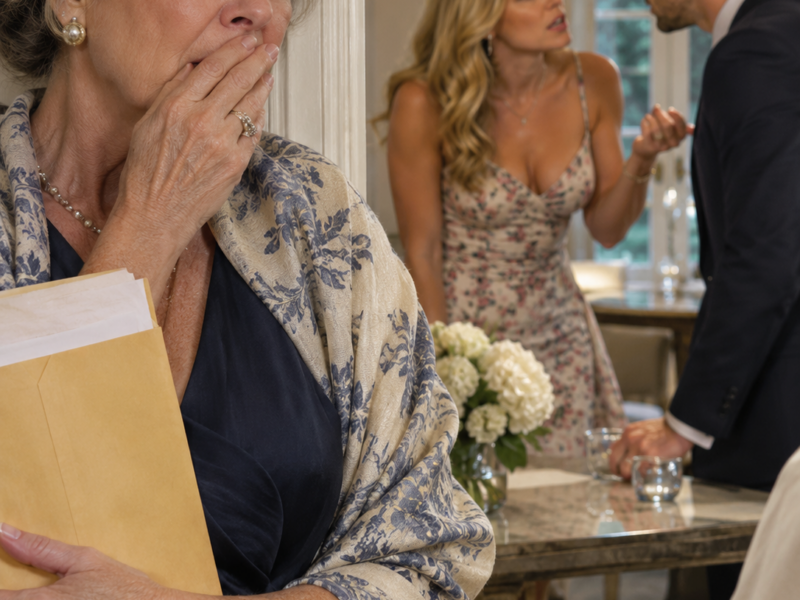
I Was 61 When I Inherited $7.9 Million, and I Was About to Surprise My Daughter With the News—Until I Overheard Her Planning to Have Me Declared Mentally Incompetent and Sell My $640,000 Home. “Once Dad Has Dementia on Paper, We Can Take Everything,” She Told Her Husband, Who Already Owed Me $60,000. I Walked Away Without Knocking, Hired a Lawyer, and Secretly Installed Cameras in My House. Weeks Later, When My Daughter Arrived With Papers for Me to Sign, I Reached for My Glasses and Said Something That Made Her Freeze…
I Was 61 When I Inherited $7.9 Million, and I Was About to Surprise My Daughter With the News—Until I Overheard Her Planning to Have Me Declared Mentally Incompetent and Sell My $640,000 Home. “Once Dad Has Dementia on Paper, We Can Take Everything,” She Told Her Husband, Who Already Owed Me $60,000. I Walked Away Without Knocking, Hired a Lawyer, and Secretly Installed Cameras in My House. Weeks Later, When My Daughter Arrived With Papers for Me to Sign, I Reached for My Glasses and Said Something That Made Her Freeze…
Part 1
The day I inherited $7.9 million, I thought my biggest problem would be deciding how to spend it. I had no idea that six weeks later, I would stand outside my daughter’s kitchen and overhear her discussing how to destroy my life.
My name is Spencer Whitaker. I’m 61 years old, a land surveyor from Burlington, Vermont. I’ve spent 34 years measuring property boundaries, but nothing prepared me for the line my own daughter was about to cross.
My older brother, Vaughn, had recently died, leaving me his lakeside cottage in Muskoka and an astonishing $7.9 million. My wife, Marlene, and I agreed to keep the inheritance secret until the legal paperwork was completed.
But I was terrible at keeping good news.
One afternoon, I arrived early at our daughter Fallon’s house with a bottle of sparkling cider. I intended to surprise her and her husband, Corbett, with the news.
As I approached the screen door, I heard Corbett say something that stopped me cold.
“Once the doctor confirms his dementia, getting power of attorney will be easy.”
Then Fallon answered.
“And the house? We should get at least $640,000.”
I froze.
They were talking about me.
Corbett explained how his mother, Greta, a former nurse practitioner, would provide documentation suggesting I suffered from progressive cognitive decline. They had already hidden my reading glasses, fabricated incidents of forgetfulness, and planted my car keys in the freezer.
Their next move was horrifying.
Fallon would enter our home while we were away, leave a saucepan heating on the stove, and arrange for her mother to discover it. They would claim I had forgotten to turn off the burner, creating evidence that I was becoming dangerous to myself.
After that, they planned to place me in a memory care facility, sell our mortgage-free home, and use the proceeds to rescue Corbett’s failing taproom.
Then Fallon laughed.
“The $60,000 Dad lent us? We can just say he imagined it.”
I had paid for her education, contributed to her wedding, and helped finance her husband’s business. Now she was planning to steal my home and erase my independence.
I backed away before they noticed me.
Three blocks later, I pulled over, shaking so badly I could barely hold my phone.
I called Marlene and told her to come home immediately.
When I explained everything, she initially refused to believe it. But then she remembered the strange incidents, the missing glasses, and the conversations in which Fallon had insisted I was becoming forgetful.
Finally, Marlene whispered, “They planned all this for $640,000. What would they do if they knew about the $7.9 million?”
That question changed everything.
The next morning, we contacted Irene, an attorney who specialized in estate protection.
She listened carefully before explaining our options. We needed an independent neurological evaluation, a forensic investigation of our finances, new estate documents, and evidence of whatever Fallon intended to do next.
Most importantly, we couldn’t reveal that we knew.
Within days, security cameras were installed in our home, and I underwent a comprehensive neurological examination.
The results confirmed that my memory and cognitive abilities were excellent.
Meanwhile, the forensic accountant discovered something worse than we expected.
Over fourteen months, $23,400 had disappeared from my accounts through unauthorized transfers connected to Corbett’s business.
Then he uncovered a $90,000 business loan secured by our home.
The guarantor signature supposedly belonged to me.
It was forged.
Marlene stared at the documents in disbelief.
“They didn’t just want our money,” she whispered. “They were willing to lose our house.”
That evening, I remembered something hidden in my wallet.
Three years earlier, when I lent Corbett $60,000, he had written a repayment promise on a cocktail napkin. Fallon had signed it as a witness.
Irene examined the napkin and smiled.
“This could be very useful.”
Weeks passed. We continued attending family dinners, smiling while Fallon expressed concern about my supposed memory problems.
Then the cameras captured Greta entering our house with a key and photographing confidential financial and medical documents.
Soon afterward, Fallon arranged an appointment with a doctor recommended by Greta.
I attended willingly.
When the doctor tested my memory, I answered every question correctly. I even recited the complete legal description of our property, including its measurements and boundary markers.
Fallon looked stunned.
But she didn’t abandon her plan.
She simply accelerated it.
Then, one gray afternoon, my phone buzzed with a security alert.
I opened the camera feed.
Fallon was standing in our kitchen.
She filled a saucepan with water, placed it on the stove, and turned on the burner.
Then she shut our elderly beagle, Bixby, inside the bathroom.
I watched her turn the heat higher.
She was creating the accident she intended to blame on me.
Part 2
I immediately contacted the detective Irene had brought into the investigation and hurried home.
By the time I arrived, the saucepan was nearly dry and smoke filled the kitchen.
I switched off the burner and opened the window.
Moments later, Fallon appeared, pretending she had just discovered the danger.
“Dad! You could have burned the house down!”
She called emergency services, tearfully describing me as confused and incapable of living safely.
Every word was recorded.
Two days later, Greta submitted a letter claiming I suffered progressive cognitive decline. But the letter described the stove incident despite being dated two days before it happened.
Now Irene had everything she needed.
When Fallon invited herself, Corbett, and Greta to dinner to discuss important paperwork, we agreed.
Marlene prepared a beautiful roast. After dessert, Fallon presented a power of attorney and a document transferring our home into her name.
“Just sign here, Dad.”
I picked up the pen.
“First, let me get my glasses.”
Then Marlene switched on the television.
The screen showed Fallon deliberately turning on our stove.
I placed the neurological report, financial records, forged loan guarantee, and signed $60,000 napkin on the table.
Finally, I revealed the inheritance.
Fallon whispered, “Dad, we didn’t know.”
“Exactly,” I replied.
Then the doorbell rang.
Two police officers entered.
Part 3
Over the following year, the consequences unfolded.
Corbett faced fraud and forgery charges, accepted a plea agreement, and lost his taproom. His business debts consumed what remained of their finances.
Greta lost her nursing license after investigators established that she had knowingly submitted false clinical information.
Fallon faced theft, conspiracy, and reckless-endangerment charges. Her cooperation reduced her punishment, but she received probation, restitution obligations, and lost her real estate license.
The court also upheld Corbett’s $60,000 debt. I donated the recovered money to an organization supporting victims of financial abuse.
Fallon wrote letters, left desperate voicemails, and eventually appeared outside our house in the rain.
We never opened the door.
A year later, Marlene and I finally visited Vaughn’s cottage.
We sat beside the lake with Bixby sleeping between us, watching the evening sunlight disappear.
“Do you miss her?” Marlene asked.
“Every day,” I admitted. “But I miss the little girl I raised, not the woman who tried to destroy us.”
Inside my jacket was a letter Vaughn had written before his death.
His final advice was simple.
“Defend your boundaries.”
I’d spent my life measuring property lines. Now I understood that the most important boundary wasn’t around my land or my fortune.
It was around my dignity, my freedom, and my peace.
And I would never let anyone cross it again.