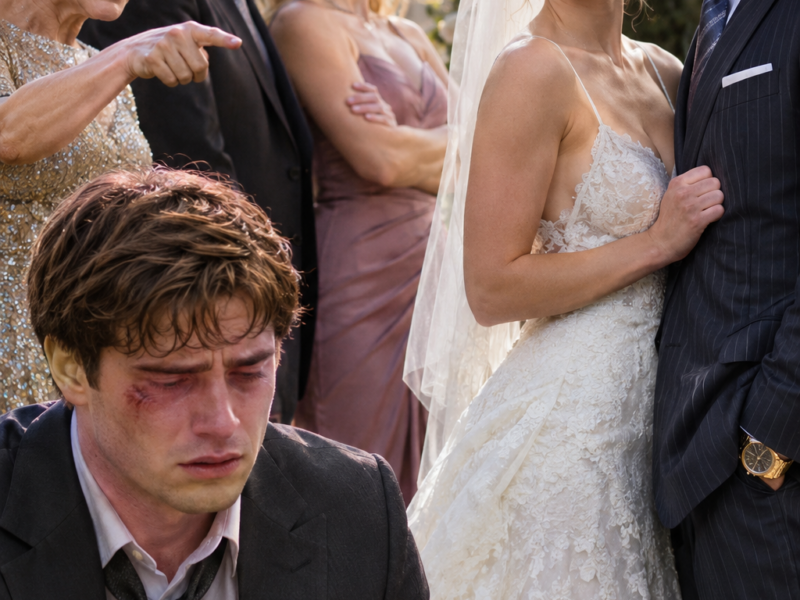
I Was 34 When My Sister Dragged Me Across Her Billionaire Wedding Rehearsal and Laughed, “She Flunked Out of Medical School and Mops Hospital Floors!” My Parents Joined In, Boasting They’d Hidden Me at the Children’s Table. But When the Groom’s Billionaire Mother Turned Pale and Whispered, “Dr. Bennett? I’ve Been Looking for You for Three Years,” the Entire Party Fell Silent. My Sister Had No Idea I’d Saved That Woman’s Life—or That Her Secret $500,000 Charity Scheme Was About to Raise a Terrifying Question…
My Sister Humiliated Me at Her Billionaire Wedding, Calling Me a Medical School Dropout Who Cleaned Hospital Floors. My Parents Laughed—Until the Groom’s Mother Recognized Me as the Surgeon Who Saved Her Life. But When She Asked About My Sister’s $500,000 Charity Fund, I Realized the Wedding Was Hiding a Secret That Could Destroy My Entire Family…
PART 1
My name is Claire Bennett, and I was thirty-four years old when my younger sister humiliated me in front of three hundred wealthy wedding guests.
“She dropped out of medical school,” Madison announced, laughing as she pulled me toward her future mother-in-law. “Now she cleans hospital floors in Chicago.”
My mother smiled. “We seated her with the children so she wouldn’t embarrass anyone important.”
My father added, “There’s not much to brag about when your daughter cleans toilets.”
Everyone laughed.
Everyone except Eleanor Whitfield.
The billionaire founder of Whitfield Health stared at me, slowly lowered her wineglass, and whispered, “Dr. Bennett?”
I nodded.
Her eyes filled with tears.
“My God. I’ve been looking for you for three years.”
The terrace fell silent.
Then Eleanor turned toward Madison.
“This woman saved my life.”
Madison’s smile disappeared.
Three years earlier, Eleanor had suffered a catastrophic aortic dissection during a business conference in Chicago. I had led the emergency operation that saved her after nine exhausting hours.
What my family never understood was that I hadn’t dropped out of medical school.
I had graduated near the top of my class, completed my surgical training, and become chief of trauma surgery at Lakeshore Memorial Hospital.
Years earlier, my mother had misunderstood me when I mentioned spending long hours scrubbing in for surgery. Somehow, the story became that I scrubbed hospital floors.
I corrected them repeatedly.
They never listened.
Madison had always been the favorite. My parents financed her businesses, bought her cars, and celebrated her smallest accomplishments.
When I entered medical school, they refused to help with tuition.
When I graduated, they didn’t attend.
Eventually, I stopped discussing my career with them.
But now Eleanor Whitfield was standing in front of everyone, telling them the truth.
“She is one of the finest surgeons I’ve ever known,” Eleanor said firmly.
My father’s face turned red.
Madison tried to laugh.
“Surely there’s some mistake.”
Eleanor looked directly at her.
“I was the patient, Madison. I remember the woman who saved me.”
Then she took my arm and led me into the garden.
For several minutes, she thanked me for everything I’d done.
But suddenly, her expression changed.
“Claire, I need to ask you something. Have you heard of Madison’s charity, Hearts of Hope?”
I nodded cautiously.
Eleanor explained that Madison had requested a $500,000 donation to support trauma patients at my hospital.
Half the money had already been transferred.
My stomach tightened.
“Eleanor,” I whispered, “our hospital has never received any money from Hearts of Hope.”
Her face went pale.
And at that moment, I realized my sister’s wedding might be hiding something far worse than another family humiliation.
PART 2
That night, I returned to the small staff cottage my family had arranged for me, far from the luxurious rooms reserved for important guests.
I opened my laptop and began investigating.
Within twenty minutes, I discovered that Hearts of Hope wasn’t registered as a nonprofit charity.
It was a private company.
Madison was listed as its organizer.
My father was its registered agent.
Then I checked my credit report.
Two accounts had been opened without my knowledge: a $40,000 credit card and a $60,000 personal line of credit.
Both used my parents’ address.
Someone had stolen my identity and accumulated $100,000 in debt.
A further $90,000 loan application had been stopped by my credit freeze.
I stared at the screen, feeling sick.
My family hadn’t simply dismissed my accomplishments.
Someone had been using my name to obtain money.
Around eleven, Julian Whitfield knocked on my door.
He asked whether we could walk along the beach.
Julian looked exhausted.
“My mother told me about the charity,” he admitted. “And there’s something else I need to ask you.”
He hesitated.
“Did Madison pay off your parents’ mortgage two years ago?”
I stopped walking.
“No,” I answered. “I did.”
Two years earlier, my grandmother’s attorney had contacted me about my childhood home facing foreclosure.
I had secretly transferred $310,000 from my savings to rescue the property.
I never told my parents.
I only wanted them to have somewhere safe to live.
Madison had apparently discovered the payment and claimed the credit.
Julian looked devastated.
“She told me saving her parents was the proudest thing she’d ever done.”
Then he revealed that Madison had persuaded him to transfer $2 million into a joint account after their wedding.
The authorized signers would be Julian, Madison, and my father.
The transfer was scheduled for the following morning.
“Cancel it,” I told him.
He nodded.
At dawn, I called my grandmother’s attorney, Walter Price.
He uncovered another terrible secret.
My parents had borrowed $450,000 against the house I’d already saved.
The money had helped finance Madison’s extravagant wedding.
The loan carried fourteen percent interest and would soon become due.
They had gambled their home on Madison marrying a billionaire.
At 9:04 a.m., Julian sent me a message.
“Transfer canceled.”
Twenty minutes later, Madison began screaming inside the mansion.
My mother summoned me to the bridal suite.
Madison accused me of destroying her future.
When I revealed that I had paid off our parents’ mortgage, my mother looked stunned.
But Madison immediately burst into tears.
And just like always, my mother rushed to comfort her.
“Leave,” she ordered me. “You’ve caused enough trouble.”
I walked out without arguing.
Instead, I went directly to Eleanor.
She was meeting with Julian, an attorney, and a financial investigator.
They had traced the $250,000 charitable payment.
Approximately $140,000 had been spent on wedding expenses.
Much of the remaining money had gone to an offshore account connected to Trent Delaney, a convicted fraudster secretly involved with Madison.
Julian covered his face.
He had believed he was marrying a generous, successful woman.
Instead, he was discovering an elaborate financial scheme.
Eleanor suggested canceling the ceremony privately.
But Julian shook his head.
“She’ll blame Claire for everything,” he said. “I want the truth out.”
And by afternoon, the wedding guests were gathering beneath an enormous arch of white roses.
None of them knew what was about to happen.
PART 3
At three-thirty, I approached the wedding lawn wearing a simple green dress and my grandmother’s watch.
My assigned seat was number three hundred.
The very last row.
But when I reached it, the chair was missing.
Someone had deliberately removed it.
I stood there, embarrassed despite everything I’d already endured.
Then Eleanor appeared beside me.
She looked at the empty space.
“Absolutely not.”
Taking my arm, she escorted me down the center aisle and seated me beside her in the front row.
My parents watched in disbelief.
When Madison appeared in her expensive wedding gown, her smile faltered.
But she continued toward the altar.
The minister began speaking.
Suddenly, Julian raised his hand.
“Before we exchange vows, Madison, I have a question.”
She smiled nervously.
“Of course, darling.”
“Who paid off your parents’ mortgage?”
Madison hesitated.
“I did.”
Julian shook his head.
“No. Claire paid $310,000 from her own savings.”
Whispers spread through the crowd.
Madison immediately accused me of lying.
Julian continued.
“Who is Trent Delaney?”
Her face turned white.
Then Eleanor stood and explained that money intended for injured patients had financed the wedding.
She asked me whether Lakeshore Memorial had received any donations from Hearts of Hope.
“Not one cent,” I answered.
I explained that the supposed charity was a private company connected to Madison and my father.
My father began stammering.
Madison screamed that we were conspiring against her.
Then Julian revealed that Trent had been detained while attempting to leave the country.
He had emptied the offshore account and apparently intended to abandon Madison.
My sister collapsed onto the grass.
Moments later, federal agents approached the altar.
They escorted Madison away while hundreds of guests watched.
My mother grabbed my arm.
“Do something! She’s your sister!”
I looked at her calmly.
“I didn’t steal the money. I didn’t lie. And I’m not covering for her.”
That evening, my father declared that I was no longer his daughter.
For the first time, I didn’t beg him to reconsider.
“Okay,” I said.
I returned to Chicago the following morning.
But Madison’s arrest wasn’t the end.
After being released on bond, she posted a tearful video claiming I’d framed her.
My parents supported her accusations.
My mother even filed a complaint questioning my medical credentials.
Although the allegations were false, the hospital placed me on temporary leave during its review.
For the first time in years, I couldn’t operate.
Then a bridesmaid released footage of the wedding.
The video showed Eleanor recognizing me, Julian exposing the financial scheme, and Madison attacking me with her bouquet.
Former patients began defending me publicly.
My medical research circulated online.
Eleanor announced a $10 million donation to establish the Bennett Trauma Fellowship.
The hospital reinstated me, and the complaint was dismissed.
I believed the worst was finally over.
Then, several weeks later, my phone rang at two in the morning.
A nurse from the emergency department sounded frightened.
“Dr. Bennett, we have a critically ill patient. He says he’s your father.”
Gary Bennett had collapsed at O’Hare Airport.
He had suffered an acute aortic dissection.
The same condition that had nearly killed Eleanor.
And unless someone operated immediately, my father would die.
PART 4
When I entered the emergency department, my father looked smaller than I’d ever seen him.
His skin was pale.
An oxygen mask covered his face.
When he recognized me, tears filled his eyes.
“Claire,” he whispered. “I’m sorry.”
I explained that his aorta was tearing and that he needed immediate surgery.
He reached for my hand.
“Please save me.”
“I will,” I promised.
With the necessary consent and surgical support, I led the emergency operation.
It lasted more than seven hours.
There were moments when his heart nearly stopped.
But eventually, we stabilized him.
My father survived.
When I informed my mother, she broke down.
“You really are a surgeon,” she whispered.
“I’ve been one for years, Mom.”
Then she explained why they had come to Chicago.
Their house was facing foreclosure again.
Their finances had collapsed.
And after everything that happened, they had finally decided to apologize.
My father had even written me a letter during their flight.
In it, he admitted that he’d been ashamed of my supposed failure because he’d never bothered to learn the truth.
He wrote that he was proud of me.
I cried while reading it.
But an apology couldn’t erase years of cruelty.
Nine days later, I visited his hospital room carrying a folder.
I asked my parents to tell me everything.
My father admitted he’d known Madison’s charity wasn’t properly registered.
My mother confessed that she’d suspected the credit accounts were fraudulent.
Then she admitted she’d knowingly signed the false complaint against my medical credentials.
“Why?” I asked.
Neither could answer.
Finally, I asked the question I’d carried since childhood.
“Why was Madison always more important than me?”
My father stared at his hands.
“Because she needed us,” he whispered. “You always seemed strong. Madison made us feel necessary.”
He began crying.
“We punished you for being independent.”
For the first time, I understood their behavior.
But understanding didn’t mean excusing it.
With Walter’s help, I’d negotiated to purchase their troubled mortgage for $380,000.
I offered to protect the house under strict conditions.
The property would be placed into a trust I controlled.
My parents could continue living there, paying $1,200 monthly rent to support the trauma fellowship.
They would publicly retract their lies, cooperate with investigators, and stop financing Madison’s wrongdoing.
My father agreed immediately.
My mother hesitated.
“But she’s still my daughter.”
I looked at her.
“So am I.”
After a long silence, she signed.
The foreclosure was canceled.
My parents returned home and publicly apologized.
For several weeks, things seemed peaceful.
Then Madison appeared at their doorstep after midnight.
She was crying, claiming she had nowhere to go.
But the doorbell camera showed a black car waiting nearby.
Madison demanded that our parents sign a statement accusing me of coercing them into transferring the house.
My mother called me, trembling.
For thirty-four years, she’d surrendered whenever Madison cried.
This time, my father reminded her of their promise.
My mother pressed the intercom.
“Madison, I love you. But I’m not signing anything.”
Madison’s tears stopped.
She screamed insults before returning to the waiting car.
The recording became evidence of attempted witness tampering.
Her bond was revoked.
Months later, Madison pleaded guilty to fraud, aggravated identity theft, and witness tampering.
She received a six-year federal prison sentence.
Trent received eleven years.
PART 5
My parents and I didn’t become a perfect family overnight.
There were difficult conversations, painful memories, and moments when old habits returned.
But something had changed.
They began calling me every Sunday.
They asked about my patients.
And for the first time, they actually listened.
My father started volunteering at a hospital in Georgia.
Whenever someone asked about his family, he proudly told them about his daughter, the surgeon who had saved his life.
Meanwhile, the Bennett Trauma Fellowship welcomed its first group of young doctors.
Several had grown up without financial support or encouragement.
I understood their struggles better than they realized.
Eleanor attended the opening ceremony with Julian.
My parents came, too.
When my achievements were announced, my father stood and applauded louder than anyone.
Afterward, my mother approached me with a small package.
Inside was a framed letter.
My acceptance letter to Emory University’s medical school.
The same letter my father had folded and placed on the kitchen counter fourteen years earlier.
The crease was still visible.
“He kept it,” my mother whispered.
I looked toward my father.
He nodded, his eyes wet.
Then my mother embraced me.
Not because I had saved someone important.
Not because a billionaire was watching.
Simply because I was her daughter.
That spring, I finally bought the Chicago brownstone I’d dreamed of owning.
It had a small backyard where I planted white roses.
The same flowers that had decorated Madison’s ruined wedding.
I wanted to give those flowers a new meaning.
One afternoon, a letter arrived from a federal prison.
The return address read Madison Bennett.
I placed it on my kitchen table beside a vase of roses.
I still haven’t opened it.
Sometimes, I wonder whether my sister genuinely regrets what she did.
Other times, I wonder whether she’s already preparing another story in which she’s the victim.
Maybe one day I’ll read her words.
Maybe I won’t.
For most of my life, my family decided who I was allowed to be.
They called me a failure because they never bothered to understand my success.
They called me selfish when I stopped sacrificing everything.
And they called me cruel when I finally demanded honesty.
But I learned that loving your family doesn’t mean surrendering your dignity.
Forgiveness doesn’t require allowing people to hurt you again.
And sometimes, the greatest act of love isn’t rescuing someone from the consequences of their choices.
It’s allowing them to face those consequences.
My name is Claire Bennett.
For years, my family told everyone I cleaned floors in a hospital.
They were right about one thing.
I do spend my life inside a hospital.
But instead of holding a mop, I hold human hearts in my hands.
Including the heart of the father who once told me I was no longer his daughter.
And now, for the first time in my life, I get to decide what happens next.
THE END