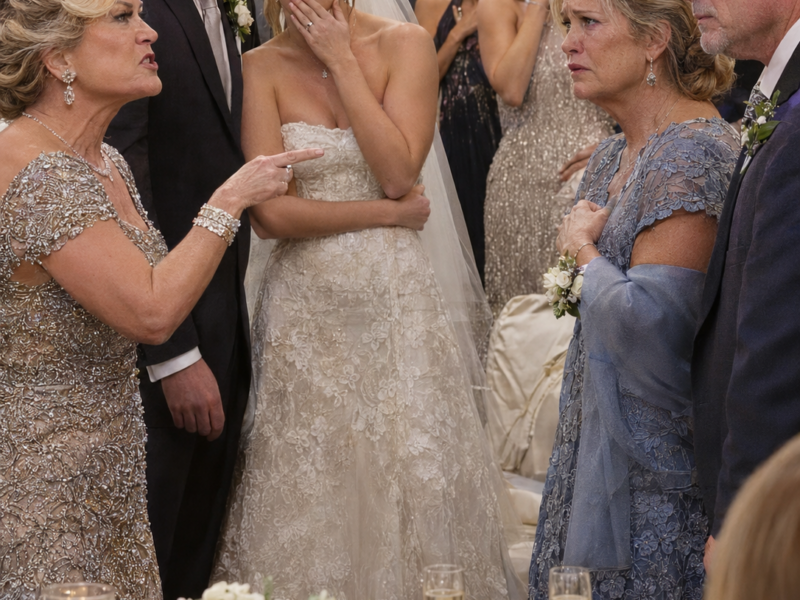
I Was 33 When I Walked Into My Wedding Reception and Found My Husband’s Family Sitting at the Main Table While My Parents Were Left Standing by the Door. My Mother-in-Law Looked at Them and Sneered, “They Look Poor,” But My New Husband Shocked Me Even More When He Agreed. I Stayed Silent, Opened My Wedding Clutch, and Waited Until 8:15 PM to Make an Announcement That Would Change Everything—Especially When the $2.4 Million Investor at Table 3 Suddenly Stood Up.
I Was 33 When I Walked Into My Wedding Reception and Found My Husband’s Family Sitting at the Main Table While My Parents Were Left Standing by the Door. My Mother-in-Law Looked at Them and Sneered, “They Look Poor,” But My New Husband Shocked Me Even More When He Agreed. I Stayed Silent, Opened My Wedding Clutch, and Waited Until 8:15 PM to Make an Announcement That Would Change Everything—Especially When the $2.4 Million Investor at Table 3 Suddenly Stood Up.
Part 1
My name is Fontaine Maddox. I was thirty-three years old when I discovered that the man I had just married was willing to let his family humiliate the two people who had sacrificed everything to give me a better life.
It happened at my wedding reception, inside a restored sugar mill outside Lafayette, Louisiana. Two hundred and forty guests had gathered beneath the wooden beams and sparkling lights. White linen covered the tables, magnolia leaves decorated the centerpieces, and a Cajun band was preparing to play the first dance of the evening.
But when I walked into the reception hall, I noticed something that made my stomach tighten.
The main table had been rearranged.
There were nine people sitting at it. Every single one belonged to my husband’s family.
My parents were nowhere near the front.
I finally spotted them standing beside the entrance, looking as though they had accidentally walked into a room where they weren’t supposed to be. My mother held her handbag with both hands. My father stood beside her, slowly turning his old hat between his fingers.
He was wearing the only formal suit he owned, the same one he had worn to his own mother’s funeral years earlier.
My new mother-in-law, Celestine Deah, noticed me looking at them. She glanced at my parents, then turned toward the people seated beside her.
“They look poor,” she announced loudly enough for the nearest tables to hear. “People like them are much more comfortable in the back.”
I waited for my husband to defend them.
Instead, Spencer looked at his mother, then at me.
“Mama’s not wrong, Fontaine. Don’t make a scene. Not here.”
That was the moment I understood that the wedding I had spent months preparing for was not the beginning of the life I had imagined.
But to understand why I eventually stood in front of 240 people and made an announcement that destroyed my husband’s family’s biggest business deal, you need to understand where I came from.
I grew up on Bayou Sage in Lefor Parish, Louisiana, where the roads eventually disappeared into marshland and the water seemed to stretch forever.
My father, Lucian Maddox, had spent forty-six years shrimping. His boat was a fifty-two-foot trawler named the Odal Marie, after my mother. It smelled of diesel fuel, saltwater, old coffee, and the kind of hard work that never completely leaves a person’s hands.
I started working aboard that boat when I was fifteen.
While other girls my age were going to the mall or spending their weekends at football games, I was learning how to sort shrimp, clean the deck, check the nets, and recognize the difference between an approaching storm and an ordinary afternoon shower.
My father wasn’t a talkative man. His hands were rough, his face permanently tanned, and his laughter was something you had to earn.
But he taught me two lessons that shaped everything I became.
The first was simple.
“A fair price paid on time is the only handshake that matters.”
The second was something he demonstrated rather than explained.
Whenever we attended church gatherings, weddings, funerals, or community dinners, Daddy always took the last available chair. If there weren’t enough seats, he stood against the back wall with his hat in his hands.
When I was younger, I once asked him why he never tried to sit closer to the front.
He shrugged.
“A man sits where he’s put, sweetheart.”
I thought it was humility. I admired him for it.
I didn’t understand that some people mistake humility for weakness, and that there are families who will happily use a kind man’s manners as an excuse to treat him like he doesn’t belong.
My mother, Odal, was just as hardworking. She had spent thirty years running the cafeteria at Golden Meadow Elementary School. She knew every child’s favorite meal and could stretch a small grocery budget into enough food for a family of five.
She wasn’t wealthy, but nobody in our parish went hungry if she could help it.
When I finished high school, I took accounting classes at night at Nicholls State while continuing to work on the boat during the day.
By the time I was twenty-four, I had noticed something that bothered me more every year.
The people catching the shrimp were getting the worst deals.
Dock buyers frequently paid late, changed prices after unloading, or deducted mysterious fees from fishermen’s checks. Some families had been working the water for generations, yet they were constantly struggling to pay for fuel, repairs, and equipment.
I decided I wanted to change that.
With nine thousand dollars of my savings, I bought a used commercial ice machine. I rented a neglected stretch of dock from an elderly man named Mr. Peter and painted a sign on a piece of plywood.
Maddox Seafood and Ice.
Fair prices. Friday payments.
The first week, only three boats agreed to sell to me.
My father’s was one of them.
He refused any special treatment. He insisted on receiving exactly what I paid everyone else, even when I offered him a better price.
“If you’re going to build something, build it right,” he told me.
Nine years later, Maddox Seafood had grown into a successful operation.
We purchased shrimp, crab, crawfish, drum, and redfish from forty local boats. We had twenty-two employees, two refrigerated trucks, a processing facility, and customers stretching from Houma to Shreveport.
I still personally signed the fishermen’s checks every Friday.
My accountant, Rosalie Theott, often joked that I ran a modern seafood company with the habits of someone who still lived in the 1970s.
I didn’t mind.
Every name on those checks belonged to somebody I knew. I knew whose boat needed a new engine, whose daughter was starting college, and whose wife was recovering from surgery.
Those weren’t just suppliers.
They were families.
And then Spencer Deah walked into my life.
It was a warm March morning two years before my wedding. Spencer arrived at my dock wearing expensive loafers that had clearly never touched a fish scale.
His family owned Deah Hospitality, a restaurant group with three upscale Cajun restaurants in Lafayette, Baton Rouge, and New Orleans.
He was thirty-three, the managing partner, and had driven two hours to personally taste our seafood.
I remember watching him pick up a shrimp straight from the ice, taste it, and close his eyes.
“That’s incredible,” he said.
Then he surprised me by asking my father the name of his dog.
The dog’s name was Budro.
Most city businessmen never bothered learning the names of the people working on the boats, let alone their dogs. But Spencer remembered Budro every time he returned.
He brought pralines for the crew, asked about my father’s fishing stories, and even attempted to speak Cajun French with my grandmother.
He was terrible at it.
My grandmother laughed until tears rolled down her cheeks.
Within a few months, Spencer was visiting regularly.
He took me to dinner in Lafayette, listened to me talk about fuel costs and fishing seasons, and seemed genuinely interested in my business.
He made me feel intelligent rather than intimidating.
My mother liked him almost immediately.
My father took longer to warm up, but one evening Spencer helped him repair a fishing net and ruined an expensive pair of shoes without complaining.
That earned him something close to my father’s approval.
Within a year, I was in love.
Looking back, I can see how carefully Spencer learned to become the person everyone wanted him to be.
The first warning came during Easter, when I brought my parents to meet his family.
The Deah residence was an enormous house beneath ancient live oaks in Lafayette. Inside, a dining table large enough for twenty-two people had been decorated with handwritten place cards and expensive china.
Celestine Deah greeted us at the entrance wearing a cream silk suit.
She kissed the air beside my cheek and looked at my mother’s flowered church dress.
“So this is the shrimp girl,” she said brightly. “And her people.”
She walked away before either of my parents could respond.
Nobody had prepared seats for them.
For ten minutes, my mother and father stood beside the china cabinet while Spencer’s relatives and friends found their places.
My mother held her handbag with both hands.
Daddy held his hat.
I finally found two folding chairs in a hallway closet and carried them into the dining room myself.
Celestine watched me place them at the far end of the table, near the kitchen entrance.
“Oh, I’m sorry,” she said with a theatrical smile. “Your people look a little rustic. I assumed they’d prefer eating in the kitchen with the help.”
Several people laughed.
My father quietly placed a hand on my arm.
“It’s all right, sweetheart.”
But it wasn’t all right.
On the drive home, Spencer apologized repeatedly.
His mother was old-fashioned, he explained. She didn’t mean anything by it. She would eventually accept my family.
I wanted to believe him.
A month later, he approached me with a business proposal.
Deah Hospitality wanted Maddox Seafood to become its exclusive seafood supplier.
The contract would be worth approximately $31,000 per month.
It was the largest account I had ever considered, but I refused to let my relationship influence my business decisions.
I hired Ellis Robichaux, my attorney, to review the agreement.
The contract included standard payment terms: sixty days after delivery, with a thirty-day cure period if the buyer defaulted.
It also included automatic annual renewal unless either party submitted written notice before the expiration date.
We signed on April 28.
I circled that date in red on my office calendar.
At the time, I had no idea how important it would become.
Spencer proposed in June on the end of my dock, with Budro sitting beside him.
I said yes before he finished asking.
Unfortunately, his mother immediately began planning our wedding.
She chose the venue, the florist, the band, the guest list, and eventually the date: the last Saturday in April.
She invited 240 people, most of whom were her friends from the Lafayette social circle.
I didn’t object to having a beautiful wedding. I simply wanted my parents to feel welcome.
One afternoon, Celestine showed me a seating chart.
My parents had been assigned to table nineteen, in the far corner.
“Your people will be more comfortable in the back,” she explained. “They’ll have their own crowd.”
I put down my glass.
“My parents will sit at the main table.”
She smiled.
“We’ll see.”
I didn’t leave that decision to chance.
The following Monday, I drove to the sugar mill and met the event coordinator, Tasha Gidry.
We arranged the main table together.
Bride. Groom. Best man. Maid of honor. Both sets of parents.
Tasha printed the arrangement and promised nobody would change a name without my permission.
I thought that settled it.
I was wrong.
Part 2
The warning signs continued.
At our engagement party, Spencer’s sister, Margot, mocked my mother’s blue dress because she had bought it at Dollar General. Celestine laughed, and Spencer laughed with them.
When I confronted him, he said he hadn’t been laughing at my mother.
Then he repeated the words I had heard too many times.
“Mama’s not wrong, Fontaine. Your parents would probably be happier with their own crowd.”
Meanwhile, Deah Hospitality’s invoices began falling behind. By November, they owed my company more than $90,000.
I stopped deliveries, sent legal notices, and demanded payment. They eventually sent just enough money to keep the contract alive.
Then I learned Spencer was using my unpaid seafood deliveries to convince investor Julian Brousard to finance a $2.4 million restaurant expansion.
The investor believed their seafood supply was secure and their expenses were under control.
Neither was true.
I gave Spencer one final chance: pay the outstanding balance and tell Julian the truth before our wedding.
He promised he would.
The money never arrived.
And as the wedding approached, I began to realize that the date circled in red on my office calendar might be more important to Spencer’s family than the wedding itself.
Part 3
By the beginning of March, I had stopped believing that everything would somehow work itself out.
I still loved Spencer, or at least the version of him I remembered falling in love with. But love was becoming increasingly difficult to separate from the excuses, the broken promises, and the uncomfortable feeling that I was being positioned to serve a purpose in someone else’s financial plans.
The first person who confirmed my suspicions was an elderly businessman named Julian Brousard.
I met him at a country club fundraiser in Lafayette. He was seventy, had a thick white mustache, and had made his fortune in oil field services after starting his career as a roughneck.
He was seated beside me at dinner.
When he learned that I owned Maddox Seafood, his expression brightened.
“You’re the shrimp lady!” he said. “Spencer talks about you all the time.”
I smiled politely.
Julian leaned closer.
“I’m investing in his new restaurant on the river in Baton Rouge. Two-point-four million dollars. We signed the preliminary agreement, and the final papers are scheduled for the Monday after your wedding.”
I nodded.
“That sounds exciting.”
“It certainly is. Spencer tells me your father’s boats practically work for his restaurants. Cheapest seafood in Louisiana, and everything paid like clockwork.”
My smile remained in place, but something inside me went cold.
Paid like clockwork.
Deah Hospitality owed me more than $160,000.
I didn’t confront Julian at dinner. I simply thanked him for the conversation and drove home alone.
During those two hours on the interstate, I finally understood the arrangement.
Spencer wasn’t merely behind on payments.
He was presenting my seafood supply as a reliable business advantage to secure a multimillion-dollar investment.
He was using the fact that I continued paying forty fishermen every Friday to make his restaurants look financially healthier than they really were.
And the wedding was scheduled two days before our supply contract automatically renewed.
If I said nothing, the contract would renew for another year.
If Julian signed his investment agreement on Monday, Spencer would have secured his money while keeping my company tied to his restaurants.
The next morning, I called Ellis.
I asked him to prepare a written notice of non-renewal.
I didn’t send it immediately.
I wanted to give Spencer one final opportunity to do the right thing.
But the wedding day was approaching, and Celestine had already started making changes to the seating arrangements again.
On Thursday evening, my parents hosted a crawfish boil on my dock.
Forty families came.
There was newspaper across the tables, corn and potatoes steaming in enormous pots, and enough food to feed everyone twice.
For the first time in months, I felt peaceful.
My father raised a can of beer and announced that everybody would attend my wedding.
“And we’re dressing up,” he added.
Everyone laughed.
I laughed, too, but I knew something they didn’t.
I had folded the signed non-renewal notice into my wedding clutch.
I was prepared to send it.
On Saturday morning, my mother helped me into my wedding dress.
She pinned my grandmother’s pearl brooch near my shoulder and stepped back to look at me.
“You look beautiful, sweetheart,” she whispered.
Then she turned toward the window because her eyes were filling with tears.
My father walked me down the aisle that afternoon.
The ceremony was beautiful. Spanish moss hung from the oak branches, pink flowers surrounded the old sugar mill, and Spencer looked genuinely happy when he promised to love me.
For a moment, I allowed myself to believe that perhaps everything would be different after we were married.
Then the reception began.
And I discovered that Celestine had moved my parents’ seats.
The nine people at the main table were all members of the Deah family.
My parents were standing by the entrance.
I walked toward them, took my mother’s arm, and led them straight to the front.
I placed my mother in my chair.
Then I pulled out the groom’s chair for my father.
“Daddy, sit here.”
He looked uncomfortable.
“Sweetheart, we can sit in the back. A man sits where he’s put.”
I looked at him.
“Then I’m putting you here.”
He finally sat down.
Celestine stood up.
“They look poor,” she announced.
My mother lowered her eyes.
Spencer stood beside his mother.
“Mama’s not wrong, Fontaine. Don’t make a scene.”
I looked at the man I had married only hours earlier.
Then I asked the server to bring two additional chairs.
I sat down at the end of the table and waited.
At 8:00 p.m., while the guests were eating seafood from my dock, I opened my clutch and sent the signed non-renewal notice to Deah Hospitality.
The contract would end on Monday.
There would be no automatic renewal.
At 8:15, the bandleader handed me the microphone.
I stood, looked at my parents, and began speaking.
Part 4
“Good evening, everyone. Thank you for coming.”
My voice echoed through the old brick hall.
“I know some of you have traveled a long way, and I appreciate every one of you being here.”
I paused.
“Before I say anything else, I’d like to introduce two people.”
I turned toward my father.
“This is Lucian Maddox. He’s been shrimping for forty-six years. His boat is named after my mother. He’s never been late paying a man, and he’s never once taken the best chair in any room.”
Then I placed my hand on my mother’s shoulder.
“This is Odal Maddox. She spent thirty years feeding children at Golden Meadow Elementary School. If you grew up in this parish, there’s a good chance she made your lunch.”
Someone near the back called out, “That’s right!”
A few guests laughed warmly.
My mother straightened in her chair.
I continued.
“Earlier tonight, somebody told me that my parents look poor. I want to explain what poor looks like.”
The room became silent.
“It looks like a man who gets up at three in the morning for forty-six years to provide for his family. It looks like a woman who irons an inexpensive dress twice because she wants her daughter to feel proud of her. If that’s poor, I hope I look exactly like them someday.”
My father lowered his eyes.
My mother pressed a napkin against her mouth.
Then I asked everyone to look toward tables twenty through twenty-four.
Those were the tables Celestine had assigned to the fishermen and their families.
“These are the people who supplied the seafood you’re eating tonight.”
I began naming them.
Tal Nakan.
The Arseno brothers.
Miss Evette Sheramy.
Forty families who had spent their lives working on the water.
I explained that every shrimp, crab, crawfish, and redfish served at the reception had come through Maddox Seafood.
Then I made my announcement.
“Deah Hospitality owes my company $186,400. Some of that money has been overdue for seven months. Throughout those seven months, every fisherman sitting at those tables was still paid every Friday.”
A few guests exchanged uncomfortable looks.
“Tonight, I sent written notice that Maddox Seafood will not renew its supply contract with Deah Hospitality. As of Monday, our business relationship ends.”
Spencer’s face changed immediately.
Celestine looked as though someone had slapped her.
But the most important reaction came from table three.
Julian Brousard slowly pushed back his chair and stood.
He looked directly at Spencer.
“You sat in my office and told me your seafood was paid like clockwork. Is that true?”
Spencer opened his mouth.
“Julian, listen. It’s a family matter.”
Julian shook his head.
“Monday’s off, son. I don’t sign with a man who stiffs fishermen.”
He turned to his wife.
“Marie, get your purse.”
The room went completely silent.
The $2.4 million investment Spencer had been counting on disappeared in a single conversation.
Celestine began shouting.
“You ungrateful little shrimp girl! We brought you into this family! We gave you this wedding!”
Spencer hurried toward me.
“Give me the microphone, Fontaine!”
I didn’t argue.
I handed it to Dudley, the accordion player.
Then I turned toward my father.
“Daddy, may I have this dance?”
He looked surprised.
But he took my hand.
The band began playing an old Cajun waltz, and we stepped onto the dance floor together.
My father wasn’t an elegant dancer. He moved carefully, like someone balancing on a boat in rough water.
But he held me close.
When I looked up, his eyes were wet.
“You didn’t have to do all that, sweetheart.”
“Yes, Daddy. I did.”
And for the first time that evening, I watched him smile.
Part 5
The dance floor slowly filled.
Tal Nakan brought his wife forward. The Arseno brothers joined them, followed by their families.
Miss Evette came toward my mother and practically pulled her out of her chair.
Within minutes, the people Celestine had hidden at the back of the room were dancing beneath the lights.
I watched my mother laugh.
I watched my father dance.
And I realized that I had spent far too much of my life trying to earn acceptance from people who had never intended to give it.
When the music ended, I returned to the head table.
My wedding ring felt strangely heavy.
I slipped it off and placed it beside the empty groom’s place card.
Then I took my parents by the arms and walked out through the front entrance.
Not the kitchen door.
The front door.
We stopped at a gas station in Broussard and bought boudin. Still wearing our wedding clothes, we sat in my father’s pickup with the windows down.
My mother laughed so hard that she spilled rice on her dress.
It was the happiest moment of my entire wedding day.
The following Monday, several restaurants contacted Maddox Seafood.
They had heard what happened and wanted to purchase directly from us.
Julian Brousard never signed his investment agreement.
Without his money, Deah Hospitality struggled to maintain its operations. By June, the family had sold its Baton Rouge restaurant.
In July, a cashier’s check for $186,400 arrived at my office.
Rosalie framed the deposit slip and hung it beside the processing room’s fire extinguisher.
That Friday, I signed the fishermen’s checks as usual.
Tal finally purchased a new winch. Miss Evette’s grandson bought a secondhand engine for her boat.
And the business continued growing.
Spencer moved out of my house the week after the wedding.
We lived separately for the required period before finalizing our divorce.
He sent me one message months later.
“I really thought you’d let it go.”
I read it once and never responded.
Celestine eventually stepped down from her social committee.
Margot’s photograph of my father sitting at the head table circulated around Lafayette, but not for the reason she intended.
Someone reposted it with a caption:
“The only real gentleman at the wedding.”
It received thousands of shares.
That summer, the Arseno brothers built a long cypress table at the end of my dock.
They carved two words into the wood.
Maddox’s Table.
Every Sunday, our families gather there to eat whatever came off the boats that week.
My father sits at the head.
The first time, he tried to take the last chair out of habit.
Miss Evette refused to let him.
Now he doesn’t argue.
And every time I see him sitting there, I remember what he once told me.
“A man sits where he’s put.”
I finally understand what he meant.
Being humble doesn’t mean accepting humiliation. Being kind doesn’t mean allowing people to disrespect those you love.
And being successful doesn’t mean anything if you forget the people who helped you get there.
My mother still has that blue dress she wore to the engagement party.
Sometimes she wears it when we have Sunday dinner.
My father still works on his boat, although he doesn’t need to go out as often.
And I still write the Friday checks by hand.
Because the most valuable thing I inherited from my parents wasn’t money, property, or a business.
It was the understanding that a person’s worth has absolutely nothing to do with the clothes they wear, the house they live in, or the people they know.
The people who looked poor to my husband’s family were the very people who had kept their restaurants supplied.
The people they considered unimportant were the ones who had built the foundation of my business.
And the man they expected to sit quietly in the back was the man who had taught me everything worth knowing.
I lost a husband that evening.
But I kept my dignity, protected forty families, and finally gave my parents the place they had always deserved.
At the head of the table.
And nobody who makes my mother and father stand at the door will ever have a seat at mine again.