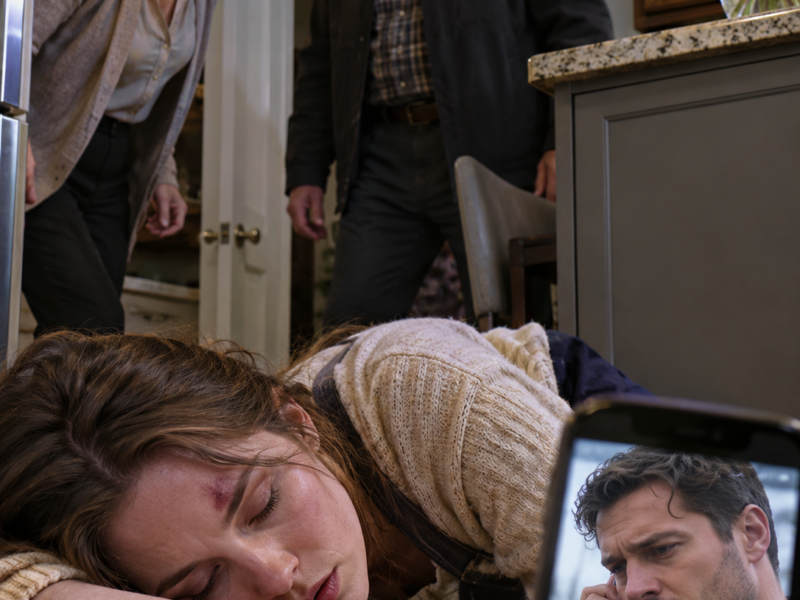
I Was 32 When I Collapsed on My Parents’ Kitchen Floor While Helping Move Their Washing Machine, but My Father Scoffed, “She Always Wants Attention,” and My Sister Stepped Over Me Before They All Walked Out. I Couldn’t Stand, Reach My Phone, or Call for Help Until a Neighbor Found Me and Dialed 911. For Seven Days, My Family Never Visited, but When My Mother Finally Called, a Stranger Answered My Phone Instead. What That Woman Said Next Left My Mother Speechless…
I Was 32 When I Collapsed on My Parents’ Kitchen Floor While Helping Move Their Washing Machine, but My Father Scoffed, “She Always Wants Attention,” and My Sister Stepped Over Me Before They All Walked Out. I Couldn’t Stand, Reach My Phone, or Call for Help Until a Neighbor Found Me and Dialed 911. For Seven Days, My Family Never Visited, but When My Mother Finally Called, a Stranger Answered My Phone Instead. What That Woman Said Next Left My Mother Speechless…
PART 1
The last thing I expected to hear while lying helpless on my parents’ kitchen floor was my own father laughing at me.
“Here we go again,” he muttered, shaking his head. “She always needs to make everything about herself.”
I tried to answer him, but my tongue felt impossibly heavy. My heart was hammering so violently that I could hear its rhythm inside my ears. The ceiling seemed to tilt above me, and every attempt to move sent another wave of dizziness through my body.
My younger sister, Maren, stepped over my legs as though I were an inconvenient piece of furniture.
“Just leave her alone,” she said impatiently. “She’ll get up when she realizes nobody’s paying attention.”
I looked toward my mother.
She was standing only a few feet away.
For one desperate second, our eyes met. I genuinely believed she would kneel beside me, touch my forehead, ask whether I could breathe, or at least reach for her phone.
Instead, she picked up her purse.
Then I heard the front door close.
And I was alone.
My name is Paige Whitaker. I was thirty-two years old when I discovered that the people who had spent my entire life telling me family came first were perfectly willing to abandon me when my life might depend on them.
But the most devastating part of this story isn’t what happened on that kitchen floor.
It’s what happened seven days later, when my mother finally called my phone and heard the voice of a woman she never expected to answer.
To understand why that phone call changed everything, you need to understand the kind of daughter I had spent my life trying to be.
I wasn’t rebellious. I wasn’t irresponsible. I wasn’t someone who constantly needed rescuing.
Actually, I was the exact opposite.
For years, I had been the person everyone in my family called whenever something went wrong.
A bill needed paying? Call Paige.
A doctor’s appointment needed arranging? Paige would handle it.
A broken appliance, an unexpected expense, a ride across town, a confusing insurance document?
Somehow, every problem eventually found its way to me.
I worked at a pharmaceutical distribution center in Tempe, Arizona. I’d started in an entry-level position processing orders, checking shipping information, and making sure medications reached the pharmacies that depended on them.
It wasn’t glamorous work, but it was important.
A single incorrect lot number or expiration date could create serious problems, and I took pride in being the kind of employee who caught mistakes before they became emergencies.
My supervisor, Victor Hale, noticed.
Over time, he gave me increasingly complicated responsibilities. I began coordinating between departments, correcting inventory discrepancies, and helping train employees who were struggling with the system.
When two senior coordinators left within a few months of each other, I helped keep their responsibilities from overwhelming the team.
Eventually, Victor called me into his office.
“Paige, you’ve been doing work above your position for months,” he said. “It’s time your title and paycheck reflected that.”
I was promoted to operations coordinator.
I remember sitting in my car afterward, staring at the official confirmation on my phone.
I had worked so hard for that moment.
And naturally, the first person I wanted to tell was my mother.
Her response?
“Oh, that’s wonderful, honey. Does that mean you’ll have a little more money now?”
Before I could answer, she continued.
“Because your father and I have been struggling with a few expenses.”
That was my family in one conversation.
My accomplishments were valuable only when they could be converted into something useful for someone else.
My father, Thomas, was even less interested in my career.
Whenever I mentioned a complicated assignment or an exhausting week, he’d wave his hand.
“You sit around looking at a computer. You don’t know what real work is.”
Meanwhile, he never hesitated to ask me to spend my weekends fixing things around his house.
My sister Maren was twenty-eight and had perfected a different strategy.
She rarely demanded anything directly.
Instead, she presented every problem as an emergency only I could solve.
“Paige, I’m short on rent this month.”
“Paige, my car’s making a weird noise.”
“Paige, I forgot to schedule that appointment. Can you do it?”
Sometimes I helped because I genuinely cared.
Other times I helped because refusing required more emotional energy than simply getting things done.
And somewhere along the way, my family stopped treating my assistance as kindness.
They started treating it as an obligation.
Three weeks before the incident, I began noticing how exhausted I was.
Not just physically.
Emotionally.
I’d finish ten hours at work and find six missed calls from relatives who needed something.
My mother expected me to answer during meetings. My father became irritated when I couldn’t visit immediately. Maren acted wounded whenever I told her I needed money for my own expenses.
I started saying no occasionally.
That was when the accusations began.
“You’ve changed since your promotion.”
“You think you’re better than us now.”
“Family should matter more than a job.”
I tried explaining that my job was how I paid my bills, maintained my independence, and built my future.
Nobody seemed interested.
Then, on a Thursday evening, my mother called about their washing machine.
The old machine needed to be moved before a replacement arrived. The delivery company had explained that the laundry area needed to be clear.
“We just need a little help shifting it,” Mom said.
“Can’t Dad and Maren manage it?”
“Your father has his back trouble, and you know Maren isn’t good with heavy things.”
I looked at my calendar.
Monday was already going to be a long day.
“Mom, I’m working until four.”
“Perfect. Come afterward. It’ll take fifteen minutes.”
I hesitated.
“Are you sure Dad will actually help?”
“Of course he will. Don’t make this complicated.”
I should have recognized that sentence as a warning.
But I agreed.
Monday afternoon arrived with the kind of dry Arizona heat that makes the air feel like it’s pressing against your skin.
I finished my shift, drove across Tempe, and stopped at my apartment long enough to change into an old T-shirt and jeans.
By the time I reached my parents’ house, my shoulders were aching and I had a dull headache.
My father opened the door.
“Finally,” he said.
I checked my phone.
I was exactly five minutes later than I’d estimated.
Inside, the washing machine was wedged into a narrow laundry area connected to the kitchen.
Their neighbor, Ruth Collins, had lent them an appliance dolly.
Ruth was a widow in her sixties who lived two houses down. She was the kind of woman who remembered people’s birthdays and brought soup when someone was sick.
She had apparently dropped off the dolly earlier that afternoon.
My father had already attached it to the washing machine, but when I inspected the strap, I noticed it wasn’t secure.
“Dad, this needs tightening.”
“It’ll hold.”
“If it slips, somebody could get hurt.”
He sighed dramatically.
“Fine. Do it your way.”
I tightened the strap, checked the wheels, and explained how we needed to guide the machine through the doorway.
Maren was standing in the kitchen looking at her phone.
“Can we hurry?” she asked. “I have plans.”
I looked at her.
“You could help.”
“I’m supervising.”
She laughed at her own joke.
I didn’t.
We started moving the washer.
At first, everything went smoothly.
Then one wheel caught against the threshold.
The machine tilted slightly, forcing me to brace the handle.
“Dad, hold it steady,” I said.
“Just pull harder.”
“I can’t pull while you’re pushing in the wrong direction.”
He made an irritated noise.
Maren glanced up from her phone.
“Seriously, how difficult can moving one washing machine be?”
I was about to respond when something strange happened.
My heart suddenly began racing.
Not the ordinary faster heartbeat that comes from exertion.
This felt completely different.
It was as though something inside my chest had lost its rhythm and was desperately trying to find it again.
I stopped moving.
“Wait,” I whispered.
Dad frowned.
“What now?”
“Something’s wrong.”
I put one hand against the counter.
The kitchen lights seemed unusually bright.
A wave of dizziness passed through me, followed by a frightening sensation of weakness spreading down my arms.
“I need to sit down.”
My father looked at the washing machine.
“Can you at least finish moving it first?”
“No. Dad, listen to me.”
I struggled to draw a full breath.
“My heart is beating really fast.”
Maren rolled her eyes.
“You’re probably just tired.”
“I don’t feel right.”
“You never feel right when somebody needs help,” Dad snapped.
Those words barely registered.
My fingers were beginning to lose their grip on the dolly.
I tried to step away.
The floor seemed to move beneath me.
I reached toward the countertop, but my hand slid across its edge.
Then my knees gave out.
I remember hitting the floor.
I remember the sharp pain in my shoulder.
And I remember looking up at three people who seemed more irritated than frightened.
“Paige?” my mother said.
I tried to answer.
Nothing came out.
My father leaned forward slightly.
Then he straightened.
“She always wants attention.”
I wanted to scream.
I wanted to tell him I wasn’t pretending.
That something was terribly wrong.
That I couldn’t make my arms support my weight.
Maren walked around me toward the hallway.
“Leave her. She’ll be fine.”
My mother hesitated.
For one extraordinary moment, I thought she might finally understand.
“Mom,” I whispered.
She didn’t kneel down.
She didn’t check my pulse.
She didn’t call an ambulance.
She simply looked toward my father, waiting for him to decide what should happen.
And he decided they were leaving.
I heard Maren collecting her bag.
My father’s keys jingled.
My mother said something about being late.
Then their voices faded.
The front door slammed.
I was still on the kitchen floor.
My phone was several feet away on the counter.
I tried dragging myself toward it.
My shoulder burned.
My arms trembled.
I barely moved an inch.
That’s when the fear truly arrived.
Because until that moment, even after everything they’d said, some part of me believed my family would come back.
Surely they wouldn’t leave me like this.
Surely my mother would realize.
Surely my father would turn around.
But the house remained silent.
And as my vision began darkening around the edges, I understood something that would haunt me long after I recovered.
I had spent my entire adult life running to my family’s rescue.
Yet when I desperately needed someone to rescue me, they had walked away.
The next thing I remembered was a woman’s voice.
“Paige? Honey, can you hear me?”
It wasn’t my mother.
And the hands reaching toward me didn’t belong to anyone in my family.
They belonged to Ruth Collins.
I didn’t know it then, but that woman had just changed the course of my life.
PART 2
Ruth had returned to collect a strap she’d accidentally left behind with the appliance dolly.
She expected to find my family finishing the job.
Instead, she found me collapsed beside the washing machine.
“Paige, don’t try to stand,” she said, kneeling beside me.
She immediately called 911.
While following the dispatcher’s instructions, she stayed beside me, speaking calmly even when I struggled to respond.
I remember hearing sirens.
Then unfamiliar voices.
Then nothing.
When I opened my eyes the next morning, I was in a hospital bed, connected to a heart monitor.
A physician named Dr. Aaron Feld explained that my heart had shown an abnormal rhythm requiring further evaluation.
I could barely process his words.
“Who called the ambulance?” I asked.
“Your neighbor,” he answered.
“Where’s my family?”
He paused.
“There’s no record of anyone from your family visiting.”
I stared at the empty chair beside my bed.
My parents knew I’d collapsed.
My sister had watched it happen.
Yet none of them had come.
Later that afternoon, my best friend Dana arrived with clothes and my phone charger.
She held my hand while I cried.
And then she asked the question I had been avoiding.
“Paige, if Ruth hadn’t returned for that strap, who would have found you?”
I had no answer.
PART 3
The question stayed with me long after Dana left the hospital that evening.
If Ruth hadn’t returned, how long would I have remained on the kitchen floor?
Another hour?
Until the next morning?
Would my family eventually have come back and found me unconscious?
Or would they have assumed I’d gotten up, gone home, and decided to punish them by refusing their calls?
I hated those thoughts.
They were frightening, impossible to answer, and ultimately useless to my recovery.
But every time I closed my eyes, I heard the front door shutting.
I could remember the sound more clearly than the paramedics arriving.
That realization disturbed me.
A single ordinary sound had become associated with the most helpless moment of my life.
Dr. Feld visited the following morning.
He explained that the monitoring had identified an abnormal heart rhythm, although the team still needed to determine its cause and decide on appropriate treatment.
He asked whether I’d experienced similar symptoms previously.
I admitted I’d occasionally felt my heart flutter or race during stressful days.
Usually, I dismissed it as exhaustion.
“Did you ever tell anyone?” he asked.
“My family thought I was being dramatic whenever I mentioned feeling unwell.”
He looked at me carefully.
“Regardless of what anyone else thought, symptoms like yours deserve medical attention.”
I nodded.
It was such a straightforward statement.
Yet hearing someone take my physical condition seriously nearly made me cry again.
Over the next two days, the hospital team continued evaluating my condition.
There were blood tests, monitoring, medical questions, and conversations about what I could safely do after discharge.
I learned more about my own health during those days than I had during years of ignoring warning signs.
But while my doctors tried to understand what had happened inside my body, I was trying to understand what had happened inside my family.
I kept checking my phone.
Not because I wanted to speak to them.
Because I couldn’t believe they had remained silent.
On the first morning, I found a message from Maren.
Did you end up moving the washer back against the wall? Dad says it’s blocking the kitchen.
I read it three times.
There was no question about my health.
No mention of my collapse.
No concern that I might need help.
Just the washing machine.
I showed the message to Dana when she arrived.
Her expression changed.
“Are you serious?”
I nodded.
She took a moment before speaking.
“Paige, I don’t think you understand how badly they’ve conditioned you to accept being treated like this.”
I wanted to defend them.
The instinct appeared automatically.
Maybe Maren didn’t know I’d been hospitalized.
Maybe my parents hadn’t explained.
Maybe they genuinely believed I had recovered.
Then Dana asked something devastating.
“Even if they thought you were fine, wouldn’t a normal person check?”
I looked away.
She was right.
Someone who cared would have checked.
I remembered countless nights when Maren called me because she had a headache, a flat tire, or an unexpected bill.
I’d always responded.
Once, she called at eleven thirty because she’d locked herself out of her apartment.
I drove forty minutes to help her.
Another time, Dad developed a mild fever and Mom called me six times because she was worried.
I went over with groceries and medicine.
When Mom needed a minor outpatient procedure, I rearranged my schedule to drive her there and back.
I never considered those things extraordinary.
I thought that was simply what family did.
But apparently, family responsibilities only flowed in one direction.
That afternoon, I asked the hospital records department how I could obtain documentation about my admission.
I wasn’t planning revenge.
I wasn’t looking for someone to sue.
I simply wanted to know exactly what could be confirmed.
My memory of the collapse was fragmented.
I remembered asking for help.
I remembered their reactions.
I remembered hearing them leave.
But I didn’t know how much time passed before Ruth found me.
The hospital records confirmed that paramedics brought me in after an emergency call from a neighbor.
They recorded my symptoms and the observations made by medical staff.
They didn’t reveal what my family had been thinking.
And they couldn’t establish every detail of the time I’d spent alone.
I understood those limits.
Still, the information mattered.
For years, my family had convinced me that disagreements happened because I remembered things incorrectly.
Whenever I pointed out an unfair expectation, Dad accused me of exaggerating.
Whenever Maren failed to repay money, she claimed I’d misunderstood our agreement.
Whenever Mom promised to help and didn’t, she’d tell me I was too sensitive.
I was tired of doubting myself.
This time, I wanted to separate what I remembered from what I could verify.
I called Ruth.
She answered immediately.
“Paige! How are you feeling, sweetheart?”
Her concern nearly broke me.
I explained that I was recovering and asked whether she could tell me what had happened when she returned.
“Of course.”
She described entering the house and calling out.
Nobody answered.
The washing machine was near the kitchen doorway.
Then she saw me.
“You were on the floor,” she said softly. “You looked terribly pale. I asked whether you could hear me, and you tried to answer, but you couldn’t get yourself up.”
“Was anyone else there?”
“Not when I arrived.”
“Did you see them leave?”
“No, honey. I don’t want to tell you something I didn’t personally see.”
I appreciated her honesty.
She couldn’t know precisely when my family had left.
But she could confirm that she’d found me alone, called emergency services, and remained until help arrived.
“Ruth, can I ask you something?”
“Anything.”
“Were you scared?”
There was a pause.
“Yes,” she admitted. “I was.”
My throat tightened.
She continued.
“When I saw you couldn’t get up, I knew you needed professional help. I wasn’t going to leave you there.”
I stared at the blanket covering my legs.
A neighbor had recognized the seriousness of my condition in seconds.
My own family had watched me collapse and walked away.
After ending the call, I began organizing everything.
I saved Mom’s original request about the washing machine.
I kept Maren’s message asking when I would arrive.
I wrote down what I remembered saying when my heart began racing.
I recorded the approximate sequence of events and marked the details I couldn’t independently confirm.
Dana helped me put the notes in order.
“You’re handling this like one of your inventory investigations,” she observed.
I almost smiled.
“It’s the only way I know how to deal with something that doesn’t make sense.”
She sat beside me.
“Maybe you’ll never understand why they did it.”
That possibility frightened me more than I expected.
I wanted a reason.
I wanted someone to explain how three adults could watch another person collapse without calling for assistance.
I wanted there to be some enormous misunderstanding that would make their behavior less awful.
But each day passed without an explanation.
On the fourth day, my mother finally sent a text.
Are you still at the hospital?
That was all.
Not How are you?
Not What happened?
Not I’m sorry.
Just a question that sounded almost irritated.
I didn’t respond.
Instead, I placed the phone facedown.
For the first time in my life, I allowed one of my mother’s questions to remain unanswered.
The silence felt uncomfortable.
But it also felt strangely peaceful.
By the sixth day, the medical team was discussing the possibility of discharge after my remaining evaluations were complete.
I would need follow-up appointments, medication management, and temporary restrictions.
I couldn’t simply return to normal life immediately.
Victor called after receiving my medical leave documentation.
“Paige, I want you to focus on getting better,” he said.
I apologized for the sudden absence.
He interrupted.
“You don’t need to apologize for having a medical emergency.”
Another simple sentence.
Another moment when a person outside my family offered more understanding than the people who had raised me.
Victor explained that the team could cover my responsibilities.
My position would be waiting when I was medically cleared.
I thanked him.
After the call, I sat quietly for a long time.
At work, I was valued for being reliable, but my supervisor understood that I was human.
At home, reliability had become a trap.
The difference was impossible to ignore.
On the seventh day, Ruth came to visit.
She brought a small bag containing a soft blanket, fruit, and a paperback novel.
“You need something besides hospital television,” she said.
I laughed for the first time in days.
We talked about my recovery, the weather, and her little garden.
I told her that I wasn’t ready to speak to my family.
She nodded.
“Then you don’t have to.”
I explained that I was exhausted and might fall asleep between tests.
“Would you mind keeping my phone nearby?” I asked. “If someone calls, you can say I’m resting and take a message. But please don’t discuss my medical information.”
“Of course.”
I trusted her.
Not because she made grand promises.
Because she had already shown me what she would do when I needed help.
Later that afternoon, I fell asleep.
I don’t know how long I’d been resting when my phone began vibrating.
Mom’s name appeared on the screen.
Ruth picked it up.
“Hello?”
There was a silence.
Then my mother’s familiar voice.
“Who is this? Where’s Paige?”
Ruth introduced herself.
“I’m Ruth Collins. I’m the neighbor who found Paige on your kitchen floor.”
According to Ruth, my mother immediately sounded uncomfortable.
“Why are you answering my daughter’s phone?”
“Paige gave me permission to take messages while she’s resting.”
“What do you mean, resting?”
Ruth kept her voice calm.
“She’s receiving medical care. When I found her at your house, she couldn’t get up. I called 911 because she needed help.”
My mother apparently hesitated.
Then she asked the question that exposed just how little she understood.
“Why were you involved in our family business?”
Ruth answered quietly.
“Because when I found your daughter, she needed emergency assistance, and nobody else was there to give it.”
My mother didn’t know what to say.
For the first time, someone outside our family had directly confronted the reality she’d been avoiding.
And when Ruth later placed the phone in my hand, I realized I was finally ready to ask my family one question they couldn’t dismiss.
PART 4
“Mom,” I said, my voice still weak. “Why did you leave me on the floor?”
There was a long silence.
Then I heard my father’s voice in the background.
“Who’s that?”
“It’s Paige,” Mom answered.
A moment later, the phone was on speaker.
Maren joined the conversation.
Suddenly, all three people who had abandoned me were listening.
For seven days, I’d imagined this moment.
I’d imagined my mother crying with relief.
I’d imagined my father apologizing.
I’d imagined Maren admitting she’d been frightened and hadn’t known what to do.
But the first thing my father said was, “We didn’t know you were actually sick.”
I closed my eyes.
“Dad, I told you something was wrong.”
“You said you were dizzy.”
“I told you my heart was racing.”
“Well, people get dizzy.”
“I collapsed.”
Nobody answered.
I continued.
“I couldn’t stand. I couldn’t reach my phone. You saw that.”
My mother interrupted.
“Sweetheart, everything happened so quickly.”
“Then why didn’t anyone call 911?”
“We thought you needed to rest.”
“On the kitchen floor?”
Her silence told me more than her words.
Maren finally spoke.
“I thought Dad was handling it.”
I stared at the wall.
“And Dad thought what, exactly?”
My father sounded irritated.
“I thought you were exaggerating like you sometimes do.”
Something inside me became very still.
For years, those words would have made me defensive.
I would have reminded him about my responsibilities, listed the ways I helped, and begged him to acknowledge that I wasn’t dramatic.
But lying in that hospital bed, I finally understood that defending myself wasn’t the problem.
The problem was that he believed he had the authority to decide whether my suffering deserved attention.
“Dad,” I said, “you didn’t have to know what was medically wrong. You only had to recognize that your daughter couldn’t get off the floor.”
He exhaled.
“We thought you’d be fine.”
“And if Ruth hadn’t returned?”
No answer.
“What if she hadn’t come back for her strap? What would you have done?”
Mom began crying.
“Paige, please don’t talk like that.”
“Why not?”
“Because you’re frightening me.”
I almost laughed.
I had been terrified on that kitchen floor.
Now she was asking me to protect her from the discomfort of hearing about it.
“I was frightened too, Mom.”
She started explaining how stressful the day had been.
The replacement washing machine was expensive.
Dad had been having back trouble.
Maren was dealing with personal problems.
Everyone was overwhelmed.
I listened until she finished.
Then I said, “None of those things explains leaving me without help.”
Dad snapped.
“Are you going to hold this over our heads forever?”
I took a slow breath.
“No. I’m going to stop letting you hold everything else over mine.”
“What does that mean?”
“It means things are changing.”
I explained that I would no longer pay their bills, arrange appointments, handle household problems, or rearrange my career around their demands.
Maren immediately became defensive.
“So you’re punishing all of us?”
“I’m protecting myself.”
“Over one mistake?”
I stared at my phone.
One mistake.
That was what she called leaving her sister unable to stand on a kitchen floor.
“You had three chances to help,” I said. “Mom could have called. Dad could have called. You could have called. None of you did.”
Mom protested.
“We’re still your family.”
“Then why did a neighbor have to act like it?”
Nobody spoke.
I told them I needed space and would contact them when I was ready.
Then I ended the call.
Ruth was sitting quietly beside the window.
She hadn’t heard every word, but she could see my hands trembling.
“Are you all right?” she asked.
I looked at the phone.
“I think I just told my family no.”
She reached across the bed and squeezed my hand.
“Sounds like you’ve had a very difficult week.”
I nodded.
What surprised me was that beneath the sadness, I felt relief.
The conversation hadn’t produced a genuine apology.
But I had finally stopped trying to convince my family to understand something they seemed determined to minimize.
A few days later, Dr. Feld cleared me to return home with restrictions.
I wasn’t permitted to drive until my symptoms had been reviewed again.
I needed follow-up appointments and careful attention to medication instructions.
Dana offered to bring me home.
Ruth offered to help with groceries.
Victor confirmed that my leave arrangements remained in place.
For the first time, I was accepting help from people who didn’t attach emotional debts to their kindness.
When I reached my apartment, I expected to feel lonely.
Instead, I felt safe.
There was no one demanding that I solve their problems.
No one accusing me of laziness for resting.
No one treating my medical restrictions as an inconvenience.
Dana helped me put away groceries.
Then she sat at the kitchen table while I reviewed my bills.
“Are you going to be okay financially?” she asked.
“I think so.”
I had savings.
Not an enormous amount, but enough to manage my immediate expenses while I sorted out my leave and medical costs.
I contacted the hospital billing office, reviewed my insurance information, and asked about payment arrangements.
I scheduled grocery deliveries.
I confirmed my follow-up appointments.
These were ordinary responsibilities.
Yet doing them for myself felt like reclaiming something important.
For years, I’d been so busy managing everyone else’s life that my own needs always came last.
Now I had no choice but to prioritize them.
Unfortunately, my family didn’t appreciate the change.
Two days after I returned home, Mom texted.
Can you call the appliance company? They’re giving your father a hard time about the delivery.
I stared at the message.
I had been home from the hospital less than forty-eight hours.
She hadn’t asked whether I could sleep comfortably.
She hadn’t asked about my medications.
She hadn’t asked whether I needed groceries.
She wanted me to call about a washing machine.
I replied, You’ll need to contact them yourself. I’m recovering.
Her response arrived almost immediately.
You’re making everything harder than it needs to be.
I put my phone down.
An hour later, Maren called.
I let it go to voicemail.
She left a message.
“Paige, Mom’s really upset. You can’t just abandon everybody because you’re angry.”
I listened once.
Then I deleted it.
The following morning, Dad texted me about an overdue payment notice.
Normally, I would have called the company, negotiated an extension, and possibly covered the amount myself.
Instead, I replied with one sentence.
You’ll need to handle your own payment arrangements.
He didn’t respond.
But Mom did.
I don’t recognize you anymore.
I read those words while sitting on my couch with a blanket over my legs.
For a moment, guilt washed over me.
My mother was upset.
My father was angry.
My sister thought I was cruel.
The old version of me would have panicked.
I would have called everyone, apologized, and offered to help with something just to restore peace.
Instead, I opened the notebook Dana had bought me.
On the first page, I wrote:
Being available to everyone else is not the same as being loved.
I stared at that sentence for several minutes.
Then I wrote another.
An emergency does not become my responsibility simply because someone expects me to solve it.
I started listing the boundaries I needed.
No more lending money to relatives who repeatedly failed to repay it.
No more rearranging my work schedule for problems they could manage themselves.
No more accepting insults as the price of being helpful.
And most importantly, no more allowing anyone to dismiss my health or safety.
Writing those boundaries was easier than living by them.
Every time my phone rang, I felt an almost physical urge to answer.
Every time Mom sent an upset message, I wanted to explain myself more clearly.
I kept hoping that if I found the perfect words, she’d finally understand.
Dana noticed.
One afternoon, while helping me prepare lunch, she asked, “What are you hoping your parents will say?”
I thought about it.
“I want them to admit they were wrong.”
“And if they never do?”
I didn’t answer immediately.
That was the painful question.
What if the apology I needed never came?
What if they preferred protecting their self-image to acknowledging what they’d done?
Would I spend the rest of my life waiting?
Dana leaned against the counter.
“You’re allowed to make decisions based on what happened, Paige. You don’t need them to agree with your version of events.”
I knew she was right.
Still, I wanted one final conversation.
Not another chaotic phone call.
Not another argument interrupted by household complaints.
I wanted to look all three of them in the eyes and say exactly what their choices had cost me.
So I arranged a meeting at a community center.
It was a public building with small rooms available for private discussions.
I chose it because I didn’t want to return to my parents’ house.
I didn’t want to sit at their kitchen table, within sight of the place where I’d collapsed.
And I wanted to be able to leave whenever I decided the conversation was over.
I sent a message to my parents and Maren.
I’m willing to meet once to discuss what happened and explain my decisions going forward. This is not a meeting about the washing machine, your bills, or anyone else’s problems.
Mom replied first.
We’ll be there. I hope you’re finally ready to be reasonable.
That sentence almost made me cancel.
Instead, I confirmed the time.
Then I called Ruth.
“Would you be willing to come with me?” I asked.
She hesitated.
“Are you sure you want me there?”
“Yes. I want someone who can explain what she personally saw.”
Ruth agreed.
I spent the next few days preparing.
I organized the hospital timeline, the messages about the washing machine, and the account Ruth had given me.
I knew the records couldn’t explain everything that happened inside the house.
But I also knew what I remembered.
I wasn’t preparing to put my family on trial.
I was preparing to stop allowing them to rewrite the experience until it became something harmless.
On the morning of the meeting, I dressed carefully.
Simple jeans, a blue blouse, comfortable shoes.
I placed my notes in a folder and checked my phone battery.
Before leaving, I looked at myself in the mirror.
I looked tired.
My recovery wasn’t complete.
But there was something different about my expression.
I wasn’t going to that meeting to beg for their love.
I was going to tell them what I would no longer accept.
And when my mother walked into the room and saw Ruth sitting beside me, the look on her face told me she hadn’t expected to be confronted by the one person who had actually saved me.
PART 5
My mother stopped just inside the meeting room.
For a moment, she simply stared at Ruth.
Then she looked at me.
“Why is she here?”
Her tone was sharp enough to make me realize that she still believed she could control how this conversation unfolded.
“Because Ruth found me,” I answered. “And because I asked her to come.”
Mom tightened her grip on her purse.
“This is a family matter.”
Ruth remained calm.
“I understand,” she said. “I’m only here to explain what I personally witnessed.”
Dad entered behind Mom, followed by Maren.
My sister looked uncomfortable the moment she saw the folders on the table.
“What’s all this?” she asked.
“My notes.”
“Are you seriously documenting everything?”
“Yes.”
She shook her head.
“This is ridiculous.”
I waited until everyone had taken a seat.
Then I began.
“I asked you here because I need to make something clear. I’m not interested in arguing about whether I was dramatic, tired, or difficult that afternoon. I’m interested in what happened when I collapsed.”
Mom immediately tried to interrupt.
I raised my hand.
“Please let me finish.”
To my surprise, she stopped.
I explained the timeline.
Mom had asked me to come after work.
Dad had agreed to help move the washing machine.
Maren knew I was coming.
We had used Ruth’s dolly to move the appliance through the narrow doorway.
When I began feeling unwell, I said something was wrong.
I asked them to stop.
My heart was racing, I became dizzy, and I lost my balance.
Then I collapsed.
“I remember trying to get up,” I said. “I remember hearing you moving around me. And I remember the front door closing.”
Dad shifted in his chair.
“We already told you we thought you were fine.”
I looked at him.
“How did you know?”
He frowned.
“What?”
“How did you know I was fine?”
“We assumed—”
“Did you check whether I could stand?”
He said nothing.
“Did you ask whether I could breathe normally?”
Silence.
“Did you call 911?”
“No, but—”
“Did you call Ruth and ask her to check on me?”
Dad looked away.
“No.”
I let the answer sit between us.
Then I turned toward Ruth.
“Would you explain what happened when you returned?”
She nodded.
“I came back for a strap that belonged to the dolly. I called out when I entered, but nobody answered. When I reached the kitchen, Paige was on the floor beside the washing machine. She was clearly having difficulty getting up.”
Ruth paused.
“I called emergency services and stayed with her until the ambulance arrived.”
Mom crossed her arms.
“Well, obviously we’re grateful you helped.”
Ruth answered gently.
“I wasn’t looking for gratitude.”
My mother’s expression hardened.
Ruth continued.
“I’m only explaining why I called. Paige needed assistance, and I wasn’t comfortable leaving her alone.”
I watched Mom process those words.
For once, there was no dramatic accusation.
No shouting.
No insult.
Just a straightforward description of what had happened.
And somehow, that made it harder for her to dismiss.
Dad cleared his throat.
“I don’t understand why we’re making such a production out of one bad afternoon.”
I turned back toward him.
“Because that afternoon could have ended very differently.”
“You don’t know that.”
“No,” I agreed. “I don’t. And neither did you when you walked away.”
He opened his mouth, then closed it.
I continued.
“You keep saying you thought I’d be fine. But you didn’t check. You didn’t call anyone. You simply decided I wasn’t worth interrupting your day over.”
Mom began shaking her head.
“That’s not fair.”
“Then explain what happened.”
She looked genuinely frustrated.
“Your father was stressed. Maren had things going on. The machine was blocking the kitchen. Everything was chaotic.”
I listened.
Then I asked, “Which one of those problems prevented you from calling an ambulance?”
She didn’t answer.
Maren finally spoke.
“I didn’t understand how serious it was.”
I looked at her.
“You saw me fall.”
“Yes.”
“You heard me say something was wrong.”
“Yes, but—”
“You saw me struggling to get up.”
She looked down.
“I thought Dad would handle it.”
“Did you ask him?”
“No.”
“Did you check whether he had called someone?”
“No.”
“Then you didn’t know anyone was handling it.”
Her eyes filled with tears.
“I didn’t mean for you to get hurt.”
For the first time, I heard something in her voice that sounded less like anger and more like fear.
But I wasn’t prepared to confuse regret with accountability.
“Maren, I’m not saying you wanted me hurt. I’m saying you walked away when I needed help.”
She wiped her eyes.
“I know.”
The admission surprised me.
I waited.
But she didn’t apologize.
Instead, she added, “I just don’t think you should treat me like a terrible person forever.”
And there it was.
Even now, she was more concerned about what my judgment meant for her than what her actions had meant for me.
I felt a sadness settle over me.
Not the sharp, panicked sadness I’d experienced in the hospital.
Something quieter.
The sadness of finally accepting that people might never become who you needed them to be.
Mom leaned forward.
“Paige, families make mistakes. You can’t throw away your entire family over one incident.”
I looked at her.
“You’re right about one thing. Families do make mistakes.”
She seemed relieved.
“But when people make serious mistakes, they need to acknowledge them.”
Dad crossed his arms.
“What do you want, then? For us to get on our knees?”
“No.”
“Then what?”
“I wanted you to care.”
The room fell silent.
I continued before anyone could interrupt.
“I wanted you to ask if I was okay. I wanted someone to come to the hospital. I wanted a phone call that wasn’t about an appliance or a bill. I wanted one of you to say, ‘Paige, we should have helped you, and we’re sorry.’”
Mom began crying.
I looked at her without moving.
For most of my life, her tears had been enough to make me surrender.
If she cried during an argument, I apologized.
If she became upset about money, I helped.
If she said I was disappointing her, I abandoned whatever boundary I’d attempted to set.
But this time, I didn’t reach across the table.
I didn’t offer a tissue.
I didn’t tell her everything was all right.
Because everything wasn’t all right.
“I’m not here to punish you,” I said. “I’m here to tell you that our relationship cannot continue the way it has.”
Dad sighed loudly.
“Here we go.”
I ignored him.
“I won’t be sending money anymore. I won’t be arranging appointments, paying bills, or managing repairs. I won’t be available whenever someone decides their problem is suddenly my responsibility.”
Mom shook her head.
“We’ve always helped each other.”
I looked at her.
“Have we?”
She frowned.
“What is that supposed to mean?”
“It means I can remember dozens of emergencies when I came running to help you. But when I had an actual medical emergency, all three of you left.”
Dad’s face reddened.
“You keep saying that like we deliberately tried to hurt you.”
“I’ve never claimed to know what you intended.”
“Then stop acting like we’re monsters.”
“I’m talking about what you did.”
He pushed his chair backward.
“Families shouldn’t abandon each other.”
I stared at him.
The irony was so obvious that for a moment I couldn’t believe he’d said it.
Then I answered quietly.
“Dad, you abandoned me when I couldn’t stand.”
He froze.
No one moved.
For several seconds, the only sound was the distant murmur of people walking through the community center hallway.
Then Mom spoke.
“So what now? Are you never going to speak to us again?”
I had spent days considering that question.
I had thought about birthdays, holidays, future celebrations, and all the ordinary moments when people expected family members to gather.
I’d imagined the questions relatives would ask.
I’d imagined my mother telling people I’d become selfish after my promotion.
I’d imagined Dad insisting that I’d exaggerated a minor incident.
I’d imagined Maren describing herself as the victim of my cruelty.
And I had realized something important.
I couldn’t control the story they told.
I could only control the life I chose to live.
“For now, I’m ending personal contact,” I said. “Any necessary practical communication can be handled briefly in writing. I’m not taking calls asking for favors or money.”
Mom looked horrified.
“You can’t mean that.”
“I do.”
“We raised you.”
“I know.”
“We sacrificed for you.”
“I know you made sacrifices.”
“Then how can you do this?”
I took a breath.
“Because being grateful for what you did when I was a child doesn’t mean I have to accept being treated badly as an adult.”
Dad stood.
“This is unbelievable.”
I remained seated.
“You don’t have to agree.”
Mom’s tears became louder.
“After everything we’ve done for you, this is how you repay us?”
I felt the old guilt rising.
It was familiar.
Powerful.
Almost comforting in its predictability.
For one second, I considered softening my decision.
Maybe I could promise to help occasionally.
Maybe I could tell them I’d reconsider after a few weeks.
Maybe I could make the conversation less painful.
Then I remembered the floor.
The cold tiles against my cheek.
My phone just out of reach.
The sound of Maren’s footsteps.
The closing door.
And the horrifying knowledge that nobody was coming back.
The guilt faded.
“I didn’t come here to negotiate my safety,” I said.
Maren looked up.
“So that’s it?”
“Yes.”
“You’re just done?”
I nodded.
“I’m done being responsible for people who refuse to take responsibility for themselves.”
Mom whispered, “You’re breaking this family.”
I gathered my papers.
“No, Mom. I’m acknowledging that something was already broken.”
Then I stood.
My legs still felt weaker than they had before the incident, but I was steady enough to walk.
Ruth rose beside me.
Mom looked between us.
“You’re leaving?”
“Yes.”
“Just like that?”
I looked at her one last time.
“I asked for help when I couldn’t walk away. You left anyway. Today, I can walk away, and that’s what I’m choosing to do.”
I thanked Ruth for coming.
Then I opened the door.
Nobody followed.
Outside, the afternoon sunlight was warm against my face.
I expected to feel triumphant.
I didn’t.
I felt exhausted.
Sad.
And strangely free.
Ruth walked beside me toward the parking lot.
When we reached her car, she stopped.
“Are you okay?”
I thought carefully before answering.
“Not completely.”
She smiled gently.
“That’s understandable.”
I looked back at the building.
“I think I kept hoping they’d say something that would change everything.”
“And did they?”
“No.”
She waited.
“But I think I’ve finally accepted that I don’t need them to.”
Ruth nodded.
“That’s a good place to begin.”
Over the following weeks, I began learning what life looked like when I wasn’t constantly preparing to rescue my family.
At first, it felt unnatural.
I’d wake up on Saturday mornings expecting a request.
I’d finish work-related paperwork and instinctively check whether Mom needed help with something.
I’d see a missed call from an unfamiliar number and feel my stomach tighten.
But slowly, those habits began to fade.
I muted the family message thread.
When unwanted calls continued, I blocked the numbers involved.
I kept my written record of the boundaries I’d communicated, but I stopped reopening the notes every time I felt guilty.
I didn’t need to relive the kitchen incident daily to justify my decision.
Meanwhile, my recovery continued.
Dr. Feld monitored my progress, reviewed my symptoms, and adjusted my treatment plan as necessary.
I attended my appointments.
I followed the activity restrictions.
And I learned that taking care of my health was not an act of selfishness.
Six weeks after the incident, I was cleared to return to work with adjustments.
Victor welcomed me back without making me feel guilty about my absence.
He arranged a manageable schedule and made sure another coordinator could cover duties that required longer hours.
“We’re glad you’re back,” he said. “But don’t try to do everything at once.”
I almost laughed.
That was exactly what I’d spent my entire life doing.
Trying to do everything.
For everyone.
All at once.
But this time, I listened.
I returned to the work I enjoyed.
I helped improve the inventory review process.
I trained another employee to handle routine discrepancies.
And I began delegating tasks instead of assuming that being dependable meant personally carrying every burden.
Outside work, Dana and I started spending more time together.
Sometimes we went to dinner.
Sometimes we watched movies.
Sometimes we simply sat on my balcony talking about ordinary things.
There was something wonderful about conversations that didn’t end with someone asking for money or help.
Ruth continued checking in occasionally.
I brought her flowers one weekend to thank her.
She laughed when I handed them over.
“You didn’t have to do that.”
“I know,” I answered. “I wanted to.”
And that distinction meant everything.
Helping because I wanted to felt completely different from helping because I was afraid of what would happen if I refused.
As for my family, I heard occasional updates through relatives.
My parents eventually arranged the washing machine delivery themselves.
They hired someone to handle a few household repairs.
Maren began asking other people for transportation and financial help.
Some relatives suggested that I should reconsider my decision.
Others quietly admitted they’d noticed how much my family depended on me.
I didn’t argue with anyone.
I simply explained that I had made a decision about my own life and wasn’t looking for people to take sides.
I didn’t need my parents to suffer.
I didn’t want Maren’s life to fall apart.
I didn’t wish misfortune on any of them.
I just no longer believed it was my responsibility to prevent every inconvenience they encountered.
One evening, nearly two months after the collapse, I was sitting on my balcony when Dana called.
“Guess what?” she said.
“What?”
“I found a little place near Sedona that I think you’d love. Once your doctor says you’re ready to travel, we should take a weekend trip.”
I smiled.
Before the incident, I would immediately have checked whether my parents needed anything that weekend.
I might have worried about Maren borrowing my car.
I might have wondered whether Mom would accuse me of wasting money while she struggled with bills.
But this time, my first thought was different.
That sounds wonderful.
“Send me the details,” I said.
After we hung up, I sat outside watching the evening sky change color.
For the first time in a long while, my future felt like something that belonged to me.
I had a job I cared about.
A home where I felt safe.
Friends who respected my boundaries.
A neighbor whose kindness had reminded me what real concern looked like.
And a growing understanding that love shouldn’t require someone to disappear into the needs of everyone around them.
I still thought about the kitchen sometimes.
I probably always would.
There were moments when certain sounds brought the memory back unexpectedly.
A door shutting.
The wheels of a heavy appliance rolling over a threshold.
Someone saying, “You’re exaggerating.”
But those memories no longer controlled my decisions.
They reminded me why I’d changed.
I had once believed that being a good daughter meant being available no matter how badly I was treated.
I believed family loyalty required endless forgiveness, unlimited patience, and a willingness to sacrifice my own needs.
Now I understood something I wished I’d learned much earlier.
Family isn’t defined only by blood.
It’s also defined by actions.
By who notices when you’re struggling.
By who stays when helping becomes inconvenient.
By who picks up the phone when you can’t.
And by who chooses to protect you when you are too vulnerable to protect yourself.
My parents had spent years telling me that family came first.
But when I lay helpless on their kitchen floor, they chose to walk away.
Ruth Collins, a woman who owed me absolutely nothing, chose to stay.
Seven days later, when my mother finally called and heard Ruth’s voice instead of mine, she was confronted with a reality she’d spent a week avoiding.
Someone else had done what my family should have done.
Someone else had recognized that my life mattered.
And although I couldn’t change what happened that afternoon, I could change what happened afterward.
I could stop begging for consideration.
I could stop confusing obligation with love.
I could stop measuring my worth by how much I sacrificed for people who never seemed satisfied.
Most importantly, I could choose not to return to a relationship simply because the people who hurt me wanted things to go back to normal.
Because normal had nearly cost me everything.
I survived that afternoon because a neighbor returned for a forgotten strap.
But I began truly living again when I realized I didn’t have to keep returning to the people who had left me behind.
And if there’s one thing I know now, it’s this:
The people who call themselves your family may expect you to stay forever. But when they’ve shown you that your safety means less to them than their convenience, walking away isn’t betrayal. Sometimes, it’s the first time you’ve truly chosen yourself.