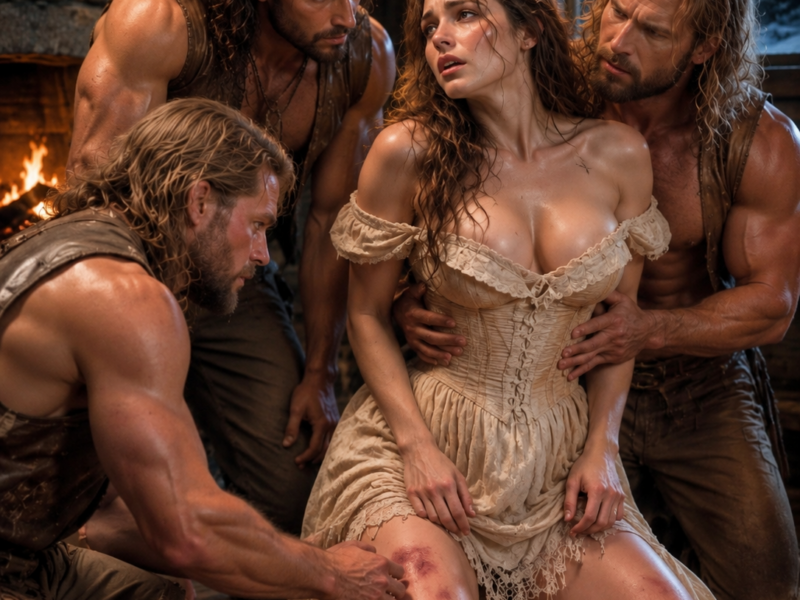
I Was 23 When I Arrived in Montana to Marry a Rancher, Only to Discover Three Mountain Men Waiting for Me Instead. They Tore Up My Marriage Contract and Offered Me Freedom, but Weeks Later, a Corrupt Judge Seized Our Ranch, Set the Mountain on Fire, and Had Me Kidnapped. As I Escaped Barefoot and Bleeding, I Remembered the Secret Legal Papers I’d Filed Behind Everyone’s Back. When the Judge Shouted, “I Am the Law in This County!” I Stepped Forward With One Document He Never Expected Me to Have…
I Was 23 When I Arrived in Montana to Marry a Rancher, Only to Discover Three Mountain Men Waiting for Me Instead. They Tore Up My Marriage Contract and Offered Me Freedom, but Weeks Later, a Corrupt Judge Seized Our Ranch, Set the Mountain on Fire, and Had Me Kidnapped. As I Escaped Barefoot and Bleeding, I Remembered the Secret Legal Papers I’d Filed Behind Everyone’s Back. When the Judge Shouted, “I Am the Law in This County!” I Stepped Forward With One Document He Never Expected Me to Have…
Part 1
The first time I met the three men who were supposed to become my husbands, I was standing alone on a dusty train platform in Montana, clutching a suitcase that held everything I owned. The second time I truly understood what kind of men they were, I was barefoot, bleeding, and running through a canyon while an entire mountainside burned behind me.
But the strangest part of my story wasn’t that three strangers had offered me a home.
It was that the most powerful man in the county wanted all four of us dead, and I was the only one who knew how to stop him.
My name is Clementine Ashford. I was twenty-three years old in the summer of 1878, and until that August, I had never traveled farther west than Chicago.
I had also never been kissed.
That last detail mattered more to certain people than anything else about me.
To the marriage broker who arranged my journey, I was a respectable, untouched young woman with no family and few prospects. To the factory owner who had employed me for three miserable years, I was a replaceable pair of hands. And to the man whose name appeared on my marriage contract, I was apparently worth exactly two hundred dollars.
I didn’t discover that last part until much later.
At the time, I believed I was traveling to marry a rancher named Silas Cobb.
His letters had been brief but encouraging. He owned land in the Montana mountains. He had a steady income, a respectable home, and a desire for a hardworking wife who could appreciate a simple life.
After spending sixteen hours a day bent over sewing machines in a Philadelphia garment factory, simple sounded like paradise.
I had no parents left. My younger sister had died of fever the previous winter, and the factory had dismissed me after an accident damaged two fingers on my right hand.
Marriage wasn’t something I had dreamed about.
It was simply the last door that hadn’t been slammed in my face.
When the train finally stopped, the August heat struck me so fiercely that I almost stumbled backward.
The little station was crowded with miners, ranch hands, merchants, and travelers. Dust floated through the sunlight. Horses stamped impatiently beside wagons, and somewhere behind the depot, a group of men laughed loudly enough to make several women turn away.
I stepped onto the platform, straightened my faded blue dress, and searched the crowd for my future husband.
Instead, three men approached me.
The first was impossibly tall, with broad shoulders, dark hair, and a scar cutting through his left eyebrow. He wore a long brown coat despite the heat, and there was something about the way people moved aside for him that made me nervous.
The second man looked gentler. He had light brown hair, thoughtful gray eyes, and the careful posture of someone accustomed to studying people before speaking.
The third was younger, perhaps twenty-eight, with long dark hair tied loosely behind his neck. His expression was guarded, and his eyes kept moving between the crowd and the hills beyond town.
All three stopped in front of me.
“Miss Ashford?” the scarred man asked.
I swallowed. “Yes. I’m looking for Silas Cobb.”
The three exchanged glances.
That was the first moment I knew something was terribly wrong.
“There isn’t any Silas Cobb,” the second man said.
I stared at him.
“Excuse me?”
“My name is Ezra,” he continued gently. “This is Gideon, and that’s Roan.”
The younger man tipped his hat.
“We’re the men who arranged for you to come.”
For several seconds, I couldn’t move.
Then I tightened my grip on my suitcase.
“I was told I was marrying one man.”
Gideon’s jaw shifted.
“I know.”
“One man,” I repeated, louder this time. “Not three.”
A miner leaning against the station fence snickered.
My face burned.
“Is this some sort of joke?”
“No, ma’am,” Ezra answered.
“Then what am I supposed to be? Something the three of you purchased together?”
Gideon looked as though I had struck him.
He reached inside his coat and withdrew a folded document.
I recognized my own signature immediately.
The marriage contract.
He held it between two enormous hands.
Then, without explanation, he tore it in half.
He tore the halves again and released the pieces into the wind.
I watched them scatter across the platform.
“What have you done?” I whispered.
“Given you back something that should never have been taken,” he replied.
I couldn’t understand him.
Ezra stepped forward.
“The broker who sent you here wasn’t arranging honest marriages. He was connected to men trafficking women into mining camps. Gideon learned about it and paid what they demanded to get your name removed from their list.”
My stomach turned cold.
“You’re saying I was sold?”
“I’m saying someone intended to sell you,” Ezra answered. “And we’re trying to make certain that doesn’t happen.”
Gideon looked directly at me.
“You owe us nothing, Clementine. Not marriage. Not gratitude. Not a single day’s work.”
I searched his face for deception.
“Then why bring me here?”
“Because the broker had already sent your traveling papers,” he said. “And because leaving you in the hands of those men wasn’t an option.”
Roan finally spoke.
“You can take another train. Or stay at the ranch until you figure out where you want to go.”
I looked toward the ticket office.
My purse contained seventy-three cents.
Behind me waited a city that had swallowed three years of my life and given me nothing in return.
Ahead of me stood three strangers whose kindness might be genuine or might be another carefully disguised trap.
I had learned that dangerous men often smiled.
These men weren’t smiling.
Perhaps that was why I believed them just enough to climb into their wagon.
“Temporary,” I warned.
Gideon nodded.
“Temporary.”
Their ranch was nearly four hours from town, high in the mountains where pine trees crowded the slopes and the roads became little more than narrow trails carved through stone.
By the time we arrived, the sun had fallen behind the western ridge.
The house was larger than I expected, built of heavy logs, with a broad porch overlooking a valley of yellow grass.
A barn stood beyond the fence, and farther away I could see cattle grazing near a creek that had almost dried to nothing.
Everything smelled of dust and warm pine.
Roan helped unhitch the horses while Ezra showed me inside.
He gave me a small bedroom with a real mattress, clean blankets, and a lock on the inside of the door.
That lock nearly made me cry.
Nobody asked me to explain why.
For the first three nights, I slept with a chair pushed beneath the doorknob anyway.
No one attempted to enter.
By the fourth morning, embarrassment had begun replacing fear.
I couldn’t remain a guest forever, especially when I had no money to contribute.
So I started working.
I scrubbed floors. I washed clothes. I baked bread from flour that had nearly gone stale. I repaired torn shirts and mended blankets.
When I discovered the root cellar had been neglected for years, I spent two afternoons clearing broken shelves and hauling rotten wood outside.
Ezra found me there with blood running from my thumb.
“Good Lord, Clementine.”
“It’s only a splinter.”
“That’s a rather large splinter.”
“I’ve had worse.”
He knelt beside me, opened a small leather case, and removed the wood with a pair of instruments.
His hands were remarkably steady.
“Are you a doctor?” I asked.
His expression changed.
“I used to be.”
“Why aren’t you anymore?”
He hesitated.
“Because sometimes doing the right thing costs a man his reputation.”
I wanted to ask more, but something in his voice told me the wound was older than any scar I could see.
Instead, I thanked him.
He smiled faintly.
“You’re welcome. And Clementine?”
“Yes?”
“You don’t have to work yourself into exhaustion to earn a place here.”
I looked down at my injured hand.
“That’s the only way I’ve ever earned one.”
His smile disappeared.
That evening, I discovered a wooden trunk in the attic.
Inside were medical textbooks, agricultural manuals, and thick volumes of law.
Most were covered in Ezra’s handwriting.
I had learned to read as a child, but books had always been a luxury.
Now I was surrounded by them.
I began sneaking upstairs after supper, taking a candle and reading until my eyes burned.
The legal books fascinated me most.
They spoke of ownership, contracts, rights, obligations, and the strange ways a simple signature could change someone’s entire life.
I wondered how different my journey would have been if I had understood the contract I’d signed.
Two weeks after arriving, I found an abandoned horse stall in the barn.
Its roof leaked, but the walls were solid.
With some cleaning, it could become a classroom.
That idea came from meeting a little girl named Hannah, whose mother worked at a nearby logging camp.
Hannah was nine years old and couldn’t read her own name.
When I asked why she didn’t attend the town school, her mother looked away.
“They don’t accept children like her.”
I understood what she meant.
Hannah’s father had been Native American.
Other children in the valley came from immigrant families or households too poor to afford proper clothing.
To the respectable citizens of town, they were invisible.
I decided they wouldn’t be invisible to me.
The following Monday, four children appeared at the barn.
I gave each a slate, a piece of chalk, and a seat on a freshly repaired bench.
“Today,” I told them, “we begin with the alphabet.”
I didn’t know that simple decision would nearly cost us everything.
Because three miles away, in a courthouse overlooking the town square, Judge Thaddeus Cole was about to hear that a woman living with three unwanted mountain men had opened a school for children he believed should remain ignorant.
And Judge Cole was not accustomed to being challenged.
Especially by women.
Especially by women who had nothing to lose.
Part 2
The first warning arrived on a Tuesday morning.
Three armed riders stopped outside the barn while six children practiced their letters.
Their leader wore a tarnished badge and carried a length of chain on his saddle.
“Judge Cole says this school closes today.”
I stepped into the doorway.
“On what grounds?”
“Teaching children who don’t belong in the town school.”
“That isn’t a crime.”
He smiled.
“Depends who’s enforcing the law.”
Behind me, the children went silent.
I told them to escape through the rear opening.
Then I stood my ground.
One rider dismounted and reached for me.
Before he could touch my arm, a horse thundered into the yard.
Roan.
He jumped from the saddle and shoved the man backward.
The fight was quick and brutal.
A chain swung. A fist connected. Then sunlight flashed against a knife.
Roan staggered.
Blood spread across his shirt.
I screamed his name and threw myself between him and the attacker.
Seconds later, Gideon arrived, his revolver drawn.
The riders fled.
Ezra spent the entire night stitching Roan’s wound while I held the lamp.
Near dawn, Roan caught my hand.
“Thought you’d run,” he whispered.
I shook my head.
“Then you still don’t know me.”
Outside, another rider watched our house from the distant ridge.
He carried a message from Judge Cole.
Next time, there would be no warning.
Part 3
Roan survived, although he spent the following week behaving as if every bandage Ezra changed was a personal insult.
“I’ve had worse scratches from tree branches,” he complained.
Ezra tightened the wrapping around his ribs.
“Then perhaps next time you should ask the tree branch to stab you somewhere less dangerous.”
I laughed before I could stop myself.
Roan looked at me in surprise.
It was the first time I had laughed freely since arriving in Montana.
For some reason, that seemed to please him more than anything else.
The attack changed our household.
Gideon began checking the property boundaries twice each morning. Ezra kept his medical supplies packed. Roan insisted on teaching me how to handle a rifle, although Ezra warned him that reopening his wound would earn him another week in bed.
I learned how to load the weapon, how to aim, and, most importantly, when not to fire.
“Don’t ever let fear make a decision your judgment ought to make,” Gideon told me.
I remembered those words.
They would save my life.
Meanwhile, I continued teaching.
The children returned only after their parents were convinced the danger had passed, and every morning I watched them climb the hill with their slates tucked beneath their arms.
Hannah brought wildflowers.
A little boy named Samuel brought a cracked tin whistle.
Another child, Joseph, gave me a crooked wooden bird he had carved himself.
I kept it beside my bed.
Those small gifts mattered more than any wedding present I might once have imagined receiving.
But Judge Cole had not forgotten us.
I learned more about him during a trip into town with Ezra.
Thaddeus Cole controlled nearly everything in the valley. He owned interests in the timber companies, influenced the county sheriff, and held mortgages on properties belonging to families who had fallen behind during the drought.
People spoke of him carefully.
Some didn’t speak of him at all.
At the general store, a woman lowered her voice when she saw me buying chalk.
“You’d be wise to stop making trouble,” she murmured.
“Teaching children isn’t trouble.”
“Not to decent people.”
“Then why doesn’t anyone stand against him?”
Her face went pale.
“Because decent people have families to protect.”
That answer stayed with me all the way home.
That evening, I asked Gideon why the judge hated them.
He was sitting on the porch, cleaning his revolver.
For a long time, he said nothing.
Finally, he looked toward the mountains.
“I used to hunt men for money.”
“Bounties?”
He nodded.
“Some deserved the rope. Others were just poor fools who’d crossed the wrong person. I wasn’t always careful about the difference.”
I waited.
“One man I brought in died before his trial. I learned later that he’d been innocent.”
“Was it your fault?”
“I delivered him.”
“That isn’t what I asked.”
Gideon looked at me.
“No,” he said quietly. “But I could have asked more questions.”
I sat beside him.
“Is that why you came here?”
“Partly.”
“And the judge?”
“He wanted me to bring in a man who’d witnessed one of his land dealings. I refused. Thaddeus arranged for an old charge against me to be reopened. I spent six months in prison before the accusation fell apart.”
I finally understood the sadness behind his eyes.
“What about Ezra?”
Gideon hesitated.
“He treated patients who couldn’t pay. One died after another doctor refused to help. Thaddeus blamed Ezra and used his influence to ruin his standing.”
“And Roan?”
“His mother’s people were from this land long before the judge’s family arrived. Thaddeus doesn’t appreciate being reminded of it.”
Three men.
Three different stories.
One common enemy.
I began to understand why they had built their home so far from town.
They weren’t hiding from justice.
They were hiding from a man who had learned how to disguise cruelty as law.
That night, I returned to the attic and opened Ezra’s books.
I read about property claims, federal authority, and the rights of unmarried women.
Certain passages made my heart race.
Others confused me enough that I copied them into a notebook and studied them again the next evening.
I asked Ezra questions.
Sometimes he answered immediately.
Sometimes he stared at me before asking where I had learned to think that way.
“From you,” I told him.
He smiled.
But the more I learned, the more frightened I became.
The ranch’s original deed had been recorded under Gideon’s name, and the judge had already begun challenging its validity.
There were questions about earlier filings, conflicting boundary descriptions, and restrictions Thaddeus claimed applied to the three men.
I couldn’t yet tell which arguments were legitimate and which were inventions.
What I could tell was that the judge wanted the land.
And I suspected the school wasn’t his only reason.
One afternoon, while sorting through the old ranch papers, I found a survey map showing a proposed mining road crossing our northern pasture.
The route would connect a valuable mineral claim to the main road through town.
Without access across the ranch, transporting ore would be expensive.
With it, the mining company could make a fortune.
A name appeared beside the proposed road.
T. Cole.
I showed the map to Ezra.
His face hardened.
“So that’s what he’s after.”
“Does Gideon know?”
“He suspects.”
“Then why hasn’t he done anything?”
“Because suspecting a crooked judge and proving it are two different matters.”
I studied the map again.
“And what if someone could prove it?”
Ezra looked at me for a long moment.
“Clementine, what are you thinking?”
I folded the paper.
“That a man who knows how to manipulate the law may be less prepared for someone who knows how to read it.”
I began writing letters.
I sent one to the territorial land office.
Another went to a federal official whose name appeared in Ezra’s books.
A third contained copies of the survey documents and the statements I had collected from families who had lost property to Thaddeus.
I asked questions about the ranch’s title and whether a woman could file a competing homestead claim on land subject to disputed ownership.
I did not tell the men everything.
Not because I distrusted them.
Because I feared Gideon would try to protect me by stopping me.
That fear proved justified during the great dust storm.
It arrived without warning on a Thursday afternoon.
The sky darkened until the mountains disappeared behind a wall of brown.
Wind battered the shutters. Dust crept beneath the doors. The house groaned like a ship caught in violent water.
We gathered in the main room while Roan slept beside the fireplace and Ezra read by lamplight.
Gideon stood at the window.
Then he turned and placed a leather pouch on the table beside me.
“There’s enough money here for passage east.”
I stared at it.
“What?”
“Or anywhere else you choose.”
“You’re sending me away?”
“Thaddeus won’t stop. The men he sent nearly killed Roan.”
I rose slowly.
“You tore up my marriage contract because you said I deserved to make my own decisions.”
“You do.”
“Then why are you making this one for me?”
His face tightened.
“Because I can’t bear the thought of you getting hurt.”
I stepped closer.
“And I can’t bear the thought of abandoning people I care about because a wicked man frightens them.”
The room grew silent.
I touched the scar beside his eyebrow.
“You don’t get to decide my courage is less important than your fear.”
For a moment, he looked almost defenseless.
Ezra closed his book.
Roan opened his eyes.
And I finally said what I had barely admitted to myself.
“I came here expecting one husband. Instead, I found three men who treated me as though my life belonged to me.”
My voice trembled.
“Somewhere along the way, I stopped wanting to leave.”
Gideon’s hand covered mine.
“Are you certain?”
I looked at Ezra, whose kindness had taught me how to trust again.
Then at Roan, whose bravery had nearly cost him his life.
Then back at Gideon.
“More certain than I’ve ever been.”
No one spoke for several seconds.
Finally, Roan smiled.
“Well, thank heaven. I thought we’d all die of old age before somebody admitted it.”
Even Gideon laughed.
Later, when the storm passed, we stood together beneath a sky crowded with stars.
For the first time, I let myself imagine a future on that mountain.
A real home.
A school filled with children.
A family I had chosen instead of one assigned to me.
I didn’t know that while we were standing beneath those stars, Judge Thaddeus Cole was signing an order that would take our land.
And if that order failed, he had already prepared something far worse.
Part 4
The papers arrived four days later.
A man wearing a stiff collar rode into our yard shortly after breakfast and handed Gideon an official-looking document.
He didn’t dismount.
“County seizure order,” he announced.
Gideon unfolded the paper.
His expression changed with every line.
“On what grounds?”
“Improper ownership. Invalid original recording. Property rights affected by previous convictions and disputed legal status.”
Ezra took the document from him.
“This is absurd.”
The messenger shrugged.
“Judge’s ruling.”
“This deed was recorded six years ago.”
“Then you’ve enjoyed six years longer than you should have.”
The man adjusted his reins.
“You have until sundown to vacate.”
I stepped forward.
“Under whose authority?”
He looked me up and down.
“Young lady, this doesn’t concern you.”
“It concerns the home where I live.”
“It isn’t your home anymore.”
Then he rode away.
For a long time, none of us moved.
Finally, Roan struck the porch railing so hard that the wood cracked.
“He’s stealing it.”
Ezra read the papers again.
“He’s using every possible argument at once. Some are legally questionable. Others are outright false.”
“Can we appeal?” I asked.
“Certainly. But not before his men arrive.”
Gideon folded his arms.
“Then we move what we can.”
I refused to accept it.
I went upstairs and retrieved my notebook, legal correspondence, and the documents I had been collecting.
A letter from the territorial office had confirmed that part of the land’s title remained unresolved.
Another indicated that a federal homestead application might protect a qualifying claimant’s interest, though it would not automatically erase existing disputes.
Three days earlier, I had submitted an application in my own name, accompanied by supporting maps and a sworn statement.
It was a desperate measure.
It might not work.
But it was something.
I had also sent evidence of the judge’s threats to a federal marshal.
When I told Ezra, he stared at me.
“You’ve been investigating Thaddeus?”
“Someone had to.”
“Why didn’t you tell us?”
“Because I didn’t know whether I could accomplish anything.”
He took my hands.
“Clementine, you should never have carried this alone.”
I wanted to answer.
Instead, I smelled smoke.
At first, I thought someone had started a cooking fire.
Then a gust of wind carried black ash through the open window.
I ran outside.
A line of flames stretched across the northern tree line.
It was too straight.
Too deliberate.
The fire had been started in several places at once.
“Gideon!”
He appeared beside me.
For one dreadful moment, neither of us spoke.
Then he shouted, “Get the horses!”
Everything happened at once.
Roan ran toward the cattle. Ezra began moving barrels of water from behind the house. Gideon grabbed an axe and raced toward the brush surrounding the barn.
I filled buckets until my shoulders screamed.
Smoke swallowed the valley.
The sky turned an unnatural red.
Pine trees exploded into flame, their dry branches cracking like gunfire.
I could hear animals screaming.
I could hear men shouting.
I could barely see the house.
The heat became unbearable.
I soaked my apron and tied it across my mouth.
For what seemed like hours, I carried water from the failing well, throwing it over the grass nearest the porch.
Then someone grabbed me from behind.
A hand clamped over my mouth.
I struggled, kicked, and tried to scream.
A second man seized my wrists.
The third struck the back of my head.
The world disappeared.
When I woke, I was lying on cold stone.
My head throbbed.
My hands were tied behind my back.
For a moment, I thought I had died and been buried underground.
Then I heard voices.
“Judge wants her held until the fire finishes the property.”
“What if the others survive?”
“They won’t come looking tonight.”
A man laughed.
“That ranch will be ash by morning.”
I opened my eyes.
I was inside an abandoned mine.
Dim light entered through an opening at the far end of the tunnel.
My shoes were gone.
My dress was torn.
Blood had dried along my temple.
I tried to move, but the ropes tightened around my wrists.
Panic rose through my chest.
I thought of the factory.
The marriage contract.
Every man who had ever looked at me and believed I was too weak to resist him.
Then I remembered Roan showing me how cowboys sometimes escaped ropes during accidents.
He had laughed while explaining how a thumb joint could sometimes slip free if a hand was injured or compressed badly enough.
I had called him a fool for even discussing it.
Now I found myself staring into the darkness, wondering whether I possessed the courage to hurt myself in order to escape.
I pulled against the rope.
Pain shot through my hand.
I tried again.
Something shifted sharply near my thumb, and I nearly screamed.
My vision blurred.
But the rope loosened enough for me to drag one hand free.
I sat shaking, tears streaming down my face.
Then I untied the other wrist.
For several minutes, I couldn’t stand.
I listened to my captors talking outside.
One complained about the smoke.
Another said the fire had already reached the lower pasture.
They sounded comfortable.
Certain.
They believed I was helpless.
That mistake gave me my only chance.
I crept along the tunnel until I discovered a narrow side passage.
Cold air touched my face.
I followed it.
The passage opened onto a rocky canyon.
Beyond the cliffs, the mountains glowed orange.
I could see smoke rising into the night.
The ranch was somewhere beneath it.
I started running.
Bare stone sliced my feet.
Sharp gravel dug into my skin.
Every breath hurt.
But I kept moving.
I thought of Gideon searching the burning woods.
Of Ezra carrying his medical bag through the smoke.
Of Roan refusing to abandon the cattle.
I thought of six children who might arrive at the barn the following morning and find nothing except ashes.
I ran until blood marked the rocks behind me.
Then my legs collapsed.
I fell onto my knees and tried to rise.
Nothing happened.
I heard horses approaching.
Three riders.
For one terrifying moment, I thought the kidnappers had found me.
I reached blindly for a stone.
Then I saw the first rider’s face.
A scar crossed his eyebrow.
“Gideon,” I whispered.
He leaped from his horse and caught me as I fell.
I remember his arms.
His coat around my shoulders.
His voice repeating my name.
Then everything went dark again.
When I regained consciousness, I was being carried through the mountains.
Gideon held me against his chest while Ezra rode beside us.
Roan followed, watching the trail.
“Her feet are badly cut,” Ezra said. “We need shelter.”
“Fire’s moving east,” Roan answered.
“There’s a hunting cave beyond the ridge,” Gideon said.
The horses climbed through smoke and darkness.
Then thunder shook the mountains.
Rain began falling.
At first, only a few drops struck Gideon’s coat.
Then the sky opened.
Water poured down the cliffs, extinguishing flames that had consumed the forest for hours.
Roan shouted something I couldn’t hear above the storm.
Gideon lowered his head against the rain and pushed the horse forward.
By the time we reached the cave, I was barely conscious.
Ezra cleaned my wounds while Roan built a small fire beneath an overhang near the entrance.
I cried when Ezra removed stones embedded in my feet.
Nobody mocked my tears.
Gideon remained beside me, holding my uninjured hand.
When the bandages were finally secured, Roan knelt before me.
“How did you escape?”
I showed him my swollen thumb.
His face changed.
“You remembered what I told you.”
I nodded.
He looked almost sick.
“Clementine, I never thought you’d actually need to do that.”
“Neither did I.”
He pressed his forehead gently against mine.
“You saved yourself.”
His voice broke on the last word.
Later, when Ezra and Roan were asleep, Gideon remained awake beside the cave entrance.
I watched him for a while.
Then I whispered, “You should rest.”
He shook his head.
“Not yet.”
“Why?”
He looked at me.
“Because for several hours tonight, I believed you were dead.”
I had never heard such pain in a man’s voice.
“I thought I’d find you in the ashes,” he continued. “And all I could think was that I should have made you leave when I had the chance.”
I reached for him.
“You would have had to drag me onto that train.”
He smiled sadly.
“I know.”
“Gideon?”
“Yes?”
“I’m frightened too.”
He moved closer.
“Of what?”
“Of losing this. Of losing all of you.”
He took my face between his hands.
“You haven’t.”
Not yet.
Those were the words neither of us spoke.
Outside, the rain continued.
Inside, I finally understood that love wasn’t always a grand declaration.
Sometimes it was a man sitting awake through the night because he needed to hear you breathing.
Sometimes it was another man cleaning blood from your feet.
Sometimes it was a wounded rancher searching a burning mountain rather than abandoning someone he had promised to protect.
By morning, the rain had stopped.
The world smelled of wet earth and smoke.
I sat wrapped in Gideon’s coat while the three men prepared to return home.
Then Ezra noticed the papers I was desperately trying to dry beside the fire.
“What are those?”
I looked at the singed edges.
“My claim application.”
Gideon stared.
“Your what?”
I unfolded the damaged document.
“The reason Judge Cole hasn’t won yet.”
And for the first time since the fire began, all three men looked at me as though hope might still be possible.
Part 5
We returned to the ranch beneath a gray morning sky.
Nothing could have prepared me for the sight.
The northern pasture was black.
The fence had burned almost completely.
Several great pine trees stood like charred skeletons, and smoke rose from the remains of a storage shed.
The barn had survived, though one corner of the roof was badly scorched.
The house was still standing.
I nearly wept when I saw it.
Roan dismounted and surveyed the scattered cattle.
“We’ll spend weeks finding them.”
“At least they’re alive,” Ezra said.
Gideon looked toward the blackened trees.
“He thinks he’s won.”
I unfolded the papers I had protected through the fire.
“Then we need to change his mind.”
The men gathered around me.
I explained everything.
The surveying records.
The mining road.
The questionable seizure order.
The letters I had sent to federal officials.
And the homestead application I had submitted in my own name.
For several moments, no one spoke.
Then Ezra slowly removed his hat.
“Clementine, you’ve been doing legal research while teaching children, running the household, and helping us survive a drought?”
“I had plenty of evenings.”
Roan laughed.
“You spent your evenings reading books thick enough to stop a bullet.”
“Someone had to read them.”
Gideon studied the document.
“Will it work?”
“I don’t know,” I admitted. “The claim still requires confirmation, and there are serious questions about the boundaries. But the land office agreed to review it. The judge cannot simply declare himself owner without answering those questions.”
“Then we’ll go to town.”
“My feet—”
“I’ll carry you.”
I smiled despite everything.
“You may regret saying that.”
“I’ve regretted much worse.”
By noon, the four of us entered the federal land office.
I leaned heavily on Gideon’s arm while Ezra carried the documents.
Roan remained near the doorway, watching the street.
The clerk behind the desk recognized me immediately.
“Miss Ashford.”
“Have you received a decision?”
He looked at my injured feet, then at the three men behind me.
“There’s been considerable activity regarding your application.”
My stomach tightened.
“Good or bad?”
“Complicated.”
He opened a heavy ledger.
“Your application was entered three days ago. Since then, the office has confirmed that the county’s seizure order conflicts with an earlier federal land record. The disputed acreage cannot be transferred to the judge while the matter remains under review.”
I gripped the counter.
“So he can’t take the ranch?”
“Not by that order.”
“And my claim?”
“Provisionally accepted for examination. Your supporting documents are being forwarded for review. The office has also suspended the proposed transfer involving the surrounding parcels.”
For a moment, I couldn’t speak.
It wasn’t a final victory.
But it was the first genuine protection we had received.
Then the clerk reached beneath his desk.
“There’s something else.”
He handed me a sealed envelope.
“This arrived for you yesterday.”
The return address belonged to the federal marshal’s office.
My fingers trembled as I opened it.
Inside was a brief letter acknowledging my evidence and informing me that investigators had uncovered additional complaints against Judge Cole.
They had found irregularities involving land transfers, threats against witnesses, and financial connections to the mining company.
A marshal had been dispatched.
I looked up at Gideon.
“He’s being investigated.”
Ezra released a breath.
Roan grinned.
“Now there’s something worth hearing.”
We stepped outside.
A crowd had already gathered.
News traveled quickly in a small town, especially when three armed mountain men accompanied an injured young woman into a government building.
People whispered as we passed.
Some looked frightened.
Others looked curious.
Then a voice thundered from the far end of the street.
“Clementine Ashford!”
Judge Thaddeus Cole sat on a black horse surrounded by armed men.
His face was red with fury.
I recognized two of the riders who had threatened my classroom.
My heart began pounding.
Thaddeus pointed toward me.
“You think you can steal my property with a forged application?”
I felt Gideon’s hand tighten around my arm.
I stepped forward anyway.
“The property was never yours.”
The judge laughed.
“You’re a foolish little girl playing with laws you don’t understand.”
I held up the land office’s written notice.
“Then perhaps you can explain why the federal government has suspended your seizure order.”
The crowd murmured.
Thaddeus’s smile vanished.
“That document means nothing.”
“It means you don’t own the ranch.”
“I am the law in this county!”
“No,” I answered. “You’re a judge. There’s a difference.”
His face twisted.
“Arrest her.”
The riders moved.
Gideon stepped in front of me.
Ezra reached for his revolver.
Roan shifted beside the hitching post.
The street became terribly quiet.
I knew how easily it could end in bloodshed.
So I raised my voice.
“Before anyone touches me, perhaps the judge would like to explain why his signature appears on a mining company survey showing a private road through our property.”
Thaddeus froze.
I unfolded the second paper.
“Or why families whose farms were seized by his court later discovered those farms had been transferred to companies connected to him.”
People began speaking among themselves.
A farmer stepped out of the crowd.
“My brother lost his land last spring.”
Another man shouted, “Cole took my father’s timber claim!”
The judge looked around.
“These are lies!”
“Then you should welcome an investigation,” I said.
He leaned forward in his saddle.
“You have no idea what you’ve done.”
“I know exactly what I’ve done.”
My voice shook, but I continued.
“I’ve asked people more powerful than you to look at what you’ve been doing.”
His expression changed.
For the first time, I saw fear.
Then he pulled his revolver.
Everything happened very quickly.
Gideon reached for me.
Roan moved toward the nearest rider.
Someone screamed.
But before the judge could raise his weapon, a commanding voice rang across the street.
“Thaddeus Cole! Drop that gun!”
Six mounted men approached from the western road.
Federal marshals.
Their leader held a warrant.
The judge stared at them.
One of his hired men immediately lowered his weapon.
Another backed away.
The lead marshal dismounted.
“Judge Cole, you’re under arrest on federal charges involving extortion, unlawful interference with land claims, and conspiracy. Additional charges are under investigation.”
Thaddeus began shouting.
He demanded to see the territorial governor.
He threatened to have the marshals dismissed.
He claimed the federal government had no authority over him.
The marshal listened without changing expression.
Then he stepped forward and placed handcuffs around the judge’s wrists.
Thaddeus looked straight at me.
“You miserable little witch.”
I met his eyes.
“You should have let the children learn to read.”
The marshal led him away.
For several seconds, the street remained silent.
Then someone began clapping.
It was Hannah’s mother.
She stood beside the general store with tears running down her cheeks.
A second person joined her.
Then another.
Soon the sound filled the street.
I didn’t feel triumphant.
I felt exhausted.
And strangely light.
Gideon wrapped an arm around my shoulders.
“You knew the marshals were coming?”
“I hoped.”
Roan stared at me.
“You planned all this?”
“Not all of it.”
Ezra smiled.
“Enough of it.”
I looked at the courthouse where Thaddeus had ruled for so many years.
“It wasn’t only about us.”
Gideon followed my gaze.
“I know.”
The investigation continued through autumn.
Thaddeus’s financial dealings were examined. Witnesses who had remained silent for years finally came forward, and several officials who had helped him were removed from their positions.
The charges against Gideon were formally reviewed, clearing away the last remaining stain from his old conviction.
Ezra began corresponding with physicians willing to support his return to medical practice.
Roan helped families recover cattle and tools they had lost during the fire.
Meanwhile, the federal land office completed its review of our property.
The final arrangement took longer than any of us wanted.
Some parcels required corrected surveys. Others needed new filings. We learned that the first application alone had never guaranteed ownership of everything shown on the old ranch map.
But with Thaddeus’s fraudulent interference exposed, the legitimate claims could finally be settled.
By the first snowfall, the ranch’s title was secure.
The land we had nearly lost was ours to work and protect.
I remember the day the final papers arrived.
Gideon placed them on the kitchen table.
“Your name is first,” he said.
I looked at the documents.
Then at the three men standing around me.
“That doesn’t seem right.”
Roan frowned.
“You saved the ranch.”
“We saved it.”
Ezra pulled out a chair.
“What are you suggesting?”
“An agreement. Equal ownership where the law permits, with our rights and responsibilities properly recorded.”
Gideon watched me carefully.
“You could keep control for yourself.”
“I know.”
“Nobody would blame you.”
I shook my head.
“That’s not the kind of home I want.”
I sat and picked up the pen.
“A family shouldn’t depend on one person holding power over the others.”
Ezra looked at me with an expression I had come to recognize.
Pride.
“You’ve become remarkably good at understanding legal documents,” he said.
I smiled.
“I had a patient teacher.”
It took several more weeks and the assistance of a qualified attorney, but eventually the necessary agreements were completed.
Our partnership was recorded in writing.
Not because we distrusted one another.
Because we understood the damage that could be done when rights existed only as promises.
By then, autumn had transformed the valley.
The grass returned.
The creek ran clear.
A new well provided enough water for the household, the animals, and the garden I had planted beside the porch.
The barn was repaired, and the little classroom became a proper schoolhouse with windows, sturdy benches, and a blackboard large enough for twelve children.
Twelve.
Twice as many as before.
I cried on the morning they all arrived.
Hannah came running toward me carrying an envelope.
“I wrote you something!”
I opened it.
The letters were uneven.
Some were backward.
But I could read every word.
Dear Miss Clementine, thank you for telling me I can become anything.
I pressed the paper against my chest.
That was the moment I knew the struggle had been worthwhile.
Not when the judge was arrested.
Not when the land claim was settled.
Not even when the first rain extinguished the fire.
It was when a little girl who had once been denied an education discovered that her future could be larger than the world other people had chosen for her.
As winter approached, our household settled into a rhythm that would have seemed impossible to me only months earlier.
Gideon repaired fences and worked the cattle.
Ezra treated sick neighbors and continued rebuilding his medical career.
Roan managed the horses, helped with the harvest, and occasionally sat at the kitchen table while I taught him spelling.
He was a dreadful student.
Or so he claimed.
In truth, he learned quickly whenever he stopped pretending not to care.
One evening, I found him reading a newspaper beside the fireplace.
When he noticed me, he lowered it.
“Not a word.”
I smiled.
“Of course not.”
He shook his head.
“You’ve changed this place, Clementine.”
I looked around the room.
The fire crackled softly.
Bread cooled beside the stove.
Gideon was repairing a leather harness while Ezra studied a medical journal.
Outside, snow drifted across the mountain.
“No,” I said quietly. “We changed it together.”
There were still difficult days.
There were arguments.
There were nights when the past returned in dreams.
Sometimes I woke remembering the mine, the ropes, the smell of smoke, and the terrible certainty that nobody would find me.
On those nights, I would walk into the kitchen and find one of the men already awake.
Gideon would make tea.
Ezra would sit with me until my hands stopped shaking.
Roan would tell some ridiculous story until I laughed despite myself.
They never demanded that I forget what had happened.
They simply reminded me that I no longer had to face it alone.
People in town never entirely understood our family.
Some whispered.
Some disapproved.
Others learned to mind their own business after discovering that I wasn’t interested in explaining my private life to strangers.
Our home didn’t resemble the marriage I had imagined when I signed that contract in Philadelphia.
It was something we had shaped together, according to our own commitments, with care for one another and respect for the choices each of us made.
And that was enough.
One evening, near the end of November, Gideon found me standing on the porch.
Snow covered the distant mountains.
The valley below lay peaceful beneath a pale moon.
He approached quietly and slipped his coat around my shoulders.
“Cold?”
“A little.”
He stood beside me.
For a while, neither of us spoke.
Then he said, “Do you ever wish you’d taken that train back east?”
I thought about the question.
I remembered the frightened girl standing on the station platform, holding her suitcase like a shield.
I remembered the torn marriage contract scattering through the dust.
I remembered the first book I’d opened in the attic.
The children sounding out their letters.
Roan bleeding on the kitchen table.
Ezra’s careful hands.
Gideon’s voice calling my name through a burning canyon.
And I remembered the judge standing in the street, furious because a woman he had dismissed as powerless had finally challenged him.
“No,” I answered.
Gideon looked at me.
“Not even once?”
I smiled.
“There were times I wanted to run. Times I was terrified. Times I thought coming here had been the worst mistake of my life.”
“And now?”
I took his hand.
“Now I think it was the first decision I ever made entirely for myself.”
Behind us, the door opened.
Ezra stepped outside carrying two cups of warm cider.
Roan followed with a blanket.
“You two planning to freeze out here?” he complained.
Gideon laughed.
“Apparently.”
Roan draped the blanket over my shoulders and stood on my other side.
Ezra handed me a cup.
For a moment, I looked at all three men.
They had never been the respectable husband promised in my letters.
They were flawed, stubborn, wounded men who had spent years believing themselves unworthy of an ordinary life.
Yet they had given me something extraordinary.
Not a fortune.
Not a grand house.
Not a guarantee that nothing terrible would ever happen again.
They had given me room to become the woman I wanted to be.
And I had given them the same.
I looked toward the barn, where the repaired schoolhouse windows reflected the moonlight.
Tomorrow, the children would return.
There would be lessons to prepare, bread to bake, animals to feed, and a hundred small problems demanding attention.
I welcomed every one of them.
Because they belonged to a life I had chosen.
A life no contract had purchased.
A life no judge had been able to steal.
I had arrived in Montana believing that a woman’s future depended on the man willing to marry her.
I had been wrong.
My future depended on what I was willing to learn, what I was brave enough to defend, and whom I freely chose to love.
As the four of us stood beneath the winter stars, I finally understood something that had taken twenty-three years, a broken marriage contract, a burning mountain, and a fight against a corrupt judge to teach me.
Freedom wasn’t about living without fear.
It was about refusing to let fear make every choice for you.
And love wasn’t about finding someone powerful enough to own or control your future.
It was about finding people who would stand beside you while you built it.
I leaned against Gideon, felt Ezra’s hand settle warmly over mine, and heard Roan laughing at something neither of us had said.
The sound carried across the quiet porch.
For once, I wasn’t thinking about the past.
I wasn’t wondering whether I deserved happiness.
I wasn’t waiting for another person to tell me what I was worth.
I was simply home.
And after everything it had taken to reach that moment, I knew I would never again surrender the right to decide what that word meant.
Because the young woman who stepped off that train had come to Montana hoping somebody would give her a life.
The woman standing on that porch had learned how to make one for herself.
And that, more than anything else, was the freedom I had spent my whole life searching for.