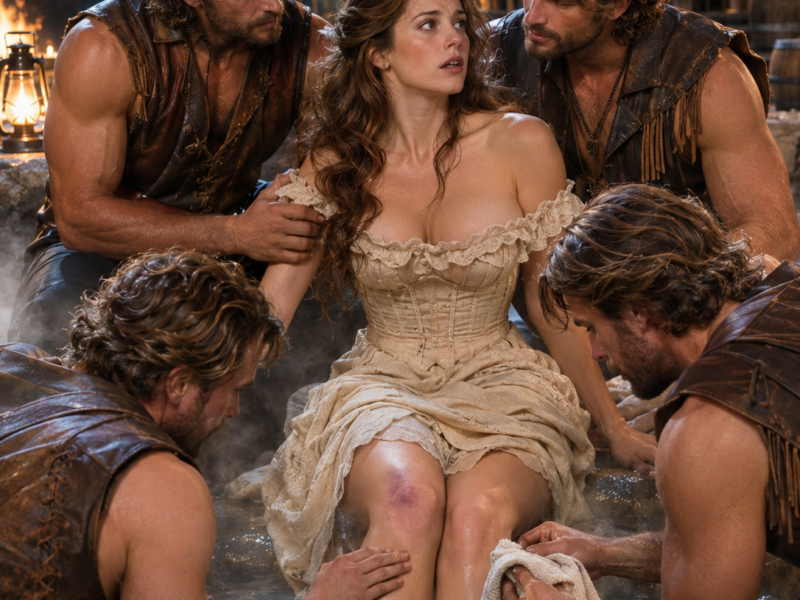
I Was 20 When I Arrived in Montana to Marry One Stranger, Only to Discover Four Mountain Cowboys Had Paid for My Marriage Contract. “I’m Not a Piece of Property You Can Share!” I Told Them, Never Imagining I’d Soon Risk My Life to Save Their Ranch. But When the Ruthless Mill Owner Who Destroyed My Father’s Life Arrived With Armed Men and Threw a Pouch of Gold at Their Feet, One Cowboy Raised His Rifle, Looked Him Straight in the Eye, and Did Something That Left Everyone Frozen…
I Was 20 When I Arrived in Montana to Marry One Stranger, Only to Discover Four Mountain Cowboys Had Paid for My Marriage Contract. “I’m Not a Piece of Property You Can Share!” I Told Them, Never Imagining I’d Soon Risk My Life to Save Their Ranch. But When the Ruthless Mill Owner Who Destroyed My Father’s Life Arrived With Armed Men and Threw a Pouch of Gold at Their Feet, One Cowboy Raised His Rifle, Looked Him Straight in the Eye, and Did Something That Left Everyone Frozen…
PART 1
The first thing I noticed when I stepped off the train in Red Sand, Montana, was that four men were waiting for me instead of one.
The second thing I noticed was that none of them looked particularly happy to see me.
It was the summer of 1878, and I was twenty years old, carrying everything I owned in a battered trunk and a faded carpetbag. Inside my left boot, I had hidden a piece of paper that could destroy my life if the wrong person found it.
My name was Maeve Calloway, and I had traveled more than a thousand miles to marry a stranger.
At least, that was what I thought I had agreed to.
The man standing in the center of the platform was tall, broad-shouldered, and frighteningly still. A pale scar crossed his left eye, and his gray gaze seemed capable of stripping the truth from a person without asking a single question.
“Miss Calloway?” he asked.
“Yes. And you must be Mr. Callahan.”
He nodded.
I glanced at the three men beside him.
“Are these your ranch hands?”
Something uncomfortable passed between them.
“No,” Callahan answered. “We own the ranch together.”
“That sounds sensible.”
“We also made the marriage arrangement together.”
For a moment, I thought the Montana heat had affected my hearing.
“I’m sorry. What?”
Callahan looked directly at me.
“The four of us paid for your passage. The arrangement was made on behalf of all four of us.”
I stared at him.
Then at the others.
One was an enormous man with kind brown eyes who looked more embarrassed than threatening. Another stood silently beside the platform railing, his dark hair brushing his collar. The last had burn scars climbing his neck and an expression suggesting he had already decided I was trouble.
“You mean,” I said slowly, “that you expect me to become a wife to four men?”
Callahan didn’t flinch.
“Yes.”
I laughed once, but there was nothing amusing about it.
“You neglected to mention a rather important detail in your letters.”
“We thought you might refuse.”
“You were correct.”
The scarred man snorted.
Callahan silenced him with a glance.
I tightened my grip on my carpetbag.
“Let me explain something. I came west because I was promised a respectable marriage and a place where I could begin again. I did not come here to be purchased like a cow at market.”
The enormous man lowered his eyes.
Callahan’s expression changed.
Not to anger.
To something remarkably close to shame.
“You’re right,” he admitted. “We should have told you.”
That surprised me more than the deception itself.
Men rarely admitted wrongdoing in my experience, especially when they believed they held all the power.
“And if I refuse?” I asked.
“We’ll pay for your return journey. The next eastbound train comes Thursday.”
Thursday.
Three days away.
Back east waited Jeremiah Flint, the wealthy mill owner who had spent two years hunting me over a debt my father had supposedly left behind.
I had no money to fight him.
No family left to shelter me.
And no desire to return to Chicago.
So I looked at the four strangers again.
“I’ll stay until Thursday,” I said. “I’ll see your ranch, learn what kind of men you are, and decide whether I want anything more to do with you.”
Callahan nodded.
“But understand this,” I continued. “If I stay, it will be because I choose to. You will treat me with respect, and you will never mistake kindness for obedience.”
The enormous man smiled faintly.
The scarred one rolled his eyes.
The silent one simply watched.
Callahan picked up my trunk.
“Fair enough.”
That was how I met Callahan, Harlan, Roan, and Garrick.
Four men who believed they needed a wife to save their dying ranch.
None of us understood what we were about to become.
Their ranch lay deep inside a red sandstone canyon, where the summer sun seemed determined to burn everything living into the earth.
The fields were cracked.
The creek was shrinking.
The cattle looked thin.
Yet the fences were maintained, the horses cared for, and someone had planted a small vegetable garden beside the house.
That garden interested me.
People who planted seeds during a drought were either fools or optimists.
Sometimes the difference mattered less than people imagined.
Harlan, the enormous man, helped me down from the wagon.
“It’s not much,” he apologized.
I studied the modest timber house and the leaning water tower.
“I’ve lived in worse places.”
He looked surprised.
I didn’t explain.
The Chicago mills had taught me that poverty could be ugly in ways a simple ranch never would be.
My room contained a narrow bed, a handmade quilt, and a jar of dried flowers.
Someone had tried to make it welcoming.
That mattered.
I had barely unpacked when Garrick appeared in the doorway.
“Can you cook?”
“Yes.”
“Know cattle?”
“Not yet.”
He frowned.
“Everybody works here.”
“Good,” I replied. “I’ve been working since I was eleven.”
He looked me over.
“You won’t last a week.”
I met his gaze.
“Then I suppose you’ll enjoy being proven right.”
He walked away without another word.
I decided immediately that Garrick would be the hardest of the four to understand.
By the following morning, I had discovered something more alarming than Garrick’s personality.
The ranch was running out of water.
Callahan had estimated that their main storage tank held ten days’ supply.
Their creek was barely flowing.
And an old secondary well behind the barn had not been used for years.
“Why haven’t you checked it?” I asked Harlan.
He shrugged.
“Too much work. Too many other things needing attention.”
I borrowed a bucket and rope.
Two hours later, filthy water began rising from the abandoned well.
After repeated drawing and clearing, the water improved.
It still needed careful treatment before drinking, but it offered an additional source for ranch work.
Harlan stared into the bucket.
“Well, I’ll be damned.”
I smiled.
“Maybe save your prayers until we’ve fixed the rope.”
That afternoon, I walked the southern field, studying the shallow depressions running toward the canyon floor.
At the mill, I had learned how water moved through channels, pipes, and mechanical systems.
Water was valuable.
Wasted water meant stopped machines.
Stopped machines meant docked wages.
And docked wages meant hungry workers.
I recognized the same problem here.
When the rain finally arrived, most of it would rush downhill and disappear into the sandy ground before reaching the fields.
We needed irrigation trenches.
Garrick found me studying the land.
“What are you doing?”
“Planning a way to keep rainfall from escaping.”
He examined the ground.
Then he handed me a pickaxe.
“Prove it.”
I understood the challenge.
He expected me to complain.
Instead, I tied my skirts above my ankles and began digging.
The sun burned my neck.
My palms blistered.
My shoulders screamed.
But I kept working.
An hour passed before Garrick picked up another tool.
Without speaking, he began digging beside me.
By the time Harlan arrived, both of us were covered in dust.
“Maeve!” he exclaimed. “Your hands are bleeding!”
He reached for my pickaxe.
I held on.
“Harlan, look at the trench.”
He looked.
“Does it seem useful?”
“Yes, but—”
“Then let me finish useful work. I’m not made of glass.”
Something softened in his face.
He stepped back.
“Yes, ma’am.”
For the first time, Garrick looked at me without contempt.
That evening, he passed me the bread before I asked.
It was a small gesture.
But on that ranch, small gestures often spoke louder than grand declarations.
Later, Callahan found me sitting beside the kitchen lamp, trying to wrap my damaged hands.
“Those need cleaning,” he said.
“I know.”
He brought a medical bottle, clean cloth, and fresh bandages.
“May I?”
I hesitated before placing my hands in his.
He cleaned each wound carefully.
There was something unexpectedly gentle about a man who looked as though he had spent his life fighting wars.
“You didn’t have to prove anything today,” he said.
“I wasn’t trying to prove anything.”
He looked up.
“Then why?”
“Because the ranch needed those trenches.”
He studied me for a moment.
“You worked in Flint’s mill?”
My stomach tightened.
“Yes.”
“For how long?”
“Six years.”
“And that’s where you learned about machinery?”
“That’s where I learned that if something broke, the owners blamed the workers while the workers figured out how to repair it.”
Callahan said nothing.
I looked away.
“Mr. Flint isn’t a good man.”
“I gathered that.”
I almost told him everything then.
About my father’s death.
About the fraudulent debt.
About the men who had followed me from boardinghouse to boardinghouse.
But trust was dangerous.
I had learned that lesson too young.
So I thanked him for the bandages and went to bed.
For the first time in months, I slept without dreaming of Chicago.
By the end of my first week, I had stopped thinking about Thursday.
Garrick repaired the broken shutters.
Harlan showed me how to care for the horses.
Roan, the quiet tracker, began leaving freshly gathered herbs beside my kitchen window.
And Callahan asked my opinion before making decisions about the garden and water supply.
They were changing.
So was I.
One evening, while watching the sunset turn the canyon walls crimson, I realized something strange.
I no longer felt like a desperate woman hiding among strangers.
I felt useful.
I felt heard.
I almost felt safe.
Then the wind shifted.
A bitter smell drifted across the garden.
Smoke.
I turned toward the northern ridge.
Beyond the canyon wall, a dark cloud was rising into the sky.
A horse came thundering down the trail.
Roan.
He leaped from the saddle before the animal stopped.
“Fire!” he shouted. “North ridge! It’s coming straight toward us!”
The horses began screaming inside the barn.
Callahan grabbed his rifle and shouted for the others.
I stared at the approaching wall of smoke.
Everything we had begun building could disappear before sunset.
And as the first burning embers floated into the yard, I realized that the men who had promised to protect me were about to discover whether I would protect them.
PART 2
The wildfire reached our northern fence within minutes.
Smoke swallowed the yard, and the horses screamed inside the barn.
“Wet cloth!” I shouted. “Cover their eyes and keep them calm!”
Harlan followed my instructions while Roan guided the terrified mustangs toward the southern corral.
Callahan and Garrick fought the flames with soaked sacks.
I joined them.
For nearly an hour, we battled burning grass beneath a sky blackened with ash.
When the fire finally died, the northern pasture was destroyed.
But the barn remained standing.
And every horse survived.
That evening, we sat together beneath the stars, too exhausted to pretend we were strangers anymore.
Harlan told me about his cruel father.
Garrick described the mining accident that had scarred his body.
Roan spoke quietly about his mother’s family losing their land.
Then I told them about mine.
“My father died in Flint’s mill,” I whispered. “Flint blamed him for the accident and left me with a debt I never owed.”
Nobody interrupted.
Callahan finally reached across the table.
“You don’t have to face him alone anymore.”
For one beautiful moment, I believed him.
Then, three days later, Roan returned from town with news that turned my blood cold.
“Jeremiah Flint is in Red Sand.”
And he was asking where I lived.
PART 3
I had spent two years imagining what I would do if Jeremiah Flint ever found me again.
In some versions, I ran.
In others, I begged.
Occasionally, during my angriest nights, I imagined standing before him and telling him exactly what I thought of the man who had destroyed my father.
But when Roan announced that Flint had arrived in Red Sand, I did none of those things.
I simply sat at the kitchen table and felt the old fear return.
Callahan noticed.
“Tell us everything,” he said.
So I did.
My father had been forty-three when he died beneath a failed machine in Flint’s Chicago mill. The company claimed he had ignored safety procedures.
I knew better.
Workers had complained about that machinery for months.
Flint had refused to repair it.
After Father’s funeral, Flint’s representatives arrived with a ledger showing unpaid loans, accumulated fees, and penalties.
They claimed I was responsible.
I was seventeen, grieving, and nearly penniless.
I tried working off the debt, but the numbers continued growing.
Eventually, I understood that Flint didn’t want repayment.
He wanted control.
So I ran.
“Why didn’t you tell us?” Callahan asked when I finished.
“Because I didn’t know whether you would hand me over.”
He looked wounded by that answer.
Then he nodded.
“You had every reason to be careful.”
Two days later, Flint appeared at our ranch.
He arrived with four armed men, wearing an expensive coat and a smile that made my skin crawl.
“Miss Calloway,” he greeted me pleasantly.
“Mr. Flint.”
His eyes swept over the house, the barn, and the men standing nearby.
“I understand you’ve found yourself an unusual arrangement.”
I remained on the porch.
“I’ve found work and a home.”
“A home purchased with someone else’s money, perhaps.”
Callahan stepped forward.
“State your business.”
Flint produced a leather pouch.
“The young lady owes me a considerable sum. However, I’m willing to compensate you gentlemen for your inconvenience.”
He tossed the pouch into the dirt.
Gold coins clinked inside.
“I believe that should cover whatever you paid for her.”
Everything went silent.
Callahan slowly picked up his rifle.
Flint’s companions reached toward their holsters.
But Callahan didn’t aim at them.
He aimed at the pouch.
The gunshot cracked through the canyon.
Leather exploded.
Gold scattered across the dusty yard.
Flint stared.
Callahan lowered the rifle.
“In this valley,” he said quietly, “human lives aren’t merchandise.”
He stepped between Flint and me.
“And my wife is priceless.”
My heart stopped.
My wife.
He had never called me that before.
Not once.
Flint’s pleasant smile disappeared.
“You’re making a serious mistake.”
“Then it’s mine to make,” Callahan answered.
Flint studied us for a long moment.
“This isn’t finished.”
He mounted his horse and rode away.
Only after he disappeared did I realize my hands were trembling.
Roan approached carrying a Winchester.
“You should learn to use this.”
“Because Flint will return?”
“Because you should be able to defend yourself whether we’re here or not.”
That afternoon, he taught me how to shoot.
I practiced until my shoulder ached and the empty tins along the fence had holes through them.
But I knew rifles alone would not protect us.
Flint controlled mines, mills, and powerful businessmen across several territories.
He had already begun buying influence over the valley’s water rights.
If he couldn’t take me by force, he could starve our ranch into surrender.
Callahan understood that.
Within a week, he arranged to meet the regional water-rights council in Deering.
Harlan and Roan would accompany him.
They expected to be gone several days.
Garrick remained behind with me.
By then, he and I had developed an understanding.
He still rarely complimented me.
But he repaired whatever I needed, left coffee warming on the stove, and had begun asking my opinion before changing anything around the ranch.
One morning, I found him replacing the handle on my pickaxe.
“You broke it,” he said.
“I know.”
“You work too hard.”
I smiled.
“Coming from you, that’s quite an accusation.”
He almost smiled back.
The night the attackers came, I was in the summer kitchen preserving squash.
The air was heavy, and the cicadas were screaming from every direction.
Then I heard something beneath their noise.
Horses.
Several.
Moving quickly.
I reached for the Winchester.
Before I could call Garrick, a burning torch sailed over the northern fence.
It struck the barn roof.
Dry timber caught instantly.
Then came shouting.
A gunshot.
I ran outside.
Garrick was pulling horses from the barn when a second shot rang out.
He staggered.
For one terrible second, he remained upright.
Then he collapsed.
“Garrick!”
I fired toward the shadow near the fence.
A man cried out.
Another disappeared behind the smoke.
I reached Garrick and found blood spreading across his shirt beneath his left shoulder.
“Leave me,” he gasped.
“Absolutely not.”
“Maeve—”
“Save your breath.”
I dragged him toward the root cellar, half carrying him down the narrow steps.
There, beneath the dim light of a lantern, I tore open his shirt and examined the wound.
The bullet had passed through.
The bleeding was severe.
I pressed clean cloth against it, secured a tight dressing, and kept pressure until the blood flow slowed.
Garrick’s face turned white.
“You’re going to live,” I told him.
“You sound certain.”
“I refuse to be wrong.”
His mouth twitched despite the pain.
Then I heard another crash outside.
The barn.
Our animals.
Our home.
I picked up the rifle.
“Stay here.”
He grabbed my wrist.
“Don’t go.”
I looked at him.
“If I don’t, they’ll burn everything.”
Something changed in his eyes.
For the first time, Garrick looked genuinely frightened.
Not for himself.
For me.
“Come back,” he whispered.
I squeezed his hand.
Then I climbed the stairs.
The yard was a nightmare of fire and smoke.
Two attackers lay motionless near the fence.
Others were gathering beneath the trees, preparing to approach the house.
I moved behind the stone foundation.
When two men rushed across the yard, I fired.
One fell.
The other retreated.
I tried shooting again.
Click.
Empty.
I reached for spare cartridges.
A movement sounded behind me.
I turned.
Too late.
Something struck the back of my head.
The rifle slipped from my fingers.
I remember the burning barn spinning sideways.
Then everything vanished.
When I opened my eyes again, I was lying on a dirt floor.
My head throbbed.
A barred window admitted a narrow stripe of afternoon sunlight.
I was inside a locked room.
Somewhere nearby, machinery groaned.
Flint’s mining camp.
I sat up slowly.
That was when I noticed the child huddled in the corner.
He couldn’t have been older than nine.
He had dark eyes, dusty clothes, and bare feet.
“Hello,” I whispered.
He stared at me.
“I’m Maeve. What’s your name?”
A long silence followed.
Then he answered.
“Sika.”
“Are you hurt?”
He shook his head.
“How long have you been here?”
“Many days.”
I felt anger rising in my chest.
Flint had kidnapped a child.
A little boy.
I wanted to tear the entire camp apart.
Instead, I crawled closer.
“Listen to me, Sika. We’re getting out of here.”
He looked doubtful.
“Both of us,” I promised.
I examined the door, the window, and the rough timber walls.
The lock was old.
The hinges were solid.
Outside, ore carts rolled along iron rails beside the processing shed.
I knew machinery.
More importantly, I knew how neglected machinery could become dangerous.
First, however, we needed to escape that room.
I pulled off my right boot and pried a loose iron nail from its heel.
Sika watched curiously.
“What are you doing?”
“Trying something foolish.”
“Will it work?”
“I suppose we’ll find out.”
After a long struggle with the worn locking mechanism, I heard a faint metallic click.
The door opened.
Sika stared.
I smiled despite my headache.
“Come on.”
We slipped into the yard while the guards were distracted.
Near the processing shed, an unattended ore cart and damaged brake assembly gave me an idea.
I had seen enough failures at the mill to recognize the danger.
I interfered with the already weakened mechanism, then hurried Sika behind a protective wall.
Minutes later, a loaded cart broke loose.
The crash shook the camp.
Men shouted.
Workers ran toward the wreckage.
I grabbed Sika’s hand.
“Run!”
We raced toward the western trail.
Behind us, horses began moving.
Someone had discovered our escape.
I pulled Sika behind me and snatched up an iron bar lying beside a shed.
Four riders rounded the corner.
I raised the bar, ready to fight.
Then the first rider pulled off his hat.
Gray eyes.
A familiar scar.
Callahan.
I nearly collapsed.
Behind him rode Harlan, Roan, and Garrick.
Garrick was pale, his injured shoulder heavily bandaged.
But he was alive.
He swung down from his horse despite Harlan’s protests.
For a moment, neither of us spoke.
Then he crossed the distance between us and held me carefully against him.
“You came back,” he whispered.
I closed my eyes.
“I promised.”
Roan knelt beside Sika and spoke gently in a language I didn’t understand.
The boy’s frightened expression softened.
Harlan examined my head wound while Callahan disappeared toward the main office.
When he returned, Jeremiah Flint was walking ahead of him.
Without his armed men, Flint looked remarkably ordinary.
Callahan demanded written confirmation that my father’s debt had been canceled and that Flint would make no further claim against me.
Flint protested.
Then he looked at the evidence of his ruined camp, the witnesses gathering nearby, and the armed men standing around him.
He signed.
I read the paper twice.
My father’s name was finally free.
So was mine.
I looked at Flint.
“You stole years from my life,” I said. “You’ll never take another.”
He didn’t answer.
We rode home beneath the fading sun.
I leaned against Callahan as the canyon came into view.
For the first time since I was seventeen, I could imagine a future that didn’t involve running.
But freedom from Flint’s debt did not mean freedom from the danger he had left behind.
And the next battle would come from people I had never considered my enemies.
PART 4
When we returned to the ranch, the barn was little more than a blackened shell.
The roof had collapsed.
Several walls stood crooked against the night sky.
Burned timber littered the yard, and the smell of smoke seemed permanently embedded in the ground.
But the horses had survived.
Garrick was alive.
Sika was safe.
And my father’s debt was gone.
For one evening, that was enough.
Harlan settled Garrick in bed and changed his dressings.
Roan prepared food for Sika, who ate silently at our kitchen table.
Callahan checked the damaged fences while I washed the dust and blood from my face.
Later, I found myself sitting outside beneath the stars.
Callahan joined me carrying two cups of coffee.
He handed me one.
We sat without speaking.
Eventually, I removed the debt-release document from my boot.
“I keep reading it,” I admitted.
“Does it change?”
“No.”
“Then why?”
I looked down at my father’s name.
“Because I spent so long believing this would never happen.”
Callahan rested his elbows on his knees.
“You were free before he signed it, Maeve.”
I shook my head.
“Not completely.”
He considered that.
Then he nodded.
“No. I suppose not.”
The silence between us felt comfortable.
After a while, Harlan appeared.
He settled onto the porch steps and looked toward the darkened barn.
“Garrick keeps asking about the horses.”
I smiled faintly.
“That sounds like him.”
“He also asked whether you were hurt.”
“Did he?”
“Six times.”
I laughed.
Harlan’s expression grew serious.
“He thinks you’re the bravest woman he’s ever known.”
“He should tell me himself.”
“He will. Probably around Christmas.”
That made us both laugh.
Then Harlan grew quiet.
“Before you arrived, we weren’t really living here.”
I looked at him.
“We were working,” he continued. “Surviving. Keeping the cattle alive and the buildings standing. But this place wasn’t much of a home.”
“It was yours.”
“That’s different.”
Roan emerged from the house and joined us.
“Sika’s asleep,” he said.
“Can you take him home tomorrow?” I asked.
Roan nodded.
“His family lives north of the canyon.”
He hesitated.
“His grandmother will want to thank you.”
“She doesn’t owe me thanks. Her grandson belongs with her.”
Roan looked at me for a long moment.
Then he smiled.
It was so unexpected that I almost forgot what we had been discussing.
We remained together beneath the stars until the lamps burned low.
I had come west thinking a family was something granted by marriage, blood, or law.
Now I was beginning to believe it could also be something built through trust.
The following morning, Roan took Sika home.
By afternoon, he returned with news that his family wanted to visit us.
Before they could arrive, however, Red Sand turned against us.
The gossip began on Sunday.
A woman living with four unmarried men was scandal enough.
A woman refusing to apologize for it was apparently intolerable.
The reverend condemned our household from his pulpit.
Town women whispered whenever I passed.
Men who had once greeted Callahan warmly began avoiding him.
I could have endured all of that.
Then the county council restricted our access to the communal creek.
Three council members had business connections to Flint.
They claimed the ranch’s traditional water rights lacked proper documentation.
Callahan returned from town carrying the notice.
I watched him read it twice.
“What does it mean?” I asked.
He looked toward the dry fields.
“It means the creek is no longer ours to use.”
My stomach tightened.
Without that creek, our livestock would die.
The old well could buy us some time, but not enough.
Flint had left.
His influence remained.
We gathered around the kitchen table and examined every possible alternative.
Garrick suggested hauling water through the northern pass.
Harlan pointed out that the horses couldn’t sustain such journeys in the heat.
Roan studied our canyon map.
“There’s water somewhere beneath the northeast wall,” he said.
Callahan frowned.
“What makes you think that?”
“My mother’s people knew this land before the ranches came.”
He traced the curve of the canyon.
“They spoke about water trapped beneath an old layer of clay.”
“How deep?”
“I don’t know.”
“How far?”
“I don’t know that either.”
Garrick sighed.
“So we’re digging for something that might not exist.”
Roan looked at him.
“Or we’re dying because we refused to look.”
Nobody argued.
The following morning, I planned to begin searching with him.
Instead, an elderly woman named Mrs. Alderman arrived at our gate.
I recognized her immediately.
She had been among those criticizing our household.
Her horse was sweating heavily, and worry had carved deep lines into her face.
“Miss Calloway,” she called, “the children in town are sick.”
I stepped outside.
“How many?”
“Six yesterday. Eight today.”
“What happened?”
“The creek was diverted during the water dispute. Some of the remaining water has become contaminated.”
My anger flared.
They had restricted our water.
Now their own families were suffering.
Mrs. Alderman swallowed.
“Doctor Pryor is overwhelmed.”
I studied her.
“Why come to me?”
She lowered her eyes.
“Because I’ve heard you know practical medicine.”
I thought of Mrs. Ferris, the older mill worker who had taught me about hygiene and caring for sick laborers.
She had been a wartime nurse before coming to the factory.
She taught me how dangerous dehydration could become.
And she had died after a machine accident that the mill’s owners blamed on her.
I remembered her voice.
When someone needs help, Maeve, you don’t ask whether they deserve it.
I went inside and packed what supplies I could.
Callahan met me at the stable.
“You’re going?”
“Yes.”
“They’ve treated you badly.”
“The children haven’t.”
He looked toward the road.
“I’ll ride with you.”
I touched his arm.
“Please don’t.”
His expression hardened.
“Maeve—”
“If I arrive surrounded by armed men, they’ll see a threat. I need them to see someone who came to help.”
He struggled with that.
Then he nodded.
“I won’t be far.”
“I know.”
At Doctor Pryor’s surgery, I found frightened mothers crowded around beds holding feverish, desperately weak children.
The doctor looked exhausted.
He had medicine, but too little clean water and no organized plan for replacing the fluids the children were losing.
I asked for clean vessels, boiled water, measured salt and sugar, and his help preparing a suitable rehydration drink.
We worked together, giving small amounts to children who could swallow safely and carefully watching those who needed more urgent treatment.
Others required further medical care.
Nothing about it was easy.
Several mothers initially refused to let me touch their children.
I didn’t argue.
I showed the doctor what I knew and allowed him to supervise.
Their children’s lives mattered more than my pride.
Hours passed.
By evening, some of the sickest children were responding.
The doctor still faced days of work, but there was finally hope.
At sunset, the reverend appeared in the doorway.
He looked at me for a long moment.
“I owe you an apology.”
I dried my hands.
“For what?”
He looked uncomfortable.
“For what I said about your household.”
“You condemned people you didn’t know.”
“Yes.”
“And people listened.”
“Yes.”
I waited.
“I intend to correct that.”
I nodded.
“Then do it publicly.”
He lowered his eyes.
“I will.”
That night, I rode home exhausted.
All four men were waiting on the porch.
Harlan had warmed supper.
Roan took my horse.
Garrick stood in the doorway, still recovering from his wound.
“The children?” he asked.
“Some are improving.”
He nodded.
“Good.”
I went inside and ate while they sat around me.
For once, nobody asked whether I belonged.
They simply made room.
The next afternoon, Roan announced that Sika’s grandmother was coming.
Eleven visitors arrived near sunset.
Sika ran ahead and threw himself against me.
I knelt and hugged him.
His grandmother was a small woman with silver braids and eyes that seemed to notice everything.
Roan translated as she thanked me.
I told her I was grateful Sika had made it home.
She listened.
Then she asked us to follow her.
We walked northeast along the canyon wall, climbing through broken sandstone and thorny scrub.
After twenty minutes, the air became cooler.
The soil beneath our feet darkened.
Sika’s grandmother stopped beside a curved section of rock.
An older man accompanying her knelt and touched the ground.
“Water,” he said.
Harlan crouched beside him.
The earth was damp.
Callahan stared.
Roan looked toward the rock formation.
“This is the place,” he whispered.
The grandmother explained that water collected beneath a natural clay shelf several feet underground.
Her family had known the location for generations.
Callahan looked at her.
“Why show us?”
She turned toward me.
“Because you brought our child home.”
I shook my head.
“That doesn’t mean you owe us your family’s water.”
Roan translated.
The grandmother considered my words.
Then she answered.
“The earth does not know your fence from ours. Water should give life, not power.”
I couldn’t speak.
For the first time since the blockade, I truly believed the ranch might survive.
We began digging the next morning.
Six members of Sika’s family stayed to help.
Harlan supervised the timber supports.
Garrick prepared tools and reinforced the frame.
Roan worked beside his relatives.
Callahan hauled buckets of heavy soil.
And I dug.
The work continued for three exhausting days.
On the third afternoon, Harlan drove a probing bar into the earth.
When he pulled it free, water dripped from the end.
Nobody spoke.
Then he began laughing.
We cleared the final layer carefully.
Cold groundwater seeped into the shaft.
It gathered slowly, steadily, until there was enough to draw into a bucket.
Callahan lifted the first bucket and stared at it.
Roan smiled.
I covered my mouth.
After everything we had suffered, I began to cry.
Not because the water solved every problem.
It didn’t.
We would still need to manage it carefully and protect the source.
But we had found something no powerful businessman could simply manufacture.
Hope.
Within days, the county council reconsidered the creek restriction.
News of the sick children, our work in town, and the new spring had changed public opinion.
The blockade was lifted.
The reverend returned to our ranch.
He walked past the ruined barn, the garden, and the spring where Roan was teaching Sika how to handle the bucket rope.
Then he looked at me.
“I told my congregation I was wrong.”
I waited.
“What did you say?”
“That I judged your family without understanding it.”
My throat tightened.
“And?”
He smiled sadly.
“That goodness sometimes appears in forms we don’t expect.”
I thanked him.
When he left, I stood watching the road.
Callahan came beside me.
“You’ve changed this valley.”
“No,” I said softly. “We all have.”
He reached for my hand.
This time, I took it without hesitation.
Months earlier, I had arrived expecting four men who wanted to own me.
Instead, I had found four wounded souls learning how to love without possession.
And I knew then that when the first autumn rain arrived, I would have one final decision to make.
PART 5
The first autumn rain arrived on a Thursday.
I remember that detail because Thursday had been important from the beginning.
On the day I stepped off the train in Red Sand, Callahan had promised that I could leave on Thursday if I wanted.
Back then, the word represented freedom.
A way out.
An escape from four strangers whose intentions I didn’t understand.
But by the time the rain finally came, Thursday meant something else entirely.
It began with a low rumble beyond the northern mountains.
The sky darkened.
A cool wind rolled through the canyon, carrying the smell of distant rain.
I was working in the kitchen garden when the first drops struck the earth.
At first, there were only a few.
Then the heavens opened.
Water poured down so suddenly that my dress was soaked before I could move.
I stood between the squash beds, staring at the sky.
And I laughed.
I laughed until tears mixed with the rain on my cheeks.
After months of relentless heat, cracked fields, frightened cattle, burning buildings, and desperate searches for water, the drought was breaking.
Callahan stepped onto the porch.
He watched me standing in the rain.
Then Harlan appeared beside him.
The enormous man walked straight into the yard, lifted his face, and spread his arms.
Garrick emerged from the forge.
“What in God’s name are you doing?” he shouted.
“Getting wet!” I called.
He stared at me.
Then, for the first time since I had met him, Garrick laughed openly.
Not a sarcastic snort.
Not an embarrassed chuckle.
A real laugh.
Roan was standing on the canyon rim when the storm arrived.
I could see his silhouette against the gray sky.
He didn’t run for shelter.
He simply stood there, allowing the rain to wash over him.
The irrigation trenches Garrick and I had dug during my first week began filling.
I watched water follow the channels exactly as we had planned.
The earth drank.
The garden revived beneath the downpour.
And something inside me finally felt ready to rest.
We eventually gathered indoors when the thunder grew too close.
Harlan put water on the stove for tea.
Garrick lit the hearth.
Roan arrived dripping wet, his dark hair plastered against his neck.
Callahan remained unusually quiet.
He disappeared into his room.
When he returned, he was carrying a familiar leather pouch.
He placed it in the middle of the kitchen table.
I recognized it immediately.
The pouch Flint had thrown into our yard.
The one Callahan had shot apart.
He had repaired it and filled it with gold.
I stared at him.
“What’s this?”
Callahan sat across from me.
“The first autumn rain.”
I frowned.
“I noticed.”
His expression remained serious.
“When you arrived, we agreed that you would decide whether to stay.”
I looked at the pouch.
He continued.
“We’ve never wanted you to believe you were trapped here. This money is enough to take you somewhere safe, somewhere you can start again.”
My chest tightened.
“You’re offering me money to leave?”
“I’m giving you a choice.”
Harlan sat very still.
Garrick stopped tending the fire.
Roan watched me quietly.
Callahan reached across the table.
“You owe none of us anything, Maeve. Not for the passage. Not for protecting you. Not for the ranch.”
I looked at his scarred hand.
“And if I stay?”
His gray eyes softened.
“Then you stay because you want this life. Nothing more.”
For several seconds, I couldn’t speak.
I remembered that first afternoon on the platform.
Four enormous strangers.
A marriage arrangement I had never fully understood.
A frightened girl pretending she wasn’t afraid.
I remembered Garrick challenging me with the pickaxe.
Harlan tending wounded horses.
Roan teaching me to shoot.
Callahan bandaging my hands.
The wildfire.
The burning barn.
The cellar where Garrick nearly died.
Flint’s prison.
Sika.
The contaminated creek.
The children’s frightened faces.
The spring.
Every terrible thing that had happened seemed woven together with something precious.
I had spent most of my life being told that survival was enough.
Work hard.
Keep your head down.
Avoid trouble.
Don’t expect too much.
But these men had taught me something different.
A person could survive for years without ever truly belonging anywhere.
And belonging could not be purchased.
It had to be chosen.
I picked up the pouch.
All four men watched me.
I walked to the window.
Opened it.
And threw the pouch into the rain.
It landed in the muddy yard with a heavy thud.
For a moment, nobody moved.
Then Garrick stood.
“What the hell did you do that for?”
I turned around.
“Because I don’t need your money.”
Callahan’s eyes widened slightly.
I walked back to the table.
“I don’t want another train. I don’t want another town. I don’t want another life.”
My voice shook.
“I want this one.”
Harlan covered his mouth.
Roan lowered his head, smiling.
Garrick looked away, but I could see emotion moving across his scarred face.
Callahan stood.
“Maeve…”
“I’m not finished.”
He stopped.
I reached for his hand.
Then I took Harlan’s and placed it beside his.
There was something I had been carrying quietly for weeks.
Something I had wanted to tell them when the time felt right.
And at last, it did.
I guided their hands gently toward my stomach.
Harlan looked down.
Then up at me.
His expression changed.
“Maeve?”
I nodded.
“I believe I’m going to have a baby.”
Silence fell over the kitchen.
Outside, rain hammered the roof.
Garrick gripped the back of a chair.
Roan went completely still.
Callahan stared at me as though I had spoken in a language he had forgotten how to understand.
Harlan was the first to recover.
“How long?”
“About two months, I think.”
He drew a slow breath.
“You should see a doctor to be certain.”
“I will.”
His hands trembled.
I had seen those enormous hands calm terrified horses and care for wounded men without hesitation.
Now he looked almost afraid to touch me.
Garrick finally spoke.
“The baby’s ours?”
His voice was rough.
I looked at him.
“All of ours.”
He blinked hard.
For a moment, I thought he might cry.
Then he came closer and rested one hand gently over mine.
Roan joined us.
Callahan remained silent.
I turned toward him.
“Are you all right?”
He looked down at our joined hands.
Then he laughed softly.
A quiet, disbelieving sound.
“I spent years believing this place would never be anything except a ranch.”
I smiled.
“And now?”
He looked directly at me.
“Now it’s a home.”
He kissed my forehead.
And I knew no ceremony, expensive ring, or carefully worded promise could have made that moment more meaningful.
We had already made our promises in other ways.
We made them when we worked alongside one another.
When we faced danger together.
When we respected each other’s choices.
When we stayed.
That evening, Garrick disappeared into the workshop.
I found him sitting beside the workbench, turning a piece of smooth cedar in his hands.
“What are you making?”
“Nothing.”
I looked at the wood.
“That’s a very elaborate piece of nothing.”
He scowled.
“Go rest.”
I smiled.
“Are you ordering me around?”
“I’m asking you to stop making me nervous.”
I laughed.
He looked up.
Then his expression softened.
“Maeve?”
“Yes?”
His voice became quiet.
“I never thanked you.”
“For what?”
“For pulling me out of that yard. For keeping me alive.”
I sat beside him.
“You would have done the same for me.”
He shook his head.
“Before you arrived, I’m not sure I would have known how.”
I looked at his scars.
He had carried those marks for years, believing they made him unworthy of happiness.
Now he was sitting beside me, preparing to make something beautiful.
“People can change, Garrick.”
He nodded slowly.
“You proved that.”
I kissed his cheek.
“Now tell me what you’re making.”
He sighed.
“A crib.”
I smiled.
“Of course.”
Within an hour, Harlan had joined him.
Then Roan.
The three men spent the evening arguing over timber joints, measurements, and which wood would be strongest.
Garrick wanted cedar.
Harlan insisted the corners needed reinforcing.
Roan quietly redesigned the frame when neither of them could agree.
Their argument became so serious that Callahan finally walked into the workshop.
“Are you building a crib or a fortress?”
Garrick looked offended.
“Both, if necessary.”
Everyone laughed.
I sat in the rocking chair I had repaired during my first week on the ranch and watched them.
The rain continued falling outside.
The hearth warmed the room.
And for the first time in my life, I wasn’t afraid of tomorrow.
But our story didn’t end with that storm.
The months that followed were neither simple nor perfect.
Pregnancy brought exhaustion, aching feet, and mornings when the smell of cooking made me rush outside.
The ranch demanded constant attention.
The new barn needed finishing.
The cattle required winter feed.
The spring had to be protected against freezing.
There were days when we argued.
Days when Garrick’s temper returned.
Days when Callahan tried to make every decision himself.
Days when Harlan worried too much.
And days when Roan disappeared into silence rather than explain what troubled him.
We weren’t a perfect family.
We were five imperfect people trying to build something none of us had experienced before.
But we had learned how to apologize.
How to listen.
How to forgive.
When Garrick became impatient, I reminded him that fear could wear the face of anger.
When Callahan tried carrying every burden alone, Harlan made him sit down.
When Roan grew distant, I waited until he was ready to speak.
And when I became so stubborn that I refused help even while exhausted, all four men reminded me that accepting kindness wasn’t the same as surrendering independence.
Sometimes I listened.
Sometimes I didn’t.
That was marriage, I supposed.
Or at least, that was ours.
One morning, near the beginning of winter, I found Callahan standing outside the rebuilt barn.
He was looking toward the distant canyon road.
I approached quietly.
“What are you thinking about?”
He smiled.
“The day you arrived.”
I laughed.
“You looked as though you’d rather face a stampede.”
“I probably would have.”
“And Garrick hated me.”
“He hated everyone.”
“He still does occasionally.”
Callahan chuckled.
Then his expression grew thoughtful.
“We thought we needed someone to save the ranch.”
“You did.”
“No,” he said. “We thought we needed someone to cook our meals, manage the house, and make the place respectable.”
“And instead?”
He turned toward me.
“We met someone who demanded that we become better men.”
I studied him.
“Did I really change you?”
He shook his head.
“You gave us a reason to change ourselves.”
That answer stayed with me.
Because I had never wanted to rescue four helpless men.
They weren’t helpless.
They were strong, skilled, complicated people who had been hurt by a world that didn’t always reward goodness.
I hadn’t healed them.
I had simply refused to treat their scars as proof they were beyond healing.
And they had done the same for me.
As winter settled over the canyon, Red Sand gradually learned to accept our unusual household.
Some people never approved.
That was their right.
But others saw our work.
They saw the cattle recovering, the rebuilt barn standing strong, and the spring supplying clean water.
They saw Harlan treating injured animals without asking whether their owners could pay.
They saw Roan helping travelers lost in the mountains.
They saw Garrick repairing broken equipment for neighbors who couldn’t afford replacements.
And they saw Callahan attending council meetings to make certain no wealthy businessman could again control the valley’s water without challenge.
As for me, I continued working wherever I was needed.
I helped Doctor Pryor organize cleaner water supplies and taught families what Mrs. Ferris had once taught me.
I spoke openly about the dangerous conditions in Flint’s mills.
And I never stopped remembering my father.
Sometimes, late at night, I would take out the old debt-release document.
I kept it carefully folded in a wooden box beside my bed.
Not because I feared Flint anymore.
But because it reminded me how far I had traveled.
My father used to call me his Iron Girl.
For years, I believed that meant I had to be strong enough never to break.
Now I understood something different.
Iron could be shaped.
Bent.
Heated.
Remade.
Its strength didn’t come from remaining unchanged.
It came from surviving the fire.
One evening, while the first snow fell quietly beyond our windows, I sat in my rocking chair watching four men finish a wooden crib.
Garrick had carved tiny stars into the headboard.
Harlan had sanded every edge until it was smooth.
Roan had fitted the joints with such precision that the structure barely moved when tested.
Callahan had added a small inscription beneath the frame.
I asked him what it said.
He smiled.
“Read it.”
I leaned forward.
The words were simple.
Built with love. Given in freedom. Always home.
My eyes filled with tears.
Harlan knelt beside my chair.
“What’s wrong?”
“Nothing.”
Garrick frowned.
“Then why are you crying?”
I laughed through my tears.
“Because I’m happy, you impossible man.”
He looked relieved.
Roan rested a hand on my shoulder.
Callahan stood beside us, smiling.
And I realized that the greatest thing I had gained was not a husband.
Nor four husbands.
Nor a ranch.
It was the freedom to become the person I had always wanted to be.
Someone loved without being owned.
Someone protected without being controlled.
Someone needed without being used.
Months earlier, I had stepped off a train carrying one trunk, one carpetbag, and a debt that threatened to swallow my future.
Four strangers had stood waiting for me.
I had been frightened, furious, and determined never to belong to anyone who believed he could purchase me.
Now I sat beside a warm fire, carrying a child whose arrival would change all our lives.
Outside, snow settled across the same red earth that had once seemed incapable of growing anything.
Inside, four men were arguing over where to place the crib.
I smiled.
There would be more work tomorrow.
There would be difficulties we couldn’t predict.
There would be mistakes, disagreements, and days when love demanded more patience than any of us believed we possessed.
But there would also be laughter.
There would be hands reaching for one another.
There would be children playing beneath the canyon walls.
There would be seasons of rain after seasons of drought.
And whatever came, we would face it together.
I leaned back in my chair and rested one hand on my growing belly.
For most of my life, I had believed home was somewhere I needed to find.
But home, I finally understood, was something people created through the choices they made for one another.
I looked around at the four men who had once believed they were too damaged to deserve happiness.
They hadn’t become perfect.
Neither had I.
But they had learned to listen before demanding, to protect without possessing, and to love without keeping score.
And perhaps that was the greatest transformation of all.
I had not tamed four wild mountain men by making them obedient.
I had simply shown them that love was not weakness.
And they had shown me that trusting someone did not mean surrendering myself.
The rain had saved our land.
The spring had saved our cattle.
But the choices we made, again and again, had saved something far more precious.
Us.
That night, as the fire burned low and snow covered the silent canyon, I closed my eyes and listened to the men I loved laughing over the crib they had built for our child.
I had traveled west to escape a past that wanted to own me.
Instead, I had discovered a future no amount of gold could ever buy.
And for the first time in my life, I knew exactly where I belonged.
I was home.