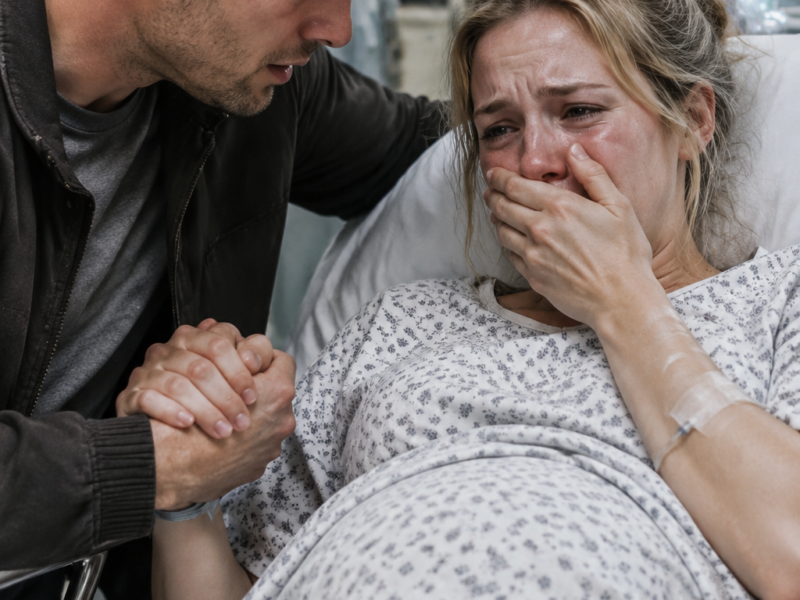
I Took My Best Friend’s Pregnant Wife to the Hospital… Then She Revealed Why He Wasn’t Coming
I Took My Best Friend’s Pregnant Wife to the Hospital… Then She Revealed Why He Wasn’t Coming
At 2:13 in the morning, my best friend’s pregnant wife gripped the handle of my truck so tightly that her knuckles turned white. Her breathing came in short, uneven bursts, and every few seconds, she closed her eyes as another contraction swept through her body. She was barefoot, wearing a loose sweatshirt over her swollen belly, and trying desperately not to cry.
I had driven through dozens of emergencies in my life, but nothing had prepared me for that particular night.
“Hannah, look at me,” I said, keeping one hand on the steering wheel and the other close enough to reach her if she needed me. “We’re almost there.”
She nodded, but her eyes remained fixed on the dark road ahead.
Her husband, Daniel, was supposed to meet us at the hospital.
He was my closest friend, the man I had known since college, the person who had stood beside me through some of the most difficult years of my life. He was also the father of the little girl Hannah was about to bring into the world.
I had called him six times since leaving her house.
Every call had gone straight to voicemail.
At first, I assumed his phone was switched off. Daniel traveled frequently for business, and he had recently told me he was attending meetings outside North Carolina. I figured he might have been on a plane or somewhere with terrible reception.
But then Hannah’s phone lit up.
The sudden glow illuminated her exhausted face. She glanced at the screen, read the message, and slowly turned the phone facedown on her lap.
I noticed the movement.
“Everything okay?” I asked.
She didn’t answer immediately.
Outside, the streets were almost completely deserted. Traffic lights changed from red to green over empty intersections, and the glow of storefront signs passed across the windshield.
Then Hannah whispered, “He isn’t coming.”
I glanced at her.
“What do you mean? Did he say he’s running late?”
She shook her head.
“He isn’t coming at all.”
I tried to keep my voice calm.
“Hannah, maybe he’s having trouble getting through. I’ll call him again when we get there.”
She let out a small, painful laugh that had absolutely no humor in it.
“There is no business trip, Owen.”
For a moment, I thought I had misunderstood her.
“What?”
“He left six weeks ago. Tonight, he told me he doesn’t want to be there when she’s born.”
My foot remained on the accelerator, but my mind seemed to stop moving.
The traffic light ahead turned red. I pressed the brake and watched the empty intersection while the words settled into my thoughts.
Daniel had been lying to me.
Not just about where he was, but about something much bigger. Something that had apparently been happening for weeks while I continued believing everything between him and Hannah was normal.
The light changed.
A horn sounded behind us, startling me back into the moment.
I pressed the gas.
“Why didn’t you tell me?” I asked quietly.
Hannah looked down at her stomach.
“Because I didn’t want to explain it to anyone.”
She took another breath, fighting through the beginning of a contraction.
“I thought I could handle it. I thought maybe he’d come around. Then tonight he sent me that message, and I realized I couldn’t keep waiting.”
I wanted to ask a hundred questions.
I wanted to know where Daniel was, why he had abandoned his wife, whether he was with someone else, and what could possibly have happened to make him turn away from his own child.
But Hannah was in labor.
Whatever had happened between them could wait.
“What do you need me to do?” I asked.
She looked at me.
“Just get me through the doors.”
That was Hannah.
Even when her world was falling apart, she asked for the smallest possible thing. She had always been considerate, almost excessively so, as though needing help was something she had to apologize for.
My name is Owen Reed. I was thirty years old that night, and I managed emergency restoration projects across central North Carolina.
My work involved flooded schools, burned warehouses, storm-damaged homes, and commercial buildings that had suffered structural failures. I was the person companies called when something terrible happened and someone needed to figure out what could still be saved.
I had built my career around remaining calm when everyone else was panicking.
Unfortunately, I was discovering that knowing how to repair damaged buildings did not mean I understood how to repair damaged relationships.
Daniel and I had met during our freshman year at North Carolina State University.
We were studying engineering, and our first real conversation happened in a laboratory after he accidentally spilled an entire container of coffee over a set of printed calculations.
Instead of apologizing, he looked at the ruined pages and announced that the coffee had probably improved the mathematics.
I laughed despite myself.
He had that effect on people.
Daniel was outgoing, confident, and endlessly entertaining. He could walk into a room full of strangers and leave with five new friends. I was the opposite. I preferred listening to conversations rather than dominating them, and I usually thought through a decision several times before making it.
Somehow, we worked.
He pulled me into experiences I would never have pursued on my own, and I helped him remember deadlines, appointments, and the occasional important detail he had forgotten.
Over the years, our friendship became something I considered permanent.
We graduated, found jobs, moved into separate apartments, and continued seeing each other almost every week.
When Daniel met Hannah, he told me he had finally found someone who could tolerate him for longer than an afternoon.
She was twenty-six, four years younger than me, and worked as a children’s librarian in Raleigh.
I remembered meeting her for the first time at a small restaurant downtown. Daniel arrived twenty minutes late, talking loudly about a parking problem, while Hannah sat across from him with an amused expression.
She apologized for his lateness before he had even finished explaining it.
That was my first impression of her: intelligent, gentle, and capable of finding humor in situations that would have irritated most people.
She remembered people’s names. She remembered what books they liked. She even remembered how much sugar Daniel put in his coffee.
I had never thought of her as anything other than my best friend’s wife.
I understood the boundaries of friendship, and I had never been interested in crossing them.
Four years earlier, I had stood beside Daniel as his best man.
I remembered his speech at the reception. He talked about how lucky he was to have found someone who made ordinary days feel important.
He said he wanted a family someday.
I remembered that particularly well because he had spent most of our college years insisting that he would never become the kind of man who settled down.
Yet there he was, standing beneath a decorated arch, promising Hannah that he would always be there.
Now, as I drove his pregnant wife to the hospital, I wondered how much of that promise had ever been sincere.
When we reached the emergency entrance, an orderly came rushing outside with a wheelchair.
Hannah tried to refuse it.
“I’m fine,” she insisted.
Then another contraction folded her forward, and she gripped my arm so tightly that I felt her fingernails through my jacket.
“Okay,” she whispered. “Maybe the wheelchair.”
I helped her sit down and followed the orderly inside.
The hospital was brightly illuminated despite the hour. Nurses moved between rooms, phones rang at the admissions desk, and the smell of disinfectant hung in the air.
A clerk looked up as we approached.
“Relationship to the patient?”
I opened my mouth.
“Family friend,” Hannah answered.
Two simple words.
They were accurate, but for some reason they sounded inadequate.
I had known her for years. I had attended her wedding, celebrated holidays with her and Daniel, and watched her prepare for motherhood.
Yet now, when someone asked who I was, the only honest answer was that I was a family friend.
And the person who should have been standing beside her was nowhere to be found.
The next forty minutes passed in fragments.
There were forms to complete, questions about Hannah’s medical history, and nurses checking the baby’s heart rate.
Daniel’s name appeared repeatedly.
Husband.
Emergency contact.
Father of the baby.
Each time someone mentioned him, I noticed Hannah’s expression tighten.
Eventually, a nurse approached the bed.
“Would you like us to continue trying to contact your husband?”
Hannah looked toward the window.
“No.”
The nurse paused.
“Are you sure?”
“Yes. Please remove him as the person authorized to receive updates. I don’t want him receiving information about my condition through the hospital.”
The nurse nodded professionally.
“Who would you like us to contact instead?”
Hannah glanced at me.
“Owen.”
I gave the nurse my information.
After she left, I stood near the window and took out my phone.
I tried Daniel again.
This time, he answered.
“What?”
Not hello.
Not an explanation.
Not even a question about whether Hannah was okay.
Just one impatient word.
“Hannah is in labor.”
There was silence.
Then he said, “I know.”
I stared at the phone.
“You know?”
“She texted me.”
“Then get here.”
“I’m not in Raleigh.”
“Where are you?”
Another pause.
“Austin.”
I felt my jaw tighten.
“You told me you were in Richmond for a client meeting.”
“I didn’t want to explain everything over the phone.”
“Daniel, your daughter is being born.”
His response came so quickly that I almost thought I had heard him incorrectly.
“Don’t call her that like you know what this is.”
I stepped into the hallway.
For a moment, I couldn’t speak.
The man on the other end of the line sounded nothing like the person I had known for twelve years.
“I know Hannah is alone,” I finally said.
“She isn’t alone. You’re there.”
The sentence landed with a coldness I had never heard in his voice.
“Daniel, whatever happened between you two, you can deal with it later. Get on a plane.”
“I’m not coming back tonight.”
“Why?”
I heard him exhale.
Then he said something that made my anger turn into disbelief.
“Because every time something falls apart, you walk in and become the dependable one. So do what you always do, Owen. Fix it.”
Before I could respond, he ended the call.
I remained in the hallway for several seconds, staring at the dark screen.
He had not simply abandoned Hannah.
He had somehow turned his own abandonment into an accusation against me.
When I returned to the room, Hannah was watching me.
“He answered,” she said.
It wasn’t a question.
“Yes.”
“Where is he?”
“Austin.”
She nodded slowly.
“With Caroline.”
I recognized the name immediately.
Caroline Vail worked in marketing for Daniel’s construction software company. I had heard him mention her several times during the previous year.
There had been late meetings, investor dinners, and occasional business trips that seemed to involve the same people.
At the time, I hadn’t considered any of it suspicious.
“How long?” I asked.
Hannah closed her eyes.
“I don’t know exactly. Long enough.”
Before I could ask anything else, the monitor beside her bed changed rhythm.
A nurse entered, checked the sensors, and asked Hannah to turn onto her side.
The baby’s heart rate steadied, but the atmosphere in the room changed.
Everything had become immediate.
This was no longer simply a painful marriage or an argument between two people.
A little girl was about to be born, and the adults responsible for protecting her were already making decisions that would shape her life.
Hannah took a slow breath.
“I need you to understand something.”
I moved closer.
“I’m listening.”
“I didn’t call you because I wanted you to take his place.”
“I know.”
“No, you don’t.” She opened her eyes. “You solve things. You make lists. You carry what other people drop. But this is not your responsibility.”
I looked at her for a moment.
“You called because you needed a ride.”
“I called because you were the only person nearby who would answer.”
Her honesty hurt more than I expected.
Not because I wanted to be important to her, but because it made the situation so painfully clear.
She had reached out to me because the person who should have been there had chosen not to be.
“Then let me be the person who answered,” I said. “Nothing more has to be decided tonight.”
Her expression softened.
“Okay,” she whispered.
A doctor came in shortly afterward and explained that labor was progressing quickly. Unfortunately, the baby was not tolerating every contraction well.
They would continue monitoring her closely, but if the pattern worsened, they might need to perform a cesarean delivery.
Hannah listened carefully.
She asked three questions about the risks, the procedure, and what would happen if the baby’s heart rate dropped again.
Then she signed the consent form.
Her hand didn’t shake until the doctor left.
Afterward, she reached for mine.
“I’m scared,” she whispered.
I sat beside her.
“I know.”
“Don’t tell me everything will be fine.”
“I won’t.”
“Tell me something true.”
I looked at the monitor, then at her.
“You are not doing this alone.”
Her fingers tightened around mine.
That was the first promise I made to her that night.
It was also the first promise I worried I might not be allowed to keep.
Twenty minutes later, the baby’s heart rate dropped again.
The room filled with medical staff.
Everyone moved quickly, but nobody panicked. The doctor explained that she recommended an urgent cesarean delivery.
Hannah nodded.
Then a nurse asked who would accompany her.
For the first time since we had arrived, Hannah looked directly at the empty chair beside her bed.
“My sister isn’t here,” she said quietly.
“You’re allowed one support person,” the nurse explained.
Hannah turned toward me.
“Can you stay?”
There was no romance in the question. No hidden meaning. She was a frightened woman facing surgery, and she deserved not to enter that room alone.
“Yes,” I answered.
They gave me surgical scrubs and a cap.
Before putting my phone away, I sent a message to Hannah’s sister, Mara, explaining what was happening.
Then I followed the nurses into the operating room.
The lights were brighter than anything I had seen outside the hospital. Medical equipment surrounded the operating table, and several people were already preparing for the procedure.
I stayed near Hannah’s head.
A blue surgical screen separated us from the doctors.
She kept asking whether the baby was okay.
I repeated exactly what the medical team told us, refusing to offer reassurances I couldn’t guarantee.
Then, after what felt like an impossibly long wait, a sharp cry cut through the room.
It was loud, angry, and wonderfully alive.
Hannah’s entire face changed.
“Is that her?”
I smiled.
“That’s her.”
My voice broke on the last word.
A nurse brought the baby close enough for Hannah to see.
She was tiny, red-faced, and furious at the world. Her little hands opened and closed as she cried.
Hannah started laughing and crying at the same time.
“Hello, Sophie,” she whispered.
I hadn’t known the name.
For a moment, I simply stood there, watching a mother meet her daughter.
There was something extraordinary about that first exchange. Hannah looked exhausted, frightened, and overwhelmed, but the moment she saw Sophie, every other expression seemed to disappear.
The nurse asked whether I wanted to take a picture for her.
I took Hannah’s phone.
My hands were unsteady, so I took three photographs.
In the first, Sophie had turned her face away.
In the second, Hannah’s eyes were closed.
In the third, Hannah was looking at her daughter with such complete devotion that I had to look away after pressing the button.
I had attended weddings, graduations, funerals, and countless celebrations.
But I had never witnessed anything quite like that.
A new life had arrived in a room filled with people, and the one person who had promised to welcome her had chosen to be somewhere else.
Mara arrived shortly after sunrise.
She came rushing through the hospital corridor with an overnight bag she had apparently packed in a hurry.
Her flight from Atlanta had been delayed, and she looked exhausted.
The moment she saw Hannah, she crossed the room and wrapped her arms around her sister.
Then she kissed Sophie’s forehead.
Finally, she turned toward me and hugged me so tightly that my shoulders hurt.
“Thank you,” she whispered.
I stepped back.
“Anyone would have done it.”
Mara studied my face.
“No. Anyone should have. That is not the same thing.”
I didn’t know how to respond.
I stayed long enough to make sure Hannah had everything she needed, then left before breakfast.
In the parking garage, I found seven missed calls from Daniel.
I didn’t return them until I reached my truck.
When he answered, he sounded impatient.
“Is the baby okay?”
“She’s healthy. Hannah is recovering.”
“What did they name her?”
“You should ask Hannah.”
“She blocked me.”
“Then send her an email and wait until she decides whether to answer.”
He exhaled sharply.
“You think I’m a monster.”
I leaned against the truck.
“I think you missed your daughter’s birth after telling your wife you didn’t want to be there.”
“You don’t know what the last year has been like.”
“You’re right. I don’t, because you lied to me.”
“I was trying to keep you out of it.”
“You put me in it the moment you told Hannah you weren’t coming.”
His voice sharpened.
“Did she tell you everything?”
“She told me enough.”
“No, she told you her version.”
“Then tell me yours.”
For several seconds, there was nothing but silence.
Then he said, “I never wanted children.”
I remembered the neighborhood cookout eight months earlier.
Daniel had stood beside Hannah with one hand resting on her shoulder while their friends congratulated them on the pregnancy.
He had smiled for photographs.
He had raised a glass and toasted to becoming a father.
He had looked perfectly happy.
“You celebrated in front of everyone,” I said.
“What was I supposed to do? Humiliate her?”
“You were supposed to tell the truth before she built a life around your lie.”
“I tried. I thought I could adjust.”
“And Caroline?”
He didn’t answer.
His silence told me more than any explanation could have.
“I’ll come back when things calm down,” he eventually said.
“No.”
“What?”
“You come back when Hannah permits it. Those are different things.”
He made a frustrated sound.
“You sound like our lawyer.”
“I sound like someone who was in the room you abandoned.”
He hung up.
For the next week, I deliberately stayed away unless Hannah or Mara contacted me.
I understood that helping someone could easily become an excuse to intrude on their life.
Hannah had just given birth. She was recovering physically and emotionally from an experience that had changed everything she thought she knew about her marriage.
The last thing she needed was another person deciding what was best for her.
I had no intention of becoming that person.
Mara occasionally sent me pictures.
One showed Sophie sleeping in a white knitted hat. Another showed Hannah sitting on the couch with a blanket over her legs, looking exhausted but peaceful.
Behind them, the unfinished crib stood in pieces against the wall.
An hour after receiving that picture, I got a message from Hannah.
“Do you still own the drill Daniel borrowed last spring?”
I stared at the screen.
I replied that Daniel had returned the drill, but apparently not the ability to use it.
She responded a minute later.
“Can you come tomorrow at ten? Just the crib, nothing else.”
I smiled.
At exactly ten the following morning, I knocked on her door carrying my toolbox and two coffees.
Hannah opened it with Sophie resting against her shoulder.
She wore loose gray pants and one of Daniel’s old college sweatshirts. The sleeves were rolled up, and her hair was tied back carelessly.
“You’re on time,” she said.
“You sound surprised.”
“Daniel treated appointment times as opening suggestions.”
I laughed.
She stepped aside.
The house looked almost the same as it had before, but small absences made it feel different.
Daniel’s shoes were gone from the entryway.
The framed wedding photograph had disappeared from the shelf.
A row of unopened envelopes sat beside a yellow legal pad covered in Hannah’s handwriting.
I noticed all of it, but I didn’t ask.
Mara was in the kitchen washing bottles.
I set the coffee beside her and carried my toolbox into the nursery.
The crib had been partially assembled, although it was obvious that someone had become frustrated halfway through the process.
I began sorting the pieces.
Hannah settled into the rocking chair with Sophie.
“Are you sure you don’t need to rest?” I asked.
“I’ve been resting for a week. I’m allowed to watch someone else struggle with furniture.”
“I appreciate the confidence.”
“Daniel used to say you could assemble anything.”
“Daniel also used to say he could cook.”
She laughed.
For a while, we worked in comfortable silence.
I tightened bolts, checked the frame, and made sure every piece was properly secured.
At one point, I noticed the kitchen faucet dripping.
“That’s going to need a new washer.”
Hannah looked at me.
“Owen.”
“What?”
“Don’t.”
I raised my hands.
“I’m only observing.”
“You’re observing like a man who is about to repair a faucet, fix a closet, and reorganize my entire life.”
I looked toward the kitchen.
“It is dripping.”
“It can drip until Thursday. A plumber is coming.”
I returned to the crib.
“Understood.”
She watched me for a moment.
Then her expression softened.
“I need to know I can handle my own house.”
“You can.”
“Then let me.”
I put down the wrench.
“The crib is done.”
“Thank you.”
Mara walked in drying her hands.
“The porch light is broken, too.”
Hannah gave her a look.
“What?” Mara asked. “I’m leaving tomorrow. I’m allowed one act of betrayal.”
I smiled, but I didn’t reach for the toolbox.
“I’ll send you the number of an electrician.”
Hannah nodded.
It was a small exchange, but it taught me something I hadn’t fully understood before.
Respecting someone was not the same as rescuing them.
Sometimes the most useful thing I could do was stop.
Before leaving, Hannah handed me a folded envelope.
“What’s this?”
“Payment for the crib.”
I opened it.
There were forty dollars inside.
“No.”
“You gave up your Saturday.”
“I was here for thirty-six minutes.”
“Then you earned an impressive hourly rate.”
I placed the envelope on the table.
“Buy Sophie a book.”
“I work in a library.”
“Then buy her one you don’t have to return.”
She glanced toward the crib.
“Daniel used to say you could turn every argument into a project.”
“That sounds like him.”
“He meant it as a criticism.”
“I know.”
She looked at me.
“I don’t.”
I waited.
“He talked about you more during the last year than you probably realize,” she continued. “Whenever something went wrong, he compared himself to you.”
I frowned.
“What do you mean?”
“If the sink broke, he said you would have fixed it already. If he missed an appointment, he said you would never forget one. If he made a mistake at work, he talked about how you always seemed to know what to do.”
I felt uncomfortable.
“I never asked him to compete with me.”
“I know.”
She adjusted Sophie against her shoulder.
“He asked me once whether I had feelings for you.”
My stomach tightened.
“What did you say?”
“I told him no. You were his friend, and I loved my husband.”
She looked directly at me.
“Whatever Daniel did afterward was not caused by some secret between us. I will not let his jealousy rewrite my marriage into a betrayal that never happened.”
“I never thought it was.”
“Good.”
Her voice softened.
“Because I won’t let it rewrite our friendship either.”
I considered that for a moment.
“Our friendship?”
The question was not hostile. It was careful.
For years, Hannah and I had known each other because Daniel had brought us into the same circle. We had shared dinners, holidays, and conversations, but we had never developed a separate friendship.
Now Daniel was no longer the center of that connection.
Perhaps we needed to discover what remained.
“Maybe that’s something we have to build from the beginning,” I said.
Hannah looked down at Sophie.
“Maybe.”
It wasn’t permission to come closer.
But it wasn’t a closed door either.
Over the next two months, our friendship developed slowly.
I didn’t appear at Hannah’s house without being invited.
She didn’t call me every time Sophie cried or a cabinet hinge came loose.
We found a rhythm that belonged to neither obligation nor emergency.
On Tuesdays, I sometimes stopped by the library after work because Hannah had started a parent-and-baby reading hour and needed help moving folding tables.
On Fridays, she occasionally sent me photographs of Sophie making expressions that looked judgmental enough to belong to an elderly accountant.
One picture showed Sophie staring directly at the camera with a deeply offended expression.
Hannah captioned it, “She has reviewed your last construction proposal and found several weaknesses.”
I replied, “Tell her I welcome constructive criticism.”
She sent back a laughing emoji.
Once, a summer storm knocked out electricity across her neighborhood.
She brought Sophie to my house because I had a generator.
She arrived carrying enough supplies for a three-day expedition.
There were blankets, bottled water, food, batteries, a portable lantern, and a printed list of emergency numbers.
I opened the door and stared at the collection.
“You packed for a disaster movie.”
“I know the danger of relying on an emergency manager,” she said.
I raised an eyebrow.
She pointed toward the plastic bins in my pantry.
“Pasta. Rice. Canned goods. Batteries.”
“They’re useful.”
“You labeled the label maker.”
“So nobody confuses it with the stapler.”
She shook her head.
That night, after Sophie fell asleep in a portable bassinet, Hannah and I sat on opposite ends of my couch while rain tapped against the windows.
For the first time, she talked about what she wanted her future to look like.
She had returned to the library three days a week, and her director had offered her an unused community room for a literacy program aimed at new parents.
The room needed repairs.
The budget was almost nonexistent.
“I want to make it somewhere parents can bring their babies without feeling judged,” she explained. “A place where someone can read to a child even if they have no idea what they’re doing. Somewhere new parents can meet each other and realize they’re not the only ones struggling.”
“What kind of repairs does it need?”
Her eyes narrowed.
“That tone is exactly why I hesitated to tell you.”
“What tone?”
“The one that turns a conversation into a site assessment.”
I smiled.
“I can look at the room. Looking is not taking over.”
“You say that now.”
“I have learned about boundaries.”
“You respected one boundary about a faucet.”
“It was a difficult week.”
She laughed.
Then her expression became serious.
“I want the program to be mine,” she said. “Not something people praise because the abandoned pregnant woman had a brave little project.”
The bluntness of those words made me sit forward.
“Who called you that?”
“No one. Not directly.”
She looked toward the window.
“But people lower their voices when they talk to me. They bring casseroles and look at my ring finger. They ask whether Daniel has come to his senses, as though my future is waiting for his mood to improve.”
I listened.
“What do you want?”
“I want the divorce finalized. I want dependable child support. I want Sophie to know her father if he can show up safely and consistently.”
She paused.
“And I want one part of my life that isn’t organized around what Daniel failed to do.”
I understood then that the project mattered to her for reasons far beyond books and furniture.
It represented independence.
It was something she could build without needing Daniel’s approval or anyone’s sympathy.
“I’ll inspect the room,” I said. “Then I’ll give you three options with costs. You decide what happens next.”
“Three?”
“Two would look careless.”
She laughed softly.
“Fine. Three.”
The community room had water damage along one wall, outdated lighting, and shelves that were far too tall for young children.
I prepared estimates and contacted several contractors.
Hannah chose the least expensive safe option, applied for a city grant, and recruited volunteers herself.
I joined the volunteer list under my own name.
By August, we were spending Saturday mornings sanding shelves and painting trim.
Hannah wore old jeans and tied her hair back with a red bandana.
Sophie slept nearby under Mara’s supervision while parents from the reading group helped between feedings and diaper changes.
The room gradually became brighter and more welcoming.
The old shelves were replaced with low wooden units.
The damaged wall was repaired and painted.
A colorful tree appeared across one wall, its branches spreading toward the ceiling.
Hannah wanted children to be able to add their names to the leaves as they joined the program.
I liked seeing her in charge.
She didn’t ask permission before making decisions. She listened when someone had expertise, but she wasn’t afraid to reject suggestions that didn’t fit her purpose.
One afternoon, I recommended replacing an entire section of flooring.
She folded her arms.
“Explain why.”
“There’s water damage underneath. The surface looks fine, but the material has started separating.”
“How much?”
I gave her the estimate.
She considered it.
“Show me where the damage is.”
I did.
She examined it carefully, then approved the additional cost.
“You enjoy arguing with me,” I said.
“I enjoy making you support your claims.”
“That’s a more academic description of arguing.”
“Libraries are serious places.”
I looked toward the cardboard dragon hanging from the ceiling.
“Apparently.”
“He has a master’s degree,” she replied.
I laughed.
Somewhere during those months, my feelings began changing.
There was no dramatic moment when everything suddenly became clear.
It happened gradually, through ordinary experiences.
I noticed how Hannah thanked every volunteer by name.
I noticed how she could hold Sophie, answer a parent’s question, and still recognize that I had skipped lunch.
I noticed that she never used Daniel’s failures to demand more from me.
She appreciated help, but she never treated it as something she was owed.
One afternoon, while I was measuring a windowsill, she handed me half a turkey sandwich.
“You get irritable when you forget to eat,” she said.
“I do not.”
“You accused a level of being emotionally dishonest yesterday.”
“It was off by three degrees.”
“Eat.”
I took the sandwich.
Our fingers touched briefly.
For a second, neither of us moved.
Then Hannah withdrew her hand.
We continued working.
Neither of us mentioned it.
That evening, Daniel called.
He had returned to Raleigh and wanted to meet me.
I almost refused.
But Hannah had a mediation appointment with him the following week, and I wanted to understand whether he intended to create more problems.
We met at a coffee shop near the interstate.
Daniel looked thinner than I remembered.
He wore the same expensive watch and carried the same leather bag, but the confidence that had once surrounded him seemed to have disappeared.
“Caroline and I aren’t together,” he said before I had even sat down.
“I didn’t ask.”
He stared at his coffee.
“She didn’t want the reality. She wanted the version where we were escaping together.”
I sat across from him.
“You had a wife about to give birth. Reality was always going to arrive.”
He rubbed his forehead.
“I made a mess.”
“You made choices.”
“I know.”
It was the first responsible sentence I had heard from him in months.
He told me his company had been struggling long before Hannah became pregnant.
He had hidden debt, borrowed against their savings without explaining the risks, and convinced himself that one major investment would repair everything.
When the investment failed, he panicked.
He felt trapped by the company, the marriage, the coming baby, and the image of himself he had spent years creating.
Caroline had offered him an escape.
At first, he told himself it was temporary.
Then he began lying to everyone, including me.
None of that excused what he had done.
But it helped me understand how Daniel had arrived at such a terrible place.
He hadn’t woken up one morning and suddenly become a different person.
He had spent years choosing appearances over honesty until the truth became unbearable.
“I want to see Sophie,” he said eventually.
“That decision belongs to Hannah and the legal agreement.”
“You’re with them all the time.”
“I help at the library. I visit when Hannah invites me.”
He leaned forward.
“You’re already taking my place.”
I looked at him.
“No one can take a place you refuse to occupy.”
His jaw tightened.
“You always wanted this.”
I stood.
“No. I wanted my friend to be honest. I wanted Hannah to be treated with dignity. I wanted your daughter to have a father who showed up. Don’t turn your shame into an accusation against us.”
“Us?”
The word exposed more than I had intended.
I forced myself to remain calm.
“Hannah and I have not crossed a line. But you want to believe we have because that would make your choices easier to explain.”
Daniel laughed once without humor.
“At least tell me the truth, Owen.”
“The truth is that whatever I feel is not permission to interfere with her divorce, her recovery, or your responsibility as Sophie’s father.”
He looked at me carefully.
“So you do.”
I leaned closer to the table.
“The truth is also that she doesn’t belong to either of us.”
His eyes dropped.
I left before anger made me say something I couldn’t take back.
That night, I told Hannah about the meeting.
I didn’t begin with Daniel’s accusation.
Instead, I told her what he had admitted about the money and gave her the name of a financial attorney my company had used.
She listened without interrupting.
“You met him because of me?” she asked.
“I met him because he asked.”
“That’s not an answer.”
I looked at her across the library room.
The volunteers had gone home, and Sophie was sleeping in her stroller beneath the cardboard dragon.
“I wanted to know whether he planned to hurt you again.”
“That sounds protective.”
“It was.”
“And what did it cost you?”
I considered the question.
“My oldest friendship, probably.”
Hannah folded her arms.
“I didn’t ask you to sacrifice it.”
“I know.”
“Then why?”
I wanted to tell her that I cared about her.
Not simply because she was Daniel’s wife, not because she had called me during an emergency, and not because I had somehow become involved in her life.
I cared about the person she was.
But her divorce wasn’t final.
Her recovery was still underway.
Her life had already been rearranged by one man’s selfishness, and I refused to make my feelings another emergency she had to manage.
“Because he lied to both of us,” I said. “And I needed to stop pretending neutrality was loyalty.”
Hannah studied me for a long moment.
“That’s almost an honest answer.”
She picked up the stroller and left me standing beneath the paper dragon.
I watched her disappear through the doorway, knowing she had seen the part of my answer I was still trying to hide.
The mediation did not repair Daniel and Hannah’s marriage.
It did something more useful.
It gave their separation structure.
Daniel agreed to repay the money he had taken from their savings, submit to a formal child support arrangement, and begin with short supervised visits with Sophie.
Hannah did not punish him by denying access to his daughter.
But she also did not reward one apology by restoring trust.
She required consistency.
If Daniel wanted to be a father, he would have to demonstrate that commitment through repeated actions.
I admired her more for that than I knew how to express.
By early fall, the literacy room was almost finished.
The city approved Hannah’s grant.
The library hired a part-time assistant for her program, and a local newspaper planned a small feature about the opening.
Her life was moving forward because of work she had done, not because anyone had rescued her.
Mine, meanwhile, was about to move in a direction I hadn’t anticipated.
My company offered me a twelve-month position leading hurricane recovery projects along the Gulf Coast.
It was the kind of assignment I had spent years preparing for.
The position offered more authority, better pay, and the opportunity to build a regional team from the ground up.
Six months earlier, I would have accepted before the call ended.
Instead, I asked for a week to consider it.
I told Hannah while we were installing the last low shelf in the reading room.
She sat back on her heels, a screwdriver resting across her palm.
“That’s a major promotion,” she said.
“It is.”
“When would you leave?”
“Three weeks.”
She nodded.
“You should take it.”
The answer came too quickly.
“You don’t have to say that.”
“I’m not performing generosity. You worked for this.”
“I could ask for a Raleigh-based role.”
She looked at me.
“Because you want one?”
I stared at the shelves.
“Or because you think Sophie and I need you nearby?” she asked.
“That’s not what I said.”
“It is the question you avoided.”
The room had become bright and welcoming around us.
Sunlight crossed the new floor, illuminating the painted tree on the wall.
Hannah set down the screwdriver.
“Owen, I care about you, more than is probably wise right now. But I will not become the reason you shrink your life.”
Her confession was quiet.
Still, it changed the air between us.
“You care about me?” I repeated.
Her eyes filled slightly, although her voice remained steady.
“Don’t make me regret saying it.”
“I care about you, too.”
She nodded.
“That isn’t enough.”
I understood what she meant.
Feeling wasn’t the problem.
Timing, freedom, and intention were.
“My divorce hearing is in November,” she continued. “Daniel is finally showing up for Sophie twice a week. I’m learning what my life looks like without waiting for someone to choose me.”
I wanted to reach for her hand.
Instead, I stayed where I was.
“I cannot step from one marriage directly into a relationship built on gratitude.”
“I don’t want gratitude.”
“Then don’t stay because you were there on the worst night of my life.”
I looked at her.
“What if I stay because I want the mornings after it?”
Her expression broke for a second.
Then she looked away.
“You don’t know what those mornings are yet.”
“Neither do you.”
“Exactly.”
Sophie stirred in her stroller.
Hannah lifted her daughter and held her against her shoulder.
The ordinary intimacy of that movement hurt more than any dramatic rejection could have.
“Take the job,” she said. “Find out whether you were coming back because this is home, not because you feel guilty leaving.”
I accepted the assignment two days later.
Before I left, the literacy room officially opened.
Parents filled the space.
Toddlers pulled books from the new shelves, babies slept in strollers, and volunteers moved between families offering coffee and helping people find comfortable places to sit.
The newspaper photographed Hannah beneath the painted tree.
She thanked the volunteers, the library board, Mara, and the parents who had trusted the program.
She thanked me last.
“Owen taught me that repair is not the same as replacement,” she told the room. “You preserve what still has strength. You remove what is unsafe, and then you build something that belongs to the people who will live with it.”
Our eyes met across the crowd.
I realized that she was talking about more than a room.
I left for Louisiana the following morning.
Distance did not erase what I felt.
If anything, it clarified it.
For the first month, Hannah and I spoke mostly about practical things.
I asked about the literacy program.
She asked whether my crews had enough equipment.
She sent photographs of Sophie learning to sit without support.
I sent pictures of a school gym we had reopened after flood repairs.
Then our conversations gradually became longer.
She told me when Daniel completed four visits in a row without being late.
I told her I was glad.
And I meant it.
Daniel’s growth did not threaten me.
Sophie deserved every dependable adult willing to become one.
I also began telling Hannah about my own mistakes.
A contractor I trusted overpromised.
A schedule I designed failed because I hadn’t listened carefully enough to a local superintendent.
A project I thought would take two weeks ended up taking almost a month.
For once, I stopped presenting myself as the man who always knew what to do.
One evening, Hannah called while I was sitting outside my temporary apartment.
“You sound different,” she said.
“How?”
“I don’t know. More relaxed, maybe.”
I laughed.
“I’ve had a difficult few weeks.”
“That doesn’t explain it.”
I thought for a moment.
“I’m learning that competence and control aren’t the same thing.”
“That must be painful for you.”
“Extremely.”
She laughed.
I closed my eyes just to listen.
It was strange how much I missed that sound.
The divorce became final in November.
Hannah didn’t call me that day.
Instead, she sent a single message.
“It is done. I am sad, relieved, and still myself.”
I read it several times before replying.
“All three can be true.”
She sent a small heart.
I didn’t ask whether she wanted to celebrate.
I understood that the end of a marriage was not necessarily a victory, even when the marriage had become unbearable.
Sometimes a person needed space to grieve the future they had once imagined.
In December, my company offered to extend the Gulf Coast assignment into a permanent regional position.
The salary was generous.
The work mattered.
The decision should have been easy.
Instead, I found myself walking through a repaired elementary school one afternoon, watching children enter a library we had rebuilt after a major flood.
The shelves were new.
The walls were clean.
The windows let in sunlight.
I thought about Hannah’s painted tree.
I thought about the difference between fleeing responsibility and choosing a life.
I did not want to return to Raleigh because Hannah needed me.
She had already proven she didn’t.
I wanted Raleigh because my work there mattered, too. Because my mother lived forty minutes away. Because my oldest friendships did not have to end with Daniel. And because every picture Hannah sent of the literacy room felt like a photograph of home.
I negotiated a new position managing disaster preparation across North Carolina.
It was not a retreat.
It offered less travel, greater long-term authority, and the opportunity to prevent some of the emergencies I had spent years cleaning up.
I signed the offer before telling Hannah.
That distinction mattered.
I wanted the decision to be mine, not something she felt responsible for.
I returned on a cold Saturday in January.
It was Sophie’s first birthday.
I had been invited, but I hadn’t told Hannah which flight I booked.
When I entered Mara’s house carrying a wrapped stack of board books, the living room was full of people.
Sophie wore a little paper crown and sat on a blanket near the window.
Daniel was assembling a toy badly on the floor.
Hannah stood beside the birthday cake.
She saw me and went completely still.
Daniel looked up next.
For a moment, the three of us occupied the same impossible picture.
The father who had left.
The friend who had stayed.
And the woman neither of us had the right to define.
Daniel stood and crossed the room.
“I heard you were coming back,” he said.
“For good?”
“Yes.”
He nodded.
Months of therapy and responsibility hadn’t transformed him into someone entirely different, but they had removed some of the performance from his face.
He looked more tired, perhaps, but also more honest.
“I’m trying,” he said quietly.
“I can see that.”
He looked down at the toy in his hands.
“I’m sorry for what I said about you and Hannah.”
“She deserves that apology, too.”
“I gave it to her.”
We stood there for a moment.
Then we shook hands.
It didn’t restore our friendship.
It didn’t erase what had happened.
But it created the possibility of civility, which was enough for that day.
The party continued.
Sophie received more toys than any one-year-old could possibly need.
She seemed particularly interested in the wrapping paper and completely indifferent to the expensive wooden toy Daniel had spent twenty minutes assembling.
Mara joked that she had inherited her mother’s intelligence.
Hannah laughed.
I watched them from across the room.
For the first time, I didn’t feel as though I needed to be responsible for anything.
I was simply there.
After the party, Hannah walked me to my truck.
The winter air was sharp, and the porch light cast a warm glow across the driveway.
“You came back,” she said.
“I did.”
“For good?”
“For good.”
She looked at me carefully.
“For us?”
I shook my head.
“No.”
Pain flashed across her face before I continued.
“I came back for my life. My work, my family, and the place I want to build a future.”
I stepped a little closer.
“And I am standing here for you because I love you.”
Hannah’s breath caught.
I had imagined saying those words in a dozen different ways.
In my mind, they had sounded dramatic, perhaps even poetic.
The truth was much simpler.
“I loved you carefully at first because you were married,” I said. “Then I loved you quietly because you were healing. But quiet can become another form of hiding, and I don’t want to hide behind being useful anymore.”
She looked toward the house.
Sophie’s laughter carried through the door.
“I cannot promise easy,” she said.
“I don’t want easy.”
“Daniel will always be Sophie’s father.”
“I know.”
“There will be schedules, mistakes, and people who think they understand how this began.”
“I know.”
She looked back at me.
“I will never owe you love because you drove me to the hospital.”
I nodded.
“I know that most of all.”
Her eyes searched my face.
“Then what are you asking for?”
I smiled.
“A first date.”
She laughed through tears.
“After all that, you’re asking for dinner?”
“Dinner is a recognized starting point.”
“You really do label everything.”
“Only important categories.”
She stepped closer and placed one hand against my chest.
“Yes,” she whispered. “Dinner.”
I didn’t kiss her immediately.
I waited.
Only after she lifted her face and closed the distance herself did I lean forward.
The kiss was gentle.
There was no desperation in it, no attempt to claim something that had been denied to me.
It was simply two people acknowledging something they had both chosen freely.
It wasn’t a rescue.
It wasn’t repayment.
It was a beginning.
The months that followed were not always easy.
We went on ordinary dates.
We had conversations about expectations, boundaries, and the complicated place Daniel would always occupy in our lives.
Sometimes we disagreed.
Sometimes we misunderstood each other.
There were evenings when Hannah was too exhausted to go out, and I learned that bringing dinner to her house did not automatically mean I needed to stay.
There were weekends when Daniel’s schedule changed, and we had to rearrange plans.
There were moments when I had to remind myself that loving Hannah did not mean becoming Sophie’s replacement father.
Sophie already had a father.
What she needed was a stable environment and adults who understood that her happiness mattered more than their pride.
Daniel gradually became more consistent.
He attended scheduled visits.
He learned how to prepare bottles, change diapers, and soothe Sophie when she cried.
He still made mistakes, but he stopped expecting Hannah to excuse them automatically.
One afternoon, he arrived twenty minutes early for a scheduled visit.
Hannah called me afterward.
“You’re going to be surprised.”
“What happened?”
“Daniel was early.”
I laughed.
“Should we document the event?”
“I considered taking a photograph.”
I could hear the amusement in her voice.
But I could also hear something else.
Relief.
I was glad.
Not because I wanted Daniel to become part of my life again, but because Sophie deserved a father who cared enough to make the effort.
I never wanted her to grow up believing that adults had to choose sides.
As our relationship became more serious, Hannah and I continued building the literacy program.
It expanded to additional library branches.
Parents who had first arrived carrying newborns began bringing toddlers.
Some returned as volunteers.
Others simply came to borrow books and spend time with people who understood the exhausting, beautiful experience of raising a child.
My disaster-preparation team helped several branches develop storm plans and backup power systems.
We worked together without confusing partnership with dependence.
Hannah remained the director of her program.
I remained responsible for my work.
We supported each other, but neither of us had to disappear into the other’s life.
Eighteen months after that first terrible night, Hannah and I stood in the finished reading garden behind the library.
The garden had been her idea.
It contained small wooden benches, raised flower beds, and a winding path designed for parents pushing strollers.
Sophie chased soap bubbles between the benches while Mara watched from a nearby chair.
Daniel had arrived that morning with a birthday gift for her and left after lunch for his scheduled weekend.
He was no longer my best friend.
But he had become a present father.
Some relationships were not restored.
They were rebuilt into forms that caused less harm.
Hannah’s literacy program now served six branches across the county.
My team had helped those libraries install emergency power systems and develop plans for storms and other disruptions.
We were doing meaningful work.
And, for the first time in years, my life felt less like an endless series of emergencies.
I had begun to understand that not every problem needed to be solved immediately.
Some things needed time.
Some needed distance.
Some needed an honest conversation.
And some needed to be allowed to end.
That afternoon, as Sophie chased another bubble, I reached into my jacket and took out a small wooden box.
Hannah noticed it.
“What is that?”
I looked at her.
“I have a question, but I need to say something first.”
She stared at the box.
“Owen.”
I smiled.
“Just listen.”
She laughed nervously.
I took her hand.
“I’m not asking because I promised you would never be alone. You’re capable of standing on your own. You’ve proved that more times than I can count.”
Her eyes began to fill.
“I’m asking because every day you choose to stand beside me makes my life larger. You challenge me, make me laugh, and remind me that being dependable doesn’t mean having every answer.”
I opened the box.
Inside was a ring.
“I don’t want to replace anything in your past. I don’t want to rewrite the story of how we met or pretend the difficult parts never happened.”
I paused.
“I want to build something honest with you. Something that belongs to both of us. Something we keep choosing, even when life becomes difficult.”
Behind us, Sophie suddenly shouted, “Ask her!”
Hannah burst into laughter.
I looked toward Mara.
“Did you organize this?”
Mara raised both hands innocently.
“I have no idea what you’re talking about.”
Hannah wiped her eyes.
“She’s been coaching Sophie.”
“I suspected an organized campaign.”
I knelt anyway.
Hannah said yes before I finished the question.
She pulled me up and wrapped her arms around me.
I held her tightly while Sophie ran toward us, clapping her hands because everyone else seemed happy.
Later, after the garden had emptied and Sophie had fallen asleep in her stroller, Hannah rested her head against my shoulder.
Through the library window, we could see the room we had repaired together.
The painted tree still covered one wall.
Children’s names filled its branches.
The little wooden shelves were full of books, and the tables were scattered with colorful drawings.
Hannah watched it for a long time.
“Do you remember the night Sophie was born?” she asked.
“Every minute.”
“I thought the worst part was that Daniel wasn’t coming.”
I turned toward her.
“What do you think now?”
She considered the question.
“I think the most important part was learning that being left didn’t make me helpless.”
I listened.
“And that someone can come when you call without claiming ownership of everything that happens afterward.”
I kissed her forehead.
“That’s a good lesson.”
She smiled.
“Do you remember what you told me in the hospital?”
“Which part?”
“That I wasn’t doing it alone.”
I nodded.
“I remember.”
“You kept that promise.”
I looked at her.
“Only because you let me.”
She rested her head against my shoulder again.
For a long time, we sat quietly.
I thought about that night, the empty hospital chair, Daniel’s unanswered calls, and the first time Sophie cried.
I thought about the months that followed, the unfinished crib, the repaired library room, the arguments over flooring, and the conversations that had slowly changed our lives.
For a long time, I had believed that being dependable meant taking responsibility whenever something went wrong.
I thought it meant stepping forward, fixing whatever was broken, and making sure nobody else had to carry the weight.
But Hannah had taught me something different.
Being dependable did not mean taking control.
It meant knowing when to help and when to step back.
It meant understanding that someone could need you without belonging to you.
It meant offering support without turning kindness into a debt.
And perhaps most importantly, it meant allowing people to become strong in their own way rather than making them dependent on yours.
Daniel had once been the closest friend I had.
Losing that friendship hurt.
There were still moments when I remembered our college years and wondered whether the man I had known had ever truly existed.
But I had learned that the past could not always be restored.
Sometimes the only honest thing to do was accept what had happened and decide what kind of future could still be built.
Daniel had his relationship with Sophie.
Hannah had rebuilt her life.
I had found a new direction in my work and a kind of love I hadn’t expected.
And none of those things required us to pretend that the past had been different.
Eighteen months earlier, I had driven through the darkness because a frightened woman needed to reach a hospital.
I had thought I was simply helping my best friend’s wife.
I had no idea that the night would eventually change everything I believed about loyalty, responsibility, forgiveness, and love.
But perhaps that was the strange thing about life.
Sometimes the most important moments don’t arrive with celebrations or carefully planned beginnings.
Sometimes they arrive at 2:13 in the morning, in an ordinary truck, beneath the glow of streetlights, when someone who has every reason to feel abandoned reaches for the only person they believe will answer.
And sometimes the greatest thing you can do for that person is not promise to save them.
It is simply to show up, help them through the next difficult moment, and then give them the freedom to decide what happens afterward.
As Hannah and I walked toward the parking lot that evening, Sophie sleeping peacefully between us in her stroller, she slipped her hand into mine.
I looked down at her.
“What?” she asked.
“Nothing.”
“You’re smiling.”
“I was thinking.”
“That sounds dangerous.”
I laughed.
“About the night you called me.”
She squeezed my hand.
“I was terrified.”
“I know.”
“I didn’t know what would happen.”
“Neither did I.”
She looked at me.
“But you came.”
I stopped walking for a moment.
“Yes.”
She leaned closer.
“And you kept coming.”
I kissed her forehead.
“I’ll keep coming.”
Then I added something I had learned to believe more deeply than any promise I had made before.
“Not because you have to need me.”
She smiled.
“Never because I have to.”
That became the promise we built our marriage on.
Not rescue.
Not obligation.
Not repayment for a kindness given during the worst night of someone’s life.
Just truth, boundaries, forgiveness where it was earned, and the daily decision to arrive.
Because love is not proven by showing up once when everything is falling apart.
It is proven by what happens afterward, when the emergency is over, when everyone is free to walk away, and two people still choose to stand beside each other.
And that, I finally understood, was the difference between being someone’s rescuer and becoming their partner.
THE END